Untargeted killing

Back in November 2012 I explained that the debate over CIA-directed targeted killing in Pakistan, Yemen, Somalia and elsewhere risked overlooking the conduct of targeted killing by the US military and its coalition partners in Afghanistan:

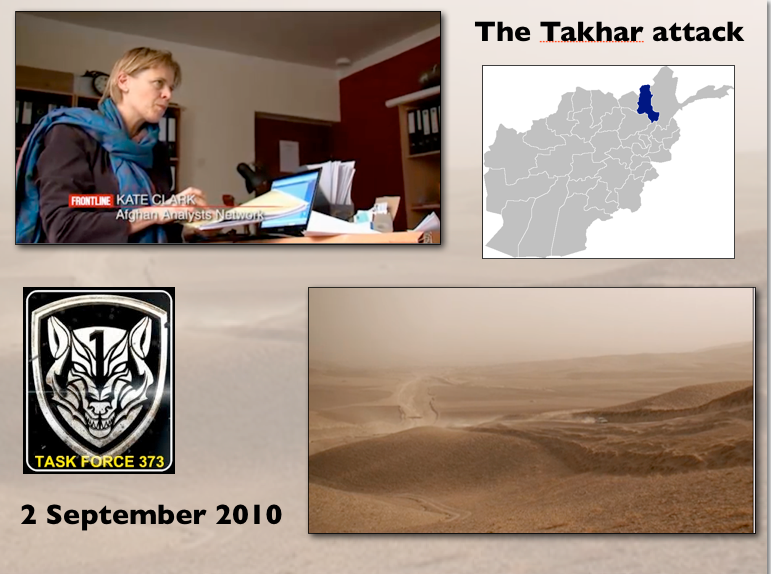
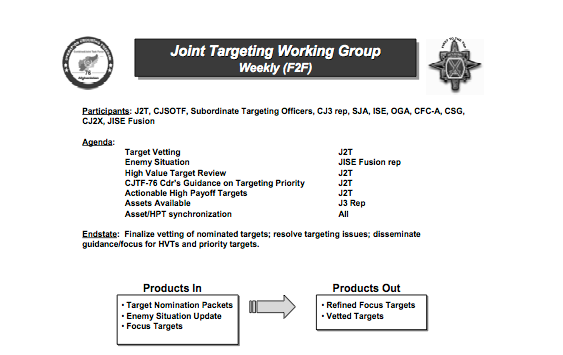
Targeted killings are also carried out by the US military – indeed, the US Air Force has advertised its ability to put ‘warheads on foreheads’ – and a strategic research report written by Colonel James Garrett for the US Army [‘Necessity and Proportionality in the Operation Enduring Freedom VII Campaign‘] provides a rare insight into the process followed by the military in operationalising its Joint Prioritized Effects List (JPEL). Wikileaks has provided further information about JSOC’s Task Force 373 – see, for example, here and here – but the focus of Garrett’s 2008 report is the application of the legal principles of necessity and proportionality (two vital principles in the calculus of International Humanitarian Law (IHL)) in counterinsurgency operations. Garrett describes ‘time-sensitive targeting procedures’ used by the Joint Targeting Working Group to order air strikes on ‘high-value’ Taliban and al-Qaeda leaders in Afghanistan, summarised in this diagram:

joint-targeting-working-group

Notice that the members included representatives from both Combined Joint Special Operations Task Force (CJSOTF) and the CIA (‘Other Government Agency’, OGA). This matters because Joint Special Operations Command (JSOC) – once commanded by General Stanley McChrystal – and the CIA, even though they have their own ‘kill lists’, often co-operate in targeted killings and are both involved in strikes outside Afghanistan. Indeed, there have been persistent reports that many of the drone strikes in Pakistan attributed to the CIA – even if directed by the agency – have been carried out by JSOC.
Now Spiegel Online has provided new, detailed information about the Joint Prioritized Effects List and targeted killing in Afghanistan.  Its base materials – some of which come from the Snowden cache – cover the period 2009-2011 and include an anonymised version of the JPEL (extract below).

JPEL Afghanistan PNG

The Spiegel team explains:

[This is] the first known complete list of the Western alliance’s “targeted killings” in Afghanistan. The documents show that the deadly missions were not just viewed as a last resort to prevent attacks, but were in fact part of everyday life in the guerilla war in Afghanistan.

The list, which included up to 750 people at times, proves for the first time that NATO didn’t just target the Taliban leadership, but also eliminated mid- and lower-level members of the group on a large scale. Some Afghans were only on the list because, as drug dealers, they were allegedly supporting the insurgents.

As I’ve said, the JPEL was maintained through close collaboration between the CIA and the US military, including Joint Special Operations Command, so it is not surprising that the list is not confined to Afghanistan but also includes Pakistanis who were located inside Pakistan.

We already know that targeted killings inside Pakistan’s Federally Administered Tribal Areas involved signal intelligence from the NSA, Britain’s GCHQ and Australia’s Pine Gap facility.  Spiegel‘s cache of documents shows that coalition states outside the ‘Five Eyes’ (US, UK, Canada, Australia and New Zealand) were included in the wider Center Ice platform that also supplied geospatial intelligence for tracking and targeting.  Taken together:

Predator drones and Eurofighter jets equipped with sensors were constantly searching for the radio signals from known telephone numbers tied to the Taliban. The hunt began as soon as the mobile phones were switched on.

Britain’s GCHQ and the US National Security Agency (NSA) maintained long lists of Afghan and Pakistani mobile phone numbers belonging to Taliban officials. A sophisticated mechanism was activated whenever a number was detected. If there was already a recording of the enemy combatant’s voice in the archives, it was used for identification purposes. If the pattern matched, preparations for an operation could begin. The attacks were so devastating for the Taliban that they instructed their fighters to stop using mobile phones.

The document also reveals how vague the basis for deadly operations apparently was. In the voice recognition procedure, it was sufficient if a suspect identified himself by name once during the monitored conversation. Within the next 24 hours, this voice recognition was treated as “positive target identification” and, therefore, as legitimate grounds for an airstrike. This greatly increased the risk of civilian casualties…

[In addition]  Center Ice was not just used to share intelligence about mobile phone conversations, but also information about targets.

Finally – and directly relevant to that penultimate paragraph – Spiegel includes a detailed post-strike ‘Dynamic Target Storyboard‘ that explains how one mission executed by a British AH-60 helicopter (callsign/codename UGLY 50) armed with Hellfire missiles missed its target (‘Objective DOODY’, a mid-level Taliban commander called Mullah Niaz Muhammed categorised as JPEL ‘level 3’) on its first pass and then, coming in for a second attack, seriously wounded an innocent father and killed his child:
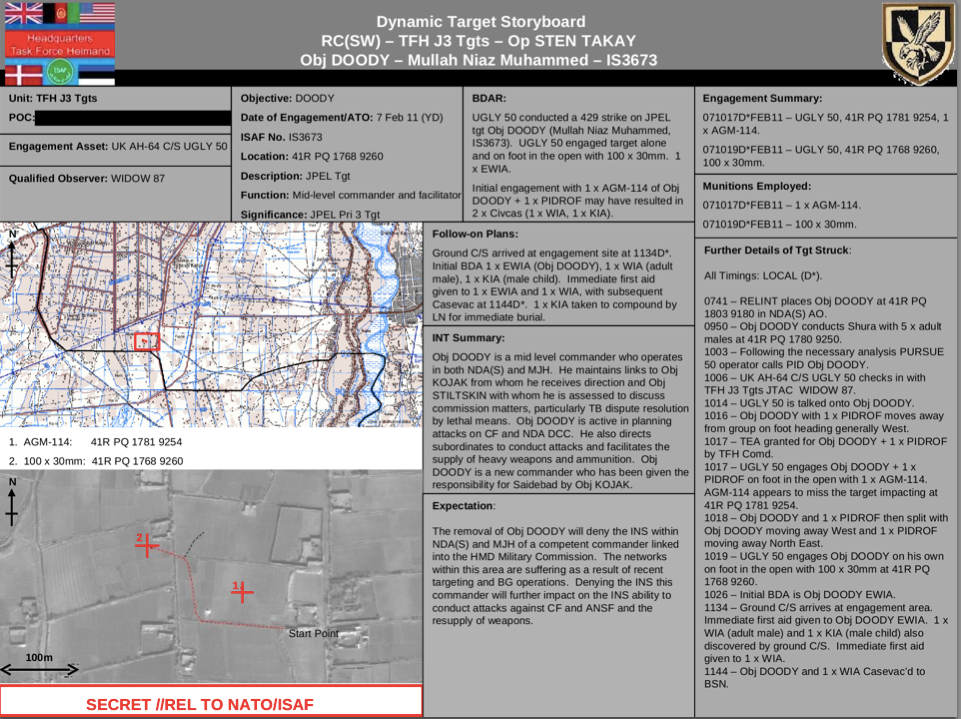
Dynamic Targeting Storyboard PNG

To navigate the storyboard – a standard ‘after action’ report – you need to wade through an alphabet soup of acronyms, some of which I know and others I don’t.  Working left to right along the top line, the mission was under the control of TFH – ISAF’s Task Force Helmand – whose main component was provided by the UK military; under BDAR (Battle Damage Assessment and Repair) the AH-64 attack helicopter is identified as operating under ISAF Rules of Engagement 429 (the details of all these ROEs remain classified).  The Intelligence Summary shown below identifies the target as ‘Objective DOODY’, provides skeletal details of his activities, and links him with two other targets on the JPEL, ‘KOJAK’ and ‘STILTSKIN’ (presumably part of the military’s standard social network analysis).

The far right column provides further information about the attack.  At 0741 intelligence (ELINT is electronic intelligence, but RELINT is not included in the Ministry of Defence’s acronym list) places ‘DOODY’ in Nad-e-Ali (South); by 0950 he is holding a meeting with five other men, and at 1003 a ‘PURSUE 50 operator’ [how I would like to know more about what means] confirms positive identification (PID) which denotes ‘reasonable certainty that this is a legitimate military target’. Shortly afterwards, a Joint Terminal Attack Controller (JTAC), listed as a ‘Qualified Observer’ with the grim call sign WIDOW 87,  contacts the helicopter crew and talks them on to the target: once they have him in their field of view they are ready to attack.  What isn’t clear from all this is whether the JTAC is relying on a video feed from a drone – this seems the most likely source, and an aerial view is included on the storyboard, tracking the target’s movements once the attack is under way – or whether s/he is on the ground (unlikely, I think, since ground troops take more than an hour to arrive on site after the attack: see ‘Follow-on Plans’ box).

When the target walks away from the meeting, accompanied by one man, the helicopter crew is cleared to engage both of them (TEA) (I’ve explained PID but if anyone knows what PIDROF means please let me know since that seems to authorise killing his unknown and unnamed companion).

According to a supplementary page on the storyboard file, shown below, the AH-64 makes its initial run but fails to engage and returns for a second attempt; in doing so, the crew loses visual identification of the target, what the military usually calls the ‘visual chain of custody’, and at 1017 fires a Hellfire missile which misses the nominated target and instead causes fragmentation injuries to two civilians nearby (marked 1 on the aerial view).  The helicopter returns again; by then ‘DOODY’ and his companion have parted company, and the crew fires 100 rounds from its 30 mm cannon at ‘DOODY’, leaving him seriously wounded (EWIA: ‘enemy wounded in action’; marked 2 on the aerial view).

Assessment
Over an hour later, at 1134, ground troops arrive to capture ‘DOODY’ – but they also find one other seriously wounded man and the body of his young son.  The boy is buried by his family, and the casualties are airlifted to the military hospital at Camp Bastion (BSN);  ‘DOODY’ is later transferred to Kandahar for further treatment for a serious head wound.
ISAF launched an investigation into the incident, but no details have been released.

So: two innocent, unnamed bystanders killed.  As more evidence unfolds of the inaccuracies of ‘targeted killing’, even when the target is supposedly named and identified (so not a ‘signature strike’), it seems that we should start talking about the prevalence of untargeted killing…
A short history of schematic bodies

While I was in Irvine last month for the Secrecy and Transparency workshop, I had a series of rich conversations with Grégoire Chamayou — who also made a brief but brilliant presentation on targeting, signature strikes and time-space tracking.  He now writes to say that he has elaborated his ideas in a longer contribution to Léopold Lambert‘s Funambulist papers: ‘A very short history of schematic bodies‘.

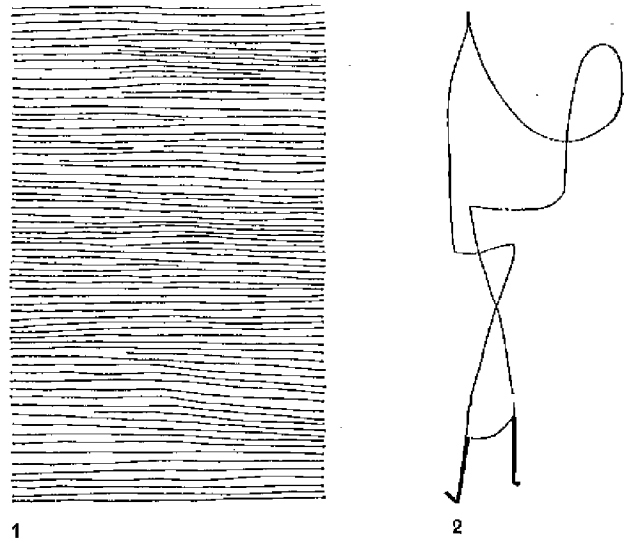
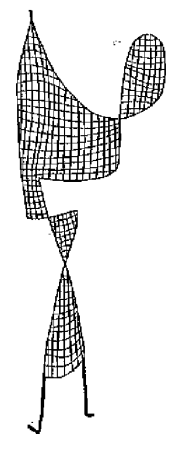
(Even more) briefly, Grégoire connects Torsten Hågerstrand‘s time geography – which Anne Buttimer once saw as a danse macabre – to the activity-based intelligence that supposedly ‘informs’ CIA-directed drone strikes [see my ‘Lines of descent’ essay: DOWNLOADS tab] via three diagrams drawn from Paul Klee.

16

The first two (above) distinguish (1) ‘dividuals‘ from (2) ‘individuals‘: so, following Deleuze, Grégoire distinguishes (1) ‘societies of control articulated through the dyad of “dividuals” and databanks’ from (2) ‘disciplinary societies structured around a relationship between the individual and the mass.’ Seen thus, Hagerstrand’s project mapped the reverse move from (1) to (2), from ‘statistical dividuality’ to ‘chronospatial individuality’.

But Grégoire suggests that targeting involves a third fabrication, a co-construction of (1) and (2), thus:

17

He writes:

The corresponding object of power here is neither the individual taken as an element in a mass, nor the dividual appearing with a code in a databank, but something else: a patterned individuality that is woven out of statistical dividualities and cut out onto a thread of reticular activities, against which it progressively silhouettes in time as a distinctive perceptible unit in the eyes of the machine.

The production of this form of individuality belongs neither to discipline nor to control, but to something else: to targeting in its most contemporary procedures, whose formal features are shared today among fields as diverse as policing, military reconnaissance and marketing. It might well be, for that matter, that we are entering targeted societies.

This speaks directly to current theses about the individuation of military violence as one (and only one) modality of later modern war, but we need to remember that targeting appears at the interface of the market and the military, as Sam Weber shows in Targets of opportunity.  

It’s also important to think through the ‘body’ that is made to appear in the sights and as a sight; it’s not a fleshy body but a digital-statistical trace that is literally ‘touched’ by the cross-hairs (the apparatus of the drone as prosthesis).  As I wrote in ‘Drone geographies’ (DOWNLOADS tab),

[People] are brought within the militarized field of vision through the rhythmanalysis and network analysis of a suspicious ‘pattern of life’, a sort of weaponized time-geography… 

Killing is made the culmination of a natural history of destruction – in precisely not the sense intended by W.G. Sebald – and the targets are rendered as ‘individuals’ in a calculative rather than corporeal register.

Here Ian Hacking‘s ideas about ‘making up people‘ are also relevant.  In his classic British Academy lecture, ‘Kinds of people: moving targets‘, he described how ‘a new scientific classification may bring into being a new kind of person’ – in this case, the target – and how ‘a classification may interact with the people classified.’  A signature strike is surely the deadliest version of this ‘interaction’…

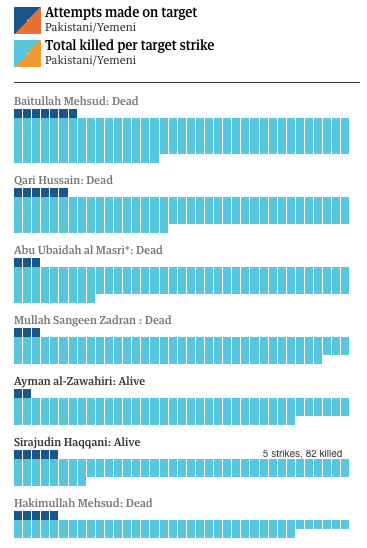
Incidentally, anyone who thinks that so-called ‘personality strikes’ are somehow less deadly needs to read REPRIEVE‘s latest report, You only die twice: multiple kills in the US drone program.  Spencer Ackerman has a good summary (and graphic, extracted below) here, describing the multiple deaths involved in the search for specific, named targets:

'Personality strikes' in Pakistan


Security archipelagos

Three short contributions that have caught my eye raise a series of interesting questions about contemporary ‘security archipelagos’ (in multiple sense of the term, hence the plural).

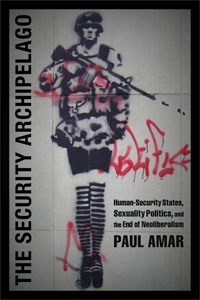
amar-security-archipelagoThe term itself comes from Paul Amar, and Austin Zeiderman has a short but interesting review of his The Security Archipelago: Human-Security States, Sexuality Politics, and the End of Neoliberalism (Duke, 2013) over at Public Books (Public Culture‘s public site):

‘Amar asserts that we need an analytical framework focused on the rise of human security—a governance regime that “aim[s] to protect, rescue, and secure certain idealized forms of humanity.” This new regime is gradually replacing neoliberalism, Amar contends, “as the hegemonic project of global governance and of state administration.” This shift is evident in how security is now justified and pursued by states. The antagonistic relationship between security and human rights that characterized the “neoliberal market states” of the late 20th century is no longer so evident. The repressive security strategies that underpinned earlier development paradigms have been succeeded by the “promise to reconcile human rights and national security interests” in the interest of economic prosperity. Progressive and conservative security doctrines now agree on the imperative to “humanize” (or “humanitarianize”) both state and parastatal security apparatuses. The result, Amar argues, is what he calls the “human-security state”: a globally emergent governance regime with “consistent character and political profile.” From Latin America to the Middle East, political legitimacy is increasingly based on securing humanity against a range of malicious forces….

If the megacities of the Global South are indeed “laboratories” in which new logics and techniques of global governance are being created, it is up to other researchers to fill out and develop further Amar’s concept of the “security archipelago.” Though his study provides both the theoretical rationale and the analytical tools with which to do so, it may be worth questioning whether the “human” is necessarily central to emerging security regimes. For along with human security apparatuses and the human actors struggling to articulate progressive alternatives, a host of non-humans—drones, border fences, hurricanes—are actively producing the security landscape of the future.’

Secondly, I’ve been thinking about the ways in which the work of these ‘laboratories’ often relies on non-state, which is to say corporate, commercial sites (this isn’t news to Paul, of course, even if he wants to challenge our ideas about neoliberalism).  We surely know that the traditional concept of the military-industrial complex now needs wholesale revision, and I’ve noted before the timely and important essay by Jeremy Crampton, Sue Roberts and Ate Poorthuis on ‘The new political economy of geospatial intelligence‘ in the Annals of the Association of American Geographers 104 (1)  (2014) (to which I plan to return in a later post).  The latest MIT Technology Review has a short but suggestive essay by Antonio Regalado, ‘Spinoffs from Spyland’, which describes some of the pathways through which the National Security Agency commercializes (and thus potentially subcontracts and, in some cases, even subverts) its surveillance technology:

In 2011, the NSA released 200,000 lines of code to the Apache Foundation. When Atlas Venture’s Lynch read about that, he jumped—here was a technology already developed, proven to work on tens of terabytes of data, and with security features sorely needed by heavily regulated health-care and banking customers. When Fuchs’s NSA team got cold feet about leaving, says Lynch, “I said ‘Either you do it, or I’ll find five kids from MIT to do it and they’ll steal your thunder.’”

Eventually, Fuchs and several others left the NSA, and now their company [Sqrrl] is part of a land grab in big data, where several companies, like Splunk, Palantir, and Cloudera, have quickly become worth a billion dollars or more.

Over the summer, when debate broke out over NSA surveillance of Americans and others, Sqrrl tried to keep a low profile. But since then, it has found that its connection to the $10-billion-a-year spy agency is a boost, says Ely Kahn, Sqrrl’s head of business development and a cofounder. “Large companies want enterprise-scale technology. They want the same technology the NSA has,” he says.

SQRRL

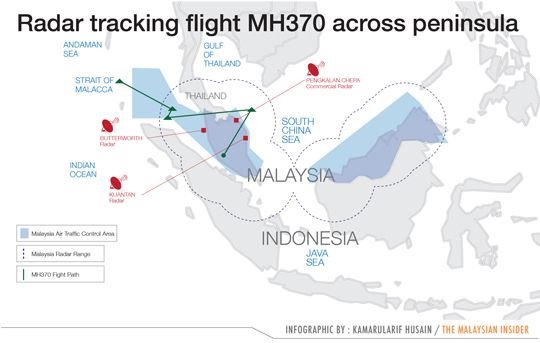
And finally, before we rush to radicalise and globalise Foucault’s critique of the Panopticon, it’s worth reading my friend Gaston Gordillo‘s cautionary note – prompted by the search for missing Malaysian Airlines Flight 370 – on ‘The Opaque Planet’:

The fascination with, and fetishization of, technologies of global location and surveillance often makes us forget that, for all their sophistication, we live on a planet riddled with opaque zones that will always erode the power of human-made systems of orientation, for the simple fact that no such system (contrary to what the NSA seems to believe) will ever manage to create an all-seeing God. This opacity is intrinsic to the textured, three-dimensional materiality of the surface of the planet, and is especially marked in the liquid vastness of the ocean.

MH370-military_radar-tracking-peninsula-170314-eng-graphcs-tmi-kamarul

Phil Steinberg has already commented on the geopolitics of the search, but Gaston draws out attention to the gaps in the surveillance capabilities of states, and here too the geopolitical meshes (and sometimes jibes against) the geoeconomic, as described in this report from Reuters:

Analysts say the gaps in Southeast Asia’s air defenses are likely to be mirrored in other parts of the developing world, and may be much greater in areas with considerably lower geopolitical tensions.

“Several nations will be embarrassed by how easy it is to trespass their airspace,” said Air Vice Marshal Michael Harwood, a retired British Royal Air Force pilot and ex-defense attache to Washington DC. “Too many movies and Predator (unmanned military drone) feeds from Afghanistan have suckered people into thinking we know everything and see everything. You get what you pay for. And the world, by and large, does not pay.”

Mapping Aleppo – and more

Mapping Aleppo

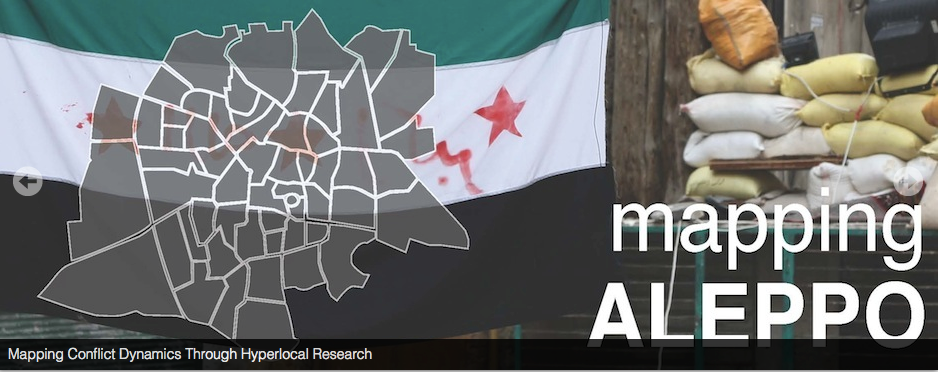
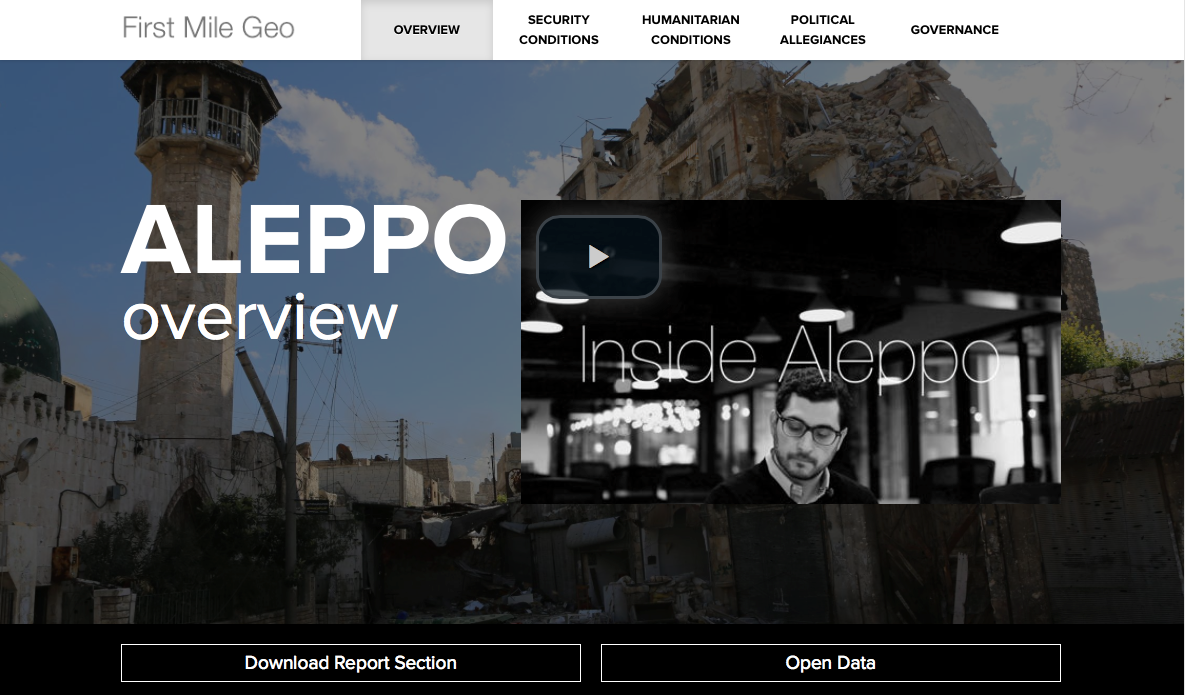
I’ve posted about mapping the war in Syria and its spillover effects before (see here and here), but most of these projects cover a wide area with varying degrees of reliability.  Now News from Laleh Khalili of a report from David Kilcullen‘s Caerus Associates (with the American Security Project) on the civil war in Aleppo, “Mapping the conflict in Aleppo, Syria”, which provides a much more fine-grained view of what is happening on the ground.  You can download the report here or view the interactive version via First Mile Geo here, and you can read an account of the project from Wired‘s Greg Miller here.

Caerus has also joined with the Pentagon’s Center for Complex Operations to produce a special supplement of PRISM (vol.  4, 2014) on the Syrian conflict, which includes an essay by Kilcullen and Nathaniel Rosenblatt on ‘The Rise of Syria’s Urban Poor: Why the War for Syria’s Future Will Be Fought Over the Country’s New Urban Villages’; the whole issue is available on open access here.

These interventions are important and interesting for several reasons.

First, the report is based on exacting local fieldwork.  Acknowledging that local people in conflict zones develop vitally important stocks of local knowledge as a means of survival, the report also accepts that this ‘information-rich environment remains analytically poor.’  For that reason, the field teams ‘provided training and cloud-based tools to help local actors collect locally understood knowledge about their conflict for rigorous analysis.’

From September 16, 2013 to January 6, 2014, we collected four types of information: a monthly survey of perceptions among 560 residents in Aleppo’s 56 neighborhoods, biweekly location and status data for bakeries (a key indicator of humanitarian conditions due to the centrality of bread in the Syrian diet), biweekly location and status data on security checkpoints (a key indicator of security, territorial control and public safety conditions), and a monthly neighborhood-level assessment filled out by our enumerators. These four data streams not only allowed the research team to detect and visualize shifts in the environment in near-real time, but also provided an extremely rich source of insights on the geo-social dynamics at play. All field research was conducted in Arabic.

First Mile Geo notes that it will make the data available to organisations ‘for responsible use’: see Open Data here.

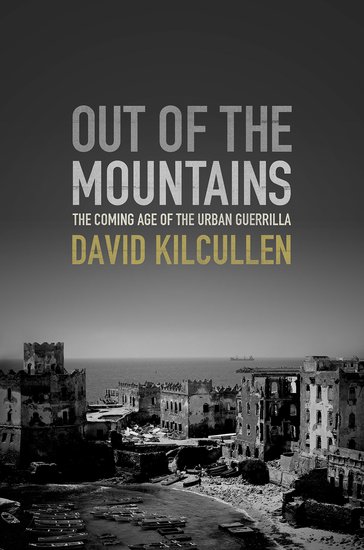
KILCULLEN Out of the mountainsSecond, Kilcullen’s analytical argument (he is described as ‘Principal Investigator’ for the Mapping project) is, naturally enough, fully conformable with the thesis he develops at length in his latest book, Out of the mountains: the coming age of the urban guerrilla (2013); the report reveals the grisly details of contemporary siege warfare and urbicide – central themes in the book, where Kilcullen notes the work of  Steve Graham and Eyal Weizman – and gestures towards a future ‘feral city’ (how I hate that phrase) broken into multiple fiefdoms where gangs and militias exact violence and provide rudimentary services to the residents:

‘The inability of opposition groups to aid residents of neighborhoods they control suggests Aleppo – and Syria as a whole – will become a mosaic of small, intersecting fiefdoms, each providing assistance to its respective neighborhood without regard to macro-level concerns for national governance and reconciliation. Growing warlordism may be particularly acute in Aleppo, where economic rent-seeking opportunities will attract armed gangs who will attempt to seize control of its neighborhoods. These “conflict entrepreneurs” will have little incentive to end a conflict from which they derive power, prestige, and profit. Even in the event of peace, Aleppo’s strategic location will help these actors establish roots for illicit networks that may endure well beyond the present conflict. Moreover, as a non-capital city, Aleppo will not benefit from national government attention. Instead, Aleppo’s future may resemble that of similarly conflict-plagued second cities in the Middle East, such as Mosul in Iraq or Benghazi in Libya. These cities are plagued by warlordism and dominated by illicit economies. They have quickly become safe havens enabling terrorist networks to plan, recruit, and launch attacks.’ 

I’ve posted about Out of the Mountains here, when I promised an extended commentary: Laleh and I will be working on a joint examination of Kilcullen’s larger thesis in the near future, so watch this space. We already have Mike Davis‘s thumbnail view:

‘Although an enemy of the state, I must concede that this is a brilliant book by the most unfettered and analytically acute mind in the military intelligentsia. Kilcullen unflinchingly confronts the nightmare of endless warfare in the slums of the world.’

Here, incidentally, it’s revealing to read Kilcullen’s theses alongside Neil Brenner‘s ‘Theses on urbanisation’, Public culture 25:1 (2013) 85-114, which makes a series of suggestive proposals – but from which war is strikingly absent.  So Kilcullen’s thesis certainly demands serious scrutiny, particularly by those who think that the future of war is somehow encapsulated in the drone.  In my previous note, I joined Geoff Manaugh in being sceptical about the ‘aerial-algorithmic’ interventions that attracted Kilcullen in a series of talks based around the book, but ‘Mapping the conflict in Aleppo’ reveals a much more substantial interest in ‘the facts on the ground’, local actors and local knowledge.  (And here a good counter-text would be the brilliant work of AbdouMaliq Simone; see also his blog, Villes-Noires, here).  So, as I say, watch this space.

First Mile Geo ALEPPO

But there’s a third reason this matters.  I’ve been reading and thinking about Jeremy Crampton, Sue Roberts and Ate Poorhuis‘s ‘The new political economy of geographical intelligence’ – a fine essay in the Annals of the Association of American Geographers 104: 1 (2014) 196-214 – and I’ll be returning to this in the next day or two.  They emphasise the importance of satellite imagery in the production of US geospatial intelligence, whereas I’ve been developing a different (though related) argument about  the importance of satellite communications for the ‘everywhere war’.  In both cases, there is an intimate relation between ‘milsat’ and ‘comsat’, the military and commercial sectors, which will come as no surprise to those who’ve been plotting the extending contours of the military-industrial complex.

Those contours have snared all sorts of other institutions, of course, which is why James Der Derian talks about MIME-NET (the military-industrial-media-entertainment network) and I’ve talked about MAIM-NET (the military-academic-industrial-media network).  The role of universities in the development of military capabilities and military knowledge (and ultimately the production of military violence) is no less surprising, of course, and in fact there’s a session on ‘Geography and the military’ organised by Eric Sheppard at the AAG conference in Tampa (an appropriate location for several reasons) to debate these issues.  But it should now be clear that the production of these geographical knowledges is not confined to the military and civilian intelligence agencies, the academy and large corporations but also includes a host of much smaller private contractors devoted to ‘geographical intelligence’.  They come in different shapes and sizes, and with different agendas.  Caerus, for example, describes itself as a ‘strategy and design firm’ that helps clients ‘understand and thrive in complex, conflict-afflicted, and disaster-affected environments’.  But there are many others, and it’s important not to lose sight of their role in what the US military would call ‘shaping the battlespace’…

Predatory networks

A key moment in the development of the United States’ UAV program was the deployment of a prototype Predator – General Atomics’ GNAT-750 – over Bosnia.  This is how I summarised the accelerated fielding program in ‘Moving targets’ (DOWNLOADS tab):

Even as the GNAT-750 was deployed over Bosnia-Herzegovina, the design was being developed into a new platform, the RQ-1 Predator, which incorporated three major modifications. The original intention had been to provide still imagery and text interpretation, but this was replaced by real-time motion video in colour (by day) and infrared (by night). A more serious limitation was range; the GNAT-750 could only operate 150 miles from the ground control station because it relied on a C-band line of sight data link. The CIA experimented with using relay aircraft to expedite data transmission – the same solution that had been used for the ‘electronic battlefield’ along the Ho Chi Minh Trail – but the breakthrough came with the use of the Ku-band satellite system that dramatically increased the operational range. The upgrade had been tested in the United States, and was retrofitted to Predators in Europe in August 1995. Although data was then rapidly transmitted across the Atlantic, the key intelligence nodes were still in Europe, like the Combined Air Operations Centre at Vicenza in Italy, and the drones were still controlled from ground stations within the region, at first from Gjader in Albania and later from Tazar in Hungary. A third, no less revolutionary innovation was the installation of an onboard global positioning system (GPS); early target imagery had to be geo-located using a PowerScene software program, but the introduction of satellite-linked GPS made a considerable difference to the speed and accuracy of targeting.

But I now think this misses other even more important dimensions that speak directly to the fabrication of the network in which Predators and eventually Reapers become embedded.

My primary source is a remarkable MIT PhD thesis by Lt. Col. Timothy Cullen, The MQ-9 Reaper Remotely Piloted Aircraft: Humans and Machines in Action (2011).  The research involved interviews with 50 pilots, 26 sensor operators, 13 Mission Intelligence Coordinators and 8 imagery analysts between 2009-2010 (so this is inevitably a snapshot of a changing program – but one with a wide field of view) and direct observation of training missions at Holloman Air Force Base; the thesis is also informed by Cullen’s own, considerable experience as a pilot of conventional strike aircraft and by actor-network theory, though most particularly by Edward Hutchins‘ cognitive ethnography and by the work of Lucy Suchman.

CULLEN p. 94I should say, too, that the thesis is irony made flesh, so to speak.  The author notes that:

Missing from public discussions are the details of remote air operations in current conflicts and the role of social networks, organizational culture, and professional practices in the evolution and history of RPA. The public cannot have informed discussions about these topics without empirical observations and descriptions of how RPA operators actually fly and employ the aircraft.

Fair enough, of course, but parts of the thesis are heavily redacted; I realise this isn’t – can’t – be Cullen’s doing, but it is as frustrating for the reader as it surely must be for the author (for Private Eye devotees, the image on the right shows p. 94).  Still, there’s enough in plain sight to provide a series of arresting insights into the development of the UAV program.

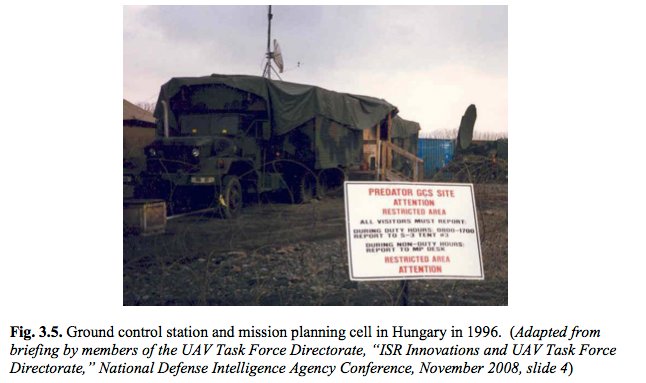
First, early Predator crews were remarkably detached from the wider mission and their ability to communicate with people outside their Ground Control Stations was extremely limited.  The pilot’s primary responsibility was to program the aircraft to fly on autopilot from target to target and to monitor the flight path, while two sensor operators identified and tracked the targets whose images were to be captured.  In a tent outside the ground control station a ‘Mission Planning Cell’ (MPC: see photograph below) served as the communications interface; since this was an experimental system, the Ground Control Station was not permitted to receive or transmit sensitive or classified information.  Apart from the transmission of images, all communications between the two were either face-to-face (literally through the tent flaps) or via a telephone link.

GCS and Mission Planning Cell, Hungary 1996

Before a mission the MPC received a set of 50-300 imagery targets (known as ‘Collection Points’) from the Balkans Combined Air Operations Center in Vicenza in Italy, and used this to create a detailed target deck.  The time between the initial requests and final image capture steadily decreased from 72 hours to 48 hours, and eventually re-tasking during a mission became standard: more on the tasking process here.

Bosnia imageryThe video feeds from the Predator were sent via coaxial cable to the MPC where they were digitised and encrypted for onward transmission over a secure network to commanders in the field and to a group of 10-12  imagery analysts in the United States.  The analysts posted video clips and annotated stills on a classified web page, but the quality of the video feeds with which they had to work was significantly less than the raw feeds available in theatre, and the slow response time was another serious limitation on the value of their work.

At the time, of course, all this seemed revolutionary, and the second Annual Report on the UAV program in 1996 declared that:

Even more significant than the Predator performance “firsts” is the wide use made of its imagery, amplified by the increased network of receiving stations both in-theater and back in CONUS [continental US]. The development of this dissemination capability is shown below.

conus

It first used VSATs at selected receiving sites, and then the SATCOM-based Joint Broadcast System (JBS). The Predator-JBS network represents the first time for the simultaneous broadcast of live UAV video to more than 15 users. This provided a common picture of the “battlefield.” Video imagery can be viewed either as full motion video or via a “mosaicking” technique at the ground station. 

[JAC Molesworth was the Joint Analysis Center at RAF Molesworth in the UK, US European Command’s intelligence center, and DISN is the Defense Information Systems Network for data, video and voice services].

But the system was far from responsive; the MPC filtered all communications from commanders and imagery analysts and, as the tasking diagram below shows, whether the cycle followed the standard model or allowed for more flexible re-tasking the Predator crew had very little discretion and was, in a substantial sense, what Cullen calls ‘a passive source of data’.  Its responsibilities were limited to the ‘physical control’ of the platform.

figure8-1

This has been transformed by the cumulative construction of an extended, distributed network in which UAV crews are in direct communication, either by voice or through secure internet chatrooms, with multiple agents: commanders, military lawyers, image analysts, joint terminal attack controllers and ground troops.  But this was not how the system was originally conceived or fielded, and Cullen shows that its transformation depended on the skilled intervention of UAV crews and their commanders who ‘envisioned and used the system as a collaborative network of operators, intelligence analysts, and ground personnel to establish objectives, exchange information, and understand the context of a mission’:

‘RPA [Remotely Piloted Aircraft] operators restructured the ground control station and crew tasks to shift the actions of crewmembers from low status missions of gathering and disseminating data to higher status tasks of integrating and creating information, participating in the assessment of threats, and actively contributing to commanders’ decision-making processes. RPA operators were not satisfied with simple connections to a network of people and tools to accomplish a mission. They sought and fostered social relationships with them and demanded interactive dialog among them in a form they could anticipate, understand, and evaluate’ (Cullen, p. 204).

Second, early Predator operations, not only in the Balkans in the late 1990s but also over southern Iraq and in Afghanistan, were not what would later become known as ‘remote-split operations’.  It was assumed that the Predator had to be operated as close to the combat theatre as possible. This was not only because of the platform’s limited range, important though this is: as I’ve said before, these are not weapons of global reach.  Indeed, it’s still the case that Predators and Reapers have to be physically close to their theatre of operations, which is why the United States has become so alarmed at the implications of a complete withdrawal from Afghanistan for the CIA’s program of targeted killing in Pakistan.  According to David Sanger and Eric Schmitt,

‘Their concern is that the nearest alternative bases are too far away for drones to reach the mountainous territory in Pakistan where the remnants of Al Qaeda’s central command are hiding. Those bases would also be too distant to monitor and respond as quickly as American forces can today if there were a crisis in the region, such as missing nuclear material or weapons in Pakistan and India.’ 

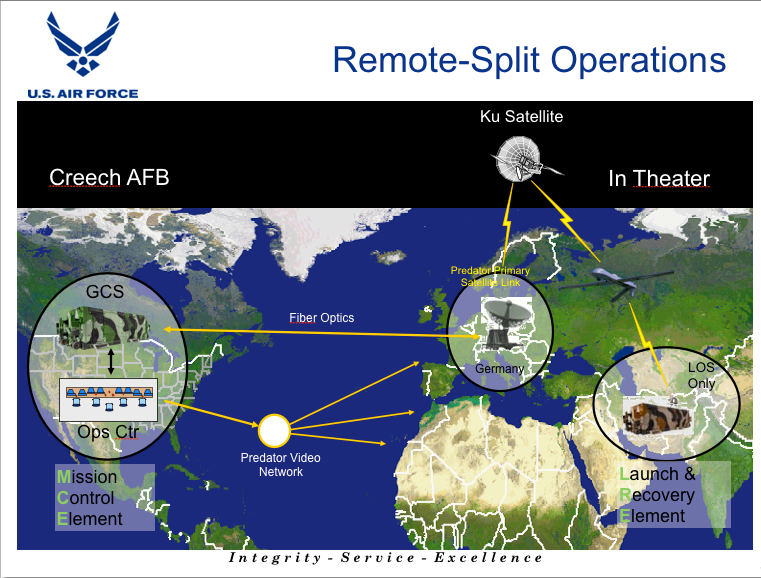
For the ‘no-fly zone’ established over southern Iraq reconnaissance flights were flown by Predators from Ali Al Salem Air Base in Kuwait, and for the initial campaign in Afghanistan from Jacobad in Pakistan, and Cullen explains that the vulnerability of these (‘austere’) sites limited the MPC’s access to secure networks, communications and databases.  But in 2002-3 USAF pilots and sensor operators returning from secondment to – Cullen actually calls it ‘kidnapping’ – ‘other agencies’, which is to say the CIA, successfully argued that the primary execution of remote missions should be consolidated at Nellis Air Force Base and its auxiliary field, Indian Springs (later re-named Creech AFB), in southern Nevada, which would expand and enhance crews’ access to secure intelligence and analysis capabilities.  There would still have to be a forward deployed ‘Launch and Recovery’ element to maintain the aircraft and to control take-off and landing using a line of sight link, but all other mission tasks could be handled from the continental United States using a Ku-band satellite link via a portal at Ramstein Air Force Base in Germany.  When remote split operations started in 2003 the MPC disappeared, replaced by a single Mission Intelligence Co-ordinator who was stationed inside the Ground Control Station in constant communication with the pilot and sensor operator and this, in turn, transformed the configuration and equipment inside the GCS.  But, crucially, relations beyond the GCS were also transformed as USAF commanders visited Afghanistan and Iraq and established close relations with ground troops: ‘remote’ and ‘split’ could not imply detachment, and the new technological networks had to be infused with new social interactions for the system to be effective.

Remote-Split Operations (USAF)

Focal to these transformations – and a crucial driver of the process of network construction and transformation – was the decision to arm the Predator and turn it into a ‘hunter-killer’ platform.  At that point, Cullen observes,

‘Predator pilots became decision makers, and Predator’s weapons transformed Predator pilots and sensor operators into war fighters – Predator crews could create effects on the battlefield they could observe, evaluate and adjust… The arming of the Predator was synonymous with the integration of the system – the people, tools and practices of the Predator community – into military operations’ (pp. 245-7).

The reverse was also true: not only was the Predator integrated into the battlespace but, as Cullen notes, the network was ‘infused’ into the Ground Control Station. In consequence, a sensation of what Cullen calls ‘remote presence’ was inculcated amongst UAV crews and, in particular, sensor operators who developed a strong sense of being part of the machinic complex, ‘becoming the camera’ so intimately that they were ‘transported’ above the battlespace.  These transformations were stepped up with the development of the Reaper, reinforced by new practices and by the introduction of a new, profoundly combative discourse that distanced the Reaper from the Predator:

‘[T]o reinforce the power and responsibility of Reaper crews, members of the 42nd Attack Squadron changed the language of their work. Sensor operators did not operate a sensor ball; they flew a “targeting pod” like fighter pilots and weapon system officers. Reaper pilots and sensor operators did not have a “mission intelligence coordinator”; they coordinated strike missions with the support of an “intelligence crewmember.” Reaper crews did not conduct “intelligence, surveillance, and reconnaissance” missions; they flew “non-traditional” intelligence missions like fighter and bomber crews. Members of the 42nd Attack Squadron used the rhetoric of the fighter community to highlight the strike capabilities of Reaper; to influence the perceptions of Reaper operators; and to shape the priorities, attention, and assertiveness of Reaper crews during a mission’ (p. 264)

The language was performative, but its performative force – the ability to ‘create effects on the battlefield’ – was realised through the developing networks within which and through which it was deployed.

To be continued.

Boundless Informant and the everyware war

As part of my presentation on “Drones and the everywhere war” at York, I decided to unpack this extraordinary claim made by John Nagl, one of the architects of the US military’s revised counterinsurgency doctrine:

We’re getting so good at various electronic means of identifying, tracking, locating members of the insurgency that we’re able to employ this extraordinary machine, an almost industrial-scale counterterrorism killing machine that has been able to pick out and take off the battlefield not just the top level al Qaeda-level insurgents, but also increasingly is being used to target mid-level insurgents.

It’s a remark I’ve discussed several times before.  Nagl’s ‘killing machine’ is not limited to drone strikes, of course, but subsumes the ‘night raids’  and other Special Forces operations detailed in Jeremy Scahill‘s Dirty Wars.  But at York I wanted to explore how those ‘electronic means of identifying, tracking and locating’ fed into drone strikes in Pakistan: and, thanks to Edward Snowden and Glenn Greenwald, I was able to get much closer to the belly of the beast.

Drones+ app

I’d started the presentation with a riff on Josh Begley‘s attempt to persuade Apple to include his Drones+ app in the App store.  Apple decided, for several contradictory and spurious reasons, to reject the app, and at his thesis defence Josh asked:

 ‘Do we really want to be as connected to our foreign policy as we are to our smart phones… Do we really want these things to be the site of how we experience remote war?’

Apple’s answer was ‘no’, clearly, but it turns out that others are intimately connected to drone strikes through their phones and e-mails, and it was this that I fastened on.

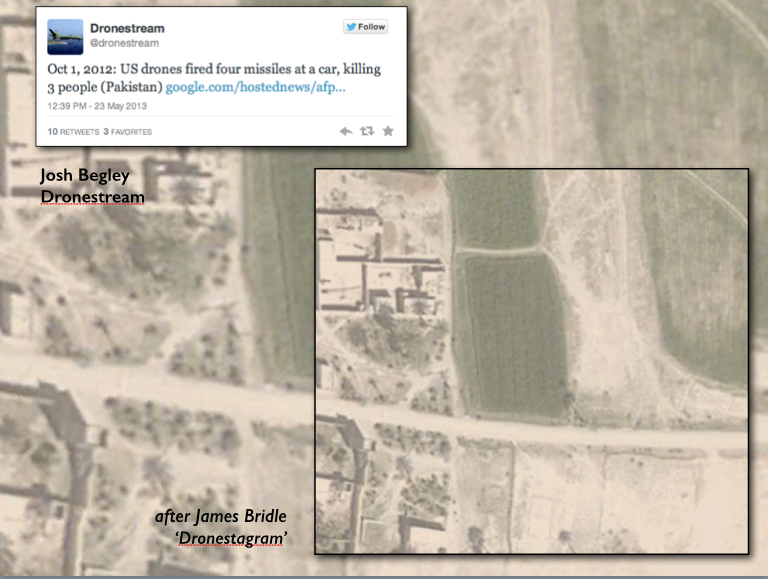
Josh, undeterred by Apple, went on to launch the Dronestream platform, from which he tweeted details of every known US drone strike.  I combined one of Josh’s tweets for 1 October 2012 with a version of James Bridle‘s Dronestagram, which uses Instagram to post images of the location of drone strikes (I say ‘a version’ because Dronestagram was launched too late for this particular strike, so this is a mock-up; in any case, it’s difficult to pinpoint the locations from available reports with much precision, but the details for this strike are available via the Bureau of Investigative Journalism, as the second slide below shows):

1 October 2012 Dronestream and Dronestagram

Bureau of Investigative Journalism 1 October 2012 strike

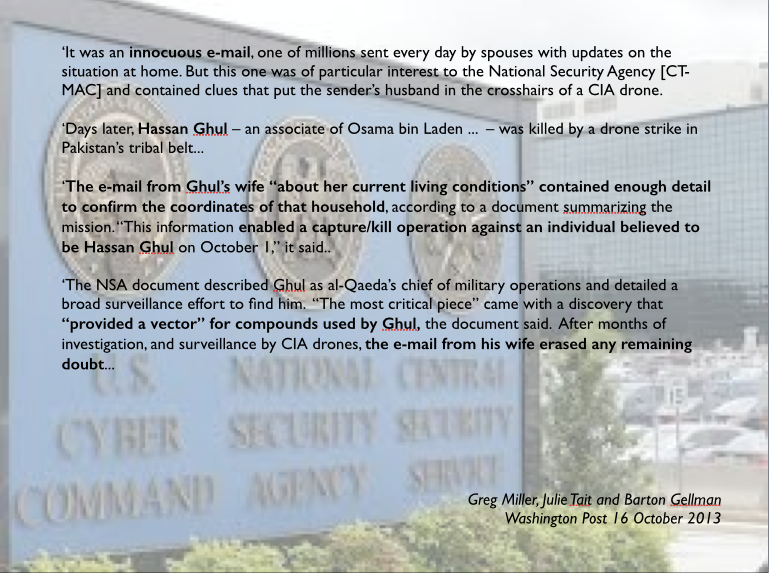
We now know that this strike was made possible as a result of interceptions made by the National Security Agency’s Counter-Terrorism Mission-Aligned Cell (CT-MAC).  Writing in the Washington Post on 16 October 2013 Greg Miller, Julie Tait and Barton Gellman explained how this strike had targeted Hassan Ghul:

Hassan Ghul NSA intercepts

Not quite ‘any doubt’; as they went on to note, ‘Although the attack was aimed at “an individual believed to be” the correct target, the outcome wasn’t certain until later, when “through SIGINT [signals intelligence] it was confirmed that Hassan Ghul was killed.”‘

So how did the intercept work?  Not surprisingly, we don’t know for sure; but the map below of NSA’s ‘Boundless Informant‘ – another dimension of what I’ve been calling ‘the everywhere war’ – offers some clues.  I’ve taken it from a report in the Guardian by Glenn Greenwald and Ewen MacAskill:

Boundless Informant March 2013 heat map

This is six months later, but it shows that Pakistan was, after Iran, the major focus of NSA’s surveillance and data mining operations (Miller and his colleagues had noted that “NSA threw the kitchen sink at FATA’, the Federally Administered Tribal Areas).  It would be wrong to assume that the targeted killing of Ghul was the result of a simple hack into hotmail, and the Post report details the multiple methods used by NSA.

Still, the geography of covert surveillance shown on the map is revealing.  Yesterday Greenwald returned to Boundless Informant and rebutted the charge that he had misinterpreted the meaning of this and other slides, and in doing so quoted from NSA’s own explanation of the system:

BOUNDLESSINFORMANT is a GAO [Global Access Operations, a branch of the NSA] prototype tool for a self-documenting SIGINT system. . . BOUNDLESSINFORMANT provides the ability to dynamically describe GAO’s collection capabilities (through metadata record counts) with no human intervention and graphically display the information in a map view, bar chart, or simple table. . . .
By extracting information from every DNI and DNR metadata record, the tool is able to create a near real-time snapshot of GAO’s collection capability at any given moment. The tool allows users to select a country on a map and view the metadata volume and select details about the collection against that country. The tool also allows users to view high level metrics by organization and then drill down to a more actionable level – down to the program and cover term.

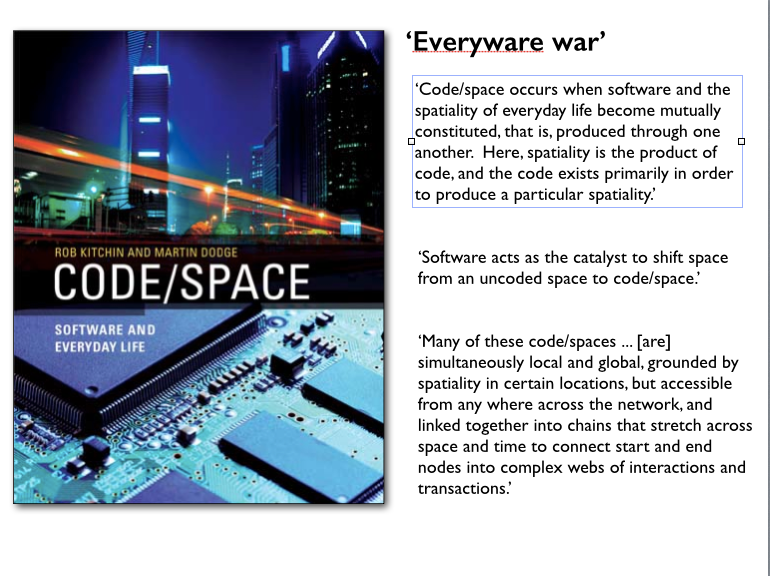
It’s not too difficult to connect the dots and draw two more general conclusions.  The first is that this is another, darker dimension to the ‘code/space’ and ‘everyware’ discussed in such impressive detail by Rob Kitchen and Martin Dodge:

Everyware war

My slide is just short-hand, of course, but you can see where I’m going, I hope – and, as we know from this week’s harrowing testimony on Capitol Hill about the murder of Mamana Bibi in Waziristan and Amnesty International’s report, Will I Be Next?, these operations and their algorithms work to turn ‘everyday life’ into everyday death.  So I’ll be thinking more carefully about code/space and its implication in the individuation of later modern war, paying closer attention to the technical production of ‘individuals’ as artefacts and algorithms as well as the production of the space of the target: more to come.

The second general conclusion I leave to Peter Scheer, who provides a more refined (and critical) gloss on John Nagl’s comment with which I began:

SCHEER Connecting the dots

I’m incorporating these and other developments into the revised and extended version of “Moving targets and violent geographies” which will appear in The everywhere war, but I hope this bare-bones account (and that first draft, available under the DOWNLOADS tab) shows that my posts are more connected than they must sometimes appear…  The slides were pulled together on the day I gave the presentation, so forgive any rough edges.

Black spots and blank spots

Over at Guernica, Trevor Paglen has a short essay on the rise of what he calls ‘the terror state’ that connects the dots between several recent posts:

For more than a decade, we’ve seen the rise of what we might call a “Terror State,” of which the NSA’s surveillance capabilities represent just one part. Its rise occurs at a historical moment when state agencies and programs designed to enable social mobility, provide economic security and enhance civic life have been targeted for significant cuts. The last three decades, in fact, have seen serious and consistent attacks on social security, food assistance programs, unemployment benefits and education and health programs. As the social safety net has shrunk, the prison system has grown. The United States now imprisons its own citizens at a higher rate than any other country in the world.

While civic parts of the state have been in retreat, institutions of the Terror State have grown dramatically. In the name of an amorphous and never-ending “war on terror,” the Department of Homeland Security was created, while institutions such as the CIA, FBI and NSA, and darker parts of the military like the Joint Special Operations Command (JSOC) have expanded considerably in size and political influence. The world has become a battlefield—a stage for extralegal renditions, indefinite detentions without trial, drone assassination programs and cyberwarfare. We have entered an era of secret laws, classified interpretations of laws and the retroactive “legalization” of classified programs that were clearly illegal when they began. Funding for the secret parts of the state comes from a “black budget” hidden from Congress—not to mention the people—that now tops $100 billion annually. Finally, to ensure that only government-approved “leaks” appear in the media, the Terror State has waged an unprecedented war on whistleblowers, leakers and journalists. All of these state programs and capacities would have been considered aberrant only a short time ago. Now, they are the norm.

This ought to be depressingly familiar stuff, though it is important to connect those dots.  I highlight Trevor’s argument here (which radiates far beyond the paragraphs I’ve extracted above) for two reasons.

PAGLEN BLank Spots on the MapFirst, the practices that Trevor disentangles work through distinctively different geographies, at once material and virtual. Trevor’s own work addresses different dimensions of what he’s also called the Blank Spots on the Map – here definitely be dragons! though there’s a delicious irony in the US finding Edward Snowden’s whereabouts (at least this morning) to be one of them. There’s some small comfort to be had in the raging impotence of the state apparatus, which is evidently neither all-seeing nor all-knowing.  As part of his project, Trevor has done much to bring into (sometimes long-distance) focus the prying eyes of the ‘terror state’ – see for example here – but I’m particularly interested in the differential modalities of ‘watching’ and ‘acting’.  The US Air Force has become preoccupied with the predicament of ‘swimming in sensors, drowning in data‘, for example, which makes it exceptionally difficult to convert its enhanced capacity for intelligence, surveillance and reconnaissance into focused strikes and, as I noted earlier, this is only one version of a wider divergence outlined by Peter Scheer:

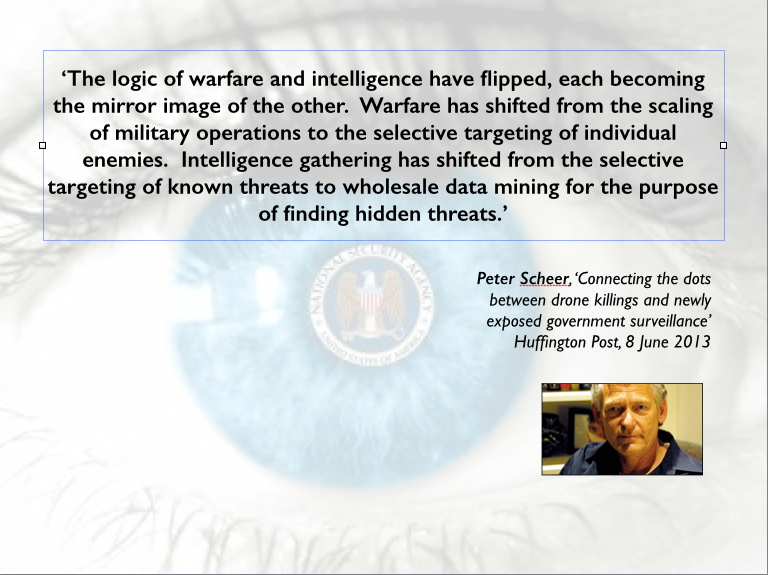
The logic of warfare and intelligence have flipped, each becoming the mirror image of the other. Warfare has shifted from the scaling of military operations to the selective targeting of individual enemies. Intelligence gathering has shifted from the selective targeting of known threats to wholesale data mining for the purpose of finding hidden threats.

The resulting paradigms, in turn, go a long way to account for our collective discomfort with the government’s activities in these areas. Americans are understandably distressed over the targeted killing of suspected terrorists because the very individualized nature of the drone attacks converts acts of war into de facto executions — and that in turn gives rise to demands for high standards of proof and adjudicative due process.

Similarly, intelligence activities that gather data widely, without fact-based suspicions about specific individuals to whom the data pertain, are seen as intrusive and subject to abuse.

TREVOR PAGLEN Keyhole 12-3 Optical reconnaissance satelliteThis is an interesting suggestion, a simple schematic to think with, and at present I’m working through its implications (and complications) for other dimensions of later modern war – specifically the geographies of cyberwarfare that I briefly outlined in my early essay on ‘The everywhere war’ (DOWNLOADS tab).  So for the book I’m splicing  cyberwarfare into the now explosive debate over surveillance in cyberspace, and the transformation of James Gibson‘s Fordist version of ‘Technowar’ into its post-Fordist incarnation.  In a report for Vanity Fair Michael Joseph Gross calls cyberwarfare ‘silent war’ and ‘war you cannot see’, and yet it too (as Trevor’s work implies) is material as well as virtual, not only in its consequences but also in its very architecture: see, for example, here and here (and the wonderful graphic that accompanies the report).  So, with patience, skill and effort, it can indeed be seen.  And, contrary to Thomas Rid‘s Cyber war will not take place (2013), there is a crucial sense – one which my dear friend Allan Pred constantly emphasised – in which these capacities and activities do indeed take place… More soon.

There’s a second reason for noting Trevor’s essay (he was, not incidentally, a student of Allan’s): it originates from Creative Time Reports edited by Marisa Mazria Katz:

Creative Time Reports strives to be a global leader in publishing the unflinching and provocative perspectives of artists on the most challenging issues of our times. We distribute this content to the public and media free of charge.

Asserting that culture and the free exchange of ideas are at the core of a vibrant democracy, Creative Time Reports aims to publish dispatches that speak truth to power and upend traditional takes on current issues. We believe that artists play a crucial role as thought leaders in society, and are uniquely capable of inspiring and encouraging a more engaged and informed public, whether they are addressing elections or climate change, censorship or immigration, protest movements or politically motivated violence.

In an era of unprecedented interconnectedness, Creative Time Reports provides artists with a space to voice analysis and commentary on issues too often overlooked by mainstream media. We believe in the importance of highlighting cultural producers’ distinctive viewpoints on world events and urgent issues of social justice to ensure a livelier, more nuanced and more imaginative public debate.

Given everything I’ve said about the importance of the arts to creative critical research the relevance of this will, I hope, be obvious: art not simply as a means to represent the results of research but rather as a medium through which to conduct research.  Good to think with, as Lévi-Strauss might have said, but also good to act with.  (More on Creative Time here; they are holding a ‘summit’ on Art, Place and Dislocation in the 21st Century City in New York, 25-26 October 2013).

Drones and ‘the world as free-fire zone’

Fred Kaplan has an interesting essay on the history and use of armed drones by the United States at MIT Technology Review: ‘The world as free-fire zone‘ (June 2013).  Kaplan provides a telling critique of Obama’s May statement about the conduct of targeted killings (though that doesn’t of course exhaust what the military uses UAVs for), but his discussion is muddied by what he says about Vietnam – and what he doesn’t.

GREINER War without frontsThe title of the essay invokes a notorious tactic deployed by the United States in South Vietnam: the creation of free-fire, free-strike or what the Air Force called free-bomb zones (the name was changed in 1967  to ‘specified fire zones’ for PR purposes, though what was specified was the zone not the fire).  This is how historian Bernd Greiner summarises the policy in War without fronts: the USA in Vietnam (2007, trans. 2009):

‘License to destroy and annihilate on a large-scale applied unrestrictedly in the so-called “Free Fire Zones”.  Set by the South Vietnamese authorities – either the civil administration or the commanders of an Army corps or division – the US forces operated within them as though outside the law: “Prior to entrance into the area we as soldiers were told all that was left in the area after civilian evacuation were Viet Cong and thus fair game.” Virtually all recollections of the war contain such a statement or something similar, simultaneously referring to the fact that anyone who did not want to be evacuated had forfeited the right to protection, since in the Free Fire Zones the distinction between combatant and non-combatant was a prior lifted.’

Matters were not quite so simple, at least in principle, since (as Nick Turse notes in Kill anything that moves: the real American war in Vietnam (2013)), ‘the “free-fire” label was not quite an unlimited license to kill, since the laws of war still applied in these areas.’  And yet, as both Greiner and Turse show in considerable detail (and I’ll have more to say about this in another post), in practice those laws and the rules of engagement were serially violated.  Whatever the situation in Vietnam, however, it’s surely difficult to extend this – as Kaplan wants to do – to US policy on targeted killings.  Invoking the Authorization for Use of Military Force passed by Congress on 14 September 2001 (as Obama does himself), Kaplan writes:

‘This language is strikingly broad. Nothing is mentioned about geography. The premise is that al-Qaeda and its affiliates threaten U.S. security; so the president can attack its members, regardless of where they happen to be. Taken literally, the resolution turns the world into a free-fire zone‘ (my emphasis).

A couple of years ago Tom Engelhardt also wrote about Obama hardening George W. Bush’s resolve to create a ‘global free-fire zone’.  Kaplan’s criticism of the conditions that the Obama administration now claims restrict counter-terrorism strikes is, I think, fair – though much of what he says derives directly from a draft Department of Justice memorandum dated 8 November 2011 on ‘the use of lethal force in a foreign country outside the area of active hostilities against a U.S. citizen who is a senior operational leader of al-Qa’ida or an associated force’ rather than Obama’s wider speech on counter-terrorism on 23 May 2013 or the ‘fact sheet on policy standards and procedures’ that accompanied it.  But they are closely connected, and Kaplan’s objections have real substance.

First, the Obama administration insists that the threat posed to the United States must be ‘imminent’, yet since the threat is also deemed to be continuing ‘a broader concept of imminence’ is required that effectively neuters the term.

Second, apprehension of the suspect must be unfeasible, yet the constant nature of the threat means that the ‘window of opportunity’ can always be made so narrow that ‘kill’ trumps ‘capture’.

But what of Obama’s third condition: that ‘before any strike is taken, there must be near-certainty that no civilians will be killed or injured’?  Kaplan accepts that this is a ‘real restriction’.  Critics of the programme differ on how successful it has been in practice, and supporters like Amitai Etzioni have turned ‘civilian’ into a weasel word that means whatever they want it to mean (which is not very much).  Still, the most authoritative record of casualties – which I take to be the Bureau of Investigative Journalism in London – clearly shows that civilian deaths in Pakistan (at least) have fallen considerably from their dismal peak in 2009-10.  Whatever one makes of all this, however, it hardly turns the world into a ‘free-fire zone’.  The war machine will continue to be unleashed outside declared war zones (or what Obama also called ‘areas of active hostilities’, which may or may not mean the same thing), and Obama and his generals will continue to conjure a battlespace that is global in extent.  But if we take the President at his word – and I understand the weight that conditional has to bear – military violence may occur everywhere but not anywhere: ‘We must define our effort not as a boundless “global war on terror” – but rather as a series of persistent, targeted efforts to dismantle specific networks of violent extremists that threaten America.’

The question is whether we can take the President at his word.  As Glenn Greenwald points out, ‘Obama’s speeches have very little to do with Obama’s actions’.  Tom Junod says much the same about what he continues to call the Lethal Presidency: ‘When a man is as successful in fusing morality and rhetoric as Barack Obama, there’s always a tendency to think that the real man exists in his words, and all he has to do is find a way to live up to them.’  Performativity is not only conditional, as it always is, but in this case also discretionary.

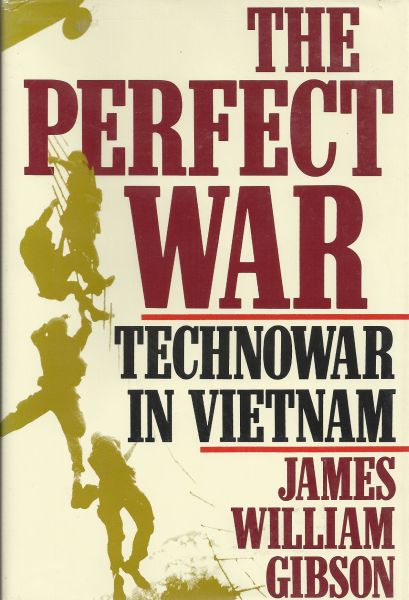
GIBSON The perfect warKaplan also refers to a notorious metric from the Vietnam war: the body-count.  As James Gibson patiently explains in his brilliant critique of The perfect war: technowar in Vietnam (1986), this was one of the central mechanisms in US Secretary of Defense Robert McNamara’s attempt to wage an appropriately Fordist war (he went to the Pentagon from being President of the Ford Motor Company).  The body-count can be traced back to the Korean War, but it came into its own in Vietnam where it was supposed to be the key metric of success – bizarrely, even of productivity – in a ‘war without fronts’ where progress could not be measured by territory gained.  Here too Turse is illuminating on the appalling culture that grew up around it, including the inflation (and even invention) of numbers, the body-count competitions, and the scores and rewards for what today would no doubt be called ‘excellence in killing’.

But what Kaplan has in mind is not quite this, but the central, absurdist assumption that there is a direct relationship between combatants killed and military success:

‘It is worth recalling the many times a drone has reportedly killed a “number 3 leader of al-Qaeda.” There was always some number 4 leader of al-Qaeda standing by to take his place. It’s become a high-tech reprise of the body-count syndrome from the Vietnam War — the illusion that there’s a relationship between the number of enemy killed and the proximity to victory.’

How else can we interpret John Nagl‘s tangled celebration (on Frontline’s ‘Kill/Capture’) of the importance of targeted killing for counterinsurgency and counter-terrorism?

‘We’re getting so good at various electronic means of identifying, tracking, locating members of the insurgency that we’re able to employ this almost industrial-scale counterterrorism killing machine that has been able to pick out and take off the battlefield not just the top level al Qaeda-level insurgents, but also increasingly is being used to target mid-level insurgents.’

Peter Scheer draws a distinction between the two moments in Nagl’s statement that helps clarify what he presumably intended (though Scheer is writing more generally):

‘The logic of warfare and intelligence have flipped, each becoming the mirror image of the other. Warfare has shifted from the scaling of military operations to the selective targeting of individual enemies. Intelligence gathering has shifted from the selective targeting of known threats to wholesale data mining for the purpose of finding hidden threats.’

In other words, the scale of intelligence has become industrial (or more accurately perhaps, post-industrial: see here), far exceeding the scale of intelligence available in Vietnam [though see here for a discussion of the connections between McNamara’s data-driven war and today’s obsession with Big Data, and here and here for an outline of the ‘security-industrial complex’], whereas the scale of killing has clearly contracted from what most certainly was industrial-scale killing in Vietnam.   Yet the networked connections between the two reveal the instantiation of the same driving logic of technowar in a radically new ‘war without fronts’.

For all these intimation of Vietnam, however, the genealogy of the drone with which Kaplan begins his essay is resolutely post-Vietnam (or at any rate outside it).  And this, I think, is a mistake.

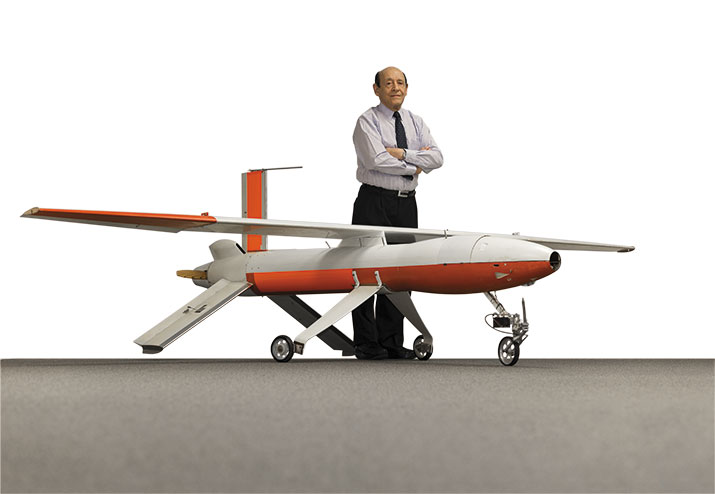
Technological history is shot through with multiple sources of inspiration and no end of false starts, and usually has little difficulty in assembling a cast of pioneers, precursors and parallels, so I’m not trying to locate a primary origin.  Ian Shaw‘s account of the rise of the Predator (more from J.P. Santiago here) homes in on the work of Israeli engineer Abraham Karem, who built his first light-weight, radio-controlled ‘Albatross’ (sic) in his garage in Los Angeles in 1981.

Karem's Albatross (Chad Slattery)

He may have built the thing in his garage, but Karem was no hobbyist; he was a former engineering officer in the Israeli Air Force who had worked for Israel Aircraft Industries, and by 1971 he had set up his own company to design UAVs.  Neither the Israeli government nor the Israeli Air Force was interested, so Karem emigrated to the United States.  The Albatross was swiftly followed by the Amber, which was also radio-controlled, and by 1988 with DARPA seed-funding Karem’s prototype was capable of remaining aloft at several thousand feet for 40 hours or more. But fitting hi-tech sensor systems into such a small, light aircraft proved difficult and both the US Navy and the Army balked at the project.  Karem set about developing a bigger, heavier and in many ways less advanced version for a putative export market: the GNAT-750.

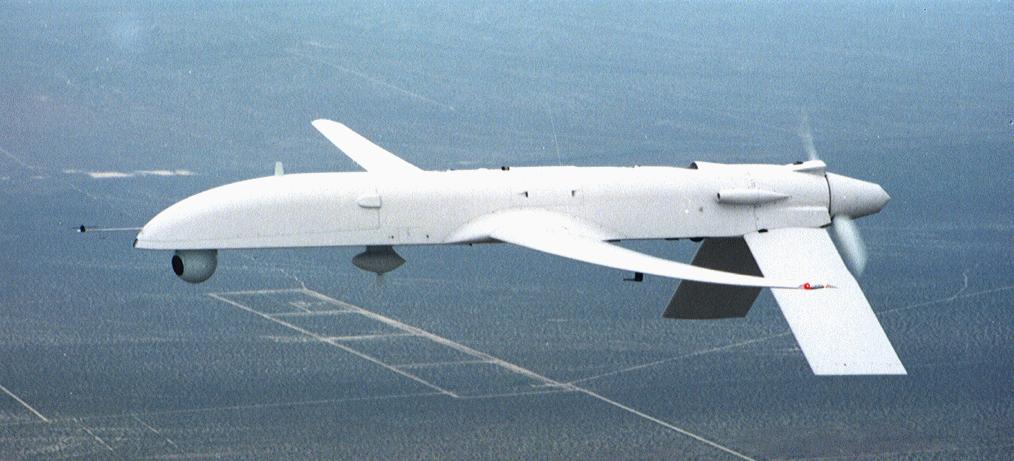
GNAT-750

This was a desperate commercial strategy that didn’t save Karem’s company, Leading Systems Inc., from bankruptcy.  But it was a sound technical strategy.  In 1990 General Atomics bought the company and the development team, and when the CIA was tasked with monitoring the rapidly changing situation in the Balkans it purchased two GNAT-750s (above) for the job.  They were modified to allow for remote control via a satellite link (the first reconnaissance missions over Bosnia in 1995 were managed by the Air Force and controlled from Albania): the new aircraft was re-named the Predator.

It’s a good story – and you can find a much more detailed account by Richard Whittle in ‘The man who invented the Predator’ at Air & Space Magazine (April 2013) here – but in this form it leaves out much of the political in-fighting.  The second part of Ian’s narrative turns to the role of the Predator in the development of the CIA’s counter-terrorism campaign, and while he notes the enlistment of the US Air Force – ‘ultimately, the CIA arranged for Air Force teams trained by the Eleventh Reconnaissance Squadron at Nellis Air Force Base [Indian Springs, now Creech AFB] to operate the agency’s clandestine drones’ – he doesn’t dwell on the ‘arranging’ or the attitude of the USAF to aircraft without pilots on board.

Kaplan does, and his story starts earlier and elsewhere:

‘The drone as we know it today was the brainchild of John Stuart Foster Jr., a nuclear physicist, former head of the Lawrence Livermore National Laboratory (then called the Lawrence Radiation Laboratory), and — in 1971, when the idea occurred to him — the director of defense research and engineering, the top scientific post in the Pentagon.’

Foster was a hobbyist – he loved making model aircraft – and thought it ought to be possible to capitalise on his passion: ‘take an unmanned, remote-controlled airplane, strap a camera to its belly, and fly it over enemy targets to snap pictures or shoot film; if possible, load it with a bomb and destroy the targets, too.’  Two years later DARPA had overseen the production of two prototypes, Praeire [from the Latin, meaning both precede and dictate] and Caler [I have no idea], which were capable of staying aloft for 2 hours carrying a 28 lb payload.  At more or less the same time, the Pentagon commissioned a study from Albert Wohlstetter, a former RAND strategist, to identify new technologies that would enable the US to respond to a Soviet invasion of Western Europe without pressing the nuclear button. ‘Wohlstetter proposed putting the munitions on Foster’s pilotless planes and using them to hit targets deep behind enemy lines, Kaplan explains, ‘Soviet tank echelons, air bases, ports.’  By the end of the decade the Pentagon was testing ‘Assault Breaker’ and according to Kaplan ‘something close to Foster’s vision finally materialized in the mid-1990s, during NATO’s air war over the Balkans, with an unmanned aerial vehicle (UAV) called the Predator.’

But the use of the mid-altitude, long-endurance (‘MALE’ – really) drones remained largely the preserve of the CIA because the senior officer corps of the Air Force was hostile to their incorporation:

‘All this changed in 2006, when Bush named Robert Gates to replace Donald Rumsfeld as secretary of defense. Gates came into the Pentagon with one goal: to clean up the mess in Iraq… He was particularly appalled by the Air Force generals’ hostility toward drones. Gates boosted production; the generals slowed down delivery. He accelerated delivery; they held up deployment. He fired the Air Force chief of staff, General T. Michael Moseley (ostensibly for some other act of malfeasance but really because of his resistance to UAVs), and appointed in his place General Norton Schwartz, who had risen as a gunship and cargo-transport pilot in special operations forces… and over the next few years, he turned the drone-joystick pilots into an elite cadre of the Air Force.’

These are both important narratives, which help to delineate multiple lines of descent, but my own inclination is to push the story back and to move it outside the North Atlantic.  It’s not difficult to find precedents for UAVs around the time of the First World War – I’ve discussed some of them here – and towards the end of the Second World War America attempted to develop remote-controlled bombers to use against Germany (see ‘Project Aphrodite’ here and here).  But if we focus less on the object – the aircraft – and more on its dispositions and the practices mobilised through the network in which it is embedded (as Kaplan’s references to ‘free-fire zones’ and ‘body counts’ imply) then I think here Vietnam is the place to look.  For as I’ve argued in ‘Lines of descent’ (DOWNLOADS tab), not only did the Air Force experiment with surveillance drones over North Vietnam, as Ian briefly notes in his own account, but the US military developed a version of ‘pattern of life analysis’ and a sensor-shooter system that would prove to be indispensable to today’s remote operations.  Seen like this, they confirm that we are witnessing a new phase of technowar in exactly the sense that Gibson used the term: except that now it has been transformed into post-Fordist war and, to paraphrase David Harvey, ‘flexible annihilation’.

Drones and the Quiet Americans

quiet-disposition

Following on from the Coded Conduct exhibition in London in April, James Bridle’s new work A Quiet Disposition opens at the Corcoran in Washington DC later this month, running from 19 June to 7 July.  He explains the background to his ongoing project on networked technologies and the in/visibility of military violence like this (my emphases):

“The Disposition Matrix” is the term used by the US Government for its intelligence-gathering and targetting processes. Overseen by the National Counterterrorism Center and in development for some time, the Matrix is usually described as a database for generating capture and “kill lists”, but the criteria for both adding to and acting on the information in the database is not public. One of the outcomes of the process is the ongoing, undeclared CIA drone war in Pakistan, Yemen and elsewhere. These attacks have killed an estimated 3105 people in Pakistan alone since June 2004, including 535 confirmed civilians and 175 children. (Sources: The Bureau of Investigative Journalism, New America Foundation.)

The architectural theorist Keller Easterling uses the term “disposition” in other contexts, to refer to the propensity or temperament of forms which produce actions. Disposition is found not in activity itself, but in the relationships or relative positions of the objects that produce action. Consider a motorway: you can describe the movement of the cars, but the active form is immanent in the concrete itself; the motorway has a disposition. If such forms can be said to have a disposition, to what extent can they be said to possess agency?

For Easterling, architectures and infrastructures perform aspects of their being: not merely spatial objects, they shape the world around them on many levels: legal, political, technological. The sociologist Erving Goffman in turn uses the term “disposition” to describe the entire performance, including – in human terms – gesture, posture, expression and intent. These subtexts are capable of overwhelming what is being merely said: the distinction between the aesthetics of what is being depicted, and what is actually being done.

Drones – the armed, unmanned planes in action around the world – are dispositional. Their significance is not wholly in their appearance, but in how they transform the space around them; both the physical space (the privileged view of the weaponised surveillance camera at 50,000 feet) and the legal, national and diplomatic spaces that as a result permits new kinds of warfare and assassination. And the Disposition Matrix is an organising principle: not a thing, not a technology, not an object, but an active form, a reorientation of intent into another dimension or mode of expression. In another sense, the Disposition Matrix is the network itself, the internet and us, an abstract machine, intangible but effective. Finally, the Disposition Matrix is an attitude and a performance.

Quiet AmericanAnd the quiet disposition?  The central insight that animates much of James’s recent work around the New Aesthetic is, as he says in the lecture posted below, that ‘drones … shorten time and space very effectively but instead of using those same networked technologies to make things clearer or to bring empathy they use it to obfuscate and hide.’  You can see this – or rather not see it – in the extraordinary secrecy that cloaks so many of the sites of air attack.  160 years after the dawn of mass-mediated warfare, it is (as he says) sobering to think that we know less about what is happening in Waziristan today than the British public knew about the campaign in the Crimea. Hence Dronestagram and similar projects.  Even though the drone ‘has almost become synonymous with America and with a certain way of prosecuting war’, however, James prefers to see drones as shells or, better, prostheses, ‘extensions of  the network itself’.  For this reason The Quiet Disposition seeks to turn the network on itself, a sort of auto-immune cyberattack, through an intelligence-gathering software system (like the Obama administration’s ‘disposition matrix‘) that lives online, constantly scanning the web for reports about the drone programme and using AI to effect connections between them.