‘The superpower’s dilemma’

I’m on the magical island of Sicily for the 9th Pan-European Conference on International Relations: Worlds of Violence (you can find abstracts and even some papers here though presumably not for ever).

I’ve never been to one of these things before, not even the ISA (though I must do something about that) so there’s a  learning curve – not only about IR but about how people in a different field who all seem to know one another comport themselves (or don’t).  There are lots of geographers here too, though Philippe Le Billon and Simon Springer, who organised a series of sessions on Geographies of Violence, never made it (fortunately not felled by violence).

I’m giving what I hope is more or less the final version of ‘Angry Eyes‘ (updates here and here) on the Uruzgan drone strike so I’ve been attending several sessions on drones to see what other analysts have been up to beyond the range of my targeting sensors trained on ssrn and Academia [This is perhaps the place to say I don’t post anything on either platform, since all my texts are available on this website under DOWNLOADS: but maybe I should?].

web-syria-drone-epa

Yesterday Lisa Hajjar spoke on ‘Drone warfare and the superpower’s dilemma‘.  She explains the title like this:

The United States has been in a continuous—or, at least, uninterrupted—state of armed conflict since 2001, and there is no end in sight. The strategies and technologies, as well as the locales of engagement and designated enemies of this “’global’ war on terror” have changed considerably over the past fourteen years. Nevertheless, the US government still relies on the Authorization for Use of Military Force (AUMF), passed by Congress on 14 September 2001 (three days after the 9/11 terrorist attacks), as the legal authority to bomb people in Afghanistan, Pakistan, Yemen, and Somalia, in Iraq since the occupation (the 2003 invasion was authorized under a different AUMF), in Libya since 2012, and most recently in Syria. This expanding conflict is not actually the same in any empirical sense, but the 2001 AUMF continues to be relied on because of the plasticity of the label of terrorism and the fact that the war against it has neither been won nor lost. This ability to continue fighting without losing and the inability to stop without winning could be described as “the superpower’s dilemma.”

‘The most significant change over the course of the “war on terror”’, she continues, ‘is the escalating use of armed drones (unmanned aerial vehicles, or UAVs) to target geographically diffuse and unconventional enemies.’

My analysis highlights three main issues: 1) why drone strikes for targeted killing have superseded capture and combat in US counter-terrorism strategy; 2) how officials explain and justify the strategic logic of remote killing; and 3) why drones seem to provide a technological answer to the superpower dilemma of how the United States can continue to “stay in the fight” without a significant commitment of “boots on the ground.” The conclusion is that bombing operations and aerial campaigns are incapable of achieving the declared security goals that their use aims to serve. On the contrary, drone warfare has been an important factor in the continuation of the “war on terror.”

My ability to report all this is not down to phenomenal powers of recall or a crash course in shorthand: you can read the full essay in two parts at Jadaliyya here and here.

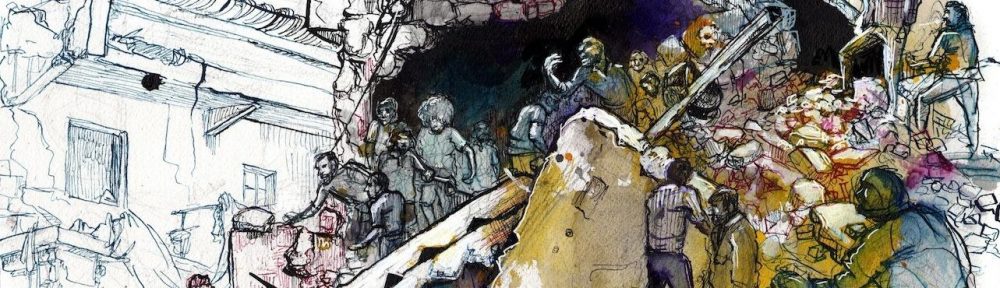
(If you wonder about the image above, by the way, you can find the answer to its symbolic significance here and here).

_85425907_raf_strike_grab_976

Meanwhile, other states are operating drones too – notably over Iraq and Syria – including Russia (more here and here) and the UK (see here and read here).  I’m keeping my eyes on those developments too, but right now it’s Angry Eyes that holds my attention (not least because it reminds us that military drones are used for far more than targeted killing).  There are discussants for my own presentation, so I’ve prepared a paper summarising the argument and conclusions in lieu of a real paper – the long-form version is still in preparation – and I’ll post that soon.  But now I must away to think myself into my part….

Oikological warfare

OWENS Counterinsurgency

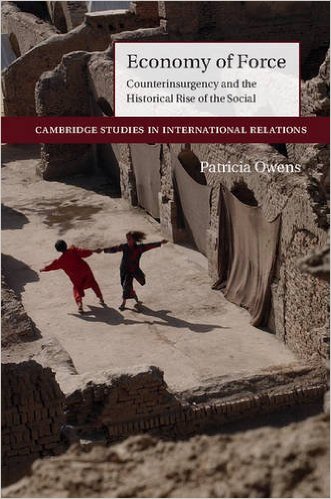
A new book from the ever-innnovative Patricia Owens, Economy of Force: counterinsurgency and the historical rise of the Social (Cambridge University Press, 2015).

There’s an excellent interview with Patricia at e-IR here, which includes her own summary of the book:

The book retrieves the older, but surprisingly neglected, language of household governance, oikonomia, to show how the techniques and domestic ideologies of household administration are highly portable and play a remarkably central role in international and imperial relations. In contrast to the ahistorical and anachronistic adoption of social language across IR, I think there is an important story to be told of when, where, and why the social realm first emerged as the domain through which human life could be intervened in and transformed. Economy of Force tells this story in terms of modern transformations in and violent crises of household forms of rule. In two late-colonial British emergencies in Malaya (1948-1960) and Kenya (1952-1960), US counterinsurgency in Vietnam (1954-1975), and US-led campaigns in Afghanistan (2001-2014) and Iraq (2003-2011), so-called ‘armed social work’ policies were the continuation of oikonomia – not politics – by other means. Though never wholly succeeding, counterinsurgents drew on and innovated different forms of household governance to create units of rule in which local populations were domesticated. Military strategists conceived population control as sociological warfare because the social realm itself and distinctly social forms of thought are modern forms of oikonomikos, the art and science of household rule.

The argument has big implications for international theory, as well as the history and theory of counterinsurgency. Rather than objective theories of modern society and their interrelations, various forms of liberalism, political realism, social constructivism, and Marxism need to be situated within the history of the rise and violent transformation of the social realm. They are fragments of competing paradigms of social regulation. Ironically, the dominance of distinctly social forms of thought has obscured the household ontology of the modern social realm. Each of the major traditions is explicitly based on, or implicitly accepts, the erroneous notion that modern capitalism destroyed large-scale forms of household rule. So the book not only offers a new history and theory of counterinsurgency. It offers a new history of the rise of the social realm and political history and theory of household governance.

Research for the book was supported by a yearlong fellowship at the Radcliffe Institute for Advanced Study at Harvard University. There’ll be a symposium on Economy of Force at Disorder of Things later in 2015.

Here’s the Contents list:

1. Introduction: oikonomia in the use of force
2. The really real? A history of ‘social’ and ‘society’
3. Out of the confines of the household?
4. The colonial limits of society
5. ‘More than concentration camps’: the battle for hearths in two late-colonial emergencies
6. Society itself is at war: new model pacification in Vietnam
7. Oikonomia by other means: counterinsurgency in Afghanistan and Iraq
8. Conclusion: ‘it’s the oikos, stupid’.

Among the many pre-publication plaudits, here’s Didier Fassin‘s:

“Through a combination of historical perspective on the colonial world and contemporary inquiry into the imperial enterprise, Economy of Force invites us to rethink the laws of warfare and politics of counterinsurgency by paying attention to the pacification of local populations understood as a form of domestication. It thus unveils the genealogy of the blurred line between military and humanitarian interventions.”

You can get a taste of Patricia’s argument (particularly if you shrink from CUP’s extortionate pricing, even for the e-edition) in her ‘Human security and the rise of the social’, Review of International Studies 38 (2012) 547-567 and ‘From Bismarck to Petraeus:the question of the social and the social question in counterinsurgency’, European journal of international relations 19 (1) (2013) 139-161.

I’ve just heard from Patricia, who tells me that CUP will publish Economy of Force next year in paperback (which ought to make it much more accessible); she’s also made available the proofs of the Introduction on her academia.edu page here.

(In)human Terrain

humanterrain3

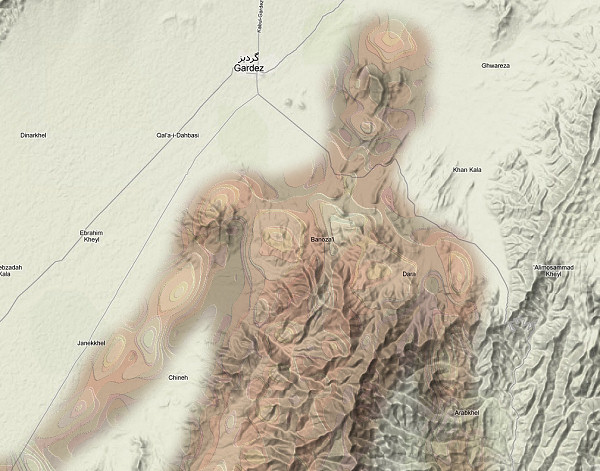
It’s been an age since I looked at the US military’s attempt to ‘weaponise culture’ in its counterinsurgency programs (see ‘The rush to the intimate’: DOWNLOADS tab), but Roberto Gonzalez has kept his eyes on the ground – or the ‘human terrain’ (I’ve borrowed the image above from Anthropologists for Justice and Peace here).

In a special report for Counterpunch a month ago, Roberto noted the demise of the Human Terrain System:

The most expensive social science program in history – the US Army’s Human Terrain System (HTS)–has quietly come to an end. During its eight years of existence, the controversial program cost tax payers more than $725 million…

HTS supporters frequently claimed that the program would increase cultural understanding between US forces and Iraqis and Afghans–and therefore reduce American and civilian casualties. The program’s leaders insisted that embedded social scientists were delivering sociocultural knowledge to commanders, but the reality was more complex. HTS personnel conducted a range of activities including data collection, intelligence gathering, and psychological operations. In at least one case, an HTS employee supported interrogations in Afghanistan.

The program also served a more insidious function: It became a propaganda tool for convincing the American public–especially those with liberal tendencies–that the US-led occupations of Iraq and Afghanistan were benevolent missions in which smart, fresh-faced young college graduates were playing a role. It appeared to demonstrate how US forces were engaged in a kinder, gentler form of occupation. Department of Defense photos portrayed HTS personnel sitting on rugs while drinking tea with Afghan elders, or distributing sweets to euphoric Iraqi children. Here was a war that Americans could feel good about fighting.

The program had its critics, inside as well as outside the military, and US Army Training and Doctrine Command (TRADOC) eventually confirmed that HTS had been terminated on 30 September 2014.  In his report, Roberto traces the rise and fall of HTS, and attributes its demise to US troop withdrawals from Iraq and Afghanistan, the fall from grace of the ‘new’ counterinsurgency’s champion David Petraeus, the incompetence of many of the HTS teams, and – crucially – to the precipitate shift from ‘cultural’ to geospatial intelligence.

The last, impelled by the desire to substitute air strikes for ‘boots on the ground’ and to rely on computational methods rather than human intelligence, is the key: as Oliver Belcher put it in his PhD thesis on The afterlives of counterinsurgency, “It’s algorithms, not anthropology, that are the real social science scandal in late-modern war.”

I’ve been exploring this shift in my ‘Dirty Dancing’ essay – in relation to the American production of the Federally Administered Tribal Areas of Pakistan as a space of execution, a code/space in which data surveillance and computational methods are activated to assert an extra-territorial claim over bodies-in-spaces – but it’s become clear to me that this continues to rely on (and in some respects even extends) the weaponisation of culture.  It’s an appropriate metaphor: after all, weapons are inherently dangerous, they can be misdirected, they do misfire and they can cause grievous harm far beyond their intended target.

In a follow-up post on ‘Re-making the Human Terrain’, Roberto says as much:

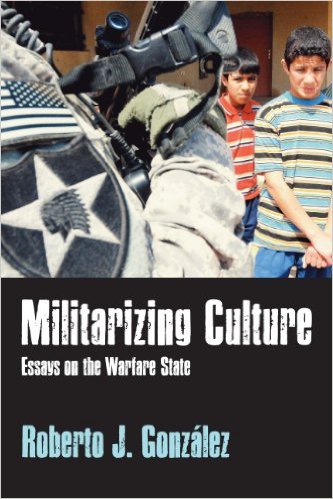
GONZALEZThe gaps in military knowledge that HTS claimed to fill still remain. The desire to weaponize culture is as old as dreams of counterinsurgency, and such dreams do not die easily.

It would be premature for those concerned about the militarization of culture to breathe a sigh of relief. The needs of empire—especially an empire in denial—are far too great to ignore cultural concerns. HTS’s sudden death can obscure the fact that elements of the program continue to survive, though in distinct and sometimes unrecognizable forms. The basic idea behind HTS—to equip the military with cultural expertise for battlefield operations—has not been eradicated. If anything, the concept has firmly taken root.

He traces its off-shoots through the development of a Global Cultural Knowledge Network – which I can’t help seeing as the cultural version of the Bombing Encyclopedia of the World – and the role of private corporations in providing ‘human terrain analysts’ to support US special operations (see also Max Forte here on what I think of as the Military-Academic-Industrial-Media complex: MAIM).  Interestingly, Whitney Kassel – who is adamant that ‘shuttering HTS will almost certainly be a mistake’ – notes that ‘the National Defense University conducted a detailed study of HTS [summarised in JFQ] in late 2013 and recommended that the function be moved and permanently housed at U.S. Army Special Operations Command … which has the lead for irregular warfare and other Army functions that make the most frequent use of sociocultural knowledge.’

Roberto also provides a more detailed analysis of the US military’s investment in socio-cultural modelling and (this is truly vital) predictive forecasting in two linked essays on ‘Seeing into hearts and minds’: Part 1 is ‘The Pentagon’s quest for a social radar’, Anthropology Today 31 (3) (June 2015) 8-13 and Part 2 is ‘‘Big data’, algorithms, and computational counterinsurgency, Anthropology Today 31 (4) (August 2015) 13-18.

Social Radar JPEG

The second part is most directly relevant to what I’ve been working on because it describes the conceptual development of so-called ‘Social Radar’ (see image above: ‘sensor systems for the 21st century‘; see also here) and the morphing of the NSA’s Real Time Regional Gateway for Iraq – which integrated data surveillance from multiple sources and domains with visual feeds from drones – into Nexus 7 in Afghanistan.

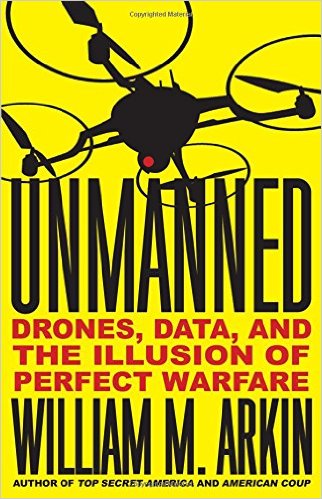
Similar fusion systems have surely been working across the border, and in his Unmanned: drones, data, and the illusion of perfect warfare (2015) William Arkin provides a fascinating glimpse into other genealogies that have produced what he calls ‘the Data Machine’:

ARKIN UnmannedToday, the Data Machine doesn’t care where it is fighting. It doesn’t matter whether targets are hiding in Hindu Kush caves or in villages of the Fertile Crescent. Nor does Predator care, or Reaper, or Global Hawk, or any other of our other aptly and awkwardly named all-seeing eyes. In fact, they don’t care about anything: they are machines. But the men and women … behind the entire Machine also don’t care, for every place is reduced to geographic coordinates that flash across a screen in seconds. Nations, armies, and even people are reduced to links and networks.

Loitering drones and geolocating weapons just need the data. Everyone needs the global information grid and the Internet—or, more precisely, an internet. Actual battlefield geography and culture have become immaterial. The node and the network sentry become the determinant and the provocateur of action—all the way to the edge of the world, anywhere.

The lightness (and darkness) of being

The Light of God slide.001

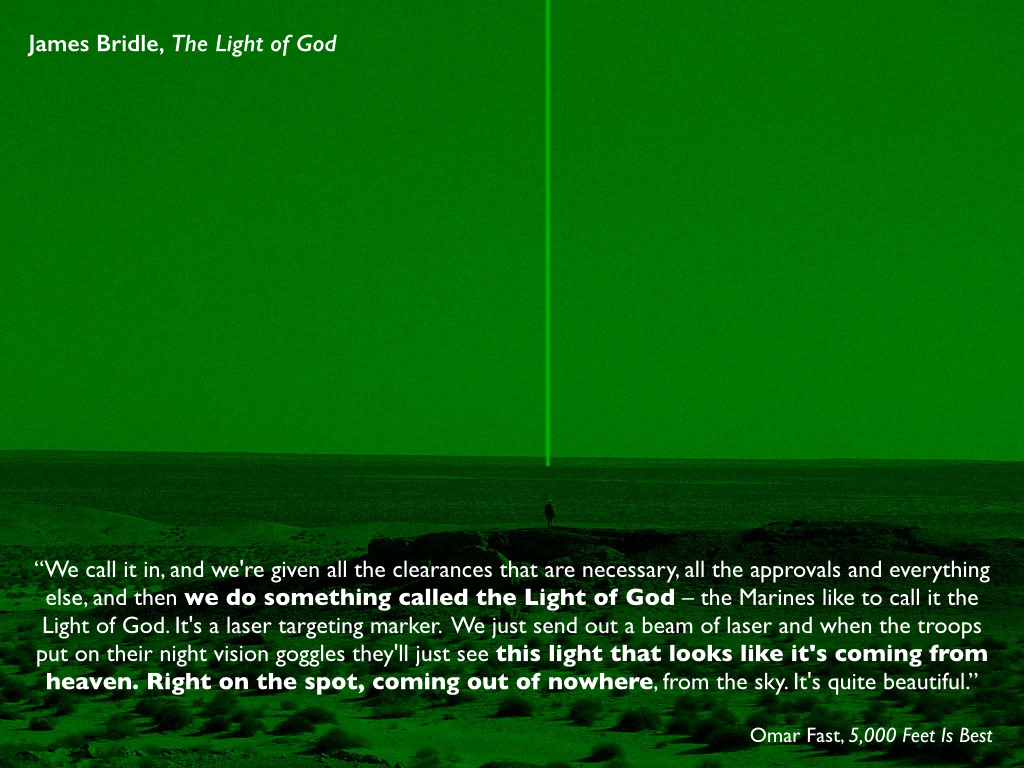
Pip Thornton‘s wonderful ‘The meaning of light: seeing and being on the battlefield‘ – which, among many other good things, worries away at the conceit shown in the image above – is just out in Cultural geographies (Online First).  It will eventually form part of a special issue on ‘Darkness’ edited by Tim Edensor.

Here’s the abstract:

On the battlefield, light and dark mean much more than the (dis)ability to see. While the darkness of night-time can be used as a tactic, providing cover for personal and territorial defence and attack, it also affects and secures bodies and the spaces they inhabit in other more immediate and intimate ways, recalibrating senses and redefining distance. Light too can spell both safety and danger on the battlefield, disciplining and controlling its occupants with often asymmetrical power-plays of affect and aggression. Using autoethnographic examples of experiences in Iraq in 2003 (based on the poem below), this article sets out to challenge traditional binaries of light/ dark, good/bad and to question the elemental, cultural and technological sovereignty of light and vision in modern battlespaces.

And here’s the poem:

Light Discipline

In a blackout we adjust our sights

by touch and cup our smoke against

the desert, waiting for the light.

At long last the barrel scrapes

into place and the night is instantly

exposed. I cover my ears and watch.

In the distance a fitful city crouches,

seared eyes raised to the floating

arc above, waiting for the strike.


Base lines and military projections

David Vine has updated his map of the global footprint of the US military over at Politico.

VINE US military bases

I used an early version for my ‘War and Peace’ essay (DOWNLOADS tab), and that map – like this one – was drawn primarily from the annual Base Structure Report, a summary of the US military’s ‘real property inventory’ (all sites owned and managed by the Pentagon).  It’s an unwieldy document which uses a high threshold to filter inclusion:

To qualify for individual entry in the BSR, a DoD site located in the United States must be larger than 10 acres AND have a Plant Replacement Value (PRV) greater than $10 million. If the site is located in a foreign country, it must be larger than 10 acres OR have a PRV greater than $10 million to be shown as a separate entry. Sites that do not meet these criteria are aggregated as an “Other” location within each state or country.

Iraq doesn’t appear in these tabulations – though it is shown on the map – yet the continuing US involvement in the conflict there and across the all-but-erased border in Syria has surely extended its footprint.  As David notes,

‘There were 505 bases at the U.S. occupation’s height, but the Iraqi parliament rejected the Pentagon’s wish to keep 58 “enduring” bases after the 2011 withdrawal. U.S. forces have occupied at least five bases since 2014 and are considering more installations.’

Afghanistan is absent too: ‘By the end of 2014 … the U.S. military will have closed, deconstructed, or vacated most of what were once around 800 military installations, ranging from small checkpoints to larger combat outposts to city-sized bases.’  But the US military retains a significant presence there, and its drones are still based there to support continuing military operations and to attack targets across the border in Pakistan.

There are also strategic omissions.  There’s no mention in the Base Structure Report of Al Udeid Air Base in Qatar, for example, which is the location of US Central Command’s Combined Air and Operations Center.

(You can find more from David on the history of America’s ‘infrastructure for war’ in the Middle East here and on its ‘lily-pad’ strategy here).

There are all sorts of issues involved in measuring a ‘military footprint’ – see my post here and Josh Begley here (who works from the previous year’s Base Structure Report for FY 2013 to produce a radically different visualization) – but for all its uncertainties, David’s map is a sobering snapshot, and he relies on supplementary sources to conclude:

Despite recently closing hundreds of bases in Iraq and Afghanistan, the United States still maintains nearly 800 military bases in more than 70 countries and territories abroad—from giant “Little Americas” to small radar facilities. Britain, France and Russia, by contrast, have about 30 foreign bases combined.

By my calculation, maintaining bases and troops overseas cost $85 to $100 billion in fiscal year 2014; the total with bases and troops in warzones is $160 to $200 billion.

VINE Base Nation

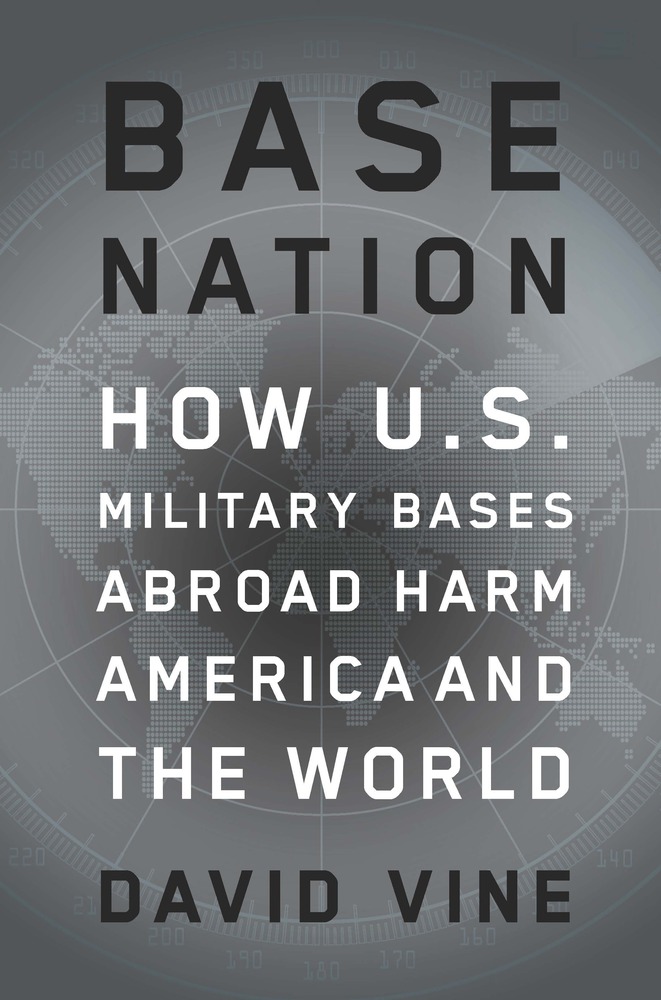
When I first contacted David, his original map formed part of his scorching investigation into Diego Garcia: Island of Shame: the secret history of the US military base on the island of Diego Garcia (Princeton, 2009; paperback 2011: all royalties went to the Chagossians); the new version forms part of an even more ambitious project, Base Nation: how US military bases abroad harm America and the world (Metropolitan Books, 2015):

American military bases encircle the globe. More than two decades after the end of the Cold War, the U.S. still stations its troops at nearly a thousand locations in foreign lands. These bases are usually taken for granted or overlooked entirely, a little-noticed part of the Pentagon’s vast operations. But in an eye-opening account, Base Nation shows that the worldwide network of bases brings with it a panoply of ills–and actually makes the nation less safe in the long run.

As David Vine demonstrates, the overseas bases raise geopolitical tensions and provoke widespread antipathy towards the United States. They also undermine American democratic ideals, pushing the U.S. into partnerships with dictators and perpetuating a system of second-class citizenship in territories like Guam. They breed sexual violence, destroy the environment, and damage local economies. And their financial cost is staggering: though the Pentagon underplays the numbers, Vine’s accounting proves that the bill approaches $100 billion per year.

For many decades, the need for overseas bases has been a quasi-religious dictum of U.S. foreign policy. But in recent years, a bipartisan coalition has finally started to question this conventional wisdom. With the U.S. withdrawing from Afghanistan and ending thirteen years of war, there is no better time to re-examine the tenets of our military strategy. Base Nation is an essential contribution to that debate.

There is a long history of struggles against the presence of US military bases overseas – Catherine Lutz‘s edited collection, The bases of empire: the global struggle against US military posts (New York University Press, 2009) remains an indispensable starting-point.

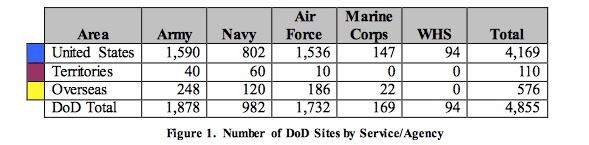
Of course, the US military is also omnipresent in the United States, with installations in all 50 states and seven territories.  The Base Structure Report includes this summary:

DoD sites JPEG

And these bases have brought their own problems and spawned their own protests too.


Airwars

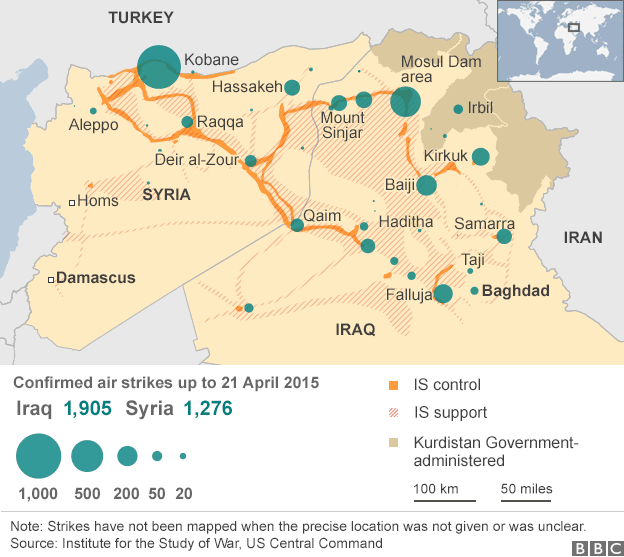
Air strike sin Iraq and Syria to April 2015

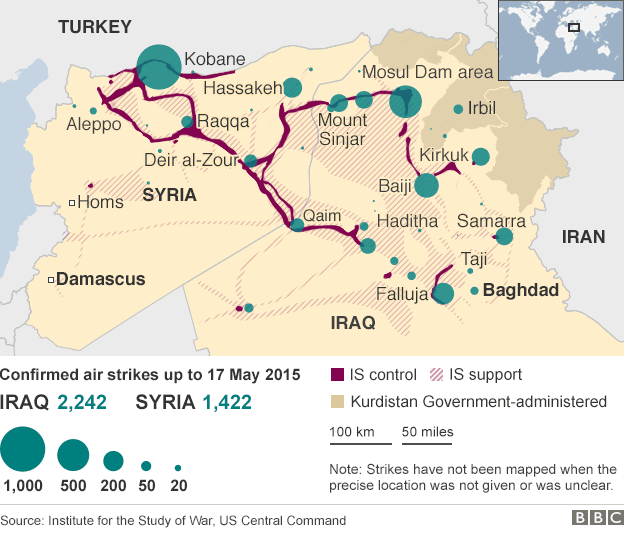
Air strikes in Iraq and Syria to 17 May 2015

I’ve taken the maps above from the BBC, which rely on reports from the Institute for the Study of War and news releases from US Central Command on ‘Operation Inherent Resolve‘.

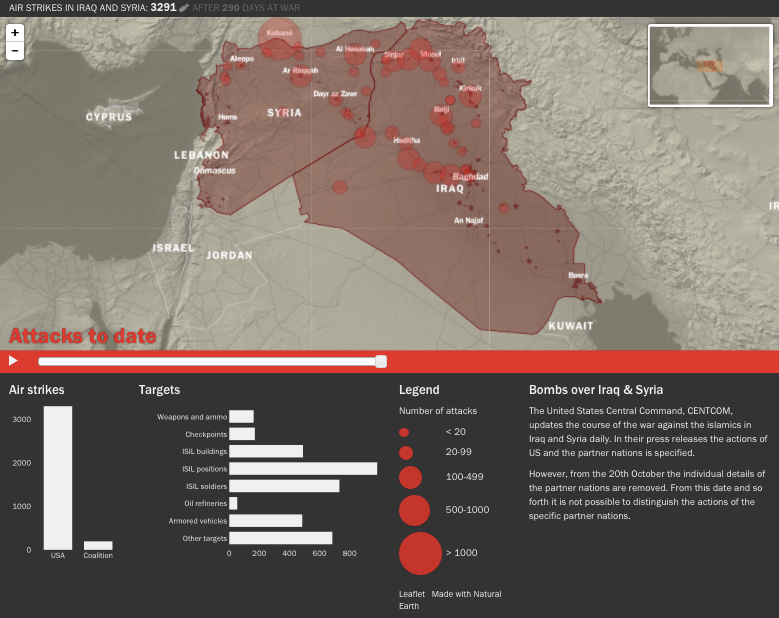
For readers wanting to follow and analyse the US-led air campaign in Iraq and Syria in more detail, I recommend Chris Woods‘ new project, Airwars.  Chris is a veteran of the Bureau of Investigative Journalism’s Drone War Project and the author of Sudden Justice: America’s secret drone wars (2015) – which really is the gold standard for analysis of US remote operations.

Airwars.org is a collaborative, not-for-profit transparency project aimed both at tracking and archiving the international air war against Islamic State (Daesh), in both Iraq and Syria. We also seek to highlight – and follow up where possible – those cases in which claims of civilian non-combatant casualties from coalition airstrikes have been indicated by credible monitoring agencies. In addition we track reported ‘friendly fire’ incidents.

The site includes tabulations and also an interactive, zoomable map (see the screenshot below).  You can find a detailed discussion of sources and methodology here.

AIRWARS 25 May 2015

I’m tracking all this for The everywhere war…  In case you are wondering why that is taking so long to finish: The colonial present started out as an essay on 9/11 and the US invasion of Afghanistan; I then realised that Sharon was taking advantage of the ‘war on terror’ to ramp up Israeli dispossession and repression of the Palestinian people, and so started work on a second essay (I’m ashamed to say that at the time I knew as little about the West Bank and Gaza as I did about Afghanistan on 11 September 2001).  Then the US invaded Iraq…  Much the same is happening with The everywhere war, but I do have the end in my sights.  I hope.


‘By our algorithms we shall know them’

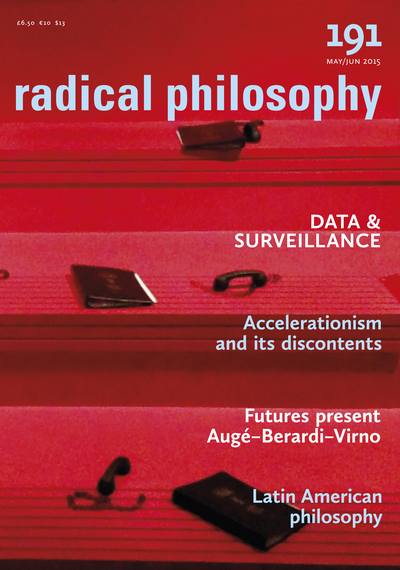
191webcoverweb

Radical Philosophy 191 is out now, including two contributions of particular interest to me as I continue to grapple with the surveillance apparatus that (mis)informs US drone strikes in the Federally Administered Tribal Areas.  This has come into sharper view after Obama’s rare admission of not only a strike in the FATA but of a mistake in targeting – though his statement was prompted by the death of an American and Italian hostage not by the previous deaths of innocent Pakistanis.

First, Grégoire Chamayou‘s ‘Oceanic enemy: a brief philosophical history of the NSA‘ which traces a path from the sonic surveillance of submarines off Barbados in 1962 to ‘pattern of life’ analysis in Afghanistan, Iraq and Pakistan, and which – not surprisingly – intersects with his Theory of the drone in all sorts of ways:

‘The premiss is the same as before: ‘in environments where there is no visual difference between friend and enemy, it is by their actions that enemies are visible.’ Today the task of establishing a distinction between friend and enemy is once again to be entrusted to algorithms.’

Second, Claudia Aradau‘s ‘The signature of security: big data, anticipation, surveillance‘ shatters the crystal balls of the intelligence agencies:

‘We are not crystal ball gazers. We are Intelligence Agencies’, noted the former GCHQ director Iain Lobban in a public inquiry on privacy and security by the Intelligence and Security Committee of the UK Parliament (ISC) in the wake of the Snowden revelations about mass surveillance….

I argue here that the disavowal of ‘crystal ball gazing’ is as important as the image of finding the clue through the data deluge in order to locate potential dangerous events or individuals in the future. Intelligence work is no stranger to the anticipation of the future – rather, it justifies itself precisely through the capacity to peer into the future in order to prevent or pre-empt future events from materializing. Big data has intensified the promise of anticipating the future and led to ‘exacerbat[ing] the severance of surveillance from history and memory’, while ‘the assiduous quest for pattern-discovery will justify unprecedented access to data’. ‘Knowledge discovery’ through big-data mining, and prediction through the recording of datafied traces of social life, have become the doxa of intelligence and security professionals. They claim that access to the digital traces that we leave online through commercial transactions or social interactions can hold a reading of the future. They repeat the mantra of data scientists and private corporations that the ‘digital bread crumbs’ of the online world ‘give a view of life in all its complexity’ and ‘will revolutionize the study of human behaviour’.

Unlike statistical technologies of governing populations, big data scientists promise that through big data ‘we can escape the straightjacket of group identities, and replace them with more granular predictions for each individual’. To resist their unreasonable promise of predicting crises, preventing diseases, pre-empting terrorist attacks and overall reshaping society and politics, I recast it as divination rather than detection. Big-data epistemics has more in common with the ‘pseudo-rationality’ of astrology than the method of clues. As such, it renders our vocabularies of epistemic critique inoperative…

‘There is nothing irrational about astrology’, concluded Adorno, ‘except its decisive contention that these two spheres of rational knowledge are interconnected, whereas not the slightest evidence of such an interconnection can be offered.’ The irrationality of big-data security is not in the data, its volume or messiness, but in how a hieroglyph of terrorist behaviour is produced from the data, without any possibility of error.

You can obtain the pdfs of both essays by following the links above – but they are time-limited so do it now.

The trauma hero

wwi-trauma

Following up my earlier post on novels, memoirs and narratives of war, there’s a thoughtful discussion by Roy Scranton at the LA Review of Books on what he calls ‘the myth of the trauma hero’.

A boy goes to war, his head full of romantic visions of glory, courage, and sacrifice, his heart yearning to achieve heroic deeds, but on the field of battle he finds only death and horror. He sees, suffers, and causes brutal and brutalizing violence. Such violence wounds the soldier’s very soul.

After the war the boy, now a veteran and a man, returns to the world of peace haunted by his experience, wracked by the central compulsion of trauma and atrocity: the struggle between the need to bear witness to his shattering encounter with violence, and the compulsion to repress it. The veteran tries to make sense of his memory but finds it all but impossible. Most people don’t want to hear the awful truths that war has taught him, the political powers that be want to cover up the shocking reality of war, and anybody who wasn’t there simply can’t understand what it was like.

The truth of war, the veteran comes to learn, is a truth beyond words, a truth that can only be known by having been there, an unspeakable truth he must bear for society.

This is probably the place to say that Roy served in the US Army in Iraq 2002-2006, studied at the New School for Social Research, and in 2010 embarked on a doctorate in English at Princeton – although, as you will soon see, this runs the very real risk of claiming that ‘he knows what he writes’ by virtue of these experiences.

Roy traces the myth of the trauma hero to eighteenth-century European Romanticism, and argues that it achieved its mature form in the twentieth century.  Accordingly he follows its development through Wilfred Owen in the First World War, Ernest Hemingway in the Second and Tim O’Brien in Vietnam until he reaches its contemporary form in Afghanistan and Iraq – and, in our own immediate present, in a film like Eastwood’s American Sniper.

It’s a beautifully composed contribution, and it’s made me re-think the basis for my ‘Gabriel’s Map’ and ‘Natures of War’ essays (DOWNLOADS tab) because Roy’s central thesis turns on a critique of the sacralization of trauma in ways that, at first sight, collide with my own attempts to develop what I’ve called a corpography (also DOWNLOADS tab) that can make us attentive to the corporeality and materiality of modern war:

‘Most Americans seem to believe that war can only be known through direct, physical, sensory experience on the battlefield, such as the moment of vision Owen describes in “Dulce et Decorum Est.” Ernest Hemingway, who in contrast to Owen’s long front-line service lasted only a few weeks as a noncombatant before being wounded and returning to the US, stands in American letters as the high priest of combat gnosticism. In Hemingway’s work, the emphasis on physicality, embodiment, and materiality we see in Owen’s representations of the soldier’s truth opens into a metaphysical bias against representation itself.’

d34387b998ba1136a34e9cc9e03515eeIn effect, Roy suggests, ‘being there’ becomes a privileged position from which truth cannot be communicated – only felt, and so only shared between those who were there.  The assertion of ethnographic privilege run through multiple fields from anthropology to journalism, of course, and it bedevils any attempt at historical reconstruction, but here it is heightened by the appeal to the supposedly inexpressible experience of trauma.  This could be developed still further through the reflections of, say, Elaine Scarry or Giorgio Agamben.  I take this very seriously, and yet if you work your way through the letters, diaries and memoirs of those who returned from the wars there is, I think, a sustained (and diverse) attempt to convey the corporeal – viscerally traumatising – experience of military violence.

But Roy’s point, I take it, is that this dilemma can function – can even be invoked – to exclude commentary and criticism.  And he concludes by emphasising the work that the ‘trauma hero’ continues to perform hors de combat:

‘[The most troubling consequence of our faith in the revelatory truth of combat experience and our sanctification of the trauma hero [is] that by focusing so insistently on the psychological trauma American soldiers have had to endure, we allow ourselves to forget the death and destruction those very soldiers are responsible for… Understanding the problem of American political violence demands recognizing soldiers as agents of national power, and understanding what kind of work the trauma hero is doing when he comes bearing witness in his bloody fatigues.’

I understand this concern too; there are – as I’ve argued in ‘The Natures of War’ – moments in many memoirs, novel and poems that reach towards the redemptive, even the exculpatory.  But I’ve also been deeply affected by those that disclose a more complex sense of the soldier as victim and vector of military violence: one of the recurrent motifs of the texts from the Western Front that I’ve worked with, for example, is the description of the fighting as ‘murder’.

So, much to think about – not least for the ways in which Roy’s ideas about the contemporary trauma hero complicate theses about a supposed transition to ‘post-heroic war’.  Those claims have a special resonance in the drone debates where, as I’ve noted elsewhere, Grégoire Chamayou has suggested that the trauma reportedly suffered by drone operators is ‘being mobilised to restore to war the ethico-heroic temper [critics] insisted it had lost through trauma’.

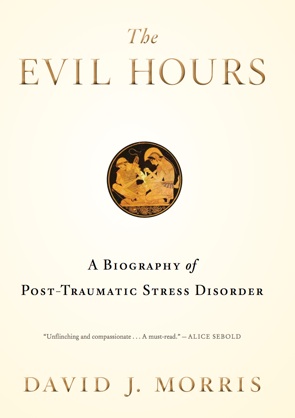
Evil Hours Cover Final

If you want to know more about the genealogy of post-traumatic stress, I recommend David J. Morris, The evil hours: a biography of post-traumatic stress disorder (Eamon Dolan/Houghton Mifflin Harcourt, 2015).   You can read an extract over at Salon here.  The book is particularly relevant to this discussion because it suggests that where trauma was once mediated through philosophy and literature it is now constituted through psychology and psychiatry.  David is very good on the arguments that raged over ‘shell-shock’ during the First World War, but if you want a ‘biography’ of that then you should turn to Michèle Barratt‘s Casualty figures: how five men survived the First World War (Verso, 2007).

Finally, Roy’s Learning to die in the Anthropocene is due from City Lights in the fall; you can get a taste of it from his essay in the New York Times with the same title here; this was the final installment of a five-part series on War and the city in which Roy retraced his footsteps from civilian to soldier to civilian.

Freedom fries, anyone?

Three more contributions to the Charlie Hebdo debate to think about.  The first is from Pankaj Mishra at the Guardian.  Not sure about his call for a ‘new Enlightenment’ – though there was certainly much wrong with the old one – but it’s a luminously (sic) intelligent argument.  He writes about ‘a profound clash – not between civilisations, or the left and the right, but a clash of old and new visions of the world in the space we call the west, which is increasingly diverse, unequal and volatile.’

It is not just secular, second-generation immigrant novelists [Hari Kunzru, Laila Lalami and Teju Cole] who express unease over the unprecedented, quasi-ideological nature of the consensus glorifying Charlie Hebdo’s mockery of Islam and Muslims. Some Muslim schoolchildren in France refused to observe the minute-long silence for the victims of the attack on Charlie Hebdo mandated by French authorities.

It seems worthwhile to reflect, without recourse to the clash of civilisations discourse, on the reasons behind these striking harmonies and discords. Hannah Arendt anticipated them when she wrote that “for the first time in history, all peoples on earth have a common present … Every country has become the almost immediate neighbour of every other country, and every man feels the shock of events which take place at the other end of the globe.” Indeed, it may be imperative to explore this negative solidarity of mankind – a state of global existence in which people from different pasts find themselves thrown together in a common present.’

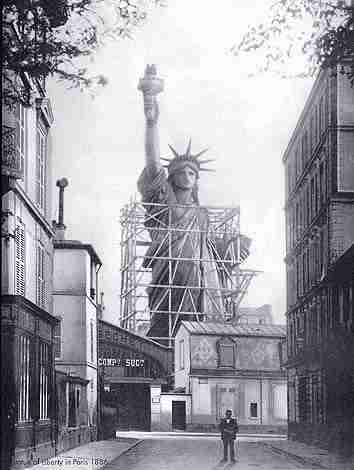
Construction of Statue of Liberty in Paris.comI think that’s right, which is why I’m disconcerted by Pankaj’s focus on Europe; I certainly don’t think the murders in Paris can be assimilated to ‘an assault on American values’ (far from it), but the complicated and often confounding relations between the two republics need excavation too.  They go back far beyond the gift of the Statue of Liberty to the US in the 1880s – I discussed this in what is still my favourite chapter in Geographical Imaginations – and reach forward to include the double, displaced misadventures in Indochina (not least the conviction that the US would sort out Vietnam after France had failed to do) and, still more proximately, France’s refusal to support the US-led invasion of Iraq (“freedom fries“, anyone?).

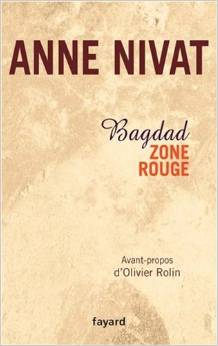
NIVAT Bagdad zone rougePankaj is simply brilliant on the ghosts of the colonial past, as you would expect, and they reappear in a different spectral guise in a short essay by Anne Nivat at Warscapes.  She provided some of the most reflective reporting from occupied Iraq (see her Bagdad, zone rouge), and in ‘Charlie Hebdo and the Boomerang Effect’ she mines that rich vein of experience to reflect on the knee-jerk responses to the murders in Paris:

In a democracy, one has the privilege of freedom of expression, and it is in the name of this that, for years, I have been traveling to the lands of “Islamist” wars.

For some time, I have been amazed, and even hurt, to hear friendly voices claim not to understand why I continue to give the floor to “the other side”; to those who make us afraid; to the “bad guy”; the “barbarian”; the “jihadist”; the Taliban; the “Islamic fighters” – the ones our allies have sought out to fight, or to “bump off in the outhouse,” as Russian President Vladimir Putin so elegantly put it in 2000 in reference to Chechen separatist fighters (Western military and political leaders typically use less violent vocabulary, but the meaning remains the same).

I regret that the attempts to know the “enemy” – my work, and others’ – have not been sufficient, as evidenced by the onslaught of hate on social networks.

And at the same site Andrew Ryder explores the multiform versions of ‘hate’ in ‘Charlie Hebdo and the limits of nihilism’.  He maps the gavotte between iconoclasm and nationalism and in so doing returns us to the figure of the Republic and to the dilemmas exposed by Pankaj Mishra.

Three years ago, [the editor of Charlie Hebdo] said, “If we say to religion, ‘You are untouchable,’ we’re fucked.” His idea was that no religion should be free from mockery, because to allow this is to permit the continuing subjugation of human freedom by religious superstition…

However, Charb also said, that same year, “I don’t blame Muslims for not laughing at our drawings. I live under French law. I don’t live under Koranic law.” This is the point where this apparent commitment to freedom actually masks French nationalism. What he is really saying, whether he was conscious of it or not, is that traditional French secularism, the products of a distinct national revolutionary tradition, should take absolute precedence over the values of immigrants. The secularism takes the shape of social chauvinism. In this context, it’s no longer a progressive contribution to the liberation of human beings. The apparent irreverence is bound to a greater advocacy of European heritage over the cultural character of the immigrants who now comprise such a large part of its society, and who were traditionally colonized and exploited by the ostensibly progressive and liberal nations whose secular values are then rhapsodized… [T]his complicity with racism was probably unrecognizable to him. We can see this today in the irony of the French right, paying homage to a magazine that hated them.

Novel wars

Since I added ‘The Natures of War’ to the DOWNLOADS section several people have asked me about my use of novels, especially in relation to Vietnam, while others have asked me to recommend writings – both novels and memoirs – that treat contemporary conflicts, especially Afghanistan.
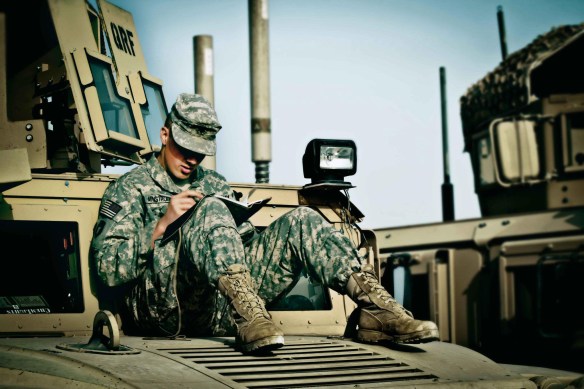
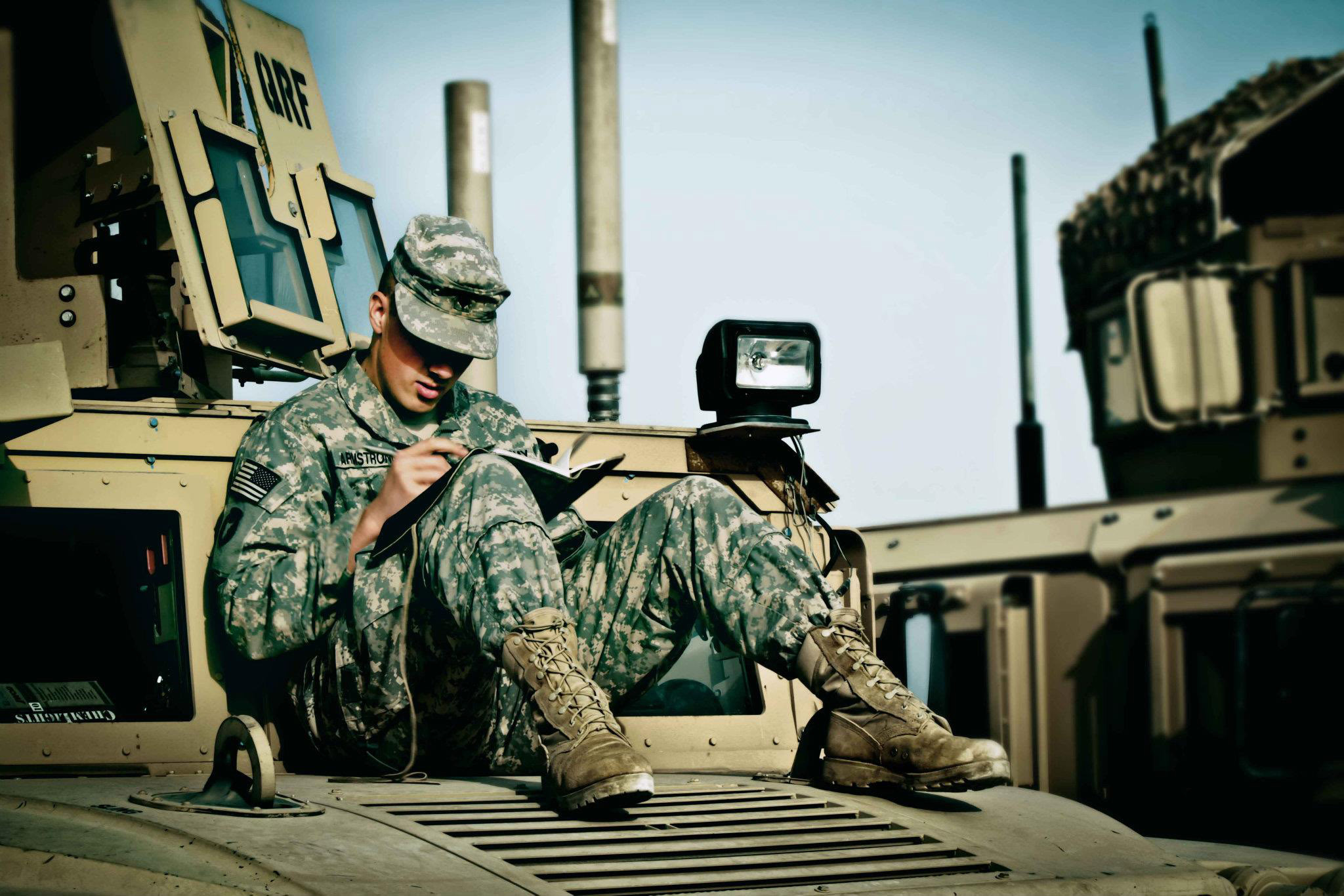
Writing letters to home

The first part is easy.  To say things too quickly, I think the usual distinction between ‘fiction’ and ‘non-fiction’ is much more problematic than it seems (don’t we all know this? and in any case where exactly do you place a ‘memoir’ in such a strangely bifurcated landscape?).  I also believe that there are some insights – truths, if you prefer – that are best conveyed in ostensibly fictional form.  For that reason I suspect it’s significant that it’s my appeal to (for example) Karl Marlantes‘s magnificent Matterhorn in the Vietnam section that seems to trouble some readers much more than my use of poetry in the section on the Western Desert in the Second World War.  Yet both emerged through their authors’ reflections on their experiences of modern war in those places.  That doesn’t mean that one can ignore literary conventions or linguistic devices – no text is a transparent reflection of the world, after all – but this surely also holds for nominally factual accounts too (and that goes for military blogs, which have created their own conventions).  In other ‘fictional’ cases I can think of – like Tom McCarthy‘s C, which I drew upon in ‘Gabriel’s Map’ to characterise the battlefields of the Western Front  – the narrative is clearly embedded in intensive and immensely thoughtful research.  In fact, I’d push this further: hence my interest in documentary drama as part of – not simply a product of – the research process.

The second question is more difficult, but there are some recent guides which might help.  A good place to start is George Packer‘s ‘Home Fires: how soldiers write their wars‘ which appeared in the New Yorker last spring.  Packer tries to pin down what is distinctive about writing that seeks to capture the wars fought in the shadows of 9/11:

‘The first wave of literature by American combatants in these long, inconclusive wars has begun to appear—poems, memoirs, short stories, novels. Their concerns are the same as in all war writing: bravery and fear, the thin line between survival and brutality, the maddening unknowability of the enemy, tenderness, brotherhood, alienation from a former self, the ghosts of the past, the misfit of home.

But Iraq was also different from other American wars… Without a draft, without the slightest sacrifice asked of a disengaged public, Iraq put more mental distance between soldiers and civilians than any war of its duration that I can think of. The war in Iraq, like the one in Vietnam, wasn’t popular; but the troops, at least nominally, were—wildly so. (Just watch the crowd at a sports event if someone in uniform is asked to stand and be acknowledged.) Both sides of the relationship, if they were being honest, felt its essential falseness.’

Given this disconnect, he concludes, ‘it’s not surprising that the new war literature is intensely interested in the return home.’  But when it deals with the soldiers’ experience of war, he continues,

‘It deals in particulars, which is where the heightened alertness of combatants has to remain, and it’s more likely to notice things. To most foreign observers, the landscape of Iraq is relentlessly empty and ugly, like a physical extension of the country’s trauma. But in the poetry and the prose of soldiers and marines the desert comes to life with birdsong and other noises, the moonlit sand breeds dreams and hallucinations.’

It’s that struggle to turn the experience of land into its evocation that interests me.  But Packer makes surprisingly little of it, and his gaze is focused almost unwaveringly on Iraq rather than Afghanistan (not surprising, given his own war reporting).

Writing in the New York TimesMichiko Kakutani identifies a series of writings on the human costs of what Dexter Filkins called ‘the forever war’:

‘War cracks people’s lives apart, unmasks the most extreme emotions, fuels the deepest existential questions. Even as the wars in Iraq and Afghanistan morph into shapeless struggles with no clear ends in sight, they have given birth to an extraordinary outpouring of writing that tries to make sense of it all: journalism that has unraveled the back story of how and why America went to war, and also a profusion of stories, novels, memoirs and poems that testify to the day-to-day realities and to the wars’ ever-unspooling human costs.

‘All war literature, across the centuries, bears witness to certain eternal truths: the death and chaos encountered, minute by minute; the bonds of love and loyalty among soldiers; the bad dreams and worse anxieties that afflict many of those lucky enough to return home. And today’s emerging literature … both reverberates with those timeless experiences and is imprinted with the particularities of the conflicts in Afghanistan and Iraq: changes in technology, the increased presence of female soldiers and, most importantly, the all-volunteer military, which has opened a chasm between soldiers (“the other 1 percent”) and civilians.’

Here too there is an attempt to see how today’s writing differs from the established canon of war literature.  En route, Kakutani makes some good suggestions for reading, but she says very little about the differences – those dense ‘particulars’ again – between Iraq and Afghanistan.
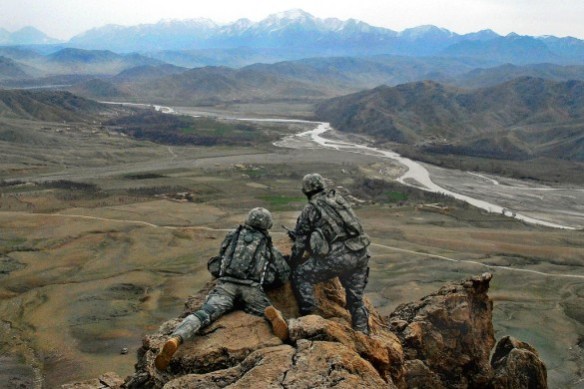
afghan1

She leaves that to Brian Castner‘s outstanding essay for the LA Review of Books, ‘Afghanistan: a stage without a play.’

Castner did two tours in Iraq, and his own account of that experience (and, just as important, what followed) in The Long Walk is a tour de force in every sense of the phrase.  But he is also remarkably perceptive in his readings of Afghanistan (‘the Undescribed War’, he calls it) and – of particular interest to me, given my interest in ‘the natures of war’ or what my good friend Gastón Gordillo would prefer me to call ‘terrain‘ – its land and landscapes.  Castner also draws several illuminating comparisons with Vietnam (not least through a double parallel with the US’s ‘Indian Wars’ of the nineteenth century).

Kevin Maurer covered both wars, and always found

“Afghanistan far more riveting than Iraq because it’s a whole different world. Baghdad is a Middle Eastern city, but it is a modern city. In Afghanistan that barely exists. I’ve always been able to turn my brain into Afghanistan mode and out, while Iraq blurs.”

The influence of the terrain, especially its beauty, is clear: while a few descriptions of colorful Iraqi skies creep into the literature, it was mostly an ugly urban war fought along the New York State Thruway, rest stop to rest stop. “Afghanistan always had that Vietnam vibe to it,” Maurer said, “because you can go get lost in Afghanistan, you can be on some hill on some outpost. In Iraq you were never that far out.”

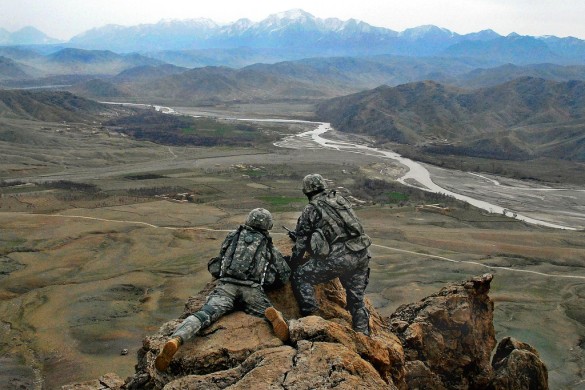
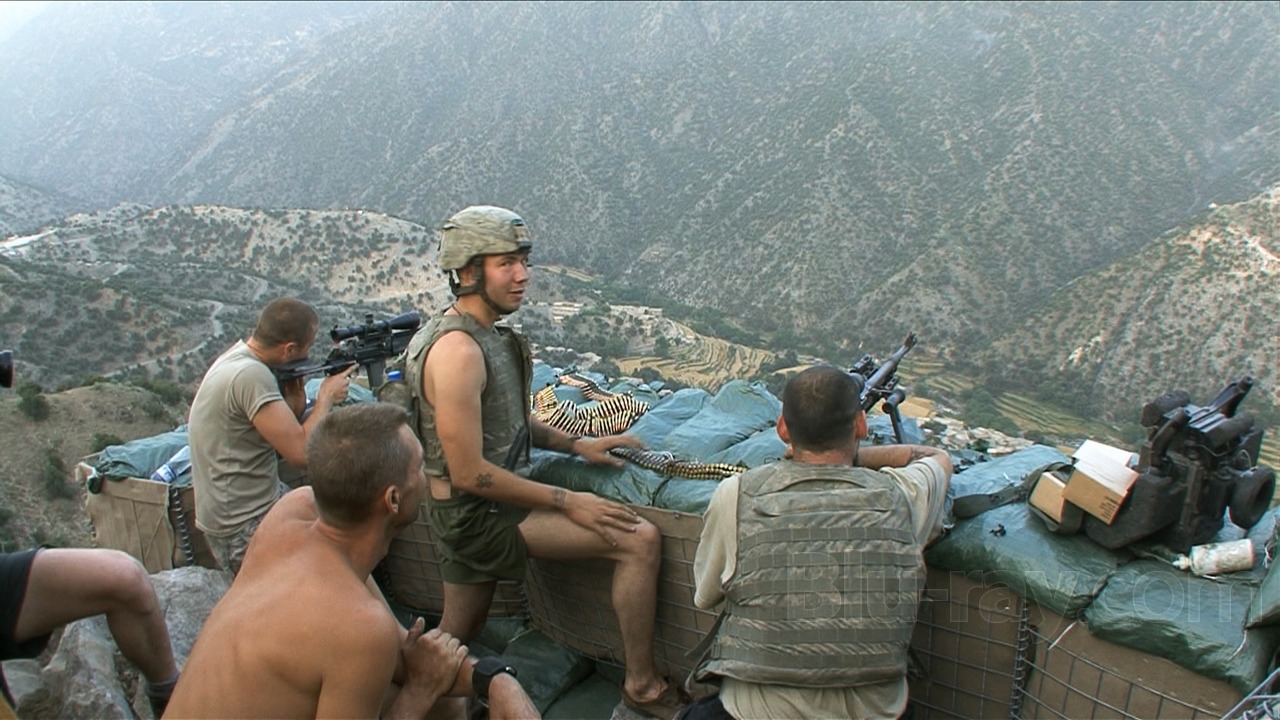
Korengal

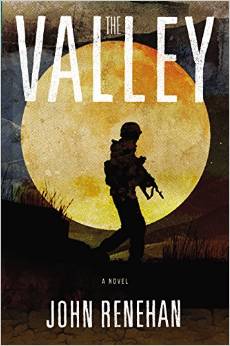
And for that very reason the terrain was always more than beautiful.  You can see that in a film like Restrepo – and even more clearly in Koregal (above) – but according to Castner you can also see it in John Renehan’s forthcoming novel, The Valley.  And here too Vietnam continues to haunt the imaginative landscape:

RENEHAN The ValleyThe landscape acts as an omnipresent consciousness, an apparition always in the corner of [Lieutenant] Black’s eye, and Renehan attaches to it layers of reverence and dread and unknowable quasi-mysticism; the valley is capable of anything. This infection spreads slowly for the reader, and Renehan says his writing process followed a similar path. “I more or less thought I was setting out to write a mystery story that happened to be set in a war. But as I started writing it I realized it was growing into something different in my mind, and it changed on paper too.” A detective story becomes a heroin- and concussion-fueled dreamscape that crosses genres. “Going After Cacciato gave me comfort in writing the parts of The Valley that become almost surreal,” Renehan said. “It reassured me that this sort of thing is okay, because it’s a war novel, right?”

What I need to think more about – the process I started in ‘Gabriel’s Map’ and continued in ‘The Natures of War’ – is how, despite Castner’s title, the stage is always part of the play.  And novels and poems will continue to help me do so.

POSTSCRIPT  Just after I finished drafting this post, I stumbled across ‘s Peter Molin‘s excellent blog: Time Now: the Iraq and Afghan wars in art, film and literature which also discusses the three reviews I list here.  Peter is a US Army officer who served in Afghanistan in 2008-9, and his posts are rich in ideas, insights and resources: well worth bookmarking.