War and therapeutic geographies

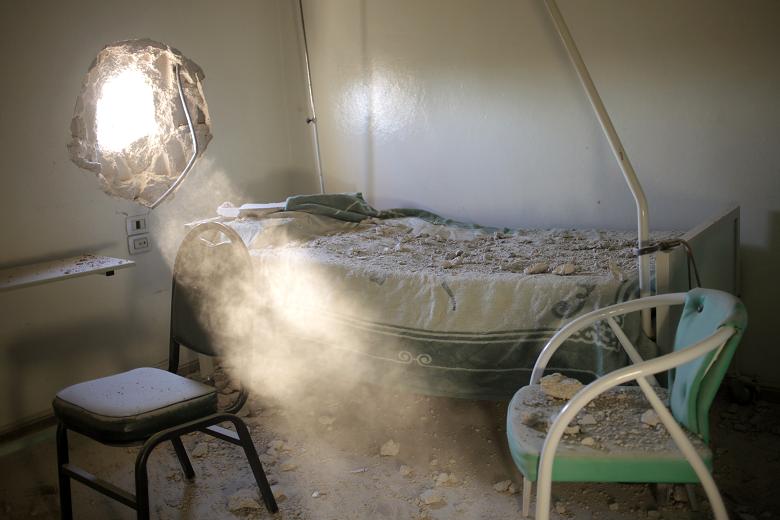
Tall Rifat hospital near Aleppo attacked by helicopter gunships June 2012

I previously noted the problems of providing medical care to those fleeing the war in Syria – and to those who’ve been left behind – and an article by Thanassis Cambanis in the Boston Globe (‘Medical care is now a tool of war’) reinforces the importance of the issue:

 The medical students disappeared on a run to the Aleppo suburbs. It was 2011, the first year of the Syrian uprising, and they were taking bandages and medicine to communities that had rebelled against the brutal Assad regime. A few days later, the students’ bodies, bruised and broken, were dumped on their parents’ doorsteps.

Dr. Fouad M. Fouad, a surgeon and prominent figure in Syrian public health, knew some of the students who had been killed. And he knew what their deaths meant. The laws of war—in which medical personnel are allowed to treat everybody equally, combatants and civilians from any side—no longer applied in Syria.

“The message was clear: Even taking medicine to civilians in opposition areas was a crime,” he recalled.

As the war accelerated, Syria’s medical system was dragged further into the conflict. Government officials ordered Fouad and his colleagues to withhold treatment from people who supported the opposition, even if they weren’t combatants. The regime canceled polio vaccinations in opposition areas, allowing a preventable disease to take hold. And it wasn’t just the regime: Opposition fighters found doctors and their families a soft target for kidnapping; doctors always had some cash and tended not to have special protection like other wealthy Syrians.

Doctors began to flee Syria, Fouad among them. He left for Beirut in 2012. By last year, according to a United Nations working group, the number of doctors in Aleppo, Syria’s largest city, had plummeted from more than 5,000 to just 36.

Since then, Fouad has joined a small but growing group of doctors trying to persuade global policy makers—starting with the world’s public health community—to pay more urgent attention to how profoundly new types of war are transforming medicine and public health.

It is grotesquely ironic that ‘global policy-makers’ should have to be persuaded of the new linkages between war, medicine and public health, given how often later modern war is described (and, by implication, legitimated) through medical metaphors: see in particular Colleen Bell, ‘War and the allegory of medical intervention: why metaphors matter’, International Political Sociology 6: 3 (2012) 325-28 and ‘Hybrid warfare and its metaphors’, Humanity 3 (2) (2012) 225-47.

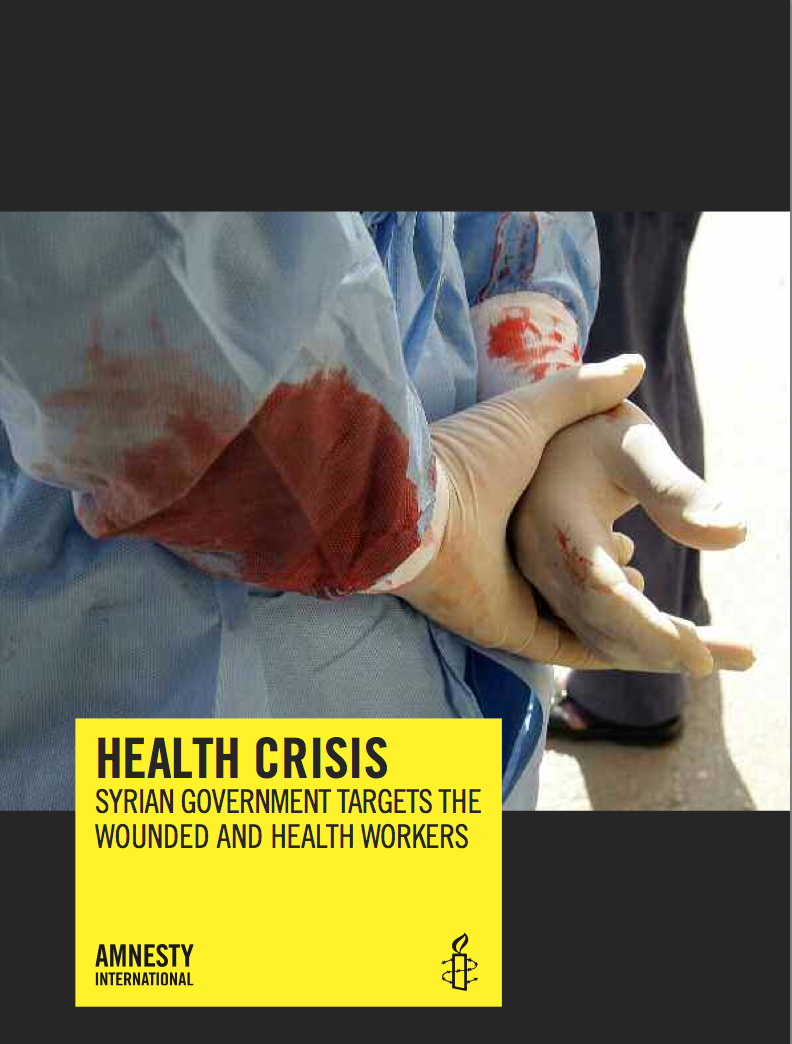
AI Health Crisis in SyriaBut there are, as Fouad emphasises, quite other, densely material biopolitics attached to contemporary military and paramilitary violence, including not only the targeting of medical staff, as he says, but also their patients.

“In Syria today, wounded patients and doctors are pursued and risk torture and arrest at the hands of the security services,” said Marie-Pierre Allié, president of [Médecins san Frontières’]. “Medicine is being used as a weapon of persecution.”

In October 2011 Amnesty International described the partisan abuse of the wounded in hospitals in Damascus and Homs, and the denial of medical care in detention facilities, in chilling detail.

At least then (and there) there were hospitals.  Linking only too directly to my previous post on Aleppo, Cambanis concludes:

Today, Fouad’s former home of Aleppo is largely a ghost town, its population displaced to safer parts of Syria or across the border to Turkey and Lebanon. The city’s former residents carry the medical consequences of war to their new homes, Fouad said—not just injuries, but effects as varied as smoking rates, untreated cancer, and scabies. Wars like those in Syria and Iraq don’t follow the old rules, and their effects don’t stop at the border.

I first became aware of these issues at a conference on War and medicine in Paris in December 2012, which prompted my current interest in the casualties of war, combatant and civilian, and the formation of modern medical-military machines.  Several friends from the Paris meeting (Omar Dewachi, Vinh-Kim Nguyen and  Ghassan Abu Sitta) have since joined with other colleagues to produce a preliminary review published this month in The Lancet: ‘Changing therapeutic geographies of the Iraqi and Syrian wars’.  They write:

War is a global health problem. The repercussions of war go beyond death, injury, and morbidity. The effects of war are long term, reshaping the everyday lives and survival of entire populations.

In this report,we assess the long-term and transnational dimensions of two conflicts: the US-led occupation of Iraq in 2003 and the ongoing armed conflict in Syria, which erupted in 2011. Our aim is to show that, although these conflicts differ in their geopolitical contexts and timelines, they share similarities in terms of the effects on health and health care. We analyse the implications of two intertwined processes—the militarisation and regionalisation of health care.  In both Syria and Iraq,boundaries between civilian and combatant spaces have been blurred. Consequently,hospitals and clinics are no longer safe havens. The targeting and misappropriation of health-care facilities have become part of the tactics of warfare. Simultaneously, the conflicts in Iraq and Syria have caused large-scale internal and external displacement of populations. This displacement has created huge challenges for neighbouring countries that are struggling to absorb the health-care needs of millions of people.

They emphasise ‘the targeting and implication of medicine in warfare’ and note that ‘the militarisation of health care follows the larger trends of the war on terror, where the boundaries between civilian and combatant spaces are broadly disrespected.’  They have in mind ‘not only the problem of violence against health care, but also [the ways in which] health care itself has become an instrument of violence, with health professionals participating (or being forced to participate) in torture, the withholding of care, or preferential treatment of soldiers.’

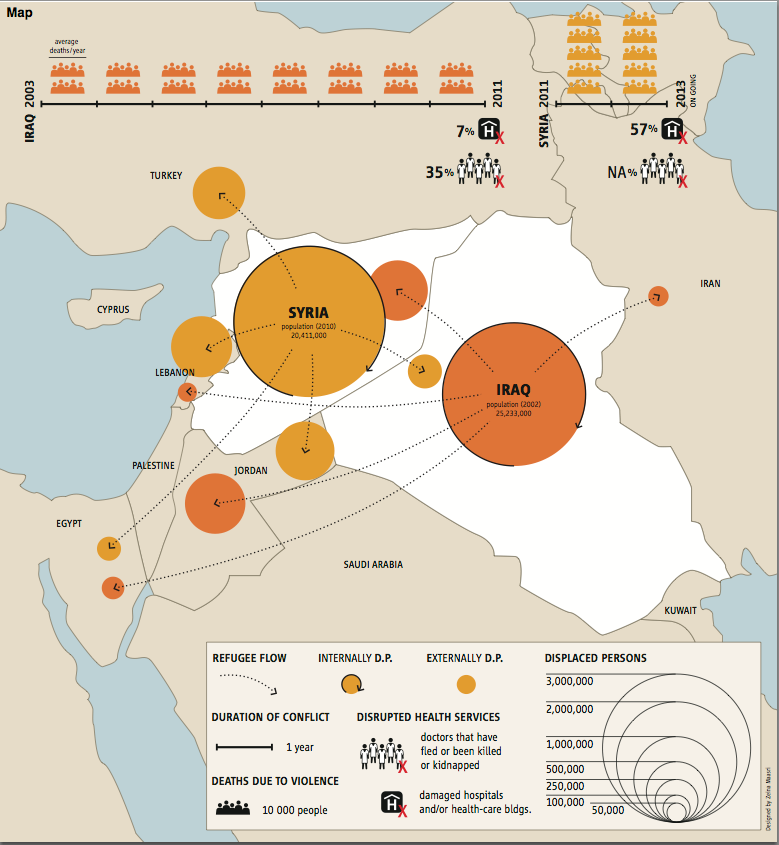
And they describe a largely unplanned dispersal of medical care across the region that blurs other – national – boundaries, requiring careful analysis of the ‘therapeutic geographies‘ which trace the precarious and shifting journeys through which people obtain medical treatment in and beyond the war zone.  They insist that ‘migrants seeking refuge from violence cannot be framed and presented as mere victims but as people using various strategies to acquire health care and remake their lives.’ The manuscript version of the report included the map below, which illustrates the scale of the problem:

Therapeutic geographies

My own work addresses similar issues through four case studies over a longer time-span, to try to capture the dynamics of these medical-military constellations: the Western Front in 1914-18, the Western Desert in the Second World War, Vietnam, and Afghanistan 2001-2014 (see ‘Medical-military machines’, DOWNLOADS tab).

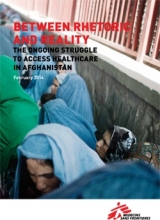
msf-afghanistan-report-finaToday Médecins sans Frontières published an important report, Between rhetoric and reality:  the ongoing struggle to access healthcare in Afghanistan, that speaks directly to these concerns.  Like the Lancet team, the report explores the ways in which war affects not only the provision of healthcare for those wounded by its violences but also access to healthcare for those in the war zone who suffer from other, often chronic and life-threatening illnesses: ‘The conflict creates dramatic barriers that people must overcome to reach basic or life- saving medical assistance. It also directly causes death, injury or suffering that increase medical needs.’  Releasing their findings, MSF explained:

After more than a decade of international aid and investment, access to basic and emergency medical care in Afghanistan remains severely limited and sorely ill-adapted to meet growing needs created by the ongoing conflict…  While healthcare is often held up as an achievement of international state-building efforts in Afghanistan, the situation is far from being a simple success story. Although progress has been made in healthcare provision since 2002, the report … reveals the serious and often deadly risks that people are forced to take to seek both basic and emergency care.

The research – conducted over six months in 2013 with more than 800 patients in the hospitals where MSF works in Helmand, Kabul, Khost and Kunduz provinces – makes it clear that the upbeat rhetoric about the gains in healthcare risks overlooking the suffering of Afghans who struggle without access to adequate medical assistance.

“One in every five of the patients we interviewed had a family member or close friend who had died within the last year due to a lack of access to medical care,” said Christopher Stokes, MSF general director. “For those who reached our hospitals, 40 per cent of them told us they faced fighting, landmines, checkpoints or harassment on their journey.”

The patients’ testimonies expose a wide gap between what exists on paper in terms of healthcare and what actually functions. The majority said that they had to bypass their closest public health facility during a recent illness, pushing them to travel greater distances – at significant cost and risk – to seek care.

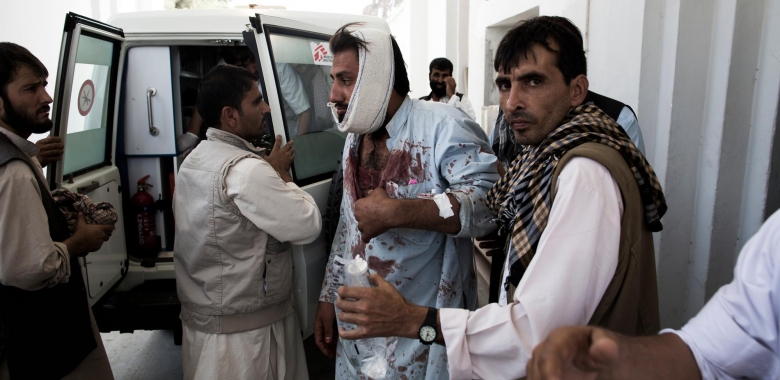
MSF provides a photoessay describing some of these precarious journeys (‘Long and dangerous roads’) here, from which I’ve taken the photograph below, showing an inured man being led by a relative into the Kunduz Trauma Centre.

MSB5652

When soldiers fall

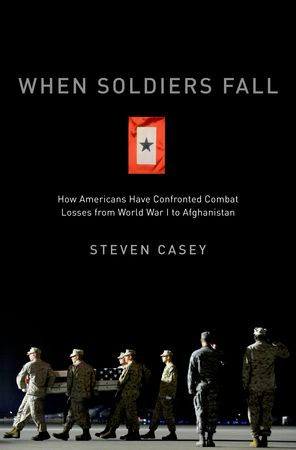
CASEY When soldiers fallNews of an important new book that feeds directly into my new project on medical-military machines and casualties of war, 1914-2014: Steven Casey‘s When Soldiers Fall: How Americans Have Confronted Combat Losses from World War I to Afghanistan (OUP, January 2014).  My own project is concerned with the precarious journeys of those wounded in war-zones (combatants and civilians) rather than those killed and the politics of ‘body-counts’, but Casey’s work presents a vigorous challenge to the usual assumptions about public responses to combat deaths:

The extent to which combat casualties influence the public’s support for war is one of the most frequently and fiercely debated subjects in current American life and has cast an enormous shadow over both the Iraq and Afghanistan conflicts. The common assumption, based largely on U.S. experience in past wars, is that the public is in some way casualty averse or casualty shy, and that as losses increase its support for a war will inexorably decline. Yet this assumption has been adopted as conventional wisdom without any awareness of one of the most important dimensions of the issue: how has the public become aware of the casualties sustained during particular wars? To what extent has the government tried to manipulate or massage the figures? When and why have these official figures been challenged by opportunistic political opponents or aggressive scoop-seeking reporters?

As Steven Casey demonstrates, at key moments in most wars what the public actually receives is not straightforward and accurate casualty totals, but an enormous amount of noise based on a mixture of suppression, suspicion, and speculation. This book aims to correct this gap in information by showing precise what casualty figures the government announced during its various wars, the timing of these announcements, and any spin officials may have placed upon these, using a range of hitherto untapped primary documents. Among the nuggets he has uncovered is that during World War I the media depended on Axis figures and that the Army and Navy did not announce casualty figures for an entire year during World War II. Organized chronologically, the book addresses the two world wars, the limited wars in Korea and Vietnam, and the recent conflicts that are part of the War on Terror. Using sources such as the private military command papers of Generals Patton, MacArthur, and Westmoreland, and previously unopened New York Times archives, it offers the first analysis of how the U.S. government has publicized combat casualties during these wars, and how these official announcements have been debated and disputed by other voices in the polity. Casey discusses factors such as changes of presidential administration, the improvement of technology, the sending of war correspondents to cover multiple conflicts, and the increasing ability to identify bodies. Casey recreates the complicated controversies that have surrounded key battles, and in doing so challenges the simplicity of the oft-repeated conventional wisdom that “as casualties mount, support decreases.” By integrating military and political history, he presents a totally new interpretation of U.S. domestic propaganda since 1917, filling a major gap left by a spate of recent books. Finally, it provides a fresh and engaging new perspective on some of the biggest battles in recent American history, including the Meuse-Argonne, D-Day, the Battle of the Bulge, China’s intervention in the Korean War, the Tet Offensive, and the recent campaigns in Iraq and Afghanistan.

Amazon has temporarily withdrawn its Kindle edition because there are technical issues that it is working with OUP to resolve: I hope this is sorted out soon…  But for now you can read an extract over at Salon, ‘How Richard Nixon reinvented American warfare (…and paved the way for Iraq and Afghanistan)’:

Determined to prop up South Vietnam in an election year, Nixon’s casualty sensitivity had not extended beyond American lives to enemy noncombatants. “Now, we won’t deliberately aim for civilians,” he told his senior advisers at one point in 1972, “but if a few bombs slop over, that’s just too bad.” In Nixon cold calculation the American electorate was principally concerned with U.S. losses; it cared far less about what happened to civilians….

In the wake of defeat, the U.S. government tried to learn the appropriate lessons. As well as reconsidering military-media relations, officials thought long and hard about the conditions under which the public would support the use of force—and the prospect of casualties—in the future. Sometimes, they looked back beyond Vietnam to an earlier era when the media had appeared more manageable and the public less skeptical. Of course, even during the two world wars and Korea, the government had always faced searching questions about the veracity of its casualty information. But Vietnam had clearly changed the rules of the game. Trust in government was much lower. The media was even keener to probe for the story behind the official narrative. And the whole debate was now even more sensitive to the human cost of war. These were all legacies that the two Bushes would have to grapple with in the post–Cold War era, as they took the United States into war against a new set of enemies.

Soldiers of Fortune

In the wake of the far too early death of the brilliant John Fortune, the Guardian has reminded me of this stunning sketch with John Bird about the British Army planning for the Iraq War.  As you’ll see, it’s also about Geography and War.

Theory of the drone 12: ‘Killing well’?

This is the 12th in a series of extended posts on Grégoire Chamayou‘s Théorie du drone and covers the final chapter in Part III: Necro-ethics, called ‘Précisions’; in French the singular means accuracy, as you might expect, but the plural means ‘details’ – which is, of course, where the devil is to be found…

One of the most common claims advanced by those who defend the use of armed drones is that they reduce ‘collateral damage’ because they are so precise.  Following directly from his previous critique of Bradley Jay Strawser, Chamayou cites him again here: ‘Drones, for all their current and potential misuse, have the potential for tremendous moral improvement over the aerial bombardments of earlier eras.’  But he dismisses this as a misleading comparison: if Dresden or Hiroshima are taken as the yardstick against which accuracy is to be measured – or, for that matter, as the standard against which military ethics are to be judged – then virtually any subsequent military operation would pass both tests with flying colours.

The comparison confuses form with function.  Compared to Lancaster bombers and Flying Fortresses (even with their famous Norden bombsights: for Malcolm Gladwell on the ‘moral importance’ of the bombsight to Norden, a committed Christian, see here and here; for more on the bombsight, see here), the Predator and the Reaper are evidently more accurate.  But Chamayou insists that the real comparison ought to be with other tactical means currently available to achieve the same objective.
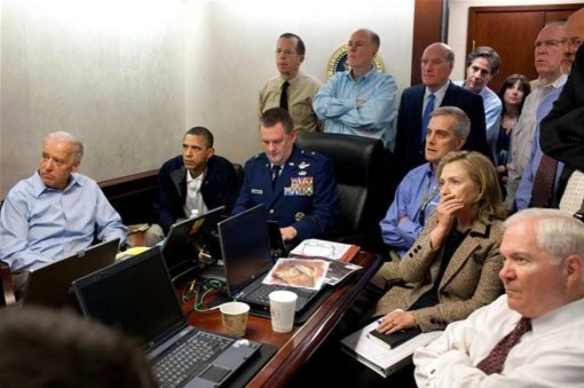
Situation Room

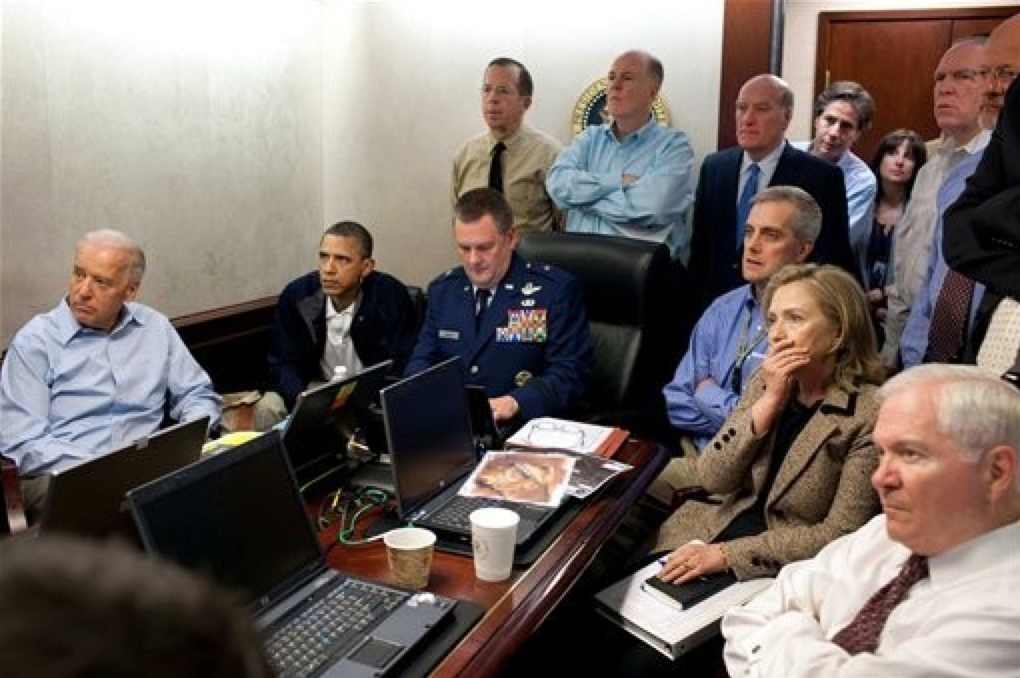
In the kill/capture raid against Osama Bin Laden on 1 May 2011 (assuming ‘capture’ was ever on the agenda), he argues that the choice was between drones and Special Forces not between drones and re-staging Dresden in Abbotabad.  This doesn’t quite work, since the raid was carried out by US Navy Seals who swept in from Bagram via Jalalabad by helicopter, but the mission also depended on real-time imagery from an RQ-170 stealth drone (‘the Beast of Kandahar’).  This was the source of the live video feed watched by Obama and members of his administration in the famous ‘Situation Room’ photograph [on which, see Keith Feldman on ‘Empire’s Verticality’ in Comparative American Studies 9 (4) (2011) 325-41].

The RQ-170 is an unarmed platform, but its role should remind us that drones are part of networked warfare – even when strikes are carried out by other means, the enhanced intelligence, surveillance and reconnaissance capabilities provided by the long dwell-times of these remote platforms mean that they are instrumental in the activation of the kill-chain.  This holds for military operations far beyond targeted killing: in Afghanistan between 2009 and 2011 drones were directly responsible for only 5-6 per cent of weapons released by the US Air Force, but they no doubt played a vital role in the release of many of the others.
Night raidStill, Chamayou’s basic point is a sharp one – and I rehearsed similar arguments in my discussion of The politics of drone wars last year – but readers of Jeremy Scahill‘s Dirty Wars may still reasonably object that the civilian casualties resulting from JSOC’s infamous night raids in Afghanistan cast doubt on the precision and accuracy of ground forces too.  Gareth Porter has estimated that more than 1,500 civilians were killed in night raids in just ten months in 2010-11, making them ‘by far the largest cause of civilian casualties in the war in Afghanistan.’  Indeed, Afghan protests have frequently centred on the civilian toll exacted by drones and night raids.

Even if the appropriate comparison is between different modalities of military violence in the present, Chamayou argues that the discussion is bedevilled by another series of confusions about ‘accuracy’ or ‘precision’.   In fact, though he doesn’t say so, the the two terms aren’t interchangeable. Strictly speaking,  accuracy refers to the deviation from the aiming point, precision to the dispersion of the strike:
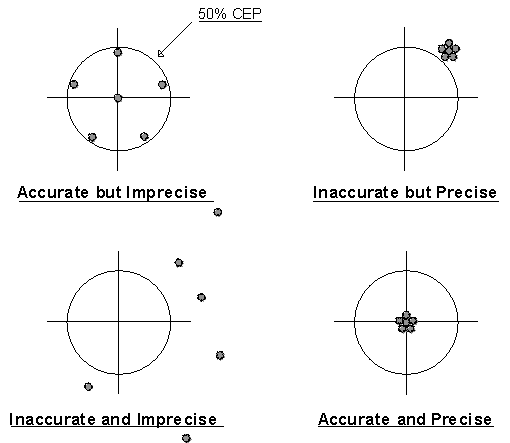
Accuracy and precision

CEP in the diagram above refers to the Circular Error Probable, once described by the Pentagon as ‘an indicator of the delivery accuracy of a weapon system’, which is a circle of radius n described around the aiming point.  Assuming a bivariate normal distribution, then – all other things being equal (which they rarely are) – 50% of the time a bomb, missile or round will land within the circle: which of course means that the other half of the time it won’t, even under ideal experimental conditions.  As this is a normal distribution, then 93 per cent should land within 2n and more than 99 per cent within 3n.

Chamayou doesn’t refer to the CEP directly, only briefly to the ‘accuracy of fire’,  but – to revert to the comparison he refuses – the CEP of bombing from the air has contracted dramatically since the Second World War when it was around 3,000 feet (though this improved over time): so much so that David Deptula, when he was USAF Deputy Chief of Staff for ISR, used to talk of crossing a ‘cultural divide of precision and information’.  The image below, taken from one of his presentations, shows the contraction (notice that the aim point is the Pentagon….).
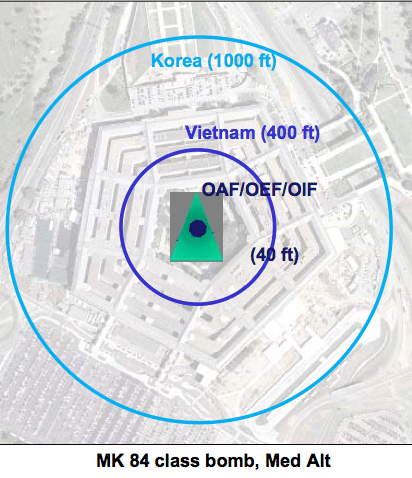
Target mensuration (USAF)

Interestingly, the most recent Joint Publication (3-60) from the Joint Chiefs of Staff on Targeting (January 2013) has explicitly removed the concept from its Terms and Definitions, citing as its authority the Department of Defense’s Dictionary of Military and Associated Terms (it was still there on 31 January 2011, but no longer).  I haven’t been able to discover the reasons for the change, though there is longstanding scepticism about the validity of the measure: see, for a specific example, Donald MacKenzie‘s classic discussion in Inventing accuracy: a historical sociology of nuclear missile guidance (1993, pp. 352-7).  I’ve seen several comments to the effect that the measure isn’t useful for ‘smart bombs’ because they don’t display the same spread as ‘dumb bombs’.  (There’s a quick primer on the emergence of smart bombs during the Vietnam War here, and an account of the evolution of ‘precision strike’ since then here; for more detail, try David Koplow‘s Death by moderation: the US military’s quest for useable weapons (2009)).

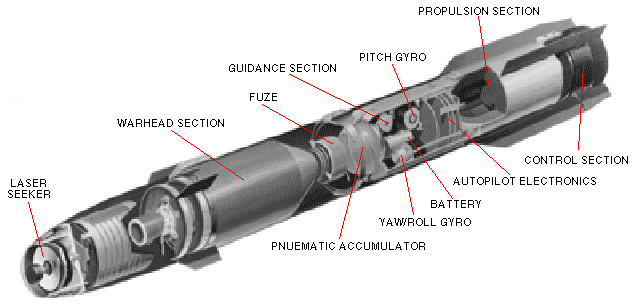
The MQ-1 Predator carries two AGM-114 Hellfire missiles [shown below, top; for acronyphiles, AGM designates an Air-to-Ground Missile, while the ‘Hellfire’ was originally developed as a ‘Helicopter-Launched Fire-and-Forget Missile’; its main platform is still an attack helicopter], while the MQ-9 Reaper can carry four AGM-114 Hellfire Missiles or replace two of them with GBU-12 Paveway II bombs [GBU = Guided Bomb Unit; shown below, bottom].
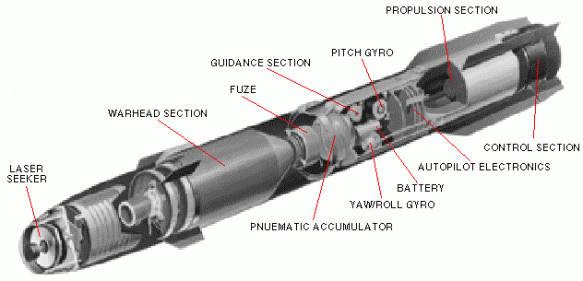

hellfire

GBU-12_xxl

Both weapons systems are laser-guided; the sensor operator, sitting beside the pilot in the Ground Control Station, uses a laser targeting marker (LTM) to ‘paint’ the target – this can also be done by ground troops in conventional combat zones – but its accuracy can be compromised by cloud, smoke, fog or dust.  (This is why the Air Force also uses GPS-guided weapons; they are less accurate but unaffected by these environmental conditions).  Once the necessary clearances have been obtained from mission commanders and military lawyers, the pilot fires the missile and the sensor operator guides it on to its target.

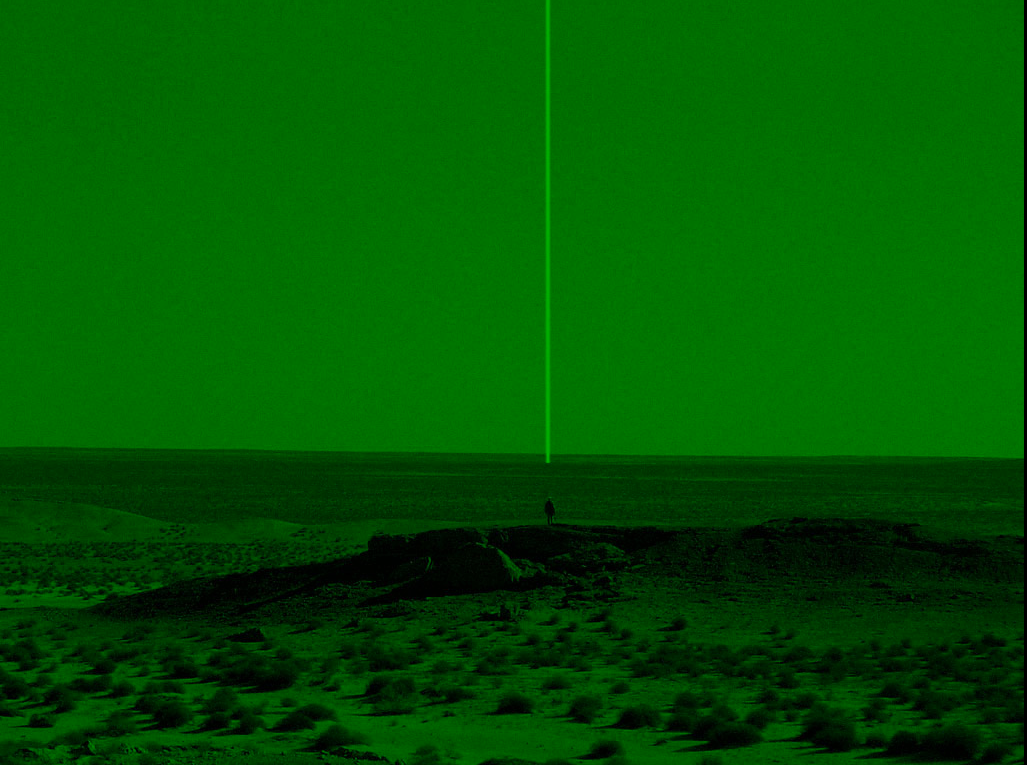
Omer Fast‘s interview with a sensor operator (‘Brandon’ –  whether this is a pseudonym or really Brandon Bryant is hard to know) for 5,000 Feet is the Best provides a series of insights into the operation in Afghanistan and Iraq.  You can’t see the beam with the naked eye, but American ground troops can see it with their infrared goggles.  According to ‘Brandon’, they call it the ‘Light of God’ (really); the image below is James Bridle‘s replication of the effect based on laser targeting night systems and a CC-licensed photograph of the Iraqi desert by Rob Bakker.
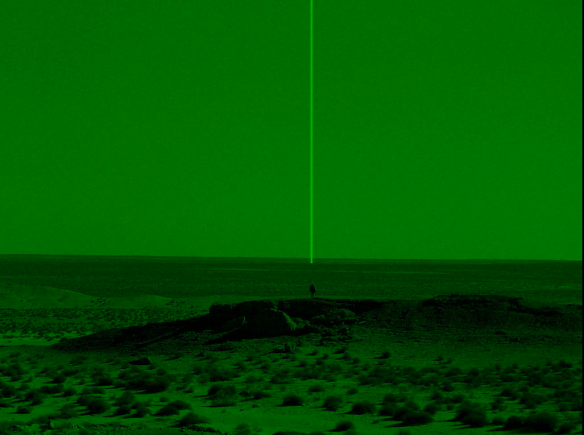
JAMES BRIDLE Light of God

‘Brandon’:

‘Usually the laser track is about half the size of this [hotel] room.  Poof!  By the time it hits the ground… a lot of times it turns into a square for some reason…  It could be anywhere from ten feet by ten feet to twenty feet by twenty feet… It starts off small and you watch it kind of open up’

This is not exactly putting ‘warheads on foreheads‘, but ‘Brandon’ explains that the crew is also required to identify a secondary ‘abort’ target.

‘… some of the contingencies we have to worry about are: if we’re firing at a building and somebody crosses – maybe – who knows, a group of children starts crossing in front of the building, we need a second site once that missile is already off the rails.  To go ahead and drop that missile so that we don’t harm the children  So usually we’ll choose an alternate site a couple hundred feet to a couple of hundred yards away.  It might be an empty field.  And we use that as the backup…

So let’s  say we get the missile off the rail and a group of kids comes into play: I call “abort” and I’ll start moving that laser over to an empty site so that we can detonate there and not cause any additional loss of life.’

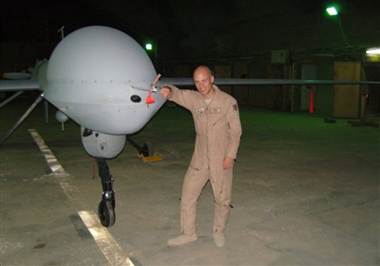
Predator and Brandon Bryant

Sounds good, but the real Brandon Bryant (above) has a different story to tell; it turns out that there is an eight-second window in which the missile can be diverted:

With seven seconds left to go, there was no one to be seen on the ground. Bryant could still have diverted the missile at that point. Then it was down to three seconds. Bryant felt as if he had to count each individual pixel on the monitor. Suddenly a child walked around the corner, he says.

Second zero was the moment in which Bryant’s digital world collided with the real one in a village between Baghlan and Mazar-e-Sharif.

Bryant saw a flash on the screen: the explosion. Parts of the building collapsed. The child had disappeared. Bryant had a sick feeling in his stomach.

“Did we just kill a kid?” he asked the man sitting next to him.

“Yeah, I guess that was a kid,” the pilot replied.

“Was that a kid?” they wrote into a chat window on the monitor.

Then, someone they didn’t know answered, someone sitting in a military command center somewhere in the world who had observed their attack. “No. That was a dog,” the person wrote.

They reviewed the scene on video. A dog on two legs?

Even then, think about that blossoming square, twenty feet by twenty feet.  Then factor in the Circular Error Probable of a Hellfire missile, which is usually calculated at between 9 and 24 feet. The ‘pinpoint’ accuracy of the missile is starting to blur and the ‘surgical’ strike beginning to blunt.  In fact, the development of the Hellfire missile suggests another narrative.  In 1991 the Pentagon was already advertising the Hellfire as capable of ‘pinpoint’ accuracy, and since then it has been upgraded more than half a dozen times, each version promising greater accuracy: as Matthew Nasuti asks in his catalogue of Hellfire errors, what can be more accurate than ‘pinpoint accurate’?

In any case, narrowing the discussion to the CEP misses two things.  First, as former USAAF officer Peter Goodrich points out in his discussion of ‘The surgical precision myth‘, this ‘totally disregards what happens after the bomb explodes’.  What Goodrich has in mind is the blast and fragmentation radius, which Chamayou calls ‘the kill radius’.  Fast’s ‘Brandon’ insists

‘All of us are taught about how far those Hellfire missiles go, how far their frag goes.  And “danger close” as we call it when you have troops that are very close or civilians that are present.  They’re just factors that  you have to work in to bring down the percentages of the harm that could be done.’

In the targeting cycle the US Air Force enters those ‘factors’ into both collateral damage estimation and ‘weaponeering’, modifying the missile or bomb to restrict its blast and fragmentation radius. Chamayou reports that the Hellfire missile has a ‘kill radius’ of 50 feet (15 metres) and a ‘wounding radius’ of 65 feet (20 metres); the GBU-12 Paveway II has a ‘casualty radius’ of between 200 and 300 feet (within which 50 per cent of people will be killed).   These calculations aren’t exactly equivalent – and it’s difficult to obtain precise and comparable figures – but nothing about this is as precise as the rhetoric  implies.  As Chamayou asks:

‘In what fictional world can killing an individual with an anti-tank missile [the Hellfire] that kills every living thing within a radius of 15 metres and wounds everyone else within a radius of 20 metres be seen as “more precise”?’

All those who are killed or wounded within the casualty radius are presumably guilty by proximity.

This is Chamayou’s second rider, which relates to what happens before the bomb or missile is released: to the production – the US military sometimes calls it the ‘prosecution’ – of the target.  In this sense, the technical considerations I’ve just described are beside the point (sic).  All of the calibrations I’ve set out in such detail apply to missiles and bombs irrespective of the platform used to deliver them; what is supposed to distinguish a Predator or a Reaper from a conventional strike aircraft or attack helicopter is that it combines ‘hunter’ and ‘killer’ in a single platform and, specifically, that its real-time full-motion video feeds enable crews (and others in the loop) to see what they are doing in unprecedented detail.
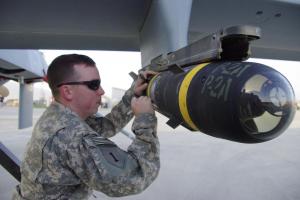
Signing a Hellfire missile attached to a MQ1-C (Gray Eagle) UAV at BagramDoes this political technology of vision make it possible, as advocates claim, to distinguish between combatants and civilians more effectively than ever before?  Here Chamayou rehearses common criticisms: that in standard US military practice ‘combatant’ morphs into ‘militant’, even ‘presumed militant’ and, at the hideous limit, into ‘military-aged male’ – counting ‘all military-age males in a strike zone as combatants … unless there is explicit intelligence posthumously proving them innocent’ – and that this process of (so to speak, performative) militantisation as Chamayou calls it is underwritten by a techno-judicial probabilisation (again his term) whose ‘epistemology of suspicion’ allows signature strikes that target un-named and unknown people on the basis of their ‘pattern of life‘.

But both these procedures and, indeed, the criticisms of them, obscure what is for Chamayou, the fundamental paradox, what he calls the ‘profound contradiction’.  International law defines a combatant and thus a legitimate target in terms of direct participation in hostilities and an imminent threat.  It’s more complicated than that, as I’ll show later, but this is enough for Chamayou to fire off two key questions: How can anyone be participating in hostilities if there is no longer any combat? How can there be any imminent threat if there are no troops on the ground?  The drone, praised for its forensic ability to distinguish between combatant and non-combatant, in fact abolishes the condition necessary for such a distinction: combat itself (p. 203; also p. 208).

It’s an artful claim, but it oversimplifies the situation.  Chamayou has (once again) confined the discussion to targeted killing but, as I’ve repeatedly emphasised, Predators and Reapers have also been used for other purposes in Iraq and Afghanistan, including the provision of ‘armed overwatch’ and close air support to ground troops.  Outside these war-zones – in the Federally Administered Tribal Areas of Pakistan, Yemen, Somalia and elsewhere – the critique is a powerful one (which is not to say that Obama’s lawyers have not claimed a legal warrant for their supposedly covert drone strikes in these areas: more on this later too).  Still, Chamayou’s argument loops back to earlier discussions about the intrinsic non-reciprocity of drone warfare.

And here Chamayou closes with a powerful argument.  If ethics is classically about how to live well and die well, he suggests that necro-ethics is a doctrine of ‘killing well’.  He notes that critics of the covert drone wars demand, time and time again, transparency.  They want to know the legal armature and adjudicative apparatus for the strikes, the rules and procedures that are followed, and the lists of casualties.  But he argues that their demands turn the issue into an arid juridico-administrative formalism endorsed by bureaucratic Reason.  In the kill zones, he says ruefully, there are no legal memoranda, no columns of numbers or ballistics reports (p. 207): these are the very formularies of necro-ethics.  And, as I’ve noted, there are no air-raid warnings, no anti-aircraft defences and no air-raid shelters either.

It’s in that spirit that Chamayou closes the chapter with an extended quotation from Madiha Tahir’s Louder than bombs‘:

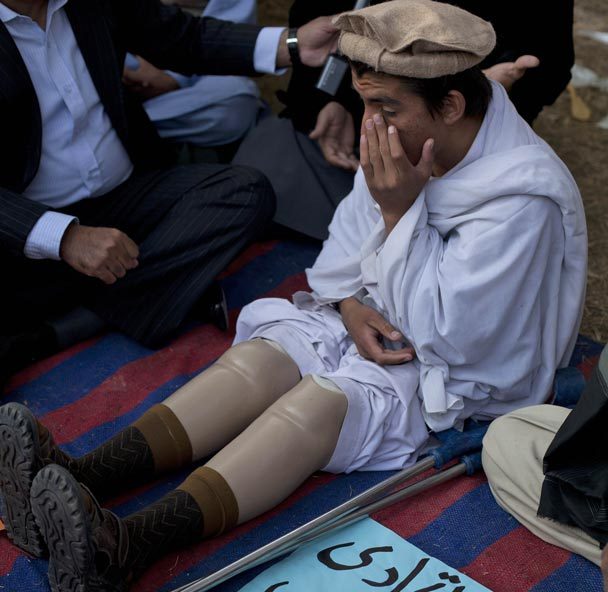
Saudallah WazirWhat is the dream?

I dream that my legs have been cut off, that my eye is missing, that I can’t do anything … Sometimes, I dream that the drone is going to attack, and I’m scared. I’m really scared.

After the interview is over, Sadaullah Wazir pulls the pant legs over the stubs of his knees till they conceal the bone-colored prostheses.

The articles published in the days following the attack on September 7, 2009, do not mention, this poker-faced, slim teenage boy who was, at the time of those stories, lying in a sparse hospital in North Waziristan, his legs smashed to a pulp by falling debris, an eye torn out by shrapnel. nor is there a single word about the three other members of his family killed: his wheelchair-bound uncle, Mautullah Jan and his cousins Sabr-ud-Din Jan and Kadaanullah Jan.  All of them were scripted out of their own story till they tumbled off the edge of the page.

Did you hear it coming?

No.

What happened?

I fainted. I was knocked out.

As Sadaullah, unconscious, was shifted to a more serviceable hospital in Peshawar where his shattered legs would be amputated, the media announced that, in all likelihood, a senior al-Qaeda commander, Ilyas Kashmiri, had been killed in the attack. The claim would turn out to be spurious, the first of three times when Kashmiri would be reported killed.

Sadaullah and his relatives, meanwhile, were buried under a debris of words: “militant,” “lawless,” “counterterrorism,” “compound,” (a frigid term for a home). Move along, the American media told its audience, nothing to see here.

Some 15 days later, after the world had forgotten, Sadaullah awoke to a nightmare.

Do you recall the first time you realized your legs were not there?

I was in bed, and I was wrapped in bandages. I tried to move them, but I couldn’t, so I asked, “Did you cut off my legs?” They said no, but I kind of knew.

When you ask Sadaullah or Karim or S. Hussein and others like them what they want, they do not say “transparency and accountability.” They say they want the killing to stop. They want to stop dying. They want to stop going to funerals — and being bombed even as they mourn. Transparency and accountability, for them, are abstract problems that have little to do with the concrete fact of regular, systematic death.’

And Madiha adds this: ‘The technologies to kill them move faster than the bureaucracies that would keep more of them alive: a Hellfire missile moves at a thousand miles per hour; transparency and accountability do not.’

Indeed they don’t; Sadaullah died last year, Mirza Shahzad Akbar reports, ‘without receiving justice or even an apology.’  Not even killing well, then.
Militarized vision

Before I started my odyssey through Grégoire Chamayou‘s Théorie du drone (which will continue next week), I had discussed multiple ways of thinking about the relations between visualities, political technologies of vision and drones.  Much of the work that I pointed to takes place in the borderlands between investigative journalism and visual art: hence my interest in (for example) James Bridle, Omer Fast, and Trevor Paglen (for a quick review and further links, see here).

Two additional essays have crossed my screen, appropriately enough, which contribute to these discussions.

The first is Matt Delmont‘s ‘Drone encounters: Noor Behram, Omer Fast and visual critiques of drone warfare’ [American Quarterly 65 (1) (2013) 193-202]:

‘Drones draw their deadly power from …  twin claims to visual superiority: the ability to see and to resist being seen.  At the same time, however, artists, scholars, and human rights activists have used the visual to contest the expansion of the drone program.’

The first of these, as Tim Mitchell showed in his classical expositions of what, following Heidegger, he called ‘the-world-as-exhibition’ (which has continued to haunt much of my work since Geographical Imaginations), is a profoundly – and appropriately – colonial/imperial impulse.  You can find a suggestive discussion of Heidegger’s original exposition of ‘the conquest of the world as picture’ directed specifically at today’s drone wars in Joseph Pugliese‘s ‘Prosthetics of law and the anomic violence of drones’ [Griffith Law Review 20 (2011) 931-61] and, eventually (!), an extended account in The everywhere war.

What interests Matt is the critical ability to reverse the impulse – to make the unseen seen/scene – and turn the visual back on itself, and that’s exactly the point sharpened in exquisite detail in Henrik Gustafsson‘s ‘Foresight, hindsight and state secrecy in the American West: the geopolitical aesthetics of Trevor Paglen’ [Journal of visual culture 12 (2013) 148-164]:

‘Combining geographic research and artistic practice, self-professed ‘experimental photographer’ Trevor Paglen implements such a dialectical method in his ongoing project to map and photograph the sprawling black sites of the US military and intelligence community. Paglen’s images rarely show human agents, other than the blurry figures boarding an unmarked aircraft, or the blackened-out faces on fake passports. It is concerned, instead, with the agency of space. Moving between imaginative geographies and what Paglen refers to as ‘facts on the ground’, it investigates how the former produces the latter, how imaginative geographies materialize.’

It’s a beautifully realised reading that pays particular attention to what geographer Don Mitchell famously called ‘the lie of the land‘.  In Don’s terms, this was the extraordinary capacity of the landscape – as at once material fabrication and enframed visuality – to conceal through its very physicality the work involved and embodied in its production.  In much the same way, Henrik suggests, Trevor’s work offers a series of strategic reversals, détournements, of the ‘dark geography’ of the national security state inscribed in and on the landscape (and the skyscape).

Paglen Untitled (Reaper Drone)

As my last post showed, I hope, my interest in the aesthetic-imaginative has not diminished my commitment to the archival-documentary (or my admiration for projects like these or Oppenheimer’s The Art of Killing that so artfully bleed the one into the other).

In that vein, I’ve returned to the incident I discussed last time – the US combat helicopter attack on unarmed civilians in New Baghdad in July 2007 – and started to compare what happened there with the even deadlier attack on three vehicles carrying civilians down a dusty mountain road in Uruzgan, Afghanistan in February 2010 which I discussed in “From a view to a kill” (DOWNLOADS tab) (that strike was also carried out by US attack helicopters, but the vital ‘visual responsibility’ was the work of a surveillant Predator crew.)

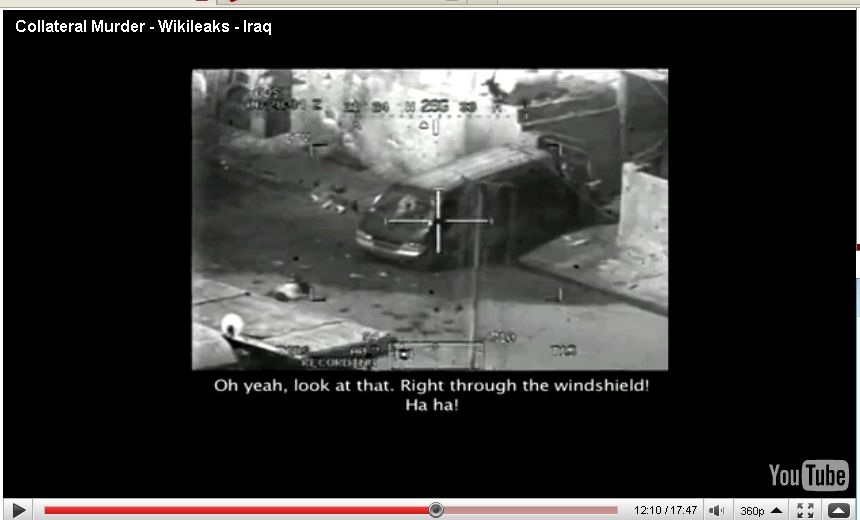
Collateral Murder2

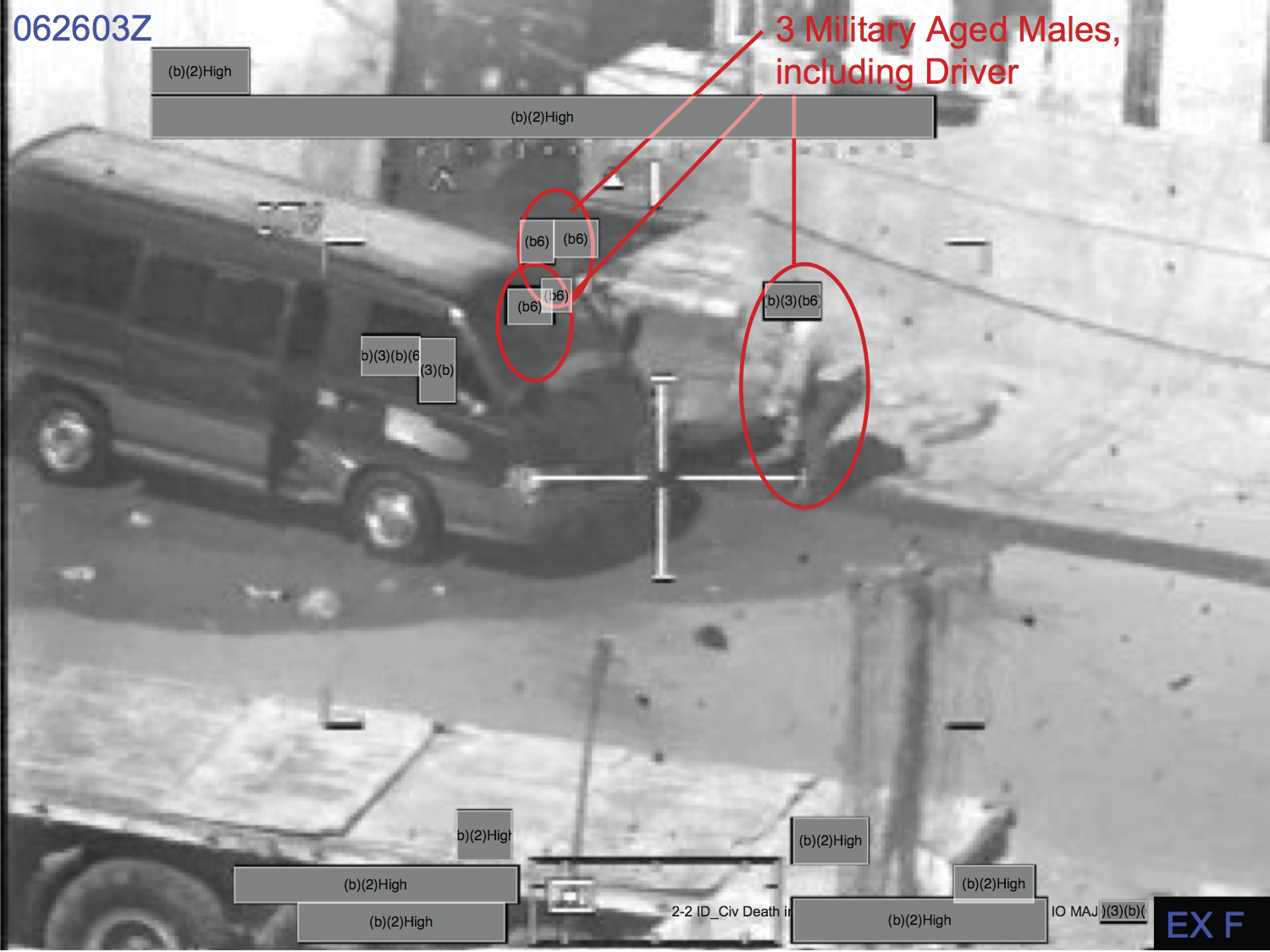
My intention is to work towards an extended essay on ‘Militarized vision‘ that will, I hope, take critiques of the politics of vision beyond the full motion video feeds from drones. I’m working my way through transcripts of both incidents, the video clip of the Baghdad attack released by Wikileaks, and the military’s own investigations of both incidents.  The interrogations and conclusions from the investigations are crucial, I think, not only for providing additional information and even insight, but also for adding an understanding of the juridical layer involved in the scopic regimes at work.  The reports have much to tell us about what flight crews and ground troops saw (and didn’t see) on the days in question (above) and about what is possible for the military to see (and not see) after the event (below).  I’d already worked my way through the Uruzgan investigation in detail for The everywhere war, but re-reading it alongside what Wikileaks called “Collateral Murder” is proving to be an illuminating exercise.

New Baghdad %22MAM%22

More later, though my next posts on Chamayou (and what will be a separate post on the juridical individuation of later modern war) will provide some of the necessary context.

‘Un-Manning’

I don’t imagine that anyone who has seen it will ever forget the cockpit video of US Apache attack helicopters mowing down two Reuters journalists and ten other civilians in Baghdad in July 2007.  It was part of the cache that the principled and courageous Bradley Manning gave to Wikileaks, which released the full, unedited clip as Collateral Murder in 2010, and earlier this month Manning’s lawyers opened their defence with a showing of the same video.

The transcript of the video is here, and a redacted copy of the US Army’s investigation report (with annotated video stills) is here.

The incident has been the subject of two short documentary films, linked by a common figure, Ethan McCord, a US soldier who arrived at the scene minutes after the shooting began (more here).

The first is Shuchen Tan‘s Permission to engage, which won the Prix Europa for the best European TV investigation in 2012.  Here’s the trailer:

http://www.youtube.com/watch?v=6PlsG0p-PQA

And here is the full (brilliant) film:

http://www.youtube.com/watch?v=YnF5X7xF8zc

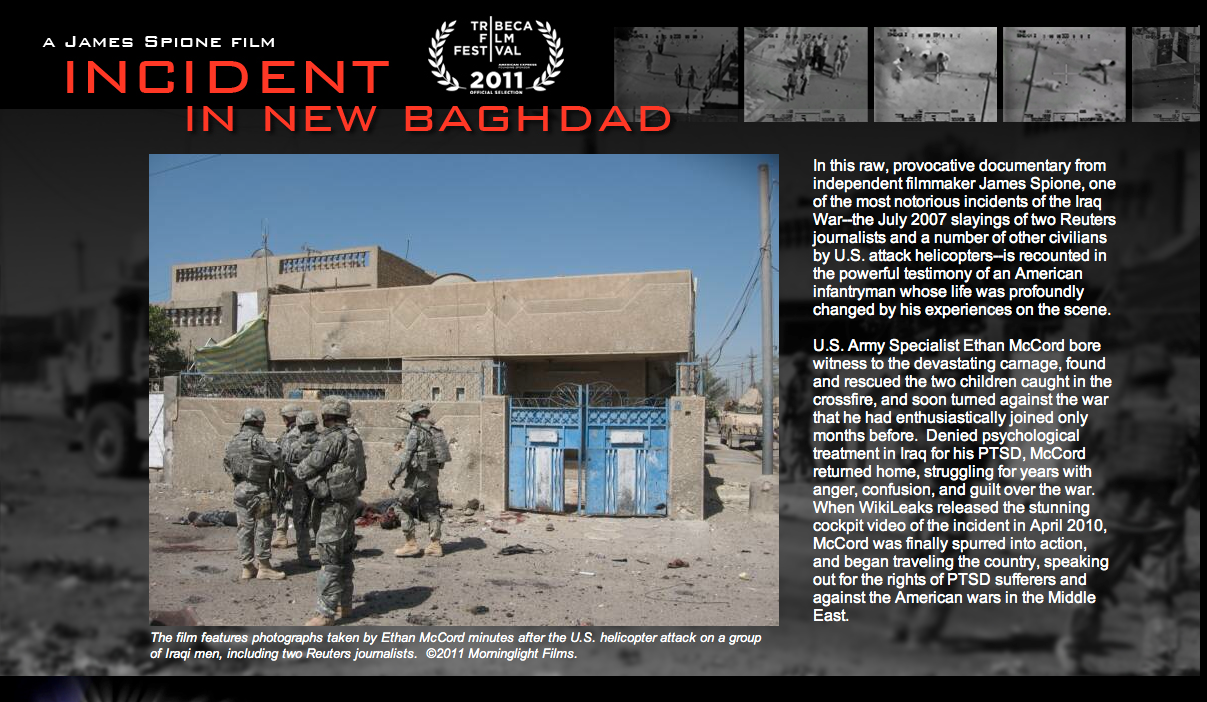
The second is James Spione‘s  Incident in New Baghdad, which won the prize for the best documentary short at the Tribeca Film Festival in 2011 and for best picture and best documentary short at the Fargo Film Festival in 2012.

Incident in New Baghdad

This is how Spione introduces his film:

Psychologists call it “psychic numbing.” Tell someone that tens of thousands of civilians have been killed in the Iraq conflict, or that thousands of U.S. veterans of our Mideast wars suffer from crippling PTSD, and their eyes will likely glaze over. Most people simply cannot comprehend the meaning of such vast numbers, nor are they likely to show any particular concern. Conversely, however, the tale of a single tragic incident can create great empathy in the same person–and greater understanding of the wider effects of war.

On April 5th, 2010, the controversial website WikiLeaks released a grainy black-and-white video that stunned the world. Recorded from the gunsight camera of an U.S. Army attack
helicopter during one of the most chaotic and deadly periods of the Iraq War, the footage depicts the violent deaths of two Iraqi journalists, Namir Noor-Eldeen and Saeed Chmagh,
along with at least eight other mostly unarmed individuals on the streets of Baghdad in July 2007. Minutes later on the video, when the driver of a passing van attempts to come to the aid of the mortally wounded Chmagh, a second helicopter attack occurs that destroys the van and kills several more people, wounding two small children in the process…

My short film INCIDENT IN NEW BAGHDAD examines what happened that day from the first-hand perspective of an American infantryman whose life was profoundly changed by his experiences on the scene. U.S. Army Specialist Ethan McCord bore witness to the devastating carnage, found and rescued the two children caught in the crossfire, and soon turned against the war that he had enthusiastically joined only months before. Denied psychological treatment in Iraq for his PTSD, McCord returned home, struggling for years with anger, confusion, and guilt over the war. When Wikileaks released the video of the incident, McCord was finally spurred into action, and began traveling the country, speaking out for the rights of PTSD sufferers and against the American wars in the Middle East.

However, there is so much more to the story, and I am now developing a more in-depth, feature-length examination of this incident that will include the perspectives of many more people involved in this incident: the infantry on the ground; the families of both Noor-Eldeen and Chmagh; the children, whose father was killed in front of them in the van, as well as their mother; and if possible, the 1-8 Cavalry Airborne gunner who pulled the trigger. My hope is that, by hearing from all of the first-hand participants of this tragic event, we may come to better understand the profoundly damaging consequences that ripple out through the lives of survivors over many years from just one so-called “engagement” in a war. And when we learn from all involved that this incident was not an aberration, but a commonplace occurrence over the course of many years, perhaps then we will start to understand those mind-numbing statistics, and feel the true moral scale of the damage, the wounds, the folly of a war of choice that never needed to happen.

I rehearse all this now for two reasons other than the shadow of sentencing that now hangs over Manning (though that is reason enough) .

First, the video at the dark heart of this incident – and these films – was not captured by a Predator or Reaper thousands of feet in the air and fed back to pilots, screeners and commanders thousands of miles away in the continental United States: this was close-in and immediate, and this raises important questions about scopic regimes and military violence that spiral far beyond the usual (and I think narrowly framed) debate over drones.

Approximate Target

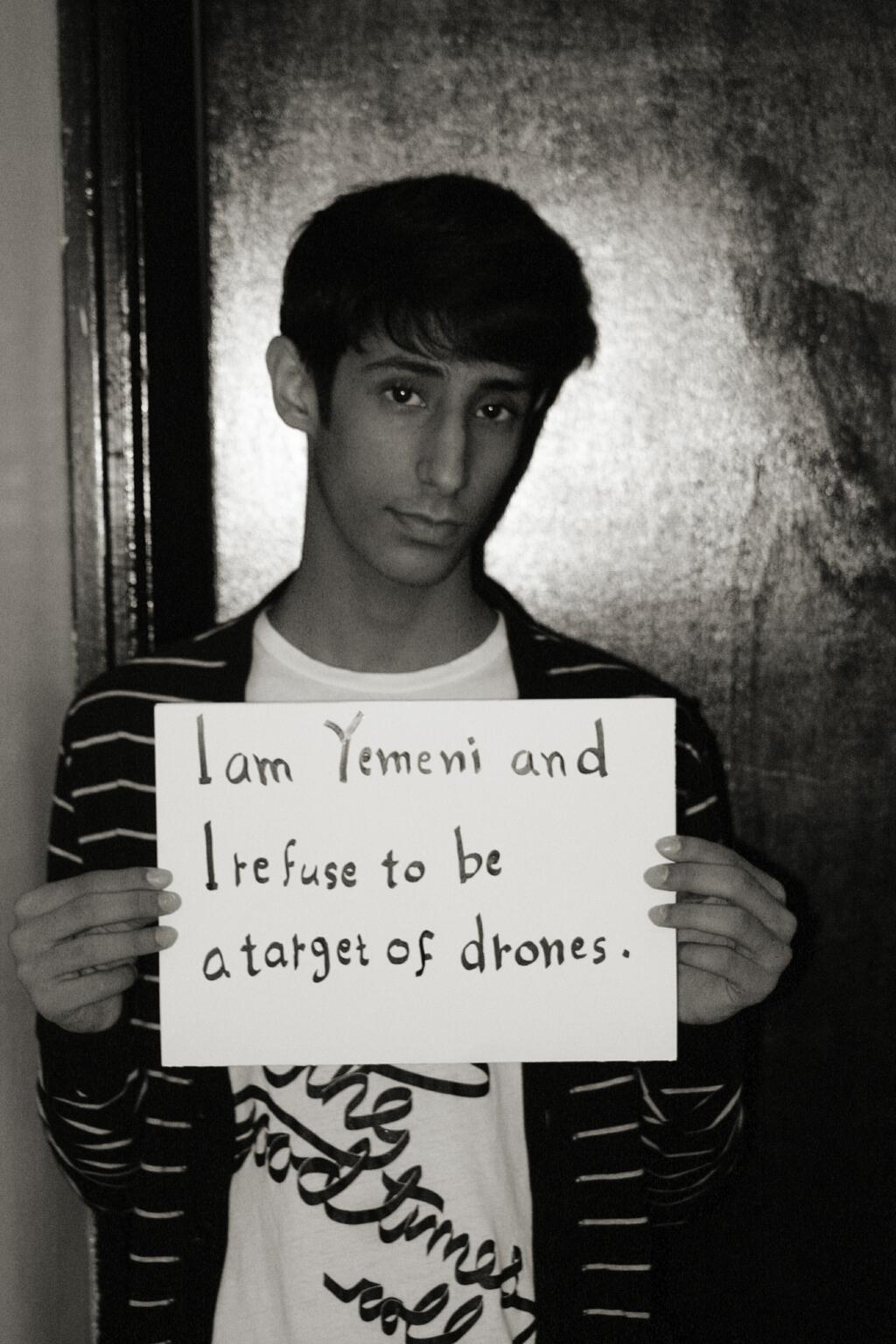
Second, Incident in New Baghdad was part-financed by Carol Grayson, who became one of the film’s executive producers.  She is clearly a remarkable woman in all sorts of ways, not least because she has spent much (I suspect most) of her time since then working on a new documentary film project, The Approximate Target that charts ‘the human cost of remote control killing, the dangers of covert government policy and unaccountability in modern warfare.’  It’s been a long, difficult and continuing journey with seemingly no end of obstacles and obstructions: you can read more on her blog here.

BJCiq-vCMAAgpWe-1From what I’ve been able to discover – which is not as much as I’d like – the focus of the The Approximate Target appears to be on CIA-directed strikes in Waziristan.  But Carol’s most recent posting (today) includes a letter from a Yemeni civilian to President Obama and Yemen’s President Hamadi on the eve of their meeting at the White House.  The letter was released today by Reprieve.  In it, Faisal bin Ali Jabera,  young engineer who lost two of his relatives in a drone strike on Hadhramout last summer, writes:

Our family are not your enemy. In fact, the people you killed had strongly and publicly opposed al-Qa’ida. Salem was an imam. The Friday before his death, he gave a guest sermon in the Khashamir mosque denouncing al-Qa’ida’s hateful ideology. It was not the first of these sermons, but regrettably, it was his last…

Our town was no battlefield. We had no warning – our local police were never asked to make any arrest. My young cousin Waleed was a policeman, before the strike cut short his life…

Your silence in the face of these injustices only makes matters worse. If the strike was a mistake, the family – like all wrongly bereaved families of this secret air war – deserve a formal apology. To this day I wish no vengeance against the United States or Yemeni governments. But not everyone in Yemen feels the same. Every dead innocent swells the ranks of those you are fighting.

Theory of the drone 2: Hunting

This is the second in a series of posts on Grégoire Chamayou‘s Théorie du drone.

3: Theoretical principles of man-hunting

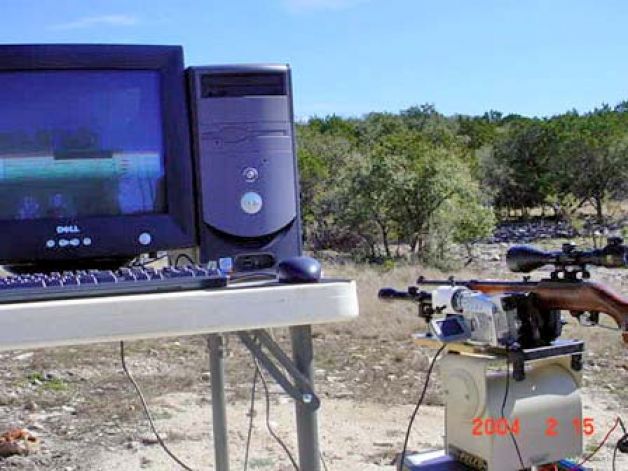
Chamayou opens his discussion with a revealing vignette.  In 2005 Texas entrepreneur John Lockwood developed a website, Live-shot.com, which promised a ‘real-time on-line hunting and shooting experience’.  The cyber-hunter was after deer and other game kept for the purpose on a 300-acre ranch near San Antonio.

LiveShot

You might think that a more relevant example would be Wafaa Bilal’s Domestic Tension described in his Shoot an Iraqi: art, life and resistance under the gun:

‘For one month, Bilal lived alone in a prison cell-sized room in the line of fire of a remote-controlled paintball gun and a camera that connected him to internet viewers around the world. Visitors to the gallery and a virtual audience that grew by the thousands could shoot at him 24 hours a day.’

Wafaa Bilal, Domestic Tension

There is a wonderful discussion of the project and its wider implications for experimental geopolitics by Alan Ingram [‘Experimental geopolitics: Wafaa Bilal’s Domestic Tension‘] in the Geographical Journal 1788 (2) (2012) 123-133.  He explains that Bilal conceived Domestic Tension as a commentary on ‘remote control warfare’ after his brother had been killed in a strike by a US helicopter gunship called in by commanders watching a video feed from a Predator in the skies over Kufa.

But Lockwood’s venture is even more revealing, particularly when juxtaposed with Domestic Tension, because it involved real-time killing (of captive deer, antelope and other animals) and after a public outcry it was eventually banned.  A full report from the Washington Post is here. Even the National Rifle Association was up in – er – arms: its spokesperson declared,  ‘We believe that hunting should be outdoors and that sitting in front of a computer three states away doesn’t qualify as hunting.’  Chamayou’s translation of one police officer’s condemnation – “It’s not hunting.  It’s killing’ – becomes ‘It’s not hunting.  It’s murder’, which artfully raises the stakes, but you get the point, which is about the hue and cry that attended killing animals on line while ‘man-hunting by remote control’ attracted considerably less public attention: then, anyway.

Live Shot

To be fair, there were critics like Dale Jamieson who saw Live Shot as symptomatic of a wider issue:

“If you look at this as being kind of a continuum or slippery slope,” said Jamieson, “you have people who enjoy the act of killing and destruction in video games, you have people who enjoy killing animals over the Internet…. But of course the next step in this is that people start killing people over the Internet. That’s the worry.”

California state Senator Debra Brown was equally forthright in her condemnation:

“What happens if this technology gets expanded to other uses?” she said. “It’s actually pretty scary. What’s the line between real life and a video game? It has all the video game feel: It’s remote, it’s disconnected from the reality of it, the hunter doesn’t have to deal with any blood or wounding or tracking.”

Chamayou doesn’t track these responses, which surely sharpen his point, but he doesn’t really need to: I haven’t been able to find any critics who drew attention to the remote killings of people that were already taking place under the unblinking eye of US Predators in Pakistan and Yemen. (Incidentally, this chapter is illustrated by an image of a Predator firing a Hellfire missile; the photograph is all over the web – for example here – but, as James Bridle has shown, this now canonical image is in fact a Photo-shopped fake, ‘a computer-generated rendering of a drone … flying over an abstracted landscape’).

For Chamayou those targeted killings are the effects of an apparatus that he describes as militarized man-hunting.  He invokes George W. Bush’s line (in a speech at the FBI in February 2003) about the ‘war on terror’ being a ‘different kind of war’ that ‘requires us to be on an international manhunt’ to argue that that within a decade what seemed to most commentators at the time to be just a folksy Texan cowboy phrase had been converted into a state doctrine of non-conventional violence that combines elements of military and police operations  without fully corresponding to either.

He suggests that US Secretary of Defense Donald Rumsfeld was already playing with the possibilities of what Eyal Weizman has called thanatotactics. Rumsfeld was convinced that ‘Israeli techniques for dealing with Palestinian resistance could be simply scaled up.’  If the IDF had turned Gaza into a laboratory for targeted killing from the air, however, how could this be done by the Pentagon on the global scale?  And – for some Pentagon insiders at least – how could this be done without having a new Phoenix program rise from the flames of what one adviser was already calling ‘preventive manhunting’?

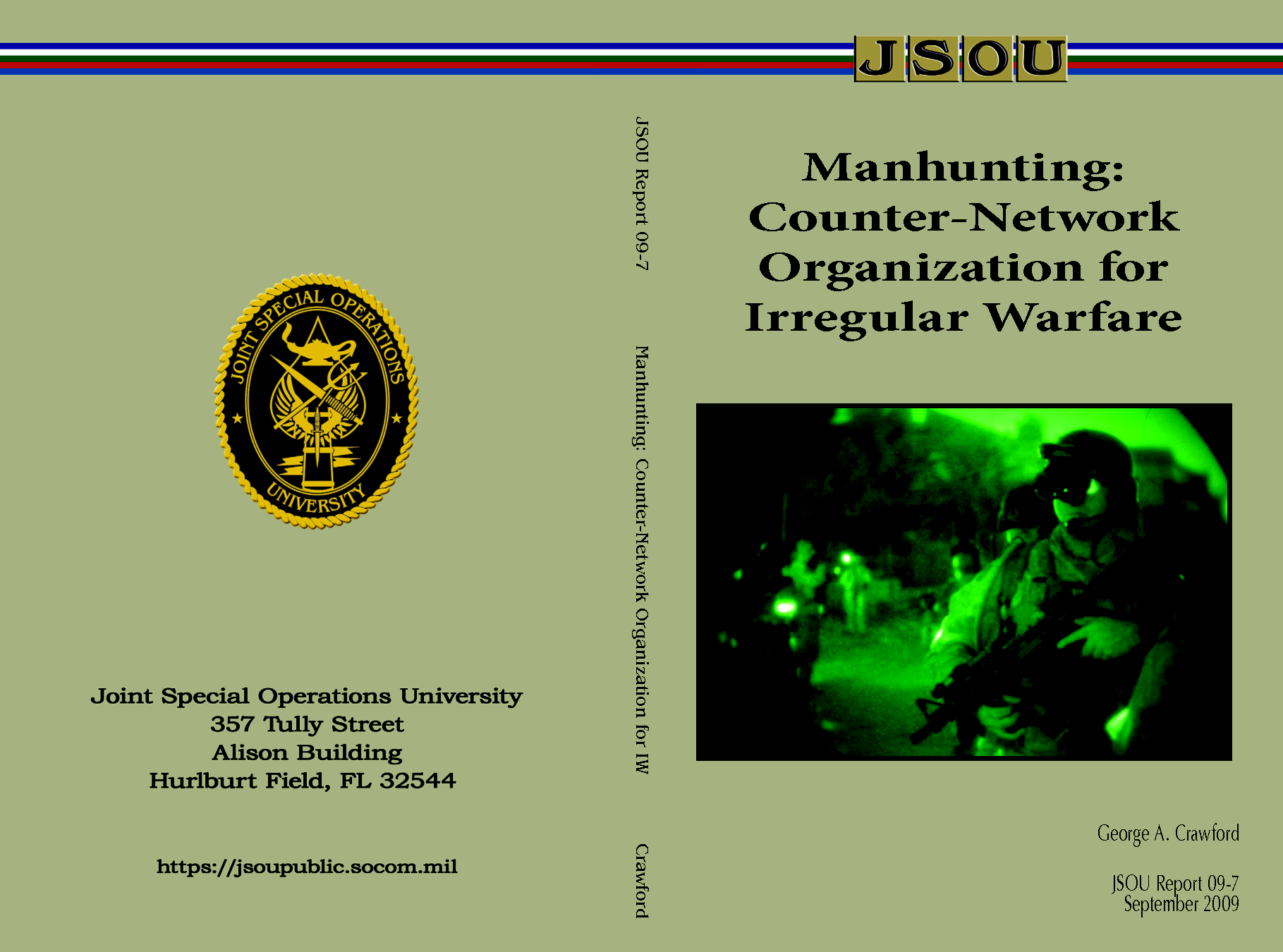
CRAWFORD ManhuntingThis is where those ‘theoretical principles’ start to emerge.  Some of the most difficult issues concern the provision of a legal armature, as I’ll discuss in a later post (and it is these that interest me the most), but what Chamayou has more directly in mind here is the formulation of a military (rather than policing: the difference, as we’ll see, is crucial) doctrine to guide these operations.  He suggests that its most developed form drew upon the work of a private-sector consultant, George Crawford, who published Manhunting: reversing the polarity of warfare in 2008 and a subsequent report for the Joint Special Operations University, Manhunting: counter-network organization for irregular warfare  in 2009.

CRAWFORD Manhunting 2

Crawford’s report included a ‘chronology of American manhunting operations’, and out of that remarkably long history Chamayou fastens on the Pancho Villa Expedition in 1916.  This was a massive (and spectacularly unsuccessful) ground operation across the US/Mexico border, in which thousands of US troops under the command of General Pershing penetrated deep into Mexico in an effort to capture the Mexican revolutionary leader Pancho Villa (who had conducted a series of cross-border raids into New Mexico).

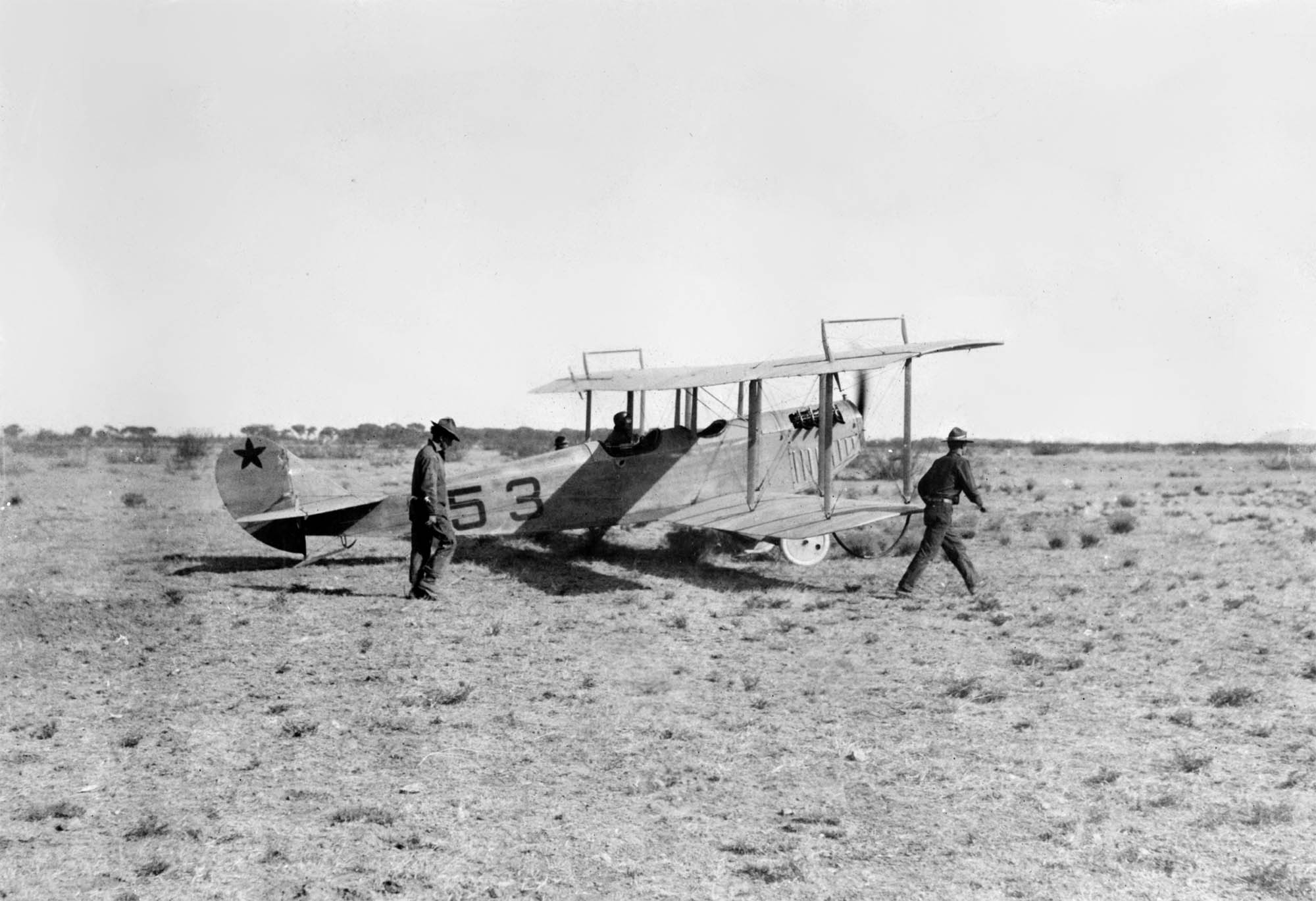
Chamayou doesn’t mention it, perhaps because it would complicate the clean lines of his narrative, but the expedition included air support from the eight planes of the 1st Aero Squadron (below) in what was to become ‘the first combat engagement of American Army pilots and airplanes’ (more here and here).  Their principal function, as with the use of military aircraft on the Western Front, was reconnaissance, but if this was a distant forerunner of US aerial surveillance of the southern border it was a dismal failure.  According to Pershing:

“[T]he aeroplanes have been of no material benefit so far, either in scouting or as a means of communication.  They have not at all met my expectations.  The further south Villa goes into the mountains the more difficult will be their tasks, and I have no doubt we shall soon be compelled to abandon them for either scouting the enemy or keeping in touch with the advance columns.”

HighFlight-1stAeroSqn9-1

But the entire expedition was a failure, and the crucial lesson, spelled out by Crawford and repeated by Chamayou, was the imperative to reverse the polarity: instead of deploying large numbers of ‘boots on the ground’ – what Crawford ridiculed as using an elephant gun to swat ‘the terrorist mosquito’ – operations against non-state actors should be conducted by small teams networked into a targeted killing operation.  This changes the terms of war not so much because the conflict is asymmetric, or even because it’s not about territorial gain, but rather because war is transformed from the classical paradigm of a duel into something quite other: ‘a hunter who advances, and a prey who flees or hides’.

The (tactical) rules of the game are quite different; the hunter must engage to win, while the fugitive must evade to win.  Crawford:

Firepower becomes less significant in terms of mass, while the precision and discretion with which firepower is employed takes on tremendous significance, especially during influence operations. Why drop a bomb when effects operations or a knife might do? Maneuver adopts new concept and form. In manhunting, friendly forces seek to engage the enemy. Like a lone insurgent, the enemy seeks to avoid the allied force, biding time until he has an opportunity to strike at vulnerable, unprotected, or noncombat assets.

The first task is thus not to immobilise but to identify and locate the enemy, which implies an apparatus of detection.  ‘Man-hunting’ thus becomes, in Crawford’s eyes at any rate, an intelligence-based operation directed towards identifying pivotal nodes (which is to say key leaders or ‘High Value Targets’) in the virtual and physical spaces of social networks.  Here Chamayou cites John Dodson‘s attempt – one of countless others – to provide a statistical methodology for ‘man-hunting’:

‘Nexus Topography is an extension of the common practice of Social Network Analysis (SNA) used to develop profiles of [High Value Targets]. Currently, SNA examines the links in a social group, whereas, Nexus Topography is a template that can be used to construct a map of relationships in different social environments. Nexus Topography maps social forums or environments, which bind individuals together (this can be extended to include Dark Networks and Small Worlds).

Network analysis, in multiple forms, is a staple of geo-spatial intelligence and contemporary counterinsurgency and counter-terrorism.  But how far Crawford’s specific proposals directly informed US military operations is another question, and one Chamayou doesn’t address.  I suspect their influence was at best indirect.  Even so, pursuing their logic enables Chamayou to conclude that militarized man-hunting is not about responding to specific attacks but instead providing ‘pre-emptive security’ against emergent threats.  On this new terrain ‘war’ becomes a vast campaign of extra-judicial killing, for which (as he says) the ‘Predator’ and the ‘Reaper’ live up to their names.  Hence the next chapter,which traces the next set of principles:

4: Surveillance and annihilation

FOUCAULT Surveillir et punirThe English translation doesn’t capture Chamayou’s substitution, which is a play on the French title of Michel Foucault‘s Discipline and punish: Surveillir et punir.

The reference to Foucault is entirely apposite.  Chamayou’s central point here is that, within the apparatus of militarized man-hunting, ‘detection’ is above all a visual modality (and much of Foucault’s work involved a sustained interrogation of the gaze). Chamayou argues that drones promise something like a ‘God’s eye view’; their protagonists claim that their near real-time, full-motion and increasingly high-definition video feeds have revolutionised the capacity to provide a constant view of the enemy.

This is all familiar ground, to me at any rate, and in this chapter Chamayou draws on my own work (and others’) to tease out six core principles.  I discuss all of them in ‘From a view to a kill’ and ‘Lines of descent’ [DOWNLOADS tab], so here I will simply list them in summary form:

1: Persistent stare or permanent watch – Predators and Reapers have long ‘dwell-times’ and in principle permit protracted surveillance;

2: Totalisation of perspectives or synoptic view – ‘wide-area surveillance’  promises to be able to ‘quilt’ multiple images together;

3: Complete archive – the question of data retrieval and analysis is immensely difficult, which is why the US Air Force has consistently worried about ‘swimming in sensors, drowning in data’, and why specialist image analysts have experimented with TV/video archival and retrieval techniques;

4: Data fusion from multiple sensors;

5: ‘Pattern of life’ analysis;

6: Detection of anomalies and pre-emption.

The classical names given to these new political technologies of vision – like Gorgon Stare and Argus (in Greek mythology the hundred-eyed giant, which in DARPA-speak becomes Autonomous Real-time Ground Ubiquitous Surveillance) – confirm the premium placed on visibility or even hypervisibility.

Gorgon Stare

But Chamayou argues that this political technology is far more ‘economical’ than Bentham’s Panopticon, which Foucault uses so powerfully to figure modern surveillance, because it requires neither spatial partitions nor architectural demarcations. It is what Zygmunt Bauman might call a ‘liquid’ technology, since it needs only airspace to function (though the current interest in A2/AD (‘anti-access/areal denial’) is a sharp reminder that at present – and even for the foreseeable future – Predators and Reapers can only hunt in uncontested air space).

And even more unlike the Panopticon, this political technology is not directed towards enclosure or confinement.  Just as the Gorgon’s stare petrified its enemies to death, turning them into stone, so this too is a deadly gaze. Video feeds trigger missile launches: ‘No longer surveillir et punir but surveiller et anéantir’ (annihilation) (p. 67).

(Incidentally, how far the US will continue to fund some of these systems is unclear: recent reports suggest that the Pentagon is scaling back its funding for the Gorgon Stare, but the Air Force is still promoting the ARGUS-IS as its next-generation sensor technology).

Living Under DronesThe shadows cast by these capacities are far longer than the supposedly ‘precision strikes’ they facilitate: they impose a new landscape of threat and dread. Here Chamayou invokes the Stanford/NYU report Living under drones (2012) to conclude that the presence of Predators and Reapers terrifies whole populations who live under them (see also my commentary here).  Above and beyond the deaths and physical injuries they inflict, and the rubble, the rage and the bereavements they produce, Chamayou concludes that drones also produce ‘a psychic enclosure whose boundaries are no longer defined by bars, barriers or walls but by the invisible circles described overhead by the ceaseless gyrations of these flying sentinels’ (literally, ‘watch-towers’).

As Chamayou’s patient excavation of these various principles proceeds, it becomes clear that the ‘doctrine’ that is coming in to view is much more than doctrine as the military understands the term.  For the Pentagon, doctrine consists of those ‘fundamental principles by which the military forces or elements thereof guide their actions in support of national objectives. It is authoritative but requires judgment in application.’  The appeal to its authoritative status is significant, of course, and speaks directly to (or rather from) from the military chain of command.

CHAMAYOU ManhuntsBut what Chamayou is after in what elsewhere he calls ‘the manhunt doctrine‘ is something that transcends the military (this form of ‘man-hunting’ deliberately blurs the distinctions between conventional military and police operations to produce what Chamayou calls ‘hybrid operations, monstrous offspring [enfants terribles] of the police and the military, of war and peace’) and seeks to expose the political technologies, the discursive systems and the scopic regimes from which it derives its wider authority and through which it exercises its powers.

In doing so it follows directly from his previous work, Les chasses à l’homme (in English, Manhunts), which promises a philosophical history – or, as I said in my previous post, a genealogy.  But Théorie du drone is more than the next chapter, because it has much to say about the transformation of ‘techno-war’ into something radically different, a modality of later modern war that is focused more than ever on the identification, pursuit and elimination of individuals.

To be continued.

Baghdad is still burning

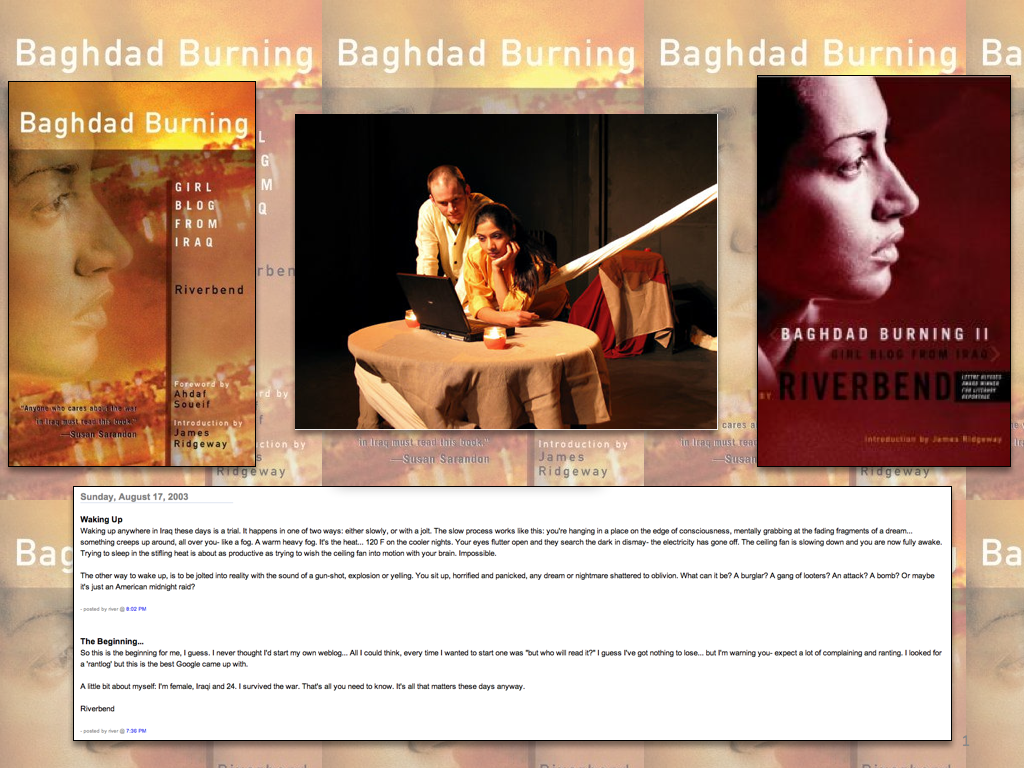
One of the very best blogs to be written out of Baghdad while the city was under US military occupation was Baghdad Burning.  Written by a young Iraqi woman who called herself “Riverbend“, it documented everyday life in a city being torn apart by military and paramilitary violence and provided a spirited series of commentaries on US and Iraqi politics.

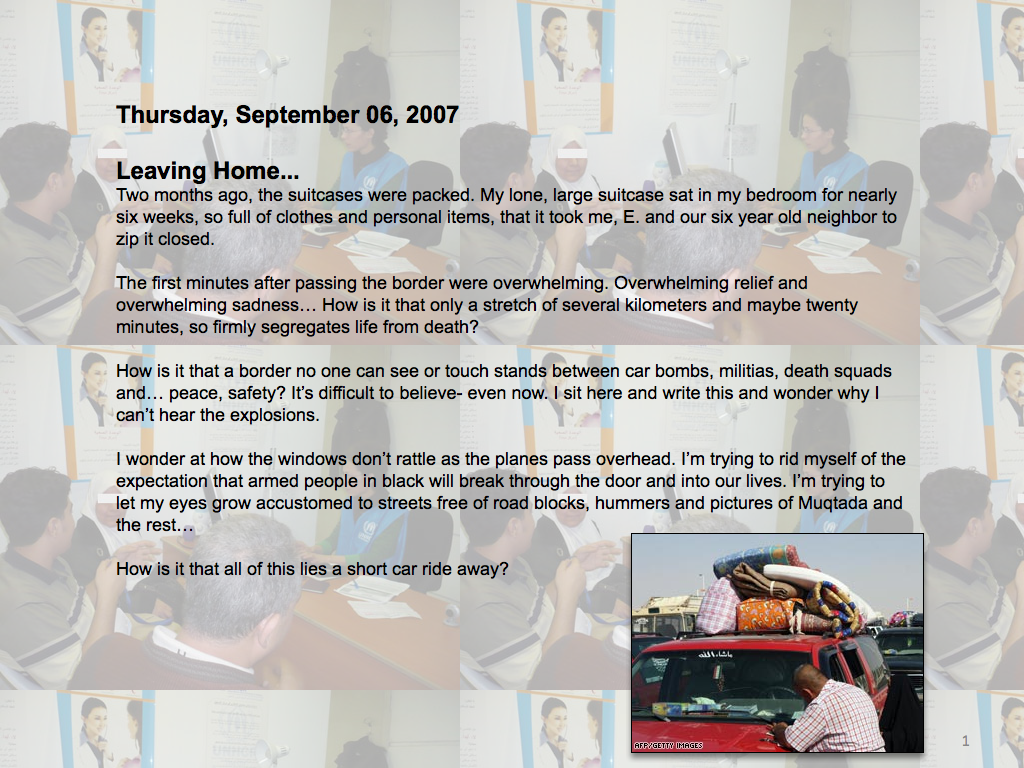
In September 2007 Riverbend and her family finally left Baghdad:

Baghdad Burning.002

They crossed the border into Syria and took refuge in Damascus.  ‘Syria is a beautiful country,’ Riverbend wrote in her last post on 22 October 2007:

‘… at least I think it is. I say “I think” because while I perceive it to be beautiful, I sometimes wonder if I mistake safety, security and normalcy for ‘beauty’. In so many ways, Damascus is like Baghdad before the war – bustling streets, occasional traffic jams, markets seemingly always full of shoppers…’

And she described a newly strange sense of being at home:

‘Walking down the streets of Damascus, you can hear the Iraqi accent everywhere. There are areas like Geramana and Qudsiya that are packed full of Iraqi refugees. [You can find some extraordinary photographs by Gabriela Bulisova of Iraqi refugees in Damascus here and a revealing guide to being an Iraqi refugee in the city here].  Syrians are few and far between in these areas. Even the public schools in the areas are full of Iraqi children….

‘We live in an apartment building where two other Iraqis are renting. The people in the floor above us are a Christian family from northern Iraq who got chased out of their village by Peshmerga and the family on our floor is a Kurdish family who lost their home in Baghdad to militias and were waiting for immigration to Sweden or Switzerland or some such European refugee haven.

The first evening we arrived, exhausted, dragging suitcases behind us, morale a little bit bruised, the Kurdish family sent over their representative – a 9 year old boy missing two front teeth, holding a lopsided cake, “We’re Abu Mohammed’s house – across from you- mama says if you need anything, just ask – this is our number. Abu Dalia’s family live upstairs, this is their number. We’re all Iraqi too… Welcome to the building.”

I cried that night because for the first time in a long time, so far away from home, I felt the unity that had been stolen from us in 2003.’

After that – silence.

The blog was transformed into two books, both published by the Feminist Press at CUNY with the same title, and inspired several stage plays and a BBC radio adaptation in 2007.

Baghdad Burning.001

It has also been the subject of a stream of academic commentaries that shows no sign of slackening: see, for example, Wayne Hunt here, Amira Jamarkan here, Francesca Maioloi here, Nadine Sinno (Chapter 9 of Feminism and war here), plus these subscriber-only essays: Wes Attewell, ‘ “Every Iraqi’s Nightmare: blogging peace in occupied Baghdad’ [Antipode 44 (3) (2012)]; Wisam Khalid Abdul Jabbar, ‘Riverbend’s blogosphere: mockery and menace in colonial discourse’ [Critical discourse studies 10 (3) (2013); and Tess Pierce, ‘Singing at the digital well’ [Feminist formations 22 (3) 2010].

But on 9 April 2013, ten years since the fall of Baghdad to U.S. troops, Riverbend returned – to the blogosphere at least.  In her post, she lists the lessons of the war and the occupation, ‘probably’, she writes, ‘for the last time’:

‘We learned that while life is not fair, death is even less fair – it takes the good people. Even in death you can be unlucky. Lucky ones die a ‘normal’ death… A familiar death of cancer, or a heart-attack, or stroke. Unlucky ones have to be collected in bits and pieces. Their families trying to bury what can be salvaged and scraped off of streets that have seen so much blood, it is a wonder they are not red. 
We learned that you can be floating on a sea of oil, but your people can be destitute. Your city can be an open sewer; your women and children can be eating out of trash dumps and begging for money in foreign lands. 
We learned that justice does not prevail in this day and age. Innocent people are persecuted and executed daily. Some of them in courts, some of them in streets, and some of them in the private torture chambers.’

Riverbend hasn’t returned to Baghdad, where violence (which never went away) has intensified over the last six months and headlines – now tucked away on the inside pages of European and American newspapers – are once again recording ‘another day of slaughter‘.  You can find contrasting reports on conditions in Baghdad now here (“Everyone has his own map of familiar, reassuring, “stabilised” places, and other areas where they dare not return”), here (‘“Before we at least had the security to go anywhere,” Salbi said. “We go out like normal, but we don’t have the security of knowing we will come back. If someone is running even a half an hour late, you start worrying about bombs”‘), here (“… the sprawling, less well-to-do neighbourhoods, such as Ghazaliya, Dora and Saidiya still feel angry and tense. The concrete walls and armed checkpoints, put up during the American occupation at the height of the sectarian violence, remain in place. They still function to control the population, limiting access in some neighbourhoods to a couple of exits that can be easily sealed off”), and here (“Baghdad looked like a city scarred by death and despair. The sense of fear among ordinary Iraqis, exhausted and traumatized by the foreign occupation and years of fratricide, is overwhelming. Across the capital lie abandoned houses”).

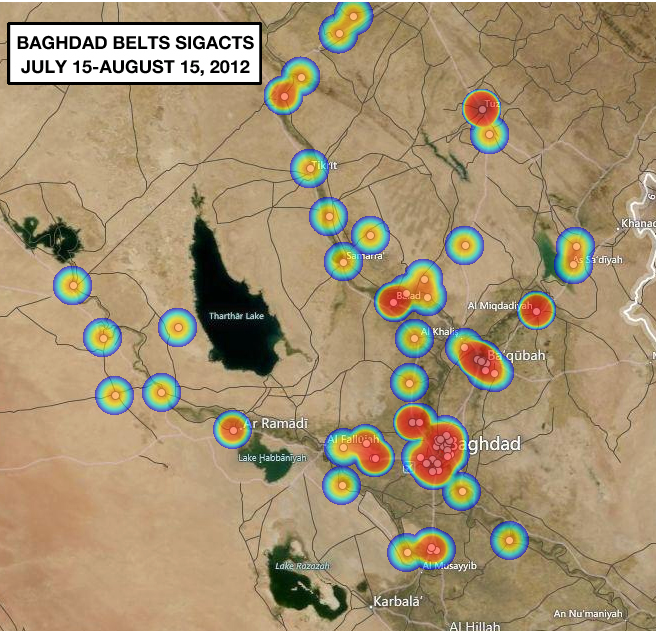
Snapshots of a tangled mosaic.  You can find an overview, with graphs and maps, here and a backgrounder to that article here.  Below I’ve reproduced a map from the Institute for the Study of War; despite the military language (SIGACTS are ‘significant acts’), the map was compiled by ISW ‘from available open-source news reporting from Iraqi and western media. Where possible, the attacks were cross-referenced with other sources.’ In consequence the map does ‘not provide an exhaustive account of security incidents in Iraq during the period in question’ but indicates ‘concentrations of violence.’  But the continuity of military language – and military cartographic conventions which I discussed in “Seeing Red” (DOWNLOADS tab) – is about more than the neo-conservative ideology of the ISW: it also speaks to the resurgence of violence noted in many of those recent press reports:

Baghdad Belts SIGACTS July-August 2012

Casualty figures in Iraq are now at their highest level since June 2008.  Iraq Body Count is still maintaining its grim but necessary tabulations – though some critics insist that these gravely underestimate the true figures – and in its most recent report notes:

The US/UK-led invasion of March 2003 has brought a decade of high and low intensity armed conflict to Iraq. But this conflict is not yet history. It remains entrenched and pervasive, with a clear beginning but no foreseeable end, and very much a part of the present in Iraq. In major regions of the country armed violence continues to exact a remorseless toll on human life, young and old, male and female, across society.

The US/UK-led invasion of March 2003 has brought a decade of high and low intensity armed conflict to Iraq. But this conflict is not yet history. It remains entrenched and pervasive, with a clear beginning but no foreseeable end, and very much a part of the present in Iraq. In major regions of the country armed violence continues to exact a remorseless toll on human life, young and old, male and female, across society.

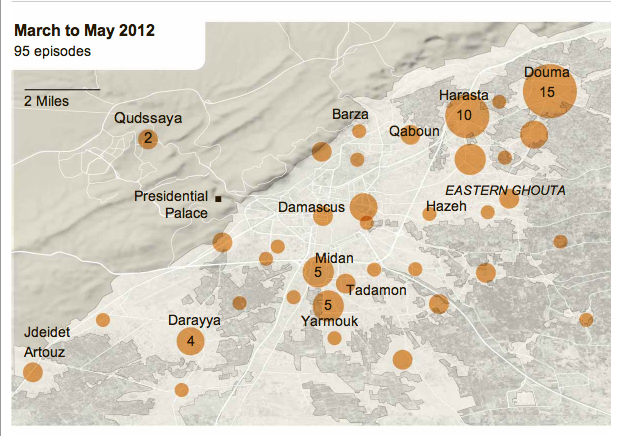
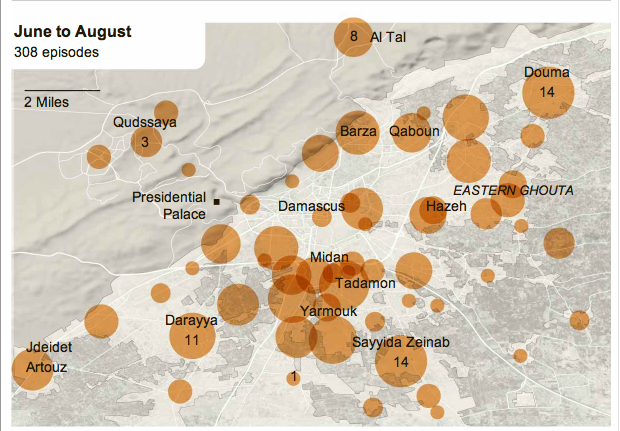
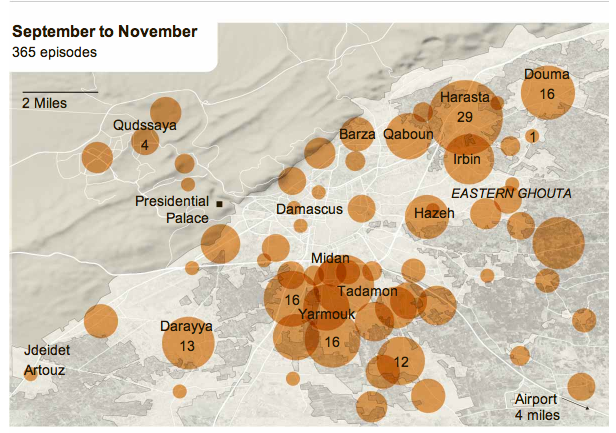
Riverbend is no longer in Damascus either, where violence has also intensified during the civil war, especially since last spring (see this sequence of maps compiled by the New York Times here):

Damascus violence March-May 2012

 Damascus violence June-August 2012

Damascus violence September-November 2012

Many Iraqis have been forced out of Damascus by the fighting and returned to Baghdad, shaken by the reappearance of sectarian violence, but Riverbend explains:

‘I moved before the heavy fighting, before it got ugly. That’s how fortunate I was. I moved to another country nearby, stayed almost a year, and then made another move to a third Arab country with the hope that, this time, it’ll stick until… Until when? Even the pessimists aren’t sure anymore. When will things improve? When will be able to live normally? How long will it take?’

I hope she isn’t in Cairo.

Sim Cities and theatres of war

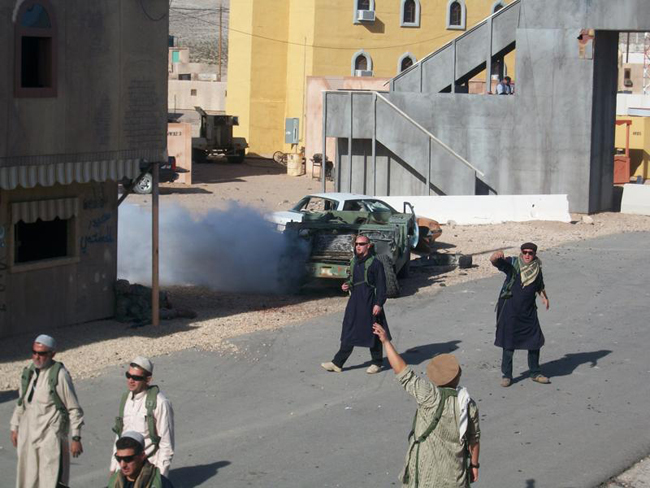
When I wrote “Rush to the intimate” (DOWNLOADS tab), a discussion of the ‘cultural turn’ in US counterinsurgency, I was fascinated by a rich and rapidly expanding literature on pre-deployment training and Mission Rehearsal Exercises in simulated “Afghanistans” and “Iraqs” across the United States and beyond in what Steve Graham later called, in Cities under siege, a ‘theme-park archipelago’:

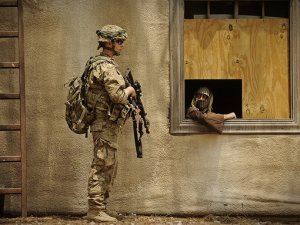
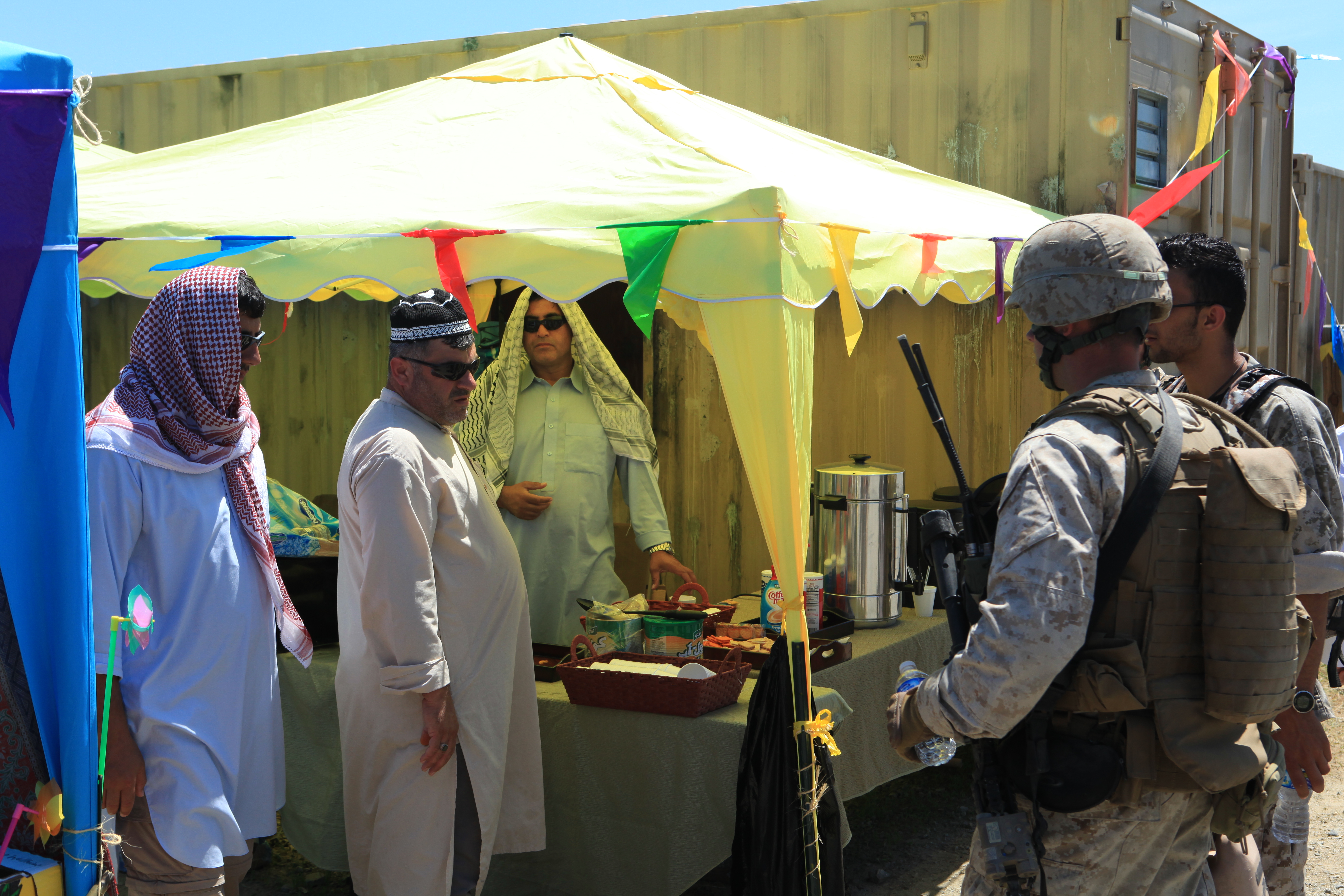
fort-polk‘US troops prepare for deployment in Afghanistan and Iraq by rotating through major Combat Training Centers.  The arc of these ‘theatres of war’ runs from the United States through Europe to Jordan and Kuwait, but the main Mission Rehearsal Exercises are conducted at the Joint Readiness Training Center at Fork Polk, Louisiana; the National Training Center at Fort Irwin, California; and the US Marine Corps Air Ground Combat Training Center at Twentynine Palms, California.  Each includes prefabricated villages and small towns to train troops in urban operations.  … There is little attempt at morphological similitude.  In fact, the same physical structures serve for Afghanistan and Iraq, as though the two are indistinguishable and interchangeable, and the buildings are rudimentary approximations.  One journalist described the crude architecture of ‘Wadi al Sahara’ at Twentynine Palms as being ‘like an impressionist painting’.  From the surrounding hills it could be mistaken for part of Basra or Fallujah, but ‘a walk through its dusty streets shows it to be only a vast collection of shipping containers.’ This too is not without its performative consequences.  Shipping containers are an improvement on poker chips and Lego bricks, but reducing living spaces to metal boxes and studio flats conveys a silent message about the sort of people who live in them.

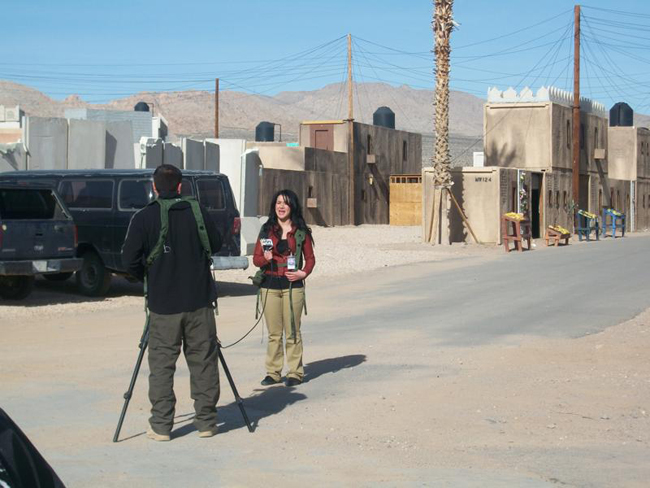
Realistic Urban Training‘The focus at all the training centres is on interactive realism, and the cultural turn has transformed the terms of engagement.  In the early stages of the ‘war on terror’, the emphasis was on kinetic operations and on state-of-the-art special effects that drew on the visual and pyrotechnic skills of Hollywood and theme-park designers.  When one reporter visited Fort Polk in January 2003, she described troops calling in air strikes, securing roads and bridges on the perimeter of a town, and dealing with ambushes staged by insurgents played by soldiers from the base. Her story repeated the physical imagery of the Handbook for Joint Urban Operations issued the previous fall with precision: ‘From sewers to rooftops, cities are multi-layered, like three-dimensional chess boards.’  Civilians appeared only as casualties, and then only in the very last paragraph, where one soldier admitted that he had ‘no clear answer’: ‘“What can you do?”’ The cultural turn is supposed to provide the answer to that question, and from 2006 a flurry of media reports described a new emphasis on military-civilian interaction.  Exercises still include kinetic operations, though these are now more likely to focus on combating IEDs and suicide bombings, but the main objective is no longer scoring kills but ‘gaining the trust of the locals.’  The deployment of Civilian (sometimes called Cultural) Role Players has expanded dramatically.  More than 1,000 are on call at Fort Polk alone, including 250 Arabic speakers, many of them recruited from the Iraqi diaspora in Atlanta, Houston, Memphis and as far away as Michigan.  Their very presence has changed the imaginative geography.  One corporal noted that his previous training had never incorporated civilians ‘wondering what’s going on, and looking around, and doing everyday things.  So when we got there and there were other people besides the enemy, it kind of threw us on our heels.  You know, all we trained for was that the enemy are the only ones on the streets.’  But these Civilian Role Players are not extras, figures to be bypassed, and their roles are carefully scripted.  They play community leaders, police chiefs, clerics, shopkeepers, aid workers, and journalists, and new scenarios require troops to understand the meaning of cultural transactions and to conduct negotiations with local people.  Careful tallies are kept of promises made by US commanders, and the immediate consequences of civilian casualties are dramatized in depth.  Mock newscasts by teams representing CNN and al Jazeera remind troops that local actions can have far-reaching consequences.  Even the special effects have become more intimate; in one Gothic gesture, amputees are used to simulate the effects of suicide bombs (though not, I suspect, US air strikes).  ‘It is no longer close in and destroy the enemy,’ one Marine officer explained: ‘We have to build relationships with Iraqis in the street.’
At the time the richest reports were these (and the quotations above were taken from them): Dexter Filkins and John Burns, ‘Mock Iraqi villages in Mojave prepare troops for battle’, New York Times, 1 May 2006; Wells Tower, ‘Letter from Talatha: Under the God Gun’, Harper’s Magazine, January 2006; Vince Beiser, ‘Baghdad, USA’, Wired Magazine 14.06 (June 2006); Tony Perry, ‘“Mojave Viper” sessions reflect situations in Iraq’, Los Angeles Times, 24 July 2006; Guy Rez, ‘Simulated city preps Marines for reality of Iraq’, National Public Radio, 13 April 2007.

I now need to re-visit all of this for The everywhere war.  My good friend, the ever-enterprising Oliver Belcher, visited Muscatatuk Urban Training Center in Indiana in September 2010 as part of his PhD research, so I had some idea of what had changed in the interim (and what had not).

NTC Fort Irwin exercise

Now Geoff Manaugh (of BldgBlog fame) has provided a sumptuously illustrated account (also on his blog here and at Venue here) of his recent visit to the simulated Afghan town of Ertebat Shar at Fort Irwin in the Mojave Desert (above); when US troops were training for Iraq it was Medina Wasl, and the basic geometry was imported from satellite photographs of Baghdad.
‘… at the most basic level, soldiers will use Fort Irwin’s facsimile villages to practice clearing structures and navigating unmapped, roofed alleyways through cities without clear satellite communications links. However, at least in the training activities accessible to public visitors, the architecture is primarily a stage set for the theater of human relations: a backdrop for meeting and befriending locals (again, paid actors), controlling crowds (actors), rescuing casualties (Fort Irwin’s roster of eight amputees are its most highly paid actors, we learned, in recompense for being literally dragged around during simulated combat operations), and, ultimately, locating and eliminating the bad guys (the Blackhorse regiment [a 120-strong insurgent force drawn from the 11th Armored]).’

Other recent images and video-essays can be found here and here.

Two things in particular stand out for me from Geoff’s immensely interesting essay.

First, the site and at least some of its training exercises are now regularly open to the public – NTC ‘Box Tours’ run twice a month and can be booked no more than 30 days in advance: see here for details – so special dispensations are no longer needed.  As this implies, the sense of public scrutiny has evidently been dramatically heightened since 2007, though even then national media seemed to be all over the place, and this now extends to the incorporation of the visitors themselves.  Geoff reports:

‘In the series of set-piece training exercises that take place within the village, the action is coordinated from above by a ring of walkie-talkie connected scenographers, including an extensive internal media presence, who film all of the simulations for later replay in combat analysis. The sense of being on an elaborate, extremely detailed film set is here made explicit. In fact, visitors are openly encouraged to participate in this mediation of the events: We were repeatedly urged to take as many photographs as possible and to share the resulting images on Facebook, Twitter, and more.’

NTC Fort Irwin media

As I’ve argued before, this sense of reflexivity – attention to the conduct of conduct – is focal to later modern war (though it extends far beyond multiple media platforms and includes, crucially, the lawyering-up of the kill-chain).

Second, the wounds of war have become ever more elaborately scripted.  Wells Tower‘s brilliant ‘Letter from Talatha’ (cited above) was very good on this, but now Geoff reproduces
‘an extraordinary collection of injury cards handed out to fallen soldiers and civilians. These detail the specific rules given for role-playing a suite of symptoms and behavior — a kind of design fiction of military injury.’

US ArmyTactical Combat Casualty CareScanning these cards raises a series of questions about other, more visceral geographies that lie behind the fiction: the (selective) geographies of care that extend from a war-zone back to hospitals in the United States. The US military has developed an elaborate system of recording and removing its own casualties (as part of what it usually calls ‘tactical combat casualty care‘).

Tactical telemedicineThe geography of this process is acutely physical. The delays imposed by time and space can kill, which is why the US military is currently exploring what it calls ‘tactical telemedicine’ (see the simulation report here; image on right).

The military casualty system is the product of a long historical geography: there’s a useful review of the US experience up to World War II by Bernard Rostker here, and I’m starting to wonder – with another good friend, Craig Jones – and as part of our joint interest in ‘geographies of the kill-chain’ how to explore the changing political and cultural geographies of injury and trauma that radiate from military violence.  There are vital comparative aspects to this, involving not only the (differential) treatment of combatants and civilians by different actors but also the different capacities of military and civilian medicine in war-zones and beyond.  All other dimensions of the theatre of war.

War tourism

531852_10152763437810085_650007389_n

I spent part of the week-end at UBC’s Museum of Anthropology, which is currently hosting Safar/Voyage: contemporary works by Arab, Iranian and Turkish artists (until 15 September).  I’d written an essay for the accompanying catalogue – “Middle of What?  East of Where?”, which you can find under the DOWNLOADS tab – and I was at MOA on Saturday afternoon for a lively and appropriately wide-ranging public conversation (billed as a”Global Dialogue”) on “Nomadic aesthetics and the importance of place” with Jian Ghomeshi, artist Jayce Salloum and curator Jill Baird.

destinationx1While I was at MOA I spent some time with the artworks on display and in the company of a brilliant app that provides all sorts of information and context; for such a compact exhibition they are thrillingly diverse, speaking to one another in a multiplicity of ways, and disrupting common stereotypes of the region as somehow homogeneous.  Two exhibits are likely to be of particular interest to readers of this blog.  The first, artfully parked outside the second, is Lebanese artist Ayman Baalbaki‘s Destination X (originally 2010, but recreated for MOA in 2013):

Destination X is an old car piled high with the hastily gathered belongings of a refugee family: luggage, everyday objects, and colourful cloth bundles tied to the roof. During the Lebanese civil war these floral fabrics, regional and postcolonial at the same time, replaced fabrics embroidered with local peasant motifs, mirroring the lost agricultural “paradise.” The overloaded car suggests movement and absence, urgency and wandering. The letter X symbolizes forced flight into exile to places unknown. Distance is swallowed in an aimless journey, when time and duration become vague. The journey and its hardships, the risk of leaving home, the difficulty of resettling.

You can find images of earlier versions here, where the artist explains that, while the work had its origins in the Lebanese civil war, it speaks to many other situations and peoples: “Other nationalities can sympathise…Many of the elder generations, it echoes with them…either from Bosnia or from World War II.”

ATinstallThe second is Adel Abidin‘s mixed-media installation, Abidin’s Travels (2006), set up as a travel agent’s office, complete with posters, brochures and video, and its nemesis (a website: how many travel agents are there these days?)

I came up with the idea when I visited Iraq in 2004 and was greeted at a checkpoint by an American soldier, who said, “Welcome to Baghdad!” I realized I was being welcomed by an occupier of my own city. This experience made me think about cities in war and their messy transformations.

After the occupation and gentrification of a city in a conflict zone, you would need a guide, even if you grew up there. This is what I saw happening in Baghdad. So I created a travel agency, using “holiday travel” as a point of departure and Iraq as a destination, to explore the idea of tourism and consumerism in general, and how these generic models break down when applied to a country ripped apart by war. I created this work to draw attention to the new Iraq, “the democratic Iraq,” a mythical place where, in reality, possibility and opportunity barely exist.

You can find a short, interesting commentary by Laura Marks here.

longstillset

Baghdad has obviously changed in the last six or seven years, but in case you think tourism has been ‘normalised’ check out Wikitravel‘s current guide, which reads as though it was written by the artist (“The easiest way to stay safe in Baghdad is not to go there in the first place”).  Still more revealing, look at the hotel reviews (yes) on Trip Advisor here.  Like all reviews on the site, they tell you as much about the reviewer as they do the place – I was particularly taken by this review of one hotel, which was never far from the headlines during the invasion and occupation, and which displays what I hope is a rare sensitivity to the lot of ordinary people in Baghdad:
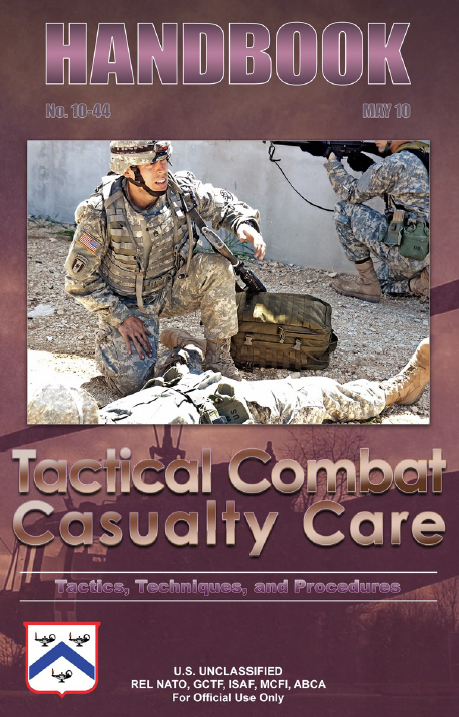
The problems start with the lack of amenities. The pool wasn’t fit to swim in, the hotel doesn’t have a bar, there isn’t a gym, nothing. The service was appalling. The food was always cold & generally dreadful, the bathrooms are fitted out with full bottles of head and shoulders, Colgate, dove soap, bic razors and gilette shaving foam. There is no room service, no laundry service and all that for $300 a night….One plus. It’s safe, which is saying something for Baghdad…

Not much global dialogue there then.