‘By our algorithms we shall know them’

191webcoverweb

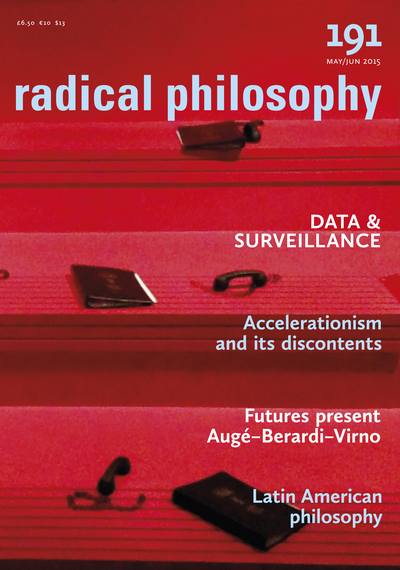
Radical Philosophy 191 is out now, including two contributions of particular interest to me as I continue to grapple with the surveillance apparatus that (mis)informs US drone strikes in the Federally Administered Tribal Areas.  This has come into sharper view after Obama’s rare admission of not only a strike in the FATA but of a mistake in targeting – though his statement was prompted by the death of an American and Italian hostage not by the previous deaths of innocent Pakistanis.

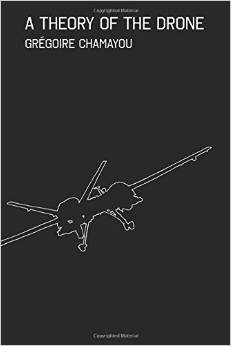
First, Grégoire Chamayou‘s ‘Oceanic enemy: a brief philosophical history of the NSA‘ which traces a path from the sonic surveillance of submarines off Barbados in 1962 to ‘pattern of life’ analysis in Afghanistan, Iraq and Pakistan, and which – not surprisingly – intersects with his Theory of the drone in all sorts of ways:

‘The premiss is the same as before: ‘in environments where there is no visual difference between friend and enemy, it is by their actions that enemies are visible.’ Today the task of establishing a distinction between friend and enemy is once again to be entrusted to algorithms.’

Second, Claudia Aradau‘s ‘The signature of security: big data, anticipation, surveillance‘ shatters the crystal balls of the intelligence agencies:

‘We are not crystal ball gazers. We are Intelligence Agencies’, noted the former GCHQ director Iain Lobban in a public inquiry on privacy and security by the Intelligence and Security Committee of the UK Parliament (ISC) in the wake of the Snowden revelations about mass surveillance….

I argue here that the disavowal of ‘crystal ball gazing’ is as important as the image of finding the clue through the data deluge in order to locate potential dangerous events or individuals in the future. Intelligence work is no stranger to the anticipation of the future – rather, it justifies itself precisely through the capacity to peer into the future in order to prevent or pre-empt future events from materializing. Big data has intensified the promise of anticipating the future and led to ‘exacerbat[ing] the severance of surveillance from history and memory’, while ‘the assiduous quest for pattern-discovery will justify unprecedented access to data’. ‘Knowledge discovery’ through big-data mining, and prediction through the recording of datafied traces of social life, have become the doxa of intelligence and security professionals. They claim that access to the digital traces that we leave online through commercial transactions or social interactions can hold a reading of the future. They repeat the mantra of data scientists and private corporations that the ‘digital bread crumbs’ of the online world ‘give a view of life in all its complexity’ and ‘will revolutionize the study of human behaviour’.

Unlike statistical technologies of governing populations, big data scientists promise that through big data ‘we can escape the straightjacket of group identities, and replace them with more granular predictions for each individual’. To resist their unreasonable promise of predicting crises, preventing diseases, pre-empting terrorist attacks and overall reshaping society and politics, I recast it as divination rather than detection. Big-data epistemics has more in common with the ‘pseudo-rationality’ of astrology than the method of clues. As such, it renders our vocabularies of epistemic critique inoperative…

‘There is nothing irrational about astrology’, concluded Adorno, ‘except its decisive contention that these two spheres of rational knowledge are interconnected, whereas not the slightest evidence of such an interconnection can be offered.’ The irrationality of big-data security is not in the data, its volume or messiness, but in how a hieroglyph of terrorist behaviour is produced from the data, without any possibility of error.

You can obtain the pdfs of both essays by following the links above – but they are time-limited so do it now.

Joining the dots…

The Bureau of Investigative Journalism and The Rendition Project have just published their first quarterly report on 119 people secretly detained and tortured by the CIA as part of the ‘war on/of terror’.

You can download the brief report as a pdf here, but the infographic below summarises the key findings (and don’t let its stark simplicity fool anyone about the detailed research that went into its production: this is difficult work).

what-we-know

Many commentators have noted that the Obama administration’s determination to end the CIA’s rendition program coincided with a decision to ramp up its covert program of targeted killing.  The preference for ‘kill’ over ‘capture’ is complicated by the living death suffered by many of those who were imprisoned in the carceral archipelago of black sites and prisons – and we should surely welcome the determination to widen the focus beyond Guantanamo to include, notably, Bagram.

But the apparent distinction between the two programs becomes even more blurred once you realise that many of the officials in charge of the one were switched to the other.  According to Mark Mazzetti and Matt Apuzzo writing in the New York Times:

‘Perhaps no single C.I.A. officer has been more central to the effort than Michael D’Andrea, a gaunt, chain-smoking convert to Islam who was chief of operations during the birth of the agency’s detention and interrogation program and then, as head of the C.I.A. Counterterrorism Center, became an architect of the targeted killing program. Until last month, when Mr. D’Andrea was quietly shifted to another job, he presided over the growth of C.I.A. drone operations and hundreds of strikes in Pakistan and Yemen during nine years in the position…

‘Mr. D’Andrea was a senior official in the Counterterrorism Center when the agency opened the Salt Pit, a notorious facility in Afghanistan where prisoners were tortured. His counterterrorism officers oversaw the interrogation and waterboarding of Abu Zubaydah, Abd al-Rahim al-Nashiri and Khalid Shaikh Mohammed. His actions are described in the withering Senate Intelligence Committee report about torture that was released late last year, although he was not identified publicly.’

(On the Times‘ decision to name names, see Jack Goldsmith‘s interview with Dean Baquet, Executive Editor of the Times).

But the real sting in the tail comes when Mazetti and Apuzzo also note:

‘The confidence [Senator Dianne] Feinstein and other Democrats express about the drone program, which by most accounts has been effective in killing hundreds of Qaeda operatives and members of other militant groups over the years, stands in sharp contrast to the criticism among lawmakers of the now defunct C.I.A. program to capture and interrogate Qaeda suspects in secret prisons.

‘When Ms. Feinstein was asked in a meeting with reporters in 2013 why she was so sure she was getting the truth about the drone program while she accused the C.I.A. of lying to her about torture, she seemed surprised.

‘“That’s a good question, actually,” she said.’

Dirty Dancing online

I had a wonderful time at the Balsillie School at Waterloo last week – good company, constructive conversations and endless hospitality – and I’m truly grateful to Simon Dalby, Jasmin Habib and all the graduate students who made my visit so enjoyable.  I finished by giving one of the Centre for Global Governance Innovation (CIGI)’s Signature Lectures.

This was the latest (and near-final) version of “Dirty dancing: drones and death in the borderlands”.   The argument has developed considerably since my first presentations; I’ll upload the written version once it’s finished, but CIGI has posted the lecture and Q&A online here.  I’ve also embedded the YouTube version below, but if that doesn’t work try here.

My thanks to the AV technicians who made this possible: their help with the production followed by their assured and rapid-fire editing beats anything I’ve encountered anywhere.

In this version, I begin with two CIA-directed drone strikes in Pakistan’s Federally Administered Tribal Areas, one on Baitullah Mehsud (the leader of Tehrik-i-Taliban) and the other on ‘Mamana’ Bibi, an innocent grandmother and midwife, and ask what it is that makes strikes like these – which is to say strikes as unlike these – possible.  My answer turns on the kinds of space the FATA been made out to be: in particular, a space of exception in which people are knowingly and deliberately exposed to death, and a territory conceived as a political technology through which power lays claim to bodies-in-space.

Unlike Giorgio Agamben‘s original formulation, though, my discussion of the space of exception focuses not on violence authorised through the suspension of the law but rather violence that operates inside the law: so I look at the legal regimes, both international and national, that affect military and paramilitary violence in the FATA.  A further difference is that this exceptional state of affairs is provoked not by an event but by a margin: by the construction of the FATA as a liminal zone, borderlands that are outside ‘Pakistan proper’ or ‘mainland Pakistan’.  Many commentators (including me) trace the origin of aerial violence to the British Raj, its Frontier Crimes Regulations and its ‘policing’ of the North-West Frontier.  This is important, but the line of descent to today’s air strikes is not direct.  In particular, it is important to bring into view the cross-border incursions made by Soviet and Afghan aircraft during the occupation of Afghanistan.  Thousands of people were killed and injured during these attacks, and this constitutes an important horizon of memory, but no less important is the response of the Pakistan Air Force: their US-supplied jets intercepted incoming aircraft and either escorted them out of Pakistani air space or, towards the end of the 1980s, engaged them in combat.  This begs an obvious question: if Pakistan objects to the US strikes – carried out by drones that are slow, noisy and sluggish – why does its Air Force not shoot them down?  Since today’s drones cannot be used in contested air space – bluntly, they can only be used against defenceless people – why does Pakistan elect to render the people of FATA defenceless?  This immediately brings into view the other source of aerial violence in the borderlands: the ongoing offensives in the FATA launched by the Pakistan Air Force (in concert with large-scale ground operations).  Even though the Pakistan Air Force has its own reconnaissance drones, some of which are now armed, these are not attempts to put ‘warheads on foreheads’, as the US Air Force would have it, but wide-area assaults conducted by conventional strike aircraft and attack helicopters – as I show in the case of Mir Ali and Miran Shah during Operation Zarb-i-Azb (see here and here and here).

To complete the sequence and add the US drone strikes, I trace the intimate collaboration between both the CIA and the US Air Force and between Washington and Islamabad.  The diplomatic cables released by Wikileaks show time and time again that many of the negotiations about access to ‘flight boxes’ over North and South Waziristan were conducted by the Chairman of the Joint Chiefs of Staff and the commander of US Central Command.  I show, too, how the collaboration between Washington and Islamabad continued until at least 2013.

Hacking.001

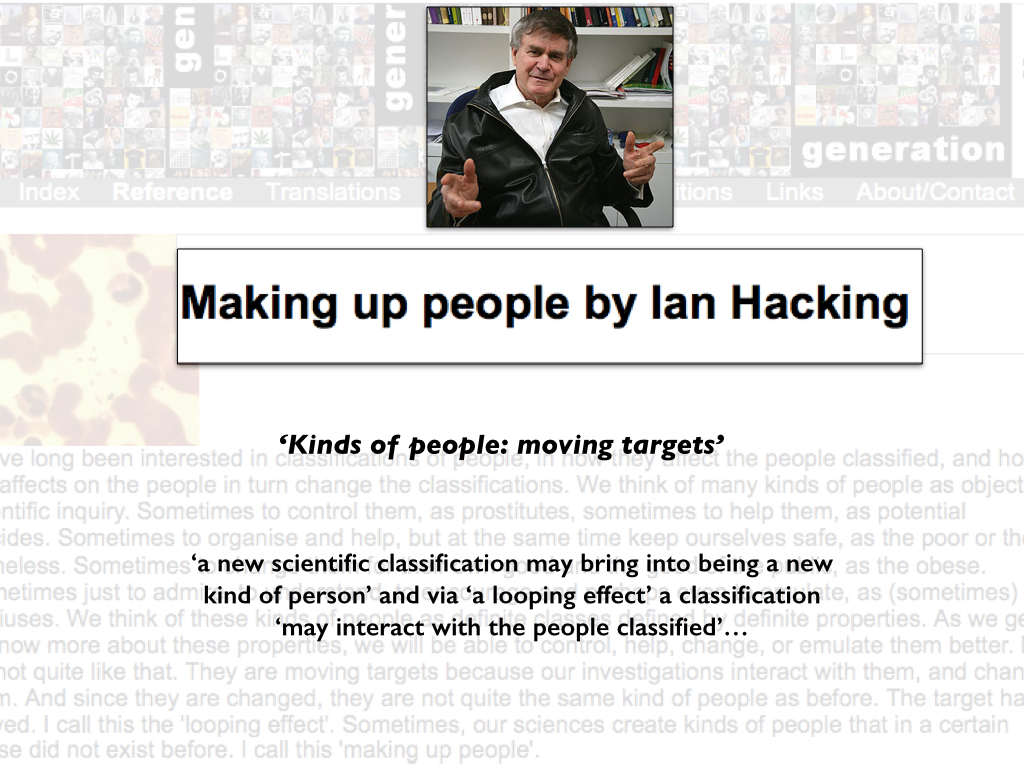
In order for the CIA-directed strikes to be possible, however, the FATA must also be turned into a territory in something like the sense proposed by Stuart Elden.  So I describe the multiple ways in which data is harvested by the NSA and other agencies to produce what Rob Kitchin and Martin Dodge call code/space: the algorithmic combination of sensors, traces and intercepts to summon into being a body-as-target (for more, see here: scroll down), and to produce the space of the target where fleshy bodies disappear and are replaced by codes, co-ordinates and cross-hairs.  This is another version of what Ian Hacking calls ‘making up people’: there is an important sense, then, in which the supposed ‘individuation’ of later modern war depends on the selective and active production (and destruction) of an ‘individual’.

The questions and comments after the lecture were immensely helpful, and as I turn this into its final, written version I’d be grateful for any further comments if you watch the video.

Law, ethics and drone warfare

SCHELLER Kill-chain

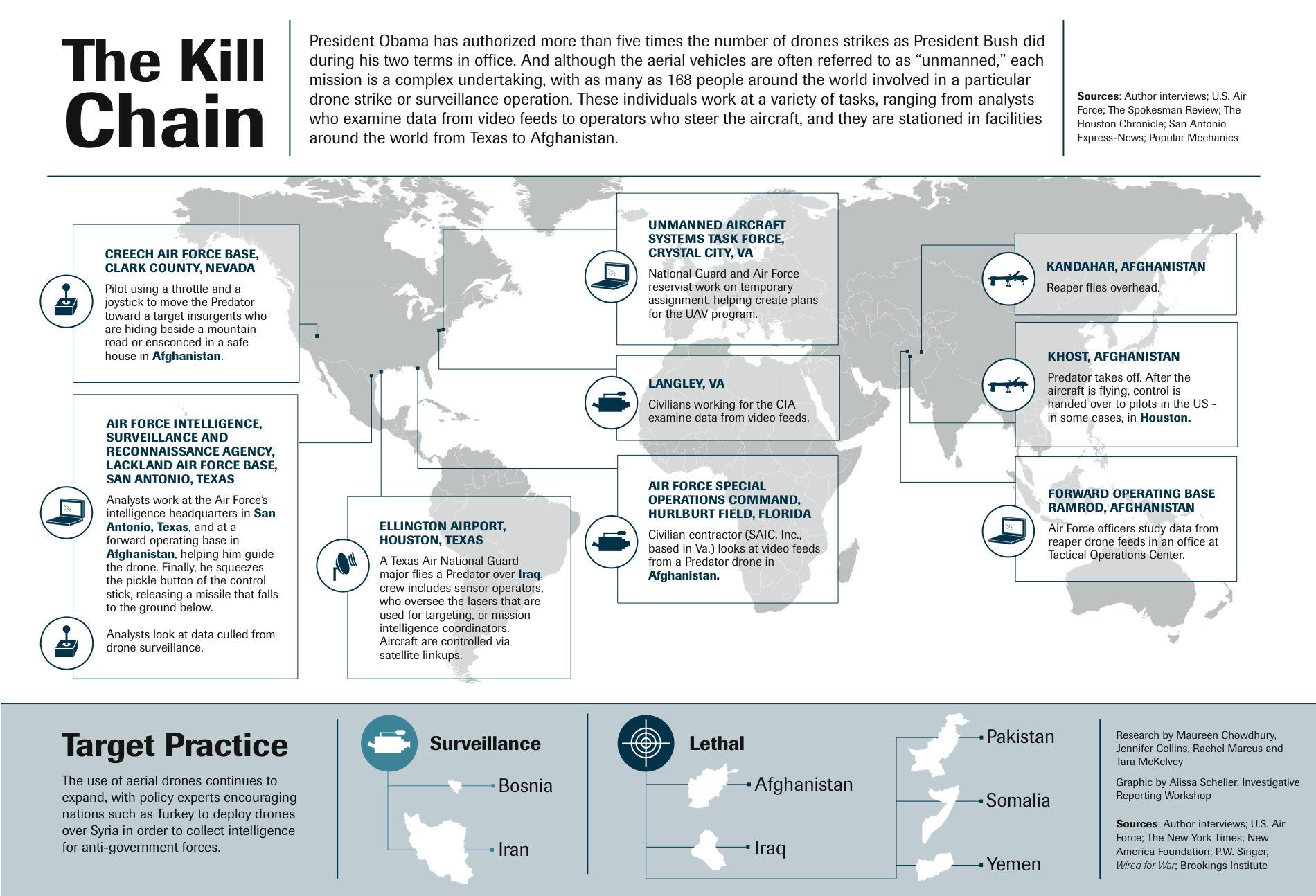
The infographic above was produced by Alissa Scheller for an Investigative Reporting Workshop on Drones, and specifically an article by Tara McKelvey on Harold Koh and the legal armature that the Obama administration has sought for its nominally covert program of targeted killing.

Since then (2012) there has been a cascade of essays around these legal and ethical issues; much of the spikiest writing is to be found on the indispensable ssrn, but here are some other essays I’ve just caught up with that readers might also find helpful:

Special issue: ‘Legal and ethical implications of drone warfare’, in International Journal of Human Rights 19 (2) (2015) including:

Michael J. Boyle, ‘The legal and ethical implications of drone warfare’ (pp 105-126)

Stephanie Carvin, ‘Getting drones wrong’ (pp. 127-141)

Craig Martin, ‘A means-methods paradox and the legality of drone strikes in armed combat’ (pp. 142-175)

Daniel R. Brunstetter & Arturo Jimenez-Bacardi, ‘Clashing over drones: the legal and normative gap between the United States and the human rights community’ (pp. 176-198)

David Whetham, ‘Drones to protect’ (pp. 199-210)

Caroline Kennedy & James I. Rogers, ‘Virtuous drones?’ (pp. 210-227)

Symposium: ‘Towards a drone accountability regime‘, in Ethics and International Affairs 1 (2015) with a major contribution from Allen Buchanan and Robert O. Keohane

From a moral standpoint, lethal drones are intrinsically no worse as a means of warfare than bombing or sending commandos to kill enemies. From the perspective of their users, they have six major advantages over more conventional weapons: they are often cheaper; their use can be more readily concealed; they allow for more precise targeting, with the potential for less “collateral damage”; their use can involve less serious infringements of sovereignty than invasion by troops; and they may be less likely to provoke widespread hostile reactions by the population of the country in which they are used than military operations involving troops on the ground. But these advantages generate three major risks: of violating sovereignty, of over-using the military option, and of making it more difficult to identify violations of constraints against targeting noncombatants. To deal with these risks, a Drone Accountability Regime is needed that imposes obligations on states, which in turn would be required to impose them on their agents. Since it would be infeasible to negotiate a treaty-based legal regime at present and for the foreseeable future, the Drone Accountability Regime should be informal and should involve transnational actors as well as states. Its key principle should be transparency, helping enable civil society to hold states accountable, and its central agent would be an Ombudsperson with broad authority to investigate situations and publicize her findings. No institution can ensure that states, or operators, are held fully accountable to appropriate standards of conduct, but such a regime could increase the degree of accountability for the use of lethal drones.

— and critical responses from Neta Crawford, Janina Dill, and David Whetham.

Bianca Baggiarini, ‘Drone warfare and the limits of sacrifice’, Journal of international political theory 11 (1) (2015) 128-44

M.J. Boyle, ‘The race for drones’, Orbis 59 (1) (2015) 76-94

Lindsay Cohn-Warrior, ‘Drones and targeted killing: costs, accountability and US Civil-Military relations’, Orbis 59 (1) (2015) 95-110

Jelena Pejic, ‘Extraterritorial targeting by means of armed drones: some legal implications’, International review of the Red Cross (2015) (online early)

Lauren Wilcox, ‘Drone warfare and making bodies out of place’, Critical studies on security 3 (1) (2015) 127-131

John Williams, ‘Distant intimacy: space, drones and Just War’, Ethics and International Affairs 1 (2015) 93-110

And to widen the discussion and give it substantive depth, see Craig Jones, ‘Lawfare and the juridification of late modern war‘, Progress in human geography (2015) (Online First):

Processes of juridification are a defining feature of late modern war. But geographic accounts of war have generally not considered the role that law plays in shaping its conduct. This paper explores the juridification of war using the concept of lawfare. Lawfare may signal an intensification and shift in the relationship between war and law, but I argue that understanding the nature and extent of these changes requires a careful examination of the historical geographies of war, law and lawfare. Drawing from critical legal approaches I offer a preliminary geographical and historical theorization of lawfare so that we may better understand the relationship between war and law today.

War at a distance

Porter-The-Global-Village-Myth-webNews from Patrick Porter of a new book due out in March, The global village myth: distance, war and the limits of power (from Hurst in the UK/Georgetown University Press in the US):

According to security elites, revolutions in information, transport, and weapons technologies have shrunk the world, leaving the United States and its allies more vulnerable than ever to violent threats like terrorism or cyberwar. As a result, they practice responses driven by fear: theories of falling dominoes, hysteria in place of sober debate, and an embrace of preemptive war to tame a chaotic world.

Patrick Porter challenges these ideas. In The Global Village Myth, he disputes globalism’s claims and the outcomes that so often waste blood and treasure in the pursuit of an unattainable “total” security. Porter reexamines the notion of the endangered global village by examining Al-Qaeda’s global guerilla movement, military tensions in the Taiwan Strait, and drones and cyberwar, two technologies often used by globalists to support their views. His critique exposes the folly of disastrous wars and the loss of civil liberties resulting from the globalist enterprise. Showing that technology expands rather than shrinks strategic space, Porter offers an alternative outlook to lead policymakers toward more sensible responses—and a wiser, more sustainable grand strategy.

You can get a preliminary preview of Patrick’s basic argument at War on the Rocks here.

Drone networks

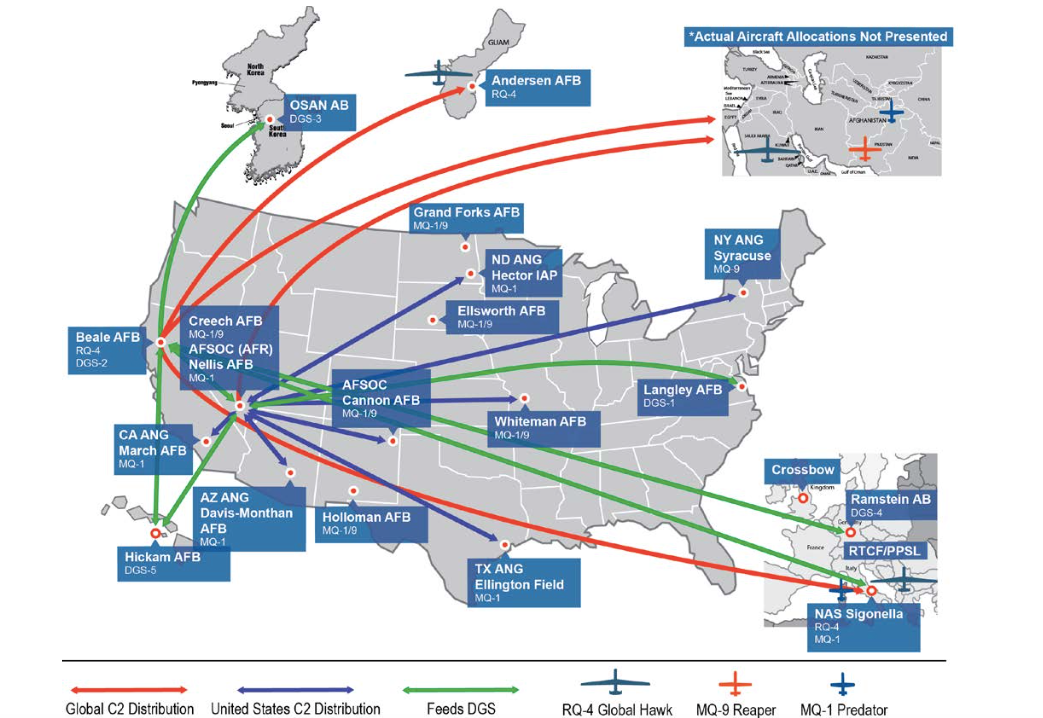
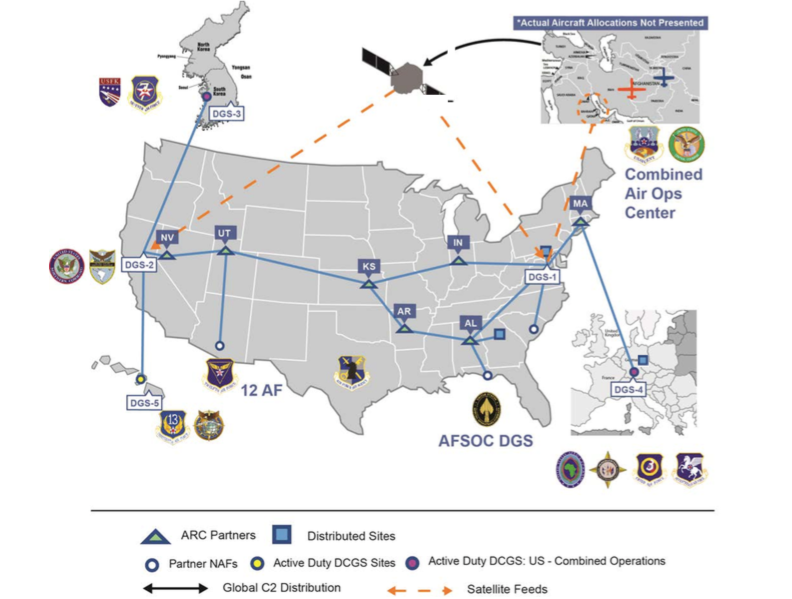
Three contributions to the debates over drones and military violence.  First, my friends at the Bard Center for the Study of the Drone have published Dan Gettinger‘s essay on ‘Drone Geography: mapping a system of intelligence‘.  It’s a superb sketch of the intelligence network in which the US Air Force’s drones are embedded (you can read my complementary take on ‘Drone geographies’ under the DOWNLOADS tab).  Let me add just one map to the illustrations that stud his essay.  It’s taken from the Air Force’s RPA Vector report for 2013-28, published last February, and it shows the architecture of remote split operations within and beyond the United States.  It’s helpful (I hope) because it shows how the Ground Control Stations in the continental United States feed in to the Distributed Common Ground System that provides image analysis and exploitation (shown in the second map, which appears in a different form in Dan’s essay).  I’m having these two maps combined, and I’ll post the result when it’s finished.

RSO architecture (USAF) 1

Distributed Common Ground System (USAF) 2

Dan is right to emphasise the significance of satellite communications; much of the discussion of later modern war and its derivatives has focused on satellite imagery, and I’ve discussed some of its complications in previous posts, but satellite communications materially shape the geography of remote operations.  The Pentagon has become extraordinarily reliant on commercial providers (to such an extent that Obama’s ‘pivot to the Pacific’ may well be affected), and limitations of bandwidth have required full-motion video streams from Predators and Reapers (which are bandwidth hogs) to be compressed and image quality to be degraded.  Steve Graham and I are currently working on a joint essay about these issues.

One caveat: this is not the only network in which US remote operations are embedded.  In my essay on ‘Dirty Dancing’ (now racing towards the finish line) I argue that the CIA-directed program of targeted killing in the Federally Administered Tribal Areas of Pakistan cannot be severed from the multiple ways in which the FATA have been configured as both borderlands and battlefields and, in particular, from the cascade of military operations that have rendered the FATA as a space of exception (in something both more and less than Agamben’s sense of the term).  Here I’ve learned much from an excellent essay by Elizabeth Cullen Dunn and Jason Cons, ‘Aleatory sovereignty and the rule of sensitive spaces’, Antipode 46 (1) (2014) 92-109).  They complicate the claim that spaces of exception always derive from a single locus of sovereign power (or ‘the sovereign decision’).  Instead, they  suggest that borderlands are ‘contested spaces’ where ‘competing’ powers ‘collide’.  In the FATA multiple powers have been involved in the administration of military violence, but on occasion – and crucially – they have done so in concert and their watchword has been a qualified and covert collaboration. In particular, the FATA have been marked by a long and chequered gavotte between the militaries and intelligence services of the United States and Pakistan which, since the 1980s, has consistently put at risk the lives of the people of the borderlands.  And in my essay on ‘Angry Eyes’ (next on my screen) I argue that the US military’s major use of Predators and Reapers in Afghanistan – orchestrating strikes by conventional aircraft and providing close air support to ‘troops in contact’ – depends on communication networks with ground troops in theatre, and that this dispersed geography of militarised vision introduces major uncertainties into the supposedly ‘precise’ targeting process.

CHAMAYOU Theory of the droneSecond: Elliott Prasse-Freeman has an extended review of the English translation of Grégoire Chamayou‘s Theory of the drone – called ‘Droning On‘ – over at the New Inquiry (you can access my own commentaries on the French edition here: scroll down).  His central criticism is this:

While his title promises theory, we instead are treated to a digression on the military and social ethics of attacks from the air, in which Chamayou asks without irony, “can counterinsurgency rise to the level of an aero-policy without losing its soul?” What offends Chamayou is the “elimination, already rampant but here absolutely radicalized, of any immediate relation of reciprocity” in warfare. This, we are told, is the problem.

Promised a theory of the drone, how do we arrive at a theory of the noble soldier?…

And so, dispatching with the dream of the drone … Chamayou assumes the concerns not of the brutalized but of military leaders and soldiers.

He continues in terms that resonate with my argument in ‘Dirty Dancing’:

By combining knowing (intelligence, surveillance, reconnaissance), sighting (targeting in movement and in the moment), and eliminating (“putting warheads on foreheads”), the drone constitutes an assemblage of force (as drone-theorist Derek Gregory puts it) that promises a revolution in control and allows the US war apparatus to imagine space and politics in new ways. Because the body of the accused can ostensibly be precisely seen, it can be seen as itself carving out a body-sized exception to state sovereignty over the territory on which that body moves. In this way, eliminating the body does not constitute an assault on the territory of the state, as these bodies are presented as ontologically (and hence quasi-legally) disconnected from that territory.  Geographer Stuart Elden in Terror and Territory (2009) points out the significant overlap between who are labeled ‘terrorists’ and movements fighting for their own political spaces – which hence necessarily violate extant states’ ‘territories’ (and hence the entire international order of states): to violate territory is to terrorize. The US is hence remarkably concerned in its arrogation of a position of supra-sovereignty to ensure that it overlaps with ‘classic’ state sovereignty, and by no means violates the norm of territorial integrity (well-defined borders): by harboring or potentially harboring unacceptable transnational desires, the militant uproots himself, and risks being plucked out and vaporized in open space that belongs only to him. The exception to sovereignty provides the drone the opportunity to extend this exception into temporal indefiniteness: wars are not declared, aggressions are not announced—the fleet, fusing police and military functions, merely watches and strikes, constantly pruning the ground of human weeds.

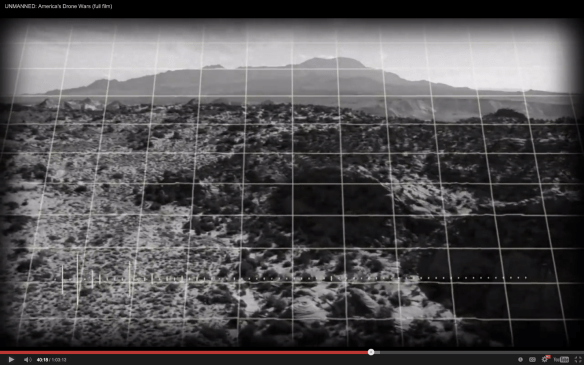
In ‘Dirty Dancing’ I’m trying to prise apart – analytically, at least – the space of exception, conceived as one in which a particular group of people is knowingly and deliberately exposed to death through the political-juridical removal of legal protections and affordances that would otherwise be available to them, and territory conceived (as Stuart suggests) as a political-juridical technology, a series of calculative practices that seeks to calibrate and register a claim over bodies-in-spaces.  That’s why Dan Gettinger’s essay is so timely too, and why I’ve been thinking about the FATA as a performance of what Rob Kitchin and Martin Dodge call ‘code/space’, why I’ve been working my way through the files released by Edward Snowden, and why I’ve been thinking so much about Louise Amoore‘s superb critique of The politics of possibility: risk and security beyond probability (2013).
Screen Shot 2015-01-07 at 10.03.16 AM

Although Louise doesn’t address drone strikes directly, her arguments are full of vital insights into the networks that are mobilised through them.  ‘The sovereign strike is always something more, something in excess of a single flash of decision’, she insists, and when she writes that —

those at risk (which is to say those who are to be put at risk by virtue of their inferred riskiness) are ‘not strictly “included by means of their own exclusion”, as Agamben frames the exception, they are more accurately included by means of a dividuated and mobile drawing of risk fault lines’
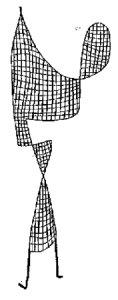
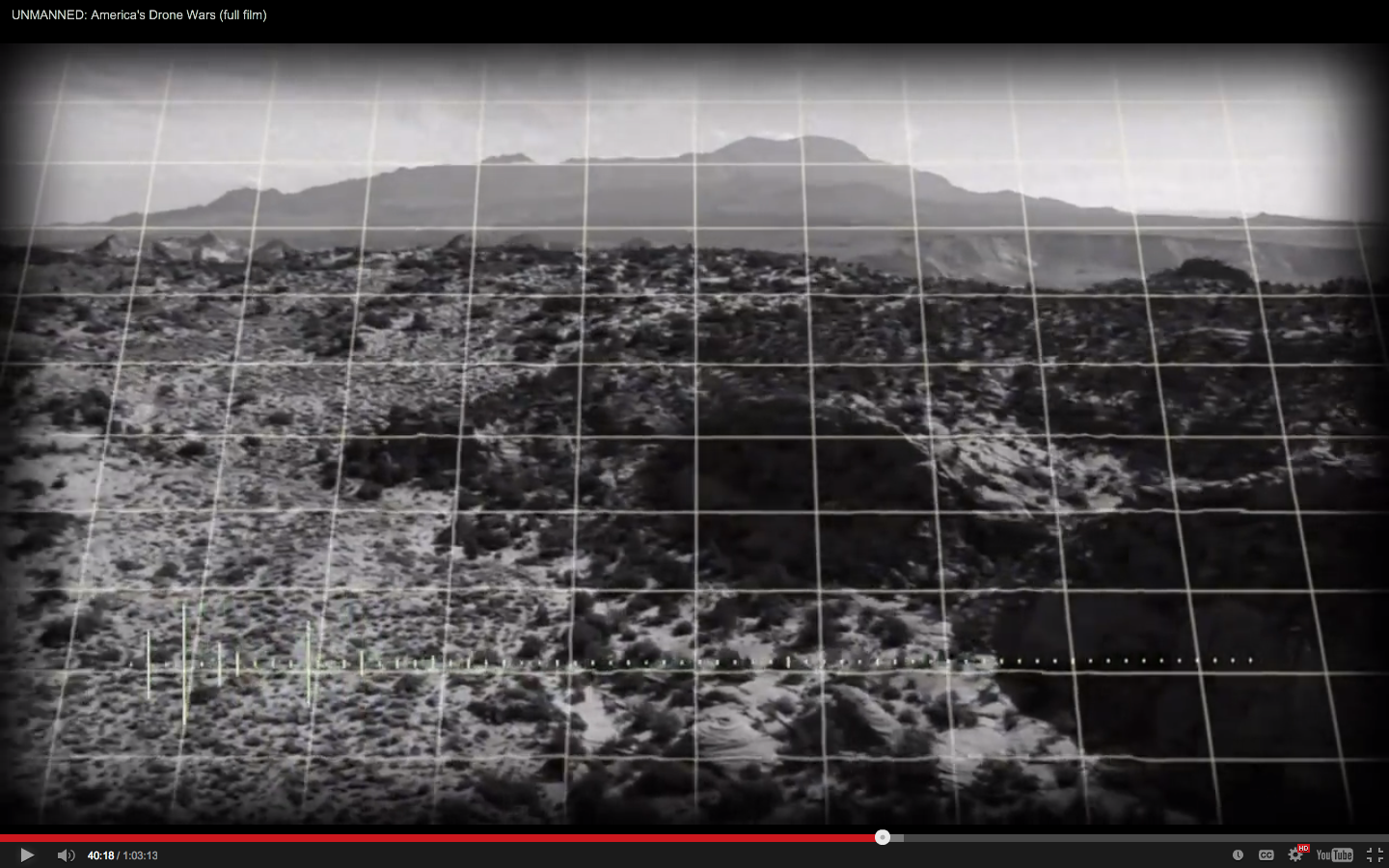
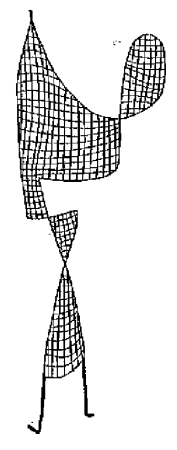
17— it’s a very short journey back to Grégoire Chamayou‘s reflections on the strange (in)dividual whose ‘schematic body’ emerges on the targeting screen of the Predator or Reaper.  Louise writes of ‘the appearance of an emergent subject’, which is a wonderfully resonant way of capturing the performative practices through which targets are produced: ‘pixelated people’, she calls them, that emerge on screens scanning databanks but which also appear in the crosshairs…

And finally, Corporate Watch has just published a report by Therezia Cooper and Tom Anderson, Gaza: life beneath the drones.  This brings together a series of interviews conducted in 2012 – when ‘drones killed more people in Gaza than any other aircraft’ – that were first published in serial form in 2014.  The report includes a tabulation of deaths from Israeli military action in Gaza and those killed directly by drones (2000-2014) and a profile of some of the companies involved in Israel’s military-industrial complex.
Unlawful combatants

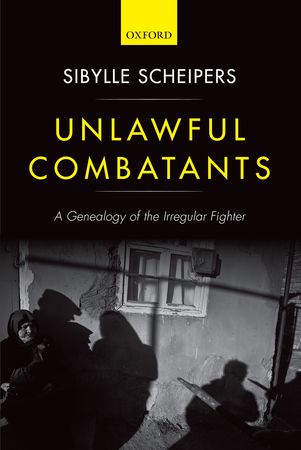
Unlawful combatantsI know several friends are interested (critically) in Carl Schmitt‘s Theory of the Partisan (see also Jan-Werner Müller‘s commentary here), but Sibylle Scheipers has now provided an indispensable genealogy of these often shadowy figures and their late modern incarnations: Unlawful Combatants: a genealogy of the irregular fighter (Oxford, 2015).

Unlawful Combatants brings the study of irregular warfare back into the centre of war studies. The experience of recent and current wars in Afghanistan, Iraq, Libya, and Syria showed that the status and the treatment of irregular fighters is one of the most central and intricate practical problems of contemporary warfare. Yet, the current literature in strategic studies and international relations more broadly does not problematize the dichotomy between the regular and the irregular. Rather, it tends to take it for granted and even reproduces it by depicting irregular warfare as a deviation from the norm of conventional, inter-state warfare. In this context, irregular warfare is often referred to as the ‘new wars’ and is associated with the erosion of statehood and sovereignty more generally. This obscures the fact that irregulars such as rebels, guerrillas, insurgents and terrorist groups have a far more ambiguous relationship to the state than the dichotomy between the state and ‘non-state’ actors implies. They often originate from states, are supported by states and/or aspire to statehood themselves.

The ambiguous relationship between irregular fighters and the state is the focus of the book. It explores how the category of the irregular fighter evolved as the conceptual opposite of the regular armed forces, and how this emergence was tied to the evolution of the nation state and its conscripted mass armies at the end of the eighteenth century. It traces the development of the dichotomy of the irregular and the regular, which found its foremost expression in the modern law of armed conflict, into the twenty-first century and provides a critique of the concept of the ‘unlawful combatant’ as it emerged in the framework of the ‘war on terror’.

Here is the Contents list:

1: Introduction
2: The Making of the Irregular Fighter, 1740-1815
3: The Nineteenth Century: Rebels, Rifles, and the Laws of War
4: The Second World War: Anti-Partisan Warfare, Genocide, and the Rebirth of the Auxiliary Fighter
5: Wars in the Colonies: Orientalism and the Social Production of Colonial Subjects
6: Irregular Fighters in the Twenty-first Century: Between ‘Unlawful Combatants’ and ‘Rebel’ Auxiliaries
7: Conclusion

The book is a product of the Changing Character of War programme at the University of Oxford, where Sibylle was Director of Studies until she moved to St Andrews in 2011.

Bodies of violence

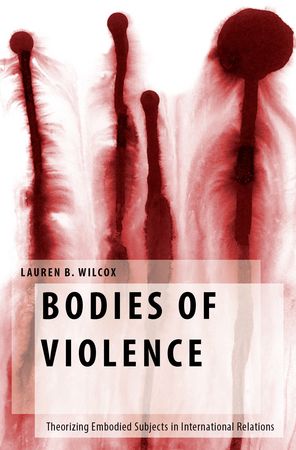
Bodies of violenceNew from Oxford University Press, Lauren Wilcox‘s Bodies of violence: theorizing embodied subjects in International Relations (how I wish books didn’t come with subtitles that serve only to narrow the audience for works that deserves a much wider one).

According to conventional international relations theory, states or groups make war and, in doing so, kill and injure people that other states are charged with protecting. While it sees the perpetrators of violence as rational actors, it views those who are either protected or killed by this violence as mere bodies: ahistorical humans who breathe, suffer and die but have no particular political agency. In its rationalist variants, IR theory only sees bodies as inert objects. Constructivist theory argues that subjects are formed through social relations, but leaves the bodies of subjects outside of politics, as “brute facts.”

According to Wilcox, such limited thinking about bodies and violence is not just wrong, but also limits the capacity of IR to theorize the meaning of political violence. By contrast to rationalist and constructivist theory, feminist theory sees subjectivity and the body as inextricably linked. This book argues that IR needs to rethink its approach to bodies as having particular political meaning in their own right. For example, bodies both direct violent acts (violence in drone warfare, for example) and are constituted by practices that manage violence (for example, scrutiny of persons as bodies through biometric technologies and body scanners). The book also argues that violence is more than a strategic action of rational actors (as in rationalist theories) or a destructive violation of community laws and norms (as in liberal and constructivist theories). Because IR theorizes bodies as outside of politics, it cannot see how violence can be understood as a creative force for shaping the limits of how we understand ourselves as political subjects, as well as forming the boundaries of our political communities.

By engaging with feminist theories of embodiment and violence, Bodies of Violence provides a more nuanced treatment of the nexus of bodies, subjects and violence than currently exists in the field of international relations.

Here’s the Contents list:

Introduction
Chapter 1: Bodies, Subjects, and Violence in International Relations
Chapter 2: Dying is Not Permitted: Guantánamo Bay and the Liberal Subject of IR
Chapter 3: Explosive Bodies: Suicide Bombing as an Embodied Practice and the Politics of Abjection
Chapter 4: Crossing Borders, Securing Bodies: Airport Security Assemblages and Bodies of Information
Chapter 5: Body Counts: The Politics of Embodiment in Precision Warfare
Chapter 6: Vulnerable Bodies and “Responsibility to Protect”

If you don’t know Lauren’s work already, you can catch up with some of it here.

Freedom fries, anyone?

Three more contributions to the Charlie Hebdo debate to think about.  The first is from Pankaj Mishra at the Guardian.  Not sure about his call for a ‘new Enlightenment’ – though there was certainly much wrong with the old one – but it’s a luminously (sic) intelligent argument.  He writes about ‘a profound clash – not between civilisations, or the left and the right, but a clash of old and new visions of the world in the space we call the west, which is increasingly diverse, unequal and volatile.’

It is not just secular, second-generation immigrant novelists [Hari Kunzru, Laila Lalami and Teju Cole] who express unease over the unprecedented, quasi-ideological nature of the consensus glorifying Charlie Hebdo’s mockery of Islam and Muslims. Some Muslim schoolchildren in France refused to observe the minute-long silence for the victims of the attack on Charlie Hebdo mandated by French authorities.

It seems worthwhile to reflect, without recourse to the clash of civilisations discourse, on the reasons behind these striking harmonies and discords. Hannah Arendt anticipated them when she wrote that “for the first time in history, all peoples on earth have a common present … Every country has become the almost immediate neighbour of every other country, and every man feels the shock of events which take place at the other end of the globe.” Indeed, it may be imperative to explore this negative solidarity of mankind – a state of global existence in which people from different pasts find themselves thrown together in a common present.’

Construction of Statue of Liberty in Paris.comI think that’s right, which is why I’m disconcerted by Pankaj’s focus on Europe; I certainly don’t think the murders in Paris can be assimilated to ‘an assault on American values’ (far from it), but the complicated and often confounding relations between the two republics need excavation too.  They go back far beyond the gift of the Statue of Liberty to the US in the 1880s – I discussed this in what is still my favourite chapter in Geographical Imaginations – and reach forward to include the double, displaced misadventures in Indochina (not least the conviction that the US would sort out Vietnam after France had failed to do) and, still more proximately, France’s refusal to support the US-led invasion of Iraq (“freedom fries“, anyone?).

NIVAT Bagdad zone rougePankaj is simply brilliant on the ghosts of the colonial past, as you would expect, and they reappear in a different spectral guise in a short essay by Anne Nivat at Warscapes.  She provided some of the most reflective reporting from occupied Iraq (see her Bagdad, zone rouge), and in ‘Charlie Hebdo and the Boomerang Effect’ she mines that rich vein of experience to reflect on the knee-jerk responses to the murders in Paris:

In a democracy, one has the privilege of freedom of expression, and it is in the name of this that, for years, I have been traveling to the lands of “Islamist” wars.

For some time, I have been amazed, and even hurt, to hear friendly voices claim not to understand why I continue to give the floor to “the other side”; to those who make us afraid; to the “bad guy”; the “barbarian”; the “jihadist”; the Taliban; the “Islamic fighters” – the ones our allies have sought out to fight, or to “bump off in the outhouse,” as Russian President Vladimir Putin so elegantly put it in 2000 in reference to Chechen separatist fighters (Western military and political leaders typically use less violent vocabulary, but the meaning remains the same).

I regret that the attempts to know the “enemy” – my work, and others’ – have not been sufficient, as evidenced by the onslaught of hate on social networks.

And at the same site Andrew Ryder explores the multiform versions of ‘hate’ in ‘Charlie Hebdo and the limits of nihilism’.  He maps the gavotte between iconoclasm and nationalism and in so doing returns us to the figure of the Republic and to the dilemmas exposed by Pankaj Mishra.

Three years ago, [the editor of Charlie Hebdo] said, “If we say to religion, ‘You are untouchable,’ we’re fucked.” His idea was that no religion should be free from mockery, because to allow this is to permit the continuing subjugation of human freedom by religious superstition…

However, Charb also said, that same year, “I don’t blame Muslims for not laughing at our drawings. I live under French law. I don’t live under Koranic law.” This is the point where this apparent commitment to freedom actually masks French nationalism. What he is really saying, whether he was conscious of it or not, is that traditional French secularism, the products of a distinct national revolutionary tradition, should take absolute precedence over the values of immigrants. The secularism takes the shape of social chauvinism. In this context, it’s no longer a progressive contribution to the liberation of human beings. The apparent irreverence is bound to a greater advocacy of European heritage over the cultural character of the immigrants who now comprise such a large part of its society, and who were traditionally colonized and exploited by the ostensibly progressive and liberal nations whose secular values are then rhapsodized… [T]his complicity with racism was probably unrecognizable to him. We can see this today in the irony of the French right, paying homage to a magazine that hated them.

Divided societies and connected spaces

Following my last post, Mustafa Dikeç has sent me a link to his brilliant reflections on ‘Hate’ at the Society & Space website here.  Written from Paris, it takes us to the heart of modern French society and its divided spaces:

DIKEÇ Badlands… if we are troubled about what has happened, troubled enough to take a hard look at, rather than falling in love with, ourselves, then it is important to inquire about the conditions that made such a mobilisation of hate possible. In the highly emotional aftermath of the incidents, it is hard not to feel moved by the extraordinary mobilisation of citizens. Newspapers are full of comments about how proud we should be as French citizens, how a united and solidaristic people we are, how the spirit of May 1968 continues despite the attack on its inheritors, how we value equality and freedom of expression, and so on. If all were nice and dandy, then what made such radicalisation of these three French-born and raised citizens possible? Why, a decade ago, did 300 cities go up in flames for two weeks, and what has been done since? How is it that the extreme right has become the second major political force in this land of freedom, equality and fraternity? …

This is not at all to suggest that the murderers’ actions can be justified by the circumstances. But to warn that despite the timely and admirable display of unity under an alleged one and indivisible republic, the French society is deeply divided, owing to its long history of discrimination and the increasing hostility towards immigrants – a poisonous mix of xenophobia and Islamophobia that several French politicians, endowed with the authority of the state, have unashamedly mobilised for their political ends. Muslims are the most stigmatised group of this divided society, spared neither by satire nor political discourse and action.

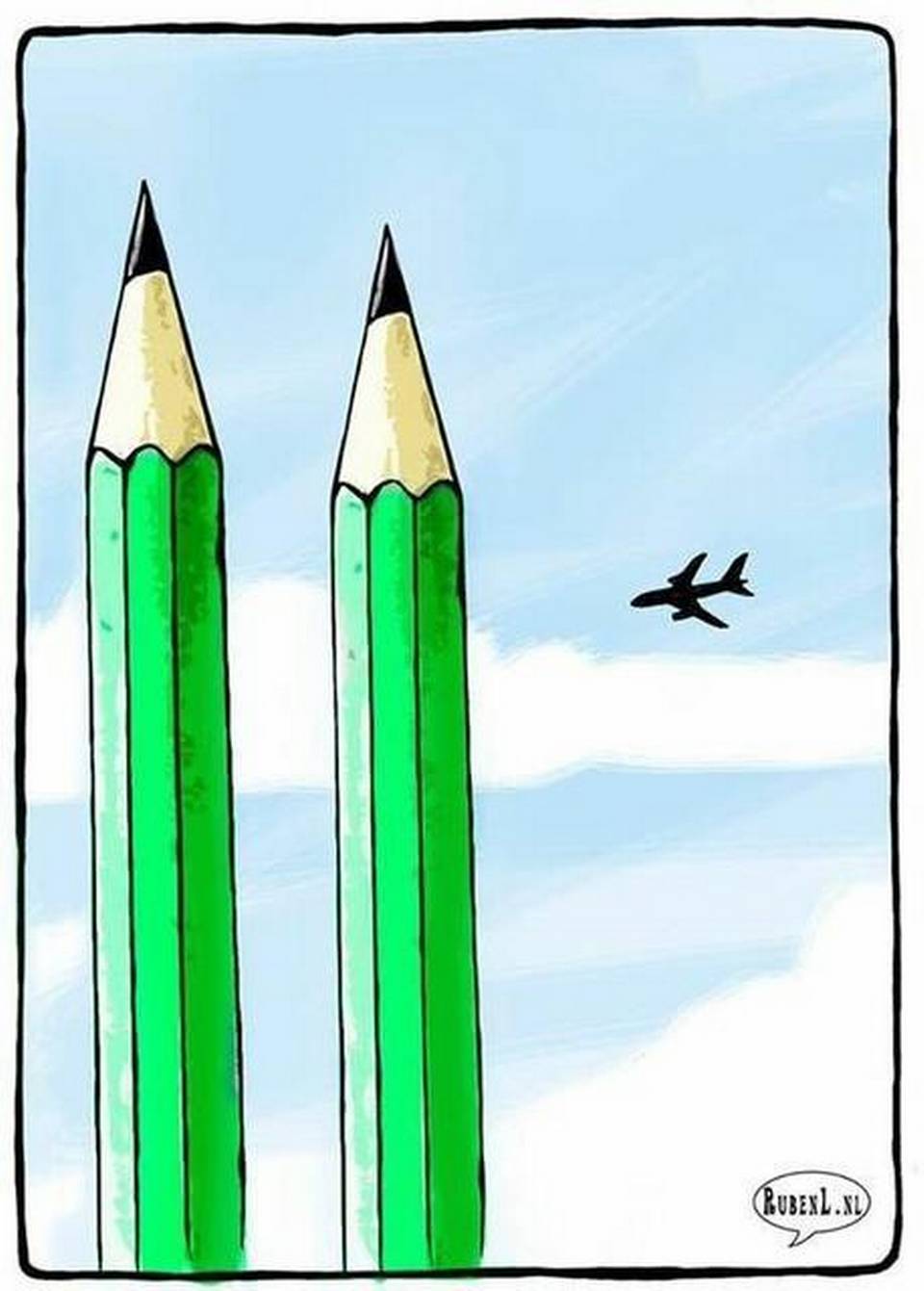
thursdaytoonMustafa’s essay begins not with the murders in Paris but with a bomb explosion in Yemen, and a second e-mail from Tim Raeymaekers has alerted me to his equally indispensable post ‘”Us” against “Them”‘ over at Liminal Geographies here.  Tim moves in the opposite direction to Mustafa, zooming out above the arc of that explosion to provide a contrapuntal geography that reads the murders in Paris in concert with the global violence of contemporary wars, most of them fought under the tattered banners of counter-terrorism, undeclared in their particulars and less than covert in their killing.  He ends with this reminder from Teju Cole‘s incandescent essay on ‘Unmournable bodies’ at the New Yorker:

BUTLER Precarious LifeFrance is in sorrow today, and will be for many weeks to come. We mourn with France. We ought to.

But it is also true that violence from “our” side continues unabated. By this time next month, in all likelihood, many more “young men of military age” and many others, neither young nor male, will have been killed by U.S. drone strikes in Pakistan and elsewhere. If past strikes are anything to go by, many of these people will be innocent of wrongdoing. Their deaths will be considered as natural and incontestable as deaths like Menocchio’s, under the Inquisition. Those of us who are writers will not consider our pencils broken by such killings. But that incontestability, that unmournability, just as much as the massacre in Paris, is the clear and present danger to our collective liberté.