Predator View

I’m in Zurich – many thanks to Benedikt Korf for the invitation and the wonderful hospitality – for a seminar with Benedikt’s doctoral students on the long form version of ‘The Natures of War’ (they have what I hope is the penultimate draft; I’ll post the final version once I’ve reworked it after the seminar) and then a public lecture: ‘Angry eyes: the militarization of vision and modern war’.

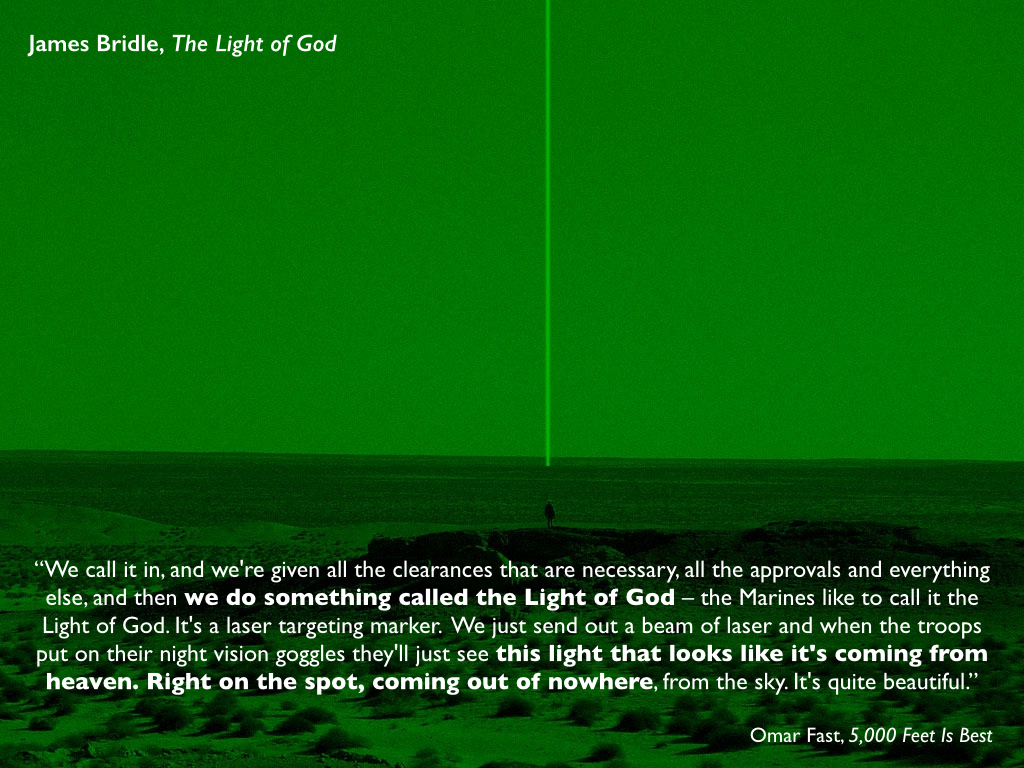
Part of my argument in the lecture is about the narrowness of ‘Predator View’, so let me explain what I mean.  My starting point is the illusion that the use of the intelligence, surveillance and reconnaissance capabilities of remote platforms like the MQ-1 Predator or the MQ-9 Reaper produces a transparent battlespace: in effect, a version of Donna Haraway‘s ‘God-trick’, the ability to see everything from nowhere in particular.  The most succinct version of this is the treatment of laser targeting as ‘the eye of God’:

Eye of God.001

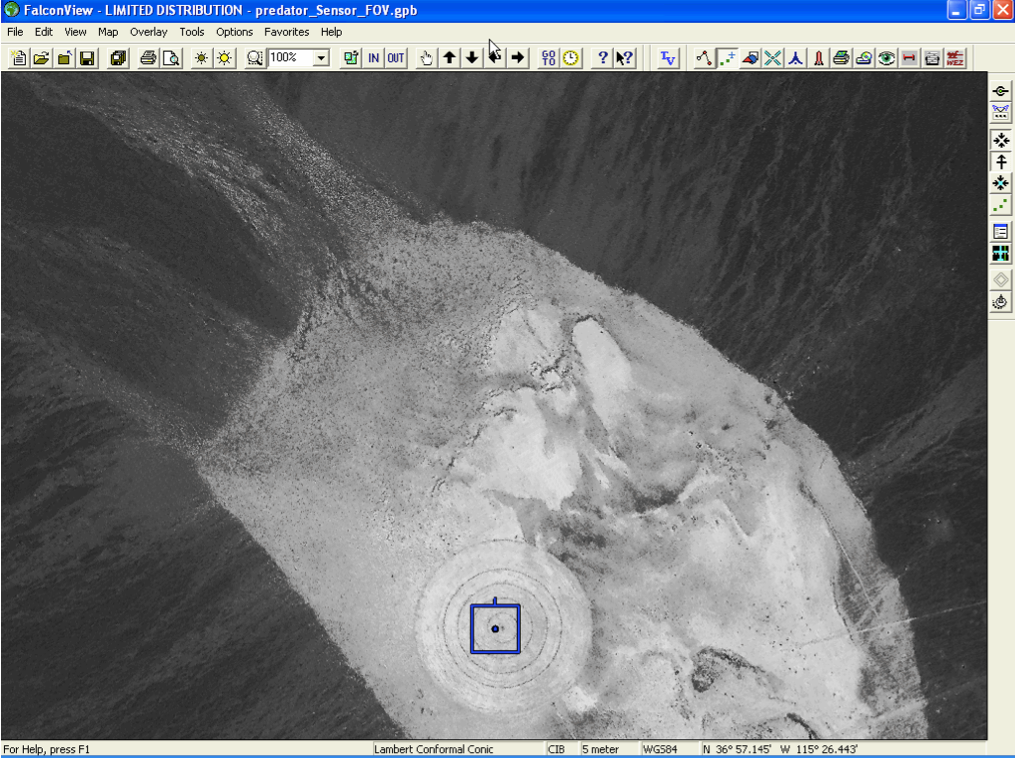
In fact, ‘Predator View’ is remarkably narrow. First, and most directly, a common complaint is that the view provided by its Full Motion Video is literally too narrow – ‘like looking through a soda straw’.  It’s for this reason that pilots and sensor operators also use FalconView, a Windows-based mapping tool that is supposed to provide them with situational awareness.  I’ve taken the image below from a presentation by Lt Col Paul Hastert (USAF) on ‘Spiral development in wartime’ – the screenshot is the FalconView image, the small square the field of view from a Predator – but the most detailed account of FalconView is Jon Lindsay‘s ‘”War upon the map”‘: User innovation in American military software’, Technology and culture 51 (3) (2010) 619-51.

FALCONVIEW and Predator FOV

There have been several later releases of FalconView, and a version is now even open source, so it’s probably not surprising that the US military also uses Google Earth.  In fact, in two of the air strikes I consider in detail it was, in part, juggling these different views that contributed to wrong targeting decisions.  (There are projects that provide a wider field of view – the nine-camera suite of Gorgon Stare is in operation and its second increment is already in use in Afghanistan – and others that integrate imagery from multiple sources, like Raytheon’s Zeus, which is intended to supplant FalconView as the ‘primary mission execution tool‘).

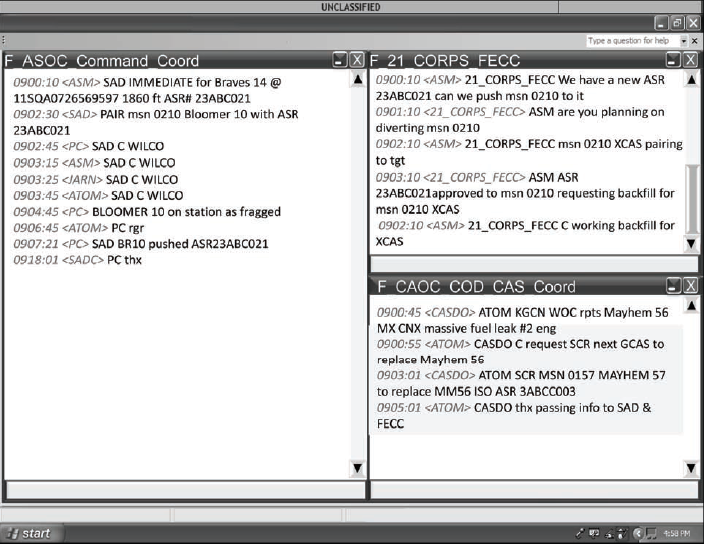
But in the air strikes that I consider those involved in these networked operations are also busy communicating via radio and – crucially – via the typed messages displayed in mIRC‘s online chat windows.  The image below is taken from the US military’s multi-service manual on Tactical Chat (see also the discussion at Public Intelligence here).

mIRC 3 chatrooms

In the case of the ‘friendly fire’ incident in the Sangin Valley in 2011, the pilot and sensor operator were unaware of crucial entries made by image analysts in mIRC and of private (or ‘whisper’) chats to the Mission Intelligence Co-ordiator.  That’s not entirely surprising.  Once permission has been given to engage a target, ‘KILL CHAIN” is typed into the room to minimise extraneous chatter that might otherwise visually distract and so ‘degrade’ the strike.  According to the Mission Intelligence Controller for the Sangin incident:

‘When we got a standby for a 9-line [strike briefing] we put [KILLCHAIN] in the mIRC room to shut down chatter so we can be heads down supporting the pilot and the sensor … as they are getting ready for a possible Hellfire shot our whatever action… That’s our job, to be their third set of eyes…’

That third set of eyes is vital, though of little use if its responses are shut down.  In this case the pilot was paying no attention to mIRC because he was fully occupied:

‘I did not see the chat in the main mission room after seeing muzzle flashes. From that point on, my focus was clear concise communications with the [Joint Terminal Attack Controller] and ensuing [Close Air Support] comms, 9 line etc. At this point I was also focused on keeping the aircraft in position to maintain FMV on the individuals. I was also getting the aircraft into the [Weapons Engagement Zone]. Winds were 30 knots out of the west so I had to make sure I kept the aircraft position and direction in cross check.’

All of this suggests that it is unduly narrow to focus the analytical gaze on the Full Motion Video feeds.

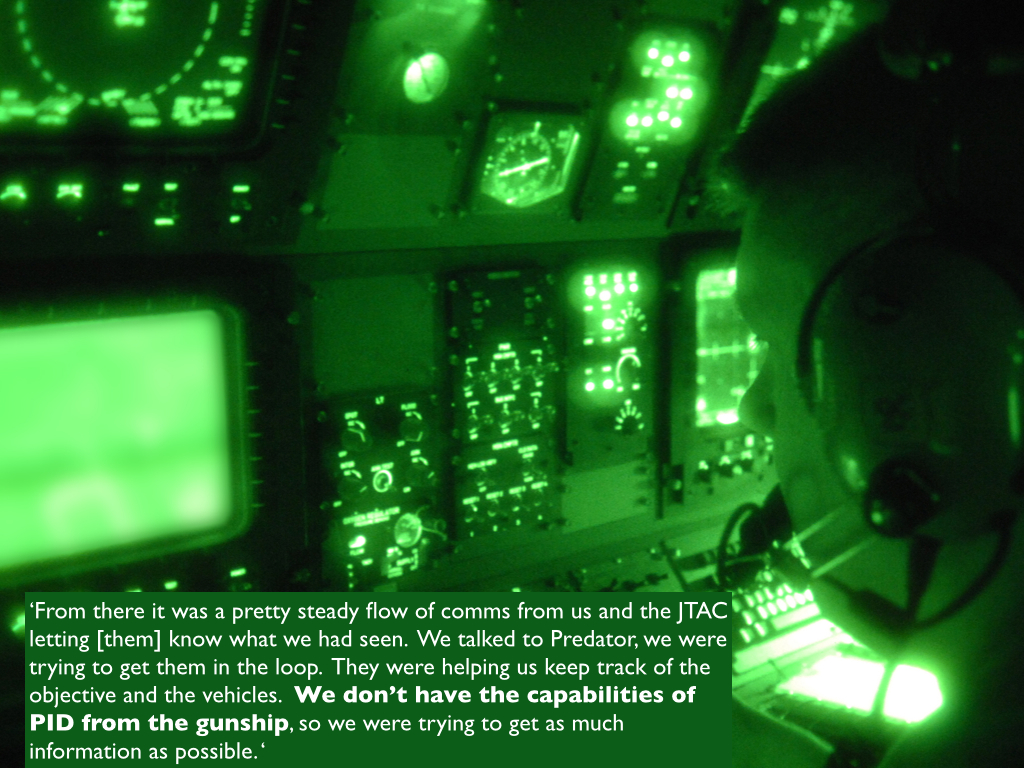
But there’s more.  Militarised vision is not limited to Predators and their successors, and it’s important to consider the clarity and resolution of the imagery captured and transmitted from other, conventional aircraft like the AC-130 (first image below), the B-1 bomber, F-15E strike aircraft or attack helicopters (second image below)  – again, this was important in two of the strikes I consider in detail.

AC-10 Uruzgan.001

MMS from attack helicopter - Uruzgan.001

This leads me to two other senses in which the critical emphasis on ‘Predator View’ is too narrow.  It’s a mistake to fasten on one incident – even what has become the iconic ‘signature strike’ coordinated by a Predator on three civilian trucks in Uruzgan – because that misses the continuities, repetitions and transformations in Close Air Support (which is where most of the mistakes are made).

Better, I think, to widen the analytical gaze, which is why I examine the Kunduz air strike on 4 September 2009 (in which no remote platform was involved), the Uruzgan air strike of 21 February 2010 (which was co-ordinated by a Predator but carried out by two attack helicopters), and the Sangin Valley air strike of 6 April 2011 (which was executed by a Predator).  The Granai strike is included because it trigged McChrystal’s Tactical Directive of 6 July 2009 to minimise civilian casualties: ‘‘We must avoid the trap of winning tactical victories – but suffering strategic defeats – by causing civilian casualties or excessive damage and thus alienating the people.’  In all three cases I’ve worked through thousands of pages of official investigations – one by the German Bundestag since the ISAF report remains classified (Kunduz), and the others by the US Army and US Air Force (Uruzgan) and the US Marine Corps (Sangin Valley).

4 US air strikes in Afghanistan.001

And finally, it is also necessary to consider the multiple viewing positions involved in networked military violence.  There is a de-centralised, distributed and dispersed geography of militarised vision whose fields of view expand, contract and even close at different locations engaged in the administration of military violence.  And in all three incidents it turns out that vital mistakes in the interpretation of imagery were made at operations centres in theatre on the ground.

This has prompted me to radically revise the argument I originally set out in ‘From a view to a kill’ (DOWNLOADS tab).  There my focus was on the geography shown in the first map below – like every other commentator I’ve read, incidentally – but I’ve now widened the angle to take in the geography shown in the second map and this substantially changes the story.

Dispersed vision Uruzgan (1).001

Dispersed vision Uruzgan (2).001

It was what happened at the operations centres at Special Operations Task Force 12 in Kandahar and Combined Joint Special Operations Task Force in Bagram that turned out to be every bit as important as the Predator crew’s obvious desire to ‘go kinetic’.

I make similar arguments about Kunduz, where the F-15E pilots were clearly reluctant to strike and the ground commander and JTAC at the Forward Operating Base overrode their objections.

Sangin is even more instructive, because the official investigation of this ‘friendly fire’ incident that resulted in the deaths of two Marines largely exonerated both the Predator crew and the ground commander and JTAC at the operations centre – but a detailed, spirited counter-memorandum from the US Marines commandant refuted the findings line by line, castigated the attempt to pin the blame for what happened on the young, inexperienced lieutenant leading the patrol, and excoriated the ground commander and JTAC back at the patrol base.  More on this soon.

The (long!) essay on these  strikes is the last chapter I need to complete for The everywhere war. There is a strong sense, so I shall argue, in which it was the view ‘on the ground’ that mattered much more than any ‘light of God’ from above.  And as for transparency….

Conflicts without borders

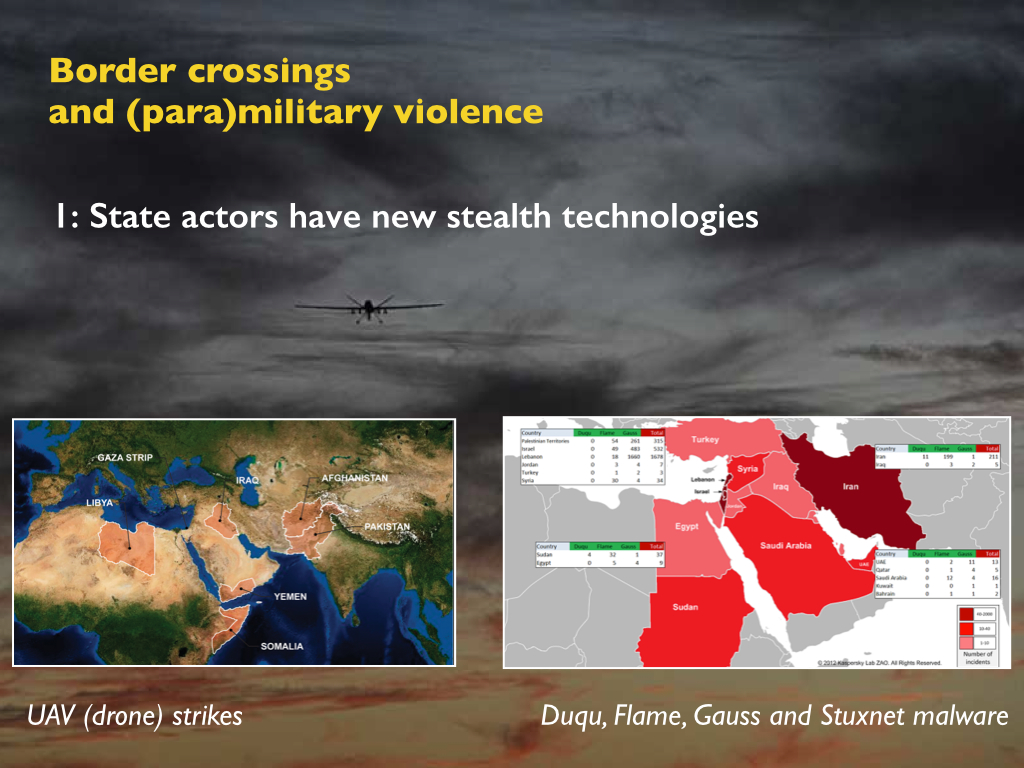
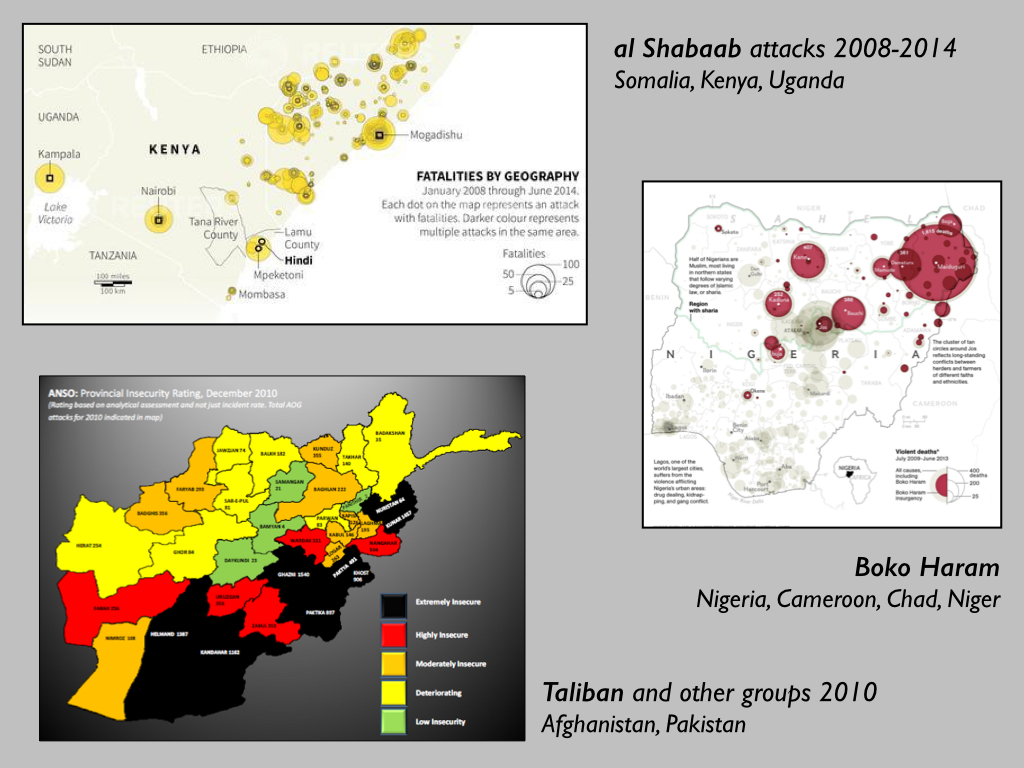
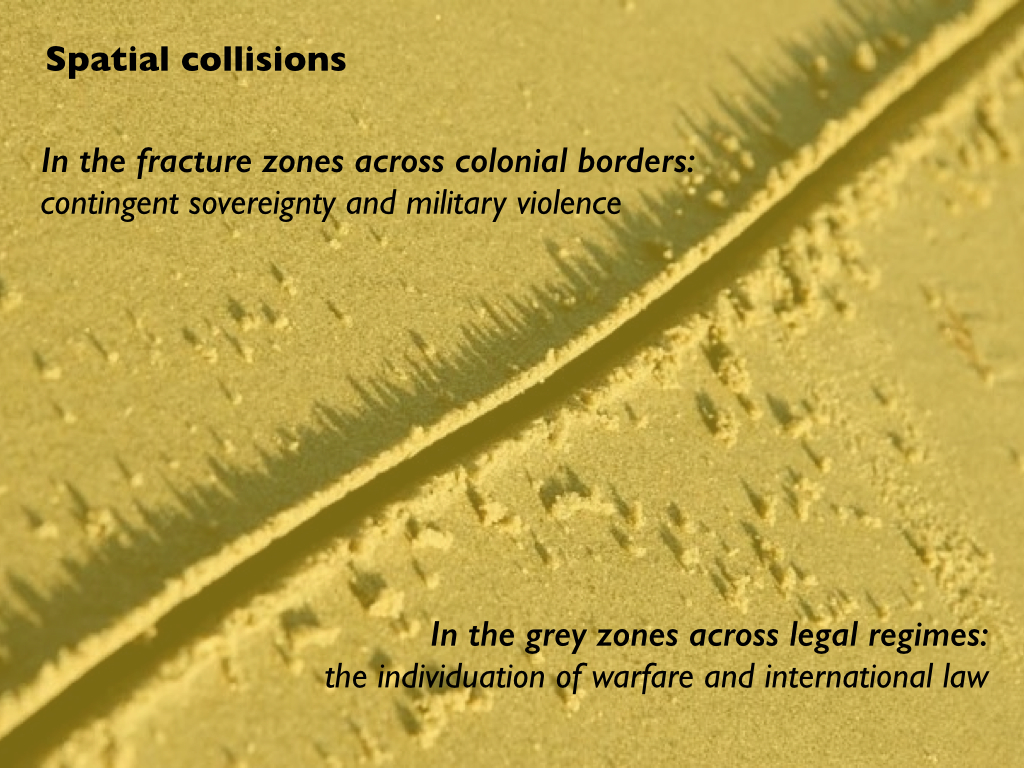
In Finland last month I gave a presentation on Law, violence and b/ordering, in which I began by making two preliminary points about border crossings and (para)military violence: trans-border incursions and transgressions have been facilitated by (i) new stealth technologies deployed by state actors and (ii)  the rise of new non-state and para-state actors.  Here are the relevant slides:

GREGORY 2 Law, violence and b:ordering.001

GREGORY 2 Law, violence and b:ordering.002

GREGORY 2 Law, violence and b:ordering.003

GREGORY Law, violence and b:ordering.003

I derived the map showing the advance of IS(IS)/ISIL from the Institute for the Study of War; say what you like about their politics (this is the Kagans we are talking about), their maps and summaries are extremely helpful.

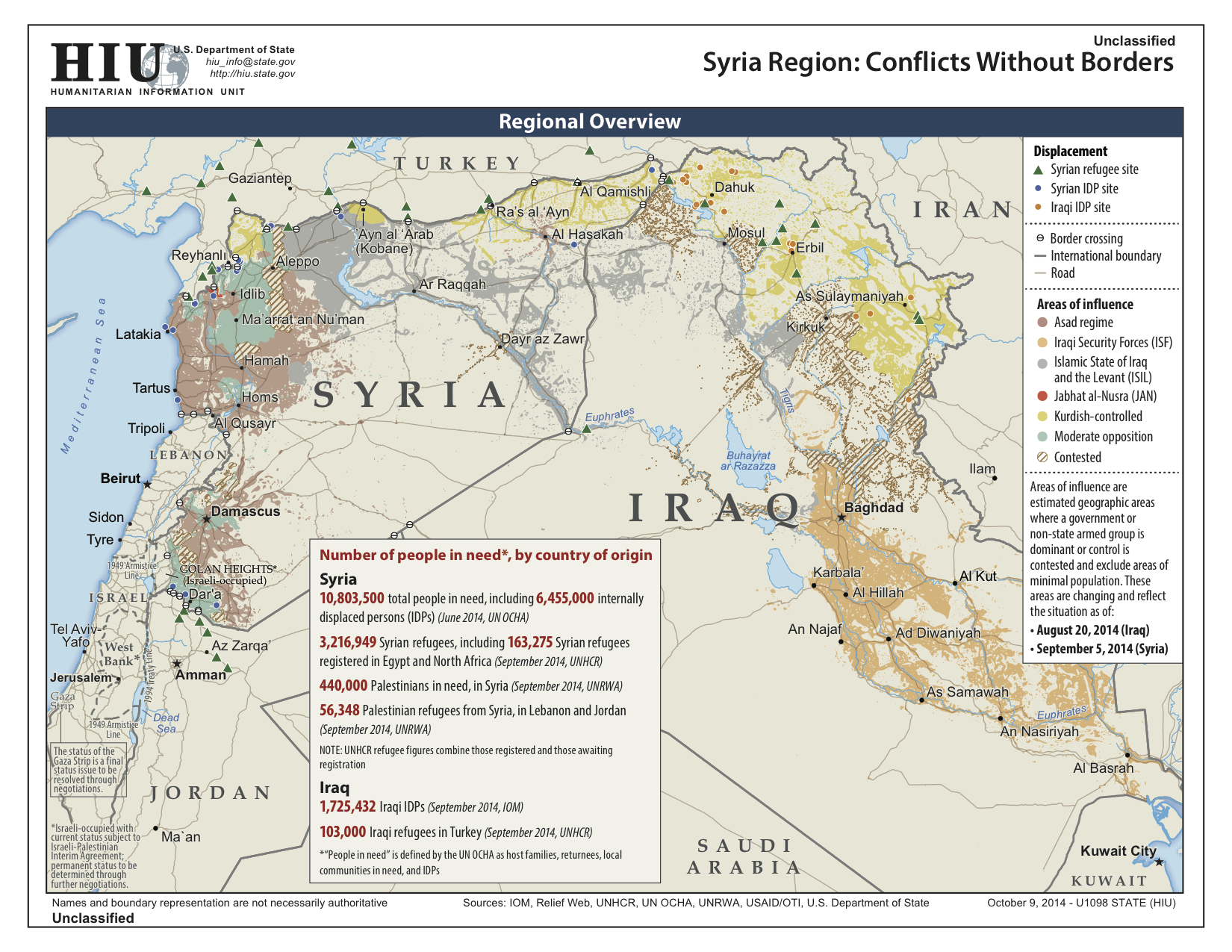
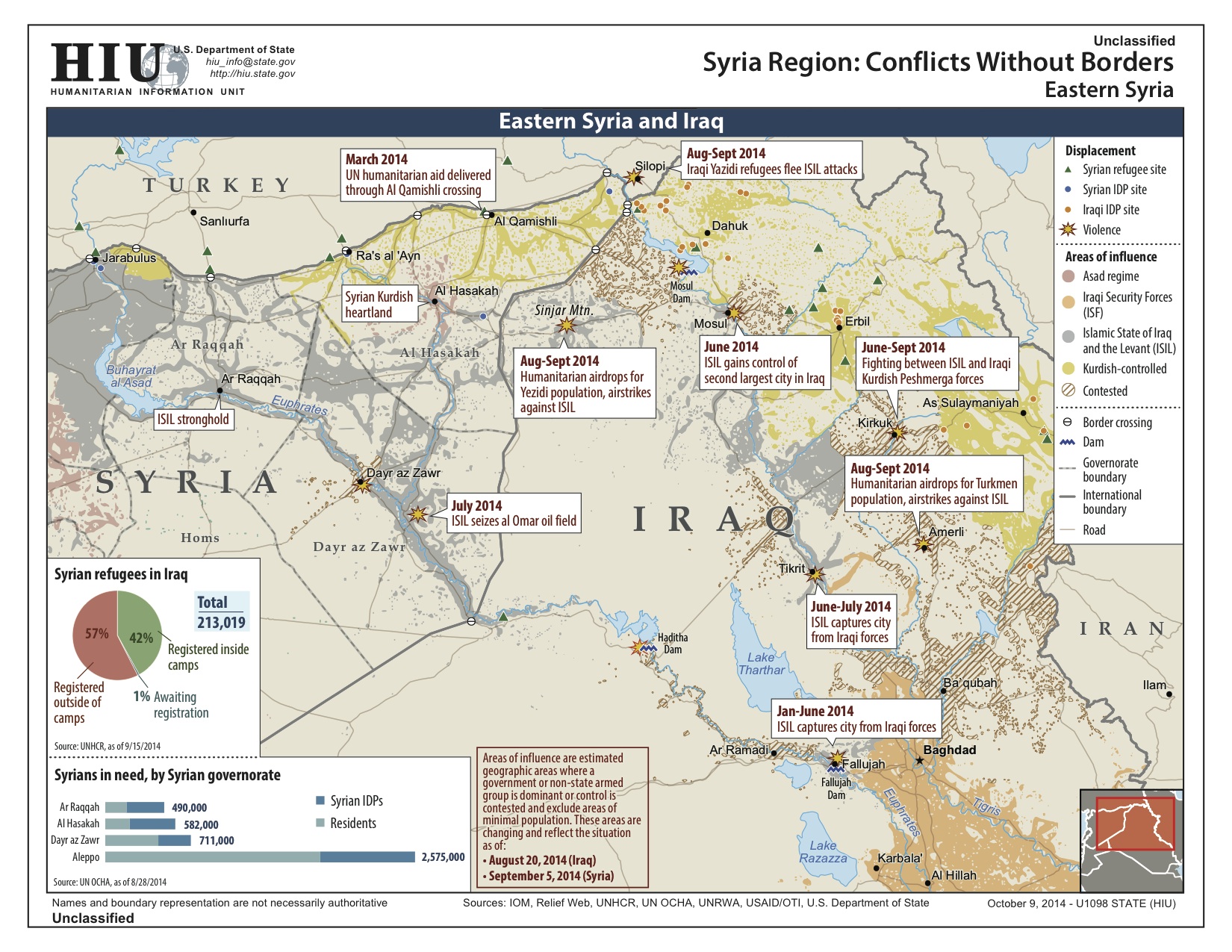
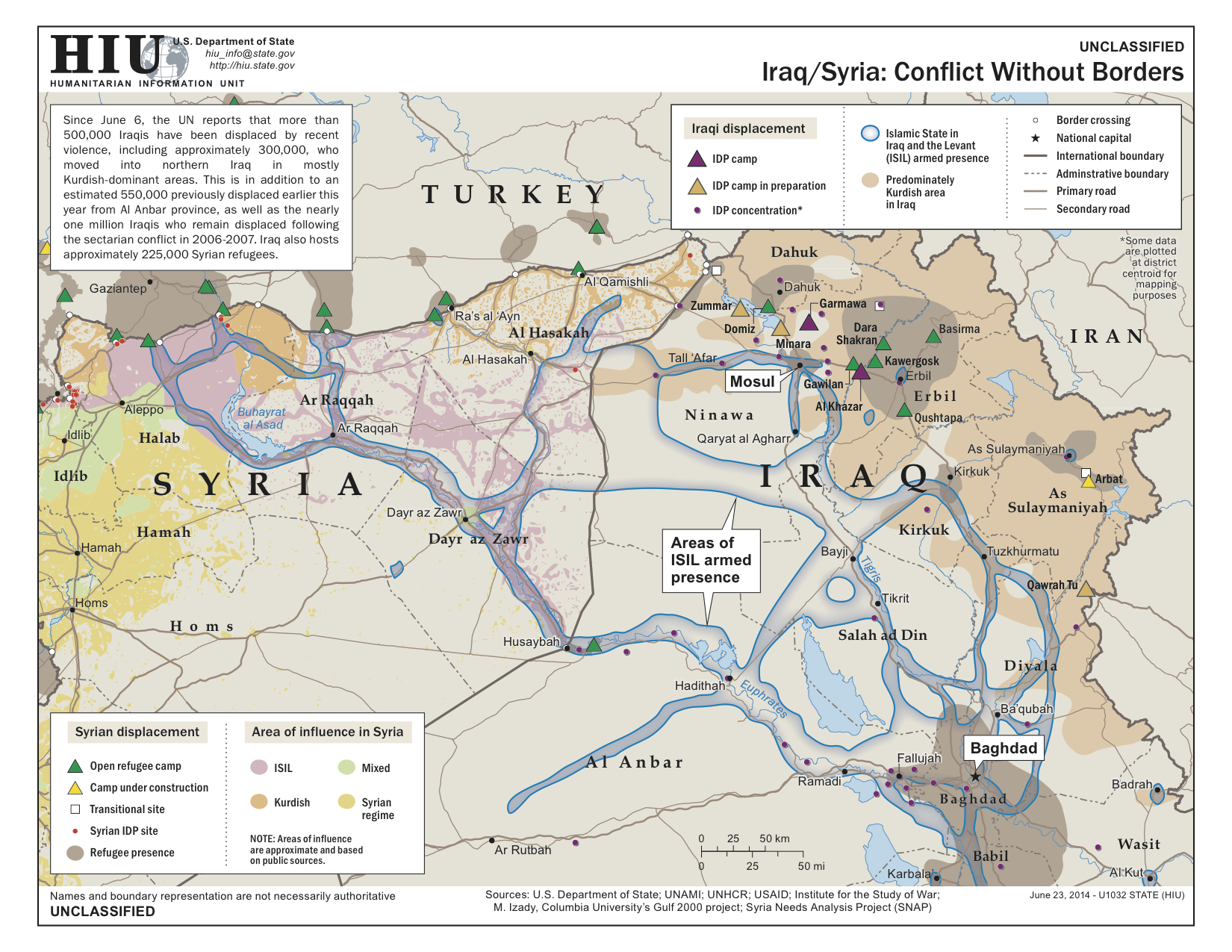
Now Public Intelligence has just published a series of (unclassified) maps of Iraq, Syria, Lebanon and Jordan produced by the Humanitarian Information Unit of the US State Department called Conflicts Without Borders:

‘Conflicts Without Borders refers to a conflict in one country that draws in other governments and non-state actors, exacerbates stresses and conflicts in the neighbouring countries, and generates displacement across borders.’

That’s a definition to think about; there are obvious ironies in the US offering a definition that I suspect is intended to exclude its own part in initiating conflicts (if so, it doesn’t work), and there is the interesting attribution of causal powers to conflicts (which ‘draw in’ other actors like so many black holes).

This map series is dated 9 October 2014; the maps provide a Regional Overview (the first map below) and then show Northern Syria and Turkey, Western Syria and Lebanon, Southern Syria and Jordan and Eastern Syria and Iraq (the second map below).

DoS-Syria-ISIL

DoS-Iraq and Syria-ISIL

You can access a single summary map for late June here (shown below):

DoS Iraq Syria Conflict June 2014

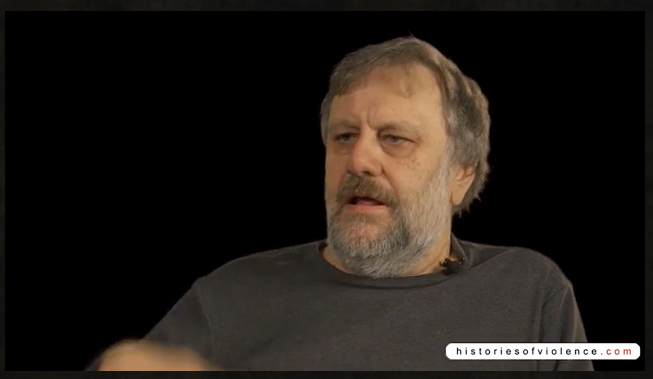
Zizek on Disposable Life

Zizek on Disposable Life

I discussed the History of Violence project’s Disposable Life series when it was first announced here.  Introducing the series, the Project’s Director Brad Evans explains:

“Mass violence is poorly understood if it simply refers to casualties on battlefields or continues to be framed through conventional notions of warfare. We need to interrogate the multiple ways in which entire populations are rendered disposable on a daily basis if we are to take seriously the meaning of global citizenship in the 21st Century”.

Nine videos have been produced so far, and you can access the first eight here; the latest comes from Slavoj Zizek:

For Zizek, the issue of ‘disposable lives’ in the contemporary period does not simply relate to some small or invisible minority. According to the new logics of global capitalism, the vast majority of the worlds citizens (including almost entire Nations) are deemed to be worthless and superfluous to its productive needs. Not only does this point to new forms of apartheid as the global cartography for power seeks to police hierarchies of disposability, it further points to a nihilistic future wherein the aspirations of many are already being sacrificed.

You can access the video through the links above or directly from vimeo here.  Not my favourite theorist or commentator, but worth watching not least for the one-liner about Sloterdijk (at 4.06 if you’re really busy).  What he takes from Sloterdijk is this:

‘”global” means there is a globe which is not all-encompassing, it’s a globe where from within you think it’s endless, all encompassing, you see it all, but no, it excludes…’

I agree with Brad’s framing of the project – impossible not to, I think – but once you start to imagine the global in these (un)exceptionable terms,  both conventional and unconventional modes of warfare start to seep back in to the discussion.  For on those now radically dispersed and discontinuous battle spaces whole populations are being rendered disposable on a daily basis.

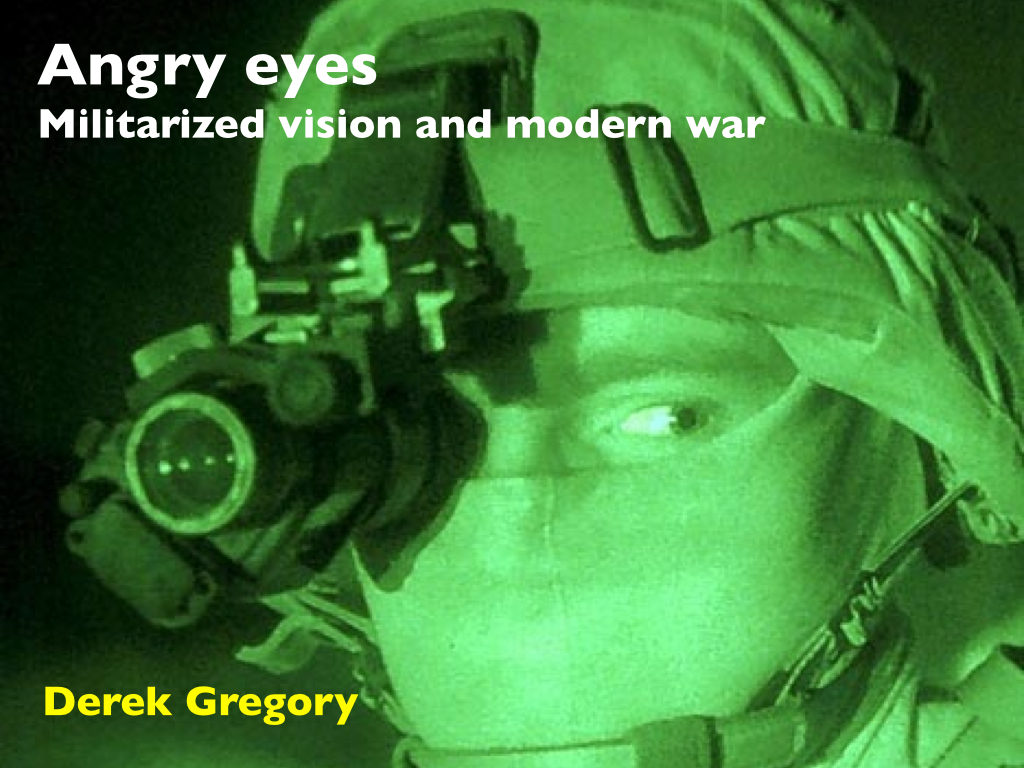
Angry eyes

GREGORY Angry eyes JPEG.001

As part of my project on Militarized Vision I’ve been drawing together my work on two air strikes in Afghanistan in which the full motion video feeds from UAVs played a central role.  The first was an air strike in Uruzgan on 21 February 2010, which was carried out by two combat helicopters but mediated by video and commentary from a Predator and other eyes in the sky (the most thorough press account is by David Cloud here).  The second was a  ‘friendly fire’ incident in the Sangin valley on 5 April 2011 when a Predator strike claimed the lives of two US Marines (you can find an excellent summary account by David Cloud and David Zucchino here).

The two reports I’ve just cited were published in the LA TimesCombat by Camera series, but a close reading of the two official investigations – thousands of pages obtained through FOIA requests – inevitably shows that the stories were more complicated than the tag-line implies.  Still, for all the differences there are some remarkably close parallels between the two, and these have prompted me to revise (in radical ways) the analysis I originally offered in “From a view to a kill” (DOWNLOADS tab).

Searching for a title for the presentations I’m giving on this in October and November, I half-remembered a song called ‘Angry Eyes’.  When I tracked down the lyrics (by Kenny Loggins) I literally could not believe my eyes.  He obviously wasn’t writing about the US Air Force (or the Israeli), but it requires no great leap of the imagination to switch from love to violence:

Time, time and again
I’ve seen you starin’ out at me.

Now, then and again, I wonder
What it is that you see

[Chorus:]
With those Angry Eyes.
Well, I bet you wish you could
Cut me down with those Angry Eyes…

You want to believe that
I am not the same as you.
I can’t concieve, oh no,
What it is you’re tryin’ to do

[Chorus]

What a shot you could be if
You could shoot at me
With those Angry Eyes…

You tried to defend that
You are not the one to blame.

But I’m finding it hard, my friend,
When I’m in the deadly aim
Of those Angry Eyes.

So the presentations (here in Vancouver, and in Zurich and Bergen) will be called “‘Angry eyes’: militarized vision and modern war”.  As the image implies, there’s more to this than full motion video displays, and I’m also going to try to say something about the genealogy of what Paul K. Saint-Amour calls ‘optical war’ (and its distance from the corpographies of ‘boots on the ground‘).

More on all this later, when I’ve finished the essay that I am presently spinning off the presentations with the same title; it’s the last thing I have to do for “The everywhere war” (I hope).

Boots on the ground

?????????????????????????????????????????????????????????????????????????????????????????????????????????????????????????????????????????????????????????????????????????????????????????????????????????????????????????????????????????????????????????????????????????????????????????????????????????????????????????????????????????????????????????????????????????????????????????????????????????????????????????????????

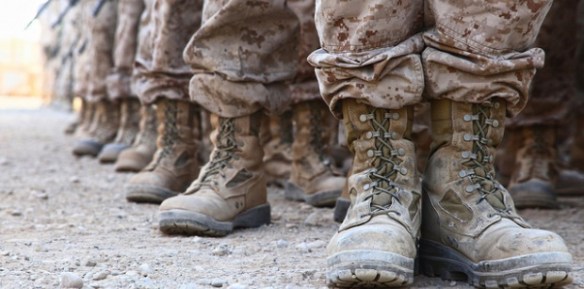
One of the most shop-soiled phrases of the past several weeks and months is “boots on the ground” (or the lack of them).  You can find historical and contemporary discussions from the US military here and here, but the most recent – and recurrent – instance is President Obama’s insistence that, whatever else the United States will do in Iraq and Syria to counter the aggressive advance of the Islamic State, it won’t involve “boots on the ground”.  The reasons are not difficult to discern, and they involve the substitution of “boots on the ground” for “bodies in bags” (on which, see the American Friends Service Committee exhibition, “Eyes Wide Open“: also the Burning Man version here).

But they also involve an extraordinary (but, again, by no means unprecedented) restriction of what constitutes armed combat.  Mark Landler has a very good discussion of this in the New York Times:

American advisers could be sent to the front lines alongside Iraqi and Kurdish troops, and could even call in airstrikes, without directly engaging the enemy. It is a definition rejected by virtually every military expert.

“Calling in airstrikes is just as much combat as firing a rifle at someone,” said John A. Nagl, a retired lieutenant colonel who served in a tank battalion in Iraq and helped write the Army’s counterinsurgency field manual. “What that guy really is doing is painting a house with a laser designator that results in that house being vaporized.”

The American advisers are armed, and if they are shot at by the enemy, they are authorized to return fire. In a close combat advisory role in a city, experts said, the American troops would tell Iraqi commanders which house to hit, how much ammunition to use in an assault, and how to organize medical evacuation for their troops…

“If you’re trying to deploy a military effect on the ground, you’re in combat,” said Paul D. Eaton, a retired Army general who helped train Iraqi troops and is now an adviser to the National Security Network. “You may not be in direct combat, but it’s a combat mission.”

There are also not very muffled  echoes of Vietnam and the US Military Assistance Command.

This is very much on my mind, because I’ve been busy finishing the long-form version of “The Natures of War”, and in the process radically re-working my discussion of the ground war in Vietnam.  This has given me a new insight into what “boots on the ground” means – with an emphasis on the “ground”, or what my good friend Gastón Gordillo prefers to call terrain – and here is an extract (I’ll post the full draft next week, which will include the references and the footnotes).

***

GI Vietnam LIFE

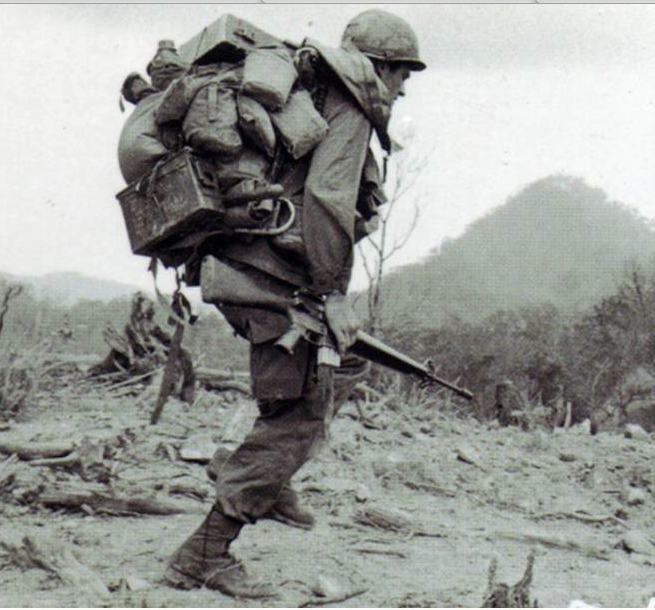
Then as now the scale of support involved in combat operations meant that many soldiers never left their bases – in Vietnam the ratio of support to combat troops was roughly 10 to 1 [this is the ratio cited by most historians, but the US Army prefers a much lower “Tooth to Tail” ratio: see here] – but those that did had to carry their world on their backs. On a long patrol they might be resupplied by helicopter, but that could never be guaranteed. In addition to a rifle, most men carried at least 60 pounds: multiple quart canteens of water (at least two and sometimes as many as eight: ‘There is never, ever enough water’) and canned C-rations; ammunition and grenades; and a poncho or half-shelter which doubled as a stretcher or a shroud if they were hit. In addition, radio operators carried a PRC-25 field radio, which weighed 23 pounds, and spare batteries, while mortar crews lugged a firing tube and base plate weighing around 40 pounds, and their bearers carried four mortar rounds (which added 32 pounds of dead weight to their load). This mattered because, as one newly arrived lieutenant soon realised, ‘the jungle would exact a toll for every ounce I carried.’ ‘We dumped everything we didn’t absolutely need,’ one GI explained, but still the rucksack frame and webbing rubbed and cut so ‘our waists and shoulders were covered with “saddle sores” that were kept raw by sweat and dirt and cartridge belts and packs.’ Everyone, he said ‘was in a constant world of hurt.’
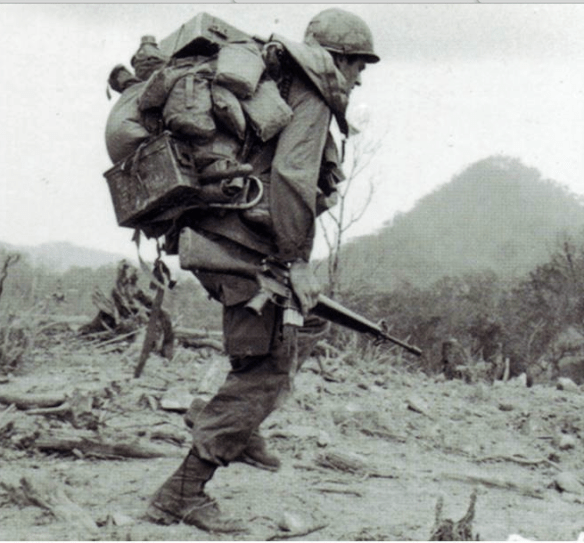
Combat Infantryman Vietnam

It was just as tough on the legs. Tim O’Brien translates the equipment list – ‘the things they carried’ – into its impact on the lower body:

‘We walked along. Forward with the left leg, plant the foot, lock the knee, arch the ankle. Push the leg into the paddy, stiffen the spine. Let the war rest there atop the left leg: the rucksack, the radio, the hand grenades, the magazines of golden ammo, the rifle, the steel helmet, the jingling dog-tags, the body’s own fat and water and meat, the whole contingent of warring artefacts and flesh. Let it all perch there, rocking on top of the left leg, fastened and tied and anchored by latches and zippers and snaps and nylon cord. Packhorse for the soul.’
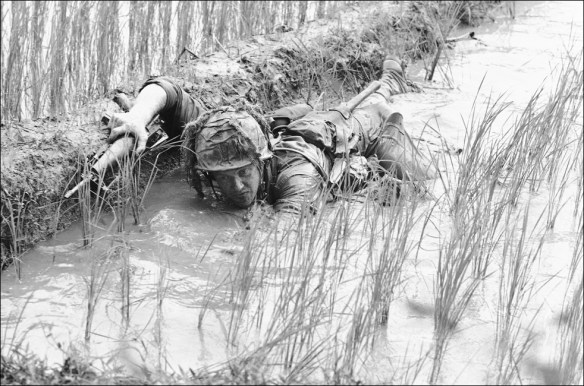
Soldier in paddy field An Thi S Vietnam- Jan 1966Skinner

O’Brien was describing a patrol moving through rice paddies, and these imposed their own burdens on soldiers. Out in the open they were vulnerable to attack or sniper fire, and they avoided the dikes which were often mined or booby-trapped.

‘Instead, we struggled through the sucking mud of the paddies. The banks of the streams were especially treacherous. Each step through the soft muck was torture, and every few steps a man would sink in mud up to his crotch. The gnarled roots of the mangroves could twist an ankle or a knee in a second. The putrid stench of rotting vegetation permeated the stifling humid air, and canteens were emptied quickly.’

‘The water in these pestilential miasmas was stagnant, muddy and fetid,’ explained one lieutenant, ‘with all kinds of flotsam, including mosquito larvae and water buffalo faeces applied as fertiliser’. Beneath the murky water lurked the menace of punji stakes made of split bamboo that could pierce a boot and put a soldier out of action; worse, the wound could become infected from the dung-laden water, and air evacuation was often imperative. Then there were the leeches: ‘When we reached the other side of the rice paddies,’ the lieutenant continued, ‘my men dropped their pants and burned the already engorged leeches off their ankles and penises with lit cigarettes; even the non-smokers carried cigarettes for this purpose.’
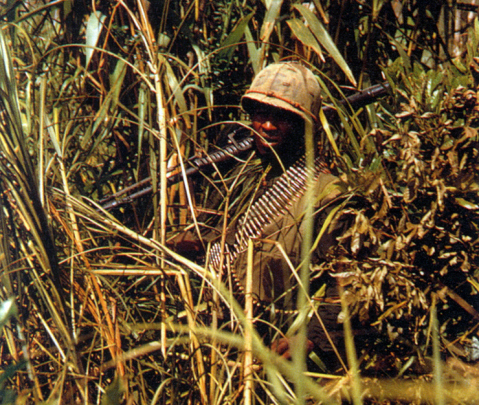
photo5

In the Central Highlands soldiers had to fight their way through triple-canopied jungle and up thickly forested mountain sides. Like their comrades in the paddy-fields, they learned to avoid the beaten track. They rarely used trails, which were notorious for mines and booby-traps that, as Philip Caputo explained, turned ‘an infantryman’s world upside down’:

‘The foot soldier has a special feeling for the ground. He walks on it, fights on it, sleeps and eats on it; the ground shelters him under fire; he digs his home in it. But mines and booby traps transform that friendly, familiar earth into a thing of menace, a thing to be feared as much as machine guns or mortar shells. The infantryman knows that any moment the ground he is walking on can erupt and kill him; kill him if he’s lucky. If he’s unlucky, he will be turned into a blind, deaf, emasculated, legless shell.’

He might have been talking about the cyborg natures of the Western Front or the Western Desert, but in Vietnam’s guerrilla war there were few fixed minefields beyond the Demilitarized Zone. Base perimeters were systematically mined by the US and its allies, and the North Vietnamese often mined clearings that could be used as helicopter landing zones. But it was the transience of mining by the North Vietnamese Army and the Viet Cong – its improvisational, opportunistic nature – that was so threatening. ‘The NVA were so good at moving mines around that they would put the minefield out at dusk along a patrol route and take it in before dawn’ so that ‘you could clear one area and there would be mines there the next night.’ Booby-traps could be anywhere: ‘They hang from trees. They nestle in shrubbery. They lie under the sand.’ Denied the trails, soldiers had to hack a path with their machetes or Ka-Bars or more often, to muffle the sound of their painfully slow progress, they threaded their way between the trees and the choking vines:

‘Up ridges, down ridges, over ridges, wading through rocky streams, hacking at jungle growth, breathing in and hopefully breathing out some of the constant bugs that continuously swarmed around our heads, watching our skin as it quickly deteriorated from the numerous bites, scrapes, cuts, tears, thorns, and other abuses of the environment that attempted to beat our bodies into submission. The clothes and boots forming the inanimate part of our body protection were quickly drenched with sweat, dirt, mashed bugs, and the mixed blood and juices from both the bugs’ bodies and our own.’

In the Highlands they encountered other cyborg natures. Devastating Arc Light strikes by B-52 bombers produced a surreal, cratered moonscape whose blasted terrain was even more difficult to negotiate than pristine rainforest:

‘The jungle had been torn to smithereens by the big bombs. Trees had been ripped from the ground forming an abatis of twisted, interattached splintered branches, vines, and roots that was more impenetrable than the worst the natural jungle had to offer.’
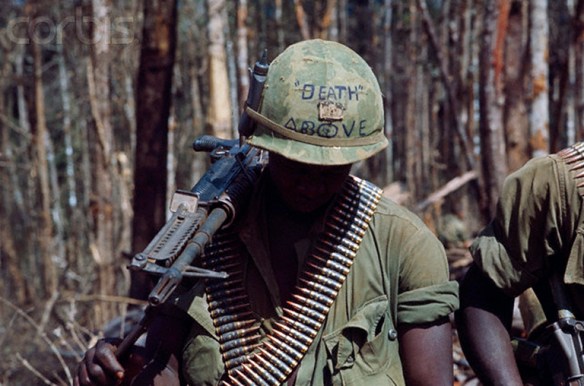
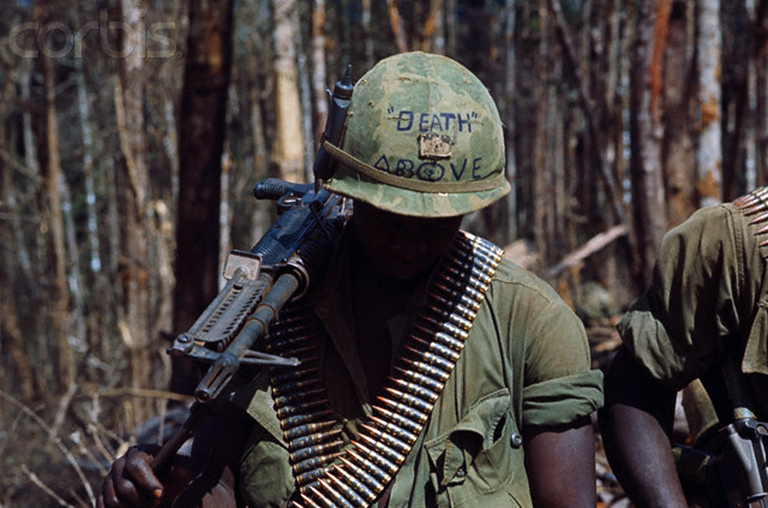
US Soldier Wearing Helmet with Message

The craters would be ‘littered with huge pieces of bomb shrapnel’ and unexploded bombs that had not burrowed into the soft earth: their ‘green shapes that protrude menacingly from the red dirt add yet another facet of terror for us to deal with.’ It was impossible to avoid the deep craters: ‘They are too congested; the muddy holes sap our strength as we slide down into their depths, wade through the stagnant green rainwater and then climb fifteen feet up to the slope to the opposite rim.’ If the bombs had found their target then the patrols faced more than a physical barrier, because the bomb field would also contain decomposed corpses, animal and human, and body parts. Delezen continued:

‘[T]he heavy smell of death is around us and is growing stronger as we move. Soon I discover that the source of the overpowering stench is a shallow bomb crater positioned along our path; the crater was probably gouged into the earth by a five hundred pound bomb. There is a naked leg sticking out of the dark hole; on the foot is a rubber sandal made from a discarded truck tire. It looks as though the crater is moving … the movement is rats. In the dusk it looks like a blackish gray carpet covering the mangled, bloated bodies that the grunts have thrown into the hole. The bottom of the hole is full of large maggots that create the illusion that the crater is shimmering. I determine that there are at least twelve enemy bodies that lay intertwined in the crater. The huge rats are snapping at each other as they feed on the dead soldiers; this has to be the entrance to hell itself. The smell is overwhelming; it is so strong that I can taste it.’

B-52s and long-range artillery were not the only means of ravaging the land. It was also impregnated with the residues of napalm and other chemical toxins, and long after an air strike these could still irritate your eyes, make you gag and burn your skin. They also turned any vertical movement into a dangerous glissade:

‘[T]he mountain that we are now climbing has been attacked by countless sorties of Phantom jets delivering “snake and nape.” The splintered, tortured tree trunks are black and charred from the napalm and the oily gel that did not ignite has mixed with the red mud, turning it into a texture similar to axle grease. My pack and ammo belt are waterlogged and have picked up extra weight from the greasy mud.

‘The mud has clogged the lug soles of our jungle boots and it is difficult not to slip; we know that if we lose our footing we will end up at the bottom of the mountain. I use my weapon to climb, digging the stock into the mud as a brace while I grab the next bomb-blasted tree trunk. The oily napalm has lubricated the entire mountain, it has soaked into the burned trees; we have to grasp each splintered trunk in a hug. The black M-16 no longer resembles a rifle; it is encased within a shapeless red blob of sticky mud. After a while, I have to use my Ka-Bar to climb with. I stab the earth ahead and then pull myself up; the deep, soft mud soon renders this effort useless.’

***

 There’s much, much more, as the full post will show, but I’ve said enough to convey some of the ways in which “boots on the ground” are involved in my developing interest in corpography and war.  This extract also raises two other issues that I can’t develop in any detail in the essay.
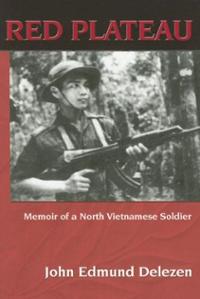
red-plateau-memoir-north-vietnamese-soldier-john-edmund-delezen-paperback-cover-artThe first turns on the parallel experience of the National Liberation Front [the ‘Viet Cong”] and the North Vietnamese Army.  The Americans assumed that their enemies were creatures of the jungle (in more ways than one), but many of them were recruited from towns and cities and had little or no experience of the rainforest and no idea of the privations that jungle warfare would impose on them.  This is made clear in Truon Nhu Tang‘s A Viet Cong memoir, which is widely cited, but the best and most directly relevant account that I know is the truly remarkable collaboration between John Edmund Delezen and Nguyen Van Tuan, Red Plateau, which describes a North Vietnamese battalion ‘comprised of boys from towns and farms and most knew very little about the forest-enshrouded mountains’.  I cite Delezen in the extract above – his Eye of the tiger is one of the very best personal accounts I’ve read – but his collaboration with his erstwhile enemy is just as compelling.  Here is Nguyen Van Tuan’s inventory of the things carried by the NVA:

‘As dark nears we once again move onto the path and begin our trek south, I curse my pack; if not for this burden I would move effortlessly. Each pack contains an extra uniform and one pair of pajamas, a rain-sheet, a ground cloth, a shovel, ammunition, grenades, explosives, a small medical kit, B-40 rockets for the RPG crews or boxes of machine gun ammunition for the  crews and toilet articles which are for the most part extremely minimal. In addition to this loaded pack, we each carry our individual weapon with ammunition vest, knife and canteen of water. The heavy weapon crews and mortar teams suffer worse…much worse, the load they carry is unimaginable….

‘When we pause to fill canteens from a stream, we try to rearrange the loads we are burdened with; it is a futile task, there is no relief, each arrangement brings its own torment. The loads we bear begin to increase as the supplies carried by those who fall prey to fever and those who carry the litters must be redistributed; our packs remain things that we continue to curse.’

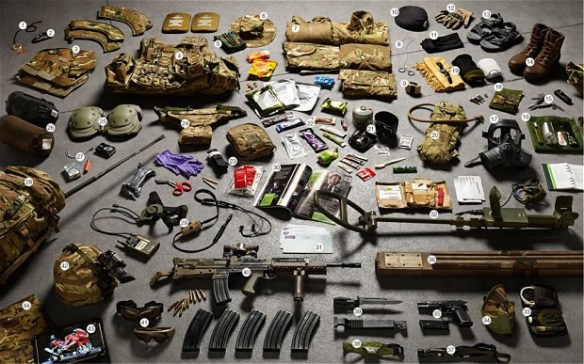
The second issue is the genealogy of “the things they carried”, and Tom Atkinson (really; not quite “Tommy Atkins” but close enough) has provided an extremely interesting visual reconstruction of what he calls “Soldiers’ Inventories” here (you can also find more here and here).  His 13 images extend from the Battle of Hastings (1066) through the Somme in 1916 and the Battle of Arnhem in 1944 to Helmand in 2014 (shown below), though since this is an inventory of British soldiers there’s no trace of Vietnam.  (Interestingly, though, a common complaint from US soldiers and especially Marines in Vietnam was that much of their equipment was outdated and derived from the Second World War – including, on occasion, their canned rations).
Helmand_2996025b

Here’s the key for a close-support sapper, Royal Engineers, Helmland Province, 2014:

1 Silva compass – used for basic navigation and fire control orders
2 Karabiner – used for securing kit and equipment to the vehicles
3 Osprey body armour shoulder and neck attachments – the armour increases protection but can be very restrictive so these parts are detachable depending on the threat assessment
4 Osprey body armour; can be fitted with pouches to carry everything from ammunition, water, first aid kits and grenade or with plates and protective attachments (as shown)
5 Notebook
6 Warm weather hat
7 Spare clothing including underwear trousers, UBAS (Under body Armour Shirt) and normal shirt
8 Dog tags
9 A desert issued belt
10 Beret – used for repatriation ceremonies, vigils and large parades
11 Shemagh – to soak up sweat and also a dust guard
12 Gloves
13 Sandals – issued kit, as soldiers may need to run for cover even while showering
14 Boots
15 Multi tool
16 Washkit
17 GSR – general service respirator
18 A housewife – a basic sewing kit; a soldier has to repair his own rips and tears on the ground
19 Socks, scarf, wristwatch
20 Camel pack – drinking water pack
21 Cooker and mug and tea making kit
22 Rations – quantity will depend on the task but soldiers normally carry about 24 hours worth
23 First aid kit including the (black) tourniquet and (grey) first field dressing
24 Ballistic protection – used to protect the groin from IED blast
25 Knee pads – offer protection to a soldier whilst “taking a knee” from the heat of the ground or rocky areas
26 Sleeping bag with an inflatable roll mat
27 Camera, cigarettes
28 Radio – BOWMAN Radio system (HF, VHF or even SAT Comms), daysack could also be fitted with ECM (Electronic counter measures)
29 Personal role radio – used for line of sight communications within a small patrol
30 Magazine
31 Envelopes
32 Mine extraction kit fitted with a mine prodder, instruction and mine marking kit
33 Weapon cleaning kit
34 Holster
35 Pistol – used as a second weapon system and in confined spaces or where a “long” weapon is unsuitable. Sig and Glock have mostly replaced the Browning 9mm calibre
36 Bar mine – anti-tank landmine
37 Head torch – can be fitted with coloured lenses for more tactical situations
38 Bayonet and bayonet scabbard
39 SA80 A2 fitted with a desert hand guard, upgraded flash eliminator and bipod, all issued for Afghanistan and a SUSAT sight system. It is 5.56 calibre and is here issued with 6 magazines which can hold 30 rounds each
40 Ballistic eye protection – normally goggles or sunglasses
41 Mk 6 Helmet fitted with Helmet mounted night vision systems
42 iPad – personal effect for down time
43 Poncho

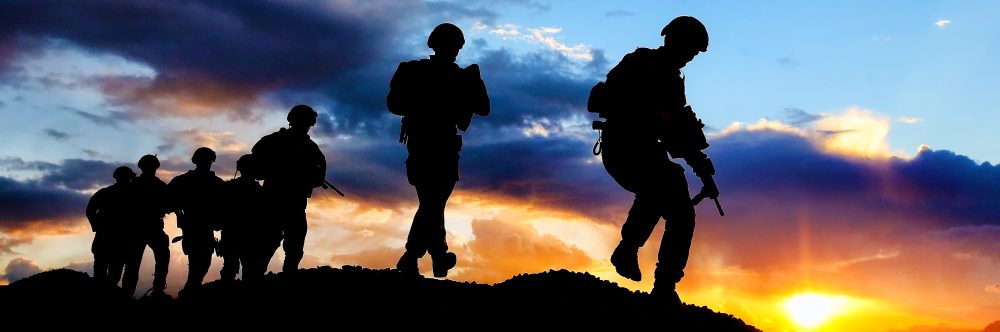
I’ll leave the least word to Karl Marlantes, whose splendid Vietnam novel Matterhorn I’ve recommended before.  This comes from his What it is like to go to war (2011), and in so many ways returns us to where I came in:

I am not saying that the infantry today has it easy. Certainly the communications with home have changed, but the field conditions, such as filth, cold, heat, fatigue, and lack of sleep, have not changed since the infantry was using rocks. However, the trend is clear. Robots are already being deployed for fighting in cities. And soon they will be able to be controlled from Nevada.
War and demise

Tanisha Fazal has an important article in the latest International Security: ‘Dead wrong? Battle deaths, military medicine and exaggerated reports of war’s demise.’

It is, in part, an artful response to what must surely seem the increasingly astonishing claim that we live in a time of unprecedented peace.  It depends, in part, on who ‘we’ are, of course, but the general thesis has been shouted from the rooftops by (for example) Joshua Goldstein‘s Winning the war on war (2011) and Steven Pinker‘s The better angels of our nature (2011).  Pinker’s thesis is the more general, to be sure: he claims a decline in ‘violence’ in general, not only in military and paramilitary violence.

StevenPinker

Tanisha’s argument hinges on the reliance on ‘battle deaths’ as an index of the incidence of war; these statistics are a minefield of their own, though they are used by most of the major databases, but Tanisha argues that many contemporary wars have been distinguished by a diminution in battle deaths and a marked increase in the numbers of wounded who now survive injuries that would previously have killed them.

She identifies four key changes.  The first two are pre-emptive: soldiers in advanced militaries are now healthier, and so they  can survive disease and injury much better than in the past, and they are equipped with protective equipment that reduces their vulnerability (she’s thinking here not only of MRAPs but more particularly of personal equipment that affords the head and trunk some protection against blast injuries).

scr_110506-D-6767M-002

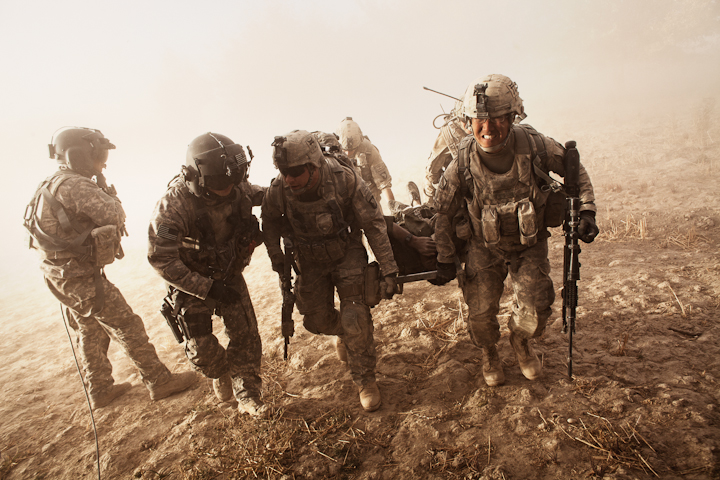
The second two are reactive, and their emphasis on military medicine and evacuation chains intersects directly with my present research on combat casualty care 1914-2014 (see here and here).  From Tanisha’s summary over at Political violence @ a Glance:

‘… battlefield medicine itself has improved via the availability of anesthetics and antibiotics, which make for more effective surgeries as well as a greater likelihood of avoiding or surviving post-operative infections. Similarly, the return of the tourniquet as part of a general focus on hemostatics appears to have dramatically reduced the percentage of soldiers dying from preventable blood loss.

‘… military evacuation practices have gone from soldiers laying on the ground for weeks waiting for transport by stretchers to mechanized ambulances to medevac helicopters. States invest heavily in military transport for this purpose today; NGOs like the ICRC, however, were at the vanguard of this particular shift.’

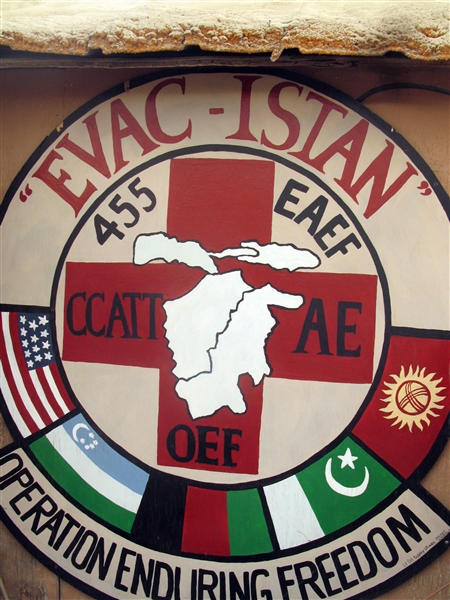
Medevac

That last sentence raises a series of other, crucial questions that I’m also trying to address in my own project: not only the involvement of civilian/humanitarian organisations (and here I’m presently exploring the role of the Friends Ambulance Service on the Western Front in the First World War and in the Western Desert in the Second) but also the part played by militaries in caring for civilian casualties.  How far have they enjoyed the benefits of improved military medicine and trauma care, and how far down the evacuation chain do they move before they are diverted to (often less advanced) civilian hospitals and clinics?

Legal geographies and the assault on international law

I suspect anyone interested in international/transnational legal geographies will know of Jens David Ohlin‘s work already (he’s Professor of Law at Cornell and recently co-edited Targeted Killings: Law and Morality in an Asymmetrical World [Oxford, 2012]).  If not, check out his page on ssrn for recent papers; I’ve found three particularly helpful in thinking about US air strikes in Afghanistan and Pakistan and, more recently, the Israeli offensive against Gaza (more on this and the space of exception soon, I promise):

Targeting and the concept of intent (2013); Acting as a sovereign versus acting as a belligerent (2014); and The combatant’s privilege in asymmetric and covert conflicts (2014)

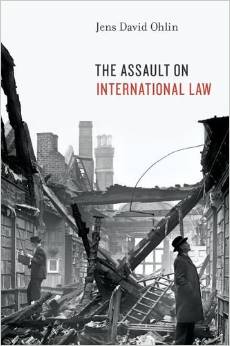
I’ve just received news of his new book out early in the New Year, whose relevance will be apparent from its title: The assault on international law.

OHLIN Assault of international lawInternational law presents a conceptual riddle. Why comply with it when there is no world government to enforce it? The United States has a long history of skepticism towards international law, but 9/11 ushered in a particularly virulent phase of American exceptionalism. Torture became official government policy, President Bush denied that the Geneva Conventions applied to the war against al-Qaeda, and the US drifted away from international institutions like the International Criminal Court and the United Nations.

Although American politicians and their legal advisors are often the public face of this attack, the root of this movement is a coordinated and deliberate attack by law professors hostile to its philosophical foundations, including Eric Posner, Jack Goldsmith, Adrian Vermeule, and John Yoo. In a series of influential writings they have claimed that since states are motivated primarily by self-interest, compliance with international law is nothing more than high-minded talk. Theses abstract arguments then provide a foundation for dangerous legal conclusions: that international law is largely irrelevant to determining how and when terrorists can be captured or killed; that the US President alone should be directing the War on Terror without significant input from Congress or the judiciary; that US courts should not hear lawsuits alleging violations of international law; and that the US should block any international criminal court with jurisdiction over Americans. Put together, these polemical accounts had an enormous impact on how politicians conduct foreign policy and how judges decide cases – ultimately triggering America’s pernicious withdrawal from international cooperation.

In The Assault on International Law, Jens Ohlin exposes the mistaken assumptions of these ‘New Realists,’ in particular their impoverished utilization of rational choice theory. In contrast, he provides an alternate vision of international law based on a truly innovative theory of human rationality. According to Ohlin, rationality requires that agents follow through on their plans even when faced with opportunities for defection. Seen in this light, international law is the product of nation-states cooperating to escape a brutish State of Nature–a result that is not only legally binding but also in each state’s self-interest.

Michael Sfard

But not all assaults on international law derive from the United States and from professors hostile to its philosophical foundations.  I urge you to read Michael Sfard‘s coruscating Op-Ed from Ha’artez on 4 August, ‘A “targeted assassination” of international law‘ (which is also available here if it disappears behind a paywall).  Michael is an Israeli human rights lawyer, specializing in international humanitarian law and dealing directly with the Israeli occupation of Palestine, and he is also the legal adviser to Yesh Din: Volunteers for Human Rights:

Israelis are surprised. Did I say surprised? Downright shocked. Even before the dust from the fighting has settled, even before this “most just of all wars” has ended, even as the most moral army in the world is still mired in Gaza – there is already talk of war crimes and an international investigation.

We, who didn’t carpet-bomb even though we could have, who dropped fliers and made phone calls and knocked on the roof; we, who agreed to the humanitarian cease-fire that Hamas violated; we, who took more precautions than any other nation would have done – we are once again being accused of war crimes. Once again, the same old song is being sung: decisions about opening an international investigation, talk of the International Criminal Court, fear of arrests in Europe. And we don’t understand why we deserve all this.

It is possible to console ourselves by accepting the explanation that the television journalists keep repeating to us: that the world is anti-Semitic and two-faced and supports Hamas. But this would constitute a regrettable evasion of the tough questions. It would constitute an effort to flee the pointed discussion Israeli society ought to be holding about the way we have waged armed conflicts with our enemies over the last decade.

Since the Second Lebanon War of 2006, the Israel Defense Forces has adopted an extremely problematic combat doctrine for conflicts that take place in urban areas with dense civilian populations, and in which the enemy is seen as an illegitimate terrorist entity (Hezbollah in Lebanon and Hamas in Gaza). This combat doctrine is supported by a legal theory developed by the IDF’s international legal division, which interprets the laws of war in a manner that is shockingly different from their accepted interpretation by experts in the field worldwide. Its direct result is massive civilian casualties and the destruction of civilian neighborhoods.

This combat doctrine consists of two elements, each of which is a declaration of war against the fundamental principles of the laws of armed combat. The first element redefines what constitutes a legitimate target for attack, such that it now includes not only classic military targets (bases, combatants, weapons stockpiles and so forth), but also facilities and objects whose connection to the enemy organization is nonmilitary in nature….

The second element is even more far-reaching: It holds that when fighting in urban areas, we are entitled to treat the entire area as a legitimate target and bombard it via air strikes or artillery shelling – as long as we first warn all the residents of our intention to do so and give them time to leave. The IDF first used this method in Beirut’s Dahiya neighborhood during the Second Lebanon War. Before bombing, the army dropped fliers telling the residents to leave. Then the bombs were dropped, and most of Dahiya’s houses were destroyed.

This doctrine was applied, to varying degrees, in Operations Cast Lead and Protective Edge as well, primarily in Gaza City’s Shujaiyeh neighborhood. It does not take into consideration the question of whether the prior warning given the population is effective – i.e., whether the population can in fact leave, whether solutions have been found for the elderly, the ill and the children. Nor is it accompanied by the creation of a safe corridor through which people can flee to someplace that won’t be fired on, and where civilians have what they need to survive.

The terrifying result of this combat doctrine, in both Cast Lead and Protective Edge, was piles of bodies of women, children and men who weren’t involved in the fighting….

The IDF’s lawyers, who provide legal support for this combat doctrine, are conducting a “targeted assassination” of the principles of international law: the principle of distinction, which requires differentiation between military targets (which are legitimate) and civilian targets (which aren’t); the principle of proportionality, which forbids attacking even a legitimate target if the anticipated harm to civilians is excessive in comparison to the military benefit from the target’s destruction; and the need to take effective, rather than merely symbolic, precautions.

More soon.

Virtual Gaza

idffacebook

I had originally thought The everywhere war would include a reworked and extended version of my discussion of cyberwarfare and Stuxnet which appeared in the Geographical Journal (DOWNLOADS tab), but the chapter is now about ‘virtual’ battlespaces more generally – which are far from being purely ‘virtual’, of course – and includes some of the jottings I’ve made on the role of digital media in later modern war (see here and here).  With that in mind – but rather more than that in mind – I should update the part they are playing in Israel’s latest war on Gaza where, as the Wall Street Journal‘s headline on 23 July had it, ‘Israel and Hamas take fight to social media’.

The IDF is no stranger to information warfare and to the power of social media.  John Timpane explains the back-story succinctly:
In November 2012, Israel launched Operation Pillar of Defense – on Twitter. It thereby became the first nation to initiate hostilities by social media. Starting with a YouTube video of the aerial assassination of Hamas leader Ahmed al-Jabari, Pillar of Defense escalated the social-media war. The Israeli Defense Force (Twitter following: 292,000) tweeted times and places of rocket strikes against Israel. A rag-tag bunch of pro-Hamas Twitter feeds (such as the oft-shut-down @alqassam, with 11,000-plus followers), Facebook pages, and YouTube videos published images of torn bodies and bombed schools.
As of 2014, “both sides,” says [Lawrence] Husick, “have become remarkably more sophisticated in how they use social media to engage with the rest of the world.”

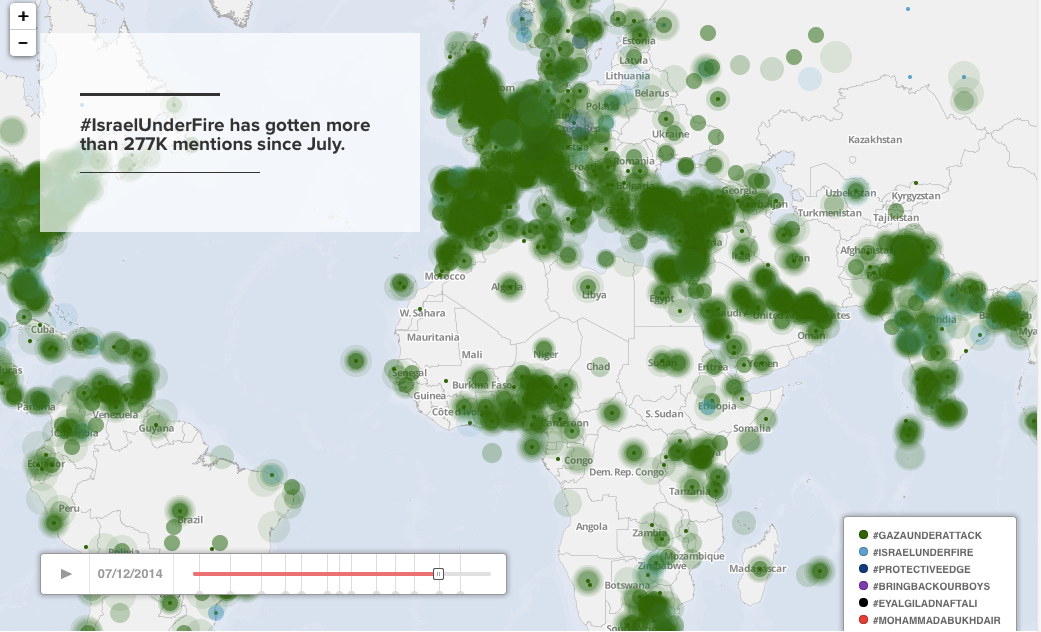
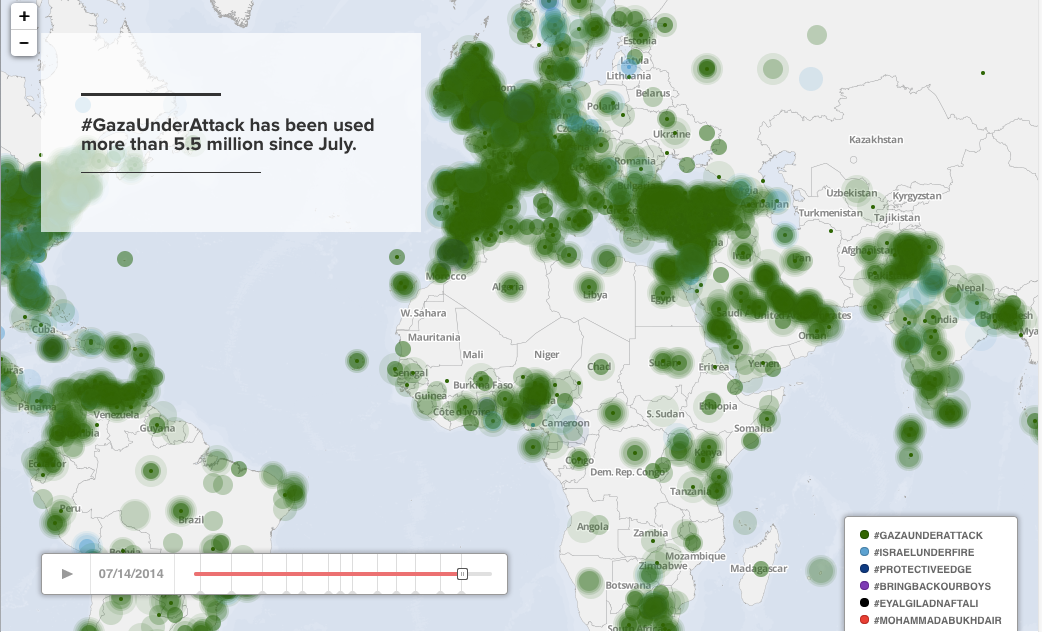
To provide some idea of the scale of operations, al-Jazeera has produced this remarkable representation of the unfolding of a global Twitterstorm about the war; what appears below are screenshots and you really need to watch the whole thing:

#Israelunderfire

#Gaza under attack

The resources each side has at its disposable are far from equal.  According to Harriet Sherwood:

The propaganda war between Israel and the Palestinians is not new, but this battle-round is being fought with unprecedented ferocity. And like the asymmetry in the military conflict, the strength and resources of the Israel social media troops outweigh those of Hamas and other Palestinian organisations.

And those asymmetries have increased. Max Schindler reports,

With dueling Twitter hashtags, Facebook posts and YouTube channels, the Israeli Defense Forces and Hamas, the Palestinian militant group, are trading not just fire but also barbs over social media, in an attempt to win hearts and minds around the world. But Hamas, barred from certain platforms, faces additional challenges in the Internet war.

In this round of violence, the social media battle has become increasingly important. Israel’s ability to wage its campaign in Gaza depends on the level of international criticism it sustains.

On Wednesday, Twitter suspended several accounts used by Hamas…. Twitter’s terms of service block use of the website to “a person barred from receiving services under the laws of the United States or other applicable jurisdiction.” Hamas is classified as a terrorist organization by the State Department, denying it access to American commercial products…. Facebook maintains a similar policy, and has deleted dozens of Hamas accounts due to American government restrictions.

All of this has still wider implications because many of the tweets and the cell-phone videos uploaded to YouTube(see below) re-circulate through mainstream media too – though my strong suspicion is that the cautionary ‘cannot be verified‘ tag is used more often to diminish the suffering of people in Gaza than to call into question the IDF’s hasbara (public diplomacy/propaganda, take your pick).

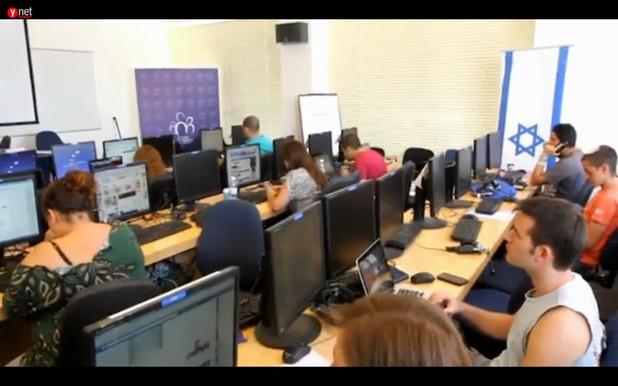
These are more than military (or paramilitary) media operations, but the remainder is not only the work of individual ‘citizen-journalists’.  Ali Abunimah reports on a social media ‘war room’, set up on the first day of the current offensive by students at the Interdisciplinary Center Herzliya, a private university, to ‘explain’ Israel’s actions to overseas audiences: ‘israelunderfire’ originated here.  Some 400 volunteers from around the world are now involved in targeting online forums and producing their own (dis)infographics (more – and affirmative – reporting from the the Jerusalem Post here).

IDC Herzliya %22War Room%22

But most of the running is being made by the  IDF’s own concerted media campaign, and as I noted earlier Rebecca Stein has provided a timely analysis of ‘How Israel militarized social media’ that debunks some of the myths that have grown up around its ‘success’ (see also the link to her previous work here):

‘What’s been lost in this coverage – in this story of surprise — is the history of the Israel’s army presence on social media. For in fact, the military’s move to social media as a public relations platform has been rife with improvisation and failure, a process that runs counter to IDF narratives about its innovative work in this regard (the IDF lauding itself as a military early adopter). The army’s interest in the wartime potential of social media can be traced to the first few days of the 2008-2009 Gaza incursion….

In the years that followed, the IDF investment in social media would grow exponentially both in budgetary and manpower allocations, building on this ostensible wartime triumph.

But the process was rife with challenges and missteps…

Today, Israelis are also concerned about losing the media war. But they tell the story differently. In their rendering, the Israeli media problem is a by-product of damning or doctored images (this was the spirit of Netanyahu’s infamous “telegenically dead” remarks), of Palestinian media manipulation, of global anti-Israeli cum anti-Semitic bias. The Israeli media manages these problems by removing most traces of Palestinian dead and wounded from national news broadcasts.’

This feeds in to a deeper narrative in which both Palestinian casualties and Israeli culpability disappear from view, deftly characterised by Yonatan Mendel:

‘”We can forgive the Arabs for killing our children,” Golda Meir said in 1969, ‘but we cannot forgive them for forcing us to kill their children.’ Forty-five years on, in the third week of the Israeli attack on Gaza, with more than 800 Palestinians killed, about a quarter of them children, Israel’s government, its media and Israeli society have turned Meir’s idea of Israel being ‘forced’ to do unacceptable things into a vast and dangerous superstition. It refuses to take responsibility for the killing, just as it refused to take responsibility for the military occupation and the blockade: these, it tells itself, are what it has been forced into. Killing in Gaza in 2014, killing in 2012, and in 2008. But Israel has convinced itself, despite the rising numbers of dead, that isn’t killing anyone in Gaza. Hamas are the people doing the killing; they are responsible for the siege, the destruction, the underdevelopment, the poverty, the absence of peace talks, the postponement of a ceasefire and the use of UNRWA schools for military purposes.’

One final, crucial qualification. Even as he explains how the IDF and Hamas are fighting a media war, a battle to control the story on social media, John Tirmane insists that ‘the real war is of steel and fire, flesh and blood.’  What the countervailing voices of the ‘Twitterstorm’ seek to enable and to disable is an all too material firestorm.

Problematizing Cyber-Wars

Cyber OrientI’ve just received a Call For Papers on Problematizing Cyber-Wars for a special issue of CyberOrient: Online Journal of the Virtual Middle East.  The Guest Editor for the issue is the amazing Helga Tawil-Souri, whose work has done so much to illuminate these issues already and who starts in January as the new Director of NYU’s Hagop Kevorkian Center for Near Eastern Studies [more on Helga’s work, with links to her writing and other projects, here].

According to military analysts, since the 1991 Gulf War and even more so since the Hezbollah-Israel 2006 war, we have entered a new phase of warfare, in which kinetic and traditional military power are losing importance to symbolic and media power. Perhaps unsurprisingly given a still-widely held Orientalist view in military circles, many such perspectives revolve around wars and conflicts in the ‘Middle East’ or against ‘Islam’ more broadly – taking place in Iraq, Iran, Afghanistan, Israel/Palestine, Syria, but also on cyber networks and mobile phones. 


While these claims are of course hyperbole, this special issue of CyberOrient invites articles on questions of how we might define wars in a (new) media-age in the region; whether, why, and how (new) media are increasingly sites of warfare; the relationships between ‘virtual’ and ‘real’ battlespaces. Topics could include the significance of targeting (and bombing) telecommunications and media infrastructures; the use of (new) media as outlets for propaganda during wartime; the mediatization of war and the militarization of media; the role of participatory or social media and mobile communications during and in wars; relationships or differences between official, military, alternative, citizen, and grass-roots (new) media uses during war and conflict; the expanding definition of warzones; commemoration and memorialization of war in a digital age; among others. We welcome submissions from across disciplines and methodological approaches that are empirically and critically grounded.

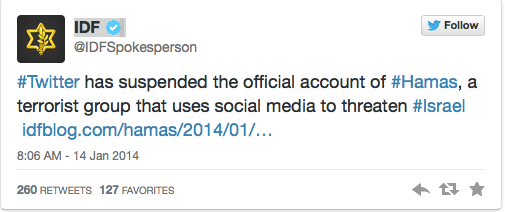
IDF tweet re Hamas Twitter account

[In relation to the IDF tweet (above), from earlier this year, Twitter hasn’t suspended the all too obviously fake ‘Hamas Global PR’ here…]

CyberOrient is a peer-reviewed journal published by the American Anthropological Association, in collaboration with the Faculty of Arts of Charles University in Prague. The aim of the journal is to provide research and theoretical considerations on the representation of Islam and the Middle East, the very areas that used to be styled as an “Orient”, in cyberspace, as well as the impact of the internet and new media in Muslim and Middle Eastern contexts.

Submission

Articles should be submitted directly to Helga Tawil-Souri (helga@nyu.edu) and Vit Sisler (vit.sisler@ff.cuni.cz) by 30 September 2014 (Full Papers). Articles should
be between 6,000 and 8,000 words (including references), and follow the AAA style in referencing and citations. Upon acceptance, articles will be published online with free access in spring 2015.

More information can be found here.

UPDATE:  With exquisite timing, Mondoweiss has just published Rebecca Stein‘s analysis of ‘How Israel militarized social media’:

‘What’s been lost in this coverage – in this story of surprise — is the history of the Israel’s army presence on social media. For in fact, the military’s move to social media as a public relations platform has been rife with improvisation and failure, a process that runs counter to IDF narratives about its innovative work in this regard (the IDF lauding itself as a military early adopter). The army’s interest in the wartime potential of social media can be traced to the first few days of the 2008-2009 Gaza incursion….

In the years that followed, the IDF investment in social media would grow exponentially both in budgetary and manpower allocations, building on this ostensible wartime triumph.

But the process was rife with challenges and missteps.’

You can also find more detail in my previous posts here and here.

Style wars

One of these days I’ll set out the advice I give to students about writing essays – and when I do I’ll also include what I wish published authors would avoid too (me included) – but in the meantime you might be interested in these trenchant words of advice:

Keep the language crisp and pungent; prefer the forthright to the pompous and ornate.
Do not stray from the subject; omit the extraneous, no matter how brilliant it may seem or even be.
Favor the active voice and shun streams of polysyllables and prepositional phrases.
Keep sentences and paragraphs short, and vary the structure of both.
Be frugal in the use of adjectives and adverbs; let nouns and verbs show their own power.

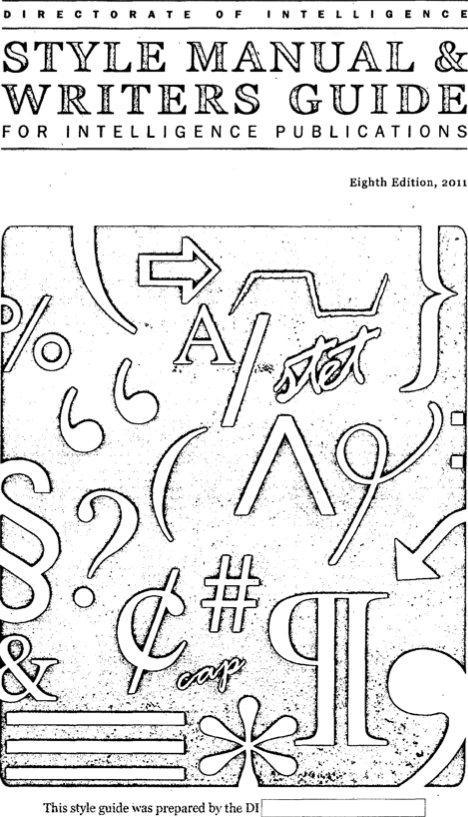
They are taken from the CIA’s detailed Style Manual & Writers Guide for Intelligence Publications issued in 2011; you can find Michael Silverberg‘s commentary at Quartz here.

CIA Style Guide

What particularly caught my eye was this admonition:

Do not uppercase the w in Korean war, which was “undeclared”; the same logic applies to Vietnam war and Falklands war, and a similar convention (if not logic) to the Iran-Iraq war.

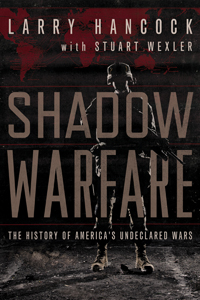
Shadow-Warfare_FINALHidden in plain sight here is the remarkable fact that the United States has not formally declared war since 1941.  You may think that not much depends on a formal declaration, and you would be right, except that this reluctance says much about executive authority and, crucially, what Larry Hancock and Stuart Wexler call, in their excellent Shadow Warfare (Counterpoint, 2014), ‘the history of America’s undeclared wars’.

In a sense, their book provides the back-story to Jeremy Scahill‘s Dirty Wars:

Contrary to their contemporary image, deniable covert operations are not something new. Such activities have been ordered by every president and every administration since World War II. Clandestine operations have often relied on surrogates, with American personnel involved only at a distance, insulated by layers of deniability.

Shadow Warfare traces the evolution of these covert operations, detailing the tactics and tools used from the Truman era through those of the contemporary Obama administration. It also explores the personalities and careers of many of the most noted shadow warriors of the past sixty years, tracing the decades-long relationship between the CIA and the military.

Shadow Warfare offers a balanced, non-polemic exploration of American concealed warfare, detailing its patterns, consequences, and collateral damage, and presenting its successes as well as its failures. Hancock and Wexler explore why every president, from Franklin Roosevelt on, felt compelled to turn to secret, deniable military action. It also delves into the political dynamic of the president’s relationship with Congress, and the fact that despite decades of warfare, Congress has chosen not to exercise its responsibility to declare a single state of war—even for extended and highly visible combat.