Seeing Machines

VIRILIO Vision machineIn a series of posts on photography Trevor Paglen provides some ideas that intersect with my own work on Militarized Vision and ‘seeing like a military’.  First, riffing off Paul Virilio, Trevor develops the idea of photography as a ‘seeing machine‘:

‘Seeing machines is an expansive definition of photography. It is intended to encompass the myriad ways that not only humans use technology to “see” the world, but the ways machines see the world for other machines. Seeing machines includes familiar photographic devices and categories like viewfinder cameras and photosensitive films and papers, but quickly moves far beyond that. It embraces everything from iPhones to airport security backscatter-imaging devices, from electro-optical reconnaissance satellites in low-earth orbit, to QR code readers at supermarket checkouts, from border checkpoint facial-recognition surveillance cameras to privatized networks of Automated License Plate Recognition systems, and from military wide-area-airborne-surveillance systems, to the roving cameras on board legions of Google’s Street View” cars.

What’s more, the idea of seeing machines I’m sketching out here isn’t confined to the imaging devices and systems I’ve described in broad strokes. The definition extends to include the images (or data) produced by such imaging systems, the digital metadata associated with those images, as well as additional systems for storage, archiving, search and interpretation (either human or algorithmic). Finally, and crucially, seeing machines encompasses not only imaging systems, search, and storage capacities, it encompasses something a bit more abstract, namely the “styles” or “practices” of seeing that different imaging systems enable (i.e. the difference between what a view camera and an automated license-plate reading camera “want” to do and how they see the world differently).  Crucially, the definition of photography I’m proposing here encompasses imaging devices (“cameras” broadly understood), the data (“images” being one possible manifestation of that data) they produce, and the seeing-practices with which they are enmeshed.’

In a subsequent post on Geographies of Photography Trevor then links these seeing-practices to what he calls the production of space (and what I now prefer to think of as performances of space), and uses the example of the Reaper to illustrate what he has in mind:

What exactly is a Reaper drone? In essence, it’s a camera attached to a remote-controlled airplane. Sometimes it carries missiles. What’s particular about a Reaper drone (and other drones in its larger family, including the Predator and the Sentinel) is that airplane, pilot, navigator, analysts, and commander don’t have to be in the same place. The aircraft might be flying a combat mission in Yemen by a pilot based in Nevada, overseen by a manager in Virginia, and supported by intelligence officers in Tampa (geographer Derek Gregory has written about what he calls “Drone Geographies.”) The drone creates its own “relative” geographies, folding several noncontiguous spaces around the globe into a single, distributed, “battlefield.” The folding of space-time that the Reaper drone system enables is a contemporary version of what Marx famously called the “annihilation of space with time,” i.e. the ability to capitalize on the speed of new transportation and communications technologies to bring disparate spaces “closer” together, relatively speaking.

I think that’s more or less right: these new, networked political technologies of vision have been instrumental in the production of a non-linear and discontinuous battlespace, threaded by wormholes that connect one site to another.  But, as I’ll try to show when I eventually get to my post on Uruzgan, the process is far from seamless, the folds are more fragile than most of us realise, and the discontinuities and ruptures are as important as the connections for the administration of military violence.

Endless War and the machine

When I wrote ‘Seeing Red: Baghdad and the event-ful city’ (DOWNLOADS tab) I was intrigued by the way in which the US military apprehended the city as a field of events:

‘In Baghdad, these security practices performed a continuous audit that compiled reports of events (Significant Activity Reports or SIGACTS) and correlated the incidence of ‘enemy-initiated attacks’ and other ‘enemy actions’ with a series of civil, commercial and environmental indicators of the population at large: moments in the production of what Dillon and Lobo-Guerrero call a generalized bio-economy.’  

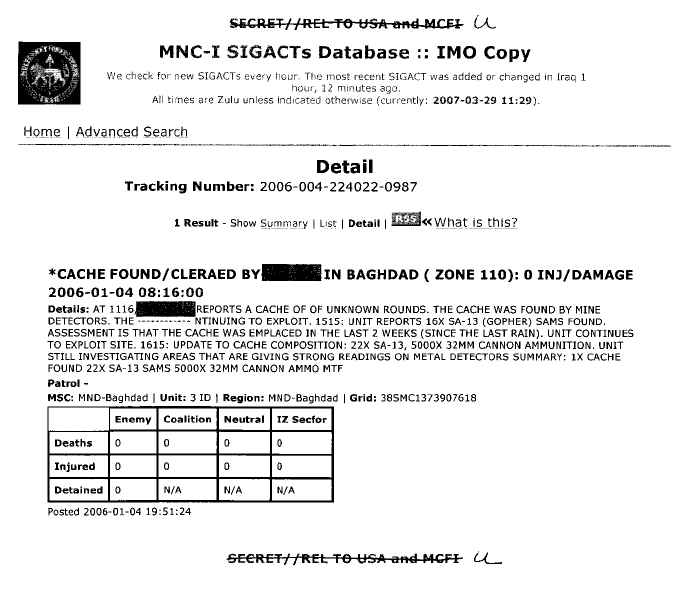
The animating core of the system was the SIGACT  – shown below – and these were eventually fed into a single reporting and analysis platform, the Combined Information Data Network Exchange (CIDNE).
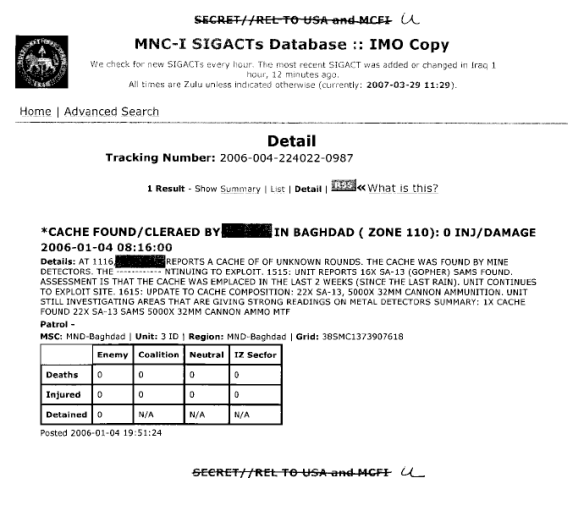
SIGACT

‘The primary transcription of an event, its constitution as a SIGACT, with all its uncertainties and limitations, was transmitted downstream to be digitized and visualized, correlated and ‘cleansed’, so that it could be aggregated to show trends or mapped to show distributions.  All the systems for SIGACT recording and analysis interfaced with visualization and presentation software, which was used to generate ‘storyboards’ at every level in the chain.’

The chain as it was constituted in Iraq in May 2006 is shown below; CENTRIX (top left) is the Combined Enterprise Regional Information Exchange System that provided information exchange across the US-led coalition;  CPoF (scattered across the centre field) is the Command Post of the Future, a distributed GIS system I discussed in the original essay that provided a command-level visualization of the battlespace as a field of events (a system that has since been upgraded multiple times); and at the centre right you can see the key automated data exchanges to and from CIDNE:
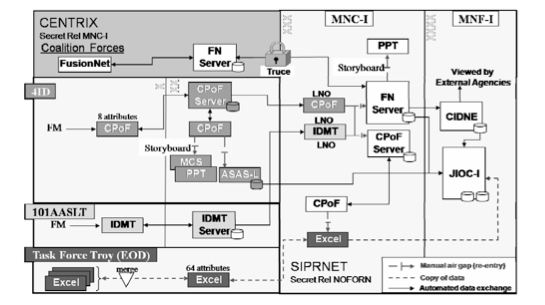
MNF-I Event Reporting, May 2006 (Wortman)

Since I wrote, scholars have used SIGACT reports much more systematically to analyse the connective tissue between ethno-sectarian violence and the ‘surge’ – see, for example, Stephen Biddle, Jeffrey Friedman and Jacob Shapiro, ‘Testing the surge’, International Security 37 (1) (2012) 7-40; Nils Weidmann and Idean Saleyhan, ‘Violence and ethnic segregation: a computational model applied to Baghdad‘, International Studies Quarterly 57 (2013) 52-64 – to explore the political dynamics of civilian casualties – see, for example, Luke Condra and Jacob Shapiro, ‘Who takes the blame?  The strategic effects of collateral damage’, American Journal of Political Science 56 (1) (2012) 167-87 – and to conduct more general evaluations of counterinsurgency in Iraq: see, for example, Eli Berman, Jacob Shapiro and Joseph Felter, ‘Can hearts and minds be bought? The economics of counterinsurgency in Iraq’, Journal of political economy 119 (4) (2011) 766-819.

I’ve been revisiting these modelling exercises for The everywhere war, because they require me to rework my essay on ‘The biopolitics of Baghdad’ (though not, I think, to change its main argument).  I’m struck by the idiom they use – my critique of spatial science written in another age would have been substantially different had it been less preoccupied with the detecting of spatial pattern, had its methods been applied more often to issues that matter, and had its architects been less convinced of the self-sufficiency of their methods.

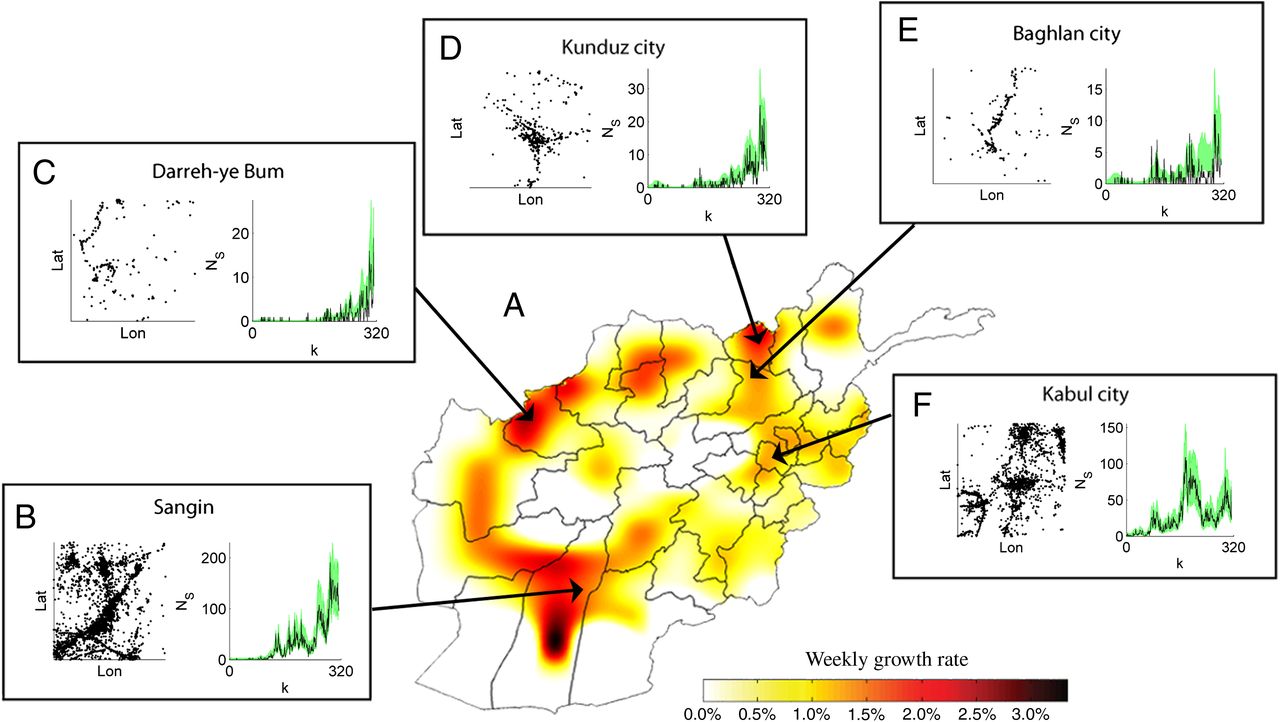
But I’m also struck by the idiom of the SIGACT itself.  We’ve since become much more accustomed to its staccato rhythm through Wikileaks’ release of the Afghan and Iraq War Diaries, whose key source was CIDNE.  Again, these have been visualised and analysed in all sorts of ways: see, for example, herehere, here and here (and especially Visualizing Data and its links here).  The image below comes from Andrew Zammit-Mangion, Michael Dewar, Visakan Kadirkamanathan and Guido Sanguinetti,’Point-process modelling of the Afghan War Diaries’, Proceedings of the National Academy of Sciences 109 (31) (2012) and shows the time-space incidence of events recorded in the Diaries (here I suspect I’m channelling half-remembered conversations with Andrew Cliff….)
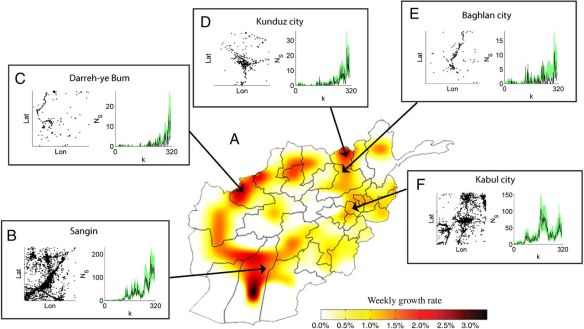
F2.large

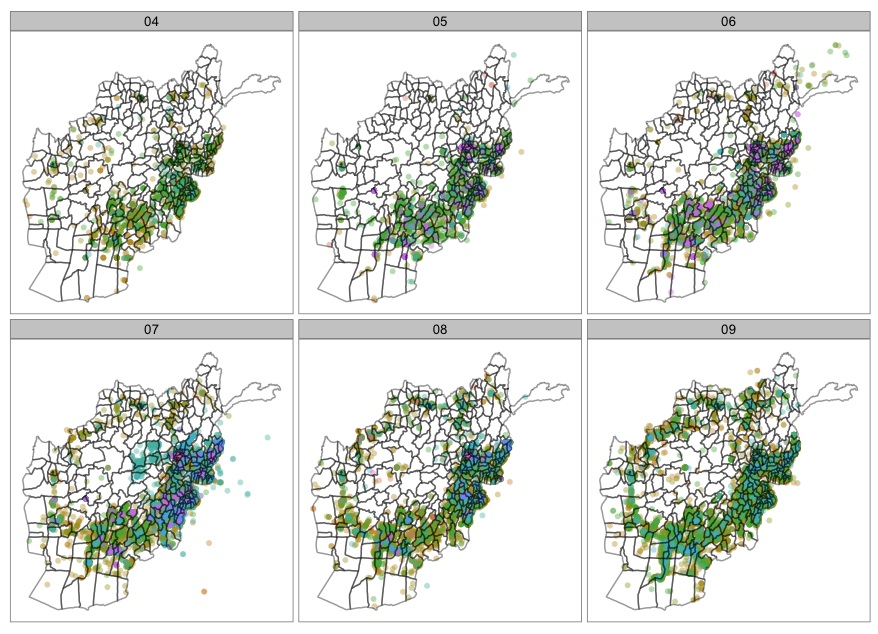
And here, rather more prosaically, is another version – by Drew Conway and Mike Dewar – that provides a time-sequence of the mounting intensity of the war 2004-2009 (for Danger Room‘s discussion and gloss, see here):
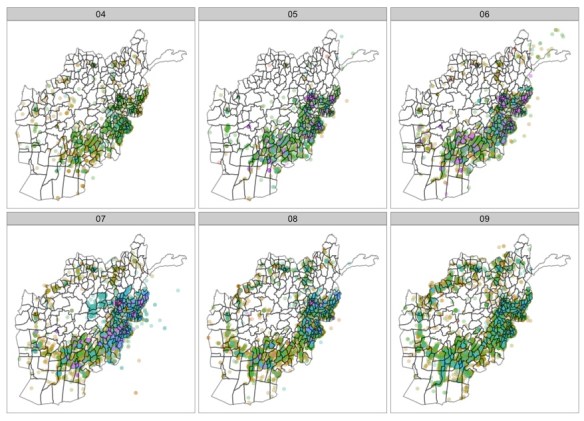
events_by_label_map

Now David Pinder has kindly drawn my attention to an extraordinarily suggestive essay by Graham Harwood,Endless War: on the database structure of armed conflict’ over at rhizome, and to the art-work that is it subject, which together have returned me to my original interest in the ‘event-field’ of later modern war and the automated interactions between its data platforms.

Graham’s central question is deceptively simple: ‘How does the way war is thought relate to how it is fought?’ SIGACTS populate the digital battlespace with events and invite a calculative and algorithmic apprehension of the field of military violence.  To show what this means, Graham and his partner Matsuko Yokokoji (who together compose YoHa: English translation ‘aftermath’) joined with his Goldsmith’s colleague Matthew Fuller to produce an intriguing artwork, Endless War.

It processes the WikiLeaks Afghan War Diary data set as a collection of analytic viewpoints, both machine and human. A software-driven system, Endless War reveals the structure of these viewpoints by using N-gram fingerprints, a method that allows sorting of the text as an anonymous corpus without having to impose predetermined categories on it. Presented as a gallery installation, the system includes a computer that processes the data in real time, projections of the results, and coil pick-up microphones on the central processing unit that sonify the inner working of the machine.

The torrent files released by WikiLeaks in 2010 are the residue of the system that created them, both machine and human. They seem to hint at the existence of a sensorium, an entire sensory and intellectual apparatus of the military body readied for battle, an apparatus through which the Afghan war is both thought and fought.

You can get a sense of the result from vimeo’s record of the installation at the Void Gallery in Derry:

This is a video, obviously, but Endless War isn’t a video.  As the artists explain in a note added to the vimeo clip:

Just as an algorithm is an ‘effective procedure’, a series of logical steps required to complete a task, the Afghan War Diary shows war as it is computed, reduced to an endless permutation of jargon, acronyms, procedure recorded, cross-referenced and seen as a sequence or pattern of events.

Endless War is not a video installation but a month-long real-time processing of this data seen from a series of different analytical points of view. (From the point of view of each individual entry; in terms of phrase matching between entries; and searches for the frequency of terms.) As the war is fought it produces entries in databases that are in turn analysed by software looking for repeated patterns of events, spatial information, kinds of actors, timings and other factors. Endless War shows how the way war is thought relates to the way it is fought. Both are seen as, potentially endless, computational processes. The algorithmic imaginary of contemporary power meshes with the drawn out failure of imperial adventure.

This computational assemblage (think not only of the cascading algorithms but also of the people and the handshakes between the machines: a political technology ‘full of hungry operators’, as Graham has it) is performative: it is at once an inventory – an archive – and a machine for producing a particular version of the military future. Graham again:

‘A SigAct necessarily retains evidential power that reflects its origin outside of the system that will now preserve it, but once isolated from blood and guts, sweat and secretions of the theatre of action (TOA), the SigActs are reassembled through a process of data atomisation. This filter constructs a domain where the formal relation, set theory, and predicate logic has priority over the semantic descriptions of death, missile strikes, or the changing of a tank track and the nuts and bolts needed…

This system of record keeping can be seen as a utopia of war. It is idealized, abstracted, contained; time can be rolled back or forward at a keystroke, vast distances traversed in a query, a Foucauldian placeless place that opens itself up behind the surface of blood-letting and hardware maintenance and the ordering of toilet rolls. A residue that casts a shadow to give NATO visibility to itself. As the ensemble of technical objects and flesh congeal, they create an organ to collectively act to rid itself of some perceived threat—this time from Al Qaeda or the Taliban—faulty vehicles, bad supplies, or invasive politics. This organ also allows NATO’s human souls to imagine themselves grasping the moment, the contingency of now. All of the war, all of the significant events, all of the time, all of the land, coming under the symbolic control of a central administration through the database, affording governance to coerce down the chain of command.’

This is a much more powerful way of capturing – and, through the physical installation itself, conveying – what I originally and imperfectly argued in ‘Seeing Red’:

‘… optical detachment is threatened by a battle space that is visibly and viscerally alive with death; biopolitics bleeds into necropolitics. And yet the Press Briefings that are parasitic upon these visualizations move in a dialectical spiral, and their carefully orchestrated parade of maps, screens and decks reinstates optical detachment. For even as the distancing apparatus of the world-as-exhibition is dissolved and the map becomes the city, so the city becomes the map: and in that moment – in that movement – Baghdad is transformed into an abstract geometry of points and areas and returned to the field of geopolitics. And as those maps are animated, the body politic is scanned, and the tumours visibly shrink, so Baghdad is transformed into a biopolitical field whose ‘death-producing activities [are hidden] under the rhetoric of making live’ (Dauphinee and Masters 2007: xii). In this looking-glass world bodies are counted but they do not count; they become the signs of a pathological condition and the vector of recovery. These processes of abstraction are, of course, profoundly embodied. This is not algorithmic war, and behind every mark on the map/city is a constellation of fear and terror, pain and grief. For that very reason our disclosure of the infrastructure of insight cannot be limited to the nomination of the visible.’


Exorbitant witnessing

PLIThe first issue of the Cambridge journal of postcolonial literary inquiry, edited by Ato Quayson, on ‘New topographies of the postcolonial’, is available as an open access edition here.

The Cambridge Journal of Postcolonial Literary Inquiry is a new peer-review journal that aims to deepen our grasp of postcolonial literary history while enabling us to stay comprehensively informed of all critical developments in the field. The journal will provide a forum for publishing research covering the full spectrum of postcolonial critical readings and approaches, whether these center on established or lesser known postcolonial writers or draw upon fields such as Modernism, Medievalism, Shakespeare and Victorian Studies that have hitherto not been considered central to postcolonial literary studies, yet have generated some of the best insights on postcolonialism. The Journal aims to be critically robust, historically nuanced, and will put the broadly defined areas of literature and aesthetics at the center of postcolonial exploration and critique. Essays of up to 8000 words on any aspect of postcolonial literature, literary history and aesthetics should be sent to The Editor at pli@cambridge.org.

The special issue includes a fine essay by Debjani Ganguly,The world novel, mediated wars and exorbitant witnessing‘, which provides close and illuminating readings of Art Spiegelman‘s Maus and In the shadow of no towers and Michael Ondaatje‘s Anil’s Ghost and connects them to what she calls ‘our era of humanitarian wars’ (see p. 16 for her characterization).  Here is the abstract:

This essay traces the emergence of a new contemporary novel form at the conjunction of global violence in the wake of the Cold War, digital hyperconnectivity, and a mediated infrastructure of sympathy. Since the first Gulf War, and more so, in the rhetoric presaging the wars in Iraq and Afghanistan, we have come to accept that there is very little difference between the technologies used to wage war and those used to view it. This essay argues that the novels of our time are not contiguous with contemporary cinematic or televisual or new media genres in representing the immediacy of violence, but are rather texts that graph the sedimented and recursive history of such mediation. Their alternative way of documenting “witness”—that is, of abstracting the architectonics of testimonial work—urges us to focus not so much on the question of visibility—and its stock thematics of overexposure and desensitization—as on the legibility of this new mode of witnessing. The distinction between visibility and legibility amounts to calibrating differently the work of witnes- sing in novels, their textual and tropological play with multiple modes of spectatorship and engagement, and their distinctively different braiding of the factual and the evidentiary in comparison with genres of the visual.

Britain’s Reapers

UK Remote Control

As Craig Jones has discussed in detail, it’s been much easier to get information about the ways in which the United States has incorporated drones into its military and paramilitary operations than to prise open the door of UK operations (see also Chris Cole on ‘five basic facts we are simply not allowed to know here).

But the House of Commons Defence Committee has just published a two-volume report, Remote Control: remotely piloted air systems – current and future UK use.

Volume 1, the report and formal minutes (58 pp), can be downloaded as a pdf here, and Volume II, written evidence (130 pp), is available here.  The second volume includes submissions from the Ministry of Defence, Northrop Grumman, and General Atomics together with critical submissions from Drone Wars UK, Reprieve, the Network for Social Change’s Remote Control project, and the Bureau of Investigative Journalism.

Over at the Bureau, Alice Ross has a first response and summary here, while Chris Cole has a trenchant critique at Drone Wars UK here.

I’m still working my way through all this, but here are some key passages.

First, on the ‘double proximity’ of drone operations – as I’ve said before, even though these platforms can be controlled from thousands of miles away they are not weapons of global reach:

‘The MoD told us that in order to utilise unmanned air systems in the most efficient manner, they should be based as close as possible to the target area of interest to allow for the longest loiter time possible. In a “non-permissive” or hostile environment this would be “extremely difficult”.’

The other side of this is the invocation of a new (though, as I’ve also emphasised, thoroughly conditional and technologically mediated) quasi-intimacy:

‘It was very clear from the visit to XIII Squadron and discussions with Reaper aircrew that all were experienced professional personnel with a clear purpose and keen understanding of the Rules of Engagement which govern their operations. Despite being remote from the battle space they exhibited a strong sense of connection to the life and death decisions they are sometimes required to take. This was in stark contrast to the image portrayed by some commentators of “drone” pilots as video gaming “warrior geeks”.’

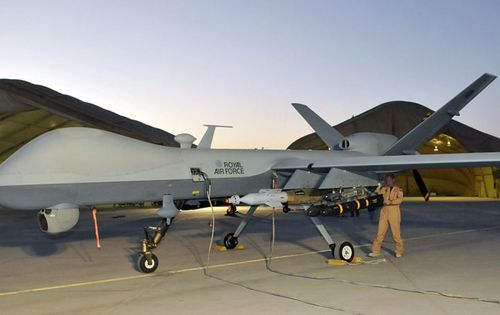
RAF Reaper

Again, as I’ve argued elsewhere, that ‘sense of connection’ is much more highly developed in relation to troops on the ground than to others who are in (or beyond) the field of view, and who are inevitably shut out from audio or online communications, which in part accounts for the risk to non-combatants whenever troops are ‘in contact’ with the Taliban and other fighters.

Second, the report seeks to draw a line between the US program of targeted killing and UK military operations in Afghanistan:

‘We acknowledge that over the last few years there has been a growing concern in relation to the sharing of intelligence with allies and the uses to which such data may contribute. While the issues raised by Reprieve stray beyond the terms of reference for our inquiry and indeed the remit of the Defence Committee, we do believe that there should be greater transparency in relation to safeguards and limitations the UK Government has in place for the sharing of intelligence…

‘We consider that it is of vital importance that a clear distinction be drawn between the actions of UK Armed Forces operating remotely piloted air systems in Afghanistan and those of other States elsewhere… In Afghanistan UAS provide intelligence in support of our ground commanders, enabling them to stay one step ahead of the enemy. Whether for targeting the Taliban or supporting troops on patrol, their ability to loiter over and survey areas for enemy activity and then feed back images and video in real time means they are an invaluable asset to our forces on the ground. Together, the UK’s fleet of UAS have carried out over 160,000 hours of ISR operations.

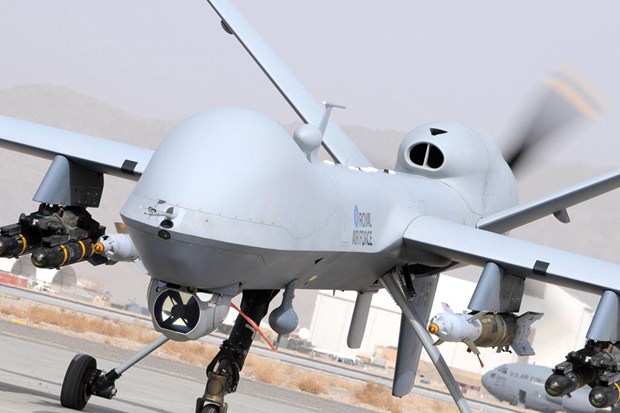
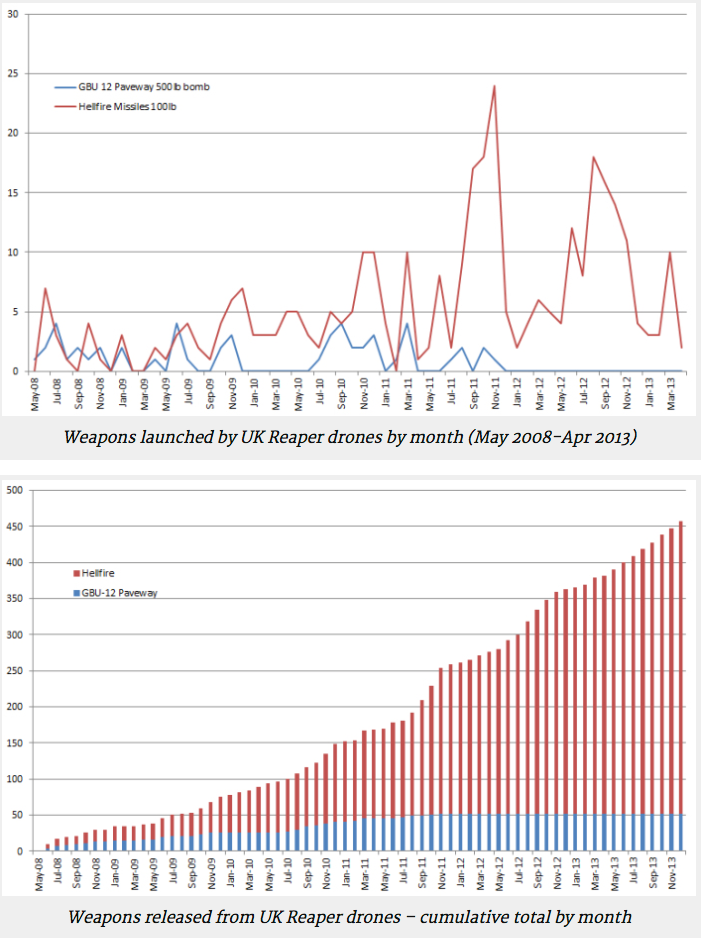
‘The General Atomics MQ-9 Reaper operated by the RAF is the UK’s only armed remotely piloted air system. The RAF fleet rose to ten in early 2014 as an additional five aircraft were accepted into service. RAF Reapers provide persistent intelligence, surveillance, target acquisition and reconnaissance (ISTAR) for ISAF forces in Afghanistan, mostly in support of UK forces in Helmand province…. Since May 2008, UK Reaper aircraft have been armed with precision-guided weapons—Hellfire laser guided air-to-ground missiles and GBU-12 Paveway 500lb laser guided bombs… By 31 August 2013, UK operated Reaper aircraft had flown over 50,000 hours on operations in the ISR role with 418 weapons fired in the same period.’

RAF Reaper and weapons

Here are the raw figures released to Drone Wars UK last month, following a FoI Request to the Ministry of Defence:

Weapons released by UK Reapers in Afghanistan 2008-2013 (Drone Wars UK)

Chris Cole is not convinced by the Committee’s (and, by extension, the Ministry’s) attempt to draw the line:

‘The report also argues that it is “of vital importance” that a clear distinction be draw between the use of drones by UK armed forces and what it discreetly calls “those of other States elsewhere.” It urges the MoD to continue its PR campaign – what the committee calls a “public awareness programme” – in order to “aid public understanding and acceptance.” PR it seems trumps transparency.’

Third, and closely connected to Chris’s misgivings, the report restates without examination the legal armature for UK military operations:

‘…the MoD told us that UK remotely piloted aircraft operate within the constraints of UK rules of engagement (ROE) and policy, even where operational control is assigned to a Coalition Commander, such as the Commander of ISAF. The MoD also stated that UK policy relating to targeting by remotely piloted aircraft is exactly the same as that for manned aircraft (and land and maritime weapons where applicable):

‘It is entirely compliant with International Humanitarian Law. Targets are always positively identified as legitimate military objectives and both pattern of life assessment and collateral damage estimate conducted. Strikes are carried out in accordance with the Law of Armed Conflict.

‘Personnel were keen for the public to know more and understand better what it is they do and to dispel some myths that have grown up about Reaper operations in particular. One pilot commented that the public needed to know that remotely piloted aircraft are “not robots, they’re not autonomous and we spend an awful lot of time training to fly them”. This training emphasised all aspects of the RAF rules of engagement such as whether a strike is necessary, whether any civilians are nearby, and what instructions have been received from the ground commander. Reaper aircrew were firmly of the view that the loiter time of remotely piloted aircraft allowed more informed decisions to be made and consequently the risk of civilian casualties was reduced should a missile strike be required….

Fourth, on civilian casualties and transparency:

‘The MoD told us that it was aware of only one incident involving an armed UK remotely piloted air system Reaper, which had resulted in the deaths of civilians:

‘On 25 March 2011 [three years ago to the day!] an attack on two pick-up trucks resulted in the destruction of a significant quantity of explosives and the death of two insurgents. Sadly, four Afghanistan civilians were also killed. In line with current ISAF procedures, an ISAF investigation was conducted to establish if any lessons could be learned or if any errors in operational procedures could be identified. In that case, the report concluded that the actions of the Reaper crew had been in accordance with extant procedures and rules of engagement.

…We note the conclusion of the UN Special Rapporteur [Ben Emmerson] that in any case in which civilians have been, or appear to have been, killed, there is an obligation on the State responsible to conduct a prompt, independent and impartial fact-finding inquiry and to provide a detailed public explanation. We recognise that this is not a simple and straightforward request as to do so could seriously jeopardise continuing operations. Nonetheless, we recommend that, to the extent that it is operationally secure to do so, following an event which has resulted in confirmed civilian casualties the MoD should seek to publish details about the incident and any lessons learned from the review process…’

For a good discussion of the UK’s definition of ‘civilian’ in such cases, see Dapo Akande at the European Journal of International Law here.

To be continued.

Mapping violent conflict

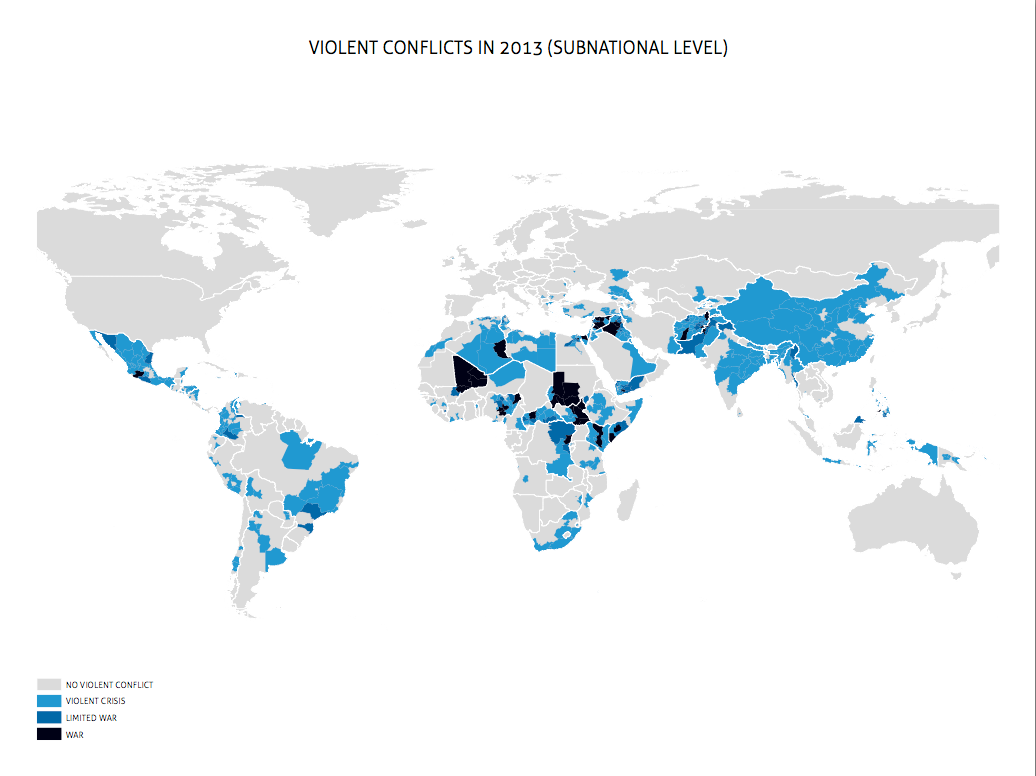
The Heidelberg Institute for International Conflict Research has published its Conflict Barometer for 2013:

Violent conflicts 2013 HEIDELBERG

The full report can be downloaded here; it includes a detailed explanation of methodology and sources, many more maps, and a series of detailed regional surveys.

There are, of course, many other projects that attempt to monitor the macro-geography of armed conflict that also make their databases available for research, including the Correlates of War project (data from 1816 on), the Armed Conflict Dataset maintained by UCDP/PRIO (see also here; data from 1946 on) – both these are global – and the Armed Conflict Location & Event Data Project (ACLED) which provides a much more detailed, sub-regional mapping and claims to be ‘the most comprehensive public collection of political violence data for developing states.’  I’ve pasted an example of their sub-regional mapping below; the original is here, along with others for the DRC and Zimbabwe, while maps plotting the activities of Boko Haram, the Lord’s Resistance Army and other conflicts are available here and here.

ACLED_Infographic_Al-Shabaab-Activity-Map-721x1024

I also greatly admire the Event Data on Conflict and Security (EDACS) produced by Sven Chojnacki and his colleagues in Berlin, and the disaggregated analyses they provide.  Like ACLED, this also includes a remarkably detailed time-space analysis of violence in Somalia:

CHOJNACKI Somalia

You can find out more about the project from the special issue of International Interactions 38: 4 (2012) on Event Data in the Study of Conflict.

The other side of NSA

I’ve emphasised the networks in which drone operations take place several times on this blog, and I’ll have more to say about it (and, crucially, the satellite links involved) very shortly.  But this applies to all domains in which advanced militaries now operate.  In 2012 Army magazine (62: 6) put it like this:

The world in which U.S. forces operate is increasingly wireless and computer network-based. Rapidly evolving information technologies are expanding the speed, capacity, agility, efficiency and usefulness of modern networks. The prolif- eration of these systems is changing the way humans interact with each other and their environment, including military operations. This creates conditions that will make U.S. forces increasingly dependent on these technologies and require soldiers to counter technology-empowered and so- phisticated adversaries who can utilize commercial indus- try and the network as their primary combat developers. This broad and rapidly changing [Operational Environment] will present a plethora of potential threats and opportunities that are primarily limited by our own—and our opponents’—imagination, causing the Army to operate within a cyberspace domain and EMS [Electromagnetic Spectrum] that are increasingly congested and contested.

The authors went on to emphasise the convergence of ‘cyber and EMS capabilities’ (and, not coincidentally to my interest in satellite communications, the intersections between commercial and military systems):

Commercial and military systems are increasingly reliant on both as networks and telecommunication infrastructures expand their use of wireless means. This is particularly important for collaborative systems that require connectivity to operate effectively. The synergistic effect of these networks is a significant reason why EW [electronic warfare], EMSO [EMS operations] and cyber operations must be viewed as interrelated and interdependent.

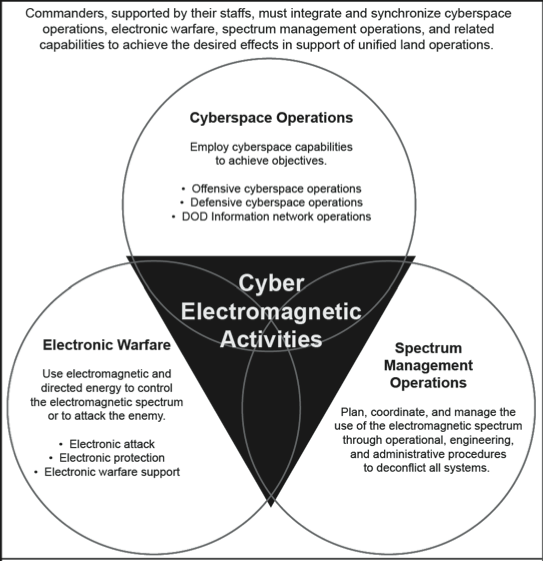
The Pentagon has now published its first Field Manual on Cyber Electromagnetic Activities (FM 3-38).  If you are still wondering what these are, and why I’ve described them as the ‘other side’ of NSA (and by extension, GCHQ and the other ‘Five Eyes’) global surveillance operations, this is what the manual says:

Cyber electromagnetic activities are activities leveraged to seize, retain, and exploit an advantage over adversaries and enemies in both cyberspace and the electromagnetic spectrum, while simultaneously denying and degrading adversary and enemy use of the same and protecting the mission command system (ADRP 3-0). CEMA consist of cyberspace operations (CO), electronic warfare (EW), and spectrum management operations (SMO).

Cyber Electromagnetic Activities

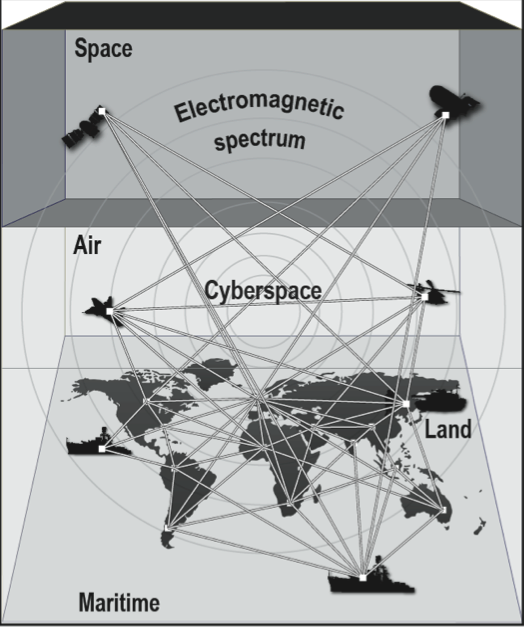
The FM – and remember this is doctrine: we have a long way to go before we are able to probe into practice – diagrams the relation between the ‘five domains’ of US military operations (air, land, sea, space and cyberspace) and the electromagnetic spectrum like this:

Five domains and the Electromagnetic Spectrum

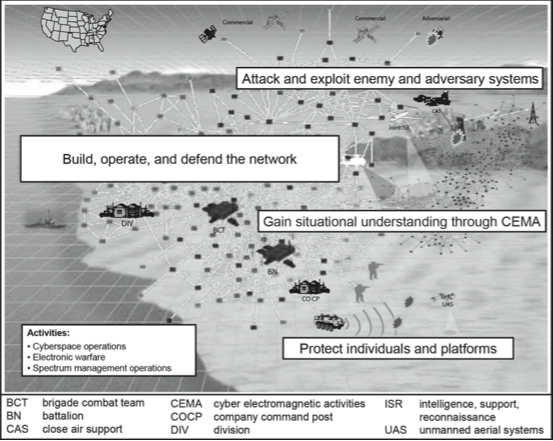
Operationally, for ‘unified land operations’ (this is a US Army manual, remember) this translates into undertaking Cyber Electromagnetic Activities (CEMA) thus:

Cyber electromagnetic activities Operational View

You can find a short discussion of the pre-history behind the Field Manual here.

I’m going to work my way through the manual in detail, and think through its implications for what I already know about cyberwar (even if Thomas Rid thinks it will never take place).  I sketched out some of my early ideas in ‘The everywhere war’ (DOWNLOADS tab), largely in relation to Stuxnet and cyber-attacks on Iran’s nuclear programme, but there have been many more developments and revelations since then, so watch this space.

Mapping Aleppo – and more

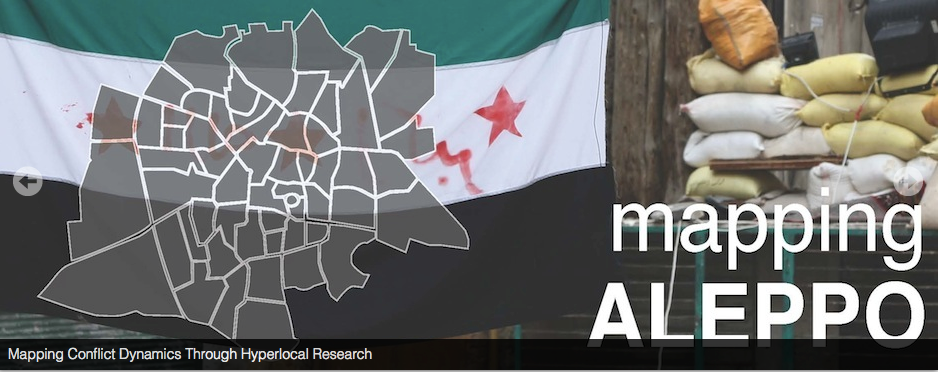
Mapping Aleppo

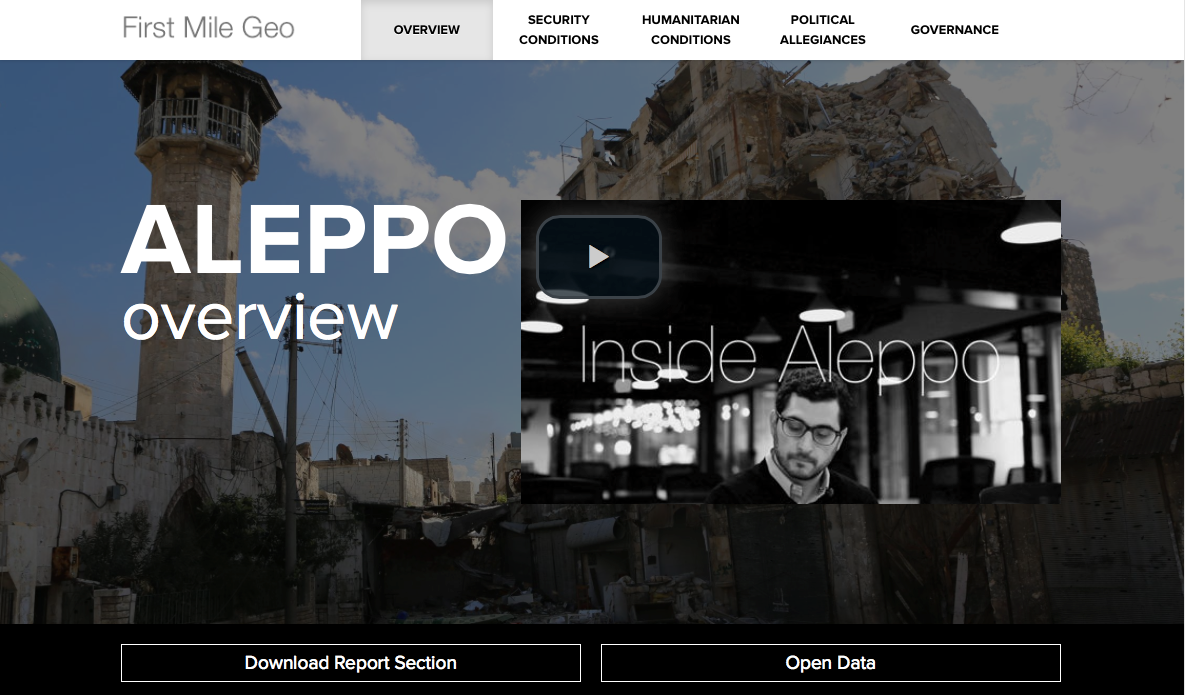
I’ve posted about mapping the war in Syria and its spillover effects before (see here and here), but most of these projects cover a wide area with varying degrees of reliability.  Now News from Laleh Khalili of a report from David Kilcullen‘s Caerus Associates (with the American Security Project) on the civil war in Aleppo, “Mapping the conflict in Aleppo, Syria”, which provides a much more fine-grained view of what is happening on the ground.  You can download the report here or view the interactive version via First Mile Geo here, and you can read an account of the project from Wired‘s Greg Miller here.

Caerus has also joined with the Pentagon’s Center for Complex Operations to produce a special supplement of PRISM (vol.  4, 2014) on the Syrian conflict, which includes an essay by Kilcullen and Nathaniel Rosenblatt on ‘The Rise of Syria’s Urban Poor: Why the War for Syria’s Future Will Be Fought Over the Country’s New Urban Villages’; the whole issue is available on open access here.

These interventions are important and interesting for several reasons.

First, the report is based on exacting local fieldwork.  Acknowledging that local people in conflict zones develop vitally important stocks of local knowledge as a means of survival, the report also accepts that this ‘information-rich environment remains analytically poor.’  For that reason, the field teams ‘provided training and cloud-based tools to help local actors collect locally understood knowledge about their conflict for rigorous analysis.’

From September 16, 2013 to January 6, 2014, we collected four types of information: a monthly survey of perceptions among 560 residents in Aleppo’s 56 neighborhoods, biweekly location and status data for bakeries (a key indicator of humanitarian conditions due to the centrality of bread in the Syrian diet), biweekly location and status data on security checkpoints (a key indicator of security, territorial control and public safety conditions), and a monthly neighborhood-level assessment filled out by our enumerators. These four data streams not only allowed the research team to detect and visualize shifts in the environment in near-real time, but also provided an extremely rich source of insights on the geo-social dynamics at play. All field research was conducted in Arabic.

First Mile Geo notes that it will make the data available to organisations ‘for responsible use’: see Open Data here.

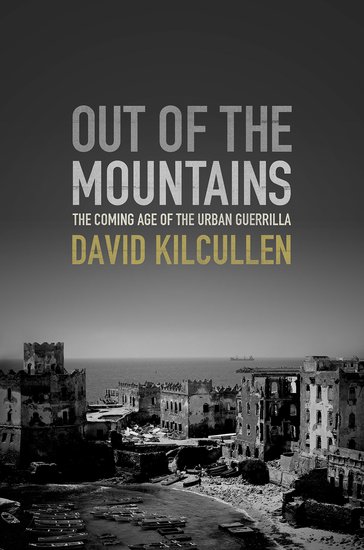
KILCULLEN Out of the mountainsSecond, Kilcullen’s analytical argument (he is described as ‘Principal Investigator’ for the Mapping project) is, naturally enough, fully conformable with the thesis he develops at length in his latest book, Out of the mountains: the coming age of the urban guerrilla (2013); the report reveals the grisly details of contemporary siege warfare and urbicide – central themes in the book, where Kilcullen notes the work of  Steve Graham and Eyal Weizman – and gestures towards a future ‘feral city’ (how I hate that phrase) broken into multiple fiefdoms where gangs and militias exact violence and provide rudimentary services to the residents:

‘The inability of opposition groups to aid residents of neighborhoods they control suggests Aleppo – and Syria as a whole – will become a mosaic of small, intersecting fiefdoms, each providing assistance to its respective neighborhood without regard to macro-level concerns for national governance and reconciliation. Growing warlordism may be particularly acute in Aleppo, where economic rent-seeking opportunities will attract armed gangs who will attempt to seize control of its neighborhoods. These “conflict entrepreneurs” will have little incentive to end a conflict from which they derive power, prestige, and profit. Even in the event of peace, Aleppo’s strategic location will help these actors establish roots for illicit networks that may endure well beyond the present conflict. Moreover, as a non-capital city, Aleppo will not benefit from national government attention. Instead, Aleppo’s future may resemble that of similarly conflict-plagued second cities in the Middle East, such as Mosul in Iraq or Benghazi in Libya. These cities are plagued by warlordism and dominated by illicit economies. They have quickly become safe havens enabling terrorist networks to plan, recruit, and launch attacks.’ 

I’ve posted about Out of the Mountains here, when I promised an extended commentary: Laleh and I will be working on a joint examination of Kilcullen’s larger thesis in the near future, so watch this space. We already have Mike Davis‘s thumbnail view:

‘Although an enemy of the state, I must concede that this is a brilliant book by the most unfettered and analytically acute mind in the military intelligentsia. Kilcullen unflinchingly confronts the nightmare of endless warfare in the slums of the world.’

Here, incidentally, it’s revealing to read Kilcullen’s theses alongside Neil Brenner‘s ‘Theses on urbanisation’, Public culture 25:1 (2013) 85-114, which makes a series of suggestive proposals – but from which war is strikingly absent.  So Kilcullen’s thesis certainly demands serious scrutiny, particularly by those who think that the future of war is somehow encapsulated in the drone.  In my previous note, I joined Geoff Manaugh in being sceptical about the ‘aerial-algorithmic’ interventions that attracted Kilcullen in a series of talks based around the book, but ‘Mapping the conflict in Aleppo’ reveals a much more substantial interest in ‘the facts on the ground’, local actors and local knowledge.  (And here a good counter-text would be the brilliant work of AbdouMaliq Simone; see also his blog, Villes-Noires, here).  So, as I say, watch this space.

First Mile Geo ALEPPO

But there’s a third reason this matters.  I’ve been reading and thinking about Jeremy Crampton, Sue Roberts and Ate Poorhuis‘s ‘The new political economy of geographical intelligence’ – a fine essay in the Annals of the Association of American Geographers 104: 1 (2014) 196-214 – and I’ll be returning to this in the next day or two.  They emphasise the importance of satellite imagery in the production of US geospatial intelligence, whereas I’ve been developing a different (though related) argument about  the importance of satellite communications for the ‘everywhere war’.  In both cases, there is an intimate relation between ‘milsat’ and ‘comsat’, the military and commercial sectors, which will come as no surprise to those who’ve been plotting the extending contours of the military-industrial complex.

Those contours have snared all sorts of other institutions, of course, which is why James Der Derian talks about MIME-NET (the military-industrial-media-entertainment network) and I’ve talked about MAIM-NET (the military-academic-industrial-media network).  The role of universities in the development of military capabilities and military knowledge (and ultimately the production of military violence) is no less surprising, of course, and in fact there’s a session on ‘Geography and the military’ organised by Eric Sheppard at the AAG conference in Tampa (an appropriate location for several reasons) to debate these issues.  But it should now be clear that the production of these geographical knowledges is not confined to the military and civilian intelligence agencies, the academy and large corporations but also includes a host of much smaller private contractors devoted to ‘geographical intelligence’.  They come in different shapes and sizes, and with different agendas.  Caerus, for example, describes itself as a ‘strategy and design firm’ that helps clients ‘understand and thrive in complex, conflict-afflicted, and disaster-affected environments’.  But there are many others, and it’s important not to lose sight of their role in what the US military would call ‘shaping the battlespace’…

Death, drones and Camp Delta

When I wrote ‘The Black Flag’ (DOWNLOADS tab), exploring the idea of Guantanamo Bay as a space of exception, three young men had just committed suicide in the war prison.  This is how I started:

In the early morning of 10 June 2006 three prisoners held at the military detention facility at the US Naval Station at Guantánamo Bay, Cuba, two from Saudi Arabia and one from Yemen, were found dead in their cells. Although the three men had been detained without trial for several years and none of them had court cases or military commissions pending (none of them had even been charged), the commander of the prison dismissed their suicides as ‘not an act of desperation but an act of asymmetric warfare against us’. Although the three men had been on repeated hunger strikes which ended when they were strapped into restraint chairs and force- fed by nasal tubes, the US Deputy Assistant Secretary of State for Public Diplomacy described their deaths as ‘a Public Relations move to draw attention’ – to what, she did not say – and complained that since detainees had access to lawyers, received mail and had the ability to write to families, ‘it was hard to see why the men had not protested about their situation’. Although by presidential decree prisoners at Guantánamo are subject to indefinite detention and coercive interrogation while they are alive, when President George W. Bush learned of the three deaths he reportedly stressed the importance of treating their dead bodies ‘in a humane and culturally sensitive manner’. 

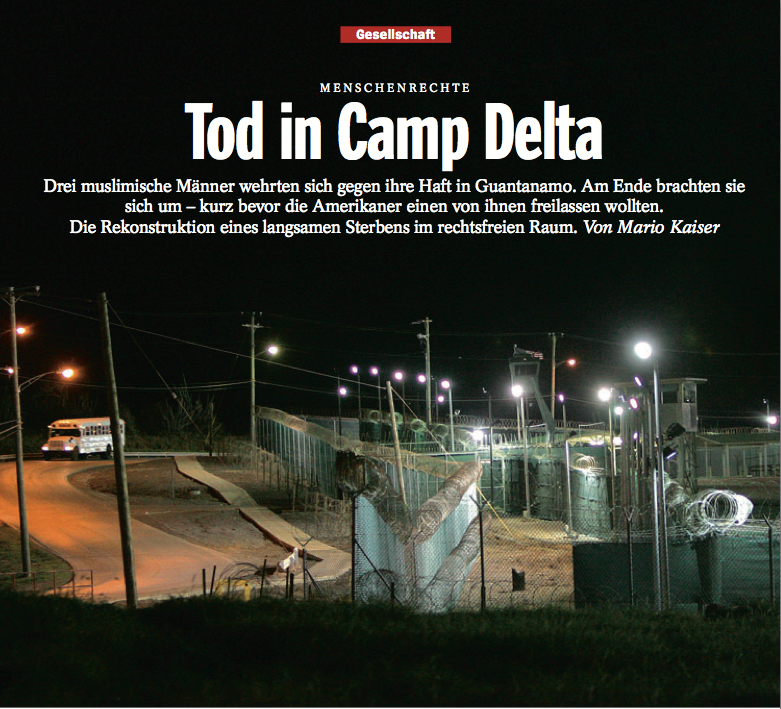
KAISER Tod in Camp Delta

After ‘The Black Flag’ was published, I read a remarkable account of the despair and desperation of these three men by Mario Kaiser.  His original essay has now been updated and translated into English as ‘Death in Camp Delta‘ at Guernica.  Here is an extract:

At some point during their captivity, these three men began to retreat. They no longer touched the food the guards pushed through the holes in the doors of their cells. Their bodies dwindled. Their lives hung on thin yellow tubes shoved down their nostrils each morning to let a nutrient fluid drip into their stomachs. In their minds, nothing changed. They didn’t want to stay, and one night, on June 9, 2006, they decided to leave Guantánamo. They climbed on top of the sinks in their cells and hanged themselves.

In the Pentagon’s view, the men hanging from the walls of their cells were assassins whose suicides were attacks on America. The Pentagon struck back.

The story of the lives and deaths of these prisoners is an odyssey of three young men who left for Afghanistan and ended up in Cuba. It is the story of a war against a terror that is difficult to define, a war that the United States government wages even in the cells of its prisoners. It is about a place, Camp Delta, that exposes the asymmetry of this war, and it leads to the front lines—and the American lawyers standing between them, struggling to defend presumed enemies of their country. It is the story of the internal and external battle over Guantánamo.

Nobody but the dead knows the whole truth. But there are places where the story can be pieced together. There are files and letters, people who distinctly remember these prisoners. There are places where the strands of this story intersect. A law firm in Washington. A mosque in London. A living room in North Carolina. A cell in Guantánamo.

This is on my mind today for three reasons.  The first is that Kaiser describes himself as

‘a writer who combines in-depth reporting with literary storytelling. Taking on issues of social transformation and human rights, Kaiser’s stories are based on long-term immersion in environments that are difficult to access. His hope is that this approach provides a fuller understanding of the ways in which policies and social change affect people’s lives and long-term prospects.’

It’s worth reflecting on those aspirations if you read his essay (which I urge you to do) because they raise important questions about the lazy distinction between ‘fact’ and ‘fiction’, and about the ability of researchers to produce and animate publics through their (our) work.  There’s something there, too, about the power (and, yes, the seductions) of story-telling: so much academic writing still seems to substitute and so privilege our own narrative (‘I did this… then I did that .. I thought this…. then I felt that’) for the stories of others.  And, as Kaiser shows in that brief extract, those stories are often multi-sited.

AGAMBEN State of exceptionThe second reason Kaiser’s work matters to me is that I’m revisiting ‘The Black Flag’ for The everywhere war (more on this later) and, partly in consequence, thinking again about spaces of exception.  I’m in Mexico this week, and I’ve been re-reading Giorgio Agamben‘s Homo sacer and The state of exception.  I was originally doing this to sharpen my arguments about the Federally Administered Tribal Areas as a space of exception for air strikes by the CIA/JSOC and the Pakistan Air Force – I’ll be talking about this in Glasgow early next month, and I’ll post the presentation slides as soon as I’ve finished – but as I’ve worked my way through these texts still wider issues have emerged.

One of the central elements of Homo sacer (and Remnants of Auschwitz – though here too the differences between the two texts are suggestive) is the deliberate exposure of bodies to death: outcasts from whom the protections of the law have been stripped so that their death is no crime.  But in The state of exception Agamben’s focus is on the genealogy of the ‘force of law’ through which this takes place: the victims are nowhere in sight.  Throughout the short text Agamben makes much of the proximity of war and, for the ’emergency’ that activates the modern state of exception, of the First World War, but war and its developing armature of (international) law is never subjected to critical scrutiny.

Yet war (and its casualties) can reveal something else about spaces of exception.  On the battlefield – and let us immediately agree with Frédéric Mégret that ‘the battlefield’ is a highly unstable conceptual constellation – soldiers are at once vectors and victims of violence.  Here the usual restrictions on killing are removed; they can kill, provided they do so ‘lawfully’, without risk of punishment (‘combatant immunity’).  The other side of the contract, of course, is that those who might kill them are not subject to  legal sanction either.

This is not what Agamben means by the state of exception, and apart from repeated references to a contemporary ‘global civil war’ (and to Guantanamo) the transnational rarely appears in his writing and international law disappears into the margins.  His thumb-nail history of the state of exception is framed by the state and its sovereign.

But for reasons that I’ll set out in a later post, the proximity of the exceptional space of  the ‘battlefield’, of war zones and killing fields, to the ultimate reductions of bare life, is far from accidental.  In fact, that’s one of the links between the three deaths in Guantanamo Bay and air strikes and targeted killings in the Federally Administered Tribal Areas of Pakistan which, as I’ll want to show, requires a radically enlarged view of spaces of exception and their historical geographies.  (In the case of the FATA, the Obama administration insists it requires a radically enlarged juridical conception of the ‘battlefield’ in time and space too).

To be continued.

Disposable life

Histories of violence banner

Histories of Violence launches its tremendously important (and equally ambitious) Disposable Life project, which Brad Evans explains like this:

“Mass violence is poorly understood if it simply refers to casualties on battlefields or continues to be framed through conventional notions of warfare. We need to interrogate the multiple ways in which entire populations are rendered disposable on a daily basis if we are to take seriously the meaning of global citizenship in the 21st Century”. (Brad Evans, Project Director)

 Throughout the Twentieth Century, violence was ceaselessly waged against targeted populations deemed to be “disposable”. The years 2014-2016 will be a poignant moment to reflect upon the historical significance and contemporary meaning of these mass atrocities. The period begins with the 20th anniversary of the Zapatista uprising which provided a contemporary frame on the history of indigenous and racial persecution. April 2014 will mark the 20th anniversary of the Rwandan genocide which exposed to a watching global community the horrifying legacy of colonialism, along with its lasting and unresolved implications. June 2014 bears witness to the 100th anniversary of the outbreak of World War I which remains one of the bloodiest conflicts in human history. Onto January 2015, we confront the historical memory of the violence of Auschwitz which taught us the shame of being human. The year also witnesses the 70th anniversaries of the bombings of Hiroshima & Nagasaki that still serve as a horrifying reminder of the devastating potential of weapons of mass destruction and the capacity to reason widespread destruction; the 100th anniversary of the Armenian “genocide” which remains a source of contention and passionate debate in terms of its definition and political vocabulary; the 65th anniversary of the start of the Korea War that continues to have profound impact upon global ideas of security and peaceful co-habitation; the 60th anniversary of the official start of Vietnam War (from United States perspective) whose targeted violence against local populations and biospheres in particular fundamentally challenged claims of Western superiority and enlightenment; along with the 40th anniversary of the beginning of the “killing fields” in Cambodia which remains one of the most violent experimental episodes in the history of human existence.

There is no doubt a need to collectively memorialise these traumatic events and remember the devastating loss of life. Any attempt to create more just futures must have an appreciation of these histories of violence. There is also a need however to move beyond the historicity of memorialisation to critically question their contemporary significance in terms of providing a more honest and somber reflection of the present conjuncture. This requires us to move beyond the dominant Western tropes for conceptualising such violence as either exceptional in history or the result of a failure of liberal modernity. Disposability may take many different forms. It cannot be reduced to simplistic explanations. Nor can it be properly understood without engaging its underlying causes that may be of a political, economic, cultural, social, psychological and identity based nature. Only then might we start to rethink the terms of global citizenship in the 21st Century. With this in mind, the initiative is compelled to ask: Are there, for instance, aspects of contemporary global society that make it possible to think and act in ways that render specific populations disposable? How might we commemorate these tragic events in ways that will cultivate a deeper understanding of the conditions that give rise to extreme violence? Is it correct to argue that we now live in a post-colonial and post-racial moment? Or are there continued remnants from the brutality of colonialism that shapes relations amongst people today? What challenges does the notion of disposability pose for the integrity of social research? How should we engage the broader public in critical education and discussion around the various forms that violence has taken in the past and continues to take in the present? And how might we forge a truly trans-disciplinary pedagogy that connects the arts, humanities and social sciences such that we may engage more critically with the meaning of violence and the disposability of populations in the 21st Century?

This is excellent stuff, and from my point of view a critical question concerns the ways in which notions of ‘disposability’ circulate between (or perhaps more accurately among) the ‘battlefields and warfare’ with which the paragraph begins and the other spaces and spheres of social life to which it opens out.  I think this requires histories of violence, to be sure, but also geographies of violence – in short, historical geographies of violence.

The Project is launched with a short video from Cynthia Enloe, who ‘provides her original interpretation of the paradigm by exploring the meaning of disposability in the terms of the ways life continually appears arbitrary and nameless. For Enloe, not only does the problem of disposability point to contemporary forms of banality as earlier critiqued by Hannah Arendt, it allows us to rethink what it means to be humane in the 21st Century.’

For a partial list of future contributors, book projects and recommended readings, see here.  And keep watching that space!