Cities under siege (II)

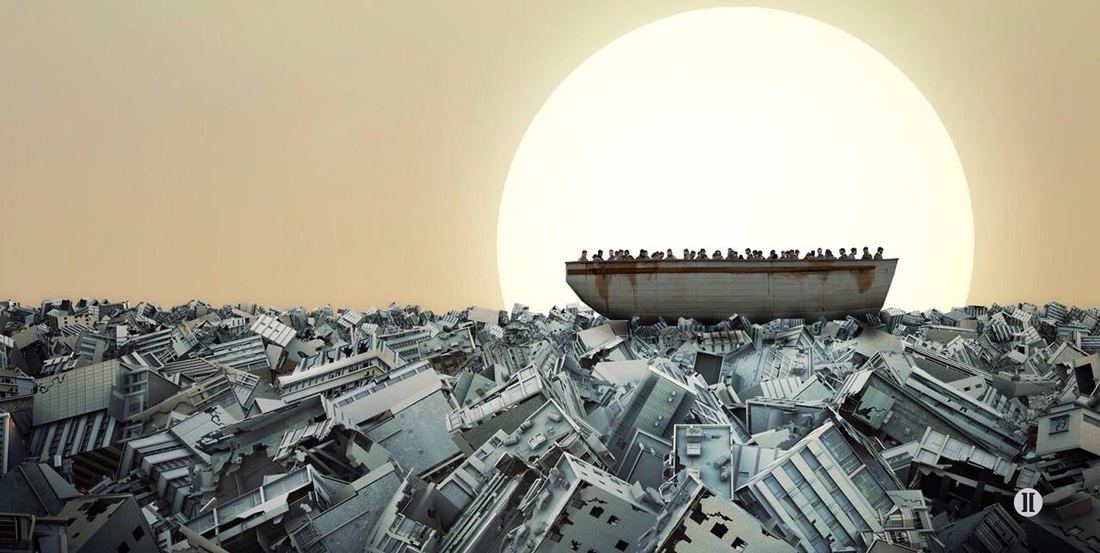
In this second post on Cities under siege I provide a back-story to the re-intensification of military and paramilitary violence against civilians in Syria I described here.  But it’s also a back-story to the stunning image above, ‘Deluge’ by Imranovi: people were evacuated to what eventually became nominally ‘de-escalation zones’ from besieged cities like Aleppo, but many more continued to flee Syria altogether – like Imranovi himself (more on Imranovi here and here).  It’s worth pausing over his artwork: every time we see video of those perilous boats crammed with desperate refugees we ought to reflect on the oceans of bloody rubble strewn across their land and the millions of other displaced people in their wake.

There is a close connection between internal displacement and cities under siege.  Here is the UN’s estimate of the displaced population in December 2016:
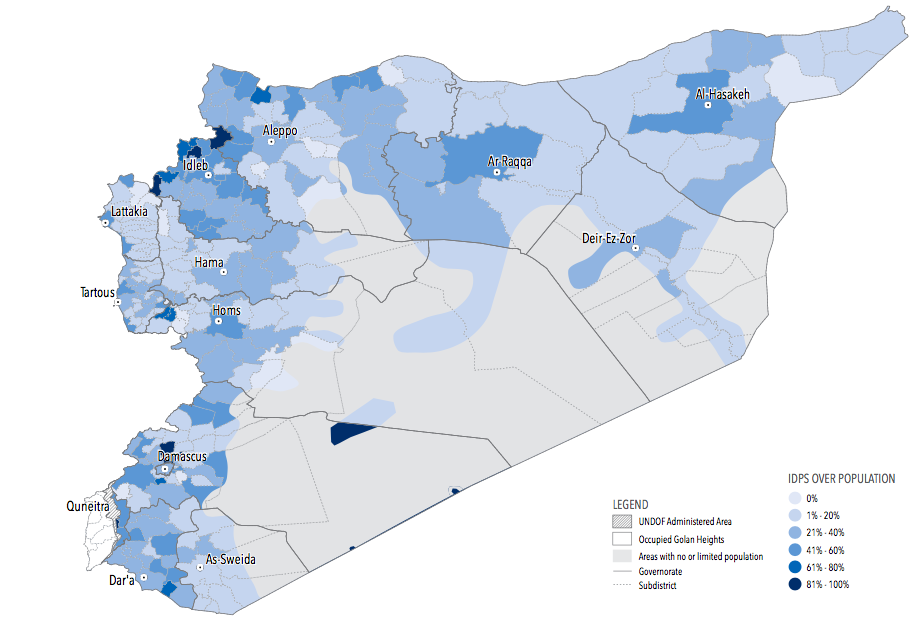
They are concentrated in towns and cities.  Many people have managed to escape areas under siege, risking their lives to do so, but many others have sought refuge in towns and cities that have themselves come under siege.  Here, for example, is Siege Watch‘s description of Eastern Ghouta in mid-2016:

The capture of besieged towns on the south and eastern sides of Eastern Ghouta had a negative impact on conditions throughout the entire besieged region. IDPs from the frontline areas fled into host communities that have also been subjected to the same long-term siege and lack the infrastructure and resources to support the newly displaced families. There is now a higher concentration of people living in temporary shelters or sleeping on the streets.

The UN defines a besieged area as ‘an area surrounded by armed actors with the sustained effect that humanitarian assistance cannot regularly enter, and civilians, the sick and wounded cannot regularly exit the area.’  

But the definition  and its application turn out to be as problematic as perhaps you would expect.  Here is Annie Sparrow:

Estimates of the number of Syrians currently living under siege vary widely, according to who is doing the reporting. For example, last December [2015], the United Nations Office for the Coordination of Humanitarian Affairs (OCHA) in Damascus communicated back to the UN secretary-general’s office that 393,700 civilians were besieged. For the same period, Siege Watch estimated that the real figure was more than one million…

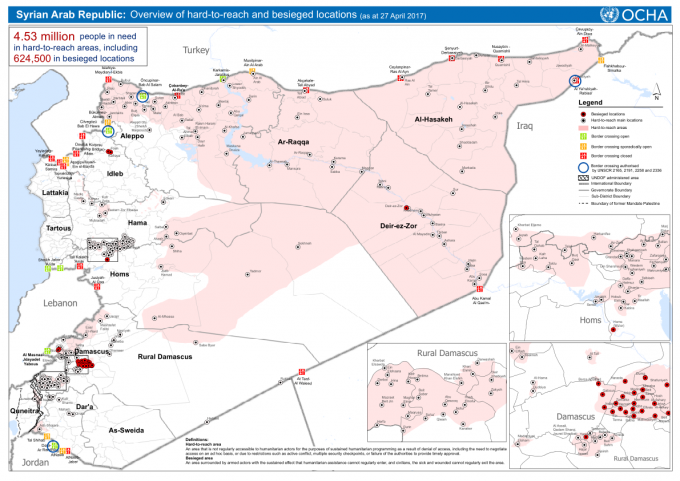
From its base at the five-star Four Seasons Hotel in Damascus, OCHA decided that an area is merely “hard to reach” rather than besieged if it has received an aid convoy in the last three months, regardless of whether the supplies are sufficient for one month, let alone three.

One doesn’t need to travel far from Damascus to see how little a distinction there often is between a “hard to reach” and a “besieged” area.

I’ll return to that last, vital point, but here are two of those OCHA maps.  The first shows the situation in January 2016 and the second in April 2017:
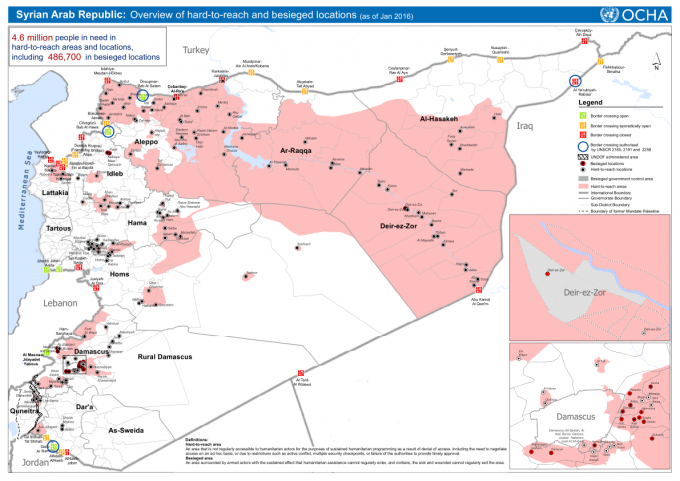
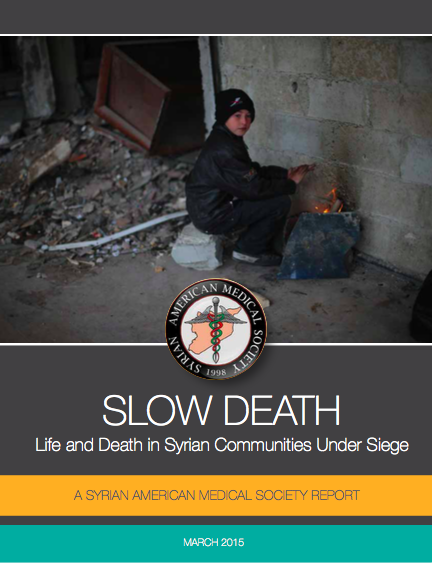
Even those attenuated maps are alarming enough, but the Syrian American Medical Society (SAMS) also believes that the OCHA reports systematically under-report the magnitude of the crisis, and in Slow Death: Life and Dearth in Syrian communities under siege (March 2015) they provided a more sensitive three-tier classification.
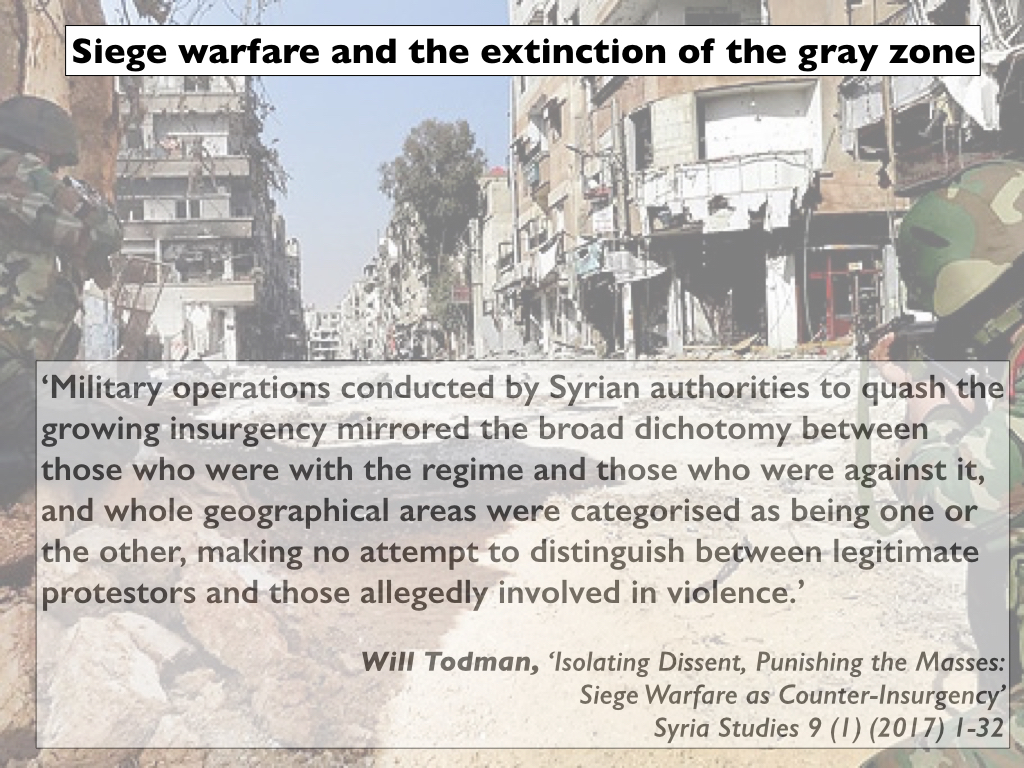
These are, of course, heterogeneous communities – none of the reports I have cited (nor those I will draw on later) conceals the presence of armed groups of various stripes within them, often jostling for control – but siege warfare renders them as homogeneous.  The presence of civilians, for the most part desperately struggling to survive in the midst of chaos and conflict, is erased; this begins as a discursive strategy but rapidly becomes a visceral reality.  In short, siege warfare becomes a version of enemy-centric counterinsurgency and counterterrorism, the Syrian government less invested in ‘performing the state’ through the provision of services than in denying services to the entire population in these areas.  By these means the Assad regime has pursued a strategy that mimics the Islamic State’s determination to ‘extinguish the grey zone‘:
Like Annie, I have been impressed by the work of Siege Watch and so I’ll start with their regular reports that have provided a series of powerful insights into the effects of sieges on everyday life.  In their first report they identified characteristics shared by all communities besieged by the Syrian government.  When that report was compiled almost 50 communities were besieged; only two of them were under siege by forces other than the Syrian government and a third was besieged on one side by the Syrian government and on the other by Islamic State.

There are three characteristics that I want to emphasise:

Deprivation:

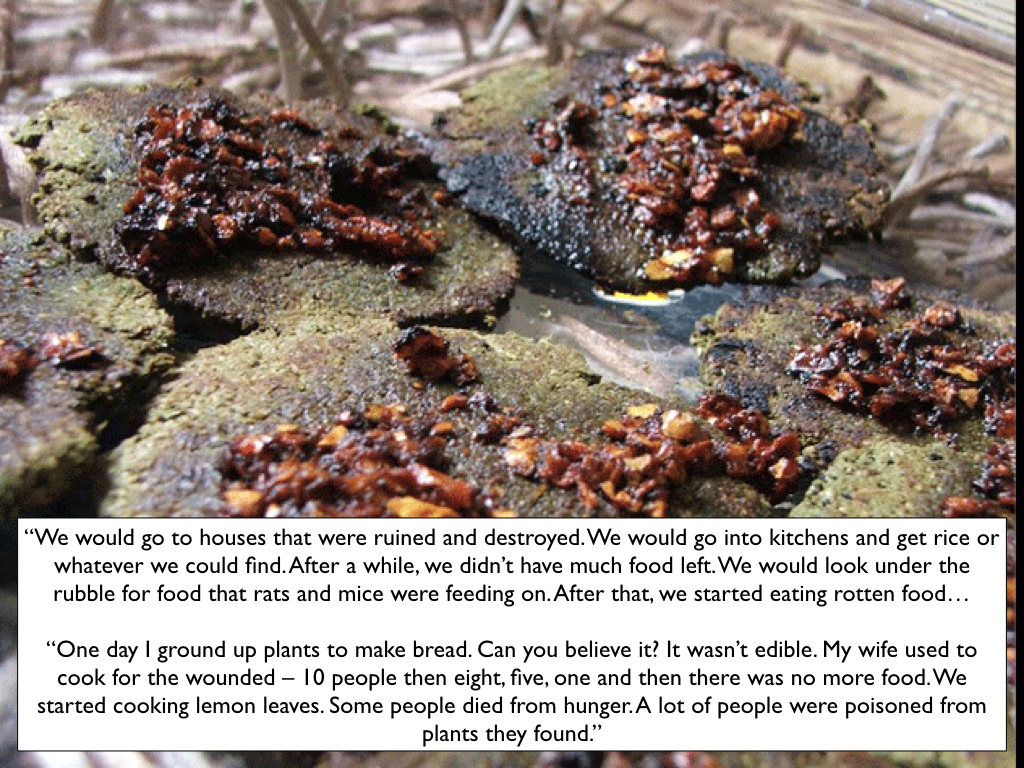
  • ‘Civilians in the besieged areas struggle to survive. Electricity and running water are usually cut off, and there is limited (if any) access to food, fuel, and medical care. In many of these areas, civilians have died from malnutrition due to the severity with which the blockades are enforced. In all of these areas, civilians with diseases, chronic conditions, and injuries have died as a result of the lack of access to medical care. Other recorded causes of siege-related deaths include hypothermia due to the lack of heating oil in the winter, and poisoning after eating something toxic while scavenging for food. Poor sanitation conditions in the besieged areas have resulted in frequent outbreaks of infectious diseases.’

Extortion and economic development:

  • ‘The pre-war economies in all of the government-besieged areas have collapsed. They have been replaced with siege economies that depend on smuggling, bribery, and local production; and because they are nearly-closed economic systems they experience extreme price volatility. Unemployment levels in besieged areas are high, reaching 100% in some of the worst Tier 1 communities such as Jobar. The Syrian government profits off of the sieges by allowing a few pro-government traders to sell goods – sometimes expired – through the checkpoints at tremendously inflated prices and taking a cut of the profits. Sometimes civilians can pay extremely high bribes to government forces or smugglers to escape the besieged areas, although both methods entail tremendous personal risk. These extortive practices have drained the areas under long-term siege of their financial resources.’
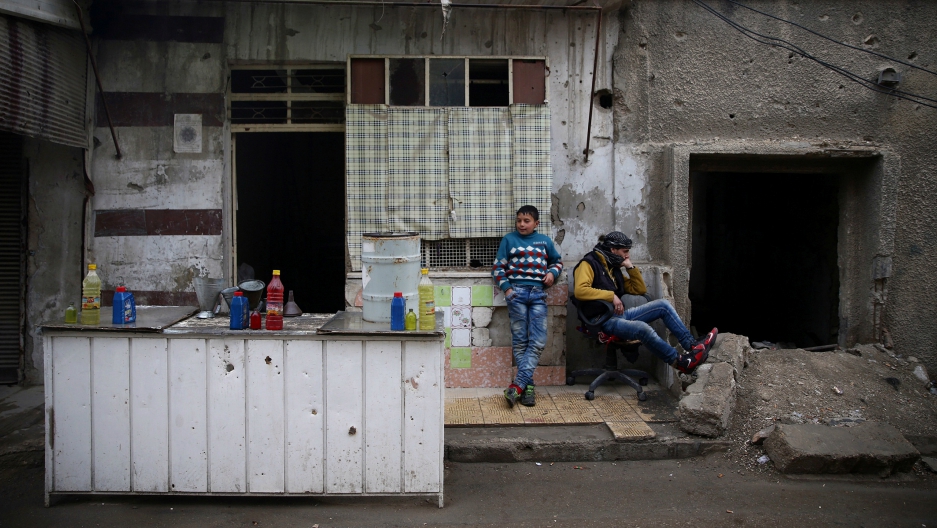
An improvised fuel stand in besieged Eastern Ghouta, February 2017

Violence:

  • ‘Most of these besieged areas are targeted with violent attacks by the Syrian armed forces and its allies. In addition to sniping and the use of explosive weapons with wide area effects in populated areas, there have also been confirmed uses of internationally banned weapons such as landmines, cluster munitions, and chemical weapons….  Most of the communities also contain AOGs [Armed Opposition Groups] which defend the the areas against incursion by pro-government forces, launch offensive attacks against the Syrian military and its allies, and coordinate with the Local Councils to varying degrees. Many Siege Watch survey respondents noted that AOGs were present only around the periphery of their communities, and a few respondents from towns in the interior of the Eastern Ghouta said that AOGs were not active in their areas at all.… [In addition] both Syrian government forces and extremists compete to recruit recruit men and boys from besieged communities using threats, blackmail, fear, propaganda, and indoctrination.’  

Siege Watch notes how, in consequence, ordinary people have ‘adjusted’ to these new, bleak realities: ‘Creative survival tactics such as rooftop gardening [below: eastern Aleppo], burning plastic to extract oil derivatives, and the local production of some basic medical supplies have become more common over time, and people have begun to acclimatise to a more primitive lifestyle’ [see also here].
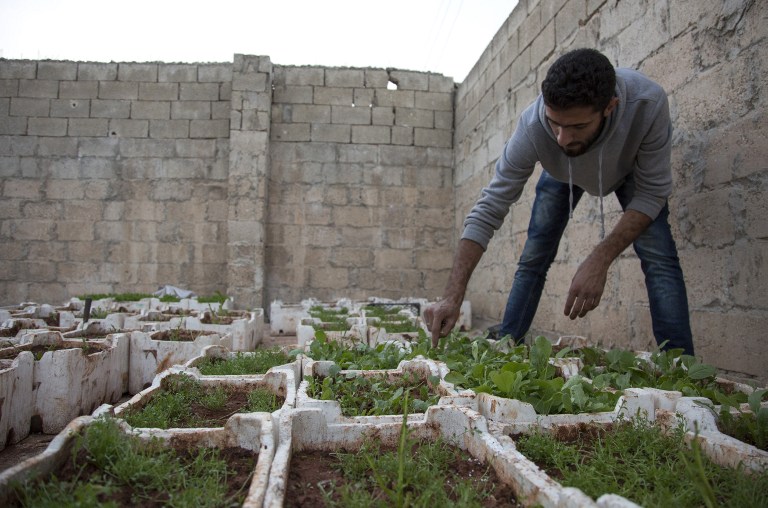
That sentence gestures towards a sharper point made by José Ciro Martinez and Brent Eng (‘Struggling to perform the state: the politics of bread in the Syrian civil war’, International political sociology 11 (2) (2017) 130-47):

‘Most accounts [of the war in Syria] choose to privilege bellicose affairs over the humdrum concerns of daily life, which are deemed humanitarian issues separate from the violent battles and geopolitical struggles said to comprise the “actual” politics of war. This portrayal of conflict is illusory: it disregards the majority of interactions that shape both life and politics in contemporary war zones, where “most people most of the time are interacting in non-violent ways” (Tilly 2003, 12). One result of prevalent depictions of civil war is that civilians are frequently rendered powerless. If they do appear, it is as pawns in a conflict fought by armed groups autonomous from the societies they struggle to control.’

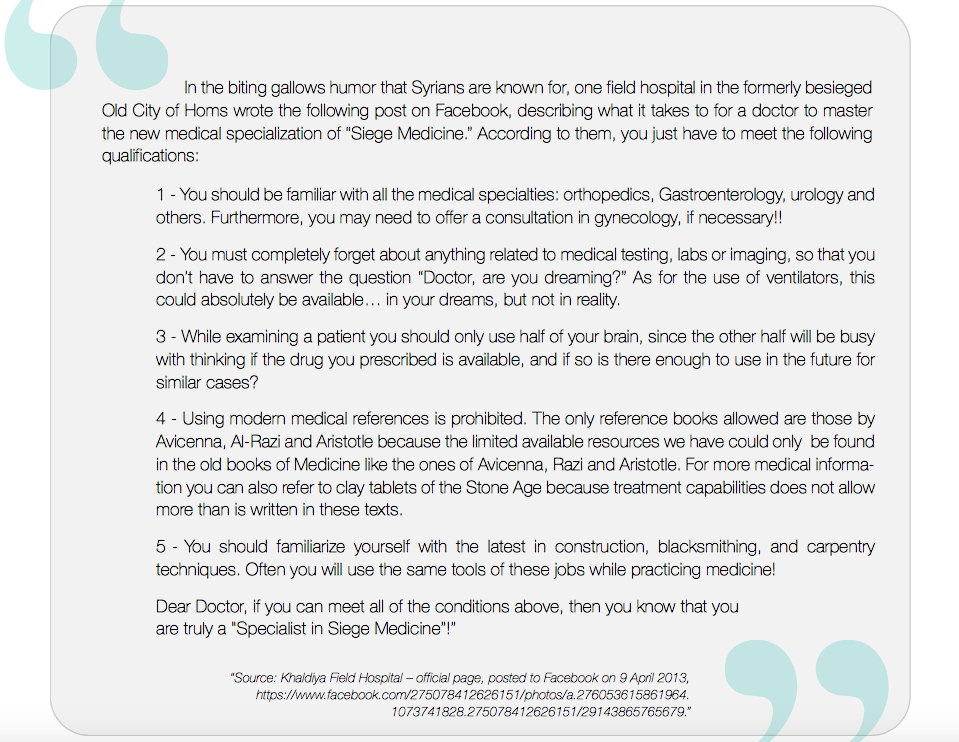
That’s an important qualification, but it plainly doesn’t erase the struggles of civilians either – which makes ‘acclimatisation’ a remarkably weak term to describe the multiple, extraordinary ways in which civilians have been forced to adjust to a new, terrifyingly abnormal ‘normal’ in order to survive.  Here, for example, is a doctor in Homs describing ‘Siege Medicine’ [more here]:The Center for Civilians in Conflict has also provided a report on civilian survival strategies that lists a series of other extraordinary, collective measures (and the title, Waiting for No One, says it all).  These strategies include the provision of makeshift early warning systems against incoming air attacks (spotter networks, radios and sirens); the provision and protection of medical infrastructure (in part through improvised field hospitals and the construction of underground hospitals); and the development of local aid and rescue teams (including the Syrian Civil Defence or White Helmets); protection from unexploded ordnance (‘the armed groups typically harvest them for their own makeshift weapons’ but the White Helmets and other groups have sought to render them harmless).
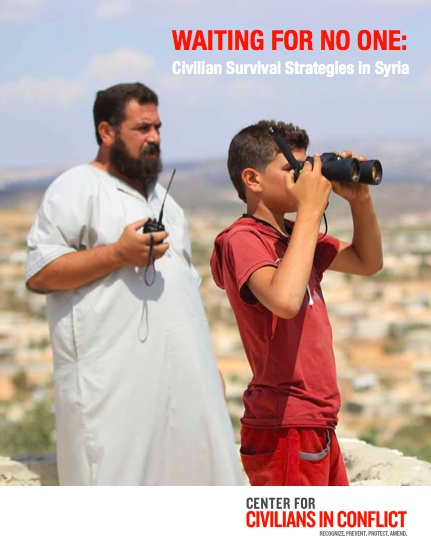
But Siege Watch – and José and Brent – have in mind something more: something in addition to strategies that are necessarily but none the less intimately related to direct, explosive and often catastrophic violence.  They also want to emphasise the ways in which otherwise ordinary, everyday activities have been compromised and ultimately transformed by siege warfare.

Here I focus on food (in)security.  Here is Annia Ciezadlo reporting from Yarmouk in Damascus:

In a dark kitchen, by the flickering light of a single safety candle, two men bundled in hats and jackets against the cold put on an impromptu video satire: live from Yarmouk, at the southernmost edge of Damascus, a cooking show for people under siege.

“This is the new dish in the camp of Yarmouk. It hasn’t even hit the market yet,” said the man on the right, 40-year-old Firas Naji, the blunt and humorous host.

He picked up a foot-long paddle of sobara, Arabic for prickly pear cactus. Holding it carefully by one end to avoid thorns, he displayed first one side and then the other for the camera.

“In the U.S., they get Kentucky [Fried Chicken], hot dogs. In Italy, spaghetti and pizza,” he said, his raspy voice caressing the names of unattainable foods. “Here in Yarmouk, we get sobara.

“It’s not enough we have checkpoints in the streets and shelling,” he added, laying the cactus back on the counter with a sad laugh. “Even our cooking has thorns.”


Yarmouk was established in 1957 as a refugee camp for Palestinians but gradually it had absorbed more and more Syrians displaced by drought, famine and eventually fighting.  As the war intensified, so the siege tightened:

The government checkpoints in and out of Yarmouk would close for four days, then five, then six. Soldiers would confiscate any amount of food over a kilo…. On July 21, 2013, the regime closed the main checkpoint into Yarmouk for good. The siege was total: Nobody could leave, and nothing could enter except what the soldiers permitted.

Over the next six months, the price of everything went up. A single radish reached $1.50 at one point; a kilo of rice was $100.
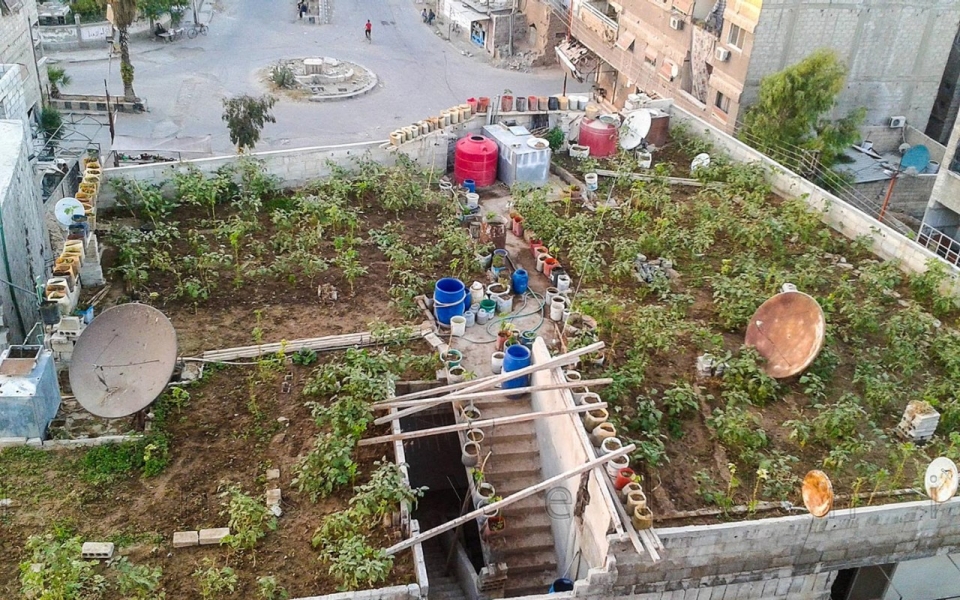
And so the inhabitants turned to gardening:

Between buildings, in abandoned lots and on rooftops, the siege gardeners of Yarmouk have been cultivating everything from eggplants to mulukhiyeh, a jute plant whose glossy leaves make a rich green stew. Come harvest time, they bag the produce into 1-kilo portions, hang the bags on the handlebars of beat-up bicycles and pedal around the camp distributing the food to their neighbors. They focus on those most in danger of starving: children, poor people and the elderly.

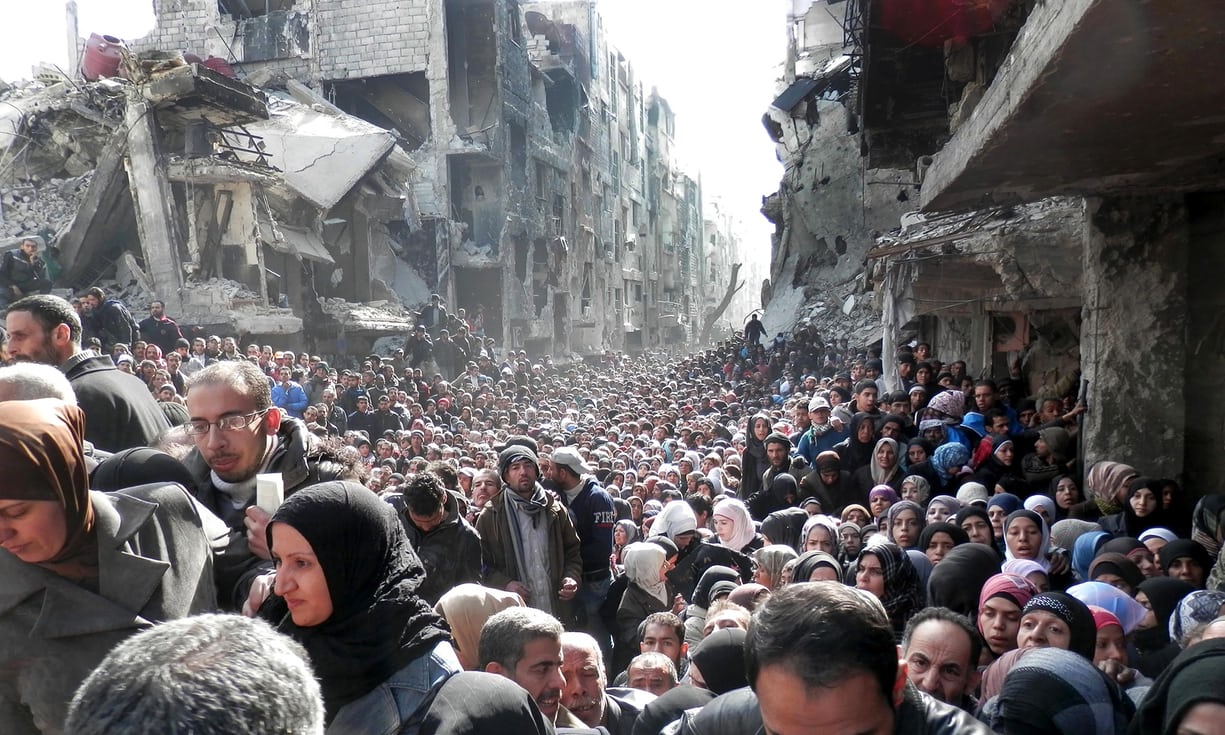
But the situation was much bleaker than the picture conjured up by that paragraph; the siege waxed and waned, and UNRWA was occasionally granted permission to deliver emergency relief, but the image below – of residents queuing for food supplies – shows how desperate the situation became.
Here is a woman in September 2014 describing the horrors of the siege to Jonathan Steele:

There was no anger or hysteria in her voice, just a calm recollection of facts. “You couldn’t buy bread. At the worst point a kilo of rice cost 12,000 Syrian pounds (£41), now it is 800 pounds (£2.75) compared to 100 Syrian pounds (34p) in central Damascus. It was 900 pounds (£3.10) for a kilo of tomatoes, compared to 100 here,” Reem recalled. “We had some stocks but when they gave out we used to eat wild plants. We picked and cooked them. In every family there was hepatitis because of a lack of sugar. The water was dirty. People had fevers. Your joints and bones felt stiff. My middle daughter had brucellosis and there was no medication,” she said. In October 2013, in a sign of how bad things had become, the imam of Yarmouk’s largest mosque issued a fatwa that permitted people to eat cats, dogs and donkeys.

Control of Yarmouk see-sawed between the Syrian Arab Army, Al-Nusrah and Islamic State, with thousands of civilians trapped behind the siege lines so that time and time again the community was thrown back on its own, desperately strained resources to survive.

Here is how Mamoon Yalabasi described a second satirical video from Yarmouk, made shortly after IS over-ran the camp, in April 2015:

“We are in the Yarmouk camp, the camp of plentifulness…  Take a look at the floor,” said the man as the camera shows water in the street. “This is not water. This is an excess of cooking [flooding the streets].”

The youth then moved on to mockingly give his viewers advice on how to lose weight.

“Would you like to lose weight? Green tea won’t work, nor will ginger … just come to Yarmouk camp for five months, in each month you’ll lose 9kg,” he said, adding the Arabic proverb: “Ask someone with experience instead of asking a doctor.”  …  “We ask the troublesome channels that claim Yarmouk camp is under siege to stop reporting that. It is ‘absolutely’ [said in English] not true,” one said.  “It’s true that my grandmother died of hunger but not because the camp was under siege but because my grandfather was so stingy – he never allowed her near the fridge,” he added.

Perhaps you think all this extreme, even exceptional, comforted by those images of rooftop gardens, and believe that those who bravely tended them could somehow perform their own green revolution.  So here are Zeinat Akhras and her brother describing how they survived during the siege of Homs:
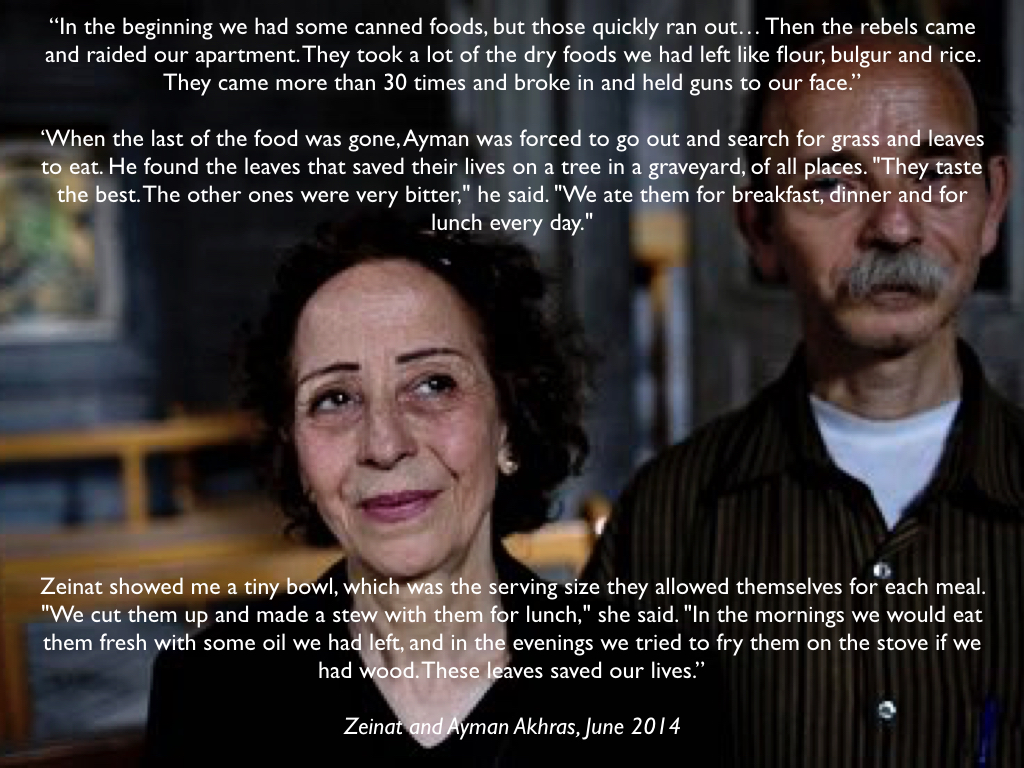
The examples can be multiplied many times over, but in a way this last testimony is exceptional – amongst those on which I’m drawing, at any rate – because it only became available once the siege had been lifted.  Those videos from Yarmouk point towards something different: the possibility of breaching siege lines through digital media.

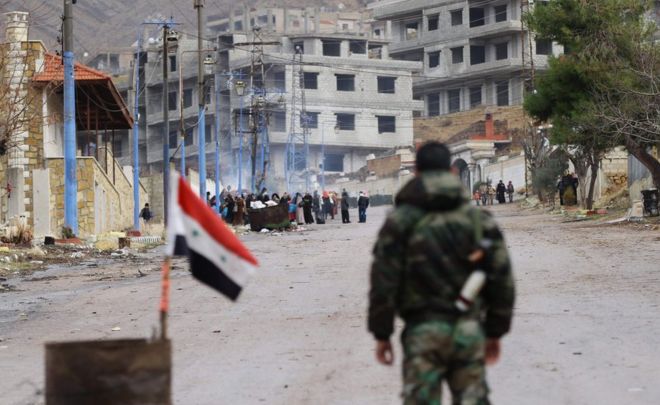
So let me turn to Madaya, a town in the Qalamoun Mountains 45 km north-west of Damascus and once famous for its fruits and vegetables.  It came under siege from the Syrian Arab Army and Hezbollah militias in July 2015: the town was encircled by 65 sniper-controlled checkpoints (below) and its surrounding countryside sown with thousands of landmines.
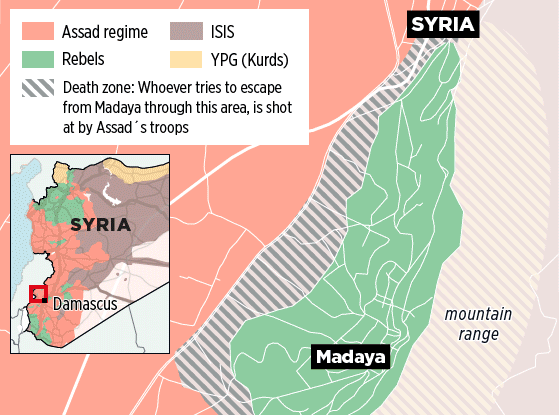
In January 2016 the UN still classified Madaya as a ‘hard-to-reach area’, so listen to one local resident describing conditions to Amnesty International that same month:

Every day I wake up and start searching for food. I lost a lot of weight, I look like a skeleton covered only in skin. Every day, I feel that I will faint and not wake up again… I have a wife and three children. We eat once every two days to make sure that whatever we buy doesn’t run out. On other days, we have water and salt and sometimes the leaves from trees. Sometimes organizations distribute food they have bought from suppliers, but they cannot cover the needs of all the people.

In Madaya, you see walking skeletons. The children are always crying. We have many people with chronic diseases. Some told me that they go every day to the checkpoints, asking to leave, but the government won’t allow them out. We have only one field hospital, just one room, but they don’t have any medical equipment or supplies.

I’ve described that field hospital before, but Mohammad‘s testimony reminds us that war produces not only catastrophic injuries; it also produces and intensifies chronic illnesses that a protracted siege eventually renders untreatable.  (The Syrian American Medical Society issued a report, Madaya: Starvation under Siege, which you can read here).

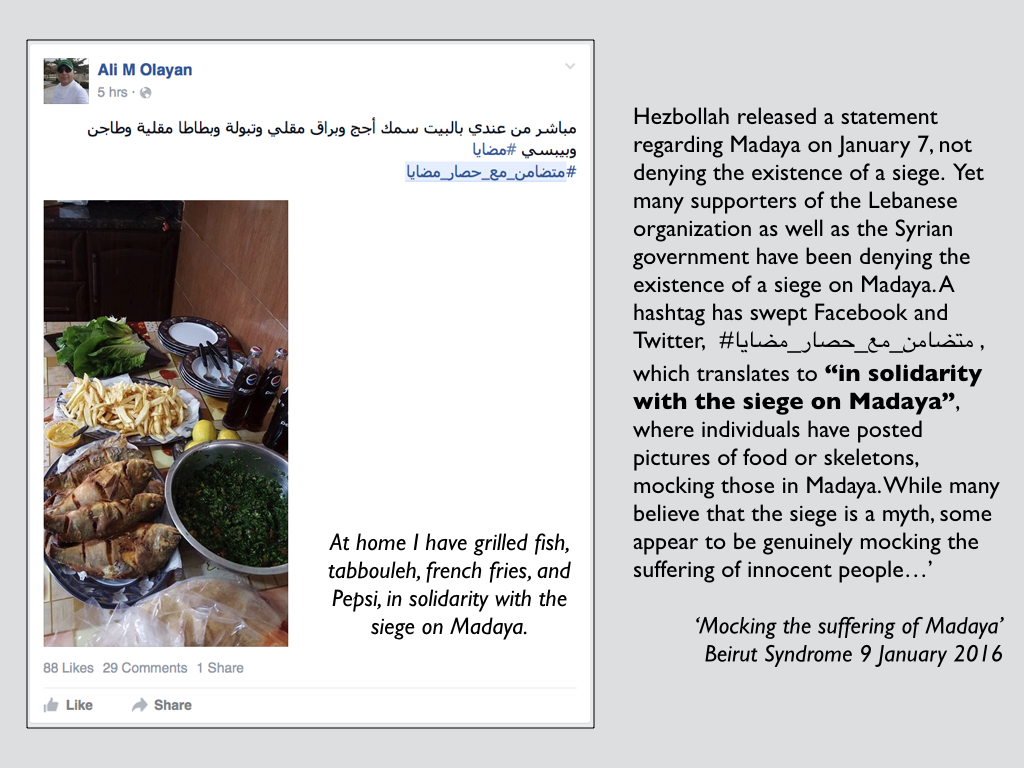
Two days later there were reports of a different digital satire: one that denied the existence of a siege in Madaya and mocked its victims.

A hashtag has swept Facebook and Twitter,  #متضامن_مع_حصار_مضايا , which translates to “in solidarity with the siege on Madaya”, where individuals have posted pictures of food or skeletons, mocking those in Madaya. While many believe that the siege is a myth, some appear to be genuinely mocking the suffering of innocent people…’

The posts were subsequently removed, but here is one I captured:
Fortunately a different digital economy was already at work.  Rym Momtaz, a producer with ABC News, had started a text exchange with a young mother of five children in Madaya:

We communicate through secure messaging apps over the phones, over the internet really. So the way we went about finding her was to go through a wide network of sources that we’ve cultivated over the years of covering the war in Syria. We had to work for a few weeks, I have to say, to identify the right person and then to get in touch with her and to gain her trust in order for her to feel comfortable enough to engage in this conversation with us because she felt and her family felt that it might put her in danger.

‘‘She would text me from the moment she woke up, which was very, very, early, like 5 a.m.,’ Rym explained, ‘and then she would text me truly throughout the day.’  And that same month – January 2016 – ABC started publishing those precious despatches from Madaya.  ‘They can’t get out of Madaya – and we can’t get in,’ ABC News’ Foreign Editor emphasised, but ‘they can tell their story to the world.’
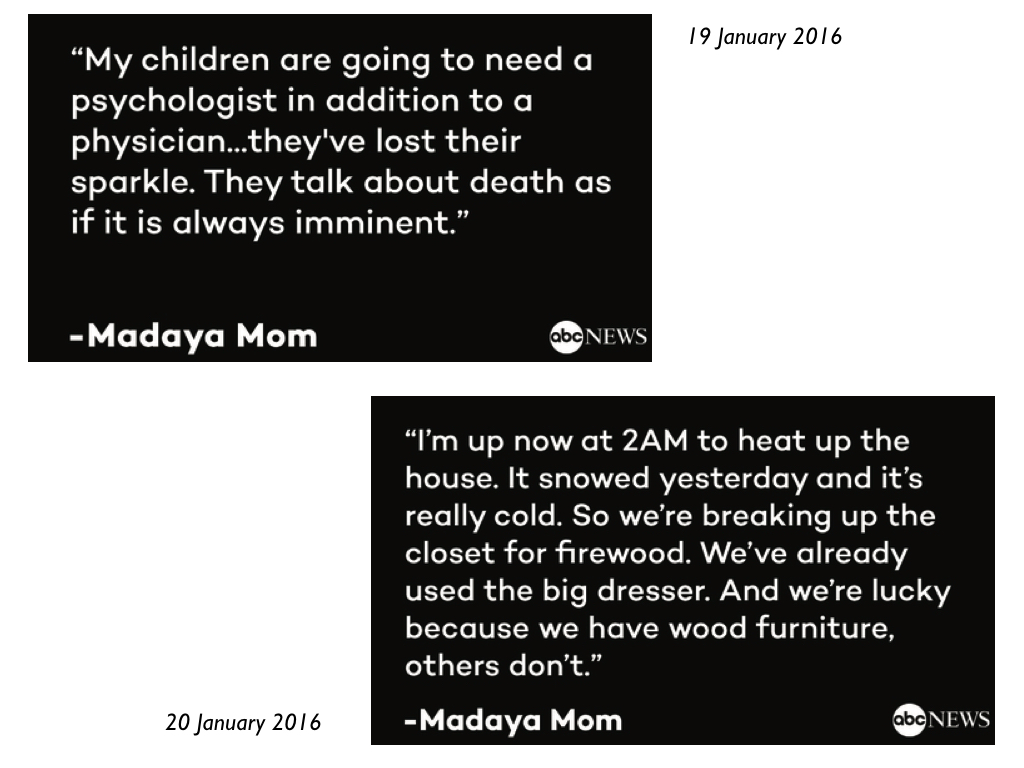
Working with Marvel Comics, ABC transformed her story into a free digital comic: Madaya Mom.
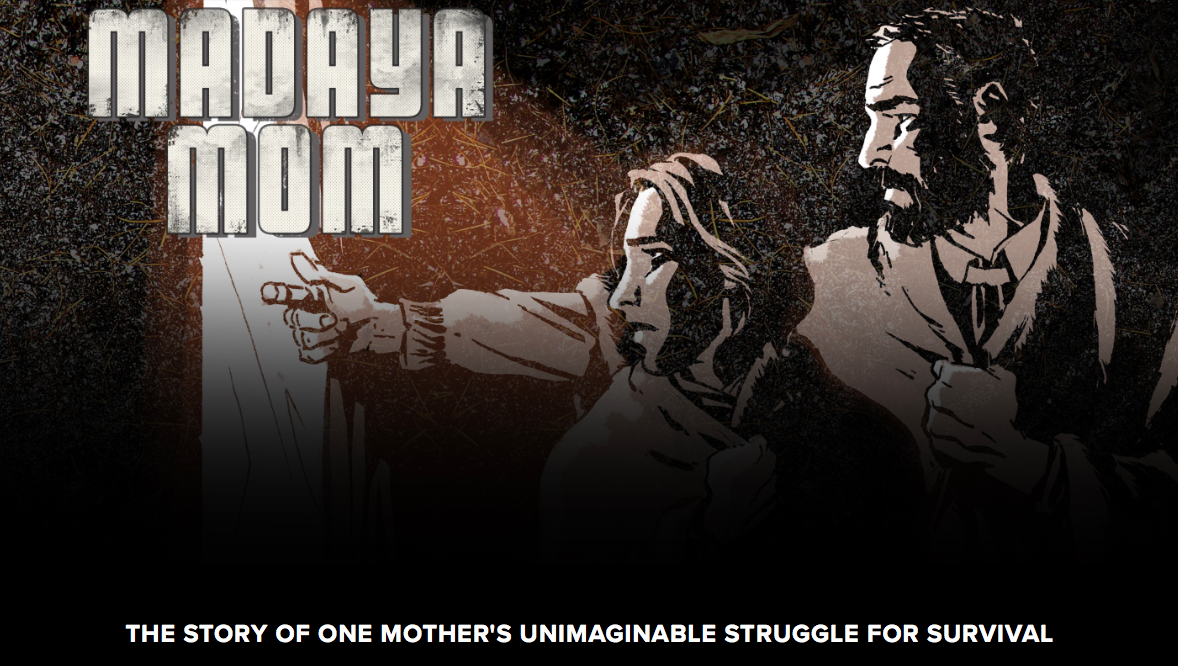
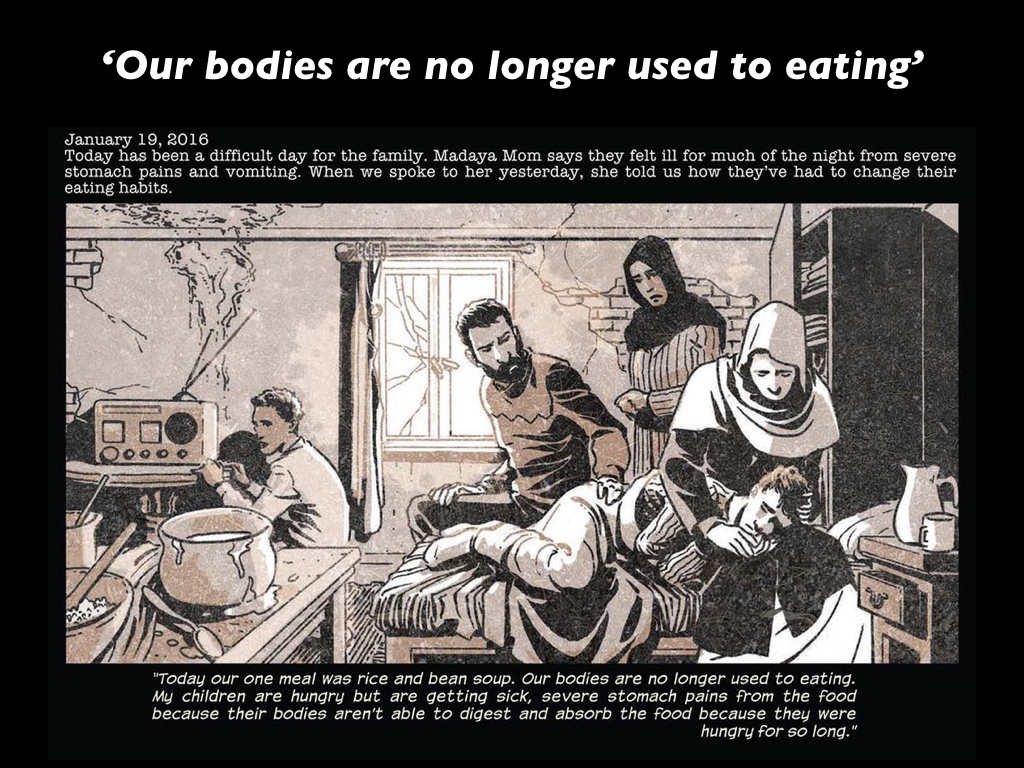
For Dalibor Talajic, the Marvel Comics illustrator who worked on the project,

The most striking parts is for me the most intimate ones as she – for instance, she decides to even though they are – they’re all starving, she decides to stop eating herself because this little amounts of supplies and food that she has, she distributes it to her children and of course husband. And she herself just stopped eating. And it’s not like a dramatic decision. It’s, like, a logical thing to do. These are the moments that stick with me most.
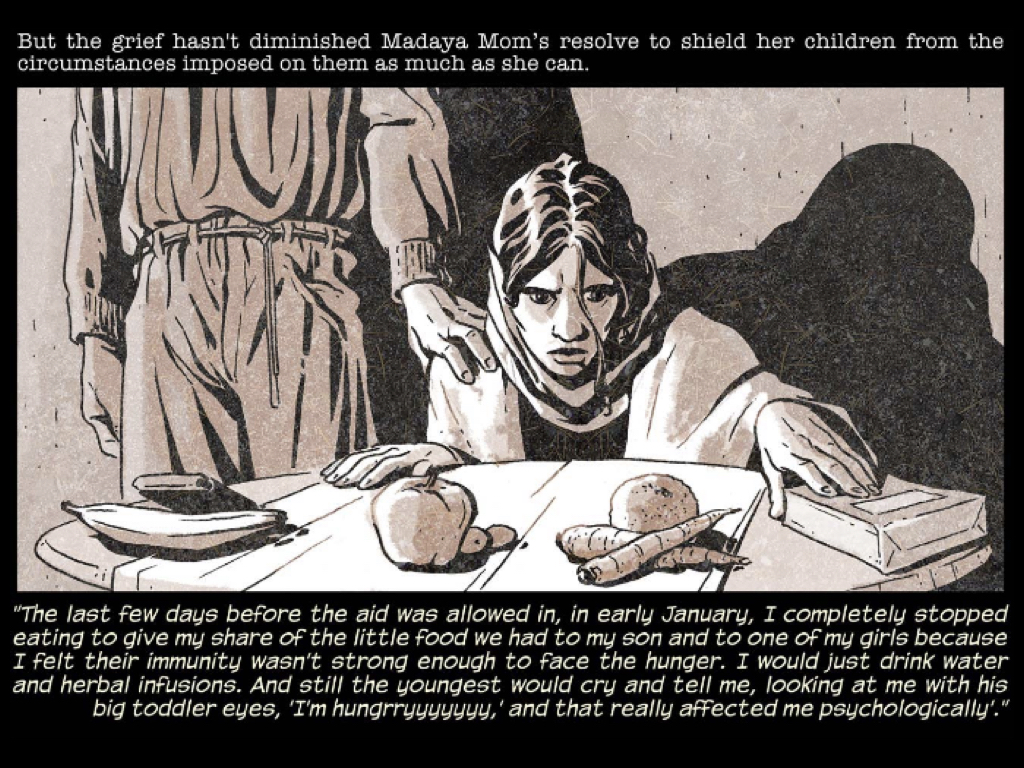
And it is through the assault on the intimacies of everyday life – on something as vital as feeding one’s family – that siege warfare is at its most vicious.

In case you are wondering how the family managed to charge their phones, not at all incidentally, here is the answer:
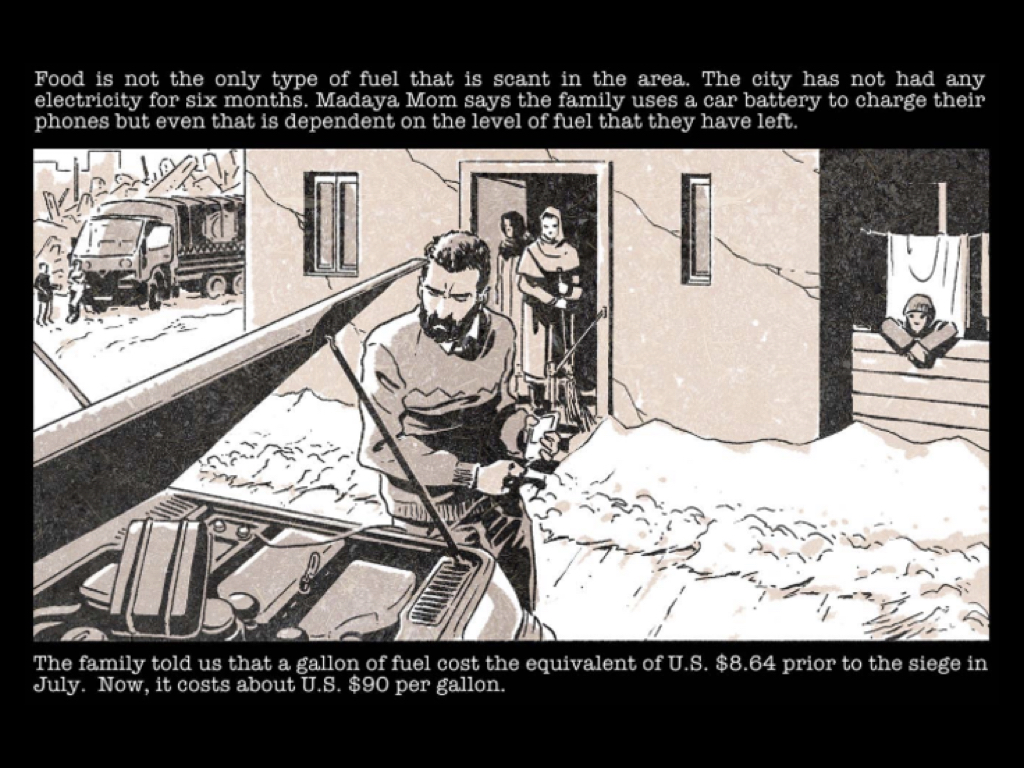
After protracted negotiations aid convoys were allowed in from time to time, but the situation remained grave.  An aid worker who accompanied a UNICEF convoy into Madaya in September 2016 described the stories told by patients who flocked to a makeshift medical clinic:

Parents whose children had stopped eating because their bodies could no longer tolerate only rice and beans. Children who could no longer walk straight because of the lack of Vitamin D and micronutrients that had riddled their bones with rickets, or who had stopped growing entirely, stunted from lack of essential vitamins. One mother showed us her baby’s bottle filled with rice water – the teat so worn it had to be sewn back to together. “Look at what I am feeding my child” she said.

Almost everyone we spoke to asked for protein – meat, eggs, milk, vegetables – something more to sustain themselves than the dry goods that were available. One mother explained that every time her child now smells boiled burgal, she starts to cry.

The doctor reported an increase in miscarriages, 10 cases in the last 6 months, because of the nutritional status of mothers. Over the last year alone, he has had to perform over 60 caesarian sections. This number was unheard of before the crisis, she told us  But women no longer have the strength for childbirth, and many pregnancies go over term, again because of the poor health of pregnant women.

Six months later life in Madaya remained precarious in the extreme:
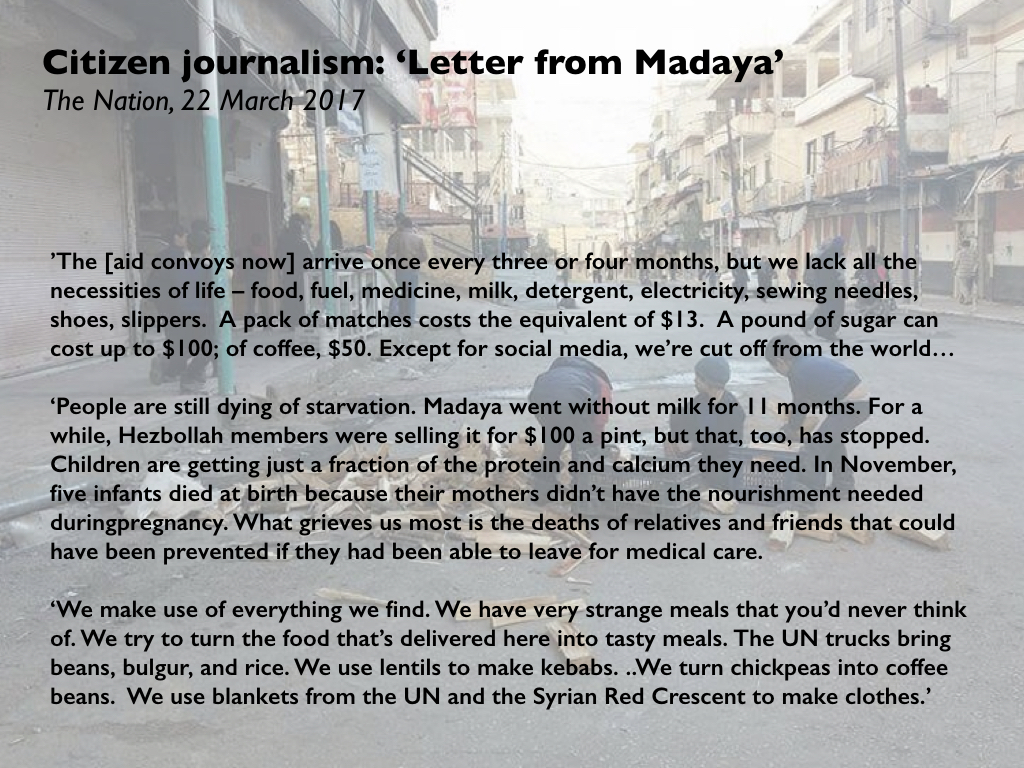
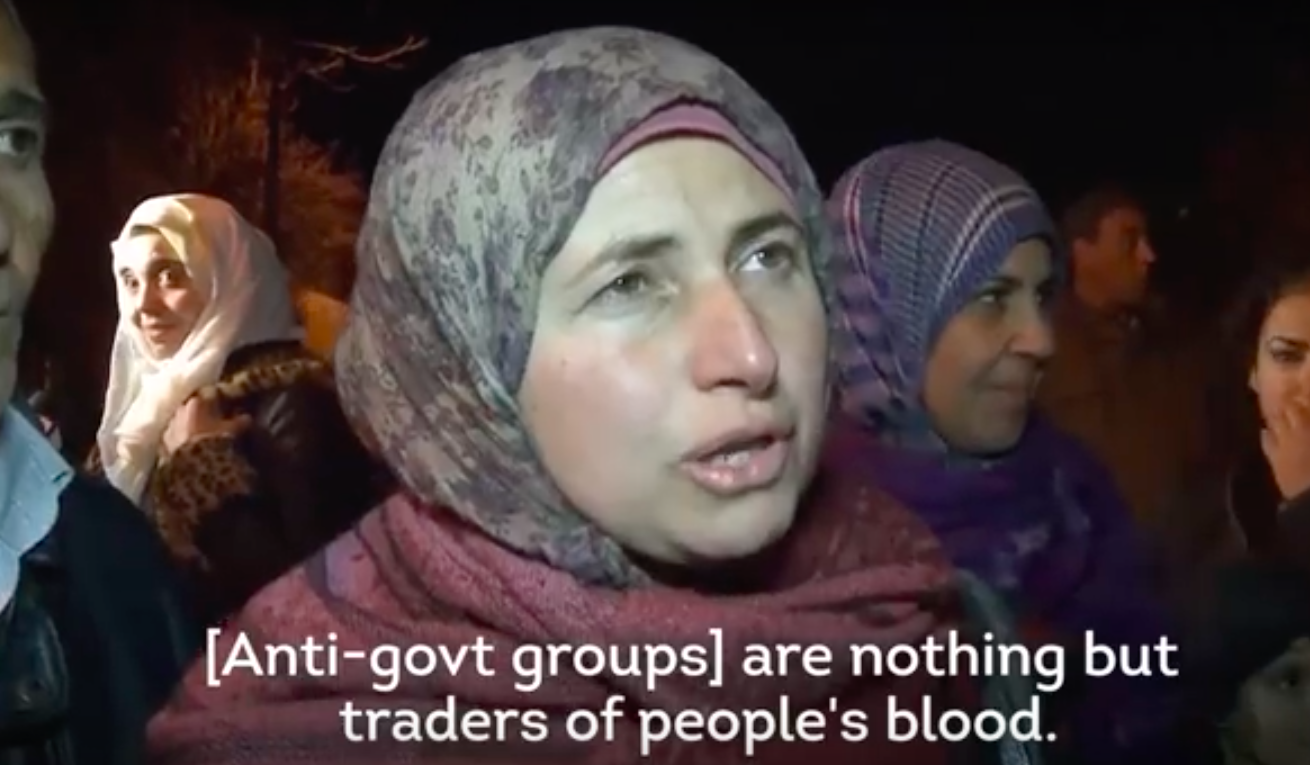
Throughout the siege there were accusations of profiteering, but these ran in both directions (it is partly through them that Hezbollah elected to acknowledge the suffering of the city – only to point the fingers of blame at the rebels inside).  According to Avi Asher-Schapiro for VICE News, who spoke to the local leader of Ahrar al-Sham, Abdulrahman, via Skype in January 2016:

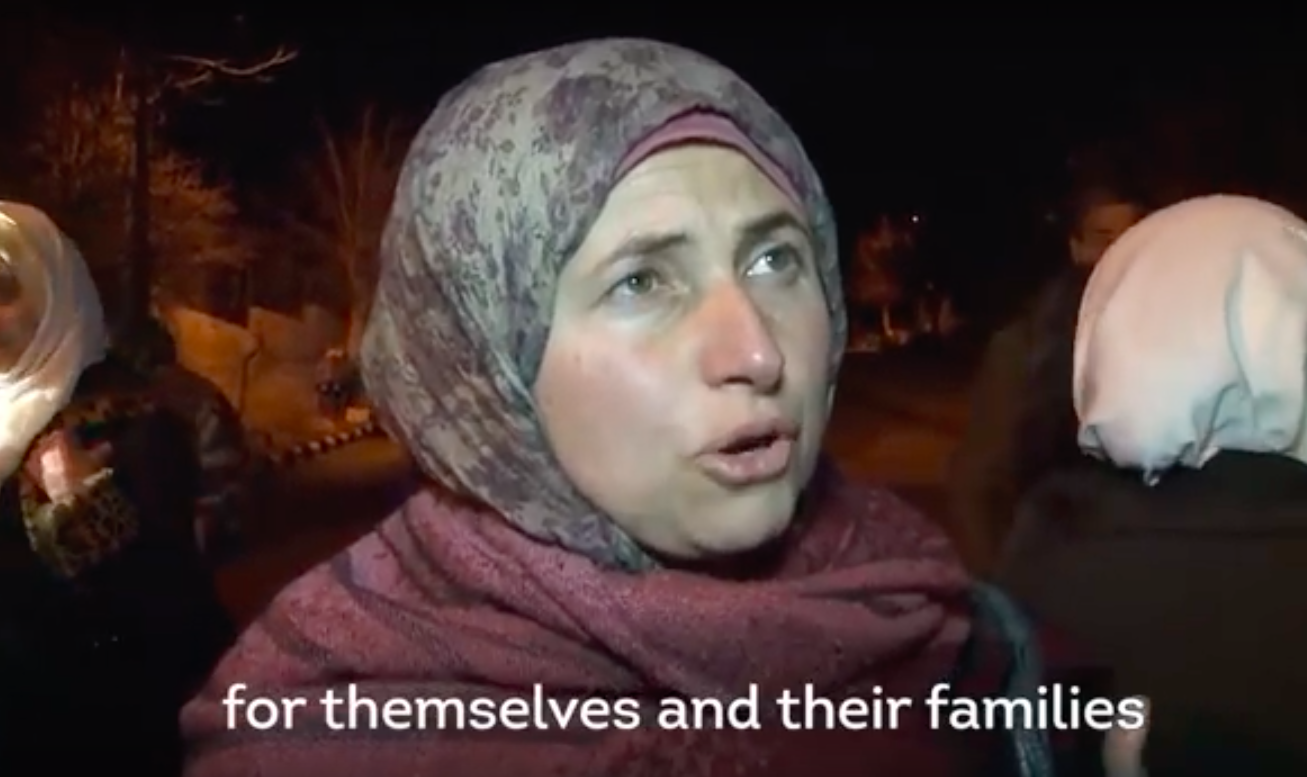
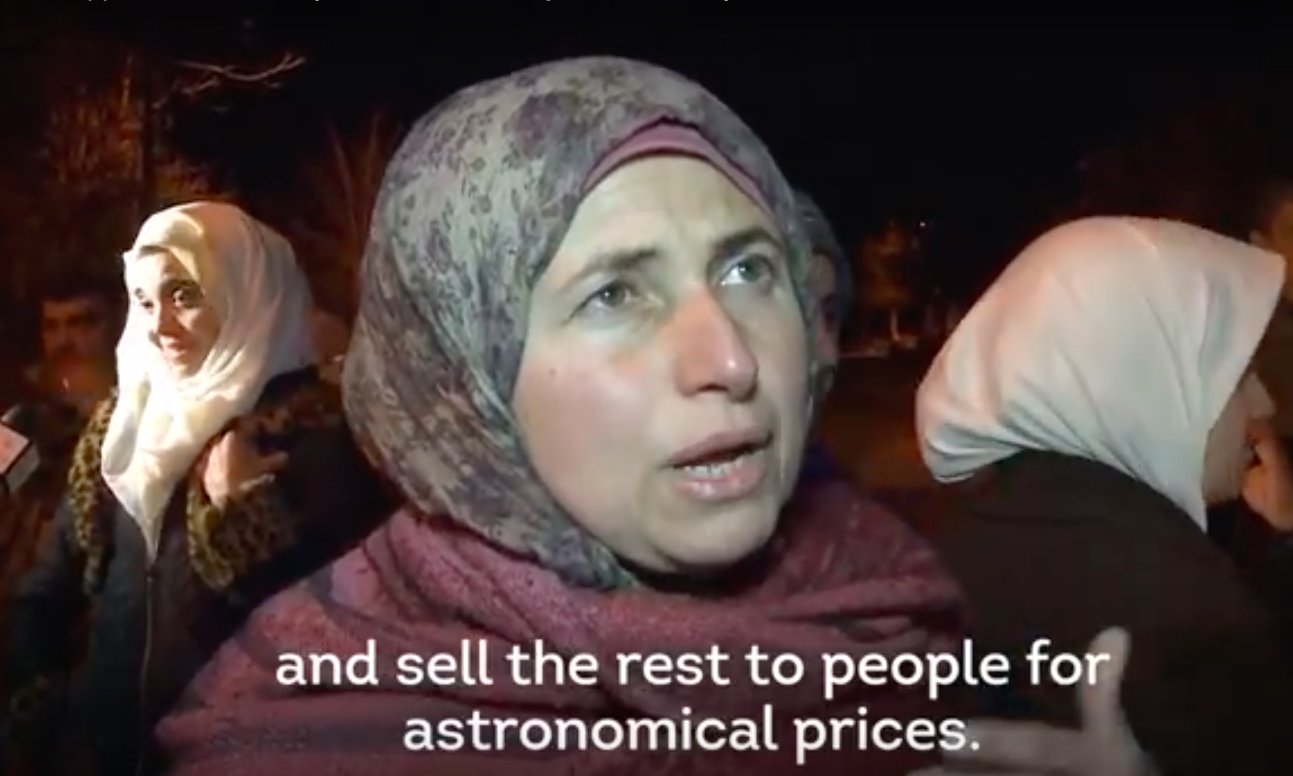
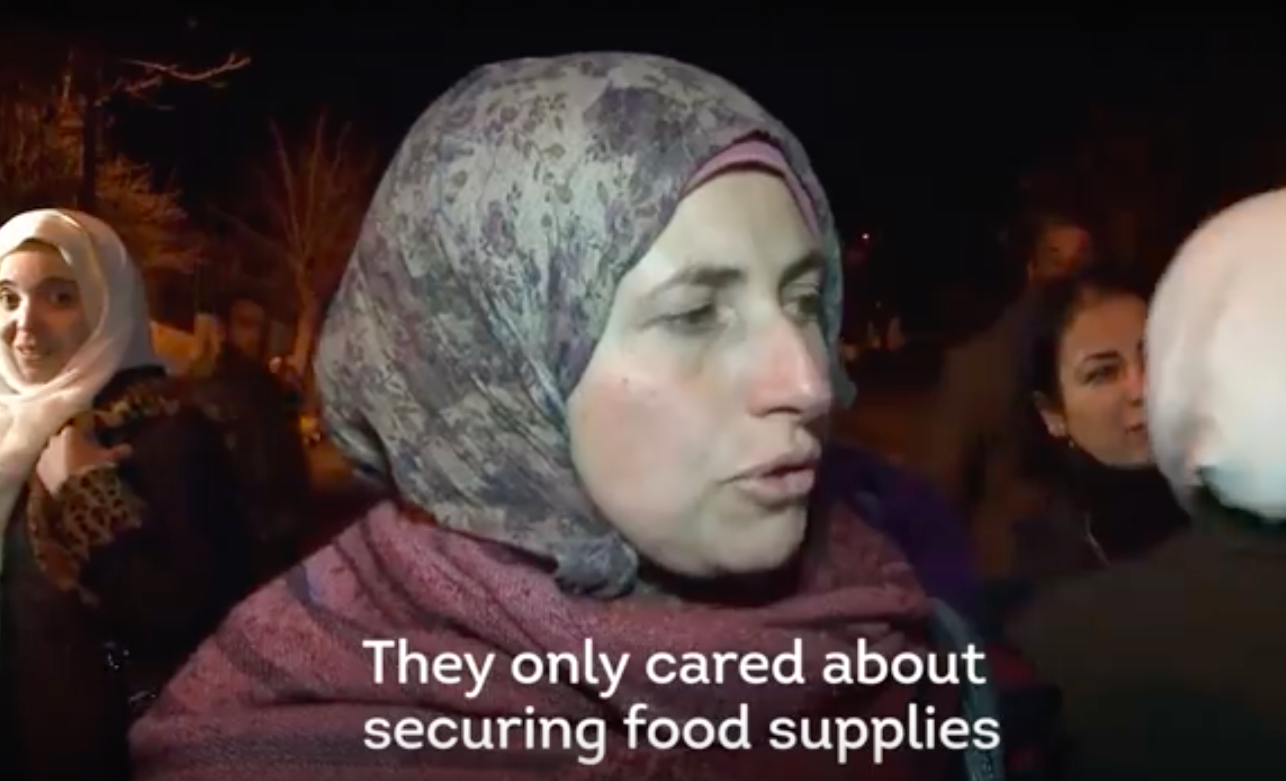
Hezbollah media outlets are accusing Abudlrahman and his men of confiscating food in Madaya, holding the population hostage, and profiteering during the crisis. In early January, a video surfaced of a woman from Madaya condemning rebels for hoarding food among themselves. The rebels are “only traders in people’s blood,” she told a scrum of reporters who gathered at the barricades outside Madaya. “They only care about securing food supplies for their families.”

That video [above] was aired around the world by Reuters and Al Jazeera. The accusations enraged Abdulrahman. “When Madaya goes hungry, we go hungry,” he says. “These are vicious lies.” VICE News spoke with another woman who claimed to be at the barricades that day. Although it was impossible to verify her claims, she said that Hezbollah fighters — who can be seen in the video frame — told women to condemn the rebels and praise Assad in exchange for food and safe passage from the town.

In a press release from early January, Hezbollah also accused Abdulrahman of profiteering. “Armed groups in Madaya control food supplies within the town and sell to whoever can afford it,” the statement read, “Thus, starvation is widespread among poor civilians.” VICE News spoke to a Hezbollah commander stationed outside Madaya who repeated these claims, and said that Hezbollah has been sending food inside the town. The rebels, he said, are keeping it for themselves. He also strongly denied that Hezbollah was trading food for propaganda.

VICE News also spoke with aid workers at the Doctors Without Borders-affiliated field hospital in Madaya, who reported no interference from Abdulrahman’s men in the dispensation of aid.
For further, still more shocking twists on the story, see here and a response here.  It’s difficult to adjudicate these competing claims in the face of skilfully organised propaganda campaigns (in which the alt.left is often as grotesque as the alt.right), but wherever the truth lies, it is clear that food has been consistently transformed into a weapon of war (‘surrender or starve‘) – a crime expressly forbidden by international humanitarian law (see also here) – and that 40,000 civilians inside Madaya were trapped in the midst of the battle.

In my previous post on this subject, I described all this as the back-story to the carnage now taking place in Idlib, in eastern Ghouta and elsewhere, but it is of course only one back-story: there are many more.  Still, on 14 April 2017 under the ‘Four Towns Agreement’ a fleet of sixty buses transported several thousand people, rebels and civilians, from Madaya – to Idlib.
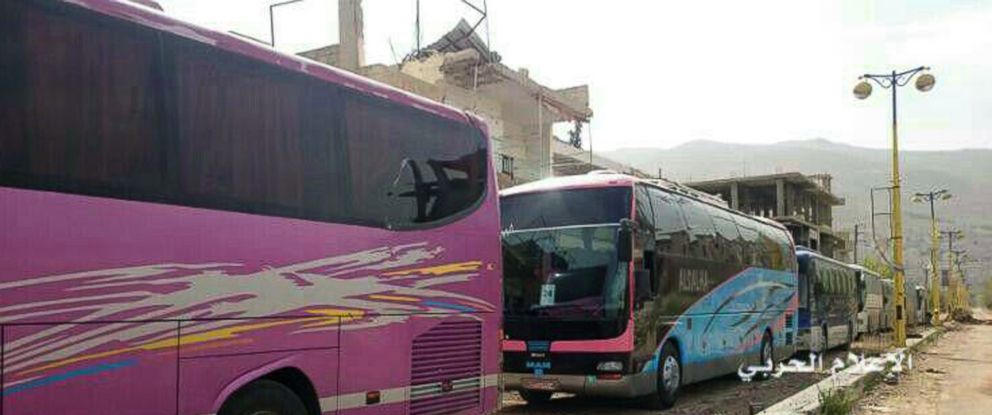
Only 2,200 out of 40,000 people signed up to go, and ‘Madaya Mom’ expressed the catch-22 facing the besieged population perfectly:

If we leave, we’re labeled terrorists and we go to Idlib where the chemical attack happened last week; and if we stay we don’t know how the government will treat us.

At first, those who left were relieved and even heartened.  Deutsche Welle spoke with one young evacuee from Madaya soon after he arrived in Idlib:

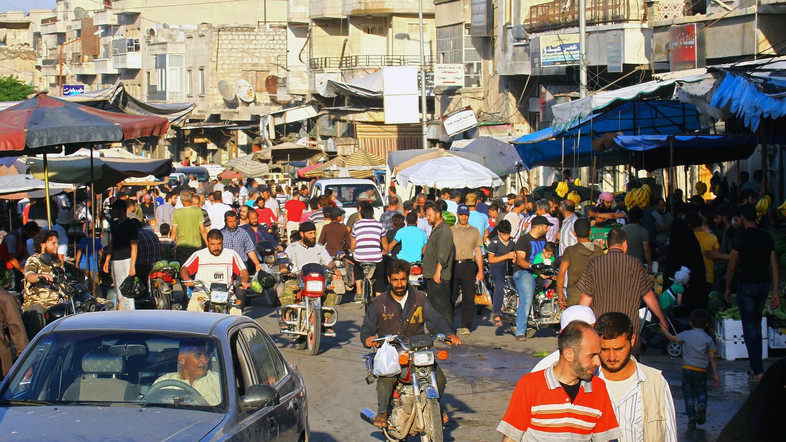
I was surprised. I saw markets [below, June 2017], people walking in the streets; there is electricity, internet, ice cream and food – things we did not have in Madaya. Madaya and Zabadani are destroyed. In Idlib, the destruction is not too bad. There are a lot of cars and I was really surprised to see cars. I felt like the little children that came from Madaya to Idlib: they were surprised when they saw a banana, a cherry, biscuits or chocolate. They have never seen that before. It sounds stupid, but I felt a little bit the same when I saw cars again.

I can eat everything. The first thing I ate was fried chicken and it was great. And I have had a lot of chocolate, too.
But as the interview progressed, his elation was punctured by a growing realisation of the  bleak future ahead:

But in general, Idlib is a poor city… I started to search for jobs, but there are almost no jobs here. Idlib is like a big prison. It’s like Gaza. It’s like Madaya, but a big Madaya. So we are imprisoned here.

We know what horrors lay in wait, and we know something of what is happening in Idlib now.  But what of Madaya?  Here are extracts from a report (‘community profile’) for September 2017 (you can find more from SIRF/REACH here):

  • Movement was unrestricted within Madaya. For movement in and out of the area, two access points have been used since the implementation of the Four Towns Agreement. In September, 26-50% of the population were reportedly able to use formal access points providing they showed identi cation. However, men reportedly did not feel safe using the access points, fearing conscription and detention when crossing, while both men and women reported verbal harassment.
  • Since May 2017, commercial vehicle access has been permitted to the area. However, access restrictions on vehicle entry continued to be reported in September and included documentation requirements, confiscation of loads, required fees and limited entry depending on the day or time.
  • Humanitarian vehicle entry has reportedly not been permitted for the past six months.
  • The cost of a standard food basket in Madaya has remained stable since May 2017, with the average cost around 12% more expensive than nearby communities not classi ed as besieged or hard-to-reach.
  • Water continued to be insufficient and some residents reportedly reallocated money intended for other things to purchase water. Meanwhile, access to generators remained stable at 4-8 hours a day in all areas of the community.

I’m conscious of how much I haven’t been able to address in this post.  In particular, I’ve chosen to focus on the ‘silent violence’ of hunger and malnutrition rather than the explosive violence of mortars, missiles and bombs.  The two coincide in all sorts of ways – think, for example, of the air strikes on bakeries, what Anna Ciezadlo called ‘the war on bread‘, and on hospitals and clinics – but the contrast is really my point.  As one resident of Aleppo told Amnesty,

You need months before you die of starvation. The air strike attacks were a different story. You could die from a piece of shrapnel in a fraction of a second. Nobody was protected from the air strikes and shelling. Civilians, rebels, buildings, cars, bridges, trees, gardens etc. were all a target.

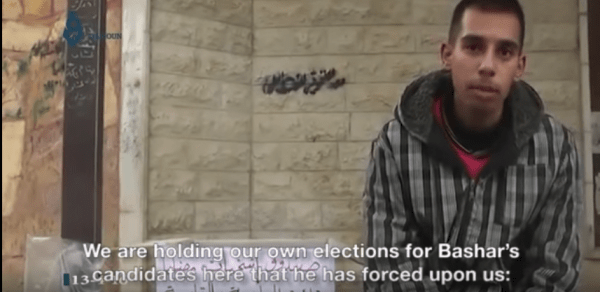
And so one final digital satire.  In April 2016 the Syrian government held elections and claimed that even opposition-held areas were enthusiastically participating.  Responding to what they called ‘the theatrics of the Assad regime’, teenagers in Madaya posted a video of their own mock hustings:The rival candidates were “Deadly Starvation”, “Deadly Illness”, and “Airstrikes”.
Cities under siege (I)

This is the first of a two-part post, in which I return (at last!) to a promissory note I issued last year about siege warfare in Syria.  My return is prompted by a series of reports about the catastrophic situation in Eastern Ghouta (a suburb of Damascus) and Idlib.

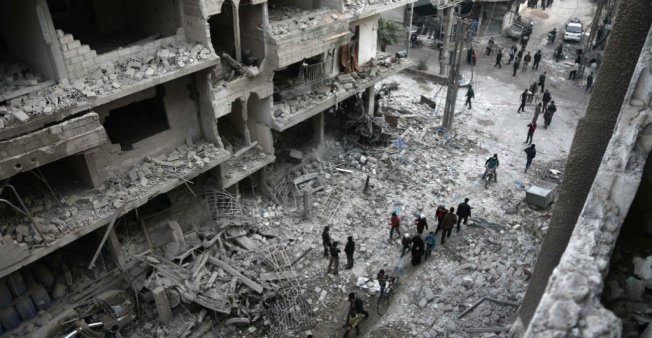
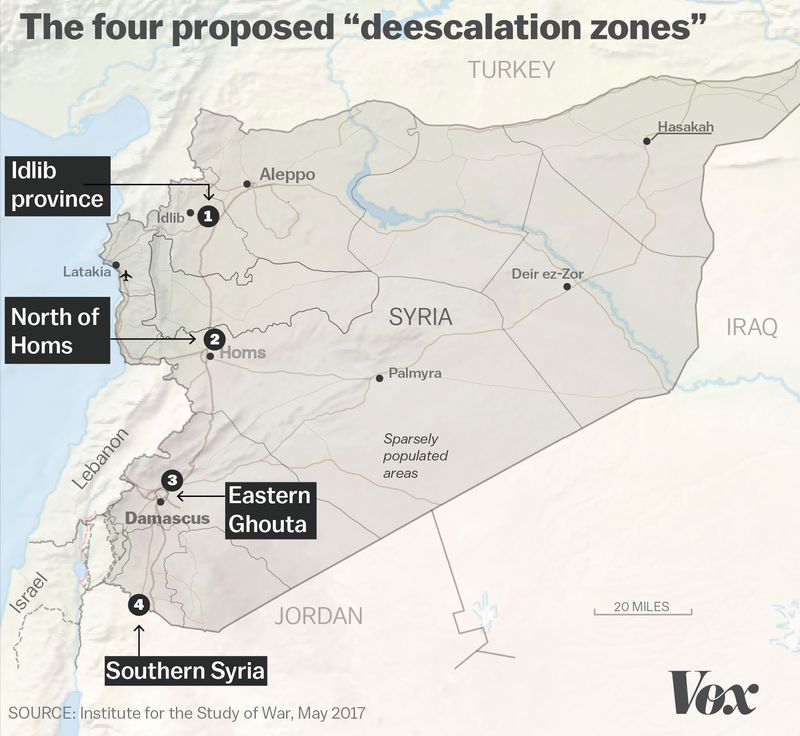
First, Eastern Ghouta, which has been under siege by the Syrian Arab Army and its allies since April 2013.  Most of Eastern Ghoutta was designated as one of four ‘de-escalation zones’ (see map above) under an agreement reached in May 2017, in which aerial violence and all other hostilities would be suspended for six months and humanitarian aid would be allowed across the siege lines.

But the agreement turned out to be primarily a way of killing time.  Aron Lund writes:

In September, just as the Eastern Ghouta’s de-escalation zone was finalized, the situation abruptly worsened. After ordering a halt to the already heavily restricted commercial traffic through the Wafideen crossing [see map below: more here and here], the Syrian government refused to permit any more UN aid missions.

It was a transparent attempt to stoke the humanitarian emergency in Eastern Ghouta, but this time the effect was more severe than during previous rounds of food cuts. With the rebel trading tunnels out of commission for half a year, smuggling could no longer compensate for the shortfall or bring in medicine or basic necessities like fuel, which has not entered the Ghouta since February.

Food stockpiles dwindled quickly and triggered a scramble for whatever remained available on the market, the panicky mood inflamed by suspicions that rebel-connected businessmen were hoarding goods for speculation purposes. From August to October, the already high prices inside Eastern Ghouta increased fivefold, far beyond any other region of Syria.

Air strikes (above) and artillery bombardment resumed in November and have continued, and urgent medical evacuations were denied.  Here is UN Senior Adviser Jan Egelan in December 2017:

Six months ago a very detailed evacuation plan was delivered to the government for needy cases of evacuation, on medical grounds from eastern Ghouta.  Since then, names have been added regularly and it is now, we now have a revised list of 494 names. There are among them 282 cases that need] specialized surgery, specialized treatment, specialized investigations that [they] cannot get inside. There are 73 severe cancer cases, 25 kidney failure cases and 97 heart disease cases [that are] very concerning, five acutely malnourished children that need to be evacuated, six acute mental health cases etc.

The list had to be revised because 12 patients had died while waiting for ‘a half an hour drive to hospitals in Damascus and elsewhere that stand ready to help and save lives.’  Egelan explained that ‘231 of the cases are female, 137 are children, 61 are over 65 years old.  So these are civilians, in the midst of this horrific war.’

He added:  ‘Civilians, children, no one can be a bargaining chip in some kind of tug of war, where many things are negotiated at the same time. These have a right to be evacuated and we have an obligation to evacuate them.’

Siege warfare involves not only closure of movement across the lines for those inside; it also involves opening the zone to violence from the outside.  The assault on Eastern Ghouta has provided ample evidence, but the second case is even more instructive.

And so, second, what was supposed to be the ‘de-escalation’ zone of Idlib has been converted into a ‘kill box’ (for a discussion of the term in relation to remote warfare, see here and here).  Here is Martin Chulov and Kareem Shaheen writing in the Guardian:

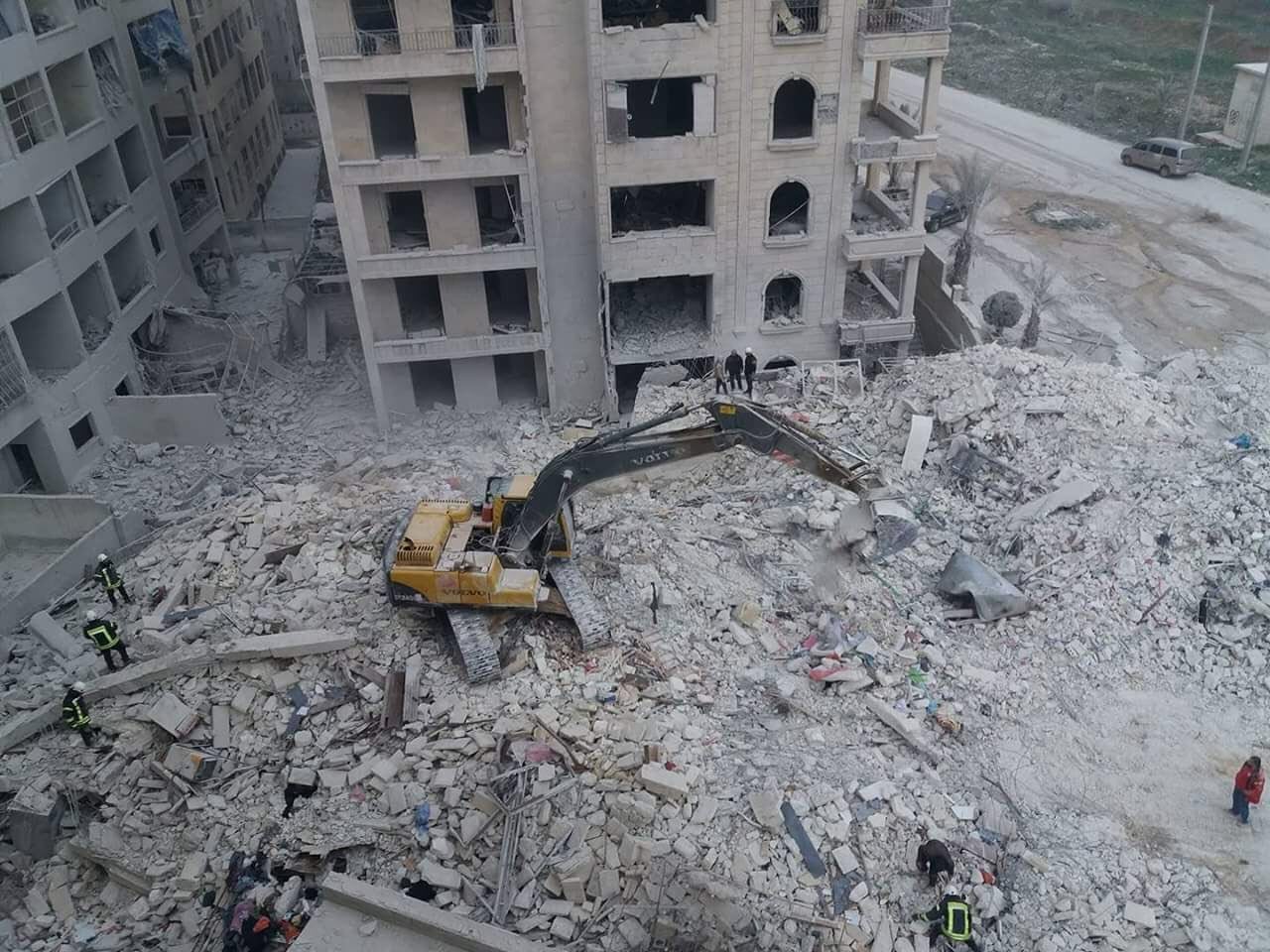
Russian and Syrian jets bombed towns and villages across north-west Syria on Monday, devastating civilian areas and forcing fresh waves of refugees to flee to open ground in the biggest aerial blitz on opposition-held areas since the fall of Aleppo more than a year ago.  Monitoring groups said as many as 150 airstrikes were recorded in Idlib province by Monday, with dozens more pounding up to 18 towns across the region by nightfall.  Residential areas bore the brunt of the strikes, which severely damaged at least two major hospitals, and levelled dozens of buildings in which panicked locals had taken shelter.

Refugees and locals say they fear that Idlib has been transformed into a kill box, with the international community paying scant regard to their fate, as regional powers, Russia, Turkey and Iran all vie for influence in a vital corner of the country.

These strikes were in retaliation for the downing of a Russian aircraft – in this spectacularly asymmetric war, only air-to-ground attacks are acceptable – but aerial violence against civilian infrastructure in Idlib precedes that incident.  Owdai (al Hisan) hospital in Saraqab City was hit by air strikes on 21 and 29 January, for example, and has now closed indefinitely  MSF reports that the loss of the hospital is all the more devastating because ‘medical needs in the area are expected to increase due to the massive displacement of Syrians fleeing fresh violence in Idlib’s eastern countryside and northeast Hama.’

Since then, the strikes intensified:

“The Russians are on a frenzy. They’re going mad. The shelling is ongoing throughout the day and night. The warplanes are hitting residential areas,” Hadi Abdullah, a local journalist, told Al Jazeera by phone from the town of Kafr Nabl in the northwestern Syrian province bordering Turkey…

The main hospital in Maaret al-Numan [above: this was the largest hospital in Idlib], east of Kafr Nabl, has stopped working after it was hit by air strikes, according to the civil defence – also known as the White Helmets.  “About 10 air raids hit the hospital. It was a disaster,” said Hadi, who had rushed to the scene.”The most difficult and heartbreaking scene was when the volunteers were quickly pulling the babies out of the hospital. I can’t get the image out of my head,” he recalled with a trembling voice.

‘De-escalation’ has become a prelude to its inverse.  “There is a misperception that the de-escalation areas have resulted in peace and stability,’ UN assistant secretary-general Panos Moumtsiz said today. “If anything, these have been serious escalation areas.”

With all these horrors in mind, in my second post I’ll turn to the back-story.  You can find other dimensions to the critique of siege warfare in Susan Power, ‘Siege warfare in Syria: prosecuting the starvation of civilians’, Amsterdam Law Forum 8: 2 (2016) 1-22 here or Will Todman, ‘Isolating dissent, punishing the masses: siege warfare as counterinsurgency’, Syria Studies 9 (1) (2017) 1-32.

There’s also a series of important quarterly reports from Siege Watch; these started in February 2016, and the most recent covers August-September 2017 and includes a detailed analysis of both Eastern Ghouta and Idlib.

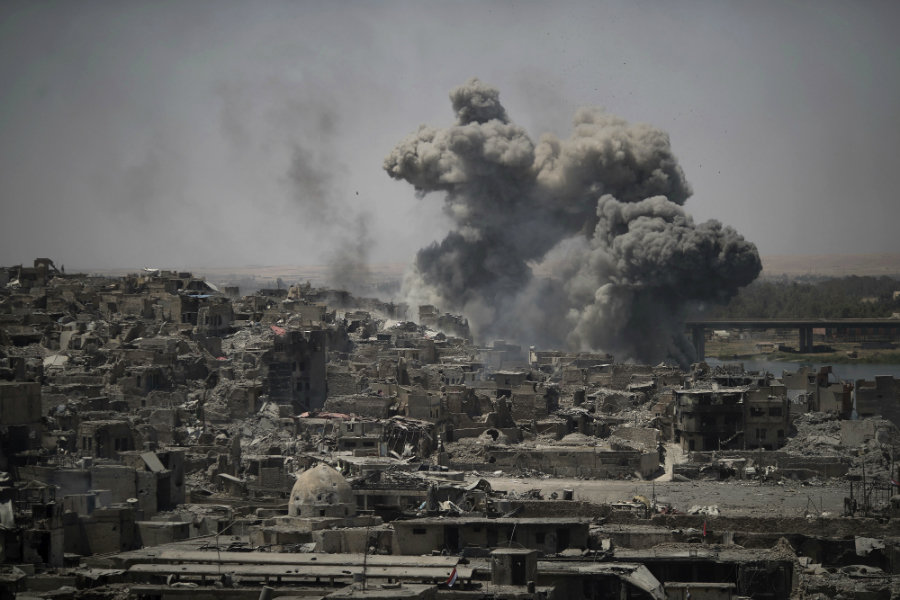
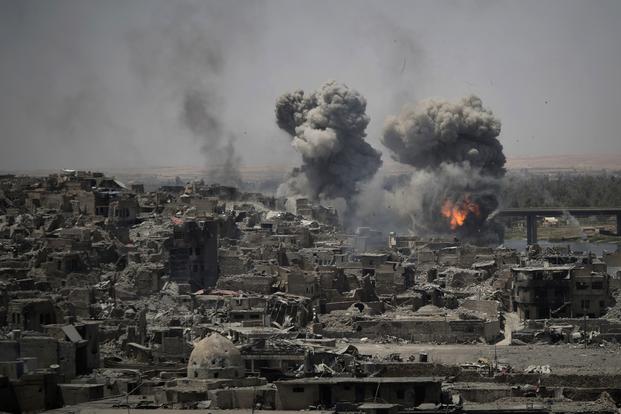
I plan to approach the issue through one of my favourite books, Steve Graham‘s Cities under siege.  Steve’s object was what he called ‘the new military urbanism’ but the situation in Syria – and elsewhere: think Mosul in Iraq (see, for example, here: scroll down) or Israel’s endless sieges of Gaza (see, for example, here) – demonstrate the extraordinary capacity of later modern war to combine cutting-edge technology (never has that adjective been more dismally appropriate) with medieval cruelty.  There is another difference; for all Steve’s analytical passion – and empathy – the voices of those inside the cities under siege are largely silent, yet in Syria (again: and elsewhere) digital media allow us to listen to them and to witness their suffering.  More soon.

New depths

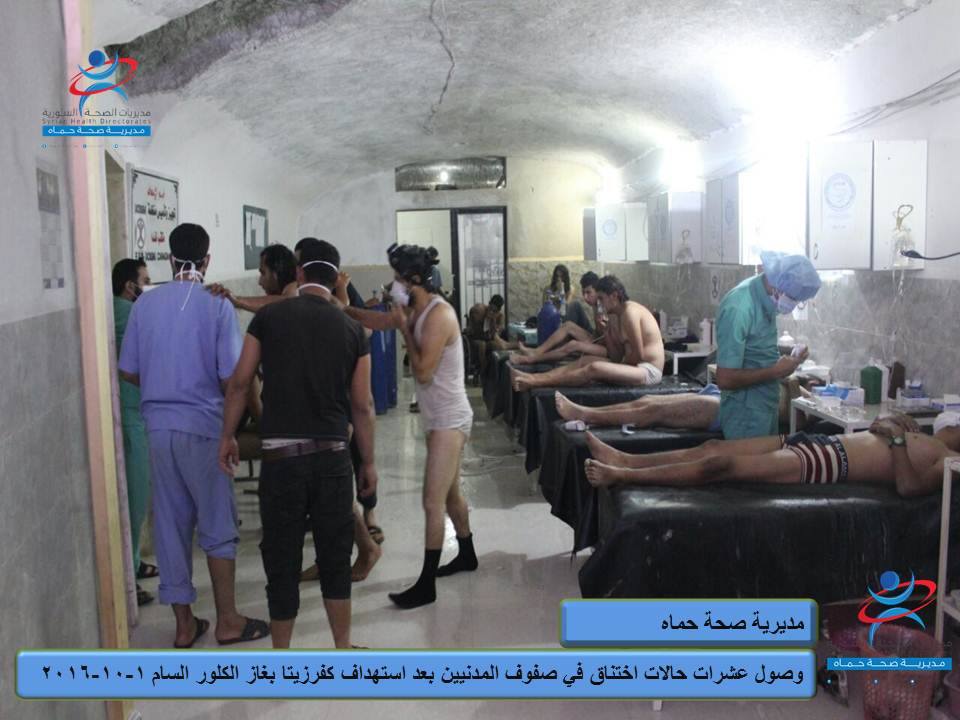
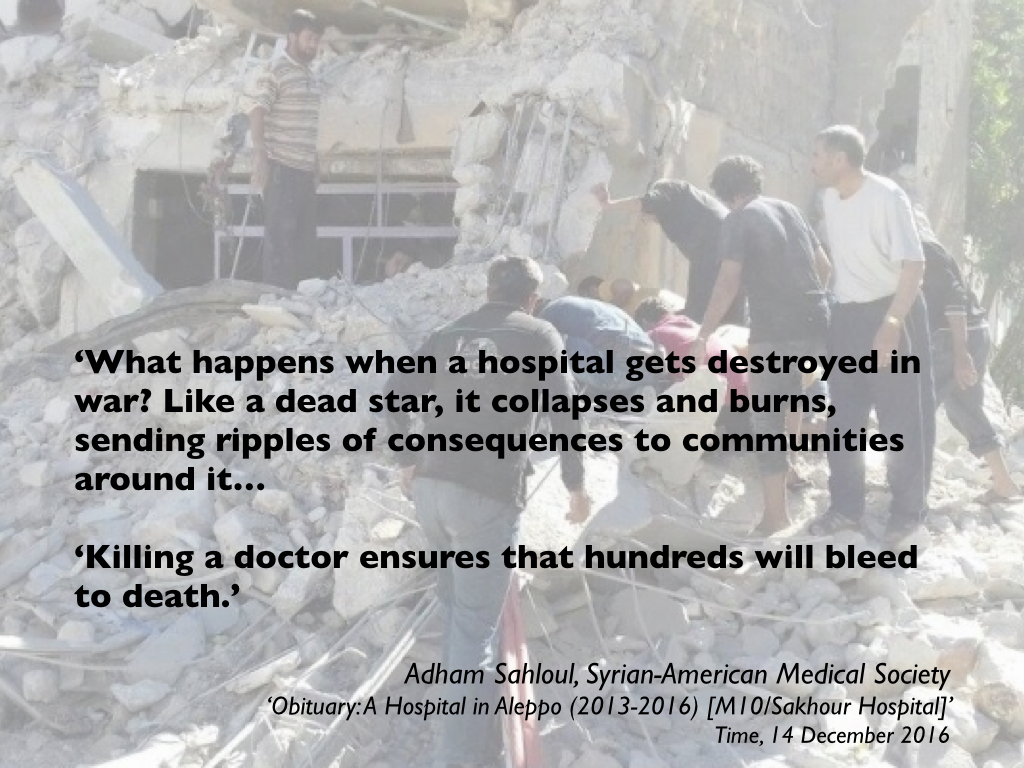
I’m still working on the (very) long-form version of ‘The Death of the Clinic’; in a previous post I described the attacks on hospitals in Syria and, in particular, the the construction – and destruction – of the underground Cave Hospital in Hama, Syria (see also my update on ‘Bombs, bunkers and borders’ here).  You can find videos and photographs from Jake Godin here.  The hospital has provided trauma surgery and paediatric care, treatment for major illnesses, and emergency treatment for victims of gas attacks (below):

Th hospital opened in late 2015; it suffered series of devastating air strikes in October 2016 (see here).

I have just received this bleak news:

A few hours ago, at 12:15 pm Damascus time [on 1 February], the Al Maghara (Dr. Hassan Al Araj) Cave Hospital in Kafr Zita, Hama was hit by five missiles from an airstrike. The hospital, built under 60 feet of rock, suffered extensive damage.

The pharmacy was destroyed and there was extensive damage to the emergency department, which UOSSM supports, and ambulances. There were minor injuries and no casualties reported. The facility was put out of service. The hospital serves a population of 50,000 people, has 7,000 beneficiaries a month and performs roughly 150 major surgeries a month.

The hospital was previously hit by three airstrikes in 2018; on January 30, January 5, January 2. The hospital was built under 60 ft. of rock to protect it from airstrikes and is considered one of the most structurally fortified hospitals in all of Syria. Damaging the structure to this extent is only possible through advanced weapons/ bunker buster missiles.

Cities and War

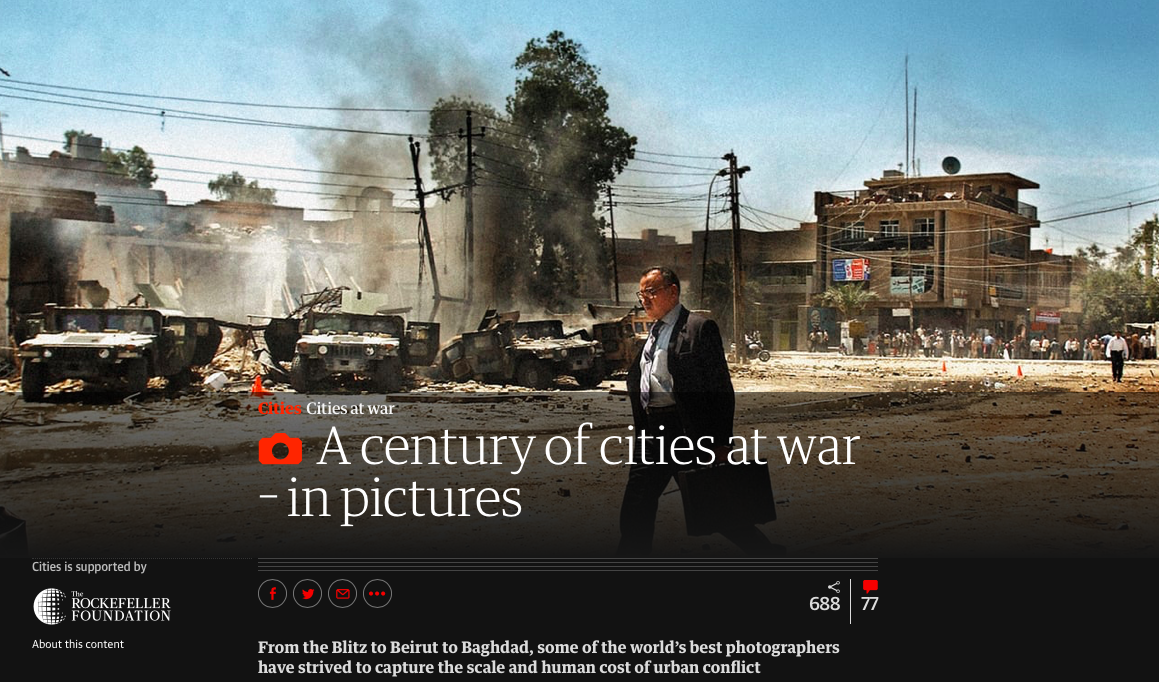
This week the Guardian launched a new series on Cities and War:

War is urbanising. No longer fought on beaches or battlefields, conflict has come to the doors of millions living in densely populated areas, killing thousands of civilians, destroying historic centres and devastating infrastructure for generations to come.

Last year, the world watched the Middle East as Mosul, Raqqa, Sana’a and Aleppo were razed to the ground. Across Europe, brutal attacks stunned urban populations in Paris, London and Berlin, while gang warfare tore apart the fabric of cities in central and south America.

In 2018, Guardian Cities will explore the reality of war in cities today – not merely how it is fought, but how citizens struggle to adapt, and to rebuild stronger than ever.

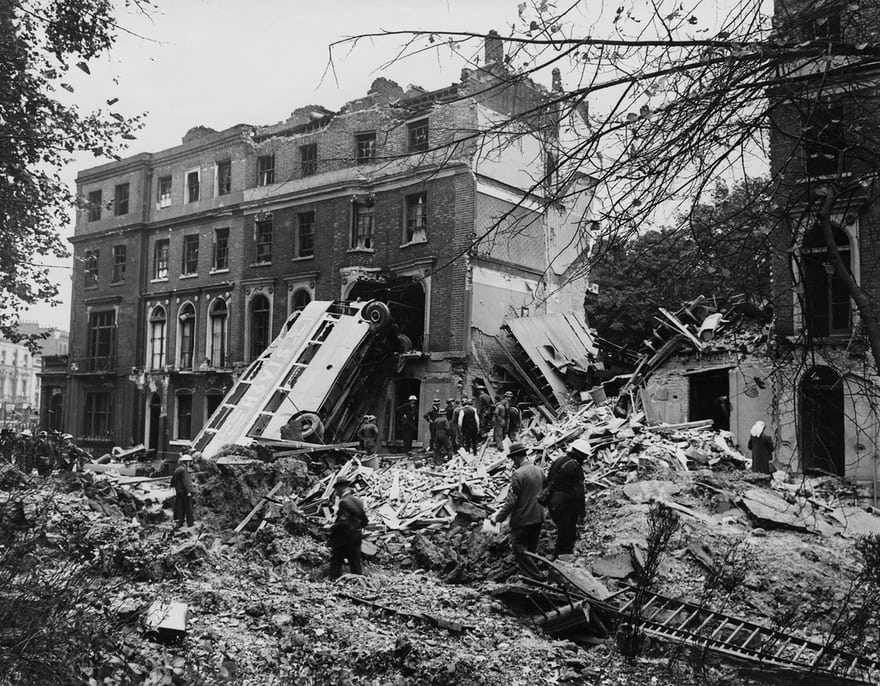
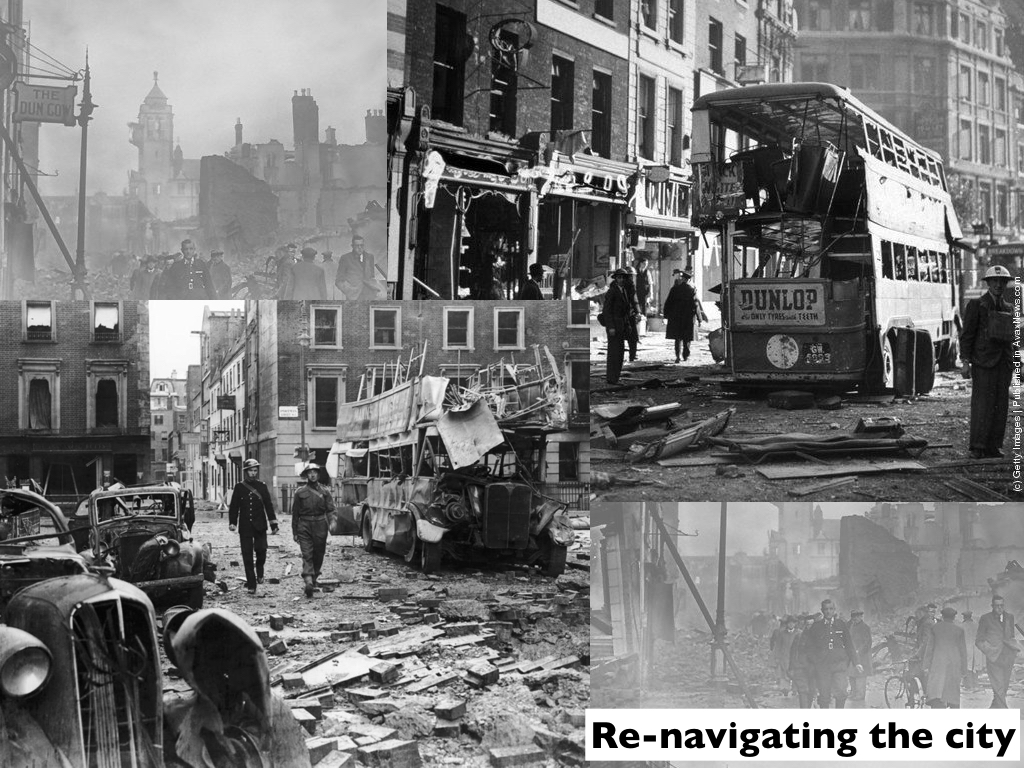
The series opened on Monday with a photographic gallery illustrating ‘a century of cities at war’; some of the images will be familiar, but many will not.  When I was working on ‘Modern War and Dead Cities‘ (which you can download under the TEACHING tab), for example, I thought I had seen most of the dramatic images of the Blitz, but I had missed this one:

It’s an arresting portfolio, and inevitably selective: there is a good discussion below the line on what other cities should have made the cut.

The first written contribution is an extended essay from Jason Burke, ‘Cities and terror: an indivisible and brutal relationship‘, which adds a welcome historical depth and geographical range to a discussion that all too readily contracts around recent attacks on cities in Europe and North America, and suggests an intimate link between cities and terrorism:

[I]t was around the time of the Paddington station attack [by Fenians in 1883]  that the strategy of using violence to sway public opinion though fear became widespread among actors such as the anarchists, leftists and nationalists looking to bring about dramatic social and political change.

This strategy depended on two developments which mark the modern age: democracy and communications. Without the media, developing apace through the 19th century as literacy rates soared and cheap news publications began to achieve mass circulations, impact would be small. Without democracy, there was no point in trying to frighten a population and thus influence policymakers. Absolutist rulers, like subsequent dictators, could simply ignore the pressure from the terrified masses. Of course, a third great development of this period was conditions in the modern city itself.

Could the terrorism which is so terribly familiar to us today have evolved without the development of the metropolis as we now know it? This seems almost impossible to imagine. Even the terror of the French revolution – Le Terreur – which gives us the modern term terrorism, was most obvious in the centre of Paris where the guillotine sliced heads from a relatively small number of aristocrats in order to strike fear into a much larger number of people.

The history of terrorism is thus the history of our cities. The history of our cities, at least over the last 150 years or so, is in part the history of terrorism. This is a deadly, inextricable link that is unlikely to be broken anytime soon.

Today Saskia Sassen issued her ‘Welcome to a new kind of war: the rise of endless urban conflict‘.  She begins with an observation that is scarcely novel:

The traditional security paradigm in our western-style democracies fails to accommodate a key feature of today’s wars: when our major powers go to war, the enemies they now encounter are irregular combatants. Not troops, organised into armies; but “freedom” fighters, guerrillas, terrorists. Some are as easily grouped by common purpose as they are disbanded. Others engage in wars with no end in sight.

What such irregular combatants tend to share is that they urbanise war. Cities are the space where they have a fighting chance, and where they can leave a mark likely to be picked up by the global media. This is to the disadvantage of cities – but also to the typical military apparatus of today’s major powers.

The main difference between today’s conflicts and the first and second world wars is the sharp misalignment between the war space of traditional militaries compared to that of irregular combatants.

Irregular combatants are at their most effective in cities. They cannot easily shoot down planes, nor fight tanks in open fields. Instead, they draw the enemy into cities, and undermine the key advantage of today’s major powers, whose mechanised weapons are of little use in dense and narrow urban spaces.

Advanced militaries know this very well, of course, and urban warfare is now a central medium in military training.  Saskia continues:

We have gone from wars commanded by hegemonic powers that sought control over sea, air, and land, to wars fought in cities – either inside the war zone, or enacted in cities far away. The space for action can involve “the war”, or simply specific local issues; each attack has its own grievances and aims, seeking global projection or not. Localised actions by local armed groups, mostly acting independently from other such groups, let alone from actors in the war zone – this fragmented isolation has become a new kind of multi-sited war.

This is, in part, what I tried to capture in my early essay on ‘The everywhere war’, and I’m now busily re-thinking it for my new book.  More on this in due course, but it’s worth noting that the Trump maladministration’s National Defense Strategy, while recognising the continuing importance of counter-terrorism and counterinsurgency, has returned the Pentagon’s sights to wars between major powers – notably China and Russia (see also here)– though it concedes that these may well be fought (indeed, are being fought) in part through unconventional means in digital domains.  In short, I think later modern war is much more complex than Saskia acknowledges; it has many modalities (which is why I become endlessly frustrated at the critical preoccupation with drones to the exclusion of other vectors of military and paramilitary violence), and these co-exist with – or give a new inflection to – older modalities of violence (I’m thinking of the siege warfare waged by Israel against Gaza or Syria against its own people).

The two contributions I’ve singled out are both broad-brush essays, but Ghaith Abdul-Ahad has contributed a two-part essay on Mosul under Islamic State that is truly brilliant: Part I describes how IS ran the city (‘The Bureaucracy of Evil‘) and Part II how the people of Mosul resisted the reign of terror (‘The Fall‘).

Mosul fell to IS in July 2014, and here is part of Ghaith’s report, where he tells the story of Wassan, a newly graduated doctor:

Like many other diwans (ministries) that Isis established in Mosul, as part of their broader effort to turn an insurgency into a fully functioning administrative state, the Diwan al-Siha (ministry of health) operated a two-tier system.There was one set of rules for “brothers” – those who gave allegiance to Isis – and another for the awam, or commoners.

“We had two systems in the hospitals,” Wassan said. “IS members and their families were given the best treatment and complete access to medicine, while the normal people, the awam, were forced to buy their own medicine from the black market.

“We started hating our work. As a doctor, I am supposed to treat all people equally, but they would force us to treat their own patients only. I felt disgusted with myself.”

(Those who openly resisted faced death, but as IS came under increasing military pressure at least one doctor was spared by a judge when he refused to treat a jihadist before a civilian: “They had so few doctors, they couldn’t afford to punish me. They needed me in the hospital.”)

Wassan’s radical solution was to develop her own, secret hospital:

“Before the start of military operations, medicines begun to run out,” she said. “So I started collecting whatever I could get my hands on at home. I built a network with pharmacists I could trust. I started collecting equipment from doctors and medics, until I had a full surgery kit at home. I could even perform operations with full anaesthesia.”

Word of mouth spread about her secret hospital.

“Some people started coming from the other side of Mosul, and whatever medicine I had was running out,” she said. “I knew there was plenty of medicine in our hospital, but the storage rooms were controlled by Isis.

“Eventually, I began to use the pretext of treating one of their patients to siphon medicine from their own storage. If their patient needed one dose, I would take five. After a while they must have realised, because they stopped allowing doctors to go into the storage.”

The punishment for theft is losing a hand. Running a free hospital from her home would have been sedition, punishable by death…

When Wassan’s hospital was appropriated by Isis fighters [this was a common IS tactic – see the image below and the Human Rights Watch report here; the hospital was later virtually destroyed by US air strikes] her secret house-hospital proved essential. More than a dozen births were performed on her dining table; she kicked both brothers out of their rooms to convert them into operating theatres; her mother, an elderly nurse, became her assistant.

As the siege of Mosul by the Iraqi Army ground on, some of the sick and injured managed to run (or stumble) the gauntlet to find medical aid in rudimentary field hospitals beyond the faltering grip of IS, while others managed to make it to major trauma centres like West Irbil.

But for many in Mosul Wassan’s secret hospital was a lifeline (for a parallel story about another woman doctor running a secret clinic under the noses of IS, see here).

Yet there is a vicious sting in the tail:

For Wassan, the ending of Isis rule in Mosul is bittersweet. After many attempts to reach Baghdad to write her board exams for medical school, she was told her work in the hospital for the past three years did not count as “active service”, and she was disqualified.

“The ministry said they won’t give me security clearance because I had worked under Isis administration,” she said.

This, too, is one of the modalities of later modern war – the weaponisation of health care, through selectively withdrawing it from some sections of the population while privileging the access and quality for others.  ‘Health care,’ writes Omar Dewachi, ‘has become not only a target but also a tactic of war.’  (If you want to know more about the faltering provision of healthcare and the fractured social fabric of life in post-IS Mosul, I recommend an interactive report from Michael Bachelard and Kate Geraghty under the bleak but accurate title ‘The war has just started‘). 

The weaponisation of health care has happened before, of course, and it takes many forms. In 2006, at the height of sectarian violence in occupied Baghdad, Muqtada al-Sadr’s Shi’a militia controlled the Health Ministry and manipulated the delivery of healthcare in order to marginalise and even exclude the Sunni population.  As Amit Paley reported:

 ‘In a city with few real refuges from sectarian violence – not government offices, not military bases, not even mosques – one place always emerged as a safe haven: hospitals…

‘In Baghdad these days, not even the hospitals are safe. In growing numbers, sick and wounded Sunnis have been abducted from public hospitals operated by Iraq’s Shiite-run Health Ministry and later killed, according to patients, families of victims, doctors and government officials.

‘As a result, more and more Iraqis are avoiding hospitals, making it even harder to preserve life in a city where death is seemingly everywhere. Gunshot victims are now being treated by nurses in makeshift emergency rooms set up in homes. Women giving birth are smuggled out of Baghdad and into clinics in safer provinces.’

He described hospitals as ‘Iraq’s new killing fields’, but in Syria the weaponisation of health care has been radicalised and explicitly authorized by the state.

You may think I’ve strayed too far from where I started this post; but I’ve barely moved.  For towards the end of her essay Saskia wonders why military and paramilitary violence in cities in so shocking – why it attracts so much more public attention than the millions murdered in the killing fields of the Congo.  And she suggests that the answer may lie in its visceral defilement of one of humanity’s greatest potential achievements:

Is it because the city is something we’ve made together, a collective construction across time and space? Is it because at the heart of the city are commerce and the civic, not war?

Lewis Mumford had some interesting things to say about that.  I commented on this in ACME several years ago, and while I’d want to flesh out those skeletal remarks considerably now, they do intersect with Saskia’s poignant question about the war on the civic:

In The Culture of Cities, published just one year before the Second World War broke out, Mumford included ‘A brief outline of hell’ in which he turned the Angelus towards the future to confront the terrible prospect of total war. Raging against what he called the ‘war-ceremonies’ staged in the ‘imperial metropolis’ (‘from Washington to Tokyo, from Berlin to Rome’: where was London, I wonder? Moscow?), Mumford fastened on the anticipatory dread of air war. The city was no longer the place where (so he claimed) security triumphed over predation, and he saw in advance of war not peace but another version of war. Thus the rehearsals for defence (the gas-masks, the shelters, the drills) were ‘the materialization of a skillfully evoked nightmare’ in which fear consumed the ideal of a civilized, cultivated life before the first bombs fell. The ‘war-metropolis’, he concluded, was a ‘non-city’.

After the war, Mumford revisited the necropolis, what he described as ‘the ruins and graveyards’ of the urban, and concluded that his original sketch could not be incorporated into his revised account, The City in History, simply ‘because all its anticipations were abundantly verified.’ He gazed out over the charnel-house of war from the air — Warsaw and Rotterdam, London and Tokyo, Hamburg and Hiroshima — and noted that ‘[b]esides the millions of people — six million Jews alone — killed by the Germans in their suburban extermination camps, by starvation and cremation, whole cities were turned into extermination camps by the demoralized strategists of democracy.’

I’m not saying that we can accept Mumford without qualification, still less extrapolate his claims into our own present, but I do think his principled arc, at once historical and geographical, is immensely important. In now confronting what Stephen Graham calls ‘the new military urbanism’ we need to recover its genealogy — to interrogate the claims to novelty registered by both its proponents and its critics — as a way of illuminating the historical geography of our own present.

It’s about more than aerial violence – though that is one of the signature modalities of modern war – and we surely need to register the heterogeneity and hybridity of contemporary conflicts.  But we also need to recognise that they are often not only wars in cities but also wars on cities.

The slow violence of bombing

When I spoke at the symposium on ‘The Intimacies of Remote Warfare’ in Utrecht before Christmas, one of my central arguments was about the slow violence of bombing.  The term is, of course, Rob Nixon‘s, but I borrowed it to emphasise that the violence of sudden death from the air – whether in the air raids of the First and Second World Wars or the drone strikes of the early twenty-first century – neither begins nor ends with the explosion of bombs and missiles.

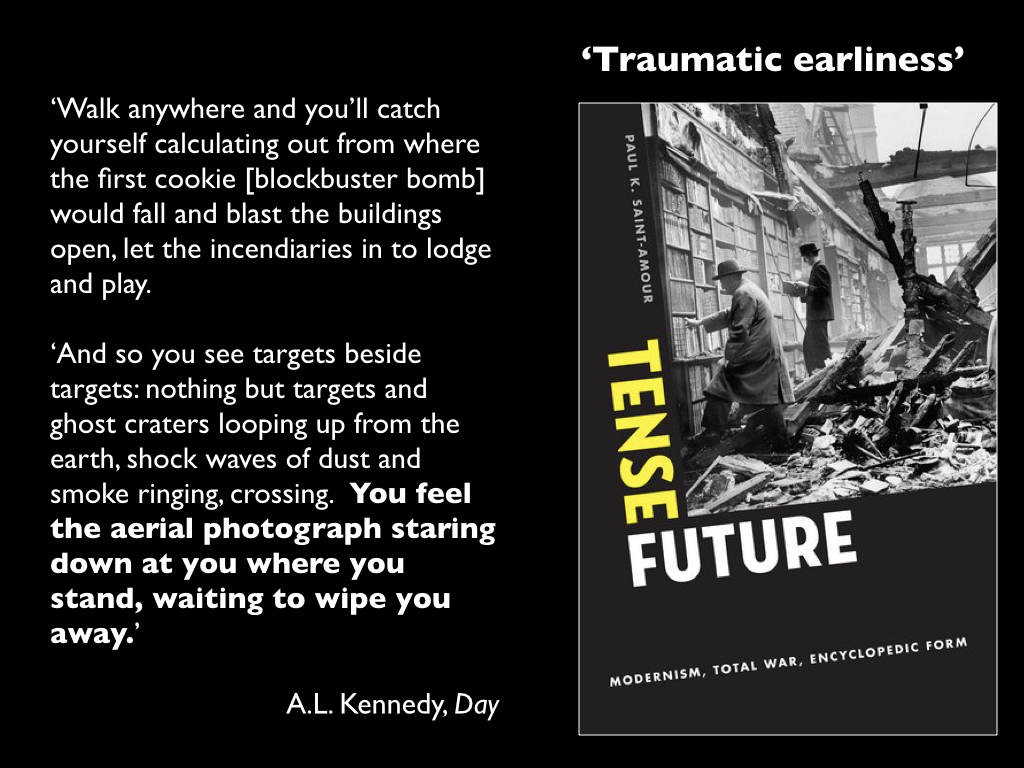
Paul Saint-Amour speaks of ‘traumatic earliness’: that dreadful sense of deadly anticipation.  The sense of not only preparation – communal and individual – but also of an involuntary tensing.  I described this for the First and Second World Wars in ‘Modern Wars and Dead Cities’, which you can download from the TEACHING tab, but here is A.L. Kennedy who captures it as well as anyone:

Add to that the blackouts, the new landscape of civil defence with its sandbags and shelters, the new choreography of movement through the war-time city, the air-raid sirens and the probing arcs of the searchlights.

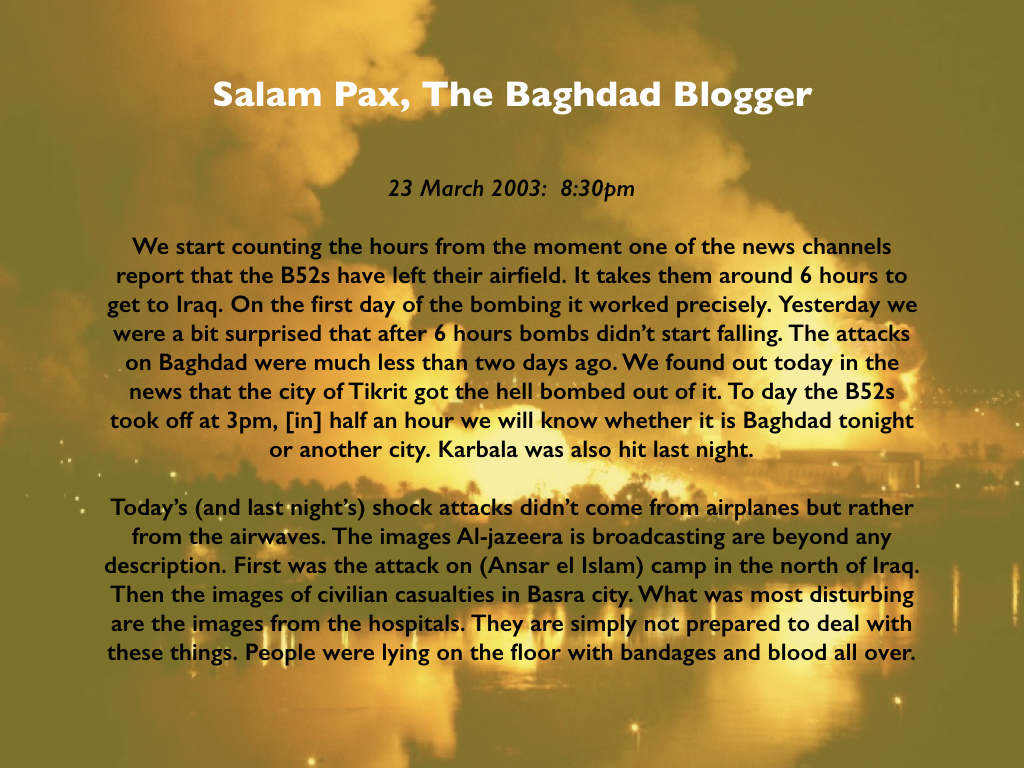
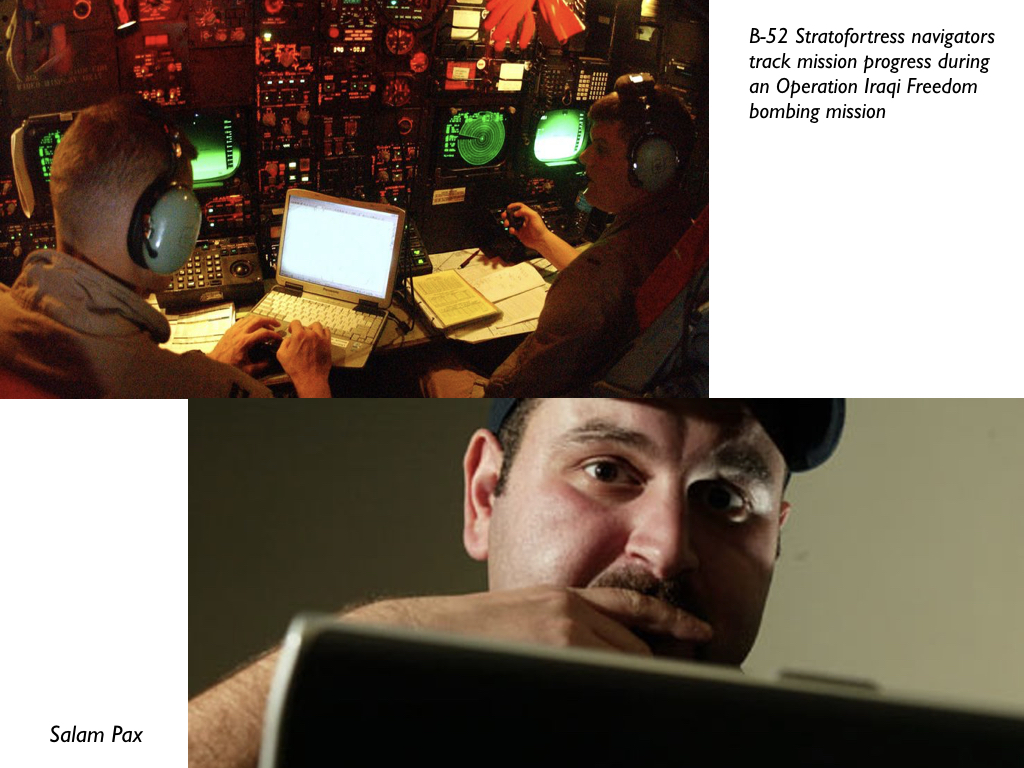
Perhaps this seems remote, but it shouldn’t.  Modern technology can radically heighten that sense of foreboding: calibrate it, give it even sharper definition.  Here is Salam Pax, counting down the hours to US air strikes on Baghdad:

Fast forward to drone strikes.  The sense of dread visited on innocents by multiple US drone programmes is readily overlooked in the emphasis on ‘targeted killing’, on what the US Air Force once called its ability to put ‘warheads on foreheads’, and on the individuation of this modality of later modern war.  ‘The body is the battlefield’, as Grégoire Chamayou argues.

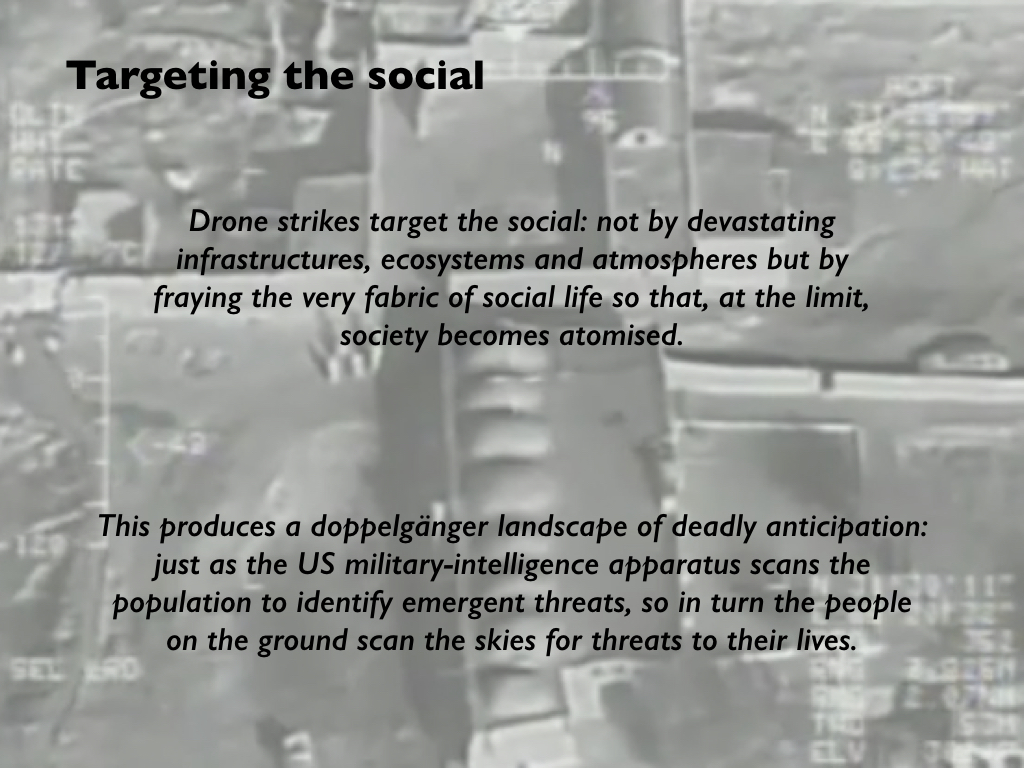
I’ve written about all those things, but there is a powerful sense in which the battle space still exceeds the body: for in order to target the individual these programmes also target the social, as this set of slides from my Utrecht presentation tries to show:

Here too, surely, is traumatic earliness.  (I’ve discussed this in more detail in ‘Little Boys and Blue Skies’ [DOWNLOADS tab], and I’m indebted to Neal Curtis, ‘The explication of the social’, Journal of sociology 52 (3) (2016) 522-36) for helping me to think this through).

And then, after the explosion – the shocking bio-convergence that in an instant produces the horror of meatspace – the violence endures: stored in the broken buildings and in the broken bodies.  In the Second World War (again as I show in ‘Modern Wars and Dead Cities’) the landscape was made strange every morning: buildings newly demolished, people driven from their homes and their workplaces, roads blocked by hoses and ambulances, by craters and unexploded bombs, rescue workers still toiling in the rubble to remove the dead and the injured, hospitals still treating and caring for the casualties.

And the violence of a drone strike lingers too: not on the same scale, but still the destroyed houses, the burned-out cars, the graves of the dead and above all the traumatized survivors (and their rescuers), some of them forced into newly prosthetic lives (see here and here).  The explosion is instantaneous, a bolt from the blue, but the pain, the grief and the scars on the land and the body endure.

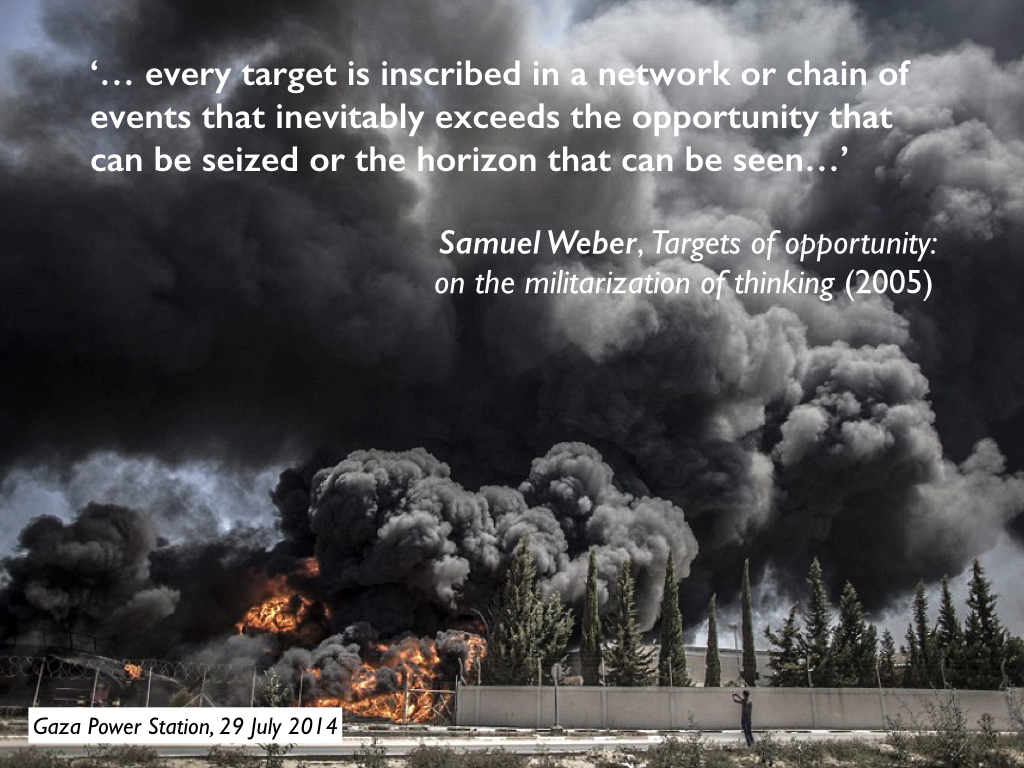
These effects have a horizon that is not contained by any carefully calculated blast radius.  The grief spirals out through extended families and communities; and – depending on the target – so too do the casualties.  As I’ve said before, power stations in Gaza or Iraq have been targeted not for any localised destructon but because without power water cannot be pumped, sewage cannot be treated, food (and medicines) stored in refrigerators deteriorates.  And hospitals have been systematically targeted in Syria to deny treatment to hundreds and thousands of sick and injured:

The work of enumerating and plotting air strikes, in the past or in the present, is immensely important.  But those columns on graphs and circles on maps should not be read as signs of an episodic or punctiform violence.

A refugee state

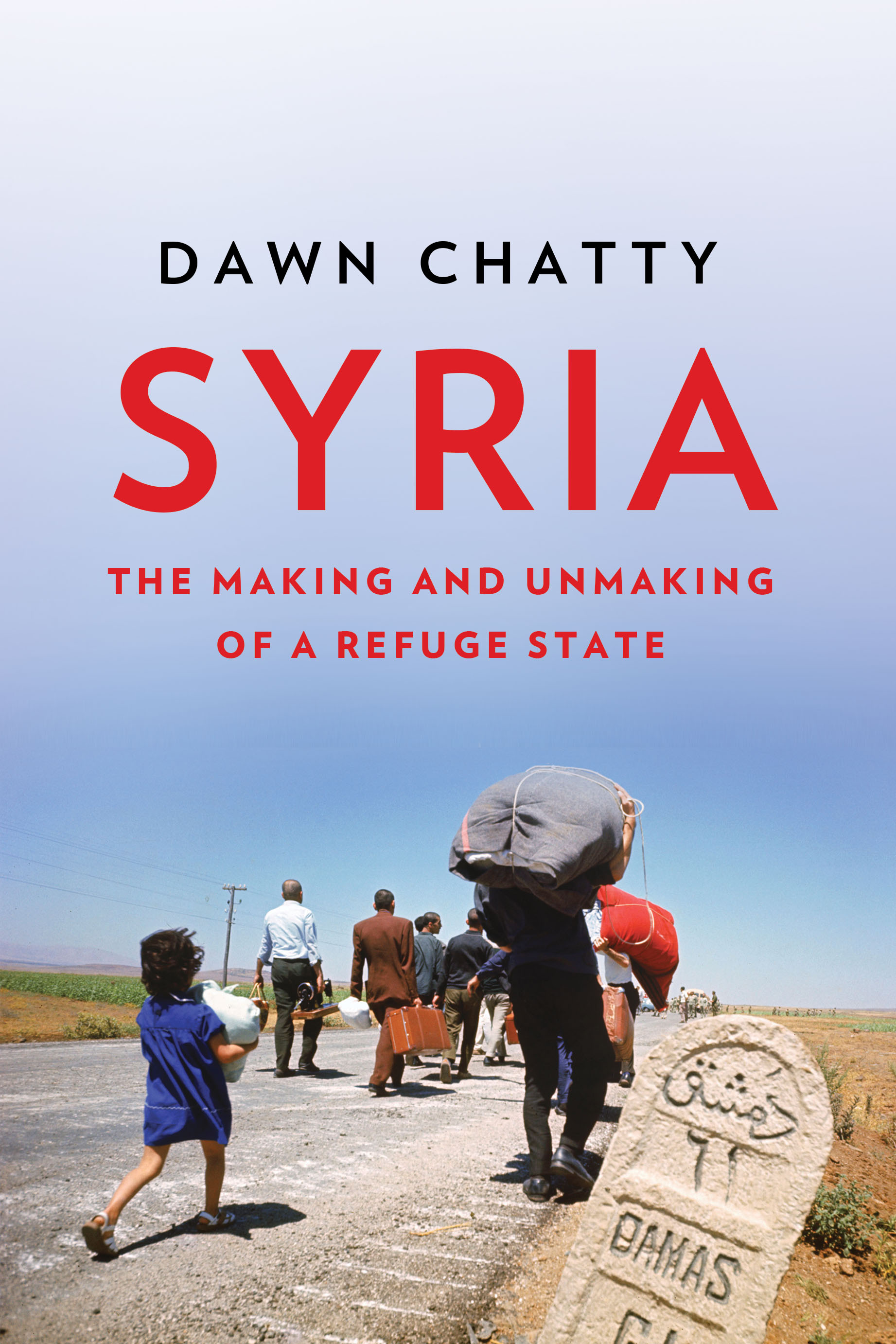
I’ve been working on the (very) long-form version of “Death of the Clinic”, so apologies for the silence: it’s been – and continues to be – utterly absorbing.  But I have managed to get my head sufficiently far above the water to notice this vital new book: Dawn Chatty‘s Syria: the making and unmaking of a refugee state (from Hurst in the UK and Oxford University Press elsewhere), out next month:

The dispossession and forced migration of nearly 50 per cent of Syria’s population has produced the greatest refugee crisis since World War II. This new book places the current displacement within the context of the widespread migrations that have indelibly marked the region throughout the last 150 years. Syria itself has harbored millions from its neighboring lands, and Syrian society has been shaped by these diasporas. Dawn Chatty explores how modern Syria came to be a refuge state, focusing first on the major forced migrations into Syria of Circassians, Armenians, Kurds, Palestinians, and Iraqis. Drawing heavily on individual narratives and stories of integration, adaptation, and compromise, she shows that a local cosmopolitanism came to be seen as intrinsic to Syrian society. She examines the current outflow of people from Syria to neighboring states as individuals and families seek survival with dignity, arguing that though the future remains uncertain, the resilience and strength of Syrian society both displaced internally within Syria and externally across borders bodes well for successful return and reintegration. If there is any hope to be found in the Syrian civil war, it is in this history.

Contents:

Chapter One: Greater Syria at the end of the Ottoman Empire
Chapter Two: The Circassians and other Caucasian forced migrants reimagining a homeland
Chapter Three: The Armenians and other Christians seek protection and refuge
Chapter Four: The Kurds seeking freedom of religious expression
Chapter Five: Palestinians return to their ‘motherland’
Chapter Six: Sha’laan: a modern cosmopolitan quarter in Damascus
Chapter Seven: Iraqis and second wave Assyrians as temporary guests
Chapter Eight: The unmaking of a State, as Syrians flee the country

Here is Raymond Hinnebusch on the book:

Passionate and erudite, combining the intimacy of the anthropological eye with a broad historical sweep, Dawn Chatty tells the two-century story of Syria as a place of refuge. Beginning with Sultan Abdul Hamid’s creation of the muhajireen quarter of Damascus as a refuge for Muslims from Crete, Chatty further exposes the often-forgotten forced migrations of Muslims from the Balkans, Crimea, and the Caucasus; the story continues with the Armenians, Kurds, then the Palestinians and Iraqis. The last chapter recounts the tragedy of how Syrians have now become refugees from their own country.

Taking it to the limit

A postscript to my posts here, here and here on civilian deaths from air strikes in Iraq, Syria and elsewhere: Vice has an extended interview with Chris Woods of Airwars here.

The biggest issue we saw in 2017—particularly if we look at the US-led coalition—was that the war moved very heavily into cities. That, more than any other single factor, resulted in the deaths of many more civilians and casualty events. We saw a similar pattern at the back end of 2016, when Russia and the Assad regime heavily bombed east Aleppo. There’s a very strong correlation between attacks on cities and large numbers of civilian casualties. And frankly, it doesn’t matter who’s carrying out those attacks. The outcome for civilians is always dire…

Things didn’t get any better under Trump for civilians—in fact, they got a lot worse. One of the reasons for that was the intensity of the bombardment. We saw an absolutely ferocious bombing campaign by the US and its allies in both Mosul and Raqqa in 2017. Between those two cities, the coalition alone dropped 50,000 munitions. One bomb or missile was dropped on Raqqa every 12 minutes, on average, for the duration of the four-month battle…

When Russia and the Assad regime were bombing Aleppo in late 2016, we had assumed that a key reason for the large number of civilian casualties was down to the fact they were primarily using dumb-bombs. We have actually changed our modeling since then, based on what we have seen with the coalition in places like Raqqa and Mosul. The reason is that even when you use precision bombs on cities, really, the outcome for civilians is the same as a dumb bomb. You can’t control what the bombs do when they land.

We saw very little difference between Russian and coalition strikes when it came to bombing cities. This is the big problem we have with a shift to urban warfare —it’s really taking us to the limits of any benefits we might have in terms of protecting civilians by using precision munitions.

Chris also has some characteristically smart (and sharp) things to say about transparency and accountability too…

Killing cities

In a perceptive commentary on the ground-breaking investigation by Azmat Khan and Anand Gopal into civilian casualties caused by the US air campaign against Islamic State (Daesh) in Iraq – see also my posts here and hereRobert Malley and Stephen Pomper write:

The Trump administration has celebrated a no-holds-barred approach to the fight against ISIS, given greater deference to ground commanders, loosened restrictions imposed by its predecessor, and expanded the fight to an ever-growing number of Middle Eastern and African theaters. This adds up to a quasi-automatic recipe for greater civilian casualties. Independent monitoring organizations have tracked the numbers, and invariably they point to a serious uptick in civilian deaths in Iraq and Syria since January 2017. The explanation lies partly in the transition in Iraq and Syria toward the final, more urban phase of the conflict in the heavily populated cities of Mosul and Raqqa. But partly only. It also lies in policy guidance, as well as in matters such as tone, attitude, and priorities set at the very top—including by the commander in chief. These have a way of trickling down and affecting performance on the battlefield.

And yet. Those dead civilians that The New York Times found not to have been counted were not counted by the Obama administration. They were not counted by people who were intent on limiting civilian casualties and ensuring transparency. That those safeguards proved inadequate even in the hands of an administration that considered them a priority raises particularly vexing questions.

Part of the problem, as they note, is the nature of the campaign itself.  This is not the sort of counterinsurgency campaign that emerged in Afghanistan and Iraq in which air power was used in support of US and allied ground troops (although we know that also produced more than its share of civilian casualties); neither is it a counterterrorism campaign directed against so-called High Value Targets who supposedly ‘present a direct and imminent threat to the United States’ (ditto; and as I discuss in ‘Dirty dancing’ – DOWNLOADS tab – ‘imminence’ turned out to be remarkably elastic, a deadly process of time-space expansion).
Ultimately, though, their anxieties turn on what they call the ‘over-militarization’ of the US response to al Qaeda and its affiliates and to IS.  They explain, succinctly, what has encouraged this militarized response (not least the lowering of the threshold for military violence allowed by remote operations):
[U]ntil this changes, an increasing number of innocent lives will suffer the consequence. Some will be counted. Others, not. All will have paid a terrible price.
In December the Bureau of Investigative Journalism confirmed an escalation in US air strikes across multiple theatres in Trump’s first year in office:
President Donald Trump inherited the framework allowing US aircraft to hit suspected terrorists outside of declared battlefields from his predecessor, Barack Obama. Bar some tinkering, his administration has largely stuck within the framework set by the previous one.

However, the quantity of operations has shot up under President Trump. Strikes doubled in Somalia and tripled in Yemen [in 2017].

In Afghanistan, where the Bureau has been monitoring US airstrikes since it was officially declared a noncombat mission at the end of 2014, the number of weapons dropped is now approaching levels last seen during the 2009-2012 surge.

Meanwhile, there are signs that the drone war may be returning to Pakistan, where attacks were also up, compared with 2016.

Much remains unclear about these actions, apart from Trump’s signature combination of machismo and ignorance, but we do know that Obama’s restrictions on the use of military force outside Afghanistan, Iraq and Syria have been loosened:

In 2013, Obama introduced measures that meant that strikes in areas of countries that were not active war-zones, such as Pakistan and Yemen, had to go through an elaborate sign-off process with the White House.

The Trump administration effectively side-stepped the restrictions by declaring parts of Somalia and Yemen to be areas of “active hostilities”.
In September NBC reported that the Trump administration was planning to allow the CIA to take a more aggressive role and to give the agency more authority to conduct (para)military operations.  In consequence a comprehensive revision of Obama’s guidelines was in prospect:

The drone playbook, known as the Presidential Policy Guidance, or PPG, includes a provision that no strike should go forward unless analysts determine that there is a near-certainty that no civilians will be harmed. And it includes a provision forbidding the addition of new detainees to the U.S. prison in Guantanamo Bay, Cuba.  The Trump administration is contemplating removing both of those restrictions.

Pakistan remains a nominally covert area of operations.  US drone strikes in the Federally Administered Tribal Areas resumed in March after a nine-month hiatus – though Trump’s latest spat with Islamabad raises questions about the sporadic but systematic co-operation that had characterised so much of the campaign – and (provocatively: again, see ‘Dirty Dancing’ for an explanation) one strike took place outside the FATA in June 2017.  The Bureau’s detailed list is here: five strikes are listed, killing 15-22 people.

In Afghanistan the Bureau noted that air strikes had doubled and that this escalation has been accompanied by a corresponding decrease in transparency (Chris Woods told me the same story for Iraq and Syria when we met in Utrecht).

All of this confirms the report released today by Action on Armed Violence.

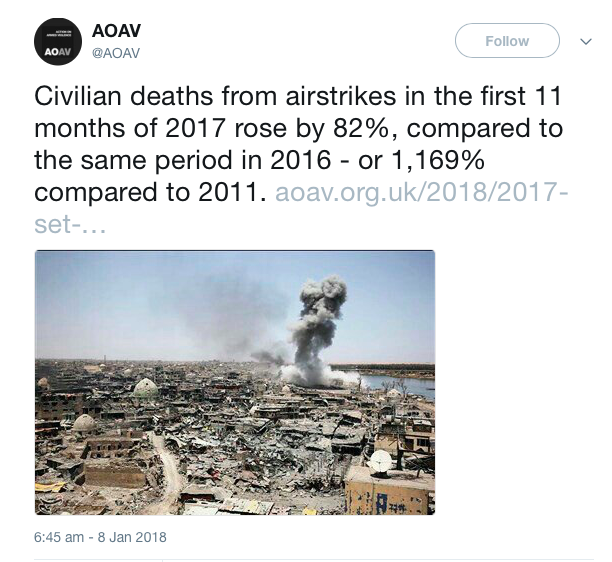
At least 15,399 civilians were killed in the first 11 months of 2017 according to Action on Armed Violence’s (AOAV) recording of English language media explosive violence events.  This devastating toll – up to the end of November – strongly suggests that 2017 was the worst year for civilian deathsfrom explosive weapons since AOAV’s records began in 2011.

This sharp rise, constituting a 42% increase from the same period in 2016, when 10,877 civilians were killed, is largely down to a massive increase in deadly airstrikes.

Compared to 2011, the first year of AOAV’s recording, the rise in civilians killed by explosive violence in the first 11 months of 2017 constitutes an 175% increase (5,597 died in the same period seven years ago).

On average, our records to November show that there were 42 civilian deaths per day caused by explosive violence in 2017.

The report continues:

For the first time since our recording of all English language media reports of explosive weapon attacks began, the majority of civilian deaths were by air-launched weapons. Of the total civilian deaths recorded (15,399), 58% were caused by airstrikes, mainly in Syria, Iraq and Yemen.

Civilian deaths from airstrikes in this 11-month period was 8,932 – an increase of 82% compared to the same period in 2016 when 4,902 civilians were killed, or 1,169% compared to 2011, when 704 died.

Significantly, as airstrikes are almost always used by State actors, rather than non-State groups, States were responsible for the majority of civilian deaths from explosive weapons for the first time since our records began.

Iain Overton, Executive Director of AOAV commented:

 These are stark figures that expose the lie that precision-guided missiles as used by State airforces do not lead to massive civilian harm. When explosive weapons are used in towns and cities, the results are inevitable: innocent children, women and men will die.

In the same vein, Karen McVeigh‘s summary for the Guardian quotes Chris Woods from Airwars:

This is about urban warfare and that’s why we are getting crazy numbers… War is moving into cities. It doesn’t matter whether it’s Russia or the US-led coalition or ground forces leading the assault, the outcome for civilians under attack is always dire…. We’re becoming too complacent about urban warfare, and militaries and governments are downplaying the effects.

I think that’s right, though I also think war is moving back into the cities (if it ever left them); the serial military operations in Mosul and Raqqa are vivid examples of what Chris means, but they also recall the assaults on Fallujah and other cities documented in Steve Graham‘s still utterly indispensable Cities under siege.

The point is sharpened even further if we widen the angle of vision to take in air campaigns conducted by other air forces: the Syrian Arab Air Force and the Russian Air Force in Syria, or the Saudi-led coalition in Yemen.

Yet again, killing cities to save them.  As a spokesperson for Raqqa is Being Slaughtered Silently put it last summer, ‘This is very similar to the Vietnam war, where entire cities were destroyed… What is happening in Raqqa is like dropping a nuclear bomb in stages.’

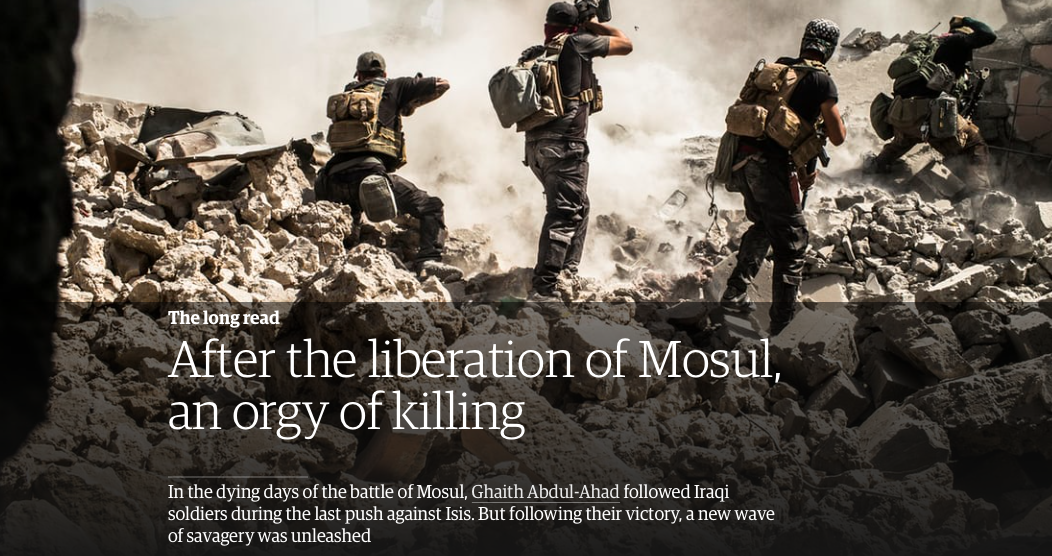
Steve’s work should also remind us that these dead cities are not produced by air strikes alone.  Once reduced to rubble they have often been disembowelled (I can think of no better word) by ground forces; it’s as though these now barely human landscapes compel or at any rate license the continued degradation of both the living and the dead:  see, for example, Kenneth Rosen on ‘The Devil’s Henchmen’ here or  Ghaith Abdul-Ahad‘s chillingly detailed report on the aftermath of the liberation of Mosul here.

I’m still astonished that all those high-minded theoretical debates on planetary urbanism somehow ignore the contemporary intensification of urbicide and urban warfare (see ‘Mumford and sons’ here).

Those who don’t count and those who can’t count

An excellent article from the unfailing New York Times in a recent edition of the Magazine: Azmat Khan and Anand Gopal on ‘The Uncounted‘, a brilliant, forensic and – crucially – field-based investigation into civilian casualties in the US air war against ISIS:

American military planners go to great lengths to distinguish today’s precision strikes from the air raids of earlier wars, which were carried out with little or no regard for civilian casualties. They describe a target-selection process grounded in meticulously gathered intelligence, technological wizardry, carefully designed bureaucratic hurdles and extraordinary restraint. Intelligence analysts pass along proposed targets to “targeteers,” who study 3-D computer models as they calibrate the angle of attack. A team of lawyers evaluates the plan, and — if all goes well — the process concludes with a strike so precise that it can, in some cases, destroy a room full of enemy fighters and leave the rest of the house intact.

The coalition usually announces an airstrike within a few days of its completion. It also publishes a monthly report assessing allegations of civilian casualties. Those it deems credible are generally explained as unavoidable accidents — a civilian vehicle drives into the target area moments after a bomb is dropped, for example. The coalition reports that since August 2014, it has killed tens of thousands of ISIS fighters and, according to our tally of its monthly summaries, 466 civilians in Iraq.

What Azmat and Anand found on the ground, however, was radically different:

Our own reporting, conducted over 18 months, shows that the air war has been significantly less precise than the coalition claims. Between April 2016 and June 2017, we visited the sites of nearly 150 airstrikes across northern Iraq, not long after ISIS was evicted from them. We toured the wreckage; we interviewed hundreds of witnesses, survivors, family members, intelligence informants and local officials; we photographed bomb fragments, scoured local news sources, identified ISIS targets in the vicinity and mapped the destruction through satellite imagery. We also visited the American air base in Qatar where the coalition directs the air campaign. There, we were given access to the main operations floor and interviewed senior commanders, intelligence officials, legal advisers and civilian-casualty assessment experts. We provided their analysts with the coordinates and date ranges of every airstrike — 103 in all — in three ISIS-controlled areas and examined their responses. The result is the first systematic, ground-based sample of airstrikes in Iraq since this latest military action began in 2014.

We found that one in five of the coalition strikes we identified resulted in civilian death, a rate more than 31 times that acknowledged by the coalition. It is at such a distance from official claims that, in terms of civilian deaths, this may be the least transparent war in recent American history [my emphasis].  Our reporting, moreover, revealed a consistent failure by the coalition to investigate claims properly or to keep records that make it possible to investigate the claims at all. While some of the civilian deaths we documented were a result of proximity to a legitimate ISIS target, many others appear to be the result simply of flawed or outdated intelligence that conflated civilians with combatants. In this system, Iraqis are considered guilty until proved innocent. Those who survive the strikes …  remain marked as possible ISIS sympathizers, with no discernible path to clear their names.

They provide immensely powerful, moving case studies of innocents ‘lost in the wreckage’.  They also describe the US Air Force’s targeting process at US Central Command’s Combined Air Operations Center (CAOC) at Al Udeid Air Base in Qatar (the image above shows the Intelligence, Surveillance and Reconnaissance Division at the CAOC, which ‘provides a common threat and targeting picture’):

The process seemed staggeringly complex — the wall-to-wall monitors, the soup of acronyms, the army of lawyers — but the impressively choreographed operation was designed to answer two basic questions about each proposed strike: Is the proposed target actually ISIS? And will attacking this ISIS target harm civilians in the vicinity?

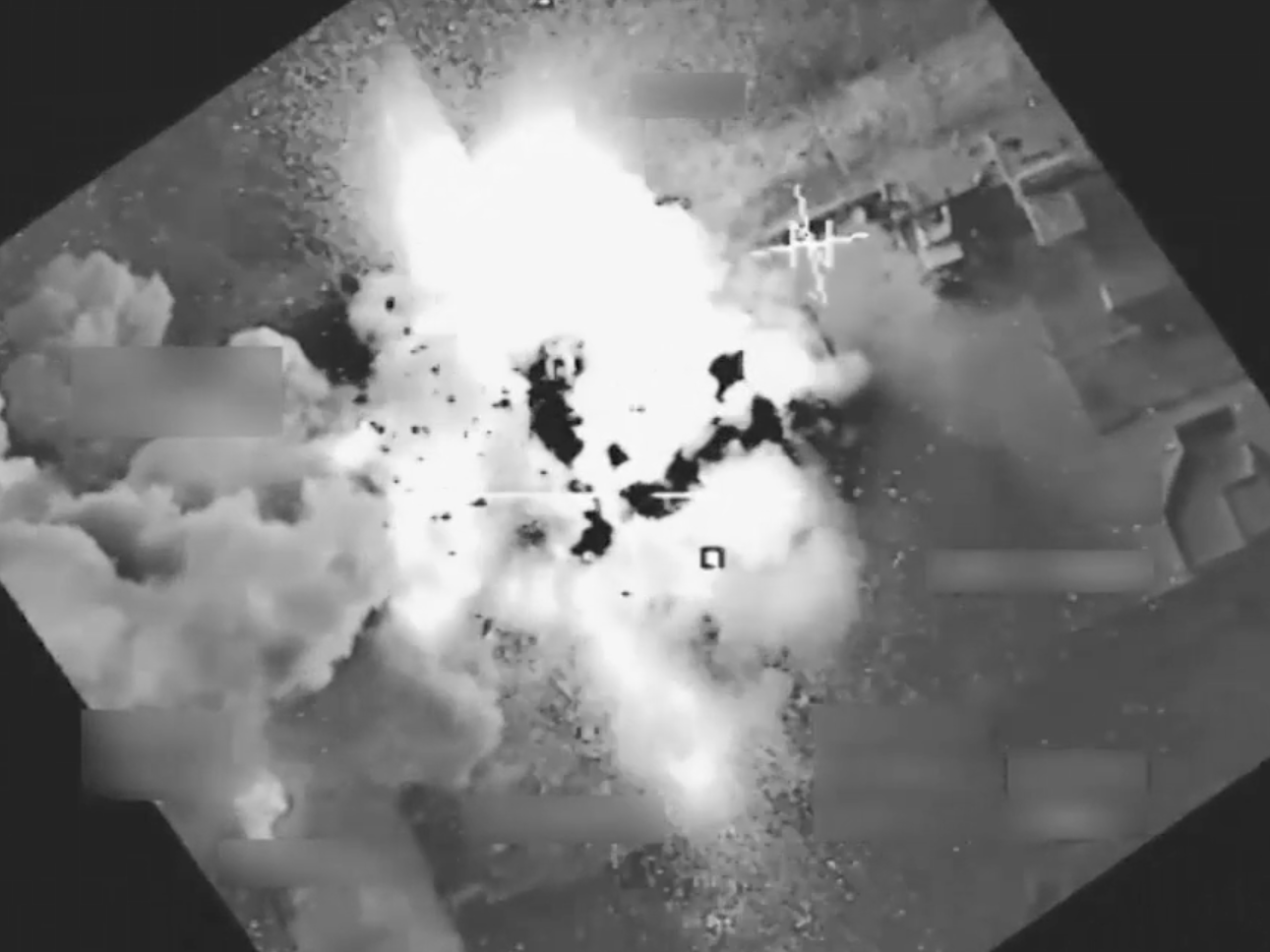
As we sat around a long conference table, the officers explained how this works in the best-case scenario, when the coalition has weeks or months to consider a target. Intelligence streams in from partner forces, informants on the ground, electronic surveillance and drone footage. Once the coalition decides a target is ISIS, analysts study the probability that striking it will kill civilians in the vicinity, often by poring over drone footage of patterns of civilian activity. The greater the likelihood of civilian harm, the more mitigating measures the coalition takes. If the target is near an office building, the attack might be rescheduled for nighttime. If the area is crowded, the coalition might adjust its weaponry to limit the blast radius. Sometimes aircraft will even fire a warning shot, allowing people to escape targeted facilities before the strike. An official showed us grainy night-vision footage of this technique in action: Warning shots hit the ground near a shed in Deir al-Zour, Syria, prompting a pair of white silhouettes to flee, one tripping and picking himself back up, as the cross hairs follow.

Once the targeting team establishes the risks, a commander must approve the strike, taking care to ensure that the potential civilian harm is not “excessive relative to the expected military advantage gained,” as Lt. Col. Matthew King, the center’s deputy legal adviser, explained.

After the bombs drop, the pilots and other officials evaluate the strike. Sometimes a civilian vehicle can suddenly appear in the video feed moments before impact. Or, through studying footage of the aftermath, they might detect signs of a civilian presence. Either way, such a report triggers an internal assessment in which the coalition determines, through a review of imagery and testimony from mission personnel, whether the civilian casualty report is credible. If so, the coalition makes refinements to avoid future civilian casualties, they told us, a process that might include reconsidering some bit of intelligence or identifying a flaw in the decision-making process.

There are two issues here.  First, this is indeed the ‘best-case scenario’, and one that very often does not obtain.  One of the central vectors of counterinsurgency and counterterrorism is volatility: targets are highly mobile and often the ‘window of opportunity’ is exceedingly narrow.  I’ve reproduced this image from the USAF’s own targeting guide before, in relation to my analysis of the targeting cycle for a different US air strike against IS in Iraq in March 2015, but it is equally applicable here:

Second, that ‘window of opportunity’ is usually far from transparent, often frosted and frequently opaque.  For what is missing from the official analysis described by Azmat and Anand turns out to be the leitmotif of all remote operations (and there is a vital sense in which all forms of aerial violence are ‘remote’, whether the pilot is 7,000 miles away or 30,000 feet above the target [see for example here]):

Lt. Gen. Jeffrey Harrigian, commander of the United States Air Forces Central Command at Udeid, told us what was missing. “Ground truth, that’s what you’re asking for,” he said. “We see what we see from altitude and pull in from other reports. Your perspective is talking to people on the ground.” He paused, and then offered what he thought it would take to arrive at the truth: “It’s got to be a combination of both.”

The military view, perhaps not surprisingly, is that civilian casualties are unavoidable but rarely intentional:

Supreme precision can reduce civilian casualties to a very small number, but that number will never reach zero. They speak of every one of the acknowledged deaths as tragic but utterly unavoidable.

Azmat and Anand reached a numbingly different conclusion: ‘Not all civilian casualties are unavoidable tragedies; some deaths could be prevented if the coalition recognizes its past failures and changes its operating assumptions accordingly. But in the course of our investigation, we found that it seldom did either.’

Part of the problem, I suspect, is that whenever there is an investigation into reports of civilian casualties that may have been caused by US military operations it must be independent of all other investigations and can make no reference to them in its findings; in other words, as I’ve noted elsewhere, there is no ‘case law’: bizarre but apparently true.

But that is only part of the problem.  The two investigators cite multiple intelligence errors (‘In about half of the strikes that killed civilians, we could find no discernible ISIS target nearby. Many of these strikes appear to have been based on poor or outdated intelligence’) and even errors and discrepancies in recording and locating strikes after the event.

It’s worth reading bellingcat‘s analysis here, which also investigates the coalition’s geo-locational reporting and notes that the official videos ‘appear only to showcase the precision and efficiency of coalition bombs and missiles, and rarely show people, let alone victims’.  The image above, from CNN, is unusual in showing the collection of the bodies of victims of a US air strike in Mosul, this time in March 2017; the target was a building from which two snipers were firing; more than 100 civilians sheltering there were killed.  The executive summary of the subsequent investigation is here – ‘The Target Engagement Authority (TEA) was unaware of and could not have predicted the presence of civilians in the structure prior to the engagement’ – and report from W.J. Hennigan and Molly Hennessy-Fiske is here.

Included in bellingcat’s account is a discussion of a video which the coalition uploaded to YouTube and then deleted; Azmat retrieved and archived it – the video shows a strike on two buildings in Mosul on 20 September 2015 that turned out to be focal to her investigation with Anand:

The video caption identifies the target as a ‘VBIED [car bomb] facility’.  But Bellingcat asks:

Was this really a “VBIED network”? Under the original upload, a commenter starting posting that the houses shown were his family’s residence in Mosul.

“I will NEVER forget my innocent and dear cousins who died in this pointless airstrike. Do you really know who these people were? They were innocent and happy family members of mine.”

Days after the strike, Dr Zareena Grewal, a relative living in the US wrote in the New York Times that four family members had died in the strike. On April 2, 2017 – 588 days later – the Coalition finally admitted that it indeed bombed a family home which they confused for an IS headquarters and VBIED facility.

“The case was brought to our attention by the media and we discovered the oversight, relooked [at] the case based on the information provided by the journalist and family, which confirmed the 2015 assessment,” Colonel Joe Scrocca, Director of Public Affairs for the Coalition, told Airwars.

Even though the published strike video actually depicted the killing of a family, it remained – wrongly captioned – on the official Coalition YouTube channel for more than a year.

This is but one, awful example of a much wider problem.  The general conclusion reached by Azmat and Anand is so chilling it is worth re-stating:

According to the coalition’s available data, 89 of its more than 14,000 airstrikes in Iraq have resulted in civilian deaths, or about one of every 157 strikes. The rate we found on the ground — one out of every five — is 31 times as high.

One of the houses [shown above] mistakenly identified as a ‘VBIED facility’ in that video belonged to Basim Razzo, and he became a key informant in Azmat and Anand’s investigation; he was subsequently interviewed by Amy Goodman: the transcript is here. She also interviewed Azmat and Anand: that transcript is here.  In the course of the conversation Anand makes a point that amply and awfully confirms Christiane Wilke‘s suggestion – in relation to air strikes in Afghanistan – that the burden of recognition, of what in international humanitarian law is defined as ‘distinction’, is tacitly being passed from combatant to civilian: that those in the cross-hairs of the US military are required to perform their civilian status to those watching from afar.

It goes back to this issue of Iraqis having to prove that they are not ISIS, which is the opposite of what we would think. We would think that the coalition would do the work to find out whether somebody is a member of ISIS or not. Essentially, they assume people are ISIS until proven otherwise.

To make matters worse, they have to perform their ‘civilianness’ according to a script recognised and approved by the US military, however misconceived it may be.  In the case of one (now iconic) air strike in Afghanistan being an adolescent or adult male, travelling in a group, praying at one of the times prescribed by Islam, and carrying a firearm in a society where that is commonplace was enough for civilians to be judged as hostile by drone crews and attacked from the air with dreadful results (see here and here).

This is stunning investigative journalism, but it’s more than that: the two authors are both at Arizona State University, and they have provided one of the finest examples of critical, probing and accessible scholarship I have ever read.

Periscope

Articles that have recently caught my eye through their intersections with various projects I’m working on (so forgive what may otherwise seem an idiosyncratic selection!):

Bogdan Costea and Kostas Amiridis, ‘Ernst Jünger, total mobilization and the work of war’, Organization 24 (4) (2017) 475-490 – I keep encountering Jünger’s work, first when I was writing ‘The natures of war‘ (he served on the Western Front in the First World War: see his remarkable Storm of Steel, still available as a Penguin Classic in a greatly improved translation) and much more recently while preparing a new lecture on occupied Paris in the Second World War (he was stationed there for four years and confided a series of revealing and often critical observations to his diaries).  But his reflections on the ‘destruction line’ of modern war are no less interesting.  For parallel reflections, see:

Leo McCann, ‘Killing is our business and business is good”: The evolution of war managerialism from body counts to counterinsurgency’, Organization 24 (4) (2017) 491-515 – I’ve written about what Freeman Dyson called ‘the bureaucratization of homicide‘ before, in relation to aerial violence, but this essay provides a wider angle.

Laura Pitkanen, Matt Farish, ‘Nuclear landscapes’, Progress in human geography [Online First: 31 August 2017] (‘Places such as New Mexico’s Trinity Site have become iconic, at least in the United States, and a study of nuclear landscapes must consider the cultural force of spectacular weapons tests and related origin stories. But critical scholars have also looked beyond and below the distractions of mushroom clouds, to additional and alternative landscapes that are obscured by secrecy and relative banality’).

I’m still haunted by the reading I did for ‘Little Boys and Blue Skies‘, much of it inspired by Matt’s work (see especially here on ‘Atomic soldiers and the nuclear battlefield’); this essay should be read in conjunction with:

Becky Alexis-Martin and Thom Davis, ‘Towards nuclear geography: zones, bodies and communities’, Geography Compass [Online early: 5 September 2017] (‘We explore the diverse modes of interaction that occur between bodies and nuclear technology and point towards the scope for further research on nuclear geographies. We bring together different strands of this nascent discipline and, by doing so, highlight how nuclear technology interacts across a spectrum of geographic scales, communities, and bodies. Although nuclear geographies can be sensational and exceptionalising, such as the experiences of nuclear accident survivors and the creation of “exclusion zones,” they can also be mundane, everyday and largely unrecognised, such as the production of nuclear energy and the life-giving nature of radioactive medicine.’)

Simon Philpott, ‘Performing Mass Murder: constructing the perpetrator in documentary film’, International Political Sociology 11 (3) (2017) 257–272 – an insightful critique of Joshua Oppenheimer‘s The Act of Killing (see my posts here and here).

José Ciro Martinez and Brett Eng, ‘Struggling to perform the state: the politics of bread in the Syrian civil war’, International Political Sociology 11 (20 (2017) 130-147 – a wonderfully suggestive analysis that has the liveliest of implications for my own work on attacks on hospitals and health-care workers in Syria (notably: ‘The provision of bread to regime-controlled areas has gone hand in hand with targeted efforts to deprive rebel groups of the essential foodstuff and, by extension, their ability to perform the state. Since 2012, the regime has bombed nascent opposition-administered attempts to provide vital public services and subsistence goods, thereby presenting itself as the only viable source of such necessities.’)  But it also has far wider implications for debates about ‘performing the state’ and much else.  And in a similar vein:

Jeannie Sowers, Erika Weinthal and Neda Zawahiri, ‘Targeting environmental infrastructures, international law and civilians in the new Middle Eastern wars’, Security Dialogue 2017 [Online early] (”We focus on better understanding the conflict destruction of water, sanitation, waste, and energy infrastructures, which we term environmental infrastructures, by drawing on an author-compiled database of the post-2011 wars in the Middle East and North Africa… Comparatively analyzing the conflict zones of Libya, Syria, and Yemen, we show that targeting environmental infrastructure is an increasingly prevalent form of war-making in the MENA, with long-term implications for rebuilding states, sustaining livelihoods, and resolving conflicts.’)

Will Todman, ‘Isolating Dissent, Punishing the Masses: Siege Warfare as Counter-Insurgency,’ Syria Studies 9 (1) (2017) 1-32 – Syria Studies is an open-acess journal from the Centre for Syrian Studies at St Andrews.

Sarah El-Kazaz and Kevin Mazur, ‘The unexceptional Middle Eastern City’, City & Society 29 (1) (2017) 148-161 – a really useful introduction to a themed section, much on my mind as this term I’ll be doing my best to jolt my students out of lazy caricatures of ‘the Islamic city’ (‘The study of Middle Eastern cities has been constrained in its analytical and methodological focus by a genealogy shaped by a triad of regional exceptions–Islam, oil, and authoritarianism–and … this special section move[s] beyond those constraints in important ways. Focusing on geographical places and time periods that have remained peripheral to the study of Middle Eastern cities, the three articles ethnographically historicize the planned and unplanned processes through which cities in the region transform to transcend a genealogy of exceptionalism and the constraints it has created. They highlight the global and local connections that shape these processes to offer new perspectives on the study of scale, verticality and sensoriums in the shaping of urban transformation around the globe.’)

Rasul Baksh Rais, ‘Geopolitics on the Pakistan-Afghanistan borderland’, Geopolitics [online early: 11 August 2017] – a helpful historical review particularly for anyone interested in the exceptional construction of the Federally Administered Tribal Areas by both Washington and Islamabad.

Katharine Hall Kindervater, ‘Drone strikes, ephemeral sovereignty and changing conceptions of territory’, Territory, politics, governance (2017) 207-21 – Kate engages with her characteristic breadth of vision with some of the problems that preoccupied me in ‘Dirty dancing’ and urges a topological engagement with territory (DOWNLOADS tab) (‘This article examines the US legal frameworks for drone-targeting operations, and in particular the conceptions of territory they draw upon, to argue that contemporary strikes reflect less a disappearance of the importance of territory and sovereignty to justifications of the use of force than a reconfiguration of their meanings. Grounded in an understanding of territory that is more networked and dynamic, drone strikes reflect the emergence of a new landscape of mobile and ephemeral sovereignty.’)

Georgina Ramsay, ‘Incommensurable futures and displaced lives: sovereignty as control over time’, Public culture 29 (3) (2017) 515-38 (‘The recent mass displacement of refugees has been described internationally as a “crisis.” But crisis implies eventfulness: a distinct problem that can be solved. The urgency of solving this problem of displacement has seen the use of expansive techniques of sovereignty across Europe, the epicenter of the crisis. Focusing exclusively on the formation of sovereignty through the analytical locus of crisis continues, however, to reproduce the trope of the “refugee” as a category of exception. This essay considers the experiences of people who were resettled as refugees in Australia and whose displacement has ostensibly been resolved. Drawing attention to their continuing experiences of violence, it considers how the temporal framing of displacement is itself a way to conceal formations of sovereignty embedded in the very processes designed to resolve displacement. Doing so opens up new ways to think about control over time as a technique of sovereignty.’)

For an equally trenchant and invigorating critique of crisis-talk, see Joseph Masco‘s brilliant ‘The Crisis in Crisis’, Current Anthropology 58 Supplement 17 (2017) S65-S76, available on open access here. (‘In this essay I consider the current logics of crisis in American media cultures and politics. I argue that “crisis” has become a counterrevolutionary idiom in the twenty-first century, a means of stabilizing an existing condition rather than minimizing forms of violence across militarism, economy, and the environment. Assessing nuclear danger and climate danger, I critique and theorize the current standing of existential crisis as a mode of political mobilization and posit the contemporary terms for generating non-utopian but positive futurities.’)

Dima Saber and Paul Long, ‘”I will not leave, my freedom is more precious than my blood”: From affect to precarity – crowd-sourced citizen archives as memories of the Syrian war’, Archives and Records 38 (1) (2017) (‘Based on the authors’ mapping of citizen-generated footage from Daraa, the city where the Syria uprising started in March 2011, this article looks at the relation between crowd-sourced archives and processes of history making in times of war. It describes the ‘migrant journey’ of the Daraa archive, from its origins as an eyewitness documentation of the early days of the uprising, to its current status as a digital archive of the Syrian war. It also assesses the effects of digital technologies for rethinking the ways in which our societies bear witness and remember. By so doing, this article attempts to address the pitfalls attending the representation and narrativisation of an ongoing conflict, especially in the light of rising concerns on the precariousness and disappearance of the digital archives. Finally, by engaging with scholarship from archival studies, this article attempts to address the intellectual rift between humanities and archival studies scholars, and is conceived as a call for more collaboration between the two disciplines for a more constructive research on archival representations of conflict.’)