Zombie law

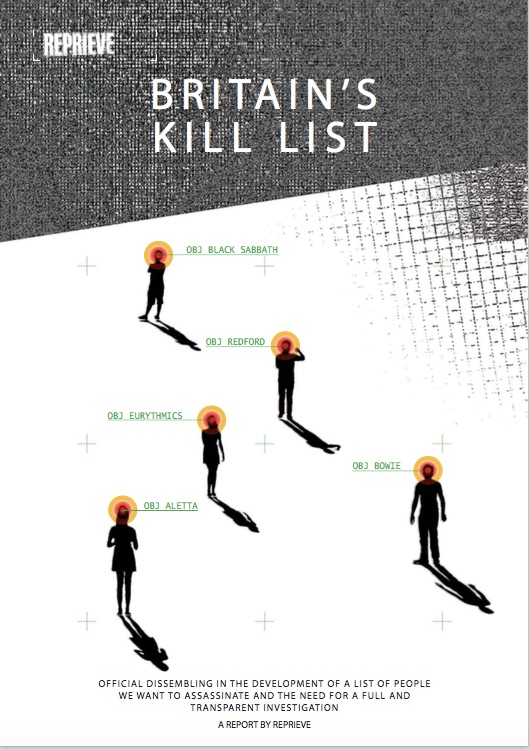
Britain's Kill List cover JPEGOver at ESIL [European Society of International Law] Reflections [5 (7) 2016], Jochen von Bernstorff has a succinct commentary on ‘Drone strikes, terrorism and the zombie: on the construction of an administrative law of transnational executions‘.

His starting-point is the UK report on the government’s policy on the use of drones for targeted killing that was published in May 2016 in response to the killing of Reyad Khan in Syria last August: you can find more in REPRIEVE’s report on Britain’s Kill List (April 2016) and in two commentaries at Just Security from Noam Lubell here and Kate Martin here.

In Jochen’s view, the UK has effectively endorsed the policies of the Obama administration and in doing so has hollowed out fundamental legal regimes that supposedly constrain state violence.

First is the concerted attempt to legitimise the unilateral killing of suspected terrorists outside ‘hot’ battlefields – in the Federally Administered Tribal Areas of Pakistan, for example – as a new form of pre-emptive self-defence to be invoked whenever the state whose sovereignty is transgressed is ‘unwilling or unable’ to take appropriate counter-measures.  I discuss other dimensions of this in ‘Dirty dancing’ (DOWNLOADS tab), and pay attention to its colonial genealogy, but Jochen emphasises another even more starkly colonial inflection:

‘The main protagonists in this discursive effort take it for granted that the new legal regime will not be applied among us, which is among Western states and the five permanent Security Council members. There will be no US-drone attacks in Brussels or Paris to kill ISIS-terrorists without the consent of the Belgian or French government, even if these governments proved to be unable to find and arrest terrorists. The new regime is a legal framework for what can be called the “semi-periphery”, consisting of states that do not belong to the inner circle or are not powerful enough to resist the application of the regime.’

Second, and closely connected, is the claim that armed conflict follows the suspect – that the individuation of warfare (‘the body becomes the battlefield’, as Grégoire Chamayou has it) licenses the everywhere war: simply, wherever the suspect seeks refuge s/he becomes a legitimate target of military violence.  But there is nothing ‘simple’ about it, Jochen contends, because this involves a wholesale exorbitation of the very meaning of armed conflict that completely trashes the role of international human rights law in limiting violence against those suspected of criminal wrong-doing.

Finally, Jochen concludes that the arguments adduced by the UK and the USA (and, I would add, Israel) demonstrate that international law is so often transformed through its violation: in Eyal Weizman‘s ringing phrase, ‘violence legislates‘.  Here is Jochen:

 ‘The Zombie is created by a fundamental reconceptualization of the notion of self- defence and armed conflict in international law with the aim to get rid of all legal constraints on state violence imposed by the law enforcement paradigm. Is this a new legal regime? Are we really moving towards an administrative law of transnational executions? It is an inherent problem of international legal discourse that measures of Great Powers violating the law will often be reformulated as an evolving new legal regime and legal scholars should be extremely sceptical of any such claims, since whoever says “emerging” in an international legal context very likely wants to cheat.’

More terror from the skies

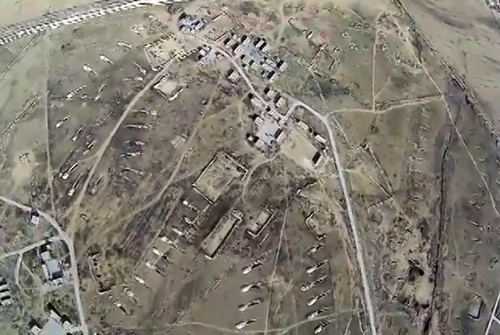
IS drone imagery Syria

Commentators have been worrying away at the likelihood of terrorist groups turning to small commercial drones not only for surveillance – IS have been doing that for some time now (see the image above) – but also for air strikes (see, for a recent example, Robert J Bunker‘s report for the US Army War College here).  The surveillance capabilities of quadcopters have been used to direct attacks by IS ground forces, including vehicles carrying suicide bombs, but the Pentagon now reports that the drones have also been equipped with improvised explosive devices (IEDs).

In response, the Pentagon has asked for $20 million for its Joint Improvised-Threat Defeat Agency to develop counter-measures: to ‘identify, acquire, integrate and conduct testing’ of methods that are able to ‘counter the effects of unmanned aerial systems and the threats they pose to U.S. forces.’

Perhaps they should also look closer to home.  Two men in Connecticut have contested the right of the Federal Aviation Administration to investigate their use of ‘recreational drones’ equipped with a handgun and a flamethrower.  Here’s a video clip:

And other commentators are already looking beyond war zones: systems like these enable groups like IS – and individuals – to carry the fight far beyond the territory they control and into the heart of cities in North America, Europe and elsewhere.

The sense of war

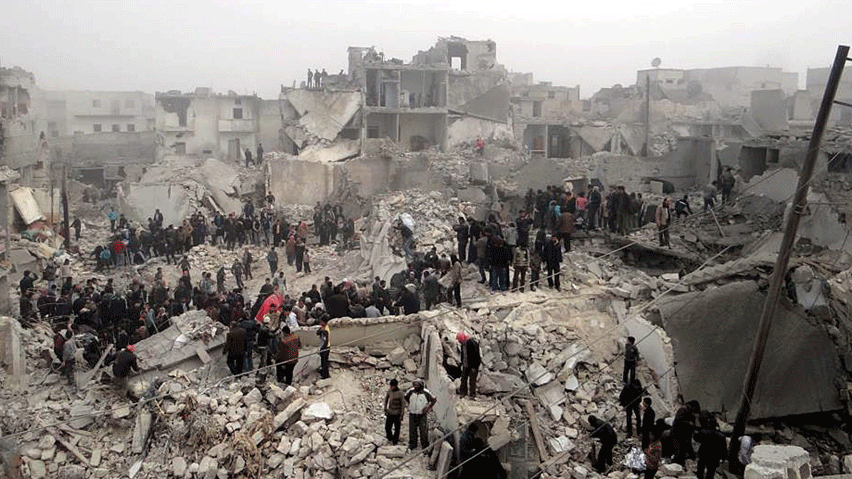
aleppo-2

In the face – often literally so – of  attempts to render later modern war as somehow bodiless, a project that contorts itself into grotesque formations around the spectacularly contradictory vocabulary of ‘surgical strikes’ against the cancerous cells of insurgency and terrorism, I continue to be drawn to attempts to convey the  corporeality of its violence.  I started down this road in ‘The natures of war‘ and continue it in my attempts to think about what I call ‘corpographies‘ (see DOWNLOADS tab for both, and also here, here and here), and it is a constant concern in my current work on casualty evacuation from war zones.

So I was taken with a short extract from Janine di Giovanni‘s The Morning They Came for Us: Dispatches from Syria (2016) that appears in Harper‘s.  It’s called ‘The Sense of War‘ (in another register so often another oxymoron):

The morning they came for usWhat does war sound like? The whistling sound of the bombs falling can only be heard seconds before impact—enough time to know that you are about to die, but not enough time to flee.

What does the war in Aleppo smell of? It smells of carbine, of wood smoke, of unwashed bodies, of rubbish rotting, of . . . fear. The rubble on the street—the broken glass, the splintered wood that was once somebody’s home. On every corner there is a destroyed building that may or may not have bodies still buried underneath. Your old school is gone; so are the mosque, your grandmother’s house and your office. Your memories are smashed…

War is empty shell casings on the street, smoke from bombs rising up in mushroom clouds, and learning to determine which thud means what kind of bomb. Sometimes you get it right, sometimes you don’t.

War is the destruction, the skeleton and the bare bones of someone else’s life.

Anand Gopal thinks her prose is ‘overwrought’, though I don’t think that’s entirely surprising, and when Sebastian Junger says that she ‘has described war in a way that almost makes me think it never needs to be described again’, even in this short passage you can see – feel – what he means.  You can find other reviews here and here.

Grim Reapers

cegrab-20160505-002509-0-1-589x442

Sky News has a report on Launch & Recovery crews responsible for US/UK drone operations against IS in Iraq and Syria based “somewhere in the Middle East”.

Much of it will be all too familiar to most readers:

Relentlessly watching their prey. Monitoring every movement a high profile Islamic State target makes.

In the words of the American officer I speak to, “we are the unblinking eye”…

“We are going to be on that target as long as the weather allows and as long as the mission allows.

In many cases there is more than one asset on that individual.

“You know when he’s going to go to the bathroom, you know when he’s going to go to eat, you know when he’s going to go to prayer time.

“You know where he goes, his associates.

“That’s all about building that picture so that we know and we can project when he’s going and where he’s going to be.”

But the video embedded in the report repays close attention, not least for the brief glimpses of the video feeds from the drones themselves.

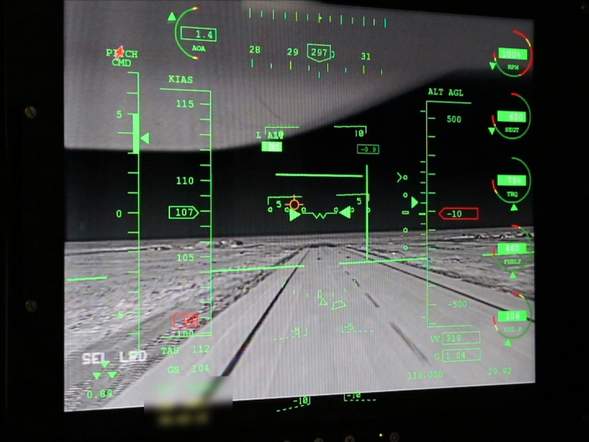
Drone airborne JPEG

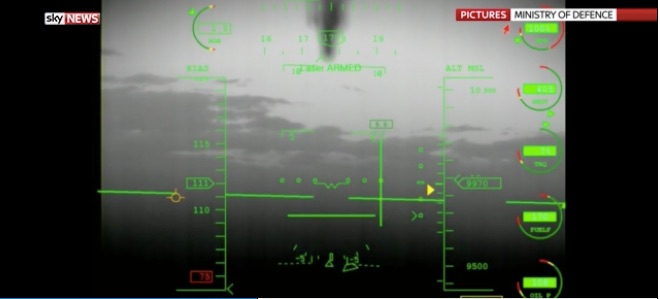
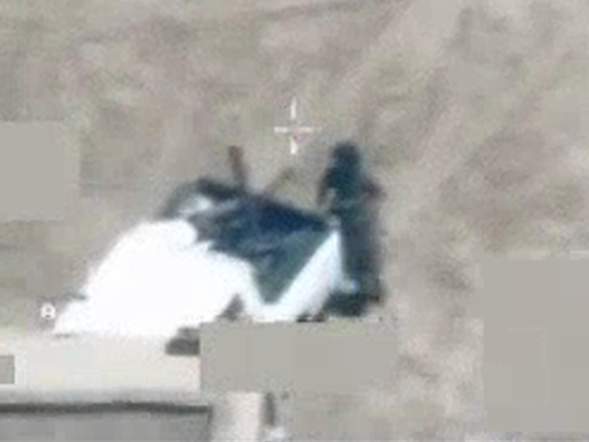
The first two images (above) are clips from the video used by the pilot to control the aircraft – a view of the runway before take-off and an airborne view before control is handed off to the crew who will fly the assault mission from ground control stations in either the US or the UK – while the third (below) is from the imagery used to identify a ‘possible target’.  The comparison between this last image and the equally ‘High Definition’ imagery released from an Italian MQ-9 Reaper late last year is instructive: see my post here.

cegrab-20160505-002219-0-1-589x442

You can find updates on the UK campaign in Iraq and Syria at Drone Wars UK here and here.

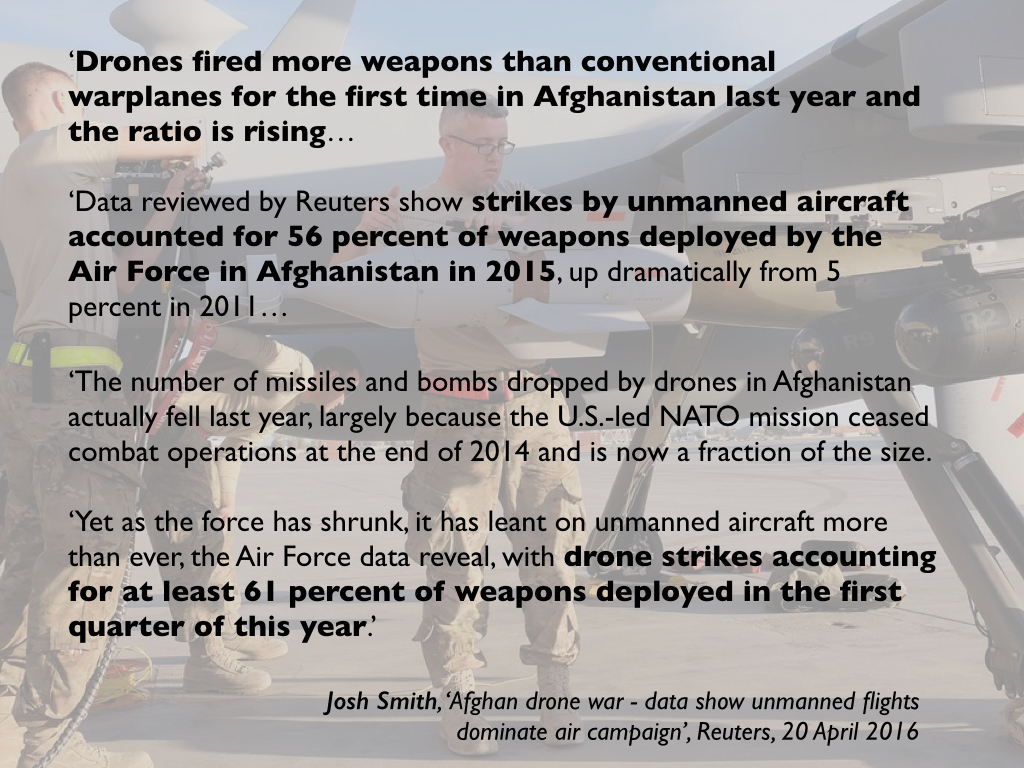
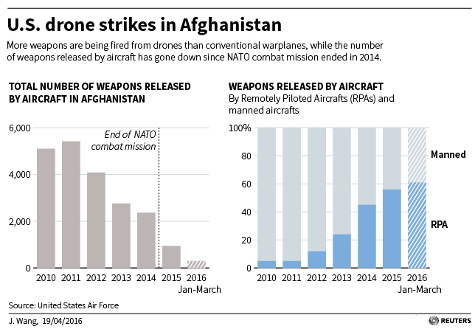
As Chris Cole reports there, too, the use of remote platforms [RPAs] to strike targets in Afghanistan has increased dramatically following the draw-down of US and NATO forces:

Drones in Afghanistan 2016.001

afghanistan-drones-sized

It is surely not coincidental that last month the US Air Force renamed eight of its RPA reconnaissance squadrons ‘attack squadrons’:

‘Eight RPA reconnaissance squadrons [based at Holloman AFB in New Mexico, Whiteman AFB in Missouri, and Creech AFB in Nevada] will be redesignated as attack squadrons [and]… Air Force Chief of Staff Gen. Mark A. Welsh III authorized RPA aircrews to log combat time when flying an aircraft within designated hostile airspace, regardless of the aircrew’s physical location.

The changes were two of many recommendations that emerged as part of Air Combat Command’s Culture and Process Improvement Program, which seeks to address a number of issues affecting operations and the morale and welfare of Airmen across the RPA enterprise….

“Aerial warfare continues to evolve. Our great RPA Airmen are leading that change. They are in the fight every day,” Welsh said. “These policy changes recognize the burdens they bear in providing combat effects for joint warfighters around the world.”’

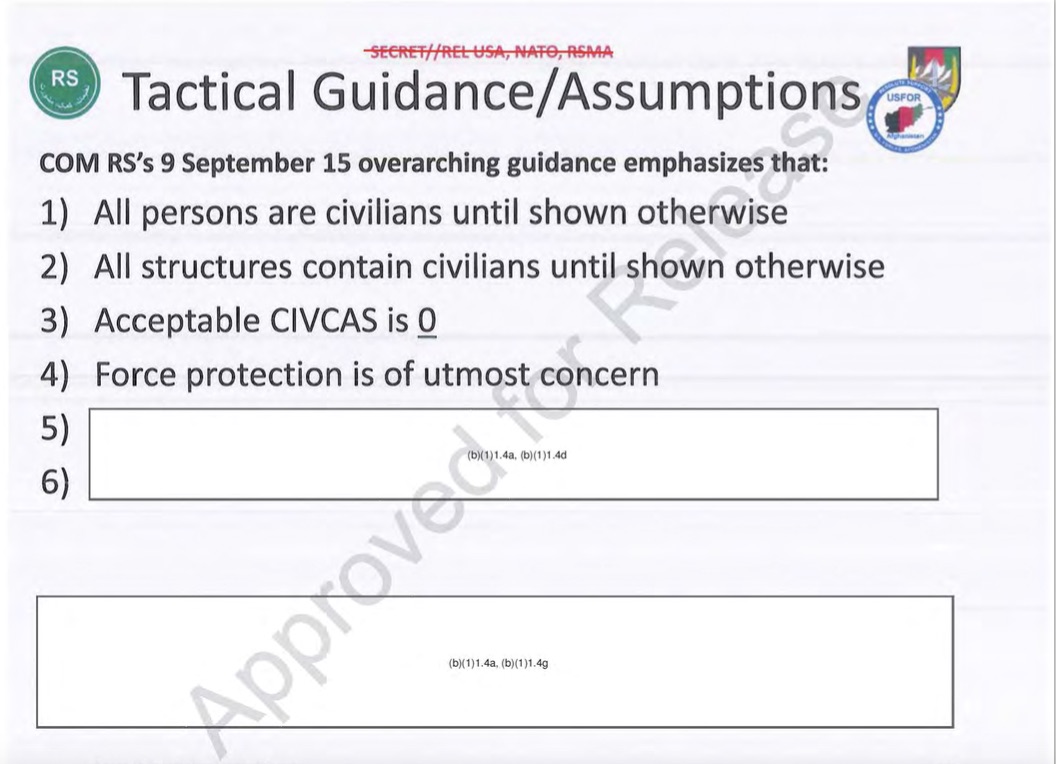
‘Acceptable CIVCAS is 0’

Kunduz 0 Extract JPEG

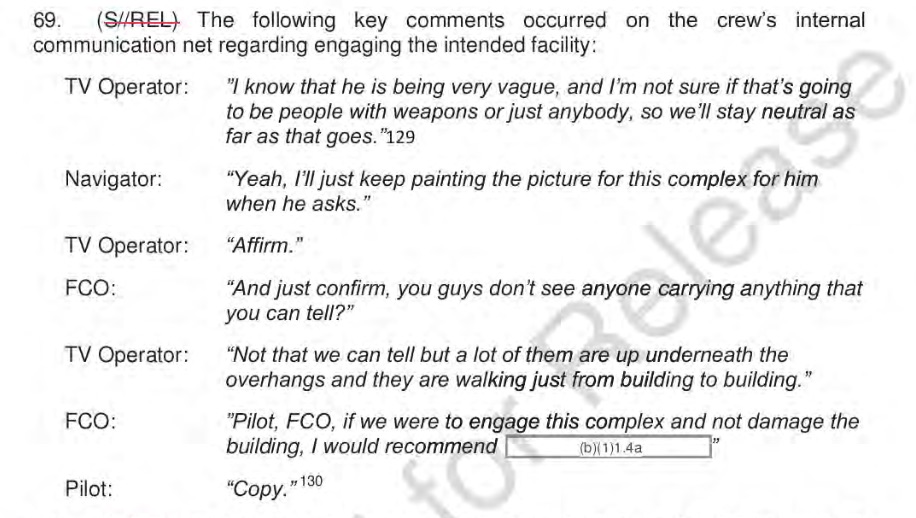
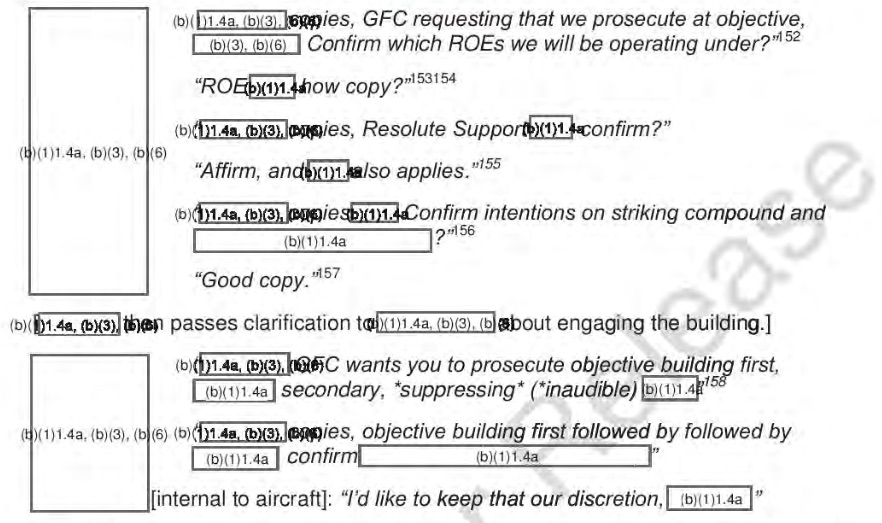
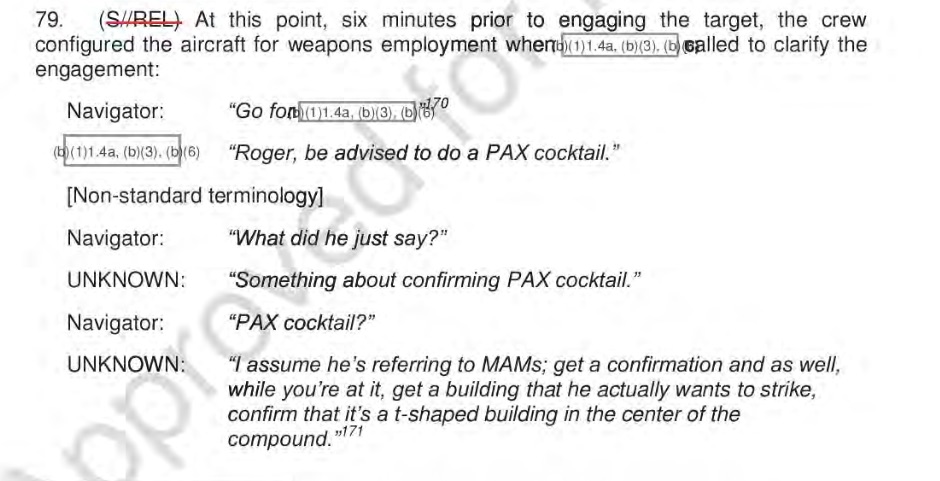
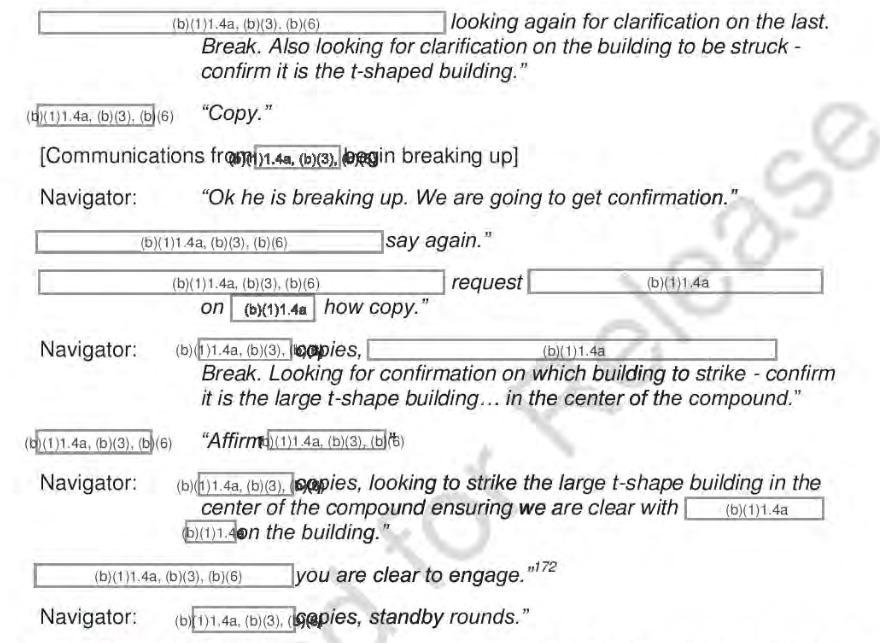
Finally US Central Command has released a redacted version of its investigation into the US airstrike on MSF’s Trauma Center in Kunduz (see my posts here, here and especially here).  You can download it from CENTCOM’s Freedom of Information Act library here.  (All the extracts pasted below capture communications exchanges before the attack, but the report includes redacted interviews with the participants involved in clearing, executing and continuing the air strike; the image above – and the title for this post – is taken from a briefing slide included in the report).

Kunduz A extract JPEG

I’ll be spending the weekend reading it, but meanwhile the Intercept has published its own long-form account of the attack by May Jeong – ‘Death from the sky: searching for ground truth in the Kunduz hospital bombing‘.  It was written before CENTCOM’s investigation was released but includes details from a series of interviews and is truly compelling reading.

Kunduz B extract JPEG

I obviously won’t be alone in working my way through the report.  Yesterday MSF was briefed by the head of CENTCOM, General Joseph Votel, and today released this preliminary statement:

MSF will take the time necessary to examine the U.S. report, and to determine whether or not the U.S. account answers the many questions that remain outstanding seven months after the attack.

MSF acknowledges the U.S. military’s efforts to conduct an investigation into the incident. Today, MSF and other medical care providers on the front lines of armed conflicts continually experience attacks on health facilities that go un-investigated by parties to the conflict. However, MSF has said consistently that it cannot be satisfied solely with a military investigation into the Kunduz attack. MSF’s request for an independent and impartial investigation by the International Humanitarian Fact Finding Commission has so far gone unanswered….

The hospital was fully functioning at the time of the airstrikes. The U.S. investigation acknowledges that there were no armed combatants within – and no fire from – the hospital compound.

The nature of the deadly bombing of the MSF Kunduz Trauma Centre, and the recurring attacks on medical facilities in Afghanistan, demand from all parties to the conflict a clear reaffirmation of the protected status of medical care in the country. MSF must obtain these necessary assurances in Afghanistan before making any decision on if it is safe to re-start medical activities in Kunduz.

Kunduz C extract JPEG

The Pentagon has insisted that no war crimes were committed but confirmed that 16 people had been punished.  Mark Thompson explains:

None of those involved will face court martial, but the administrative punishments levied against them—ranging from removal from command, letters of reprimand, to counseling—likely mark the end of their careers in uniform. None was identified by name. Those involved—the highest-ranking was a two-star general—included those aboard the AC-130 gunship that repeatedly fired on the Doctors Without Borders hospital in Kunduz, as well as members of the Army Special Force team on the ground that called in the strikes.

MSF has, understandably, condemned this response, arguing that the punishments

are out of proportion to the destruction of a protected medical facility, the deaths of 42 people, the wounding of dozens of others, and the total loss of vital medical services to hundreds of thousands of people. The lack of meaningful accountability sends a worrying signal to warring parties, and is unlikely to act as a deterrent against future violations of the rules of war.

That last sentence is particularly important, because there has been a steady increase in the targeting of medical personnel and medical facilities in Afghanistan, occupied Palestine, Syria and elsewhere: all gross violations of medical neutrality.

Kunduz D extract JPEG

So this commentary from Joanne Liu (International President of MSF) and Peter Maurer (President of the International Committee of the Red Cross) – also published today – is much more than a response to the bombing of yet another MSF facility, this time in Aleppo:

What we are witnessing is a sustained assault on, and massive disregard for, the provision of healthcare during times of conflict. Under international humanitarian law and principles, health workers must be able to provide medical care to all sick and wounded regardless of political or other affiliation, whether they are a combatant or not. And under no circumstances should they be punished for providing medical care which is in line with medical ethics. The doctor of your enemy is not your enemy.

But we are confronted with violations of these fundamental rules, with serious humanitarian consequences, for entire communities and healthcare systems that are already stretched to the limit. And this is not just the opinion of MSF and the Red Cross Red Crescent Movement.

That is why we, as the presidents of MSF and the ICRC, welcome the proposal for a landmark UN resolution to protect healthcare. But we urge the UN security council to make the resolution effective. First, it should send a powerful political message that healthcare needs to be protected. All parties to an armed conflict must fully comply with their obligations under international law, including humanitarian law. And they must clearly state their respect for the delivery of impartial medical care during times of conflict.

Second, it must urge states and all parties to armed conflict to develop effective measures to prevent violence against medical personnel, facilities and means of transport. States need to bolster, where appropriate, their legislation including by lifting restrictions and sanctions impeding impartial wartime medical care.

Armed forces and all parties to a conflict should integrate practical measures for the protection of the wounded and sick and for those engaged in medical work. These should be incorporated into orders, rules of engagement, standard operating procedures and training.

Third, it must acknowledge that when attacks on medical facilities and personnel do take place, there needs to be full, prompt, impartial and independent investigations to establish the facts. It cannot only be the victims or perpetrators who attempt to establish the facts. And there should be regular and formal reporting of such attacks at the highest level and an annual debate in the security council.

Underpinning everything has to be the acceptance that the medical needs of people – no matter who they are, where they are from or what side they support or fight for – must take precedence. Medical staff are present in areas of conflict in order to care for the sick and wounded, on the basis of need. And only need. This is the fundamental principle of impartiality and is the basis of medical ethics. It is the very fact that doctors treat on the basis of need – and are not involved in hostilities – that they can claim protection under international humanitarian law.

But there is more.  John Sifton from Human Rights Watch insists that General Viotel was simply wrong to claim that war crimes must be deliberate or intentional, so that those involved in the attacks on the MSF hospital could be absolved of criminal responsibility because the acts they committed were genuine mistakes.  According to the New York Times, Sifton argued:

There are legal precedents for war crimes prosecutions based on acts that were committed with recklessness, and that recklessness or negligence do not necessarily absolve someone of criminal responsibility under the United States military code.


The Geographies of Sixty Minutes

One of the cardinal principles informing modern casualty evacuation is the Golden Hour.  In 1975 R. Adams Cowley, founder of Baltimore’s Shock Trauma Institute, argued that ‘the first hour after injury will largely determine a critically injured person’s chances for survival.’  It’s not a straightforward metric, and combat medical care and evacuation has been transformed since it was first proposed, but the rule of thumb is that the chances of survival are maximised if the time between traumatic injury and definitive care is kept to 60 minutes or less.

Following a fire-storm of criticism on 15 June 2009 US Secretary of Defense Robert Gates required the standard time between a call for evacuation and treatment of the critically injured to be 60 minutes or less.  For US military personnel in the Second World War the average time was 10 hours; in Korea that had been cut to 5 hours (the result of using helicopters for speedy evacuation); and in Vietnam it was already down to one hour.  The reason for Gates’s intervention was that in Afghanistan the aim was two hours…

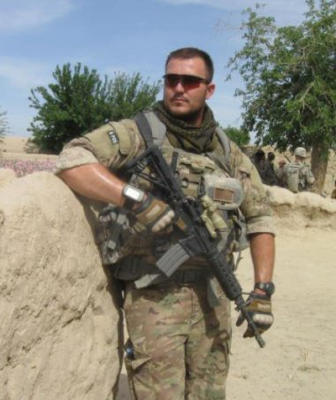
U.S. Air Force Sgt. Daniel Fye serving on a tour in the Kandahar province of Afghanistan in April 2011. (Courtesy of Daniel Fye)

U.S. Air Force Sgt. Daniel Fye serving on a tour in the Kandahar province of Afghanistan in April 2011. (Courtesy of Daniel Fye)

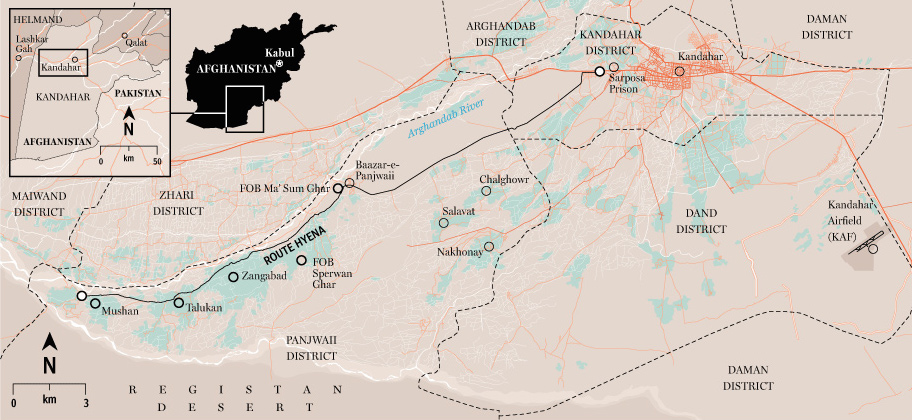
The importance of those time-critical sixty minutes was no secret to the troops in the line of fire.  Here is a scene from Brian Castner‘s truly brilliant All the ways we die and kill which imagines the thoughts running through one soldier’s head – Air Force Technical Sergeant Dan Fye on his third tour of duty with Explosive Ordnance Disposal (above) – after he stepped on an IED during a clearance operation in Mushan (Panjwayi) on 27 May 2011:

They worked on Fye a long time, and the longer they worked, the more anxious Fye got about the precious minutes slipping away. “I don’t hear the bird,” he said, over and over. They wrote the time of the tourniquet application on the white headband Fye wore under his helmet. Hopkins pushed morphine into his veins.

Eventually, an eon since Hopkins arrived but only twenty-five minutes after the blast, the hyperactive thump of helo blades cutting air slowly emerged in the distance.

Fye thought it was the most wonderful sound he had ever heard. They were at the extreme limit of the NATO footprint, and so it was a sixty-kilometer flight to the main hospital at Kandahar [see map below]. If they moved quickly, Fye would just make it in the magic golden hour.

1-FO0625_KandaharMap

Castner writes that as Fye was bleeding out in the back of the helicopter, he was

‘clinging to one thought and one thought only, running in a continuous Times Square news ticker across the front of his oxygen-starved brain: One hour. If I can get back to Kandahar in one hour, I’ll live. One hour, and I’ll live. That’s what they say. You’ll make it if you can get back to the hospital in one hour.’

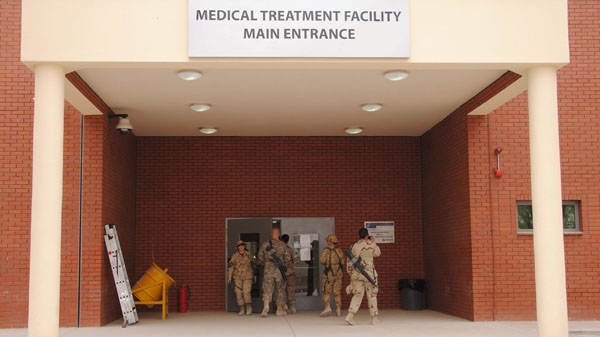
He made it.  The new, modernised and expanded Role 3 NATO hospital at Kandahar had opened a year earlier, and its executive officer claimed that ‘They hit our doors, they live.’

Kandahar new Role 3 2010

But Fye was lucky.  Later he learned why it had taken so long for the helicopter to arrive, and why he very nearly never made it to Kandahar at all:

Over multiple radio calls between Hopkins’s platoon and the rescue operations center, his report of “bilateral amputation” had been converted, telephone-game style, into “bilateral lacerations.” The medical operations center had actually turned the rescue mission off; helos don’t fly for scraped knees. The bird that eventually picked up Fye wasn’t even a real medevac bird. That’s why the robotic flight crew ignored him, didn’t treat his wounds as they went. They weren’t medics. The helo pilots had just been in the air and happened to overhear the radio traffic, including the original call for help. They understood the mistake and had disobeyed orders to go get Fye. If the human pilot of that bird had been less stubborn, the golden hour would have been long past by the time Fye made it to KAF, and he could well have been one of the 1 percent.

(More from Brian on medical evacuation here and here).

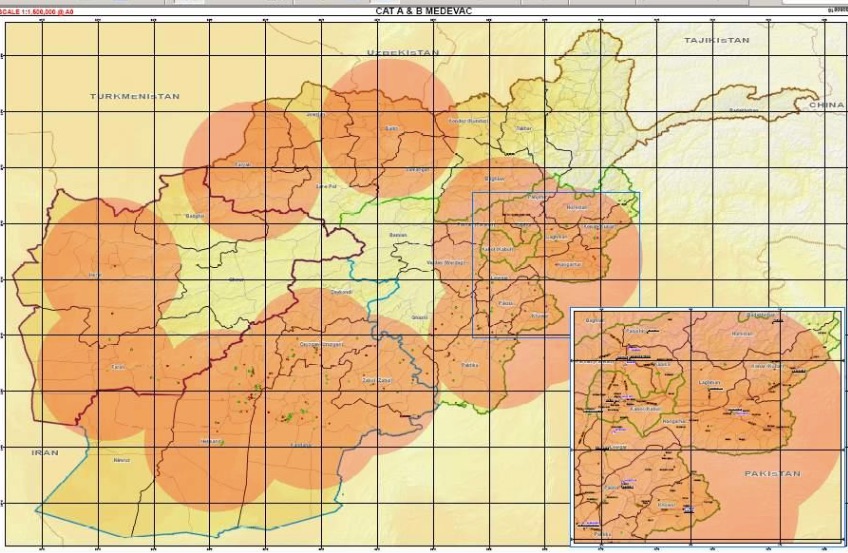
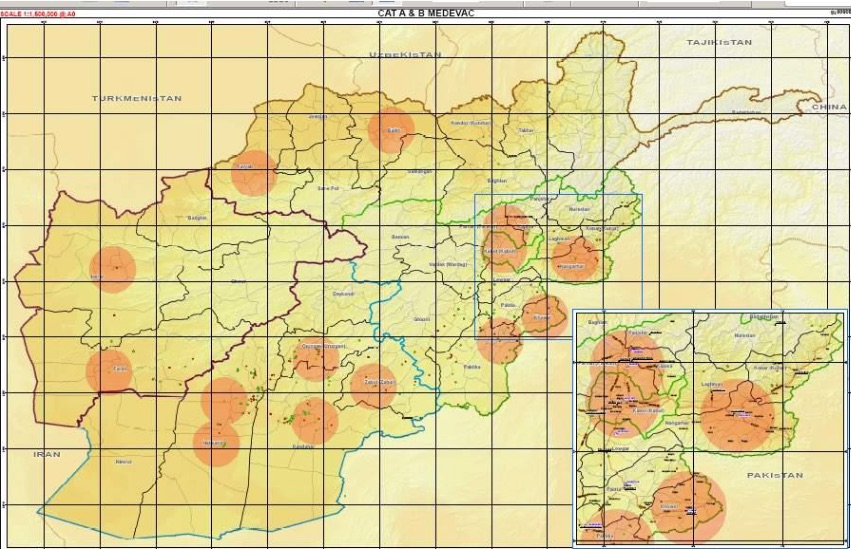
Even without miscommunication the logistical challenges were formidable.  In 2007, two years before Gates’ intervention, ISAF produced this map showing the medevac coverage – what Fye called the ‘NATO footprint’ – that supported that two-hour standard (I have taken this map and the following one from a report prepared by Col Dr Ingo Hartenstein for NATO/ISAF in December 2008 which is available here; scroll down):

ISAF Medevac coverage 2 hours

Like Vietnam, Afghanistan was a ‘war without fronts’ with a battlefield geometry that imposed a radically different evacuation model from the classical line of evacuation that had been established during the First World War.  Here is how Brian Turner puts it in My life as another country:

We won’t hear the battle in progress and work our way toward it as baggage trains of wounded, exhausted soldiers and civilians carrying their lives on their backs travel in the opposite direction. Our battle space – and perhaps it’s a cliché now – will occur in a 360-degree, three-dimensional environment.

More technically, here is Brigadier Martin Bricknell, who served (among many other roles) as Medical Adviser to ISAF’s Regional Command South in Kandahar in 2010:

The tactical geometry for the current operating environment is based upon security forces holding areas of ground and securing this space from opposition activity. This converts the battlefield from the conventional force-on-force linear geometry with an identifiable confrontation line to an area battlefield with multiple nodes of contested space. Thus the MEDEVAC mission is converted from a linear flow to area support, hence MEDEVAC planning is based upon a ‘range ring’ coverage with a radius of 40–60 nautical miles.

Given the available resources, a second map showed how those ‘range rings’ would contract if the Golden Hour were to be imposed over the evacuation grid:

ISAF MEDEVAC coverage allowing 1 hr from POI to surgery HARTENSTEIN

In practice, the situation was more variable than these maps imply – not least because there was a significant difference between the ways in which American and British contingents organised medical evacuation.

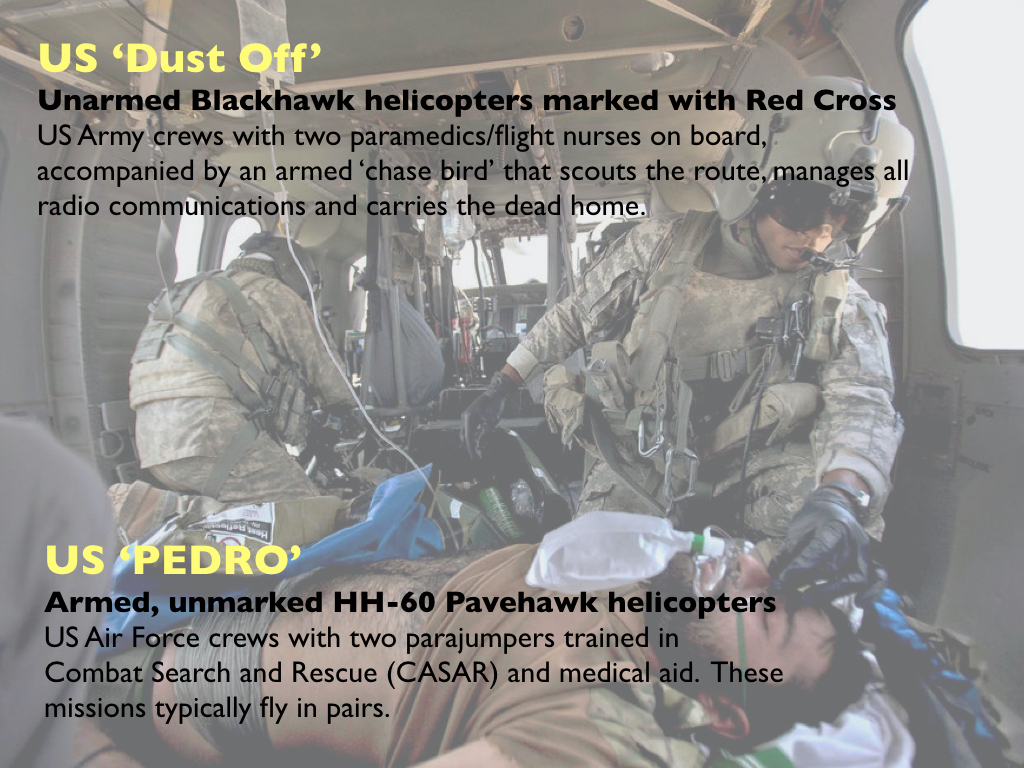
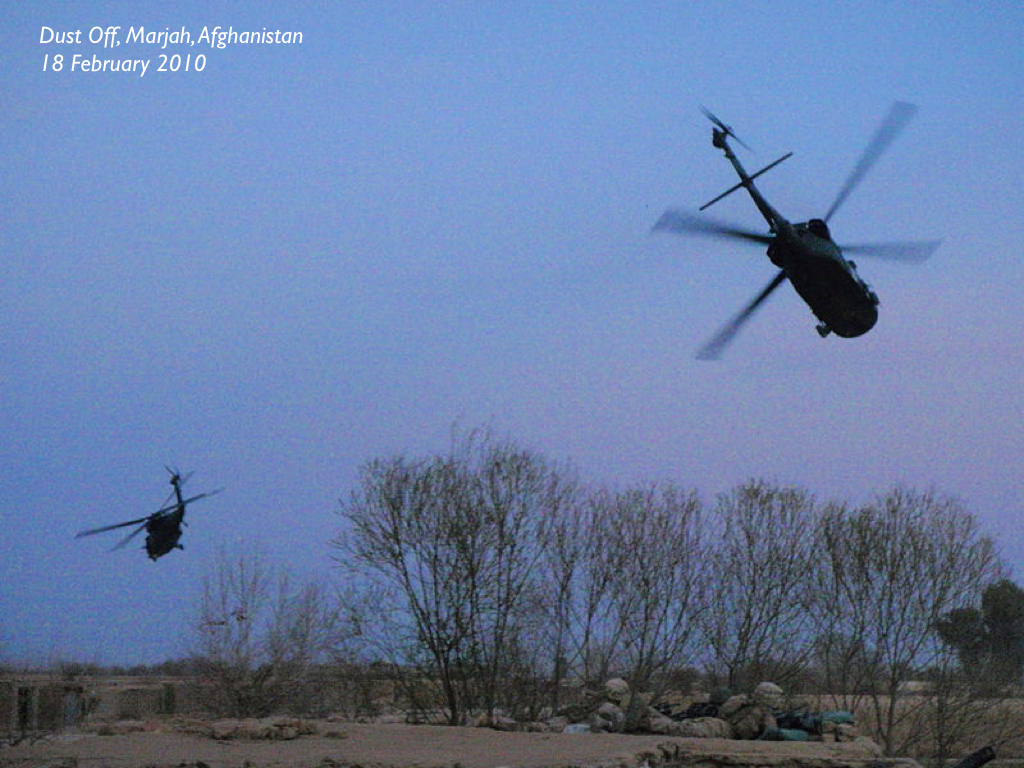
The US military, drawing on their experience in Vietnam, used Blackhawk or Pavehawk helicopters to get paramedics or combat medical technicians to the casualty as fast as possible:

DUST OFF Afghanistan.001

DUST OFF Afghanistan.002

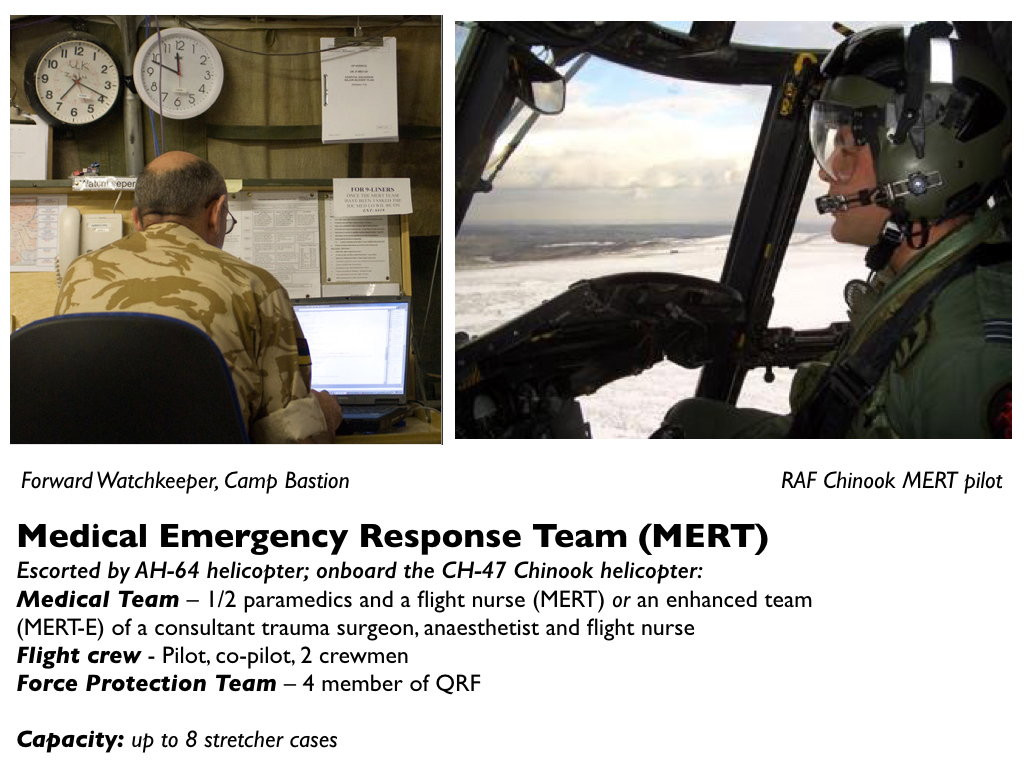
The British used larger Chinook helicopters to dispatch a Medical Emergency Response Team (MERT) with a trauma surgeon onboard to the casualty close to the point of injury (POI):

MERT Afghanistan.001

The response time was usually longer but the MERT enabled advanced trauma care to begin as soon as the patient was onboard.

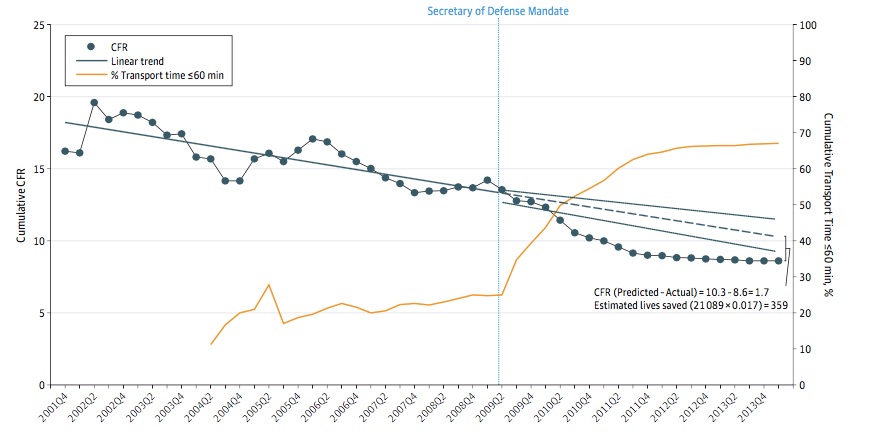
There has been considerable debate and disagreement about the robustness of the ‘Golden Hour’ in military trauma care and its relation to evacuation pathways: see, for example,  Jonathan Clarke and Peter Davis, ‘Medical evacuation and triage of combat casualties in Helmand Province, Afghanistan: October 2010-April 2011’, Military Medicine 171 (11) (2012) 1261-6.  But a research team has now calibrated the effects of reduced evacuation time on US casualty fatality rates (CFR) in Afghanistan between 2001 and 2014 [Russ Kotwal et al, ‘The effect of a Golden Hour policy on the morbidity and mortality of combat casualties’, JAMA Surgery 151 (1) (2016) 15-24; see also here]:

KOTWAL Case fatality rate and transport time

For 4,500 cases of US military casualties with detailed data the study showed a substantial change in the CFR following the Secretary of Defense’s mandate to evacuate casualties within 60 minutes: as the median evacuation time fell from 90 minutes to 43 minutes the CFR fell from 13.7 to 7.6; before the mandate 25 per cent of casualty evacuation missions fell within the Golden Hour, after the mandate the proportion soared to 75 per cent.

The interpretive field is a complicated one – while a significant number of casualties who would previously have died from their wounds now survived, a proportion of those who would previously have been recorded as ‘killed in action’ (KIA) none the less now ‘died of wounds’ (DOW) – and the reasons for the improvement in survival rates are also multivariate:

‘Secondary effects resulting from the mandate that contributed to achieving the mandated time included stream-lined authority and helicopter launch procedures, increased number and dispersion of Army helicopters, and the addition of Air Force helicopters to assist with the Army prehospital transport mission. As decreased time from critical injury to treatment capability was the underlying goal, personnel with increased expertise (blood transfusion protocol-trained basic medics, critical care paramedics, and critical care nurses) were trained and assigned to prehospital flights more routinely, resulting in earlier availability of blood products and other advanced care.

In addition, an increase in the number and dispersion of small but mobile forward surgical teams across the battle-field brought major surgical capability even closer to the point of injury and provided an alternative to transporting patients longer distances to large, but less mobile, civilian trauma center–equivalent [Combat Support Hospitals].’

GoldenHourFig1

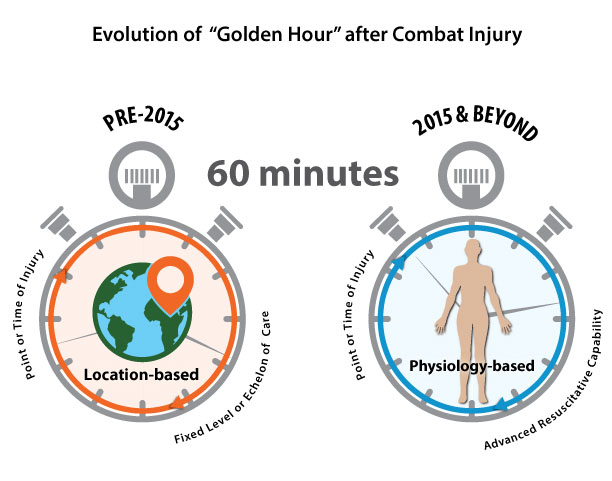
These findings – together with the experience of the British MERTs – intersect with a recalibration of the Golden Hour.  The US Combat Casualty Care Research Program (CCCRP) has proposed an ‘evolved concept’ (see the figure above) that moves from a location-based protocol to a physiological one:

The program must be willing to turn the doctrine of fixed or traditional echelons of care on its side and innovate for scenarios in which Level II and III care is performed aboard transport vehicles (land-, air- or sea-based) or within local structures of opportunity. In such circumstances, field care may be prolonged, lasting for days or even weeks. Combat casualty care research with these complex scenarios in mind promises to enhance resuscitative capability for injured service personnel regardless of environment, leveraging communications networks (i.e., telementoring) and targeted resupplies of materials. In the future, CCCRP must focus on transforming the concept of the golden hour into one bound not by the time to reach traditional echelons of care or fixed facilities, but the time until enhanced resuscitative capability can be delivered to the injured troop, regardless of location or need for transport.

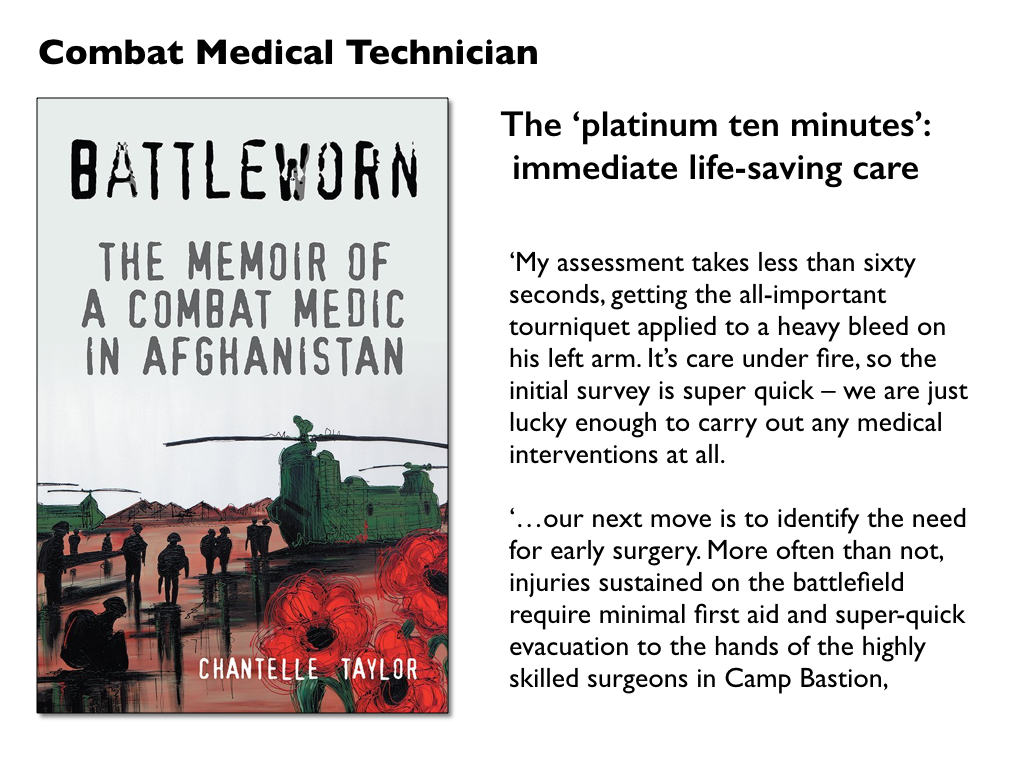
There are two riders to add.  First, embedded within the Golden Hour are ‘the platinum ten minutes’: the imperative to stop bleeding (which has led to the re-emergence and re-engineering of the tourniquet) and to control the casualty’s airway within 10 minutes of wounding.

Combat Medical Technician and Platinum 10 minutes.001

The second is that the speed of treatment and trauma care available to American and British soldiers is radically different from that available to Afghan soldiers and police officers.  Previously, they could rely on aeromedical evacuation by their allies.  But now most of their medical evacuations take place by land, over difficult and dangerous roads.  Last September Josh Smith reported:

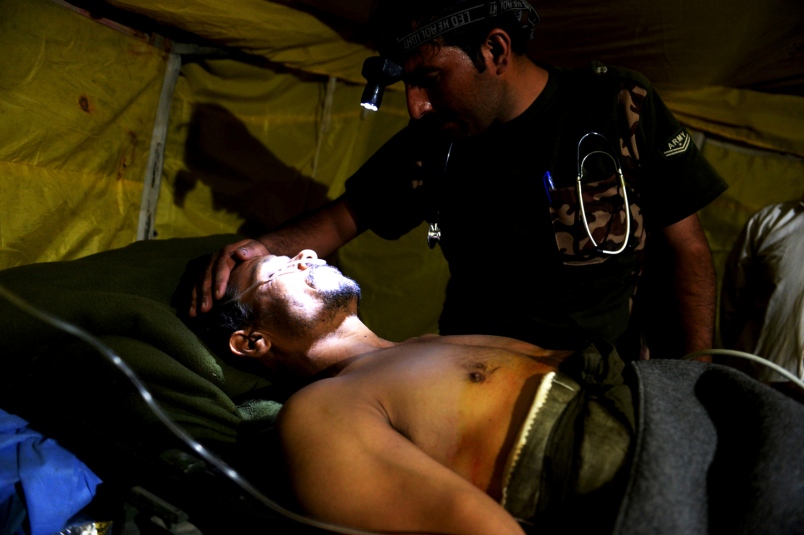
Under the dim light of a single bulb, a local Afghan policeman lay severely injured, slipping in and out of consciousness. A military doctor reported to an Afghan army brigade commander that the man was unlikely to live through the night.

Injured Afghan policeman examined by Afghan Army doctor August 2015

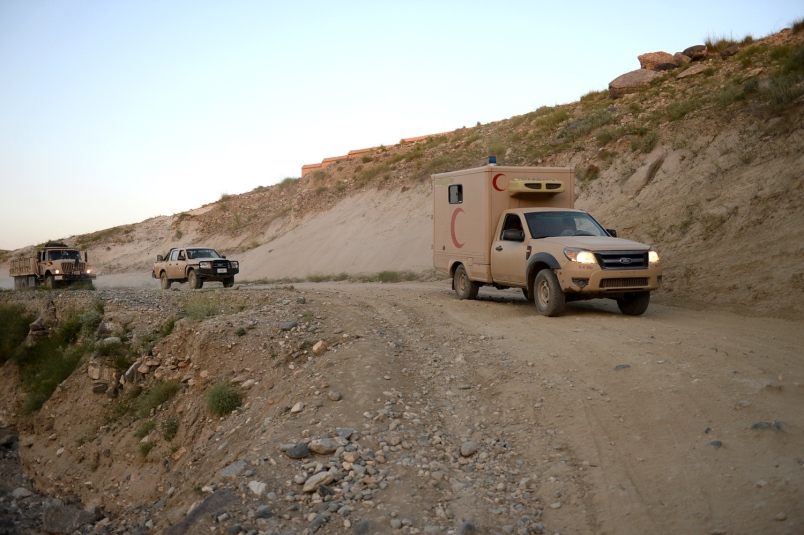
Despite the doctor’s pleas, the commander stood firm. The army could not spare any soldiers or ambulances [below] to make the five-hour drive to a better hospital at that late hour through territory teeming with Taliban ambushes and roadside bombs.

, Nangarhar province, August 2015

The lack of speedy evacuation is a tragically common problem for the rising number of Afghan police and soldiers being injured on the battlefields of Afghanistan. U.S. advisers have worked to help close the capability gap, but mostly behind the scenes, far from the battlefields where many Afghan troops say they increasingly feel alone.

Although the American forces still stationed in the country have conducted more than 200 airstrikes since their combat mission was declared over at the end of 2014, as of July, U.S. military aircraft had not flown a single conventional medical evacuation mission, according to data released by the U.S. Air Force Central Command.

U.S. military officials say they haven’t flown evacuation missions because they haven’t been asked. Also, there are far fewer American resources available for such missions now.

The difference shows up in the ratios of those killed and those who survived their wounds.

About 2,363 Americans have died in Afghanistan, with a little more than 20,000 wounded, a ratio of roughly 1-to-10.  In the first half of 2015 alone, 4,302 Afghan soldiers and police were killed in action and 8,009 more were wounded, a ratio of about 1-to-2.

Even where aircraft and trained medical technicians are available, Jeff Schogol found that the Afghan capability falls well outside the Golden Hour:

The time it takes to fly patients to hospitals varies depending on the point of injury, but it can take between 90 minutes and two and a half hours to fly an aeromedical evacuation mission in a C-208, plus one hour to transfer patients from Kandahar to Kabul in a C-130.

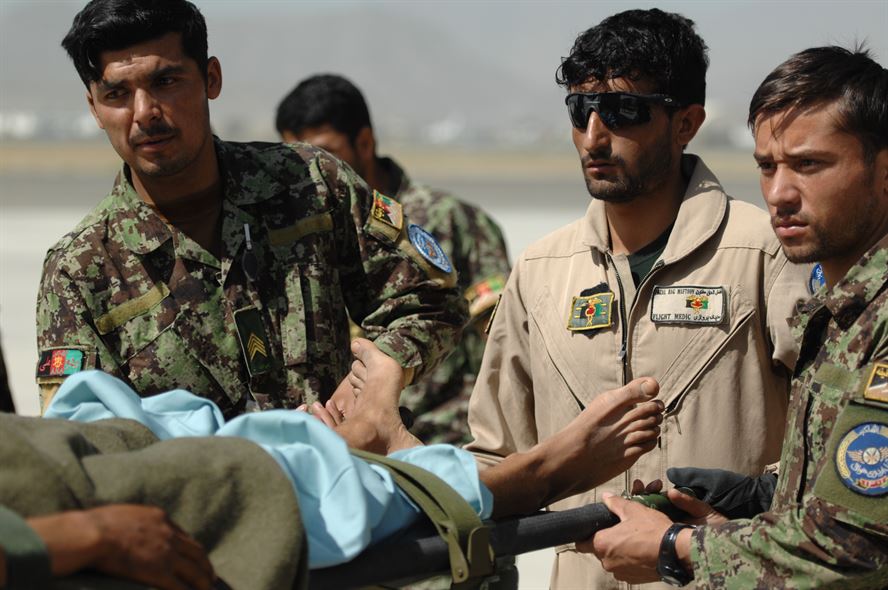
Injured ANA soldier lifted from Afghan Air Force C-27A

And the situation for Afghan civilians – as I explored in detail in ‘The prosthetics of military violence‘ – is still worse.

This is not a problem confined to Afghanistan: think of how the possibility of the Golden Hour recedes in urban combat zones subjected to artillery fire and bombing – the difficulties faced by first responders in Gaza or in the ravaged, rubble-strewn towns and cities of Syria (see also Annie Sparrow‘s report here).

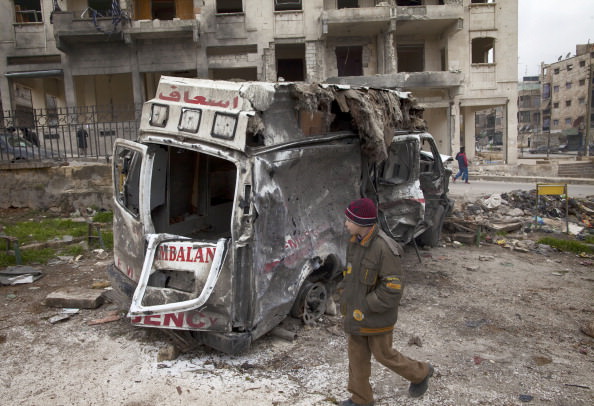
 A Syrian youth walks past a destroyed ambulance in the Saif al-Dawla district of the war-torn northern city of Aleppo on January 12, 2013. An accident and emergency centre in Aleppo uses an abandoned supermarket to conceal a fleet of 16 ambulances, just 10 of which are in working order and are driven by 22 staff members. AFP PHOTO/JM LOPEZ/ (Getty Images)


A Syrian youth walks past a destroyed ambulance in the Saif al-Dawla district of the war-torn northern city of Aleppo on January 12, 2013. An accident and emergency centre in Aleppo uses an abandoned supermarket to conceal a fleet of 16 ambulances, just 10 of which are in working order and are driven by 22 staff members. AFP PHOTO/JM LOPEZ/ (Getty Images)

And there is no guarantee of safety even once casualties reach hospital since the principle of medical neutrality is now being routinely and systematically violated.

Red Cross-Fire

Yet more on violations of medical neutrality in contemporary conflicts (see my posts here, herehere and here).  Over at Afghan Analysts Network Kate Clark provides a grim review of (un)developments in Afghanistan, Clinics under fire? Health workers caught up in the Afghan conflict.

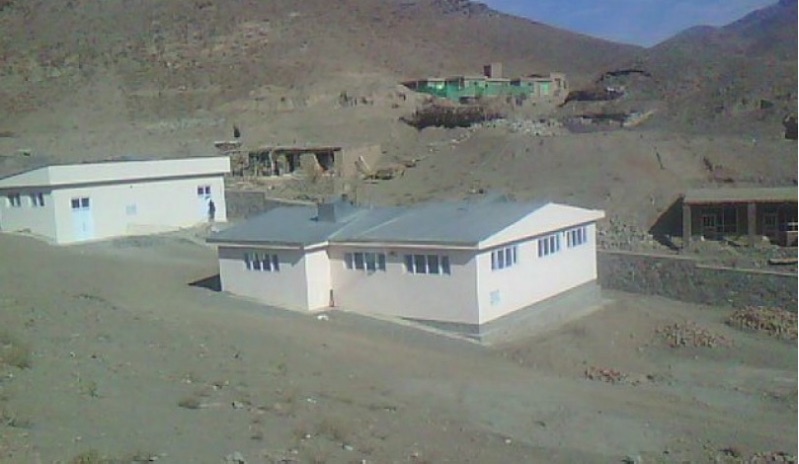
Those providing health care in contested areas in Afghanistan say they are feeling under increasing pressure from all sides in the war. There have been two egregious attacks on medical facilities in the last six months: the summary execution of two patients and a carer taken from a clinic in Wardak by Afghan special forces in mid-February – a clear war crime – and the United States bombing of the Médecins Sans Frontières (MSF) hospital in Kunduz in October 2015, which left dozens dead and injured – an alleged war crime. Health professionals have told AAN of other violations, by both pro and anti-government forces. Perhaps most worryingly, reports AAN Country Director Kate Clark, have been comments by government officials, backing or defending the attacks on the MSF hospital and Wardak clinic [see image below].
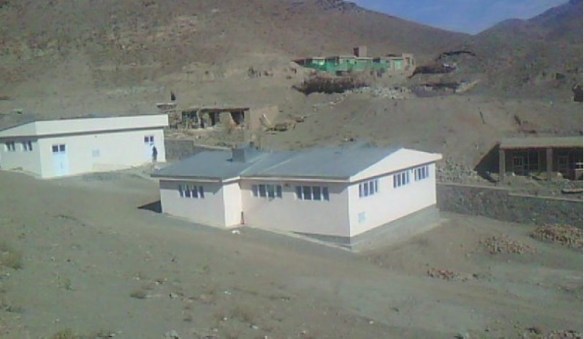
SCA Wardak clinic JPEG

So, for example:

Afghan government reactions to the news of the Wardak killings [at Tangi Sedan during the night of 17/18 February 2016; see also here] came largely at the provincial level, from officials who saw no problem in those they believed were Taleban – wounded or otherwise – being taken from a clinic and summarily executed. Head of the provincial council, Akhtar Muhammad Tahiri, was widely quoted, saying: “The Afghan security forces raided the hospital as the members of the Taliban group were being treated there.” Spokesperson for the provincial governor, Toryalay Hemat, said, “They were not patients, but Taliban,” and “The main target of the special forces was the Taliban fighters, not the hospital.” Spokesman for Wardak’s police chief, Abdul Wali Noorzai, said “Those killed in the hospital were all terrorists,” adding he was “happy that they were killed.”

Yet, the killings were a clear war crime. The Laws of Armed Conflict, also known as International Humanitarian Law, give special protection to medical facilities, staff and patients during war time – indeed, this is the oldest part of the Geneva Conventions. The Afghan special forces’ actions in Wardak involved numerous breaches: forcibly entering a medical clinic, harming and detaining staff and killing patients.  The two boys and the man who were summarily executed were, in any case, protected either as civilians (the caretaker clearly, the two patients possibly – they had claimed to have been injured in a motorbike accident) or as fighters who were hors d’combat (literally ‘out of the fight’) because they were wounded and also then detained.  Anyone who is hors d’combat is a protected person under International Humanitarian Law and cannot be harmed, the rationale being that they can no longer defend themselves. It is worth noting that, for the staff at the clinic to have refused to treat wounded Taleban would also have been a breach of medical neutrality: International Humanitarian Law demands that medical staff treat everyone according to medical need only.

That the Wardak provincial officials endorsed a war crime is worrying enough, but their words echoed reactions from more senior government officials to the US military’s airstrikes on a hospital belonging to the NGO Médecins Sans Frontières on 3 October 2015. Then, ministers and other officials appeared to defend the attack by saying it had targeted Taleban whom they said were in the hospital (conveniently forgetting that, until the fall of Kunduz city became imminent when the government evacuated all of its wounded from the hospital except the critically ill, the hospital had largely treated government soldiers). The Ministry of Interior spokesman, for example, said, “10 to 15 terrorists were hiding in the hospital last night and it came under attack. Well, they are all killed. All of the terrorists were killed. But we also lost doctors. We will do everything we can to ensure doctors are safe and they can do their jobs.”

MSF denied there were any armed men in the hospital. However, even if there had been, International Humanitarian Law would still have protected patients and medical staff: they would still have had to have been evacuated and warnings given before the hospital could have been legally attacked.

Not surprisingly heads of various humanitarian agencies all reported that the situation was worsening:

“General abuses against medical staff and facilities are on the rise from all parties to the conflict,” said one head of agency, while another said, “We have a good reputation with all sides, but we have still had threats from police, army and insurgents.” The head of a medical NGO described the situation as “messy, really difficult”:

All health facilities are under pressure. We have had some unpleasant experiences, The ALP [Afghan Local Police] are not professional, not disciplined. If the ALP or Taleban take over a clinic, we rely on local elders [to try to sort out the situation]. We are between the two parties.

He described the behaviour of overstretched Afghan special forces as “quite desperate,” adding, “They are struggling, trying to be everywhere and get very excited when there’s fighting.” Most of them, he said, were northerners speaking little or no Pashto, which can make things “difficult for our clinics in the south.”

The head of another agency listed the problems his staff are facing:

“We have seen the presence of armed men in medical facilities, turning them into targets. We have seen violations by the ANSF [Afghan National Security Forces], damage done to health facilities that were taken over as bases to conceal themselves and fight [the insurgents] from. We have seen checkpoints located close to health centres. Why? So that in case of hostilities, forces can take shelter in the concrete building. We have seen looting. We have seen ANSF at checkpoints deliberately causing delays, especially in the south, including blocking patients desperately needing to get to a health facility. We can never be certain that [such a delay] was the cause of death, but we believe it has been.”

He said his medical staff had been threatened by “ANSF intervening in medical facilities at the triage stage, forcing doctors to stop the care of other patients and treat their own soldiers, in disregard of medical priorities.” Less commonly, but more dangerously for the doctors themselves, he said, was the threat of Taleban abduction. He described a gathering of surgeons in which all reported having been abducted from their homes at least once and brought to the field to attend wounded fighters “with all the dangers you can imagine along the road.” He said the surgeons were “forced to operate without proper equipment and forced to abandon their own patients in clinics because the abduction would last days.”

Locally, medical staff often try to mitigate threats from both government forces and insurgents by seeking protection first from the local community. One head of agency described their strategy:

“When we open a clinic, our first interlocutors are the elders. Everyone wants a clinic in their area, but we decide the location and make the elders responsible for the clinic… They have to give us a building – three to four rooms. All those who work in the clinic – the ambulance driver, the owner of the vehicle, everyone – come from the area. We also need the elders to deal with the parties… If the ALP or Taleban take over clinic, we always start with the elders [who negotiate with whoever has taken over the clinic].”

However, this tactic puts a burden on community elders who may not be able to negotiate if the ANSF, ALP or insurgents are also threatening them.

***

I’ve delayed following up my previous commentaries on the US airstrike on the MSF Trauma Center in Kunduz (here and here) because I had hoped the full report of the internal investigation carried out by the US military would be released: apparently it runs to 3,000-odd pages.  I don’t for a minute believe that it would settle matters, but in any event nothing has emerged so far – though I’m sure it’s subject to multiple FOIA requests and, if and when it is released, will surely have been redacted.
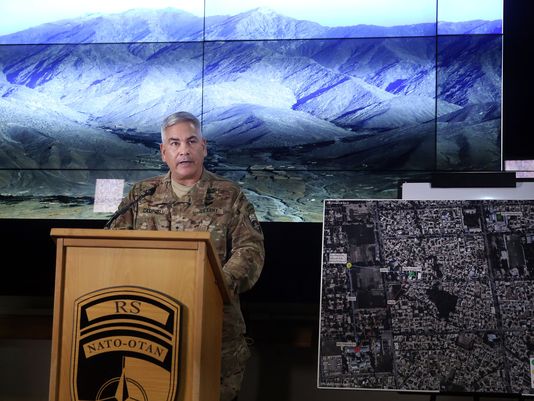
CAMBELL Press conference

All we have is an official statement by General John Campbell on 25 November 2015 (above), which described the airstrike as ‘a tragic, but avoidable accident caused primarily by human error’, and a brief Executive Summary of the findings of the Combined Civilian Casualty Assessment Team (made up of representatives from NATO and the Afghan government) which emphasised that those errors were ‘compounded by failures of process and procedure, and malfunctions of technical equipment.’

The parallel investigations identified a series of cumulative, cascading errors and malfunctions:

(1) The crew of the AC-130 gunship that carried out the attack set out without a proper mission brief or a list of ‘no-strike’ targets; the aircraft had been diverted from its original mission, to provide close air support to ‘troops in contact’, and was unprepared for this one (which was also represented as ‘troops in contact’, a standard designation meaning that troops are under hostile fire).

(2) Communications systems on the aircraft failed, including – crucially – the provision of video feeds to ground force commanders and the transmission of electronic messages (the AC-130 has a sophisticated sensor and communications suite  – or ‘battle management center’ –on board, staffed by two sensor operators, a navigator, a fire control officer, and an electronic warfare officer, and many messages are sent via classified chat rooms).
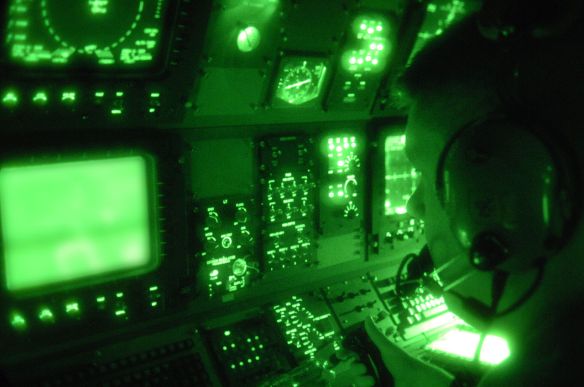
AC-130U_Sensor_Operator

The problem was apparently a jerry-rigged antenna that was supposed to link the AC-130 to the ground.  Here is how General Bradley Heithold explained it to Defense One:

“Today, we pump full-motion video into the airplane and out of the airplane. So we have a Ku-band antenna on the airplane … the U-model….  On our current legacy airplanes, the solution we used was rather scabbed on: take the overhead escape hatch out, put an antenna on, stick it back up there, move the beams around. We’ve had some issues, but we’re working with our industry partners to resolve that issue.”

He added, “99.9 percent of the time we’ve had success with it. These things aren’t perfect; they’re machines.”

Heithold said that dedicated Ku-band data transfer is now standard on later models of the AC-130, which should make data transfer much more reliable.

(3)  Afghan Special Forces in Kunduz had requested close air support for a clearing operation in the vicinity of the former National Directorate of Security compound, which they believed was now a Taliban ‘command and control node’.  The commander of US Special Forces on the ground agreed and provided the AC-130 crew with the co-ordinates for the NDS building.  He could see neither the target nor the MSF Trauma Center from his location but this is not a requirement for authorising a strike; he was also working from a map that apparently did not mark the MSF compound as a medical facility.  According to AP, he had been given the coordinates of the hospital two days before but said he didn’t recall seeing them.  The targeting system onboard the AC-130 was degraded and directed the aircraft to an empty field and so the crew relied on a visual identification of the target using a description provided by Afghan Special Forces – and they continued to rely on their visual fix even when the targeting system had been re-aligned (‘the crew remained fixated on the physical description of the facility’) and, as David Cloud points out, even though there was no visible sign of ‘troops in contact’ in the vicinity of the Trauma Center (‘An AC-130 is normally equipped with infrared surveillance cameras capable of detecting gunfire on the ground’):
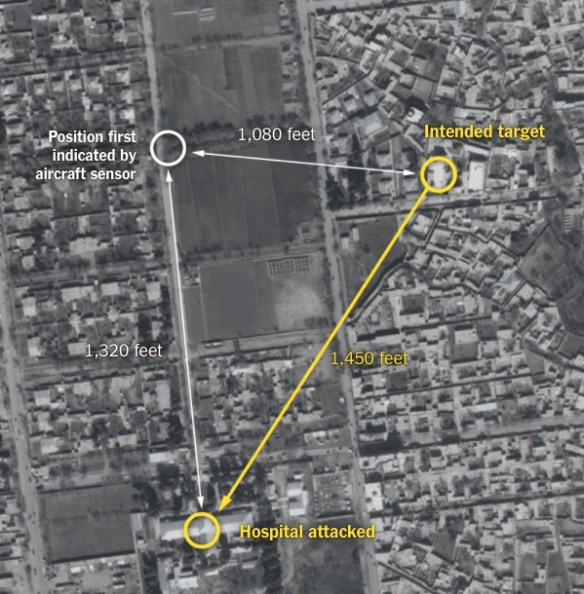
MSF Kunduz attack

Sundarsan Raghaven adds that ‘Not long before the attack on the hospital, a U.S. airstrike pummeled an empty warehouse across the street from the Afghan intelligence headquarters. How U.S. personnel could have confused its location only a few hours later is not clear…’  More disturbingly, two US Special Forces troops have claimed that their Afghan counterparts told their commander that it was the Trauma Center that was being used as the ‘command and control node’, and that the Taliban ‘had already removed and ransomed the foreign doctors, and they had fired on partnered personnel from there.’

(4) The aircrew cleared the strike with senior commanders at the Joint Operations Center at Bagram and provided them with the co-ordinates of the intended target.  Those commanders failed to recognise that these were the co-ordinates of the MSF hospital which was indeed on the ‘no-strike’ list; ‘this confusion was exacerbated by the lack of video and electronic communications between the headquarters and the aircraft, caused by the earlier malfunction, and a belief at the headquarters that the force on the ground required air support as a matter of immediate force protection’;

(5) The strike continued even after MSF notified all the appropriate authorities that their clinic was under attack; no explanation was offered, though the US military claims the duration was shorter (29 minutes) than the 60-minutes reported by those on the ground.

Campbell announced that those ‘most closely associated’ with the incident had been suspended from duty for violations of the Rules of Engagement – those ‘who requested the strike and those who executed it from the air did not undertake the appropriate measures to verify that the facility was a legitimate military target’ – though he gave no indication how far up the chain of command responsibility would be extended; in January it was reported that US Central Command was weighing disciplinary action against unspecified individuals.  In the meantime, solatia payments had been made to the families of the killed ($6,000) and injured ($3,000).
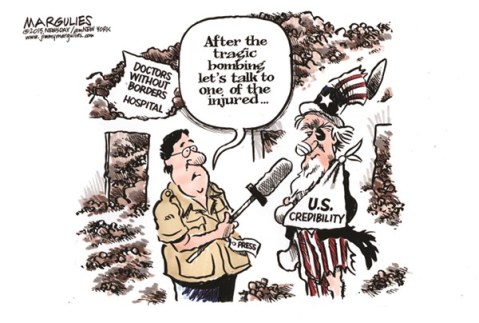
doctors-without-borders-us-credibility

Not surprisingly, MSF reacted angrily to Campbell’s summary: according to Christopher Stokes,

‘The U.S. version of events presented today leaves MSF with more questions than answers.  The frightening catalog of errors outlined today illustrates gross negligence on the part of U.S. forces and violations of the rules of war.’

Joanne Liu, MSF’s President, subsequently offered a wider reflection on war in today’s ‘barbarian times’, prompted by further attacks on other hospitals and clinics in Afghanistan, Syria, Yemen and elsewhere:

“The unspoken thing, the elephant in the room, is the war against terrorism, it’s tainting everything,” she said. “People have real difficulty, saying: ‘Oh, you were treating Taliban in your hospital in Kunduz?’ I said we have been treating everyone who is injured, and it will have been Afghan special forces, it will have been the Taliban, yes we are treating everybody.”

She added: “People have difficulty coming around to it. It’s the core, stripped-down-medical-ethics duty as a physician. If I’m at the frontline and refuse to treat a patient, it’s considered a crime. As a physician this is my oath, I’m going to treat everyone regardless.”

Kate Clark‘s forensic response to the US investigation of the Kunduz attack is here; she insists, I think convincingly, that

‘… rather than a simple string of human errors, this seems to have been a string of reckless decisions, within a larger system that failed to provide the legally proscribed safeguards when using such firepower. There were also equipment failures that compounded the problem but, again, if the forces on the ground and in the air had followed their own rules of engagement, the attack would have been averted.’

This is what just-in-time war looks like, but it’s not enough to blame all this on what General Campbell called a ‘high operational tempo’.  As a minimum, we need to be able to read the transcripts of the ground/air communications – which are recorded as a matter of course, no matter what the tempo, and which are almost always crucial in any civilian casualty incident resulting from ‘troops in contact’ (see, for another vivid example, my discussion here) – to make sense of the insensible.
The World’s E.R.
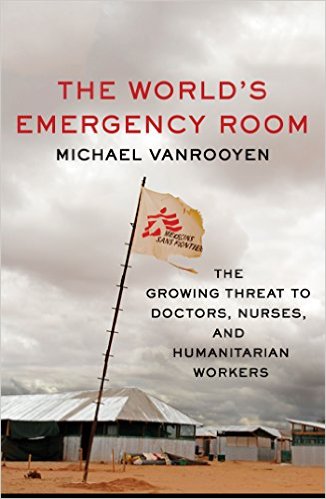
VanRooyen World's Emergency RoomAs military and paramilitary attacks on hospitals and medical facilities have increased – in Afghanistan, GazaSyria, Yemen and elsewhere – even as the number of casualties has soared, Michael VanRooyen‘s new book The World’s Emergency Room (out next month from St Martin’s) promises to provide an urgent overview of what has become a routinised violation of medical neutrality:

Twenty years ago, the most common cause of death for medical humanitarians and other aid workers was traffic accidents; today, it is violent attacks. And the death of each doctor, nurse, paramedic, midwife, and vaccinator is multiplied untold times in the vulnerable populations deprived of their care. In a 2005 report, the ICRC found that for every soldier killed in the war in the Democratic Republic of the Congo, more than 60 civilians died due to loss of immunizations and other basic health services.

The World’s Emergency Room: The Growing Threat to Doctors, Nurses, and Humanitarian Workers documents this dangerous trend, demonstrates the urgent need to reverse it, and explores how that can be accomplished. Drawing on VanRooyen’s personal experiences and those of his colleagues in international humanitarian medicine, he takes readers into clinics, wards, and field hospitals around the world where medical personnel work with inadequate resources under dangerous conditions to care for civilians imperiled by conflict. VanRooyen undergirds these compelling stories with data and historical context, emphasizing how they imperil the key doctrine of medical neutrality, and what to do about it.

Michael is a professor at the Harvard Medical School and director of the Harvard Humanitarian Initiative.

From Kirkus:

A behind-the-scenes look at the nascent field of humanitarian medicine as it has evolved in recent years of civil wars, famines, tsunamis, and other natural and man-made disasters.

Since 1990, world conflicts and refugee crises have spurred the growth of a massive force of humanitarian aid workers—some 275,000 individuals with the United Nations and NGOs, most of whom lack the formal training needed to deal with complex events like the catastrophic 2010 Haiti earthquake. In that 25-year period, more than 1,000 aid workers were killed in attacks on hospitals, medical staff, and civilian patients. VanRooyen, a professor at Harvard Medical School and the co-founder and director of the Harvard Humanitarian Initiative, came of age professionally in the fields of emergency medicine and humanitarian medicine, which are the focus of this fascinating debut. “What the emergency room is to Detroit, Chicago, and Baltimore, humanitarian medical relief is to the world’s crisis zones,” he writes. Whether in an unstable inner city or a failed state, doctors provide a safety net of emergency health care for people with critical needs. The author recounts his experiences on the ground as an emergency physician in Bosnia, Chad, the Congo, Haiti, Somalia, and many other countries and how he and like-minded colleagues have sought to professionalize humanitarian efforts, which have frequently been criticized as uncoordinated and wasteful. (The Haitian relief effort was a “humanitarian free-for-all,” he writes, involving novice agencies, inexperienced surgical teams, and “disaster tourists.”) In 2005, VanRooyen and others established the Harvard Humanitarian Initiative, a first-of-its-kind, universitywide effort to pursue research, training, and innovative approaches to humanitarian aid that could be leveraged to achieve policy changes. Despite the subtitle, the author devotes relatively little attention to the increasing dangers facing aid workers, focusing mainly on the need to establish rigorous standards for the field in order to prevent the malnutrition and infectious diseases that are the biggest killers in communities in conflict.

Citizen Ex

Algorithmic citizenship JPEG

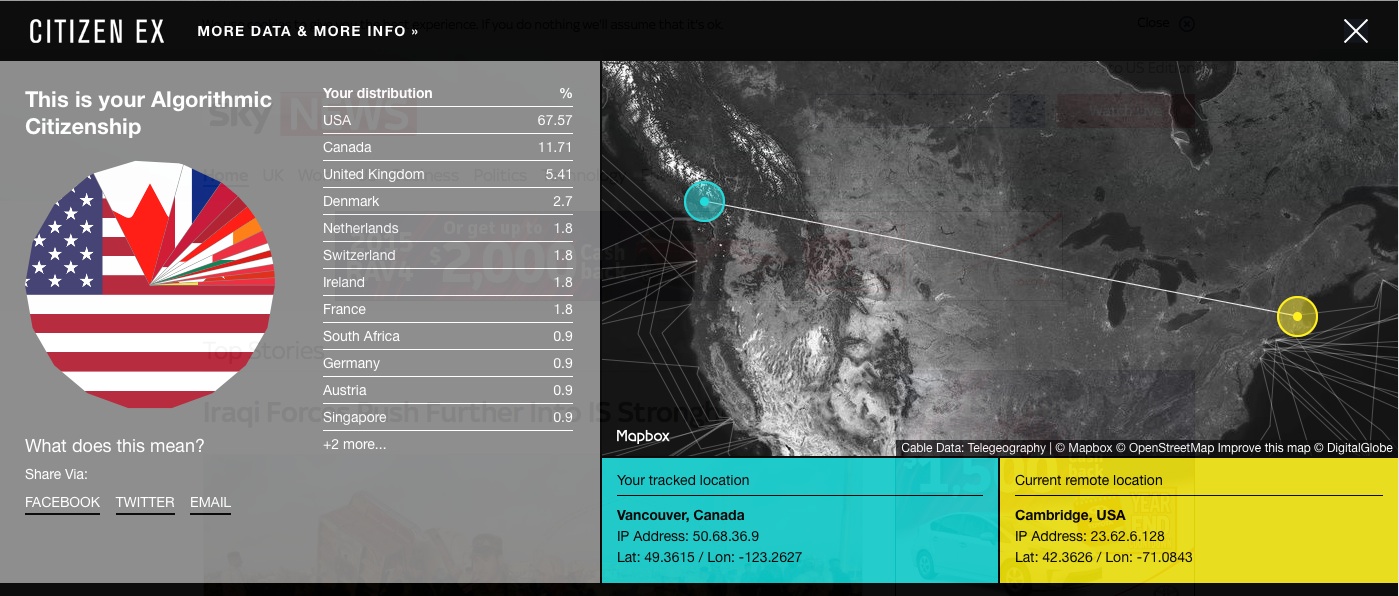
I’m late to this, so apologies, but if you are either weary of web-surfing or can’t get off your digital board, check out James Bridle‘s Citizen Ex project on ‘algorithmic citizenship’:

Algorithmic Citizenship is a form of citizenship which is not assigned at birth, or through complex legal documents, but through data. Like other computerised processes, it can happen at the speed of light, and it can happen over and over again, constantly revising and recalculating. It can split a single citizenship into an infinite number of sub-citizenships, and count and weight them over time to produce combinations of affiliations to different states.

Citizen Ex calculates your Algorithmic Citizenship based on where you go online. Every site you visit is counted as evidence of your affiliation to a particular place, and added to your constantly revised Algorithmic Citizenship. Because the internet is everywhere, you can go anywhere – but because the internet is real, this also has consequences.

The basic idea is derived from an essay by John Cheney-Lippold in Theory, culture and society here:

Marketing and web analytic companies have implemented sophisticated algorithms to observe, analyze, and identify users through large surveillance networks online. These computer algorithms have the capacity to infer categories of identity upon users based largely on their web-surfing habits. In this article I will first discuss the conceptual and theoretical work around code, outlining its use in an analysis of online categorization practices. The article will then approach the function of code at the level of the category, arguing that an analysis of coded computer algorithms enables a supplement to Foucauldian thinking around biopolitics and biopower, of what I call soft biopower and soft biopolitics. These new conceptual devices allow us to better understand the workings of biopower at the level of the category, of using computer code, statistics and surveillance to construct categories within populations according to users’ surveilled internet history. Finally, the article will think through the nuanced ways that algorithmic inference works as a mode of control, of processes of identification that structure and regulate our lives online within the context of online marketing and algorithmic categorization.

From James’s Citizen Ex site you can download (from the banner, top left) an extension to your browser which – after you’ve browsed some more – will calculate, in a very rough and ready way, your own algorithmic citizenship.  Mine (from today’s little effort) is shown at the head of this post.

This may look like an entertaining distraction, but what lies behind it is of course deadly serious: read, for example, James’s (short) stories on Libya and Syria.

Created as a browser plug-in, Citizen Ex shows us the true physical locations of the sites we visit and the territories that govern our actions as we traverse the web. In this reality, every mouse click leaves a trace, as our personal data is collected and stored in locations around the globe. It is with this information that governments and corporations construct a notional vision of our lives. This is our ‘algorithmic citizenship’ — the way we appear to the network. This programmatic fluidity is far removed from the true complexity of human identity. It reduces it to something calculable, which has profound implications for our understanding of privacy, citizenship and the self.

It also has profound implications for surveillance and the digital production of the killing spaces of later modern war.  Read this alongside Louise Amoore‘s brilliant work on The politics of possibility and you can perhaps see where I’m going:

‘[W]hat comes to count as the actionable intelligence behind a sovereign decision is a mosaic of overwhelmingly ordinary fragments of a life that become, once arrayed together, secret and sensitive evidence…

‘Drawing some elements of past activities into the calculation, the mosaic nonetheless moves over the surface of multiple past subjects and events in order to imagine a future unknown subject.’

It’s not difficult to divine (sic) how ‘Citizen Ex’ becomes ‘Citizen-Ex’.

A lack of intelligence

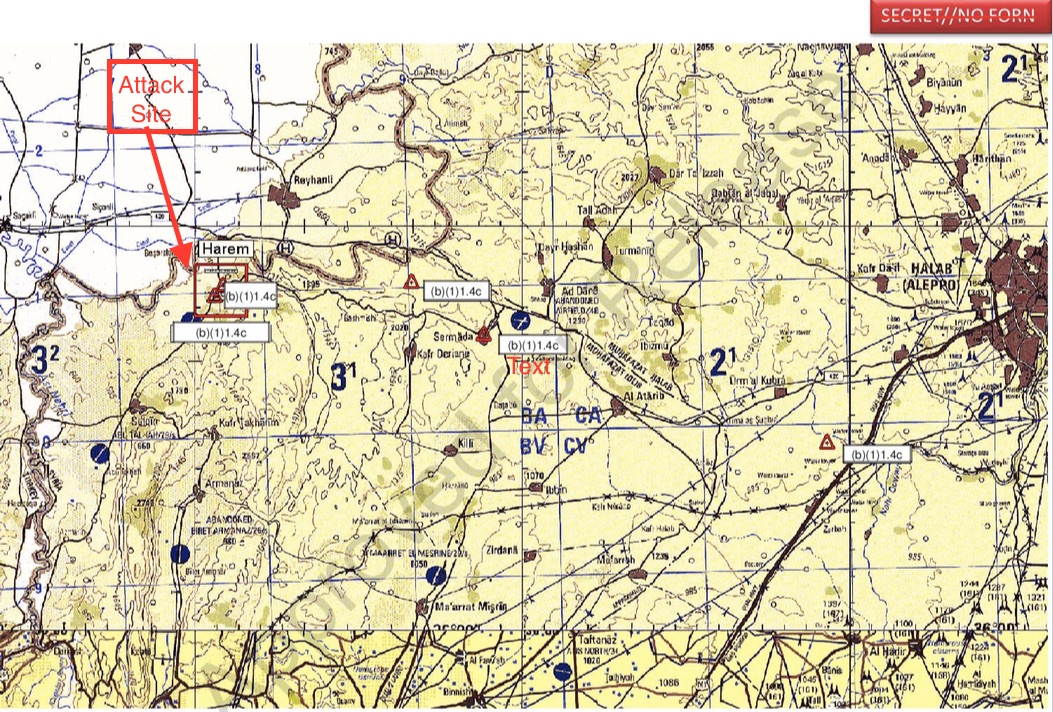
Harim Air Strike MAP annotated

The second of the three recent US air strikes I’ve been looking at took place near Harim [Harem on the map above] in Syria on the night of 5-6 November 2014.  The report of the military investigation into allegations of civilian casualties is here.

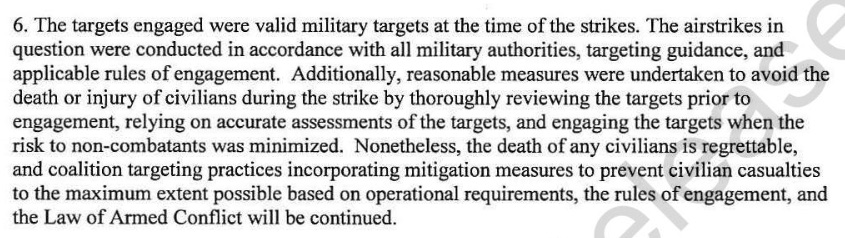
The aircraft launched multiple strikes against two compounds which had been identified as sites used as meeting places for named (though redacted) terrorists and sites for the manufacture and storage of explosives by the al-Qaeda linked ‘Khorasan Group’ (if the scare-quotes puzzle you, compare here and here).

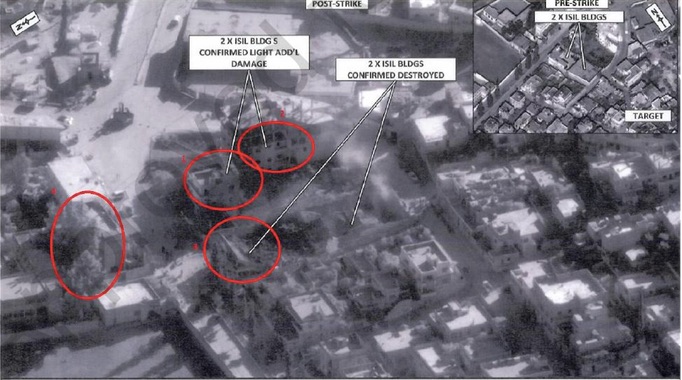
The compounds each contained several buildings and had previously been on a No Strike List under a category that includes civilian housing; they lost their protected status when ‘they were assessed as being converted to military use’ but ‘other residential and commercial structures were situated around both targets’.  An annotated image of the attack on the first compound is shown below:

Harim Air Strike on Compound 001

Although the report argues that ‘the targets were engaged in the early morning hours when the risk to civilians was minimized’ – a strange statement, since most civilians would have been asleep inside those ‘residential structures’ – US Central Command subsequently received open-source reports of from three to six civilian casualties, together with still and video imagery.  By the end of December 2014 the Combined Joint Task Force conducting ‘Operation Inherent Resolve’ had completed a preliminary ‘credibility assessment’ of the claims and found sufficient evidence to establish a formal investigation into the allegations of civilian casualties.  The investigating officer delivered his final report on 13 February 2015.

He also had access to a report from the Syrian Network for Human Rights that provided a ground-level perspective (including video) unavailable to the US military.  Its narrative is different from US Central Command, identifying the targets as being associated with An-Nussra:

The warplanes launched, at first, four missiles that hit three military points, which are located next to each other, in the northeast of the town:

1 – The Agricultural Bank, which is used by An-Nussra front as a center.
2 – The central prison checkpoint, where An-Nussra fighters were stationed.
3 – An ammunition depot in the same area.

The shelling destroyed and burned the Agricultural Bank’s building completely in addition to damaging a number of building nearby. Furthermore, a number of cars were burned while a series of explosions occurred after an explosion in the ammunition depot..
Afterwards, the warplanes targeted a fourth center with two missiles. [This target] was a building by an old deserted gas station located near the industrial school in the south of the town. The shelling destroyed the center completely as well as the gas station in addition to severely damaging the surrounding buildings. Harem residents were aided by the civil-defense teams to save people from underneath the rubble.

SNHR documented the killing of two young girls; one could not be unidentified but the other was Daniya, aged 5, who was killed along with her father who was said to be one of the An-Nussra fighters living in a house near the Agricultural Bank.  Daniya’s mother and her brother Saeed, aged 7, were seriously wounded.

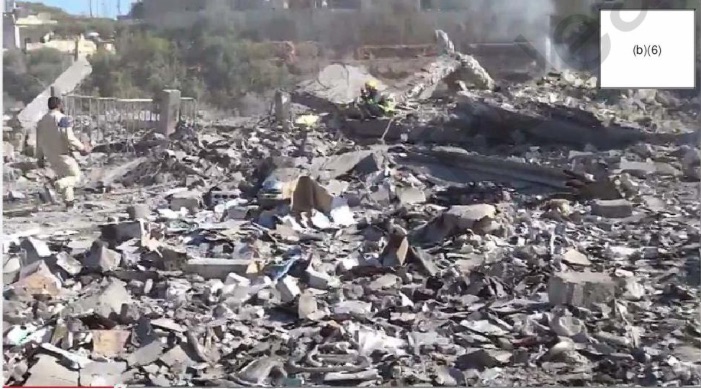
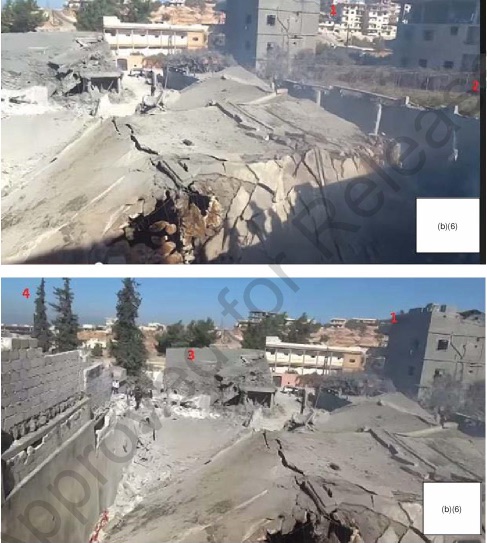
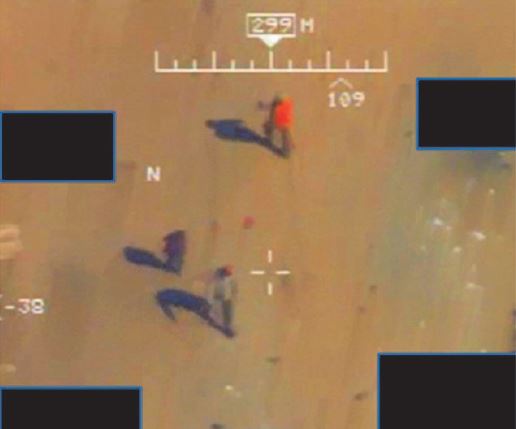
The report also included post-strike imagery from YouTube videos and Twitter feeds:

Harim VIDEO 1 jpeg

Harim VIDEO 2 jpeg

In contrast to the report on the air strike in Iraq I discussed in my previous post, this one includes no details of the attack, nor the procedures through which it was authorised and conducted – though we do know that there is a considerable military bureaucracy behind all these strikes, especially in the administration of what in this case was clearly a pre-planned rather than emergent target.  For more on the bureaucratisation of targeting, incidentally, see  Astrid Nordin and Dan Öberg, ‘Targeting the ontology of war: From Clausewitz to Baudrillard’, Millennium 43 (2) (2015) 392-410; analytically it’s right on the mark, I think, and I’ll be advancing similar arguments in my Tanner Lectures – though stripped of any reference to Baudrillard…

But there is one revealing sentence in the report.  Although the investigating officer had no doubt that the Harim strikes were perfectly legal, everything worked like clockwork and nothing need be changed –

Harim conclusion

– there is nevertheless a recommendation for ‘sustained ISR [intelligence, surveillance and reconnaissance] whenever practicable based on operational requirements, to ensure that no civilians are entering or exiting a facility.’  The clear implication is that these strikes – pre-planned, remember: these were not fleeting targets of opportunity – were not supported by real-time ISR.  When you add to that the reliance placed by the investigation on ground imagery from YouTube and Twitter, you begin to realise how little the US military and its allies must know about many of the targets they strike in Iraq and Syria.  (I might add that the US has not been averse to using Twitter feeds for targeting too: see Robert Gregory‘s compelling discussion in Clean bombs and dirty wars: air power in Kosovo and Libya, where he describes the central role played by Twitter feeds from Libyan rebels in identifying targets for the US Air Force and its NATO allies: by the closing months of the campaign France was deriving 80 per cent of its intelligence from social media contacts on the ground).

All this gives the lie to the cheery ‘let ’em have it’ guff from Robert Caruso, commenting on US air strikes in Syria last September:

By relying so heavily on drones in our recent counter-terror campaigns we’ve been fighting with one hand tied behind our back. But a key to the success of Monday’s strikes was the use of manned aircraft with pilots who can seek out enemy targets and make on-the-spot decisions…

it’s time to drop the drone fetish, and the limitations it imposed, and go back to using manned airpower, which is more powerful and better suited to hunting down elusive targets like ISIS.

Regular readers will know that I’m not saying that drones are the answer, or that their ability to provide persistent, real-time, full-motion video feeds in high definition makes the battlespace transparent; on the contrary (see my ‘Angry Eyes’ posts here and especially here: more to come soon).

But the absence of their ISR capability can only make a bad situation worse.  In February, the director of the National Counterterrorism Center conceded that that US had not ‘closed the gap on where we need to be in terms of our understanding, with granularity, about what is going on on the ground in Syria.’  Indeed, during the first four months of this year ‘nearly 75 percent of U.S. bombing runs targeting the Islamic State in Iraq and Syria [a total of more than 7,000 sorties] returned to base without firing any weapons’, and reports claimed that aircrews held their fire ‘mainly because of a lack of ground intelligence.’

Full-motion video cannot compensate for that absence, of course, and in any case there are serious limitations on the number of ISR orbits that are possible over Iraq and Syria given the demands for drones over Afghanistan and elsewhere: each orbit requires three to four aircraft to provide 24/7 coverage, and the global maximum the US Air Force can provide using its Predators and Reapers varies between 55 and 65 orbits (or ‘combat air patrols’).

In late August 2014 Obama authorised both manned and unmanned ISR flights over Syria, and since then the United States has been joined by the UK and France in deploying MQ-9 Reapers over Iraq and Syria, where their video feeds have helped to orchestrate missions carried out by conventional strike aircraft (see, for example, here).  In August 2015 France claimed that all its air strikes in Iraq had to be validated by ISR provided by a drone:

reaper-20150508

But that was in August, before Hollande threw caution to the winds and ramped up French air strikes in response to the Paris attacks in November – an escalation that relied on targeting packages supplied by the United States.

In any case, Predators and Reapers are also armed and in their ‘hunter-killer’ role they had executed around one quarter of all airstrikes conducted by the United States in Iraq and Syria by June 2015 and more than half the air strikes conducted by the UK in Iraq.  Although the UK only extended its bombing campaign against Islamic State to Syria this month, its Reapers had been entering Syrian airspace in steadily increasing numbers since November 2014 to provide ISR (in part, presumably, to enable the United States to orchestrate its air strikes) and in September 2015 it used one of them to carry out the UK’s first acknowledged targeted killing near Raqqa (see also here and here); the United States has also routinely used the aircraft in the extension of its multi-sited targeted killing program to Syria (see also here).

All this bombing, all this blood: and yet strategically remarkably little to show for it.   And all for a lack of intelligence…