Angry Eyes (2)

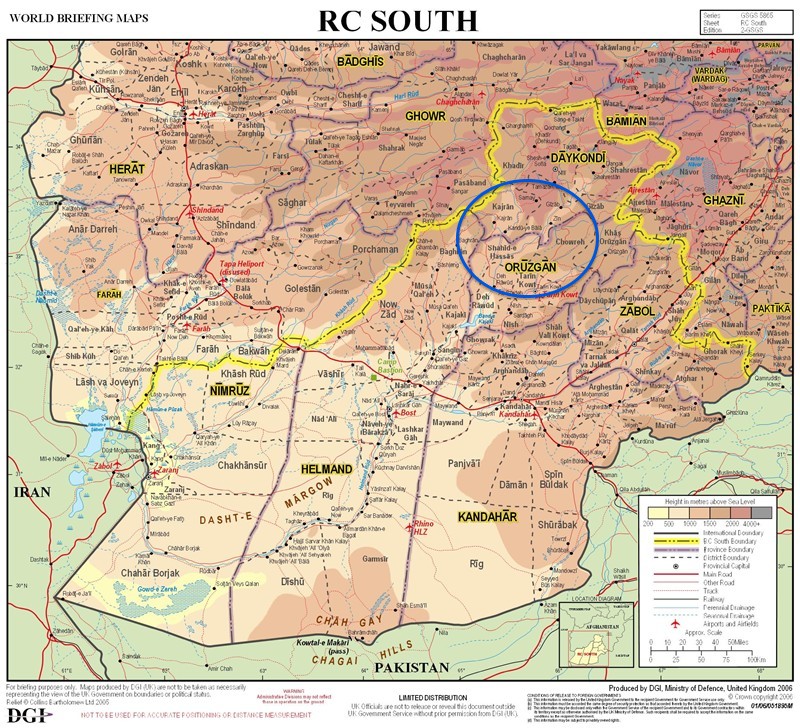
MAP isaf-rc-south

This is the second installment of my analysis of an air strike orchestrated by a Predator in Uruzgan province, Afghanistan on 21 February 2010; the first installment is here.

(4) Command and control?

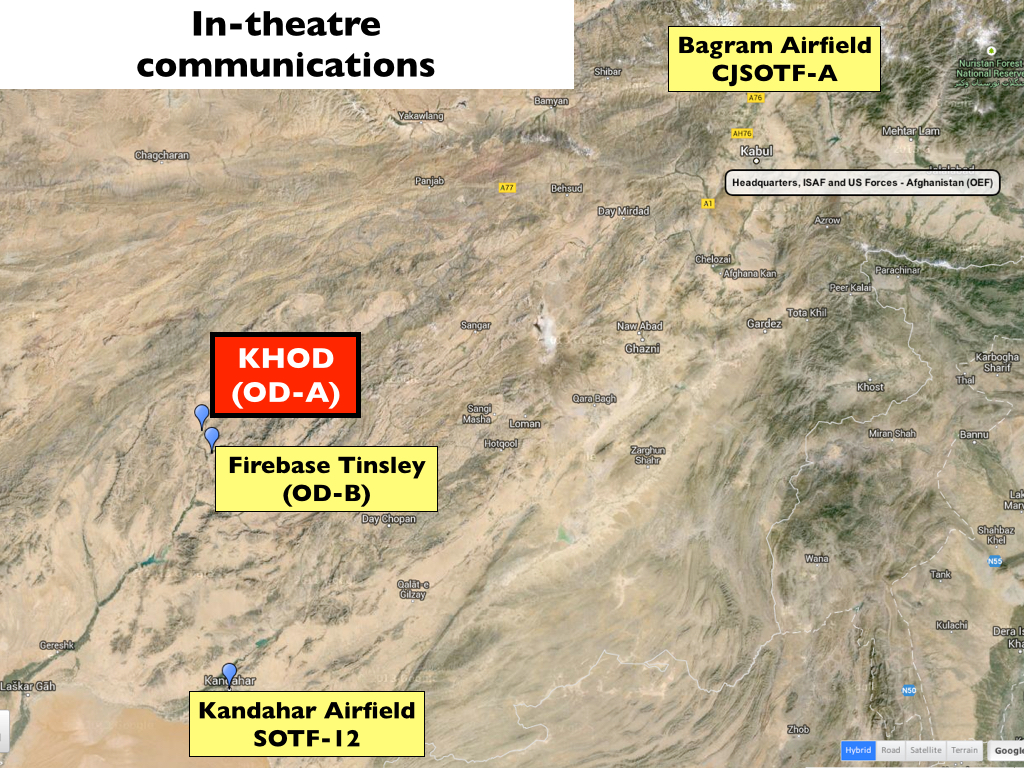
What was happening in and around Khod was being followed not only by flight crews and image analysts in the continental United States but also by several Special Forces command posts or Operations Centers in Afghanistan.  In ascending order these were:

(1) the base from which ODA 3124 had set out at Firebase Tinsley (formerly known as Cobra);

(2) Special Operations Task Force-12 (SOTF-12), based at Kandahar;

(3) Combined Joint Special Operations Task Force – Afghanistan (CJSOTF-A) based at Bagram.
GREGORY Angry Eyes 2015 IMAGES.064

Once the ODA 3124 left the wire, command and support passed to SOTF-12; the OD-B at Tinsley had limited resources and limited (and as it happens intermittent) communications access and could only monitor what was happening.

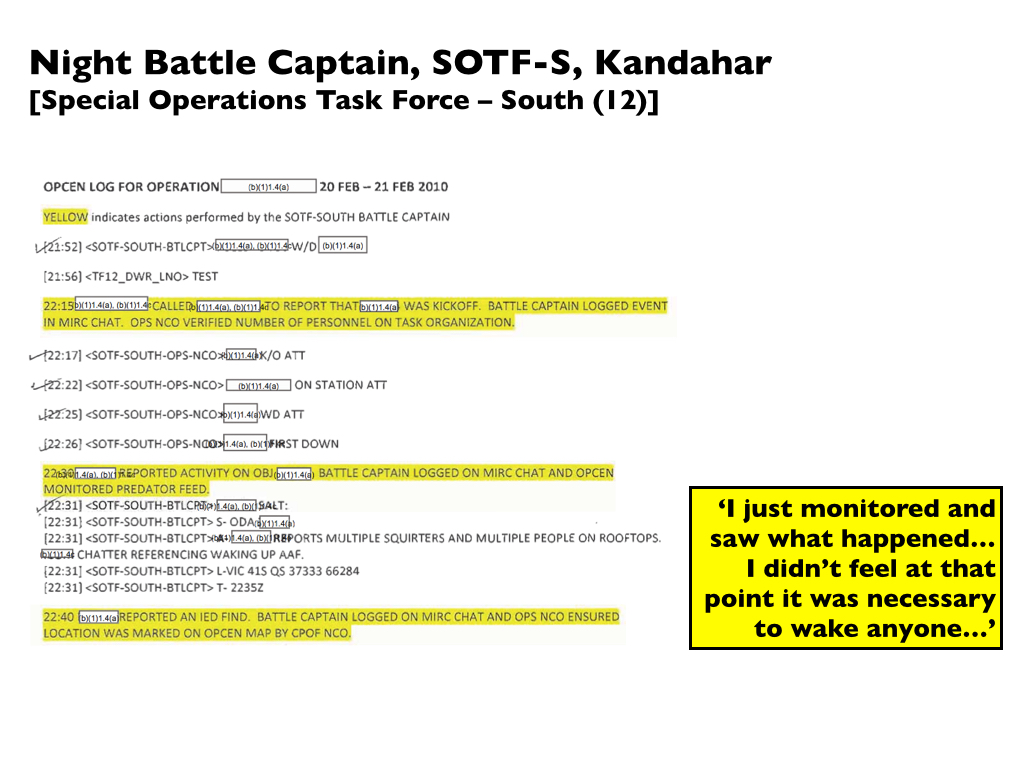
That was normal, but in fact both higher commands did more or less the same: and the investigating team was clearly appalled.  At SOTF-12 all senior (field grade) officers were asleep during the period of ‘highest density of risk and threatening kinetic activity’ (although they had established ‘wake-up criteria’ for emergency situations).  The Night Battle Captain had been in post for just three weeks and had been given little training in his role; he received a stream of SALT reports from the Ground Force Commander of ODA 3124 (which detailed Size of enemy force, Activity of enemy force, Location and Time of observation) but simply monitored the developing situation – what one investigating officer characterised as ‘a pretty passive kind of watching’.
GREGORY Angry Eyes 2015 IMAGES.065

The same was true at CJSOTF-A (the staff there monitored 15-25 missions a day, but this was the only active operation that had declared a potential Troops in Contact).

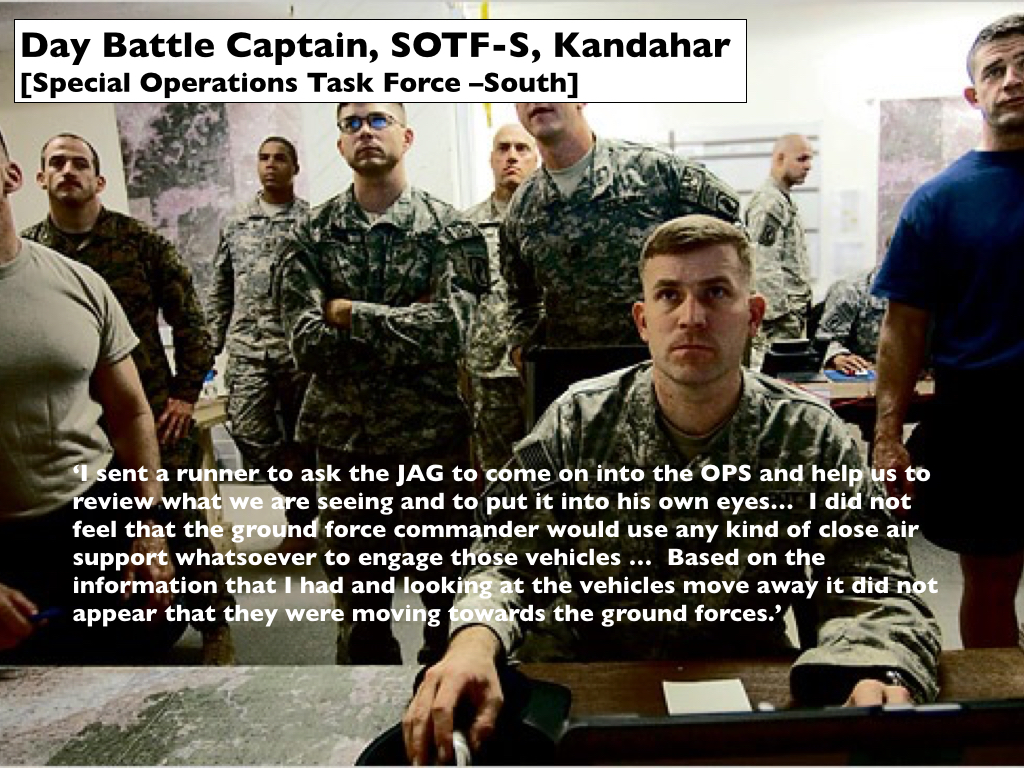
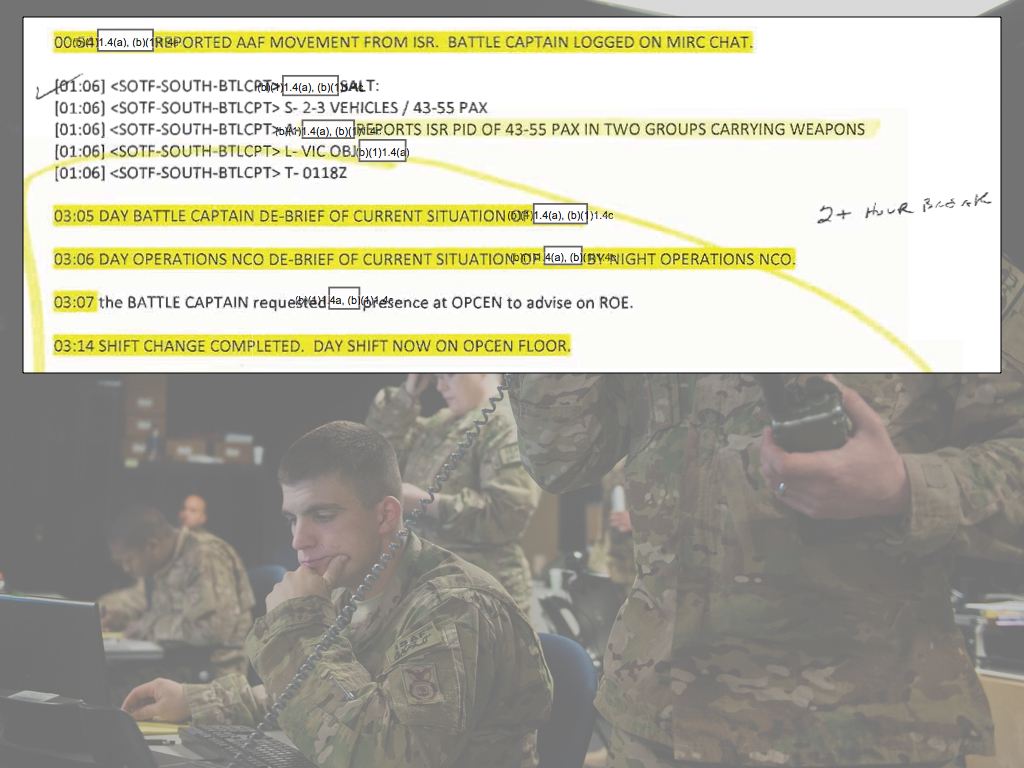
When the more experienced Day Battle Captain entered the Joint Operations Center at Kandahar and was briefed by the Night Battle Captain he was sufficiently concerned to send a runner to ask the Judge Advocate, a military lawyer, to come to the JOC.  He believed the occupants of the vehicles were hostile but was not convinced that they posed an immediate threat to troops on the ground:  ‘I wanted to hear someone who was extremely smart with the tactical directive and use of CAS [Close Air Support] in a situation I hadn’t seen before’.

This was a smart call for many reasons; the commander of US Special Forces, Brigadier General Edward Reeder, told the inquiry: ‘Honestly I don’t take a shit without one [a JAG], especially in this business’.  Significantly, the Safety Observer at Creech testified that there was no ‘operational law attorney’ available onsite for aircrews conducting remote operations; conversely, JAGs were on the operations floor of CENTCOM’s Combined Air and Space Operations Centre at Ul Udeid Air Base and, as this case shows, they were available at operations centers established by subordinate commands in-theatre.
GREGORY Angry Eyes 2015 IMAGES.073

GREGORY Angry Eyes 2015 IMAGES.074

The JAG at Kandahar was not routinely called in for ‘Troops in Contact’ but on this occasion he was told ‘my Legal Opinion [was] needed at the OPCENT and that it wasn’t imminent but they wanted me to rush over there right away…’

Meanwhile up at Bagram Colonel Gus Benton, the commanding officer of CJSOTF-A, was being briefed by his second-in-command who understood that the Ground Force Commander’s intention was to allow the three vehicles to move closer to his position at Khod.  He thought that made sound tactical sense.

‘I said that … is what we did, we let them come to us so we can get eyes on them. During my time I never let my guys engage with CAS if they couldn’t see it. I said that is great and COL [Benton] said “that is not fucking great” and left the room.’

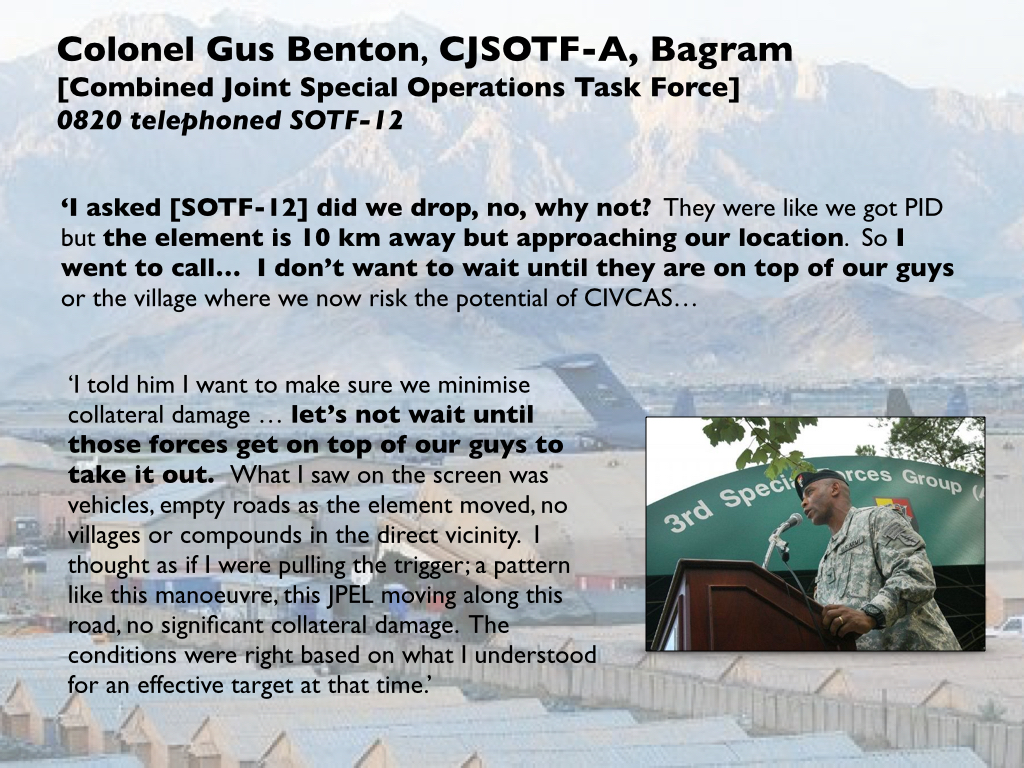
At 0820, ten minutes after the JAG entered the JOC at Kandahar, while he was watching the Predator feed, the phone rang: it was Benton.  He demanded Lt Colonel Brian Petit, the SOTF-12 commander, be woken up and brought to the phone:
GREGORY Angry Eyes 2015 IMAGES.076

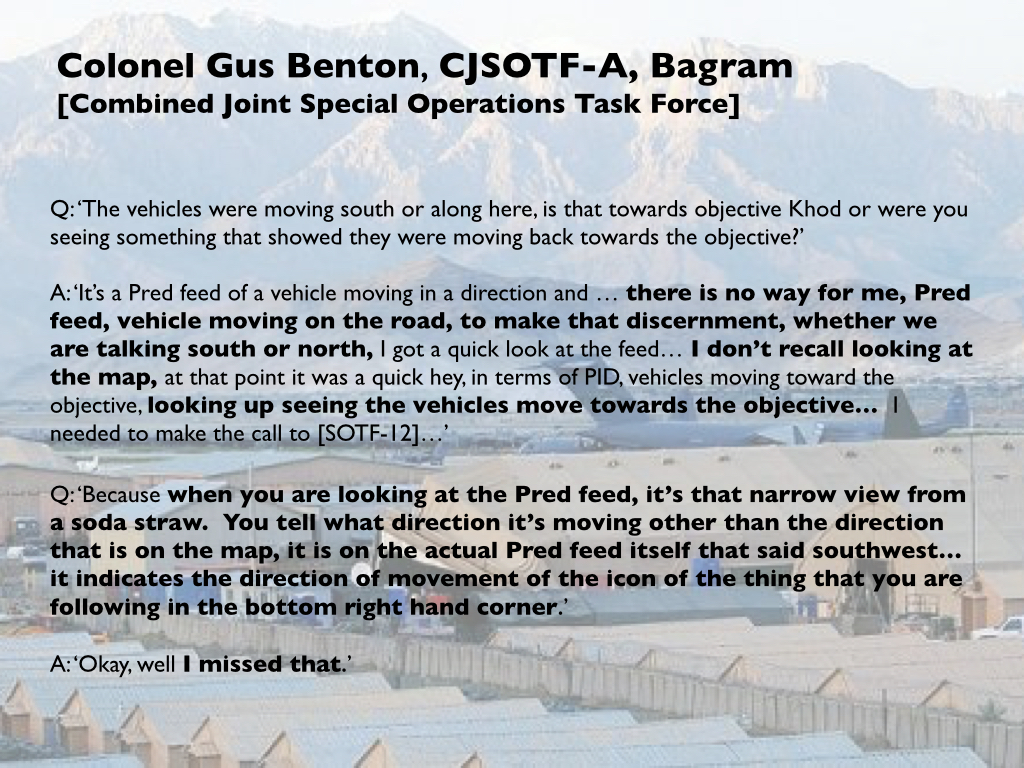
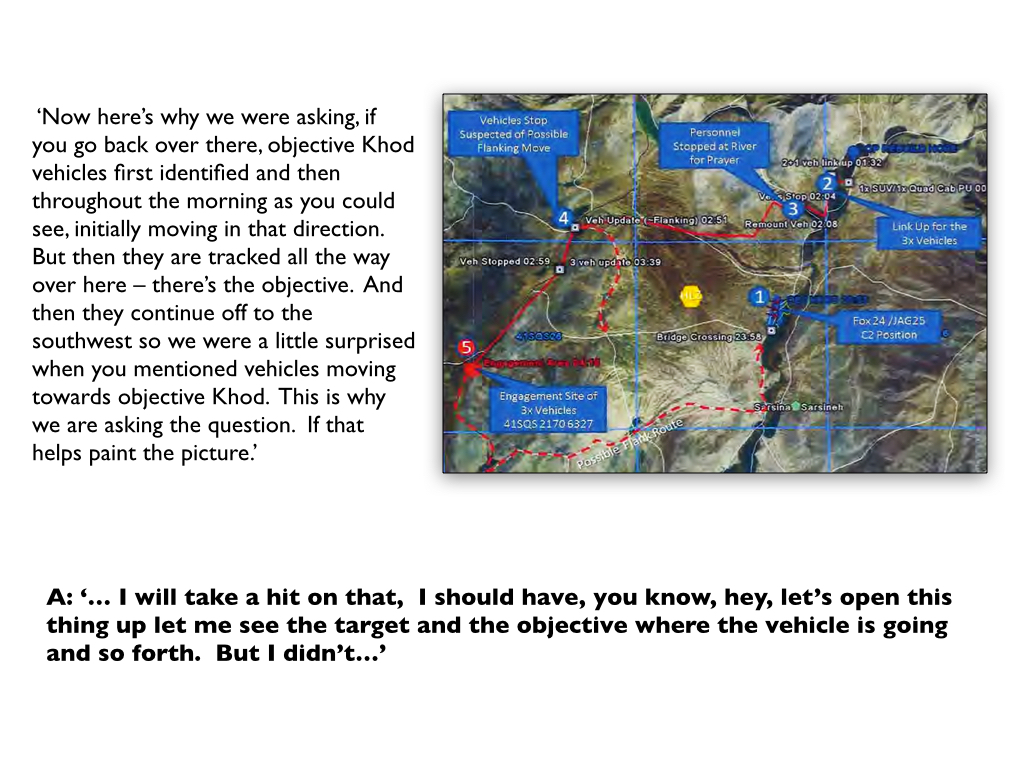
He spectacularly mis-read the situation (not least because he mis-read the Predator feed).  It was true that the vehicles were in open country, and not near any compounds or villages; but Benton consistently claimed that the vehicles were ‘travelling towards our objective’ whereas – as MG McHale’s investigating team pointed out to him – they were in fact moving away from Khod.
GREGORY Angry Eyes 2015 IMAGES.077

GREGORY Angry Eyes 2015 IMAGES.078

There had also been some, inconclusive discussion of a possible ‘High Value Target’ when the vehicles were first tracked, but the presence of a pre-approved target on the Joint Prioritised Effects List (Benton’s ‘JPEL moving along this road’) had never been confirmed and the Ground Force Commander had effectively discarded it (‘above my authority’, he said).

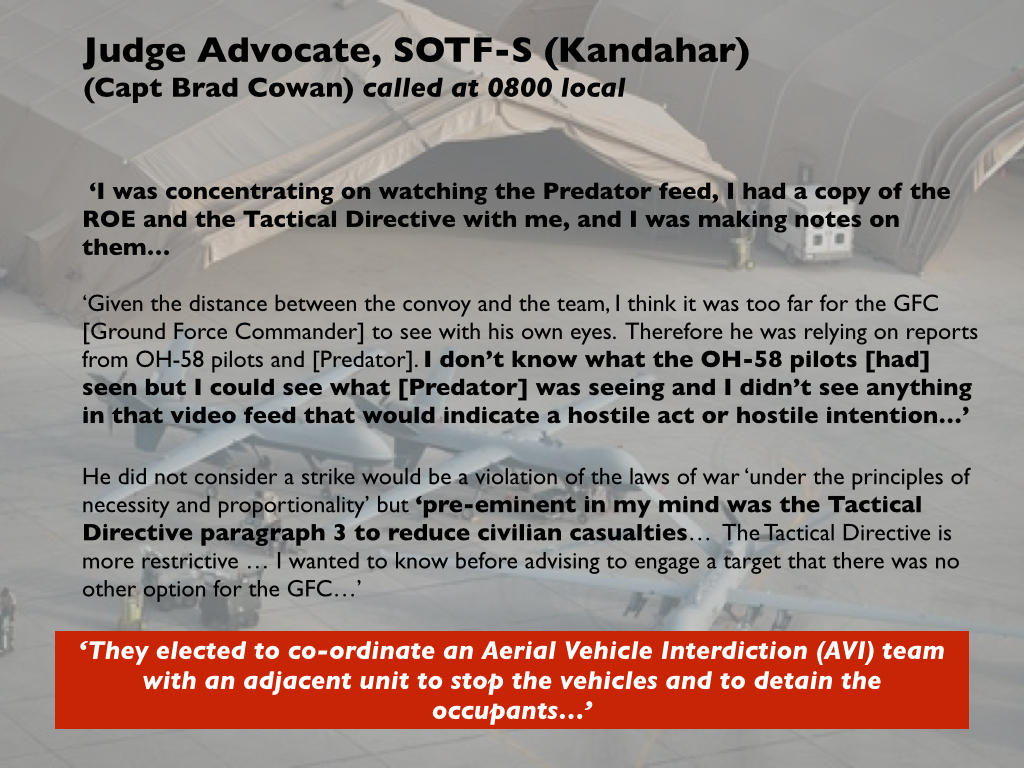
Certainly, the JAG at Kandahar read the situation differently:
GREGORY Angry Eyes 2015 IMAGES.075

When Benton rang off, the JAG went over to the Day Battle Captain and Lt Col Petit and recommended an Aerial Vehicle Interdiction (AVI) team be called in for a show of force to stop the vehicles without engaging the occupants in offensive action.

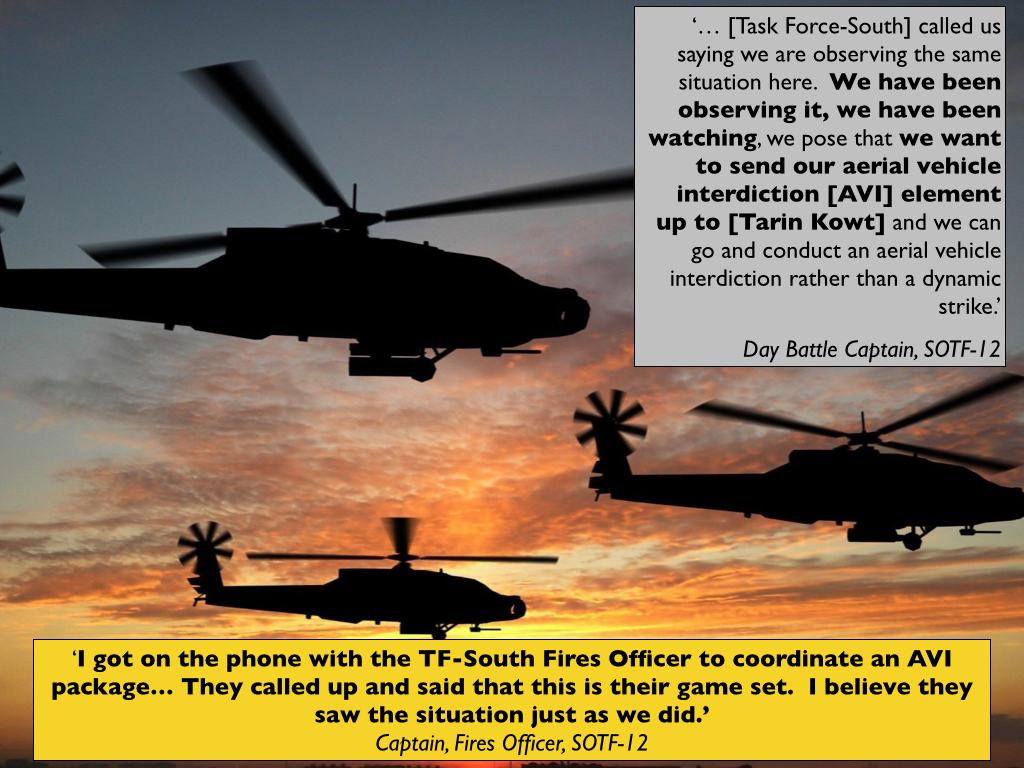
They agreed; in fact another Task Force also watching the Predator feed called to make the same suggestion, and the Fires Officer set about arranging to use their Apache helicopters to conduct an AVI:
GREGORY Angry Eyes 2015 IMAGES.079

The Fires Officer had been responsible for setting up the Restricted Operating Zone for aircraft supporting the ODA – de-conflicting the airspace and establishing what aircraft would be available – but its management was de-centralised:

‘I establish the ROZ, give the initial layout of what assets are going on, and then I pass that to the JTAC [Joint Terminal Attack Controller with the Ground Force Commander at Khod].  I pass the frequencies to the assets and the JTAC controls them from there.’

At 0630, long before all this frantic activity at Kandahar, the two OH-58s had arrived at a short hold location beyond the ‘range of enemy visual and audio detection’, and at 0730 they had left to refuel at Tarin Kowt.  The Day Battle Captain and the Fires Officer both thought they were still off station.  In fact, the helicopters had returned to hold at Tinsley/Cobra at 0810 and flat pitched to conserve fuel (which means they landed and left the rotor blades spinning but with no lift); thirty minutes later the JTAC called them forward and the Predator began to talk them on to the target.

The Day Battle Captain had another reason for thinking he and his colleagues in the JOC had more time.  He maintained that the helicopters had been brought in not to engage the three vehicles but to provide air support if and when the ‘convoy’ reached Khod and the precautionary ‘AirTic’ turned into a real TIC or Troops in Contact:

‘… the CAS brought on station for his [the Ground Force Commander’s] use was not for the vehicles but for what we thought was going to be a large TIC on the objective. The weapons team that was pushed forward to his location was not for the vehicles, it was for the possibility of a large TIC on the objective based on the ICOM chatter that we had.’

That chimes with Benton’s second-in-command at Bagram, who also thought the Ground Force Commander was waiting for the ‘convoy’ to reach Khod, but neither witness explained the basis for their belief.  It was presumably a string of transmissions from the JTAC to the Predator crew: at 0538 he told them the Ground Force Commander wanted to ‘keep tracking them and bring them in as close as we can until we have CCA up’ (referring to the Close Combat Attack helicopters, the OH-58s); shortly before 0630 he confirmed that the Ground Force Commander’s intent was to ‘permit the enemy to close, and we’ll engage them closer when they’re all consolidated’; and at 0818 he was still talking about allowing the vehicles to ‘close distance.’

Yet this does not account for the evident urgency with which the Day Battle Captain and the JAG were concerned to establish ‘hostile intent’ and ‘immediate threat’.  When the vehicles were first spotted they were 5 km from Khod, and when they were attacked they were 12 km away across broken and difficult terrain: so what was the rush if the Ground Force Commander was continuing to exercise what the Army calls ‘tactical patience’ and wait for the vehicles to reach him and his force?

In fact, the messages from the Ground Force Commander had been mixed; throughout the night the JTAC had also repeatedly made it clear that the ODA commander’s intent was ‘to destroy the vehicles and the personnel’.  The Ground Force Commander insisted that ‘sometime between 0820 and 0830’ he sent a SALT report to SOTF-12 to say that he was going to engage the target.  Unfortunately there is no way to confirm this, because SOTF’s text records of the verbal SALT reports stopped at 0630 for reasons that were never disclosed (or perhaps never pursued), but it would explain why the JTAC’s log apparently showed the JAG contacting him at 0829 to confirm there were no women and children on the target.  It would also account for testimony by one of the screeners, who realised that the helicopters were cleared to engage at 0835, ten minutes before the strike, when the NCO responsible for monitoring the Predator feed at SOTF-12 ‘dropped’ into the ‘ISR’ (I presume the relevant chat room window), and in response:

‘The MC [Mission Intelligence Co-ordinator at Creech] passed that the OH58 were cleared to engage the vehicles. We were all caught off guard… It seemed strange because we had called out that these vehicles were going west. I don’t know how they determined these vehicles to be hostile… I brought up a whisper [private chat] with the MC, I said are you sure, what are the time frames when they will be coming in, and the MC responded saying we don’t know their ETA and at that moment the first vehicle blew up…’

Should those watching the events unfold have been taken aback when the vehicles were attacked?  According to the pilot of the Predator, he and his crew were surprised at the rapid escalation of events:

‘The strike ultimately came a little quicker than we expected…. we believed we were going to continue to follow, continue to pass up feeds… When he decided to engage with the helos when they did, it happened very quickly from our standpoint. I don’t have a lot of info or situational awareness of why the JTAC decided to use them when they did. When they actually came up … the JTAC switched me on frequencies. So we weren’t talking on the frequency I was talking to him on a different frequency to coordinate with the helos.

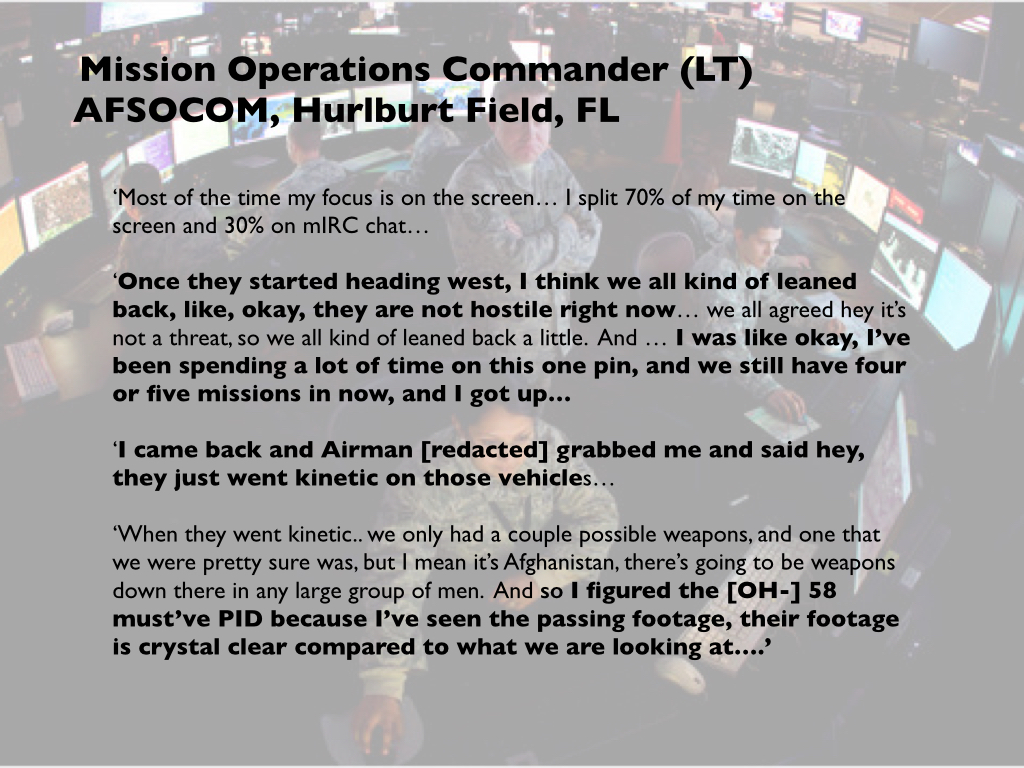
But their surprise was as nothing compared to the reaction of most observers when the first vehicle exploded.  The officer in charge of the screeners and imagery analysts who had been scrutinising the Predator feed at Air Force Special Operations Command at Hurlburt Field in Florida couldn’t believe it:
GREGORY Angry Eyes 2015 IMAGES.088

The Day Battle Captain testified:

‘I did not feel that the ground force commander would use any kind of close air support whatsoever to engage those vehicles… Based on the information that I had and looking at the vehicles move away it did not appear that they were moving towards the ground forces…

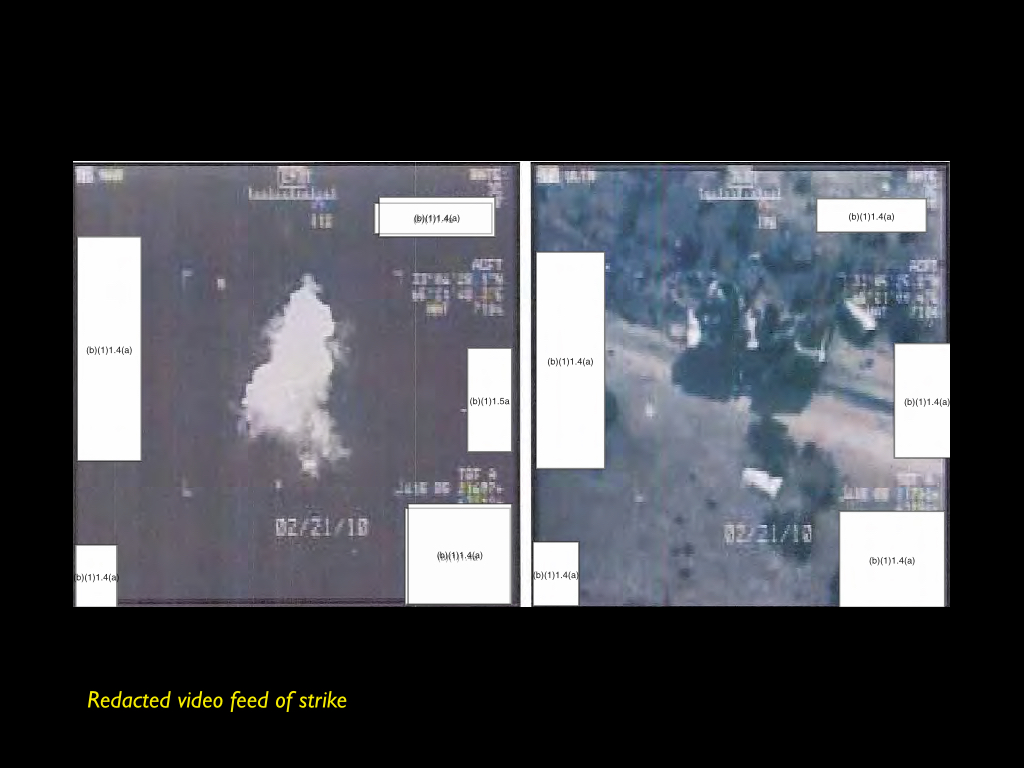
… as we were watching the Predator feed the first vehicles exploded. And everyone in the OPSCEN was immediately shocked… The amount of time from when that course of action approved by the SOTF commander to when we actually saw the strike occur there was no time, there was not adequate time to inform the ground commander that that was the course of action decided by the CJSOTF commander… I have phones ringing left and right, talking to people, trying to explain things, you know we look up on the screen and it happened…’
GREGORY Angry Eyes 2015 IMAGES.089

The Fires Officer:

‘I don’t think at any time anyone communicated to the GFC [Ground Force Commander] not to strike these vehicles because it is not something that we normally do. We feel that if he is in contact with the Predator and the OH-58s that we sent out to screen which we were not aware of and he is on the ground he generally has a pretty good picture of what is going on. He might be more privy to some conversation that he had with the OH-58 than what we know about. We normally give the GFC pretty big leeway on how they operate and the same with the JTAC because he has control of the assets and I am not going to try to take his assets away.’

In short, the investigation concluded that the Ground Force Commander never knew that an Aerial Vehicle Interdiction was being arranged, and neither of his higher commands were aware that he had cleared the helicopters to attack the three vehicles.

But, as I will show next, what lay behind these failures of communication was a de-centralised, distributed and dispersed geography of militarised vision whose fields of view expanded, contracted and even closed at different locations engaged in the administration of military violence.  Far from being a concerted performance of Donna Haraway‘s ‘God-trick’ – the ability to see everything from nowhere – this version of networked war was one in which nobody had a clear and full view of what was happening.

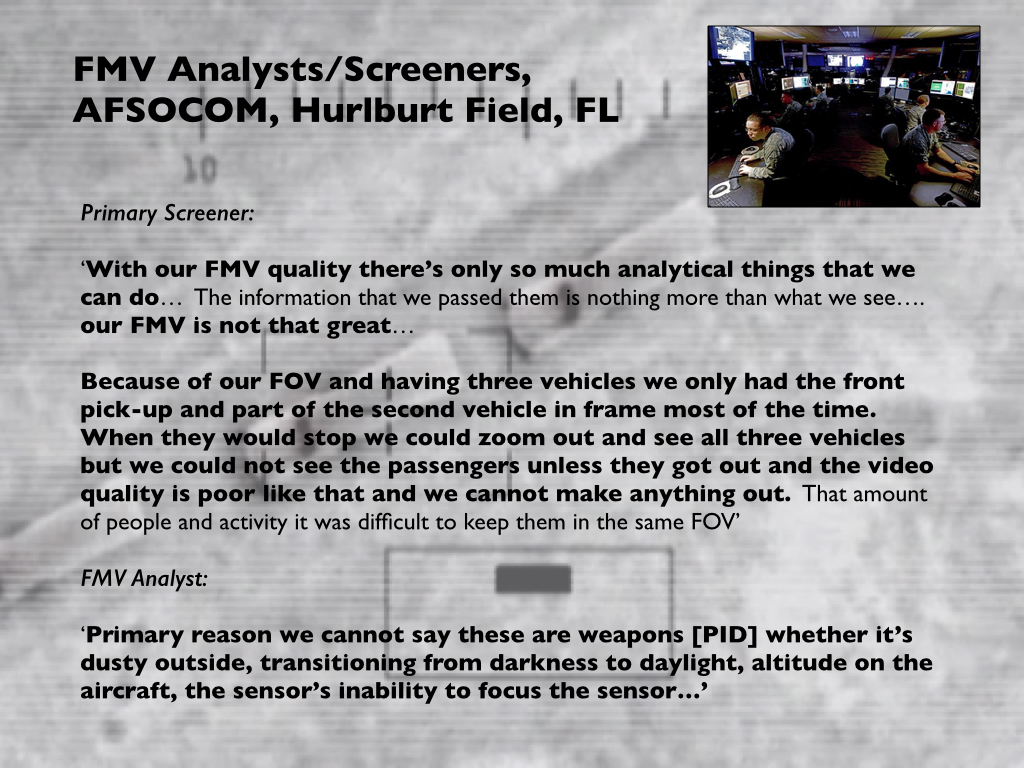
Part of this can be attributed to technical issues – the different fields of view available on different platforms, the low resolution of infra-red imagery (which Andrew Cockburn claims registers a visual acuity of 20/200, ‘the legal definition of blindness in the United States’), transmission interruptions, and the compression of full-colour imagery to accommodate bandwidth pressure.  So for example:
GREGORY Angry Eyes 2015 IMAGES.125

But it is also a matter of different interpretive fields.  Peter Asaro cautions:

‘The fact that the members of this team all have access to high-resolution imagery of the same situation does not mean that they all ‘‘see’’ the same thing. The visual content and interpretation of the visual scene is the product of analysis and negotiation among the team, as well as the context given by the situational awareness, which is itself constructed.’

The point is a sharp one: different visualities jostle and collide, and in the transactions between the observers the possibility of any synoptic ‘God-trick’ disappears.  But it needs to be sharpened, because different people have differential access to the distributed stream of visual feeds, mIRC and radio communications.  Here the disposition of bodies combines with the techno-cultural capacity to make sense of what was happening to fracture any ‘common operating picture’.   As one officer at Kandahar put it:

‘We didn’t have eyes on, minus ISR platform, that we can all see, who watches what? All the discrepancies between who watches what. What I see may be different from what someone else might interpret on the ISR… ISR is not reliable; it is simply a video platform.’

He was talking specifically about the multiple lines of communication (and hence bases for interpretation) within his Operations Center: now multiply that across sites scattered across Afghanistan and the continental United States and it becomes clear that the contemporary ‘fog of war’ may be as much the result of too much information as too little.

To be continued.

‘The superpower’s dilemma’

I’m on the magical island of Sicily for the 9th Pan-European Conference on International Relations: Worlds of Violence (you can find abstracts and even some papers here though presumably not for ever).

I’ve never been to one of these things before, not even the ISA (though I must do something about that) so there’s a  learning curve – not only about IR but about how people in a different field who all seem to know one another comport themselves (or don’t).  There are lots of geographers here too, though Philippe Le Billon and Simon Springer, who organised a series of sessions on Geographies of Violence, never made it (fortunately not felled by violence).

I’m giving what I hope is more or less the final version of ‘Angry Eyes‘ (updates here and here) on the Uruzgan drone strike so I’ve been attending several sessions on drones to see what other analysts have been up to beyond the range of my targeting sensors trained on ssrn and Academia [This is perhaps the place to say I don’t post anything on either platform, since all my texts are available on this website under DOWNLOADS: but maybe I should?].

web-syria-drone-epa

Yesterday Lisa Hajjar spoke on ‘Drone warfare and the superpower’s dilemma‘.  She explains the title like this:

The United States has been in a continuous—or, at least, uninterrupted—state of armed conflict since 2001, and there is no end in sight. The strategies and technologies, as well as the locales of engagement and designated enemies of this “’global’ war on terror” have changed considerably over the past fourteen years. Nevertheless, the US government still relies on the Authorization for Use of Military Force (AUMF), passed by Congress on 14 September 2001 (three days after the 9/11 terrorist attacks), as the legal authority to bomb people in Afghanistan, Pakistan, Yemen, and Somalia, in Iraq since the occupation (the 2003 invasion was authorized under a different AUMF), in Libya since 2012, and most recently in Syria. This expanding conflict is not actually the same in any empirical sense, but the 2001 AUMF continues to be relied on because of the plasticity of the label of terrorism and the fact that the war against it has neither been won nor lost. This ability to continue fighting without losing and the inability to stop without winning could be described as “the superpower’s dilemma.”

‘The most significant change over the course of the “war on terror”’, she continues, ‘is the escalating use of armed drones (unmanned aerial vehicles, or UAVs) to target geographically diffuse and unconventional enemies.’

My analysis highlights three main issues: 1) why drone strikes for targeted killing have superseded capture and combat in US counter-terrorism strategy; 2) how officials explain and justify the strategic logic of remote killing; and 3) why drones seem to provide a technological answer to the superpower dilemma of how the United States can continue to “stay in the fight” without a significant commitment of “boots on the ground.” The conclusion is that bombing operations and aerial campaigns are incapable of achieving the declared security goals that their use aims to serve. On the contrary, drone warfare has been an important factor in the continuation of the “war on terror.”

My ability to report all this is not down to phenomenal powers of recall or a crash course in shorthand: you can read the full essay in two parts at Jadaliyya here and here.

(If you wonder about the image above, by the way, you can find the answer to its symbolic significance here and here).

_85425907_raf_strike_grab_976

Meanwhile, other states are operating drones too – notably over Iraq and Syria – including Russia (more here and here) and the UK (see here and read here).  I’m keeping my eyes on those developments too, but right now it’s Angry Eyes that holds my attention (not least because it reminds us that military drones are used for far more than targeted killing).  There are discussants for my own presentation, so I’ve prepared a paper summarising the argument and conclusions in lieu of a real paper – the long-form version is still in preparation – and I’ll post that soon.  But now I must away to think myself into my part….

(In)human Terrain

humanterrain3

It’s been an age since I looked at the US military’s attempt to ‘weaponise culture’ in its counterinsurgency programs (see ‘The rush to the intimate’: DOWNLOADS tab), but Roberto Gonzalez has kept his eyes on the ground – or the ‘human terrain’ (I’ve borrowed the image above from Anthropologists for Justice and Peace here).

In a special report for Counterpunch a month ago, Roberto noted the demise of the Human Terrain System:

The most expensive social science program in history – the US Army’s Human Terrain System (HTS)–has quietly come to an end. During its eight years of existence, the controversial program cost tax payers more than $725 million…

HTS supporters frequently claimed that the program would increase cultural understanding between US forces and Iraqis and Afghans–and therefore reduce American and civilian casualties. The program’s leaders insisted that embedded social scientists were delivering sociocultural knowledge to commanders, but the reality was more complex. HTS personnel conducted a range of activities including data collection, intelligence gathering, and psychological operations. In at least one case, an HTS employee supported interrogations in Afghanistan.

The program also served a more insidious function: It became a propaganda tool for convincing the American public–especially those with liberal tendencies–that the US-led occupations of Iraq and Afghanistan were benevolent missions in which smart, fresh-faced young college graduates were playing a role. It appeared to demonstrate how US forces were engaged in a kinder, gentler form of occupation. Department of Defense photos portrayed HTS personnel sitting on rugs while drinking tea with Afghan elders, or distributing sweets to euphoric Iraqi children. Here was a war that Americans could feel good about fighting.

The program had its critics, inside as well as outside the military, and US Army Training and Doctrine Command (TRADOC) eventually confirmed that HTS had been terminated on 30 September 2014.  In his report, Roberto traces the rise and fall of HTS, and attributes its demise to US troop withdrawals from Iraq and Afghanistan, the fall from grace of the ‘new’ counterinsurgency’s champion David Petraeus, the incompetence of many of the HTS teams, and – crucially – to the precipitate shift from ‘cultural’ to geospatial intelligence.

The last, impelled by the desire to substitute air strikes for ‘boots on the ground’ and to rely on computational methods rather than human intelligence, is the key: as Oliver Belcher put it in his PhD thesis on The afterlives of counterinsurgency, “It’s algorithms, not anthropology, that are the real social science scandal in late-modern war.”

I’ve been exploring this shift in my ‘Dirty Dancing’ essay – in relation to the American production of the Federally Administered Tribal Areas of Pakistan as a space of execution, a code/space in which data surveillance and computational methods are activated to assert an extra-territorial claim over bodies-in-spaces – but it’s become clear to me that this continues to rely on (and in some respects even extends) the weaponisation of culture.  It’s an appropriate metaphor: after all, weapons are inherently dangerous, they can be misdirected, they do misfire and they can cause grievous harm far beyond their intended target.

In a follow-up post on ‘Re-making the Human Terrain’, Roberto says as much:

GONZALEZThe gaps in military knowledge that HTS claimed to fill still remain. The desire to weaponize culture is as old as dreams of counterinsurgency, and such dreams do not die easily.

It would be premature for those concerned about the militarization of culture to breathe a sigh of relief. The needs of empire—especially an empire in denial—are far too great to ignore cultural concerns. HTS’s sudden death can obscure the fact that elements of the program continue to survive, though in distinct and sometimes unrecognizable forms. The basic idea behind HTS—to equip the military with cultural expertise for battlefield operations—has not been eradicated. If anything, the concept has firmly taken root.

He traces its off-shoots through the development of a Global Cultural Knowledge Network – which I can’t help seeing as the cultural version of the Bombing Encyclopedia of the World – and the role of private corporations in providing ‘human terrain analysts’ to support US special operations (see also Max Forte here on what I think of as the Military-Academic-Industrial-Media complex: MAIM).  Interestingly, Whitney Kassel – who is adamant that ‘shuttering HTS will almost certainly be a mistake’ – notes that ‘the National Defense University conducted a detailed study of HTS [summarised in JFQ] in late 2013 and recommended that the function be moved and permanently housed at U.S. Army Special Operations Command … which has the lead for irregular warfare and other Army functions that make the most frequent use of sociocultural knowledge.’

Roberto also provides a more detailed analysis of the US military’s investment in socio-cultural modelling and (this is truly vital) predictive forecasting in two linked essays on ‘Seeing into hearts and minds’: Part 1 is ‘The Pentagon’s quest for a social radar’, Anthropology Today 31 (3) (June 2015) 8-13 and Part 2 is ‘‘Big data’, algorithms, and computational counterinsurgency, Anthropology Today 31 (4) (August 2015) 13-18.

Social Radar JPEG

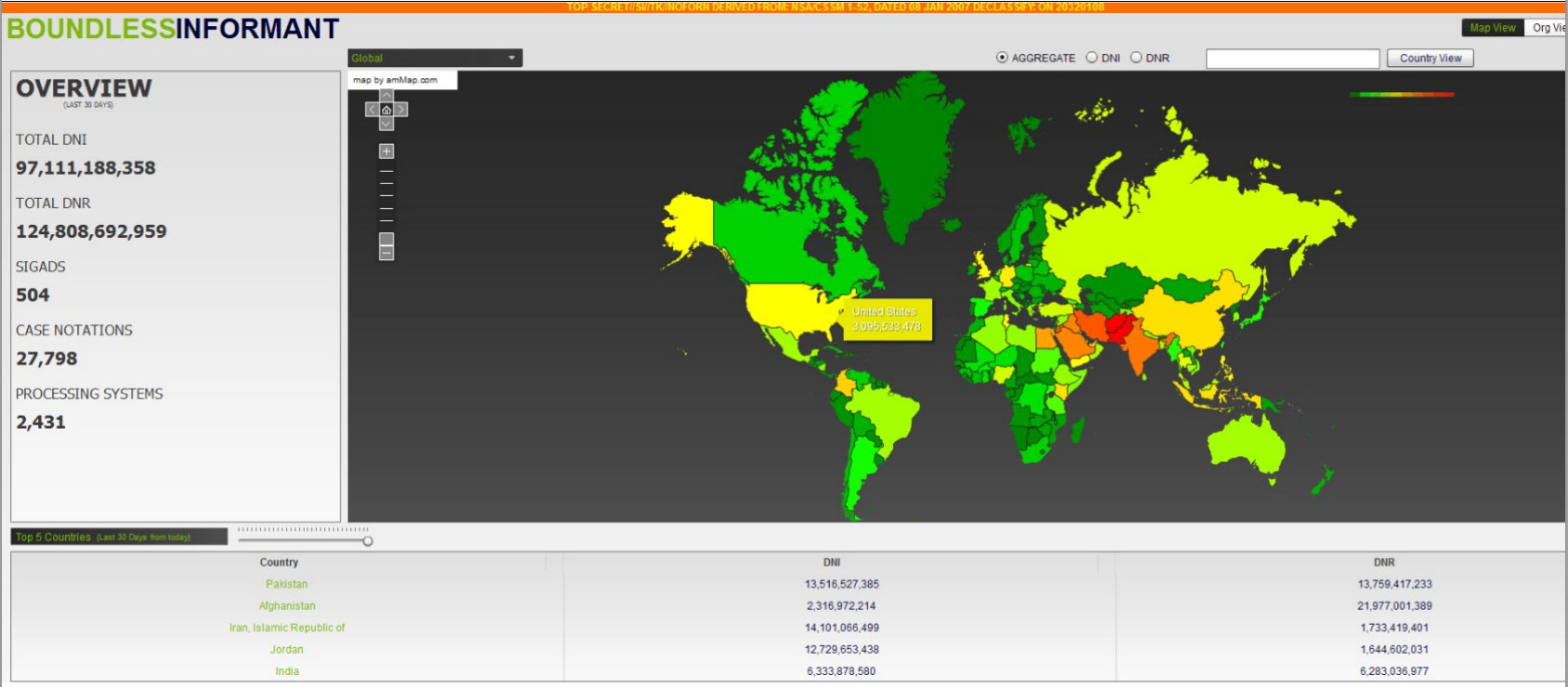
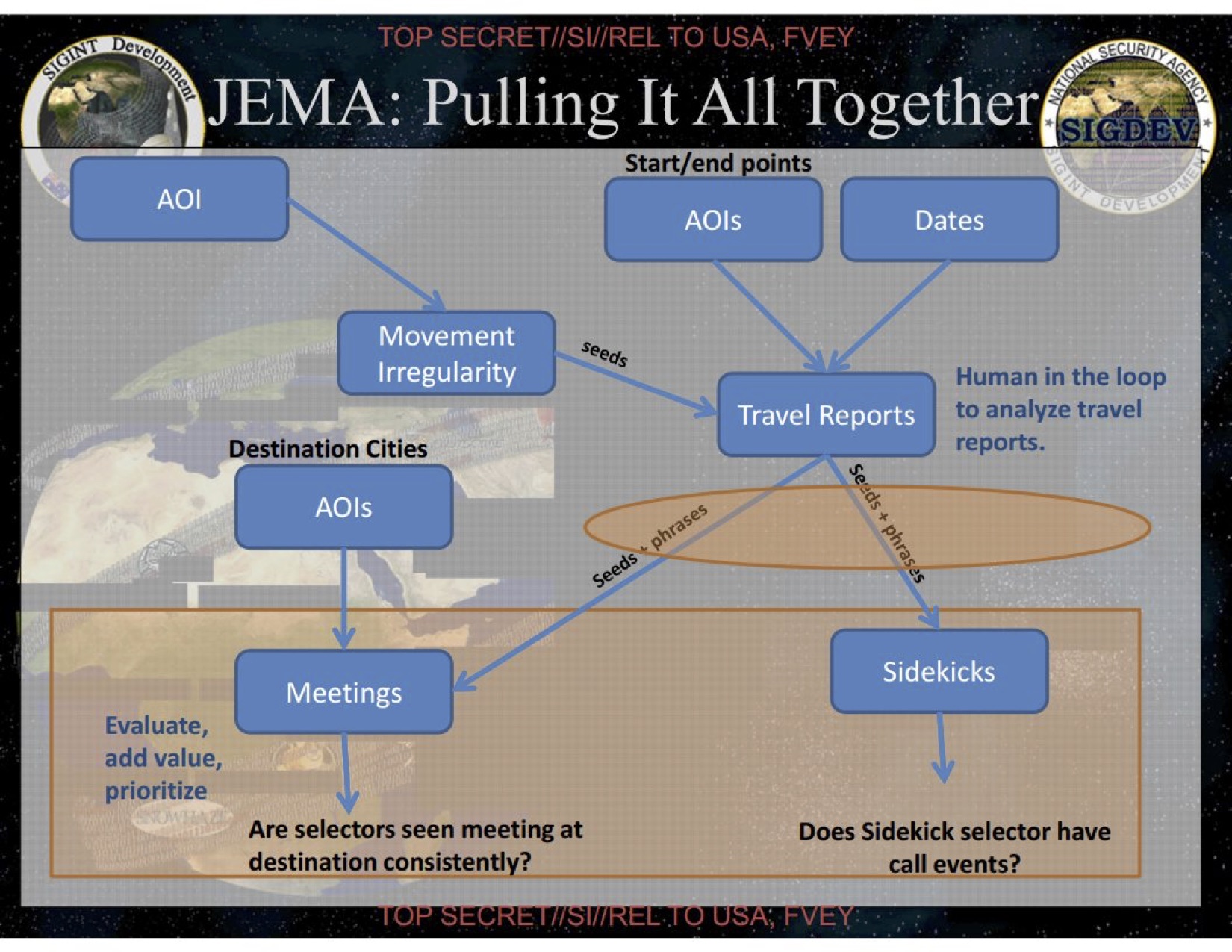
The second part is most directly relevant to what I’ve been working on because it describes the conceptual development of so-called ‘Social Radar’ (see image above: ‘sensor systems for the 21st century‘; see also here) and the morphing of the NSA’s Real Time Regional Gateway for Iraq – which integrated data surveillance from multiple sources and domains with visual feeds from drones – into Nexus 7 in Afghanistan.

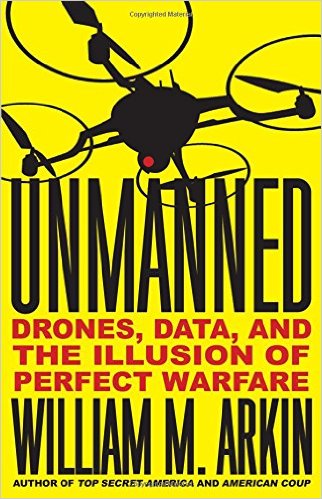
Similar fusion systems have surely been working across the border, and in his Unmanned: drones, data, and the illusion of perfect warfare (2015) William Arkin provides a fascinating glimpse into other genealogies that have produced what he calls ‘the Data Machine’:

ARKIN UnmannedToday, the Data Machine doesn’t care where it is fighting. It doesn’t matter whether targets are hiding in Hindu Kush caves or in villages of the Fertile Crescent. Nor does Predator care, or Reaper, or Global Hawk, or any other of our other aptly and awkwardly named all-seeing eyes. In fact, they don’t care about anything: they are machines. But the men and women … behind the entire Machine also don’t care, for every place is reduced to geographic coordinates that flash across a screen in seconds. Nations, armies, and even people are reduced to links and networks.

Loitering drones and geolocating weapons just need the data. Everyone needs the global information grid and the Internet—or, more precisely, an internet. Actual battlefield geography and culture have become immaterial. The node and the network sentry become the determinant and the provocateur of action—all the way to the edge of the world, anywhere.

War against the people

I’ve long admired Jeff Halper‘s work with the Israeli Committee Against House Demolitions (though to me, haunted by the passages from The poetics of place that Edward Said invokes in Orientalism,  ‘home demolition’s would carry even more resonance: it’s so much more than buildings that the Israelis so brutally turn to rubble).

ICAHD

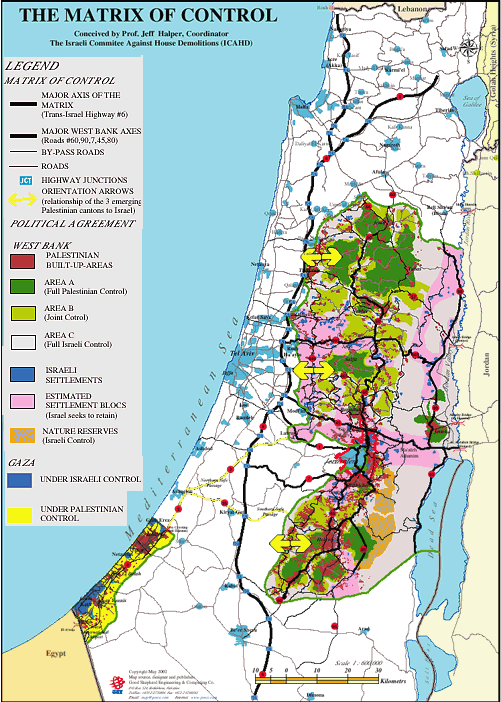
Jeff’s classic, even canonical essay on ‘the matrix of control‘ (see also here) was a constant reference point for my chapters on occupied Palestine in The Colonial Present, and on my first visit to the West Bank I was part of a group that Jeff generously spent a day showing the materialities of military occupation and illegal colonisation: you think you know what you’re going to see, but all the reading in the world can’t prepare you for what Israel has done – and continues to do – to the people of Palestine.

the-matrix-of-control

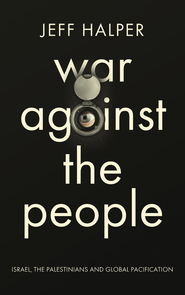
So I’m really pleased to hear from Jeff that his new book, War against the people: Israel, the Palestinians and global pacification, will be out in September (from Pluto Press in the UK and via the University of Chicago Press in the USA):

Modern warfare has a new form. The days of international combat are fading. So how do major world powers maintain control over their people today?

HALPER War against the peopleWar Against the People is a disturbing insight into the new ways world powers such as the US, Israel, Britain and China forge war today. It is a subliminal war of surveillance and whitewashed terror, conducted through new, high-tech military apparatuses, designed and first used in Israel against the Palestinian population. Including hidden camera systems, sophisticated sensors, information databases on civilian activity, automated targeting systems and, in some cases, unmanned drones, it is used to control the very people the nation’s leaders profess to serve.

Drawing from years of research, as well as investigations and interviews conducted at international arms fairs, Jeff Halper reveals that this practice is much more insidious than was previously thought. As Western governments tighten the grip on their use of private information and claw back individual liberties, War Against the People is a timely reminder that fundamental human rights are being compromised for vast sections of the world, and that this is a subject that should concern everyone.

I’ve noted before the ways in which Israel has used its continuing occupation of Palestine as a laboratory to test new technologies of military violence – and as a series of test cases designed to push the envelope of what is permissible under international humanitarian law and even international human rights law – but here Jeff radicalises the argument to develop a deeply disturbing vision of what he calls ‘securocratic wars in global battlespace’.  It’s vitally necessary to remember that later modern war is not the exclusive artefact of the United States and its military-academic-industrial-media (MAIM) complex, and that what happens in Israel/Palestine has desperately important implications for all of us.

Many commentators have claimed – I think wrongly – that one of the new characteristics of war in the twenty-first century is that it has become ‘war amongst the people’: as though No Man’s Land on the Western Front was somehow roped off from the gas attacks and shells that assaulted farms, villages and towns behind the front lines, for example, and air raids were limited to exclusively military-industrial targets.  Even if we confine ourselves to the trajectory of ostensibly modern warfare and track forward through the Second World War, Korea, Malaya, Vietnam, Laos and Cambodia…. the story is the same: modern war has long been fought amongst the people (though increasingly amongst ‘their’ people).  The deconstruction of the battlefield, as Frédéric Mégret calls it, is clearly visible in Palestine and is inseparable from its globalization.  It’s hardly surprising, then, that ‘war amongst the people’ should so easily turn into what Jeff describes as ‘war against the people’.

Here is the list of contents:

Introduction : How Does Israel Get Away With It?

Part I: The Global Pacification Industry
1. Enforcing Hegemony: Securocratic Wars in Global Battlespace

Part II: A Pivotal Israel
2. Why Israel? The Thrust Into Global Involvement
3. Niche-Filling in a Global Matrix of Control

Part III: Weaponry of Hybrid Warfare and Securocratic Control (Niche 1)
4. Niche 1: Weaponry of Hybrid Warfare and Securocratic Control
5. Dominant Maneuver
6. Precision Engagement

Part IV: Securitization and “Sufficient Pacification” (Niche 2)
7. Niche 2: The Securocratic Dimension: A Model of “Sufficient Pacification”
8. Operational Doctrines and Tactics

Part V: Serving Hegemons Throughout the World-System
9. Serving the Hegemons on the Peripheries: The “Near” Periphery
10. Security Politics on the “Far” Periphery
11. The Private Sector

Part VI: Domestic Securitization and Policing
12. Serving the Core’s Ruling Classes “At Home”

Conclusions: Mounting Counterhegemonic Challenges and Resisting Pacification
Resisting Capitalist Hegemony and Pacification: The Need for Infrastructure
Resistance to Pacification: Focusing on the MISSILE Complex

Future imperfect and tense

A clutch of forthcoming books on war that seek, in different ways, to illuminate dimensions of what I’ve been calling ‘later modern war’:

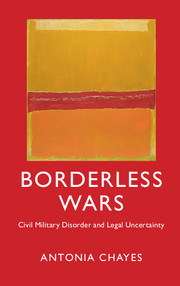
Antonia ChayesBorderless Wars (due in August at an eye-popping price from Cambridge University Press):

9781107109346In 2011, Nasser Al-Awlaki, a terrorist on the US ‘kill list’ in Yemen, was targeted by the CIA. A week later, a military strike killed his son. The following year, the US Ambassador to Pakistan resigned, undermined by CIA-conducted drone strikes of which he had no knowledge or control. The demands of the new, borderless ‘gray area’ conflict have cast civilians and military into unaccustomed roles with inadequate legal underpinning. As the Department of Homeland Security defends against cyber threats and civilian contractors work in paramilitary roles abroad, the legal boundaries of war demand to be outlined. In this book, former Under Secretary of the Air Force Antonia Chayes examines these new ‘gray areas’ in counterinsurgency, counter-terrorism and cyber warfare. Her innovative solutions for role definition and transparency will establish new guidelines in a rapidly evolving military-legal environment.

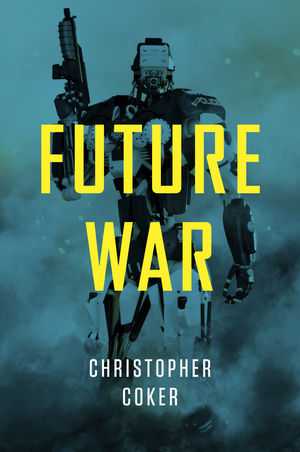
Christopher Coker‘s Future War (due in September from Polity):

COKER Future WarWill tomorrow’s wars be dominated by autonomous drones, land robots and warriors wired into a cybernetic network which can read their thoughts? Will war be fought with greater or lesser humanity? Will it be played out in cyberspace and further afield in Low Earth Orbit? Or will it be fought more intensely still in the sprawling cities of the developing world, the grim black holes of social exclusion on our increasingly unequal planet? Will the Great Powers reinvent conflict between themselves or is war destined to become much ‘smaller’ both in terms of its actors and the beliefs for which they will be willing to kill?

In this illuminating new book Christopher Coker takes us on an incredible journey into the future of warfare. Focusing on contemporary trends that are changing the nature and dynamics of armed conflict, he shows how conflict will continue to evolve in ways that are unlikely to render our century any less bloody than the last. With insights from philosophy, cutting-edge scientific research and popular culture, Future War is a compelling and thought-provoking meditation on the shape of war to come.

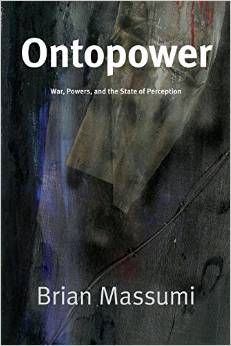
Brian Massumi‘s Ontopower: War, Powers, and the State of Perception (due in September from Duke University Press):

MASSUMI OntopowerColor coded terror alerts, invasion, drone war, rampant surveillance: all manifestations of the type of new power Brian Massumi theorizes in Ontopower. Through an in-depth examination of the War on Terror and the culture of crisis, Massumi identifies the emergence of preemption, which he characterizes as the operative logic of our time. Security threats, regardless of the existence of credible intelligence, are now felt into reality. Whereas nations once waited for a clear and present danger to emerge before using force, a threat’s felt reality now demands launching a preemptive strike. Power refocuses on what may emerge, as that potential presents itself to feeling. This affective logic of potential washes back from the war front to become the dominant mode of power on the home front as well. This is ontopower—the mode of power embodying the logic of preemption across the full spectrum of force, from the “hard” (military intervention) to the “soft” (surveillance). With Ontopower, Massumi provides an original theory of power that explains not only current practices of war but the culture of insecurity permeating our contemporary neoliberal condition.

A world of proliferated drones

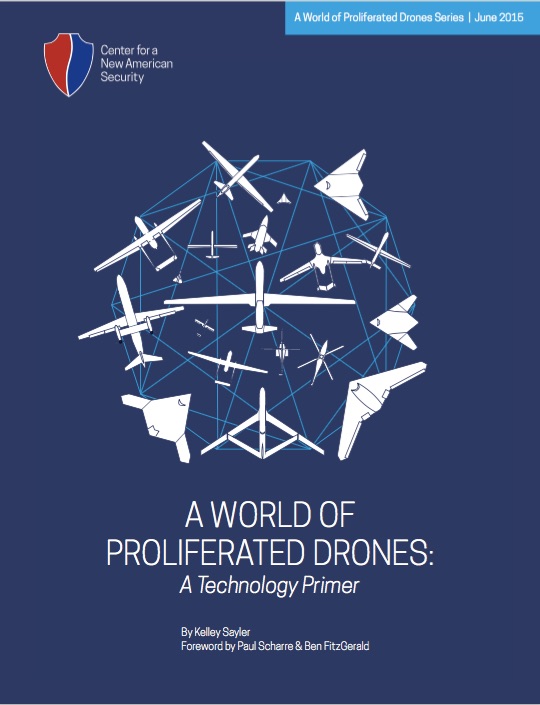
CNAS A world of proliferated dronesA new report from Kelley Sayler at the Center for a New American Security, A world of proliferated drones, starts to map what she calls ‘the likely contours of a drone-saturated world’.  The report emphasises that the United States does not have a monopoly on drones  – more than 90 states and non-state actors have them – but unusually the report pays close attention to the repurposing of small, commercial off-the-shelf drones.  It begins by summarising their capability for intelligence, surveillance and reconnaissance:

‘Current commercial drone technologies – available for purchase in either pre-assembled or customizable, component form – enable a number of high-end capabilities that were formerly the monopoly of major military powers.

Many commercial off-the-shelf (COTS) drones – including the best-selling model, the DJI Phantom – are now equipped with GPS and waypoint navigation systems. These systems enable the drone to accurately determine and hold its position, in turn removing the need for line-of-sight communications and allowing for autonomous flight… Operators of pre-assembled systems can also take advantage of smartphone-based control systems, dramatically improving ease of use. Such systems enable the user to navigate the drone simply by selecting a destination on a map or even by merely tilting the user’s phone…

High-definition video cameras are also widely available on COTS drones and, when combined with video downlinks, can provide real-time intelligence, surveillance, and reconnaissance (ISR) capabilities to multilocation receivers, though these capabilities are often limited by range and battery life.’

The report emphasises the potential weaponisation of these small drones for what it calls ‘overmatch’, in effect reversing the terms of asymmetric warfare, through (for example) the development of ‘flying IEDs‘:

‘While such systems may not appear sophisticated in a traditional military sense, ground-emplaced IEDs have caused thousands of American deaths in Iraq and Afghanistan and proved profoundly hard to defeat. Drones will enable airborne IEDs that can actively seek out U.S. forces, rather than passively lying in wait. Indeed, low-cost drones may lead to a paradigm shift in ground warfare for the United States, ending more than a half- century of air dominance in which U.S. ground forces have not had to fear attacks from the air.  Airborne IEDs could similarly be used in a terrorist attack against civilians or in precision strikes against high-profile individuals or landmarks.’

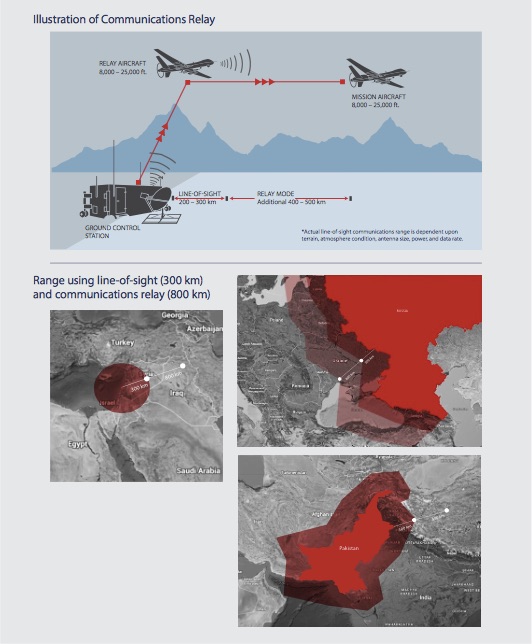
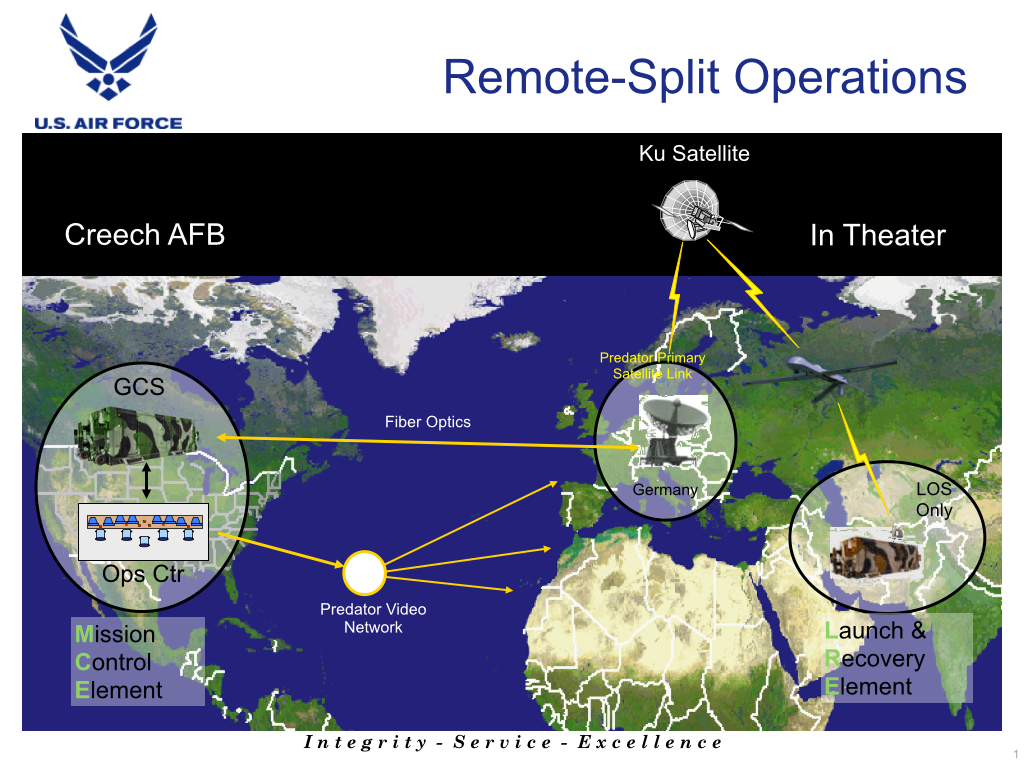
But the report also makes much of the US’s continued military-industrial investment in high-end drones.  Here various forms of stealth technology make much of the running, or at least issue most of the promissory notes, since today’s Predators and Reapers can only operate in more or less undefended air space – which is another way of saying they can only be used against the weak and/or with the complicity of other states (as in Pakistan and Yemen) – and face immense difficulties in what the US Air Force calls A2/AD [anti-access/area-denial] environments (see here and here). But I’m particularly interested in what the report has to say about the use of large military drones to act as communications relays.  Here the emphasis is on the ability of these remote relays to integrate what is otherwise often remarkably un-networked warfare and to extend the range of operational control and transmissable data.

Drones as communication relays (CNAS)

‘Large military-specific systems offer a number of additional improvements in communications capabilities. Many include wide-band satellite communications (SATCOM) that expand the amount and extend the range of transmittable data, providing distant ground stations with real-time ISR. Like some baseline systems, high-end systems are generally capable of line-of-sight communi- cations with other platforms operating in their area and, for this reason, are often employed as communications relays. Perhaps the most vivid example of the force-multiplying effects of such capabilities is the EQ-4 – what is essentially an RQ-4 Global Hawk outfitted with the Battlefield Airborne Communications Node (BACN). BACN serves as a universal translator for a diverse set of U.S. aircraft that are not otherwise capable of communicating with each other due to incompatible data links – providing a vital connection between, for example, fourth-generation F-16 fighter jets, B-1 bombers, and stealthy, fifth-generation F-22s [BACN is also used on conventional platforms: see here for its role in co-ordinating an air strike in Afghanistan]. Communications relay capabilities will also allow states to operate drones at extended ranges (300 to 800 kilometers) without satellite communications, allowing significant penetration into neighboring countries or contested areas’ (my emphasis).

Steve Graham and I are presently working on an essay on drones and satellite communications: so much of the discussion of geospatial intelligence has focused on satellite imagery, but the geographies of satellite communications (and, crucially, bandwidth) play a major role in the deployment of drones and in the highly variable quality of the imagery they transmit to users across the network.

Der Himmel über Berlin

At the end of February Tatiana Bazzichelli, director and curator of the Disruption Network Lab, invited me to be a keynote speaker at Eyes from a Distance: on drone systems and their strategies in Berlin in April.

Disruption Network Lab is an ongoing platform of events and research focused on art, hacktivism and disruption. The Laboratory takes shape through a series of conference events at Studio 1, Kunstquartier Bethanien in Berlin.

The goal of the Disruption Network Lab is to present and generate new possible routes of social and political action within the framework of hacktivism, digital culture and network economy, focusing on the disruptive potential of artistic practices. The Disruption Network Lab is a conceptual and practical zone where artists, hackers, networkers, critical thinkers and entrepreneurs enter into a dialogue. The programme is developed through artistic presentations, theoretical debates and keynote events. This series of events establishes local and translocal partnerships with other spaces and institutions.

0i1drones5_3907706133_o

The specific aim of Eyes from a Distance was unerring:

What is the politics and the regime of power beyond drone-systems? Which are the consequences both on militant networks and civil society of an increasing automatism of conflicts? Can we track down the hidden strategies that move target-killings? Can we understand better drone technology? This event combines reflections on the political and technological infrastructure of drone-systems, the use of them in massive and weaponised military programmes, and the artistic and activist response to this.

I was already committed to presentations at the Balsillie School/CIGI and to the AAG Conference in Chicago so, with immense reluctance, I had to decline.  Now I know what I missed – not only the wonderful city of Berlin but also a brilliant programme that would have kept me inside on both evenings.

You can find two video clips (one by Brandon Bryant, which I’ve embedded above) published as part of the documentation of the meeting here, and over at We Make Money Not Art, Regine has provided three detailed reports from the meeting (with useful links): The Grey Zone: the (il)legitimacy of targeted killing by drones, Eyes from a Distance: personal encounters with military drones, and Tracking Drones, reporting lives.

Intersecting with the themes raised by Eyes from a Distance, I highly recommend a new essay/work-in-progress by Sara Matthews on ‘Visual Itineraries of the Sovereign: The Drone Gaze‘.  It was originally developed for a panel on “The Ethics and Itineraries of Visual Data” at the meeting of the Society for Cinema and Media Studies in Montreal in March.

‘By our algorithms we shall know them’

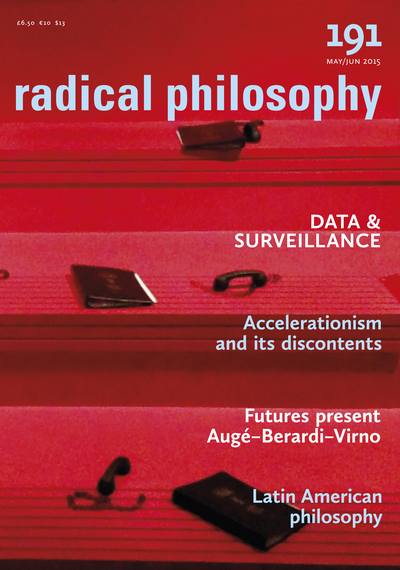
191webcoverweb

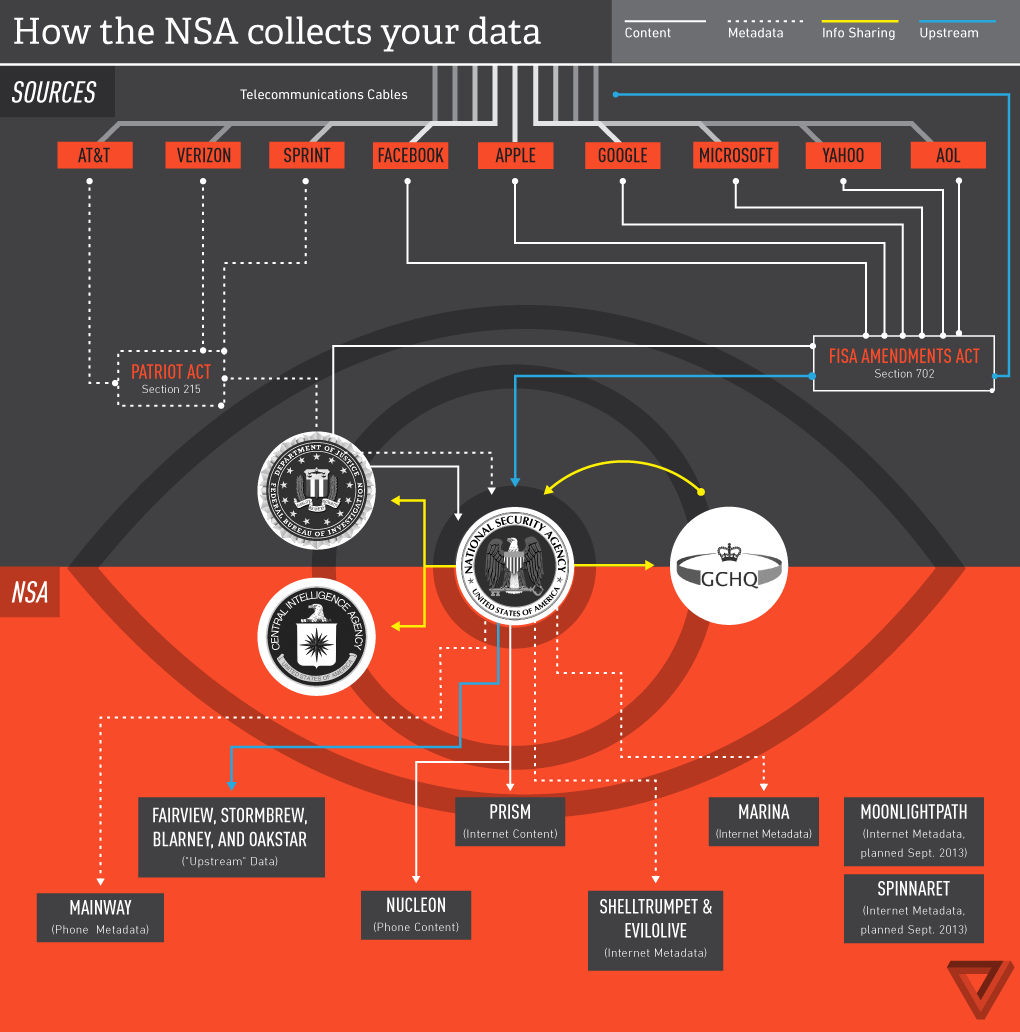
Radical Philosophy 191 is out now, including two contributions of particular interest to me as I continue to grapple with the surveillance apparatus that (mis)informs US drone strikes in the Federally Administered Tribal Areas.  This has come into sharper view after Obama’s rare admission of not only a strike in the FATA but of a mistake in targeting – though his statement was prompted by the death of an American and Italian hostage not by the previous deaths of innocent Pakistanis.

First, Grégoire Chamayou‘s ‘Oceanic enemy: a brief philosophical history of the NSA‘ which traces a path from the sonic surveillance of submarines off Barbados in 1962 to ‘pattern of life’ analysis in Afghanistan, Iraq and Pakistan, and which – not surprisingly – intersects with his Theory of the drone in all sorts of ways:

‘The premiss is the same as before: ‘in environments where there is no visual difference between friend and enemy, it is by their actions that enemies are visible.’ Today the task of establishing a distinction between friend and enemy is once again to be entrusted to algorithms.’

Second, Claudia Aradau‘s ‘The signature of security: big data, anticipation, surveillance‘ shatters the crystal balls of the intelligence agencies:

‘We are not crystal ball gazers. We are Intelligence Agencies’, noted the former GCHQ director Iain Lobban in a public inquiry on privacy and security by the Intelligence and Security Committee of the UK Parliament (ISC) in the wake of the Snowden revelations about mass surveillance….

I argue here that the disavowal of ‘crystal ball gazing’ is as important as the image of finding the clue through the data deluge in order to locate potential dangerous events or individuals in the future. Intelligence work is no stranger to the anticipation of the future – rather, it justifies itself precisely through the capacity to peer into the future in order to prevent or pre-empt future events from materializing. Big data has intensified the promise of anticipating the future and led to ‘exacerbat[ing] the severance of surveillance from history and memory’, while ‘the assiduous quest for pattern-discovery will justify unprecedented access to data’. ‘Knowledge discovery’ through big-data mining, and prediction through the recording of datafied traces of social life, have become the doxa of intelligence and security professionals. They claim that access to the digital traces that we leave online through commercial transactions or social interactions can hold a reading of the future. They repeat the mantra of data scientists and private corporations that the ‘digital bread crumbs’ of the online world ‘give a view of life in all its complexity’ and ‘will revolutionize the study of human behaviour’.

Unlike statistical technologies of governing populations, big data scientists promise that through big data ‘we can escape the straightjacket of group identities, and replace them with more granular predictions for each individual’. To resist their unreasonable promise of predicting crises, preventing diseases, pre-empting terrorist attacks and overall reshaping society and politics, I recast it as divination rather than detection. Big-data epistemics has more in common with the ‘pseudo-rationality’ of astrology than the method of clues. As such, it renders our vocabularies of epistemic critique inoperative…

‘There is nothing irrational about astrology’, concluded Adorno, ‘except its decisive contention that these two spheres of rational knowledge are interconnected, whereas not the slightest evidence of such an interconnection can be offered.’ The irrationality of big-data security is not in the data, its volume or messiness, but in how a hieroglyph of terrorist behaviour is produced from the data, without any possibility of error.

You can obtain the pdfs of both essays by following the links above – but they are time-limited so do it now.

Theories and counter-theories of the drone

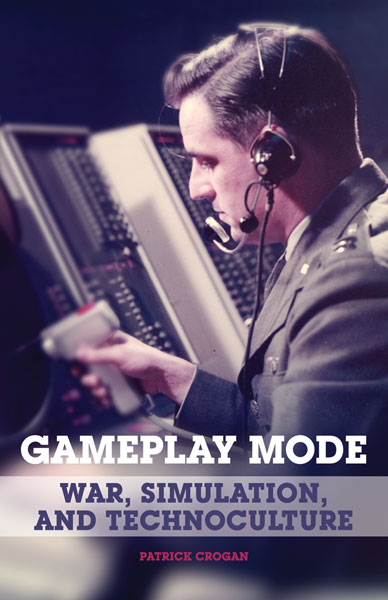
CROGAN Gameplay modeI expect many readers will know Patrick Crogan‘s Gameplay mode: war, simulation and technoculture (Minnesota, 2011).  He has now uploaded what I think is a draft of Drones and global technicity: automation and (dis)individuation at academia.  Here’s the extended abstract:

This paper (for General Organology conference [held last month at the University of Kent]) will explore the expansion of military drone usage by Western powers in the “war on terror” over the last decade or so in relation to Bernard Stiegler’s organological approach to questions concerning human historical, cultural and technological becoming.. Theorists approaching drones from different fields such as Grégoire Chamayou, Derek Gregory and Eyal Weizman have argued that the systematic and growing deployment of unmanned aerial vehicles should be understood as the “avant-garde” of a general movement toward remote and increasingly autonomous robotic systems by all branches of the armed forces of the U.S. and many of allies and competitors. These developments put into question all established cultural political, legal and ethical framings of war, peace, territory, civilian and soldier in the societies of the “advanced powers” on behalf of which these systems are deployed. Animating this indetermination is what Chamayou calls the “tendency inherent in the material development of drones” leading to this profound undoing of cultural and geopolitical moorings. I will explore the organological nature of this tendency inherent in drone materiality and technology, concentrating on the virtualizing, realtime digital developments in remotely controlled and increasingly automated robotic systems.

The projection of a simulational model of the contested space over the inhabited world is a constitutive part of this tendency. Indeed, the inhabitants of the spaces of concern in the war on terror—which in principle and increasingly in practice are everywhere—are better understood as environmental elements or “threats” in what simulation engineer and theorist Robert Sargent has called the “problem space” the computer simulation designer seeks to model conceptually in order to make the simulation serve as an effective solution. A specifically designed spatio-temporality is enacting a performative, “operational” and automated reinvention of the lived experience of both inhabiting and contesting the control of space in time.

If, as the above writers have shown, this projection of and over “enemy territory” has clear precedents in European colonialist strategies and procedures, what is unprecedented today is the digitally-enabled expansion and intensification of this spatio-temporal reanimation of the world. This reanimation must be understood as key contributor to a transformative and extremely problematic pathway toward the automation of military force projection across the globe. This essay will analyse the nature and implications of these transformative digital modellings of the enemy in and as milieu, a milieu as tiny as the space around a single ‘target’ and as large as the world, existing both in a brief “window of opportunity” and within a permanent realtime of preemptive pan-spectrum surveillance.

From an organological perspective developments in drone technics must also be approached as a particularly pressing political and ethical challenge of the global transformations of human technicity in the digital “epoch”—or rather, in the generalised crisis of epochality and spatio-temporal orientation that Stiegler sets out to thematise and respond to in his “philosophical activism”. If as Stiegler provocatively suggests in Technics and Time 1: The Fault of Epimetheus) human being had a “second origin” in the historical development of the West which achieved its culmination its “worldwide extension”, it is one whose epoch has led us tendentially and increasingly rapidly to the crisis of ethnocultural idiomatic differentiation and specificity (as he argues in Technics and Time 2: Disorientation). The history of Western techno-capitalist, imperial colonisations, wars and subsequent post-colonial globalisation is attaining its full extent and its exacerbation, readable in the above noted indeterminations of war, peace, sovereignty, citizenship and so on. What goes with this is a doubled movement (which Virilio termed “endocolonisation”) of intensification of the reorganisation of social and individual surveillance, control and regulation via realtime, pervasive digital technical regimes. The systematic deployment of computational abstraction, simulational virtualisation and anticipatory, realtime preemptive materialisation of this doubled movement is perceivable in all its cultural-political, conceptual and technological complexity in drone technics. Indeed, drones are a major driver of research and development in automation and AI for the spectrum of what the U.S.A.F calls the “perceive and act vector”, as well as for “big data” processing in realtime to handle ever-growing monitoring and surveillance feeds.

Today a voluntarist and cynical (and nihilist in Stiegler’s view) adoption of the automatising potentials of digital technics supports the rapid advances in drone systems (and I have proposed that an “elective naivety” sustains this in the academy, across scientific and humanities disciplinary contexts). From Stiegler’s organological perspective, I will argue that the autonomy of human agency is always composed with various automated functions that form part of our material, prosthetic conditions of existence. By addressing some of the inherent contradictions arising from the proposed development of fully autonomous military robotic systems, I hope to contribute toward the urgently needed “redoubling” of the first adoption of the possibilities of digital automation evidenced in drone technics (as the “logical” outcome in strategic-political terms of the latest advances of computer technology). To “re-double” technocultural becoming reflectively, critically, in the name of a less inhuman potential of automated digital technics is the responsibility of those able to read and write, to reflect and respond to the accelerating epochal transformation of the world in this “our” era of the permanent war on terror. This is the horizon in which “we” maintain the possibility of a non-inhuman future (or further “re-birth”) for contemporary humanity. For, as Stiegler has argued in What Makes Life Worth Living, this is a better way to think the present and future than that implied in the term “post-human”, for the human remains a project and a projection and not a superceded entity.

ac_bernard_stiegler_1200_02

Bernard Stiegler (above) was a keynote speaker at the conference, and if you want some tantalising glimpses into some of the other possibilities opened out by his ideas for the analysis of drones, I’d recommend James Ash, ‘Technology and affect: Towards a theory of inorganically organised objects’, Emotion, space and society (in press, 2014) – incidentally, James reviews Gameplay mode in Cultural politics 8 (3) (2012) 495-497 – and Sam Kinsley‘s ‘The matter of virtual geographies’, Progress in human geography (2014) 38 (3) (2014) 364-84.

As you can see from the abstract, Patrick also engages with my work and, crucially, Gregoire Chamayou‘s, and since the English-language translation of Theory of the drone is published at the end of this month I thought it might be helpful to list and link to my detailed commentaries on the book in one place, so here they are:

theory_of_the_drone_final

Theory of the drone 1: Genealogies

Theory of the drone 2: Hunting

Theory of the drone 3: Killing grounds

Theory of the drone 4: Pennies from heaven [on counterinsurgency/COIN]

 Theory of the drone 5: Vulnerabilities

Theory of the drone 6: Sacrifice, suicide and drones

Theory of the drone 7: Historical precedents and postcolonial amnesia

Theory of the drone 8: From invisibility to vulnerability

Theory of the drone 9: Psychopathologies of the drone

Theory of the drone 10: Killing at a distance

Theory of the drone 11: Necro-ethics

Theory of the drone 12: ‘Killing well’?

You can also find my essay on ‘Drone geographies’ from Radical Philosophy (2014) under the DOWNLOADS tab.

Jean-Baptiste Jeangène Vilmer‘s combative review of Theory of the drone, ‘Ideology of the drone’, is here and my extended commentary on that review is here.  Simon Labrecque provides another review here, invoking the USAF’s own description of its remote missions: ‘Projeter du pouvoir sans projeter de vulnérabilité.’

Meanwhile over at the Funambulist Papers, Stuart Elden suggested one way of wiring Grégoire’s previous book Manhunts to Theory of the drone here, while Grégoire’s own postscript (which suggests another route) is here.

Expect more commentary once the English edition is out.