Predatory networks

A key moment in the development of the United States’ UAV program was the deployment of a prototype Predator – General Atomics’ GNAT-750 – over Bosnia.  This is how I summarised the accelerated fielding program in ‘Moving targets’ (DOWNLOADS tab):

Even as the GNAT-750 was deployed over Bosnia-Herzegovina, the design was being developed into a new platform, the RQ-1 Predator, which incorporated three major modifications. The original intention had been to provide still imagery and text interpretation, but this was replaced by real-time motion video in colour (by day) and infrared (by night). A more serious limitation was range; the GNAT-750 could only operate 150 miles from the ground control station because it relied on a C-band line of sight data link. The CIA experimented with using relay aircraft to expedite data transmission – the same solution that had been used for the ‘electronic battlefield’ along the Ho Chi Minh Trail – but the breakthrough came with the use of the Ku-band satellite system that dramatically increased the operational range. The upgrade had been tested in the United States, and was retrofitted to Predators in Europe in August 1995. Although data was then rapidly transmitted across the Atlantic, the key intelligence nodes were still in Europe, like the Combined Air Operations Centre at Vicenza in Italy, and the drones were still controlled from ground stations within the region, at first from Gjader in Albania and later from Tazar in Hungary. A third, no less revolutionary innovation was the installation of an onboard global positioning system (GPS); early target imagery had to be geo-located using a PowerScene software program, but the introduction of satellite-linked GPS made a considerable difference to the speed and accuracy of targeting.

But I now think this misses other even more important dimensions that speak directly to the fabrication of the network in which Predators and eventually Reapers become embedded.

My primary source is a remarkable MIT PhD thesis by Lt. Col. Timothy Cullen, The MQ-9 Reaper Remotely Piloted Aircraft: Humans and Machines in Action (2011).  The research involved interviews with 50 pilots, 26 sensor operators, 13 Mission Intelligence Coordinators and 8 imagery analysts between 2009-2010 (so this is inevitably a snapshot of a changing program – but one with a wide field of view) and direct observation of training missions at Holloman Air Force Base; the thesis is also informed by Cullen’s own, considerable experience as a pilot of conventional strike aircraft and by actor-network theory, though most particularly by Edward Hutchins‘ cognitive ethnography and by the work of Lucy Suchman.

CULLEN p. 94I should say, too, that the thesis is irony made flesh, so to speak.  The author notes that:

Missing from public discussions are the details of remote air operations in current conflicts and the role of social networks, organizational culture, and professional practices in the evolution and history of RPA. The public cannot have informed discussions about these topics without empirical observations and descriptions of how RPA operators actually fly and employ the aircraft.

Fair enough, of course, but parts of the thesis are heavily redacted; I realise this isn’t – can’t – be Cullen’s doing, but it is as frustrating for the reader as it surely must be for the author (for Private Eye devotees, the image on the right shows p. 94).  Still, there’s enough in plain sight to provide a series of arresting insights into the development of the UAV program.

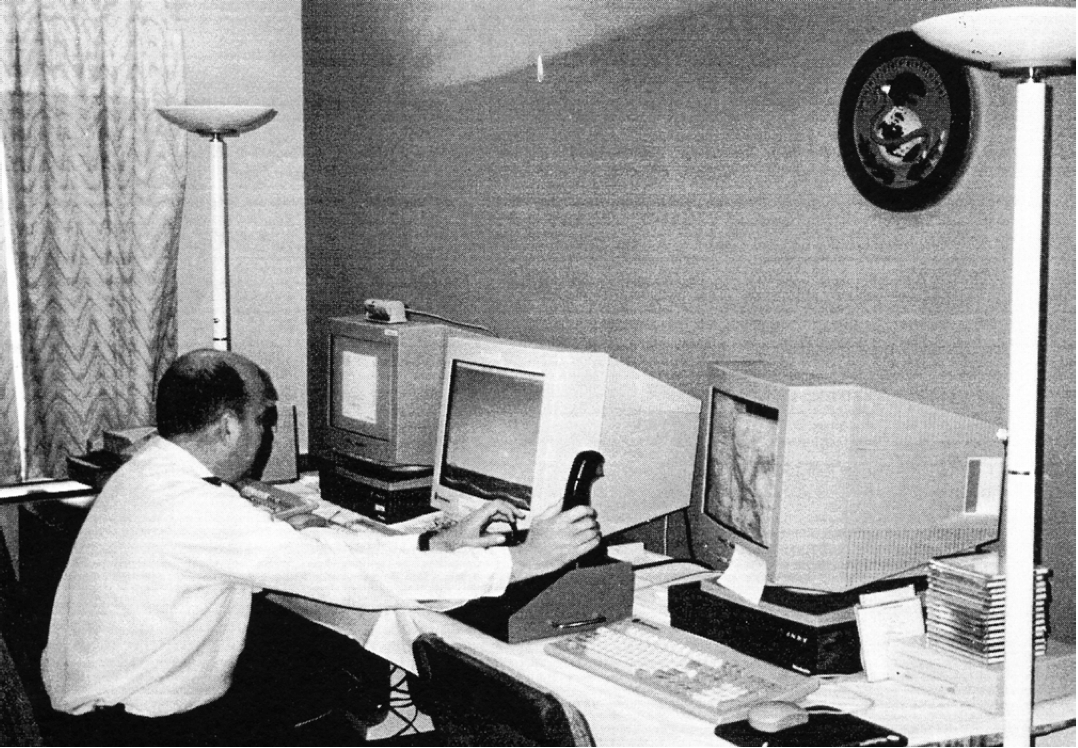
First, early Predator crews were remarkably detached from the wider mission and their ability to communicate with people outside their Ground Control Stations was extremely limited.  The pilot’s primary responsibility was to program the aircraft to fly on autopilot from target to target and to monitor the flight path, while two sensor operators identified and tracked the targets whose images were to be captured.  In a tent outside the ground control station a ‘Mission Planning Cell’ (MPC: see photograph below) served as the communications interface; since this was an experimental system, the Ground Control Station was not permitted to receive or transmit sensitive or classified information.  Apart from the transmission of images, all communications between the two were either face-to-face (literally through the tent flaps) or via a telephone link.
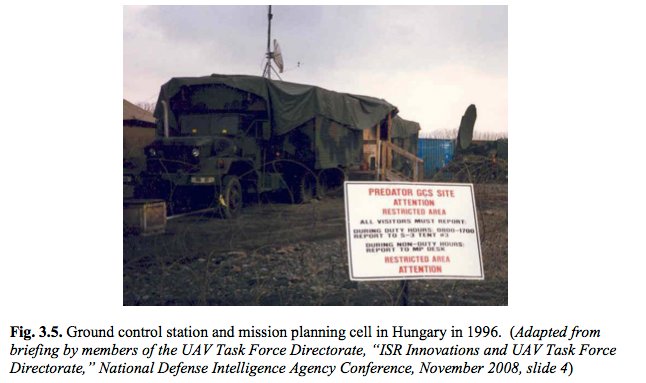
GCS and Mission Planning Cell, Hungary 1996

Before a mission the MPC received a set of 50-300 imagery targets (known as ‘Collection Points’) from the Balkans Combined Air Operations Center in Vicenza in Italy, and used this to create a detailed target deck.  The time between the initial requests and final image capture steadily decreased from 72 hours to 48 hours, and eventually re-tasking during a mission became standard: more on the tasking process here.
Bosnia imageryThe video feeds from the Predator were sent via coaxial cable to the MPC where they were digitised and encrypted for onward transmission over a secure network to commanders in the field and to a group of 10-12  imagery analysts in the United States.  The analysts posted video clips and annotated stills on a classified web page, but the quality of the video feeds with which they had to work was significantly less than the raw feeds available in theatre, and the slow response time was another serious limitation on the value of their work.

At the time, of course, all this seemed revolutionary, and the second Annual Report on the UAV program in 1996 declared that:

Even more significant than the Predator performance “firsts” is the wide use made of its imagery, amplified by the increased network of receiving stations both in-theater and back in CONUS [continental US]. The development of this dissemination capability is shown below.

conus

It first used VSATs at selected receiving sites, and then the SATCOM-based Joint Broadcast System (JBS). The Predator-JBS network represents the first time for the simultaneous broadcast of live UAV video to more than 15 users. This provided a common picture of the “battlefield.” Video imagery can be viewed either as full motion video or via a “mosaicking” technique at the ground station. 

[JAC Molesworth was the Joint Analysis Center at RAF Molesworth in the UK, US European Command’s intelligence center, and DISN is the Defense Information Systems Network for data, video and voice services].

But the system was far from responsive; the MPC filtered all communications from commanders and imagery analysts and, as the tasking diagram below shows, whether the cycle followed the standard model or allowed for more flexible re-tasking the Predator crew had very little discretion and was, in a substantial sense, what Cullen calls ‘a passive source of data’.  Its responsibilities were limited to the ‘physical control’ of the platform.

figure8-1

This has been transformed by the cumulative construction of an extended, distributed network in which UAV crews are in direct communication, either by voice or through secure internet chatrooms, with multiple agents: commanders, military lawyers, image analysts, joint terminal attack controllers and ground troops.  But this was not how the system was originally conceived or fielded, and Cullen shows that its transformation depended on the skilled intervention of UAV crews and their commanders who ‘envisioned and used the system as a collaborative network of operators, intelligence analysts, and ground personnel to establish objectives, exchange information, and understand the context of a mission’:

‘RPA [Remotely Piloted Aircraft] operators restructured the ground control station and crew tasks to shift the actions of crewmembers from low status missions of gathering and disseminating data to higher status tasks of integrating and creating information, participating in the assessment of threats, and actively contributing to commanders’ decision-making processes. RPA operators were not satisfied with simple connections to a network of people and tools to accomplish a mission. They sought and fostered social relationships with them and demanded interactive dialog among them in a form they could anticipate, understand, and evaluate’ (Cullen, p. 204).

Second, early Predator operations, not only in the Balkans in the late 1990s but also over southern Iraq and in Afghanistan, were not what would later become known as ‘remote-split operations’.  It was assumed that the Predator had to be operated as close to the combat theatre as possible. This was not only because of the platform’s limited range, important though this is: as I’ve said before, these are not weapons of global reach.  Indeed, it’s still the case that Predators and Reapers have to be physically close to their theatre of operations, which is why the United States has become so alarmed at the implications of a complete withdrawal from Afghanistan for the CIA’s program of targeted killing in Pakistan.  According to David Sanger and Eric Schmitt,

‘Their concern is that the nearest alternative bases are too far away for drones to reach the mountainous territory in Pakistan where the remnants of Al Qaeda’s central command are hiding. Those bases would also be too distant to monitor and respond as quickly as American forces can today if there were a crisis in the region, such as missing nuclear material or weapons in Pakistan and India.’ 

For the ‘no-fly zone’ established over southern Iraq reconnaissance flights were flown by Predators from Ali Al Salem Air Base in Kuwait, and for the initial campaign in Afghanistan from Jacobad in Pakistan, and Cullen explains that the vulnerability of these (‘austere’) sites limited the MPC’s access to secure networks, communications and databases.  But in 2002-3 USAF pilots and sensor operators returning from secondment to – Cullen actually calls it ‘kidnapping’ – ‘other agencies’, which is to say the CIA, successfully argued that the primary execution of remote missions should be consolidated at Nellis Air Force Base and its auxiliary field, Indian Springs (later re-named Creech AFB), in southern Nevada, which would expand and enhance crews’ access to secure intelligence and analysis capabilities.  There would still have to be a forward deployed ‘Launch and Recovery’ element to maintain the aircraft and to control take-off and landing using a line of sight link, but all other mission tasks could be handled from the continental United States using a Ku-band satellite link via a portal at Ramstein Air Force Base in Germany.  When remote split operations started in 2003 the MPC disappeared, replaced by a single Mission Intelligence Co-ordinator who was stationed inside the Ground Control Station in constant communication with the pilot and sensor operator and this, in turn, transformed the configuration and equipment inside the GCS.  But, crucially, relations beyond the GCS were also transformed as USAF commanders visited Afghanistan and Iraq and established close relations with ground troops: ‘remote’ and ‘split’ could not imply detachment, and the new technological networks had to be infused with new social interactions for the system to be effective.
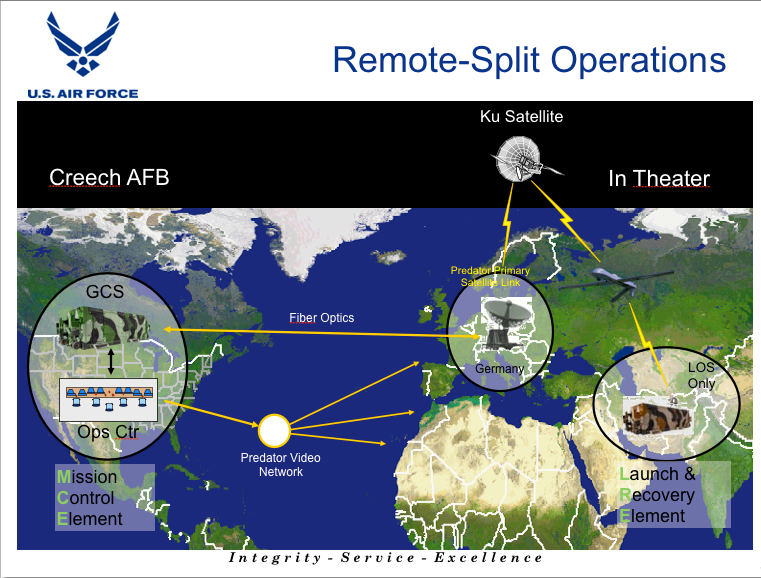
Remote-Split Operations (USAF)

Focal to these transformations – and a crucial driver of the process of network construction and transformation – was the decision to arm the Predator and turn it into a ‘hunter-killer’ platform.  At that point, Cullen observes,

‘Predator pilots became decision makers, and Predator’s weapons transformed Predator pilots and sensor operators into war fighters – Predator crews could create effects on the battlefield they could observe, evaluate and adjust… The arming of the Predator was synonymous with the integration of the system – the people, tools and practices of the Predator community – into military operations’ (pp. 245-7).

The reverse was also true: not only was the Predator integrated into the battlespace but, as Cullen notes, the network was ‘infused’ into the Ground Control Station. In consequence, a sensation of what Cullen calls ‘remote presence’ was inculcated amongst UAV crews and, in particular, sensor operators who developed a strong sense of being part of the machinic complex, ‘becoming the camera’ so intimately that they were ‘transported’ above the battlespace.  These transformations were stepped up with the development of the Reaper, reinforced by new practices and by the introduction of a new, profoundly combative discourse that distanced the Reaper from the Predator:

‘[T]o reinforce the power and responsibility of Reaper crews, members of the 42nd Attack Squadron changed the language of their work. Sensor operators did not operate a sensor ball; they flew a “targeting pod” like fighter pilots and weapon system officers. Reaper pilots and sensor operators did not have a “mission intelligence coordinator”; they coordinated strike missions with the support of an “intelligence crewmember.” Reaper crews did not conduct “intelligence, surveillance, and reconnaissance” missions; they flew “non-traditional” intelligence missions like fighter and bomber crews. Members of the 42nd Attack Squadron used the rhetoric of the fighter community to highlight the strike capabilities of Reaper; to influence the perceptions of Reaper operators; and to shape the priorities, attention, and assertiveness of Reaper crews during a mission’ (p. 264)

The language was performative, but its performative force – the ability to ‘create effects on the battlefield’ – was realised through the developing networks within which and through which it was deployed.

To be continued.
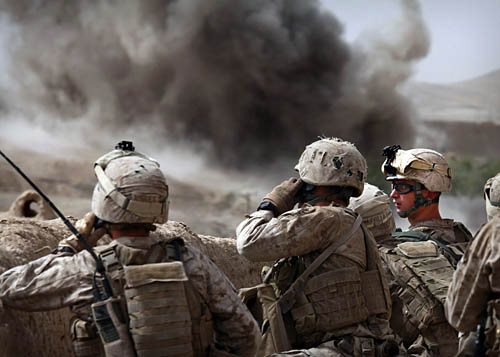
Digital airstrikes and physical casualties

Afghanistan

The US military defines Close Air Support (CAS) as ‘air action by fixed-wing and rotary-wing aircraft against hostile targets that are in close proximity to friendly forces, and [it] requires detailed integration of each air mission with the fire and movement of those forces.’  It’s a difficult and dangerous business, and not only for the intended targets.

The technologies of CAS have been transformed but, according to the the Defense Advanced Research Projects Agency, its fundamentals haven’t changed since the First World War.

‘Pilots and dismounted ground agents must ensure they hit only the intended target using just voice directions and, if they’re lucky, a common paper map. It can often take up to an hour to confer, get in position and strike—time in which targets can attack first or move out of reach.’

To achieve what is in effect the time-space compression of the kill-chain, DARPA is developing its Persistent Close Air Support program to provide an all-digital system.  The system ‘lets a Joint Tactical Air Controller call up CAS from a variety of sources, such as aircraft or missile platforms, to engage multiple, moving and simultaneous targets,’ explains David Szondy (from whom I’ve borrowed the short-hand ‘digital airstrikes’). ‘By eliminating all the radio chatter and map fumbling, the exercise is much faster and more accurate with reduced risk of friendly fire incidents.’  The program manifesto, for want of a better word, includes these aims and specifications:

The program seeks to leverage advances in computing and communications technologies to fundamentally increase CAS effectiveness, as well as improve the speed and survivability of ground forces engaged with enemy forces.

The program envisions numerous benefits, including:

  • Reducing the time from calling in a strike to the weapon hitting the target by a factor of 10, from up to 60 minutes down to just 6 minutes 
  • Direct coordination of airstrikes by a ground agent from manned or unmanned air vehicles
  • Improved speed and survivability of ground forces engaged with enemy forces
  • Use of smaller, more precise munitions against smaller and moving targets in degraded visual environments
  • Graceful degradation of services—if one piece of the system fails, warfighters would still retain CAS capability

PCAS_ProgramPage_Image

PCAS has two components:

The first is PCAS-Air, which … involves the use of internal guidance systems, weapons and engagement management systems, and communications using either the Ethernet or aircraft networks for high-speed data transmission and reception. PCAS-Air processes the data received, and provides aircrews via aircraft displays or tablets with the best travel routes to the target, which weapons to use, and how best to use them.

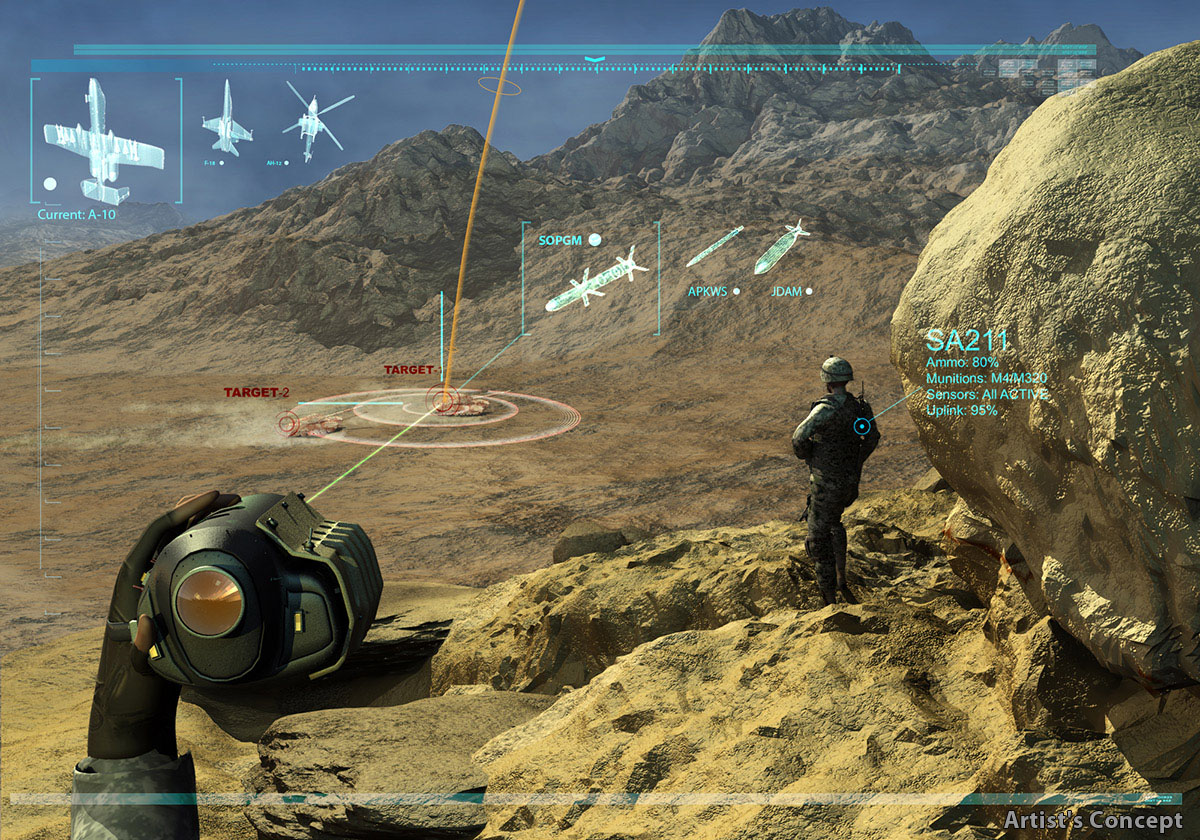
The other half is PCAS-Ground, intended for improved mobility, situational awareness and communications for fire coordination. Soldiers on the ground can use an HUD eyepiece wired to a tablet that displays tactical imagery, maps, digital terrain elevation data, and other information [the image above is an artist’s impression of the Heads-Up Display]. This means they can receive tactical data from PCAS without having to keep looking at a computer screen.

PCAS-Ground has been deployed in Afghanistan since December 2012.  The original plan, as the emphasis on ‘persistent’ implies, was to integrate the system with drones, but after the cancellation of the US Air Force’s MQ-X (‘Avenger’) program Raytheon announced that PCAS would be developed using a conventional A-10 Thunderbolt.

There is of course a long history to the digitisation and automation of the battlespace, and that reference to the First World War was not an anachronism.  There were such intimate links between mapping, aerial photography and artillery ranging on the Western Front – whose cascade of updated imagery and intelligence underwrote the seeming stasis of trench warfare – that Peter Chasseaud described the result as ‘a sophisticated three-dimensional fire-control data base’ through which ‘in effect, the battlefield had been digitised.’  It was also, in a sense, automated; I discuss this in detail in ‘Gabriel’s Map’, but it’s captured perfectly in Tom McCarthy‘s novel C.

More obvious way stations to the present include the Vietnam-era Electronic Battlefield, whose sensor-shooter system I described in ‘Lines of descent’ (DOWNLOADS tab) as a vital precursor to today’s remote operations:

http://www.youtube.com/watch?v=USwaRygAJaY

Another was the development of the PowerScene digital terrain simulation that was used to identify target imagery transmitted by proto-Predators over Bosnia-Hercegovina and to rehearse NATO bombing missions.

PowerScene at Wright-Dayton AFBRemarkably, it was also used at Wright-Patterson Air Force Base during the negotiations that led to the Dayton peace accords. As one US officer explained:  ‘It’s an instrument of war but we’ll use it for peace because you are willing to come to the table’.  The system was used to explore proposals for potential boundaries, but the sub-text was clear: if agreement could not be reached, NATO had a detailed military knowledge of terrain and targets.  (For more, see James Hasik‘s Arms and innovation: entrepreneurship and alliances in the twenty-first century defense industry (2008) Ch. 6: ‘Mountains Miles Apart’; Richard Johnson‘s ‘Virtual Diplomacy’ report here; and a precocious paper by Mark Corson and Julian Minghi here, from which I’ve taken the image on the left).

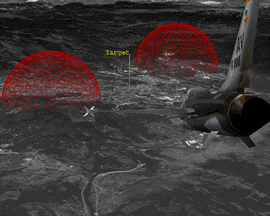
powerscene2PowerScene was later used by USAF pilots rehearsing simulated bombing missions against Baghdad in the 1990s (see right) – the system fixed target co-ordinates and red ‘bubbles’ displayed threats calibrated on the range of surface-to-air missile systems – and when Anteon Corporation and Lockheed Martin introduced TopScene air strikes over Afghanistan in 2001 were also rehearsed over digital terrain.

But there is another side to all this, because digital platforms can also be used to enable others to display and interrogate the geography of air strikes.  I’ve discussed this before in relation to the CIA-directed program of targeted killing in Pakistan here and here, but impressive progress has also been made in plotting air strikes across the border in Afghanistan.

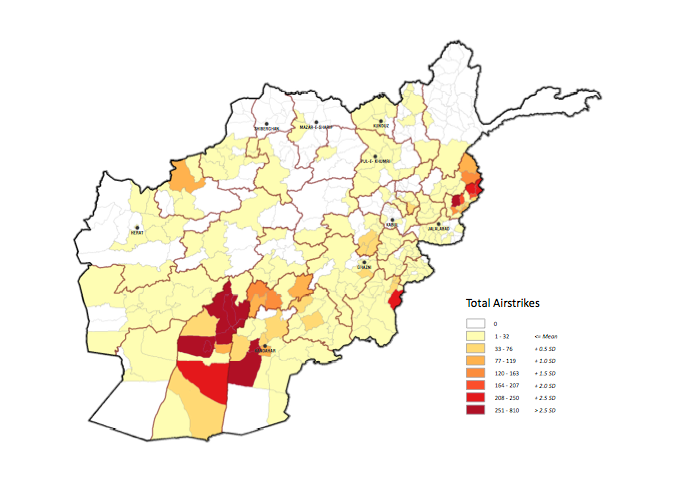
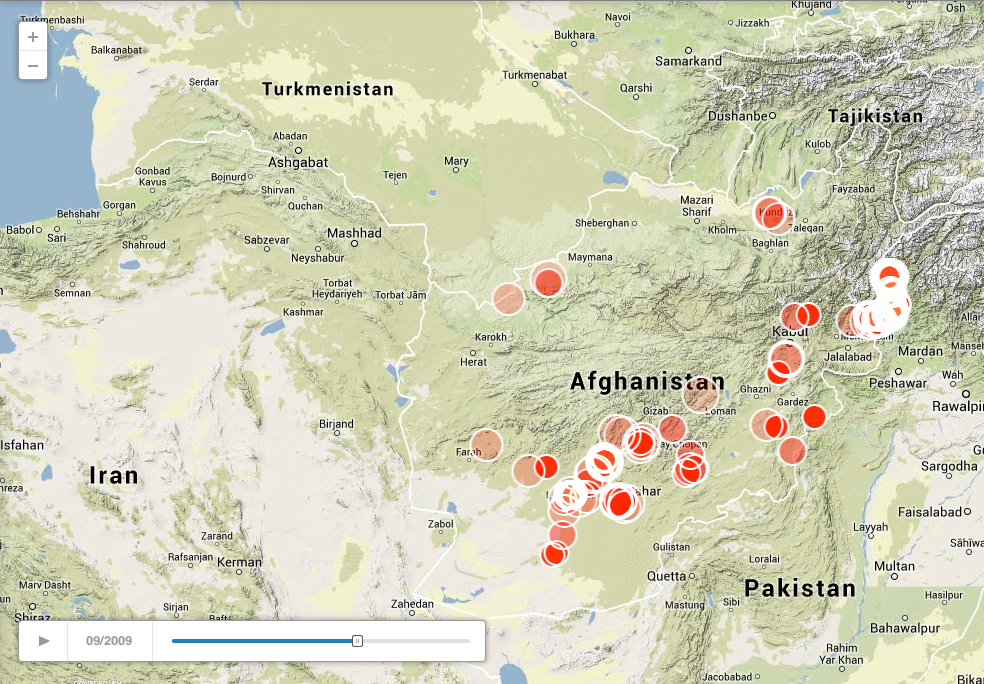
The most remarkable use of USAF/ISAF data that I know is Jason Lyall‘s work in progress on what he calls ‘Dynamic coercion in civil wars’ – ‘Are airstrikes an effective tool of coercion against insurgent organizations?’ – which focuses on air strikes in Afghanistan between 2006 and 2011. This is part of a book project, Death from above: the effects of airpower in small wars; the most recent version of the relevant analysis is here.  The map below is Jason’s summary of air strikes in Afghanistan 2006-11, but as I’ll explain in a moment, it gives little idea of the critical digital power that lies behind it.

JASON LYALL Air strikes in Afghanistan 2006-2011

First, the original USAF/ISAF data was in digital form, but transforming it into a coherent and consistent geo-coded database has involved a truly extraordinary enterprise:

We draw on multiple sources to construct a dataset of nearly 23,000 airstrikes and shows of force in Afghanistan during 2006-11. The bulk of the dataset stems from newly-declassified data from the Air Forces Central’s (AFCENT) Combined Air Operations Center (CAOC) in Southwest Asia, which recorded the location, date, platform, and type/number of bombs dropped for January 2008 to December 2011 in Afghanistan. These data required extensive cleaning to ensure that a consistent standard for each type of air operation was maintained and duplicates dropped. These data were supplemented by declassified data from the International Security Assistance Force’s (ISAF) Combined Information Data Exchange Network (CIDNE) for the January 2006 to December 2011 time period. Finally, additional records from press releases by the Air Force’s Public Affairs Office (the “Daily Airpower Summary,” or DAPS) were also incorporated. … Each air operations’ intended target was confirmed using at least two independent coders drawing on publicly available satellite imagery. Merging of these records was extremely labor intensive, not least because of the near total absence of overlap between CAOC, CIDNE, and DAPS records. Only 448 events were found in all three datasets, underscoring the problems inherent in single-sourcing data, even official data, in conflict settings (my emphasis).

Second, to get the full visual effect of Jason’s analysis you absolutely need to see the animation that he’s made available on his website here; the image below is just a screenshot for September 2009 (I’ll explain why I chose that month in my next post).

JASON LYALL Air strikes in Afghanistan 09:2009

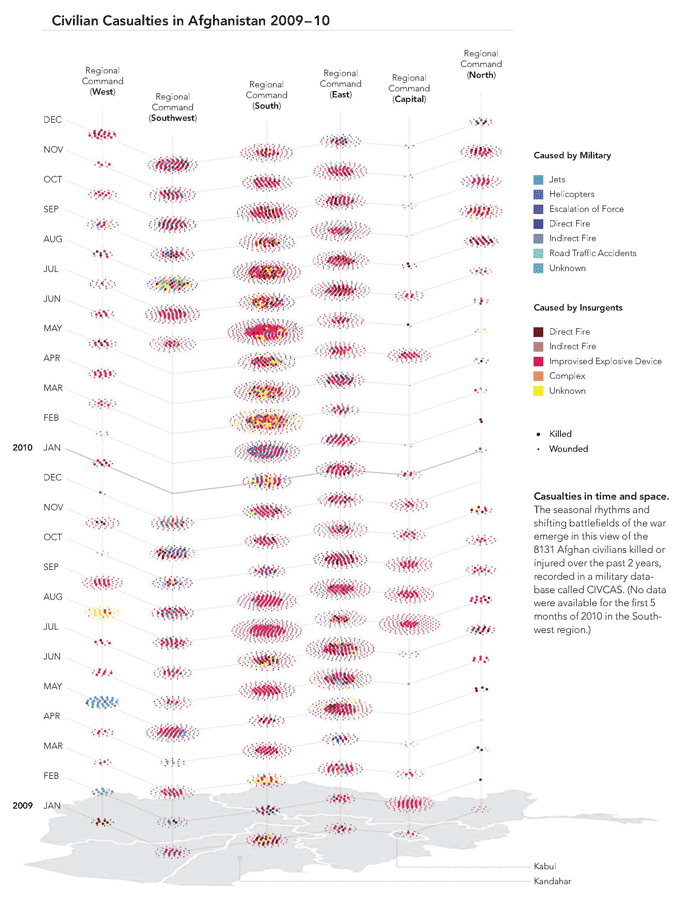
But what about casualty figures?  Josh includes a summary map of 216 air strikes involving acknowledged civilian casualties, taken from the same military databases (with all their limitations), and in January 2011 the US military released its data on ‘CIVCAS’ for the previous two years to the journal Science.  They included casualties from all parties to the conflict:

The numbers show that 2,537 Afghans civilians were killed and 5,594 were wounded in the past two years. Most of the deaths – 80 percent – are attributed to insurgents, with 12 percent caused by coalition forces, a 26 percent drop.

Here is Science‘s visualization of the CIVCAS data, designed to capture the time-space rhythms of violence from multiple causes:

F2.medium

You can access the interactive version here.

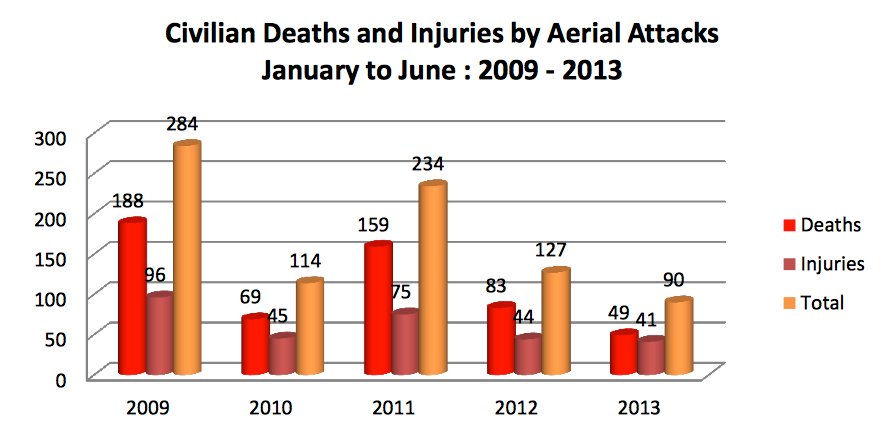
But other sources (notably the Afghan Rights Monitor and the UN Mission in Afghanistan, UNAMA, which produces six-monthly Reports on the protection of civilians in armed conflict) using different methodologies came up with much higher figures; here is a graph from the most recent UNAMA report showing casualties from air strikes 2009-13:

UNAMA Civilian casualties from air attacks 2009-13

UNAMA added this comment:

UNAMA welcomes the reduction in civilian casualties from aerial operations but reiterates its concern regarding several operations that caused disproportionate loss of civilian life and injury. UNAMA also raises concerns with the lack of transparency and accountability about several aerial operations carried out by international military forces that resulted in civilian casualties.

You can find the full analysis by John Bohannon, which includes a discussion of both databases, at Science (open access) here.

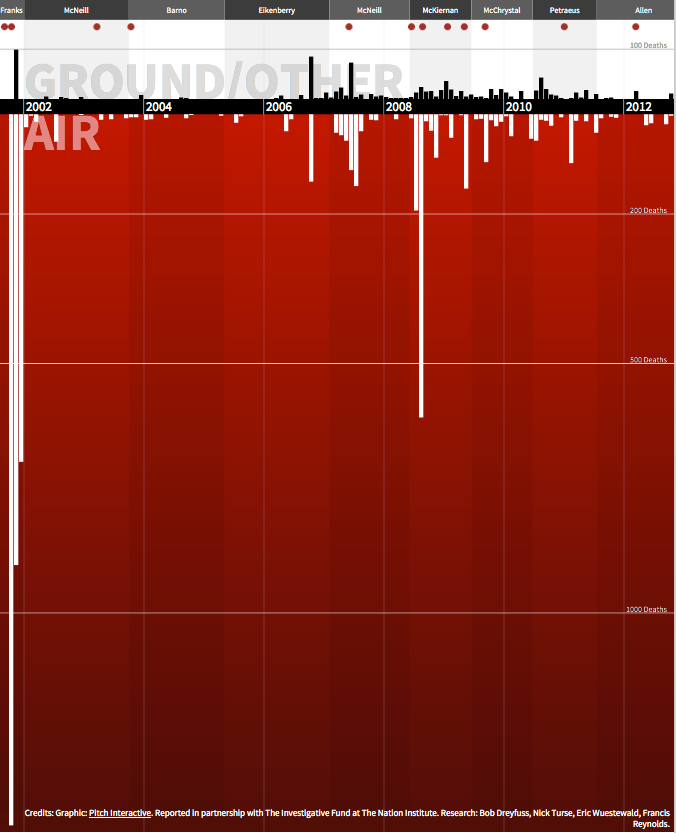
To be sure, counting casualties is always a contentious (and often dangerous) affair.  Getting information from the government of Afghanistan isn’t any more straightforward, as Nick Turse has shown: as he adds, ‘neither is it cheap’.  But he persevered, and the wonderful Pitch Interactive (a data visualization studio that also produced the haunting representation of deaths from drone strikes in Pakistan) collaborated with The Nation to produce a stunning interactive of ‘civilian deaths that have occurred in Afghanistan as a result of war-related actions by the United States, its allies and Afghan government forces.’  Here’s a screenshot:

Civilian fatalities in Afghanistan 2001-2012

You will see running along the top the military commanders during each period; the red dots mark major events.  It’s common knowledge – or should be – that the US-led invasion of Afghanistan in 2001 was spearheaded by an intensive high-level bombing campaign (I described this in The Colonial Present), shown along that desperately deep left margin.  But I suspect fewer people have grasped the reliance that ISAF has continued to place on air power.  What stands out from the image above, clearly, is the disproportionate (sic) number of deaths attributed to air strikes (5, 622) compared with ground operations (794) throughout the period: the UNAMA data above suggest that this only started to change in 2013. You can read more about this in the essay by Bob Dreyfuss and Nick Turse that accompanied the interactive, ‘America’s Afghan victims’, here, and – as always – the tireless work of Marc Herold is indispensable.

And to forestall a stream of comments, my title is not intended to suggest that digital technologies or the airstrikes they facilitate are somehow ‘immaterial’; nothing could be further from the truth.  Or the killing fields.

Boundless Informant and the everyware war

As part of my presentation on “Drones and the everywhere war” at York, I decided to unpack this extraordinary claim made by John Nagl, one of the architects of the US military’s revised counterinsurgency doctrine:

We’re getting so good at various electronic means of identifying, tracking, locating members of the insurgency that we’re able to employ this extraordinary machine, an almost industrial-scale counterterrorism killing machine that has been able to pick out and take off the battlefield not just the top level al Qaeda-level insurgents, but also increasingly is being used to target mid-level insurgents.

It’s a remark I’ve discussed several times before.  Nagl’s ‘killing machine’ is not limited to drone strikes, of course, but subsumes the ‘night raids’  and other Special Forces operations detailed in Jeremy Scahill‘s Dirty Wars.  But at York I wanted to explore how those ‘electronic means of identifying, tracking and locating’ fed into drone strikes in Pakistan: and, thanks to Edward Snowden and Glenn Greenwald, I was able to get much closer to the belly of the beast.

Drones+ app

I’d started the presentation with a riff on Josh Begley‘s attempt to persuade Apple to include his Drones+ app in the App store.  Apple decided, for several contradictory and spurious reasons, to reject the app, and at his thesis defence Josh asked:

 ‘Do we really want to be as connected to our foreign policy as we are to our smart phones… Do we really want these things to be the site of how we experience remote war?’

Apple’s answer was ‘no’, clearly, but it turns out that others are intimately connected to drone strikes through their phones and e-mails, and it was this that I fastened on.

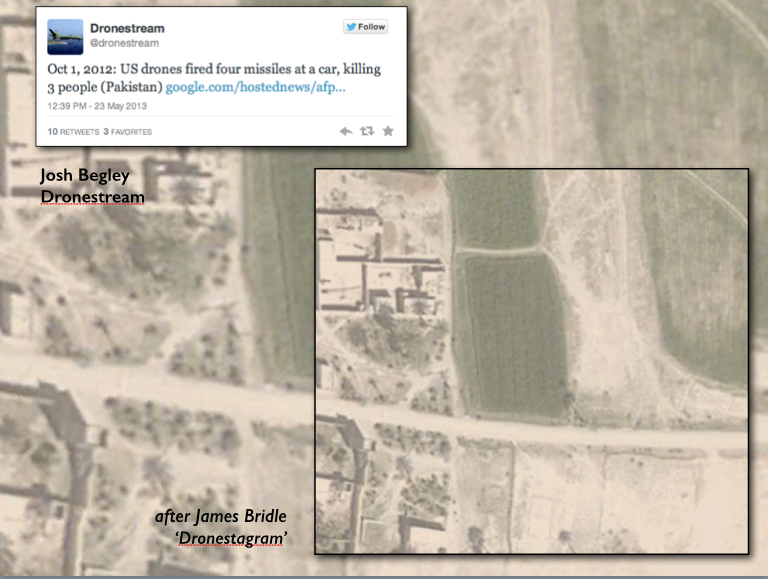
Josh, undeterred by Apple, went on to launch the Dronestream platform, from which he tweeted details of every known US drone strike.  I combined one of Josh’s tweets for 1 October 2012 with a version of James Bridle‘s Dronestagram, which uses Instagram to post images of the location of drone strikes (I say ‘a version’ because Dronestagram was launched too late for this particular strike, so this is a mock-up; in any case, it’s difficult to pinpoint the locations from available reports with much precision, but the details for this strike are available via the Bureau of Investigative Journalism, as the second slide below shows):

1 October 2012 Dronestream and Dronestagram

Bureau of Investigative Journalism 1 October 2012 strike

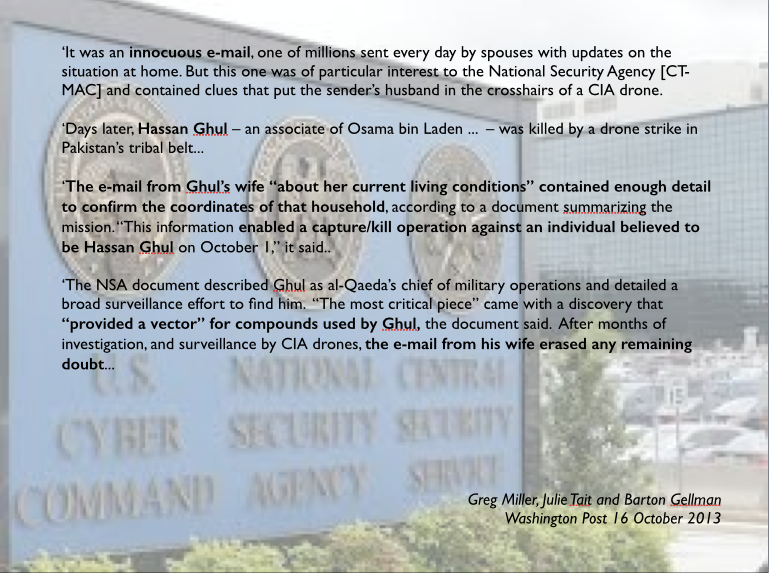
We now know that this strike was made possible as a result of interceptions made by the National Security Agency’s Counter-Terrorism Mission-Aligned Cell (CT-MAC).  Writing in the Washington Post on 16 October 2013 Greg Miller, Julie Tait and Barton Gellman explained how this strike had targeted Hassan Ghul:

Hassan Ghul NSA intercepts

Not quite ‘any doubt’; as they went on to note, ‘Although the attack was aimed at “an individual believed to be” the correct target, the outcome wasn’t certain until later, when “through SIGINT [signals intelligence] it was confirmed that Hassan Ghul was killed.”‘

So how did the intercept work?  Not surprisingly, we don’t know for sure; but the map below of NSA’s ‘Boundless Informant‘ – another dimension of what I’ve been calling ‘the everywhere war’ – offers some clues.  I’ve taken it from a report in the Guardian by Glenn Greenwald and Ewen MacAskill:

Boundless Informant March 2013 heat map

This is six months later, but it shows that Pakistan was, after Iran, the major focus of NSA’s surveillance and data mining operations (Miller and his colleagues had noted that “NSA threw the kitchen sink at FATA’, the Federally Administered Tribal Areas).  It would be wrong to assume that the targeted killing of Ghul was the result of a simple hack into hotmail, and the Post report details the multiple methods used by NSA.

Still, the geography of covert surveillance shown on the map is revealing.  Yesterday Greenwald returned to Boundless Informant and rebutted the charge that he had misinterpreted the meaning of this and other slides, and in doing so quoted from NSA’s own explanation of the system:

BOUNDLESSINFORMANT is a GAO [Global Access Operations, a branch of the NSA] prototype tool for a self-documenting SIGINT system. . . BOUNDLESSINFORMANT provides the ability to dynamically describe GAO’s collection capabilities (through metadata record counts) with no human intervention and graphically display the information in a map view, bar chart, or simple table. . . .
By extracting information from every DNI and DNR metadata record, the tool is able to create a near real-time snapshot of GAO’s collection capability at any given moment. The tool allows users to select a country on a map and view the metadata volume and select details about the collection against that country. The tool also allows users to view high level metrics by organization and then drill down to a more actionable level – down to the program and cover term.

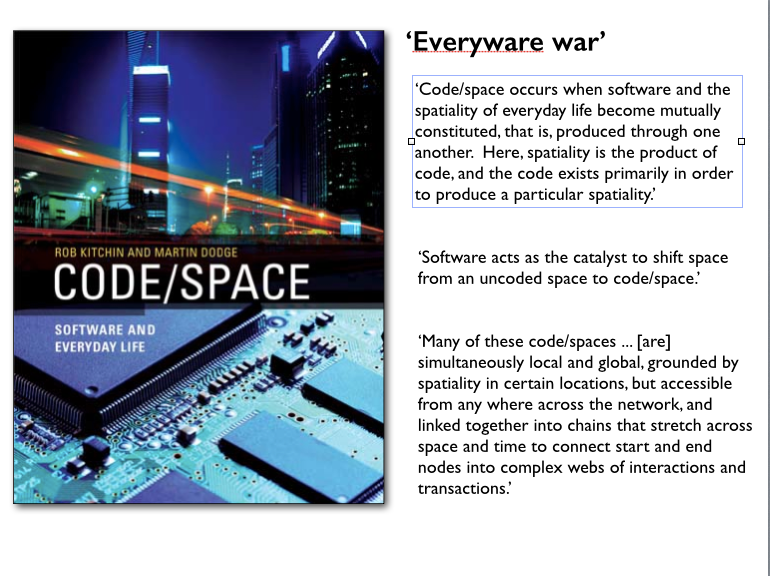
It’s not too difficult to connect the dots and draw two more general conclusions.  The first is that this is another, darker dimension to the ‘code/space’ and ‘everyware’ discussed in such impressive detail by Rob Kitchen and Martin Dodge:

Everyware war

My slide is just short-hand, of course, but you can see where I’m going, I hope – and, as we know from this week’s harrowing testimony on Capitol Hill about the murder of Mamana Bibi in Waziristan and Amnesty International’s report, Will I Be Next?, these operations and their algorithms work to turn ‘everyday life’ into everyday death.  So I’ll be thinking more carefully about code/space and its implication in the individuation of later modern war, paying closer attention to the technical production of ‘individuals’ as artefacts and algorithms as well as the production of the space of the target: more to come.

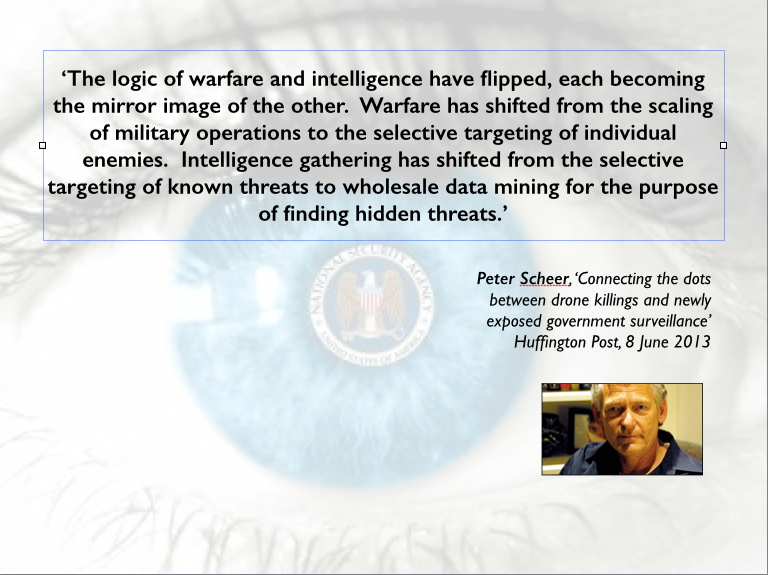
The second general conclusion I leave to Peter Scheer, who provides a more refined (and critical) gloss on John Nagl’s comment with which I began:

SCHEER Connecting the dots

I’m incorporating these and other developments into the revised and extended version of “Moving targets and violent geographies” which will appear in The everywhere war, but I hope this bare-bones account (and that first draft, available under the DOWNLOADS tab) shows that my posts are more connected than they must sometimes appear…  The slides were pulled together on the day I gave the presentation, so forgive any rough edges.

Theory of the drone 10: Killing at a distance

This is the tenth in a series of extended posts on Grégoire Chamayou‘s Théorie du drone and covers the fifth and final chapter in Part II, Ethos and psyche.

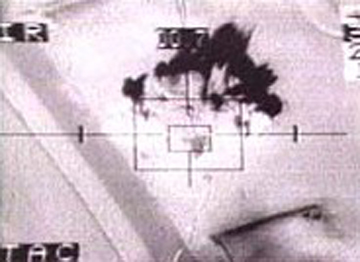
Gulf_war_target_camChamayou begins with a lecture given by German artist and film-maker Harun Farocki in Karlsruhe in 2003 called  ‘Phantom Images‘.  A ‘phantom image’, Farocki explained, is a view that is otherwise inaccessible to a human being – like the ‘bomb’s-eye view’ that became so familiar during the Gulf War (‘a suicidal camera’).  Like so many other ‘technical representations which maintain that they only represent the operative principle of a process’ these are, of course, techno-cultural performances.  They are techno-cultural because they produce a constructed and constrained space – in the Gulf War images that Farocki used to frame his argument, the battle space appears empty of people, a landscape without figures, an odyssey of destruction based on an object-ontology – and they are performances because they are what Farocki called ‘operative images’ that ‘do not represent an object but are part of an operation‘ (my emphasis).

You can find more on Farocki’s fascination with the virtual/real and Immersion here and on Images of War (at a distance) here.  Both ideas – immersion and distance – are central to Chamayou’s argument, but his starting-point is the idea of an operative image.  He wants to think of militarized vision as a ‘sighting’ that works not only to represent an object but also to act upon it and, in the case that most concerns both of us, this is the mainspring of the production of the target.

This has a long (techno-cultural) history, but drones use a video image to fix and execute the target: ‘You can click, and when you click, you kill.’  There’s something almost magical about it, Chamayou says: a hi-tech form of voodoo violence, like sticking pins into a wax doll, in which bringing someone into view – ‘pinning’ the target in the viewfinder – transports them into the killing space.

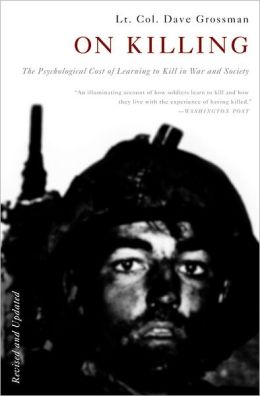
GROSSMAN On KillingBut what sort of space is it?  Chamayou considers a simple diagram from Dave Grossman‘s On Killing. For readers unfamiliar with his work, here is how Grossman describes himself on the website of his Killology Research Group:

Col. Grossman is a former West Point psychology professor, Professor of Military Science, and an Army Ranger who has combined his experiences to become the founder of a new field of scientific endeavor, which has been termed “killology.” In this new field Col. Grossman has made revolutionary new contributions to our understanding of killing in war, the psychological costs of war, the root causes of the current “virus” of violent crime that is raging around the world, and the process of healing the victims of violence, in war and peace. 

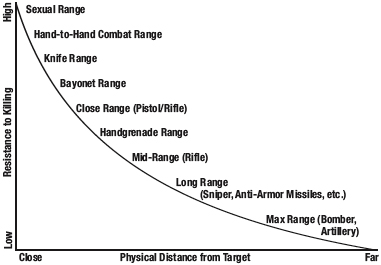
And here is the diagram, which summarises Grossman’s views on the relationship between ‘resistance to killing’ and distance from the target:

Resistance to killing as a function of distance

Grossman’s basic argument is that distance increases indifference and, as the annotations imply, there appears to be an historical sequence to all this.  Grossman’s book was published before the advent of the drone, but – given these two axes – the Predator and the Reaper presumably ought to appear on the extreme right of the diagram, representing the radicalisation of killing at a distance.

In fact, Grossman provides a discussion of videogames in which he says that the screen acts as a barrier between the player and the violence s/he unleashes in the game, making it easier to ‘kill’: exactly the argument advanced by those who claim that drones induce a ‘Playstation mentality’ to killing.

And yet, as I’ve explained in ‘From a view to a kill’ (DOWNLOADS tab), modern videogames are profoundly immersive, and the high-resolution full motion video feeds from the drones induce such an extraordinary sense of proximity, even intimacy – remember that crews frequently claim to be 18 inches from the combat zone, the distance from eye to screen – that drones are surely also pulled towards towards the extreme left of Grossman’s diagram.

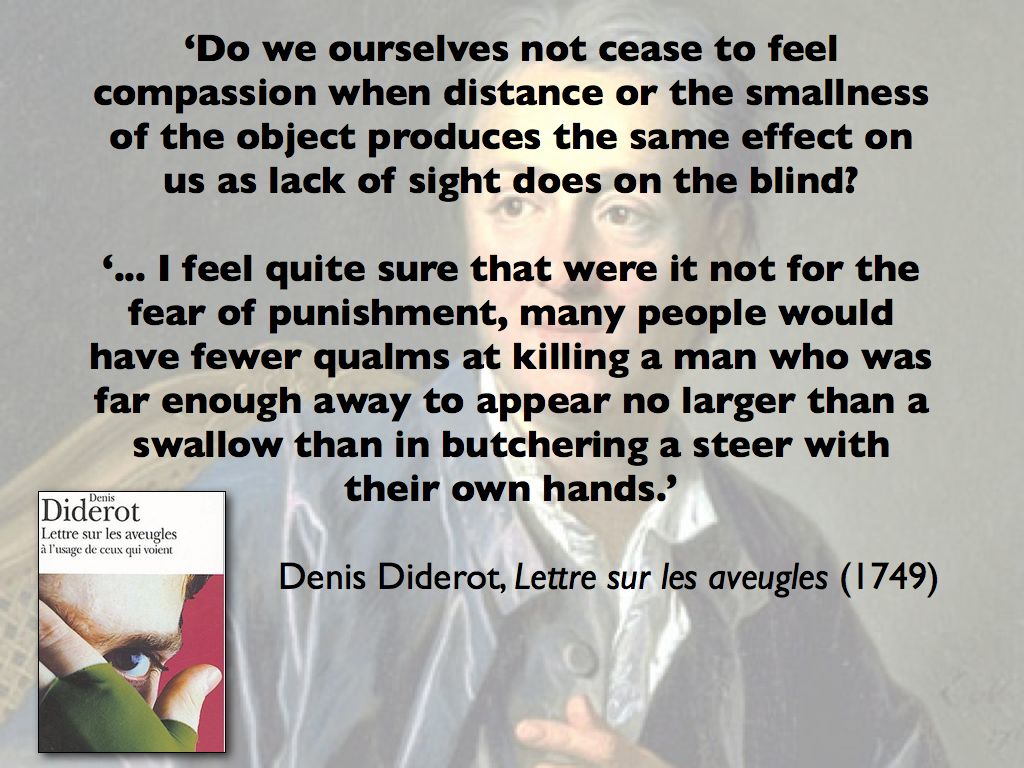
Chamayou doesn’t quote him, but Diderot’s Letter on the blind set out the original terms of the debate perfectly:

DIDEROT.001

But Chamayou is quick to show that ‘distance’ is a weasel-word, and in an extended footnote he elaborates his concept of pragmatic co-presence.  Co-presence denotes the possibility of A affecting B in some way, which means (in the absence of sorcery) that B must be within the sphere of action of A; more formally, co-presence involves the inclusion of one within the ‘range’ or ‘reach’ of another.  This is multi-dimensional – without technical mediation you can see someone much further away than you can hear them – but in many situations technical mediations are involved and so transform the relation.  This matters for two reasons.

First, there is nothing necessarily reciprocal about co-presence: what Chamayou calls ‘the structure of of co-presence’ determines what it is possible for you to do to the other, and is itself the product of struggle: each party to a conflict manouevres to produce a favourable asymmetry so that it becomes much easier for you to strike than to be hit.  In this sense, all war strives to be asymmetric – it’s not confined to wars between states and non-state actors – and it’s this that in part underwrites the history of war at a distance; as William Saletan put it, effectively re-describing Grossman’s diagram,

‘Technically, this is marvelous. Look at the history of weapons development: catapult, crossbow, cannon, rifle, revolver, machine gun, tank, bazooka, bomber, helicopter, submarine, cruise missile. Every step forward consists of a physical step backward: the ability to kill your enemy with better aim at a greater distance or from a safer location. You can hit him, but he can’t hit you.’

But – Chamayou’s second rider – ‘teletechnologies’ radically transform this sequence by severing co-presence from co-localisation.   What is distinctive about teletechnologies is not their capacity to act ‘at a distance’ but their indifference to and their interdigit(is)ation of ‘near’ and ‘far’.

This has far-reaching (sic) consequences because it produces a double disassociation.  Where, exactly, does the action take place?  Here (at Creech Air Force Base in Nevada) or there (Kandahar in Afghanistan)?  There is no single answer, of course, which is precisely Chamayou’s point.  This split – or series of splits, if you think of the wider networks involved – in turn engenders radically new forms of experience, of being-in-the-world, that can no longer be contained within the physico-corporeal confines of the conventional human subject.

Chamayou wants to show that this double disassociation is anything but ‘marvellous’.   He accepts that the targets that are produced through the full-motion video feeds from the Predators and Reapers are much less abstract: the crews see their targets – often people, not physical objects like the buildings or missile batteries that constituted Farocki’s ’empty’ battlespace – and they see the corporeal consequences of each strike.  ‘This novel combination of physical distance and visual proximity gives the lie to the old [Clausewitz-Hegelian] law of distance,’ Chamayou writes, since ‘increased distance no longer makes violence more abstract or more impersonal but, on the contrary, more graphic and more personal.’

But he insists that this proximity, even intimacy is counterbalanced by two factors which are also inscribed within the political technology of vision:

(1) ‘Proximity’ is contracted to the optical – and even this is degraded because the resolution of the video feeds reduces people to ‘avatars without faces’.  I think this is less straightforward than Chamayou implies.  He cites Salatan – ‘There’s no flesh on your monitor; just co-ordinates’ – which is a sharp remark, but the journalist was referring to the launch of long-range missiles (‘… tap a button on one continent and send a missile to another’) whereas the screens at Creech and elsewhere show human figures as well as co-ordinates.  More significant, I think, is that when drone operators provide close air support they are also in radio and online contact with troops on the ground, and this produces a pragmatic co-presence which is considerably more ‘fleshed out’ than their otherwise purely optical encounters with others in their field of view.

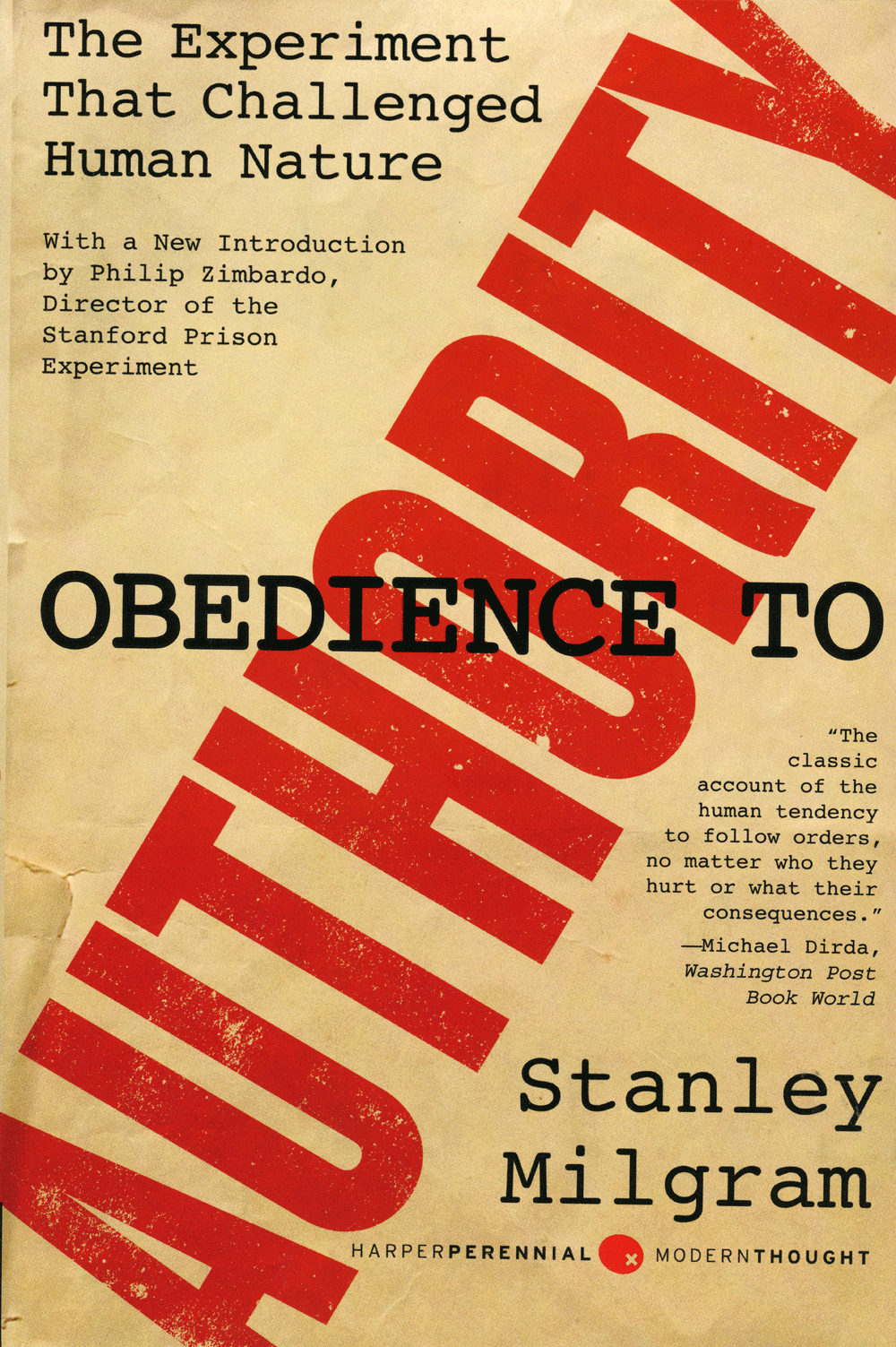
(2) Drone operators can see without being seen, and Chamayou argues that ‘the fact that the killer and his victim are not inscribed in “reciprocal perceptual fields” facilitates the administration of violence’ because it ruptures what psychologist Stanley Milgram in his notorious experiments on Obedience to authority [below] called ‘the phenomenological unity of the act’.  Milgram actually wrote “experienced”, not “phenomenological”, but you get the point; Milgram was discussing how much easier it is to hurt someone ‘if there is a physical separation of the act and its consequences’, which is radicalised in what the US Air Force calls the ‘remote split’ operations carried out by its Predators and Reapers.

MILGRAM Experiments

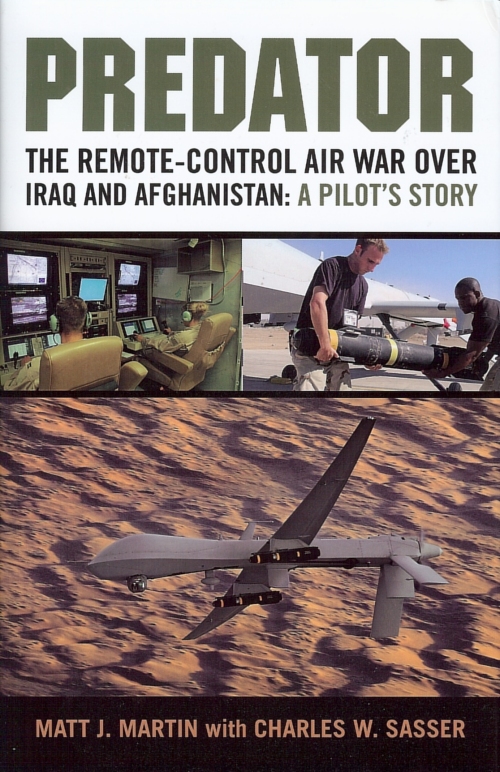
Milgram’s thesis was a general one, but to nail the sense of disassociation to the drone Chamayou quotes Major Matt Martin, a Predator operator:

‘The suddenness of action played out at long distance on computer screens left me feeling a bit stunned…  It would take some time for the reality of what happened so far away, for “real” to become real.’

Again, I think it’s more complicated than that.  Martin was clearly recalling an early experience, low on the learning curve, and interviews with other drone pilots suggest that within 6 months or so most had little difficulty in apprehending the reality, even the physicality of pragmatic co-presence. The sensor operator interviewed by Omer Fast for 5,000 Feet is the Best had this to say, for example:

‘… you get more into it the longer you’re working on the Predator.  Like my first fire mission.  You know, we fired a Hellfire missile at the target.  It didn’t quite strike [sic] me as, “Hey! I just killed someone!”  My first time.  It was within my first year there.  It didn’t quite impact.  It was like, “Yeah! I got somebody!”  You know?  And it was later on through a couple of more missions that I started to… The impact really dawned on me.  I just ended someone’s life!  That was me that did that!”‘

obedience-to-authority-milgramIt’s important to remember, too, that Milgram’s work was about structures of authority, and this has a palpable effect in the case of the military chain of command which has been transformed by the networked incorporation of video feeds from the drones and the deployment of military lawyers (JAGs) on the operations floor of the Combined Air and Space Operations Center (what I called ‘oversight’ in “From a view to a kill”),  which provides for a dispersion of responsibility across the network.

Equally important, I suspect, is that fact that drone crews are not only ‘following orders’, as the familiar jibe has it: they are also following procedures that transform military violence into a process that is at once techno-scientific and quasi-juridical and thus seen as conducted under the sign of an unimpeachable (military) Reason.

Joseph Pugliese makes a parallel argument about the incorporation of military-legal discourse into the techno-logic of the targeting process:

‘I argue that the parenthetical relation of law to technology is premised on a topical hiatus that disassociates the executioner who manipulates the killing technology of the drone from the facticity of the resultant execution. In this scenario, law is conceived of in the most radically instrumental of understandings: it enables and legitimates the execution while simultaneously suspending the connection between the doer and the deed.’

state-violence-and-the-execution-of-lawAnd yet at the same time, Pugliese explains, there is a ‘prosthetic’ relation between law and technology, in which ‘the human agent is always already inscribed by the technics of law.’ From the very beginning, he insists, the body is always already ‘instrumentalised by a series of technologies’ and also inscribed, from the very beginning, by a series of laws.  In short, ‘law is always already inscribed on the body, precisely as techné from the very first. This process of prosthetic inscription operates to constitute the very conditions of possibility for the conceptual marking of the body as”‘human’”‘: ‘The prosthesis,’ notes Bernard Stiegler, ‘is not a mere extension of the human body; it is the constitution of this body qua “human”’.’

Still, Chamayou suggests that (1) and (2) work together to sustain what Mary Cummings calls ‘moral buffering’.  In other words, and in counterpoint to optical proximity, the dispositif also provides a powerful means of distanciation.  Here is Fast’s interviewee again:

‘There’s always more of a personal touch when you’re watching something live.  And it’s even more personal when you’re the one that did it… Well, I mean you get more – I guess – emotionally distant.  As time goes on.  But I mean… I guess in my case, and some of the cases of the guys that I knew, as more time went by you put yourself more and more in the position that this is more and more real life and that you are actually there… And after a while you become emotionally distant.  But still you put yourself more and more as if you’re standing right there…’

MARTIN PredatorThis is compounded, so Chamayou argues, by a different dimension of ‘remote split’ operations. Because Predators and Reapers can stay aloft for 18 hours or more (the ‘persistent presence’ that makes them so much in demand), their crews work shifts and commute each day (or night) between home and work or, more accurately, between peace and war.  One drone operator saw this as a peculiarly strung-out existence: ‘We were just permanently between war and peace’  (my emphasis).  Matt Martin said much the same.  US-based crews ‘commute to work in rush-hour traffic, slip into a seat in front of a bank of computers, fly a warplane to shoot missiles at an enemy thousands of miles away, and then pick up the kids from school or a gallon of milk at the grocery store on [their] way home for dinner.’  He described it as living ‘a schizophrenic existence between two worlds’; the sign at the entrance to Creech Air Force Base read ‘You are now entering CENTCOM AOR [Area of Operations]’, but ‘it could just as easily have read “You are now entering C.S. Lewis’s Narnia” for all that my two worlds intersected.’

The way crews survive, Chamayou suggests, is by partitioning, ‘setting aside’, but this is extremely difficult for commuter-warriors as they regularly and rapidly move between a domestic sphere in which killing is taboo and a military sphere where (so he says) it is ‘a virtue’.   The superimposition of these two worlds – their contradictory clash – means that crews are in a sense ‘both in the rear and at the front, living in two very different moral universes between which their lives are torn.’

This is precisely the situation dramatised in George Brant‘s play Grounded, which I noted in an earlier post, and Chamayou cites a former USAF sensor operator Brandon Bryant (whose testimony I discussed here) to the same effect.  In both cases, crew members plainly are affected, even distressed by what they see on the screen; in fact Bryant has bee diagnosed with PTSD.

But Chamayou insists that this sort of testimony is rare and that most of them do manage to compartmentalise.  Fast’s sensor operator:

‘A lot of us learn real fast to leave all of our problems at the door.  You know, when we’re leaving the squadron and heading home.  Just kind of putting it on a rack and pushing it out of your mind.’

And this, Chamayou concludes, nails the real psychopathology of the drone.  He calls French philosopher Simone Weil’s Gravity and grace to his aid:

‘The faculty of setting things aside opens the door to every sort of crime…  The ring of Gyges who has become invisible – this is precisely the act of setting aside: setting oneself aside from the crime one commits; not establishing the connection between the two.’

Chamayou has used the myth of Gyges earlier in his critique, but here he invokes Weil to claim that the psychopathology of the drone is not the trauma some say that drone crews experience ‘but on the contrary the industrial production of compartmentalised psyches, protected from all possibility of reflection on the violence they have committed, just as their bodies are already protected against every possibility of exposure to the enemy.’

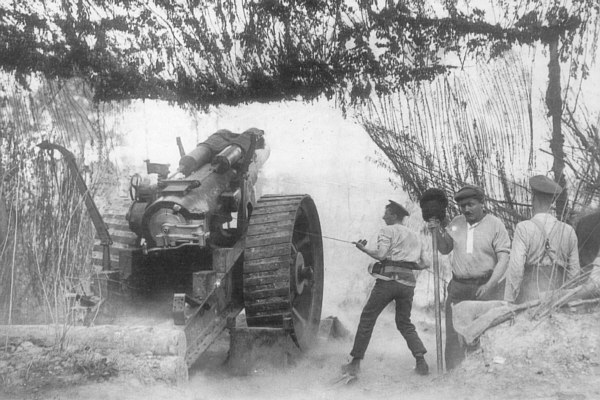
rwg05074-1I’m really not sure about this.  ‘Protected from all possibility of reflection’?  Much of the evidence that Chamayou cites here – like Milgram’s experiments – could be applied to most forms of military violence.  Here, for example, is Arnold Bennett describing artillery at work in Over there: war scenes on the Western Front (1915):

‘The affair is not like shooting at anything.  A polished missile is shoved into the gun.  A horrid bang – the missile has disappeared, has simply gone.  Where it has gone, what it has done, nobody in the hut seems to care.  There is a telephone close by, but only numbers and formulae – and perhaps an occasional rebuke – come out of the telephone, in response to which the  perspiring men make minute adjustments in the gun or in the next missile.

 ‘Of the target I am absolutely ignorant, and so are the perspiring men.’

I’ve found the same sentiments expressed by bomber crews during the Second World War.  The difference, clearly, is that drone strikes involve far more than ‘numbers and formulae’ – co-ordinates on the screen – and that the visual  production and so-called ‘prosecution’ of the target takes place in near real time, in vivid detail and under the eye of military lawyers.  But it is not surprising (nor, I think, especially pathological) that those who carry out these strikes conduct themselves with a certain seriousness, a ‘professionalism’ if you like, that precludes emotional investment. This is from David Wood‘s interview with a highly experienced USAF drone pilot:

Q: You must develop an emotional tie with the people on the ground that makes it hard if there is going to be a strike or a raid, people are going to be killed.

A: I would couch it not in terms of an emotional connection, but a … seriousness. I have watched this individual, and regardless of how many children he has, no matter how close his wife is, no matter what they do, that individual fired at Americans or coalition forces, or planted an IED — did something that met the rules of engagement and the laws of armed conflict, and I am tasked to strike that individual.

‘Professionalism’ shouldn’t be used as a mask to hide from critique, to be sure.  These crews are trained to perform with a calculative reason, dispassionately, through a techno-cultural and techno-legal armature, so that, as one USAF major told Nicola Abé, when she was preparing for a strike ‘there was no time for feelings’.  Or again, from another pilot operating a Predator over Afghanistan:

‘We understand that the lives we see in the screens are as real as our own…  I would not compare what I do as a job comparable to Call of Duty/any other video game, in any sense. It is very real and the seriousness of the lives on the ground is very real and instilled in all of our training. It is never something that we joke about. Very serious business.’

As I’ve noted before, there are (too) many instances in which crews do joke about their missions, the sort of ‘gallows humour’ that is no doubt a common reaction to  hunter-killer missions: but isn’t this also likely to be common amongst all military professionals who are trained to kill?  One pilot explicitly rejected the suggestion that drone crews become disassociated from what they do:

‘I wonder why people think this. We understand what we are doing is real world operations. We know our actions have consequences. I don’t understand the idea of being desensitized due to some operators not being in an actual firefight/combat zone.’

Later in the online exchange, the same pilot insists: ‘It’s very real.  Some of the stuff I’ve seen is burned into my brain’ – and then Brandon Bryant joins the conversation to ‘agree with what you guys have said.’  He’s on record as writing in his personal combat diary ‘I wish my eyes would rot.’

I realise that these passages can’t settle matters, but they surely cast doubt on the implication that drone crews are as machinic as the aircraft they fly.  Pugliese insists that the drone ‘cannot be reduced to a mindless machine of purely robotic acts’; neither, by virtue of what Pugliese calls their prosthetic relation to the drone, can the crew who fly them.   I still think that one of the most salient differences introduced by drones is the differential distanciation they allow when they provide close air support: an unprecedentedly close relation with troops on the ground and a calculative detachment from others in their field of view.

I realise, too, that this can’t apply to targeted killings, and so I leave you with this statement by Lt General Michael DeLong, who as deputy commander of US Central Command had to sign off on the first CIA-directed targeted killing, in Yemen in November 2002.  Then CIA Director George Tenet called DeLong to ask him to give the order, since the Predator was flown by a USAF crew:

delongp‘Tenet calls and said, “We got the target.” … I called General Franks [commander of CENTCOM]. Franks said, “Hey, if Tenet said it’s good, it’s good.” I said, “Okay … I’m going down to the UAV room.” … We had our lawyer there. Everything was done right. I mean, there was no hot dog. … The rules of war, the rules of combat that we had already set up, the rules of engagement ahead of time. Went by them. Okay, it’s a good target. …

I’m sitting back … looking at the wall, and I’m talking to George Tenet. And he goes, “You got to make the call?” These Predators had been lent to him, but the weapons on board were ours. So I said, “Okay, we’ll make the call. Shoot them.” 

Everything may have been ‘done right’, the procedures followed, but  when DeLong was asked ‘What does it feel like when you know you’re going down there to kill somebody?’ He replied:

‘It’s just war. It’s no different than going to the store to buy some eggs; it’s just something you got to do.’

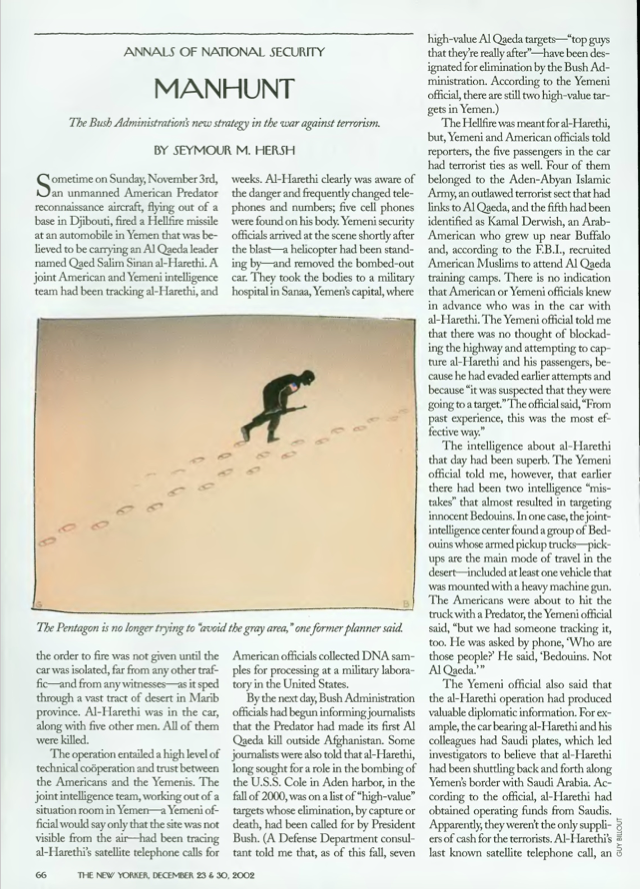
And, as Chamayou would surely insist, it wasn’t war.  It was, as Seymour Hersh wrote in the New Yorker on 23 December 2002, a manhunt.

HERSH Manhunt

To be continued.

Image wars

STALLABRASS Memory of FireI’m still putting together the programme for my graduate course this term (I’ll post the full outline under the TEACHING tab as soon as it’s ready), and I plan to spend some time on what I’m calling Militarized vision and imag(in)ing modern war.

Images have become increasingly important to the conduct of war; in Precarious Life Judith Butler argues that ‘there is no way to separate, under present historical conditions, the material reality of war from those representational regimes through which it operates and which rationalize its own operation.’  This requires us to think carefully about two, closely related issues – media representations of military violence and its effects, and the ways in which militaries have incorporated political technologies of vision into their operations.

I’m thinking of beginning with these two readings:

Bernd Hüppauf, ‘Experiences of modern warfare and the crisis of representation’, New German Critique 59 (1993) 41-76.

Lilie Chouliaraki, ‘The humanity of war: iconic photojournalism of the battlefield, 1914-2012’, Visual communication 12 (3) (2013) 315-340

Then I want to turn to the scopic regimes of advanced militaries, via Virilio and transcripts of several US military investigations into air strikes in Afghanistan and Iraq, to open up a discussion of targeting and political technologies of vision.  (This is probably also the place to say that, since I started to think through the relation between technoculture, targeted killing and the individuation of warfare I’ve also been thinking about the work of Bernard Stiegler; more later, but in the meantime you’ll find a truly excellent bibliography by cultural geographer Sam Kinsley here).

All of this opens up wide fields for debate, of course, but as I was putting together a list of supplementary materials I stumbled upon a new collection edited by Julian Stallabrass, Memory of fire: Images of war and the war of images (Photoworks, 2013):

This richly illustrated book is a visual, theoretical and historical resource about the photography of war, and how images are used as instruments of war. It comprises essays and interviews by prominent theorists, artists and photographers and covers the urgent issues of the depiction of war, the use of images of war by the media, various forms of censorship, the military as a PR and image-producing machine, the circulation of unofficial images and the impact of the digital mediascape.

Full details here , a four-pager in which Stallabrass discusses ‘Rearranging corpses, curatorially’ here, and a video in which he explains the project here:

There’s no shortage of work on these issues, I know, but there’s a particularly detailed engagement with Memory of Fire by Susie Linfield  author of The cruel radiance: photography and political violence (University of Chicago Press, 2010) – here and a sharp response from Stallabrass (scroll down).  There’s also a shorter but still informative review by Ashitha Nagesh at the always stimulating bookforum here.

Finally, you can find Stallabrass’s (2006) reaction to Retort’s Afflicted Powers and its engagement with ‘image wars’, ‘Spectacle and Terror’, on open access at the New Left Review here.

Theory of the drone 5: Vulnerabilities

This is the fifth in a series of posts on Grégoire Chamayou‘s Théorie du drone.  My next post on the book will consider Chamayou’s second section, ‘Ethos and psyche‘, in its entirety, and when I’ve worked my way through the book in separate, detailed posts (three more sections to go after the next one) I’ll provide a critical overview of the project as a whole: I hope that will help (I must be doing something right – or wrong – since these posts have been picked up by the splendid ARmy Rumour SErvice, which – despite its equally splendid acronym – is not quite a digital child of the Wipers Times).

8: Vulnerabilities

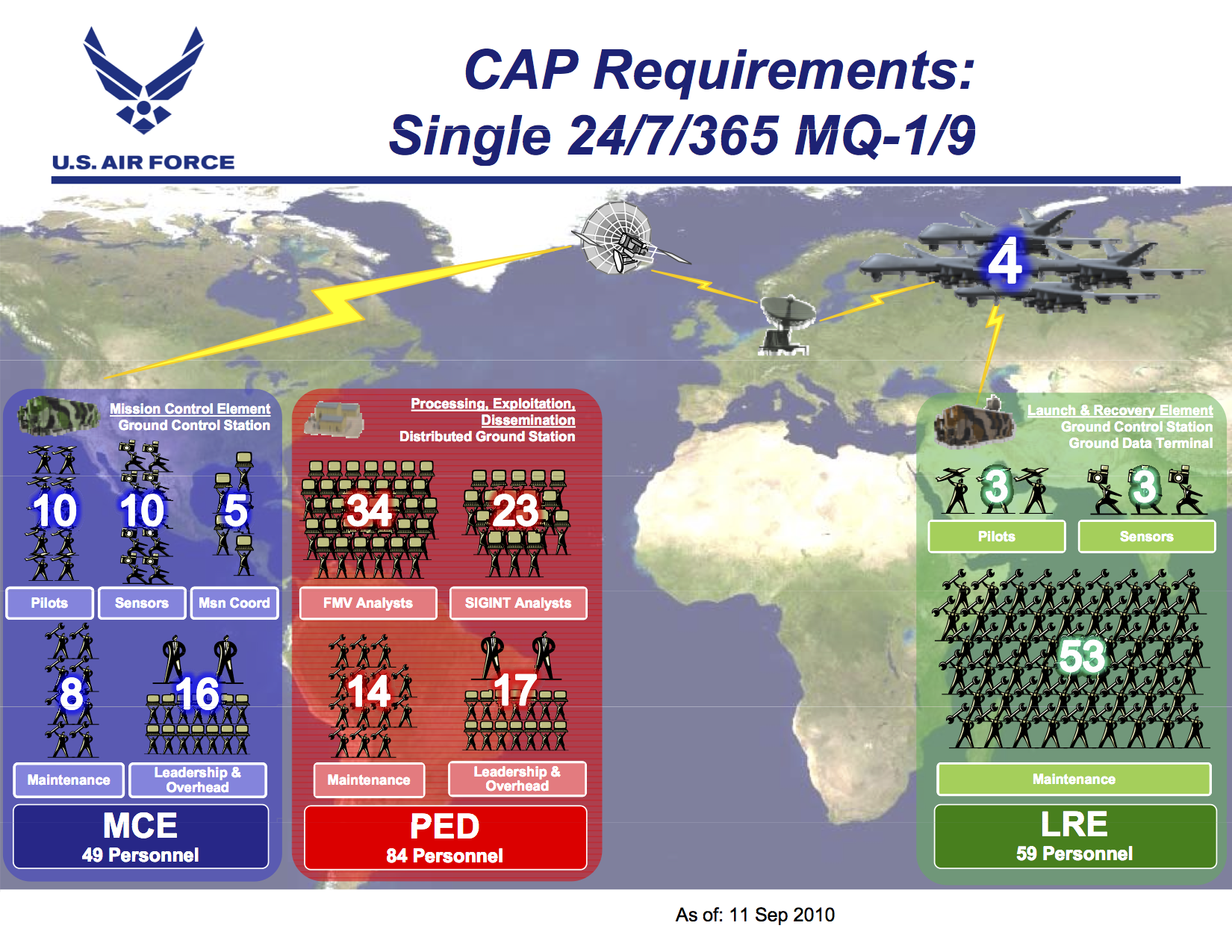
Far from being ‘unmanned’, each US Air Force combat air patrol (CAP) capable or providing coverage 24 hours a day 7 days a week involves a suite of four Predators (MQ1) or Reapers (MQ9) supported by a total of 192 personnel (the exact figures vary and are subject to change, but I’ve taken these from a June 2011 presentation by Colonel J.R. Gear, Director of the US Air Force’s Remotely Piloted Aircraft Task Force).

As you can see from his presentation slide below, most of these (133) are based outside the combat zone, and 84 of those are devoted to ‘PED’ –processing, exploiting and disseminating the feeds from the airborne sensors, especially the full-motion video (FMV) streams.

That leaves 59 who are forward deployed inside the combat zone: three pilots and three sensor operators to handle take-off and landing (which require a line-of-sight link to the aircraft because the Ku-band satellite link used for in-flight operations imposes a response delay that is too great for near-ground manoeuvres).  One of the four aircraft is held on the ground for maintenance and, given the technical problems that continue to dog what Jordan Crandall calls the wayward drone, no fewer than 53 people are involved in keeping them flying.  [More on drone crashes and glitches here, here and here].

Still, less than half the total complement (44 per cent) is in the combat zone, and all of them work from the relative safety of an airbase.

GEAR Manning Unmanned Aircraft

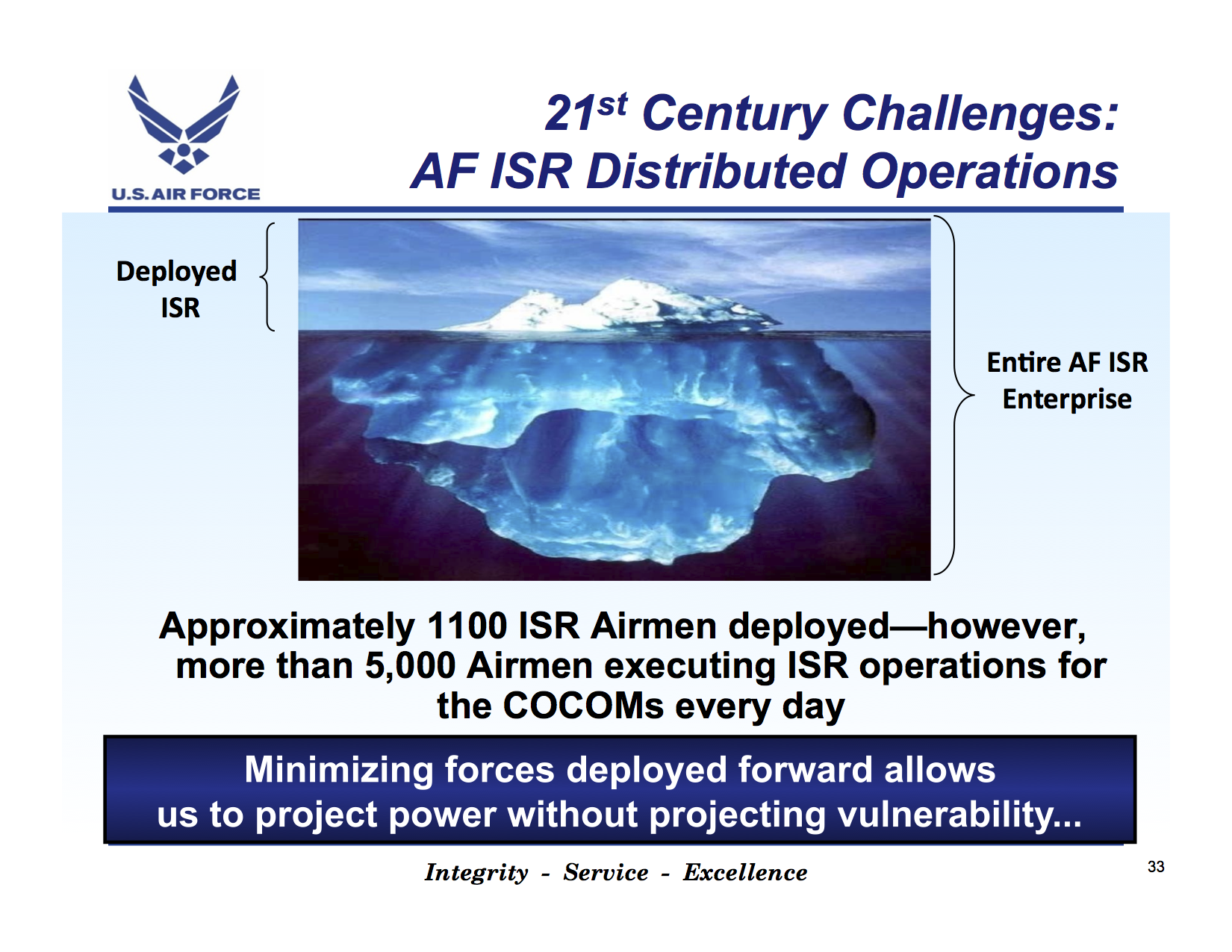
Hence the tag line repeatedly used by the US Air Force to advertise the core advantage of using drones: ‘projecting power without projecting vulnerability’:

Projecting power without vulerability

I’ve always liked to take metaphors stubbornly literally, and given what is happening to the polar ice we need to ask about the invulnerability of these remote operations.

Chamayou reminds us that in classical mythology and in fable invulnerability has always been a myth; so it is with the drone.  He distinguishes two sets of vulnerabilities, one technical and the other political-strategic.

(A) Technical

Chamayou says virtually nothing about the technical imperfections of the Predator and the Reaper, especially the crashes and other failures that I noticed above, but concentrates on two other issues.

(1) ‘Mastery of the air’: At present, Predators and Reapers can only operate in uncontested airspace; they are slow, noisy and far from agile, which makes them highly vulnerable to attack from ground-to-air missiles or conventional strike aircraft.  This is not a problem in Afghanistan – even during the invasion US Secretary of Defense Donald Rumsfeld was able to proclaim ‘air superiority’ by 10 October, just three days after launching the first attacks: ‘Afghan skies secure‘ – and according to some reports it never became a serious issue in Iraq either.  During Operation Southern Watch, tasked with enforcing no-fly zones over Iraq between the first Gulf War and the US-led invasion in 2003, Eric Reidel reported that

‘Predators were used as bait to stir up Iraqi fighters and air defenses. Surface-to-air missiles eventually brought down two of the drones and an Iraqi fighter jet shot down a third, but it didn’t come that easy to the enemy.’

But that was a contest against a military machine degraded by a sanctions regime.  What is now called A2/AD (anti-access, area denial) may well become a serious obstacle to future conflicts. In 2011 Colonel Dean Bushey, deputy director of the joint Unmanned Aircraft Systems Center of Excellence, told Reidel:

“We’re thinking about the next war, thinking about the next fight, thinking about the next campaign…  We’ve fought in a very permissive environment where there are no enemy attacks against our unmanned aircraft … It would be foolish for us to imagine that we could continue to fly unmanned systems in an environment that is not only friendly but is not GPS-denied, that is not communications-denied.”

With Obama’s ‘pivot to the Pacific’, the Pentagon has redoubled its efforts to harden its drones for combat (several commentators are sufficiently sceptical about the prospects that they see a renewed commitment to conventional strike-stealth aircraft rather than to UAVs).  But perhaps the sharper point is contained in Bushey’s final sentence, and Chamayou spends much more time on this second, vital vulnerability.

(2) ‘Mastery of the waves’: Chamayou documents a series of incidents in which signals were jammed or hacked.
In 2009 the Wall Street Journal reported that insurgents in Iraq had been using commercial off-the-shelf software (costing just $26) to intercept the video feeds from Predators for at least a year, and there was similar evidence from Afghanistan.  The Pentagon had known of the vulnerability since the aircraft were deployed over Bosnia in the 1990s, but had not bothered to encrypt the signals because they ‘assumed local adversaries wouldn’t know how to exploit it.’ You might think the solution – encryption of the Common Data Link feeding images to ROVERS (receivers) used by troops on the ground – would be easy, but four years after the story broke Noah Schachtman and David Axe reported that more than half the US fleet of Predators and Reapers were still broadcasting their video feeds in the clear:

”Standard unencrypted video is basically a broadcast to whoever can figure out the right carrier frequency, so essentially, we are simulcasting to battlefield commanders and the opposing force. If that opposing force knows we can see them and from where, they can take better evasive maneuvers.”

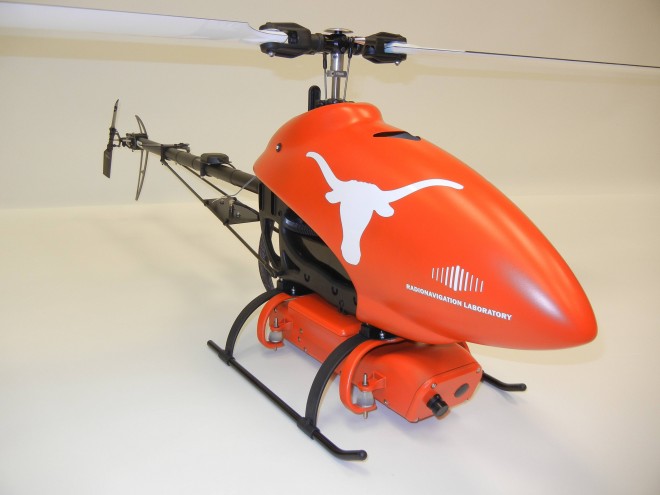
UT Adaptive Flight Hornet MiniIf signals transmitted from the drone can be hacked then, as Bushey noted, so can signals to the drone.  This is known as GPS spoofing, and the basic principle is remarkably simple; for a technical exposition that isn’t, see this research paper ‘On the requirements for successful GPS spoofing attacks’ by four Swiss computer scientists (who also propose counter-measures), but for a more user-friendly discussion see Pierluigi Paganini‘s excellent overview of ‘Hacking drones’ here.  As Chamayou says, the principle was put into practice in June 2012 , when a group of researchers from the Radionavigation Laboratory at the University of Texas at Austin successfully hijacked a small civilian helicopter-drone at the White Sands Missile Range in Nevada.  It was an experiment carried out for the Department of Homeland Security, the target was a tiny Adaptive Flight Hornet Mini (shown above) not a Predator or a Reaper, and the intercept took place at an altitude of less than 20 metres (60 feet) from a distance of 1 kilometre.  This year they intend to repeat the experiment but from a distance of 10 kilometres.  This is all part of an ongoing project to devise systems to disrupt spoofing, but Chamayou suggests that ‘the air pirates of the future’ will surely try to take control of larger drones from an even greater distance.

(B) Political-strategic

Here Chamayou is not addressing wider political, legal and ethical objections to which remote operations are indeed vulnerable – as I’ll describe in later posts – but rather the possibility of more direct responses to the deployment of drones.

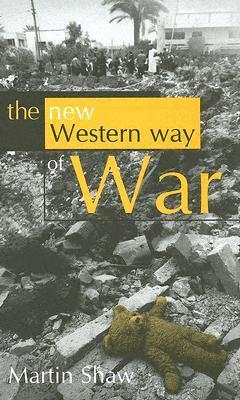
SHAW The new Western way of war(1) Reprisals: Remote operations radicalise what Martin Shaw described in 2005 as The new Western way of war: ‘risk-transfer war‘.  Although Shaw emphasised global surveillance, the minimisation of military casualties and an overwhelming reliance on airpower amongst other things – and his ‘rules of risk-transfer war’ are still essential if depressing reading – it is a sign of how far the world has turned since then that he provided no discussion of remote operations or the incorporation of drones as essential vectors of later modern war.

Perhaps for this reason Chamayou makes no mention of Shaw, but fastens on a short thesis submitted in 2009 by Major Trent Gibson of the US Marine Corps for the Master of Military Studies from Quantico, ‘Hell-bent on Force Protection’.  This was a critique of what Gibson called ‘force protection fetishism’.  He traced it back to the US military’s experience in Vietnam but argued that it was alive and well in Afghanistan and Iraq.  In a key passage quoted by Chamayou, Gibson wrote:

‘Attempts to armorize our force against all potential enemy threats … shifts the ‘burden of risk’ from a casualty-averse military force onto the populace. In doing so, we have lifted that burden from our own shoulders and placed it squarely upon those who do not possess the material resources to bear it – the civilian populace.’

Gibson was reaffirming one of the central tenets of the new counterinsurgency doctrine issued three years earlier, and he doesn’t discuss drones and remote operations either.  But what both FM 3-24 and by extension Gibson objected to was the physical separation of troops from the very people they were supposed to protect.  One of its cardinal – strategic – weaknesses – was sequestering troops inside vast, heavily defended Forward Operating Bases from which they issued out on sporadic armoured patrols.  It was, in part, on overcoming this siege mentality that the so-called “Surge” in Baghdad was predicated (see “The biopolitics of Baghdad”: DOWNLOADS tab).  General David Petraeus‘s ‘Commander’s Guidance‘ could not have been plainer:

‘Live among the people. You can’t commute to this fight. Position Joint Security Stations, Combat Outposts, and Patrol Bases in the neighborhoods we intend to secure. Living among the people is essential to securing them and defeating the insurgents.’

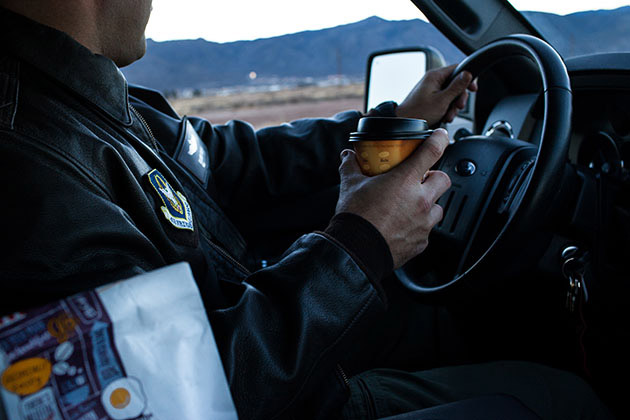
UAV pilot driving to workRemote operations hypostatise that ‘commute to the fight’ (see here).  Here is one UAV pilot talking to Der Spiegel:

‘In the morning you carpool or you take a bus and drive into work, you operate for an eight-hour shift, and then you drive back home… Before you were at war 24/7, and when you’re home you’re home. This is different. I do e-mails in the morning, rush to the airplane, come out, go to the [Base Exchange], get myself a hamburger, do some more e-mail, do it again, drive home.’

I’ll say more about that compartmentalisation in my next post – it’s a central concern in the next section of Théorie du drone – but Chamayou’s central point here is that the safety of ‘home’ is illusory and that the war cannot be contained within external ‘danger zones’.  He’s not talking about insurgent attacks against US air bases or crew (though one recent story, ‘A day job waiting for a kill-shot a world away’, reported that ‘the Air Force, citing what it says are credible threats, forbids pilots to disclose their last names’).  What Chamayou has in mind is the possibility of reprisals within the continental United States more generally: risk transferred back to the American public at large.  He explicitly endorses the conclusion to Mike Davis‘s Buda’s Wagon: a brief history of the car bomb, where Davis writes:

‘… every laser-guided missile falling on an apartment house in southern Beirut or a mud-walled compound in Kandahar is a future suicide truck bomb headed for the center of Tel Aviv or perhaps downtown Los Angeles.’

This is not a wild scenario.  Here is Michael Boyle on the costs and consequences of drone warfare:

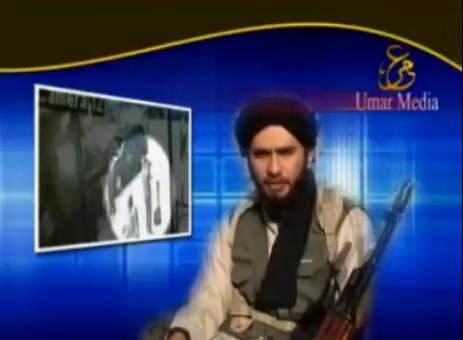
On 21 June 2010, Pakistani American Faisal Shahzad told a judge in a Manhattan federal court that he placed a bomb at a busy intersection in Times Square as payback for the US occupations of Afghanistan and Iraq and for its worldwide use of drone strikes. When the judge asked how Shahzad could be comfortable killing innocent people, including women and children, he responded: ‘Well, the drone hits in Afghanistan and Iraq, they don’t see children, they don’t see anybody. They kill women, children, they kill everybody. It’s a war and in war, they kill people. They’re killing all Muslims.’  In a videotape [below] released after his arrest, Shahzad revealed that among his motives for the attack on New York City was revenge for the death of Baitullah Mehsud, a Pakistani Taliban leader killed in a drone strike in August 2009. While his comments were reported in the American press, the Obama administration never acknowledged that it was revulsion over drone strikes—which Shahzad was rumoured to have seen at first hand when training with militant groups in Pakistan—that prompted his attack.

faisal-shahzad-martyrdom-tape

Although the incident would have strengthened his argument, Chamayou doesn’t mention it.  You can find more here; another video featured Pakistani Taliban leader Qari Hussain Mehsud claiming responsibility for what he described as retaliation against US drone attacks in the FATA (more detail here).

FUKUYAMA End of History(2) Re-purposing: Drones can be adapted for civilian use – they have been used to monitor herds of caribou and to track the progress of wild fires – and there is a rapidly expanding market for small DIY drones amongst geeks and hobbyists.  As Chamayou notes, after reading about the US Army’s small RQ-11 surveillance drone even Francis Fukyama built his own small surveillance drone in his backyard in February 2012.  What he doesn’t report, though, is the string of questions that Fukuyama raised in one of his early accounts of the project (Fukuyama now has three drones; updates including video here and here):

‘What will the world look like when not just the US but many other countries around the world operate fleets of drones; and when powerful, sophisticated drones are owned by lots of private individuals? What would our attitude be if our enemies could pick off visiting dignitaries as they stepped off the aeroplane in a supposedly friendly country, or attack soldiers in their bases in Europe or Asia? Or if Americans became vulnerable in Florida or New York? Drones might become an inexpensive delivery vehicle for terrorists or rogue states that can’t afford to deliver payloads in ballistic missiles. Some of the remotely controlled aeroplanes that hobbyists build are a third to half the size of their full-scale counterparts. As the technology becomes cheaper and more commercially available, moreover, drones may become harder to trace; without knowing their provenance, deterrence breaks down. A world in which people can be routinely and anonymously targeted by unseen enemies is not pleasant to contemplate.’

The last sentence is pretty rich: the world Fukuyama envisages is already a reality for thousands of people in Pakistan, Yemen, Somalia and elsewhere, and they have to do rather more than ‘contemplate’ it.

Still, these are Chamayou’s questions too.  It is precisely the proliferation, diffusion and and above all the down-sizing and down-marketing of small drones that interest him.  If they can be ‘demilitarised’ for civilian uses, including Fukuyama’s photographic obsessions, then he contends that it’s perfectly possible for them to be ‘re-militarised’ at remarkably low cost to constitute what Eugene Miasnikov was already calling six years ago ‘an army of suicide bombers on steroids’.  This may well be true – and, in a different vein, since October 2012 there have been (conflicting) reports of Israel shooting down two Iranian-made Hezbollah drones, so their adoption by non-state actors seems to be in train already – but it’s still a far cry from the hi-tech world of Predators and Reapers and the globalised killing machine for which they act as spears.

I’ll return to that world in my next summary and commentary on the book.

This completes my extended discussion of the eight chapters that form Part I of Théorie du drone: Techniques and tactics.

Dead streaming

Readers who have followed Josh Begley‘s Dronestream project – which I commented on here  – will be interested in this video of his graduate thesis presentation at NYU:

It’s a tour de force in under 15 minutes.  Josh begins with a rapid-fire overview of over 480 more or less covert US drone strikes in 10 years killing more than 4,700 people.  ‘What can our relationship be with this story?’ he asks.

His first attempt at finding an answer was the Drones+ app that was intended to send a notification to your iPhone every time news broke of a drone strike in Pakistan, Yemen or Somalia.  Like James Bridle‘s Dronestagram (which enabled satellite images of the sites of remote strikes to be viewed on an iPhone), it was a way of projecting the remoteness of the strikes into the intimacy of our own life-worlds.  But  Drones+ was more demanding precisely because its episodic notifications made those strikes more insistent, more interruptive.  Hence Josh’s key question:

‘Do we really want to be as connected to our foreign policy as we are to our smart phones?  … which are these increasingly intimate devices, the places where we share pictures of or loved ones and communicate with our friends, the things that we pull out of our pockets when we’re lost and which auto-magically put us at the center of the map……  Do we really want these things to be the site of how we experience remote war?’

Apple’s answer was no, as he ruefully acknowledges, though I suspect that would also be the answer of many others too: that, after all, is the appeal of remote wars to those who orchestrate them.  Out of sight, out of mind: which is precisely why there is also something ‘auto-magical’ about Josh’s determination to ‘détourne‘ these remote technologies like this.

Josh’s next step was to use a Twitter account to start to tweet every recorded drone strike, which eventually morphed (via the aggregations of the Bureau of Investigative Journalism) into Dronestream: or, more accurately, Dronestre.am.

Dronestre.am

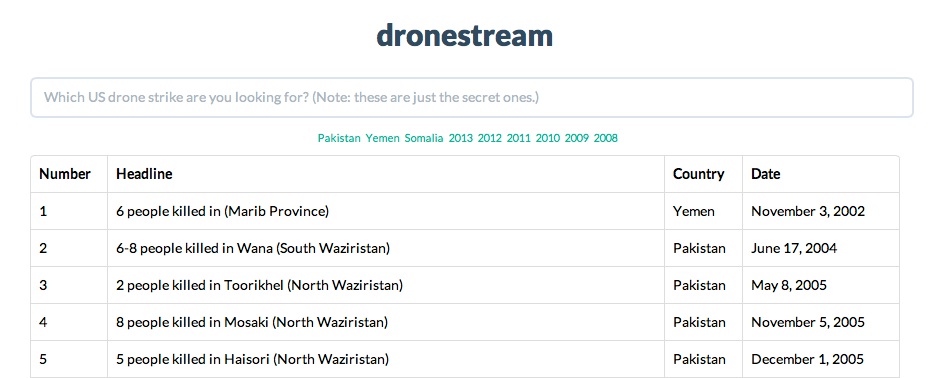
This is a publicly accessible API (Application Programming Interface) that enables the data set to be interrogated and visualized in multiple ways (and if you want a simple account of working with the API, check out Felix Haas here):

dronestream

Josh credits Trevor Paglen‘s ‘spatial analysis’ and his ongoing attempts to outline the Blank Spots on the Map as a particular inspiration for his work.  What he has sought to do, by extension, is to map ‘the blank spots in the data’: to recover what he calls ‘the negative space that these drone strikes take up’, and so enable complex stories and ordinary voices to emerge out of the swirl of Big Data.  In doing so, he argues that it becomes possible to ‘speak back’ to the drones and to the masters of dirty wars that control them, in effect artfully turning this latest version of techno-war against itself.

The trick now is to fill out these ‘blank spots on the map’, to recover the insistently human geographies that are devastated by these air strikes and the threat of more to come, so that we can overturn both the ‘face-less’ and the ‘place-less’ narrative of the covert war machine.  It thrives on being both out of sight and out of site, and Josh’s research is invaluable in reminding us that the virtual technologies that make its depredations possible are also acutely material in their form and in their effects.