Hide and Seek – and Show

Ever since I heard Isla Forsyth give one of her marvellous presentations on camouflage I’ve been fascinated by the subject – all the more so since it intersects so artfully (and, as Isla would quite rightly insist, scientifically) with my work on aerial reconnaissance, bombing and modern war.  You can get an early sense of Isla’s work from this presentation, ‘Shadow chasers: exploring the vertical and angular geometries of camouflage‘, which includes a gallery of images.  Isla’s Glasgow PhD thesis, From Dazzle to the Desert: A Cultural-Historical Geography of Camouflage, was completed last year – and I hope will appear in book form.
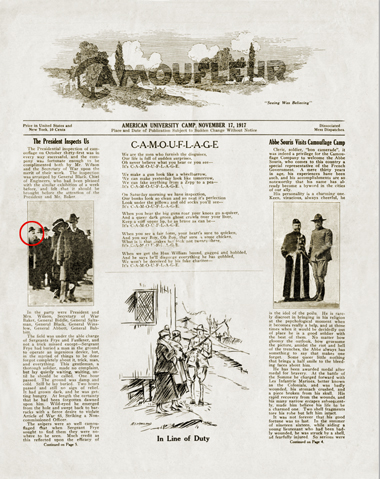
FrontPageCamoufleur

There’s a great blog on camouflage – Camoupedia – which includes an appreciative notice of Isla’s work and, amongst a feast of deceptive riches, a stunning series of posters by graphic design students to advertise a talk by Claudia Covert (that really is her splendid name) on dazzle ship camouflage in World War I, a post about the newspaper of the American Camouflage Corps in 1917 (above), and a remarkable extract from a letter from Reginald Farrer later published as The Void of War: letters from three fronts (1918):

FARRER Void of WarThe real thing about the human side of the war is the sheer fun of it. In certain aspects the war is nothing but a glorious, gigantic game of hide and seek—camouflage is nothing else. It is not only the art of making things invisible, but also of making them look like something else. Even the art of inconspicuousness is subtle and exciting. What glory it must be to splash your tents and lorries all over with wild waggles of orange and emerald and ochre and umber, in a drunken chaos, until you have produced a perfect futurist masterpiece which one would think would pierce the very vaults of heaven with its yells..

But disguise is an even higher branch of the art: you go on to make everything look like something else. Hermit crabs and caddis worms become our masters. Down from the sky peers the microscopic midget of a Boche plane: he sees a tree—but it may be a gun: he sees a gun—but it may be only a tree. And so the game of hide and seek goes on, in a steady acceleration of ingenuity on both sides, till at last the only logical outcome will be to have no camouflage at all. You will simply put out your big guns fair and square in the open, because nobody will ever believe, by that time,  that anything really is what it looks like. As far as the guns go, the war is developing into a colossal fancy dress ball, with immunity for the prize: wolves in sheep’s clothing are nothing to these gentle shepherdesses of the countryside. The more important they are, the more meekly do they shrink from notice under dominos of boughs or sods, or strawberry-netting tagged over with fluffets of green and brown rags. And sometimes they lurk under some undiscoverable knoll in a coppice, and do their barking through a little hole from which you would only expect rabbits, not shells..

And, of course, this fun sense of his [the individual] has full play in this new warfare. It is all “I spy,” on terms of life and death: the other fellow must not spy, or you hear of it instantly, through your skull. Think how it must sharpen up the civilization-sodden intelligence of a man, to have to depend for dear life on noticing every movement in a bush and every opening in a bank. Now we are getting back with one hand what we had lost by giving up the other to machinery. We are growing to make the best of both worlds, the mechanical and the human, without giving up our mental balance by relying exclusively on either. I only wish I could give you an idea of the devices and ingenuities that these grown-up hide-and-seekers have elaborated. All sorts of ludicrously simple things, the more ludicrously simple the better

Every blank-faced trench rampart of sandbags has its hidden eyes—eyes perfectly wide awake all the time, and winking at you wickedly with a rifle. But for your life you could not spot them, until you had had weeks of training, and learned the real meaning of every tiny unevenness or discoloration or bit of darkness. And even then you have to learn to guess which of these is harmless—so as to blind the others with your own fire. Or there is an innocent, untidy, earthy bank, a dump of old boots and tins and bottles and teapots without spouts. But any one of those forlorn oddments may also be the eyelid of a rifle. Only you do not know which—until you have found out! In the beginning of the war you did not find out. Everything was neat and tidy and civilized and well arranged: so you merely got killed.

I’ve quoted this at length because it seems such a radically different view of the new geometries of the First World War to that taken (as I noted here) by Charles Nevinson in his early paintings of the Western Front – at least in its celebratory temper.  And yet, in its acknowledgement of the entanglements of the machine and the human, it’s also subversively the same.  (Not surprisingly, both Isla and the author of the blog – Roy Behrens, who also wrote the book Camoupedia (2009) – pay close attention to camouflage artists, and there’s also a brief blog post on Camouflage as Futurism that notes Nevinson’s work).

All of this is on my mind today for two reasons.  The first is that Farrer’s letter was published in part under the title ‘Hide and Seek‘, which is also the title of a brilliant book on camouflage I’ve belatedly discovered (perhaps that’s appropriate): Hanna Rose ShellHide and Seek: Camouflage, Photography and the Media of Reconnaissance, published by the ever -inventive Zone Books in March last year.  The more books I buy from Zone, the more I realise that this is a wonderful platform for books that depend on images – not surprising since they are edited by Jonathan Crary,Michel Feher, Hal Foster and Ramona Nadaff.
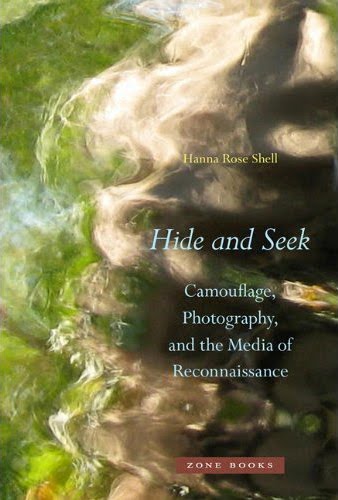
SHELL Hide and seek

You can get a sense of Hanna’s (early) work from this essay, ‘The crucial moment of deception’, in Cabinet.  There’s also an excellent article on her work in the Paris Review here , another at rhizome here, and a short interview with Hanna here:

The main focus of my book is on the period between the late 19th century and World War II, but I also show how photographic camouflage is present in military research today. What I call an enduring “chameleonic impulse” continues to motivate military R&D of wearable camouflage technologies. There is also an ongoing quest to develop “invisible cloaks” to serve simultaneously as skins and … screens onto which one’s visual environment might be projected.

Many times, people’s first association with camouflage is with the natural world — it’s often the story of the evolution of the “peppered moth” that schoolchildren learn in biology class. But it’s only when humans had to hide from the camera and other optical devices that animal protective concealment began to fascinate people … and then became a model for the development of new human technologies.

Camouflage Project

There’s a second reason.  I’m presently developing a performance work, provisionally called “The social life of bombs“, where I want (among other things) to integrate the performing and visual arts into the research process (as part of my Killing Space project).  My inspiration is in part Gerry Pratt’s Nanay, but more proximately Boca del Lupo‘s Photog, based on the experiences of four combat photographers and using cutting-edge visual technologies to mesmerising effect (I’m going to talk with them next month), and in part Ohio State University’s  The Camouflage Project (above).  The project involved OSU’s Department of Theater and the Mershon Center for International Security Studies:

The camouflage project/2The goal of The Camouflage Project is to create, organize and execute a three-part interdisciplinary endeavor linked to the theme of secret agents, camouflage, deception and disguise in World War II, specifically the F section (France) of the Special Operations Executive (SOE). The three parts are as follows:

Performance: To devise a new performance work as a collaboration between Ohio State University Theatre and the Advanced Computing Center for the Arts and Design (ACCAD). This will be a multi-media work combining digital animations and video projections with experimental use of 3D printing, 3D scanning and projection mapping.

Exhibition: To create a visual environment parallel to the performance space, which will have a second life as an installation/exhibition. The installation will feature historical background (interviews and soldier training films) on the science and art of camouflage in both World Wars organized around a visual study of selected SOE (principally female) agents and espionage circuits in France, examples of military equipment, devices, disguises, gadgets and weapons of deception.

Symposium: To organize and host an international symposium on the multiple artistic and instrumental meanings of camouflage, to be held in May 2011. The symposium will feature panels of Ohio State and international experts from military history, political science, and the Imperial War Museum addressing the subject of camouflage and the SOE.

The project offers a fresh meaning to the expression ‘theatre of war.’ On one level it theatricalizes the history of military camouflage, particularly the SOE and the role played by women agents in its espionage activity. On another it reveals the artistic dimensions of these activities: a variety of theatre artists—scenic, costume, make-up designers, and vaudeville magicians—were employed to use their theatrical skills to deceive and fool the enemy. Rather than tales of derring-do and spying, this project seeks to look at different and often hidden aspects of the war: the use and creation of camouflage, both literally and metaphorically, by people who had to work secretly behind enemy lines. The performance storyline will highlight the work of women agents, many of whose accomplishments have been concealed, erased or obscured for a variety of reasons. A narrative strategy will be to include elements of the training process involved in preparing agents for the field and the often-disastrous consequences of strategic decisions made by the SOE leadership.
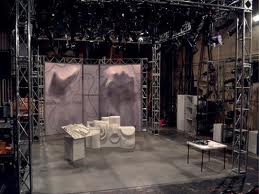
This all came together in May 2011, though the performance work has subsequently been on tour; the programme for the symposium and performance is here, a review of the 90-minute performance here.  My subject is different, of course, but I’m really taken by the tripartite structure of the project and its collaborative nature.  Perhaps I have nothing to say, only to show…

Gabriel’s map

Gabriel's map posterThe video of  “Gabriel’s map: cartography and corpography in modern war”, a lecture I gave as part of the University of Kentucky’s Committee on Social Theory 2013 series on “Mapping” in January, is now available here.

The splendid poster (left) mangles the title, but any mangling of the content is down to me!

I’m presently re-working this as an essay, but I’ll eventually post the pdf of the slides: more soon.  In the meantime, I’d welcome any comments, suggestions and criticisms.

UPDATE:  You can now access the slides for this presentation as a pdf under DOWNLOADS, but please remember that this was the first version of the presentation – I expect to be revising it over the coming weeks – and if you use any of them (for teaching purposes only) please credit the source.

3-D War

It’s strange how things sometimes come together….  News of the online publication of Stuart Elden‘s paper, ‘Secure the volume: vertical geopolitics and the depth of power‘, coincides with a short post from Jasper Humphreys at the Marjan Centre, ‘Shape shifting in Flanders‘, which describes the war on the Western Front as the first 3-D war.  What Jasper has in mind is the combination of aerial reconnaissance (and artillery spotting) with the elaborate tunnelling under enemy lines to detonate huge explosions.  But if we extend the terrain beyond the Western Front then the claim becomes a more general and I think an even more powerful one, with the bombing of civilian targets far beyond the front lines by airships and aircraft and the unrestricted use of that ‘ungentlemanly weapon’, the submarine. (Stuart cites Paul Virilio‘s Bunker Archaeology, which identifies the emergence of ‘volumetric’, deep three-dimensional warfare with the Second World War, but the genealogy is clearly older than that).

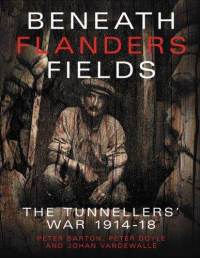
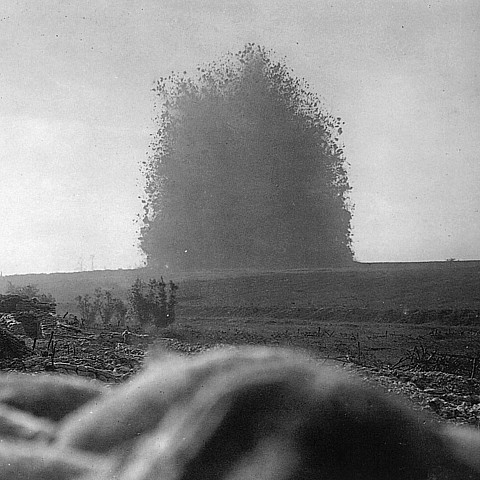
BARTON et al Beneath Flanders FieldsIt’s the underground war – the tunnellers’ war – that captures Jasper’s attention.  He focuses on the mining of Messines Ridge in June 1917, which (as he notes) appears in Sebastian Faulkes‘s Birdsong, but the tactic was a general one that not only scarred the landscape but also left an indelible impression on everyone who witnessed it, even by proxy: the detonation of the mine beneath Hawthorn Ridge in July 1916 was filmed by Geoffrey Malins for The Battle of the Somme (below).

Mining had started with the onset of trench warfare, and was dominated by the Germans during 1914 and 1915: ‘Although Germany had rejected military mining by 1914,’ Simon Jones notes, ‘it was nevertheless able quickly to revive its capability through the availability of fortress troops which could be attached ot its field army.  There seemed no alternative but to mine on the Western Front as a means of breaking the strong field defences.’  For the British and their allies mining evolved, if that’s the right verb, into three main phases: the Somme in 1916, Arras in April 1917 and – though its efficacy was by then undermined by the German strategy of defence-in-depth – Messines in June 1917.

Hawthorne Ridge mine

Hill 60 on the Messines Ridge had been mined in 1915, but the re-mining in June 1917 – as part of ‘the largest mining attack in the history of warfare’ (Jones) – was hugely spectacular:

‘The artillery preparations which for days had been intense had died down and the night was comparatively quiet…  Suddenly, all hell broke loose.  It was indescribable.  In the pale light it appeared as if the whole enemy line had begun to dance, then, one after another, huge tongues of flame shot hundreds of feet into the air, followed by dense columns of smoke which flattened out at the top like gigantic mushrooms.  From some craters were discharged tremendous showers of sparks, rivalling everything ever conceived in the way of fireworks.’
I’ve taken this from an essay by Roy MacLeod, ‘Phantom soldiers’, which provides an excellent discussion of Australian tunnellers in the underground war and emphasizes that theirs was a profoundly scientific campaign that involved knowledge of geology, engineering and – crucial for counter-mining – acoustics.  If it was science, it was doubly hellish science, both for the conditions endured by the tunnellers and for the consequences on the surface. In Underground warfare Simon Jones includes this report from a British artillery officer:

‘At exactly 3.10 a.m. Armageddon began.  The timing of all the batteries in the area was so wonderful and to a second every gun roared in one awful salvo.  At the same moment the two greatest mines in history were blown up…  First there was a double shock that shook the earth here 15,000 yards away like a gigantic earthquake.  I was nearly flung off my feet.  Then an immense wall of fire that seemed to go half-way up to heaven.  The whole country was lit with a red light like a photographic dark-room… The noise surpasses even the Somme; it is terrific, magnificent, overwhelming.  It makes one almost drunk with exhilaration…’

Barely two months later photographer Frank Hurley peered down at the huge crater in horror:

‘After, we climbed to the crest of hill 60, where we had an awesome view over the battlefield to the German lines. What an awful scene of desolation! Everything has been swept away: only stumps of trees stick up here & there & the whole field has the appearance of having been recently ploughed. Hill 60 long delayed our infantry advance, owing to its commanding position & the almost impregnable concrete emplacements & shelters constructed by the Bosch. We eventually won it by tunnelling underground, & then exploding three enormous mines, which practically blew the whole hill away & killed all the enemy on it. It’s the most awful & appalling sight I have ever seen. The exaggerated machinations of hell are here typified. Everywhere the ground is littered with bits of guns, bayonets, shells & men. Way down in one of these mine craters was an awful sight. There lay three hideous, almost skeleton decomposed fragments of corpses of German gunners. Oh the frightfulness of it all. To think that these fragments were once sweethearts, may be, husbands or loved sons, & this was the end. Almost back again to their native element but terrible. Until my dying day I shall never forget this haunting glimpse down into the mine crater on hill 60, – & this is but one tragedy of similar thousands…’

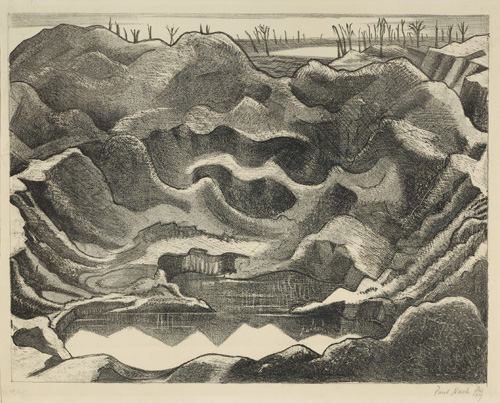
The nightmare scene was also the subject of Paul Nash‘s famous sketch, completed in November:

NASH The Crater

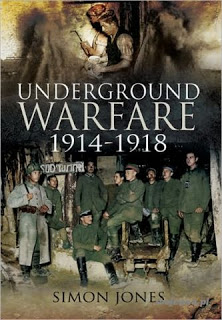
JONES Underground warfareThe BBC has a gallery of images of the underground war, which includes two maps of trenches and tunnels, here, and there’s a fascinating report of contemporary archaeological excavations of the same site here.  There are also helpful discussions and diagrams here. But the most comprehensive discussion is undoubtedly Simon Jones‘s Underground warfare 1914-1918 (2010), which includes compelling first-hand accounts from the tunnellers and countless others.

In the course of his own discussion, Jasper makes two other observations that also intersect with some of my current preoccupations.  The first is about the familiarization of the landscape of war by the first artists despatched to the front, though I’m less interested in the pastoral aesthetic than in subsequent, thoroughly modernist attempts to capture the ‘anti-landscape’ of the war.

The second is about the earthy, material medium through which the war was fought:

‘No war in history has combined such a vast theatre of operations fought in such proximity to the forces of Nature: firstly the elements of wind, rain, storms and snow created the all-pervasive mud and water – sometimes referred to metaphorically as ‘slime’ – along with the horses, mules, dogs and canaries, as well as rats and mice, all sharing the hell of the trenches with humans. Secondly, the geography and topography dominated the fighting: every small hill, river or indentation that would provide even a tiny advantage was a battle-ground.’

I’ve posted about these ‘slimescapes‘ before, and they loom large in my presentation on ‘Gabriel’s map’, but earlier this year I agreed to give a new public presentation this May (at the Vancouver Aquarium – where else?) on ‘The natures of war’ in which I develop the argument in more – er – depth.   I won’t be confining myself to the First World War, though I expect to have much to say about trench and tunnel warfare, and in particular I want to think through ‘nature’ less as the arena over which conflicts are fought (‘conflict commodities’, ‘resource wars’, and the rest) and more about nature as the medium through which conflict is conducted.  I’m assuming we can all agree that ‘nature’ is just as complex as Raymond Williams said it is, and that here it’s just a shorthand that will need very careful unpacking – or perhaps excavating.  More soon…

‘A foreign field that is forever England’?

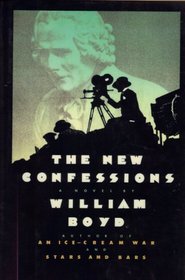
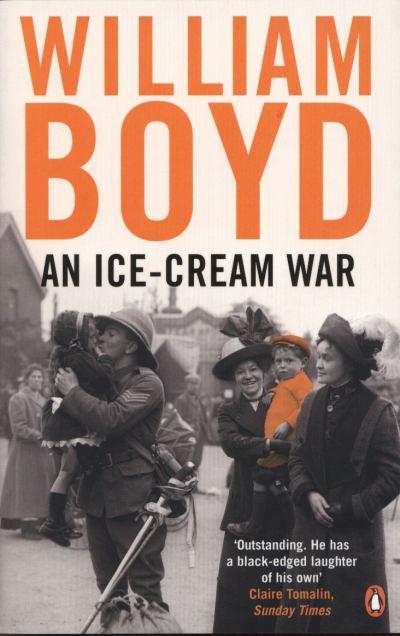
BOYD New ConfessionsI’ve already noted the effect that William Boyd‘s An Ice-Cream War (1982) had on me, but there’s another Boyd novel that also deals with the First World War – this time set on the Western Front rather than East Africa – that also offers much food for thought.

In the early sections of  The New Confessions (1987), an odyssey conducted in the obvious shadows of Rousseau, the protagonist John James Todd is serving in a Public School service battalion of the British Army just before Ypres.  In a chapter revealingly entitled ‘New geometries, new worlds’, Todd recalls the Ypres front in early June 1917 like this:

‘Take an idealized image of the English countryside – I always think of the Cotswolds in this connection…  Imagine you are walking along a country road.  You come to the crest of a gentle rise and there before you is a modest valley.  You know exactly the sort of view it provides.  A road, some hedgerowed lanes, a patchwork of fields, a couple of small villages – cottages, a post-office, a pub, a church – there a dovecote, there a farm and an old mill; here an embankment and a railway line; a wood to the left, copses and spinneys scattered randomly about.  The eye sweeps over these benign and neutral features unquestioningly.

‘Now place two armies on either side of this valley.  Have them dig in and construct a trench system.  Everything in between is suddenly invested with new sinister potential: that neat farm, the obliging drainage ditch, the village at the crossroads become key factors in strategy and survival.  Imagine running across those intervening fields in an attempt to capture positions on that gentle slope opposite so that you may advance one step into the valley beyond.  Which way will you go? What cover will you seek?  How swiftly will your legs carry you up that sudden gradient?  Will that culvert provide shelter from enfilading fire?  Is there an observation post in that barn?  Try it next time you are on a country stroll and see how the most tranquil scene can become instinct with violence.  It only requires a change in point of view.’

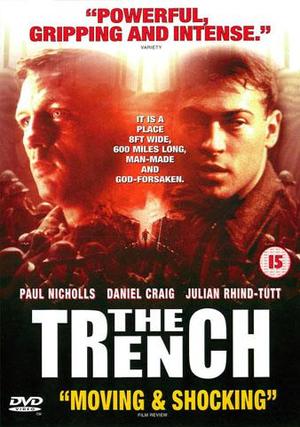
The TrenchLater Todd is recruited by the War Office Cinema Committee with strict instructions about what and may not be shown, and some ten years after he wrote the novel Boyd directed his own film, The Trench, set on the eve of the Battle of the Somme. But my point (for the moment) isn’t about photography or film but about the work of war artists on the Western Front.

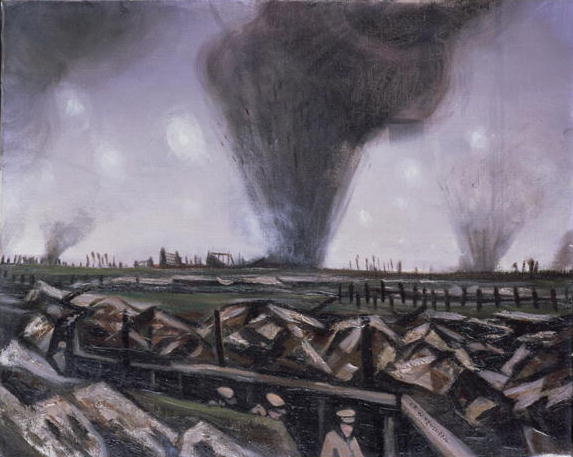
During the spring of 1916 Charles Masterman, the director of the British War Propaganda Bureau, was persuaded to appoint the first Official War Artist, Muirhead Bone.  Bone was a sketcher and watercolour artist, who was duly commissioned as an honorary Second Lieutenant and arrived in France during the Battle of the Somme.  He returned to England in October, and two hundred of his drawings were published in ten monthly parts, with an accompanying commentary by C.E. Montague.

A View in Flanders behind the Lines, Showing Locre and the Tops of Dug-Outs on the Scherpenber 1916 by Sir Muirhead Bone 1876-1953

‘For many people at home,’ Samuel Hynes remarks in A war imagined, ‘they must have been an important source of their notions of what the war looked like.’  But, he continues,

‘Bone and Montague agreed that what it looked like was England; both the drawings and the commentaries imagine the war in familiarizing English terms…  They made the war look familiar, and they provided images of it from which both the dead and the suffering living had been entirely excluded.’

BONE British troops marching to the Somme

When the first two weekly installments appeared, apparently to considerable public acclaim, Wilfred Owen called them ‘the laughing stock of the army’ because they presented such a pastoralized, picturesque and sanitized view of the war: ‘To call it England!’  Many of Bone’s drawings, like the two examples I’ve shown here, rendered the landscape in the idealized terms of Boyd’s ‘country stroll’.  (There were exceptions, but even when Bone turned to the desolation of the battlefield many of his sketches were devoid of human form, alive or dead.)  To be sure, most commentators noted that in the rear a working countryside persisted, and many of them made much of the shocking transition from a landscape that was indeed familiar, largely untouched by military violence, to something unlike any landscape on earth.

And it’s exactly that anti-landscape Owen wanted to be represented.  In The soldiers’ tale Hynes writes that

‘War turns landscape into anti-landscape, and everything in that landscape into grotesque, broken, useless rubbish – including human limbs.’

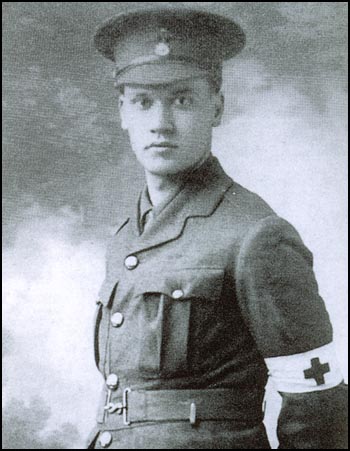
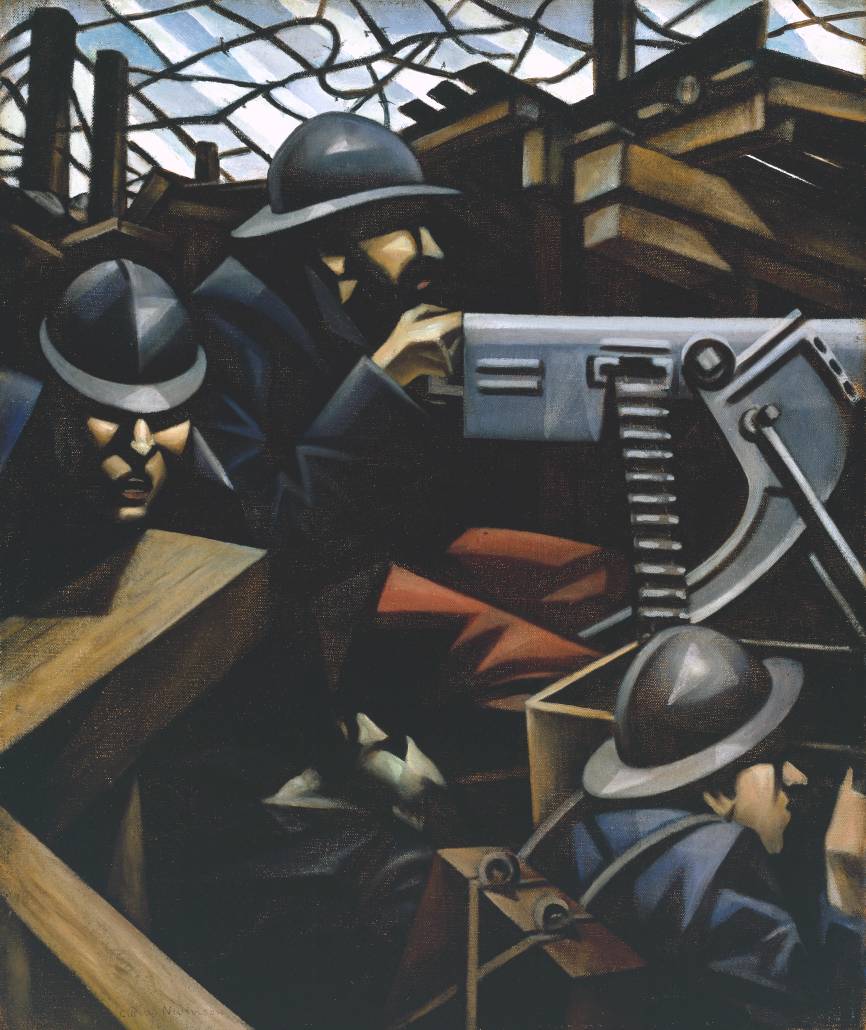
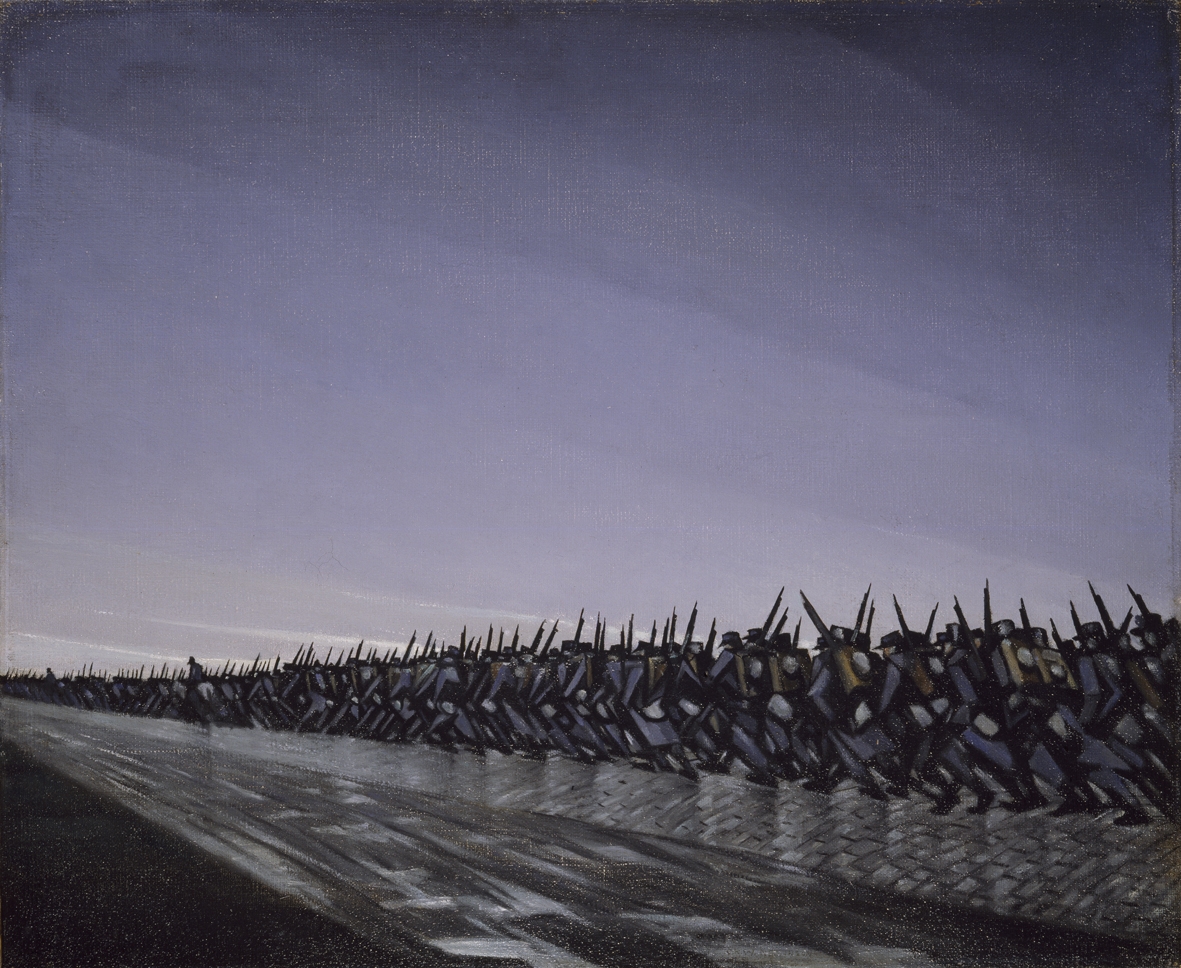
C.R.W. NevinsonAnd there were other artists who were developing Boyd’s ‘change in point of view’, a different visual vocabulary for these brutally new warscapes.  One of the most interesting, I think, is C.R.W. Nevinson.  Early in the war Nevinson served as an orderly with the Friends’ Ambulance Unit and then as an ambulance driver with the Royal Army Medical Corps.  He was invalided out in January 1916, a result of acute rheumatic fever, but in March 1916 he exhibited a series of Futurist paintings whose stark geometric planes and mechanised violence conveyed a radically different sensibility, one in which soldiers and machines were fused into shockingly new assemblages and where human bodies were caught up in and overwhelmed by the percussive force of the new military machine.  One of his most famous paintings, of a French machine-gune post, La Mitrailleuse (below), captures what Michael Walsh calls the ‘machinomorphic image’ of the war.

La Mitrailleuse 1915 by Christopher Richard Wynne Nevinson 1889-1946

Walter Sickert claimed that La Mitrailleuse ‘will probably remain the most authoritative and concentrated utterance on the war in the history of painting’, but other Nevinson paintings of this period capture other dimensions of the automations of the killing machine, as in Column on the march (1915):

Nevinson Column on the march 1915

They also captured, through what Claude Philips praised as their ‘cold, calculated violence’ and ‘cruel, metallic angularity’, what Henri Lefebvre once called ‘the overwhelming of the human body’, as in The strafing (1915):

NEVINSON The strafing

In invoking Lefebvre here, I have in mind this passage from The production of space where he describes a modern, abstract, geometric space:

‘… space has no social existence independently of an intensive, aggressive and repressive visualization. It is thus – not symbolically but in fact – a purely visual space. The rise of the visual realm entails a series of substitutions and displacements by means of which it overwhelms the whole body and usurps its role.

And yet, of course, the production of this extraordinarily violent space was literally shot through with corporeal investments.

Postcard from Nevinson to MarinettiI’ve described these artworks as Futurist, but two riders are necessary.  The first, and most obvious, is that Marinetti‘s own Manifesto of Futurism expressed a desire ‘to glorify War – the only health giver of the world’, and while Nevinson was fascinated by, even infatuated with Marinetti – he sent Marinetti a postcard (right) of him posing in front of his ambulance, without any discernible sense of irony – this was a claim that Nevinson eventually explicitly repudiated (in a column for the Daily Express called ‘Painter of Smells at the Western Front’).  Bone, incidentally, liked Nevinson’s work.

The second is more interesting.  Paul Saint-Amour has described aerial photography and interpretation on the Western Front not as an applied realism but as an applied modernism – and with good reason (some interpretation manuals described ‘Cubist’ and ‘Futurist’ landscapes) – and if we extend this insight then we might say that in these artworks Nevinson was recovering and reinscribing a scopic regime that was instrumental in the very violence he sought to subvert.

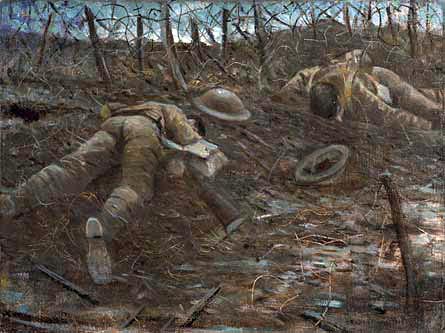
In March 1917 Nevinson was toying with the idea of putting his talents to work in the new camouflage section of the army, but by July he was back in France as an Official War Artist.  He went up in an observation balloon and claimed to be ‘the first man to paint in the air’; in fact he thought his ‘aeroplane pictures the finest work I have done’.  But in many of these later paintings he turned his back on Futurism and the machinations of the killing fields and restored the broken body to the art of war.  The most notable example is perhaps Paths of glory (1917).  Refused permission to exhibit the canvas at the Leicester Galleries in London by the War Office, Nevinson had it displayed with a brown paper sticker across the two dead bodies reading “Censored”…

NEVINSON Paths of glory

There is an excellent gallery of Nevinson’s work here, and for more discussion I recommend David Boyd Hancock, A crisis of brilliance: five young British artists and the Great War (2010); Michael Walsh, ‘C.R.W. Nevinson: conflict, contrast and controversy in paintings of war’, War in History 12 (2) (2005) 178-207, and his two books, C.R.W. Nevinson: This cult of violence (2002) and Hanging a rebel: the life of C.R.W. Nevinson (2008).

‘The largest picture in the world’

I was in Lexington Thursday-Saturday to give the first of this year’s Committee on Social Theory lectures at the University of Kentucky.  The theme this year is “Mapping“, and this was the first outing for “Gabriel’s Map: cartography and corpography in modern war”.  The video will be posted online in a week or so, and there will also be an online interview with the journal disClosure, which is moving to a digital platform.  I was last in Kentucky soon after I moved to UBC, so some time around 1989/90, to give one of the first of these lectures, and this occasion was as enjoyable as the first: many thanks to Jeremy Crampton and his wonderful colleagues and graduate students for such warm hospitality on such a chilly week!  That said, being invited to talk about “Mapping” by Jeremy is like being invited to talk about Marxism by David Harvey, so I was relieved everything went so well; I learned much from the questions, comments and conversations, so no doubt the second outing will see a different presentation.  Then, somewhere down the line, I’ll translate it into written form.

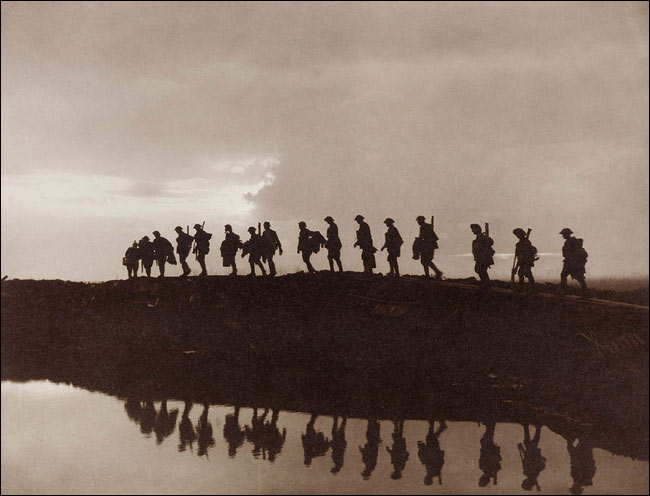
One of the most enjoyable parts of preparing a presentation, for me anyway, is the image research and design, which invariably takes me to sites and sources I’d never otherwise find.  And because it can take an age to find the right image, it slows down the process and gives me time to think more carefully (and I hope creatively) about the argument I’m developing.  This was no exception: again and again, as I raided image banks on the First World War, I encountered the work of Australian photographer and film-maker Frank Hurley (1885-1962).  In fact, it’s one of his photographs that I cut for the banner of this blog (‘Moving Forward/Supporting troops of the 1st Australian Division walking on a duckboard track near Hooge, in the Ypres Sector’).

HURLEY Moving forward

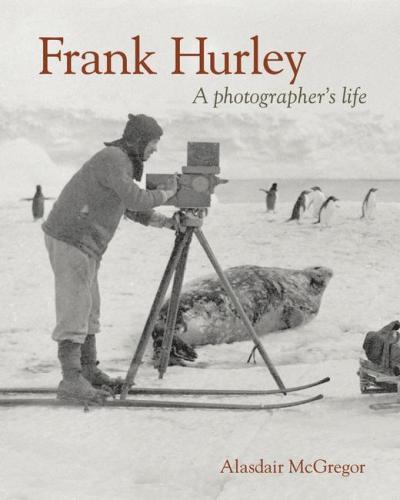
McGREGOR Frank HurleyWhen the First World War began Hurley was in Antarctica as the photographer for the Imperial Trans-Antarctic Expedition, Ernest Shackleton‘s legendary attempt to reach the South Pole on foot in 1914-1917, which ended in near disaster when the expedition’s support vessel became trapped and was eventually crushed in the pack ice.  The First Officer on the ill-fated Endurance described Hurley as ‘a warrior with his camera’ who would ‘go anywhere or do anything to get a picture.’

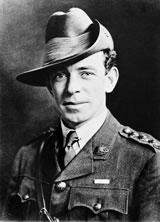
Frank HurleySure enough, soon after he returned to England Hurley was appointed as one of two official photographers to the Australian Imperial Force (AIF) in July 1917 with the honorary rank of Captain.  (War correspondents were expressly forbidden to take photographs, which is why official photographers were appointed – and subject to regulation and censorship). Hurley left England the following month for what he called ‘the grim duties of France’.  He was constantly haunted by the horror gouged into the landscape of the front line:

‘After, we climbed to the crest of hill 60, where we had an awesome view over the battlefield to the German lines. What an awful scene of desolation! Everything has been swept away: only stumps of trees stick up here & there & the whole field has the appearance of having been recently ploughed. Hill 60 long delayed our infantry advance, owing to its commanding position & the almost impregnable concrete emplacements & shelters constructed by the Bosch. We eventually won it by tunnelling underground, & then exploding three enormous mines, which practically blew the whole hill away & killed all the enemy on it. It’s the most awful & appalling sight I have ever seen. The exaggerated machinations of hell are here typified. Everywhere the ground is littered with bits of guns, bayonets, shells & men. Way down in one of these mine craters was an awful sight. There lay three hideous, almost skeleton decomposed fragments of corpses of German gunners. Oh the frightfulness of it all… Looking across this vast extent of desolation & horror, it appeared as though some mighty cataclysm had swept it off & blighted the vegetation, then peppered it with millions of lightning stabs. It might be the end of the world where two irresistible forces are slowly wearing each other away.’

Or again:

Frank HURLEY  Menin Road, 1917‘The Menin Rd is one of the, if not the, most ghastly approach on the whole front. Accretions of broken limbers, materials & munitions lay in piles on either side, giving the road the appearance of running through a cutting. Any time of the day it may be shelled & it is absolutely impossible owing to the congested traffic for the Boche to avoid getting a coup with each shell. The Menin road is like passing through the Valley of death, for one never knows when a shell will lob in front of him. It is the most gruesome shambles I have ever seen…’

But throughout his diary he is also evidently entranced, even thrilled by the aesthetic effect of such spectacular violence:

‘The battlefield in the night was a wonderful sight of star shells & flashes. The whole sky seemed a crescent of shimmering sheet lightning like illumination. It was all very beautiful yet awesome and terrible.’

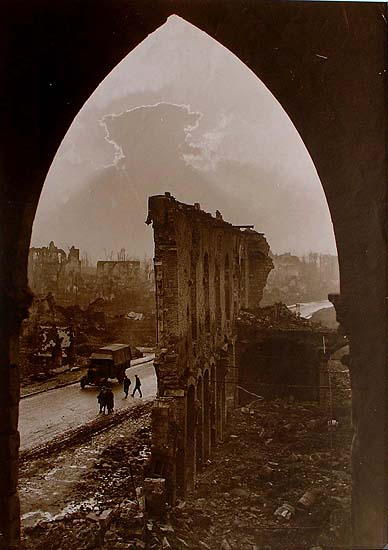
Frank HURLEY Ypres 1917At Ypres, he confesses that the shattered town is now ‘aesthetically … far more interesting than the Ypres that was’.  Making his way along the Menin Road at twilight:

‘No sight could be more impressive than walking along this infamous shell swept road, to the chorus of the deep bass booming of the drum fire, & the screaming shriek of thousands of shells. It was great, stupendous & awesome.’

Later:

‘The shells shrieked in an ecstasy overhead, & the deep boom of artillery sounded like a triumphant drum roll. Those murderous weapons the machine guns maintained their endless clatter, as if a million hands were encoring & applauding the brilliant victory of our countrymen. It was ineffably grand & terrible…’

Above all, Hurley was tormented by the difficulty of conveying the full extent of what he saw in a single exposure.  In his diary he confided that

‘We have even a worse time than the infantry, for to get pictures one must go into the hottest & even then come out disappointed. To get War pictures of striking interest & sensation is like attempting the impossible.’

He later explained:

‘None but those who have endeavoured can realise the insurmountable difficulties of portraying a modern battle by the camera. To include the event on a single negative, I have tried and tried, but the results are hopeless. Everything is on such a vast scale. Figures are scattered — the atmosphere is dense with haze and smoke — shells will not burst where required — yet the whole elements of a picture are there could they but be brought together and condensed.’

Hurley passionately believed that it was only by the superimposition of different negatives to form a single, ‘condensed’ image that he could re-present the violence of war – and, I think, its shocking, thrilling aesthetic.  Towards the end of September 1917 Hurley recorded

‘a great argument with Bean about combination pictures. Am thoroughly convinced that it is impossible to secure effects – without resorting to composite pictures.’

Charles BeanCharles Bean was Australia’s Official War Correspondent (more here, and for the documentary-drama, Charles Bean’s Great War, see here), and he was equally adamant that Hurley’s method was itself so violent that it destroyed the truth: to Bean, Hurley’s montages were ‘little short of fake’ and violated the imperative to view photographs as ‘sacred records’ of the war.  Indeed, Bean insisted that ‘press photography in this war is such a construction of flimsy fake,’ and ‘that is the last thing a historian wants to build on.’  In October Bean presented an ultimatum to which Hurley responded in a characteristically uncompromising fashion:

‘Had a lengthy discussion with Bean re pictures for Exhibition & publicity purposes. Our Authorities here will not permit me to pose any pictures or indulge in any original means to secure them. They will not allow composite printing of any description, even though such be accurately titled nor will they permit clouds to be inserted in a picture. As this absolutely takes all possibilities of producing pictures from me, I have decided to tender my resignation at once. I conscientiously consider it but right to illustrate to the public the things our fellows do & how war is conducted. These can only be got by printing a result from a number of negatives or reenactment. This is out of reason & they prefer to let all these interesting episodes pass. This is unfair to our boys & I conscientiously could not undertake to continue the work.’

The next morning Hurley resigned:

‘I sent in my resignation this morning & await the result of igniting the fuse. It is disheartening, after striving to secure the impossible & running all hazards to meet with little encouragement. I am unwilling & will not make a display of war pictures unless the military people see their way clear to give me a free hand. Canada has made a great advertisement out of their pictures & I must beat them.’

According to Robert Dixon’s engaging essay ‘Travelling Mass-Media Circus: Frank Hurley and Colonial Modernity’, Hurley had Canada in his sights because the Canadian War Records Office had staged a highly successful photographic exhibition at the Grafton Galleries in London the previous December, which had included vast enlargements using multiple negatives; the follow-up exhibition in July had as its centrepiece what was advertised as ‘the largest photograph in the world’, ‘Dreadnoughts of the Battlefield’, which occupied an entire wall of the gallery.

Dreadnoughts of the Battlefield

Within days a compromise of sorts had been reached: Hurley was allowed to make six ‘combination enlargements’ for his public exhibition, provided they were clearly labelled as composites, and he withdrew his resignation. (For more on the spat between Hurley and Bean, and the vexed political-epistemological issues at stake, see here).

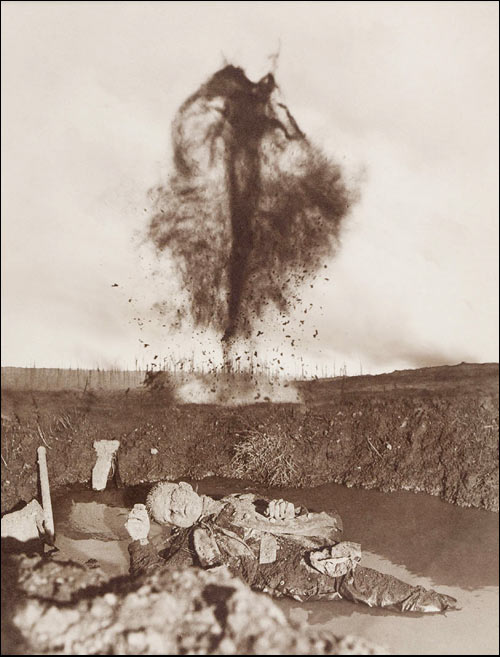
But it was not until May 1918 – after he had completed a photographic expedition to record Australian troops fighting in Palestine – that Hurley was able to prepare his photographs for the London exhibition (the catalogue for the later show in Sydney is here).  He was particularly excited by two montages.  The first, ‘DEATH THE REAPER” was made up of two negatives: ‘One, the foreground, shows the mud-splashed corpse of a Boche floating in a shell crater.  The second is an extraordinary shell burst: the form of which resembles death.’

HURLEY Death the Reaper

What is striking about Hurley’s gloss – and the composition of the image itself – is the evident striving for a particular aesthetic effect: the compulsion to ‘secure effects’ (above) that were also affects.  Hurley reserved his most extravagant self-praise for a second photo-work which was made from 12 separate negatives:

‘Our largest picture, “THE RAID”, depicting an episode an the Battle of Zonneke [south-west of Passchendaele] measures over 20 ft. x 15’6″ high.  Two waves of infantry are leaving the trenches in the thick of a Boche Barrage of shells and shrapnel.  A flight of Bombing Aeroplanes accompanies them.  An enemy plane is burning in the background.  The whole picture is realistic of battle, the atmospheric effects of battle smoke are particularly fine.’

HURLEY The Raid

You can see an animation of the composition process here and a video here, and although Hurley claims this as a ‘realistic’ photo-work, the process of composition is, again, an artfully studied one that was plainly intended to produce a particular aesthetic – and cinematic – effect.

Even more than this, though, Hurley was – as Julian Thomas makes very clear here, a show man: Robert Dixon argues that by the 1920s ‘Hurley had become not only the ring-master but also the main attraction in his own travelling, international, multi- and mass-media circus.’  (Given how much I enjoy devising my own presentations, perhaps that’s also why I find the man so interesting….).

HURLEY The Raid leaning against a wall

And ‘The Raid’, sometimes also called ‘Over the top’ (shown leaning against a wall in London, left) was his bid to produce ‘the largest picture in the world’ (a quest which shows no sign of coming to an end).

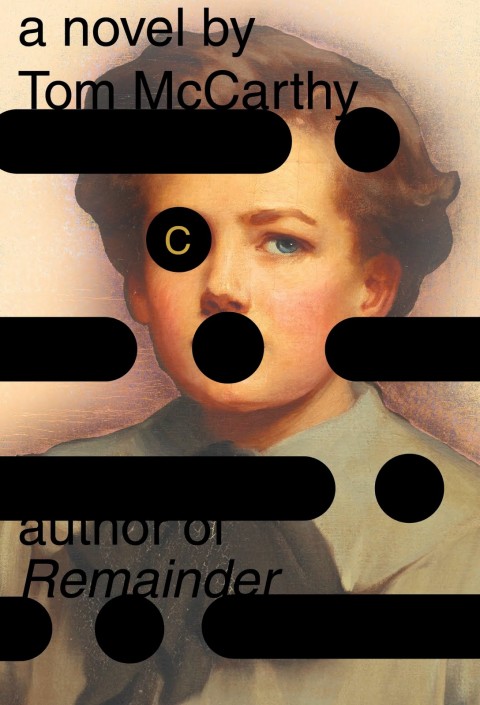
You can find online galleries of Hurley’s photographs from the First World War here.  I used several of them in my presentation at Lexington, and so this excursion into Hurley’s war work is not a side-track: I also used passages from several novels (clearly noted as such), partly to trouble the simple distinctions between ‘fiction’ and ‘non-fiction’ and to draw attention to the constructedness of our histories, but partly too because there are some truths (sic) that can be conveyed most effectively through the imaginative resources of the novel.  In the case of Tom McCarthy’s luminous novel C, which I’ve invoked before, there are complex relationships between the documentary record and the fictional narrative: C is clearly a work of prodigious imagination, but just as clearly saturated in archival research.  I’m left wondering what a latter-day Hurley would have made of it – and whether photographs are still subject to more stringent protocols than texts as a result of a presumptive indexicality.  What now counts as ‘fakery’ once Bean’s ‘sacred records’ have become secularised?

The fog-horn of war

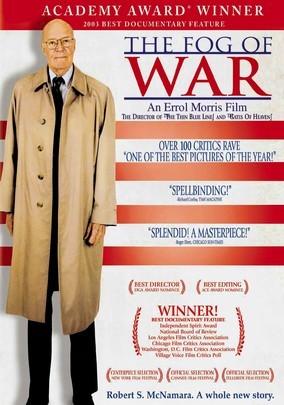
I suspect most people attribute the metaphoric “fog of war” to Clausewitz’s critical reflections on the Napoleonic wars and then fast-forward to Erroll Morris‘s brilliant 2003 film about Robert Strange (sic) McNamara, The Fog of War, which centres on the Second World War and Vietnam.

Carl von Clausewitz  (1780-1831)Both turn out to be more problematic than they seem. First, although Clausewitz mentioned ‘fog’ several times in his manuscript On War he never used the phrase “fog of war”; this is the sentence that probably comes closest to the contemporary meaning:

‘War is the realm of uncertainty; three quarters of the factors on which action is based are wrapped in a fog of greater or lesser uncertainty’ [Der Krieg ist das Gebiet der Ungewißheit; drei Vierteile derjenigen Dinge, worauf das Handeln im Kriege gebaut wird, liegen im Nebel einer mehr oder weniger großen Ungewißheit’].

In a brief commentary, Eugenia Kiesling suggests that Clausewitz made much more of ‘the friction of war’ than ‘fog’ (and was right to do so) and, more originally, that he gave it a peculiar moral force.  In fact, the two are closely connected: Victor Rosello had already noted that following ‘the metaphorical path of Clausewitzian fog-shrouded battlefields which defy attempts at penetration owing to insurmountable uncertainty’ led directly to ‘the ascendancy of the moral domain’:

‘These moral influences are the role of chance; the imponderables of fog and friction and their effects on the reliability of information; the limitation inherent in observation; the inability to penetrate the mind of the adversary; the dominance of preconception over fact; and the limitations of intelligence analysis.

ERROLL MORRIS's film "The Fog of War"And, second, here is McNamara, at the very end of Morris’s film (from the transcript):

We all make mistakes. We know we make mistakes. I don’t know any military commander, who is honest, who would say he has not made a mistake. There’s a wonderful phrase: “the fog of war.”  What “the fog of war” means is: war is so complex it’s beyond the ability of the human mind to comprehend all the variables. Our judgment, our understanding, are not adequate. And we kill people unnecessarily.

This isn’t quite what Clausewitz meant, but in any case even at the age of 85 McNamara had lost none of his ability to manufacture his own fog: as Fred Kaplan asked at the time, ‘What’s true and what’s a lie in The Fog of War?’ In effect, McNamara turns Clausewitz on his head and uses ‘the fog of war’ as an ethical defence (or, more accurately perhaps, distraction).

I’ve been led down these pathways by my continuing preoccupation with the First World War.  I’ve noted before the metricization of the battlefield on the Western Front: the meticulous planning of what Clausewitz would have called ‘paper war’ on the abstract spaces of maps.  No matter how frequently these were updated, revised and annotated, their purchase on the course of combat was ineluctably limited once the infantry went over the top.  On the British side, telephone and telegraph lines snaked back from the front lines to an ascending series of headquarters in the rear (an appropriate location in more ways than one), but as John Keegan wrote in The Face of Battle, these lines of communication, however imperfect, had one further, disabling limitation: they stopped at the end of no man’s land.

On the Somme, he wrote,

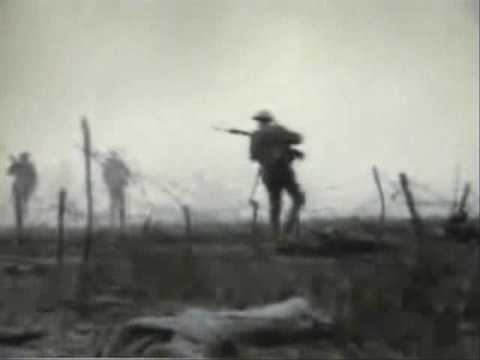
Over the top, Western Front‘Once the troops left their trenches, as at 7.30 a.m. on July 1st, they passed beyond the carry of their signals system into the unknown. The army had provided them with some makeshifts to indicate their position: rockets, tin triangles sewn to the backs of their packs as air recognition symbols, lamps and flags, and some one-way signalling expedients, Morse shutters, semaphore flags and carrier pigeons; but none were to prove of real use on July 1st.

‘That a party could disappear so completely, not in the Antarctic wastes but at a point almost within visual range of their own lines, seems incomprehensible today, so attuned are we to thinking of wireless providing instant communication across the battlefield. But the cloud of unknowing which descended on a First World War battlefield at zero hour was accepted as one of its hazards by contemporary generals. Since the middle of the nineteenth century, the width of battlefields had been extending so rapidly that no general could hope to be present, as Wellington had made himself, at each successive point of crisis; since the end of the century the range and volume of small-arms fire had been increasing to such an extent that no general could hope to survey, as Wellington had done, the line of battle from the front rank. The main work of the general, it had been accepted, had now to be done in his office, before the battle began.’

As Keegan says, there were various attempts to allow GHQ to monitor the progress of the battle. Here is one of the most fanciful, not included in his list, which involved re-imposing cartographic vision – what Edmund Blunden called in Undertones of war its ‘innocuous arrows’ and ‘matter-of-fact symbols’ – on the obdurately physical, all-too-corporeal battefield.  In Somme success: the Royal Flying Corps and the Battle of the Somme, Peter Hart reproduces this report from 2nd Liuetenant Cecil Lewis, describing a so-called ‘contact patrol’:

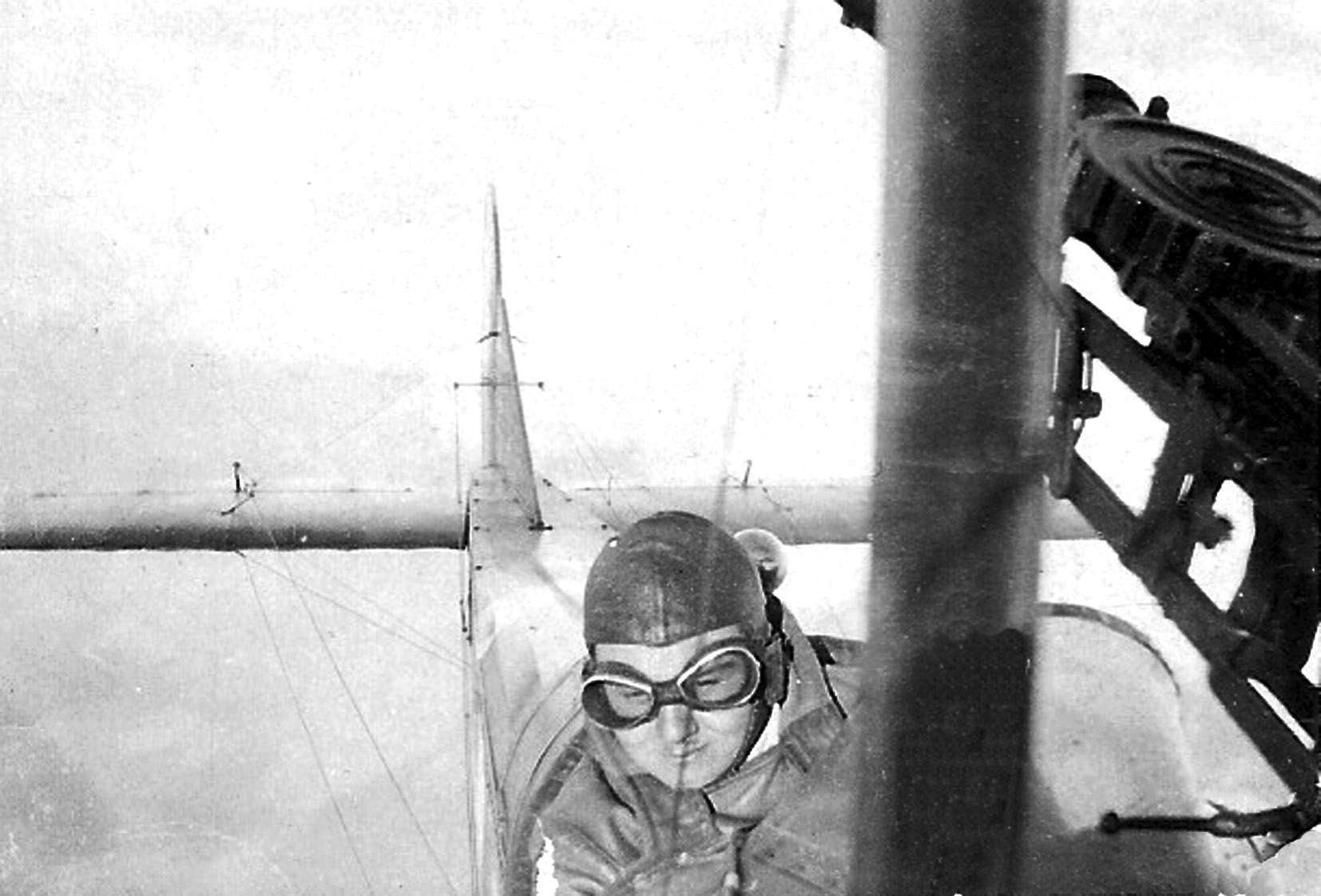
Aerial observation, Western Front‘We had all our contact patrol technique perfected and we went right down to 3,000 feet to see what was happening.  We had a klaxon horn on the undercarriage of the Morane – a great big 12 volt klaxon, and I had a button which I used to press out a letter to tell the infantry we wanted to know where they were.  When they heard us hawking them from above, they had little red Bengal flares, they carried them in their pockets, they would put a match to their flares.  All along the line wherever there was a chap there would be a flare, and we would note those flares down on the map and Bob’s your uncle!’

Not difficult to see why A.M. Burrage gloomily wrote in War is war that the infantry were ‘the little flags which the General sticks on the war-map to show the position of the front line’…  But, Lewis continued,

‘It was one thing to practice this but quite another for them to really do it when they were under fire, and particularly when things began to go a bit badly. Then they jolly well wouldn’t light anything and small blame to them because it drew the fire of the enemy on to them at once.’

War and simulation

Antoine Bousquet has an interesting post on War and simulation over at The Disorder of Things, based on a conference “Simulation, Exercise, Operations” at Oxford last summer. Antoine’s narrative locates the origins of military simulation in the Prussian Kriegspiel of the early nineteenth century but then argues that ‘it really comes of age with the Second World War, the early calculating machines that would become the all-purpose computer,  and the efforts to rationalise the conduct of military operations, notably in the areas of aerial bombing, military convoys, radar arrays, and so on – and which quite demonstrably yielded improved performances of those systems.’

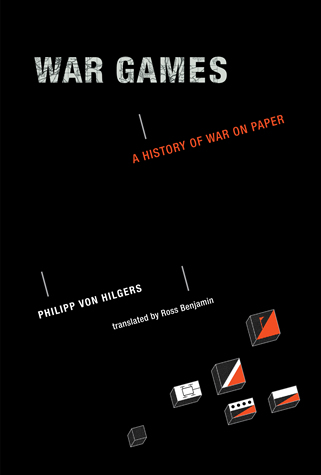
von HILGERS War GamesThis is interesting stuff, and Patrick Crogan‘s Gameplay mode: war, simulation and technoculture (Minnesota, 2011) helps bring the story up to date; if you want to start it earlier, then Philipp von HilgersWar games: a history of war on paper (MIT, 2012; the original German title was Kriegsspiele) is the (brilliant) place to start.  But since I’m still floundering around in the trenches of the First World War, I want to draw attention to the gap in Antoine’s narrative (which reappears in von Hilgers too).

During the First World War the metricisation of the battlefield – the (in)calculability of the space of war – that I spoke about earlier also allowed for simulations of imminent operations (and there are dimensions of that metricisation, including sound ranging, that speak directly to the early attempts at what would later be called operations research too: Roy MacLeod writes of a ‘batttlefield laboratory’ on the Western Front).

So, for example, in Over the top, published in 1917, Arthur Empey describes how

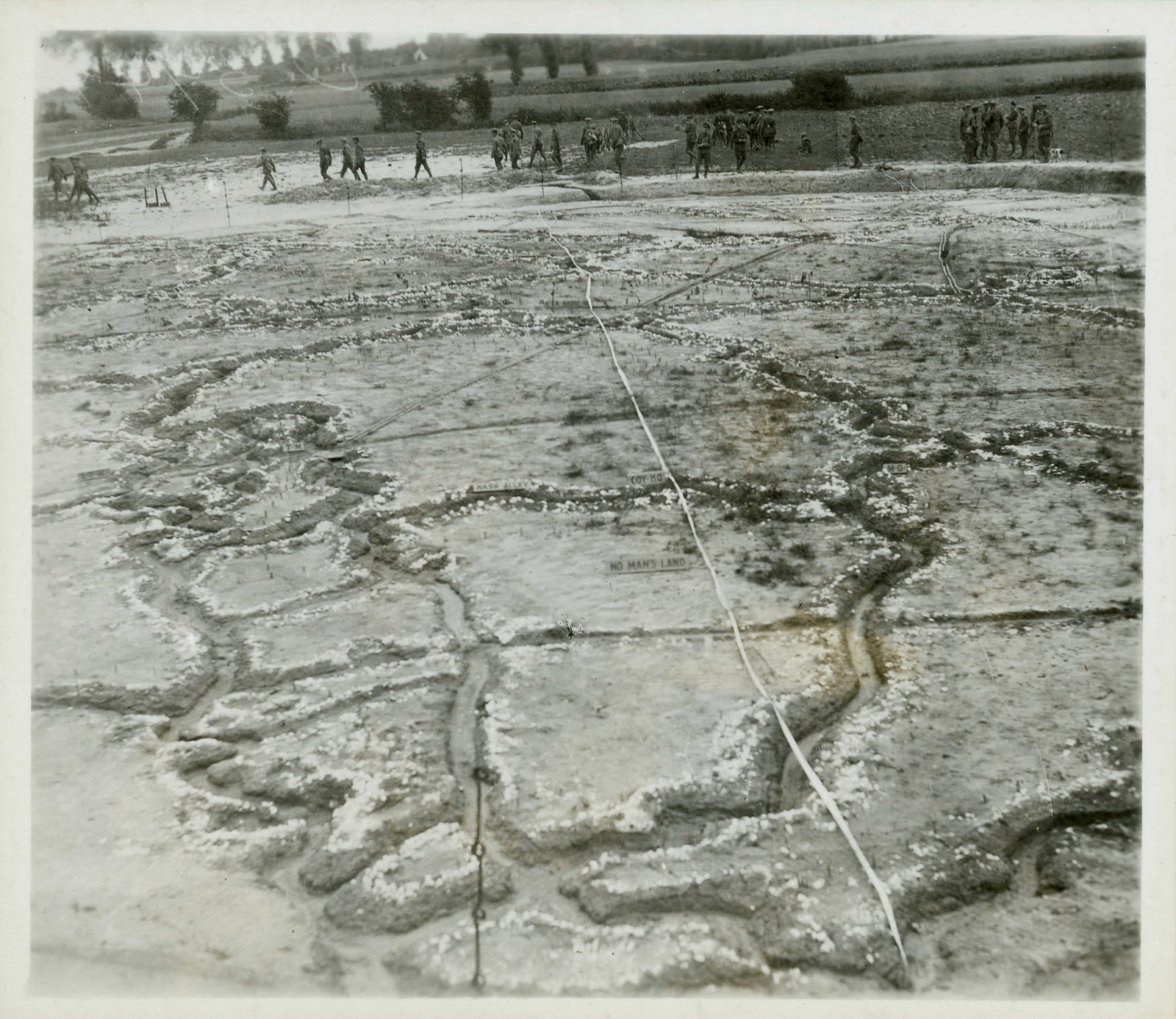
‘Three weeks before the Big Push of July 1st [1916] — as the Battle of the Somme has been called — started, exact duplicates of the German trenches were dug about thirty kilo[metre]s behind our lines. The layout of the trenches were taken from aeroplane photographs submitted by the Royal Flying Corps. The trenches were correct to the foot; they showed dugouts, saps, barbed wire defences, and danger spots. Battalions that were to go over in the first waves were sent back for three days to study these trenches, engage in practice attacks, and have night maneuvers. Each man was required to make a map of the trenches and familiarise himself with the names and location of the parts his battalion was to attack…

‘These imitation trenches, or trench models, were well guarded from observation by numerous allied planes which constantly circled above them. No German aeroplane could approach within observing distance. A restricted area was maintained and no civilian was allowed within three miles, so we felt sure that we had a great surprise in store for Fritz.’

Note here the cascade from aerial photographs and maps to physical models and back to maps again – and remember, as Dick Chorley and Peter Haggett taught some us an age ago in Models in Geography, these are all models…

In Empey’s case, there was a sting in the tail:

 ‘When we took over the front line we received an awful shock. The Germans displayed signboards over the top of their trench showing the names that we had called their trenches. The signs read “Fair,” “Fact,” “Fate,” and “Fancy” and so on, according to the code names on our map. Then to rub it in, they hoisted some more signs which read, “When are you coming over?” or “Come on, we are ready, stupid English.”

Trench model

This isn’t quite what Antoine has in mind, I realise, but what today would be called ‘mission rehearsal exercises’ are surely simulations.  And in many cases, on the Western Front at least, they took the form of elaborate clay models (see above).  In Undertones of war (1928), Edmund Blunden described – with a rather different sting in the tail – how

‘… an enormous model of the German systems now considered due to Britain was open for inspection, whether from the ground or from step-ladders raised beside, and this was popular, though whether from its charm as a model or value as a military aid is uncertain.’

Here’s A.M. Burrage in War is War:

‘Our brilliant Staff has got every move in the game worked out twenty-four hours ahead. Our jumping-off place is already assigned to us, and we are to advance about five hundred yards, crossing a stream called the Paddebeeke. We are shown a clay model of the landscape, including the roads which are no longer there. We practise the method of attack every morning…’

‘Stop, hey, what’s that sound?’

I’ve used this Buffalo Springfield song before

there’s something happenin’ here
what it is ain’t exactly clear
there’s a man with a gun over there…

stop, hey, what’s that sound?

– and I’ve posted about the sound of war before too, here and here.  This post is connected to both of them, but it also follows directly from my more recent post on bodies

McCARTHY CAn age ago Trevor Barnes recommended Tom McCarthy‘s novel C to me, and I’ve been re-reading it these last few days. There’s an extraordinary passage where McCarthy’s protagonist Serge, an observer with the Royal Flying Corps during World War I, is being driven to Nieppe when his truck  detours ‘to drop off some piano wire’ to a special unit in the woods north of Vitriers.

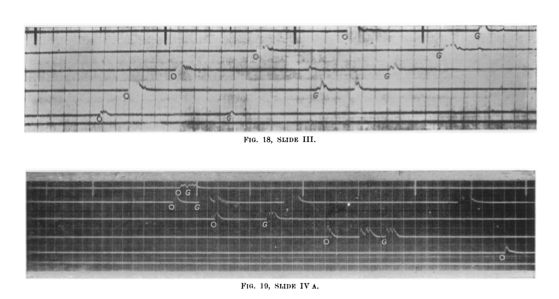
Inside the main [hut], he finds a huge square harp whose six strings are extended out beyond their wooden frame by finer wires that run through the hut’s air before breaching its boundary as well, cutting through little mouse-holes in the east-facing wall. In front of the harp, like an interrogation lamp, a powerful bulb shines straight onto it; behind it, lined up with each string, a row of prisms capture and deflect the light at right angles, through yet another hole cut in the hut’s wall, into an unlit room adjoining this one. There’s a noise coming from the adjoining room: sounds like a small propeller on a stalled plane turning from the wind’s pressure alone. “What is this place?” Serge asks. “You’re an observer, right?” the slender-fingered man says. Serge nods. “Well, you know how, when you’re doing Battery Location flights, you send down K.K. calls each time you see an enemy gun flash?” “Oh yes,” Serge answers. “I’ve always wondered why we have to do that …” “Wonder no more,” the man says with an elfin smile. “The receiving operator presses a relay button each time he gets one of those; this starts the camera in the next room rolling; and the camera captures the sound of the battery whose flash you’ve just K.K.’d to us. You with me?” “No,” Serge answers. “How can it do that?” “Each gun-boom, when it’s picked up by a mike, sends a current down the wires you just pissed on,” the man continues, “and the current makes the piano wire inside this room heat up and give a little kick, which gets diffracted through the prisms into the next room, and straight into the camera.” “So you’re filming sound?” Serge asks. “You could say that, I suppose,” the man concurs.

Sound ranging traces

Still puzzled, he follows the man into another hut:

The interior’s suffused with red light. At a trough propped up against the far wall, a man with rolled-up sleeves is dunking yards of film into developing liquid, then feeding it on from there into a fixing tank. As the film’s end emerges from this tank in turn, he holds it up, inspects it and tears off sections, clipping these with clothes pegs to a short stretch of washing line, from where they drip onto the discarded strips on the room’s floor below them. “Yuk,” Serge whispers beneath his breath. “What?” the slender-fingered man asks. “Nothing,” he replies. “Look here,” Serge’s guide says, unclipping a strip of the developed film and pointing at dark lines that run, lengthways and continuous, along its surface. The lines—six of them—are for the most part flat; occasionally, though, they erupt suddenly, and rise and fall in jagged waves, like some strange Persian script, for half an inch, before settling down and running flat again. On the film’s bottom edge, beside the punch-holes, a time-code is marked, one inch or so for every second. The jagged eruptions appear at different points along each line: staggered, each wave the same shape as the one on the line below it, but occurring a quarter of an inch (or three-tenths of a second) later. “So,” Serge’s elfin guide continues, “these kicks are made by the sound hitting each mike; and they get laid out on the film at intervals that correspond to each mike’s distance from the sound. You see them?” “Yes,” Serge answers. “But I still don’t—” “These ones ready to take through?” the guide asks the developer. The other man nods; with his piano-player’s fingers, the guide unclips the other drip-dried strips, then leads Serge out to yet another hut. This one’s wall has a large-scale map taped to it; stuck in the map in a neat semi-circle are six pins. Two men are going through a pile of torn-off, line-streaked film-strips, measuring the gaps between the kicks with lengths of string; then, moving the string over to the map slowly, careful to preserve the intervals, they transfer the latter onto its surface by fixing one end of the string to the pin and holding a pencil to the other, swinging it from side to side to mark a broad arc on the map. “Each pin’s a microphone,” the slender-fingered man explains. “Where the arcs intersect, the gun site must be.” “So the strings are time, or space?” Serge asks. “You could say either,” the man answers with a smile. “The film-strip knows no difference. The mathematical answer to your question, though, is that the strings represent the asymptote of the hyperbola on which the gun lies.”

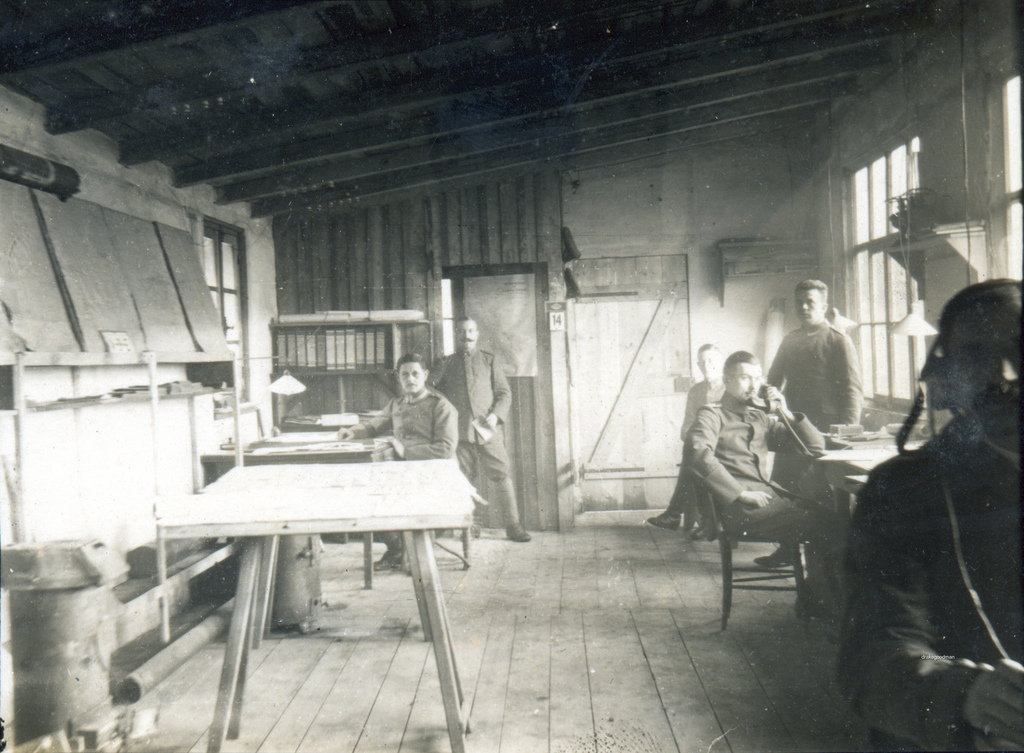
Serge has stumbled into what Peter Liddle called ‘the Manhattan Project of the 1914-18 war’: sound ranging.  It was a technique first developed by the French and German militaries  – a German sound ranging analysis section is shown below – taken up (warily) by the British (Berton claims their  old-school gunners at first thought it radical nonsense) and refined by the Canadians. As McCarthy’s brilliant reconstruction shows, it involved using sound to locate enemy artillery batteries.

The usual configuration was to have six ‘Tucker’ microphone stations at carefully surveyed intervals along an arc 4000 yards behind the front line with two observation posts in front of them, all linked to a recording station in the rear by 40 miles of wire.  When the observers saw a gun flash or heard its boom they sent a signal that activated the oscillograph and film recorder.  In the course of 1916 the British established eight of these sound-ranging sections, each plotting battery positions on base maps supplied by ‘Maps GHQ’.  In ideal conditions (which were rare) the operation could be completed for a single battery within three minutes (using graphical rather than computational methods) and with an accuracy of 25-100 yards (for more, see J.S. Finan and W.J. Hurley, ‘McNaughton and Canadian Operational Research at Vimy’, Jnl. of the Operational Research Society 48 (1) (1997) 10-14).

Analysis section of German sound ranging troop 1917

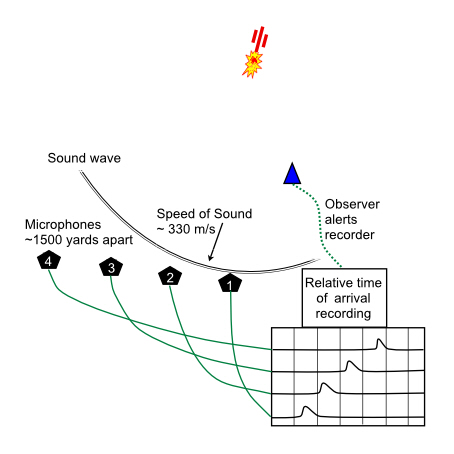
The single best source on this – though the title sounds like Flash Gordon – is John Innes‘s Flash spotters and sound rangers: how they lived, worked and fought in the Great War (1935), but Pierre Berton‘s Vimy (1986) has some useful summary pages on the Canadian role in its development. There is also a truly excellent survey that places sound-ranging in the wider context of the ‘battlefield laboratory’ in Roy MacLeod, ‘Sight and sound on the Western Front: surveyors, scientists and the “battlefield laboratory”, 1915-1918’, War & Society 18 (1) (2000) 23-46.  For more technical discussions, Peter Chasseaud‘s Artillery’s astrologers: a history of British survey and mapping on the Wester Front 1914-1918 (1999) is a key source, but there is also an exemplary (short) explanation here, from which I’ve borrowed the simplified summary diagram below.

Sound ranging

The Germans were evidently impressed by the efficacy of the Allied system, as this directive issued by General Ludendorff shows:

According to a captured English document the English have a well- developed system of sound-ranging which in theory corresponds to our own. Precautions are accordingly to be taken to camouflage the sound: e.g. registration when the wind is contrary, and when there is considerable artillery activity, many batteries firing at the same time, simultaneous firing from false positions, etc. The English have an objective method (self-recording apparatus). It is important to capture such an apparatus. The same holds good on the French front.

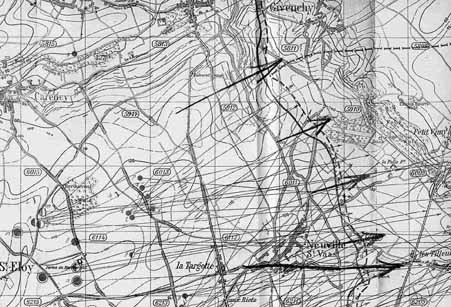
Since most of the killing and destruction was the work of the artillery, these counter-battery operations were a crucial part of the ground war.  Multiple sources were used, including aerial reconnaissance, balloon observation and flash spotting as well as sound ranging, and when combined these could eventually locate enemy guns to within 5-25 yards.  This map of German artillery intelligence for Vimy in March 1917 shows something of the power and complexity of this ‘acoustic cartography’:

German artiller intelligence map Enemy batteries known with certainty to be firing and spotted 15 to 22 March 1917 Vimy

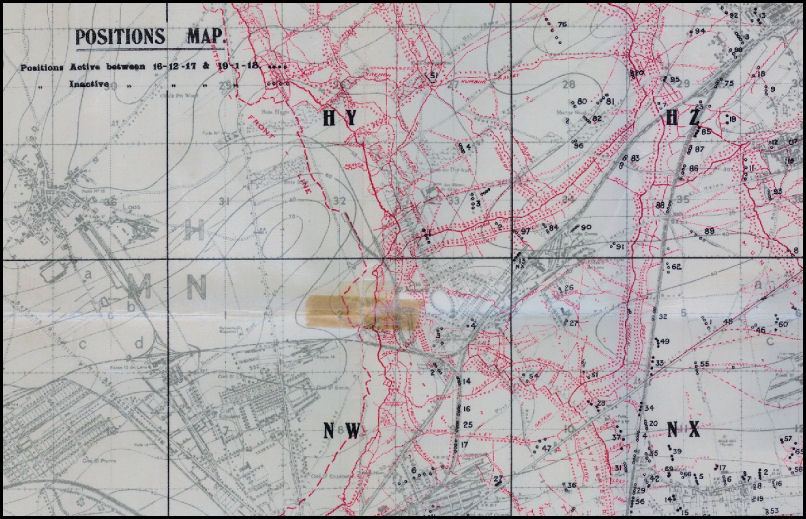
Maps showing the location of enemy batteries (‘Positions maps’ like the British one below) were issued on a regular and eventually even a daily basis.

Positions map. December 1917-January 1918

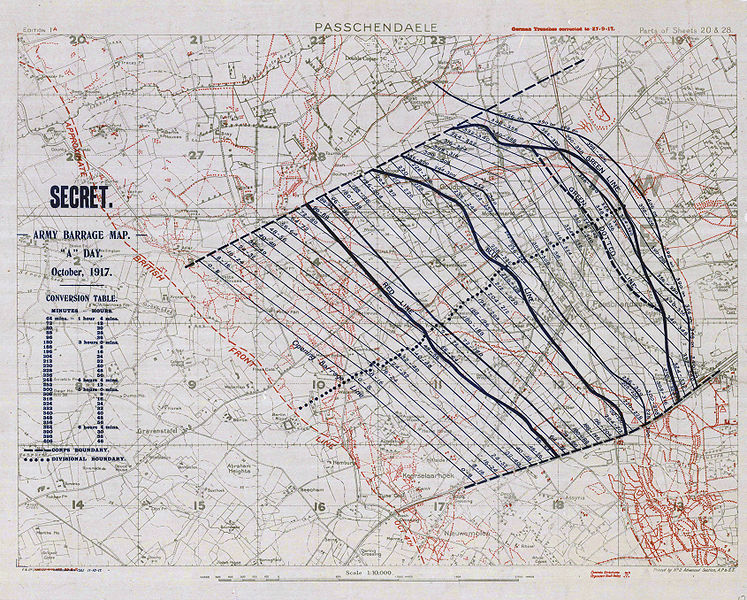
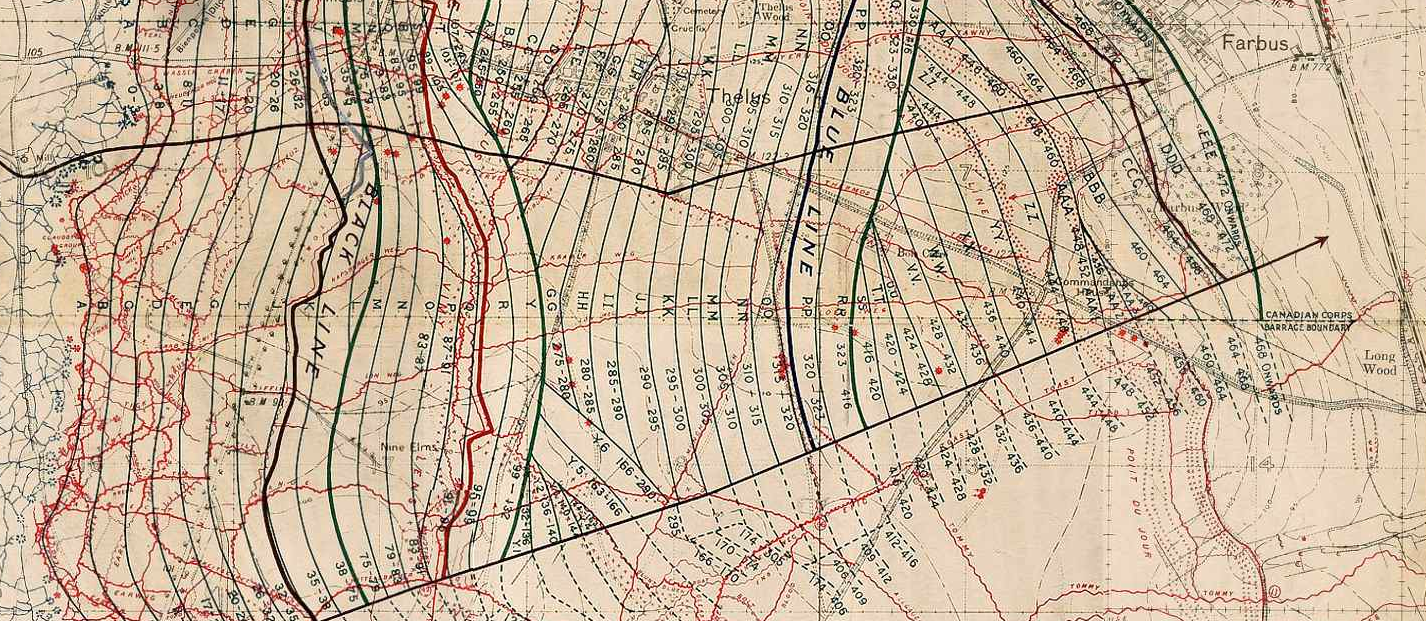
This was all part of a more general metricisation of the battlefield – hideously appropriate for the killing machine that was industrialized warfare – which you can also see in the ‘barrage maps’ that choreographed the moving curtain of artillery fire behind which troops were supposed to advance on the enemy lines.  John Keegan is very good on what he called ‘the mathematics of the barrage’ in his The Face of Battle, and from his aircraft high above No Man’s Land, Billy Bishop described it as ‘clockwork warfare’:

The waves of attacking infantry as they came out of their trenches and trudged forward behind the curtain of shells laid down by the artillery, were an amazing sight. The men seemed to wander across No Man’s Land, and into the enemy trenches, as if the battle was a great bore to them. From the air it looked as though they did not realise that they were at war and were taking it all entirely too quietly. That is the way with clock-work warfare. These troops had been drilled to move forward at a given pace. They had been timed over and over again in marching a certain distance, and from this timing the “creeping,” or rolling barrage which moved in front of them had been mathematically worked out.

BARRAGE MAP bataille-ypres-passchendaele-carte-secret

Here’s part of the barrage map for Vimy, which shows the calibration even more clearly:

Vimy barrage map 1917 (extract)

McCarthy captures this ‘clockwork’ movement perfectly when Serge looks down from his aircraft while spotting for artillery:

As the second-hand needle moves across the final quarter-segment of his watch’s face, Serge feels an almost sacred tingling, as though he himself had become godlike, elevated by machinery and signal code to a higher post within the overall structure of things, a vantage point from which the vectors and control lines linking earth and heaven, the hermetic language of the invocations, its very lettering and script, have become visible, tangible even, all concentrated at a spot just underneath the index finger of his right hand which is tapping out, right now, the sequence C3E MX12 G … Almost immediately, a white rip appears amidst the wood’s green cover on the English side. A small jet of smoke spills up into the air from this like cushion stuffing; out of it, a shell rises. It arcs above the trench-meshes and track-marked open ground, then dips and falls into the copse beneath Serge, blossoming there in vibrant red and yellow flame. A second follows it, then a third. The same is happening in the two-mile strip between Battery I and its target, and Battery M and its one, right on down the line: whole swathes of space becoming animated by the plumed trajectories of plans and orders metamorphosed into steel and cordite, speed and noise. Everything seems connected: disparate locations twitch and burst into activity like limbs reacting to impulses sent from elsewhere in the body, booms and jibs obeying levers at the far end of a complex set of ropes and cogs and relays. The salvos pause; Serge plots the points of impact on his clock-code chart, then sends adjustments back to Battery E, which fires new salvos that land slightly to the north of the first ones. 

There’s a lot more to say about this, which I plan to do in the full presentation, but what interests me at least as much is the way in which this precision (Gabriel’s ‘order and reasonableness’) – so clear and crystalline when plotted on maps or seen from the air – was confounded on the ground, not least by the shattered landscape of craters, trenches and barbed wire and by the vile agency of what Siegfried Sassoon called the ‘plastering slime’ that clawed and dragged at the soldiers’ bodies and which was erased from what Edmund Blunden called the ‘innocuous arrows’ and ‘matter-of-fact symbols’ of the maps and aerial photographs.

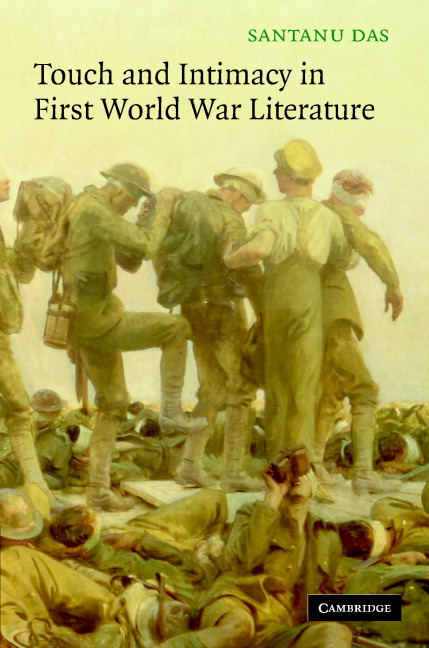
More particularly, I’m interested (here) in the production of an altogether more sensuous soundscape, part of the corpography that danced such a deadly gavotte with cartography that I sketched out in my previous post.  In Touch and intimacy Santanu Das argues that

‘The mechanised nature of the First World War severed the link between sight, space and danger, a connection that had traditionally been used to structure perception in wartime.  This disjunction resulted in an exaggerated investment in sound.’

The memoirs, letters and diaries from the Western Front confirm that the hideous noise of battle worked its way inside the very body of the soldier.  I’ve got pages of examples, but here is just one, Edward Lynch in Somme Mud (and, for that matter, in Somme mud):

‘The shells are missing us by a matter of yards.  Noise is everywhere.  We lie on the shuddering ground, rocking to the vibrations, under a shower of solid noise we feel we could reach out and touch.  The shells come, burst and are gone, but that invisible noise keeps on – now near, now far, now near, now far again.  Flat, unceasing noise.’

I’ve emphasised the passage that simply resonates with what I described previously as a haptic geography.  And so, not surprisingly, the same sources also show that, just as the landscape was inhabited, so too was knowledge of it; that knowing those deadly sounds – ‘knowing the score’, I suppose – was a vital part of staying alive.  Here is an extended passage from A.M. Burrage‘s War is war:

We are becoming acclimatised to trench warfare. We know by the singing of a shell when it is going to drop near us, when it is politic to duck and when one may treat the sound with contempt. We are becoming soldiers. We know the calibres of the shells which are sent over in search of us. The brute that explodes with a crash like that of much crockery being broken, and afterwards makes a “cheering” noise like the distant echoes of a football match, is a five-point-nine. The very sudden brute that you don’t hear until it has passed you, and rushes with the hiss of escaping steam, is a whizz-bang. For a perfect imitation of a whizz-bang, sit by the open window of a railway compartment and wait until an express train passes you at sixty miles an hour. The funny little chap who goes tonk-phew-bong is a little high-velocity shell which doesn’t do much harm. “Minnies” and “flying pigs” which are visible by day and night come sailing over like fat aunts turning slow somersaults in mid-air. Wherever one may be, and wherever they may be going to drop, they always look as if they are going to fall straight on top of one. They are visible at night because they have luminous tails, like comets. The thing which, without warning, suddenly utters a hissing sneeze behind us is one of our own trench-mortars. The dull bump which follows, and comes from the middle distance out in front, tells us that the ammunition is “dud.” The German shell which arrives with the sound of a woman with a hare-lip trying to whistle, and makes very little sound when it bursts, almost certainly contains gas.

 We know when to ignore machine-gun and rifle bullets and when to take an interest in them. A steady phew-phew-phew means that they are not dangerously near. When on the other hand we get a sensation of whips being slashed in our ears we know that it is time to seek the embrace of Mother Earth.

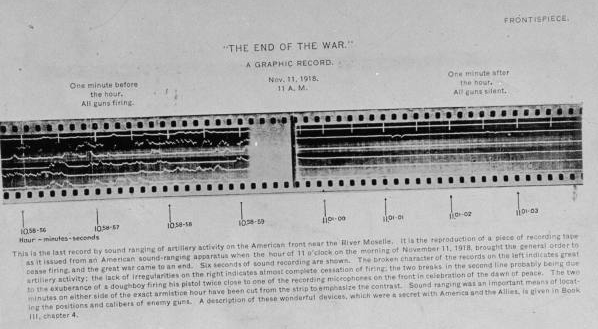
The end of the war was apprehended in both registers, and this frontispiece from Benedict Crowell’s Demobilization (1920) shows how an American sound-ranging station captured the moment the guns fell silent:

The end of the war: 11 a.m. on 11 November 1918

‘Stop, hey, what’s that sound?’

‘Imagination bodies forth…’

Following from my previous post, I’ve been thinking a lot about bodies recently, and for two reasons.

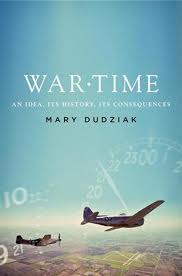
DUDZIAK War-timeThe first is the workshop on War & Medicine I attended in Paris just before Christmas.  It became very clear early on how difficult it is to determine when military violence comes to an end; Mary Dudziak has recently written about this in her War time: an idea, its history, its consequences (Oxford, 2012), largely from a legal point of view (and not without criticism), but it’s worth emphasising that the effects of violence continue long after any formal end to combat.  This ought to be obvious, but it’s astonishing how often it’s ignored or glossed over.

Think, for example, of the continuing toll of the conflicts in Afghanistan and Iraq, recovered in detail by Catherine Lutz (who was part of the workshop) and her colleagues at the Costs of War project, which shows how ‘the human and economic costs of these wars will continue for decades’.

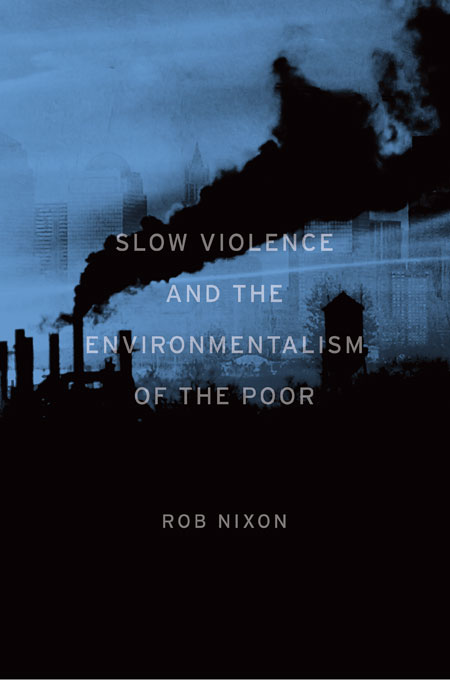
NIXON Slow violenceOr think of  the toxic environments produced by ecological warfare, by the use of depleted uranium in munitions, and by the continued deployment of land mines and cluster bombs – what Rob Nixon brilliantly calls the ‘slow violence’ produced by ‘ecologies of the aftermath’ (more on this in a later post):

 ‘In our age of depleted-uranium warfare, we have an ethical obligation to challenge the military body counts that consistently underestimate (in advance and in retrospect) the true toll of waging high-tech wars.  Who is counting the staggered deaths that civilians and soldiers suffer from depleted uranium ingested or blown across the desert?  Who is counting the belated fatalities from unexploded cluster bombs that lie in wait for months of years, metastasizing into landmines?  Who is counting deaths from chemical residues left behind by so-called pinpoint bombing, residues that turn into foreign insurgents, infiltrating native rivers and poisoning the food chains?  Who is counting the victims of genetic deterioration – the stillborn, malformed infants conceived by parents whose DNA has been scrambled by war’s toxins?’

(If you think we are winning the war on land-mines, especially in you are in Canada, read this).

These two contributions – and the conversations we had in Paris – rapidly displaced the lazy assumption of a politics of care in which the left mourns civilian casualties and the right military casualties. That there is a politics of care is clear enough, but there’s also a political geography: that’s written in to the biopolitical projects that are contained within so many late modern wars, and in Paris Omar Dewachi and Ghassan Abu-Sitta described how ‘care’ has become a means of controlling populations in wars in Iraq, Libya and Syria – a rather different sense of ‘surgical warfare’ from the one we’re used to – with states like Saudi Arabia and Qatar also funding the transfer of thousands of injured people from the war zones for treatment in hospitals in Egypt, Jordan and Lebanon.

And two brilliant medical anthropologists, Ken Macleish and Zoe Wool, brought with them vivid, carefully wrought ethnographies of injured soldiers’ bodies.  The American soldier may appear a figure of unprecedented invulnerabilty and astonishing violence – what Ken calls a figure of ‘technological magic’ produced by a ‘phantasmagoric technological empowerment of the body’ – but, as he and Zoe reminded us, soldiers are not only ‘the agents and instruments of sovereign violence’ but also its objects.  Their studies took me to places I’ve never been and rarely thought about, but I’ve been thinking about two other dimensions of their work that combined to produce my second reason for thinking about bodies.

One is the historicity that is embedded in this process.  Ken paraphrased Walter Benjamin‘s observation in the wake of the First World War – ‘the technological progress evident in modern warfare does not ensure the protection of the human body so much as it subjects it to previously unimaginable forms of harm and exposure’ – and linked it to John Keegan‘s claim in The face of battle that the military history of the twentieth-century was distinguished by the rise of ‘”thing-killing’ as opposed to man-killing weapons’ (the example he had in mind was heavy artillery).  The other is the corporeality of the combat zone.  Ken again:  ‘You need not only knowledge of what the weapons and armor can do for you and to you but a kind of bodily habitus as well – an ability to take in the sensory indications of danger and act on them without having to think too hard about it first.’  In an essay ‘On movement’ forthcoming in Ethnos, Zoe develops this insight through an artful distinction between carnality and corporeality (which may require me to revise my vocabulary):

‘The analytics of movement is a turning toward emergent carnality, flesh, and the way it is seen and felt; proprioception and those other senses of sight, sound, touch, and taste through which a body and a space enact a meaningful, sensible articulation; visceral experiences forged and diagnosed through the trauma of war which also exceed its limits.’ 

an-ice-cream-warAnd so to my second reason for thinking about bodies. Later this month I’m giving a lecture in the University of Kentucky’s annual Social Theory series.  The theme this year is Mapping, and my title is ‘Gabriel’s Map‘.  This is a riff on a phase from William Boyd‘s novel, An Ice-Cream War, that has haunted me ever since I first read it:

‘Gabriel thought maps should be banned.  They gave the world an order and reasonableness it didn’t possess.’

The occasion for the remark is a spectacularly unsuccessful British attempt to defeat a much smaller German force in November 1914 at Tanga in German East Africa; the young subaltern, Gabriel, rapidly discovers that there is a world of difference between what Clausewitz once called ‘paper war’ – a plan of attack plotted on the neat, stable lines of a map – and ‘real war’.   What I plan (sic) to do is arc back from this exceptionally brutal campaign – which lasted two weeks longer than the war in Europe – to the western front.  The two were strikingly different: the war in Africa was a war of movement and manoeuvre fought with the most meagre of military intelligence, whereas the central years of the war in Europe were distinguished by stasis and attrition and involved an extraordinary effort to maintain near real-time mapping of the disposition of forces.

The point here is to explore a dialectic between cartography and what I think I’m going to call corpography.

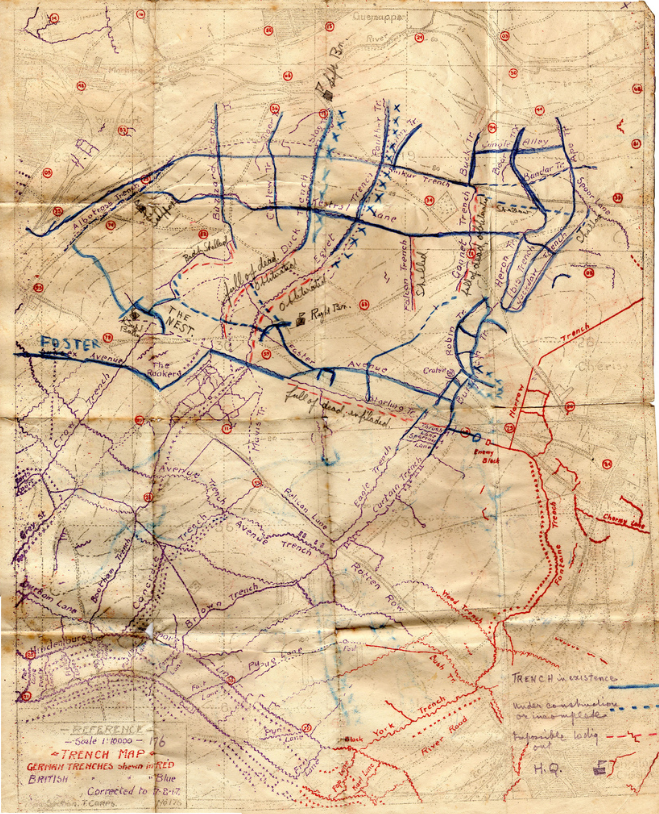
FINNEGAN Shooting The FrontThe first of these has involved working out the intimate relationship between mapping and aerial reconnaissance (what the Royal Flying Corps called ‘shooting the front’).  There is a marvellously rich story to be told here which, among other things, shows that the stasis of trench warfare was Janus-faced: it was produced by a myriad of micro-movements – advances and withdrawals, raids and repulses – whose effectiveness depended not on the fixity of the map at all but on its more or less constant updating (which in turn means that this capacity isn’t the unique preserve of twenty-first century ‘digital navigation’).  So here I’ll show how a casaced of millions of trench maps and aerial photographs was produced, distributed and then incorporated into the field of action through copies, re-drawings, sketches and annotations by front-line soldiers.  I have wonderful, telling examples, like this one (look carefully at the annotations):

Trench map annotated

Santanu DAS: Touch an dintimacy in First World War literatureBut I also want to show (as the map above implies: all those “full of dead” annotations) how, for these men, the battlefield was also literally a field: a vile, violent medium to be known not only (or even primarily) through sight but through touch, smell and sound: what Santanu Das memorably calls a ‘slimescape’ which was also a soundscape.  This was a close-in terrain that was known through the physicality of the body as a sensuous, haptic geography:

‘Amidst the dark, muddy, subterranean world of the trenches, the soldiers navigated space … not through the safe distance of the gaze but rather through the clumsy immediacy of their bodies: “crawl” is a recurring verb in trench narratives, showing the shift from the visual to the tactile.’

This was a ‘mapping’ of sorts – as Becca Weir suggests in  ‘“Degrees in nothingness”: battlefield topography in the First World War’, Critical Quarterly 49 (4) (2007) 40-55 – and there is a dialectic between cartography and corpography.

I’ve been working my way through a series of diaries, memoirs and letters to flesh out its performance in detail, but the most vivid illustration of the entanglements of cartography and corpography that I’ve found – and that I suspect I shall ever find – is this extract from a ‘body density map’ for part of the Somme.  This shows the standard trench map above a contemporary satellite photograph; each carefully ruled square is overprinted with the number of dead soldiers found buried in the first sweep after the war (between March and April 1919)…

Body Density Map, High Wood, Somme image by shipscompass on flickr

I won’t say more at present because I need to keep my powder dry for Kentucky, but I hope it will be clear by the end that, even though I’ll be  talking about the First World War, I will also have been talking about the wars conducted in the shadows of the Twin Towers and the Pentagon.

Sound targets

It seems an age since I talked about sound and war, but I haven’t been still(ed).  I’ve just finished Jonathan Pieslak‘s Sound Targets (Indiana, 2009), which adds another dimension to the discussion:

Though a part of American soldiers’ lives since the Revolutionary War, by World War II music could be broadcast to the front. Today it accompanies soldiers from the recruiting office to the battlefield. For this book, Jonathan Pieslak interviewed returning veterans to learn about the place of music in the Iraq War and in contemporary American military culture in general. Pieslak describes how American soldiers hear, share, use, and produce music both on and off duty. He studies the role of music from recruitment campaigns and basic training to its use “in country” before and during missions. Pieslak explores themes of power, chaos, violence, and survival in the metal and hip-hop music so popular among the troops, and offers insight into the daily lives of American soldiers in the Middle East.

As the blurb suggests, there’s a rich history to be traced here and I’ve only just started digging.

So far I’ve also enjoyed Glenn Watkins‘s Proof through the night: Music and the Great War (University of California Press, 2002) – the title is a line from the ‘Star-spangled banner’ – whose cover shows a Stravinsky manuscript on which the music for his four-hand Marche  (1914) is accompanied by percussive blasts from cannon roughed in by the composer himself.

‘Music in every nation gave “proof through the night” – ringing evidence during the dark hours of the war – not only of its historic role in the definition of nationhood and of nationalist resolve but also of its power on distant battlefields to recall home and hearth and to commemorate loss long after the guns had been stilled.’

So much is probably obvious, but there’s little else that is in this rewarding collection of essays/studies that constantly surprises by its engagements with a wider cultural politics and the sombre refrains of military violence.

High on the ‘to be read’ pile is Christina Baade’s Victory through harmony: the BBC and popular music in World War II (Oxford University Press, 2011), which has an accompanying website with music clips (but only if you’ve got the book so I haven’t included a link here).  The same publisher has also announced Annegret Fauser‘s Sounds of war: music in the United States during World War II for 1913, which apparently argues that ‘it was the role assigned specifically to classical music that truly distinguished musical life in the wartime United States’, so this may be rather narrower in scope than it looks.  Doesn’t look as though there will be much space for swing, jazz and bebop (or even Glenn Miller).

I’ve also rifled through Lee Andresen’s Battle notes: Music of the Vietnam War (Savage, 2003), which I retrieved from a bin in a second-hand bookstore, but I rapidly realised why it was where it was – so if anyone has any good suggestions for articles or books on what is such an obvious theme I’d be really Grateful (and not as in Dead).