West Point and the war on Ebola

I’ve taken this map from a Situation Report issued by the World Health Organisation on 6 May, which superimposes new cases of Ebola virus disease (EVD) over total confirmed cases throughout the epidemic in West Africa:
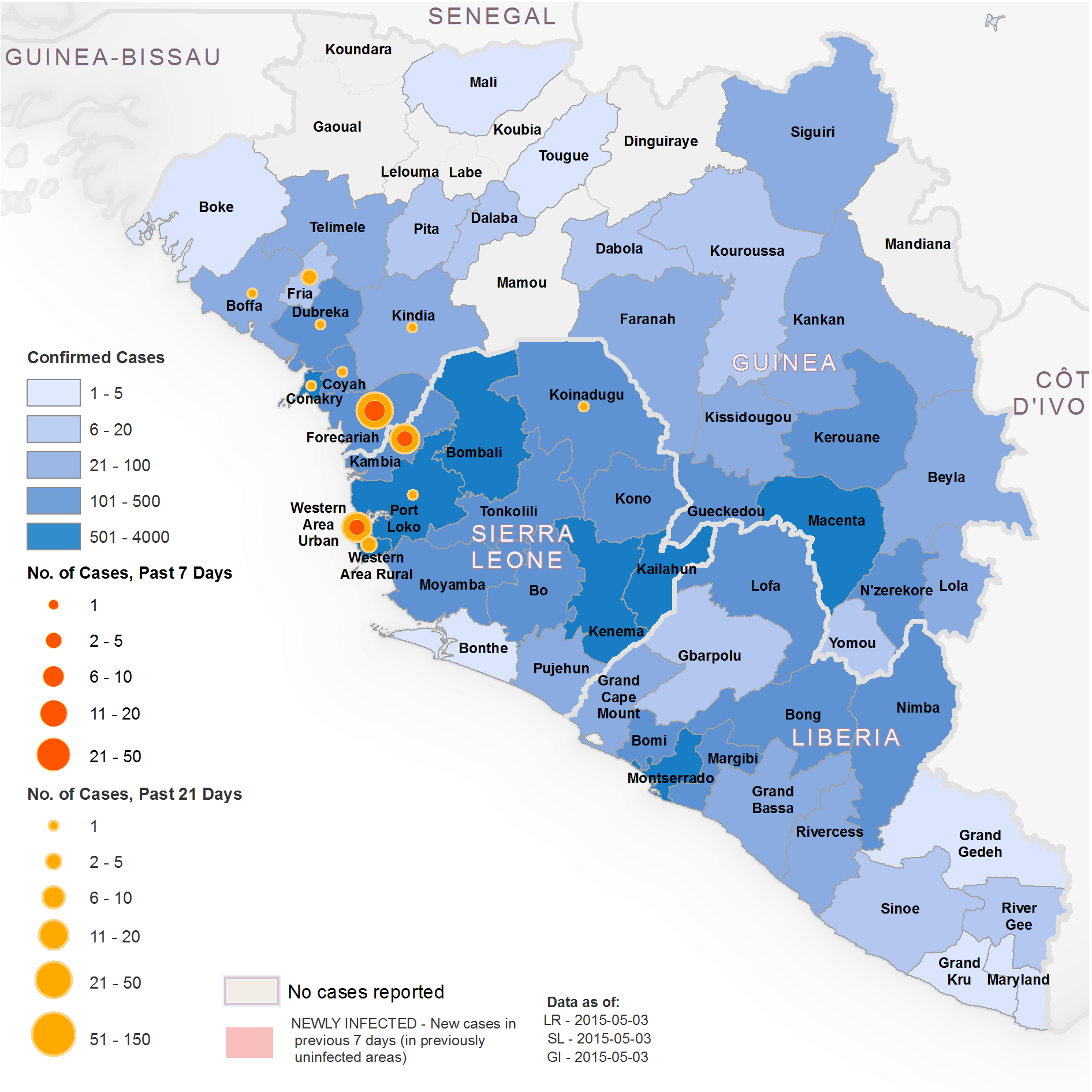
SITREP_CASECOUNT_7

Three days later the WHO declared Liberia to be free of Ebola:

Forty-two days have passed since the last laboratory-confirmed case was buried on 28 March 2015. The outbreak of Ebola virus disease in Liberia is over.

Interruption of transmission is a monumental achievement for a country that reported the highest number of deaths in the largest, longest, and most complex outbreak since Ebola first emerged in 1976. At the peak of transmission, which occurred during August and September 2014, the country was reporting from 300 to 400 new cases every week.

During those 2 months, the capital city Monrovia was the setting for some of the most tragic scenes from West Africa’s outbreak: gates locked at overflowing treatment centres, patients dying on the hospital grounds, and bodies that were sometimes not collected for days.

So it’s high time I redeemed my promise to return to the ‘war on Ebola‘.

In previous commentaries I discussed the militarisation of the epidemic and, in particular, the mission of the US military under the direction of US Africa Command.  But the ‘West Point’ in my title is thousands of miles from the US Military Academy in upstate New York…   It’s a sprawling informal settlement in Monrovia, the capital of Liberia (below).
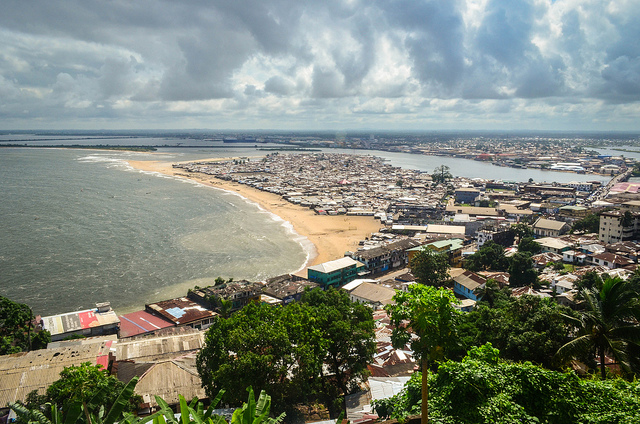
West Point, Monrovia

In an extended essay in the New Yorker earlier this year, ‘When the fever breaks‘, Luke Mogelson told the story of Omu Fahnbulleh and her husband Abraham.  They lived with their three children in Robertsport in northern Liberia.  Last summer Fahnbulleh tested positive for Ebola; by the time an ambulance arrived Abraham was sick too, and they were both loaded into the back and driven off.

Fahnbulleh and her husband believed that they were going to a hospital. Instead, several hours later, the ambulance turned onto a narrow lane that ran past low-slung shops and shanties. Fahnbulleh realized that they were in West Point, Monrovia’s largest slum. A police officer opened a metal gate, and the ambulance stopped inside a compound enclosed by tall walls. In the middle of the compound stood a schoolhouse. The driver helped Fahnbulleh and Abraham through a door, down a hall, and into a classroom. A smeared chalkboard hung on one of the walls, which were painted dark blue. Dim light filtered through a latticed window. On the concrete floor, ailing people were lying on soiled mattresses. When Fahnbulleh lay down, she saw that the two men beside her were dead.

This was the only school in West Point, originally built by USAID, and it had been converted into a ‘holding centre’ for Ebola patients; the only ‘treatment’ on offer was provided by a man in a biohazard suit spraying the floor, the walls and the patients with chlorine.  Two nights later Abraham died, and as soon as it was light Fahnbulleh – convinced she would die too if she stayed – determined to escape.

At daybreak, after spending the night in the other classroom, she walked out of the school. Policemen loitered in the yard. When Fahnbulleh reached the gate, they let her pass, afraid to touch her.

After several nights of sleeping rough she was taken to an Ebola Treatment Unit at a government hospital, from where she was eventually discharged.
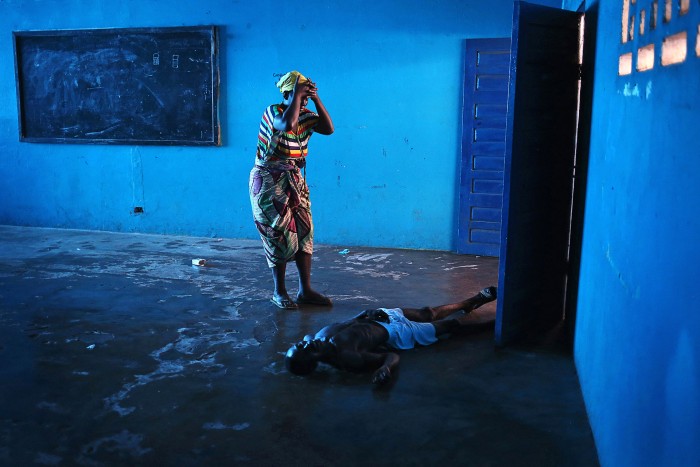
image.php

It’s a heart-breaking story, made all the more extraordinary by a photograph taken by John Moore which shows ‘Omu Fereneh’ standing over the body of her husband ‘Ibrahim’ on 15 August in the schoolhouse. The image was widely reproduced – see also here, for example – and raises important questions about the mediatisation as well as the militarisation of the crisis.  Moore’s work won him the title of  L’Iris d’Or /Sony World Photography Awards’ Photographer of the Year:

 John Moore’s photographs of this crisis show in full the brutality of people’s daily lives torn apart by this invisible enemy. However, it is his spirit in the face of such horror that garners praise. His images are intimate and respectful, moving us with their bravery and journalistic integrity. It is a fine and difficult line between images that exploit such a situation, and those that convey the same with heart, compassion and understanding, which this photographer has achieved with unerring skill. Combine this with an eye for powerful composition and cogent visual narrative, and good documentary photography becomes great.

I’m not sure that Omu Fereneh is Omu Fahnbulleh, or Ibrahim Abraham, but it would be a remarkable coincidence if they were not the same people.

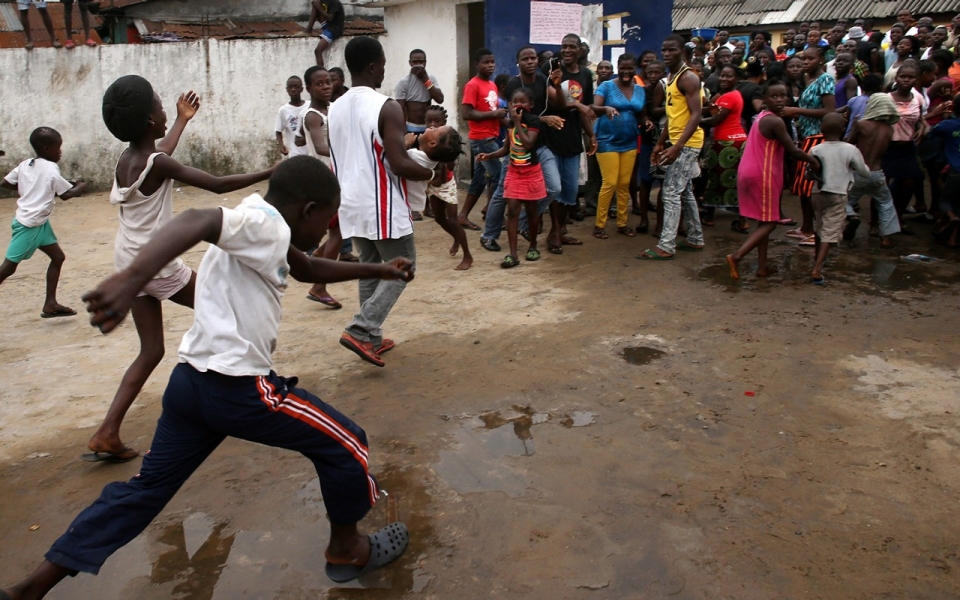
In any event, soon after the photograph was taken and soon after Fahnbulleh escaped, the situation in West Point changed dramatically.  Realising that their community had become a dumping ground for Ebola victims from all over Liberia, local residents stormed the schoolhouse and demanded it be closed.  They ransacked the building, making off with mattresses and sheets, and evicted over 20 patients who they claimed had been brought in from outside West Point.
src.adapt.960.high.west_point_ebola_1.1408545798468

Two days later the state called in its security forces which had urged the imposition of mass quarantine.  Joe Shute takes up the story:

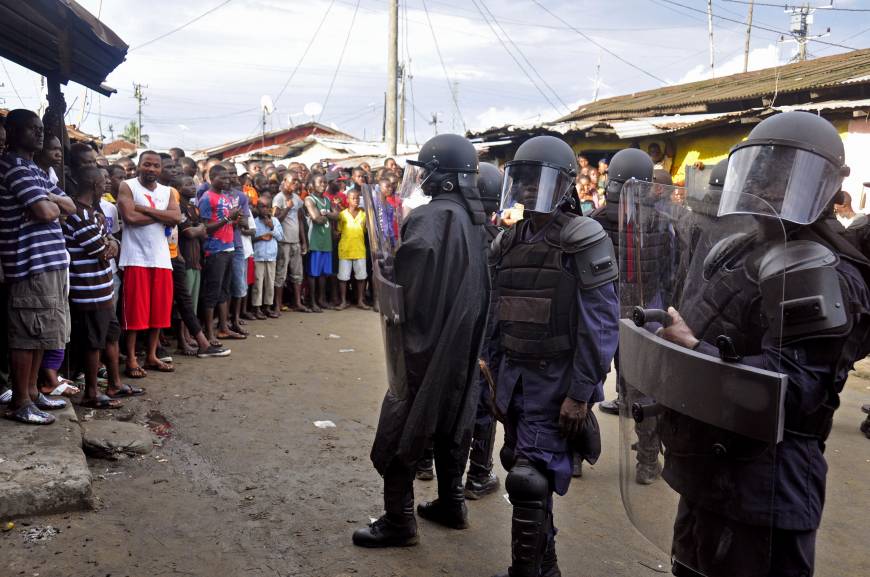
On August 20, President Ellen Johnson Sirlief ordered the only road leading in to the slum be sealed off, and the entire community placed under quarantine. As the army moved in, many of the city’s vagrants who slept in the slum at night were trapped inside.
f-libebola-a-20140822-870x577

West Point was surrounded by barricades and barbed wire; police in helmets and riot-shields stopped people going out into the city; gunships patrolled the water front, and a nightly curfew was imposed on the district’s 70,000 residents.  There was, Joe reports, ‘a desperate clamour to escape, some people even trying to swim around the peninsula to enter the city’s port.’
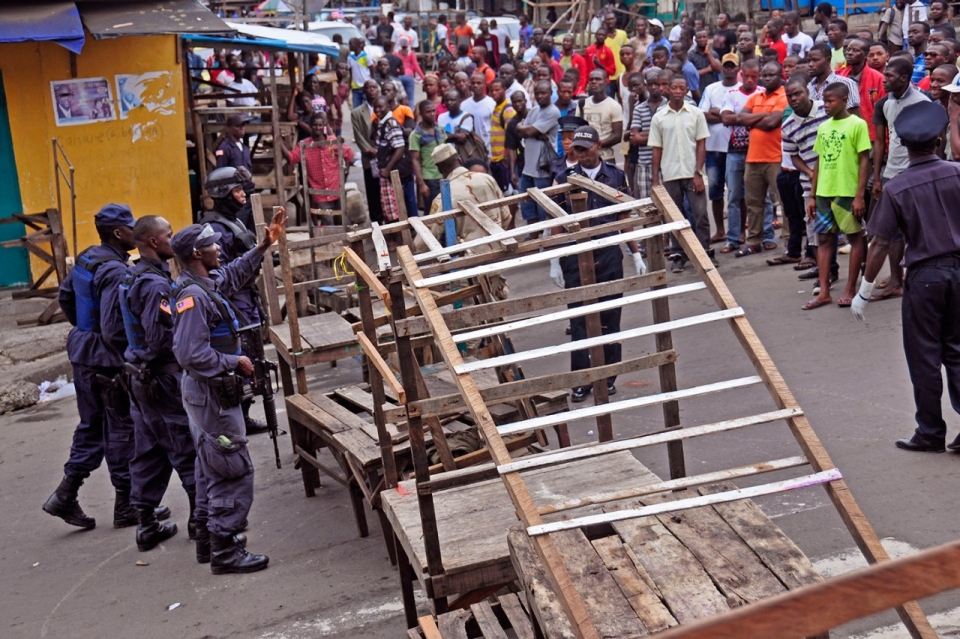
image.adapt.960.high.westpoint_1

The imposition of a militarised quarantine was a double mis-step.

First, it exacerbated the already precarious position of West Point residents.  Many of them were refugees and child soldiers from Liberia’s civil wars; they were crowded together in makeshift corrugated-iron shacks, almost all of them without plumbing or running water.  The district is threaded by narrow sand alleys – there is only one paved road – and by open sewers.  In 2009 the UN Office for the Coordination of Humanitarian Affairs reported there were only four public toilets in West Point; to use them cost 2-3 cents, and many chose to use the beach instead.
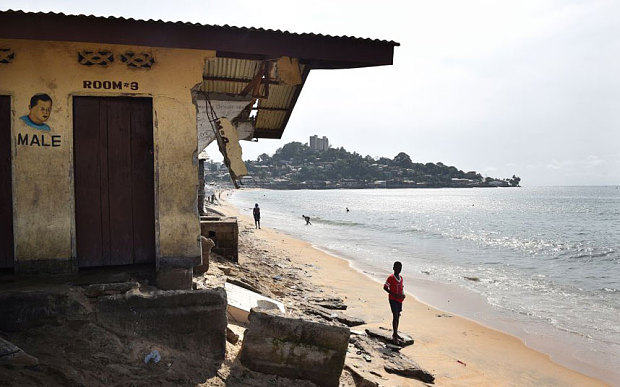
ebola-beach_3139030b

Most of West Point’s residents were dependent on access to the city and the ocean for their livelihood, but with the imposition of the blockade food supplies dwindled and food prices sky-rocketed.  As the Institute for Development Studies argued in a Practice Paper on ‘Urbanisation, per-urban growth and zoonotic disease‘ earlier this year:

Poor peri-urban residents, with no money to purchase and store in bulk, buy essentials daily. When lock-down, intended to halt disease spread, occurs, shops, markets and transport facilities are closed, reducing opportunities for peri-urban residents to work and earn cash for food. Many of their activities continue clandestinely, undermining the health intervention. During attempts in West Point to contain the spread of Ebola, people found new ways of moving through the area quarantined in August 2014. Their concern was not exposure to Ebola, but their inability to access food and water.

Some bribed the police to let them out; others, still more desperate, even swam around the point.  Here is a report from Norimitsu Onishi writing in the New York Times:

“We suffering! No food, Ma, no eat. We beg you, Ma!” one man yelled at Ms. Johnson Sirleaf as she visited West Point … surrounded by concentric circles of heavily armed guards, some linking arms and wearing surgical gloves.

“We want to go out!” yet another pleaded. “We want to be free, Mama, please.”

Quarantine has to be seen as a political, even a biopolitical response.  As the IDS insists,

In the face of Ebola, and with the pressure on governments to act, the peri-urban area becomes an attractive place to intervene. The deployment of the military and the police to quarantine the peri-urban is a tangible manifestation of state power that is oppressive for residents. Thus quarantine-related activities fulfil the political role of assuaging the urban elite’s fears of contagion – ‘cleaning up’ the peri-urban by excluding the poor, rather than helping them or addressing the key challenges of the disease.

And, as Onishi also explained, the political implications were not lost on local residents:

“Putting the police and the army in charge of the quarantine was the worst thing you could do,” said Dr. Jean-Jacques Muyembe, a Congolese physician who helped identify the Ebola virus in the 1970s, battled many outbreaks in Central Africa and has been visiting Monrovia to advise the government. “You must make the people inside the quarantine zone feel that they are being helped, not oppressed.”
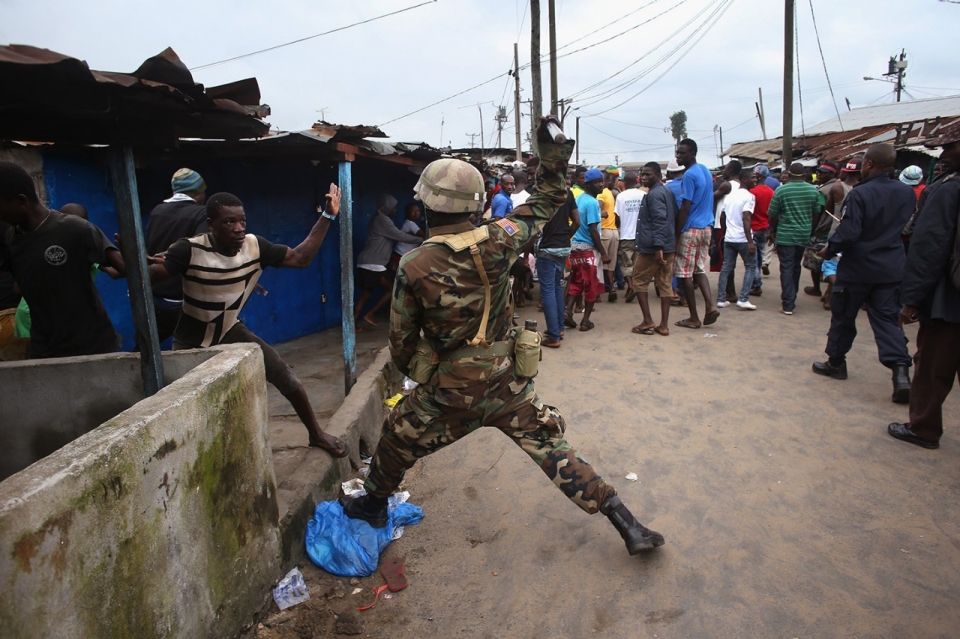
image.adapt.960.high.westpoint_5

Not surprisingly, the imposition of quarantine provoked concerted collective protest.  Hundreds of young men tried to storm the barricades and force their way through the makeshift checkpoint.  Soldiers and police opened fire, killing a fifteen-year-old boy.

As Clare Macdougall reported:

“The force was disproportionate, they were already using batons, sticks, they had access to teargas and equipment to things to control an unarmed crowd,” said Counsellor Tiawan Gongloe, Liberia’s most prominent human rights lawyer. “I find it difficult to believe that there was any justification for shooting a 15-year-old boy who was unarmed. This is not a militarized conflict, it is a disease situation and a biological problem.”

Second, as this implies, quarantine is not an effective counter-measure and may well be counter-productive.  Sealing off ‘plague towns’ was a medieval and early modern response to infectious disease – remember your Foucault! – but as one commentator noted, ‘isolating a small group of unhealthy people with a large group of healthy residents can cause more harm than good if they don’t get access to food, water and medical care — all of which are in increasingly short supply.’  In fact, transmission of Ebola occurs through bodily fluids once a patient shows symptoms of the disease, which means that the most effective response is not mass quarantine but the isolation of individual cases.  This places a premium on contact tracing (you can find another image gallery from John Moore here, tracking a tracing coordinator in West Point; see also my previous post for more details and links on contact tracing).

Following negotiations with community leaders, the government eventually agreed to lift the quarantine.  ‘We are out of jail!” declared one triumphant resident.
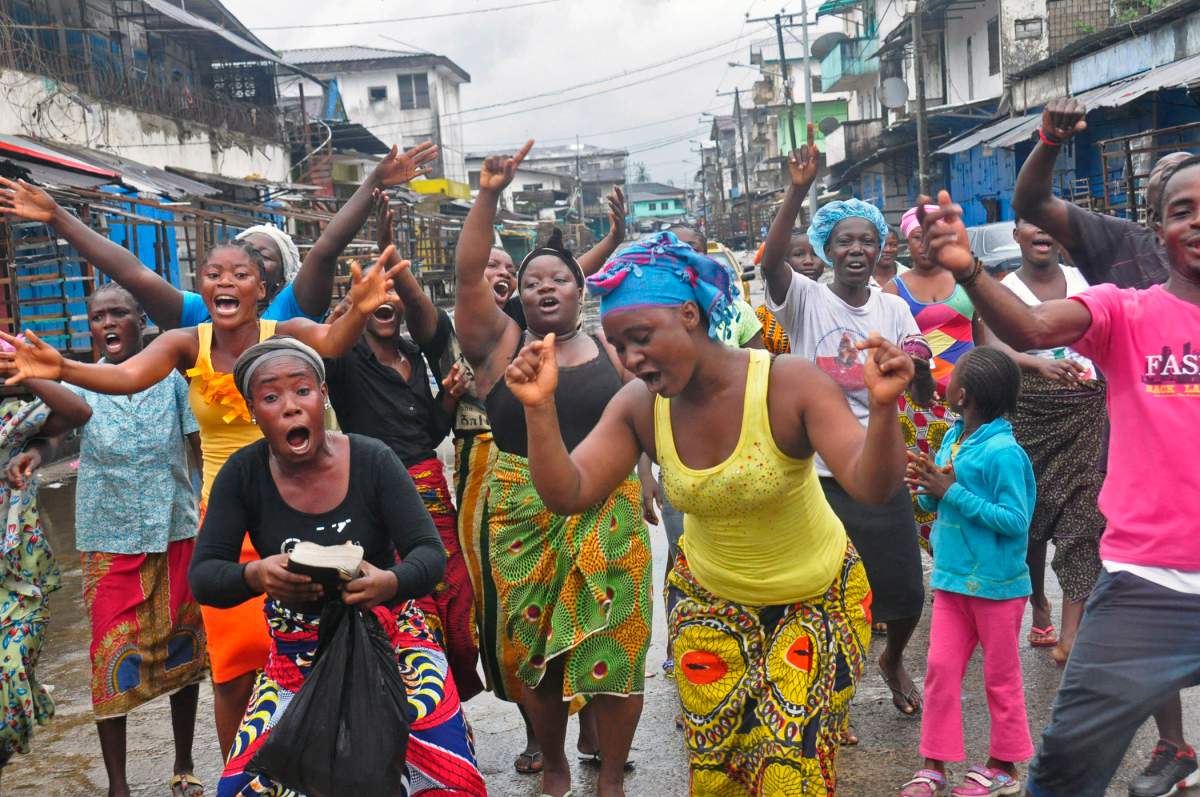
People celebrate in a street outside of West Point slum in Monrovia, Liberia, Saturday, Aug. 30, 2014. Crowds cheer and celebrate in the streets after Liberian authorities reopened a slum where tens of thousands of people were barricaded amid the countryís Ebola outbreak. The slum of 50,000 people in Liberia's capital was sealed off more than a week ago, sparking unrest and leaving many without access to food or safe water. (AP Photo/Abbas Dulleh)

People celebrate in a street outside of West Point slum in Monrovia, Liberia, Saturday, Aug. 30, 2014. Crowds cheer and celebrate in the streets after Liberian authorities reopened a slum where tens of thousands of people were barricaded amid the countryís Ebola outbreak. The slum of 50,000 people in Liberia’s capital was sealed off more than a week ago, sparking unrest and leaving many without access to food or safe water. (AP Photo/Abbas Dulleh)

Now people started to mobilise in other ways.  In return for removing the barriers and barbed wire, Luke Mogelson explained, community leaders implemented other containment measures:

identifying sick people, removing them from the community, quarantining their houses, tracking down their recent contacts, and monitoring those contacts for twenty-one days—the maximum amount of time the virus has been known to incubate before manifesting symptoms. Previously, all this was the responsibility of highly trained specialists…

In West Point, the job fell to the neighborhood. “We had to guarantee that the things that needed to be done would be done by ourselves,” Archie Gbessay, another local leader, who worked with Martu to carry out the interventions, told me one afternoon in November. We were walking down the main road that snakes through West Point. Gbessay wore a knapsack filled with case-investigation forms and kept his thumbs hooked on the chest-strap clipped across his sternum. He is twenty-eight years old but exudes a quiet force that seems to have accrued over a much longer life; his face quivers with intensity when he talks about Ebola. “If we didn’t do this, nobody was going to do it for us,” he said.

To build a network of active case-finders who could cover all of West Point, Gbessay recruited three volunteers from each of the slum’s thirty-five blocks. Most of them were young and had a degree of social clout—“credible people,” Gbessay called them. The quarantine had done little to alleviate popular skepticism of the government’s Ebola-containment policies, however, and, for a while, hostility persisted. “At first, the cases were skyrocketing,” Gbessay said. “We used to see seventy, eighty cases a day. But by the middle of September everyone started to think, Look, I better be careful. Today, you talk to your friend—tomorrow, you hear the guy is gone. So they started to pay attention.”
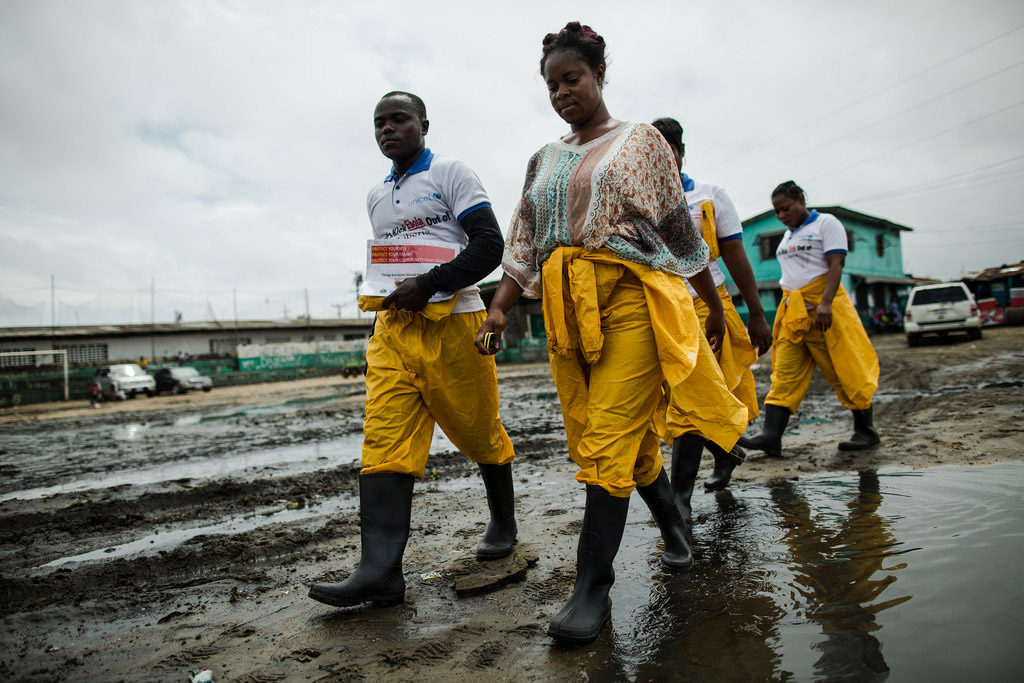
11-05-2014Volunteers_Ebola

Otis Bundor, a contact tracer in West Point, described his day’s work and emphasised the importance of a trust that depended on local knowledge and on being known:

At the beginning of the outbreak, people were afraid to tell us if their family members were sick. They worried about stigmatization, and they were frightened that their wife or sister or son would go to the hospital and never come back. Some people thought that health workers were injecting patients with poison. As a contact tracer, you need to have the intellectual prowess to convince doubters that Ebola is real…

At first, family members hid bodies and buried them under the cover of darkness. This is one of the reasons that the disease became an epidemic. Attitudes changed only when people noticed that in almost all of the houses where someone died, another person later got sick. In one household, more than seven people died after they vehemently prevented contact tracers from entering.

But gradually contact tracing – or, more accurately, the contact tracers – became accepted as something other than policing.  By the time Luke Mogelson visited West Point the holding centre in the schoolhouse had reopened as a transit centre:

 Now, when residents of the slum felt unwell, they came here to be diagnosed and, if necessary, wait for an ambulance that was staffed by West Pointers and managed by Martu. The average wait time had become a matter of minutes, rather than days.

In September, at the height of the outbreak in Monrovia, the C.D.C. warned that Ebola could infect 1.4 million West Africans by late January. The prediction assumed that no “changes in community behavior” would occur. By November, that assumption was obsolete in West Point. Gbessay’s active case-finders had largely prevailed on their neighbors to come forward with symptoms and observe basic precautions such as avoiding physical contact with each other and washing their hands several times a day at the hundreds of chlorine buckets stationed throughout the city. As a result, cases were waning. “Every day, patients come,” the supervisor of the transit center told me. “But it’s going down. It’s getting less and less.”

And as Lenny Bernstein noted, this turn-around ‘has occurred without the provision of a single treatment bed by the U.S. military, which has promised to build 17 Ebola facilities containing 100 beds each across Liberia.’

Two Tales of Two Cities

9780262527729_0

For those heading off to the International Conference on Critical Geography in Ramallah this summer, essential reading from Sharon RotbardWhite City, Black City: Architecture and War in Tel Aviv and Jaffa (MIT/Pluto Press, 2015) (first published in Hebrew in 2005).

In 2004, the city of Tel Aviv was declared by UNESCO a World Heritage Site, an exemplar of modernism in architecture and town planning. Today, the Hebrew city of Tel Aviv gleams white against the desert sky, its Bauhaus-inspired architecture betraying few traces of what came before it: the Arab city of Jaffa. In White City, Black City, the Israeli architect and author Sharon Rotbard offers two intertwining narratives, that of colonized and colonizer. It is also a story of a decades-long campaign of architectural and cultural historical revision that cast Tel Aviv as a modernist “white city” emerging fully formed from the dunes while ignoring its real foundation—the obliteration of Jaffa. Rotbard shows that Tel Aviv was not, as a famous poem has it, built “from sea foam and clouds” but born in Jaffa and shaped according to its relation to Jaffa. His account is not only about architecture but also about war, destruction, Zionist agendas, erasure, and the erasure of the erasure.

Rotbard tells how Tel Aviv has seen Jaffa as an inverted reflection of itself—not shining and white but nocturnal, criminal, dirty: a “black city.” Jaffa lost its language, its history, and its architecture; Tel Aviv constructed its creation myth. White City, Black City—hailed upon its publication in Israel as ”path-breaking,” “brilliant,” and “a masterpiece”—promises to become the central text on Tel Aviv.

There’s an excellent preview/review by Tom Sperlinger, ‘The “forced geography” of Tel Aviv‘, over at the electronic intifada:

At its heart, the book focuses on how Jaffa was all but absorbed into Tel Aviv and thus “ceased to exist as an urban and cultural entity” after 5,000 years. This focus on a city that isn’t there, which Rotbard describes as “an encyclopedia of ruins,” makes this a peculiar book to categorize.

It is not exactly a study of history or architecture. In fact, it can be quite frustrating as either, sometimes eliding past and present in the course of its argument. But it is compelling as a ghost story, in which the perpetual fictions created about Tel Aviv cannot obscure its past….[for a dissenting view, see the Comments at the electronic intifada]

Rotbard explains how in the decades since 1948, Tel Aviv has continued to push anything unwanted into the shadow city at its side:

Everything unwanted in the White City is relegated to the Black City: … garbage dumps, sewage pipes, high voltage transformers, towing lots and overcrowded central bus stations; noise and air pollution factories and small industries; illegal establishments like brothels, casinos and sex shops; unwelcoming and intimidating public institutions such as the police headquarters, jails, pathological institutes and methadone clinics; and finally, a complete ragtag of municipal outcasts and social pariahs — new immigrants, foreign workers, drug addicts and the homeless … Paradoxically, this has actually ensured that the Black City is the most colorful, heterogeneous and cosmopolitan city space in the whole of Israel.

9780520243712

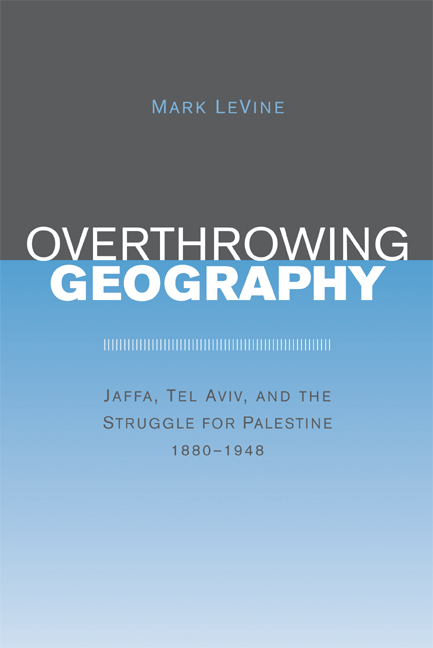
‘Forced geography’ – Sharon’s own term – reminds me of one of my favourite books, also about Jaffa and Tel Aviv: Mark Levine‘s Overthrowing Geography: Jaffa, Tel Aviv, and the Struggle for Palestine, 1880-1948 (University of California Press), which was published in 2005 hard on the heels of the original edition of White City, Black City:

This landmark book offers a truly integrated perspective for understanding the formation of Jewish and Palestinian Arab identities and relations in Palestine before 1948. Beginning with the late Ottoman period Mark LeVine explores the evolving history and geography of two cities: Jaffa, one of the oldest ports in the world, and Tel Aviv, which was born alongside Jaffa and by 1948 had annexed it as well as its surrounding Arab villages. Drawing from a wealth of untapped primary sources, including Ottoman records, Jaffa Shari’a court documents, town planning records, oral histories, and numerous Zionist and European archival sources, LeVine challenges nationalist historiographies of Jaffa and Tel Aviv, revealing the manifold interactions of the Jewish and Palestinian Arab communities that lived there.

At the center of the book is a discussion of how Tel Aviv’s self-definition as the epitome of modernity affected its and Jaffa’s development and Jaffa’s own modern pretenses as well. As he unravels this dynamic, LeVine provides new insights into how popular cultures and public spheres evolved in this intersection of colonial, modern, and urban space. He concludes with a provocative discussion of how these discourses affected the development of today’s unified city of Tel Aviv–Yafo and, through it, Israeli and Palestinian identities within in and outside historical Palestine.

Here is the Contents List:

1. Modern Cities, Colonial Spaces, and the Struggle for Modernity in the Eastern Mediterranean
2. From Cedars to Oranges: A History of the Jaffa–Tel Aviv Region from Antiquity to the Late Ottoman Period
3. Taming the Sahara: The Birth of Tel Aviv and the Last Years of Ottoman Rule
4. Crossing the Border: Intercommunal Relations in the Jaffa–Tel Aviv Region during the Mandate Period
5. A Nation from the Sands? Images of Jaffa and Tel Aviv in Palestinian Arab and Israeli Literature, Poetry, and Prose
6. Ceci N’est Pas Jaffa (This Is Not Jaffa): Architecture, Planning, and the Evolution of National Identities in Jaffa and Tel Aviv, 1880–1948
7. Planning to Conquer: The Role of Town Planning in the Expansion of Tel Aviv, 1921–1948
8. The New-Old Jaffa: Locating the Urban, the Public, and the Modern in Tel Aviv’s Arab Neighborhood

artworks-000109753529-bstbhi-t200x200POSTSCRIPT: A welcome reminder from Léopold Lambert of his interview with Dena Qaddumi (right) earlier this year on the spatial politics of Jaffa-Tel Aviv:

It attempts to propose a struggle narrative for Palestine that is not focused on Jerusalem to which many of us contribute, thus participating to a debate mostly focused on the 1967 war. By examining the spatial politics of Jaffa-Tel Aviv, Dena attempts to show that similar “ethnoocratic” logics of segregation are also at work in an environment admittedly less militarized. This logic also incorporates the same capitalist mechanisms of gentrification at work in other cities of the world. We begin by an historical approach to the “black” and “white” cities — using Sharon Rotbard’s terminology — before addressing its current situation, in particular from an architecture point of view, symptoms of the spatial violence at work within the city.

Playing a blinder

A characteristically smart post from Larry Lewis at War on the Rocks about Obama’s promise to investigate the mistakes made in the CIA-directed drone strike that unwittingly killed two hostages in Pakistan in January 2015.  ‘We’ve been on that path before, in Afghanistan,’ he writes, ‘and we know where it leads: more promises followed by a repeat of similar mistakes.’
Larry explains that the US military was causing an ‘unacceptable number’ of civilian casualties in Afghanistan between 2006 and 2009:

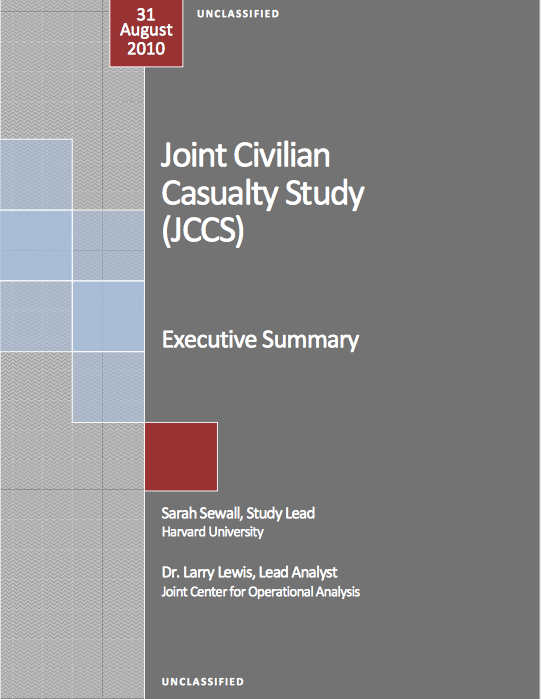
JCCSWhen an incident occurred, they investigated the incident, made changes to guidance, and promised to keep such an incident from happening again. But these incidents kept happening. So the military repeated this ineffective review process again and again. This “repeat” cycle was only broken when military leaders approved the Joint Civilian Casualty Study, a classified outside review requested by General Petraeus. This effort had two key differences from earlier efforts. First, it was independent, so it was able to overcome false assumptions held by operating forces that contributed to their challenges. And second, the study looked at all potential civilian casualty incidents over a period of years, not just the latest incident. This approach helped identify systemic issues with current tactics and policies as the analysis examined the forest and not just the nearest tree. This study also considered different sets of forces operating within Afghanistan and their relative propensity for causing civilian casualties.

You can access the unclassified Executive Summary – co-written by Larry with Sarah Sewell – here.  I’ve noted Larry’s important work on civilian casualties before – here, here and here – but his short Op-Ed raises two issues that bear emphasis.

The first is that it is a mistake to abstract strikes carried out by a Predator or a Reaper from air strikes carried out from conventional platforms; the latter are often facilitated and even orchestrated by a UAV – as in the ‘signature’ case of the Uruzgan strike in 2010 – but, pace some drone activists, our central concern should surely be the wider matrix of military violence.  This also implies the need to articulate any critique of CIA-directed drone strikes in Pakistan with the use of air power in Afghanistan (and not only because USAF pilots fly the ‘covert’ missions across the border).  Here General Stanley McChrystal‘s Tactical Directive issued in July 2009 that directly addressed civilian casualties is a crucial divide.   As Chris Woods emphasizes in Sudden Justice,

‘Radically different tactics were now being pursued on either side of the “AfPak” border…. Even as Stanley McChrystal was cutting back on airstrikes in Afghanistan, the CIA was escalating its secret air war in Pakistan’s tribal areas.’

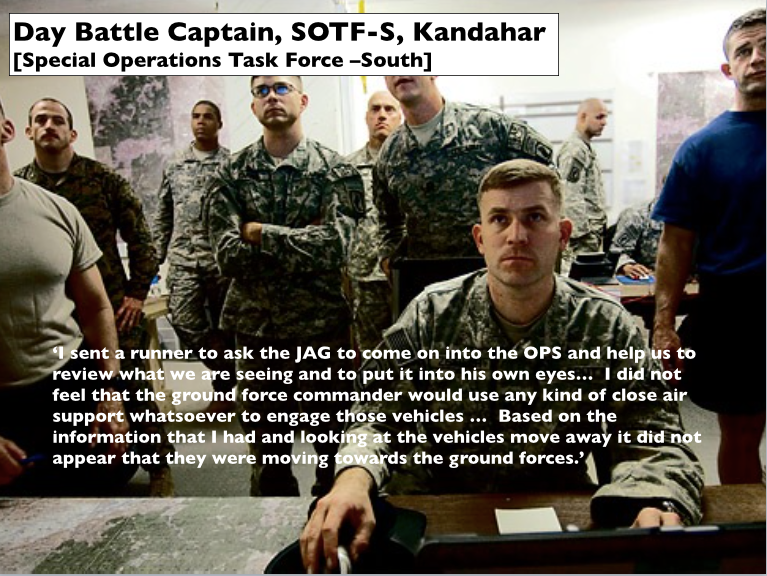
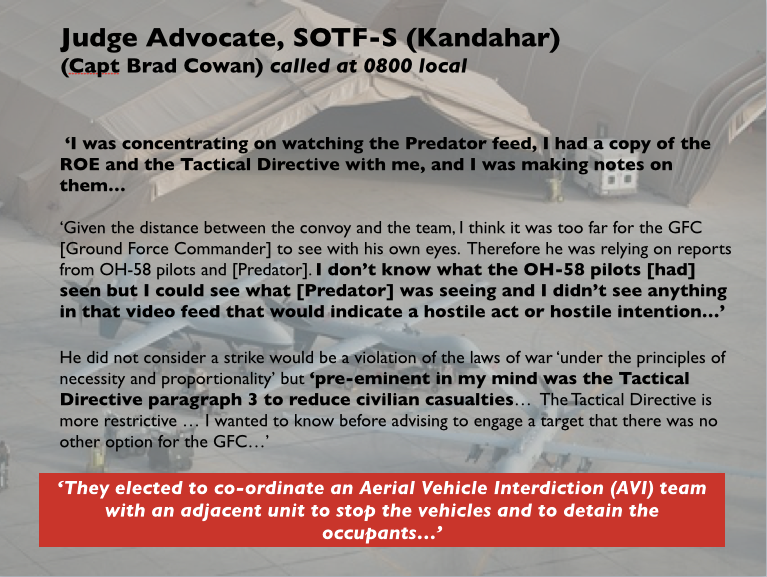
The second issue is the extraordinary partitions – blinkers might be more accurate – that seem to be imposed on military operations and investigations.  In the case of the Uruzgan attack, for example, a military lawyer was called in at the eleventh hour to monitor the video feeds from the Predator as it tracked a ‘convoy’ (a term surely as leading as ‘Military-Aged Male’) in the early morning.  As the next two slides show, taken from my ‘Angry Eyes’ presentation, the JAG knew the Rules of Engagement (ROE) and the Tactical Directive; he obviously also knew the legal requirements of proportionality,  distinction and the rest.

Angry Eyes:1

Angry Eyes:2

Knowing the ROE, the Tactical Directive and the formal obligations of international law is one thing (or several things): but what about ‘case law’, so to speak?  What about knowledge of other, similar incidents that could have informed and even accelerated the decision-making process?  In this case, before the alternative course of action could be put into effect and an ‘Aerial Vehicle Interdiction’ set in motion – using helicopters to halt the three vehicles and determine what they were up to – two attack helicopters struck the wholly innocent ‘convoy’ and killed 15-21 civilians.  Fast forward to the subsequent, I think forensic Army investigation.  This is the most detailed accounting of a ‘CIVCAS’ incident I have read (and you’ll be able to read my analysis of it shortly), and yet here too – even with senior military legal advisers and other ‘subject experts’ on the investigating team – there appears to be no reference to other, similar incidents that could have revealed more of the ‘systemic issues’ to which Larry so cogently refers.

This is made all the stranger because there is no doubt – to me, anyway – that the US military takes the issue of civilian casualties far more seriously than many of its critics allow.

CIVCAS


Noises off

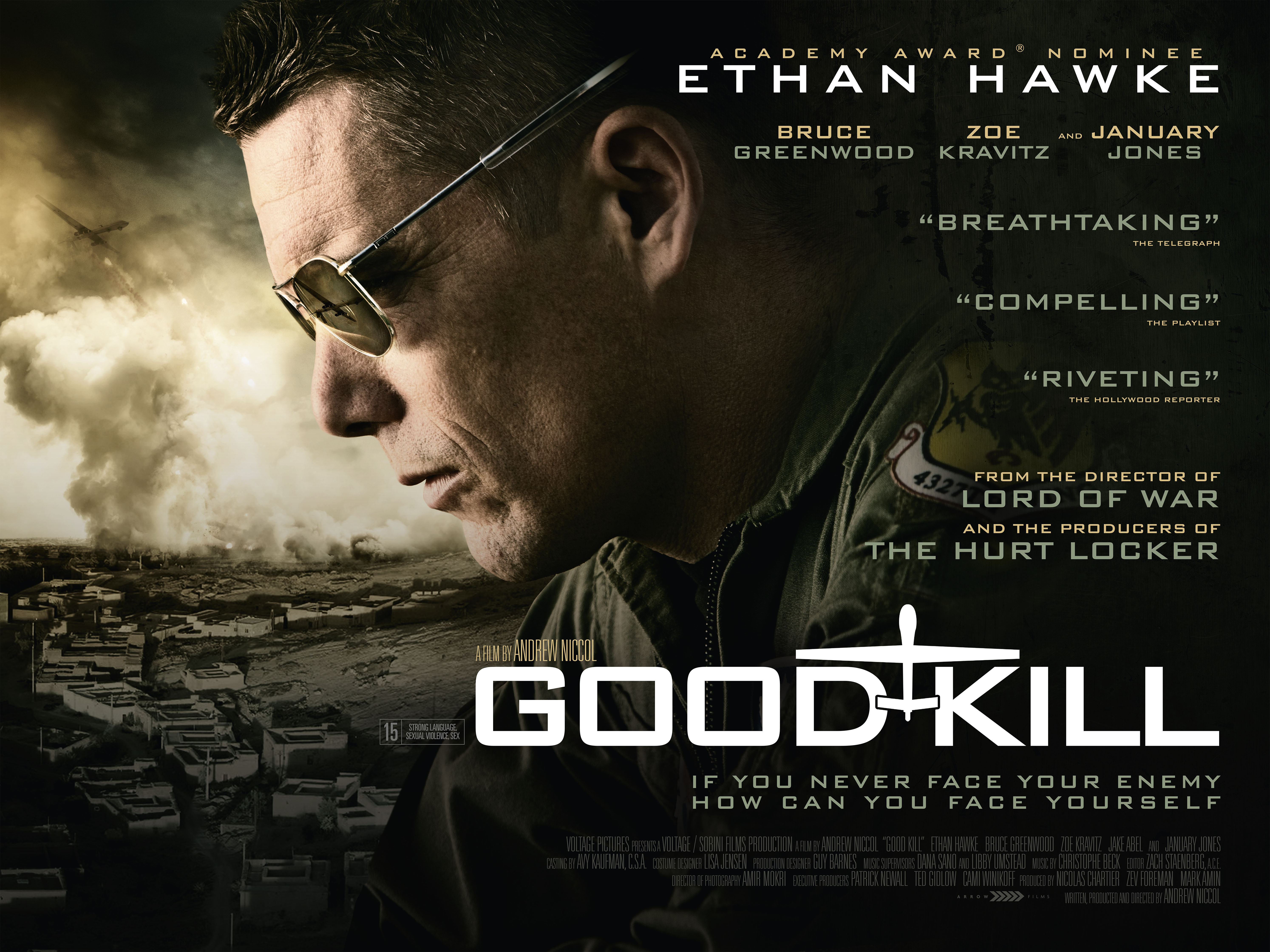
Good Kill

Matt Gallagher has an excellent double review of George Brant‘s play Grounded and Andrew Niccol‘s film Good Kill at The Intercept here:

‘[B]oth leave viewers with only keyhole snippets, stories of American homefront trauma with little reckoning of life on the receiving end of the unmanned aerial campaigns…

As Americans funding the largest war machine the world has ever known, it’s not just about us, even when we’re the ones pulling the trigger on the ground or pressing the joystick in Nevada. It’s also about them, because they are the ones living with the consequences of what our post-9/11 wars have wrought. Perhaps ironically, perhaps not, recent creative work produced by veterans of Iraq and Afghanistan, such as Maurice DeCaul’s play Dijla Wal Furat and Elliot Ackerman’s novel Green on Blue, recognize this. We’re well past time the rest of America recognizes it, too.’

As I’ve noted before, ‘popular culture continues to be preoccupied with what happens in Nevada – and what happens on the ground is left shrouded in so many shades of grey.’

10985573_938400016200522_8075406720922201197_n

If you’re wondering about Matt’s recommendations (he is the author of Kaboom: embracing the suck in a savage little war, incidentally), then you can find discussion and reviews of Dijla Wal Furat: between the Tigris and the Euphrates (which had its premiere in February) here, here and here, and Green on Blue here and (especially) here.

Der Himmel über Berlin

At the end of February Tatiana Bazzichelli, director and curator of the Disruption Network Lab, invited me to be a keynote speaker at Eyes from a Distance: on drone systems and their strategies in Berlin in April.

Disruption Network Lab is an ongoing platform of events and research focused on art, hacktivism and disruption. The Laboratory takes shape through a series of conference events at Studio 1, Kunstquartier Bethanien in Berlin.

The goal of the Disruption Network Lab is to present and generate new possible routes of social and political action within the framework of hacktivism, digital culture and network economy, focusing on the disruptive potential of artistic practices. The Disruption Network Lab is a conceptual and practical zone where artists, hackers, networkers, critical thinkers and entrepreneurs enter into a dialogue. The programme is developed through artistic presentations, theoretical debates and keynote events. This series of events establishes local and translocal partnerships with other spaces and institutions.

0i1drones5_3907706133_o

The specific aim of Eyes from a Distance was unerring:

What is the politics and the regime of power beyond drone-systems? Which are the consequences both on militant networks and civil society of an increasing automatism of conflicts? Can we track down the hidden strategies that move target-killings? Can we understand better drone technology? This event combines reflections on the political and technological infrastructure of drone-systems, the use of them in massive and weaponised military programmes, and the artistic and activist response to this.

I was already committed to presentations at the Balsillie School/CIGI and to the AAG Conference in Chicago so, with immense reluctance, I had to decline.  Now I know what I missed – not only the wonderful city of Berlin but also a brilliant programme that would have kept me inside on both evenings.

You can find two video clips (one by Brandon Bryant, which I’ve embedded above) published as part of the documentation of the meeting here, and over at We Make Money Not Art, Regine has provided three detailed reports from the meeting (with useful links): The Grey Zone: the (il)legitimacy of targeted killing by drones, Eyes from a Distance: personal encounters with military drones, and Tracking Drones, reporting lives.

Intersecting with the themes raised by Eyes from a Distance, I highly recommend a new essay/work-in-progress by Sara Matthews on ‘Visual Itineraries of the Sovereign: The Drone Gaze‘.  It was originally developed for a panel on “The Ethics and Itineraries of Visual Data” at the meeting of the Society for Cinema and Media Studies in Montreal in March.

Asymmetric law

1425285643_9e0a120e-3716-468a-ba00-e976b29db2851421848906

Breaking the Silence has just published a major report into the Israeli military’s tactics during its most recent offensive against Gaza and its people, so-called ‘Operation Protective Edge’ (see my posts herehere, here and here).

Based on interviews with 65 IDF soldiers, the report includes Background, Testimonies (‘This is how we fought in Gaza‘), and a media gallery.

Writing in today’s Guardian, Peter Beaumont reports:

Describing the rules that meant life and death in Gaza during the 50-day war – a conflict in which 2,200 Palestinians were killed – the interviews shed light for the first time not only on what individual soldiers were told but on the doctrine informing the operation.

Despite the insistence of Israeli leaders that it took all necessary precautions to protect civilians, the interviews provide a very different picture. They suggest that an overarching priority was the minimisation of Israeli military casualties even at the risk of Palestinian civilians being harmed….

Post-conflict briefings to soldiers suggest that the high death toll and destruction were treated as “achievements” by officers who judged the attrition would keep Gaza “quiet for five years”.

The tone, according to one sergeant, was set before the ground offensive into Gaza that began on 17 July last year in pre-combat briefings that preceded the entry of six reinforced brigades into Gaza.

“[It] took place during training at Tze’elim, before entering Gaza, with the commander of the armoured battalion to which we were assigned,” recalled a sergeant, one of dozens of Israeli soldiers who have described how the war was fought last summer in the coastal strip.

“[The commander] said: ‘We don’t take risks. We do not spare ammo. We unload, we use as much as possible.’”

“The rules of engagement [were] pretty identical,” added another sergeant who served in a mechanised infantry unit in Deir al-Balah. “Anything inside [the Gaza Strip] is a threat.  The area has to be ‘sterilised,’ empty of people – and if we don’t see someone waving a white flag, screaming: “I give up” or something – then he’s a threat and there’s authorisation to open fire … The saying was: ‘There’s no such thing there as a person who is uninvolved.’ In that situation, anyone there is involved.”

“The rules of engagement for soldiers advancing on the ground were: open fire, open fire everywhere, first thing when you go in,” recalled another soldier who served during the ground operation in Gaza City. The assumption being that the moment we went in [to the Gaza Strip], anyone who dared poke his head out was a terrorist.”

1425285424_2bdb2aee-c3f8-4679-a375-d6682afb701a1421848849

You can find an impassioned, detailed commentary on the report by Neve Gordon – who provides vital context, not least about the asymmetric ethics pursued by supposedly ‘the most ethical army in the world’ – over at the London Review of Books here, and a shorter commentary by Kevin Jon Heller at Opinio Juris here.  Kevin notes:

The soldiers’ descriptions are disturbingly reminiscent of the notorious “free fire” zones in Vietnam and the US government’s well-documented (and erroneous) belief that signature strikes directed against “military-age men in an area of known terrorist activity” comply with IHL’s principle of distinction. The testimonials are, in a word, stunning — and put the lie to oft-repeated shibboleths about the IDF being “the most moral army in the world.” As ever, the stories told by the IDF and the Israeli government are contradicted by the soldiers who actually have to do the killing and dying.

The legal and ethical framework pursued by the Israeli military – and ‘pursued’ is the mot (in)juste, since its approach to international law and ethics is one of aggressive intervention – is in full view at a conference to be held in Jerusalem this week: ‘Towards a New Law of War‘.

poster-A2_3-2480x35071-e1427212477619-2164x1293

‘The goal of the law of war conference,’ say the organisers, ‘is to influence the direction of legal discourse concerning issues critical to Israel and her ability to defend herself. The law of war is mainly unwritten and develops on the basis of state practice.’

You can find the full program here, dominated by speakers from Israel and the US, but notice in particular the session on ‘Proportionality: Crossing the line on civilian casualties‘:

CIvilian Casualties

As this makes clear, and as Ben White reports in the Middle East Monitor, law has become the target (see also my post here):

After ‘Operation Cast Lead’, Daniel Reisner, former head of the international law division (ILD) in the Military Advocate General’s Office, was frank about how he hoped things would progress.

If you do something for long enough, the world will accept it. The whole of international law is now based on the notion that an act that is forbidden today becomes permissible if executed by enough countries….International law progresses through violations.

Similarly, in a “moral evaluation” of the 2008/’09 Gaza massacre, Asa Kasher, author of the IDF’s ‘Code of Ethics’, expressed his hope that “our doctrine” will ultimately “be incorporated into customary international law.” How?

The more often Western states apply principles that originated in Israel to their own non-traditional conflicts in places like Afghanistan and Iraq, then the greater the chance these principles have of becoming a valuable part of international law.

Now Israel’s strategy becomes clearer… Israel’s assault on the laws of war takes aim at the core, guiding principles in IHL – precaution, distinction, and proportionality – in order to strip them of their intended purpose: the protection of civilians during armed conflict. If successful, the victims of this assault will be in the Occupied West Bank and Gaza Strip, Lebanon – and in occupations and war zones around the world.

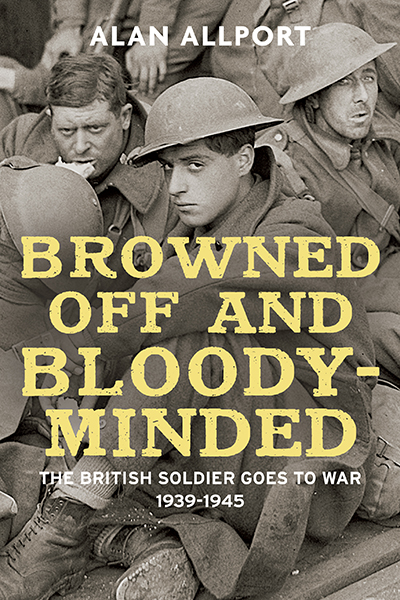
Browned Off and Bloody Minded

Browned Off and Bloody Minded

Not me: a new book by Alan Allport from Yale University Press: Browned-Off and Bloody Minded: the British soldier goes to war 1939-1945:

More than three-and-a-half million men served in the British Army during the Second World War, the vast majority of them civilians who had never expected to become soldiers and had little idea what military life, with all its strange rituals, discomforts, and dangers, was going to be like. Alan Allport’s rich and luminous social history examines the experience of the greatest and most terrible war in history from the perspective of these ordinary, extraordinary men, who were plucked from their peacetime families and workplaces and sent to fight for King and Country. Allport chronicles the huge diversity of their wartime trajectories, tracing how soldiers responded to and were shaped by their years with the British Army, and how that army, however reluctantly, had to accommodate itself to them. Touching on issues of class, sex, crime, trauma, and national identity, through a colorful multitude of fresh individual perspectives, the book provides an enlightening, deeply moving perspective on how a generation of very modern-minded young men responded to the challenges of a brutal and disorienting conflict.

Here is the Contents List:

Introduction

PART ONE: REGULARS

Colonel Lawrence and Colonel Blimp

Gentlemen and Old Sweats

Strange Defeat

PART TWO: CIVVIES

Army of Shopkeepers

Britain Blancoes while Russia Bleeds

Get some service in

PART THREE: CRUSADERS

Into the Blue

Come to Sunny Italy

Fighting Bloody Nature

Second Front

PART FOUR: KILLERS

Teeth and Tail

The Grammar of War

Categories of Courage

PART FIVE: CITIZENS

Them and Us

“What a colossal waste of time war is”

Here is a video preview:

There’s also a perceptive review by Victoria Harris here:

Allport’s latest work is far more than a revolutionary narrative of the (British) war effort. It is a window into the psyche of Britain – male Britain, it has to be said – and into the clashes between the classes, generations and masculinities that comprised it and attempted to defend their particular version of it. The British patrician class’ aversion to training the lower classes as officers, Winston Churchill’s disparaging view of the enlisted generation as weak and effeminate, tired soldiers with 300 days of continuous battle under their belts deserting en masse before D-Day; all of this is a “shock to us today”, we who have been fed a near-exclusive diet of a meritocracy fighting for democracy, backed by a prime minister confident in the toughness of this “greatest generation”. But the muddy, frustrated, sometimes downright incompetent reality Allport presents us with is far more powerful, revealing as it does how a diverse, independent-minded group of men fought, whether in a trench or at a depot or from behind a desk, despite immense fear or through tears, not from a nebulous sense of righteousness but out of a deeply human love for the man beside them.

If there is a criticism to be made of Browned Off and Bloody-Minded, it is how male and front line orientated this story remains…

I’m interested in approaches like Alan’s not least because they intersect with what I’ve tried to do in ‘The Natures of War’ (DOWNLOADS tab).  I’ve read endless first-hand accounts written by those who served on the Western Front in the First World War – and will be reading even more for my current work on casualty evacuation – but there seems to have been less interest in recovering the experiences of soldiers in the Second World War.  Alan’s work has involved excavating the archives in the Imperial War Museum, where I will be heading soon.  This time I will be switching gears to explore the lifeworlds of those who fought in the deserts of North Africa (‘the Blue’ of Part Three above).  Again, I made some headway on this in ‘The Natures of War’  – here too Part Three is of exceptional interest for me – but now I need to know much more about casualty evacuation.

‘By our algorithms we shall know them’

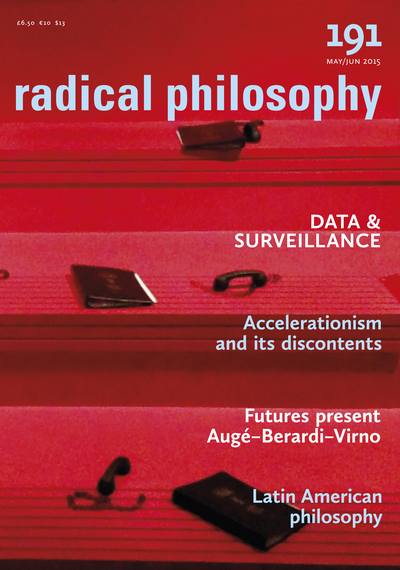
191webcoverweb

Radical Philosophy 191 is out now, including two contributions of particular interest to me as I continue to grapple with the surveillance apparatus that (mis)informs US drone strikes in the Federally Administered Tribal Areas.  This has come into sharper view after Obama’s rare admission of not only a strike in the FATA but of a mistake in targeting – though his statement was prompted by the death of an American and Italian hostage not by the previous deaths of innocent Pakistanis.

First, Grégoire Chamayou‘s ‘Oceanic enemy: a brief philosophical history of the NSA‘ which traces a path from the sonic surveillance of submarines off Barbados in 1962 to ‘pattern of life’ analysis in Afghanistan, Iraq and Pakistan, and which – not surprisingly – intersects with his Theory of the drone in all sorts of ways:

‘The premiss is the same as before: ‘in environments where there is no visual difference between friend and enemy, it is by their actions that enemies are visible.’ Today the task of establishing a distinction between friend and enemy is once again to be entrusted to algorithms.’

Second, Claudia Aradau‘s ‘The signature of security: big data, anticipation, surveillance‘ shatters the crystal balls of the intelligence agencies:

‘We are not crystal ball gazers. We are Intelligence Agencies’, noted the former GCHQ director Iain Lobban in a public inquiry on privacy and security by the Intelligence and Security Committee of the UK Parliament (ISC) in the wake of the Snowden revelations about mass surveillance….

I argue here that the disavowal of ‘crystal ball gazing’ is as important as the image of finding the clue through the data deluge in order to locate potential dangerous events or individuals in the future. Intelligence work is no stranger to the anticipation of the future – rather, it justifies itself precisely through the capacity to peer into the future in order to prevent or pre-empt future events from materializing. Big data has intensified the promise of anticipating the future and led to ‘exacerbat[ing] the severance of surveillance from history and memory’, while ‘the assiduous quest for pattern-discovery will justify unprecedented access to data’. ‘Knowledge discovery’ through big-data mining, and prediction through the recording of datafied traces of social life, have become the doxa of intelligence and security professionals. They claim that access to the digital traces that we leave online through commercial transactions or social interactions can hold a reading of the future. They repeat the mantra of data scientists and private corporations that the ‘digital bread crumbs’ of the online world ‘give a view of life in all its complexity’ and ‘will revolutionize the study of human behaviour’.

Unlike statistical technologies of governing populations, big data scientists promise that through big data ‘we can escape the straightjacket of group identities, and replace them with more granular predictions for each individual’. To resist their unreasonable promise of predicting crises, preventing diseases, pre-empting terrorist attacks and overall reshaping society and politics, I recast it as divination rather than detection. Big-data epistemics has more in common with the ‘pseudo-rationality’ of astrology than the method of clues. As such, it renders our vocabularies of epistemic critique inoperative…

‘There is nothing irrational about astrology’, concluded Adorno, ‘except its decisive contention that these two spheres of rational knowledge are interconnected, whereas not the slightest evidence of such an interconnection can be offered.’ The irrationality of big-data security is not in the data, its volume or messiness, but in how a hieroglyph of terrorist behaviour is produced from the data, without any possibility of error.

You can obtain the pdfs of both essays by following the links above – but they are time-limited so do it now.

Joining the dots…

The Bureau of Investigative Journalism and The Rendition Project have just published their first quarterly report on 119 people secretly detained and tortured by the CIA as part of the ‘war on/of terror’.

You can download the brief report as a pdf here, but the infographic below summarises the key findings (and don’t let its stark simplicity fool anyone about the detailed research that went into its production: this is difficult work).

what-we-know

Many commentators have noted that the Obama administration’s determination to end the CIA’s rendition program coincided with a decision to ramp up its covert program of targeted killing.  The preference for ‘kill’ over ‘capture’ is complicated by the living death suffered by many of those who were imprisoned in the carceral archipelago of black sites and prisons – and we should surely welcome the determination to widen the focus beyond Guantanamo to include, notably, Bagram.

But the apparent distinction between the two programs becomes even more blurred once you realise that many of the officials in charge of the one were switched to the other.  According to Mark Mazzetti and Matt Apuzzo writing in the New York Times:

‘Perhaps no single C.I.A. officer has been more central to the effort than Michael D’Andrea, a gaunt, chain-smoking convert to Islam who was chief of operations during the birth of the agency’s detention and interrogation program and then, as head of the C.I.A. Counterterrorism Center, became an architect of the targeted killing program. Until last month, when Mr. D’Andrea was quietly shifted to another job, he presided over the growth of C.I.A. drone operations and hundreds of strikes in Pakistan and Yemen during nine years in the position…

‘Mr. D’Andrea was a senior official in the Counterterrorism Center when the agency opened the Salt Pit, a notorious facility in Afghanistan where prisoners were tortured. His counterterrorism officers oversaw the interrogation and waterboarding of Abu Zubaydah, Abd al-Rahim al-Nashiri and Khalid Shaikh Mohammed. His actions are described in the withering Senate Intelligence Committee report about torture that was released late last year, although he was not identified publicly.’

(On the Times‘ decision to name names, see Jack Goldsmith‘s interview with Dean Baquet, Executive Editor of the Times).

But the real sting in the tail comes when Mazetti and Apuzzo also note:

‘The confidence [Senator Dianne] Feinstein and other Democrats express about the drone program, which by most accounts has been effective in killing hundreds of Qaeda operatives and members of other militant groups over the years, stands in sharp contrast to the criticism among lawmakers of the now defunct C.I.A. program to capture and interrogate Qaeda suspects in secret prisons.

‘When Ms. Feinstein was asked in a meeting with reporters in 2013 why she was so sure she was getting the truth about the drone program while she accused the C.I.A. of lying to her about torture, she seemed surprised.

‘“That’s a good question, actually,” she said.’

Divisions of Life

Journeys from No Man's Land.001

My main presentation at the AAG in Chicago was part of a session organised by Noam Leshem and Alasdair Pinkerton on Remnants of No Man’s Land: history, theory and excess (more on their larger project here).  Here is an extended summary of what I had to say, together with some of my slides, but bear in mind that this all had to be done in 20 minutes so there wasn’t much room for nuance.  Neither was there time to discuss civilian entanglements, both volunteers and victims, nor the sick: the presentation focuses on the wounded, even though the problems of trench foot, ‘trench flu’, and a host of other diseases were also extremely important.  They do all receive attention in the larger project from which this is extracted.  One last, geographical qualification: my discussion is limited to the evacuation of British and imperial troops from the Western Front.

My starting-point was the strange disappearance of the wounded from the field of battle.  As John Keegan wrote in The Face of Battle, in most histories the ‘wounded apparently dematerialize as soon as they are struck down’; he was writing specifically about General Sir William Napier’s account of the battle of Albuera in 1811, but the point is a sharp one that can be enlisted as part of a more general critique of military history.

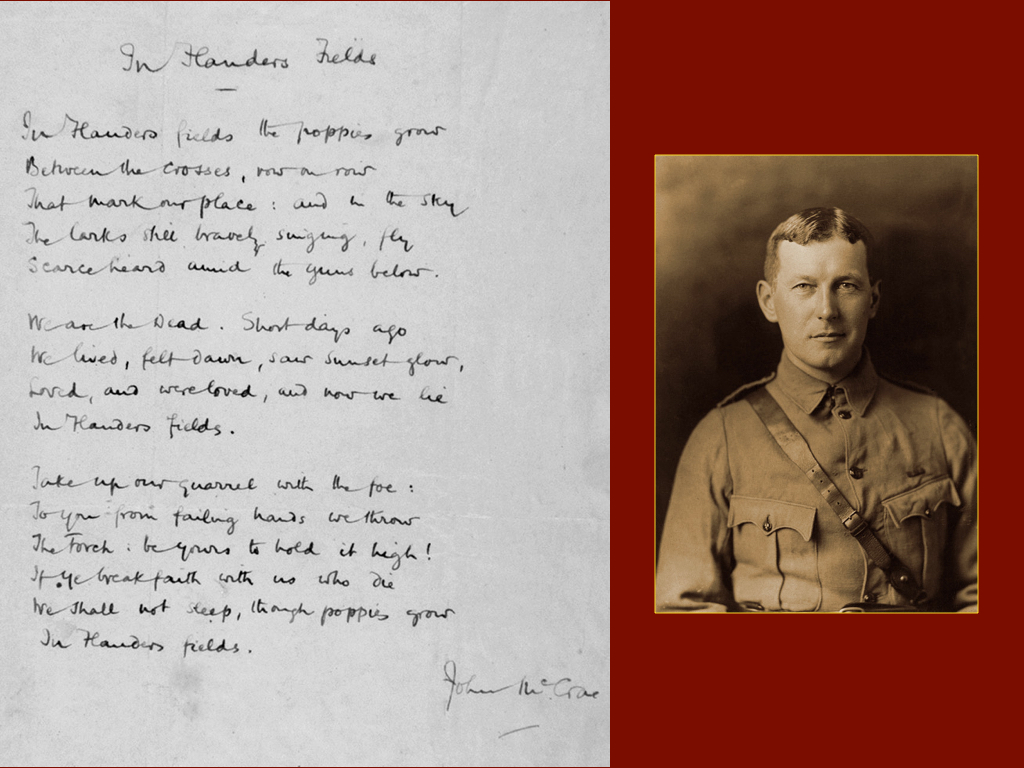
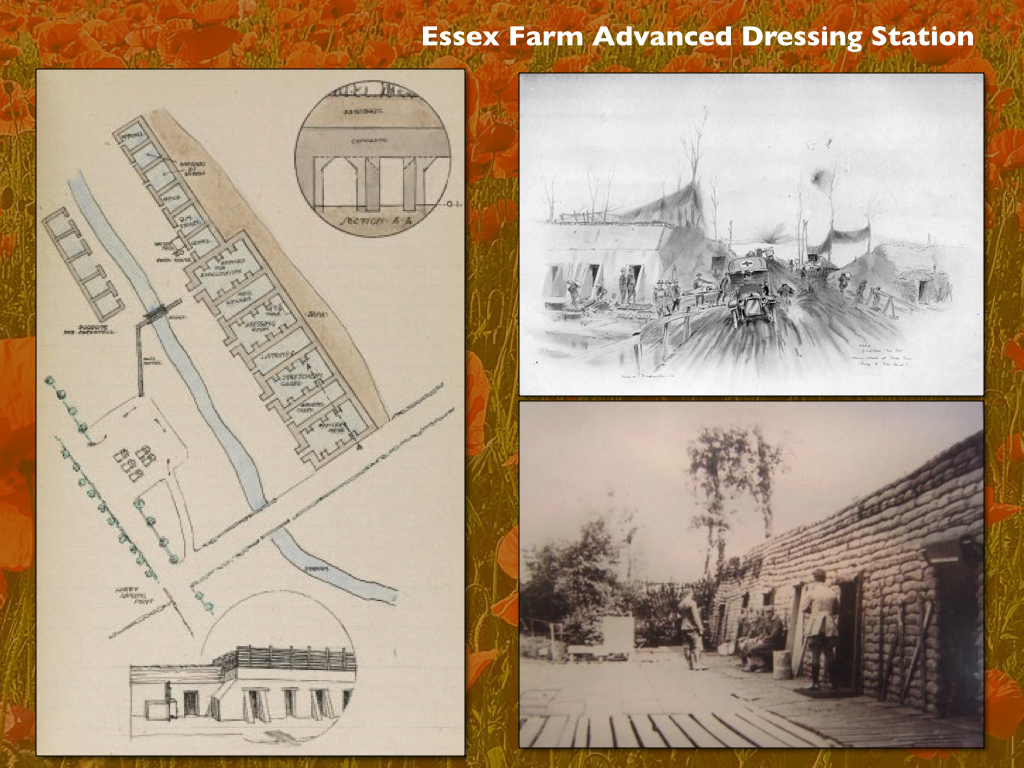
In the case of the First World War, the emphasis on those who lost their lives – on the dead not the wounded – derives not only from the sheer scale of the slaughter but also from the enduring landscape of memorialisation and commemoration.  When John McCrae‘s elegaic poem ‘In Flanders Fields’ is recited every Remembrance Day – ‘In Flanders fields the poppies grow, between the crosses, row on row’ – it is all too easy to forget that he wrote those lines not only to commemorate the death of a close friend but that he did so at Essex Farm Advanced Dressing Station:

Journeys from No Man's Land.003

Journeys from No Man's Land.004

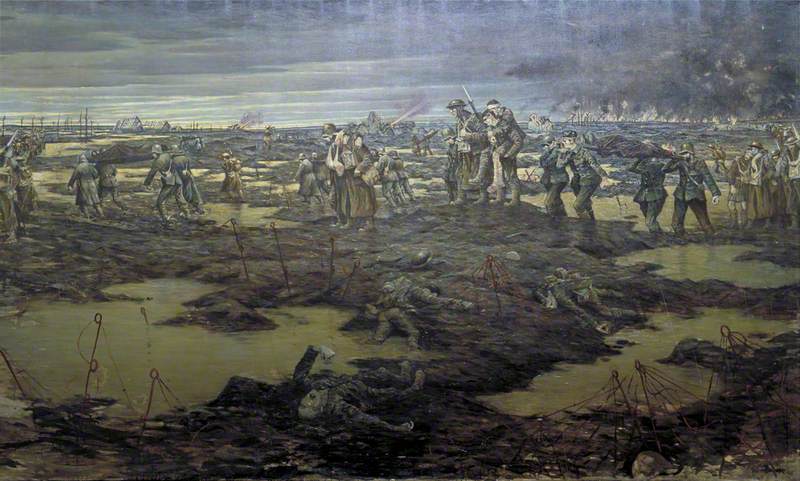
What lies behind those haunting lines – and that medical outpost – is a vast canvas of wounded men, which Christopher Nevinson captured as ‘The Harvest of Battle’ (below).  The dead occupy the foreground, but behind them is the endless, moving panorama of the wounded whose precarious journeys took most of them far beyond ‘No Man’s Land’.

(c) IWM (Imperial War Museums); Supplied by The Public Catalogue Foundation

In fact, as Emily Mayhew reminds us, ‘being wounded was one of the most common experiences of the Great War’: on the Western Front, she writes, ‘almost every other British soldier could expect to become a casualty’.

But, perhaps not surprisingly, for the first six months of the war the British Expeditionary Force was unprepared for the scale of casualties, and even with the help of civilian volunteers and aid societies – Nevinson briefly served as a medical orderly with the Friends Ambulance Unit, for example – the remarkably long time it took to evacuate the wounded combined with the perilous nature of their improvised journeys to increase the mortality rate.

Journeys from No Man's Land.007

Journeys from No Man's Land.008

And so what Mark Harrison called the military-medical machine had to be speeded up – and moved closer to the field of battle.

Journeys from No Man's Land.016

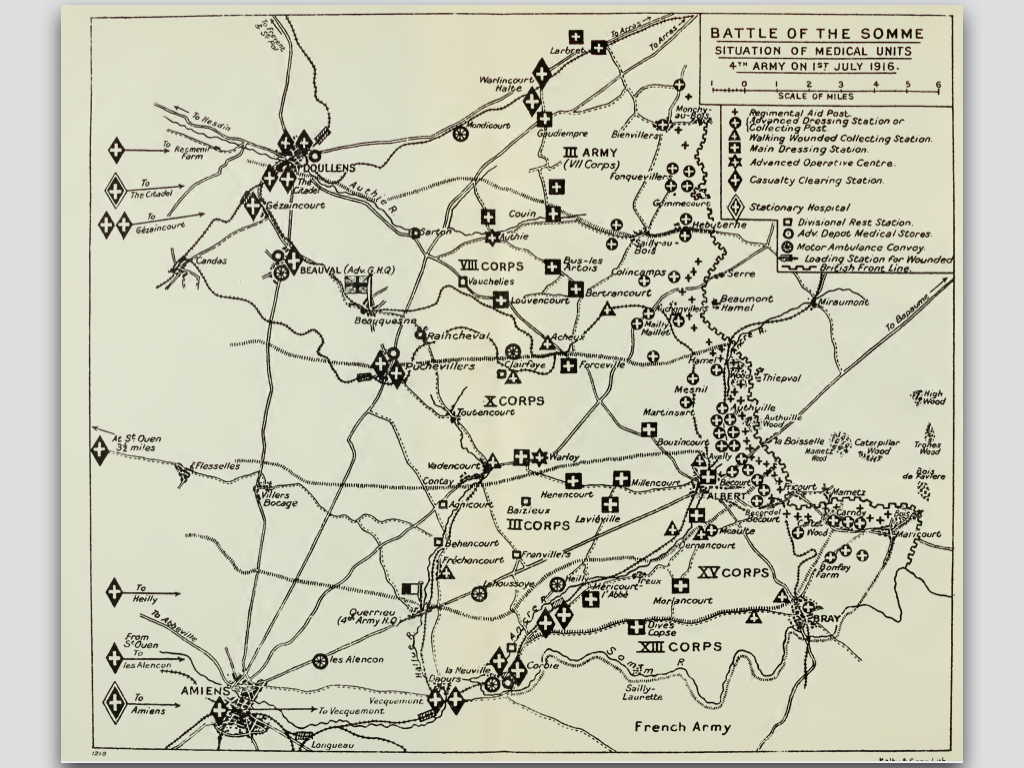
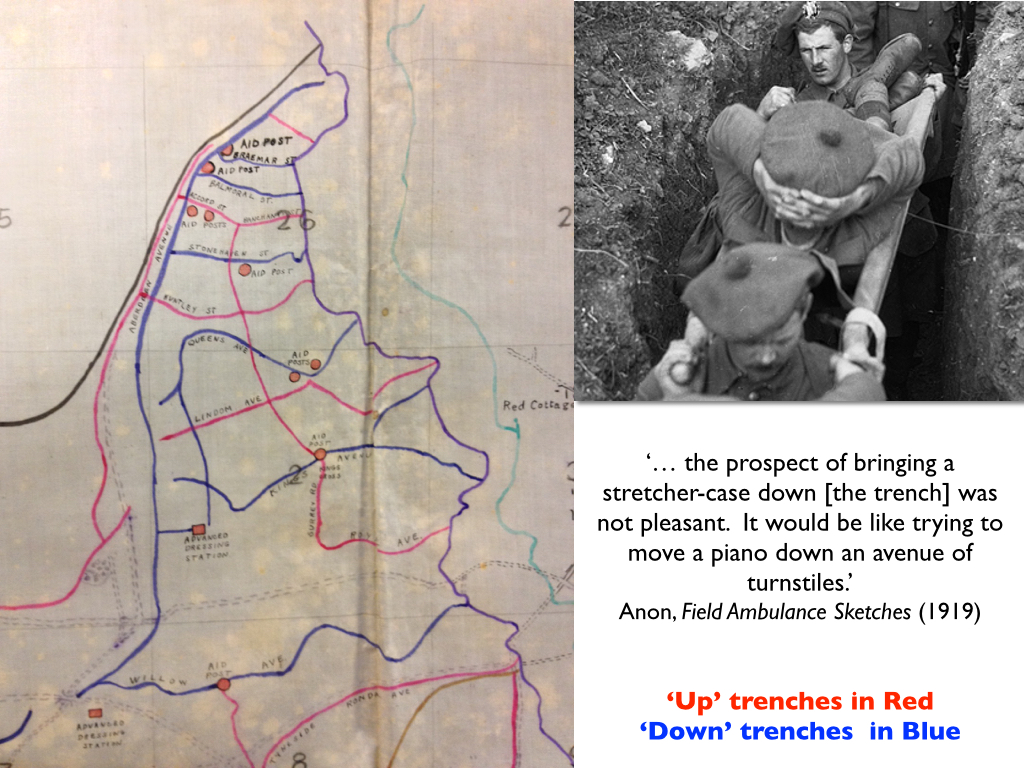
Before every major offensive elaborate plans for medical support were prepared: casualties were ‘cleared’ down the line as far and as fast as possible to make room for the newly injured, casualty clearing hospitals moved closer to the line, ambulances and stretcher-bearers made ready, and ‘down’ trenches designated for the efficient removal of the wounded (below).

Journeys from No Man's Land.017

Soldiers wounded in ‘No Man’s Land’ – a term never recognised by the British General Staff, who insisted that they controlled the field of battle right up to the enemy front lines – were often immobilised and disoriented; some crawled into shell holes, seeking refuge below the field of fire, but it could take hours, even days before they were discovered and rescued (I’ll devote a later post to a detailed discussion of some of those cases).

Journeys from No Man's Land.022

Journeys from No Man's Land.023

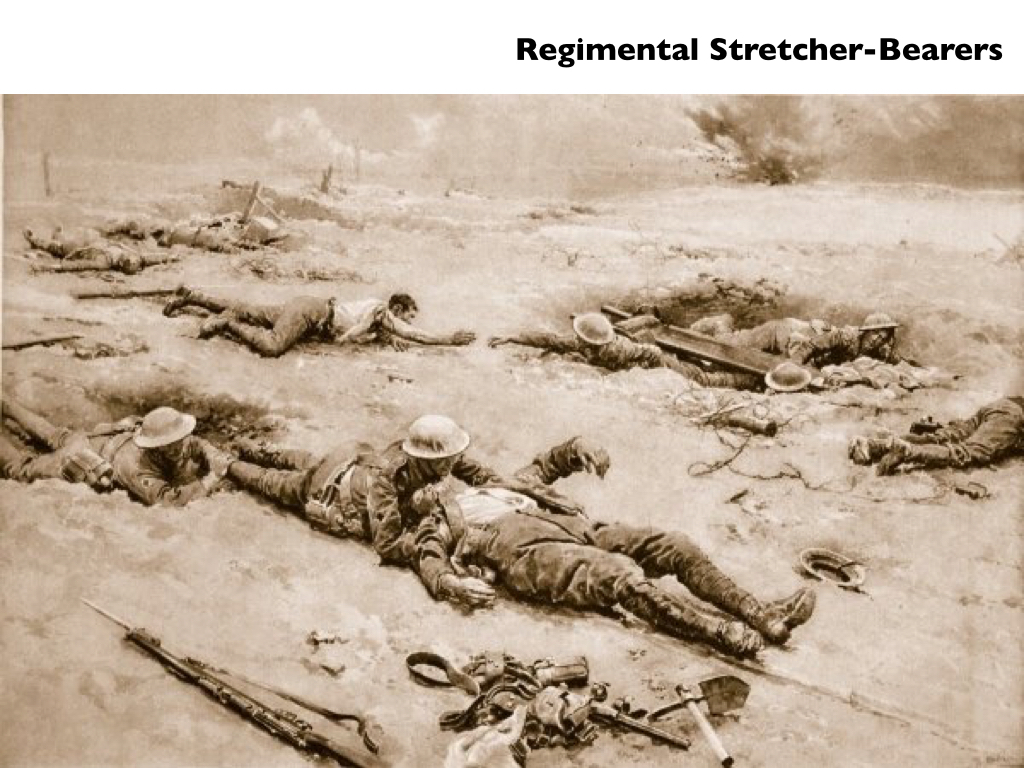
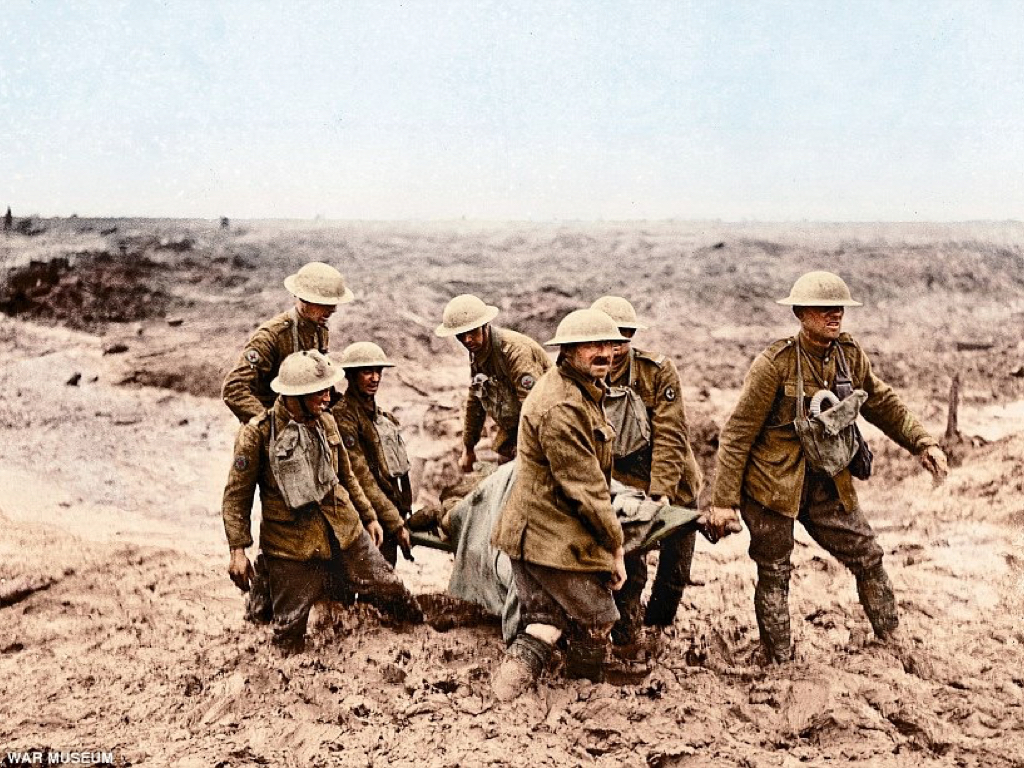
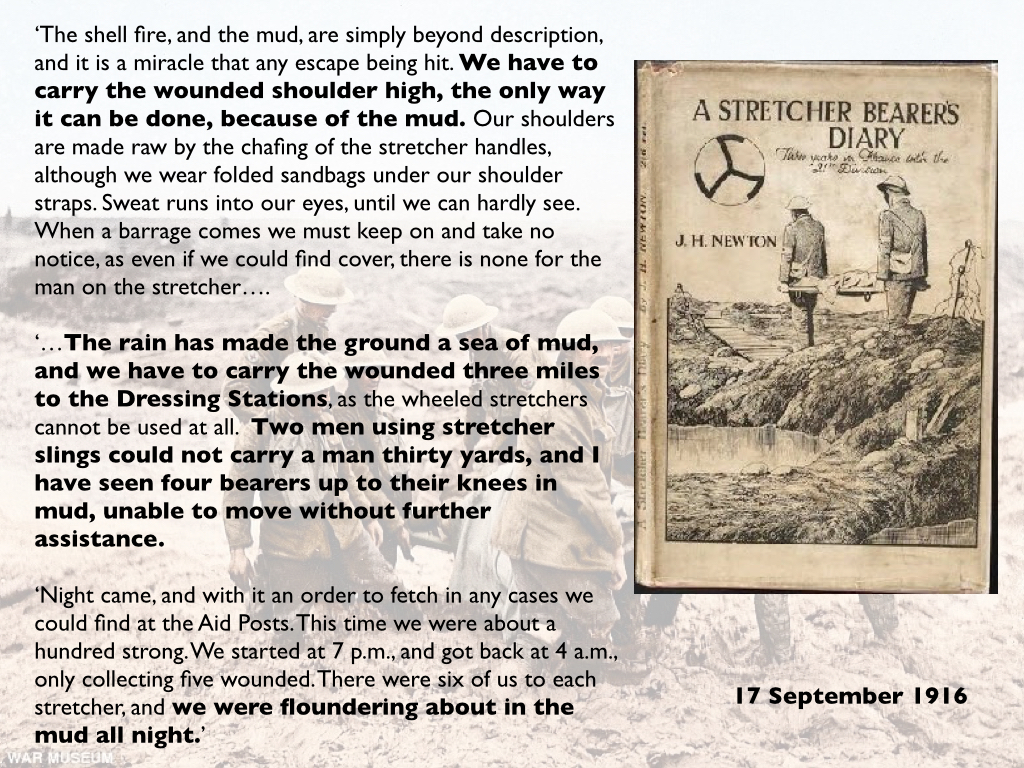
Sometimes their mates came to their rescue, sometimes the regimental stretcher bearers.  But they too had to find their way through a dangerous and devastated terrain, often with no landmarks to guide them and on occasion made virtually impassable by the thick, cloying mud that was always –  disconcertingly – much more than mud.

Journeys from No Man's Land.024

By now, they were in the care of the Royal Army Medical Corps’s Field Ambulance, and their first objective was an Advanced Dressing Station.  

Journeys from No Man's Land.026

Treatment at ADS 1917

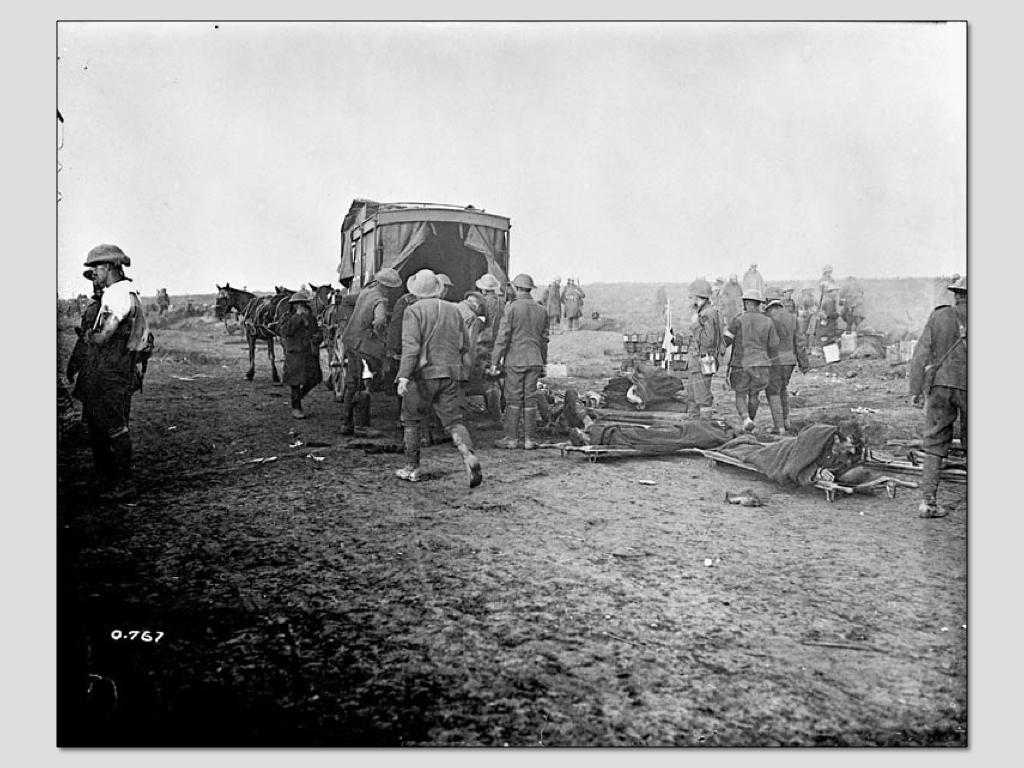
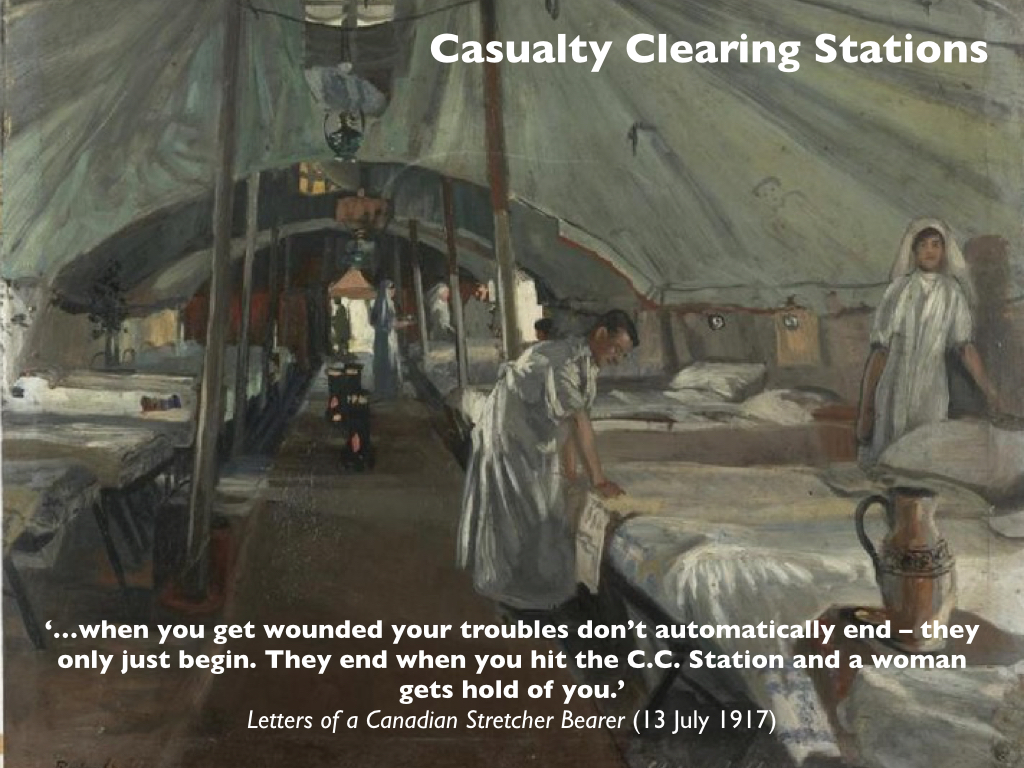
Those that needed anything beyond simple treatment or emergency surgery were sent on by horse or motor ambulance to a Casualty Clearing Station (a field hospital).

Journeys from No Man's Land.027

Journeys from No Man's Land.030

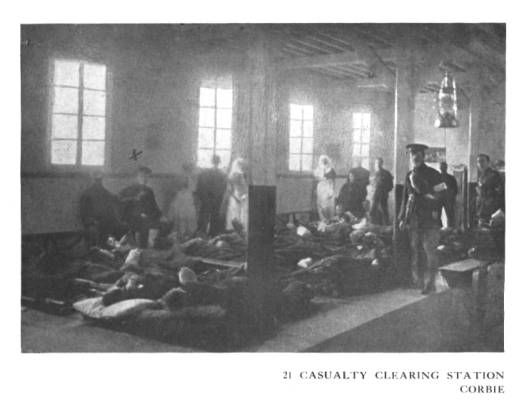
It was usually here that their first surgeries took place.  The journalist Philip Gibb was shown around a CCS at Corbie and the experience haunted him for years:

After a visit there I had to wipe cold sweat from my forehead, and found myself trembling in a queer way. It was the medical officer—a colonel—who called it that name. “This is our Butcher’s Shop,” he said, cheerily. “Come and have a look at my cases. They’re the worst possible; stomach wounds, compound fractures, and all that. We lop off limbs here all day long, and all night. You’ve no idea!”

CCS Corbie

I had no idea, but I did not wish to see its reality. The M.O. could not understand my reluctance to see his show. He put it down to my desire to save his time—and explained that he was going the rounds and would take it as a favor if I would walk with him. I yielded weakly, and cursed myself for not taking to flight. Yet, I argued, what men are brave enough to suffer I ought to have the courage to see… I saw and sickened. These were the victims of “Victory” and the red fruit of war’s harvest-fields. A new batch of “cases” had just arrived. More were being brought in on stretchers. They were laid down in rows on the floor-boards. The colonel bent down to some of them and drew their blankets back, and now and then felt a man’s pulse. Most of them were unconscious, breathing with the hard snuffle of dying men. Their skin was already darkening to the death-tint, which is not white. They were all plastered with a gray clay and this mud on their faces was, in some cases, mixed with thick clots of blood, making a hard incrustation from scalp to chin. “That fellow won’t last long,” said the M. O., rising from a stretcher. “Hardly a heart-beat left in him. Sure to die on the operating-table if he gets as far as that… Step back against the wall a minute, will you?” We flattened ourselves against the passage wall while ambulance-men brought in a line of stretchers. No sound came from most of those bundles under the blankets, but from one came a long, agonizing wail, the cry of an animal in torture. “Come through the wards,” said the colonel. “They’re pretty bright, though we could do with more space and light.” In one long, narrow room there were about thirty beds, and in each bed lay a young British soldier, or part of a young British soldier. There was not much left of one of them. Both his legs had been amputated to the thigh, and both his arms to the shoulder-blades. “Remarkable man, that,” said the colonel. “Simply refuses to die. His vitality is so tremendous that it is putting up a terrific fight against mortality… There’s another case of the same kind; one leg gone and the other going, and one arm. Deliberate refusal to give in. ‘You’re not going to kill me, doctor,’ he said. ‘I’m going to stick it through.’ What spirit, eh?”…

“Bound to come off,” said the doctor as we passed to another bed. “Gas gangrene. That’s the thing that does us down.” In bed after bed I saw men of ours, very young men, who had been lopped of limbs a few hours ago or a few minutes, some of them unconscious, some of them strangely and terribly conscious, with a look in their eyes as though staring at the death which sat near to them, and edged nearer. “Yes,” said the M. O., “they look bad, some of ’em, but youth is on their side. I dare say seventy-five per cent. will get through. If it wasn’t for gas gangrene—“

He jerked his head to a boy sitting up in bed, smiling at the nurse who felt his pulse. “Looks fairly fit after the knife, doesn’t he? But we shall have to cut higher up. The gas again. I’m afraid he’ll be dead before to-morrow. Come into the operating-theater. It’s very well equipped.”

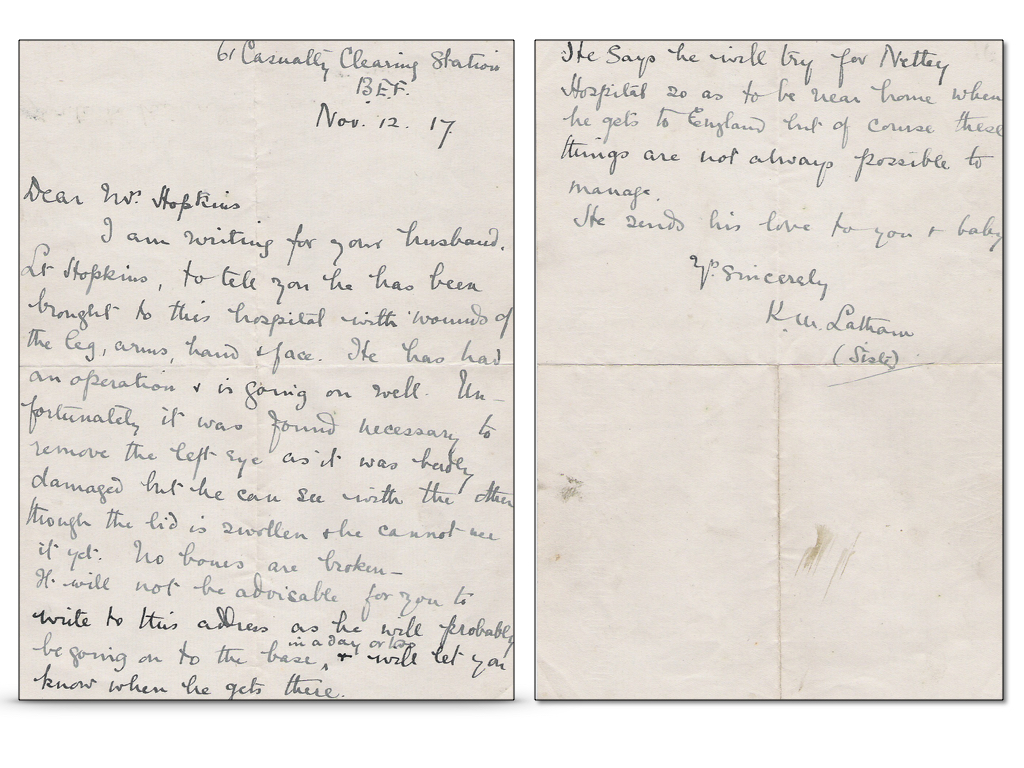
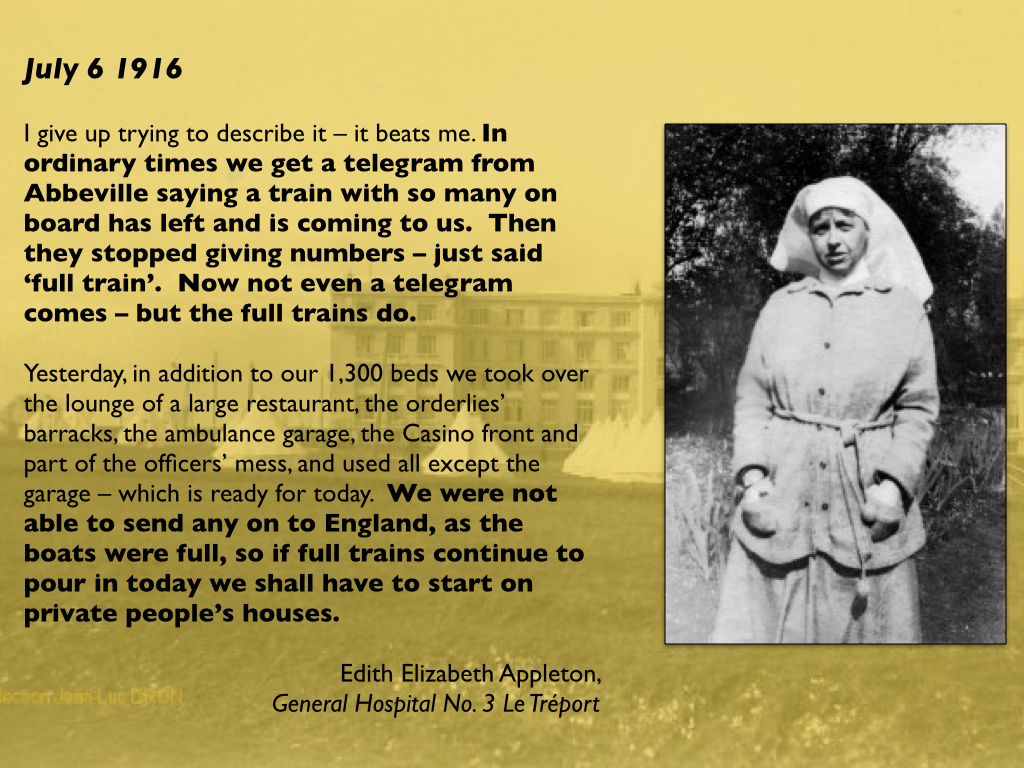
By now the bureaucratic machine had been activated: labels had been attached to the wounded and field medical cards (‘tickets’) completed; telegrams had been sent to advise families, and nurses had often written letters home on their patients’ behalf.

Journeys from No Man's Land.035Journeys from No Man's Land.036

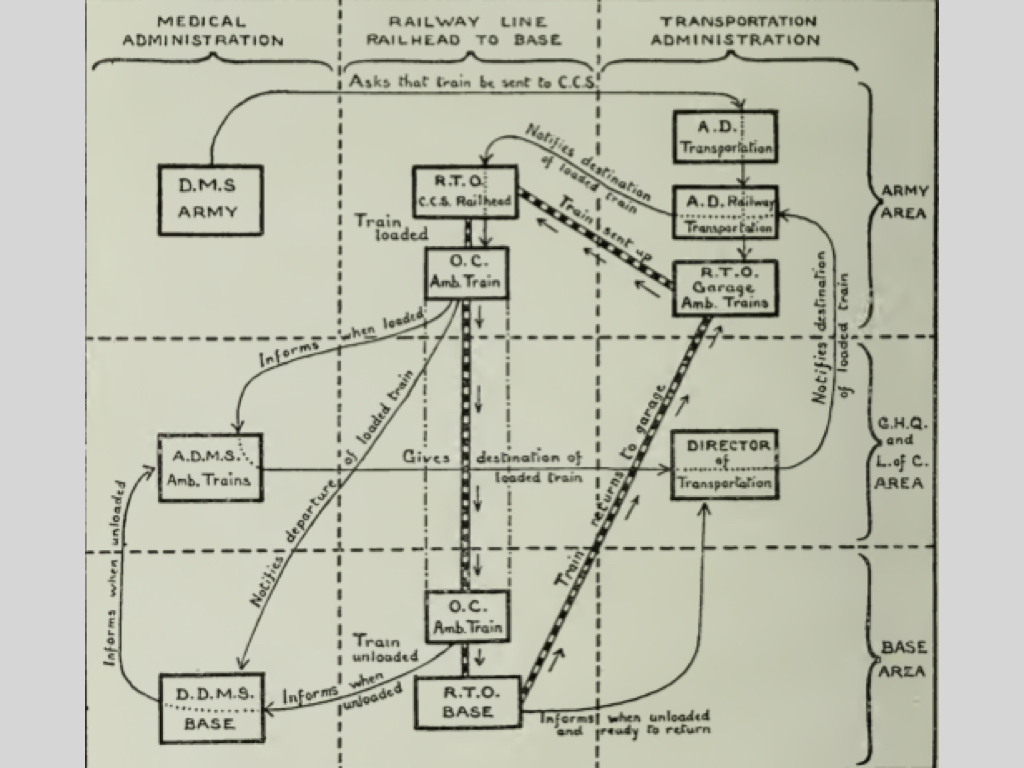
The next stage for the most seriously wounded was evacuation by ambulance train to  a base hospital on the French coast.  There was a considerable bureaucracy involved in planning these movements, but for all the neatness and symmetry of the organisational diagrams – part of Clausewitz‘s ‘paper war’ – there were all sorts of delays.

Journeys from No Man's Land.038

Journeys from No Man's Land.040

Priority was given to trains rushing reinforcements, supplies and ammunition to the front, and ambulance trains were frequently marooned in sidings waiting for them to pass so that journeys that might have taken hours could take days.  It was not uncommon for an ambulance train to arrive at a base hospital to find that there was little or no room for new patients and all but the most grievous cases had to travel on to the next.

Journeys from No Man's Land.041

Journeys from No Man's Land.042

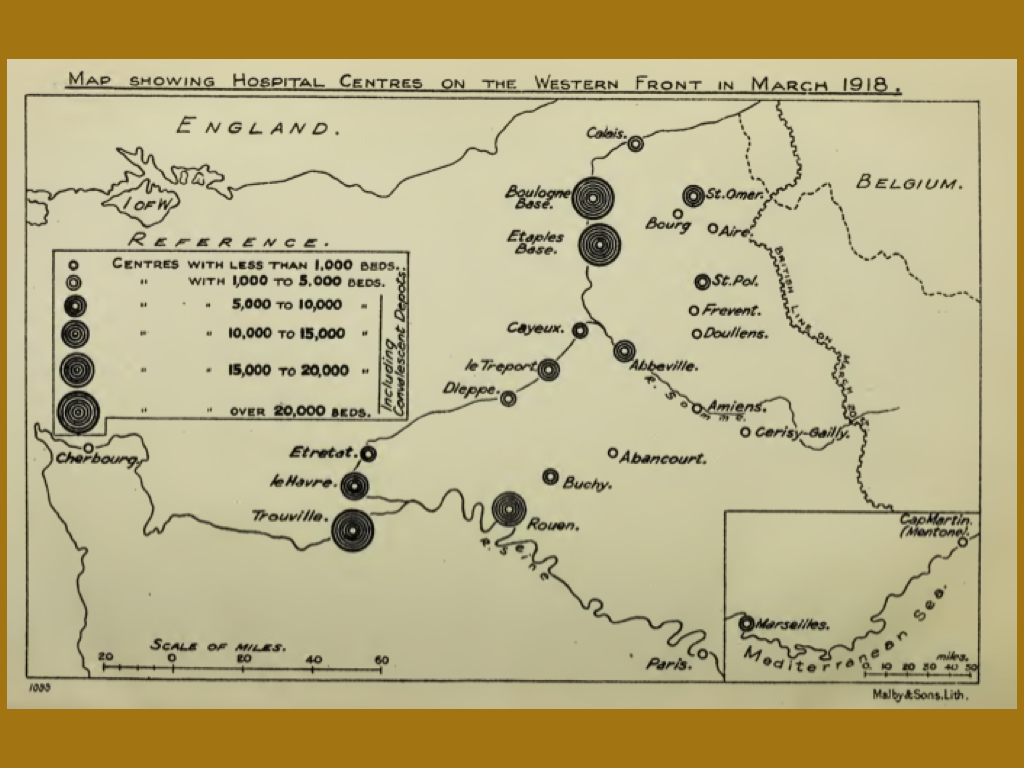
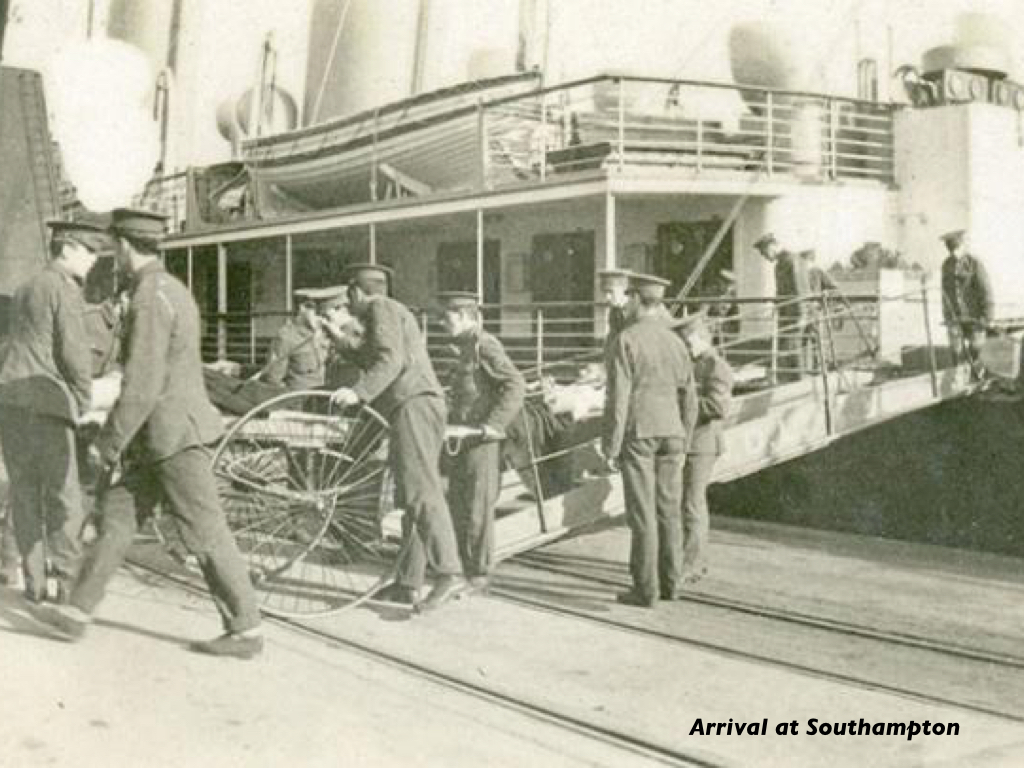
Many patients were treated at the base hospitals, but those with more serious wounds were evacuated by hospital ship to Britain.  This stage of the journey was no less dangerous than the previous one: as the war continued, there was an increasing danger of mines and submarines in the Channel.

Journeys from No Man's Land.043

Journeys from No Man's Land.044

Journeys from No Man's Land.046

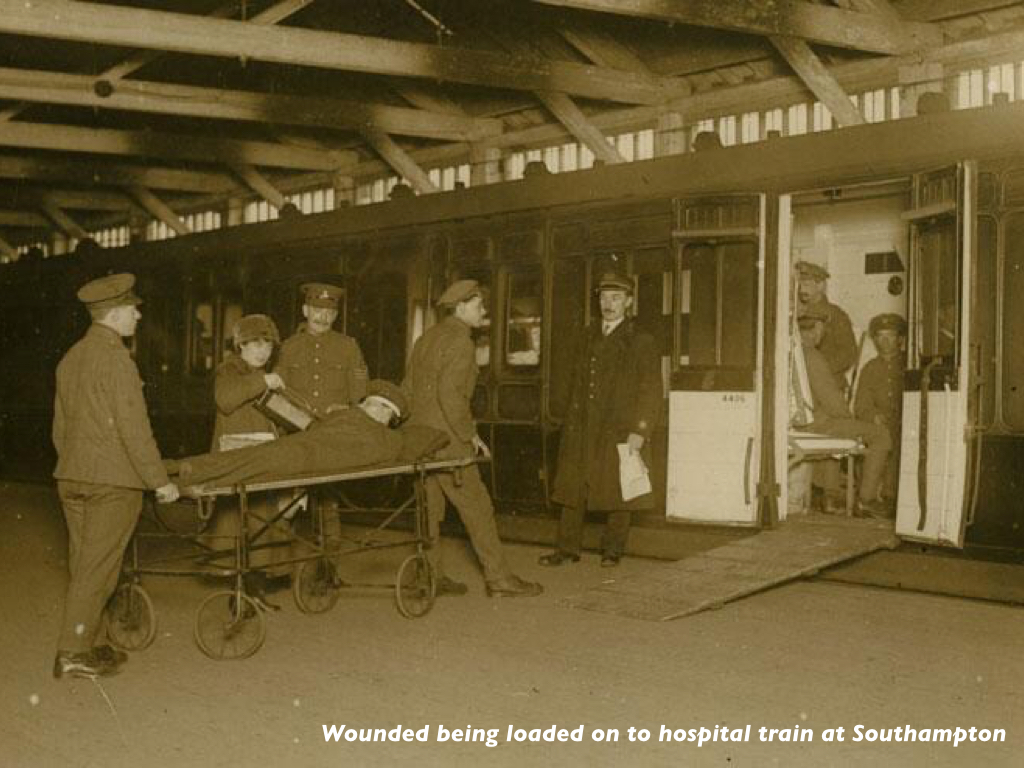
A distinctive  geography of the wounded emerged.  If they arrived at Southampton, the most critical cases were taken by train straight to the Royal Victoria Military Hospital at Netley, which treated as many as 50,000 patients during the war.  According to Lyn McDonald,

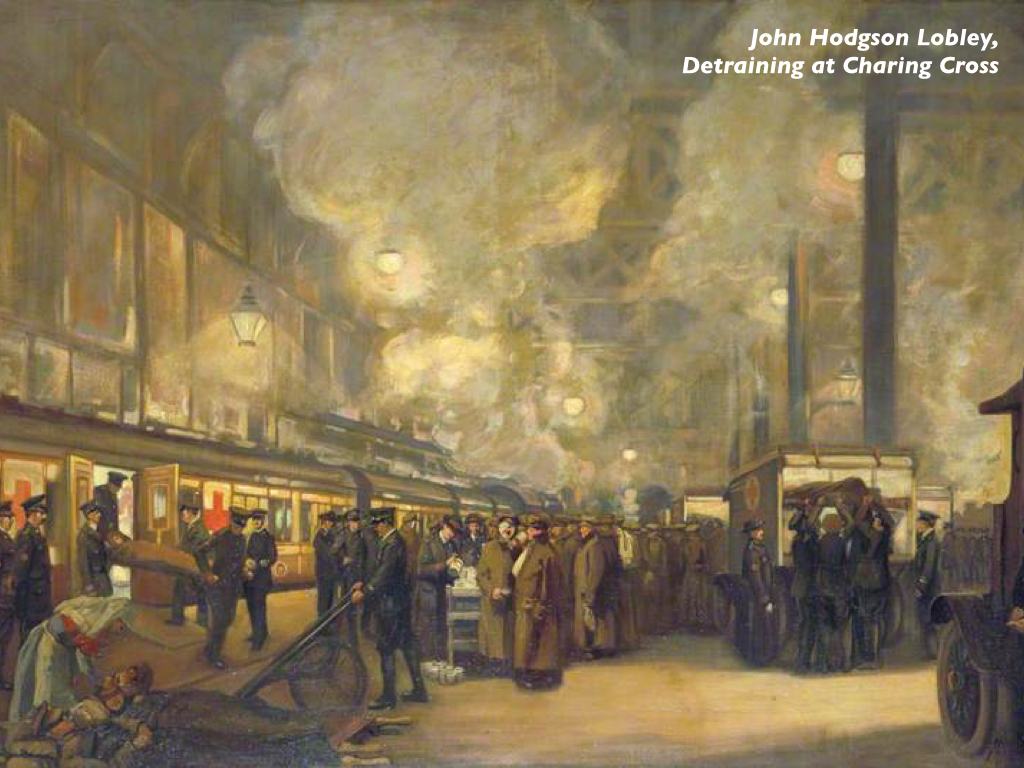
 ‘Those who could not be accommodated, and those who were seriously wounded but likely to survive a longer journey, were sent on by train to Birmingham, Bristol, Exeter, Leicester, Norwich and Plymouth.  But seven out of every ten hospital trains were directed to London, and during the first days of the Somme they rolled in almost every hour to Charing Cross and Paddington stations.’

Journeys from No Man's Land.047

Journeys from No Man's Land.048

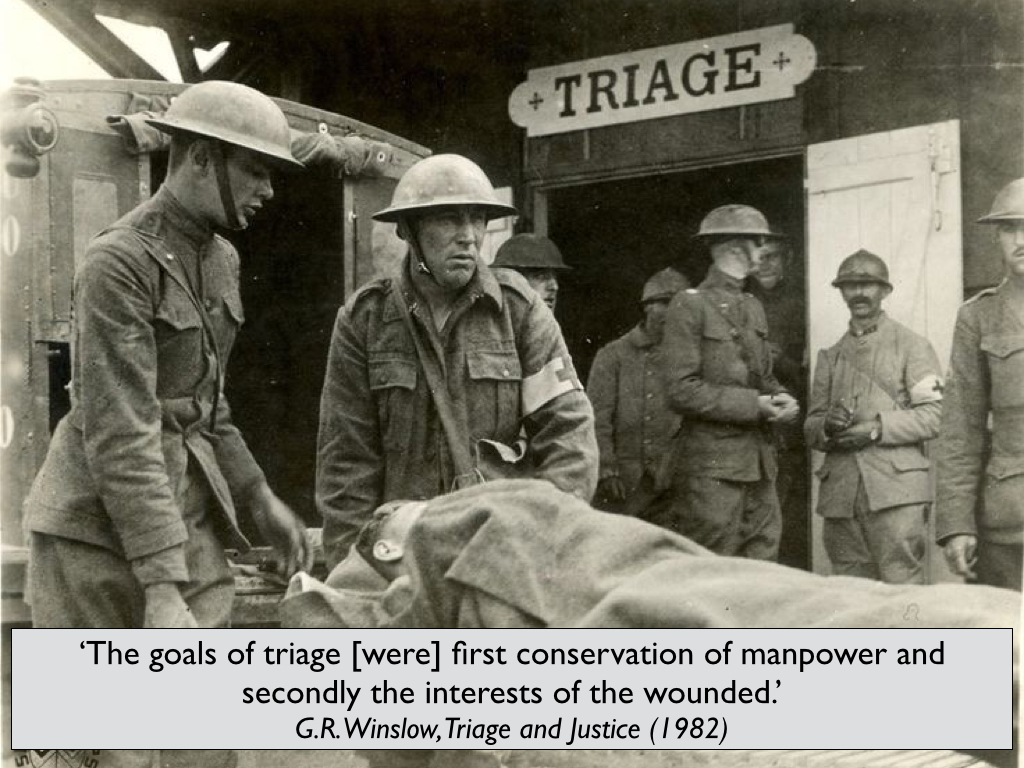
This is, of course, a highly abbreviated account of the casualty evacuation chain, and in the larger project from which this is derived I provide many more details.  But I think I’ve said enough to show that the chain was, in effect, a production line with an elaborate division of labour (again, in the larger study I show how class – or more accurately, rank – gender and race segmented the chain in various ways).  Indeed, in The Politics of Wounds Ana Carden-Coyne argues that what she calls ‘the Taylorist approach in modern war’ – and remember that this was industrial war on the grand (guignol) scale – ‘was particularly evident in the assembly-line style of evacuation and triage.’

Journeys from No Man's Land.012

This prompts two concluding observations.

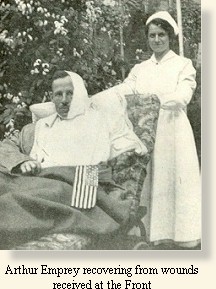
First, what was the instrumental logic that animated the evacuation chain?  After all, it was an expensive undertaking, as Arthur Empey (himself wounded on the Western Front) realised in this re-calculation of the chain:

It may sound heartless and inhuman, but it is a fact, nevertheless, that from a military stand-point it is better for a man to be killed than wounded.

EmpeyIf a man is killed he is buried, and the responsibility of the government ceases, excepting for the fact that his people receive a pension. But if a man is wounded it takes three men from the firing line, the wounded man and two men to carry him to the rear to the advanced first-aid post. Here he is attended by a doctor, perhaps assisted by two R.A.M.C. men. Then he is put into a motor ambulance, manned by a crew of two or three. At the field hospital, where he generally goes under an anaesthetic, either to have his wounds cleaned or to be operated on, he requires the services of about three to five persons. From this point another ambulance ride impresses more men in his service, and then at the ambulance train, another corps of doctors, R.A.M.C. men, Red Cross nurses, and the train’s crew. From the train he enters the base hospital or Casualty Clearing Station, where a good-sized corps of doctors, nurses, etc., are kept busy. Another ambulance journey is next in order — this time to the hospital ship. He crosses the Channel, arrives in Blighty — more ambulances and perhaps a ride for five hours on an English Red Cross train with its crew of Red Cross workers, and at last he reaches the hospital. Generally he stays from two to six months, or longer, in this hospital. From here he is sent to a convalescent home for six weeks.

If by wounds he is unfitted for further service, he is discharged, given a pension, or committed to a Soldiers’ Home for the rest of his life, — and still the expense piles up. When you realize that all the ambulances, trains, and ships, not to mention the man-power, used in transporting a wounded man, could be used for supplies, ammunition, and reinforcements for the troops at the front, it will not appear strange that from a strictly military standpoint, a dead man is sometimes better than a live one (if wounded).

Hence, for example, the orders recorded by A.M. Burrage:

The instructions given to stretcher-bearers are rather harsh. “ If you find two men wounded, and can take only one away, take away the one more likely to make a fit soldier again.” Therefore the one more urgently in need of attention must be left to die, because he would walk with a limp and would never again be able to carry a pack. Sound business, of course, but just a little hard.

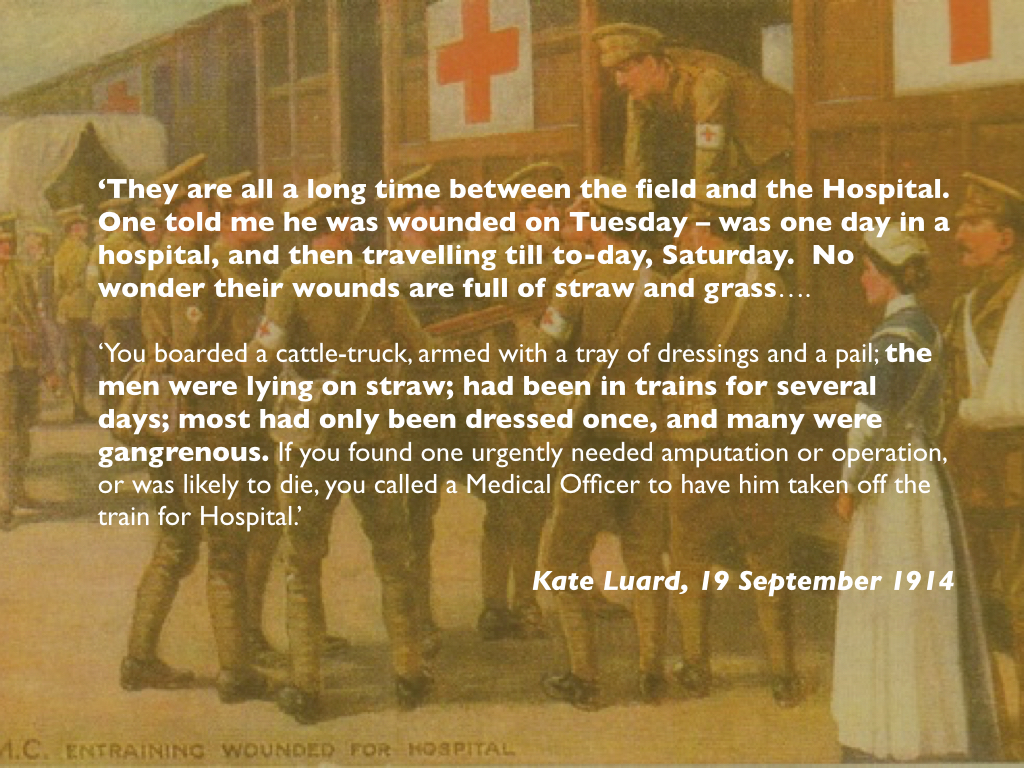
Kate Luard captured another dimension of this when she wrote in January 1915:

‘The ambulance trains do so much bringing the British Army from the field that I hope some other  trains are busy bringing the British Army to the field, or there can’t be many left in the field…’

And Emily Mayhew provides this bleak vignette from a medical orderly that captures the seemingly insatiable drive of industrial war:

An ordinary train, similar to the one that had brought him to the front, was at one end unloading reinforcements, while at the other end it was filling up with wounded men.

The logic, then, was one of ‘salvage’; four out of every five men wounded on the Western Front were returned to the fighting, which was the over-riding objective of the military-medical machine.

Journeys from No Man's Land.055

Second, the division of labour was also a division of life: the dead from the wounded, the dying from the ‘salvageable’, and the wounded from the unwounded or yet-to-be-wounded.  The last was not the least.  For breaching that separation could have the most unsettling consequences of all:

Journeys from No Man's Land.057

Journeys from No Man's Land.058

 ***

What started me on this journey was Emily Mayhew‘s brilliantly conceived Wounded and an excellent series of articles by Martin Bricknell in the Journal of the Royal Army Medical Corps: see in particular here.

You can also find more on the casualty evacuation chain from the Western Front at Beyond the Trenches here and here, the Long, Long Trail here, the Medical Front here, and the Royal Army Medical Corps site here.

My larger project examines the evacuation of casualties, combatant and civilian, from four combat zones 1914-2014: the Western Front during the First World War, the deserts of North Africa during the Second World War, Vietnam, and Afghanistan.