MAP and the meat-grinder

I’ve updated my previous posts on the medical geographies of Gaza several times (see herehere and here), and I’ve drawn on the testimony of Dr Mads Gilbert in extenso, but this testimony from another brave volunteer doctor deserves its own notice.

I met Ghassan Abu Sitta at a wonderful workshop in Paris in December 2012 on War and Medicine, and I learned so much from that one meeting (from everyone there: see my note about War and therapeutic geographies) that I was inspired to develop my own research project on the medical evacuation of casualties from war zones, 1914-2014.
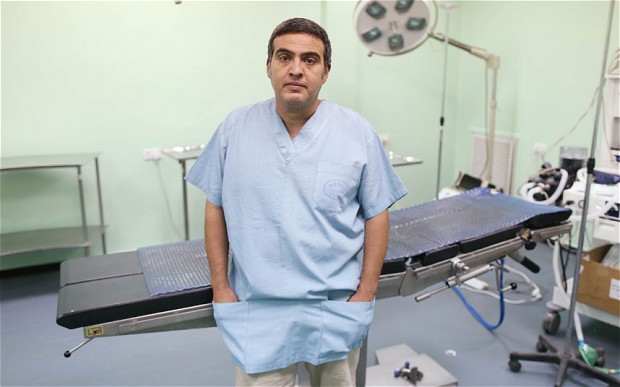
Ghassan Abu Sitta

Ghassan is a reconstructive surgeon who used to work at Great Ormond Street in London but is now based in Beirut.  He’s recently returned from Gaza where he worked as a Medical Aid for Palestinians (MAP) volunteer at al Shifa hospital carrying out five, six and sometimes seven surgeries a day.

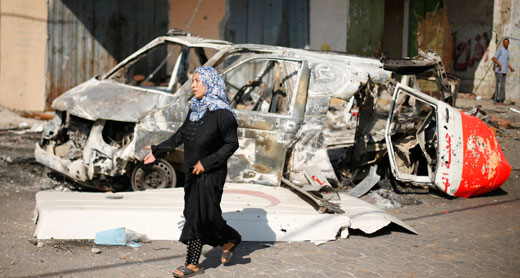
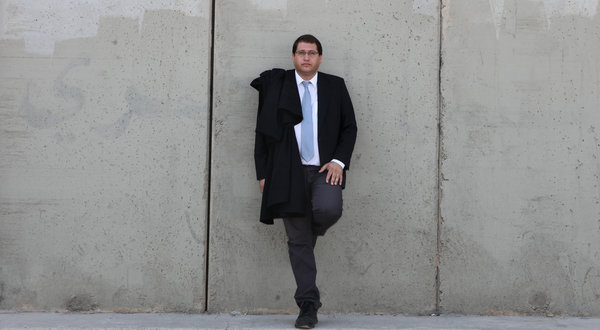
You can read some of the background in this excellent report by Robert Tait for Britain’s Telegraph, published ten days ago and from which I’ve borrowed the photograph above, but Ghassan has just been interviewed in depth by Yazan al-Saadi for Al Akhbar; you can read the full version here.

Ghassan says the attack on Gaza was like ‘a meat-grinder’, which he attributes to:

The amount of ordinance that the Israelis fired, the indiscriminate use of these bombs that are capable of bringing down whole buildings, the use of artillery shelling which is indiscriminate because the shell will hit the first thing it reaches, the fact that they were attacking from the air, from the sea, and by land with artillery at the same time. And there was a night they were doing this and then they lit all of Gaza’s sky with these flares just so people will know that this is what’s happening.

He also provides compelling testimony of his experience at al-Shifa, the main trauma centre for Gaza, that adds important detail to the accounts I’ve noted previously:

‘It looked like a refugee camp. The campus of the hospital has a lot of the families that escaped the bombing or lost their houses and they were living inside the walls of the hospital. Everywhere you go you see makeshift dwellings made out of laundry lines and bed sheeting turned into tents. And the hospital was completely full. Single rooms had four beds in them. In some wards we had two patients per bed.

‘The difference between this conflict and the one before is that nobody was allowing the patients out. So you had 7,000 injured – at the time I was there it was 6,000 and by the time the conflict ended the injured were 10,000. An overwhelming majority have still not been able to get out of Gaza. There have been some numbers, but not significant numbers to break the back of this problem….

‘The contingency plans were that all diesel was kept for the al-Shifa Hospital, so people did not have electricity at home, they would donate the diesel to the hospital. The wells that supply Shifa, like the rest of the water in Gaza, had become so contaminated with sea water, it’s salty. People do the best with what they have….

‘… the majority of the killing was happening because they were dropping ammunition designed to penetrate mountain caves. [The Israelis] were dropping them on civilian dwellings made out of breeze block. And so these four or five storey buildings were being pulverized by these one-ton bombs. That was what was wiping out whole families. And in Gaza, because land is so much in shortage, people come along and build their house, they build enough foundations that when their kids grow up, they can build a floor on top. So when you take out a four storey building, you take out four generations of a family. That was what happened to, I think, 60 families that have been completely wiped out…

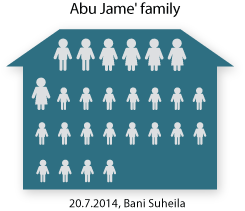
The graphic below shows 26 members of just one extended family, the Abu Jame family, killed at home in Bani Suheila on 20 July; it comes from a sequence that is shockingly far too large to reproduce here, compiled by B’Tselem and available here. The infographic lists ‘members of families killed in their homes in 59 incidents of bombing or shelling’ in which 458 people were killed, including 108 women under the age of 60, 214 minors, and 18 people over the age of 60.  If you follow the link, you can hover over each image for the names and ages of those killed.
abu_jame3

Ghassan continues:

‘… they started inventing these humanitarian ceasefires, where people would go out and they would start killing them. We had this on the day of Eid, they said there was a humanitarian ceasefire and the kids went out to a local fair ground and they bombed them. The other time was in al-Shujayeh market, there was a humanitarian ceasefire, they got them into the market, they killed them, then they waited for the ambulances to get there, and then they shelled the ambulances again.

‘So the issue isn’t the type of weapons, but the intent to kill. The amount of ordinance they used and the tonnage of the bombs they used were intended to wipe out whole neighborhoods. That’s what they have done. They have completely wiped out Shejayeh, they wiped out Khuza’a, they wiped out a big part of Rafah, a big part of Khan Younes, and parts of Beit Hanoun….

‘ All the areas around the hospital were being bombed all the time. You would hear it. We heard something we knew it was close, but didn’t know how close it was. We then got a call to the emergency room and we were told that the administration and the out patients building had been hit – a lot of families had taken refuge in that area – so we had to go and help.’

Asked directly whether Hamas or other factions were firing rockets from the vicinity of the hospital, Ghassan is unequivocal:

‘Around Shifa? No, no, no. But in other places you would see them in the sky or hear them. You would learn to distinguish the whoosh of the rocket. Gaza is so small and so flat, I mean you are not going to hide them in the mountains or the jungle because there are no mountains or jungle. People are literally on top of each other. It’s going to happen. But around the hospital there were none.’
The optics of urban ruination

Ishikawa Kōyō

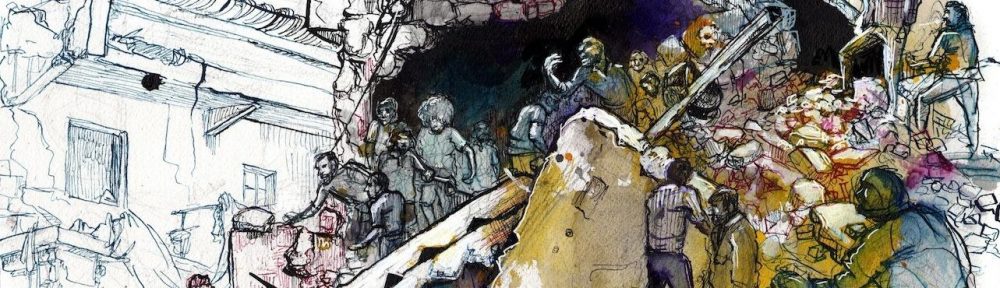
News from David Fedman of a new article co-authored with Cary Karacas, ‘The optics of urban ruination‘, which complements their previous, vital work on the cartographic imaginary of bombing.  It’s published in the Journal of Urban History but you can access it here.

World War II yielded many photographs of bombed-out cities. In this paper we telescope between two sets and scales of images that represent the principal frames through which the American and Japanese publics have memorialized the incendiary bombings that laid waste to urban Japan: aerial photographs taken by the US Army Air Forces during its wartime planning, prosecution, and assessment of the raids; and the ground-level images captured by Ishikawa Kōyō, a photographer working on behalf of the Tokyo Metropolitan Police. By means of a detailed examination of the production, circulation, and consumption of these photographs— what some scholars have called an “archaeological approach” to images of ruination—we explore not only the visual rhetoric and reality of the destruction of Japan’s cities, but also how that destruction is situated in history, memory, and visual culture.

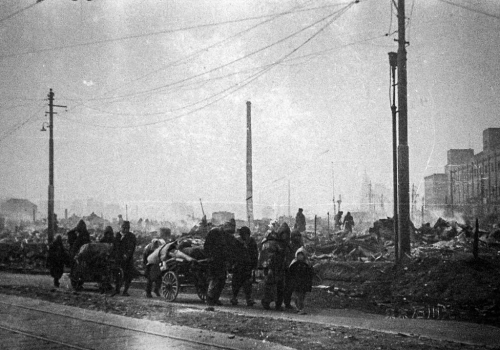
As always with their work, it’s exquisitely written, intellectually savvy and a very powerful argument.  They juxtapose the photographic ‘view from above’ that was instrumental in the planning and execution of the American air raids with Ishikawa Kōyō’s ground-level perspective.  His work is virtual unknown outside Japan and yet, as they say, has become ‘the principal visual testimony in Japan for public memory of the incendiary air raids as they were experienced on the ground’:

What followed were, according to Ishikawa, scenes from hell. His detailed account of that evening indeed repeatedly invokes infernal metaphors to describe Tokyo’s destruction. The “demon’s wings”(akuma no tsubasa) rained fire that carbonized corpses which “flowed through the streets like rapids.”  The elements also conspired against the city to whip up the red winds (akakaze) that fanned the firestorms: “immense incandescent vortices,” he wrote, “rose in a number of places, swirling, flattening, sucking whole blocks of houses into a maelstrom of fire.”

Widespread chaos, intense heat, and the realization of the need to save his own life pre-vented Ishikawa from taking any photographs. His Chevrolet destroyed by flames, he slowly made his way on foot back to the Metropolitan Police Headquarters. After resting his fatigued body, at around 2 P.M. on March 10 Ishikawa set out to document the aftermath. He saw bodies “piled like mountains” (shitai no yama o kizuiteita) and corpses burnt to the point that “you could no longer discern the sex of the body” (danjyo no kubetsu mo tsukanai shitai).

Ishikawa first told himself not to photograph such upsetting images, but then, recalling his responsibilities to capture the “reality of the scenes,” he began to snap the shutter.That day Ishikawa took thirty-three photographs of the aftermath of what came to be called the Great Tokyo Air Raid.

You can find more at Japan Air Raids, a brilliant bilingual archive, and a (harrowing) selection of Ishikawa’s images here.  If you do click on that link, heed their warning:

While photographs such as [these] provide an intimate sense of the bodily pain that was inflicted by the firebombing, they also require much of the viewer. It is one thing to look at such photographs; it is another thing altogether to comprehend or attach meaning to the actual suffering it exposes.

And – do I have to say this? – it’s worth thinking about other scenes of urban ruination.

Peace in our time

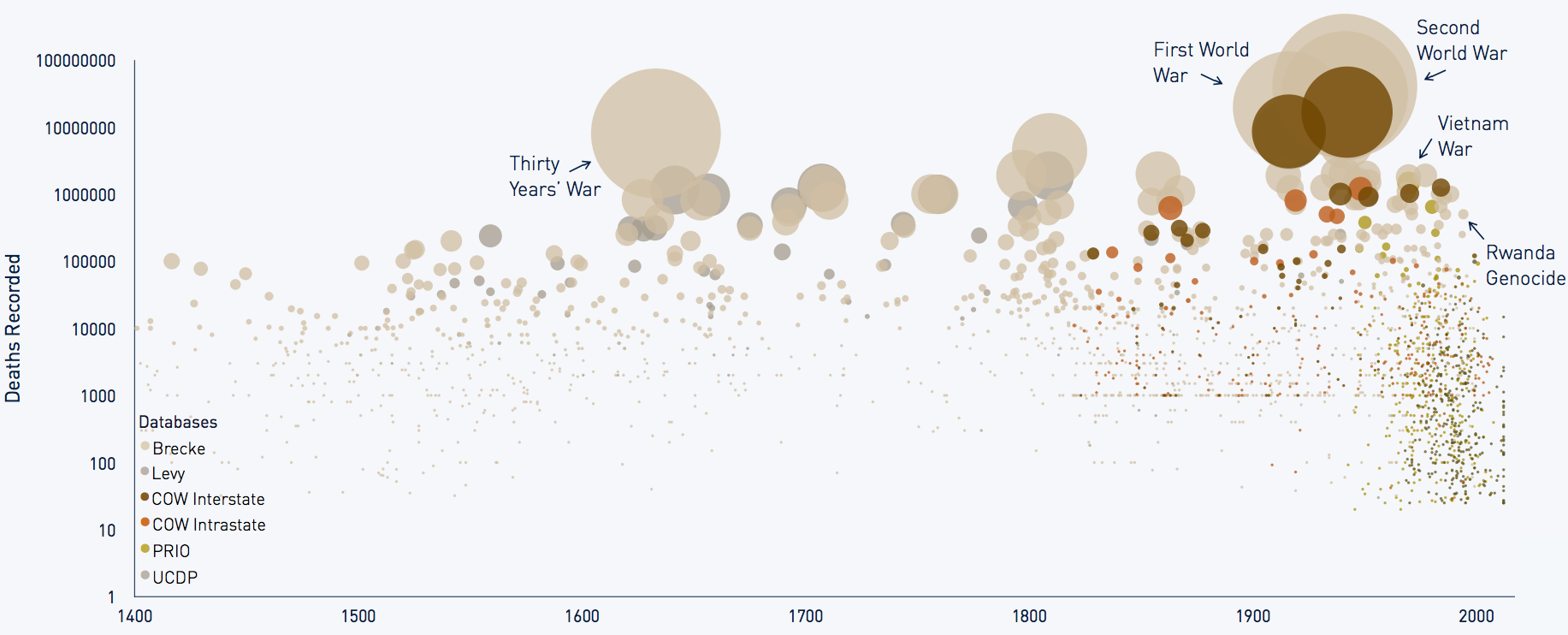
I’ve talked about charting armed conflict around the world before.  Max Rosen has a series of data visualisations – ‘Our World in Data‘ – including several on war and peace.  They include this one, drawn from multiple sources and collated (and designed) by the Hague Centre for Strategic Studies, showing global war deaths – the size of the bubble refers to the proportion of the world population killed:

ourworldindata_global-war-deaths-1400-today-size-of-the-bubble-shows-percentage-of-world-population-killed-–-the-hague-centre-for-strategic-studies0

There are of course all sorts of problems in this sort of exercise – calculating ‘war deaths’ is a political and intellectual minefield of its own – but you can find the sources used for the graphic here (click on the button on the right).

You can also download the Hague Centre’s graphics in a single pdf, ‘Peace and Conflict across time’, here (again, click on the button on the right): the display arranges the graphics into two sets – ‘Decline of Conflict’ and ‘Drivers of Peace’.  No doubt Stephen Pinker would approve.

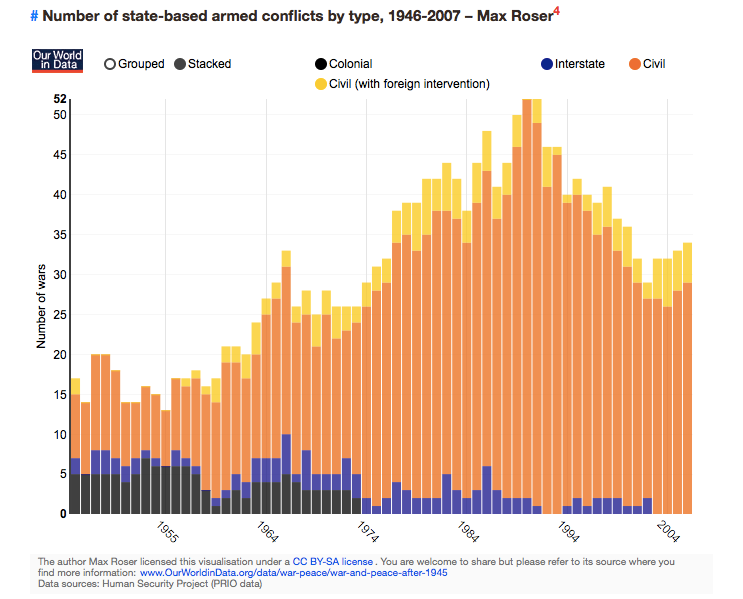
Max provides a more detailed analysis of conflicts post-1945 here, including this image (which extends only to 2004), and which is precisely the sort of thing that has licensed the debates over the decline of inter-state wars and the rise of (often transnational) ‘new wars’:

State-based armed conflicts

Before cheering the demise of inter-state war, however, we need to reflect on the multiple ways in which states and their advanced militaries are able to inflict violence by stealth (including cyber-attack), by proxy and by other other means (including economic warfare)…

Destructive Edge

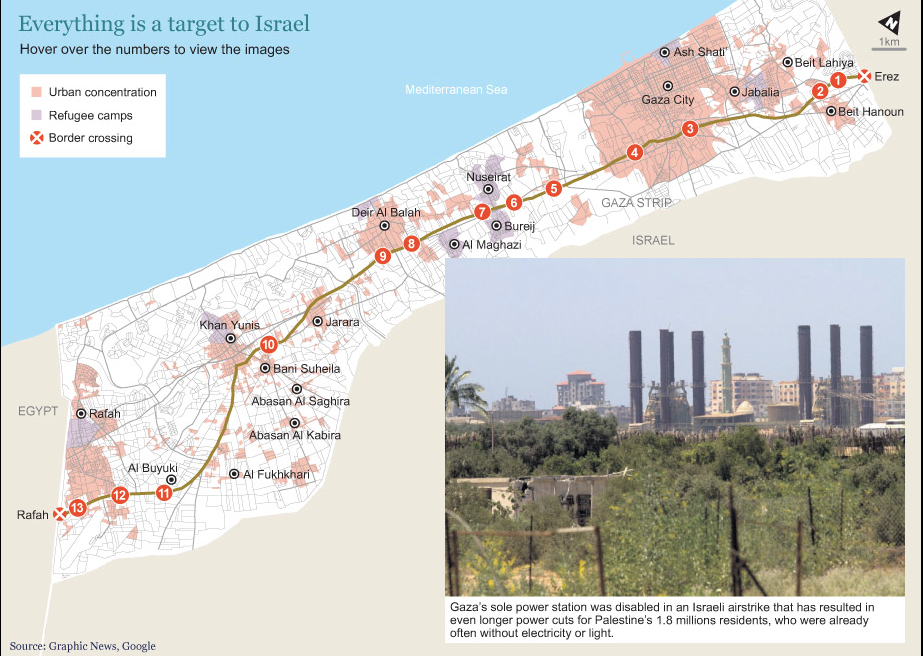
In a previous post on ‘The Death Zone‘, I suggested readers compare Israel’s extended ‘buffer zone’ in Gaza by following the line of the main highway, Saladin Street.  Hugh Naylor has followed that route on the ground – what he calls ‘Desolation Road’ – and his report is accompanied by an interactive map showing some of the vast panorama of destruction:

Screen Shot 2014-08-08 at 10.01.01

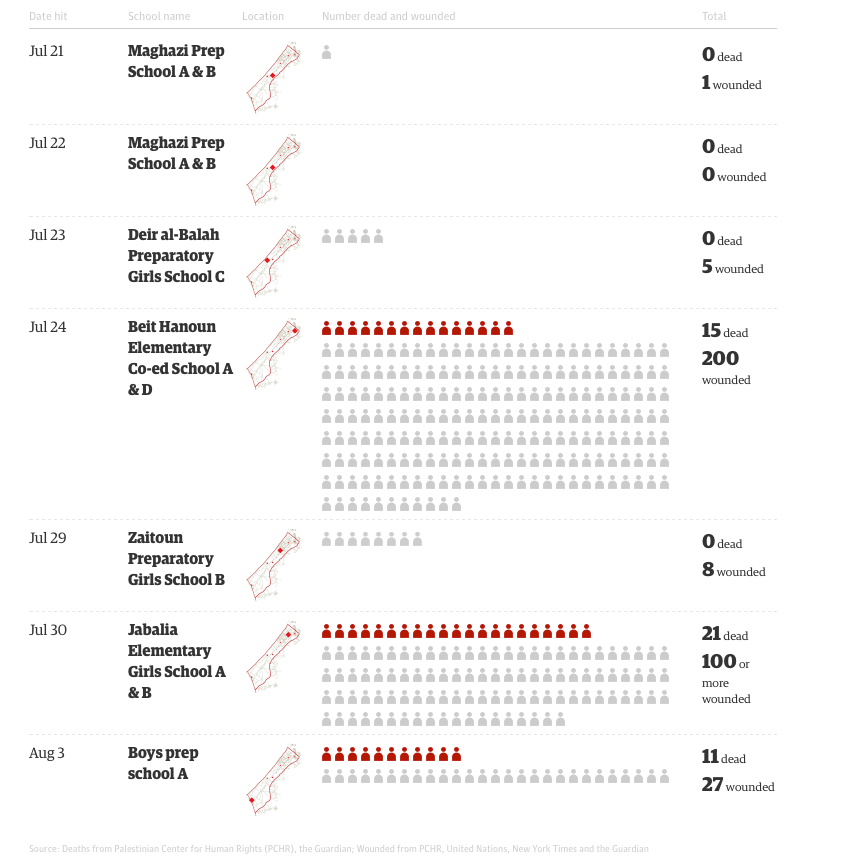
I’ll have more to say about the caption – about the Israeli military’s targeting in Gaza – shortly.  The Guardian has just published a graphic by Nadja Popovich showing the UNRWA-run schools sheltering refugees (many of them from the expanded ‘buffer zone’) that were struck by the Israeli military:

Gaza schools hit by Israeli military

 Amnesty International reports growing evidence that health facilities and workers were deliberately targeted by the Israeli military:

Testimonies from doctors, nurses, and ambulance workers who have spoken to Amnesty International paint a disturbing picture of hospitals and health professionals coming under attack by the Israeli army in the Gaza Strip, where at least six medics have been killed. There is growing evidence that health facilities or professionals have been targeted in some cases.

Since Israel launched Operation “Protective Edge” on 8 July, the Gaza Strip has been under intensive bombardment from the air, land and sea, severely affecting the civilian population there. As of 5 August, according to the UN Office for the Coordination of Humanitarian Affairs, 1,814 Palestinians had been killed in the Gaza Strip, 86 per cent of them civilians. More than 9,400 people have been injured, many of them seriously. An estimated 485,000 people across the Gaza Strip have been displaced, and many of them are taking refuge in hospitals and schools.

Amnesty International has received reports that the Israeli army has repeatedly fired at clearly marked ambulances with flashing emergency lights and paramedics wearing recognizable fluorescent vests while carrying out their duties. According to the Palestinian Ministry of Health, at least six ambulance workers, and at least 13 other aid workers, have been killed as they attempted to rescue the wounded and collect the dead. At least 49 doctors, nurses and paramedics have been injured by such attacks; at least 33 other aid workers were also injured. At least five hospitals and 34 clinics have been forced to shut down due to damage from Israeli fire or continuing hostilities in the immediate area.

Hospitals across the Gaza Strip suffer from fuel and power shortages (worsened by the Israeli attack on Gaza’s only power plant on 29 July), inadequate water supply, and shortages of essential drugs and medical equipment. The situation was acute before the current hostilities, due to Israel’s seven-year blockade of Gaza, but have been seriously exacerbated since…

Amnesty International is aware of reports that Palestinian armed groups have fired indiscriminate rockets from near hospitals or health facilities, or otherwise used these facilities or areas for military purposes. Amnesty International has not been able to confirm any of these reports. While the use of medical facilities for military purposes is a severe violation of international humanitarian law, hospitals, ambulances and medical facilities are protected and their civilian status must be presumed. Israeli attacks near such facilities – like all other attacks during the hostilities – must comply with all relevant rules of international humanitarian law, including the obligation to distinguish between civilians and civilian objects and military targets, the obligation that attacks must be proportional and the obligation to give effective warning. Hospitals and medical facilities must never be forced to evacuate patients under fire.

20140801_ambulance_520

The report includes detailed testimony from Palestinian paramedics and ambulance crews who describe the extraordinary difficulty and danger they faced in attending to casualties from Israeli shelling (see also my post on ‘Gaza 101‘, the emergency number for Gaza, and the update here).  Not surprisingly, Israel has rejected Amnesty’s claims and denied targeting hospitals, but when Netanyahu’s spokesperson, Mark Regev, explained that ‘What we’ve had to do on a number of occasions is to hit terrorist targets in the immediate vicinity of hospitals and things like that, where they’ve abused them,’ he failed to address the violations of international law summarised in the last paragraph above.

There’s more.  B’Tselem, now back on line, is also providing detailed testimony from Gaza, including (so far) two ambulance drivers, Rami ‘Abd al-Haj ‘Ali and Ahmad Sabah.  Here is an extract from the first statement (all testimonies are linked to B’Tselem’s interactive map):

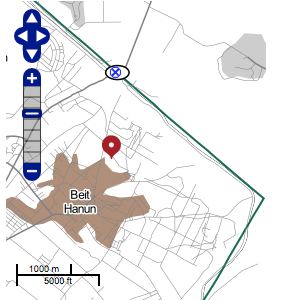
B'Tselem map Beit HanounOn Friday afternoon, 25 July 2014, I was working at the medical emergency call center in Beit Hanoun. At around 4:30 P.M., we received a call reporting injured people in al-Masriyin Street in Beit Hanoun. We asked the International Red Cross to coordinate our going there. About 15 minutes after we received the call, we got authorization and an ambulance headed over there with paramedics ‘Aaed al-Bura’i, 25, Hatem Shahin, 38, and driver Jawad Bdeir, 52. The team didn’t make it to the wounded people. Soon after they reached the street, they reported back that a tank had fired at them and they were injured. They asked for another team to come and rescue them.

The call center coordinated the arrival of another team with the International Red Cross and got authorization to go rescue the injured team. I drove the second ambulance, and there were two medics with me – Muhammad Harb, 31, and Yusri al-Masri, 54. The street is only about 200-300 meters from the call center, so we were there within minutes. When we reached the entrance to the street, we were surprised to see three tanks and a military bulldozer in the street, about 100 meters away.

Suddenly, with no warning, they opened heavy machine-gun fire at us. The bullets penetrated the ambulance. I tried to turn the ambulance around to get out of there, but the steering wheel must have been hit. Suddenly, I felt sharp pain in my leg and realized I’d been hit by a bullet or shrapnel. Then the windshield shattered. Because I couldn’t turn the ambulance around, I decided to try reversing. They kept firing as I backed up, until we got far enough away. When they stopped, I managed to turn us around and head back to the center.

On the way there we met Hatem Shahin, one of the paramedics from the first ambulance. He’d been hit by shrapnel in his shoulder and leg. He told us that a shell fired from a tank had hit the front part of the ambulance. He said he’d managed to get away but the other paramedic, ‘Aaed, had been hit. He told us that after he ran away from there, he saw the tank fire another shell at the ambulance, completely destroying it. He thought ‘Aaed must have been killed, but we didn’t know for sure.

The next day, on Saturday, a ceasefire was declared from 8:00 A.M. to 8:00 P.M. An ambulance team went to the spot and found ‘Aaed’s body in the burnt ambulance.

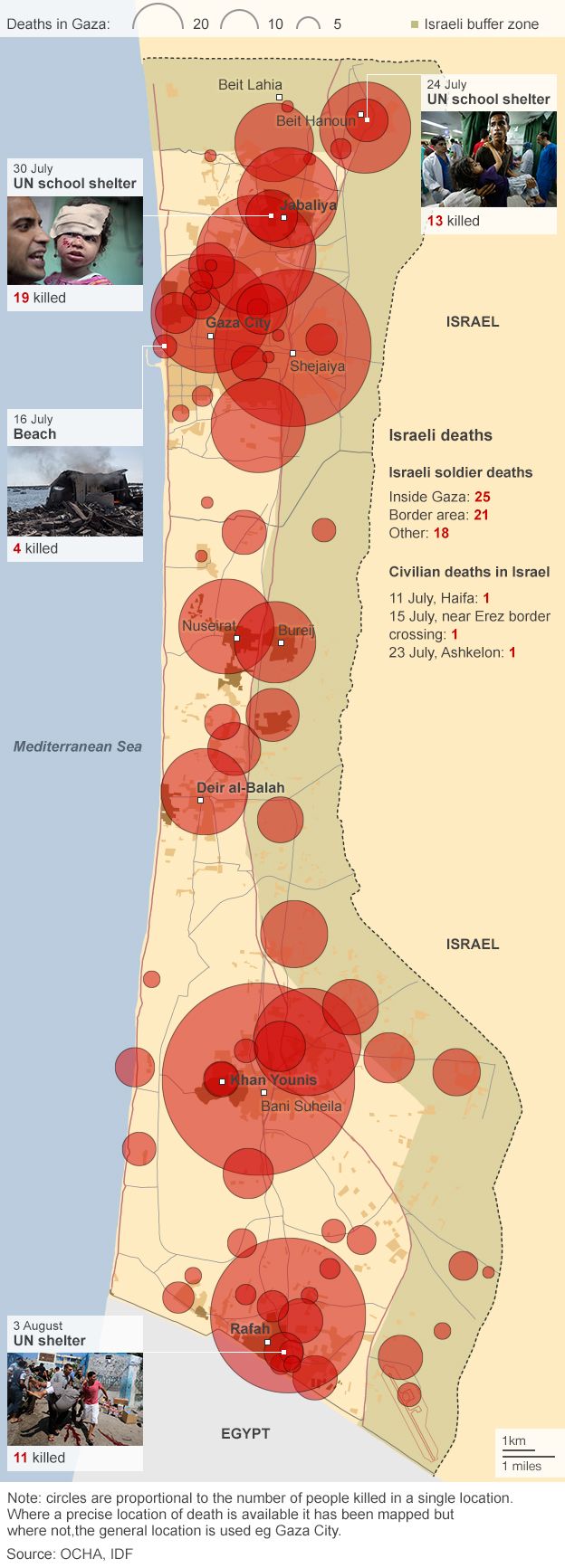
To put all of this in context, the BBC has mapped the deaths of 1,890 Palestinians – ‘mostly civilians’, as its accompanying chart shows – killed during the Israeli offensive to 6 August.  As you can see, Palestinians were killed ‘right across Gaza’ – not only in the expanded buffer zone shown on the map, though the carnage in Beit Hanoun and Shejaiya is clearly visible – with high concentrations also produced in the killing grounds of Gaza City and Khan Younis:

w640

Finally, in case you’re puzzled by the title for this post: Israel’s attack on Gaza is codenamed Tzuk Eitan in Hebrew, meaning ‘Firm Cliff’ or ‘Resolute Cliff’.  According to Yagiv Levy, ‘The operation’s name signals the power, commitment and resilience of the Israeli people.’  But the official English-language version, ‘Protective Edge’, was changed ‘to give it a more defensive connotation’ (really). As Steven Poole explains, ‘the bombing was supposedly “protective”, though not of those bombed’. All of this is of course in line with the designation of the Israeli military as the ‘Israeli Defence Forces’.

I decided I’d prefer to use a version that provides a more accurate rendering of what has happened – in Hebrew, English or Arabic.

Geographies of the Holocaust

We are in the preparatory stages for a new edition of the Dictionary of Human Geography, which I’m co-editing this time with Clive Barnett, Jeremy Crampton, Diana DavisGeraldine Pratt, Joanne Sharp and Henry Yeung.  At the moment, we are making devilishly difficult decisions over headwords (which to cut, which to add) and lengths (which to shorten, which to increase).  Of course, none of this is set in stone, and new entries always press themselves forward as the submission deadline draws near.  Sometimes they are words you wonder why they weren’t included in the first place.

One such, last time round, was ‘Holocaust’: a glaring omission from previous editions, I belatedly realised.  There was, after all, a considerable body of geographical work on it, some of it by geographers, which I did my best to incorporate in the entry I wrote in short order for the last edition.  In truth, I suspect I noticed the omission through my interest in Giorgio Agamben‘s Homo sacer and Remnants of Auschwitz; thinking about the geographies of the Holocaust made me realise that the space of the exception, however defined, was not limited by the barbed perimeter of the camp but extended out along the railway tracks to the ghettoes, the round-ups and a host of capillary and diminishing exceptions (see my discussion here).  This in turn makes the spatiality of the exception of constitutive significance.

51eob36VpHL

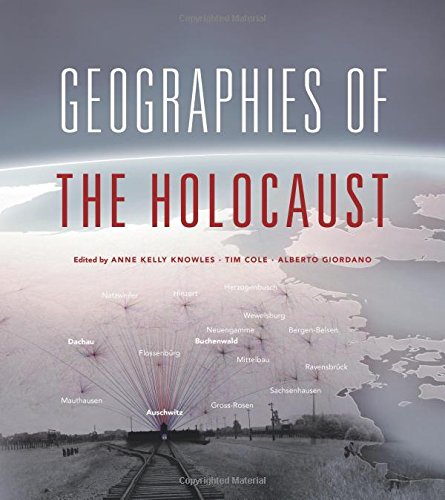
This time round, the intellectual task ought to be made easier by a new book edited by Anne Kelly Knowles, Tim Cole and Alberto Giordano, Geographies of the Holocaust, due from Indiana University Press in their Spatial Humanities series the middle of next month:

This book explores the geographies of the Holocaust at every scale of human experience, from the European continent to the experiences of individual human bodies. Built on six innovative case studies, it brings together historians and geographers to interrogate the places and spaces of the genocide. The cases encompass the landscapes of particular places (the killing zones in the East, deportations from sites in Italy, the camps of Auschwitz, the ghettos of Budapest) and the intimate spaces of bodies on evacuation marches. Geographies of the Holocaust puts forward models and a research agenda for different ways of visualizing and thinking about the Holocaust by examining the spaces and places where it was enacted and experienced.

1. Geographies of the Holocaust / Alberto Giordano, Anne Kelly Knowles, and Tim Cole
2. Mapping the SS Concentration Camps / Anne Kelly Knowles and Paul B. Jaskot, with Benjamin Perry Blackshear, Michael De Groot, and Alexander Yule
3. Retracing the “Hunt for Jews”: A Spatio-Temporal Analysis of Arrests during the Holocaust in Italy / Alberto Giordano and Anna Holian
4. Killing on the Ground and in the Mind: The Spatialities of Genocide in the East / Waitman W. Beorn, with Anne Kelly Knowles
5. Bringing the Ghetto to the Jew: The Shifting Geography of the Budapest Ghetto / Tim Cole and Alberto Giordano
6. Visualizing the Archive: Building at Auschwitz as a Geographic Problem / Paul B. Jaskot, Anne Kelly Knowles, and Chester Harvey, with Benjamin Perry Blackshear
7. From the Camp to the Road: Representing the Evacuations from Auschwitz, January 1945 / Simone Gigliotti, Marc J. Masurovsky, and Erik Steiner
8. Afterword / Paul B. Jaskot and Tim Cole

Tim Cole is the author of a series of outstanding geographical studies of the Holocaust, including Holocaust City on Budapest; he’s now Professor of Social History at Bristol, but his PhD in Geography at Cambridge was started under the supervision of Graham Smith, one of my dearest friends, who tragically died before the thesis was completed.

Here’s another old Cambridge friend Geoff Eley on the present collaborative project: ‘As a pioneering call to extend our familiar approaches, Geographies of the Holocaust offers a welcome model of collaborative interdisciplinarity — between historians and geographers, humanities and the social sciences, distinguished specialists and scholars from the outside. The desired purposes are admirably served. Thinking with space delivers not only a new range of challenging methodologies, but brings the well-established findings of the field under strikingly new perspectives too.’

Legal geographies and the assault on international law

I suspect anyone interested in international/transnational legal geographies will know of Jens David Ohlin‘s work already (he’s Professor of Law at Cornell and recently co-edited Targeted Killings: Law and Morality in an Asymmetrical World [Oxford, 2012]).  If not, check out his page on ssrn for recent papers; I’ve found three particularly helpful in thinking about US air strikes in Afghanistan and Pakistan and, more recently, the Israeli offensive against Gaza (more on this and the space of exception soon, I promise):

Targeting and the concept of intent (2013); Acting as a sovereign versus acting as a belligerent (2014); and The combatant’s privilege in asymmetric and covert conflicts (2014)

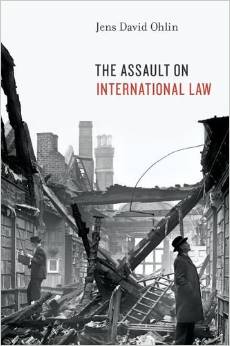
I’ve just received news of his new book out early in the New Year, whose relevance will be apparent from its title: The assault on international law.

OHLIN Assault of international lawInternational law presents a conceptual riddle. Why comply with it when there is no world government to enforce it? The United States has a long history of skepticism towards international law, but 9/11 ushered in a particularly virulent phase of American exceptionalism. Torture became official government policy, President Bush denied that the Geneva Conventions applied to the war against al-Qaeda, and the US drifted away from international institutions like the International Criminal Court and the United Nations.

Although American politicians and their legal advisors are often the public face of this attack, the root of this movement is a coordinated and deliberate attack by law professors hostile to its philosophical foundations, including Eric Posner, Jack Goldsmith, Adrian Vermeule, and John Yoo. In a series of influential writings they have claimed that since states are motivated primarily by self-interest, compliance with international law is nothing more than high-minded talk. Theses abstract arguments then provide a foundation for dangerous legal conclusions: that international law is largely irrelevant to determining how and when terrorists can be captured or killed; that the US President alone should be directing the War on Terror without significant input from Congress or the judiciary; that US courts should not hear lawsuits alleging violations of international law; and that the US should block any international criminal court with jurisdiction over Americans. Put together, these polemical accounts had an enormous impact on how politicians conduct foreign policy and how judges decide cases – ultimately triggering America’s pernicious withdrawal from international cooperation.

In The Assault on International Law, Jens Ohlin exposes the mistaken assumptions of these ‘New Realists,’ in particular their impoverished utilization of rational choice theory. In contrast, he provides an alternate vision of international law based on a truly innovative theory of human rationality. According to Ohlin, rationality requires that agents follow through on their plans even when faced with opportunities for defection. Seen in this light, international law is the product of nation-states cooperating to escape a brutish State of Nature–a result that is not only legally binding but also in each state’s self-interest.

Michael Sfard

But not all assaults on international law derive from the United States and from professors hostile to its philosophical foundations.  I urge you to read Michael Sfard‘s coruscating Op-Ed from Ha’artez on 4 August, ‘A “targeted assassination” of international law‘ (which is also available here if it disappears behind a paywall).  Michael is an Israeli human rights lawyer, specializing in international humanitarian law and dealing directly with the Israeli occupation of Palestine, and he is also the legal adviser to Yesh Din: Volunteers for Human Rights:

Israelis are surprised. Did I say surprised? Downright shocked. Even before the dust from the fighting has settled, even before this “most just of all wars” has ended, even as the most moral army in the world is still mired in Gaza – there is already talk of war crimes and an international investigation.

We, who didn’t carpet-bomb even though we could have, who dropped fliers and made phone calls and knocked on the roof; we, who agreed to the humanitarian cease-fire that Hamas violated; we, who took more precautions than any other nation would have done – we are once again being accused of war crimes. Once again, the same old song is being sung: decisions about opening an international investigation, talk of the International Criminal Court, fear of arrests in Europe. And we don’t understand why we deserve all this.

It is possible to console ourselves by accepting the explanation that the television journalists keep repeating to us: that the world is anti-Semitic and two-faced and supports Hamas. But this would constitute a regrettable evasion of the tough questions. It would constitute an effort to flee the pointed discussion Israeli society ought to be holding about the way we have waged armed conflicts with our enemies over the last decade.

Since the Second Lebanon War of 2006, the Israel Defense Forces has adopted an extremely problematic combat doctrine for conflicts that take place in urban areas with dense civilian populations, and in which the enemy is seen as an illegitimate terrorist entity (Hezbollah in Lebanon and Hamas in Gaza). This combat doctrine is supported by a legal theory developed by the IDF’s international legal division, which interprets the laws of war in a manner that is shockingly different from their accepted interpretation by experts in the field worldwide. Its direct result is massive civilian casualties and the destruction of civilian neighborhoods.

This combat doctrine consists of two elements, each of which is a declaration of war against the fundamental principles of the laws of armed combat. The first element redefines what constitutes a legitimate target for attack, such that it now includes not only classic military targets (bases, combatants, weapons stockpiles and so forth), but also facilities and objects whose connection to the enemy organization is nonmilitary in nature….

The second element is even more far-reaching: It holds that when fighting in urban areas, we are entitled to treat the entire area as a legitimate target and bombard it via air strikes or artillery shelling – as long as we first warn all the residents of our intention to do so and give them time to leave. The IDF first used this method in Beirut’s Dahiya neighborhood during the Second Lebanon War. Before bombing, the army dropped fliers telling the residents to leave. Then the bombs were dropped, and most of Dahiya’s houses were destroyed.

This doctrine was applied, to varying degrees, in Operations Cast Lead and Protective Edge as well, primarily in Gaza City’s Shujaiyeh neighborhood. It does not take into consideration the question of whether the prior warning given the population is effective – i.e., whether the population can in fact leave, whether solutions have been found for the elderly, the ill and the children. Nor is it accompanied by the creation of a safe corridor through which people can flee to someplace that won’t be fired on, and where civilians have what they need to survive.

The terrifying result of this combat doctrine, in both Cast Lead and Protective Edge, was piles of bodies of women, children and men who weren’t involved in the fighting….

The IDF’s lawyers, who provide legal support for this combat doctrine, are conducting a “targeted assassination” of the principles of international law: the principle of distinction, which requires differentiation between military targets (which are legitimate) and civilian targets (which aren’t); the principle of proportionality, which forbids attacking even a legitimate target if the anticipated harm to civilians is excessive in comparison to the military benefit from the target’s destruction; and the need to take effective, rather than merely symbolic, precautions.

More soon.

War cultures

929px-William_Orpen_-_Zonnebeke_-_Google_Art_Project

The British Academy is holding a two-day Landmark Conference in London on 12-13 November 2014, The First World War: Literature, Culture, Modernity.  The conference is convened by Santanu Das and  Kate McLoughlin:

A hundred years after the war’s outbreak, this conference brings together some of the world’s leading experts and emerging scholars to reassess its literary and cultural impact and explore its vexed relationship to modernity. Was the war a ‘crack in the table of history’ or did it reinforce deep continuities? What is the relationship between artistic form and historical violence, and between combatant and civilian creative responses? What are the colonial and transnational dimensions of First World War literature? Spanning across literature, the visual arts and music, the conference will adopt an international perspective as it investigates the war’s continuing legacies.

Registration is required; full details here.

In association with the conference, there will be an evening of music and readings at King’s College Chapel (London) on 11 November, Terrible Beauty: Music and Writing of the First World War, and an evening of poetry reading at the British Academy on 12 November, The Past Hovering: An Evening of War Poetry; both events are free but registration is required.

Following the colours

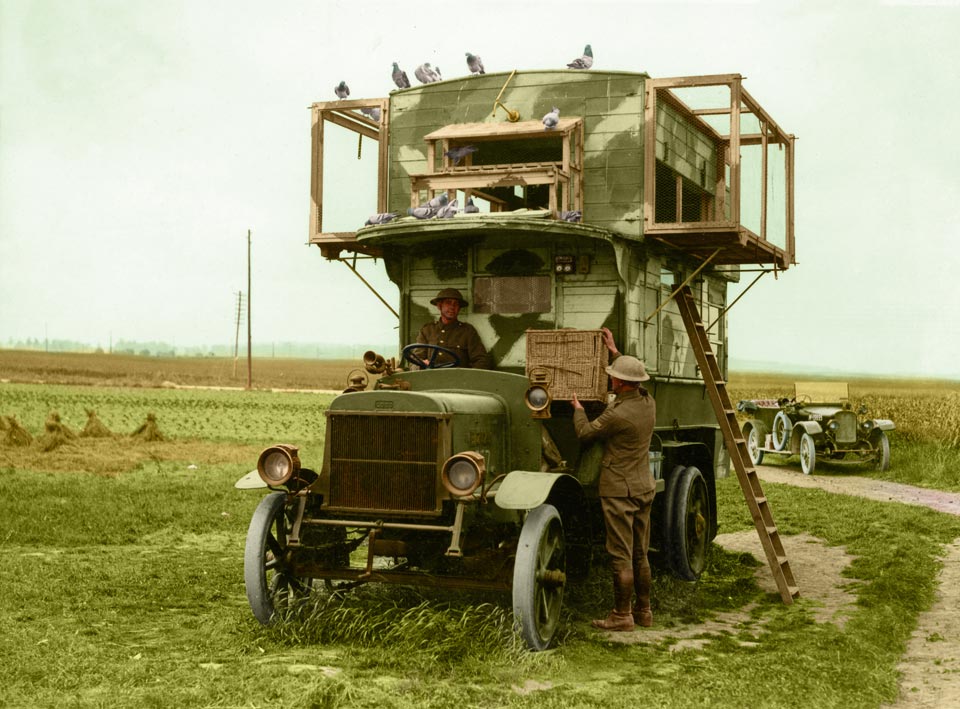
WWI Mobile carrier pigeon-loft

The Open University has just released online a series of ‘colourised’ photographs from the First World War.  My favourite is shown above: a mobile pigeon-loft so that messages could be carried back to GHQ (more on pigeons and the war effort here and especially here; their military service did not end with the First World War).

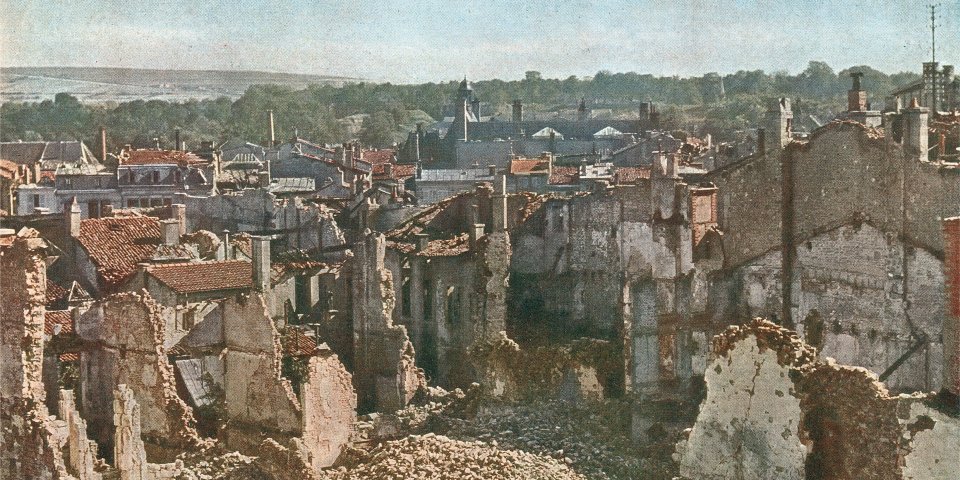
These were all originally black and white photographs, but Taschen has recently published a much more extensive collection of original colour (‘autochrome’) photographs – you can view some of the images online here – edited by Peter Walther, The First World War in Colour (384 pp).

Verdun

In an online announcement the publisher explains:

The devastating events of the First World War were captured in myriad photographs on all sides of the front. Since then, thousands of books of black-and-white photographs of the war have been published as all nations endeavour to comprehend the scale and the carnage of the “greatest catastrophe of the 20th century”. Far less familiar are the rare colour images of the First World War, taken at the time by a small group of photographers pioneering recently developed autochrome technology.

first_world_war_in_color_fo_gb_3d_05794_1406031040_id_813622To mark the centenary of the outbreak of war, this groundbreaking volume brings together all of these remarkable, fully hued pictures of the „war to end war“. Assembled from archives in Europe, the United States and Australia, more than 320 colour photos provide unprecedented access to the most important developments of the period – from the mobilization of 1914 to the victory celebrations in Paris, London and New York in 1919. The volume represents the work of each of the major autochrome pioneers of the period, including Paul Castelnau, Fernand Cuville, Jules Gervais-Courtellemont, Léon Gimpel, Hans Hildenbrand, Frank Hurley, Jean-Baptiste Tournassoud and Charles C. Zoller.

Since the autochrome process required a relatively long exposure time, almost all of the photos depict carefully composed scenes, behind the rapid front-line action. We see poignant group portraits, soldiers preparing for battle, cities ravaged by military bombardment – daily human existence and the devastating consequences on the front. A century on, this unprecedented publication brings a startling human reality to one of the most momentous upheavals in history.

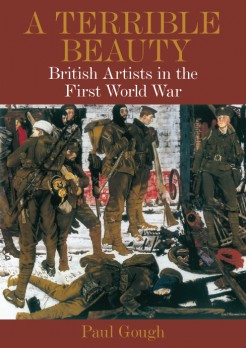
A-Terrible-Beauty-246x348And for an altogether different rendering of the First World War – often but not always in colour – I recommend Paul Gough‘s magisterial account of 15 artists (many of whom saw active service,  A terrible beauty: British artists in the First World War.  You can download the first chapter here, sadly without the illustrations: but Paul’s commentary is incisive, and I found his work really helpful in working on ‘Gabriel’s Map’, especially his essays on military sketching which considerably enlarged my sense of the ‘cartographic imaginary’ on the Western Front.  Gerry Corden has a fine account of the book here, and includes many excellent images including the work of my favourite C.W.R. Nevinson.  Finally, Paul’s own website is here: click on Vortex 1 through 5 at the bottom.

Not a pigeon in sight, though.

Handling the news

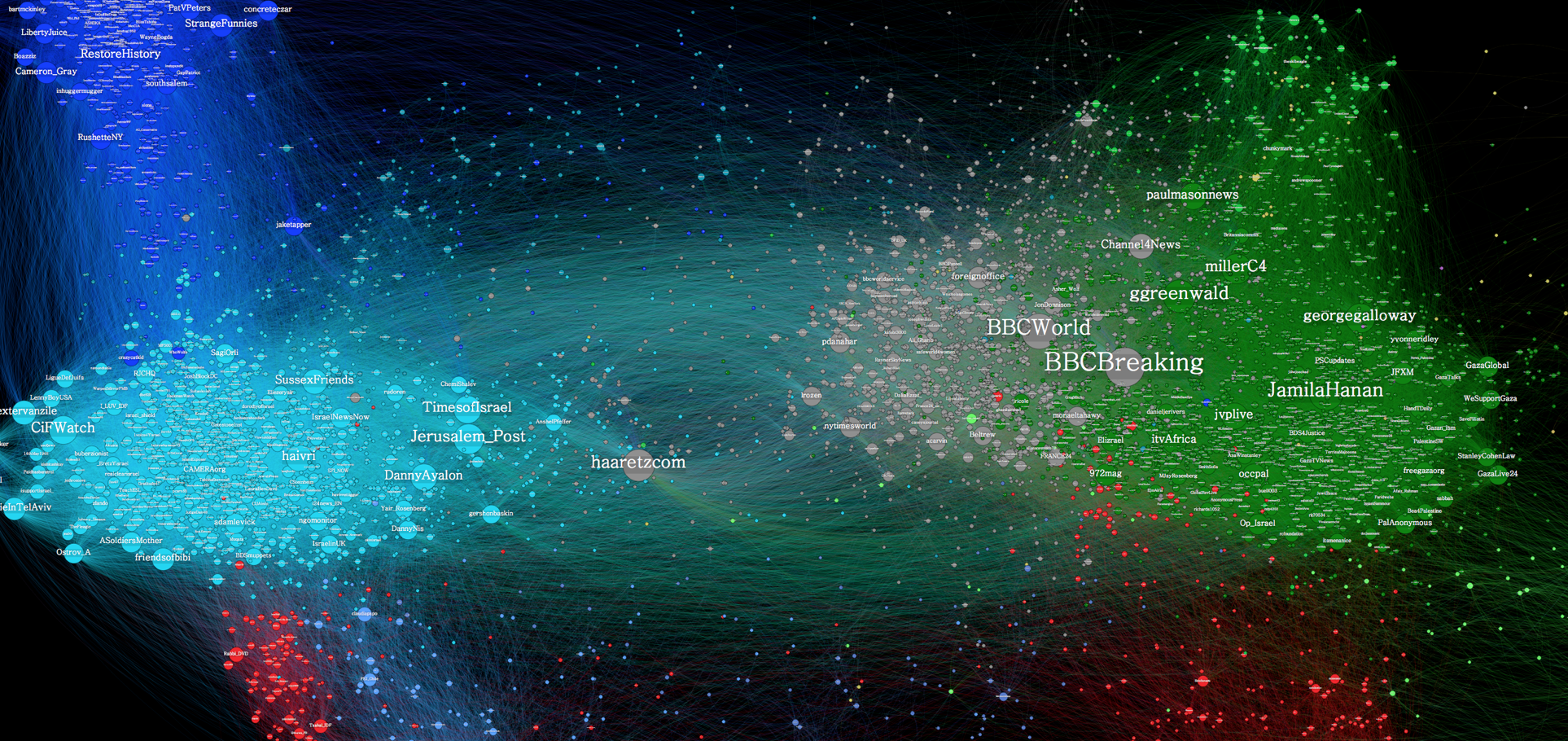
A follow-up to Virtual Gaza : Gilad Lotan, chief data scientists at beteaworks, has provided a mapping of the intersections between mainstream media news media and social media here, including a discussion of what he calls ‘personalising propaganda’.

Twitter handles responding to UNRWA school shelling 25-30 July

The Israeli liberal newspaper Ha’aretz appears between the broadly ‘pro-Palestinian’ networks on the right and the ‘pro-Israeli’ on the left.  These are his designations not mine (BBC? the New York Times??!!), but the mappings are of Twitter handles responding between 25-30 July to the Israeli shelling of an UNRWA school in Beit Hanoun – a particular event that sparked a particular series of reports – not the war as a whole.  And we should also remember that there is often a significant difference between reporting in the English-language and Hebrew editions of Ha’aretz

Legitimate targets?

I’ve been thinking about the description of Gaza as a space of exception in my last post, and I will elaborate (and qualify) that discussion shortly: in many ways the Israeli offensive against Gaza reinforces Achille Mbembe‘s arguments about necropolitics but, as I’ll try to show, suggests the need for a reworking of Giorgio Agamben‘s claims about the exception.

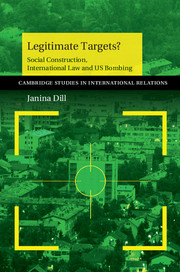
En route, I’ve been greatly taken by the work of Janina Dill (Politics and International Relations, Oxford) – particularly her discussion of Israel’s development of ‘Lawfare 2.0’ in relation to Gaza – and, as I say, I’ll have much more to say about that shortly.  But I’ve also discovered she has a book due out from Cambridge in the fall which, like her (I imagine summary) chapter in The American Way of Bombing, speaks to my own work on genealogies and geographies of bombing: Legitimate Targets? Social construction, international law and US bombing.

DILL Legitimate targets?Based on an innovative theory of international law, Janina Dill’s book investigates the effectiveness of international humanitarian law (IHL) in regulating the conduct of warfare. Through a comprehensive examination of the IHL defining a legitimate target of attack, Dill reveals a controversy among legal and military professionals about the ‘logic’ according to which belligerents ought to balance humanitarian and military imperatives: the logics of sufficiency or efficiency. Law prescribes the former, but increased recourse to IHL in US air warfare has led to targeting in accordance with the logic of efficiency. The logic of sufficiency is morally less problematic, yet neither logic satisfies contemporary expectations of effective IHL or legitimate warfare. Those expectations demand that hostilities follow a logic of liability, which proves impracticable. This book proposes changes to international law, but concludes that according to widely shared normative beliefs on the twenty-first-century battlefield there are no truly legitimate targets.

Introduction
Part I. A Constructivist Theory of International Law:
1. The challenge
2. The theory
Part II. The Definition of a Legitimate Target of Attack in International Law:
3. Positive law
4. Customary law
Part III. An Empirical Study of International Law in War:
5. The rise of international law in US air warfare
6. The changing logic of US air warfare
7. The behavioural relevance of international law in US air warfare
Part IV. An Evaluation of International Law in War:
8. The lack of normative success of international law in US air warfare
9. The impossibility of normative success for international law in war
Conclusion.