Style wars

One of these days I’ll set out the advice I give to students about writing essays – and when I do I’ll also include what I wish published authors would avoid too (me included) – but in the meantime you might be interested in these trenchant words of advice:

Keep the language crisp and pungent; prefer the forthright to the pompous and ornate.
Do not stray from the subject; omit the extraneous, no matter how brilliant it may seem or even be.
Favor the active voice and shun streams of polysyllables and prepositional phrases.
Keep sentences and paragraphs short, and vary the structure of both.
Be frugal in the use of adjectives and adverbs; let nouns and verbs show their own power.

They are taken from the CIA’s detailed Style Manual & Writers Guide for Intelligence Publications issued in 2011; you can find Michael Silverberg‘s commentary at Quartz here.

CIA Style Guide

What particularly caught my eye was this admonition:

Do not uppercase the w in Korean war, which was “undeclared”; the same logic applies to Vietnam war and Falklands war, and a similar convention (if not logic) to the Iran-Iraq war.

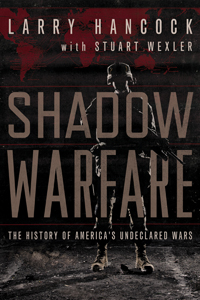
Shadow-Warfare_FINALHidden in plain sight here is the remarkable fact that the United States has not formally declared war since 1941.  You may think that not much depends on a formal declaration, and you would be right, except that this reluctance says much about executive authority and, crucially, what Larry Hancock and Stuart Wexler call, in their excellent Shadow Warfare (Counterpoint, 2014), ‘the history of America’s undeclared wars’.

In a sense, their book provides the back-story to Jeremy Scahill‘s Dirty Wars:

Contrary to their contemporary image, deniable covert operations are not something new. Such activities have been ordered by every president and every administration since World War II. Clandestine operations have often relied on surrogates, with American personnel involved only at a distance, insulated by layers of deniability.

Shadow Warfare traces the evolution of these covert operations, detailing the tactics and tools used from the Truman era through those of the contemporary Obama administration. It also explores the personalities and careers of many of the most noted shadow warriors of the past sixty years, tracing the decades-long relationship between the CIA and the military.

Shadow Warfare offers a balanced, non-polemic exploration of American concealed warfare, detailing its patterns, consequences, and collateral damage, and presenting its successes as well as its failures. Hancock and Wexler explore why every president, from Franklin Roosevelt on, felt compelled to turn to secret, deniable military action. It also delves into the political dynamic of the president’s relationship with Congress, and the fact that despite decades of warfare, Congress has chosen not to exercise its responsibility to declare a single state of war—even for extended and highly visible combat.

Periscope

Unknown

Continuing my gradual process of re-immersion….  I suspect that, for many of us, the summer is a time to redeem all those promissory notes: to devise a new research and writing schedule, free of term-time commitments, to turn notes and drafts into a finished essay, chapter or book; and – this I don’t suspect, I know – to issue even more promissory notes (‘I will get it to you by the end of next month…’).  But it’s also a time for more or less uninterrupted reading, catching up with stuff for research and for teaching, but also – this I also know – as a distraction from all those promissory notes.

2014_cover_publication_forensis_imgsize_SSo here’s my preliminary list which is also intended to answer the perennial ‘Have you read anything interesting lately?’ question.  As I explained here, under this heading I list stuff that is catching my attention at the moment – sometimes with a brief annotation, sometimes not; sometimes hot off the press (or, appropriately enough, the Kindle), sometimes something I really should have noticed an age ago…. And I promise to try to do this more often in future.  I’ve excluded all those books I’ve already trailed, but I must make one exception: my copy of Forensis was waiting for me on my return – ordered from the excellent Book Depository (‘free delivery worldwide’ – and incredible fast too) – and it is sumptuous.  As soon as I’ve finished this post, I’m off to the deck with a drink to continue reading it.

Here’s my list:

Richard Adams and Chris Barrie, ‘The bureaucratisation of war: moral challenges exemplified by the covert lethal drone’, Ethics & Global Politics 6 (4) (2013) 245-60 – I’m thinking about this in relation to my essay/chapter on ‘The God trick and the administration of military violence’, which is a detailed analysis of the Uruzgan air strike: ‘administration’ here has its double meaning, for which I am as always deeply grateful to David Nally who first alerted me to it (in the radically different context of the Irish Famine).

0804787182Irus Braverman, Nicholas Blomley, David Delaney and Alexandre Kedar (eds) The expanding spaces of law: a timely legal geography (Stanford University Press, 2014) – essential reading, important not least for Michael Smith on ‘the geolegalities of the Afghanistan intervention’; it’s taken legal geography a surprisingly long time to address international law, no?  I sometimes think that if I had realised the intellectual firepower of critical legal scholarship (especially in relation to international law) and its intersections with critical human geography years ago, I would have followed a radically different career path.

Unlearning the citySwati Chattopadhyay, Unlearning the city: infrastructure in a new optical field (Minnesota, 2013) – this is a truly lovely book, bursting with ideas, but I’m trying to ‘reverse-engineer’ some of them: Unlearning the city is about subaltern groups re-working established urban infrastructures, and I want to transport this to Baghdad as I re-think what I once called ‘the counter-city’ and to explore other insurgent practices….

Jihadis ReturnPatrick Cockburn, The Jihadis Return: ISIS and the new Sunni uprising (OR Books, 2014) – as I try to keep up with events in Syria and Iraq for The everywhere war, Cockburn’s reports from Baghdad are as lucid and indispensable as they were for The colonial present.

Jean Comaroff and John Comaroff, Theory from the South: or, how Euro-America is evolving toward Africa (Paradigm, 2012): I read this last year, and always learn so much from these authors; but with the Johannesburg Workshop in Theory and Criticism travelling around South Africa at the moment (‘Archives of the Non-Racial’ this year, and you can check out previous presentations and productions here) it’s a good time to re-visit and re-think what I thought I’d learned.

J. Martin Daughtry, ‘Thanatosonics: ontologies of acoustic violence’, Social text 119 (32 [4]) (2014) 25-51 – I’ve noted the importance of the sounds of war on several occasions, here and here and (on sound-ranging) here, and incorporated some of that into my discussion of the corpographies of the Western Front in ‘Gabriel’s map’ (DOWNLOADS tab), but this is a must-read essay both for its general argument and for its compelling discussion of the thanatosonics of the US-led war in Iraq.

Rosalyn Deutsche, ‘Un-War: an aesthetic sketch’, October 147 (2014) 3-19 – a characteristically clear and though-provoking reflection on Krzysztof Wodiczko‘s Arc de Triomphe: World Institute for the Abolition of War (see my post here).  A welcome change from the preachiness of peace-talk in some quarters.

Isla Forsyth, ‘Designs on the desert: camouflage, deception and the militarisation of space’, Cultural geographies 21 (2014) 247-265 – an exquisitely written account of the camoufleurs in the Western Desert in the Second World War, which I’m drawing on for the long-form version of ‘The nature(s) of war’ (one of my promissory notes).

John Bellamy Foster and Robert W. McChesney, ‘Surveillance Capitalism, Monopoly-Finance Capital, the Military-Industrial Complex, and the Digital Age’, Monthly Review 66 (3) (2014) available as a pdf here.

No Good MenAnand Gopal, No good men among the living: America, the Taliban and the war through Afghan eyes (Metropolitan Books, 2014) – see Juan Cole‘s commentary here.

Marie-Hélène Huet, The culture of disaster (University of Chicago Press, 2012) – a brilliant genealogy of disaster from the Enlightenment to the present: I’m particularly taken by the final chapter, ‘Now playing everywhere’ (not least because I think war is a disaster too).

John Kaag and Sarah Kreps, Drone warfare (Polity, 2014) – a philosopher and a political scientist join forces; no shortage of books on drones on the way, but this is likely to be one of the very best.  If you haven’t seen it, their NYT Op-Ed from 2012, ‘The moral hazard of drones’, is here.

Laleh Khalili, ‘The uses of happiness in counterinsurgencies’, Social text 118 [32 (1)] (2014) 23-43 – another artful, spellbinding essay from our most accomplished critic of counterinsurgency.

Jason Lyall, ‘Bombing to lose? Airpower and the dynamics of coercion in counterinsurgency wars’, available here – yet another forensic account from one of the most astute analysts in contemporary political science; it’s the lead chapter from his book-in-progress, Death from above: the effects of air power in small wars.

Robert Marzec, ‘Militarized ecologies: visualisation of environmental struggle in the Brazilian Amazon’, Public culture 26 (2) (2014) 233-255 – more than anything I’ve read in an age, this has helped me re-think the implications of my work on ‘The nature(s) of war’ for contemporary military violence (and also made me realise how much more I need to do); it’s remarkably modest in tone and temper but it’s also theoretically sophisticated and written with a power, imagination and clarity that is wholly enviable.  Its opening epigraph is an extraordinary remark from US Admiral T. Joseph Lopez: ‘Climate change will provide the conditions that will extend the war on terror’…. Discuss.

Transformation of the WorldJürgen OsterhammelThe Transformation of the World: A Global History of the Nineteenth Century (Princeton University Press, 2014) – with its chapters on Space, Mobilities, Frontiers, Networks and much (much) more, David Cannadine suggests that this acclaimed panoramic survey by ‘the Braudel of the nineteenth century’ is the one work of history to read this summer and, he adds,’believe me, it will take you all of a very long summer’.  But why no illustrations?

 Clare Richard and Peter Asaro, ‘Can drones have ethics?’ An extended interview with Peter Asaro over at Public Books; I really like Peter’s work, and if you haven’t read his ‘The Labor of Surveillance and Bureaucratized Killing: New Subjectivities of Military Drone Operators’, Social semiotics 23 (2) (2013) 196-224, now’s the time…

Ann Rogers and John Hill, Unmanned: drone warfare and global security (Pluto Press, 2014).

Kristin Bergtora Sandvik and Kjersti Lohne, ‘The rise of the humanitarian drone’, Millennium (online first: 27 June 2014) – a much needed discussion of how ‘military humanism’ has become entangled with drone warfare, showing how the military conduct of remote operations may also affect the deployment of so-called ‘humanitarian drones’.

Counterinsurgent's constitutionGanesh Sitaraman, The counterinsurgent’s constitution: law in the age of small wars (Oxford University Press, 2013).

David Trotter, ‘Messages from the 29th Floor‘, London Review of Books, 3 July 2014 – a very different ‘politics of verticality’…

Elspeth van Veeren, ‘Materializing US Security: Guantanamo’s object lessons and concrete messages’, International Political Sociology 8 (2014) 20-42 – a compelling account of a ‘Guantanamo tour’ (yet another arrow in the dismal quiver of ‘dark tourism’) and its wider implications.  More generally, you can find reports on last month’s conference on Ending sexual violence in conflict here

Julia Welland, ‘Militarised violences, basic training and the myths of asexuality and discipline’, Review of International Studies 39 (2013) 881-902 – an immensely helpful argument that works with Avery Gordon‘s ideas about ‘haunting’ to think through the sexualisation of military violence and detainee abuse.

Elvin Wyly, ‘The new quantitative revolution’, Dialogues in human geography 4 (1) (2014) 26-38 – not what you might think, and about much more than its characteristically modest title: a brilliant, just brilliant, wonderfully angry warning about the threats to a critical spatial science from the neo-liberal noösphere in which Elvin and I (and you) are embedded.

 Joseba Zulaika, ‘Drones and fantasy in US counterterrorism’, Journal for cultural research 218 (2) (2014) 171-87

Theatre of Operations

I am at last back in Vancouver after what seemed at times like a marathon on the road (even though part of it was vacation), and there’s much to catch up on and much to report.

But I’m going to ease myself in gently with news of a forthcoming book by Joseph Masco.  Many readers will know his previous book, The Nuclear Borderlands: the Manhattan Project in post-Cold War New Mexico (Princeton, 2006), a tour de force – appropriately enough – that carried off a string of major prizes. (If you don’t know it, you can get a taste in his ‘Desert modernism’, available as a pdf from Cabinet 13 (2004) here).

MASCO Theater of OperationsHis new book, due out from Duke University Press in November, is The Theater of Operations: National security affect from the Cold War to the war on terror:

How did the most powerful nation on earth come to embrace terror as the organizing principle of its security policy? In The Theater of Operations, Joseph Masco locates the origins of the present-day U.S. counterterrorism apparatus in the Cold War’s “balance of terror.” He shows how, after the attacks of 9/11, the U.S. Global War on Terror mobilized a wide range of affective, conceptual, and institutional resources established during the Cold War to enable a new planetary theater of operations. Tracing how specific aspects of emotional management, existential danger, state secrecy, and threat awareness have evolved as core aspects of the American social contract, he draws on archival, media, and ethnographic resources to offer a new portrait of American national security culture. Undemocratic and unrelenting, this counterterror state prioritizes speculative practices over facts, and ignores everyday forms of violence across climate, capital, and health in an unprecedented effort to anticipate and eliminate terror threats – real, imagined, and emergent.

I’ve commented on the idea of a ‘theatre of war’ on several occasions (see here and here) and in his new book Masco seems to be excavating its performative/manipulative dimensions to explore the constitution of ‘a new, planetary theatre of operations’ – something else to take into account as I race towards completing The everywhere war.  I’m also greatly taken by a genealogy that begins not with 9/11, which is emphatically not the moment when ‘everything changed’, but with the Cold War…

The Theater of Operations has won advance praise from another of my favourite authors, Peter Galison:

“We know that in the Cold War transportation infrastructures boomed, electronic infrastructures had to be hardened. We know about weapons and counter-weapons; we even have learned about the astonishing proliferation of security mechanisms put in place during the War on Terror. What Joseph Masco shows us in The Theater of Operations is an entire affective structure—the management of anxiety, resilience, steadfastness, sacrifice—that is demanded of every citizen. Alert to liquid containers above 2.4 ounces, hypervigilant to abandoned bags, suspicious loitering, or the detonation of a thermonuclear weapon—we learn to live our lives aware of tiny and apocalyptic things. With an anthropologist’s eye long attuned to life in the para-wartime state, Masco is the perfect guide to the theater of our lives in the security state.”

Joseph MascoEvidently not a person to stand still for long, Masco is already at work on a book on environmental crisis: you can dip a toe into the water at the excellent somatosphere (on science, medicine and anthropology) here, or dig out his chapter on ‘Bad weather: the time of planetary crisis’ in Martin Holbraad and Morten Axel Pedersen (eds), Times of security: ethnographies of fear, protest and the future, which came out from Routledge last summer.  The abstract (below), together with a link to an earlier essay on ‘Building the Bunker Society’ (available as a pdf), is here:

How, and when, does it become possible to conceptualize a truly planetary crisis? The Cold War nuclear arms race installed one powerful concept of planetary crisis in American culture. The science enabling the US nuclear arsenal, however, also produced unintended byproducts: notably, a radical new investment in the earth sciences. Cold War nuclear science ultimately produced not only bombs, but also a new understanding of the earth as biosphere. Thus, the image of planetary crisis in the US was increasingly doubled during the Cold War – the immediacy of nuclear threat matched by concerns about rapid environmental change and the cumulative effects of industrial civilization on a fragile biosphere. This paper examines the evolution of (and competition between) two ideas of planetary crisis since 1945: nuclear war and climate change. In doing so, the paper offers an alternative history of the nuclear age and considers the US national security implications of a shift in the definition of planetary crisis from warring states to a warming biosphere.

And while we are on the subject of ‘bad weather’, climate change and national security, the GAO recently released a report on the implications of global climate change for US military infrastructure. You can read a summary review here, which points out that while the Pentagon evidently takes climate change very seriously indeed – there has been a string of seminars, workshops and conferences testifying to that – the die-hards in the Republican Party continue to do everything they can to block even military-sponsored research into climate change.  As Representative David McKinley put it:

Our climate is obviously changing; it has always been changing. With all the unrest around the global [sic], why should Congress divert funds from the mission of our military and national security to support a political ideology? This amendment will ensure we maximize our military might without diverting funds for a politically motivated agenda.

The engorgement of ‘military might’ severed from a ‘politically motivated agenda’: you can’t make this stuff up.  Even for the theatre.

Drones, battlefields and later modern war

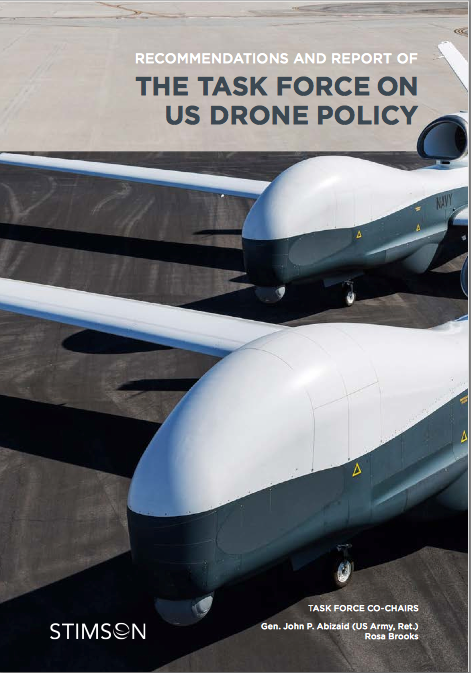
STIMSON Drone report 2014

This morning the Stimson Center issued an 81-page Recommendations and Report of the Task Force on US Drone Policy: you can access it online via the New York Times here or download it as a pdf here; Mark Mazetti‘s report for the Times is here.

Founded in 1989, the Stimson Center is a Washington-based ‘non-profit and non-partisan’ think-tank that prides itself on providing ’25 years of pragmatic solutions to global security’.  It’s named after Henry Stimson, who served Presidents Taft, Roosevelt and Truman as Secretary of War and President Hoover as Secretary of State.  The Center established its 10-member Task Force on drones a year ago, with retired General John Abizaid (former head of US Central Command, 2003-2007) and Rosa Brooks (Professor of Law at Georgetown) as co-chairs; the Task Force was aided by three Working Groups – on Ethics and Law; Military Utility, National Security and Economics; and Export Control and Regulatory Challenges – each of which is preparing more detailed reports to be published later this year.  The present Report focuses on

‘key current and emerging issues relating to the development and use of lethal UAVs outside the United States for national security purposes. In particular, we focus extensively on the use of UAVs for targeted counterterrorism strikes, for the simple reason that this has generated significant attention, controversy and concern.’

But this focus repeats and compounds the myopia of both conventional wisdom and contemporary debate.  The Report summarily (and I think properly) rejects a number of misconceptions about the use of drones, insisting that their capacity to strike from a distance is neither novel nor unique; noting that the vast majority of UAVs in the US arsenal are non-weaponized (‘less than 1 percent of … UAVs carry operational weapons at any given time’ – though their intelligence, surveillance and reconnaissance functions are of course closely tied to the deployment of weapons by conventional strike aircraft or ground forces); and arguing that ‘UAVs do not turn killing into “a video game”‘. These counter-claims are unexceptional and the Task Force presents them with clarity and conviction.

But the Report also accepts that the integration of UAVs into later modern war on ‘traditional’ or ‘hot’ battlefields [more about those terms in a moment] is, by and large, unproblematic.  Thus:

‘UAVs have substantial value for a wide range of military and intelligence tasks. On the battlefield, both weaponized and non-weaponized UAVs can protect and aid soldiers in a variety of ways. They can be used for reconnaissance purposes, for instance, and UAVs also have the potential to assist in the detection of chemical, biological, radiological and nuclear weapons, as well as ordinary explosives. Weaponized UAVs can be used to provide close air support to soldiers engaged in combat.’

A footnote expands on that last sentence:

‘In the past, warfighters on the ground under imminent threat would have to navigate a complicated command hierarchy to call for air support. The soldier on the ground would have to relay coordinates to a Forward Air Controller (FAC), who would then talk the pilot’s eyes onto a target in an extremely hostile environment. These missions have always been very dangerous for the pilot, who has to fly low and avoid multiple threats, and also for people on the ground. It is a human-error rich environment, and even today, it is not uncommon for the wrong coordinates to be relayed, resulting in the deaths of friendlies or innocent civilians. To ease these difficulties, DARPA is currently investigating how to replace the FAC and the pilot by a weaponized UAV that will be commanded by the soldier on the ground with a smartphone.’

And subsequently the Report commends the ‘robust’ targeting process put in place by the US military and the incorporation of military lawyers (JAGs) into the kill-chain:

‘The Department of Defense has a robust procedure for targeting, with outlined authorities and steps, and clear checks on individual targets. The authorization of a UAV strike by the military follows the traditional process in place for all weapons systems (be they MQ-9 Reaper drones or F-16 fighter jets). Regardless of whether particular strikes are acknowledged, the Pentagon has stated that UAV strikes, like strikes from manned aircraft, are subject to the military’s pre-strike target development procedures and post-strike assessment.

‘The process of determining and executing a strike follows a specific set of steps to ensure fidelity in target selection, strike and post-strike review.’

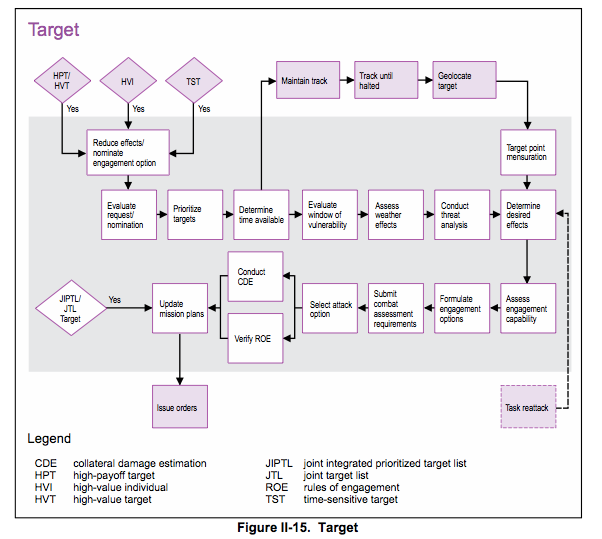
Targeting cycle

Both Craig Jones and I have discussed the targeting cycle [the figure above shows one of six steps in the ‘find-fix-track-target-engage-assess’ cycle, taken from JP 3-60 on Joint Targeting, issued in January 2013] and the role of operational law within it (Craig in much more detail than me), and these are all important considerations.  But the Report glosses over the fragilities of the process, which in practice is not as ‘robust’ as the authors imply.  They concede:

‘No weapons system is perfect, and targeting decisions — whether for UAV strikes or for any other weapons delivery system — are only as good as the intelligence on which they are based. We do not doubt that some US UAV strikes have killed innocent civilians. Nonetheless, the empirical evidence suggests that the number of civilians killed is small compared to the civilian deaths typically associated with other weapons delivery systems (including manned aircraft).’

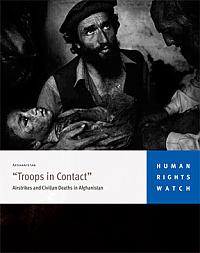
cover_646That last sentence is not unassailable, but in addition I’ve repeatedly argued that it is a mistake to abstract strikes carried out by UAVs from the wider network of military violence in which their ISR capabilities are put to use:  hence my ongoing work on the Uruzgan airstrike in Afghanistan, for example, and on ‘militarised vision’ more generally.  What these studies confirm is that civilian casualties are far more likely when close air support is provided – by UAVs directly or by conventional strike aircraft – to ‘troops in contact’ (even more so when, as in both the Kunduz and Uruzgan airstrikes, it turns out that troops calling in CAS were not ‘in contact’ at all).

In short, while it’s perhaps understandable that a Task Force that included both General Abizaid and Lt-Gen David Barno (former head of Combined Forces Command – Afghanistan from 2003-2005) should regard the use of UAVs on ‘traditional’ battlefields as unproblematic, I think it regrettable that their considerable expertise did not result in a more searching evaluation of remote operations in Afghanistan and Iraq.

But what, then, of those ‘non-traditional’ battlefields?  A footnote explains:

‘Throughout this report, we distinguish between the use of UAV strikes on “traditional” or “hot” battlefields and their use in places such as Pakistan, Yemen and Somalia. These are terms with no fixed legal meaning; rather, they are merely descriptive terms meant to acknowledge that the US of UAV strikes has not been particularly controversial when it is ancillary to large-scale, open, ongoing hostilities between US or allied ground forces and manned aerial vehicles, on the one hand, and enemy combatants, on the other. In Afghanistan and Iraq, the United States deployed scores of thousands of ground troops and flew a range of close air support and other aerial missions as part of Operation Enduring Freedom, and UAV strikes occurred in that context. In Libya, US ground forces did not participate in the conflict, but US manned aircraft and UAVs both operated openly to destroy Libyan government air defenses and other military targets during a period of large scale, overt ground combat between the Qaddafi regime and Libyan rebel groups. In contrast, the use of US UAV strikes in Yemen, Pakistan and elsewhere has been controversial precisely because the strikes have occurred in countries where there are no US ground troops or aerial forces openly engaged in large scale combat.’

0202megret0

A major focus of the report is on what Frédéric Mégret (above) has called ‘the deconstruction of the battlefield‘ and the countervailing legal geographies that provide an essential armature for later modern war (though it’s surprising that the Report makes so little use of academic research on UAVs and contemporary conflicts).  The authors ‘disagree with those critics who have declared that US targeted killings [in Pakistan, Yemen and Somalia] are “illegal”’ – no surprise there either, incidentally, since one of the Working Groups included Kenneth Anderson, Charles Dunlap and Christine Fair: I’m not sure in what universe that counts as ‘non-partisan’) but they also accept that these remote operations move in a grey zone (and in the shadows):

‘The law of armed conflict and the international legal rules governing the use of force by states arose in an era far removed from our own. When the Geneva Conventions of 1949 were drafted, for instance, it was assumed that most conflicts would be between states with uniformed, hierarchically organized militaries, and that the temporal and geographic boundaries of armed conflicts would be clear.

‘The paradigmatic armed conflict was presumed to have a clear beginning (a declaration of war) and a clear end (the surrender of one party, or a peace treaty); it was also presumed the armed conflict to be confined geographically to specific, identifiable states and territories. What’s more, the law of armed conflict presumes that it is a relatively straightforward matter to identify “combatants” and distinguish them from “civilians,” who are not targetable unless they participate directly in hostilities. The assumption is that it is also a straightforward matter to define “direct participation in hostilities.”

‘The notion of “imminent attack” at the heart of international law rules relating to the use of force in state self-defense was similarly construed narrowly: traditionally, “imminent” was understood to mean “instant, overwhelming, and leaving no choice of means, and no moment for deliberation.”

‘But the rise of transnational non-state terrorist organizations confounds these preexisting legal categories. The armed conflict with al-Qaida and its associated forces can, by definition, have no set geographical boundaries, because al-Qaida and its associates are not territorially based and move easily across state borders. The conflict also has no temporal boundaries — not simply because we do not know the precise date on which the conflict will end, but because there is no obvious means of determining the “end” of an armed conflict with an inchoate, non-hierarchical network.

‘In a conflict so sporadic and protean — a conflict with enemies who wear no uniforms, operate in secret and may not use traditional “weapons” — the process of determining where and when the law of armed conflict applies, who should be considered a com- batant and what counts as “hostilities” inevitably is fraught with difficulty…

‘While the legal norms governing armed conflicts and the use of force look clear on paper, the changing nature of modern conflicts and security threats has rendered them almost incoherent in practice. Basic categories such as “battlefield,” “combatant” and “hostilities” no longer have a clear or stable meaning. And when this happens, the rule of law is threatened.’

These too are important considerations, but they are surely not confined to counter-terrorism operations in Pakistan, Yemen and Somalia: they also apply with equal force to counterinsurgency operations in Afghanistan and Iraq, and intersect with a wider and much more fraught debate over the very idea of ‘the civilian’.

There is a particularly fine passage in the Report:

‘Consider US targeted strikes from the perspective of individuals in — for instance — Pakistan or Yemen. From the perspective of a Yemeni villager or a Pakistani living in the Federally Administered Tribal Areas (FATA), life is far from secure. Death can come from the sky at any moment, and the instability and incoherence of existing legal categories means that there is no way for an individual to be certain whether he is considered targetable by the United States. (Would attending a meeting or community gathering also attended by an al-Qaida member make him targetable? Would renting a building or selling a vehicle to a member of an “associated” force render him targetable? What counts as an “associated force?” Would accepting financial or medical aid from a terrorist group make him a target? Would extending hospitality to a relative who is affiliated with a terrorist group lead the United States to consider him a target?).

‘From the perspective of those living in regions that have been affected by US UAV strikes, this uncertainty makes planning impossible, and makes US strikes appear arbitrary. What’s more, individuals in states such as Pakistan or Yemen have no ability to seek clarification of the law or their status from an effective or impartial legal system, no ability to argue that they have been mistakenly or inappropriately targeted or that the intelligence that led to their inclusion on a “kill list” was flawed or fabricated, and no ability to seek redress for injury. Their national laws and courts can offer no assistance in the face of foreign power, and far from protecting their fundamental rights and freedoms, their own states may in fact be deceiving them about their knowledge of and cooperation with US strikes. Meanwhile, geography and finances make it impossible to access US courts, and a variety of legal barriers — such as the state secrets privilege, the political question doctrine, and issues of standing, ripeness and mootness — in any case would prevent meaningful access to justice.’

This is one of the clearest summaries of the case for transparency and accountability I’ve seen, but the same scenario has also played out in Afghanistan (and in relation to the Taliban, which appears only once in the body of the Report) time and time again.  There are differences, to be sure, but the US military has also carried out its own targeted killings in Afghanistan, working from its Joint Prioritized Effects List.  The Report notes that ‘in practice, the military and CIA generally work together quite closely when planning and engaging in targeted UAV strikes: few strikes are “all military” or “all CIA”’ – which is true in other senses too – and this applies equally in Afghanistan.

In sum, then, this is a valuable and important Report – but it would have been far more incisive had its critique of ‘US drone policy’ cast its net wider to provide a more inclusive account of remote operations.  The trans-national geographies of what I’ve called ‘the everywhere war’ do not admit of any simple distinction between ‘traditional’ and ‘non-traditional’ battlefields, and trying to impose one on such a tangled field of military and paramilitary violence ultimately confuses rather than clarifies.  I realise that this is usually attempted as an exercise in what we might call legal cartography, but I also still think William Boyd‘s Gabriel was right when, in An Ice-Cream War, he complained that maps give the world ‘an order and reasonableness’ it doesn’t possess.  And we all also know that maps – like the law – are instruments of power, and that both are intimately entangled with the administration of military violence.

The Federal Administration of Military Violence

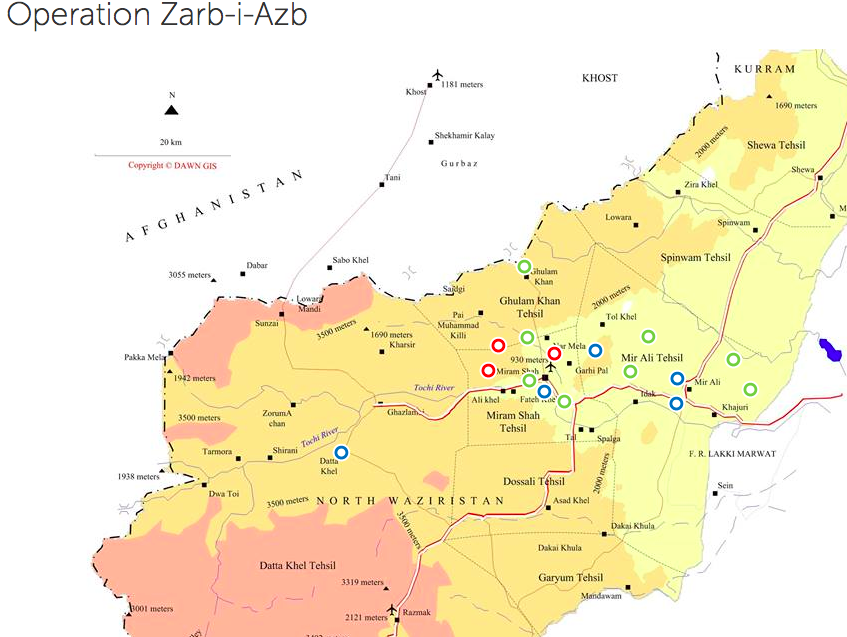
On 15 June – one week after the attack on Karachi’s international airport by the Pakistan Taliban (Tehrik-i-Taliban or TTP) and the Islamic Movement of Uzbekistan (UMI) – the Pakistan military announced its ‘comprehensive’ Operation Zarb-i-Azb in the Federally Administered Tribal Areas (FATA).  From their bases in North Waziristan, the statement announced, militants had ‘waged a war against the state of Pakistan’ and the military had been ‘tasked to eliminate these terrorists regardless of hue and color, along with their sanctuaries.’  Although the press release insisted that ‘these enemies of the state will be denied space anywhere across the country’ the epicentre of the operation was and remains North Waziristan.

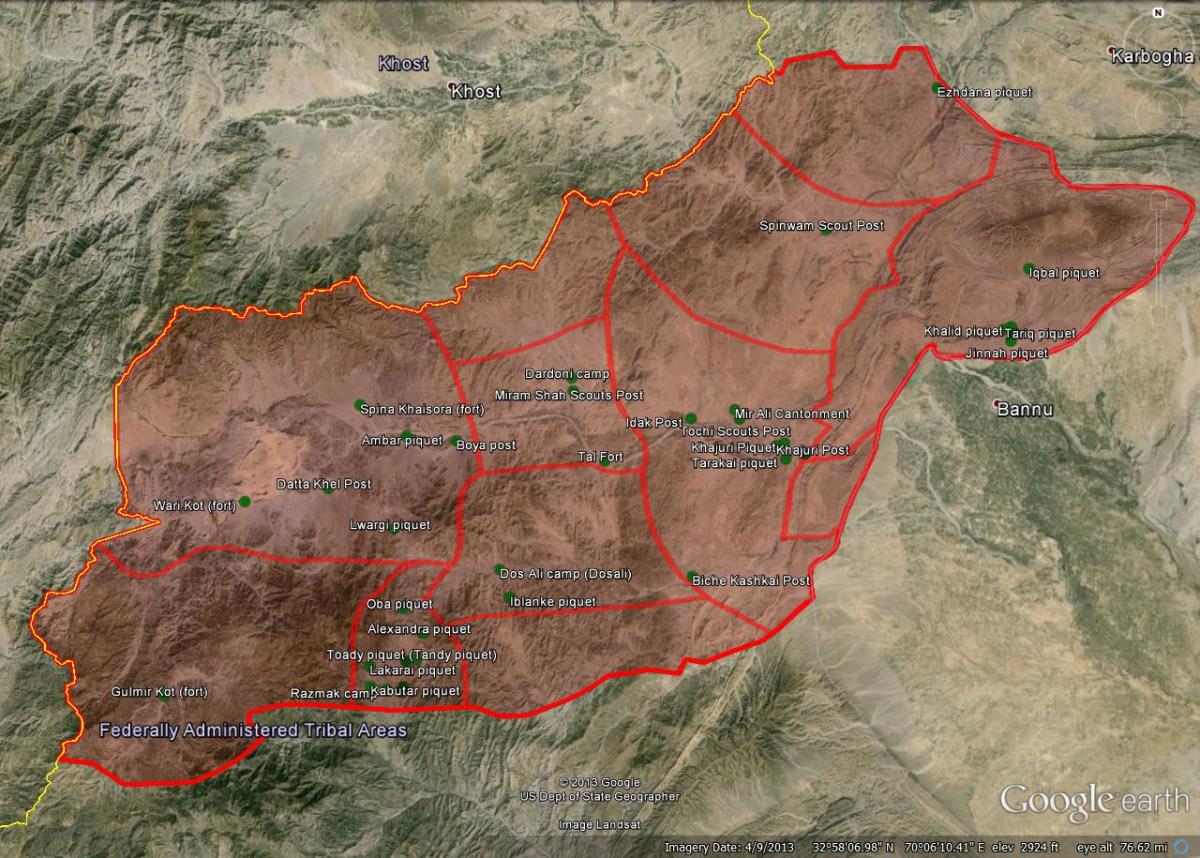
NWA_PakMil_locations_all_1200

There are reportedly 60,000 troops in the region, and the main Pakistan military installations in North Waziristan are shown on the map above (taken from the AEI spinoff site, Critical Threats), but the prelude to ground operations was a concerted attack by the Pakistan Air Force on eight targets linked to planning the assault on Karachi airport.

Green Ground Red Drones Blue PAF strikes DAWN 20 June 2014

‘Operation Zarb-i-Azb’ refers to Mohammed’s sword, and its political imagery is artfully dissected by Afiya Shehrbano Zia:

‘It refers to the (‘sharp/cutting’) sword of the prophet of Islam and is a brilliant usurpation of the religious metaphor. It upstages the religious imaginary for which the Tehreek e Taliban Pakistan (TTP) claim to be fighting. After all, who would dare to vanquish the Prophet’s metaphorical sword? The appellation justifies its cause for the defense of the Islamic state, and quells the lesser purpose of the Taliban in one fell swoop. As in all cases in the instrumentalisation of religion as a propaganda tool, it also excites nationalists and seeks to rationalise another round of military operations, killings and displacements that will follow.’

There’s much more of value in her commentary, but – as Zia also acknowledges – the genealogy and geography of the offensive is no less complicated (my map comes from Dawn, 20 June 2014; green circles are Pakistan military land operations; blue are Pakistan Air Force strikes; red are US drone strikes).

First, it’s not clear whether the Pakistan military finally has the Afghan Taliban in its sights too – regarded by Islamabad as the ‘good Taliban’ because, far from threatening the state of Pakistan, it has long been used by both the military and (particularly) the intelligence service as a counter to any Indian influence over Kabul once US and ISAF forces complete their withdrawal.  And it is of course the Afghan Taliban (along with the Haqqani network) which is the principal concern of the United States.

Second, the Pakistan military – and especially the Air Force – has a long history of offensive operations in the FATA, as I’ve discussed in detail before: see here and here.  Now other commentators have noticed this: the Bureau of Investigative Journalism has tracked 15 Pakistan Air Force strikes carried out by helicopter gunships and F-16 fighters between 19 December 2013 and 15 June 2014, which killed 291-540 people (including 16-112 civilians).

The significance of this is not only that it precedes the current offensive but also that it coincides with the so-called ‘pause’ in CIA-directed drone strikes against targets in the FATA.  Chris Woods notes that PAF strikes are ‘generating casualties far in excess of any caused by CIA drones strikes’, and one resident of Mir Ali recited a grim military timetable:

“It’s like doomsday for people in Mir Ali, where death is everywhere since Saturday… They start the day with artillery shelling early in the morning. Gunship helicopters come for shelling during the day and jets strike at around 2:00-2:30 in the night.”

The military denies all reports of civilian casualties but this beggars belief, and the Bureau reports that some residents have even concluded that the drone strikes were preferable:

‘The difference between the drone strikes and the military strikes is that drones target specifically who they want to target… the wanted terrorists… people are saying that drone attacks were good compared to the military strikes.  Personally I agree, because I have seen drones, they are in the air 24 hours and they don’t attack as randomly… the place of the attack was always an area where the Taliban or terrorists were living.’

But whatever one makes of this – a calculation that would imply that the CIA had abandoned its anonymous ‘signature strikes’ – drones have not been absent from the skies over Waziristan. Pakistan has its own reconnaissance drones, and they have repeatedly been used to direct strike aircraft onto their targets (though with what accuracy it is impossible to know) and to support ground operations: the PAF boasted of their use in May, when hundreds of houses and shops were destroyed in Machis Camp and in the bazaar at Mir Ali.  And – the third complication – the US resumed its drone war on 11 and 12 June when two UAVs fired six missiles at compounds near Miram Shah, supposedly killing ten members of UMI and the Haqqani network, and again on 18 June when three compounds near Dargah Mandi were hit.  Whether these strikes were co-ordinated with Pakistan is unclear – the Foreign Office has issued its ritual denial, but it’s difficult to believe they were not connected to Pakistan’s own military operations, and here too there is a long history of what I’ve called ‘dirty dancing‘ between Washington and Islamabad that continued until at least the end of 2011.  It seems highly unlikely that the dance has ended.

_75732447_75732446

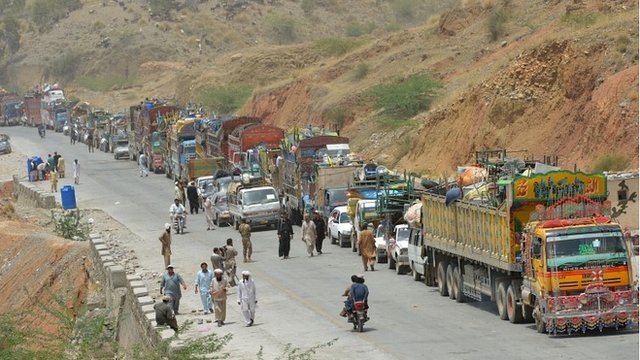
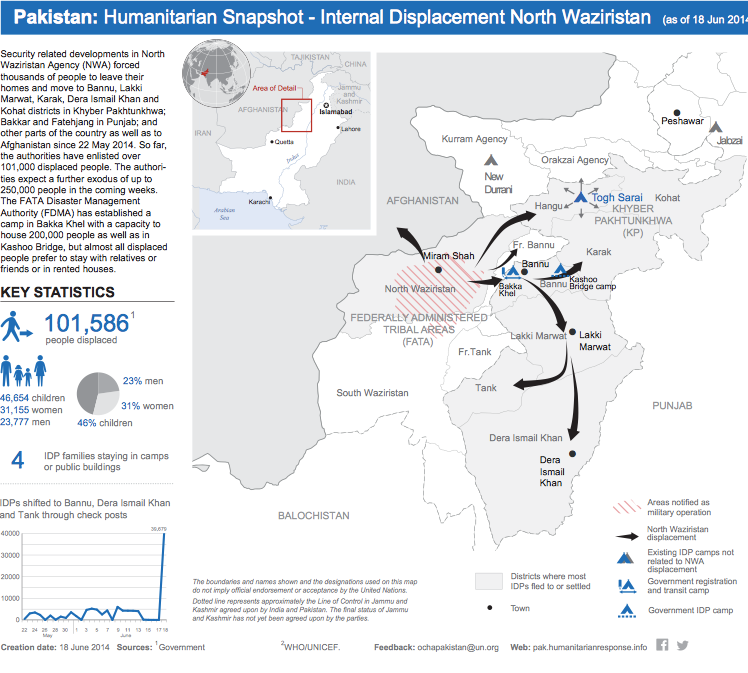
Finally, the shock waves from these various operations ripple far beyond their ostensible targets. Hundreds of thousands of people have fled, some in advance of military operations (which had been telegraphed for months), many more when the military temporarily loosened its curfew on the region. As on previous occasions, most of them fled to Bannu, some to government camps (‘Only the poorest of the poor would go to a camp in such hot and humid weather‘) but the majority to stay with family members, while some refugees have even crossed into Khost in Afghanistan to seek sanctuary. The map below is an early trace (18 June), and it shows only those who are officially registered so it excludes those lodging with their extended families; but even this anticipates hundreds of thousands more displaced people to come.

Pakistan Displaced Persons June 2014

There is also the real fear that, as Ismail Khan and Declan Walsh reported earlier this month, Taliban reprisals will focus on the Punjab, the electoral base of Prime Minister Nawaz Sharif.

All of this suggests the importance of unravelling the intimate connections between the political constitution of the Federally Administered Tribal Areas and the administration of military violence there.  This is clearly not limited to CIA-directed drone strikes, and here Zia’s reflections on a question posed by a feminist friend are worth repeating:

‘She wonders, “why this obsession with drones?” Obviously, the interest is due to a host of factors, but her query reflects the difference in modes of analysis. Her position reflects the views of women’s rights/human rights groups who consider specific military operations in one part of Pakistan as just one cog in a broader narrative about the source of the conflict. For them, this has been the cosy nexus and mutually beneficial relationship between the military establishment and the jihadi groups.

Those like Imran Khan, who foreground drones in their analysis of ‘conflict’, consider US intervention and occupation of Afghanistan as the drivers of conflict in Pakistan. But local progressive groups argue that even if militants in FATA are subdued, or US interventions are resisted, unless the policy of patronage and nurturing of jihadi groups in the rest of Pakistan is dismantled and buried, conflict at all levels will never end – drones or no drones.

This doesn’t mean that military technologies are unimportant nor that drone strikes are of marginal concern (inside or outside an ‘area of active hostilities‘): it means that we need to direct our attention to the larger matrix of political and military violence within which they are deployed, transnational and national, and to its genealogies and geographies.

Writing the wounds of war

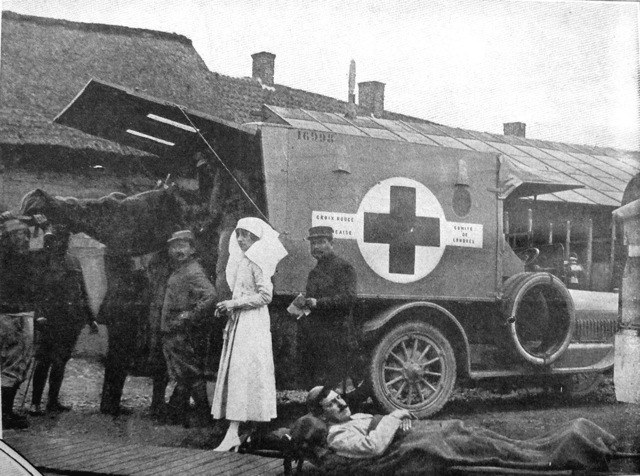
ramc-ypres-1915

Apart from trying to keep up with developments in Syria and Iraq – on which more shortly – I’ve also been continuing my reading on medical care on the Western Front.  I’ve now finished The Backwash of War, and what a bleak little book it is.  There’s very little about medical care – largely because in many respects there seems to have been very little of it in Ellen La Motte‘s field hospital – and much of the discussion is a deeply disturbing account of the cynicism of military violence: the generals who visit only to pin medals on the blankets of the dying, the contempt between medical orderlies and patients (who have no time for those who are not serving on the front lines), and the seemingly endless, agonising deaths of patients.  But that was precisely what gave the author her title:

The sketches were written in 1915 and 1916, when the writer was in a French military field hospital, a few miles behind the lines, in Belgium. War has been described as “months of boredom, punctuated by moments of intense fright.” During this time at the Front, the lines moved little, either forward or backward, but were deadlocked in one position. Undoubtedly, up and down the long reaching kilometers of “Front” there was action, and “moments of intense fright” which produced fine deeds of valor, courage and nobility. But where there is little or no action there is a stagnant place, and in that stagnant place is much ugliness. Much ugliness is churned up in the wake of mighty, moving forces, and this is the backwash of war. Many little lives foam up in this backwash, loosened by the sweeping current, and detached from their environment. One catches a glimpse of them—often weak, hideous or repellent. There can be no war without this backwash.

In some part, perhaps, La Motte’s account reflects differences between British and French medical provision.  Lyn Macdonald‘s The roses of no man’s land (which contains all sorts of insights into the geographies of medical evacuation and provision en passant) suggests that ‘Lying wounded on the battlefield [at Verdun] a French soldier was as good as dead, for there was little chance of his being brought in, and if he had the good luck to be rescued and taken to a hospital there was only one chance in three that he would leave it alive.’   By the end of the war, she continues, of France’s 1,300,000 war dead more than 400,000 had died of their wounds: ‘a proportion that was larger by far than those of any other nation and was due in considerable measure to the makeshift conditions and lack of skilled care in all but a few of the hospitals.’
The politics of wounds

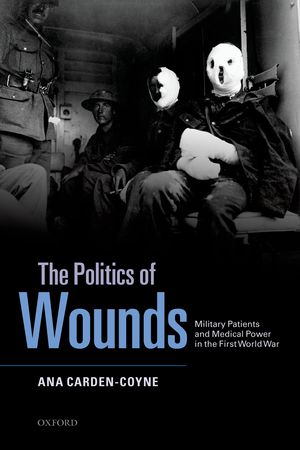
This isn’t to romanticise the experience of those wounded in other armies, of course, but it adds another dimension to what Ana Carden-Coyne calls ‘the politics of wounds’.   Her new book, due out in the fall, The politics of wounds: military patients and medical power in the First World War (Oxford University Press), is high on my reading list for my new research project:

The Politics of Wounds explores military patients’ experiences of frontline medical evacuation, war surgery, and the social world of military hospitals during the First World War. The proximity of the front and the colossal numbers of wounded created greater public awareness of the impact of the war than had been seen in previous conflicts, with serious political consequences.

Frequently referred to as ‘our wounded’, the central place of the soldier in society, as a symbol of the war’s shifting meaning, drew contradictory responses of compassion, heroism, and censure. Wounds also stirred romantic and sexual responses. This volume reveals the paradoxical situation of the increasing political demand levied on citizen soldiers concurrent with the rise in medical humanitarianism and war-related charitable voluntarism. The physical gestures and poignant sounds of the suffering men reached across the classes, giving rise to convictions about patient rights, which at times conflicted with the military’s pragmatism. Why, then, did patients represent military medicine, doctors and nurses in a negative light? The Politics of Wounds listens to the voices of wounded soldiers, placing their personal experience of pain within the social, cultural, and political contexts of military medical institutions. The author reveals how the wounded and disabled found culturally creative ways to express their pain, negotiate power relations, manage systemic tensions, and enact forms of ‘soft resistance’ against the societal and military expectations of masculinity when confronted by men in pain. The volume concludes by considering the way the state ascribed social and economic values on the body parts of disabled soldiers though the pension system.

But all this is about military patients: what of civilians who are wounded or become ill in war zones?  The BackWash of War provides one vignette that is worth reporting in full.  It’s titled ‘The Belgian Civilian’:

‘A big English ambulance drove along the high road from Ypres, going in the direction of a French field hospital, some ten miles from Ypres. Ordinarily, it could have had no business with this French hospital, since all English wounded are conveyed back to their own bases, therefore an exceptional case must have determined its route. It was an exceptional case—for the patient lying quietly within its yawning body, sheltered by its brown canvas wings, was not an English soldier, but only a small Belgian boy, a civilian, and Belgian civilians belong neither to the French nor English services. It is true that there was a hospital for Belgian civilians at the English base at Hazebrouck, and it would have seemed reasonable to have taken the patient there, but it was more reasonable to dump him at this French hospital, which was nearer. Not from any humanitarian motives, but just to get rid of him the sooner. In war, civilians are cheap things at best, and an immature civilian, Belgian at that, is very cheap. So the heavy English ambulance churned its way up a muddy hill, mashed through much mud at the entrance gates of the hospital, and crunched to a halt on the cinders before the Salle d’Attente, where it discharged its burden and drove off again.
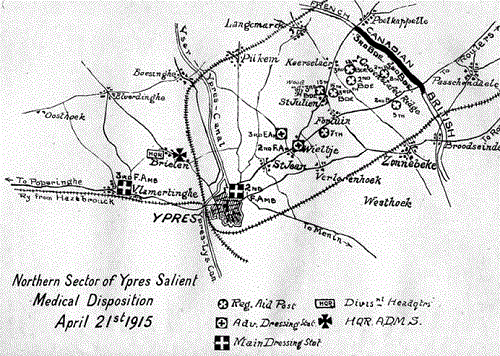
Medical Provision, Ypres, 1915

‘The surgeon of the French hospital said: “What have we to do with this?” yet he regarded the patient thoughtfully. It was a very small patient. Moreover, the big English ambulance had driven off again, so there was no appeal. The small patient had been deposited upon one of the beds in the Salle d’Attente, and the French surgeon looked at him and wondered what he should do. The patient, now that he was here, belonged as much to the French field hospital as to any other, and as the big English ambulance from Ypres had driven off again, there was not much use in protesting….

‘A Belgian civilian, aged ten. Or thereabouts. Shot through the abdomen, or thereabouts. And dying, obviously. As usual, the surgeon pulled and twisted the long, black hairs on his hairy, bare arms, while he considered what he should do. He considered for five minutes, and then ordered the child to the operating room, and scrubbed and scrubbed his hands and his hairy arms, preparatory to a major operation. For the Belgian civilian, aged ten, had been shot through the abdomen by a German shell, or piece of shell, and there was nothing to do but try to remove it. It was a hopeless case, anyhow. The child would die without an operation, or he would die during the operation, or he would die after the operation….

‘After a most searching operation, the Belgian civilian was sent over to the ward, to live or die as circumstances determined. As soon as he came out of ether, he began to bawl for his mother. Being ten years of age, he was unreasonable, and bawled for her incessantly and could not be pacified. The patients were greatly annoyed by this disturbance, and there was indignation that the welfare and comfort of useful soldiers should be interfered with by the whims of a futile and useless civilian, a Belgian child at that. The nurse of that ward also made a fool of herself over this civilian, giving him far more attention than she had ever bestowed upon a soldier. She was sentimental, and his little age appealed to her—her sense of proportion and standard of values were all wrong. The Directrice appeared in the ward and tried to comfort the civilian, to still his howls, and then, after an hour of vain effort, she decided that his mother must be sent for. He was obviously dying, and it was necessary to send for his mother, whom alone of all the world he seemed to need. So a French ambulance, which had nothing to do with Belgian civilians, nor with Ypres, was sent over to Ypres late in the evening to fetch this mother for whom the Belgian civilian, aged ten, bawled so persistently.

‘She arrived finally, and, it appeared, reluctantly. About ten o’clock in the evening she arrived, and the moment she alighted from the big ambulance sent to fetch her, she began complaining. She had complained all the way over, said the chauffeur…. She had been dragged away from her husband, from her other children, and she seemed to have little interest in her son, the Belgian civilian, said to be dying. However, now that she was here, now that she had come all this way, she would go in to see him for a moment, since the Directrice seemed to think it so important….

‘She saw her son, and kissed him, and then asked to be sent back to Ypres. The Directrice explained that the child would not live through the night. The Belgian mother accepted this statement, but again asked to be sent back to Ypres. The Directrice again assured the Belgian mother that her son would not live through the night, and asked her to spend the night with him in the ward, to assist at his passing. The Belgian woman protested.

“If Madame la Directrice commands, if she insists, then I must assuredly obey. I have come all this distance because she commanded me, and if she insists that I spend the night at this place, then I must do so. Only if she does not insist, then I prefer to return to my home, to my other children at Ypres.”

‘However, the Directrice, who had a strong sense of a mother’s duty to the dying, commanded and insisted, and the Belgian woman gave way. She sat by her son all night, listening to his ravings and bawlings, and was with him when he died, at three o’clock in the morning. After which time, she requested to be taken back to Ypres. She was moved by the death of her son, but her duty lay at home. Madame la Directrice had promised to have a mass said at the burial of the child, which promise having been given, the woman saw no necessity for remaining.

“My husband,” she explained, “has a little estaminet, just outside of Ypres. We have been very fortunate. Only yesterday, of all the long days of the war, of the many days of bombardment, did a shell fall into our kitchen, wounding our son, as you have seen. But we have other children to consider, to provide for. And my husband is making much money at present, selling drink to the English soldiers. I must return to assist him.”
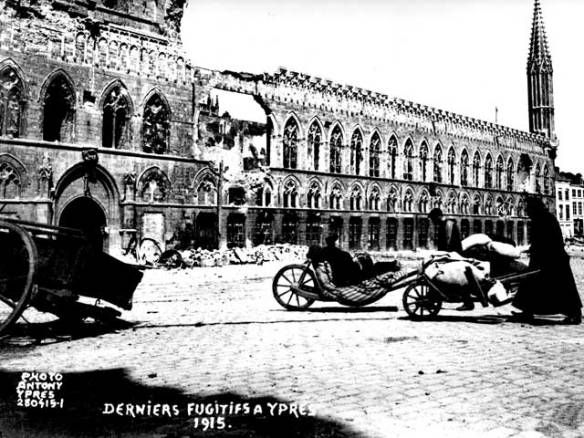
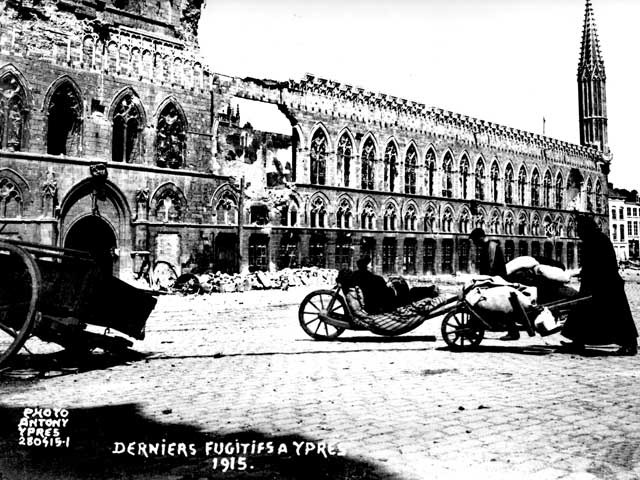
YPRES 1915

‘So the Belgian civilian was buried in the cemetery of the French soldiers, but many hours before this took place, the mother of the civilian had departed for Ypres. The chauffeur of the ambulance which was to convey her back to Ypres turned very white when given his orders. Everyone dreaded Ypres, and the dangers of Ypres. It was the place of death. Only the Belgian woman, whose husband kept an estaminet, and made much money selling drink to the English soldiers, did not dread it. She and her husband were making much money out of the war, money which would give their children a start in life. When the ambulance was ready she climbed into it with alacrity, although with a feeling of gratitude because the Directrice had promised a mass for her dead child.

“These Belgians!” said a French soldier. “How prosperous they will be after the war! How much money they will make from the Americans, and from the others.”‘

It would obviously be absurd to generalise from one vignette, but there’s clearly a different politics at work in this narrative,  and a complex set of political geographies too.  For a careful reading of La Motte’s account, in parallel with Mary Borden‘s The forbidden zone, you could do no better than Margaret Higonnet‘s introduction to her Nurses at the front: writing the wounds of the great war.  I’ve now started on a series of accounts about the work of field ambulances, and one which resonates with the events described in La Motte’s vignette is William Boyd‘s letters from 7 March to 15 August 1915 published as With a field ambulance at Ypres (1916), which you can download free here.

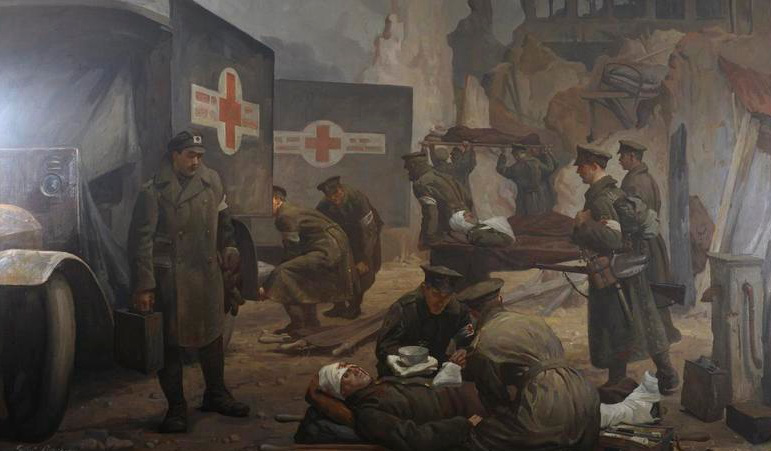
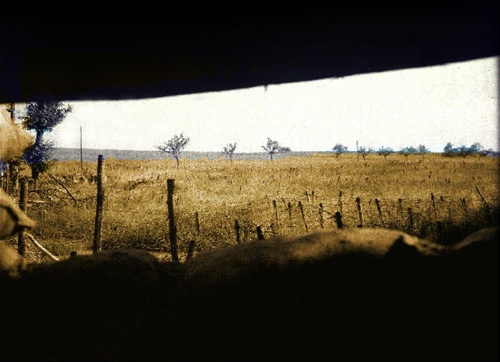
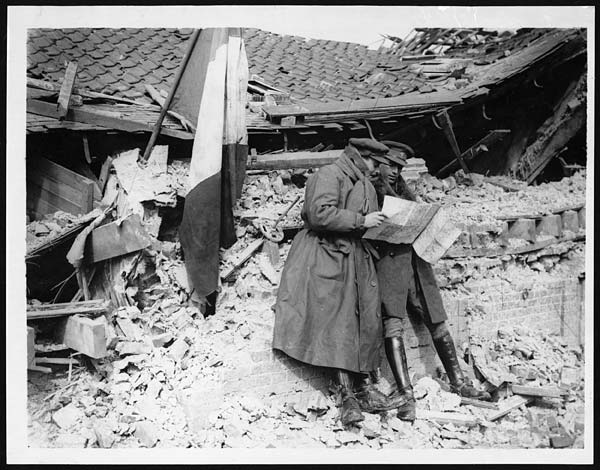
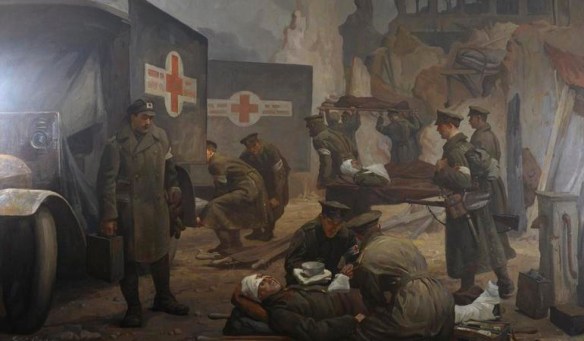
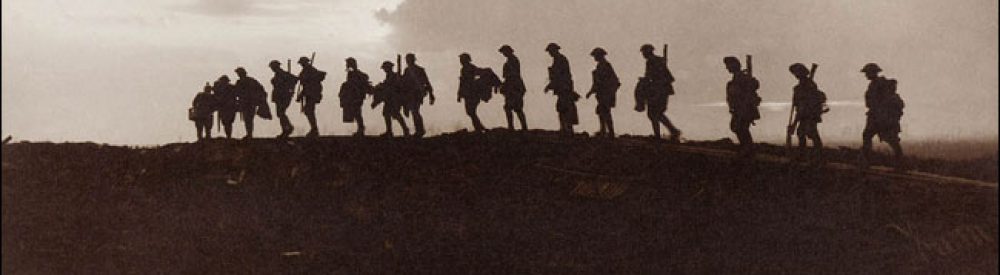
But all this – important – talk about writing the wounds of war should not blind us (me) to the role of visualising the wounds of war, and to the work done by artfully composed (and surely sanitised) images like the one that heads this post…
Behind the lines

I’m sorry for the long silence – I’ve been in the UK, giving a new presentation on the Uruzgan air strike of February 2010, and learning much en route in Lancaster, Lincoln and Bristol.  I’ll try to post extracts from the (developing) presentation in the next several weeks as I think about turning it into an essay, but I’ll still be on the road – or, more accurately, on vacation, so things will be irregular for some time to come.  I expect regular postings to resume in early July, when I’ll be back in Vancouver.

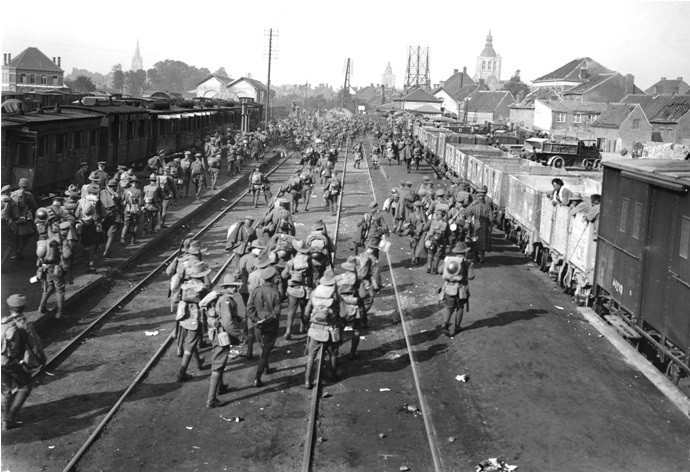
POPERINGE railhead

I’ve also spent several days in Flanders, visiting some of the major sites associated with the First World War.  We based ourselves in Poperinge, which was sufficiently far from the devastated and levelled town of Ypres to serve as a major staging post for munitions, supplies and men arriving at its station [see the image above], and for casualties being shipped back to the coast or to Britain (a slower and much more difficult journey).  It was also the place (known to the British as “Pop”, supposedly the Paris of the Front, at least around Ypres) where soldiers on leave from the Ypres Salient went to have as good a time as possible, in the shops, bars, restaurants and brothels.

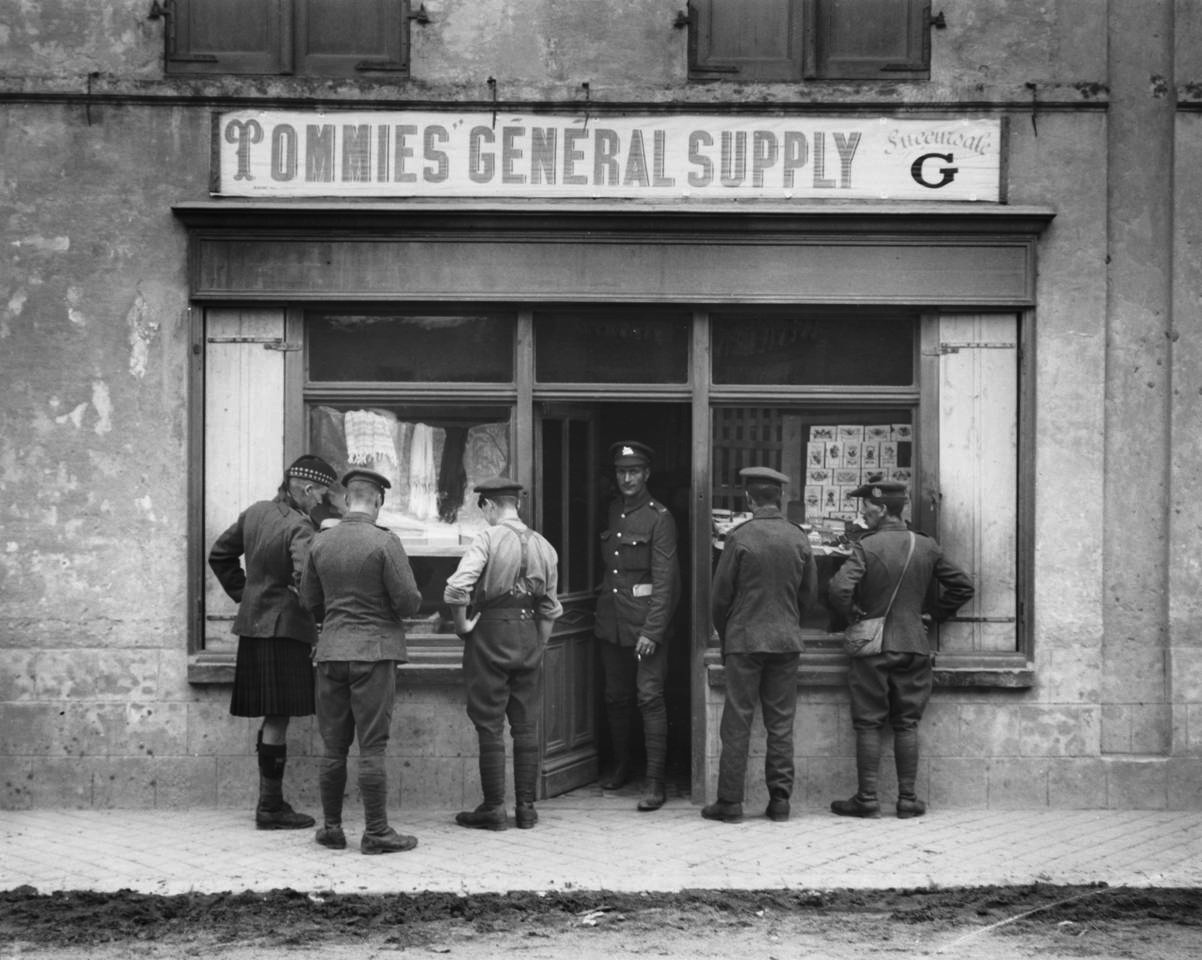
Poperinge Tommy Supply

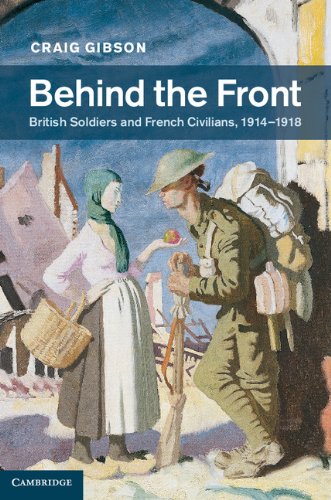
All of this has made me start to explore even more closely the military-civilian interactions behind the lines.  There’s surprisingly little work on this, but waiting for me at home is a new book by Craig Gibson, Behind the Front: British soldiers and French civilians 1914-1918 (Cambridge University Press, 2014), which despite the subtitle appears to include the war in Flanders too:

Until now scholars have looked for the source of the indomitable Tommy morale on the Western Front in innate British bloody-mindedness and irony, not to mention material concerns such as leave, food, rum, brothels, regimental pride, and male bonding. However, re-examining previously used sources alongside never-before consulted archives, Craig Gibson shifts the focus away from battle and the trenches to times behind the front, where the British intermingled with a vast population of allied civilians, whom Lord Kitchener had instructed the troops to ‘avoid’. Besides providing a comprehensive examination of soldiers’ encounters with local French and Belgian inhabitants which were not only unavoidable but also challenging, symbiotic and uplifting in equal measure, Gibson contends that such relationships were crucial to how the war was fought on the Western Front and, ultimately, to British victory in 1918. What emerges is a novel interpretation of the British and Dominion soldier at war.

GIBSON Behind the FrontThe Contents List is topical and – to my regret – doesn’t seem to include anything on the overlapping and sometimes confounding geographies of military and civilian medical care, but it still looks like an excellent survey:

Part I. Mobile Warfare, 1914:
1. The first campaign
Part II. Trench Warfare, 1914–1917:
2. Land
3. Administration
4. Billet
5. Communication
6. Friction
7. Farms
8. Damages
9. Money
10. Discipline
11. Sex
Part III. Mobile Warfare, 1918:
12. The final campaign

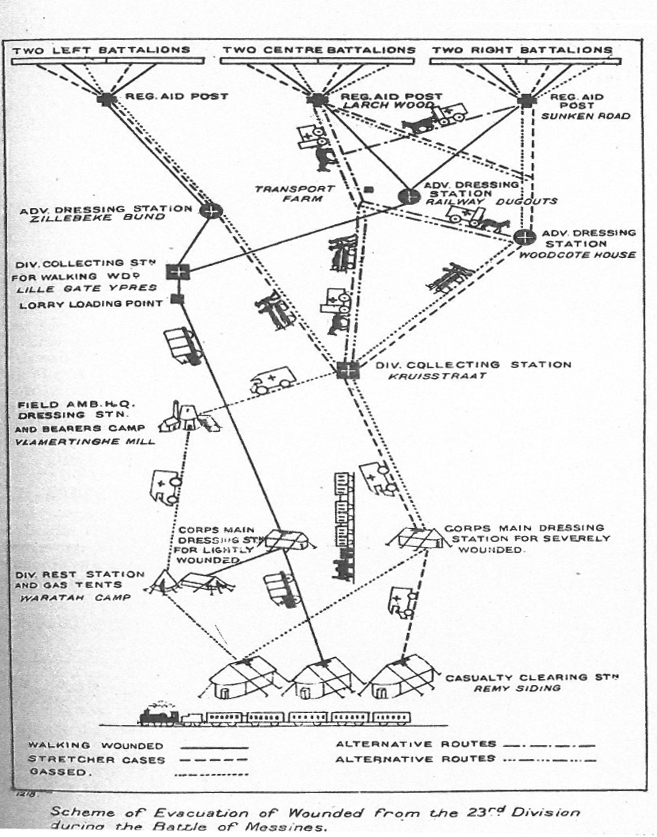
And while I’m on the subject of medical-military machines, Britain’s Arts & Humanities Research Council has a new website, Beyond the Trenches, which is devoted to recent research on the First World War.  One of its opening (short) essays is by Jessica Meyer on The long trip home: medical evacuations from the Front, which coincides with the first phase of my new research project.  It’s a skeletal account of the casualty chain, or rather chains, and doesn’t flesh out these precarious journeys like Emily Mayhew‘s marvellous social history, Wounded: from battlefield to Blighty, 1914-1918 (see here).  But it’s an interesting introduction to some of the logistical issues.

Diagram-of-evacuation-plan-Messine

The essay has been prompted by a new BBC drama series, The Crimson Field, set in a British field hospital, which in its turn was apparently inspired by Ellen Newbold La Motte‘s first-hand account of a French field hospital, The backwash of war: The Human Wreckage of the Battlefield as Witnessed by an American Hospital Nurse (1916).  This is now sitting on my Kindle (and you can also download it free from Project Gutenberg here): its ‘warts-and-all’ portrayal was so vivid that it was banned by the American government when the United States entered the war in 1917.  La Motte worked under Mary Borden, incidentally, who recorded her own experiences in The forbidden zone (more on the two women here, you can read the book here, and there is a helpful essay by Ariela Freedman, ‘Mary Borden’s Forbidden Zone: women’s writing from No Man’s Land’ in Modernism/modernity 9 (1) (2002) 109-124).

unloading-the-wounded-mary-borden

The book is organised in 14 vignettes, which were published regularly in the Atlantic Monthly, and at one point La Motte includes this observation:

“These Belgians!” said a French soldier. “How prosperous they will be after the war! How much money they will make from the Americans, and from the others who come to see the ruins!”

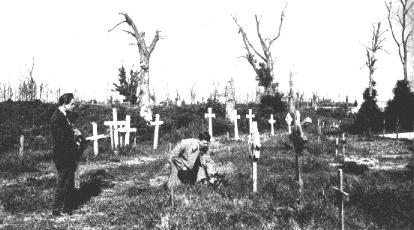
Having just returned from doing just that, I have to say that I saw remarkably few signs of crass commercialisation or opportunism: I was struck again and again by the dignified way in which the hideous events of those years have been recovered and commemorated.  There was refreshingly little jingoism too: just a quiet sense of the enormity of it all. One of the most poignant exhibits I saw was a photograph of families visiting the war graves shortly after the Armistice, trying to find the site where a husband, a brother or a son was buried or, failing that, the place where he had been killed (since the graves of countless thousands were unknown).  By then, the graves were being systematised and the cemeteries organised (see here), but the surroundings were still hauntingly raw: there had been no time for the ravaged landscape to recover, the blasted stumps to be torn out, and the trenches to be ploughed over.  It was sobering to imagine families, already burdened with grief, seeing for themselves a landscape which must have revealed, at least in part, something of the horror of the war that had been for so long hidden from them.

lillegatecem

‘The land of rotting men’

No man's land

Noam Leshem and Alasdair Pinkerton have embarked on a fascinating new project, Re-inhabiting No Man’s Land: from dead zones to living spaces here:

Nearing the centenary of the First World War, this project explores the ongoing relevance of no-man’s lands in the 21st century. Rather than merely empty, divisive spaces, the project considers the material substance of no-man’s lands, their changing social-cultural meaning and their relevance as productive political and geopolitical spaces.

As a figure of speech, No-Man’s Land is applied to anywhere from derelict inner-city districts and buffer-zones to ‘ungovernable’ regions and tax havens. But what is no-man’s land? What are the conditions that produce it? How is it administered? What sort of human activities do no-man’s lands harbour? These are the questions that prompt us to think about the no-man’s lands not as dead zones, but as living spaces.

WWI consulting a map

News of this arrived from Noam just as I finished the long-form version of Gabriel’s Map: cartography and corpography in modern war, which you can now find under the DOWNLOADS tab (scroll down).  Most of the essay is about the First World War on the Western Front (I explain the title at the start of the essay; it comes from William Boyd‘s Ice-Cream War and, in particular, the First World War in East Africa, and the title of this post comes from Edward Lynch‘s Somme Mud: the experiences of an infantryman in France, 1916-1919), but I also end with these reflections on the 21st century:

In this essay I have been concerned with the First World War but, as we approach its centenary, it is worth reflecting on the ways in which modern warfare has changed – and those in which it has not. Through the constant circulation of military imagery and its ghosting in video games, many of us have come to think of contemporary warfare as optical war hypostatised: a war fought on screens and through digital images, in which full motion video feeds from Predators and Reapers allow for an unprecedented degree of remoteness from the killing fields. In consequence, perhaps, many of us are tempted to think of the wars waged by advanced militaries, in contrast to the First World War, as ‘surgical’, even body-less. These are wars without fronts, whose complex geometries have required new investments in cartography and satellite imagery, and there have been major advances in political technologies of vision and in the development of a host of other sensors that have dramatically increased the volume of geo-spatial intelligence on which the administration of later modern military violence relies. All of this has transformed but not replaced the cartographic imaginary.

And yet, for all of their liquid violence, these wars are still shaped and even confounded by the multiple, acutely material environments through which they are fought. In Sebastian Junger’s remarkable despatch from Afghanistan, he notes that for the United States and its allies ‘the war diverged from the textbooks because it was fought in such axle-breaking, helicopter-crashing, spirit-killing, mind-bending terrain that few military plans survive intact for even an hour.’ If that sounds familiar, then so too will Kenneth MacLeish’s cautionary observations about soldiers as both vectors and victims of military violence:

‘The body’s unruly matter is war’s most necessary and most necessarily expendable raw material. While many analyses of US war violence have emphasized the technologically facilitated withdrawal of American bodies from combat zones in favour of air strikes, smart bombs, remotely piloted drones, and privately contracted fighting forces, the wars in Iraq and Afghanistan could not carry on without the physical presence of tens of thousands of such bodies…

In consequence, the troops have had to cultivate an intrinsically practical knowledge that, while its operating environment and technical armature are obviously different, still owes much to the tacit bodily awareness of the Tommy or the Poilu:

‘In the combat zone there is a balance to be struck, a cultivated operational knowledge, that comes in large part from first-hand experience about what can hurt you and what can’t… So you need not only knowledge of what the weapons and armor can do for you and to you but a kind of bodily habitus as well – an ability to take in the sensory indications of danger and act on them without having to think too hard about it first. When you hear a shot, is it passing close by? Is it accurate or random? Is it of sufficient caliber to penetrate your vest, the window of your Humvee or the side of your tank?’

In the intricate nexus formed by knowledge, space and military power, later modern war still relies on cartographic vision – and its agents still produce their own corpographies.

The notes contain various references to No Man’s Land in the First World War, though I’m increasingly interested in what lies on either side.  One of the reasons so many commentators seem to think that ‘war among the people’ is a recent development is that the imagery of the Western Front draws the eye again and again to No Man’s Land, but behind the front lines on either side were farms, fields, villages and small towns where people continued to live and work amongst the shelling, the gas attacks, and the billeted troops.

As usual, I’d welcome any comments/criticisms/suggestions on the (I hope near final) draft of the essay: an extended version will appear in War material.

Insurgent thoughts

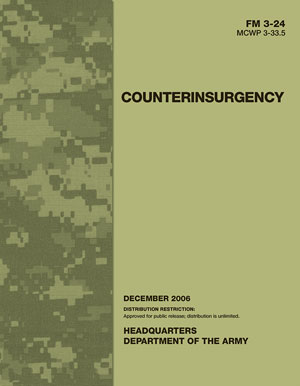
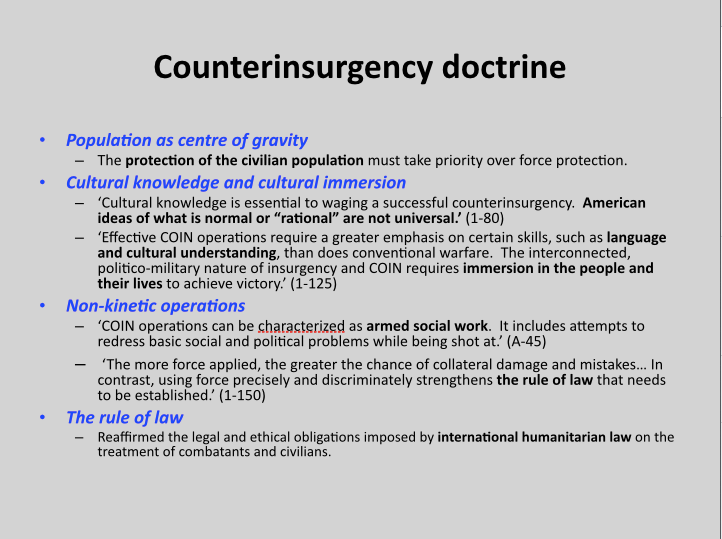
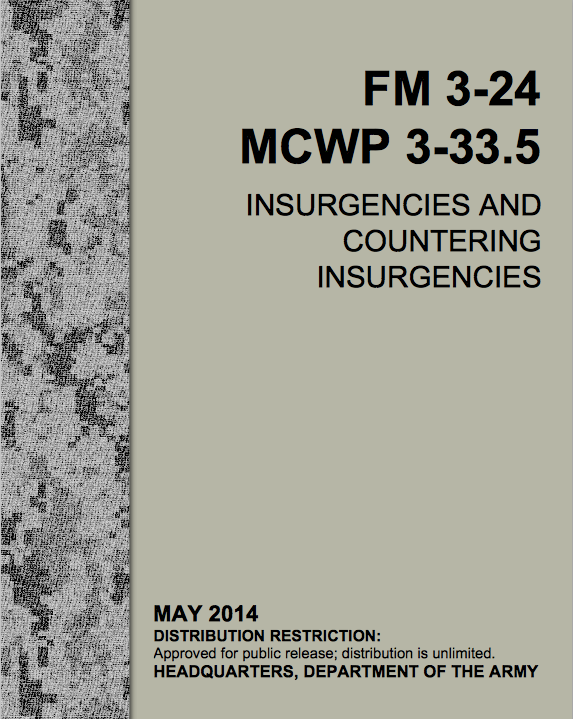
fm3-24When the US Army and Marine Corps issued their revised Field Manual 3-24 on Counterinsurgency in December 2006 there was an extraordinary public fanfare: a round of high-profile media appearances by some of its architects (you can watch John Nagl with Jon Stewart here) and, even though you could download the Manual for free – there were two million downloads in the first two months – the University of Chicago Press rushed out a paperback edition that hit the best-seller lists.  This was all to advertise counterinsurgency as what David Petraeus called ‘the graduate level of war’ and to inaugurate what I called, in ‘The rush to the intimate’ (DOWNLOADS tab), the US military’s ‘cultural turn’.  And as the media campaign made clear, it was also about the production of a public that would rally behind the new strategy to be put to work in Iraq.  The message was that the military had put the horrors of Abu Ghraib behind it – which were in any case artfully blamed on ‘rotten apples’ rather than the political-military manufacturers of the barrel that contained them – and was now marching beneath the banner of a kinder, gentler and above all smarter war (see my summary slide below).

COIN doctrine 2006

The new doctrine, first field-tested in Iraq and then applied to operations in Afghanistan, was not without its critics, both inside and outside the military.  Insiders complained that this was all smoke and mirrors – or more accurately, perhaps, too many mirrors and not enough smoke – because it was a distraction from the ‘real’ (the implication was, I think, ‘manly’) business of war-fighting, while outsiders objected to its weaponisation of culture and to the biopolitical project that it sought to advance.

FM 3-24 2014The debate grumbled on, and many insiders insisted that COIN was dead and buried, interred in the killing fields of Afghanistan.  But a revised version of the doctrine has now been issued.  It was trailed by the Joint Publication 3-24 on Counterinsurgency last December (issued by the Army, Marine Corps, Navy, Air Force and – interestingly – the Coastguard Service), which you can download here (for an early review, see Robert Lamb and Brooke Shawn‘s ‘Is revised COIN manual backed by political will? here).  But the new Field Manual has been comprehensively re-written and even re-titled: Insurgencies and countering insurgencies, which you can download here.

I’m going to work my way through it in the next week or so – I can hardly complete The everywhere war without doing so – and I’ll post a commentary in due course, but it’s worth setting out its structure now:

PART ONE: STRATEGIC AND OPERATIONAL CONTEXT

1: Understanding the strategic context

2: Understanding an operational environment

3: Culture

PART TWO: INSURGENCIES

4: Insurgency prerequisites and fundamentals

5: Insurgency threat characteristics

PART THREE: COUNTERINSURGENCIES

6: Mission command and control

7: Planning for counterinsurgencies

8: Intelligence

9: Direct approaches to counter an insurgency

10: Indirect methods for countering insurgencies

11: Working with host-nation forces

12: Assessments

13: Legal considerations

I’m still interested in how the revision treats ‘culture’, of course, but I’m also keenly interested in the discussion of ‘intrastate war’ and insurgency, the direct incorporation of air power (which was relegated to an appendix in the previous edition), the attention paid to intelligence in it multiple guises, the role of biometrics (biopolitics again!) – and in that remarkable last chapter.  One of the central diagnostics of later modern war, in my view at any rate, is its reflexivity.  You can see that in the discussions of assessment and reassessment in the new FM 3-24 (Ch 12 in particular), but attention to metrics and ‘lessons learned’ is hardly novel even if the means of monitoring have changed.  What I have in (closer) mind is a preoccupation with the public reception of military operations and military violence – which involves a distinctive emphasis on its intellectual provenance (‘the graduate level of war’ again),  on media strategies (‘strategic communications’), and on the provision of a legal armature that works to inform and legitimate its operations (hence that last chapter).

I’m sure the new manual will be the subject of intense discussion over at the always provocative and thoroughly indispensable Small Wars Journal (see, for example, Bing West‘s opening salvo here and David Maxwell‘s more measured critique here), and elsewhere too, but I doubt that it will attract the public fanfare FM 3-24 received in 2006-7.  We’ll see.

‘Books constitute capital’

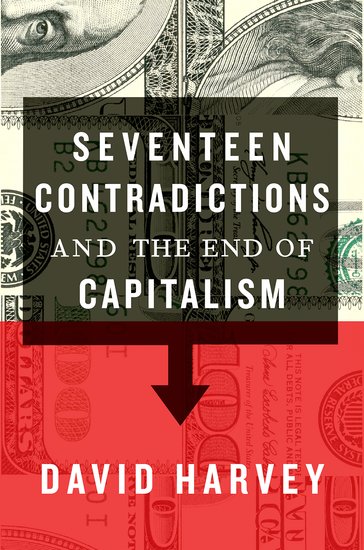
HARVEY Seventeen contradictionsIntroducing his interview with David Harvey at the Chronicle of Higher Education earlier this week, Scott Carlson notes that

‘The American stage has recently been set for questioning capitalism, with the U.S. tour of academe’s rock star of the moment, Thomas Piketty. The French economist’s Capital in the Twenty-First Century has highlighted capitalism’s drift toward inequality and criticized economists’ focus on pure theory.’

The interview was prompted by the publication of David’s latest book, Seventeen contradictions and the end of capitalism: see also this interview with Jonathan Derbyshire here.  En route, David has good things to say about Piketty’s project – its empirical detail, its humanistic flourishes (see also Paul Krugman here) – but he is evidently dissatisfied with its analytical and, in consequence, its political reach.

Since he spoke to the Chronicle, David has fleshed out his critique of Piketty here.

The book has often been presented as a twenty-first century substitute for Karl Marx’s nineteenth century work of the same title. Piketty actually denies this was his intention, which is just as well since his is not a book about capital at all. It does not tell us why the crash of 2008 occurred and why it is taking so long for so many people to get out from under the dual burdens of prolonged unemployment and millions of houses lost to foreclosure. It does not help us understand why growth is currently so sluggish in the US as opposed to China and why Europe is locked down in a politics of austerity and an economy of stagnation. What Piketty does show statistically (and we should be indebted to him and his colleagues for this) is that capital has tended throughout its history to produce ever-greater levels of inequality. This is, for many of us, hardly news. It was, moreover, exactly Marx’s theoretical conclusion in Volume One of his version of Capital. Piketty fails to note this, which is not surprising since he has since claimed, in the face of accusations in the right wing press that he is a Marxist in disguise, not to have read Marx’s Capital.

If he had – David’s central point – he would have realised that capital has to be conceived not as a thing but as a process: the insight that has animated so much of his own work ever since he made his celebrated ‘transition’ in Social justice and the city from liberal to socialist formulations.

But we might also note the reference in the passage I’ve highlighted to difference, to the macro-scale differences between the US, Europe and China, and by implication to the production of a variegated and highly uneven capitalist space.  David’s insights here have surely been his crowning achievement – and, significantly, the Chronicle interview is captioned ‘Mapping a new economy’.

SLOTERDIJK World Interior of CapitalHe’s no longer alone, of course, and many critics have also been enthralled by another rock star release, Peter Sloterdijk‘s In the world interior of capital (memorably described by Carl Raschke as a ‘philosophical docudrama’):

‘No point on the Earth’s surface, once money had stopped off there, could escape the fate of becoming a location – and a location is not a blind spot in a field, but rather a place in which one sees that one is seen.’

It’s also, as Harvey shows, rather more than that.  Sloterdijk shows that too, hence his ‘spherology‘ and his emphasis on ‘spatial multiplicities’.  But their analyses – like their philosophies and their politics – take us to radically different destinations.

So back to my title: these three books ‘constitute capital’, in exactly the sense Thomas Jefferson meant, but they also enable us to apprehend capital – in the double sense of comprehending its exactions and, ultimately, indicting its deformations.