The American way of bombing

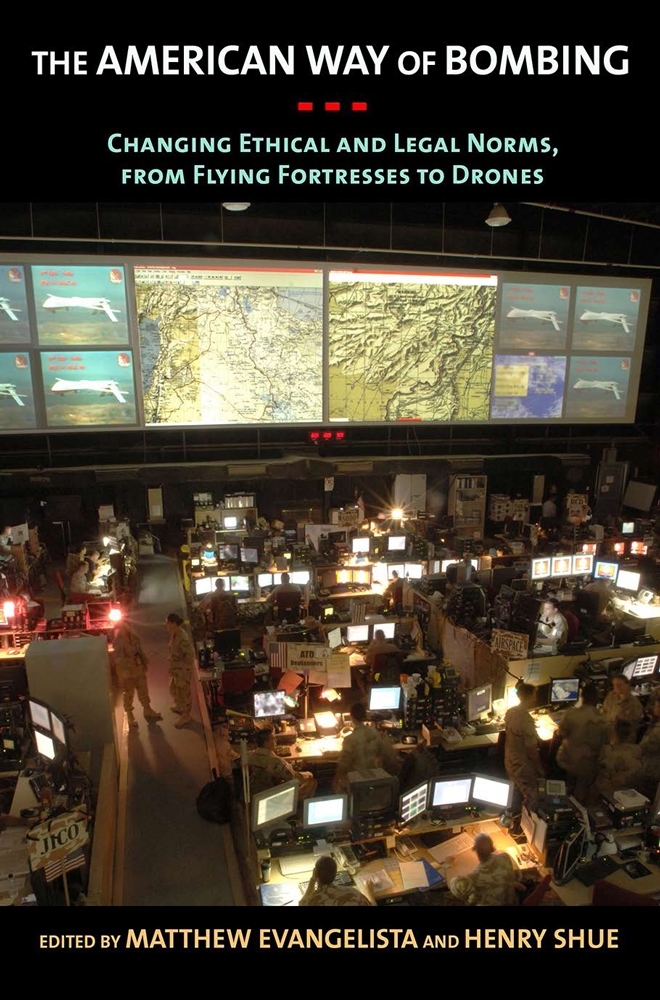
I’ve argued elsewhere (in ‘Lines of Descent’ [DOWNLOADS tab] and in ‘The American way of bombing?‘) that it’s important to situate any critical account of drones in a much longer history of air war, and a new book just out from Cornell University Press promises to do just that: The American Way of Bombing: changing ethical and legal norms from Flying Fortresses to drones, edited by Matthew Evangelista and Henry Shue.  And unlike rip-off academic-commercial publishers (most of them in the UK), this is available as an e-edition (Kindle, etc) at a perfectly reasonable price.

Here are the details:

Aerial bombardment remains important to military strategy, but the norms governing bombing and the harm it imposes on civilians have evolved. The past century has seen everything from deliberate attacks against rebellious villagers by Italian and British colonial forces in the Middle East to scrupulous efforts to avoid “collateral damage” in the counterinsurgency and antiterrorist wars of today. The American Way of Bombing brings together prominent military historians, practitioners, civilian and military legal experts, political scientists, philosophers, and anthropologists to explore the evolution of ethical and legal norms governing air warfare.

Focusing primarily on the United States—as the world’s preeminent military power and the one most frequently engaged in air warfare, its practice has influenced normative change in this domain, and will continue to do so—the authors address such topics as firebombing of cities during World War II; the atomic attacks on Hiroshima and Nagasaki; the deployment of airpower in Iraq, Afghanistan, and Libya; and the use of unmanned drones for surveillance and attacks on suspected terrorists in Pakistan, Yemen, Sudan, Somalia, and elsewhere.

American way of bombing

Introduction: The American Way of Bombing
by Matthew Evangelista

Part I. Historical and Theoretical Perspectives

1. Strategic Bombardment: Expectation, Theory, and Practice in the Early Twentieth Century
by Tami Davis Biddle

2. Bombing Civilians after World War II: The Persistence of Norms against Targeting Civilians in the Korean War
by Sahr Conway-Lanz

3. Targeting Civilians and U.S. Strategic Bombing Norms: Plus ça change, plus c’est la même chose?
by Neta C. Crawford

4. The Law Applies, But Which Law?: A Consumer Guide to the Laws of War
by Charles Garraway

Part II. Interpreting, Criticizing, and Creating Legal Restrictions

5. Clever or Clueless?: Observations about Bombing Norm Debates
by Charles J. Dunlap Jr.

6. The American Way of Bombing and International Law: Two Logics of Warfare in Tension
by Janina Dill

7. Force Protection, Military Advantage, and “Constant Care” for Civilians: The 1991 Bombing of Iraq
by Henry Shue

8. Civilian Deaths and American Power: Three Lessons from Iraq and Afghanistan
by Richard W. Miller

Part III. Constructing New Norms

9. Proportionality and Restraint on the Use of Force: The Role of Nongovernmental Organizations
by Margarita H. Petrova

10. Toward an Anthropology of Drones: Remaking Space, Time, and Valor in Combat
by Hugh Gusterson

11. What’s Wrong with Drones?: The Battlefield in International Humanitarian Law
by Klem Ryan

12. Banning Autonomous Killing: The Legal and Ethical Requirement That Humans Make Near-Time Lethal Decisions
by Mary Ellen O’Connell

Scoping Afghanistan

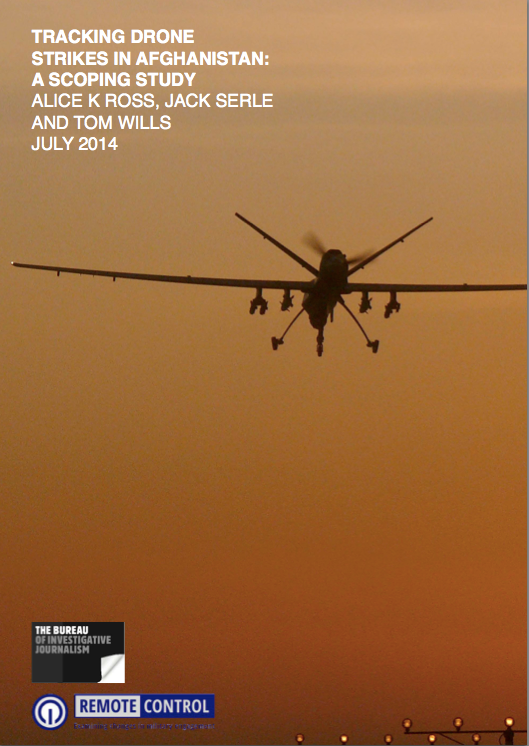
BOIJ Tracking drone strikes in AfghanistanThe marvellous Bureau of Investigative Journalism has just published a preliminary report on its new study  of drone strikes in Afghanistan, ‘the most heavily drone-bombed country in the world.’  The study, carried out with the support of the Remote Control Project, has been prompted by analyses which show that ISAF has persistently under-estimated civilian casualties from its strikes (‘“We only count that which we see… You can do a tremendous amount of forensics … [but] seldom do we see the actual bodies.”)

I have my doubts about the wisdom of severing ‘drone strikes’ from air strikes carried out by conventional aircraft that are networked in to ISR feeds from drones; I’ve elaborated this before, and it is a crucial part of my own work on militarised vision, where I’m working through the military investigations into air strikes in Kunduz, Sangin and Uruzgan.  I’ll start posting about this work next month.

The irony, I think, is not (quite) that we know so little about the ostensibly ‘public’ strikes in Afghanistan compared with the ‘covert’ campaigns in Pakistan, Yemen, Somalia and elsewhere: it is, rather, that we know a lot about how the USAF (though not the RAF) conducts strikes in Afghanistan but remarkably little about the victims, whereas in Pakistan we know much less about how the strikes are carried out (apart from the bureaucratisation of ‘kill lists’ in Washington) and, thanks to the work of the Bureau, much more about the victims.

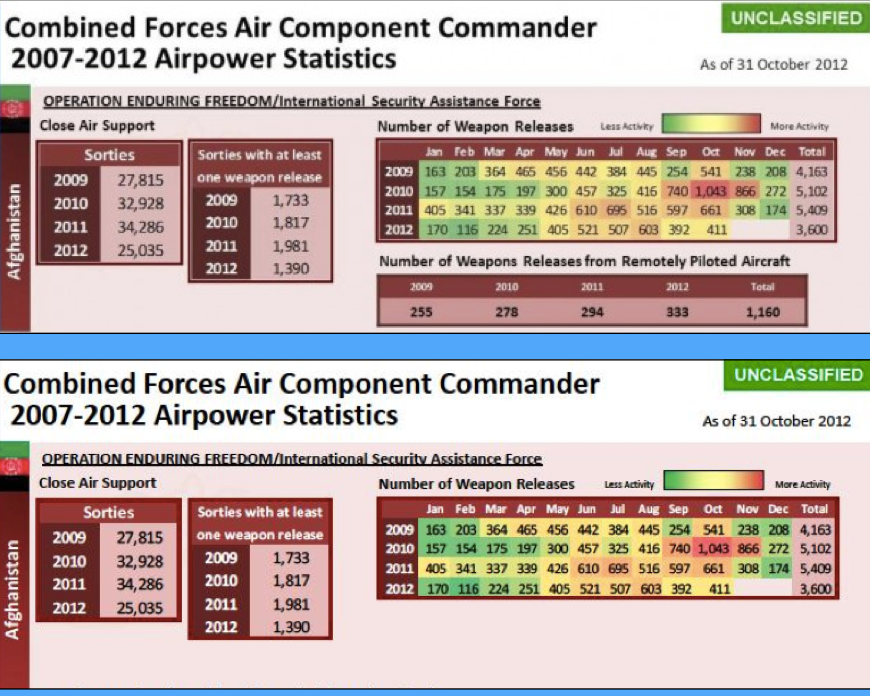
It is true, though, that while the official US military investigations released through FOIA requests are often immensely informative, even in redacted form (more on this next month), there is often also a remarkable reluctance to release even basic information to the public.  Spot the difference between these two tables; the first release (on top) was subsequently overwritten by the second (below)…

Airpower statistics 2007-2012

As I say, more to come.  In the meantime, the ‘scoping study ‘ from the Bureau is here, and well worth reading.

Problematizing Cyber-Wars

Cyber OrientI’ve just received a Call For Papers on Problematizing Cyber-Wars for a special issue of CyberOrient: Online Journal of the Virtual Middle East.  The Guest Editor for the issue is the amazing Helga Tawil-Souri, whose work has done so much to illuminate these issues already and who starts in January as the new Director of NYU’s Hagop Kevorkian Center for Near Eastern Studies [more on Helga’s work, with links to her writing and other projects, here].

According to military analysts, since the 1991 Gulf War and even more so since the Hezbollah-Israel 2006 war, we have entered a new phase of warfare, in which kinetic and traditional military power are losing importance to symbolic and media power. Perhaps unsurprisingly given a still-widely held Orientalist view in military circles, many such perspectives revolve around wars and conflicts in the ‘Middle East’ or against ‘Islam’ more broadly – taking place in Iraq, Iran, Afghanistan, Israel/Palestine, Syria, but also on cyber networks and mobile phones. 


While these claims are of course hyperbole, this special issue of CyberOrient invites articles on questions of how we might define wars in a (new) media-age in the region; whether, why, and how (new) media are increasingly sites of warfare; the relationships between ‘virtual’ and ‘real’ battlespaces. Topics could include the significance of targeting (and bombing) telecommunications and media infrastructures; the use of (new) media as outlets for propaganda during wartime; the mediatization of war and the militarization of media; the role of participatory or social media and mobile communications during and in wars; relationships or differences between official, military, alternative, citizen, and grass-roots (new) media uses during war and conflict; the expanding definition of warzones; commemoration and memorialization of war in a digital age; among others. We welcome submissions from across disciplines and methodological approaches that are empirically and critically grounded.

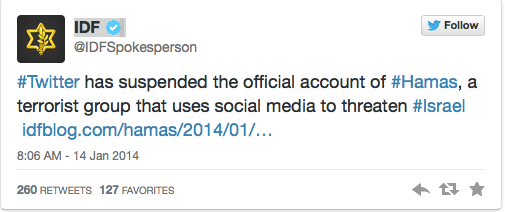
IDF tweet re Hamas Twitter account

[In relation to the IDF tweet (above), from earlier this year, Twitter hasn’t suspended the all too obviously fake ‘Hamas Global PR’ here…]

CyberOrient is a peer-reviewed journal published by the American Anthropological Association, in collaboration with the Faculty of Arts of Charles University in Prague. The aim of the journal is to provide research and theoretical considerations on the representation of Islam and the Middle East, the very areas that used to be styled as an “Orient”, in cyberspace, as well as the impact of the internet and new media in Muslim and Middle Eastern contexts.

Submission

Articles should be submitted directly to Helga Tawil-Souri (helga@nyu.edu) and Vit Sisler (vit.sisler@ff.cuni.cz) by 30 September 2014 (Full Papers). Articles should
be between 6,000 and 8,000 words (including references), and follow the AAA style in referencing and citations. Upon acceptance, articles will be published online with free access in spring 2015.

More information can be found here.

UPDATE:  With exquisite timing, Mondoweiss has just published Rebecca Stein‘s analysis of ‘How Israel militarized social media’:

‘What’s been lost in this coverage – in this story of surprise — is the history of the Israel’s army presence on social media. For in fact, the military’s move to social media as a public relations platform has been rife with improvisation and failure, a process that runs counter to IDF narratives about its innovative work in this regard (the IDF lauding itself as a military early adopter). The army’s interest in the wartime potential of social media can be traced to the first few days of the 2008-2009 Gaza incursion….

In the years that followed, the IDF investment in social media would grow exponentially both in budgetary and manpower allocations, building on this ostensible wartime triumph.

But the process was rife with challenges and missteps.’

You can also find more detail in my previous posts here and here.

Footnotes to Gaza 101

gazajuly23

Updates on Gaza 101 (at the risk of stating the obvious, the title for this post is a riff on Joe Sacco‘s brilliant Footnotes in Gaza [2009])

(1) Another powerful interview with Dr Mads Gilbert from al-Shifa Hospital, the main trauma centre in Gaza, and an excellent question:

“What would have happened if Palestinian fighters had bombed an Israeli hospital and killed five patients?  The world would have turned upside down. What is this second-hand, or even third-hand or fourth-hand citizenship in the world for the Palestinians?”

And in Gaza it’s way more than five (though that is clearly how so many governments around the world, including Canada, rank Palestinian citizenship).

Palestinian child deaths

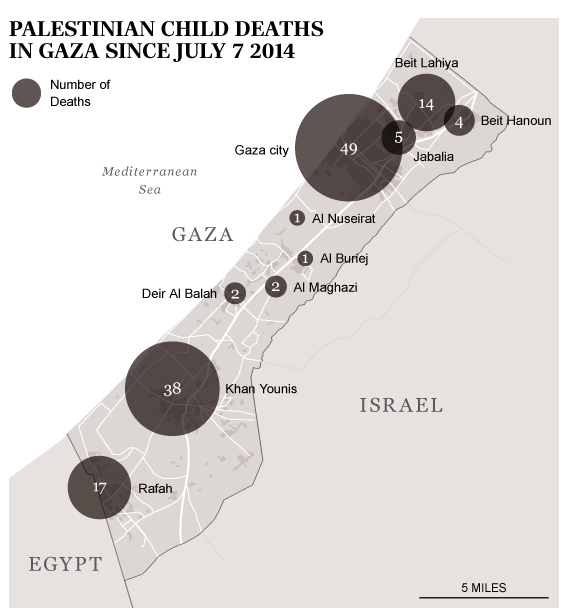
(2)  By ‘citizenship in the world’ Gilbert is getting at the differential calculus that constitutes what Judith Butler calls ‘a grievable life’, and here Maya Mikdashi sharpens a (different) point I’ve made in relation to air strikes in the Federally Administered Tribal Areas and elsewhere: that not only the dead and injured women and children [see the map above, also available here] but also the dead and injured men are worthy of our grief.

Palestine men and women and children are one people— and they are a people living under siege and within settler colonial conditions. They should not be separated in death according to their genitalia, a separation that reproduces a hierarchy of victims and mournable deaths. Jewish Israelis (including soldiers and settlers) occupy the highest rungs of this macabre ladder, Palestinian men the lowest. This hierarchy is both racialized and gendered, a twinning that allows Palestinian womenandchildren to emerge and be publicly and internationally mourned only in spectacles of violence, or “war”—but never in the slow and muted deaths under settler colonial conditions—the temporality of the “ceasefire.” To insist on publicly mourning all of the Palestinian dead, men and women and children—at moments of military invasion and during the every day space of occupation and colonization— is to insist on their right to have been alive in the first place.

(3) Finally – if only it were the end to all this – here is the splendid Richard Falk on the chronic failure of international law to protect – let alone provide justice for – the Palestinian people.  This is how he begins:

What has been happening in Gaza cannot usefully be described as “warfare”. The daily reports of atrocities situate this latest Israeli assault on common humanity within the domain of what the great Catholic thinker and poet, Thomas Merton, caIled “the unspeakable”. Its horror exceeds our capacity to render the events through language.

Up to  a point; I said something similar but much less eloquently in ‘Gaza 101’.  Trauma ruptures language, to be sure, but these words from Ann Jones are also worth reflecting on (they come from her They were soldiers):

The worst we can say of war is that it is “unspeakable,” which in fact it is not. But we don’t speak of it because that would involve so many nasty words we don’t want to use and elicit so many things we don’t want to know, so many things we think we can’t do anything about now that the government answers only to the powerful few…


Geographies of peace

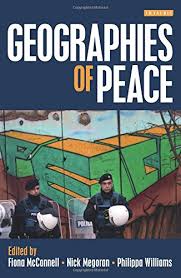
News today from I.B. Tauris of a new collection edited by Fiona McConnell, Nick Megoran and Philippa Williams, Geographies of peace:

Geographies of peaceFrom handshakes on the White House lawn to Picasso’s iconic dove of peace, the images and stereotypes of peace are powerful, widespread and easily recognizable. Yet if we try to offer a concise definition of peace it is altogether a more complicated exercise. Not only is peace an emotive and value-laden concept, it is also abstract, ambiguous and seemingly inextricably tied to its antithesis: war. And it is war and violence that have been so compellingly studied within critical geography in recent years. This volume offers an attempt to redress that balance, and to think more expansively and critically about what peace means and what geographies of peace may entail. The editors begin with an examination of critical approaches to peace in other disciplines and a helpful genealogy of peace studies within geography. The book is then divided into three sections. The opening section [Contesting narratives of peace] examines how the idea of peace may be variously constructed and interpreted according to different sites and scales. The chapters in the second section [Techniques of peacemaking] explore a remarkably wide range of techniques of peacemaking.

This widens the discussion from the archetypical image of top-down, diplomatic state-led initiatives to imperial boundary making practices, grassroots cultural identity assertion, boycotts, self-immolation, ex-paramilitary community activism, and ‘protective accompaniment’. The final section [Practices of coexistence] shifts the scale and focus to everyday personal relations and a range of practices around the concept of coexistence. In their concluding chapter the editors spell out some of the key questions that they believe a geography of peace must address: What spatial factors have facilitated the success or precipitated the failure of some peace movements or diplomatic negotiations? Why are some ideologies productive of violence in some places but co-operation in others? How have some communities been better able to deal with religious, racial, cultural and class conflict than others? How have creative approaches to sharing sovereignty mitigated or transformed territorial disputes that once seemed intractable? Geographies of Peace is the first book wholly devoted to exploring the geography of peace.

Drawing on both recent advances in social and political theory and detailed empirical research covering four continents, it makes a significant intervention into current debates about peace and violence.

Introduction: Geographical Approaches to Peace

PART I: CONTESTING NARRATIVES OF PEACE

2. Peace and Critical Geopolitics – Simon Dalby

3. Building Peaceful Geographies in and through Systems of Violence – Nicole Laliberte

4. Unearthing the Local: Hegemony and Peace Discourses in Central Africa – Patricia Daley

PART II: TECHNIQUES OF PEACEMAKING

5. Moving Away from the Edge: Rethinking International Boundary Practices – John Donaldson

6. Making Space for Peace: International Protective Accompaniment in Colombia – Sara Koopman

7. Contextualizing and Politicizing Peace: Geographies of Tibetan Satyagraha – Fiona McConnell

8. Transforming the Troubles: Cultural Geographies of Peacebuilding in Northern Ireland – Lia di Shimada

PART III: PRACTICES OF COEXISTENCE

9. A place of empathy in a fragile contentious landscape: environmental Peacebuilding in the Eastern Mediterranean –  Stuart Schoenfeld, Asaf Zohar, Ilan Alleson, Osama Suleiman and Galya Sipos-Randor

10. Everyday Peace, Agency and Legitimacy in North India – Philippa Williams

11. Migration and Peace: the Transnational Activities of Bukharan Jews – Nick Megoran

12. Welcome to Sheffield: the Less than Violent Geographies of Urban Asylum – Jonathan Darling

Conclusion: Geographies of peace, geographies for peace

Gaza 101

pcrs483

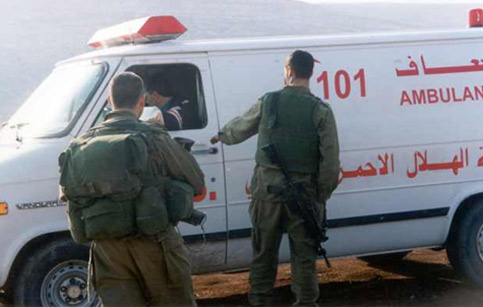
101 is the emergency number for Gaza and the rest of occupied Palestine.  And perhaps I should begin with that sentence: I say ‘the rest of occupied Palestine’ because, despite Israel’s ‘disengagement’ from Gaza in 2005, Israel continues to exercise effective control over the territory which means that Gaza has continued to remain under occupation.  It’s a contentious issue – like Israel’s duplicitous claim that the West Bank is not ‘occupied’ either (even by its illegal settlers) merely ‘disputed’ – and if you want the official Israeli argument you can find it in this short contribution by a former head of the IDF’s International Law Department here and here.  The value of that essay – apart from illustrating exactly what is meant by chutzpah – is its crisp explanation of why the issue matters:

‘This does not necessarily mean that Israel has no legal obligations towards the population of the Gaza Strip, but that to the extent that there are any such legal obligations, they are limited in nature and do not include the duty to actively ensure normal life for the civilian population, as would be required by the law of belligerent occupation…’

Certainly, one of the objectives of Israel’s ‘disengagement’ was to produce what its political and military apparatus saw as ‘an optimal balance between maximum control over the territory and minimum responsibility for its non-Jewish population’.  That concise formulation is Darryl Li‘s, which you can find in his excellent explication of Israel’s (de)construction of Gaza as a ‘laboratory’ for its brutal bio-political and necro-political experimentations [Journal of Palestine Studies 35 (2) (2006)]. (Another objective was to freeze the so-called ‘peace process’, as Mouin Rabbani explains in the latest London Review of Books here; his essay also provides an excellent background to the immediate precipitates of the present invasion). Still, none of this entitles Israel to evade the obligations of international law.  Here it’s necessary to recall Daniel Reisner‘s proud claim that ‘If you do something for long enough, the world will accept it… International law progresses through violations’: Reisner also once served as head of the IDF’s International Law Department, and the mantra remains an article of faith that guides IDF operations.  But as B’Tselem, the Israeli Information Center for Human Rights in the Occupied Territories, insisted in an important opinion published at the start of this year:

Even after the disengagement, Israel continues to bear legal responsibility for the consequences of its actions and omissions concerning residents of the Gaza Strip. This responsibility is unrelated to the question of whether Israel continues to be the occupier of the Gaza Strip.

But there’s more.  International humanitarian law – no deus ex machina, to be sure, and far from above the fray – not only applies during Israel’s military offensives and operations, including the present catastrophic assault on Gaza, but provides an enduring set of obligations.  For as Lisa Hajjar shows in a detailed discussion re-published by Jadaliyya last week, Israel’s attempts to make Gaza into a space of exception – ‘neither sovereign nor occupied’ but sui generis – run foul of the inconvenient fact that Gaza remains under occupation. Israel continues to control Gaza’s airspace and airwaves, its maritime border and its land borders, and determines what (and who) is allowed in or out [see my previous post and map here].  As Richard Falk argues, ‘the entrapment of the Gaza population within closed borders is part of a deliberate Israeli pattern of prolonged collective punishment’ – ‘a grave breach of Article 33 of the Fourth Geneva Convention’ – and one in which the military regime ruling Egypt is now an active and willing accomplice.

Karam abu Salem crossing

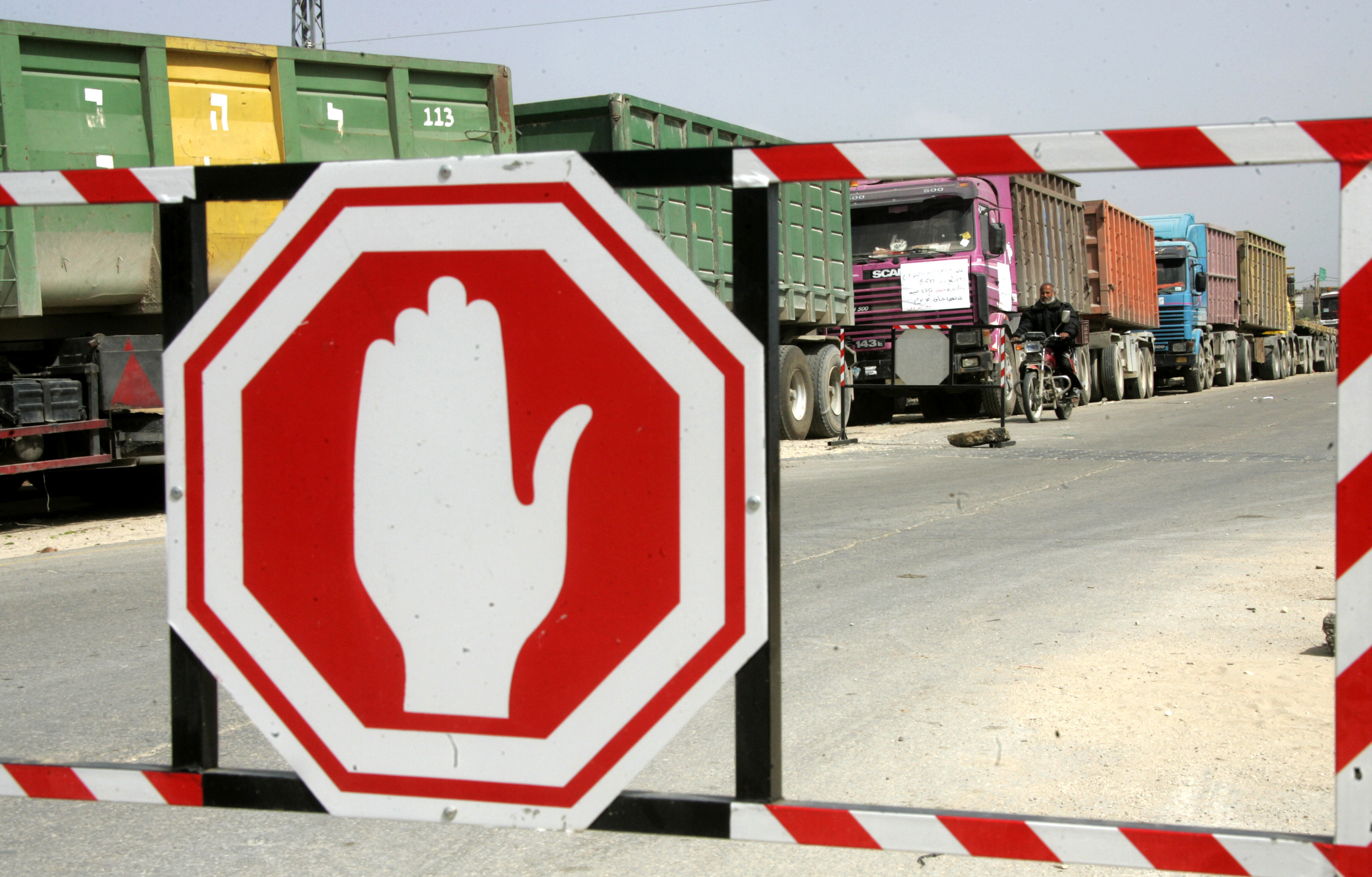
So: Gaza 101.  Medical equipment and supplies are exempt from the blockade and are allowed through the Karam Abu Salem crossing (after protracted and expensive security checks) but the siege economy of Gaza has been so cruelly and deliberately weakened by Israel that it has been extremely difficult for authorities to pay for them.  Their precarious financial position is made worse by direct Israeli intervention in the supply of pharmaceuticals.  Corporate Watch reports that

When health services in Gaza purchase drugs from the international market they come into Israel through the port of Ashdod but are not permitted to travel the 35km to Karam Abu Salem directly. Instead they are transported to the Bitunia checkpoint into the West Bank and stored in Ramallah, where a permit is applied for to transport them to Gaza, significantly increasing the length and expense of the journey.

There’s more – much more: you can download the briefing here – but all this explains why Gaza depends so much on humanitarian aid (and, in the past, on medical supplies smuggled in through the tunnels).  Earlier this summer Gaza’s medical facilities were facing major shortfalls; 28 per cent of essential drugs and 54 per cent of medical disposables were at zero stock.

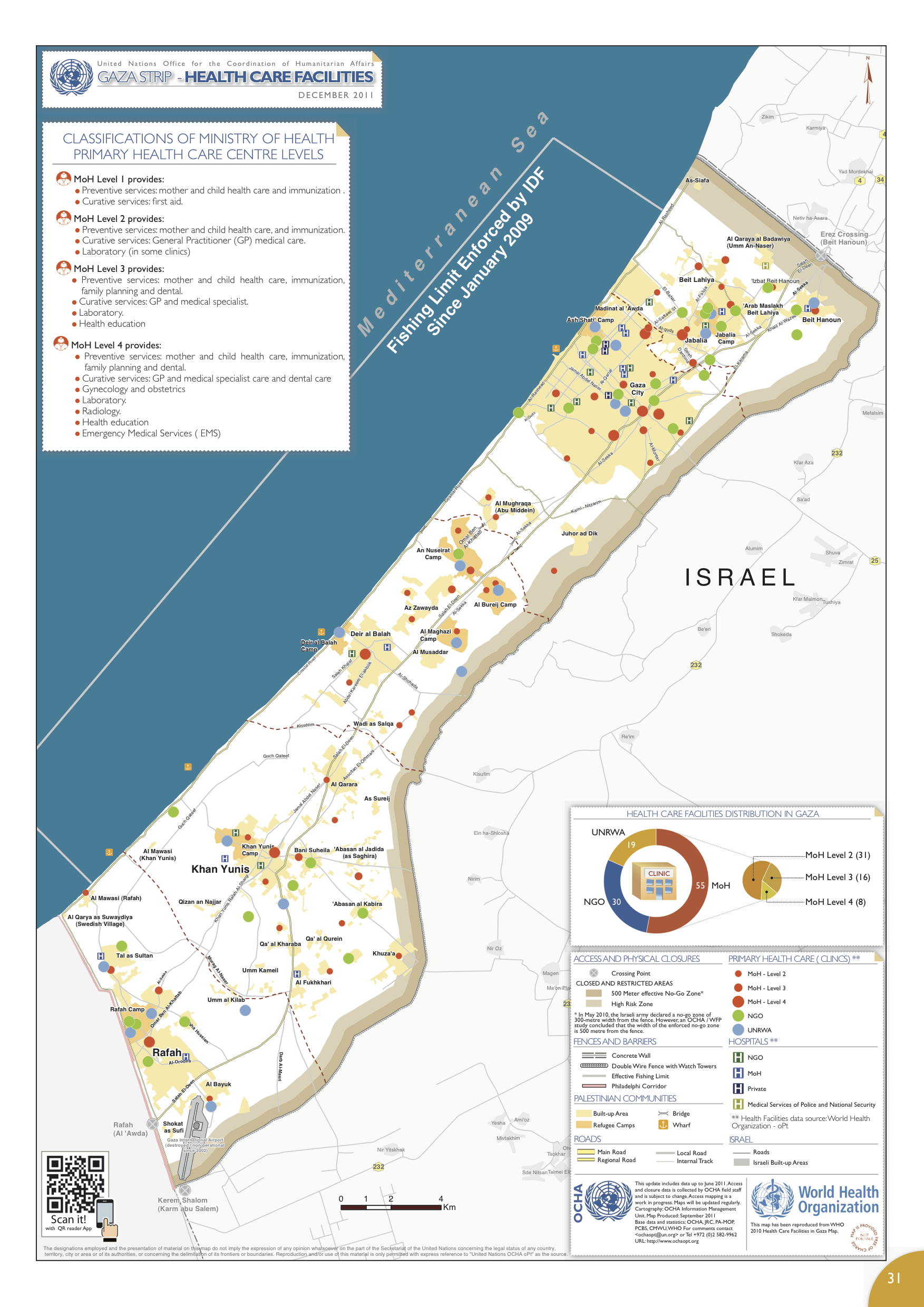
ochaopt_atlas_health_care_december2011

Medical care involves more than bringing in vital supplies and maintaining infrastructure (the map of medical facilities above is taken from the UN’s humanitarian atlas and shows the situation in December 2011; the WHO’s summary of the situation in 2012 is here).  Medical care also involves unrestricted access to electricity and clean water; both are compromised in Gaza, and on 1 January 2014 B’Tselem reported a grave deterioration in health care as a result:

‘The siege that Israel has imposed on the Gaza Strip since Hamas took over control of the security apparatus there in June 2007 has greatly harmed Gaza’s health system, which had not functioned well beforehand…. The reduction, and sometimes total stoppage, of the supply of fuel to Gaza for days at a time has led to a decrease in the quality of medical services, reduced use of ambulances, and serious harm to elements needed for proper health, such as clean drinking water and regular removal of solid waste. Currently, some 30 percent of the Gaza Strip’s residents do not receive water on a regular basis.’

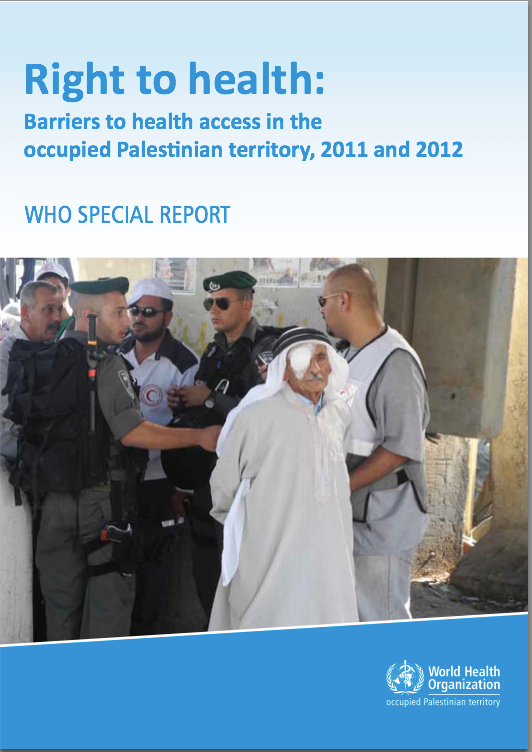
WHO Right to healthIn-bound transfers are tightly constrained, but so too are out-bound movements.  Seriously ill patients requiring advanced treatment had their access to specialists and hospitals outside Gaza restricted:

‘Israel has cut back on issuing permits to enter the country for the hundreds of patients each month who need immediate life-saving treatment and urgent, advanced treatment unavailable in Gaza. The only crossing open to patients is Erez Crossing, through which Israel allows some of these patients to cross to go to hospitals inside Israel [principally in East Jerusalem], and to treatment facilities in the West Bank, Egypt, and Jordan. Some patients not allowed to cross have referrals to Israeli hospitals or other hospitals. Since Hamas took over control of the Gaza Strip, the number of patients forbidden to leave Gaza “for security reasons” has steadily increased.’

As in the West Bank, Israel has established a labyrinthine system to regulate and limit the mobility of Palestinians even for medical treatment.  Last month the World Health Organization explained the system and its consequences (you can find a detailed report with case studies here):

‘In Gaza, patients must submit a permit application at least 10 days in advance of their hospital appointment to allow for Israeli processing. Documents are reviewed first by the health coordinator but final decisions are made by security officials. Permits can be denied for reasons of security, without explanation; decisions are often delayed. In 2013, 40 patients were denied and 1,616 were delayed travel through Erez crossing to access hospitals in East Jerusalem, Israel, the West Bank and Jordan past the time of their scheduled appointment. If a patient loses an appointment they must begin the application process again. Delays interrupt the continuity of medical care and can result in deterioration of patient health. Companions (mandatory for children) must also apply for permits. A parent accompanying a child is sometimes denied a permit, and often both parents, and the family must arrange for a substitute, a process which delays the child’s treatment.’

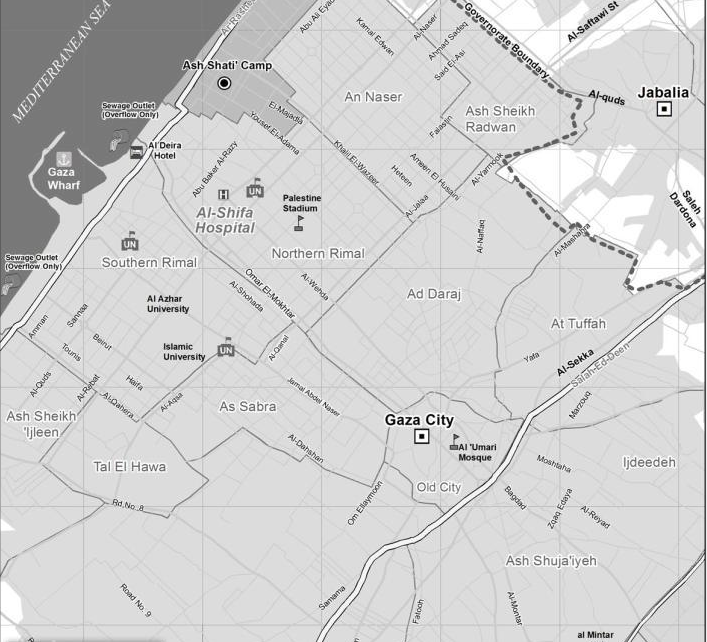
On 17 June Al-Shifa Hospital, the main medical facility in Gaza City (see map below), had already been forced to cancel all elective surgeries and concentrate on emergency treatment.  On 3 July it had to restrict treatment to life-saving emergency surgery to conserve its dwindling supplies. All of this, remember, was before the latest Israeli offensive.  People have not stopped getting sick or needing urgent treatment for chronic conditions, so the situation has deteriorated dramatically.  The care of these patients has been further compromised by the new, desperately urgent imperative to prioritise the treatment of those suffering life-threatening injuries from Israel’s military violence.

al-Shifa and Shuja'iyeh map

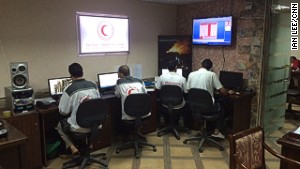
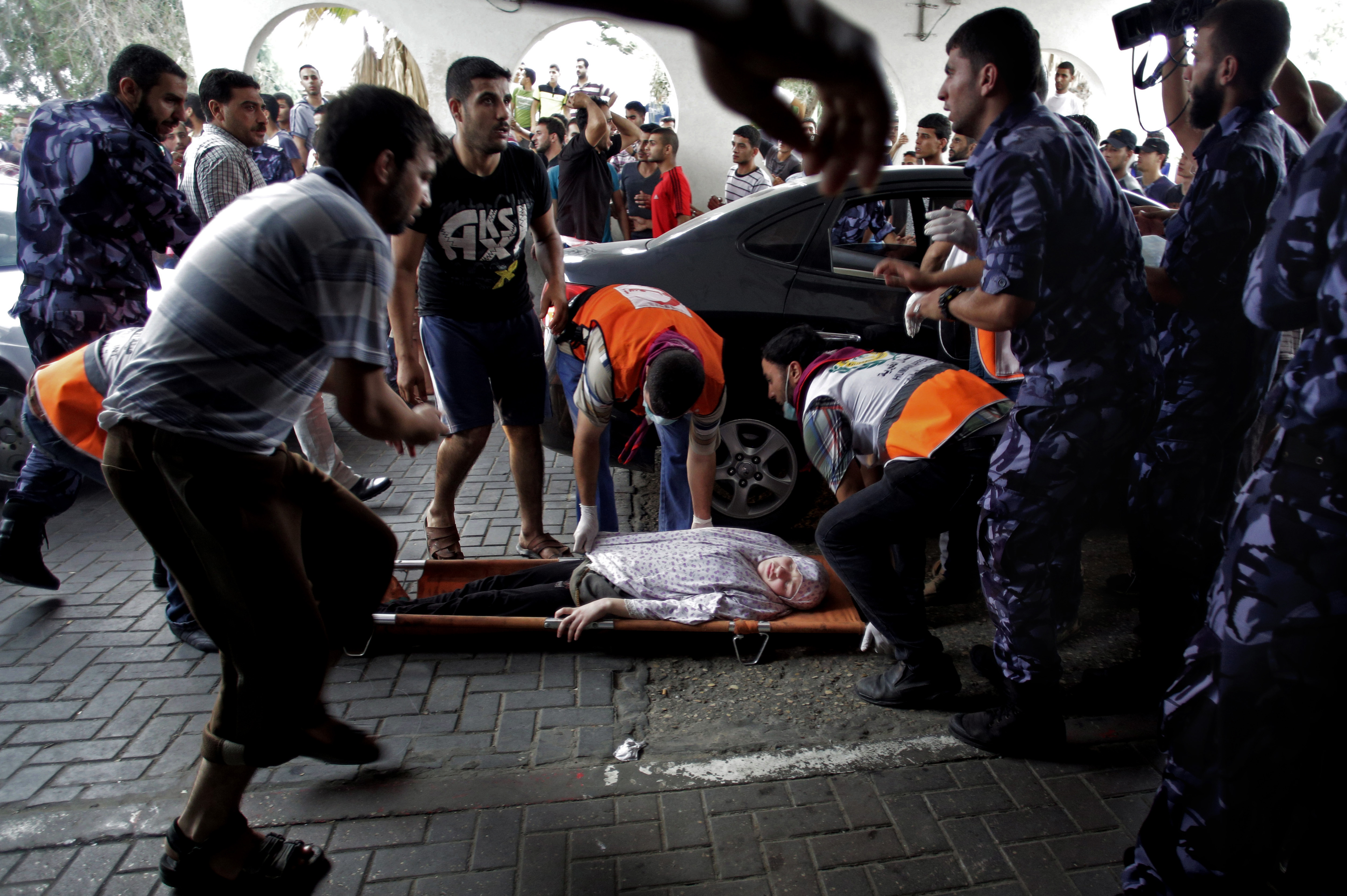
Trauma surgeons emphasise the importance of the ‘golden hour’: the need to provide advanced medical care within 60 minutes of being injured.  Before the IDF launched its ground invasion, there were three main sources of injury: blast wounds from missiles, penetrating wounds from artillery grenades and compression injuries from buildings collapsing.  But this is only a typology; many patients have multiple injuries. ‘We are not just getting patients with one injury that needs attending,’ said the head of surgery at Al-Shifa, ‘we are getting a patient with his brain coming out of his skull, his chest crushed, and his limbs missing.’  All of these injuries are time-critical and require rapid intervention. Ambulance control centre central GazaAnd yet the Ministry of Health reckons that Gaza’s ambulance service is running at 50 per cent capacity as a result of fuel shortages.  That figure must have been reduced still further by the number of ambulances that have been hit by Israeli fire (for more on paramedics in Gaza, and the extraordinary risks they run making 20-30 trips or more every day, see here and this report from the Telegraph‘s David Blair here).  When CNN reporters visited the dispatch centre at Jerusalem Hospital in Gaza City last Tuesday, they watched a a screen with illuminated numbers recording 193 killed and 1,481 injured and the director of emergency services dispatching available ambulances to the site of the latest air strike (by then, there had already been over 1,000 of them).  But the system only works effectively when there is electricity…

628x471

Power supplies were spasmodic at the best of times (whenever those were); they have been even more seriously disrupted by the air campaign, and since the start of the ground assault Gaza has lost around 90 per cent of its power generating capacity.  Nasouh Nazzal reports that many hospitals have been forced to switch to out-dated generators to light buildings and power equipment:

“The power generators in Gaza hospitals are not trusted at all and they can go down any moment. If power goes out, medical services will be basically terminated,” [Dr Nasser Al Qaedrah] said. He stressed that the old-fashioned types of power generators available in Gaza consume huge quantities of diesel, a rare product in the coastal enclave.

On occasion, Norwegian ER surgeon Mads Gilbert told reporters, if the lights go out in the middle of an operation ‘[surgeons] pick up their phones, and they use the light from the screen to illuminate the operation field.’ (He had brought head-lamps with him from Bergen but found they were on Israel’s banned list of ‘dual-use’ goods). As the number of casualties rises, the vast majority of them civilians, so hospitals have been stretched to the limit and beyond.  According to Jessica Purkiss, the situation was already desperate a week ago:

“The number of injuries is huge compared to the hospitals’ capacity,” said Fikr Shalltoot, the Gaza program director for Medical Aid for Palestinians, an organization desperately trying to raise funds to procure more supplies. “There are 1,000 hospital beds in the whole of Gaza. An average of 200 injuries are coming to them every day.”

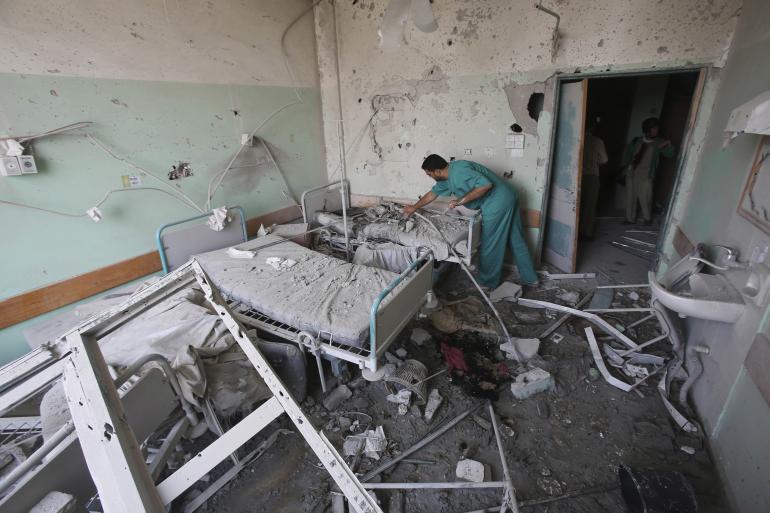
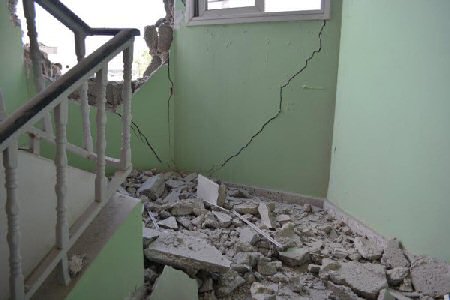
As in so many other contemporary conflicts – Iraq, Libya, Syria – hospitals themselves had already become targets for military violence.  For eleven days Al-Wafa Hospital in Shuja’iyeh in eastern Gaza City (see the map above), the only rehabilitation centre serving the occupied territories, was receiving phone calls from the IDF warning them that the building was about to be bombed.  [In case you’re impressed by the consideration, think about Paul Woodward‘s observation: ‘I grew up in Britain during the era when the Provisional IRA was conducting a bombing campaign in Northern Ireland and on the mainland. I don’t remember the Provos ever being praised for the fact that they would typically phone the police to issue a warning before their bombs detonated. No one ever dubbed them the most humane terrorist organization in the world.’] The staff refused to evacuate the hospital because their patients were paralysed or unconscious. The Executive Director, Dr Basman Alashi, explained:

‘We’ve been in this place since 1996. We are known to the Israeli government. We are known to the Israeli Health Center and Health Ministry. They have transferred several patients to our hospital for rehabilitations. And we have many success stories of people come for rehabilitation. They come crawling or in a wheelchair; they go out of the hospital walking, and they go back to Israel saying that al-Wafa has done miracle to them. So we are known to them, who we are, what we are. And we are not too far from their border. Our building is not too small. It’s big. It’s about 2,000 square meters. If I stand on the window, I can see the Israelis, and they can see me. So we are not hiding anything in the building. They can see me, and I can see them. And we’ve been here for the last 12 or 15 years, neighbors, next to each other. We have not done any harm to anybody, but we try to save life, to give life, to better life to either an Arab Palestinian or an Israeli Jew.’

el-Wafa.03

But just after 9 p.m. on 17 July shells started falling:

‘… the fourth floor, third floor, second floor. Smoke, fire, dust all over. We lost electricity… luckily, nobody got hurt. Only burning building, smoke inside, dust, ceiling falling, wall broke, electricity cutoff, water is leaking everywhere. So, the hospital became [uninhabitable].’

Seventeen patients were evacuated and transferred to the Sahaba Medical Complex in Gaza City. Sharif Abdel Kouddos takes up the story:

‘The electricity went out, all the windows shattered, the hospital was full of dust, we couldn’t see anything,’ says Aya Abdan, a 16-year-old patient at the hospital who is paraplegic and has cancer in her spinal cord. She is one of the few who can speak.

It is, of course, literally unspeakable.  But this was not an isolated incident – still less ‘a mistake’ – and other hospitals have been bombed or shelled.  According to the Ministry of Health, 25 health facilities in Gaza have been partially or totally destroyed. Just this morning it was reported that Israeli tanks shelled the al-Aqsa Hospital in Deir al-Balah in central Gaza, killing five and injuring 70 staff and patients. The Guardian reports that ambulances which tried to evacuate patients were forced to turn back by continued shelling.  According to Peter Beaumont:

‘”People can’t believe this is happening – that a medical hospital was shelled without the briefest warning. It was already full with patients,” said Fikr Shalltoot, director of programmes at Medical Aid for Palestinians in Gaza city.’

mads-gilbert-at-al-shifa-hospital

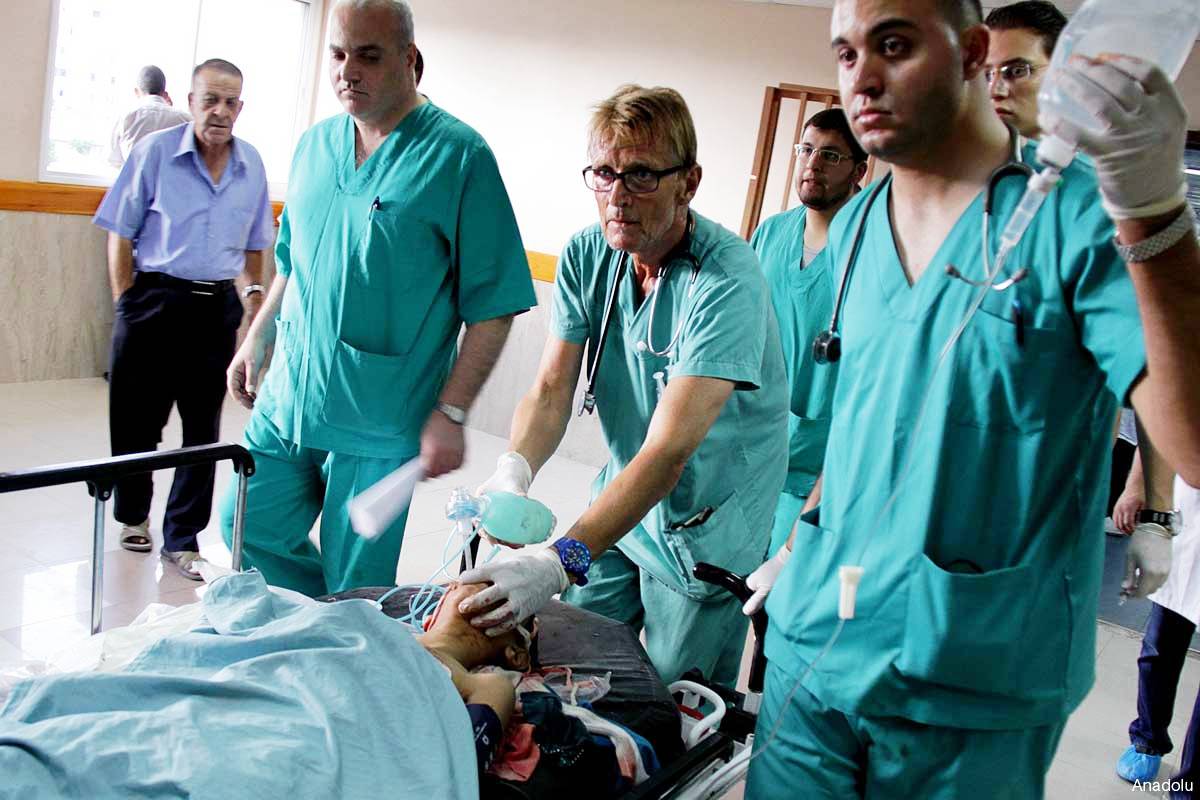
The hospitals that remain in operation are overwhelmed, with doctors making heart-wrenching decisions about who to treat and who to send away, refusing ‘moderately injured patients they normally would have admitted in order to make room for the more seriously wounded.’  Mads Gilbert (centre in the image above) again:

Oh NO! not one more load of tens of maimed and bleeding, we still have lakes of blood on the floor in the ER, piles of dripping, blood-soaked bandages to clear out – oh – the cleaners, everywhere, swiftly shovelling the blood and discarded tissues, hair, clothes,cannulas – the leftovers from death – all taken away…to be prepared again, to be repeated all over. More then 100 cases came to Shifa last 24 hrs. enough for a large well trained hospital with everything, but here – almost nothing: electricity, water, disposables, drugs, OR-tables, instruments, monitors – all rusted and  as if taken from museums of yesterdays hospitals.

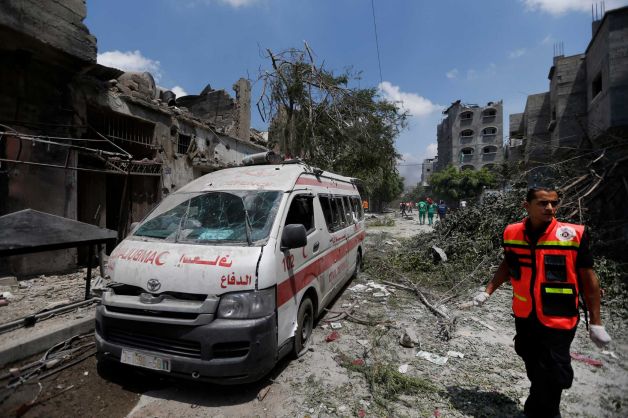
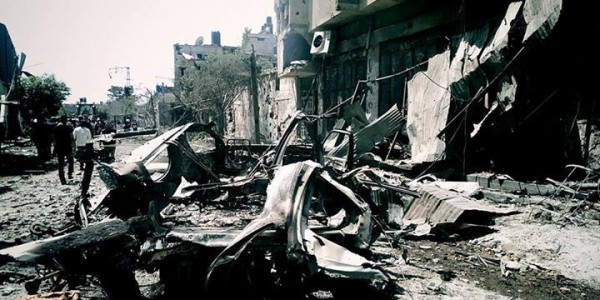
Al-Shifa, where he is working round the clock, has only 11 beds in its ER and just six Operating Rooms.  On Saturday night, when the Israeli army devastated the suburb of Shuja’ieyh, its ‘tank shells falling like hot raindrops‘, al-Shifa had to deal with more than 400 injured patients. Al-Shifa is Gaza’s main trauma centre but in other sense Gaza’s trauma is not ‘centred’ at all but is everywhere within its iron walls.  Commentators repeatedly describe Gaza as the world’s largest open-air prison – though, given the cruelly calculated deprivation of the means of normal life, concentration camp would be more accurate – but it is also one where the guards routinely kill, wound and hurt the prisoners. The medical geography I’ve sketched here is another way of reading Israel’s bloody ‘map of pain‘. I am sickened by the endless calls for ‘balance’, for ‘both sides’ to do x and y and z, as though this is something other than a desperately unequal struggle: as though every day, month and year the Palestinians have not been losing their land, their lives and their liberties to a brutal, calculating and manipulative occupier.  I started this post with an image of a Palestinian ambulance; the photograph below was taken in Shuja’ieyh at the weekend.  It too is an image of a Palestinian ambulance.

Shujaiyeh.01
For updates see here; I fear there will be more to come. In addition to the links in the post above, this short post is also relevant (I’ve received an e-mail asking me if I realised what the initial letters spelled…. Duh.)

Corpographies

I’ve been scribbling some notes for a short essay Léopold Lambert has invited me to write for his Funambulist Papers.  The brief is to write ‘something about the body – nothing too complicated’, so I’ve decided to say something more about the idea of corpography I sketched in ‘Gabriel’s Map’ (DOWNLOADS tab), which will in turn – so I hope – prepare the ground for the long-form version of ‘The nature(s) of war’ for a special issue of Antipode devoted to the work of Neil Smith [next on my to-do list].

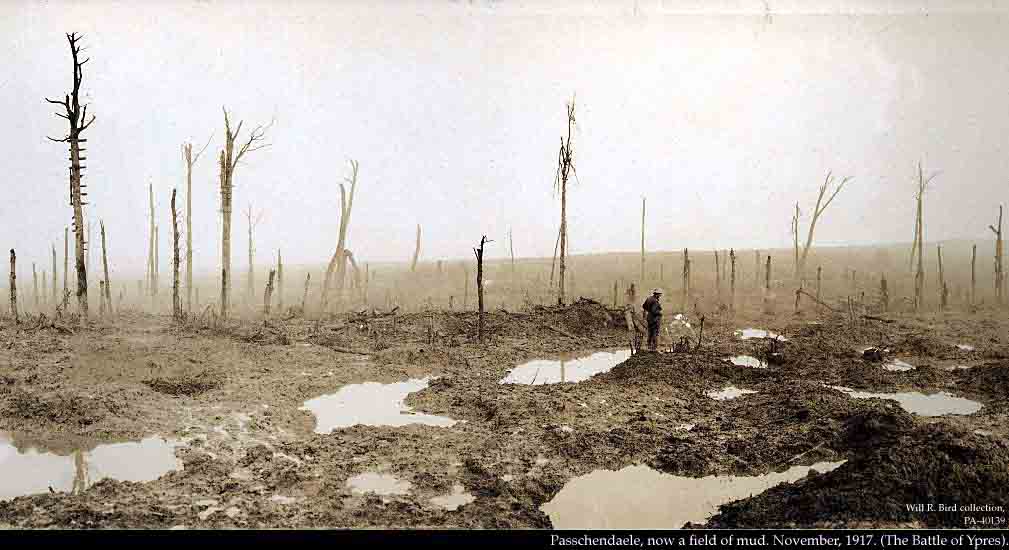
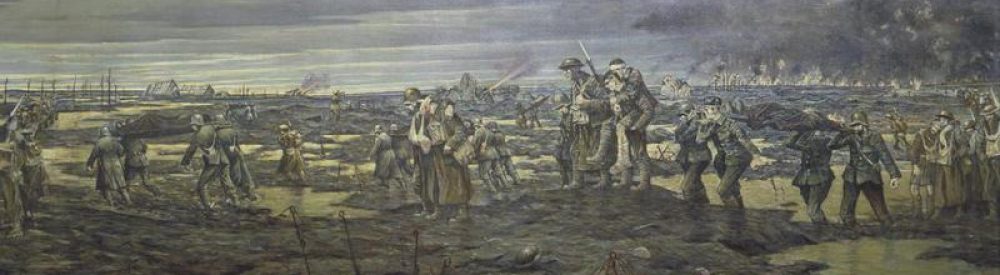
In ‘Gabriel’s Map’ (and in a preliminary sketch here) I contrasted the cartographic imaginary within which so much of the First World War was planned with a corpography improvised by soldiers caught up in the maelstrom of military violence on the ground; unlike the ‘optical war’ that relied, above all, on aerial reconnaissance, projected onto the geometric order of the map and the mechanical cadence of the military timetable – a remarkably abstract space, though its production was of course profoundly embodied – this was a way of apprehending the battle space through the body as an acutely physical field in which the senses of sound, smell and touch were increasingly privileged in the construction of a profoundly haptic or somatic geography.
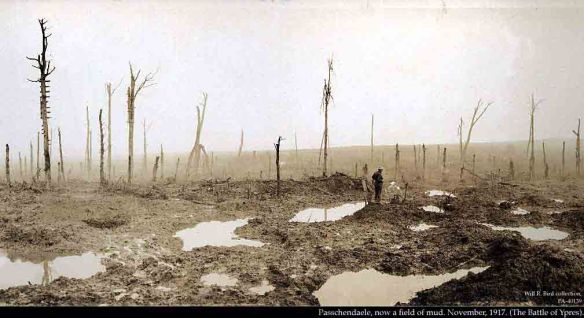
passchendale1917vj0

This is hardly original; you can find intimations of all this in classics like Eric Leed‘s No Man’s Land, and once you start digging in to the accounts left by soldiers you find supporting evidence on page after page.  What I’ve tried to do is show that this constituted more than a different way of experiencing war: it was also a different way of knowing and ordering (or, as Allan Pred would surely have said, of re-cognising) the space of military violence.  These knowledges were situated and embodied – ‘local’, even – but they were also transmissable and mobile.

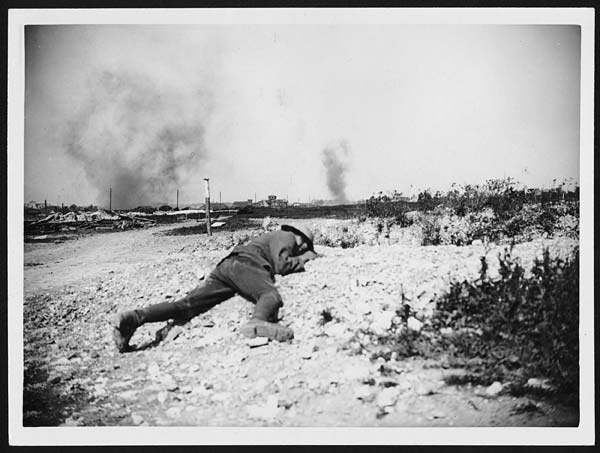
On the Western front, corpographies were at once an instinctive, jarring, visceral response to military violence –

‘When sound is translated into a blow on the nape of the neck, and light into a flash so bright that it actually scorches the skin, when feeling is lost in one disintegrating jar of every nerve and fibre … the mind, at such moments, is like a compass when the needle has been jolted from its pivot’ [‘A Corporal’, Field Ambulance Sketches (1919)]

– and an improvisational, learned accommodation to it:

‘We know by the singing of a shell when it is going to drop near us, when it is politic to duck and when one may treat the sound with contempt. We are becoming soldiers. We know the calibres of the shells which are sent over in search of us. The brute that explodes with a crash like that of much crockery being broken, and afterwards makes a “cheering” noise like the distant echoes of a football match, is a five-point-nine.The very sudden brute that you don’t hear until it has passed you, and rushes with the hiss of escaping steam, is a whizz-bang… The funny little chap who goes tonk-phew-bong is a little high-velocity shell which doesn’t do much harm… The thing which, without warning, suddenly utters a hissing sneeze behind us is one of our own trench-mortars. The dull bump which follows, and comes from the middle distance out in front, tells us that the ammunition is “dud.” The German shell which arrives with the sound of a woman with a hare-lip trying to whistle, and makes very little sound when it bursts, almost certainly contains gas.

‘We know when to ignore machine-gun and rifle bullets and when to take an interest in them. A steady phew-phew-phew means that they are not dangerously near. When on the other hand we get a sensation of whips being slashed in our ears we know that it is time to seek the embrace of Mother Earth’ [A.M. Burrage, War is war]
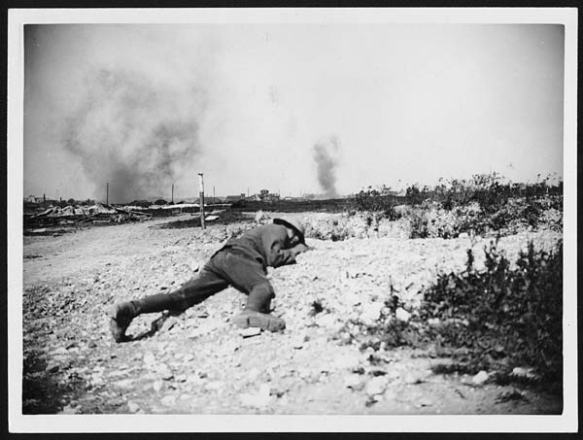
National Library of Scotland (Tom Aitken)

This was not so much a re-setting of the compass, as the anonymous stretcher-bearer had it, as the formation of a different bodily instrument altogether.  As Burrage’s last sentence shows, corpographies were at once re-cognitions of a butchered landscape – one that seemed to deny all sense – and reaffirmations of an intimate, intensely sensible bond with the earth:

‘To no man does the earth mean so much as to the soldier. When he presses himself down upon her, long and powerfully, when he buries his face and his limbs deep in her from the fear of death by shell-fire, then she is his only friend, his brother, his mother; he stifles his terror and his cries in her silence and her security…. ’ [Erich Remarque, All quiet on the Western Front]

And corpographies were not only a means through which militarised subjects accommodated themselves to the warscape – providing a repertoire of survival of sorts – but also a way of resisting at least some its impositions and affirming, in the midst of what so many of them insisted was ‘murder not war’, what Santanu Das calls a ‘tactile tenderness’ between men.  This, he argues,

‘must be seen as a celebration of life, of young men huddled against long winter nights, rotting corpses, and falling shells. Physical contact was a transmission of the wonderful assurance of being alive, and more sex-specific eroticism, though concomitant, was subsidiary. In a world of visual squalor, little gestures – closing a dead comrade’s eyes, wiping his brow, or holding him in one’s arms – were felt as acts of supreme beauty that made life worth living.’
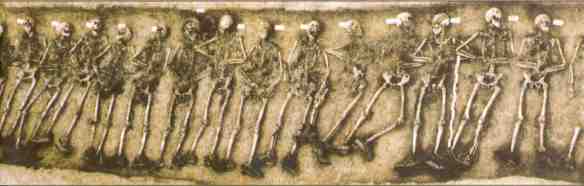
grimsbychums

A hundred years later, I have no doubt that much the same is true in Afghanistan, Iraq, Syria and elsewhere, and so my interest in corpography is also part of my refusal to acquiesce to the thoroughly disingenuous de-corporealization of today’s ‘virtuous war’.

In fleshing out these ideas I’ve been indebted to a stream of work on the body in human geography. Most of it has been remarkably silent about war, even though Kirsten Simonsen once wrote about ‘the body as battlefield‘, but it’s now difficult for me to read her elegant essay ‘In quest of a new humanism: Embodiment, experience and phenomenology as critical geography’ [Progress in human geography 37 (1) (2013): open access here] – especially Part III where she discusses ‘Thinking the body’ and ‘Orientation and disorientation’ – without peopling it with bodies in khaki, blue or field grey tramping towards the front-line trenches, clambering over the top, or crawling from shell-hole to shell-hole in No Man’s Land.

That is partly down to the suggestiveness of Kirsten’s prose, but it’s also the result of my debt to the work of Santanu Das [Touch and intimacy in First World War literature], Ken MacLeish [especially Chapter 2 of his Making War at Fort Hood; the dissertation version is here] and Kevin McSorley [whose introduction to War and the body is here] which directly addresses military violence.  I wish I’d been able to attend the Sensing War conference that Kevin co-organised in London last month; I had to turn down the invitation because I was marooned on my mountaintop in Umbria, but the original Call For Papers captured some of the ways in which the materialities and corporealities of war in the early twentieth century continue to inhabit later modern war:

War is a crucible of sensory experience and its lived affects radically transform ways of being in the world. It is prosecuted, lived and reproduced through a panoply of sensory apprehensions, practices and ‘sensate regimes of war’ (Butler 2012) – from the tightly choreographed rhythms of patrol to the hallucinatory suspicions of night vision; from the ominous mosquito buzz of drones to the invasive scrape of force-feeding tubes; from the remediation of visceral helmetcam footage to the anxious tremors of the IED detector; from the desperate urgencies of triage to the precarious intimacies of care; from the playful grasp of children’s war-toys to the feel of cold sweat on a veteran’s skin.

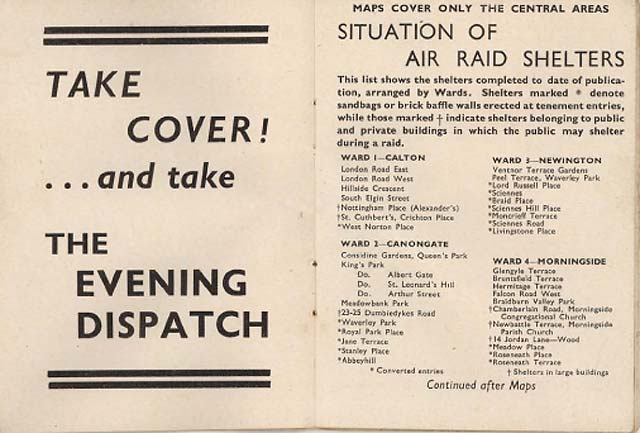
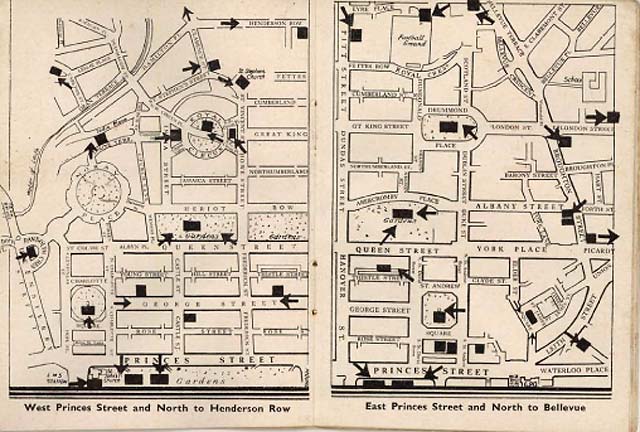
Thus far, like most of the writers I’ve drawn from here, I’ve been thinking about corpographies in relation to the soldier’s body, but as the (in)distinctions between combatant and civilian multiply I’ve started to think about the knowledges that sustain civilians caught up in military and paramilitary violence too. Some of them are undoubtedly cartographic – formal and informal maps of shelters (the images below are for Edinburgh during the Second World War), camps, checkpoints and roadblocks – and some of them rely on visual markers of territory: barriers and wires, posters and graffiti. Today much of this information is shared by social media (as the battle space has become both digital and physical).
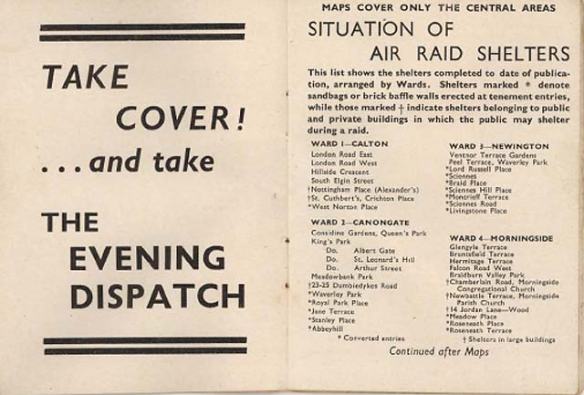
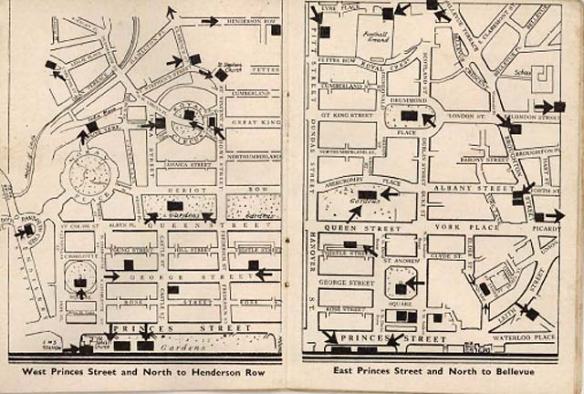
Guide to Edinburgh Air Raid Shelters WW2


0_books_-_edinburgh_air_raid_shelters_p12+p13

But much of this knowledge is also, as it has always been, corpographic.  Pete Adey once wrote – beautifully – about what he called ‘the private life of an air raid’, drawing on the files of Mass Observation during the Second World War to sketch a geography of ‘stillness’ even as the urban landscape was being violently ‘un-made’.  ‘Stillness in this sense,’ he explained,

‘denotes apprehending and anticipating spaces and events in ways that sees the body enveloped within the movement of the environment around it; bobbing along intensities that course their way through it; positioned towards pasts and futures that make themselves felt, and becoming capable of intense forms of experience and thought.’

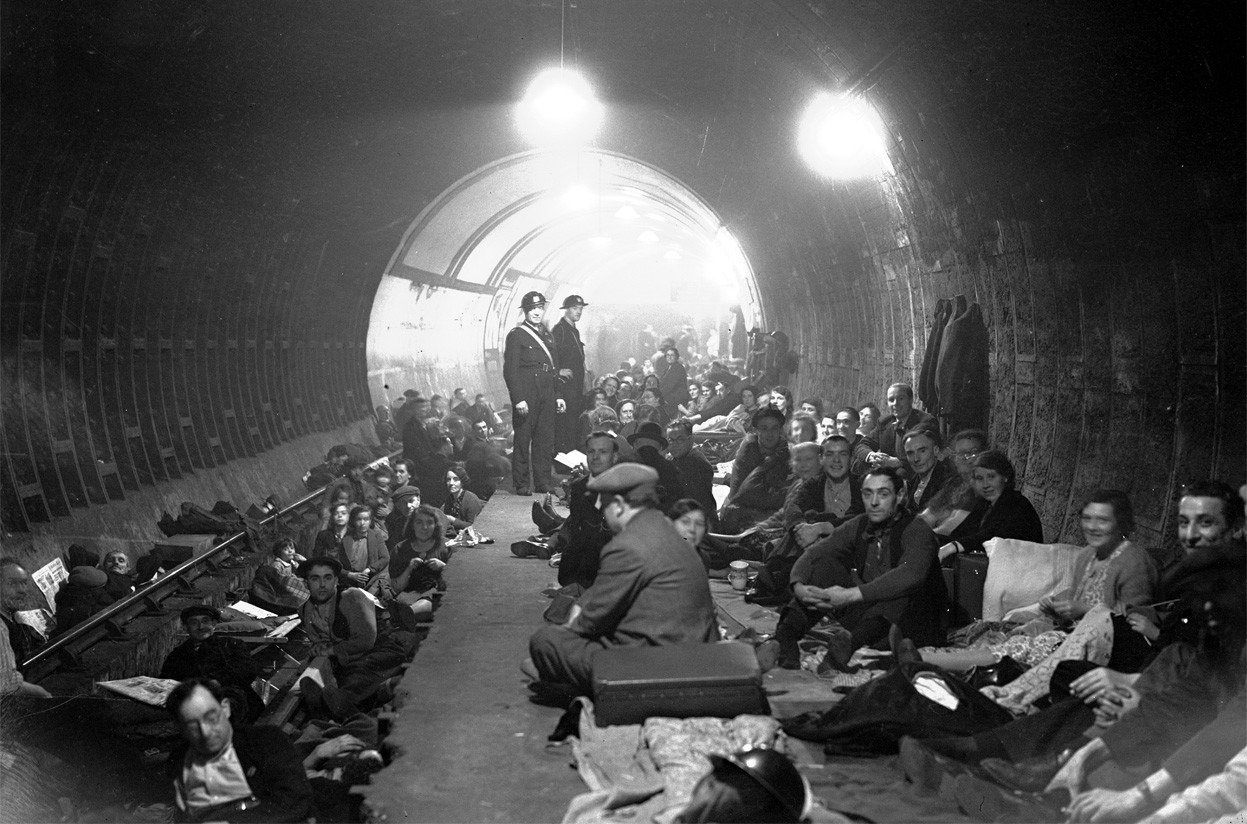
This was a corpo-reality, and one in which – as he emphasised – sound played a vital role: ‘Waves of sound disrupted fragile tempers as they passed through the waiting bodies in the physical language of tensed muscles and gritted teeth.’  But, as he also concedes, this was also a ‘not-so private’ life – there was also a social life under the bombs – and we need to think about how these experiences were shared by and with other bodies.  These apprehensions of military violence, then as now, were not only modalities of being but also modes of knowing: as Elizabeth Dauphinée suggests, in a different but closely related context, ‘pain is not an invisible interior geography’ but rather ‘a mode of knowing (in) the world – of knowing and making known’  [‘The politics of the body in pain’, Security dialogue 38 (2) (2007) 139-55]. During an air raid these knowledges could be shared by talking with others – the common currency of comfort and despair, advice and rumour – but they also arose from making cognitive sense of physical sensations: the hissing and roaring of the bombs, the suction and compression from the blast, the stench of ruptured gas mains or sewage pipes.
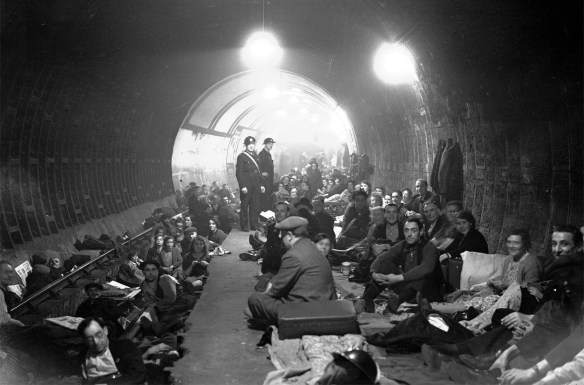
London air raid shelter

Steven Connor once suggested that air raids involve a ‘grotesquely widened bifurcation of visuality and hearing’, in which the optical-visual production of a target contrasts with ‘the absolute deprivation of sight for the victims of the air raid on the ground, compelled as they are to rely on hearing to give them information about the incoming bombs.’  Those crouching beneath the bombs have ‘to learn new skills of orientating themselves in this deadly auditory field without clear coordinates or dimensions but in which the tiniest variation in pitch and timbre can mean obliteration.’  What then can you know – and how can you know – when your world contracts to a room, a cellar, the space under the bed?  When you can’t go near a window in case it shatters and your body is sliced by the splinters?  When all you have to go on, all you can trust, are your ears parsing the noise or your fingers scrabbling at the rubble?
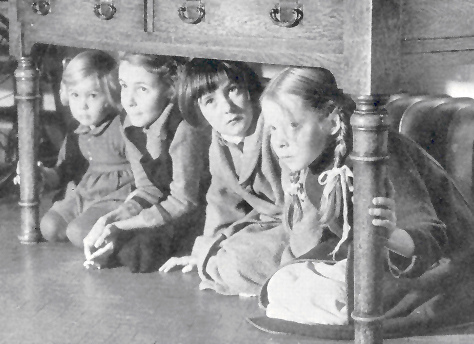
Air raid drill in children's home WW2

Here too none of this is confined to the past, and so I start to think about the thanatosonics of Israel’s air strikes on Gaza.  Sound continues to function as sensory assault; here is Mohammed Omer:

‘At just 3 months old, my son Omar cries, swaddled in his crib. It’s dark. The electricity and water are out. My wife frantically tries to comfort him, shield him and assure him as tears stream down her face. This night Omar’s lullaby is Israel’s rendition of Wagner’s Ride of the Valkyries, with F-16s forming the ground-pounding percussion, Hellfire missiles leading the winds and drones representing the string section. All around us crashing bombs from Israeli gunships and ground-based mortars complete the symphony, their sound as distinct as the infamous Wagner tubas…. Above, the ever-present thwup-thwup of hovering Apache helicopters rock Omar’s cradle through vibration. Warning sirens pierce the night—another incoming missile from an Israeli warship.’

And, as before, sound can also be a source of knowledge.  Here is Wasseem el Sarraj, writing from Gaza in November 2012:

In our house we have become military experts, specializing in the sounds of Israeli and Palestinian weapons. We can distinguish with ease the sound of Apaches, F-16 missiles, drones, and the Fajr rockets used by Hamas. When Israeli ships shell the coast, it’s a distinct and repetitive thud, marked by a one-second delay between the launch and the impact. The F-16s swoop in like they are tearing open the sky, lock onto their target and with devastating precision destroy entire apartment blocks. Drones: in Gaza, they are called zananas, meaning a bee’s buzz. They are the incessant, irritating creatures. They are not always the harbingers of destruction; instead they remain omnipresent, like patrolling prison guards. Fajr rockets are absolutely terrifying because they sound like incoming rockets. You hear them rarely in Gaza City and thus we often confuse them for low-flying F-16s. It all creates a terrifying soundscape, and at night we lie in our beds hoping that the bombs do not drop on our houses, that glass does not shatter onto our children’s beds. Sometimes, we move from room to room in an attempt to feel some sense of safety. The reality is that there is no escape, neither inside the house nor from the confines of Gaza.

The last haunting sentences are a stark reminder that knowledge, cartographic or corpographic, is no guarantee of safety. But military and paramilitary violence is always more than a mark on a map or a trace on a screen, and the ability to re-cognise its more-than-optical dimensions can be a vital means of navigating the wastelands of war.  As in the past, so today rescue from the rubble often involves a heightened sense of sound and smell, and survival is often immeasurably enhanced by the reassuring touch of another’s body.  And these fleshy affordances – which you can find in accounts of air raids from Guernica to Gaza – are also a powerful locus for critique.
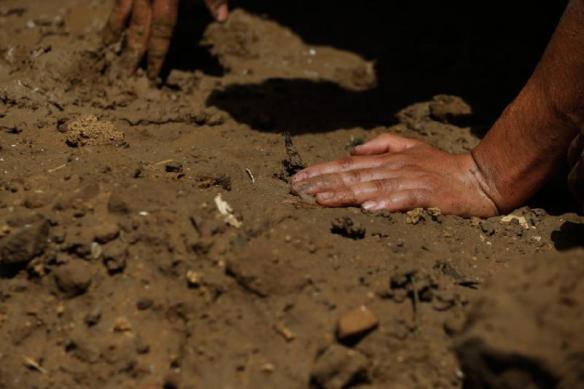
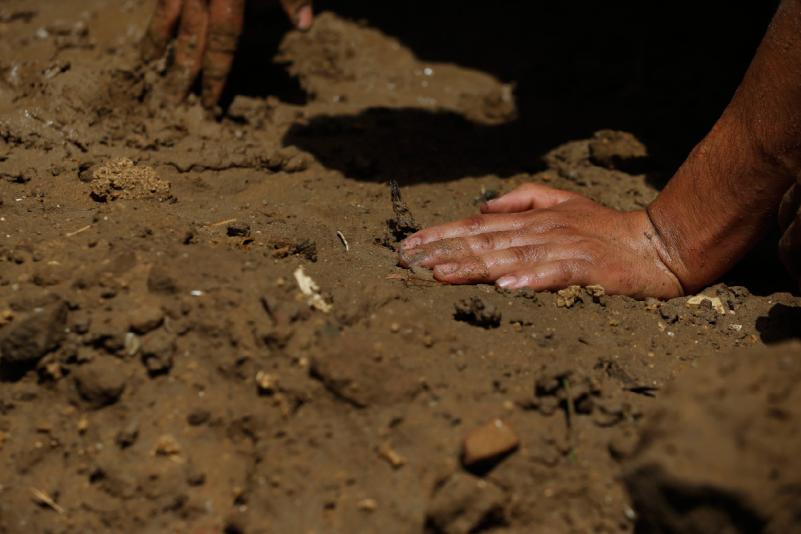
Gaza Hands and Grave

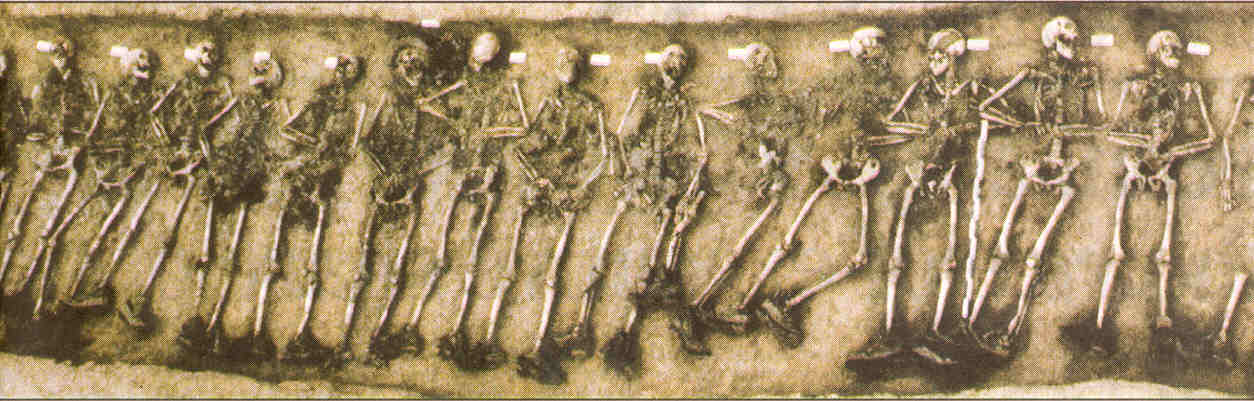
So: corpographies.  I thought I’d made the word up, but as I completed ‘Gabriel’s Map’ I discovered that Joseph Pugliese uses ‘geocorpographies’ to designate ‘the violent enmeshment of the flesh and blood of the body within the geopolitics of war and empire’ in his State violence and the execution of law (New York: Routledge, 2013; p. 86). This complements my own study, though I’ve used the term to confront the optical privileges of cartography through an appeal to the corporeal (and to the corpses of those who were killed in the names of war and empire).

And I’ve since discovered that the term has a longer history and multiple meanings that intersect, in various ways, with what I’m trying to work out.  Perhaps not surprisingly, it also serves as a medical term: cranio-corpography is a procedure devised by Claus-Frenzen Claussen in 1968 to capture in a visual trace the longitudinal and lateral movements of a patient’s body in order to detect and calibrate disorders of the ‘equilibrium function’.  More recently, corpography has also been used by dance theorists and practitioners, including Francesca Cataldi and Sebastian Prantl, to describe a critical, creative practice: a ‘dance of things’ in which the body is thoroughly immersed as a’ land.body.scape’, as Prantl puts it.  Meanwhile, Allan Parsons has proposed a ‘psycho-corpography’ – explicitly not a psycho-geography – as a way of ‘tracing the experience of living-a-body’.  Elsewhere,  Alex Chase attends to specific bodies-in-the-world, those of cultural ‘figures’ (Artaud, Bataille, Foucault, Genet, Jarman and Mishima among them), that resist normalization – hence emphatically  ‘queer’ bodies – and which figure bodies as events.  ‘I hope to develop a methodology of “corpography”,’ he says, ‘which would write between biography and textual analysis, material lived bodies and fictional work, life and representation, in order to work through other queer concepts such as temporality, space, and ethics.’

It would of course be absurd to summon all of these different usages onto a single conceptual terrain. But they do take me back to Kirsten’s essay (and to long-ago memories of an enthralling seminar in Roskilde which she introduced through her dance teacher), to ways of apprehending the danse macabre on the Western Front as both a cartography and a corpography whose junction was to be found, perhaps, in a choreography, and to think about the ways in which the sentient bodies of soldiers were at once habituated to and resisted the forceful normalizations of military violence.  They also make me wonder about civilian corpographies – about the multiple ways in which violence is inflicted on the body and yet may be resisted through the body – and in doing so they direct my steps from the past to the present and to the fragile bodies that continue to lie at the heart of today’s conflicts.  If that is to speak with Walter Benjamin, I want to insist that the ‘tiny, fragile human body’ does not only lie ‘in a field of force of destructive torrents and explosions’, as he wrote in 1936: for the body is a vector as well as a victim of military and paramilitary violence.  And it can also be a means of undoing its effects.

I suspect that these ideas will eventually thread their way into my new project on the evacuation of combatant and civilian casualties (and the sick) from war zones, 1914-2014, where it’s already clear to me that cartography and corpography are tightly locked together.  All of this is highly provisional, as you’ll realise, and as always I would welcome comments and suggestions.
Maps of/for pain

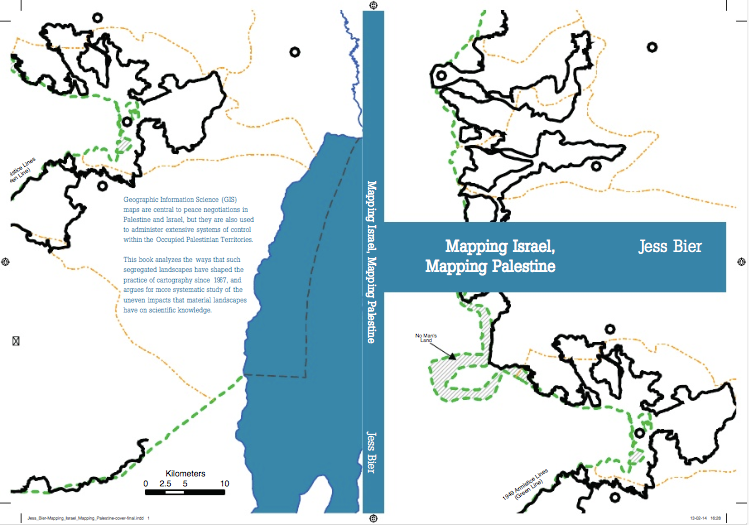
This morning I received a copy of Jess Bier‘s recently completed PhD thesis, Mapping Israel, Mapping Palestine (Technology and Science Studies, Maastricht, 2014) – thanks so much, Jess – and I look forward to working my way through it.  You can download a version from Academia here.


BIER Mapping Israel, mapping Palestine

Here is the abstract:

Mapping Israel, Mapping Palestine is an analysis of the ways that segregated landscapes have shaped the practice of cartography in Jerusalem and the West Bank since 1967. Extending work on how technology is socially constructed, it investigates the ways that knowledge is geographically produced. Technoscientific practices are situated in spatial contexts which are at once both social and material. This situated character influences the content of knowledge in ways that can be unpredictable. Therefore, it is necessary to reflexively engage with materiality in order to enable landscapes that allow for more diverse practices and forms of knowledge.

The complex geographies of Palestine and Israel provide central sites for the study of how landscapes shape the form, content, and circulation of knowledge. 1967 marks the beginning of the Israeli Occupation of the Palestinian Territories, including the West Bank and Gaza Strip. With the notable exception of East Jerusalem, currently most of the occupied areas have been neither formally incorporated into the Israeli state, nor have they been allowed to form an independent sovereign nation. Instead, small pockets of Palestinian control have been carved out through a series of international negotiations aimed at clearly defining separate states for Palestinians and Israelis—negotiations which often take place over tables strewn with maps.

Yet even as maps are employed in attempts to end the Occupation, similar methods have been used to build intricate infrastructure networks for curtailing human movement within the Territories. These include the 8‐meter [high] Wall which snakes through the West Bank, segregated sets of roads and buildings, as well as roving series of checkpoints and roadblocks, all designed with the purpose of confining Palestinians and separating them from Israelis. The planning, construction, and administration of such systems of control are made possible by the same Geographic Information Science (GIS) mapmaking practices which are used in attempts to ameliorate the conflict. To understand how this is possible, it is necessary to explore the ways that such practices are differently incorporated throughout the very region which cartographers seek to map and reshape.

The centrality of maps to debates over the future of Palestine and Israel has only intensified since the advent of digital cartography has led to increasingly minute forms of surveillance and control. Contemporary cartography incorporates a range of practices in Jerusalem and the West Bank, from adaptations of decommissioned spy satellite images to a road map made by Palestinian students who tracked their own movements on their mobile phones. Intended to display objective facts, empirical maps often inspire extensive discussion. Participants in these discussions exhibit a variety of observational frames that cannot be divorced from their unequal positions and mobilities within the very terrains that they seek to portray. Mapping Israel, Mapping Palestine addresses these issues by presenting an analysis of the empirical maps and mapmaking practices which result when diverse cartographers travel to chart the same landscapes that so condition their movement. As such, it investigates the myriad ways that the segregated landscapes of the Israeli Occupation shape the conditions of possibility for knowledge about the Occupation and its effects.

This is really important work (see also the presentation by the Foundation for Middle East Peace here), but in addition to maps and digital captures of occupied Palestine – the plethora of lines on maps – there are other operational dimensions to mapping.  I’m thinking in particular of the IDF’s target maps.  You can find a report of its ‘target bank’ for southern Lebanon in 2011 here – ‘many time larger than it was in 2006’ – and Craig Jones‘s discussion of surveillance, imagery and targeted killing here.

This apparatus is in full play during the present military offensive on Gaza, which (like all the others) involves the production and destruction of targets through the mobilisation of cartography.

But there are other dimensions.  Here is a senior IDF officer, as reported by Reuters on 12 July:

“We are dealing with a variety of families of targets. If there is a kind of a map, or a map of pain that the enemy sees, we create a lot of pain so that he will have to think first to stop the conflict.”

There may well be a map of pain — but the pain is also produced through mapping.

Bombed, Destroyed, Slaughtered

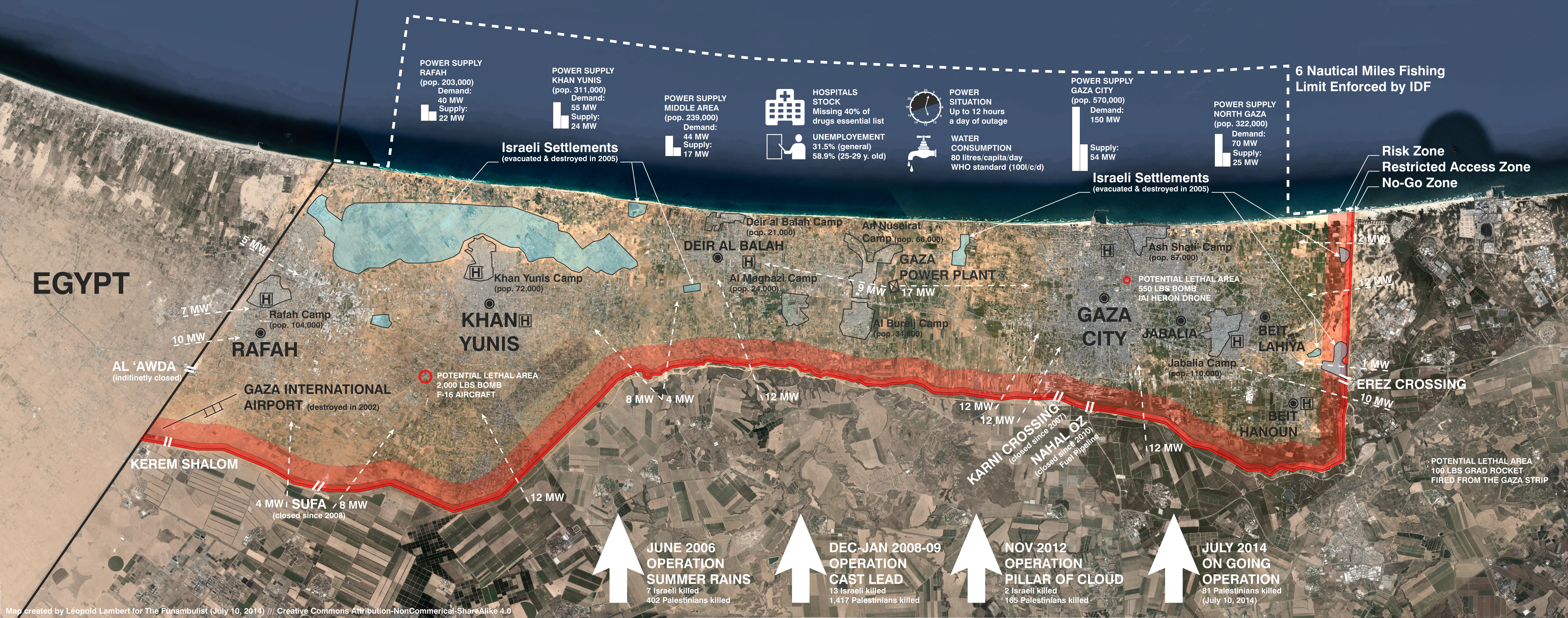
Map Gaza

Following on from my previous post, Léopold Lambert has produced the map above, showing an ‘infrastructural and militarized cartography’ of Gaza; you can download a hi-res version and read his commentary here.

Notice those repetitions marked by arrows; Rami Khoury writes in Lebanon’s Daily Star this morning:

What we are witnessing today is Israel behaving against Palestinians much as the French, British and Italian colonial powers behaved against Iraqis, Syrians, Egyptians, Algerians and Libyans a century or more ago. In its colonization of Arab lands and its raw military savagery against civilians, Israel gives us the best history lesson available of the conduct of colonial powers who treated natives as servants or subversives without rights, and who dealt with them primarily by repeated shows of force.

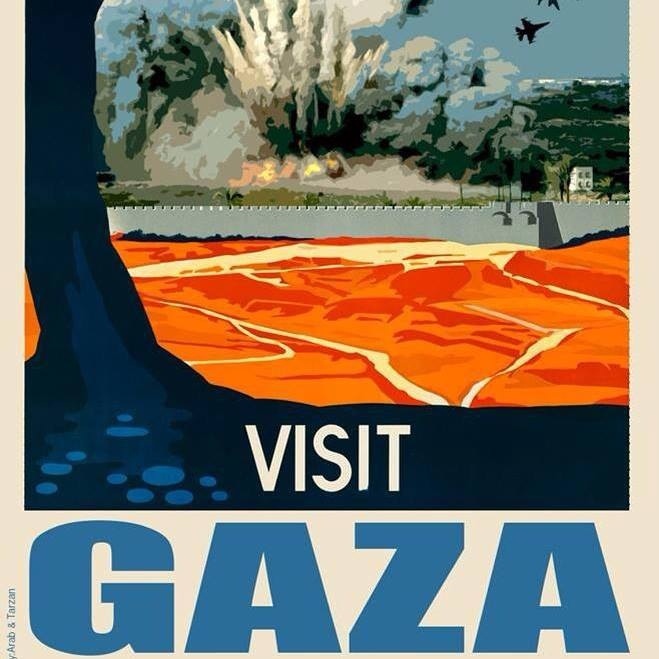
Visit GazaBut this is far more than a postscript to my previous post on Gaza, with its own vocabulary of ‘all too familiar’, ‘this time round’, and ‘once again’. Over at Critical Legal Thinking Nimer Sultany has a truly excellent short essay, ‘Repetition and Death in the Colony: On the Israeli attacks on Gaza‘:

‘At the moment of writing these lines, the BBC reports 100 deaths thus far in Gaza in the recent Israeli onslaught. As we have seen these scenes before, the invocation of repetition comes naturally. “Once again” is a commonly used word when it comes to death and suffering under occupation in Palestine and specifically Gaza….

‘But “once again” is not a mere rhetorical gesture nor symptomatic of tragic despair. It connotes a recursive power dynamic and a structural relationship between an occupier and an occupied. It should be a reminder of context rather than an erasure of context…. Lacking context, the responsibility is either equally shared by two symmetrically opposed agents of violence or the stronger party bears no responsibility because it is merely responding to the irrational violence of the weak who bears the responsibility for death and suffering.’

Nimer develops his argument in relation to the juridification of (later) modern war, the construction of the (Palestinian) civilian as a negation (the non-combatant as ‘an afterthought’), and on a ‘peace process’ that is ‘conditioned on their abdication of their right to resist an unjust foreign occupier and … their subordination of demands on behalf of justice for the sake of peace’ (see also Nimer’s ‘Colonial realities’ here; his account of the role of the Israeli Supreme Court in the juridifcation of the occupation of Palestine, ‘Activism and Legitimation in Israel’s Jurisprudence of Occupation’ in Social and Legal Studies (online March 2014) is usefully read alongside George Bisharat, ‘Violence’s Law’, Journal of Palestine Studies 42 (3) (2013) 68-84, which addresses Israel’s concerted campaign to transform international humanitarian law [‘the laws of war’]).

Gaza, stripped again

As Craig Jones notes over at War, Law and Space, the renewed fighting between Hamas and the IDF is all too familiar; so too is the cartography.

In November 2012, the New York Times published two maps – one showing Israeli cities ‘taking enemy fire’ and the other showing the site of Israeli leaflet drops on Gaza (see my discussion here).

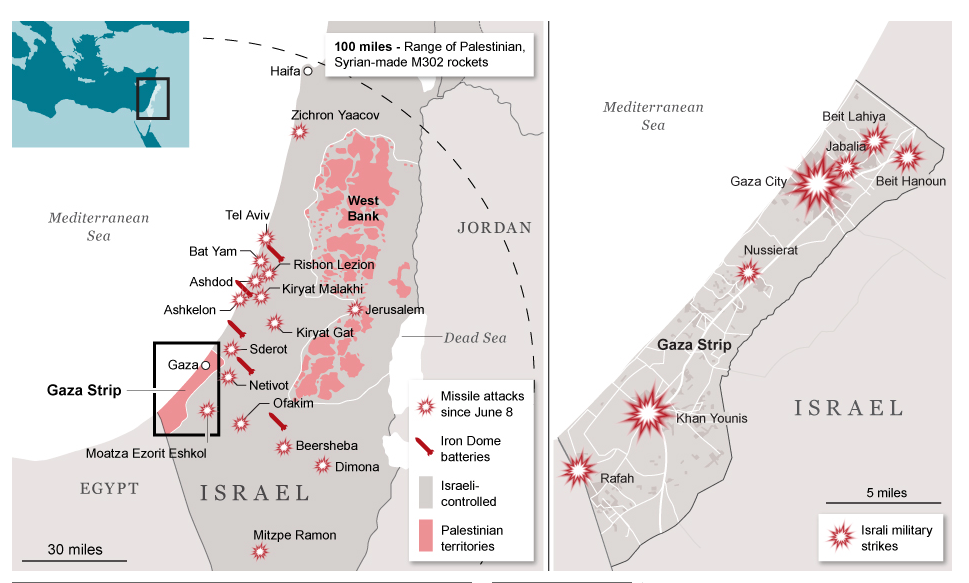
This time round, the only maps available until today have shown the putative range of Hamas’s rockets and the strikes that have taken place in Israel: Gaza might just as well have been a blank space marked ‘here be monsters’ (which is, of course, exactly how the Netanyahu administration wants us to see it).

This evening, Britain’s Telegraph published this map:

IDF and Hamas air strikes 2014

What the latest Israeli assault shows once again, however, is that the key on the left-hand map is misleading.  To juxtapose ‘Israeli-controlled’ with ‘Palestinian territories’ is like juxtaposing ‘fruit’ to ‘apples’.  So many domains of life – and death – in the Palestinian territories, in both the occupied West Bank and Gaza, remain firmly under Israeli control.