Deadly improvisations

There is nothing refined about killing, but the war in Syria has shown that both sides have resorted to improvisational tactics.  I say ‘both sides’ as a short-hand: this is hardly a two-party conflict, since the anti-Assad forces are far from united and a number of external powers – not only Iran and Saudi Arabia – are plainly using the parties as players in a proxy war.

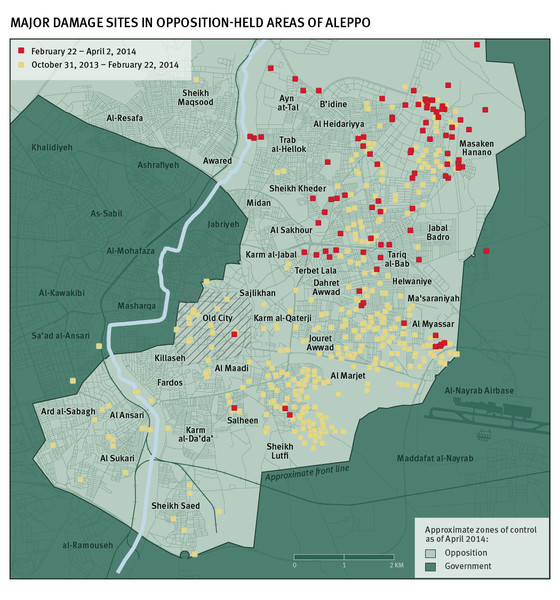
One of the first signs was the Syrian Air Force’s use of so-called ‘barrel bombs’: in effect, these are improvised explosive devices made from oil barrels filled with crude explosive and, on occasion, metal shrapnel and even chemicals like chlorine, which are then dropped from helicopters.  At first, they were dropped from low altitudes – which, according to Richard Lloyd at least, made them accurate enough to strike particular targets – but once the rebels were equipped with rocket-launchers (MANPADs) the helicopters had to fly much higher (near 7,000 feet) with a corresponding diminution in accuracy.  The first attacks took place against the city of Homs in August 2012, but the locus then shifted to rebel-held areas in Aleppo – the map below comes from Human Rights Watch‘s forensic analysis of strikes against that city between October 2013 and April 2014; some of the sites identified may have been struck by other munitions, HRW concedes, including conventional bombs, mortars and artillery shells, but the vast majority reveal the characteristic signature of the indiscriminate deployment of barrel bombs.  The Syrian National Council estimates that 20,000 people have been killed by barrel bombs thus far.

Aleppo Barrel Bombs (Human Rights Watch)

Since the Syrian Air Force has been supplied with conventional bombs by both Russia and Iran, many commentators have concluded that the recourse to crude barrel bombs is not the result of any munitions shortage but is rather a determined attempt to spread indiscriminate terror.  For we need to remember that there’s nothing special about barrel bombs; they are probably less effective – certainly less accurate – than conventional munitions.  In short, they are, as I’ve said, an improvisation – what the indefatigable Eliot Higgins (of Brown Moses fame: an absolutely indispensable source for all this) calls ‘a piece of crap’.  But they are also unequivocal evidence that the regime is ‘interested in no path forward other than by killing.’

The result has been captured in a sobering video from Syrian Zero, showing barrel bomb attacks on Darayya, a neighbourhood in Damascus during the last week of January (below; you can find a brief, helpful exposition and commentary on the video here).

Barrel bombs have also been used by the Sudanese Air Force in Southern Kordofan and Blue Nile states, and most recently by the Iraqi Air Force against Fallujah.

A second tactic used in Syria – this time by opposition forces – hearkens back to the First World War. Earlier this month, and in part as a counter to the crude air war against the rebel-held areas of Aleppo, the Islamic Front detonated a vast underground mine packed with explosives beneath the city’s Carlton Hotel, which was used as a base by the Syrian Army.  Video of the construction of the 75 metre tunnel had previously been uploaded to YouTube:

According to the BBC the explosion, just outside the Citadel, levelled the hotel and seriously damaged many surrounding buildings; there has been no official estimate of casualties, but it seems that dozens were killed or injured.  In the last few days  a much longer (850 metre) tunnel, which reportedly took 7 months to excavate, was used to detonate 60 tonnes of explosive packed under a Syrian Army base at Wadi al-Deif, also in the north of Syria.  The base, outside the town of Maarrat al-Nu’man, occupies a strategic location on the main route linking Damascus and Aleppo, and had been besieged by rebel forces for over a year.  Dozens of soldiers were killed in the attack.

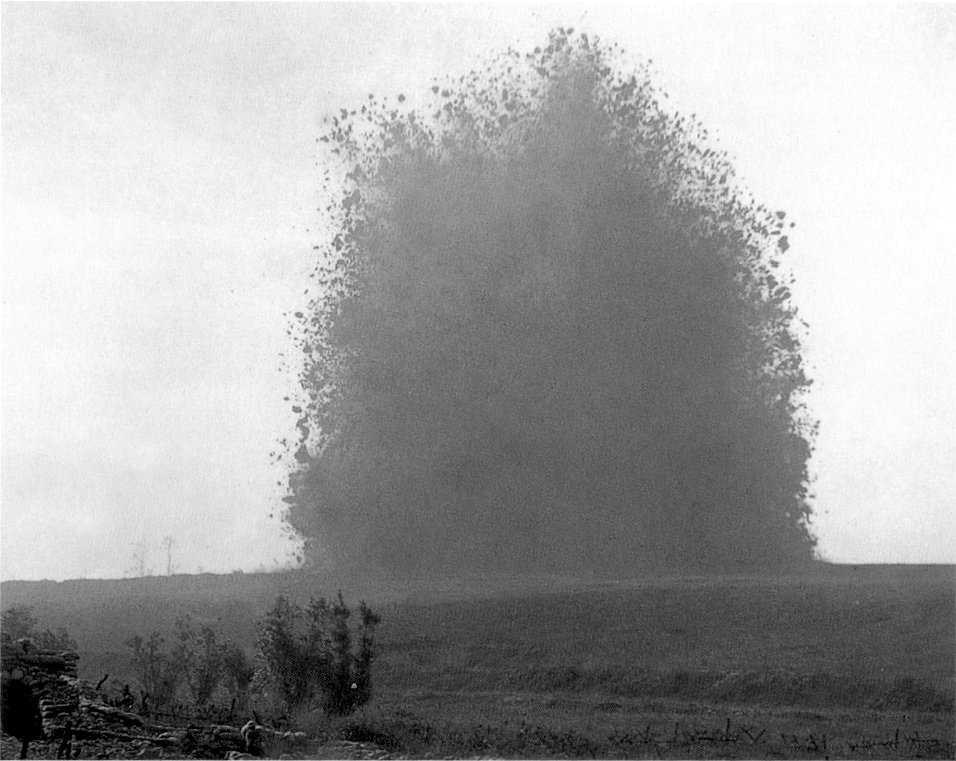
Tunnels, then, can be used not only to break sieges and blockades – as in those that keep the economy of Gaza supplied against the Israeli stranglehold: in effect, lifelines (if you want more on this, try the brilliant documentary Gaza: Tunnels to Nowhere and Nicolas Pelham, ‘Gaza’s tunnel phenomenon’, Journal of Palestine Studies 41 (4) 2012, pp. 6-31).  They can also be deathlines, dug for directly offensive purposes.  The tactic had been used to devastating effect on the Western Front, as I noted in a previous post on 3-D war: the image below is Ernest Brooks‘s famous photograph of the detonation of the British mine underneath the German lines at Hawthorn Ridge on the first day of the Battle of the Somme on 1 July 1916.  You can find video of the explosion here.

Hawthorn Ridge 1916

Then as now, as Jane Burgess argues in a dispatch from the frontlines of  ‘The Battle for Aleppo’, they are deadly improvisations in a war of attrition.

Both of these developments/reversions – the barrel bombs and the mines – obviously reinforce Stuart Elden‘s discussion of attempts to ‘secure the volume’.  But they also speak directly to a bleak politics of insecurity.

Remote operations

I’ve noted on several occasions the multiple ways in which later modern war invokes medical metaphors to legitimise military violence (notably ‘surgical strikes’ against the ‘cancer’ of insurgency), and my preliminary work on medical-military machines has revealed all sorts of feedbacks between (in particular) trauma care by advanced militaries in war zones and trauma care by civilian agencies at home.

robotic_surgery_chb15401

But these two paths have now intersected: in a paper on ‘Automated killing and mediated caringKathrin Friedrich and Moritz Queisner draw on studies of remote platforms and visual technologies – including my own – to discuss the automated killing of tumour cells using the CyberKnife system and what they call the the techno-medical ‘kill-chain’ that mediates between physician and patient.  They write:

Gregory uses the term kill-chain to characterize the setting of military interventions by unmanned aerial systems as “a dispersed and distributed apparatus, a congerie of actors, objects, practices, discourses and affects, that entrains the people who are made part of it and constitutes them as particular kinds of subjects.” Image-guided interventions in medical contexts share similar structural features and are also characterized by tying together a heterogeneity of practices, actors, discourses and expertise in order to achieve a precisely defined goal but without obviously stating their inner relations and micro politics.

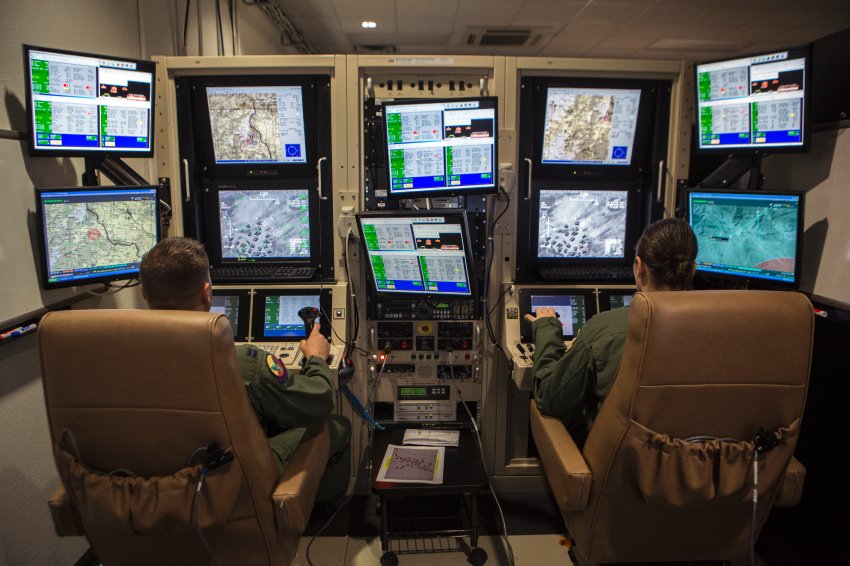
drone-pilots

Their central question, appropriately re-phrased, can also be asked of today’s remote operations in theatres of war (and beyond):

The fact that medical robots increasingly determine medical therapy and often provide the only form of access to the operation area requires us to conceptualize them as care agents rather than to merely conceive of them as passive tools. But if the physician’s action is based on confidence in and cooperation with the robot, what kind of operative knowledge does this kind of agency require and how does it change the modalities of medical intervention?

They conclude:

… since surgical intervention has become a computer-mediated practice that inscribes the surgeon into a complex setting of medical care agents, it is no longer the patient’s body but the image of the body that is the central reference for the surgeon.

As the operator of robot-guided intervention the physician accordingly needs to address and cope with the specific agency of the machine. In addition the visual interfaces need to communicate and convert their technological complexity to humanly amendable surfaces.

I recommend reading these arguments and transpositions alongside Colleen Bell‘s  ‘War and the allegory of military intervention: why metaphors matter’, International political sociology 6 (3) (2012) 325-28 and ‘Hybrid war and its metaphors’, Humanity 3 (2) (2012) and Lucy Suchman‘s ‘Situational awareness: deadly bioconvergence at the boundaries of bodies and machines’ (forthcoming at Mediatropes)…

There is yet another dimension to all this.  The U.S. Army has been at the forefront of telemedicine for decades – for a recent report on ‘4G telemedicine’ see here – but since at least 2005 the Army has also been experimenting with ‘telesurgery’ or ‘remote surgery’ in which a UAV platform mediates between the surgeon and the site of patient treatment: a different version of remote operations.  You can find early reports here, here and here (‘Doc at a distance’) and a more general account of ‘Extreme Telesurgery’ here.  Still more generally, there’s a wide-ranging review of US Department of Defense research into Robotic Unmanned Systems for Combat Casualty Care here.

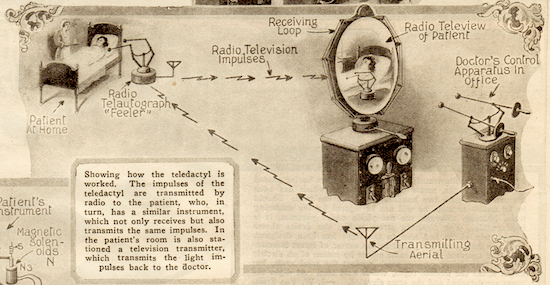
If this is all too futuristic – even ‘remote’ – to you, then check out the Teledactyl shown in the image below, which was originally published in 1925.  Although there’s not a drone in sight, the seer was the amazing Hugo Gernsback, who also conjured up the radio-controlled television plane

1925-Feb-science-and-invention-howto


In the literary trenches

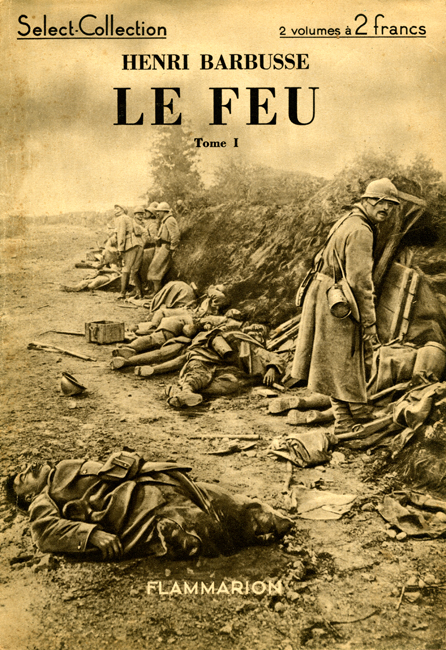
Barbusse2

Until now, my knowledge of the French experience on the Western Front has been largely confined to Henri Barbusse’s Under Fire.  I was particularly taken by his striking evocation of the materiality of war – of the ‘slimescape’ – which features in ‘Gabriel’s Map’ and ‘The Natures of War’ (both soon to be available in written form):

The earth! It is a vast and water-logged desert that begins to take shape under the long-drawn desolation of daybreak. There are pools and gullies where the bitter breath of earliest morning nips the water and sets it a-shiver; tracks traced by the troops and the convoys of the night in these barren fields, the lines of ruts that glisten in the weak light like steel rails, mud-masses with broken stakes protruding from them, ruined trestles, and bushes of wire in tangled coils. With its slime-beds and puddles, the plain might be an endless gray sheet that floats on the sea and has here and there gone under. Though no rain is falling, all is drenched, oozing, washed out and drowned, and even the wan light seems to flow. Now you can make out a network of long ditches where the lave of the night still lingers. It is the trench. It is carpeted at bottom with a layer of slime that liberates the foot at each step with a sticky sound; and by each dug-out it smells of the night’s excretions. The holes themselves, as you stoop to peer in, are foul of breath. I see shadows coming from these sidelong pits and moving about, huge and misshapen lumps, bear-like, that flounder and growl. They are “us.”

Or again:

We begin to flow again in one direction. No doubt it is a movement planned up there, back yonder, by the chiefs. We trample soft bodies underfoot, some of which are moving and slowly altering their position; rivulets and cries come from them. Like posts and heaps of rubbish, corpses are piled anyhow on the wounded, and press them down, suffocate them, strangle them. So that I can get by, I must push at a slaughtered trunk of which the neck is a spring of gurgling blood.

The ground is so full of dead that the earth-falls uncover places that bristle with feet, with half-clothed skeletons, and with ossuaries of skulls placed side by side on the steep slope like porcelain globe-jars. In the ground here there are several strata of dead and in many places the delving of the shells has brought out the oldest and set them out in display on the top of the new ones. The bottom of the ravine is completely carpeted with debris of weapons, clothing, and implements. One tramples shell fragments, old iron, loaves and even biscuits that have fallen from knapsacks and are not yet dissolved by the rain. Mess-tins, pots of jam, and helmets are pierced and riddled by bullets—the scrapings and scum of a hell-broth; and the dislocated posts that survive are stippled with holes.

It’s a clunky old translation, but the power of Barbusse’s prose still shines through.  Small wonder that he later confided: ‘I once used to think that the worst hell in war was the flame of shells; and then for long I thought it was the suffocation of the caverns which eternally confine us. But it is neither of these. Hell is water.’ (If you want more on these imaginative geographies, incidentally, I recommend Susan Grayzel‘s short essay on Barbusse and, more generally, Claire Keith‘s ‘Pilgrims in a toxic land: Writing the Trenches of the French Great War’ in Jeff Persels‘s collection, The environment in French and Francophone Literature and Film (2013) pp. 69-85).

BARTHAS Poilu

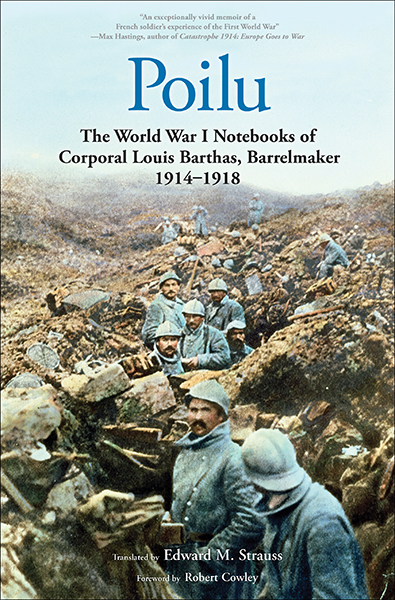
I’ve spent the last several days reading two other accounts by French authors.  The first, Louis Barthas‘s Poilu, has only recently been made available in English translation (it was first published in France in 1978).  ‘Poilu’ means ‘hairy one’, but probably the closest English-language equivalent is the much more recent ‘grunt’, for Poilu presents  the view of the (not so) common soldier.  It’s a carefully assembled account, as Robert Cowley explains in his helpful introduction:

‘Few documents from the Great War are as remarkable as the war notebooks of Louis Barthas, published in English for the first time in Edward M. Strauss’s fine translation. They are special for a number of reasons. Their author left a record of four years of service at the front, an unusual span of survival. He was not an officer but a common soldier, a corporal, a man approaching middle age who in civilian life had been a barrelmaker from the Languedoc region of France, a wine-growing center…. After he was mustered out in February 1919, Barthas began to assemble a narrativeRead more at describing his time on the Western Front that would eventually run to nineteen notebooks. He would work on it after he finished a long day of barrel-making, fleshing out the original diaries with quotes from letters home, official reports and orders that he had kept, and accounts by fellow soldiers that he had written down at the time, as well as with ephemera such as postcards and newspaper clippings. Those sources he put together in the book you read here, one that is part diary, part memoir.’

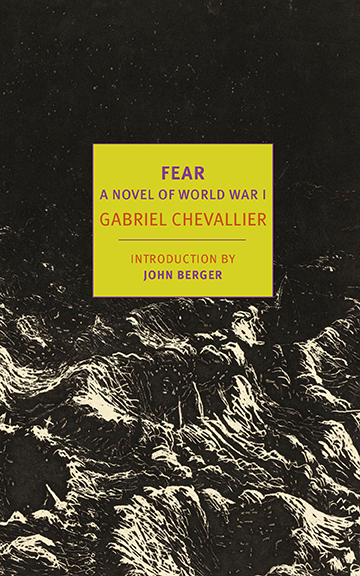
It’s been praised to the skies – see, for example, this review in the New York Times and this review at the Daily Beast – and Barthas’s spirited socialism and pacifism make it all the more interesting.  But, for me at least, it doesn’t capture the slimescape with the same intensity as my second book: Gabriel Chevallier‘s Fear.

CHEVALLIER Fear

I confess to being taken aback by its very existence.  In another life – in grammar school – my French teacher, a wonderful man called Robert Bratcher, recommended Chevallier’s Clochemerle as a way, I now suspect, of teaching us what ‘Rabelaisian’ meant without actually having to read Rabelais.  It’s a brilliantly comic novel (or at least it seemed so to this fifteen year-old), shot through with word play, artful phrases and visually, almost viscerally immediate staging in which the body – and the fear of/fascination with  its functions – loomed large.

It turns out that the same sensibilities run through Fear, which is a novelisation grounded in Chavellier’s own experiences. Malcolms Imrie‘s fine translation was made available in the UK in 2012, but the New York Times is now publishing a US edition.  ‘At times,’ Neil Fitzgerald wrote in the TLS (in a review tellingly entitled ‘When the body takes charge’),

reading Fear feels like being led through the damnation panel of Bosch’s “The Garden of Earthly Delights”, the front line “blazing like some infernal factory where monstrous crucibles melted human flesh into a bloody lava”. There are wince-inducing close-ups of mutilated men and corpses. Chevallier’s turn of phrase, brilliantly rendered in Malcolm Imrie’s translation, makes this distant war feel horrifying and close. Dartemont’s ultimate triumph, beside surviving, is in never having allowed himself to become dehumanized.

It turns out that others were also taken aback by its very existence.  Fear was originally published in 1930, as Tobias Grey explains, and the French officer class rose up against Chevallier’s merciless assault (which you can also find in Barthas):

Subsequent criticism of “Fear” meant that it was withdrawn from circulation in France on the eve of World War II and did not reappear until 1951. Chevallier, who had scored a big hit with his satirical novel “Clochemerle” (1934) in the meantime, declined to kick up a fuss. “Once war has come, the time has passed for warning that it is a disastrous venture with unforeseeable consequences,” Chevallier reasoned in the preface of “Fear.” “That is something that must be understood earlier, and acted on accordingly.” When “Fear” was recently re-published in France after many years out of print, one critic still felt it necessary to point out that pages like the ones he had just read “would have had the author shot during the war.”

As I’ve indicated, central to Chevallier’s account is the human body and the hapticity of war: its sensual, physical apprehension and its corporeal inscription.  Grey concludes:

… above all “Fear” is a novel whose most indelible passages describe the sensory degradation of war on the human body. These baroque descriptions are generously translated into English by Malcolm Imrie without a hint of stiltedness [in fact, Imrie won the Scott Moncrieff Prize for his translation]. A face is described as seeming to “acquire a dull, gray coating, as if someone had forgotten to dust it, and the beard, drawing strength from the compost of unhealthy flesh, spread rapidly, seeming to drive out life, like ivy takes light from the front of a house.” It is the kind of powerful prose that helps to make Chevallier’s long-neglected novel one of the most effective indictments of war ever written.

All of this reading is in part preparation for a trip later this month with an old friend to the battlefields of the Western Front (we’re still arguing over which of us is Blackadder and which is Baldrick, but it’s really no contest): watch this space for a report.

The art of Homo Sacer

132_img9872-1

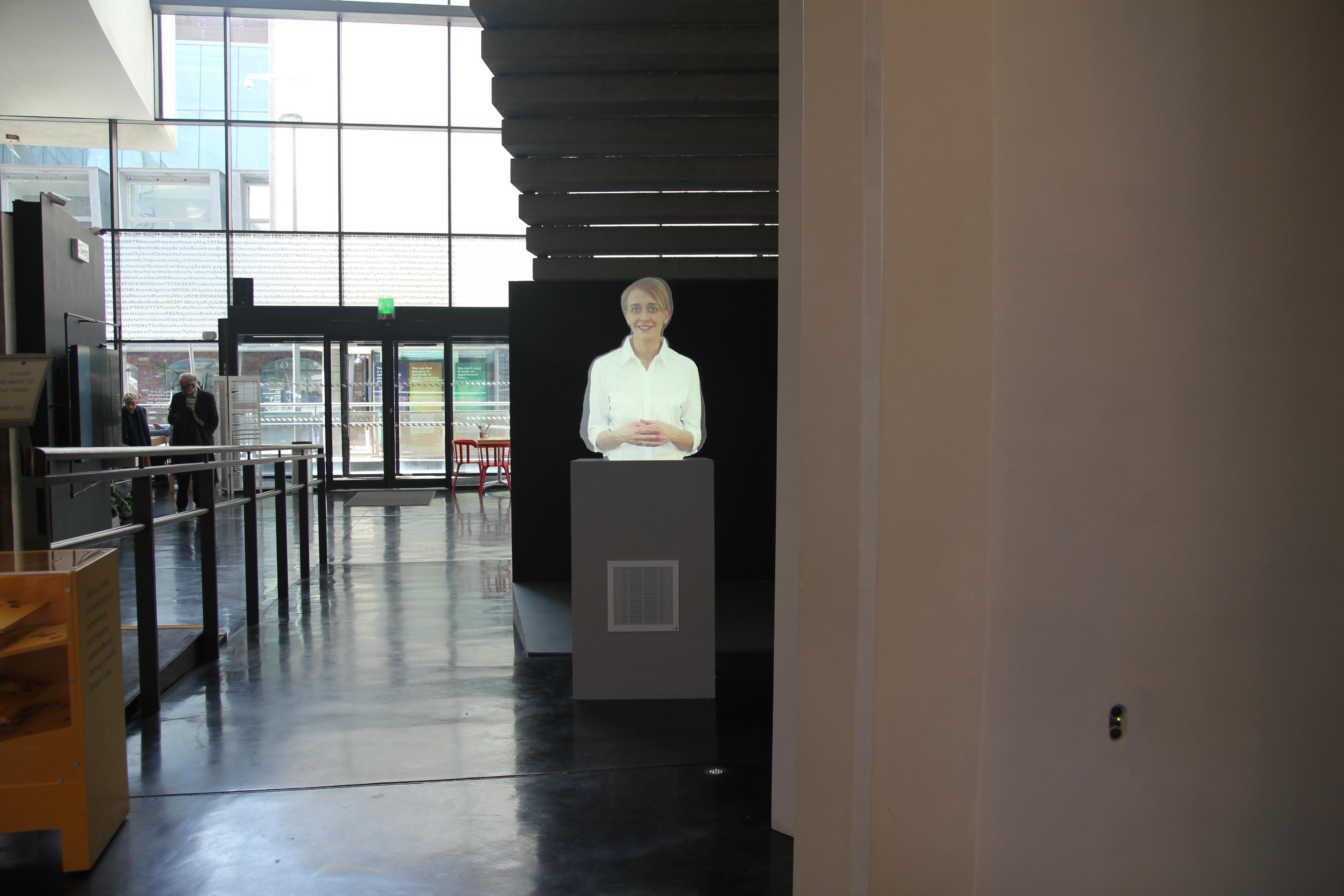
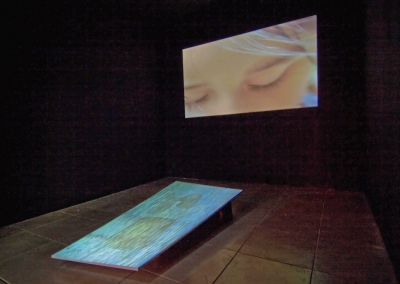
 James Bridle‘s new installation, Homo Sacer, has opened at FACT (Foundation for Art and Creative Technology) in Liverpool, as part of its Science Fiction: New Death exhibition:

Explore how our relationship with technology has blurred the lines between the real and the virtual; making our everyday lives feel increasingly like science fiction. Artists including James Bridle, Jon Rafman, Mark Leckey, Larissa Sansour and Ryan Trecartin, plus award-winning science fiction author China Miéville present works which explore how technology is creating new ways of living (and dying), of fashioning identities and the growth of cult-like communities.

The exhibition runs until 22 June, and you can (at least virtually) walk through it with Regine here.

There’s not much detail or documentation of Homo Sacer yet  – though see the image above – but James promises a video clip soon.  Meanwhile he explains:

The installation consists of a projected “hologram” in the entranceway to the gallery, of the kind increasingly found in airports, railway stations and government buildings. The hologram speaks lines from UK, EU and UN legislation, as well as quotations from government ministers, regarding the nature of citizenship in the 21st century, and how it can be revoked, which potentially fatal consequences.

BEN YOUNG Homo sacer

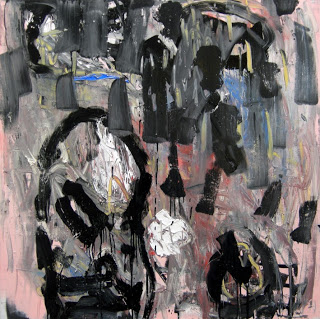
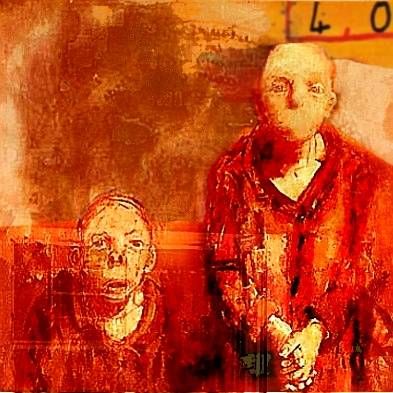
Other artists have been inspired by Giorgio Agamben‘s discussion(s) of Homo Sacer too (and, for those who take the Latin stubbornly literally, Femina Sacra), of life knowingly and deliberately exposed to death.  (If you want an artful preview of the final volume in Agamben’s series, The use of bodies, you can read Adam Kotsko‘s ‘What is to be done?  The endgame of the Homo Sacer series’ here.)  But back to art.  There’s Ben Young‘s Homo Sacer (above), for example, philosopher-artist Adolfo Vásquez Rocca‘s Homo Sacer (below), and and Tarek Tuma‘s haunting Homo Sacer series of canvases showing the faces of suffering in Syria (see here and here), which almost viscerally captures the double meaning of ‘sacra’, sacred and accursed.

ROCCA Homo Sacer

In a related vein, as I noted previously, there’s the State of Exception installation which showed what undocumented migrants abandoned as they crossed the US-Mexico border; first staged at the University of Michigan’s Institute for the Humanities, it’s currently at Detroit’s Museum of Contemporary Art.  (The wall of backpacks conjures up an after-image of the suitcases on display at Auschwitz, and although they gesture in different directions – one where movement comes to a hideous full stop and the other where flight takes off – both are redolent of Agamben’s preoccupations).  For a more wide-ranging view of States of Exception, see Angel Calabres‘s much earlier collaboration here, which trades on Agamben’s work to explore prison subjugation, torture and slaughter houses…

And this in turn brings me (back) to Abdelali Dahrouch‘s installation, Homo Sacer (2009) (below), which is a meditation on the waterboarding of ‘enemy combatants’ by the CIA:

Dahrouch

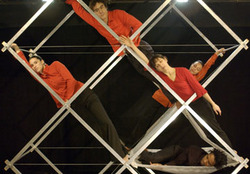
Agamben’s work has inspired not only visual artists.  There’s Christoph Winkler‘s dance-work Homo Sacer, for example, now ten years old,  which tanzjournal described like this:

The choreographer has truly succeeded in formulating a position that is both an aesthetic and ethical one. Life may be a sacred possession – in the face of sanctioned (war) crimes it becomes a disposable commodity. Dance cannot intervene in this state of affairs. But it can champion life, by displaying it in its vulnerability. Homo Sacer is not only in this respect Winkler’s most impressive piece to date.

Sophiensaele Homo Sacer

And Frankfurter Rundschau like this:

One after another, the other seven dancers climb out of the resting niches. All look distraught in the glaringly lit space, whose angularity contrasts with the fragile bodies. Following abrupt impulses, the dancers break out of themselves, only to quickly fall back into the frozen pose. Humans fleeing and hesitating in the same moment, developing an icy atmosphere of vulnerability … But in the following choreographic sequence, in which the dancers seem to be wrestling with themselves as if the truth were strangling them in its grasp, is a brilliant scene in which the ensemble intertwines and connects into complex structures that, only moments later are again severed. Energy shoots up like suddenly occurring memories – symbolizing the sudden convulsion of that very “base existence”…

And there’s even music – although Martin Kücher released only 250 copies of his solo jazz album Homo Sacer…  You can also listen to Vancouver’s own Dubstawk‘s remix Homo Sacer here.

Martin Kuchen homo sacer

All sorts of artworks have been used on the cover of Agamben’s texts, of course, and they can be revealing too: I know it’s often wrong to judge a book by its cover (but not always), and my favourite essay in Geographical imaginations is in fact my reading of the cover of David Harvey‘s The condition of postmodernity.  In any case, it’s interesting to track movements in the other direction and to see how artists engage with texts – particularly if you believe that artwork is part of the research/investigative/analytical process rather than merely one of its products.

The Days of the Roundtable

I’m very pleased (and relieved) to say that I’ve received two new grants for my work.

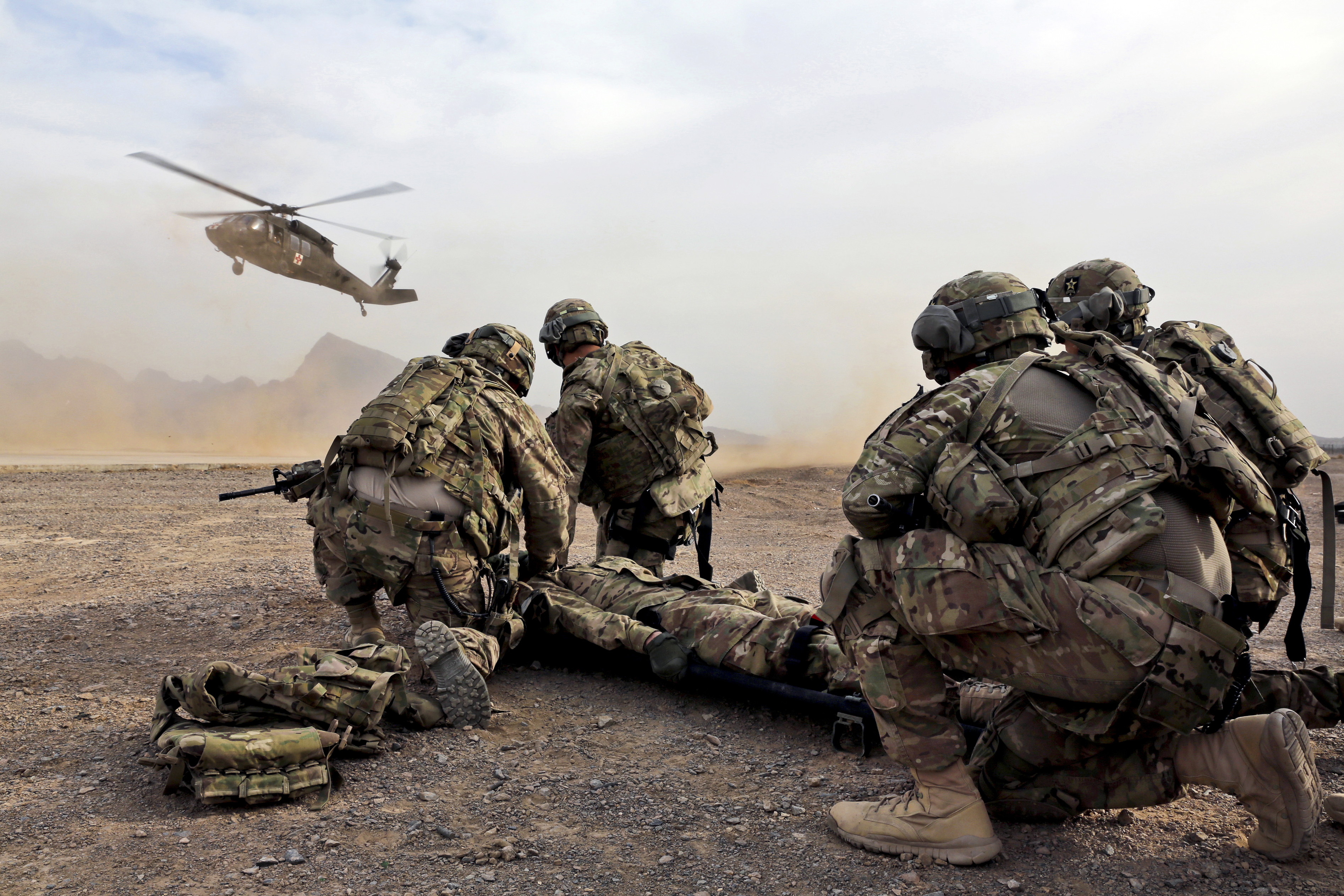
The first is an Insight Grant from the Social Science and Humanities Research Council for my project on Medical-military machines and casualties of war 1914-2014.  I’ve provided an illustrated version of the substance of the application under the DOWNLOADS tab.  The plan is to explore the human geographies of evacuation and treatment of casualties, both combatant and civilian, in four major combat zones: the Western Front 1914-1918; the Western Desert, 1942-1943; Vietnam; and Afghanistan.  Since submitting my application, though, I’ve also become interested in the medical geographies (what my good friend Omar Dewachi calls the ‘therapeutic geographies‘) in which people suffering from both war-related injuries and chronic diseases in Syria make their precarious journeys into Lebanon and Jordan for treatment.  All that in four years…

PRT Farah Conducts Medical Evacuation Training with Charlie Co., 2-211th Aviation Regiment at Forward Operating Base Farah

The second is a grant from the Peter Wall Institute for Advanced Studies at UBC to support an International Research Roundtable in May 2015 on The contours of later modern war.  This will be an invitation-only event (the grant provides for travel and accommodation for each participant), but here is the pitch.  I wrote this in an hour just before leaving for Glasgow, so forgive the rough edges:

Background

Commentators often insist that in recent years the nature of war has been transformed. Military historians who address this question display a fine-grained sensitivity to the details of armed conflict, but the imaginative (theoretical) framework they deploy usually returns to Clausewitz’s nineteenth-century theses On War. Philosophers and social scientists work with a more refined theoretical apparatus, though too often this seems to be confined to annotations of Foucault’s Paris lectures in the 1970s, and yet – unlike Foucault himself – they typically show little interest in the specifities and materialities of armed conflict. The Roundtable seeks to finesse this impasse by bringing together a group of scholars, each of whom has demonstrated both a theoretical and an empirical sensibility, to consider crucial questions about the transformations of modern war.

CREVELD Changing face of warThe objective is not to identify a single rupture – the Vietnam War, the end of the Cold War, the wars conducted in the wake of 9/11 – but to recognize that multiple temporalities are at work so that there are both continuities and contrasts to be identified and understood. Similarly, later modern war cannot be reduced to arguments about the Revolution in Military Affairs and its successor projects, which have indeed changed advanced military operations in all sorts of ways, or to the ‘new wars’ supposedly waged by non-state actors in the rubble of the Cold War and in the peripheries of empire: these twin modalities need to be thought together to provide a more inclusive understanding of the shifting contours of military and paramilitary violence.

In speaking of ‘later modern war’ the intention is to avoid the now tired discussions of the postmodern (what comes after that?), while indicating that the closing decades of the twentieth century witnessed a series of changes – political and legal, social and cultural, scientific and technical, legal and ethical – that started to distance armed conflict from the forms it had assumed during the First and Second World Wars. The term also suggests connections to the logics of what is sometimes called ‘late capitalism’ and to the evolving impositions of neo-liberal political and economic formations.

STRACHAN Changing character of warAdvanced militaries often claim that their conduct of war has become surgical, sensitive and scrupulous. The first of these relies on technical advances in intelligence, surveillance and reconnaissance (much of which now takes the form of geospatial intelligence and high-resolution, near real-time imagery) and on advances in military networks, targeting and weapons systems. The second involves the incorporation of cultural knowledge into asymmetric warfare and counter-insurgency, but it also involves a new sensitivity to public opinion: thus media operations have become central to military campaigns in an attempt to win support from populations both at home and abroad. There is also an increasing sensitivity to casualties, both combatant and civilian, and many commentators have spoken of the humanitarian armature that attends contemporary military interventions as a new ‘military humanism’. Finally, and following directly from these observations, contemporary military power is supposed to be characterized by a heightened ethical awareness and the unprecedented incorporation of international law (and military lawyers) into its operational decisions.

toc_afghan

All of these claims invite critical scrutiny, to recover their developing genealogies (how novel are they?) and to evaluate their practical consequences (what are their material effects?). They assume particular importance as interstate wars have declined, and transnational conflicts have become the dominant modality of armed conflict, as ‘war’ bleeds into terrorism, counter-terrorism and new modes of transnational policing. These changes in turn affect the sites and locations of military violence, and these in turn may be transformed not only by geopolitics and military power but also by global environmental change and the political ecologies of war. In short: is the locus of war shifting in decisive ways?

Programme

The Roundtable will address these questions through four intersecting and interlocking themes that allow for theoretical interrogation and empirical scrutiny: each of these is a stark signpost but its simplicity allows multiple questions (and the connections between them) to be addressed under each heading. In capsule form these are:

IMAGE – the role of imagery (intelligence, surveillance, reconnaissance); the images of war that circulate through media, old and new, and their role in public debate;
AGENT – the agents and vectors of military and paramilitary violence; the changing human/technological assemblages through which war is conducted;
VICTIM – the casualties of war (the dead, the wounded, the captured, the displaced); the political, cultural and legal armatures that regulate military and paramilitary violence;
LOCUS – the changing targets, spaces and ecologies of war

When they accept the invitation, each participant will be asked to provide a one-paragraph summary of their present research for posting on a dedicated website. Four weeks before the Roundtable everyone will provide a short (six page maximum) essay, written in an accessible and reference-free form, illustrated as appropriate, and drawing from their work. These may address the theme of the Roundtable in general or in detail, and will be posted on the website. Formal papers will not be presented: the emphasis will on discussion and debate.

There will be four main sessions addressing each of the four key themes:

Day 1:  Arrival

Day 2:

Morning – Walking Seminar (Stanley Park): participants will walk the Seawall as a group but in pairs, changing every 20-30 minutes, to share their research and ideas with one another.

Afternoon – IMAGE (discussion led by four participants)

Day 3:

Morning – AGENT (discussion led by four participants)

Afternoon – VICTIM (discussion led by four participants)

Evening – Public Performance: Either a staged reading of Owen Sheers’ radio play Pink Mist [about soldiers returning from Afghanistan] or George Brant’s Grounded [about a female drone operator], to be followed by public discussion led by scholars on either the Wounds of War or Drone warfare

Day 4:

Morning – Exchanges: small-group discussions (informal) about the key themes and to plan future collaborations and research projects

Afternoon – LOCUS (discussion led by four participants)

Evening – Roundtable Dinner

Day 5:  Dispersal

I also want to invite one or two visual artists to attend the Roundtable, both to take part – the visual is a vital register for both the conduct and the critique of modern war – but also to use the discussions as a provocation for their subsequent work (to be posted on and/or linked via the website).

I’ll keep you posted – I’m immensely grateful to Janis Sarra, Director of the Peter Wall Institute for Advanced Studies, and to my colleagues and friends for their support and encouragement.

I’ll keep you posted.

The God trick and the administration of military violence

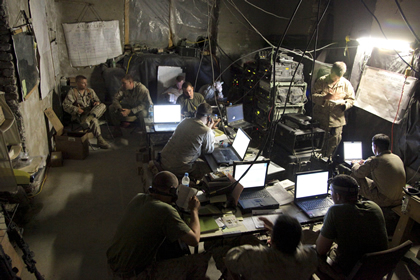
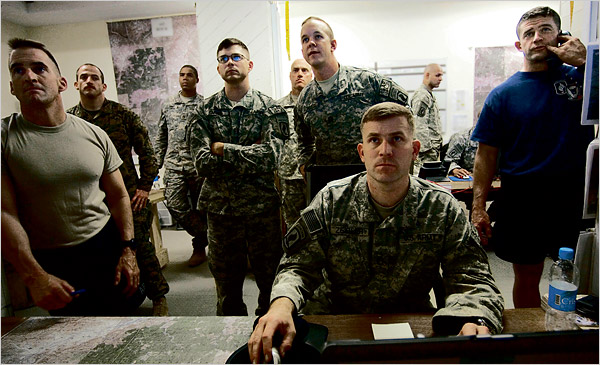
JOC staring at screen 24afghan-600

Here is the abstract for my keynote at the Lancaster symposium on Security by remote control next month; it’s a development from my presentation at the AAG in Tampa, and I’ll provide more details as I develop the argument.

The God trick and the administration of military violence

Advocates have made much of the extraordinary ability of the full motion video feeds from Predators and Reapers to provide persistent surveillance (‘the all-seeing eye’), so that they become vectors of the phantasmatic desire to produce a fully transparent battlespace.  Critics – myself included – have insisted that vision is more than a biological-instrumental capacity, however, and that it is transformed into a conditional and highly selective visuality through the activation of a distinctively political and cultural technology.  Seen thus, these feeds interpellate their distant viewers to create an intimacy with ground troops while ensuring that the actions of others within the field of view remain obdurately Other.

But the possibility of what Donna Haraway famously criticised as ‘the God-trick’ – the ability to see everything from nowhere in particular – is also compromised by the networks within which these remote platforms are deployed.  In this presentation I re-visit an air strike on three vehicles in Uruzgan province, Afghanistan, in February 2010, in which more than 20 civilians were killed in a helicopter attack prompted, in large measure, by video feeds from a Predator providing support to a Special Forces detachment in the vicinity.  Most commentaries – including mine – have treated this in terms of a predisposition on the part of the Predator crew to (mis)read every action by the victims as a potential threat.  But a close examination of the official investigations that followed, by the US Army and then the US Air Force, reveals a much more complicated situation.  The Predator was not the only ‘eye in the sky’, its feeds entered into a de-centralized, distributed and dispersed geography of vision in which different actors at different locations inside and outside Afghanistan saw radically different things, and the breaks and gaps in communication were as significant as the connections.  In short, much of later modern war may be ‘remote,’ but there’s considerably less ‘control’ than most people think.

I still haven’t found what I’m looking for

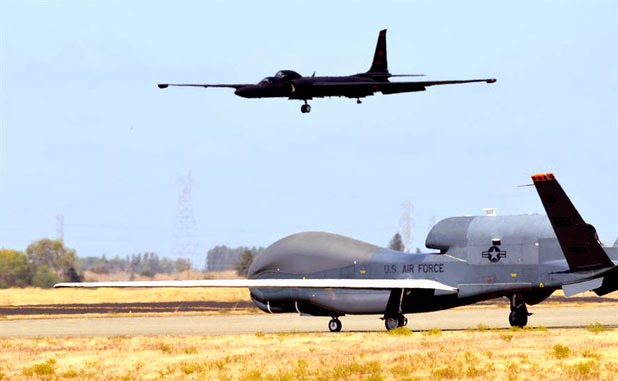
U2 (USAF photograph)

Rummaging around for more people working on militarized vision, I encountered a forum on Military optics and Bodies of difference held at Berkeley’s Center for Race and Gender earlier this year, and through that the research of Katherine Chandler, who holds a Townsend Center for the Humanities Dissertation Fellowship in the Department of Rhetoric.  Her dissertation in progress is entitled Drone Flight and Failure: the United States’ Secret Trials, Experiments and Operations in Unmanning, 1936 – 1973, which promises to fill in a crucial gap in conventional genealogies of today’s remote operations.

As you’ll see if you visit her website here, Katherine is an accomplished artist as well as researcher and critic.  You can read her essay on ‘System Failures’, which includes a discussion of Trevor Paglen‘s Drone Vision and Omer Fast‘s 5,000 Feet is the Best, at The New Inquiry (August 2012) here, and find a fuller discussion of Fast’s video situated within what Katherine calls the ‘knowledge politics’ and political ecologies of remote operations on pp. 63-74 of Knowledge politics and intercultural dynamics here.

Here is the abstract for her talk at the forum, Unmanning Politics: Aerial Surveillance 1960-1973:
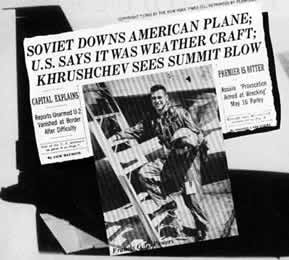
u2_spy_plane_incident_newspaper_clippingOn May 1, 1960, Francis Gary Powers’ U-2 plane was shot down over the Soviet Union while on a secret reconnaissance mission. The ensuing diplomatic fallout caused the cancellation of the Paris Summit between Dwight Eisenhower and Nikita Khrushchev. Less well known, in April 1960, Robert Schwanhausser, an engineer for Ryan Aeronautical, briefed the United States Air Force on the possibility that its Firebee target drone, used at the time for air defense training, might be re-engineered as an unmanned reconnaissance plane. In the weeks following the Powers incident, the Air Force began wholesale negotiations with Ryan Aeronautical to develop a pilotless spy plane and, on July 8, 1960, the company was given funding to begin the project. Among the noted advantages were: “political risk is minimized due to the absence of a possible prisoner” (“Alternative Reconnaissance System,” 1960). I investigate the resulting Lightning Bugs, flown for three-thousand reconnaissance missions in Southeast Asia between 1964 and 1973. 

Researching how aircraft were unmanned during the Cold War is instructive both in the ways they mimic contemporary unmanned combat aerial vehicles and trouble assumptions about them. I follow how unmanned systems operated within the logics of American Cold War politics and their perceived usefulness geopolitically – crossing borders as spy aircraft, collecting and jamming electronic signals, and gathering battlefield reconnaissance. I ask how conquest, and the ensuing assumptions of empire, colonialism and race, underlie the unmanning of military aircraft, even while these aspects were purposefully, although, unsuccessfully occluded through the idea that technologies could mitigate political risks. Moreover, unmanned reconnaissance projects were cancelled at the end of the Vietnam War and their failure provides clues about what might be left out of visions of aerial control and the ways politics, and human vulnerabilities, persisted in spite of efforts to engineer systems that would suggest otherwise.

The legitimacy of contemporary drone strikes relies on the ability of unmanned aircraft to “see” enemy targets. Yet, as Isabel Stengers has argued, any representation gives value. Looking at the few available images from these early unmanned reconnaissance flights, I move between what is seen and unseen to examine how values, particularly, secrecy and control, are formed through unmanned reconnaissance. Claiming to produce a mechanical, rather than political, view of the territories surveyed, I show how the supposedly apolitical lens of the drone occludes how politics, industry and military come together to privilege certain positions and target others.

Interesting stuff – especially that first paragraph linking ‘un-manning’ to the U-2.  There is a strange irony here, because until this year the US Air Force had in fact favoured its fleet of 33 U-2 (‘Dragon Lady’) aircraft [one of which is shown at the top of the photograph] over the high-altitude Global Hawk [shown at the bottom], so much so that it had asked for permission to cancel its orders for the new Block 30 Global Hawks and place others in storage.

GlobalHawk_USAFAirmanFirstClassBobbyCummings

You may be surprised to discover that the U-2 is still flying, but the airframe has been repeatedly modified and so too has the network in which it is embedded.  One pilot explained:

“The U-2 started out only carrying a wet-film camera. Now, with today’s technology, I’m alone up there, but I may be carrying 40 to 50 Airmen via data link who are back at a (deployable ground station).”

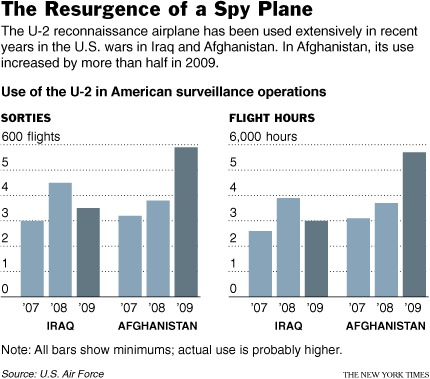
U-2 flying hours in Afghanistan and Iraq (New York Times)It’s important to remember that Predators and Reapers are not the only platforms streaming imagery to the Air Force’s Distributed Common Ground System.  The U-2 was given a new lease of life by the Gulf War in 1991, when nine U-2s flying out of the UAE  provided 50 per cent of all imagery and over 90 per cent of all ground forces targeting imagery.  During the invasion of Iraq in 2003 U-2s flew only 19 percent of the air reconnaissance missions, but they provided more than 60 per cent of the signals intelligence and 88 per cent of battlefield imagery.  The continuing wars in Afghanistan and Iraq confirmed that the U-2’s original, strategic significance had been eclipsed by its new tactical role.  Chris Pocock explains:

“The U-2 today is more a tactical intelligence gatherer…  It supports ground operations on a daily basis, flying over Afghanistan, flying around Korea, flying in the eastern Mediterranean, doing all those things every day and it’s actually not only providing intelligence that is analyzed for the benefit of those ground troops, but it’s actually in contact with those ground troops in real time.”

And that close contact – akin to the intimacy remote operators in the continental United States claim when they say they are not 7,000 miles but 18 inches from the battlespace, the distance from eye to screen – takes its toll on the U-2 pilots too.  In addition to the extraordinary pressures flying the U-2 imposes on their bodies, one USAF physician insisted that ’emotionally… they’re wrung out from that… When you’re talking to somebody on the radio and there’s gunfire in the background… you’re not taking a nap while that’s happening.’

Writing in the New York Times, Christopher Drew provided a revealing example:

Major Shontz said he was on the radio late last year with an officer as a rocket-propelled grenade exploded. “You could hear his voice talking faster and faster, and he’s telling me that he needs air support,” Major Shontz recalled. He said that a minute after he relayed the message, an A-10 gunship was sent to help.

In fact, that last clause can be generalised; the U-2 has often been deployed in close concert with other platforms, including Predators and Reapers.  Drew again:

The U-2’s altitude [70,000 feet or more], once a defense against antiaircraft missiles, enables it to scoop up signals from insurgent phone conversations that mountains would otherwise block.  As a result, Colonel Brown said, the U-2 is often able to collect information that suggests where to send the Predator and Reaper drones, which take video and also fire missiles. He said the most reliable intelligence comes when the U-2s and the drones are all concentrated over the same area, as is increasingly the case.

Part of the reason for that is that the U-2 has such an advanced imagery system:

Even from 13 miles up its sensors can detect small disturbances in the dirt, providing a new way to find makeshift mines [IEDs] that kill many soldiers.  In the weeks leading up to the [2010] offensive in Marja, military officials said, several of the … U-2s found nearly 150 possible mines in roads and helicopter landing areas, enabling the Marines to blow them up before approaching the town.

Marine officers say they relied on photographs from the U-2’s old film cameras, which take panoramic images at such a high resolution they can see insurgent footpaths, while the U-2’s newer digital cameras beamed back frequent updates on 25 spots where the Marines thought they could be vulnerable.

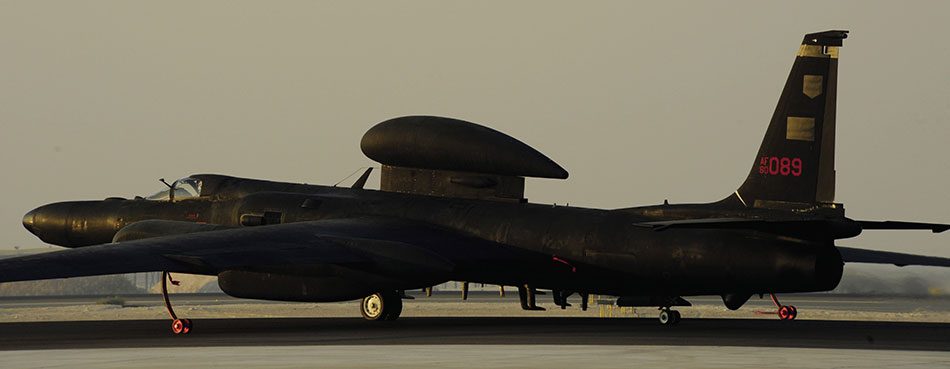
U-2 preparing for takeoff 'in SW Asia' (USAF/Eric Harris)

For all that,  in the last two years the Air Force’s plan to cut the Global Hawk program was repeatedly over-ridden by Congress, in response to an extraordinary campaign waged by Northrop Grumman, which launched what Mark Thompson called ‘its own ISR – intelligence, surveillance and reconnaissance – mission over Capitol Hill to decide where to strategically target cash-bombs to keep its plane, and more of them, flying for another day’: you can find a  full report at the Center for Public Integrity here.

The Air Force has now accepted the retirement of Lockheed Martin’s ageing Cold warrior, because (so it says) the cost per flying hour of the Hawk has now fallen below that of the U-2 ($24,000 vs. $32,000).  ‘U2 shot down by budget cuts’, is how PBS put it, while the Robotics Business Review triumphantly announced ‘Here comes automated warfare’.

Even so, cost per flying hour is not the whole story, as Amy Butler explains.  Part of the problem is logistical and, by extension, geopolitical: ‘Global Hawks based in Guam have to transit for hours just to reach North Korea, whereas the U-2, based at Osan air base, South Korea, has a shorter commute’ (details of the Hawk’s global basing can be found here).

A second issue is reliability, which bedevils all major UAVs and makes cost per flying hour a dubious index:

‘Intelligence, surveillance and reconnaissance collection is in high demand, and aircraft downtime is extremely worrisome for combatant commanders. In the Pacific, 55% of Global Hawk’s missions were canceled in fiscal 2013; 96% of the U-2’s missions were achieved. The U-2 was also scheduled for nearly three times as many missions. Global Hawk lacks anti-icing equipment and is not able to operate in severe weather.’

Finally, critics continue to complain that the sensors on the U-2 remain superior to those on the Hawk and provide a wider field of view.  According to a report from Eric Beidel,

The Global Hawk carries Raytheon’s Enhanced Integrated Sensor Suite, which includes cloud-penetrating radar, a high-resolution electro-optical digital camera and an infrared sensor. But the U-2’s radar can see farther partly because the plane can fly at altitudes over 70,000 feet, about 10,000 feet higher than a Global Hawk. A longer focal length also gives the U-2’s camera an edge, experts said…

Air Force Chief of Staff Gen. Norton Schwartz has said that the drone’s sensors just weren’t cutting it. Further, the U-2 can carry a larger payload, up to 5,000 pounds compared to 3,000 pounds for the Global Hawk.

“Some of the most useful sensors are simply too big for Global Hawk,” said Dave Rockwell, senior electronics analyst at Teal Group Corp. He referred to an optical bar camera on the U-2 that uses wet film similar to an old-fashioned Kodak. “It’s too big to fit on Global Hawk even as a single sensor.”

All of these technical considerations are also political ones, as Katherine’s abstract indicates, and none of them answers the other questions she poses about what can and cannot be seen…
Biometric war

The US military’s obsession with biometrics is, in part, the product of its phantasmatic desire to make the battlespace fully transparent, as its incorporation within the targeting cycle makes clear:

afghan-biometrics-cycle-1

But it’s also a vital means of furthering the profoundly biopolitical project embedded in later modern war (something that intersects, in various ways, with Mark Neocleous‘s arguments about military violence – war power/police power – and ‘ordering’):

The stated goal of the Afghan effort is no less than the collection of biometric data for every living person in Afghanistan. At a conference with Afghan officials in 2010, the commander of the U.S. Army’s Task Force Biometrics Col. Craig Osborne told the attendees that the collection of biometric data is not simply about “identifying terrorists and criminals,” but that “it can be used to enable progress in society and has countless applications for the provision of services to the citizens of Afghanistan.”

CALL-AfghanBiometrics-1I touched on some of this in a different context in ‘The biopolitics of Baghdad’ DOWNLOADS tab), and Public Intelligence has just released the U.S. Army Commander’s Guide to Biometrics in Afghanistanfrom which I’ve taken the image above, and which provides a much more detailed accounting.

The release also includes an illuminating short essay, ‘Identity dominance: the U.S. Military’s biometric war in Afghanistan‘, that provides a gloss on and a guide to the program:

In a section titled “Population Management,” the U.S. Army’s guide recommends that “every person who lives within an operational area should be identified and fully biometrically enrolled with facial photos, iris scans, and all ten fingerprints (if present).” The soldiers must also record “good contextual data” about the individual such as “where they live, what they do, and to which tribe or clan they belong.” According to the guide, popuation management actions “can also have the effect of building good relationships and rapport” by sending the message that the “census” is intended to protect them from “the influence of outsiders and will give them a chance to more easily identify troublemakers in their midst.”

For a wider, wonderfully critical commentary on biometric war, see Colleen Bell, ‘Grey’s Anatomy goes South: Global racism and suspect identities in the colonial present’, in the Canadian journal of sociology 38 (4) (2013) 465-486 available open access here.

In media res

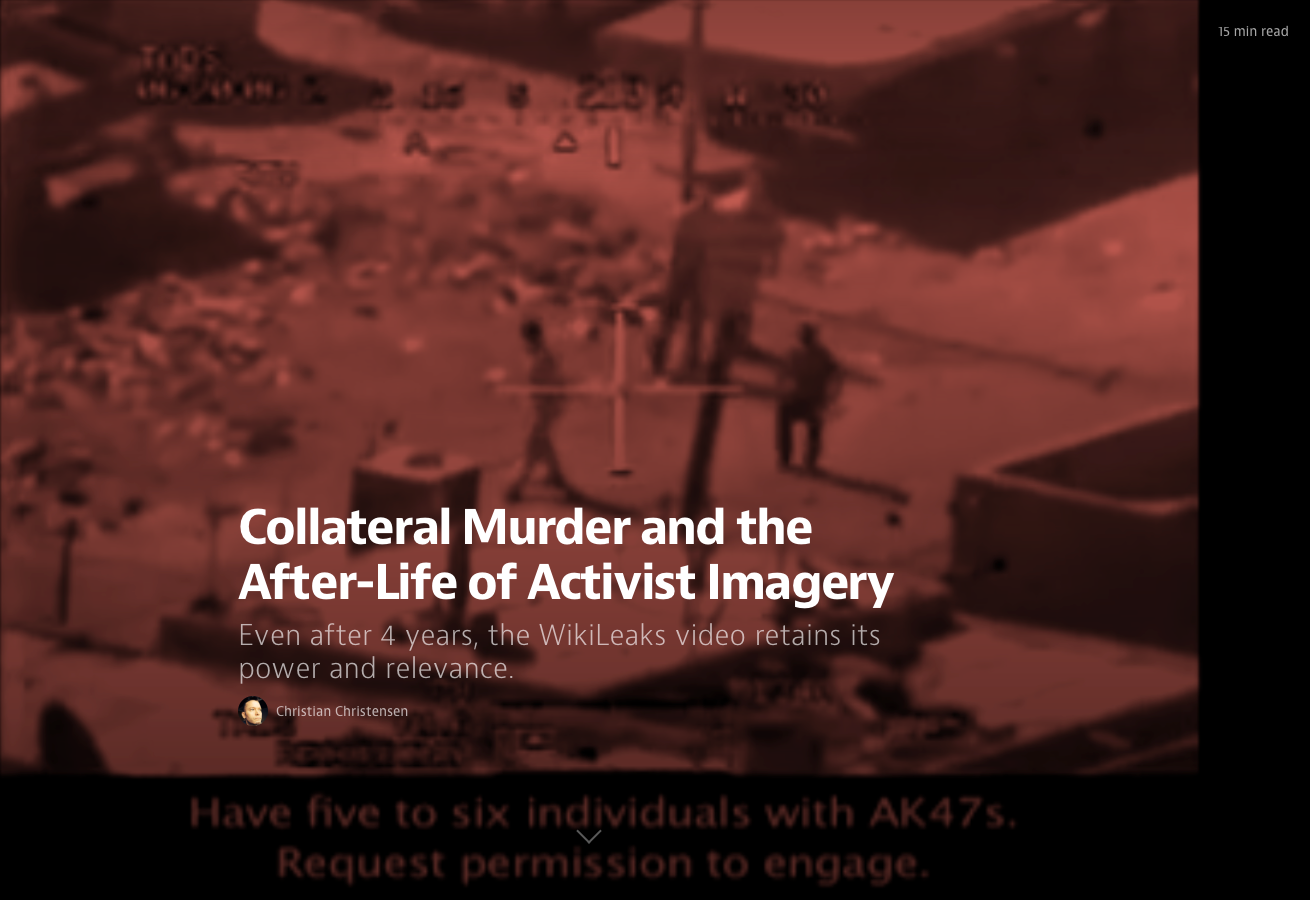
Two short essays that address the public circulation of supposedly secret information.  The first, “Collateral Murder and the After-Life of Activist Imagery”, is by Christian Christensen, and concerns the video clip released by Wikileaks as Collateral Murder in April 2010.  I’ve discussed this edited video of a US Apache helicopter attack in New Baghdad in 2007 before, together with the two documentary films that it provoked, and it forms part of my ‘Militarized Vision’ project (you can find links to the clip and to subsequent commentary in that original post).

CHRISTENSEN Collateral Murder

Christian doesn’t explore the content of the video so much as its inscription and re-inscription within public debates, part of the mediatization of later modern war.  He does make a sharp point about the status of the imagery:

One could argue that the repeated use of this imagery (and corresponding audio) has created an entirely new genre of military reporting. It is a genre with specific, often disturbing conventions: the grainy images of those on the ground, the flat, bland coloring, the “narration” of the aircraft operators which swings between the clinical and the cynical, the silence of those under surveillance or attack, the sound of the weaponry as it is discharged, and, importantly, the “overtness” of the technology, by which I mean the way in which the screen is filled with evidence of the technology being used in the form of the cross-hairs in the middle and data visible at the top and the bottom of the screen…

The Collateral Murder video not only shatters the mythology of humane warfare and benevolent US power, but also causes us to question the notion of neutral technology at the service of human development: a theme which has regained a central space in public debate in recent years.

But he also thinks there is another, no less sharp point to be made about the very act of reporting:

Within this context, the killing of two Reuters employees by the US military was particularly poignant. At the most basic level, this was the symbolic killing of Journalism (with a capital “J”) by a military unaccustomed to critical coverage or investigation at home. The killings, of course, then went unreported until Manning leaked the material and WikiLeaks published it: itself an act of journalism. With Collateral Murder, there is a layering and re-layering of meaning, and, for me, journalism lies at the heart of the clip. These are humans first, of course, and most of those killed or wounded in the attack were not journalists. But, in addition to the tragedy of human death, there is also the tragedy of what is symbolically destroyed: Transparency. Democracy. Knowledge. Critical thinking. And it took an act of journalism to bring these tragedies to light, an act of which has now itself been subjected to the full force of the state via the imprisonment of Manning, and the threat of criminal charges being brought against Assange in the US.

Incidentally, the essay is the text of Christian’s presentation to the ‘Image Operationsconference held at the Institute of Cultural Inquiry (ICI) in Berlin earlier this month; the program is here.

Image Operations

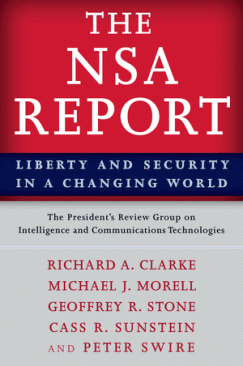
The second essay is Adam Morris‘s wide-ranging review of ‘The geopolitics of the Snowden Files‘ at the Los Angeles Review of Books.  Its immediate provocation is the publication of the Obama administration’s self-serving ‘NSA Report’:

The-NSA-Report-243x366The NSA Report — commissioned by the White House in August, published on its website in December, and now available in print via Princeton University Press— was authored by the President’s Review Group on Intelligence and Communications Technologies. As suggested by its official title, “Liberty and Security in a Changing World,” the Report was intended to advise President Obama on how to reform the data collection practices of the Intelligence Community (IC), in particular the NSA. Its authors include such veterans of the US security sector as Richard A. Clarke, Michael J. Morrell, and Peter Swire. This insiders’ perspective, in theory, is balanced by the addition to the group of constitutional lawyers Geoffrey R. Stone and Cass Sunstein. The unofficial purpose of the Report, however, was the Obama administration’s attempt to put a lid on the NSA scandal by pretending to be interested in reform. As Luke Harding points out in The Snowden Files, the Review Group was working out of the offices of the Director of National Intelligence, currently occupied by the felonious General James Clapper, w _ho knowingly lied in Congressional testimony about the bulk collection of Americans’ communication data.

The essay provides a fine, critical reading of the Report –

‘The anodyne language of these and other recommendations signals the imperial agenda out of which they are born: The NSA Report is obsessed with framing the debate over surveillance around the neopositivist vocabulary of “risk management,” but we know from history that political liberty will always suffer when a dominant regime deems a nation, its leadership or its population a “national security threat”…’

– but it also spirals off into a vigorous mapping of the context in which the NSA set about its covert operations and Edward Snowden‘s principled decision to go public (Adam also provides a commentary on Luke Harding‘s The Snowden Files: for another review, see Daniel Soar at the London Review of Books here).  And here too, of course, investigative journalism is a vital, enabling and even empowering practice.

Casualties of war

As most readers will know, there has been a lively debate – at once profoundly philosophical and intensely practical – about what counts as a ‘grievable’ (and indeed survivable) life after military and paramilitary violence, and on the calculus of war-time casualties.

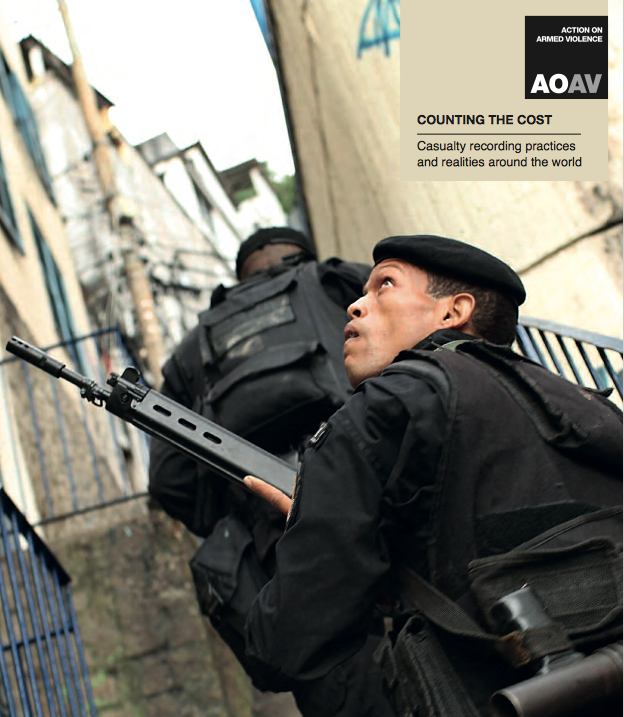
Two reports released yesterday conclude that recording and analysing data on the casualties of conflict and armed violence (both those killed and those who survive their wounds) can improve the protection of civilians and save lives.  The first, by Action on Armed Violence, is called Counting the Cost and surveys ‘casualty recording practices and realities around the world’:

Counting the costThe AOAV report shows that transparent and comprehensive information on deaths and injuries can protect civilians and save lives. The numbers of casualties have always been a contentious issue, generally dominated by secretive counting criteria, and public numbers that have been dictated more by political agendas than evidence. In other cases, the arguments have been dictated simply by the use of different estimating techniques. An example in this sense has been the debate on the total number of people that were killed during the Iraq War between Iraq Body Count and a survey published in the Lancet medical journal. The Lancet estimated over 650,000 deaths due to the war, more than 10 times the number of deaths estimated by the Iraq Body Count for the same period. A series of articles arguing for one or the other have highlighted how different systems to estimate number of deaths can lead to very different end results.

What the AOAV new report confirms is that when transparency both in the numbers produced as well as the techniques used to record them are clear and public, the debates around these numbers can be overcome. For Serena Olgiati, report co-author, “transparency makes it clear that this data is not a political weapon used to accuse opponents, but rather a practical tool that allows states to recognise the rights of the victims of violence.”

I have a more reserved view about a ‘transparent’ space somehow empty of politics – and we all know what the first casualty of war is – but the report is more artful than the press release suggests: it begins by invoking Walter Benjamin on Klee’s Angel of History:

“There is a painting by Klee called Angelus Novus. It shows an angel who seems about to move away from something he stares at. His eyes are wide, his mouth is open, his wings are spread. This is how the angel of history must look. His face is turned toward the past. Where a chain of events appears before us, he sees on single catastrophe, which keeps piling wreckage upon wreckage and hurls it at his feet. The angel would like to stay, awaken the dead, and make whole what has been smashed. But a storm is blowing from Paradise and has got caught in his wings; it is so strong that the angel can no longer close them. This storm drives him irresistibly into the future to which his back is turned, while the pile of debris before him grows toward the sky. What we call progress is this storm1.

The philosopher Walter Benjamin wrote these words in 1940 as he saw Europe engulf in flames. Within the year he had taken his own life on the French-Spanish border, the threat of deportation to a Jewish concentration camp seemingly too great for him to bear.

They are words that resonate as much today as they did then. Syria is engulfed in flames, Iraq descends back into the abyss and gun violence takes thousands of lives a week. The single catastrophe the Angelus Novus sees in the 21st century has to be the terrible harm caused by armed violence, a harm estimated to take over half a million lives a year.

Seeing this harm in its entirety is a gruelling task. Recording the true toll of armed violence reveals hard truths: it tells of underlying prejudices, of racism, of sexism: humanity’s ugliness. But only by turning behind us and calculating how many people have died and have been injured in a conflict, in a slum area, in a city in the grip of violence, can we ever begin to address the impact that armed violence has.

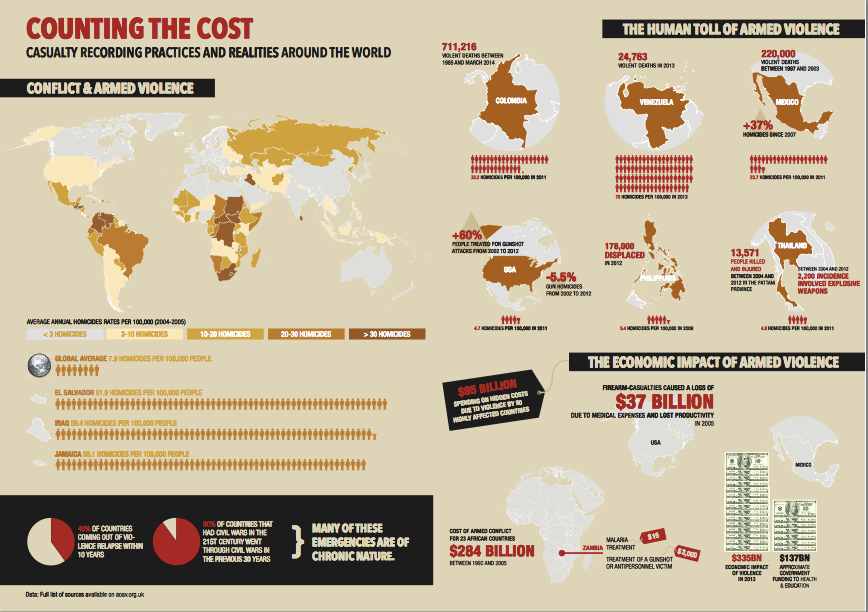
The report provided an analytical overview and a series of case studies (Colombia, Thailand and the Phillipines).

Counting the Cost Infographic

The second report is from the Oxford Research Group and is part of its Every Casualty program (see my post here).  In this report the ORG reviews the United Nations and Casualty Recording:

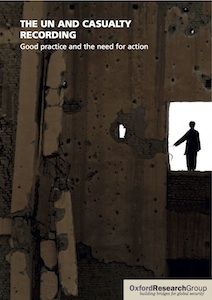
ORG-UN-and-CR Cover_1It concludes that when the UN systematically records the direct civilian casualties of violent conflict, and acts effectively on this information, this can help save civilian lives. However, casualty recording is not currently a widespread practice within the UN system.

The report recommends that the advancement of casualty-recording practice by the UN in conflict-affected countries should be pursued, as this would have clear benefits to the work of a range of UN entities, and so to the people that they serve.

This report looks at experiences of, and attitudes towards, casualty recording from the perspectives of UN staff based in New York and Geneva that we interviewed. It includes a case study of UN civilian casualty recording by the UN Assistance Mission in Afghanistan’s Human Rights unit. Finally, the report discusses challenges to UN casualty recording, and how these might be met.