Corpographies

I’ve been scribbling some notes for a short essay Léopold Lambert has invited me to write for his Funambulist Papers.  The brief is to write ‘something about the body – nothing too complicated’, so I’ve decided to say something more about the idea of corpography I sketched in ‘Gabriel’s Map’ (DOWNLOADS tab), which will in turn – so I hope – prepare the ground for the long-form version of ‘The nature(s) of war’ for a special issue of Antipode devoted to the work of Neil Smith [next on my to-do list].

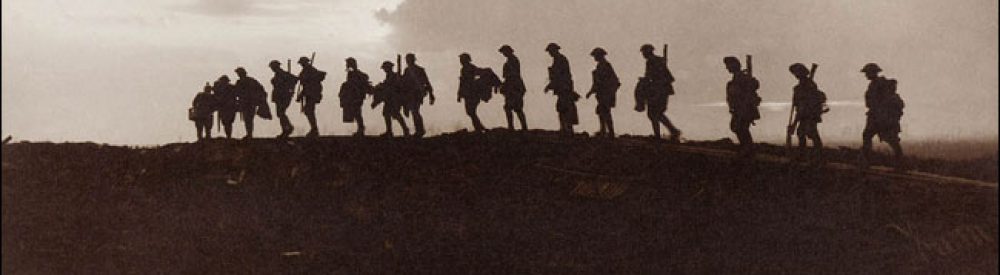
In ‘Gabriel’s Map’ (and in a preliminary sketch here) I contrasted the cartographic imaginary within which so much of the First World War was planned with a corpography improvised by soldiers caught up in the maelstrom of military violence on the ground; unlike the ‘optical war’ that relied, above all, on aerial reconnaissance, projected onto the geometric order of the map and the mechanical cadence of the military timetable – a remarkably abstract space, though its production was of course profoundly embodied – this was a way of apprehending the battle space through the body as an acutely physical field in which the senses of sound, smell and touch were increasingly privileged in the construction of a profoundly haptic or somatic geography.
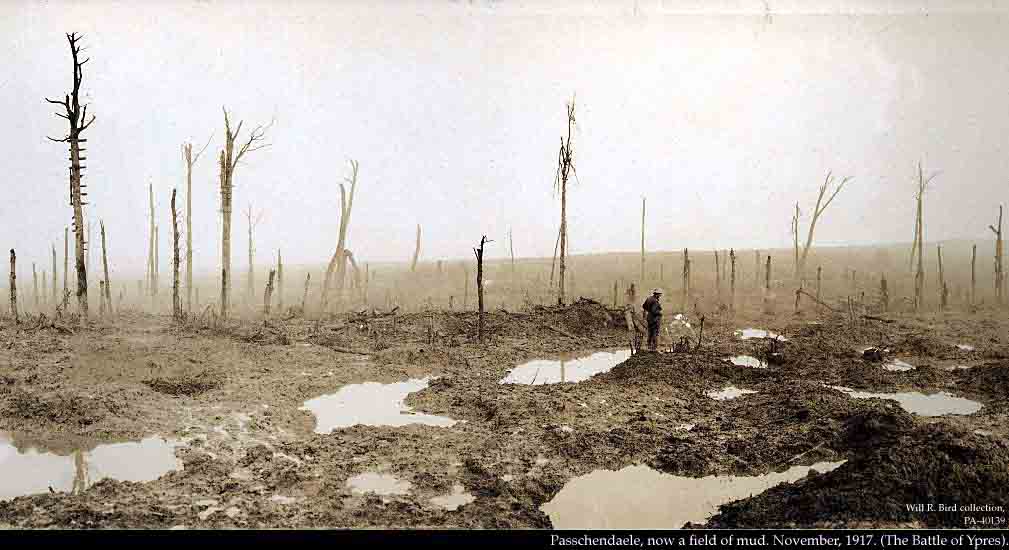
passchendale1917vj0

This is hardly original; you can find intimations of all this in classics like Eric Leed‘s No Man’s Land, and once you start digging in to the accounts left by soldiers you find supporting evidence on page after page.  What I’ve tried to do is show that this constituted more than a different way of experiencing war: it was also a different way of knowing and ordering (or, as Allan Pred would surely have said, of re-cognising) the space of military violence.  These knowledges were situated and embodied – ‘local’, even – but they were also transmissable and mobile.

On the Western front, corpographies were at once an instinctive, jarring, visceral response to military violence –

‘When sound is translated into a blow on the nape of the neck, and light into a flash so bright that it actually scorches the skin, when feeling is lost in one disintegrating jar of every nerve and fibre … the mind, at such moments, is like a compass when the needle has been jolted from its pivot’ [‘A Corporal’, Field Ambulance Sketches (1919)]

– and an improvisational, learned accommodation to it:

‘We know by the singing of a shell when it is going to drop near us, when it is politic to duck and when one may treat the sound with contempt. We are becoming soldiers. We know the calibres of the shells which are sent over in search of us. The brute that explodes with a crash like that of much crockery being broken, and afterwards makes a “cheering” noise like the distant echoes of a football match, is a five-point-nine.The very sudden brute that you don’t hear until it has passed you, and rushes with the hiss of escaping steam, is a whizz-bang… The funny little chap who goes tonk-phew-bong is a little high-velocity shell which doesn’t do much harm… The thing which, without warning, suddenly utters a hissing sneeze behind us is one of our own trench-mortars. The dull bump which follows, and comes from the middle distance out in front, tells us that the ammunition is “dud.” The German shell which arrives with the sound of a woman with a hare-lip trying to whistle, and makes very little sound when it bursts, almost certainly contains gas.

‘We know when to ignore machine-gun and rifle bullets and when to take an interest in them. A steady phew-phew-phew means that they are not dangerously near. When on the other hand we get a sensation of whips being slashed in our ears we know that it is time to seek the embrace of Mother Earth’ [A.M. Burrage, War is war]
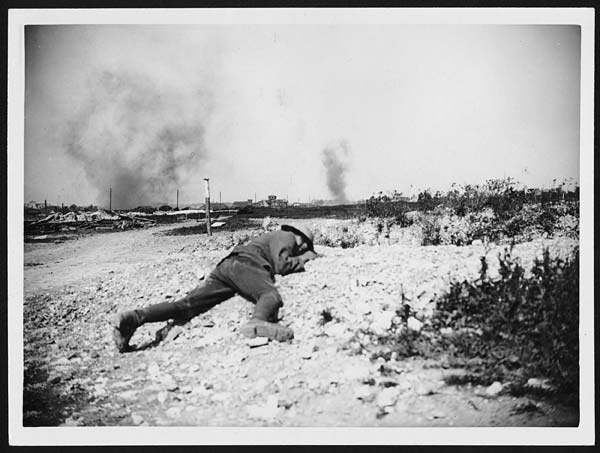
National Library of Scotland (Tom Aitken)

This was not so much a re-setting of the compass, as the anonymous stretcher-bearer had it, as the formation of a different bodily instrument altogether.  As Burrage’s last sentence shows, corpographies were at once re-cognitions of a butchered landscape – one that seemed to deny all sense – and reaffirmations of an intimate, intensely sensible bond with the earth:

‘To no man does the earth mean so much as to the soldier. When he presses himself down upon her, long and powerfully, when he buries his face and his limbs deep in her from the fear of death by shell-fire, then she is his only friend, his brother, his mother; he stifles his terror and his cries in her silence and her security…. ’ [Erich Remarque, All quiet on the Western Front]

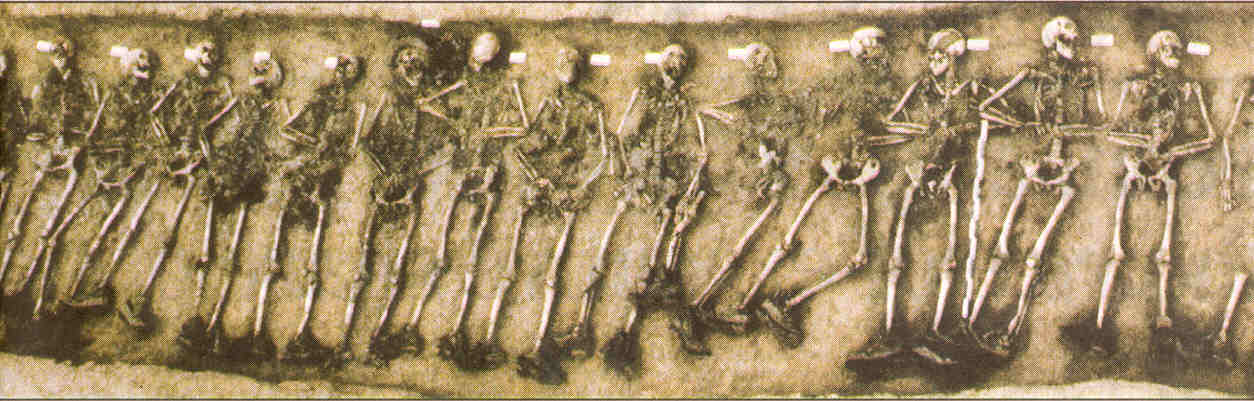
And corpographies were not only a means through which militarised subjects accommodated themselves to the warscape – providing a repertoire of survival of sorts – but also a way of resisting at least some its impositions and affirming, in the midst of what so many of them insisted was ‘murder not war’, what Santanu Das calls a ‘tactile tenderness’ between men.  This, he argues,

‘must be seen as a celebration of life, of young men huddled against long winter nights, rotting corpses, and falling shells. Physical contact was a transmission of the wonderful assurance of being alive, and more sex-specific eroticism, though concomitant, was subsidiary. In a world of visual squalor, little gestures – closing a dead comrade’s eyes, wiping his brow, or holding him in one’s arms – were felt as acts of supreme beauty that made life worth living.’
grimsbychums

A hundred years later, I have no doubt that much the same is true in Afghanistan, Iraq, Syria and elsewhere, and so my interest in corpography is also part of my refusal to acquiesce to the thoroughly disingenuous de-corporealization of today’s ‘virtuous war’.

In fleshing out these ideas I’ve been indebted to a stream of work on the body in human geography. Most of it has been remarkably silent about war, even though Kirsten Simonsen once wrote about ‘the body as battlefield‘, but it’s now difficult for me to read her elegant essay ‘In quest of a new humanism: Embodiment, experience and phenomenology as critical geography’ [Progress in human geography 37 (1) (2013): open access here] – especially Part III where she discusses ‘Thinking the body’ and ‘Orientation and disorientation’ – without peopling it with bodies in khaki, blue or field grey tramping towards the front-line trenches, clambering over the top, or crawling from shell-hole to shell-hole in No Man’s Land.

That is partly down to the suggestiveness of Kirsten’s prose, but it’s also the result of my debt to the work of Santanu Das [Touch and intimacy in First World War literature], Ken MacLeish [especially Chapter 2 of his Making War at Fort Hood; the dissertation version is here] and Kevin McSorley [whose introduction to War and the body is here] which directly addresses military violence.  I wish I’d been able to attend the Sensing War conference that Kevin co-organised in London last month; I had to turn down the invitation because I was marooned on my mountaintop in Umbria, but the original Call For Papers captured some of the ways in which the materialities and corporealities of war in the early twentieth century continue to inhabit later modern war:

War is a crucible of sensory experience and its lived affects radically transform ways of being in the world. It is prosecuted, lived and reproduced through a panoply of sensory apprehensions, practices and ‘sensate regimes of war’ (Butler 2012) – from the tightly choreographed rhythms of patrol to the hallucinatory suspicions of night vision; from the ominous mosquito buzz of drones to the invasive scrape of force-feeding tubes; from the remediation of visceral helmetcam footage to the anxious tremors of the IED detector; from the desperate urgencies of triage to the precarious intimacies of care; from the playful grasp of children’s war-toys to the feel of cold sweat on a veteran’s skin.

Thus far, like most of the writers I’ve drawn from here, I’ve been thinking about corpographies in relation to the soldier’s body, but as the (in)distinctions between combatant and civilian multiply I’ve started to think about the knowledges that sustain civilians caught up in military and paramilitary violence too. Some of them are undoubtedly cartographic – formal and informal maps of shelters (the images below are for Edinburgh during the Second World War), camps, checkpoints and roadblocks – and some of them rely on visual markers of territory: barriers and wires, posters and graffiti. Today much of this information is shared by social media (as the battle space has become both digital and physical).
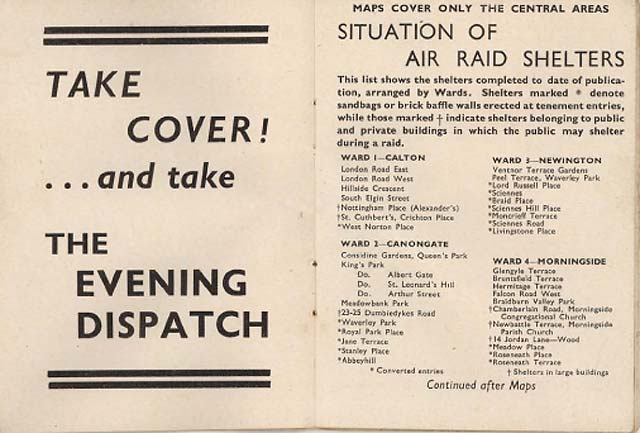
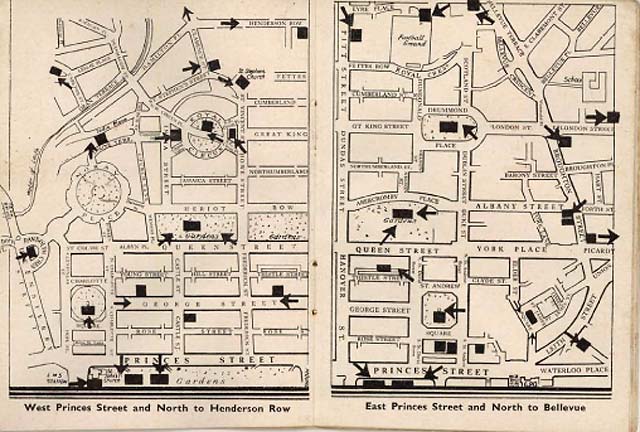
Guide to Edinburgh Air Raid Shelters WW2


0_books_-_edinburgh_air_raid_shelters_p12+p13

But much of this knowledge is also, as it has always been, corpographic.  Pete Adey once wrote – beautifully – about what he called ‘the private life of an air raid’, drawing on the files of Mass Observation during the Second World War to sketch a geography of ‘stillness’ even as the urban landscape was being violently ‘un-made’.  ‘Stillness in this sense,’ he explained,

‘denotes apprehending and anticipating spaces and events in ways that sees the body enveloped within the movement of the environment around it; bobbing along intensities that course their way through it; positioned towards pasts and futures that make themselves felt, and becoming capable of intense forms of experience and thought.’

This was a corpo-reality, and one in which – as he emphasised – sound played a vital role: ‘Waves of sound disrupted fragile tempers as they passed through the waiting bodies in the physical language of tensed muscles and gritted teeth.’  But, as he also concedes, this was also a ‘not-so private’ life – there was also a social life under the bombs – and we need to think about how these experiences were shared by and with other bodies.  These apprehensions of military violence, then as now, were not only modalities of being but also modes of knowing: as Elizabeth Dauphinée suggests, in a different but closely related context, ‘pain is not an invisible interior geography’ but rather ‘a mode of knowing (in) the world – of knowing and making known’  [‘The politics of the body in pain’, Security dialogue 38 (2) (2007) 139-55]. During an air raid these knowledges could be shared by talking with others – the common currency of comfort and despair, advice and rumour – but they also arose from making cognitive sense of physical sensations: the hissing and roaring of the bombs, the suction and compression from the blast, the stench of ruptured gas mains or sewage pipes.
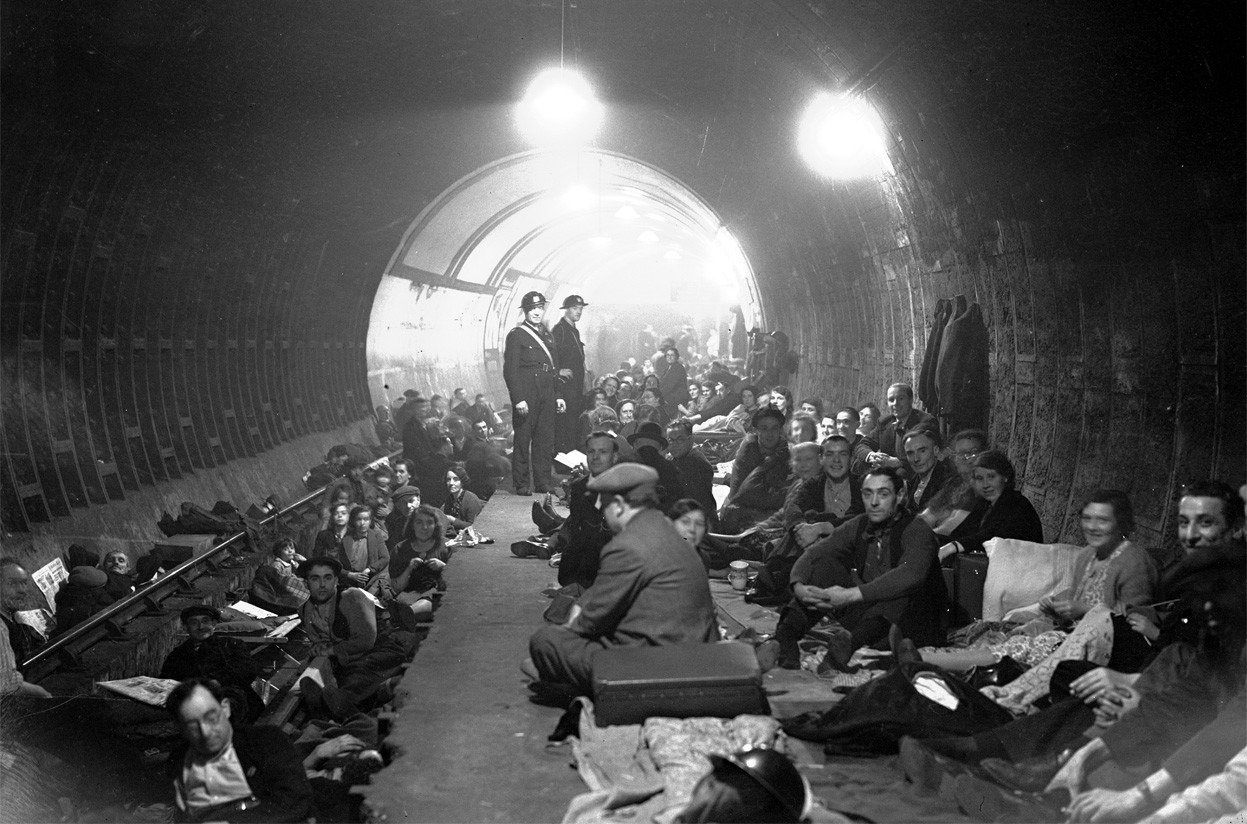
London air raid shelter

Steven Connor once suggested that air raids involve a ‘grotesquely widened bifurcation of visuality and hearing’, in which the optical-visual production of a target contrasts with ‘the absolute deprivation of sight for the victims of the air raid on the ground, compelled as they are to rely on hearing to give them information about the incoming bombs.’  Those crouching beneath the bombs have ‘to learn new skills of orientating themselves in this deadly auditory field without clear coordinates or dimensions but in which the tiniest variation in pitch and timbre can mean obliteration.’  What then can you know – and how can you know – when your world contracts to a room, a cellar, the space under the bed?  When you can’t go near a window in case it shatters and your body is sliced by the splinters?  When all you have to go on, all you can trust, are your ears parsing the noise or your fingers scrabbling at the rubble?
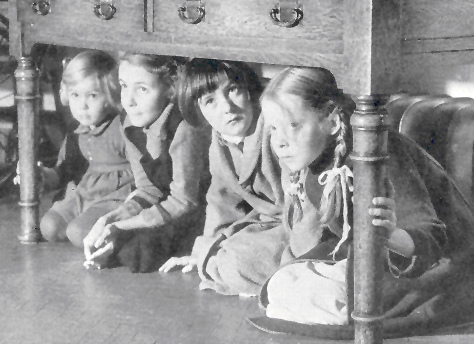
Air raid drill in children's home WW2

Here too none of this is confined to the past, and so I start to think about the thanatosonics of Israel’s air strikes on Gaza.  Sound continues to function as sensory assault; here is Mohammed Omer:

‘At just 3 months old, my son Omar cries, swaddled in his crib. It’s dark. The electricity and water are out. My wife frantically tries to comfort him, shield him and assure him as tears stream down her face. This night Omar’s lullaby is Israel’s rendition of Wagner’s Ride of the Valkyries, with F-16s forming the ground-pounding percussion, Hellfire missiles leading the winds and drones representing the string section. All around us crashing bombs from Israeli gunships and ground-based mortars complete the symphony, their sound as distinct as the infamous Wagner tubas…. Above, the ever-present thwup-thwup of hovering Apache helicopters rock Omar’s cradle through vibration. Warning sirens pierce the night—another incoming missile from an Israeli warship.’

And, as before, sound can also be a source of knowledge.  Here is Wasseem el Sarraj, writing from Gaza in November 2012:

In our house we have become military experts, specializing in the sounds of Israeli and Palestinian weapons. We can distinguish with ease the sound of Apaches, F-16 missiles, drones, and the Fajr rockets used by Hamas. When Israeli ships shell the coast, it’s a distinct and repetitive thud, marked by a one-second delay between the launch and the impact. The F-16s swoop in like they are tearing open the sky, lock onto their target and with devastating precision destroy entire apartment blocks. Drones: in Gaza, they are called zananas, meaning a bee’s buzz. They are the incessant, irritating creatures. They are not always the harbingers of destruction; instead they remain omnipresent, like patrolling prison guards. Fajr rockets are absolutely terrifying because they sound like incoming rockets. You hear them rarely in Gaza City and thus we often confuse them for low-flying F-16s. It all creates a terrifying soundscape, and at night we lie in our beds hoping that the bombs do not drop on our houses, that glass does not shatter onto our children’s beds. Sometimes, we move from room to room in an attempt to feel some sense of safety. The reality is that there is no escape, neither inside the house nor from the confines of Gaza.

The last haunting sentences are a stark reminder that knowledge, cartographic or corpographic, is no guarantee of safety. But military and paramilitary violence is always more than a mark on a map or a trace on a screen, and the ability to re-cognise its more-than-optical dimensions can be a vital means of navigating the wastelands of war.  As in the past, so today rescue from the rubble often involves a heightened sense of sound and smell, and survival is often immeasurably enhanced by the reassuring touch of another’s body.  And these fleshy affordances – which you can find in accounts of air raids from Guernica to Gaza – are also a powerful locus for critique.
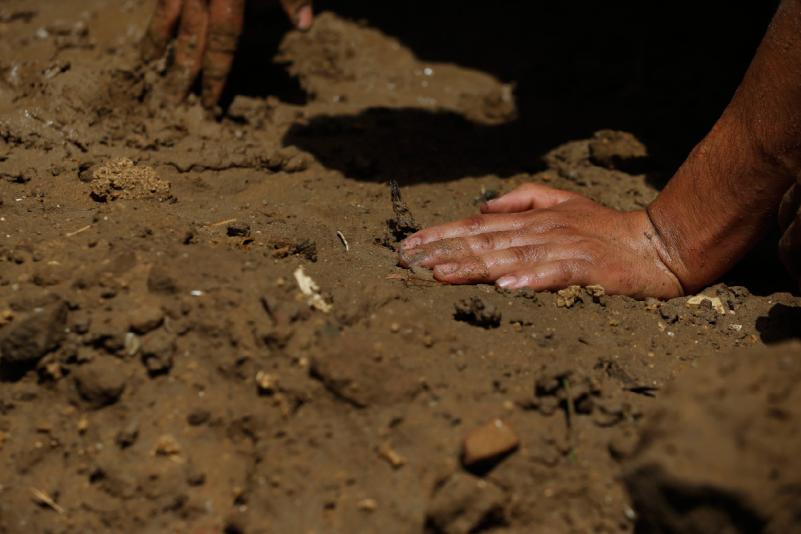
Gaza Hands and Grave

So: corpographies.  I thought I’d made the word up, but as I completed ‘Gabriel’s Map’ I discovered that Joseph Pugliese uses ‘geocorpographies’ to designate ‘the violent enmeshment of the flesh and blood of the body within the geopolitics of war and empire’ in his State violence and the execution of law (New York: Routledge, 2013; p. 86). This complements my own study, though I’ve used the term to confront the optical privileges of cartography through an appeal to the corporeal (and to the corpses of those who were killed in the names of war and empire).

And I’ve since discovered that the term has a longer history and multiple meanings that intersect, in various ways, with what I’m trying to work out.  Perhaps not surprisingly, it also serves as a medical term: cranio-corpography is a procedure devised by Claus-Frenzen Claussen in 1968 to capture in a visual trace the longitudinal and lateral movements of a patient’s body in order to detect and calibrate disorders of the ‘equilibrium function’.  More recently, corpography has also been used by dance theorists and practitioners, including Francesca Cataldi and Sebastian Prantl, to describe a critical, creative practice: a ‘dance of things’ in which the body is thoroughly immersed as a’ land.body.scape’, as Prantl puts it.  Meanwhile, Allan Parsons has proposed a ‘psycho-corpography’ – explicitly not a psycho-geography – as a way of ‘tracing the experience of living-a-body’.  Elsewhere,  Alex Chase attends to specific bodies-in-the-world, those of cultural ‘figures’ (Artaud, Bataille, Foucault, Genet, Jarman and Mishima among them), that resist normalization – hence emphatically  ‘queer’ bodies – and which figure bodies as events.  ‘I hope to develop a methodology of “corpography”,’ he says, ‘which would write between biography and textual analysis, material lived bodies and fictional work, life and representation, in order to work through other queer concepts such as temporality, space, and ethics.’

It would of course be absurd to summon all of these different usages onto a single conceptual terrain. But they do take me back to Kirsten’s essay (and to long-ago memories of an enthralling seminar in Roskilde which she introduced through her dance teacher), to ways of apprehending the danse macabre on the Western Front as both a cartography and a corpography whose junction was to be found, perhaps, in a choreography, and to think about the ways in which the sentient bodies of soldiers were at once habituated to and resisted the forceful normalizations of military violence.  They also make me wonder about civilian corpographies – about the multiple ways in which violence is inflicted on the body and yet may be resisted through the body – and in doing so they direct my steps from the past to the present and to the fragile bodies that continue to lie at the heart of today’s conflicts.  If that is to speak with Walter Benjamin, I want to insist that the ‘tiny, fragile human body’ does not only lie ‘in a field of force of destructive torrents and explosions’, as he wrote in 1936: for the body is a vector as well as a victim of military and paramilitary violence.  And it can also be a means of undoing its effects.

I suspect that these ideas will eventually thread their way into my new project on the evacuation of combatant and civilian casualties (and the sick) from war zones, 1914-2014, where it’s already clear to me that cartography and corpography are tightly locked together.  All of this is highly provisional, as you’ll realise, and as always I would welcome comments and suggestions.
Maps of/for pain

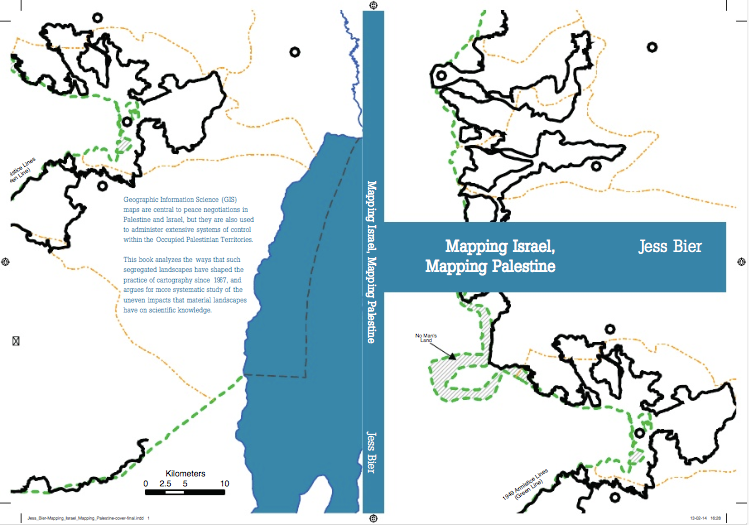
This morning I received a copy of Jess Bier‘s recently completed PhD thesis, Mapping Israel, Mapping Palestine (Technology and Science Studies, Maastricht, 2014) – thanks so much, Jess – and I look forward to working my way through it.  You can download a version from Academia here.


BIER Mapping Israel, mapping Palestine

Here is the abstract:

Mapping Israel, Mapping Palestine is an analysis of the ways that segregated landscapes have shaped the practice of cartography in Jerusalem and the West Bank since 1967. Extending work on how technology is socially constructed, it investigates the ways that knowledge is geographically produced. Technoscientific practices are situated in spatial contexts which are at once both social and material. This situated character influences the content of knowledge in ways that can be unpredictable. Therefore, it is necessary to reflexively engage with materiality in order to enable landscapes that allow for more diverse practices and forms of knowledge.

The complex geographies of Palestine and Israel provide central sites for the study of how landscapes shape the form, content, and circulation of knowledge. 1967 marks the beginning of the Israeli Occupation of the Palestinian Territories, including the West Bank and Gaza Strip. With the notable exception of East Jerusalem, currently most of the occupied areas have been neither formally incorporated into the Israeli state, nor have they been allowed to form an independent sovereign nation. Instead, small pockets of Palestinian control have been carved out through a series of international negotiations aimed at clearly defining separate states for Palestinians and Israelis—negotiations which often take place over tables strewn with maps.

Yet even as maps are employed in attempts to end the Occupation, similar methods have been used to build intricate infrastructure networks for curtailing human movement within the Territories. These include the 8‐meter [high] Wall which snakes through the West Bank, segregated sets of roads and buildings, as well as roving series of checkpoints and roadblocks, all designed with the purpose of confining Palestinians and separating them from Israelis. The planning, construction, and administration of such systems of control are made possible by the same Geographic Information Science (GIS) mapmaking practices which are used in attempts to ameliorate the conflict. To understand how this is possible, it is necessary to explore the ways that such practices are differently incorporated throughout the very region which cartographers seek to map and reshape.

The centrality of maps to debates over the future of Palestine and Israel has only intensified since the advent of digital cartography has led to increasingly minute forms of surveillance and control. Contemporary cartography incorporates a range of practices in Jerusalem and the West Bank, from adaptations of decommissioned spy satellite images to a road map made by Palestinian students who tracked their own movements on their mobile phones. Intended to display objective facts, empirical maps often inspire extensive discussion. Participants in these discussions exhibit a variety of observational frames that cannot be divorced from their unequal positions and mobilities within the very terrains that they seek to portray. Mapping Israel, Mapping Palestine addresses these issues by presenting an analysis of the empirical maps and mapmaking practices which result when diverse cartographers travel to chart the same landscapes that so condition their movement. As such, it investigates the myriad ways that the segregated landscapes of the Israeli Occupation shape the conditions of possibility for knowledge about the Occupation and its effects.

This is really important work (see also the presentation by the Foundation for Middle East Peace here), but in addition to maps and digital captures of occupied Palestine – the plethora of lines on maps – there are other operational dimensions to mapping.  I’m thinking in particular of the IDF’s target maps.  You can find a report of its ‘target bank’ for southern Lebanon in 2011 here – ‘many time larger than it was in 2006’ – and Craig Jones‘s discussion of surveillance, imagery and targeted killing here.

This apparatus is in full play during the present military offensive on Gaza, which (like all the others) involves the production and destruction of targets through the mobilisation of cartography.

But there are other dimensions.  Here is a senior IDF officer, as reported by Reuters on 12 July:

“We are dealing with a variety of families of targets. If there is a kind of a map, or a map of pain that the enemy sees, we create a lot of pain so that he will have to think first to stop the conflict.”

There may well be a map of pain — but the pain is also produced through mapping.

Bombed, Destroyed, Slaughtered

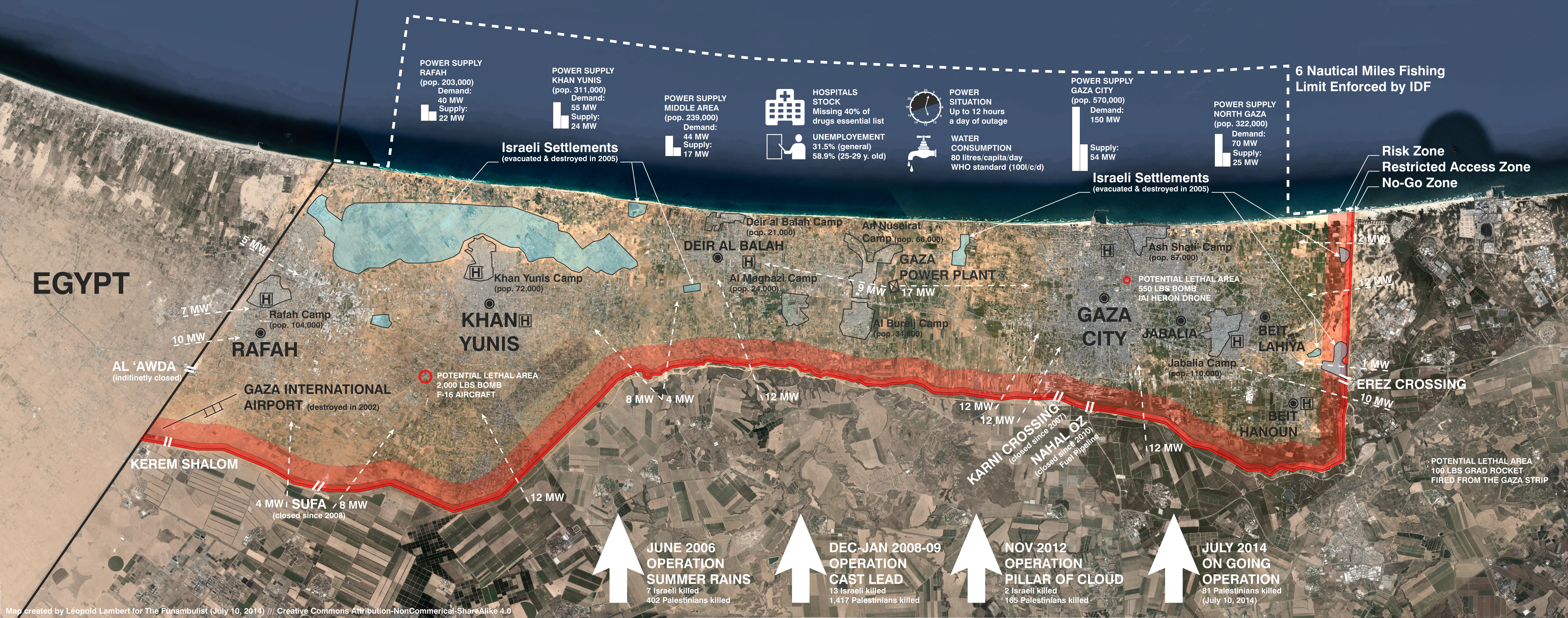
Map Gaza

Following on from my previous post, Léopold Lambert has produced the map above, showing an ‘infrastructural and militarized cartography’ of Gaza; you can download a hi-res version and read his commentary here.

Notice those repetitions marked by arrows; Rami Khoury writes in Lebanon’s Daily Star this morning:

What we are witnessing today is Israel behaving against Palestinians much as the French, British and Italian colonial powers behaved against Iraqis, Syrians, Egyptians, Algerians and Libyans a century or more ago. In its colonization of Arab lands and its raw military savagery against civilians, Israel gives us the best history lesson available of the conduct of colonial powers who treated natives as servants or subversives without rights, and who dealt with them primarily by repeated shows of force.

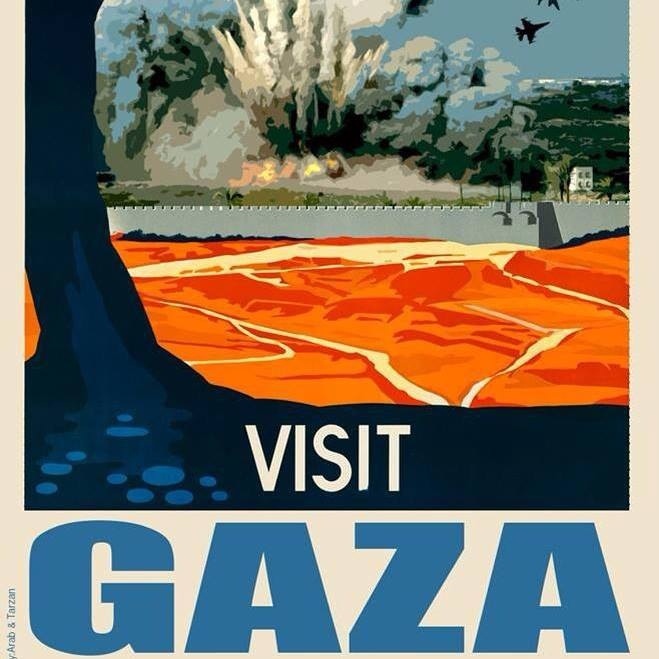
Visit GazaBut this is far more than a postscript to my previous post on Gaza, with its own vocabulary of ‘all too familiar’, ‘this time round’, and ‘once again’. Over at Critical Legal Thinking Nimer Sultany has a truly excellent short essay, ‘Repetition and Death in the Colony: On the Israeli attacks on Gaza‘:

‘At the moment of writing these lines, the BBC reports 100 deaths thus far in Gaza in the recent Israeli onslaught. As we have seen these scenes before, the invocation of repetition comes naturally. “Once again” is a commonly used word when it comes to death and suffering under occupation in Palestine and specifically Gaza….

‘But “once again” is not a mere rhetorical gesture nor symptomatic of tragic despair. It connotes a recursive power dynamic and a structural relationship between an occupier and an occupied. It should be a reminder of context rather than an erasure of context…. Lacking context, the responsibility is either equally shared by two symmetrically opposed agents of violence or the stronger party bears no responsibility because it is merely responding to the irrational violence of the weak who bears the responsibility for death and suffering.’

Nimer develops his argument in relation to the juridification of (later) modern war, the construction of the (Palestinian) civilian as a negation (the non-combatant as ‘an afterthought’), and on a ‘peace process’ that is ‘conditioned on their abdication of their right to resist an unjust foreign occupier and … their subordination of demands on behalf of justice for the sake of peace’ (see also Nimer’s ‘Colonial realities’ here; his account of the role of the Israeli Supreme Court in the juridifcation of the occupation of Palestine, ‘Activism and Legitimation in Israel’s Jurisprudence of Occupation’ in Social and Legal Studies (online March 2014) is usefully read alongside George Bisharat, ‘Violence’s Law’, Journal of Palestine Studies 42 (3) (2013) 68-84, which addresses Israel’s concerted campaign to transform international humanitarian law [‘the laws of war’]).

Gaza, stripped again

As Craig Jones notes over at War, Law and Space, the renewed fighting between Hamas and the IDF is all too familiar; so too is the cartography.

In November 2012, the New York Times published two maps – one showing Israeli cities ‘taking enemy fire’ and the other showing the site of Israeli leaflet drops on Gaza (see my discussion here).

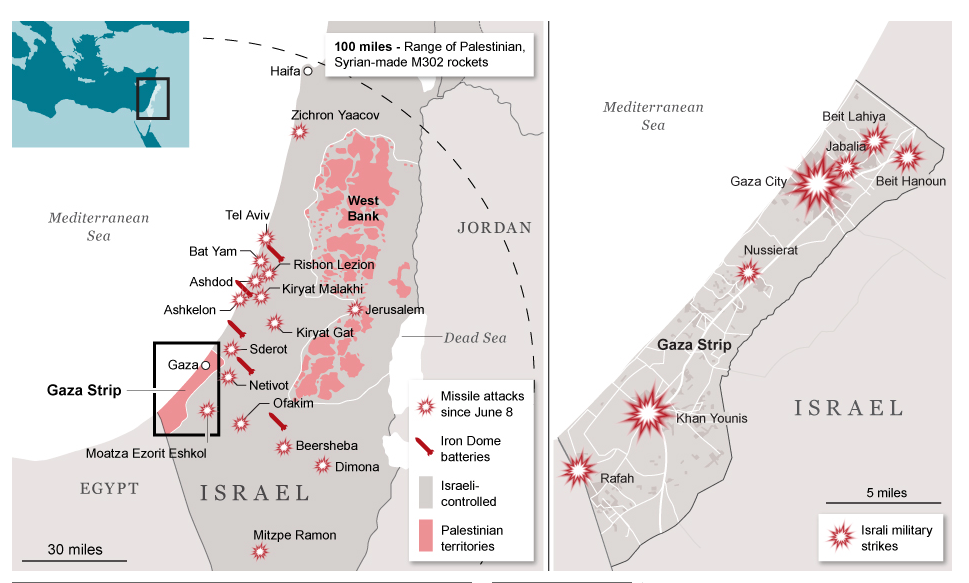
This time round, the only maps available until today have shown the putative range of Hamas’s rockets and the strikes that have taken place in Israel: Gaza might just as well have been a blank space marked ‘here be monsters’ (which is, of course, exactly how the Netanyahu administration wants us to see it).

This evening, Britain’s Telegraph published this map:

IDF and Hamas air strikes 2014

What the latest Israeli assault shows once again, however, is that the key on the left-hand map is misleading.  To juxtapose ‘Israeli-controlled’ with ‘Palestinian territories’ is like juxtaposing ‘fruit’ to ‘apples’.  So many domains of life – and death – in the Palestinian territories, in both the occupied West Bank and Gaza, remain firmly under Israeli control.

Theory of the drone 11: Necro-ethics

This is the 11th in a series of extended posts on Grégoire Chamayou‘s Théorie du drone and covers the first two of three chapters that constitute Part III: Necro-ethics.

The title recalls Achille Mbembe‘s seminal essay on ‘Necropolitics’ [Public culture 15 (1) (2003) 11-40], where he cuts the umbilical cord between sovereignty and the state (and supranational institutions) and, inspired by Michel Foucault and Giorgio Agamben, argues that ‘the ultimate expression of sovereignty resides, to a large degree, in the power and the capacity to dictate who may live and who must die.’  Necropolitics is thus about ‘contemporary forms of subjugation of life to the power of death’ – and at the limit the creation of what Mbembe calls ‘death-worlds’.

AlexisLeran-AchilleMbembe5Mins658

Mbembe develops his thesis in part – and for good reason – in relation to the Israeli occupation of Palestine.  I imagine readers will know that the Israeli Defence Force (IDF) advertises itself, incredibly, as ‘the most moral army in the world’, and although Chamayou’s ultimate objectives are different he too begins with a critical interrogation of one version of that claim (you can find much more about it in Muhammad Ali Khalidi‘s fine essay on Gaza in the Journal of Palestine Studies 39 (3) (2010) available on open access here).

1: Combatant immunity

Chamayou argues that what distinguishes contemporary forms of imperial military violence is not so much the asymmetry of the conflict or the differential distribution of vulnerability which results as the norms that are invoked to regulate its conduct.  Towards the end of the twentieth century, he suggests, the ‘quasi-invulnerability’ of the dominant force was transformed into an over-arching politico-ethical framework.  This first came into view during NATO’s intervention in Kosovo in 1999 when force protection was established as the key consideration: not only was the NATO campaign largely confined to bombing from the air (so that, apart from Special Forces, there were few boots – and, more to the point, NATO bodies – on the ground) – but pilots were ordered not to fly below 15,000 feet.  This kept them safely beyond the range of anti-aircraft fire, even as it reduced the accuracy of air strikes and endangered the lives of those the intervention was supposed to save.

nato-bombs-convoy

This seems to violate conventional notions of a just or ethical war, effectively turning ‘humanitarian intervention’ on its head, but Chamayou claims that in fact it heralded the explicit formulation of a principle of ‘imperial combatant immunity’.  Enter the IDF, stage right.  This new doctrine was set out in detail in an essay by Asa Kasher  and Amos Yadlin, writing from the ‘Department of Professional Ethics and Philosophy of Practice’ at Tel Aviv University and the IDF College of National Defense, and published as ‘Military ethics of fighting terror: an Israeli perspective’, Journal of military ethics 4 (1) (2005) 3-32.  As their affiliation shows, this was not an abstract, academic discussion; Chamayou notes, in an artful twist on Yves Lacoste (La géographie, ça sert, d’abord, à faire la guerre), ‘What use is moral philosophy?  Among other things, to wage war…’ (‘A quoi sert la philosophie morale?  Entre autres choses, à faire la guerre’) (p. 184).

In that essay Kasher and Yadlin proposed a comprehensive reformulation of military ethics – and, by extension, international law – but Chamayou fastens on their reworking (or demolition) of  the established principle of distinction.  He cites their central thesis, thus:

One major issue is the priority given to the duty to minimize casualties among the combatants of the state when they are engaged in combat acts against terror.  According to the ordinary conception underlying the distinction between combatants and noncombatants, the former have a lighter package of state duties than the latter. Consequently, the duty to minimize casualties among combatants during combat is last on the list of priorities or next to last, if terrorists are excluded from the category of noncombatants. We reject such conceptions, because we consider them to be immoral. A combatant is a citizen in uniform. In Israel, quite often he is a conscript or on reserve duty. His blood is as red and thick as that of citizens who are not in uniform. His life is as precious as the life of anyone else. A democratic state may send him to a battlefront only because it has a duty to defend its citizens and it cannot do this without some of them defending the others, within the framework of a just system of conscription and reserve duty. The state ought to have a compelling reason for jeopardizing a citizen’s life, whether or not he or she is in uniform. The fact that persons involved in terror are depicted as noncombatants is not a reason for jeopardizing the combatant’s life in their pursuit. He has to fight against terrorists because they are involved in terror. They shoulder the responsibility for their encounter with the combatant and should therefore bear the consequences. 

(It turns out that there are limits to the privileges accorded to citizen-soldiers: more recently Ha’aretz reports that Kasher suggested in early 2012 that medical experiments can be carried out on them, even if they are not fully informed of the details, in order to ‘build the military force’, though Kasher has contested these accusations and insisted that his opinion stipulated a series of ‘conditions’ that had to be met).

I didn’t mention Lacoste casually, because part of Kasher and Yadlin’s argument turns on territory: on the duties imposed by belligerent occupation (‘when a person resides in a territory that is under effective control of the state’).  This is a Trojan Horse, needless to say, because they clearly have Gaza in their sights, and their proposal seeks to further the egregious fiction that Israel’s ‘withdrawal’ in 2005 meant that the Palestinians effectively imprisoned in Gaza are no longer subject to Israeli occupation (for more on ‘Gaza under siege’, see here).  Chamayou doesn’t dwell on this, but the emphasis on ‘effective control’ could – if you accept Kasher and Yadlin’s grotesque argument (which they insist is a general one) – be brought to bear on the US campaign of targeted killing in the Federally Administered Tribal Areas of Pakistan, in Yemen and in Somalia and be made to intersect with the usual rhetoric about ‘ungoverned spaces’ and ‘lawless zones’.

Kasher and Yadlin summarize their proposed hierarchy of privileges by setting out a tariff according to which militaries would administer injury in priority sequence:

(d.1) Minimum injury to the lives of citizens of the state who are not combatants during combat;

(d.2) Minimum injury to the lives of other persons (outside the state) who are not involved in terror, when they are under the effective control of the state;

(d.3) Minimum injury to the lives of the combatants of the state in the course of their combat operations;

(d.4) Minimum injury to the lives of other persons (outside the state) who are not involved in terror, when they are not under the effective control of the state;

(d.5) Minimum injury to the lives of other persons (outside the state) who are indirectly involved in terror acts or activities;

(d.6) Injury as required to the liberties or lives of other persons (outside the state) who are directly involved in terror acts or activities.

Chamayou concludes that the core principle they seek to advance involves replacing the distinction between civilians and combatants by a hierarchical distinction between citizens and aliens: an unbridled nationalism masquerading as ethics (p. 187).  In other words, within the frontier of state control  – Chamayou says ‘ state sovereignty’, but that’s not quite what Kasher and Yadlin say – some lives are more precious than others,  while beyond that line inferior lives (including those of what they call ‘bystanders’) are to be exposed to violence and ultimately sacrificed: as they put it, ‘the state should give priority to saving the life of a single citizen, even if the collateral damage caused in the course of protecting that citizen is much higher…’

nyrb051409Their proposals had a slow fuse but they eventually set off a firestorm of protest.  Responding to a shorter version of the main essay [‘Assassination and preventive killing’, SAIS Review of International Affairs 25 (1) (2005)  41-57] and writing in the New York Review of Books (14 May 2009), Avishai Margalit and Michael Walzer were unequivocally appalled:

‘Their claim, crudely put, is that in such a war the safety of “our” soldiers takes precedence over the safety of “their” civilians.  Our main contention is that this claim is wrong and dangerous. It erodes the distinction between combatants and noncombatants, which is critical to the theory of justice in war (jus in bello).’

They continued:

‘The point of just war theory is to regulate warfare, to limit its occasions, and to regulate its conduct and legitimate scope. Wars between states should never be total wars between nations or peoples. Whatever happens to the two armies involved, whichever one wins or loses, whatever the nature of the battles or the extent of the casualties, the two nations, the two peoples, must be functioning communities at the war’s end. The war cannot be a war of extermination or ethnic cleansing. And what is true for states is also true for state-like political bodies such as Hamas and Hezbollah, whether they practice terrorism or not. The people they represent or claim to represent are a people like any other.

The main attribute of a state is its monopoly on the legitimate use of violence. Fighting against a state is fighting against the human instruments of that monopoly—and not against anyone else….

The crucial means for limiting the scope of warfare is to draw a sharp line between combatants and noncombatants. This is the only morally relevant distinction that all those involved in a war can agree on. We should think of terrorism as a concerted effort to blur this distinction so as to turn civilians into legitimate targets. When fighting against terrorism, we should not imitate it.’

In contrast,

‘For Kasher and Yadlin, there no longer is a categorical distinction between combatants and noncombatants. But the distinction should be categorical, since its whole point is to limit wars to those—only those—who have the capacity to injure (or who provide the means to injure)….

‘This is the guideline we advocate: Conduct your war in the presence of noncombatants on the other side with the same care as if your citizens were the noncombatants. A guideline like that should not seem strange to people who are guided by the counterfactual line from the Passover Haggadah, “In every generation, a man must regard himself as if he had come out of Egypt.”

Menahem YaariTheir critique found vigorous support from Menahem Yaari, a theoretical economist whose work has addressed (amongst other things) questions of justice, uncertainty and risk, but who wrote in a subsequent issue (8 October 2009) in his capacity as President of the Israel Academy of Sciences and Humanities:

‘A military code of conduct that discriminates, in cases of hazards being inflicted upon innocent civilians, on the basis of whether these civilians are “ours” or “theirs” is all the more worrisome when viewed against a general background of growing ethnocentric and xenophobic attitudes in Israel’s traditional establishment. We see an ongoing drift from universalism and humanism toward parochialism and tribalism.’

Picking up from that last sentence, Chamayou believes that this drift has accelerated and that it is by no means confined to Israel’s ‘traditional establishment’.  In his view, the ‘evisceration’ of the core principles of international humanitarian law by a ‘nationalism of self-preservation’ has become ‘the primary guiding principle of the necro-ethics of the drone’ (p. 189).

2: Humanitarian weapon

Chamayou seeks to trace a line of descent from the previous arguments to those advanced more recently by academics who directly address (and defend) the US use of drones.  He has two men in mind: Avery Plaw, an Associate Professor of Political Science at UMass – Dartmouth, and Bradley Jay Strawser, an Assistant Professor of Philosophy in the Defense Analysis Department at the US Naval Postgraduate School at Monterey.

UMass_Drone-crop

Plaw has collaborated with several colleagues to track and evaluate drone strikes in Pakistan and is involved in the UMass DRONE project (I’ve commented on this before), but it’s an Op-Ed in the New York Times on 14 November 2012 that catches Chamayou’s attention.  ‘Drones save lives, American and others’ was the headline, and Chamayou is bemused: ‘How can an instrument of death save lives?’

The question seems to invite a biopolitical response – ‘killing in order to let live’, as Mbembe and others would no doubt have it, and Chamayou doesn’t quite provide that – but neither does Plaw quite say what the headline implies.  He suggests that ‘drone strikes are the best way to remove an all-too-real threat to American lives’ and that ‘there is evidence that drone strikes are less harmful to civilians than other means of reaching Al Qaeda and affiliates in remote, lawless regions’. Perhaps this amounts to the same thing, but it’s not quite the cold calculus that Chamayou attributes to Plaw.  And as I read his (brief) intervention, the ‘American lives’ that Plaw sees as being at risk are not those of, say, ground troops in Afghanistan but of civilians in the continental United States threatened by attacks from al-Qaeda and its affiliates  – though even then Plaw would have to explain how they are ‘saved’ by attacks on the Taliban and other militant groups which scarcely pose a trans-continental danger.

'Nobody dies' Popular Science November 1997

In any event, Chamayou challenges what he sees as the paradoxically vitalist claim that serves as the first principle of contemporary necro-ethics: drones are ‘humanitarian’ because they save lives – and specifically ‘our’ lives (p. 192), which he sees encapsulated even more succinctly than in Plaw’s Op-Ed by the tag-line in the image above (from Popular Science in November 1997): ‘Nobody dies – except the enemy.’

STRAWSER Killing by remote controlThis is where he turns to – and on – Strawser.  Like Plaw, he has had his views publicised in the media –see Rory Carroll on ‘The philosopher making the moral case for US drones’  in the Guardian here and Strawser’s hasty qualification here – but Chamayou directs his attention to Strawser’s essay ‘Moral Predators: the duty to employ uninhabited aerial vehicles’, Journal of military ethics 9 (4) (2010) 342-68.  More recently, by the way, he’s edited a collection of essays, Killing by remote control: the ethics of an unmanned military (Oxford University Press, 2013), which includes an essay by Plaw on ‘Counting the dead: the proportionality of predation in Pakistan’ and an exchange between Kasher and Plaw, in which the (I think substantial) differences between the two are clarified.  These centre on the principle of distinction: the requirement to discriminate between combatants and civilians.  Kasher makes no secret of what he calls his ‘negative attitude to the principle of distinction as it is commonly understood and practically applied’ (which doesn’t leave much room for a positive attitude).  ‘Humanitarian’, he insists, means ‘an attitude towards human beings as such, not toward a certain group of people’ – given the way in which the IDF treats Palestinians, this strikes me as pretty thick – so that the principle of distinction is really ‘civilarian’ (his term) and fails to respect ‘the human dignity of combatants in the broad sense of men and women in uniform’ (which isn’t a ‘broad sense’ at all, of course: Kasher’s combatants all wear uniform).  ‘A democratic state [sic] owes its citizens in military uniform a special justification for jeopardizing their life when they do it not for the relatively simple reason of defending their fellow citizens,’ he argues, ‘but when they are required to do it for the sake of saving the life of enemy citizens who are not combatants.’  The recourse to drones, he concludes, ‘circumvents such difficulties’.

Similarly, though not identically, Strawser regards the drone as not simply a morally permissible weapon but rather as a morally compulsory one.  He proposes a Principle of Unnecessary Risk , according to which ‘it is wrong to command someone to take on unnecessary potentially lethal risks in an effort to carry out a just action for some good’, and then extrapolates more or less directly to the compulsion to employ Unmanned Aerial Vehicles (UAVs):

‘We have a duty to protect an agent engaged in a justified act from harm to the greatest extent possible, so long as that protection does not interfere with the agent’s ability to act justly. UAVs afford precisely such protection. Therefore, we are obligated to employ UAV weapon systems if it can be shown that their use does not significantly reduce a warfighter’s operational capability.’

Strawser then qualifies his basic Principle: ‘the just warrior’s increased protection (which a UAV provides) should not be bought at an increased risk to noncombatants.’   In effect, Chamayou argues, Strawser makes Kasher and Yadlin’s principle of self-preservation subordinate to the minimisation of risks to non-combatants.  But when Strawser insists that ‘if using a UAV in place of an inhabited weapon platform in anyway whatsoever decreases the ability to adhere to jus in bello principles [of proportionality and distinction], then a UAV should not be used,’ Chamayou believes he is also playing his ‘get out of jail free’ card.  For Strawser claims that ‘there is good reason to think just the opposite is true: that UAV technology actually increases a pilot’s ability to discriminate’.   In support, Strawser cites an Israeli pilot –

‘The beauty of this seeker is that as the missile gets closer to the target, the picture gets clearer . . .The video image sent from the seeker via the fiber-optic link appears larger in our gunner’s display. And that makes it much easier to distinguish legitimate from non-legitimate targets’ 

– and Plaw’s analysis of drone strikes in Pakistan from 2004 to 2007.  Strawser concedes that the claim for enhanced distinction is an empirical one; Plaw’s analysis needs a fuller examination than I can provide in this post, but it’s important to note that 2007 is a significant cut-off.  As the chart below shows, from the splendid Bureau of Investigative Journalism, this is long before the Obama administration ramped up the attacks on the Federally Administered Tribal Areas.  Plaw’s chapter in Killing by remote control extends his analysis to 2011 and concludes that US drone strikes – particularly when weighed against casualties from insurgent attacks or Pakistan military operations in the region – most often meet the demands of proportionality; but the discussion doesn’t directly address discrimination.

All-Totals-Dash47

What Strawser does, Chamayou concludes, is offer a technical resolution of an ethical dilemma: it is not necessary to subordinate one principle to another – minimisation of risk to combatants (‘citizen-soldiers’) or minimisation of risk to non-combatants (‘alien’ or otherwise) – because this new technology of killing promises to satisfy both.  In effect, drones are supposed to introduce a new, intrinsically ethical symmetry to asymmetric warfare: they save ‘our’ lives and ‘their’ lives.  They combine the power to kill and to save, to wound and to care, a weapon at once humanitarian and military – ‘humilitaire’, as Chamayou has it.  (Others have made a case for the humanitarian uses of unarmed drones, but their arguments are a far cry from military applications).

Yet if this new military power saves lives, Chamayou demands, what is it saving them from?  His answer: from itself, from its own power to kill.  And if this seems the lesser evil, in Eyal Weizman‘s terms the ‘result of a field of calculations that seeks to compare, measure and evaluate different bad consequences’, then we need to remind ourselves, with Hannah Arendt, how quickly ‘those who choose the lesser evil forget … that they chose evil.’

Chamayou turns to Weizman deliberately; that ‘field of calculations’, the calculus that is focal to the construction through calibration of our ‘humanitarian present’, is the target of Chamayou’s next and final chapter in his critique of necro-ethics – of which more very soon.

UPDATE: Today’s Guardian has a video debate between Seumas Milne and Peter Lee (Portsmouth University): ‘Is the use of unmanned military drones ethical or criminal?’ Lee claims that, ‘used correctly’, this new technology and in particular the MQ-9 Reaper is ‘the most potentially ethical use of air power yet devised.’

Dignity and destruction in Gaza

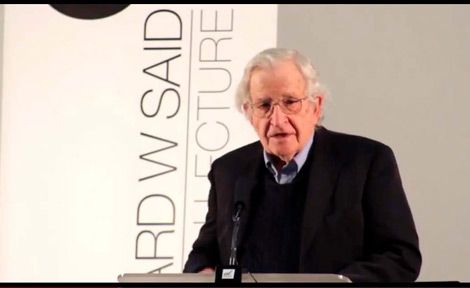
Noam Chomsky delivering the 2013 Edward Said Memorial Lecture

Edward Said died ten years ago in September, and earlier this month Noam Chomsky delivered the 2013 Edward Said Memorial Lecture in London: Violence and dignity: reflections on the Middle East.  The text that formed the basis for the lecture is here, and you can watch a video of the lecture here with introductions by Omar Al Qattan and Mariam Said.

It’s a wide-ranging lecture, but Chomsky returns again and again to the plight of the people of Gaza – and to the disgraceful actions of all those (inside Israel and out) who would rob them of their dignity, their independence and even their life.

Throughout these years Gaza has been a showcase for violence of every imaginable kind. The record includes such sadistic and carefully planned atrocities as Operation Cast Lead — “infanticide,” as it was called by the remarkable Norwegian physician Mads Gilbert who worked tirelessly at Gaza’s al-Shifa hospital with his dedicated Palestinian and Norwegian colleagues right through the criminal assault — a fair term, considering the hundreds of children massacred. And from there the violence ranges through just about every kind of cruelty that humans have used their higher mental faculties to devise, up to the pain of exile that Edward Said wrote about so eloquently. This is particularly stark in Gaza, where older people can still look across the border towards the homes a few miles away from which they were driven — or could if they were able to approach the border without being killed. One form of punishment has been to close off the Gaza side of the border area, including almost half the arable land, according to the leading academic scholar of Gaza, Harvard’s Sara Roy.

While a showcase for the human capacity for violence, Gaza is also an inspiring exemplar of the demand for dignity. The first phrase one hears in Gaza when asking about personal aspirations is for a life of dignity. The distinguished human rights lawyer Raji Sourani writes from his Gaza home that “What has to be kept in mind is that the occupation and the absolute closure is an ongoing attack on the human dignity of the people in Gaza in particular and all Palestinians generally. It is systematic degradation, humiliation, isolation and fragmentation of the Palestinian people.” While the bombs were once again raining down on defenseless civilians in Gaza last November he repeated that “We demand justice and accountability. We dream of a normal life, in freedom and dignity.”

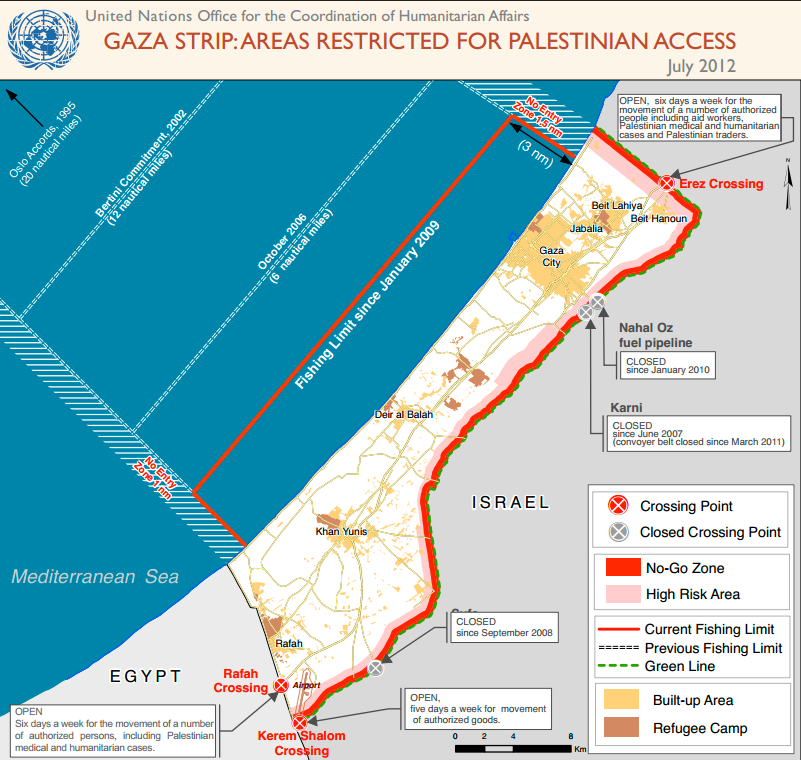
Gaza Strip restrictions

Last fall the brilliant Sara Roy gave another Said Memorial Lecture, this time at the Palestine Center in Washington DC, A deliberate cruelty: rendering Gaza unviable.  She spoke of Edward’s commitment to Gaza and its people:

Edward and I would always speak about Gaza, in fact every time we met. He felt a profound connection to the place and to the people that seemed to be a permanent part of him. Edward had great compassion and great respect for Gaza’s people. He embraced their suffering and took pride in their courage, in the dignified way they continued to move forward. Yet he feared one thing perhaps most of all: the separation and isolation that now engulfs Gaza and threatens, if it hasn’t already, to sever the Palestinians there from Palestinians elsewhere, forcing them, in the words of Hannah Arendt, to “live outside the common world,” deprived of profession and of citizenship, “without a deed by which to identify or specify [themselves].”

Edward raged against the division of his people and against the kind of loss that such division could bring: disunity, abandonment, irrelevance. In The Origins of Totalitarianism, Arendt argues that the fundamental deprivation of human rights is expressed first and most powerfully in “the deprivation of a place in the world which makes opinions significant and actions effective. Something much more fundamental than freedom and justice… is at stake when belonging to the community into which one is born is no longer a matter of course and not belonging no longer a matter of choice…” “This extremity and nothing else,” she writes, “is the situation of people deprived of human rights. They are deprived not of the right to freedom but of the right to action.” “Over the last 45 years Gaza’s trajectory has been striking; from a territory economically integrated into, and deeply dependent upon, Israel and deeply tied to the West Bank, to an area largely marginalized from Israel and the West Bank, an isolated (and disposable) enclave – subject to consistent military attacks – with which Israel and the West Bank have fewer formal economic or political ties than they once did. And from a captive economy restricted to fluctuating levels of growth (at best) but still possessed of the capacity to produce and innovate (within limitations), to an economy increasingly deprived of that capacity, characterized by unprecedented levels of unemployment and impoverishment, with three-quarters of its population needing humanitarian assistance. These damaging transformations among others I shall discuss are becoming increasingly institutionalized and permanent, shaping a future that is both partial and disfigured. What is happening to Gaza is, in my view, catastrophic; it is also deliberate, considered and purposeful.

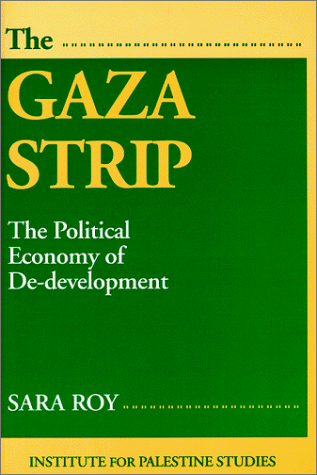
ROY Gaza StripHer lecture is spell-binding –though I hope that once and for all it breaks the spell of Israel’s ‘withdrawal’ from Gaza.  The map above comes from a UN report, Gaza in 2020: a liveable place? that is summarised here, and the text and a video of Sara’s lecture are available here and here.  The text will form part of Sara’s introduction to a new edition of The Gaza Strip: the Political Economy of De-development.

Marc Ellis provides a wonderful summary of and meditation on Sara’s passionately analytical lecture at Mondoweiss here, and you can access Sara’s A Land Diminished: reflections on Gaza’s landscape (2011) here (it also appears as a chapter in an important collection from the Ibrahim Abu-Lughod Institute of International Studies at Birzeit University, Gaza, Palestine: Out of the margins, which is available here).

The metal falcon

As public attention to military violence continues to contract to the use of drones, Rawan Yaghi supplements her previous account of living and dying under Israeli drones in Gaza with another despatch describing Israel’s use of conventional strike aircraft, Life under the F-16s in Gaza:

With F16s, it’s a scary roar like someone is mocking sounds in a water well. It also depends on the altitude of the plane, sometimes a high pitched roar, others a low distant one. F16s are harder to spot than drones or Apaches because they are always ahead of their roar. And since you never know where the plane is going and since buildings in Gaza are crammed into Gaza, you rarely get to see the metal falcon.

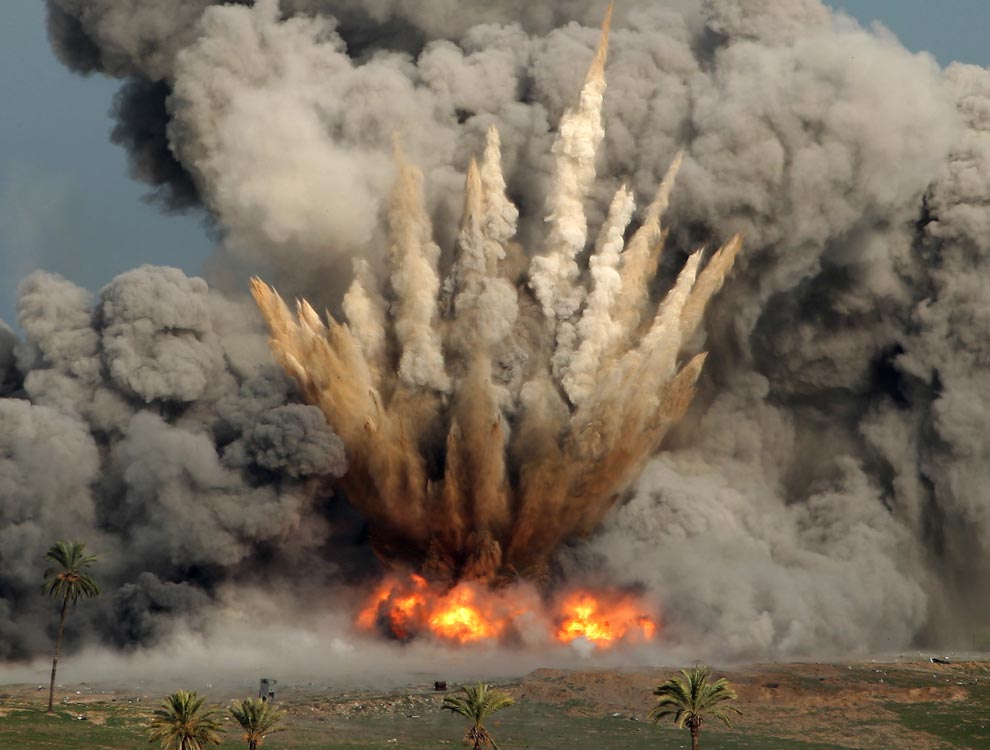
F-16 bombing Beit Hanoun, Gaza, January 2009 (Patrick Baz/AFP/Getty Images)

F-16 bombing Beit Hanoun, Gaza, January 2009 (Patrick Baz/AFP/Getty Images)

She describes the intimidating ‘mock raids’, the physical and psychological damage, and the scars that will never heal:

‘I was fourteen when the AbuSelmeyyas’ house was attacked by an F16 air strike. My body shivers as I write this. The attack killed the father and mother and seven of their children, Nasrallah 4, Aya 7, Yahya 9, Eman 12, Huda 14 who was my classmate in primary school and who had the most angelic voice I’ve ever heard, Sumayya 16, and Basma 17, leaving Awad, 19 at that time, injured and alone.  Fourteen  others were injured in that attack, since the house was located in a heavily populated neighborhood, not very far from where I live. The attack attempted to assassinate leaders of militant groups. However it failed. In October last year, The Israeli court in Jaffa refused to give any compensations to the relatives of the family and the only member if the family left, saying the house was targeted during a “combat operation”. I wasn’t allowed to see any news about the attack. I only heard some news about it. And I learned about Huda in the morning. I heard from my brother that day that the bomb was directly dropped on the room where the mother and the children were. I also heard about their body parts being found in the buildings next to their house. I was only fourteen. What did I know.

What I do know – what we all surely know – is that there is more to military violence than drones; that our attention ought not to be limited to the ‘rules’ (un)governing their operation; and that the dismal desire to wage wars outside declared war-zones neither started nor ended with George W. Bush.

Gaza in Ruins

An important post from Craig Jones about the capacity of the creative arts to respond to and even dislocate military violence that chimes beautifully with my previous post about War/Photography, and leads me into a notice of a research seminar at King’s College London (K2.29, Strand) at 6 p.m. on 5 February 2013:

‘i have come to everyday armageddon’: Spectacular and Slow Ruin in Gaza
Anna Bernard

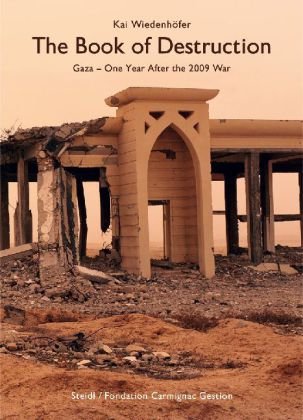
WIEDENHOFER Book of destructionThe Israeli military’s 22-day attack on Gaza in the winter of 2008-9 provoked international condemnation to a degree that the region’s daily deprivation since 2007 under Israeli and Egyptian blockade had not. After the assault, images of the ruins of Gaza – its collapsed buildings, its disabled and impoverished residents – circulated widely. Beyond recording the immediate destruction caused by the attacks, however, these representations also sought to convey a different kind of ruin: the ‘slow violence’ (Nixon 2011) of Gaza’s humanitarian crisis. Anna Bernard will explore some of the visual and narrative attempts since 2009 to draw attention to the full scale of Gaza’s devastation, including photography by Kai Wiedenhöfer and poetry by Suheir Hammad. [The title is taken from Suheir Hammad’s poem GAZA, and the video shows Wiedenhöfer’s exhibition at the Musée d’Art Moderne in Paris in 2010].

Anna Bernard works on literary and cultural representations of Israel/Palestine in international contexts. She is the author of Rhetorics of Belonging: Nation, Narration and Israel/Palestine, forthcoming from Liverpool University Press.

Ruins in Gaza – Reality and Representations
Ahmed Masoud

While the Gaza Strip is often associated with images of ruins and destruction as a result of the continuous Israeli bombardment, the rubble of destroyed buildings has also become closely associated with the national cause. In 2009, a young artist living in Jabalia Camp turned her bombed house into an installation of a tank. Her message was that holding on to living spaces was as powerful as any military machinery.

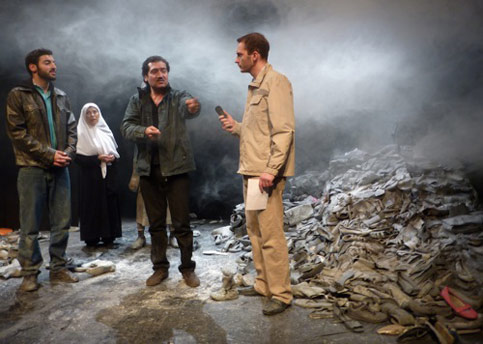
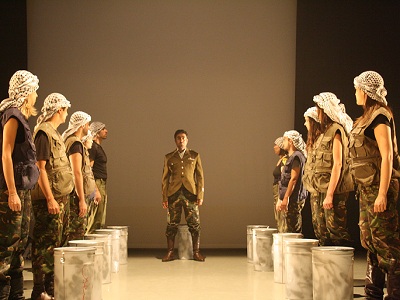
Go to Gaza drink the seaAhmed Masoud will discuss the representation of ruins in his plays Go to Gaza, Drink the Sea (2009) and Unto the Breach (2012). Working with various set designers, Ahmed chose to represent rubble using different materials. In Go to Gaza, Drink the Sea (left) destruction was represented through a mountain constructed out of thousands of old shoes, while the set of Unto the Breach compiled a collage of ripped clothes, palates, paint pails and other broken and recyclable materials. Both sets represent the hardships, but also the resourcefulness, of ordinary people living under siege. They also reflect the process of making the set and shows with a very limited budget.

Unto the breachAhmed Masoud is a Palestinian academic, writer and director. In 2005, he founded the Al Zaytouna Dance and Theatre Company. With Justin Butcher he co-wrote and directed the successful play Go to Gaza, Drink the Sea (2009), staged in London and at the Edinburgh Fringe Festival, and the BBC Radio 4 Play Escape from Gaza (January 2011). Ahmed also won the Muslim Writers Awards (sponsored by Penguin Books) in the unpublished novel category for his book Gaza Days. His latest show Unto the Breach (right) [a dance adaptation of Shakespeare’s Henry V] was performed at the Artsdepot Theatre in November 2012 and received critical acclaim.

***

All of this has prompted me to start serious work on a project I’ve had buzzing around my head for months now – a performance-work on bombing, past and present, using video, testimony, music, above all drama (and perhaps even dance).  The spur is partly my continuing frustration at conventional academic forms, partly admiration for my good friend Gerry Pratt‘s stunning drama-work Nanay (which has been performed in Vancouver and Berlin), now reinforced by Photog., and above all a desire to work on a collaborative project designed to engage the widest possible public.  Watch this space…

Just looking (and shooting)

I had just finished jotting my update to the IDF’s use of social media when Alex Vasudevan drew my attention to this brilliant, searing and deeply disturbing essay by Huw Lemmey at the New Inquiry, ‘Devastation in Meatspace’:

The missile rushing over your head was processed through an Instagram filter just hours previously. As you see it pass out of sight behind the apartment block opposite some young conscript is preparing for video footage of it to be compressed and uploaded to YouTube before the hour is out. By nightfall tonight that explosion which just shook your neighborhood, in one of the most densely populated areas on earth, will have been liked over 8,000 times on Facebook. Welcome to Gaza City.

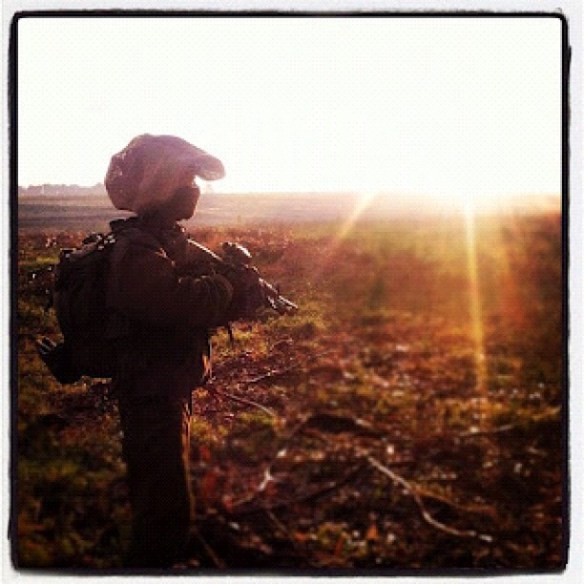
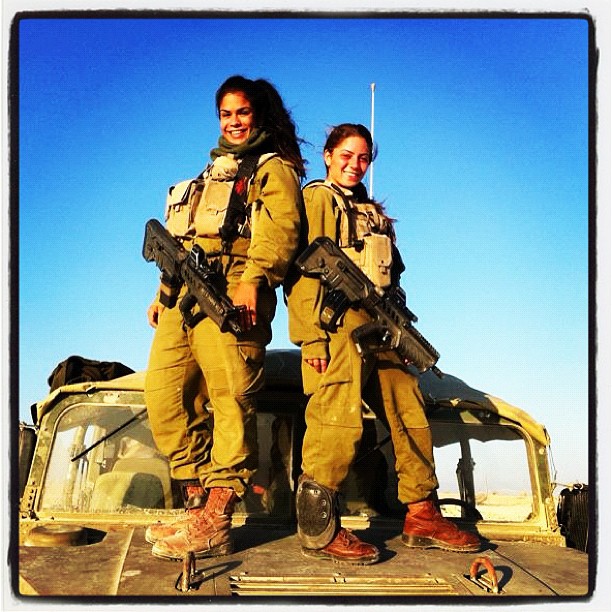
In a previous post I’d objected to the way in which some commentators advertised social media as a new way to ‘consume’ war, but  – riffing off Eyal Weizmann‘s Hollow Land –  Lemmey focuses not on the Twitter streams but on the visualizations disseminated across these digital platforms: see, for example, the IDF’s Instagram page here (and look at the comments too); more here.  You can also find a selection over at Business Insider where Geoffrey Ingersoll describes them as ‘gorgeous’, and another selection at Moral Low Ground, which reads them rather differently.

Commenting on these images, Britney Fitzgerald at the Huffington Post simply sees them as ‘the world’s newest form of war reporting” – though she does note that the ‘intimacies’ that Israel puts on display through Instagram are radically different from those with the hashtags #gaza and #palestine – but Lemmey (who describes himself as a print maker and studio technician) provides a much more compelling reading.  He shows that the IDF images do indeed resonate with a consumerist ideology – climactic versions of the desiring gaze and the lust of the eye – that has become integral to the way in which late modern war is fought:

‘[T]he [IDF] use of commercially available instagram filters replicates the visual culture favoured by much of its audience, producing images that slip easily into their feeds, naturalising the content. “These are the photos you would take if you served in the IDF,” the aesthetic says, “we are just like you, and these military decisions are the ones you would take, if you were in our situation.” They also step beyond this, including an aspirational aspect of a desirable lifestyle — impossibly handsome young troops, having fun on their downtime. This is a fighting force at play as imagined by Wolfgang Tillmans and BUTT magazine, a million miles from an occupying force…. Liking and sharing IDF visual material becomes no more controversial than sharing your favourite Nike campaign — not a matter of politics, let alone ethics, but just another part of the construction of your online persona….’

‘Like many of the more advanced lifestyle brands, the IDF are shifting the focus of image production from their own staff and creative team toward their consumers: in this case, the troops, reservists, and supporters of the IDF. Content is aggregated from individuals and fed back into the social networks of the target audience. In many ways this is an advanced form of brand-management for a such a large institution; it shows a willingness to trust the audience, allowing them to define the brand, making IDFgram perhaps the first crowdsourced propaganda campaign for a state military but also one whose identity is ever more meshed with that of its troops and supporters, emulating fashion and lifestyle brands’ movement toward consumer-led campaigns. Here the IDF becomes the avatar of a thoroughly Western consumer identity. The distance between our own lives and those of the men and women who fight in the IDF becomes ever shorter and more compressed; in collapsing this distance, the grainy and pixelated images of the Palestinian subject become more distant. This is the IDF campaign for control of the virtual environment, interjecting its brand identity into the slivers of human interaction online and thus attempting to occupy a greater portion of the market share for geopolitical allegiance.’

Lemmey says much, much more than this: please read the whole essay.

BTW: IDF stands for ‘Israel Defense Forces’, so naturally none of this should be confused with IDF Marketing, where ‘IDF stands for Innovative, Digital, Foundations’: it’s an Irish company with no connection with the Israeli military.  In case you’re now thoroughly confused, here is Arwa Mahdawi on the marketing of Israel:

Ever since it officially came into existence in 1948, Israel has gone methodically about the creation of a “Brand Israel”. This originally began with an emphasis of the religious significance of a state for the Jewish people. Then, in 2005, when it was time for a rebrand, the Israeli government consulted with American marketing executives to develop a positioning that would appeal to a new generation: an Israel that was “relevant and modern” rather than a place of “fighting and religion”. So Israel did some pinkwashing, and suddenly became a vocal champion of gay rights. It fought to retain cultural ownership of falafel, hummus, and Kafka. It poured millions of dollars into tourism campaigns that sought to replace imagery of wartorn landscapes with sun-kissed seascapes.

When it comes to winning modern wars, a robust marketing campaign is as important as a military campaign.

Saving Face(book)

An update to my post on the use of social media in Israel’s latest assault on Gaza: at the Middle East Research and Information Project (MERIP) Rebecca Stein provides an important historical perspective on the IDF’s mobilisation of these digital platforms and the resistance from senior commanders to resorting to a ‘digital vernacular’:

Even as the IDF labors to speak in a language that will be intelligible to the general public, largely abandoning traditional forms of military jargon, its Facebook and Twitter practices remain committed to the foremost military mission — that of asserting control over social media’s highly interactive field.

Rebecca also draws attention to the ways in which these military mobilisations complicate the ‘digital democracy’ narrative that emerged in the wake of the Arab uprisings.

I talked about this briefly in my essay on Tahrir Square, where I noted that it was not only the Israeli military that was learning from those events.  As Lt Col Brian Pettit put it, ‘the Arab Spring has profound implications for the US Special Operations mission of unconventional warfare’ that need to be incorporated into ‘theory, doctrine and training’.  He argued that standard ‘red force tracking’ in which the enemy is caught in a net of electronic surveillance should now be complemented by ‘social tracking’ in which social media are monitored and even enlisted.  The standard image of unconventional war, the same officer concludes, is of ‘underground resistance leaders meeting with US advisers, clustered in a dark basement around a crumpled map, secretly organizing and planning their next tactical move.’  But this is now incomplete, and future operations will need to enlist ‘a scattered network of digerati, all texting, tweeting, posting and hacking from thousands of locations.  Publicity is as paramount to the success of the digerati as is secrecy vital to the success of the traditional underground resistance cell.’  As I noted at the time, it’s not difficult to work out ‘which ‘resistance leaders’ were likely to be meeting with US advisers, nor the bodily consequences for those on the other side of the street.

But using social media is only one part of military strategy.  Writing in Joint Forces Quarterly early in 2011, Lt Col Thomas Mayfield had already accepted that ‘aggressive engagement in the social media environment can aid the commander in winning the information fight’  – bizzarely he pointed to the IDF’s ham-fisted use of social media during its previous assault on Gaza in 2008-9 – but his first priority was to monitor the use of social media to enhance ‘situational awareness’.  For a Canadian/NATO perspective on media monitoring, here is Bruce Forrester from Defence R&D Canada at Valcartier on ‘Social Media Exploitation Tools’ after the Arab uprisings.

If this is all too depressing for you, then try Richard Poplak who provides a different take on the IDF’s most recent attempts to use Facebook to save face…