Drones and atomic bombs

I’ve had my head down these past few weeks writing the long-form version of ‘Little Boys and Blue Skies’ (see here and here for preliminary notes), and en route I’ve been doing some more digging into the entanglements between nuclear weapons and drones.  And, as you’ll see, I ended up in Korea.

Until now I’ve focused on the US Air Force‘s use of B-17 drones flown by remote control from ground stations and accompanying director aircraft to sample the atomic clouds produced by tests at Bikini Atoll in the Marshall Islands from 1946, and its Project Brass Ring in the early 1950s designed to convert a B-47 Stratojet into a similarly remotely operated carrier capable of delivering the next generation of thermonuclear (hydrogen) bombs.

But the US Navy was no bystander.

In fact, the first series of postwar atomic tests, Operation Crossroads in July 1946, was an attempt by the Navy to move centre stage after Hiroshima and Nagasaki – when the Air Force had played the leading role – and to establish that sea power was still relevant in the atomic age.  The target for the bombs was a fleet of 95 ships (ironically readied at Pearl Harbor) and now anchored in the Bikini lagoon. But critics inside and outside Congress doubted the value of the tests: the bombs would be of the same type as ‘Fat Man’, dropped over Nagasaki, so no development in weapons technology was involved, and in any event surface ships were unlikely to be the targets of such devastating weapons.   They dismissed Crossroads as an expensive, purely theatrical extravaganza. And certainly, despite the remote location, 4,000 miles from San Francisco, every effort was made to attract international attention, both public and professional; the official record trumpeted that ‘never before had a nation fanfared its most secret weapon so closely before the eyes of the world’ [the official ‘pictorial record’ is here].

As far as the Air Force was concerned, however, Crossroads would be ‘a laboratory test’ not a ‘bomb-versus-battleship stunt’ [Sidney Shalett, ‘Atomic bomb test no “stunt” to AAF’, New York Times, 21 February 1946].  It would involve not only bomb delivery by one of its bombers but also cloud monitoring by drones.   ‘Almost as dramatic as the flight of the B-29 bomber’, General W.E. Kepner told reporters, ‘will be the plunge of the unpiloted but mothered drone planes into the sky-reaching, irradiated cloud.’  ‘Where men cannot go,’ he added, ‘the drone will take electronic and other recording instruments.’  Vice-Admiral William Blaney told reporters that ‘robot aircraft will dive into the atomic blast to gather scientific data’ and ‘uncover facts of radioactive phenomena as well as supply data on blast effects on airborne aircraft.’

As I noted in my earlier post, both the Air Force and the Navy supplied the drones.
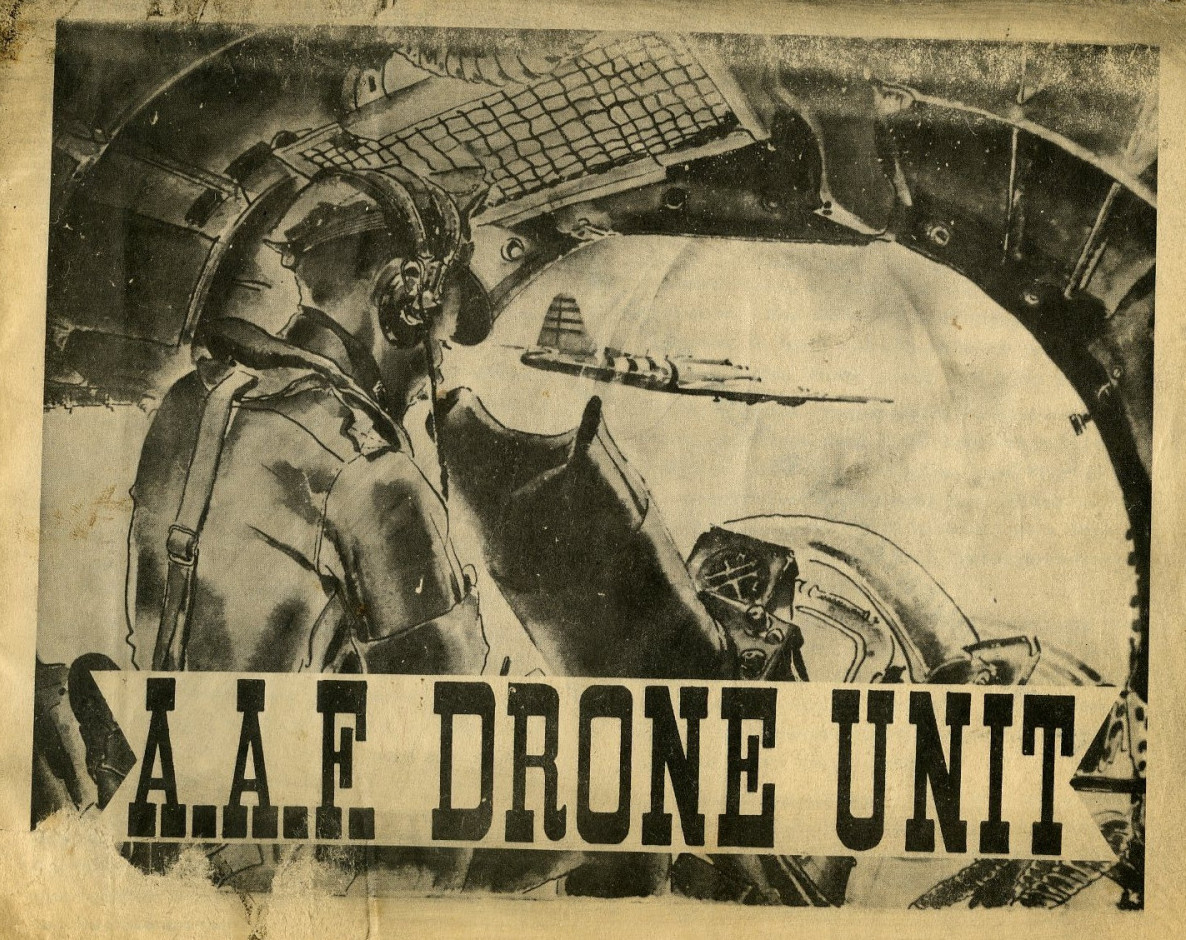
For its part, the Air Force retained its love affair with the heavy bombers that had driven its ill-fated Project Aphrodite in the dog days of the war, in which war-weary B-17 Flying Fortresses were filled with high explosives and flown from an accompanying director aircraft into enemy targets in Occupied Europe. This time its Drones Unit utilised new B-17s: four were converted into drones operated by radio-control from four others flying at a safe distance, while one acted as the master control aircraft.  The drones were stripped of all their defensive armaments and fitted with radio and television equipment; air filters were fixed to their top turrets to trap particles from the cloud and collection bags installed in their bomb bays.  Ground controllers launched the drones from control jeeps and then handed off to the airborne controllers (‘beeper pilots’) on board the accompanying B-17s who directed the aircraft into the cloud before returning them to the ground controllers who managed the landing.

But the Navy had experimented with its smaller, carrier-based aircraft during the war too.  Its Project Option had used TDR-1 drones loaded with 500-2000 lb bombs with nose-mounted TV cameras controlled from the back seat of an Avenger Torpedo bomber.
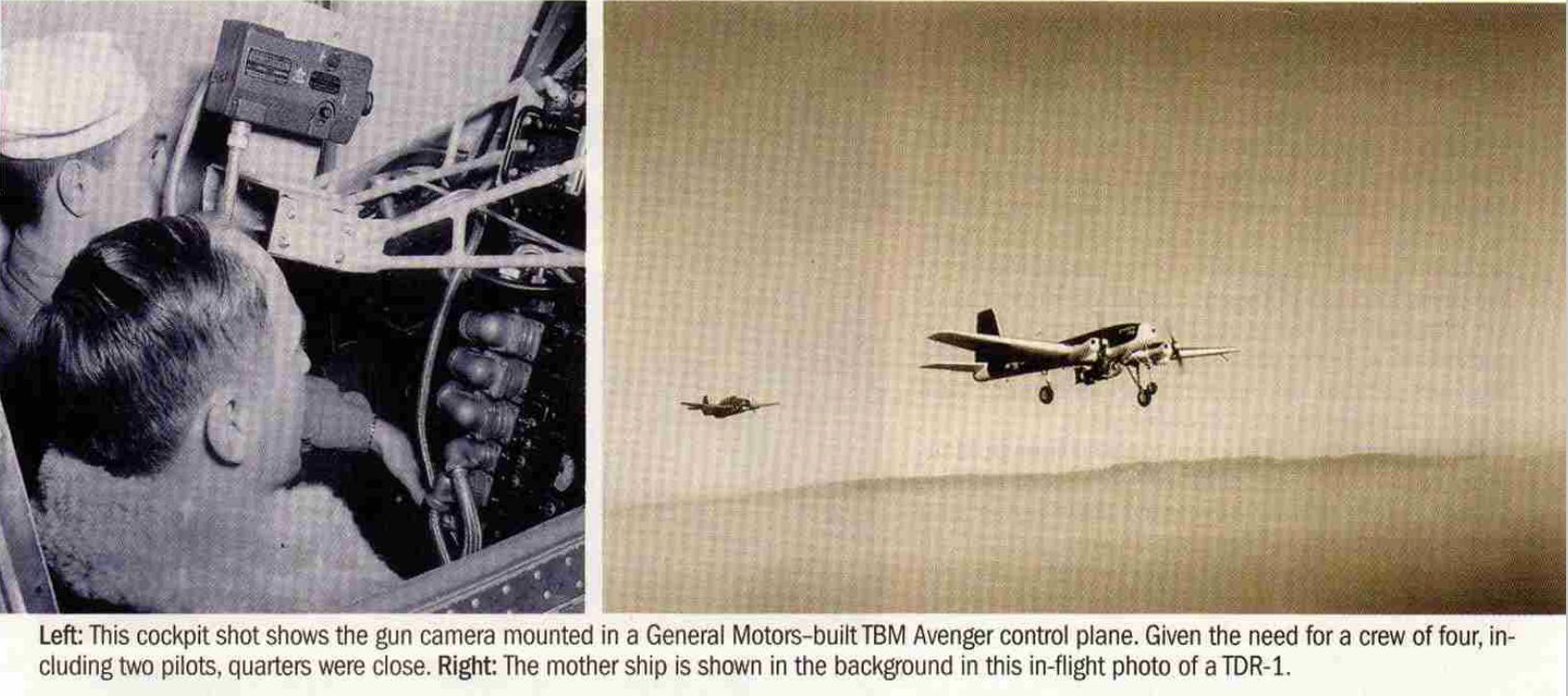
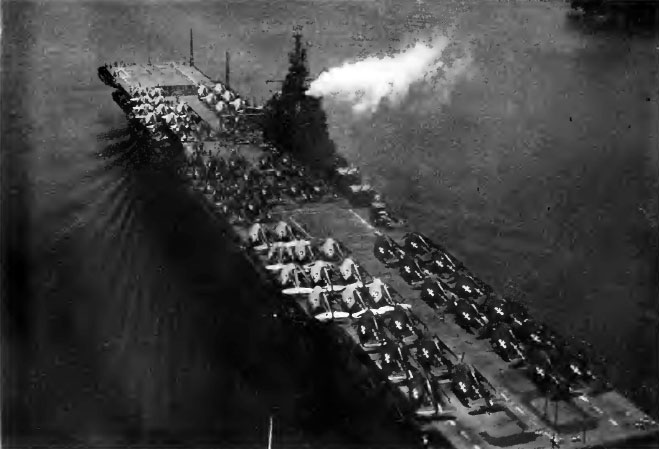
As it happens, one of the first missions of the Special Task Air Group (STAG-1) had been to deploy its drones in support of a US assault on the Marshall Islands, but the Marines landed long before the planned invasion date; the Group was then tasked with attacking targets of opportunity throughout the Solomon Islands.  In a single month, between 27 September and 26 October 1944, STAG-1 launched 46 drones, of which 29 successfully destroyed their targets.  This was a short-lived project in another sense.  As with Aphrodite, these were all in effect kamikaze missions in which the unoccupied aircraft plunged into its targets and exploded:  James Hall provides a pilot’s view in his American Kamikaze, and you can find an exquisite analysis of the project in the second chapter of Katherine Chandler‘s thesis, Drone flight and failure: the United States’ secret trials, experiments and operations in unmanning, 1936-1973.  For Crossroads, less than two years later, the Navy used carrier-based Grumman F6F-5 Hellcat fighter aircraft as drones and as control aircraft, mustering 30 drones and 26 control aircraft (below, the USS Shangri-La en route to Bikini with the drones on the flight deck).
The first shot in the series, codenamed Able, took place on 1 July 1946. At 0900 Dave’s Dream dropped the bomb over the target fleet, but the result was not the thrilling spectacle that had been advertised [below: Able shot from Enyu Island].  Visually it was a damp squib.  Judged by its own Broadway razzamatazz, one reporter jibed, it was a complete flop: ‘Operation Chloroform, the logical sequel to Operation Build-Up and Handout.’

Scientifically it was not much better.  Although Vice-Admiral Blaney initially declared that the bomb was dropped ‘with very good accuracy’, in fact it detonated off-target, exploding over one of the instrumentation vessels and compromising the readings from many others.  Even most of the high-speed cameras missed the shot. One critic concluded that ‘from the standpoint of pure science no test was ever more haphazard’ [more in Jonathan Weisgall, Operation Crossroads: the atomic tests at Bikini Atoll (1994) and Keith Parsons and Robert Zabella, Bombing the Marshall islands:a Cold War tragedy (2017)].

Against this catalogue of errors, which was glossed over in the official report, the aerial sampling missions were judged a considerable success.

(When the Partial Nuclear Test Ban Treaty put an end to atmospheric testing in 1963 you might think the need for aerial sampling disappeared with the cloud.  But the US still operates two sampling aircraft as the ‘Constant Phoenix’ program that acts as a supplement to the satellite sensor network of the US Atomic Energy Detection System: earlier this year Constant Phoenix flew sampling missions to assess North Korea’s claim to have detonated a hydrogen bomb).

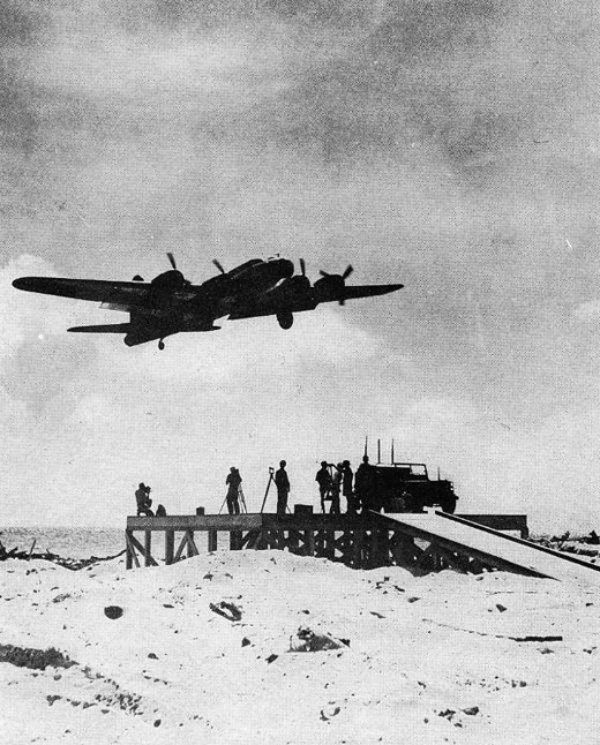
Back to the future.  As soon as the bomb was released over Bikini the first B-17 control aircraft turned its huge drone (Fox) into the cloud at an altitude of 24,000 feet; Fox was then switched to its automatic pilot, entering the cloud eight minutes after the explosion, while the control (or “beeper”) aircraft raced around the cloud and resumed control when the drone emerged on the other side.  Fox was followed by George (at 30,000 feet), How (at 18,000 feet) and Love (at 12,000 feet).  All four drones were directed back to Eniwetok atoll where they were handed back to the ground controllers in jeeps at the end of the runway who taxied them to the radiological safe area where the filters and bags were removed and flown to Los Alamos Laboratory for analysis (below).
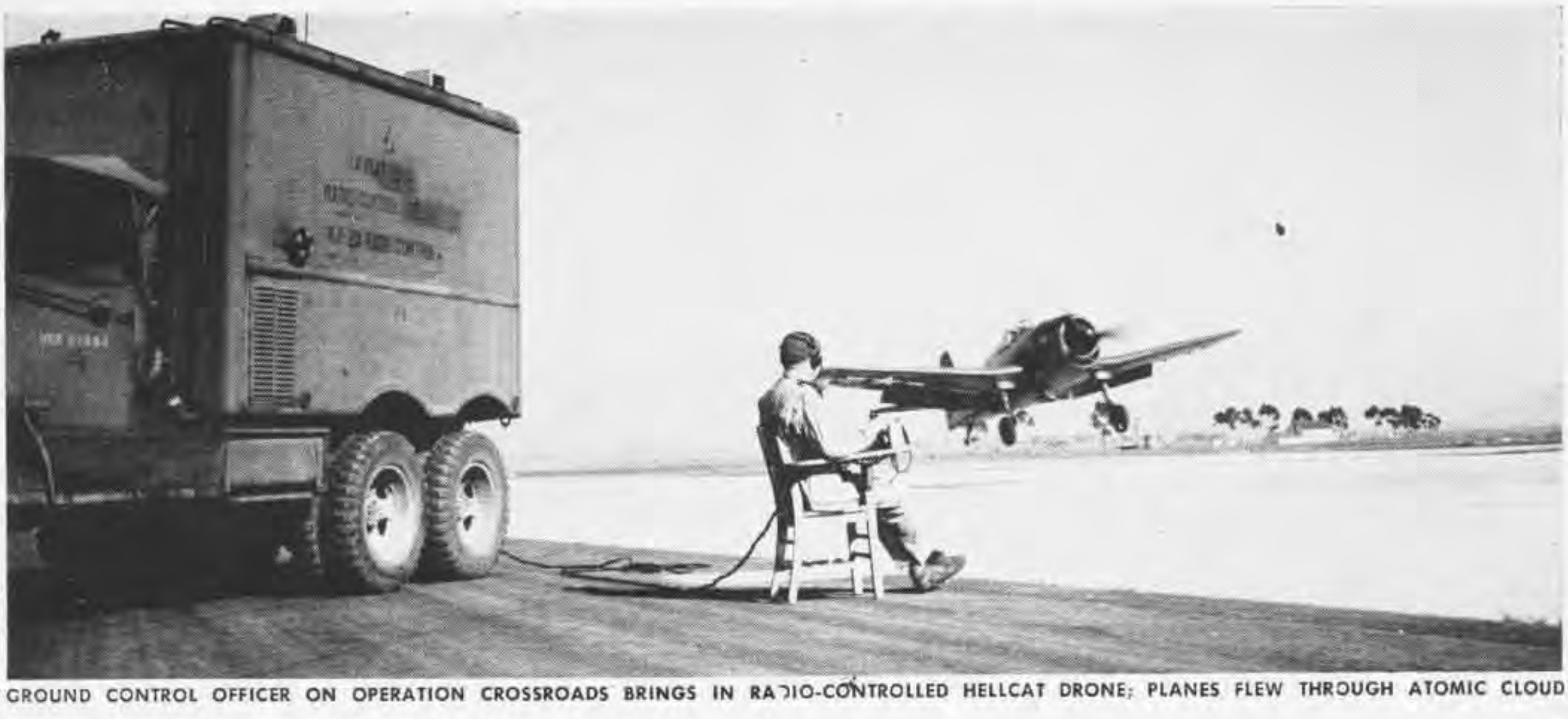
The Navy launched four of its drones from the Shangri-La, but only three of them – Yellow, White and Blue – sampled the cloud at 5,000, 10,000 and 15,000 feet before being directed back to Roi island for a ground landing and sample recovery (below).
The official report emphasised that this was a notable first. ‘At Hiroshima and Nagasaki,’ it declared, ‘a few photographs and pressure measurements were made of the explosions, but almost nothing of value to physicists was learned.’ Crossroads had changed that; ‘for the first time samples had been taken from an atomic cloud’ during what one military engineer hailed as ‘the most hugely instrumented experiment in history’.
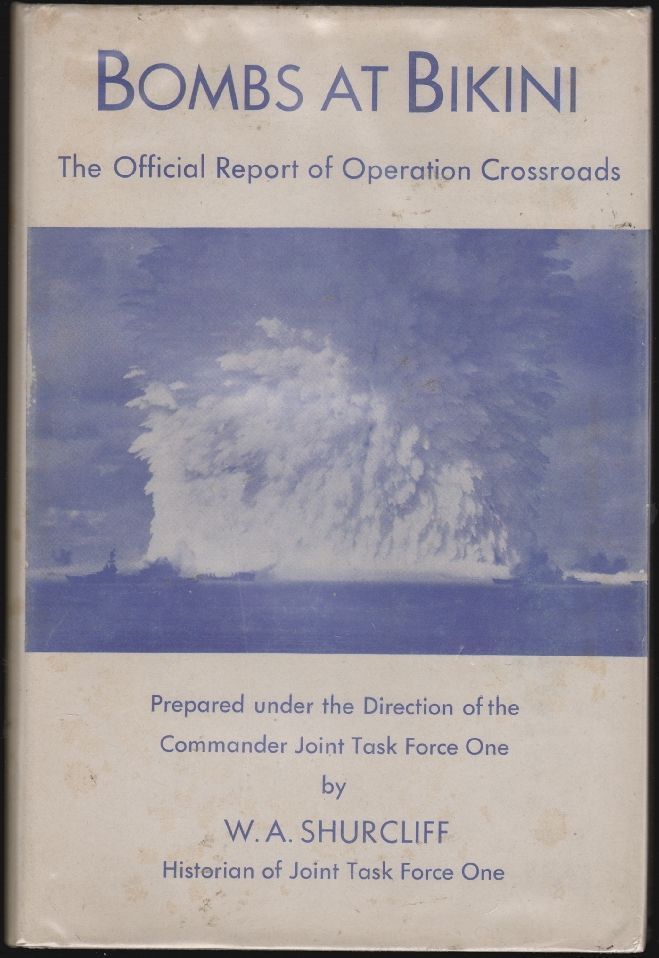
To the Air Force its drones had made crucial contributions not only to the aerial sampling programme but also to the development of remote operations more generally: ‘For the first time, four-motored drone aircraft had been flown without a safety pilot aboard.’  The author of the official report was equally impressed.  ‘With no one aboard,’ he marvelled, ‘these great planes were radio-guided through their prescribed flights across the target area, a unique and impressive feat.’  In a footnote he continued:

‘A number of Army Air Forces officials believe that the drone-plane program undertaken for Crossroads advanced the science of drone-plane operations by a year or more… Operation Crossroads was the first operation in which take-off, flight, and landing were accomplished with no one aboard.  The feat was an impressive one; many experts had thought it could never be accomplished with planes of this size.’

These were the experiments that captured the imagination of  Hanson Baldwin, a military affairs correspondent for the New York Times and Life magazine.  He had already predicted that ‘robot planes, rockets, television and radar bombing and atomic bombs will do the work today done by fleets of thousands of piloted bombers.’  Now he saw the future materialising in front of him.  ‘Today,’ he wrote in the New York Times for 25 August 1946, ‘planes without crews can be flown from almost anywhere, and can even survive… the atomic cloud.’  At Bikini the drones were controlled over a distance of eight miles or less, but Baldwin had been told that remote control up to fifty and perhaps even 100 miles was possible.  These were what today would be called line-of-sight operations, so their range was limited and Baldwin stressed that ‘an unmanned drone cannot be sent careening into a target in Europe by an operator standing at his “beep box” on La Guardia field in New York’.   But he was also adamant that a threshold had been crossed:

‘In the Pacific so much experience in the handling of drones was accumulated during the summer and the operations were so far in advance of drone operations during the war that it is safe to say that a simplified and reliable system of drone control – with all that implies – has been achieved…. Drones thus add a new and dangerous instrument to the growing armory of Mars, increase the power of the offensive and further complicate the tasks of the defensive’ [Hanson W. Baldwin, ‘The “Drone”: portent of a push-button war’, New York Times, 25 August 1946].

He was right, and the lines of descent from these post-war experiments to today’s remote operations by the US Air Force reveal continuing entanglements with nuclear weapons.

The official report of Crossroads makes no mention of the implications for remote operations of the smaller Navy drones.  Yet the Navy retained an interest in their development, and here too the connections with weapons of mass destruction are more than marginalia.
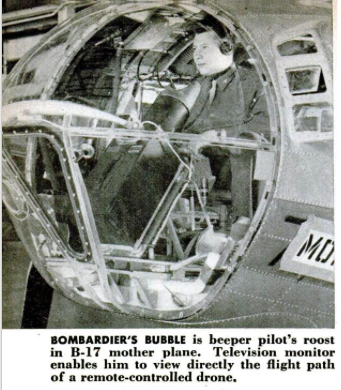
In April 1952 Herbert Johansen, an associate editor for Popular Mechanics, was invited to observe a flight of four F6F-5K Hellcats – though ‘they could just as well be our fastest jets’ – converted to drone operations at the Navy’s Pilotless Aircraft Laboratory and controlled from a single aircraft off the Atlantic coast.  Although the caption to a photograph noted that ‘Big Fellows’ – the Air Force’s Flying Fortresses – ‘can also be radio-controlled’ (see right), it was the smaller drones that got this reporter’s attention.

The Navy was ‘tight-lipped’ about its plans for the Hellcat drones, but Johansen had no difficulty imagining a future in which they would ‘carry atomic warheads and crash-dive as projectiles of destruction’ [‘No Live Operator Aboard’, Popular Mechanics 160 (4) (1952)].

Perhaps this was Johansen’s own, wild conjecture; perhaps not.  Bruce Cumings has shown that Washington had contemplated the use of nuclear weapons ‘from the first days of the Korean war’.  General MacArthur had requested atomic bombs to support ground operations as early as July 1950; in November President Truman, in response to a reporter’s question, insisted that their use was on the table, and Strategic Air Command was told that aircraft despatched to the Pacific theatre (based on Guam and Okinawa) should have ‘atomic capabilities’.  Cumings argues that ‘the US came closest to using nuclear weapons’ in April 1951, when the Pentagon prepared for immediate ‘atomic retaliation’ against any Chinese or Russian escalation; nine Mark IV bombs were transferred to the Air Force, and the President authorised their use against North Korean and Chinese targets.  But these were enormous bombs destined for the Air Force’s B-29s – each weighed 11,000 lbs and was far beyond the capacity of the Navy’s Hellcats (though not its AJ-1 bombers) – and they were never used.  Still, the Pentagon continued to consider the nuclear option, and in September and October 1951 flights of B-29s carried out simulated runs over the North, dropping dummy atomic bombs to assess their utility as battlefield weapons [see Bruce Cumings, ‘On the strategy and morality of American policy in Korea, 1950 to the present’, Social Science Japan Journal 1 (1) (1998) 57-70; see also here; Daniel Calingaert, ‘Nuclear weapons and the Korean War’, Journal of strategic studies 11 (2) (1988) 177-202; and here).

One year later the same bleak prospect as Johansen’s was conjured up by a naval officer much closer to the conflict, who was overseeing an experimental flight of Navy drones against targets in North Korea. Between 28 August and 2 September six Hellcat drones on the carrier USS Boxer were loaded with 2000 lb bombs and, with TV pods slung under their wings, yoked to director aircraft – AD-2Q Skyraiders this time – whose pilots used TV screens to guide what were now described as ‘robot missiles’ on to their targets.

The test roared on to the front pages.  An American correspondent cabled a vivid description of what he called ‘one of the most dramatic and historical events of the Korean War’:

‘We watched a guided missile roar off a catapult, climb north-westward in a sweeping turn and head for a dangerous flak-ridden communist target in North Korea more than 150 miles away.

‘As the doomed craft streaked towards its target, grim-faced electronic experts, in a secret room on this ship, rode with the missile, mile by mile, through wondrous electronic instruments.  On their dials in the secret room, the experts crossed the Sea of Japan and watched the jagged peaks of Eastern Korea loom in the distance and grow larger.  Far from the missile, an automatic device transmitted every dying moment of the missile’s last hour to the USS Boxer.

‘The target – an enemy concentration in a valley between two shadowy hills – was indicated on the receiving instrument – a real flak-ridden trap for any hapless Allied pilot.

‘A second to go now – the signal of the instruments grew stronger as the guided missile dived straight at the target at hundreds of miles an hour.  Then the instruments went suddenly blank.  The screaming dive had ended squarely on the target and the missile had crashed to oblivion’ [His dispatch was dated 1 September but delayed and censored; it was published in several regional newspapers in the United States and in the Australian press almost three weeks later: ‘United States ready for push-button warfare’, Canberra Times, 19 September 1952].
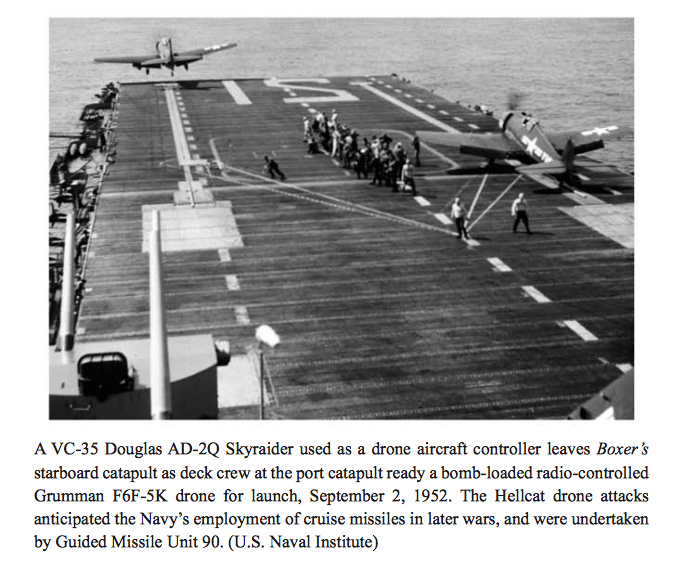
With that blank screen, he continued, those on board the Boxer knew that ‘here at last in actual combat, was a new era of battle’, when ‘electronic brains will ride in tough, dangerous places, saving the lives of American pilots.’  Or, as one observing officer marvelled, ‘It’s a nice way to fight a war’ [More from Jeremy Hsu, ‘When US Navy suicide drones went to war’, here].

Although observers were ‘amazed at the drone’s sensitive response to remote control’ and the TV screen supposedly ‘enabled the controlling officer to keep the drone “on the target” until the last second, giving the missile unbelievable accuracy’, only one of the six hit its target [‘Navy uses robot missiles against targets in Korea’, New York Times, 18 September 1952].  The others recorded near-misses, but this was enough for Lt-Cdr Lawrence Kurtz, the (less than tight-lipped) commander of Guided Missile Unit 90 responsible for the trial, to boast that the United States had enough of them to ‘launch and sustain a large-scale robot campaign’.  And he then added this ominous rider: some of the ‘missile planes’ were ‘capable of carrying an atomic bomb from one continent to another’ [ ‘United States ready for push-button warfare’; ‘Guided missiles in Korean War: Deadly new US technique’, Sydney Morning Herald, 19 September 1952].

Agency reports of his comments were played down in the United States, where they evidently incurred the wrath of his superiors. Rear Admiral John Sides described the use of the Hellcat drones as an ‘interim measure’ before the development of ‘more effective guided missiles’, conceding that ‘it wouldn’t take much imagination to realize that there are better ways of doing this job.’  But he would give no further details: the Navy was ‘investigating the use of classified information in news dispatches on the employment of pilotless bombers in Korea’, but refused to elaborate [‘Korea robot raids “interim measure”’, New York Times, 19 September 1952].  Instead, Sides switched the focus from the aircraft to American lives.  The  object of the experimental programme observed by the Popular Mechanics correspondent earlier in the year was ‘to obtain air kills by individuals operating from beyond the range of the enemy’s armament’, he emphasised, and in Korea ‘a controller sitting in relative safety’ outside the range of anti-aircraft defences ‘had been able to direct an effective drop on the enemy positions.’ The previous Times report had already underlined the significance: ‘The planes were sacrificed but, of course, not a man was lost.’

On 22 September NBC broadcast a short Department of Defense film describing what it called the dawn of ‘a new era in warfare’ in Korea but which made no mention of nuclear weapons.  Instead the commentary emphasised that the pilot of the ‘robot bomber’ was ‘safely out of range’ and that these ‘guided missiles’ might ‘someday eliminate the human element’ altogether :

‘The carrier USS Boxer launches guided missiles for the first time in combat, bringing the push-button war of tomorrow into present day reality. Defense Department films show the first mission of the robot bombers, weapons that may someday eliminate the human element from air war.

The robot missile is catapulted aloft. It is a semi-obsolete Hell Cat, carrying a one-ton bomb load and a television camera instead of a pilot.

Already in the air is the mother plane, with an observer who flies the drone by remote control. Side by side, missile and mother plane head for the target. Then the pilot, safely out of range of interception and anti-aircraft fire, guides the robot directly into the target with unerring accuracy.’
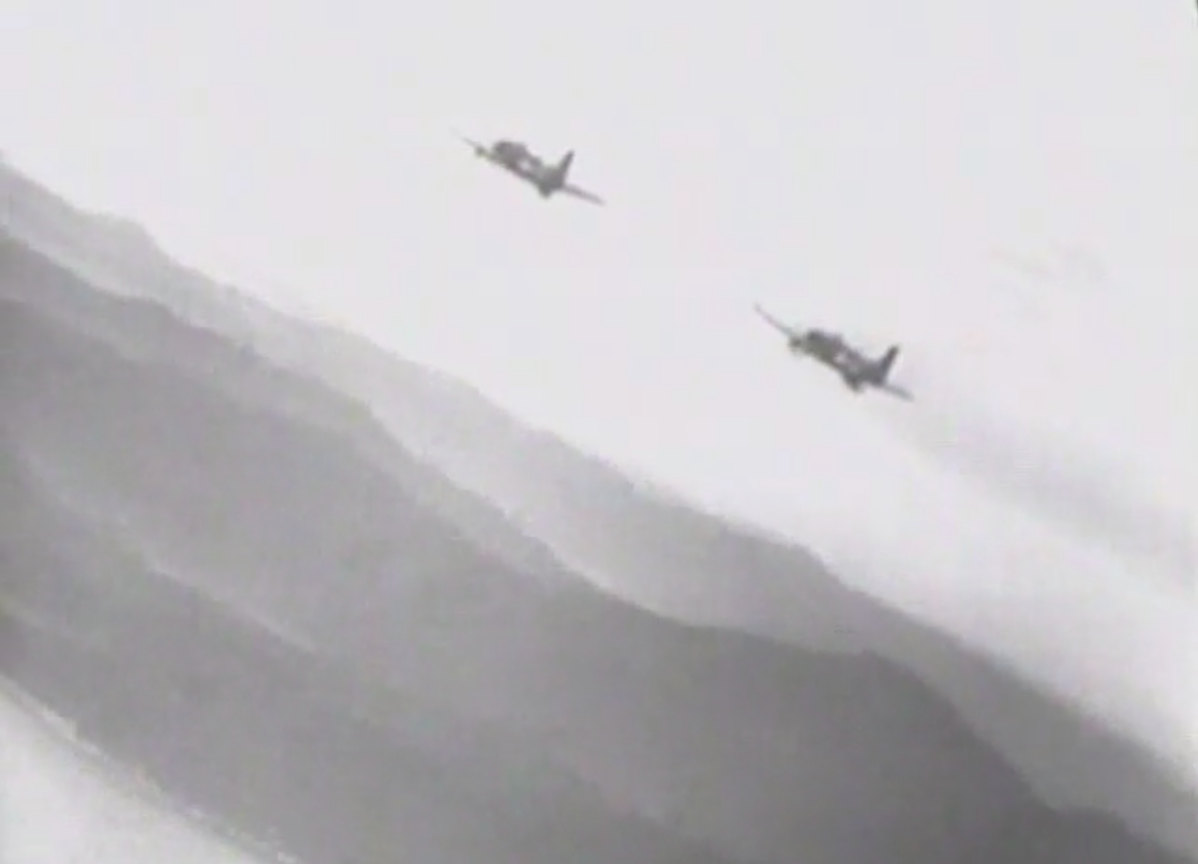
And this was, of course, the larger and sharper point.  The reason drones were originally used to fly through the atomic cloud (though they were later replaced by crewed missions); the reason the Air Force needed a remotely operated aircraft to drop the next generation of nuclear weapons; the reason the Navy wanted ‘offensive drones’ and ‘robot missiles’ to attack heavily defended targets was to save the lives of American crews.  It is the same mission that continues today in the US prosecution of what are its avowedly asymmetric wars: to ‘project power without vulnerability’.

Academics against the arms trade

Yoked to my previous post – and a distant echo of one of my earliest posts on ‘The death merchants‘ – is an important message from the editors of Critical Military Studies:

Dear academic friends and colleagues,

As many of you will know, from September 12th-15th the DSEI [Defence and Security Equipment International] arms fair will take place at the ExCeL Centre in East London. DSEI is one of the largest arms fairs in the world, with over 1500 companies and representatives from more than 100 states. As you can imagine, it also generates a lot of opposition. The Stop the Arms Fair coalition have called for a week of action before the arms fair begins, and as part of this we’re organising an academic conference, on Friday 8th September, that will take place in front of the ExCeL Centre. The conference will cover a series of issues related to militarism, with a series of talks, workshops and performances co-organised by activists and academics. Topics for workshops include:

–    Militarism and (gendered) embodiment
–    Recognising and resisting border militarism within universities
–    Militarism and contemporary colonialism
–    The purpose of radical theory

The team behind the workshop did this two years ago when the arms fair last happened, and the event was a huge success, providing participants with the opportunity to meet new people, have some wonderful conversations about the nature of militarism and the purpose of academic practice, and put academic ideas into action in an exciting and unusual manner. You can read a write-up of that event by Chris Rossdale in Critical Military Studies. There is a website for this year’s event here and Facebook event. Updates and logistics information will be available on both of those, but you can also get in touch with Chris Rossdale at C.Rossdale@lse.ac.uk if you want more details.

If you can’t make the conference (and even if you can), we are also currently circulating an open letter for academics to sign, signalling opposition to the arms fair. This will be published in a media outlet around a week before the action. We would be very grateful if you could sign it and circulate it to people and networks you think might be interested. You can find the letter here.

You can find more details (wherein the devil lurks) at DSEI’s website here, including this gem:

‘DSEI Strategic Conferences take place on 11 September (Day Zero) … 2017 brings Brexit and a change of US government, this combined with a competitive global defence & security market means DSEI can promise a conference and seminar programme that will challenge day to day thinking. Both events will tap into the ideas and theories of the people who drive the defence and security sector forward in pursuit of innovation and long-term economic prosperity…’

In case you’re wondering, admission is now £1,150 for ‘Industry/Academia’ but a snip at £150 for students….

Becoming Weapon

News from the brilliant Nisha Shah that her paper, ‘Gunning for war: infantry rifles and the calibration of lethal force’, is just out in a themed issue of Critical Studies on Security [(5 ( 2017] on ‘Becoming Weapon’:

Infantry rifles are responsible for the majority of war-related deaths. This paper describes how and why they became ‘standard-issue’ military equipment. Examining testing reports, field surgery observations and bullet specifications, I develop a theory of instrumentality through which a specific way of killing in war- fare becomes legitimate and manifest in infantry rifles. Rather than pre-given objects that are made acceptable through an evaluation of their uses and consequences, I show that weapons become possible through an ontology that calibrates how killing in war occurs, technologically and ethically. More generally, this paper expands the study of weaponry and war by uncovering the material and moral specifications that not only design but also crucially define what counts as a weapon. Clearly stated are when and against whom the line between life and death can be drawn. This paper, by contrast, uncovers the conditions that generate how and with what that line can be legitimately crossed.

In their helpful introduction, the guest editors – Antoine Bousquet, Jairus Grove and Nisha Shah – explain:

No human artefact is intrinsically a weapon, be it a sword, an explosive or a chemical agent. Conversely, a passenger airplane, a shard of broken glass or a trained dog can perfectly well serve as a vector of bodily harm or lethality. An arrangement of things becomes a weapon through relational changes in intensity and context such that its motive force, density, potential energy or mechanical capability comes to make events of death and dismemberment. And beyond the immediate occasion of a weapon’s terrible work lies a wider network of relations that condition its emergence and support its operation. Systematically pursued, the tracing of such a network will draw out dependencies that extend far beyond the immediate requirements of its material production or the political economy of its acquisition and circulation, revealing the long tail of weaponisation that runs through our contemporary societies…

By placing particular emphasis on the making or becoming of weapons, we can begin to displace the fascination with the technical performance of destruction and instead query how weapons come to destroy in the first place. In so doing, we hope to break the deadlock between techno-fetishism and normative-polemical rejections of weapons, which together function as obstacles to a greater understanding of the significance of weapons in the making of worlds of violence and war.

It’s an excellent issue, including a paper from the equally wonderful Kate Hall (Kindervater).  Here are those other contributions:

More terror from the skies

IS drone imagery Syria

Commentators have been worrying away at the likelihood of terrorist groups turning to small commercial drones not only for surveillance – IS have been doing that for some time now (see the image above) – but also for air strikes (see, for a recent example, Robert J Bunker‘s report for the US Army War College here).  The surveillance capabilities of quadcopters have been used to direct attacks by IS ground forces, including vehicles carrying suicide bombs, but the Pentagon now reports that the drones have also been equipped with improvised explosive devices (IEDs).

In response, the Pentagon has asked for $20 million for its Joint Improvised-Threat Defeat Agency to develop counter-measures: to ‘identify, acquire, integrate and conduct testing’ of methods that are able to ‘counter the effects of unmanned aerial systems and the threats they pose to U.S. forces.’

Perhaps they should also look closer to home.  Two men in Connecticut have contested the right of the Federal Aviation Administration to investigate their use of ‘recreational drones’ equipped with a handgun and a flamethrower.  Here’s a video clip:

And other commentators are already looking beyond war zones: systems like these enable groups like IS – and individuals – to carry the fight far beyond the territory they control and into the heart of cities in North America, Europe and elsewhere.

In continent

160311024028-drone-warfare-film-eye-in-the-sky-sesay-pkg-00001425-super-169

Over at the LA Review of Books Will Govinsky has a fine essay on Eye in the Sky called ‘The beauty of an imperial dilemma‘.  It begins with the image of a French gunboat firing shots into the African rainforest from Joseph Conrad‘s Heart of Darkness:

The ship’s absurdly one-sided battle becomes, for Marlow, an emblem of pointless, indiscriminate imperial violence: “[T]here she was, incomprehensible, firing into a continent.”

Will’s point is about the parallel between the anonymity of imperial violence in the African rainforest and the anonymity of the US (un)targeted killing program:

The chilling anonymity of this “targeted” drone program’s victims, crossed with the sanguine official line, again recalls Conrad’s French warship. “There was a touch of insanity in the proceeding,” Marlow says, which “was not dissipated by somebody on board assuring me earnestly there was a camp of natives ­— he called them enemies! — hidden out of sight somewhere.”

Conrad’s critique of European imperial violence moves with notorious swiftness from the opacity of the victim to the opacity at the heart of the colonizer. Marlow does not know who exactly are the victims of the French warship’s shells, but Conrad’s racism, as Chinua Achebe famously argued, precludes his narrator from caring that much. Marlow’s concern is not for the mangled bodies on the receiving end of colonial violence, but for the deplorable madness at the heart of the imperialist himself.

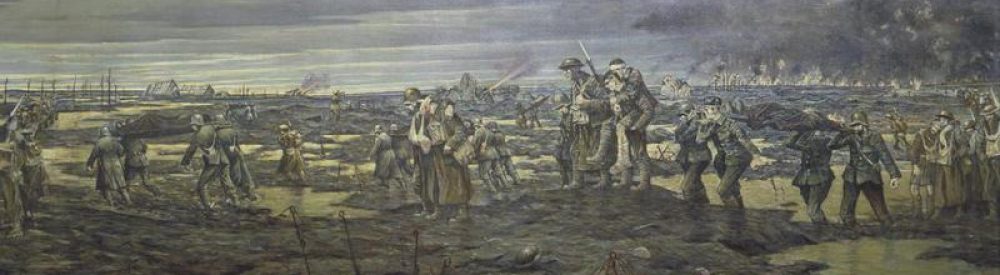
As I’ve described elsewhere, the genealogy can be traced across multiple theatres.  Here, for example, is Arnold Bennett on the Western Front:

Of the target I am absolutely ignorant.001

And here is Frederic Downs describing a US artillery bombardment in Vietnam – Francis Ford Coppola‘s setting for Heart of Darkness – in terms which loop back directly to Will’s (Conrad’s) point about anonymity, impersonality and the madness of it all:

The coordinates for that location and the time for firing would be relayed to the gun crews. At the specified time, the gun crews would be awakened. Perhaps it would be just after midnight. As the minutes ticked closer to a time set by an unknown intelligence the men would load the artillery pieces, anticipating the release of their impersonal death into a grid square. The gun commander would give the order to fire and the night would explode with man’s lightning and thunder. After the prescribed rounds, the guns would cease, the cleanup would begin, and the men would go back to their bunks. Thinking what? Within the range of those guns, within a specified area, the Central Highlands had for a brief moment changed from the jungle it had been for thousands of years into the particular insanity of man.

artillery

In these two cases, clearly, the gunners were firing blind – but what lay behind their guns was a stream of co-ordinates.

This raises two issues that bear directly on the use of today’s remote platforms.

The first is about the ethics of killing at a distance which, as Will notes, also has a (far longer) genealogy.  He cites Chateaubriand‘s question – ‘If, merely by wishing it, you could kill a man in China and inherit his fortune in Europe, being assured by supernatural means that the deed would remain forever unknown, would you allow yourself to form that project?’ – and explains that ‘killing the mandarin’ became shorthand in French for committing ‘an evil action in the hope that it will remain unknown.’

But the US targeted killing program is hardly unknown, and my own preference – which turns out to be closely related to tuer le mandarin – is to turn to Denis Diderot:

Diderot.001

The intimate connection between distance and blindness can be read again and again in accounts of bombing during the Second World War, most directly here:

Distance and blindess.001

But again, what lay behind ‘the distance and the blindness’ was a stream of intelligence.

Recognising the importance of those intelligence streams – and conceding that ‘crunching petabytes of metadata just wouldn’t make for good cinema’ – Will’s key point (and the second issue) is that in its representation of a drone strike in East Africa Eye in the Sky artfully reverses Conrad’s trope:

It asks what we would do if we knew everything. In a taut 102 minutes, the film condenses the ambiguities of drone warfare into a balance sheet of nigh certainties.

eye-in-the-sky

In a fine passage, he suggests the film offers the fantasy

of perfect, visual knowledge — a platform for the terrible beauty of a globe-girdling ethical dilemma. Poised, confident, her silver hair luminescent in the metallic grey-blue glow of her theater-like command center, [Helen] Mirren’s Col. Powell gathers up in her steely 10,000-mile stare the awful knowledge of her options.

But – as I argued in my own commentary on Eye in the Sky – this is indeed a fantasy.  The video feeds from remote platforms do not render the battle space transparent, and the make-believe that they do, Will concludes, renders the film ‘less a representation of drone warfare than a grotesque abstraction of it.’  Hence his brilliantly sobering conclusion:

We need plots that provide the narrative space to ask questions: whether the very terms of our dilemmas are spurious; whether firing into continents, day in and day out, can be anyone’s prerogative, let alone ours.

War crimes

Kunduz MSF report cover JPEG

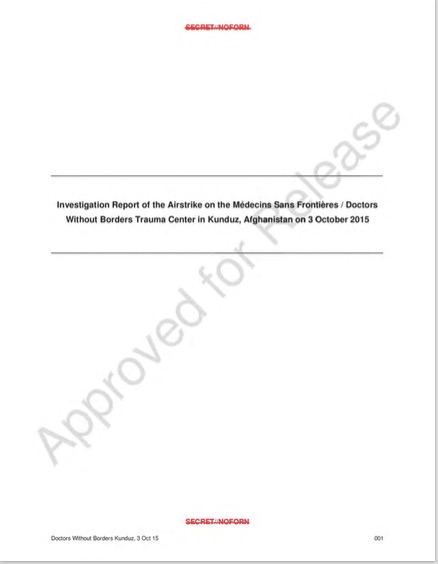
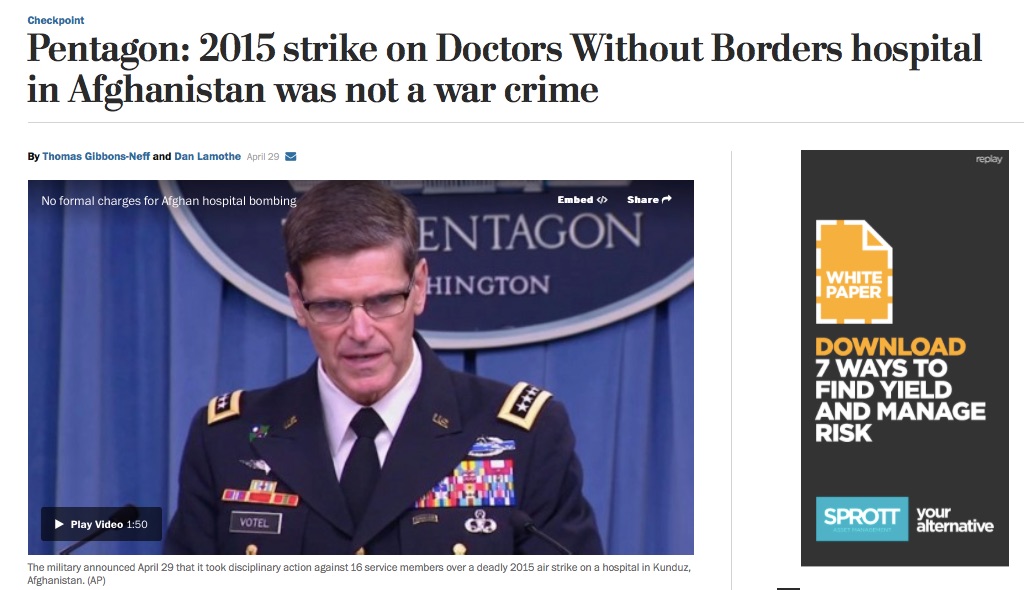
In my preliminary commentary on the US military investigation into the air strike on MSF’s trauma centre in Kunduz in October 2015 – and I’ll have much more to say about that shortly – I circled around the Pentagon’s conclusion that even though those involved in the incident had clearly violated international humanitarian law (‘the laws of war’) and the Rules of Engagement no war crimes had been committed.

That conclusion has sparked a fire-storm of protest and commentary, and to track the narrative I’ve transferred some of my closing comments from that post to this and continued to follow the debate.  (It’s worth noting that when the Pentagon published its updated Law of War Manual last year it produced an equally heated reaction – much of it from commentators who complained that its provisions hamstrung commanders and troops in the field: see here and scroll down).

Not a war crime 3 JPEG

At Just Security Sarah Knuckey and two of her students complained that the report provided no justification for such a claim. After listing the gross violations of IHL (failure to take precautions in an attack, failure to distinguish between civilians and combatants, failure to respect the requirement of proportionality), they concluded:

While it is legally correct to state that the war crime of murder requires an “intent” to kill a protected person (e.g., a civilian), nowhere in the 120-page report is there an analysis of the legal meaning of “intention.” The report actually makes no specific or direct findings about war crimes. (“War crime” appears only once, in reference to a report by the United Nations Assistance Mission in Afghanistan) [Here I should note that UNAMA’s view of what constitutes a war crime has on occasion changed with the perpetrator.  As this commentary shows, the Taliban have sometimes been held to a higher standard than the US military: in one case UNAMA suggested that the very use of high explosives in an urban area ‘in circumstances almost certain to cause immense suffering to civilians’ rendered the Taliban guilty of war crimes, whereas after the Kunduz air strike UNAMA declared that ‘should an attack against a hospital be found to have been deliberate, it may amount to a war crime’ (emphasis added)] .

Under international law, “premeditation” is not necessary for the war crime of murder, but the precise scope of intention is less clear. Numerous cases have stated that genuine mistakes and negligence are insufficient for murder. But a number of international cases and UN-mandated inquiries have found that “recklessness” or “indirect intent” could satisfy the intent requirement. Article 85 of Additional Protocol I also provides that intent encompasses recklessness. (See The 1949 Geneva Conventions: A Commentary, from page 449, for a full discussion.)

The investigation released today makes clear that US forces committed numerous violations of fundamental rules of the laws of war, violations which should and could have been avoided. Yet the report provides zero direct analysis of whether these violations amounted to war crimes. Given the seriousness of the violations committed, the US should specifically explain why the facts do not amount to recklessness, and explain the legal tests applied for the commission of war crimes.

Not a war crime 1 JPEG

Over at Lawfare, Ryan Vogel argues that the report will ‘will surely attract the attention of the International Criminal Court’s (ICC) Office of the Prosecutor (OTP)’. In fact, while the OTP has acknowledged

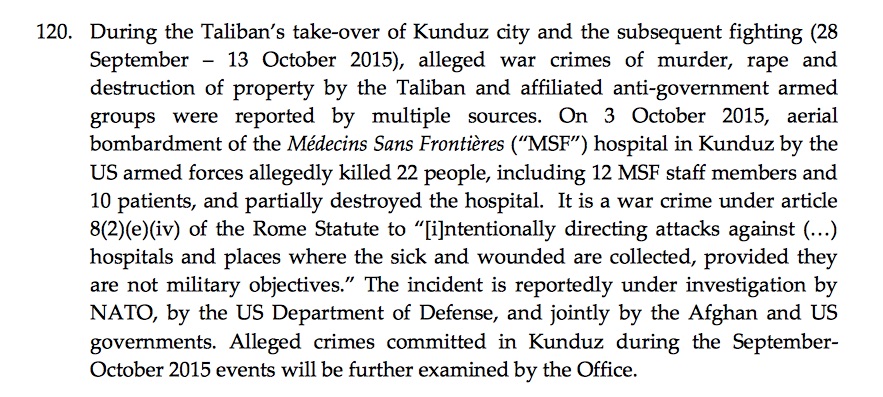
that the strike was being investigated by the United States [it has also] declared that “the [a]lleged crimes committed in Kunduz [would] be further examined by the Office” as part of the ongoing preliminary examination [see extract below]. By characterizing the incident as a violation of international law (and choosing not to prosecute), the United States may unwittingly be strengthening the OTP’s case. It is true that CENTCOM’s release statement makes clear that the investigation found that the actions of U.S. personnel did not constitute war crimes, noting the absence of intentionality. But the OTP might disagree with CENTCOM’s legal rationale, as it seems to have done previously with regard to detention operations, and decide to investigate these acts anyway as potential war crimes.

ICC 2015 JPEG

As both commentaries make clear, much hangs on the interpretation of ‘intentionality’.  At Opinio Juris the ever-sharp Jens David Ohlin weighs in on the question.  Drawing from his essay on ‘Targeting and the concept of intent‘, he notes:

The word “intentionally” does not have a stable meaning across all legal cultures. … [It] is generally understood in common law countries as equivalent to purpose or knowledge, depending on the circumstances. But some criminal lawyers trained in civil law jurisdictions are more likely than their common law counterparts to give the phrase “intentionally” a much wider definition, one that includes not just purpose and knowledge but also recklessness or what civilian lawyers sometimes call dolus eventualis.

He concludes that the consequences of the latter, wider interpretation would be far reaching:

If intent = recklessness, then all cases of legitimate collateral damage would count as violations of the principle of distinction, because in collateral damage cases the attacker kills the civilians with knowledge that the civilians will die. And the rule against disproportionate attacks sanctions this behavior as long as the collateral damage is not disproportionate and the attack is aimed at a legitimate military target. But if intent = recklessness, then I see no reason why the attacking force in that situation couldn’t be prosecuted for the war crime of intentionally directing attacks against civilians, without the court ever addressing or analyzing the question of collateral damage. Because clearly a soldier in that hypothetical situation would “know” that the attack will kill civilians, and knowledge is certainly a higher mental state than recklessness. That result would effectively transform all cases of disproportionate collateral damage into violations of the principle of distinction and relieve the prosecutor of the burden of establishing that the damage was indeed disproportionate, which seems absurd to me.

His solution is to call for the codification of  ‘a new war crime of recklessly attacking civilians, and the codification of such a crime should use the word “recklessly” rather than use the word “intentionally.”’  This would then  ‘create a duty on the part of attacking forces and then penalize them for failing to live up to it.’  And this, he concludes, would allow a prima facie case to be made that those involved in the attack on the Kunduz trauma centre were guilty – but in his view, clearly, they also escape under existing law.

Not a war crime 2 JPEG

Note those five, deceptively simple words: ‘those involved in the attack’.  I’ve had occasion to comment on this dilemma before – the dispersal of responsibility that is a characteristic of later modern war (see also here: scroll down) – and Eugene Fiddell, writing in the New York Times, clearly dismayed at the way in which the military inquiry was conducted, sharpens the same point:

Among the challenges a case like Kunduz presents is how to achieve accountability in an era in which an attack on a protected site is not the act of an isolated unit or individual. In today’s high-tech warfare, an attack really involves a weapons system, with only some of the actors in the aircraft, and others — with real power to affect operations — on the ground, in other aircraft, or perhaps even at sea.

And what if some of those ‘actors’ are algorithms and/or machines?

UPDATE:  Kevin Jon Heller offers this counter-reading to Jens’s:

As I read it, the war crime of “intentionally directing attacks against a civilian population” consists of two material elements: a conduct element and a circumstance element. (There is no consequence element, because the civilians do not need to be harmed.) The conduct element is directing an attack against a specific group of people. The circumstance element is the particular group of people qualifying as a civilian population. So that means, if we apply the default mental element provisions in Art. 30, that the war crime is complete when (1) a defendant “means to engage” in an attack against a specific group of people; (2) that specific group of people objectively qualifies as a civilian population; and (3) the defendant “is aware” that the specific group of people qualifies as a civilian population. Thus understood, the war crime requires not one but two mental elements: (1) intent for the prohibited conduct (understood as purpose, direct intent, or dolus directus); (2) knowledge for the necessary circumstance (understood as oblique intent or dolus indirectus).

Does this mean that an attacker who knows his attack on a military objective will incidentally but proportionately harm a group of civilians commits the war crime of “intentionally directing attacks against a civilian population” if he launches the attack? I don’t think so. The problematic element, it seems to me, is not the circumstance element but the conduct element: although the attacker who launches a proportionate attack on a legitimate military objective knows that his attack will harm a civilian population, he is not intentionally attacking that civilian population. The attacker means to attack only the military objective; he does not mean to attack the group of civilians. They are simply incidentally — accidentally — harmed. So although the attacker has the mental element necessary for the circumstance element of the war crime (knowledge that a specific group of people qualifies as a civilian population) he does not have the mental element necessary for its conduct element (intent to attack that specific group of people). He is thus not criminally responsible for either launching a disproportionate attack or intentionally directing attacks against a civilian population.

It’s a sharp reminder that international humanitarian law offers some protections to civilians but still renders their killing acceptable.  The exchange between Kevin and Jens continues below the line to this conclusion:

Opinio Juris JPEG

But if you read Charles Dunlap at Lawfire (sic), you will find him insisting that the mistakes made by the US military in firing on the MSF hospital ‘do not necessarily equate to criminal conduct’ – even though the investigation report concedes that they amounted to violations of international law – and that the charge of recklessness needs to be laid at the smashed-in door of MSF.  Really.  Here is what he says:

Had, for example, the hospital been marked with large Red Crosses/Red Crescents or one of the other internationally-recognized symbols (as the U.S. does) or something that would make its protected use clear from the air, isn’t it entirely plausible that the aircrew (or someone) might have recognized the error and stopped the attack before it began?

There were in fact two large MSF flags on the roof of the Trauma Centre, which was also one of the few buildings in the city on that fateful night to have been fully illuminated (from its own generator).

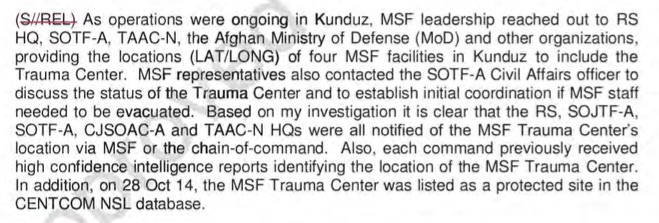
But in case you are still wondering about the responsibility borne by MSF – as ‘one of the few international humanitarian organisations that carries professional liability insurance’ (in contrast to amateur insurance, I presume), Dunlap says that is an admission that ‘even honest, altruistic, and well-intended professionals do make mistakes, even tragic ones, especially when trying to operate in the turmoil of a war zones’,  here is a paragraph from that investigation report:

MSF reach-out JPEG

How reckless was that?  The crew of the gunship that carried out the attack – in case you are still wondering – ‘specifically did not have any charts showing no strike targets or the location of the MSF Trauma Center.’

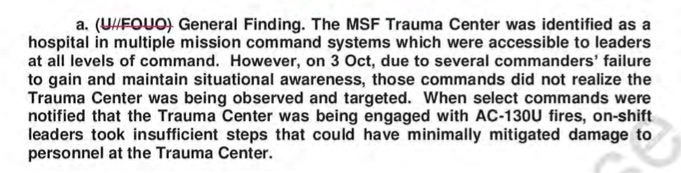
And if you picked up on Dunlap’s suggestion that if not the aircrew then ‘someone’ might have recognised the error, try this for size from the same source (and note especially the last sentence):

Multiple command failures JPEG

More to come.

Playing the military-industrial complex

Michael Davis – not to be confused with the other Mike Davis – has a new game, The Military-Industrial Complex, which may well appeal to readers looking for other ways to delay and procrastinate.  You play the Minister for Civil Industry and War Production.

Military-Industrial Complex

This is how Jack Kotzer described the game:

You sit at a terminal with your face glued to the screens. If you press right, resources go to your defences, developing tech, and weapons. If you press left, resources go to your people, developing stickers, strip-malls, and new “very special episodes” of ALF about drugs to keep them busy all day. When you fund project for the people, Stalintron’s forces get closer to the border. If you fund the war machine, your populace starts itching for a revolution. Every few turns a wild card will appear, forces beyond your power that can temper either anxiety, such as your rival’s failures, a deal with Lord Triton god of the ocean, or the sexiest goddamn Bryan Adams album to date.

“The gameplay is designed in such a way that you can never win,” said Davis in an email to Motherboard. “You can just prolong how long it takes to lose, which is my ham-fisted pinko statement on the actual Military-Industrial Complex.”

As the image shows, it’s also a retro-tribute to the original Mac – available from the App Store.

Seeing ‘Through Post-Atomic Eyes’

All the videos from Through Post-Atomic Eyes last October are now available on YouTube here, including my “Little Boys and Blue Skies: drones through post-atomic eyes. My slide deck is available under the DOWNLOADS tab.

This is the sawn-off 30-minute version; I’ll be giving an extended version when I’m at Dartmouth later this month – and I’m really looking forward to that.

Planetary bombing

NORAD's Santa

You’ve probably read the tinsel-and-glitter story about NORAD tracking Santa Claus on Christmas Eve – like Santa’s sleigh, it goes the rounds every year – but Matt Novak provides an appropriately explosive rendition of it here.

It was a smart move for the military. When American kids asked their parents what NORAD was, the U.S. parents would be able to respond “those are the people who help Santa” rather than “those are the people who are ensuring our second strike capabilities after you and everyone in your play group are turned to dust by a nuclear attack.”

Among other plums in the pudding, Matt pulls out a syndicated story from AP in December 1955, in which the military promised that it would ‘continue to track and guard Santa and his sleigh on his trip to and from the U.S. against possible attack from those who do not believe in Christmas‘ (emphasis added).

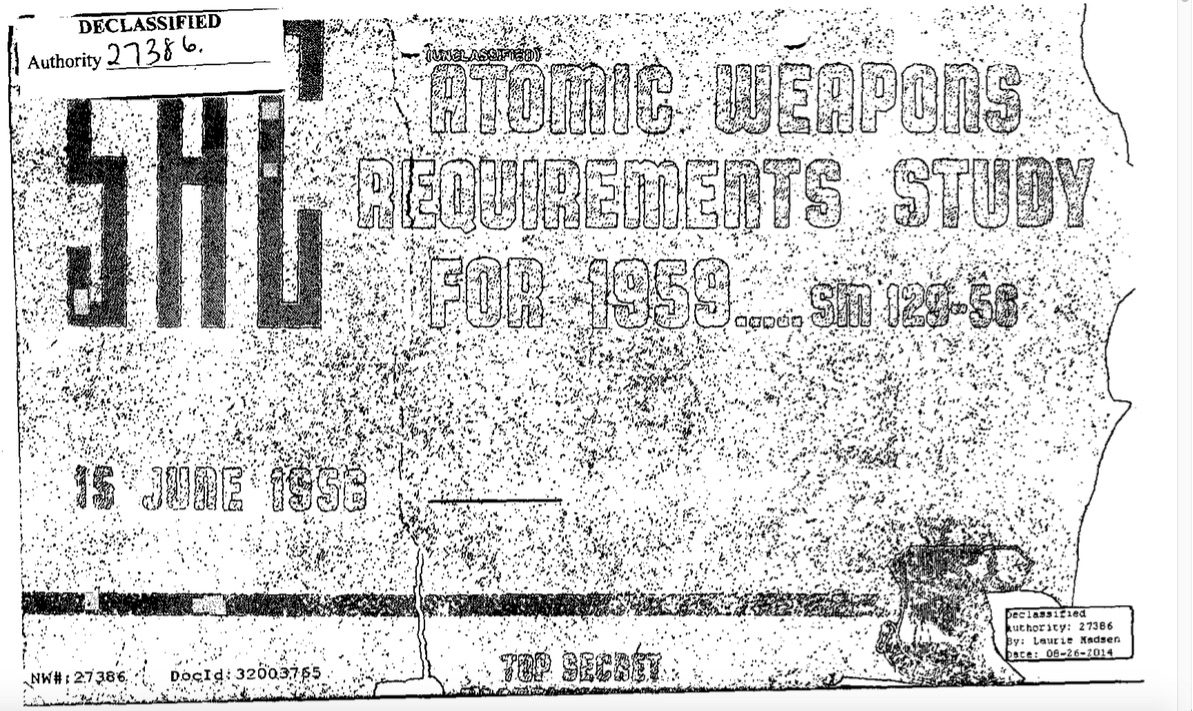
Atomic Weapons Requirements Study for 1959 JPEG

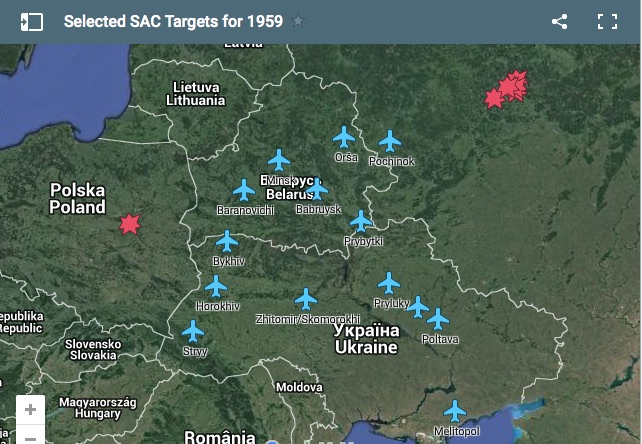
Just before Christmas this year, while NORAD was busy preparing to track Santa’s sleigh again, the National Security Archive at George Washington University released US Strategic Air Command’s Atomic Weapons Requirements Study for 1959, produced the year after that AP story.  The study

‘provides the most comprehensive and detailed list of nuclear targets and target systems that has ever been declassified. As far as can be told, no comparable document has ever been declassified for any period of Cold War history.’

Based on the Bombing Encyclopedia of the World, the Air Force planners proposed

the “systematic destruction” of Soviet bloc urban-industrial targets that specifically and explicitly targeted “population” in all cities, including Beijing, Moscow, Leningrad, East Berlin, and Warsaw. Purposefully targeting civilian populations as such directly conflicted with the international norms of the day, which prohibited attacks on people per se (as opposed to military installations with civilians nearby).

The study ‘listed over 1200 cities in the Soviet bloc, from East Germany to China, also with priorities established. Moscow and Leningrad were priority one and two respectively. Moscow included 179 Designated Ground Zeros (DGZs) while Leningrad had 145, including “population” targets.’  Every target was preceded by an eight-digit code from the Bombing Encyclopedia.

Selected SAC targets 1959 JPEG

William Burr provides an excellent, detailed commentary to accompany the Study here; you can also find more from Joseph Trevithick on this ‘catalog of nuclear death over at War is Boring here.

But all of this is prelude to the real plum in my Christmas pudding, the best paper I’ve read all year: Joseph Masco‘s ‘The Age of Fallout’ in the latest issue of History of the Present [5 (2) (2015) 137-168].

Being able to assume a planetary, as opposed to a global, imaginary is a surprisingly recent phenomenon. Although depictions of an earthly sphere are longstanding and multiple, I would argue that the specific attributes of being able to see the entire planet as a single unit or system is a Cold War creation. This mode of thinking is therefore deeply imbricated not only in nuclear age militarism, but also in specific forms of twentieth-century knowledge production and a related proliferation of visualization technologies.  A planetary imaginary includes globalities of every kind (finance, technology, international relations) – along with geology, atmosphere, glaciers, oceans, and the biosphere – as one totality.

What is increasingly powerful about this point of view is that it both relies on the national security state for the technologies, finances, and interests that create the possibility of seeing in this fashion, but also, in a single gesture, exceeds the nation-state as the political form that matters. A planetary optic is thus a national security creation (in its scientific infrastructures, visualization technologies, and governing ambitions) that transcends these structures to offer an alternative ground for politics and future making. Proliferating forms of globality – including the specific visualizations of science, finance, politics, and environment – each achieve ultimate scale and are unified at the level of the planetary. This achievement ultimately raises an important set of questions about how collective security problems can, and should, be imagined.

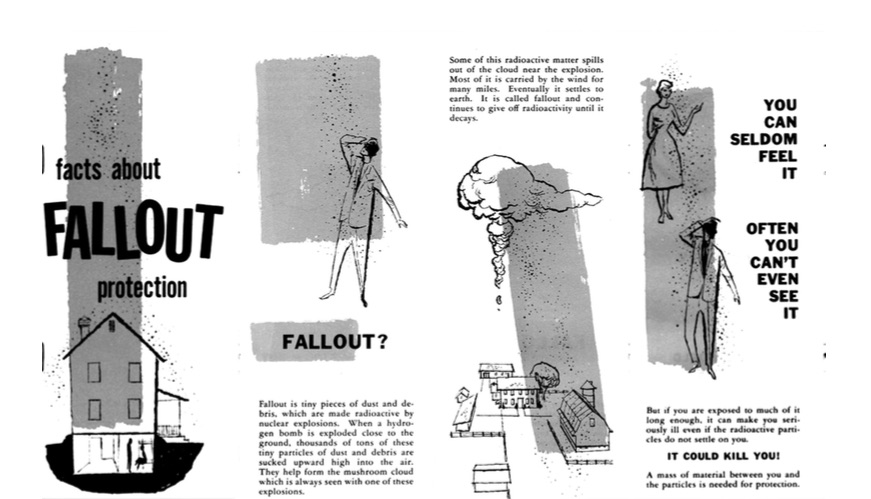
It’s a tour de force which, as these opening paragraphs show, is beautifully written too.  Joe begins with a richly suggestive discussion of the idea of ‘fallout’:

‘Fallout comes after the event; it is the unacknowledged-until-lived crisis that is built into the infrastructure of a system, program, or process. Fallout is therefore understood primarily retrospectively, but it is lived in the future anterior becoming a form of history made visible in negative outcomes.’

Its horizons are as much spatial as they are temporal – though Joe makes the sharp point that radioactive fallout was initially conceived as ‘the bomb’s lesser form’ and that it was the ‘explosive power of the bomb that was fetishized by the US military’ – and that fallout involves ‘individual actions and lived consequences, a post-sociality lived in isolation from the collective action of society or the war machine’ that mutates into what he sees as ‘an increasingly post-Foucaudian kind of governmentality’.

FALLOUT JPEG

When he elaborates the multiple registers in which radioactive fallout appears as an atmospheric toxicity Joe moves far beyond the nostrums of Peter Sloterdijk and others – which, to me anyway, seem to be based on almost wilfully superficial research – and connects it, both substantively and imaginatively, to contemporary critical discussions around global climate change and the Anthropocene.

In a cascade of maps and images, Joe shows how

Space and time are radically reconfigured in these fallout studies, constituting a vision of a collective future that is incrementally changing in unknown ways through cumulative industrial effects. The logics of a national security state (with its linkage of a discrete territory to a specific population) becomes paradoxical in the face of mounting evidence of ecological damage on a collective scale, not from nuclear war itself but rather from nuclear research and development programs. It is important to recognize that while cast as “experiments,” U.S. atmospheric nuclear tests were in reality planetary-scale environmental events.

In short, ‘since 1945 human beings have become post-nuclear creatures, marked with the signatures of nuclear weapons science.’

Towards the end of his essay, Joe says this:

In applying the lessons of the twentieth-century nuclear complex to contemporary geoengineering schemes to manage climate change, we might question 1) the claim to both newness and absolute crisis that installs a state of emergency and suspends normal forms of law and regulation; 2) a process that rhetorically reproduces the split between the event and its fallout so completely; and 3) the suggestion that geoengineering is a novel activity, that it is not an ancient practice with many antecedent examples to think with in assessing our current moment. We might also interrogate how the past fifty years of multidisciplinary work to create detailed visualizations of the planet has installed a dangerous confidence in globality itself, as increasingly high resolution visualizations come to stand in for both objectivity and sovereignty, and thus enable psychosocial feelings of control over vastly complex earth systems that remain, at best, only partially understood.

It’s an immensely provocative, perceptive paragraph; it not only makes me retrace my own wanderings through the nuclear wastelands (see here, here and here) but it also obliges me to rethink what I once called ‘the everywhere war’, to map its contours much more carefully  (the original impulse was simply to provide a counterpoint to those commentators who emphasised war time – ‘the forever war’, ‘permanent war’, ‘never-ending war’ – and who never noticed its spaces), and – particularly with that remark about ‘high resolution visualizations com[ing] to stand in for both objectivity and sovereignty’ in mind – perhaps even to see it as another dimension of Joe’s ‘Age of Fallout’.

“I’ve looked at clouds from both sides now…”

Eyal Weizman‘s stunning Wall Exchange, “Forensic Architecture”, which he presented at the Vogue Theatre in Vancouver earlier this month, is now up on YouTube here and embedded below.

https://www.youtube.com/watch?v=qBDWPn7QcIg

If you are puzzled by my riff on Joni Mitchell, start around 46:10 (though you’ll miss a lot if you do…).

And while we’re on the subject of clouds, you’ll find a remarkable analysis of a different sort of militarized cloud in Tung-Hui Hu‘s A Prehistory of the Cloud from MIT:

We may imagine the digital cloud as placeless, mute, ethereal, and unmediated. Yet the reality of the cloud is embodied in thousands of massive data centers, any one of which can use as much electricity as a midsized town. Even all these data centers are only one small part of the cloud. Behind that cloud-shaped icon on our screens is a whole universe of technologies and cultural norms, all working to keep us from noticing their existence. In this book, Tung-Hui Hu examines the gap between the real and the virtual in our understanding of the cloud.

Hu shows that the cloud grew out of such older networks as railroad tracks, sewer lines, and television circuits. He describes key moments in the prehistory of the cloud, from the game “Spacewar” as exemplar of time-sharing computers to Cold War bunkers that were later reused as data centers. Countering the popular perception of a new “cloudlike” political power that is dispersed and immaterial, Hu argues that the cloud grafts digital technologies onto older ways of exerting power over a population. But because we invest the cloud with cultural fantasies about security and participation, we fail to recognize its militarized origins and ideology. Moving between the materiality of the technology itself and its cultural rhetoric, Hu’s account offers a set of new tools for rethinking the contemporary digital environment.

Prehistory of the Cloud

Here is Lisa Parks on what is surely one of the must-reads of the year:

“Hu’s riveting genealogy of the cloud takes us into its precursors and politics, and boldly demonstrates how fantasies of sovereignty, security, and participation are bound up in it. Much more than a data center, the cloud is a diffuse and invisible structure of power that has yielded a data-centric order. Imaginative and lucidly written, this book will be core to digital media studies.”