Theatre of Operations

I am at last back in Vancouver after what seemed at times like a marathon on the road (even though part of it was vacation), and there’s much to catch up on and much to report.

But I’m going to ease myself in gently with news of a forthcoming book by Joseph Masco.  Many readers will know his previous book, The Nuclear Borderlands: the Manhattan Project in post-Cold War New Mexico (Princeton, 2006), a tour de force – appropriately enough – that carried off a string of major prizes. (If you don’t know it, you can get a taste in his ‘Desert modernism’, available as a pdf from Cabinet 13 (2004) here).

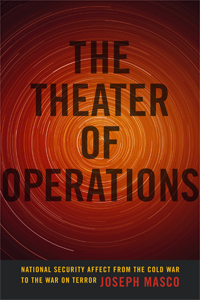
MASCO Theater of OperationsHis new book, due out from Duke University Press in November, is The Theater of Operations: National security affect from the Cold War to the war on terror:

How did the most powerful nation on earth come to embrace terror as the organizing principle of its security policy? In The Theater of Operations, Joseph Masco locates the origins of the present-day U.S. counterterrorism apparatus in the Cold War’s “balance of terror.” He shows how, after the attacks of 9/11, the U.S. Global War on Terror mobilized a wide range of affective, conceptual, and institutional resources established during the Cold War to enable a new planetary theater of operations. Tracing how specific aspects of emotional management, existential danger, state secrecy, and threat awareness have evolved as core aspects of the American social contract, he draws on archival, media, and ethnographic resources to offer a new portrait of American national security culture. Undemocratic and unrelenting, this counterterror state prioritizes speculative practices over facts, and ignores everyday forms of violence across climate, capital, and health in an unprecedented effort to anticipate and eliminate terror threats – real, imagined, and emergent.

I’ve commented on the idea of a ‘theatre of war’ on several occasions (see here and here) and in his new book Masco seems to be excavating its performative/manipulative dimensions to explore the constitution of ‘a new, planetary theatre of operations’ – something else to take into account as I race towards completing The everywhere war.  I’m also greatly taken by a genealogy that begins not with 9/11, which is emphatically not the moment when ‘everything changed’, but with the Cold War…

The Theater of Operations has won advance praise from another of my favourite authors, Peter Galison:

“We know that in the Cold War transportation infrastructures boomed, electronic infrastructures had to be hardened. We know about weapons and counter-weapons; we even have learned about the astonishing proliferation of security mechanisms put in place during the War on Terror. What Joseph Masco shows us in The Theater of Operations is an entire affective structure—the management of anxiety, resilience, steadfastness, sacrifice—that is demanded of every citizen. Alert to liquid containers above 2.4 ounces, hypervigilant to abandoned bags, suspicious loitering, or the detonation of a thermonuclear weapon—we learn to live our lives aware of tiny and apocalyptic things. With an anthropologist’s eye long attuned to life in the para-wartime state, Masco is the perfect guide to the theater of our lives in the security state.”

Joseph MascoEvidently not a person to stand still for long, Masco is already at work on a book on environmental crisis: you can dip a toe into the water at the excellent somatosphere (on science, medicine and anthropology) here, or dig out his chapter on ‘Bad weather: the time of planetary crisis’ in Martin Holbraad and Morten Axel Pedersen (eds), Times of security: ethnographies of fear, protest and the future, which came out from Routledge last summer.  The abstract (below), together with a link to an earlier essay on ‘Building the Bunker Society’ (available as a pdf), is here:

How, and when, does it become possible to conceptualize a truly planetary crisis? The Cold War nuclear arms race installed one powerful concept of planetary crisis in American culture. The science enabling the US nuclear arsenal, however, also produced unintended byproducts: notably, a radical new investment in the earth sciences. Cold War nuclear science ultimately produced not only bombs, but also a new understanding of the earth as biosphere. Thus, the image of planetary crisis in the US was increasingly doubled during the Cold War – the immediacy of nuclear threat matched by concerns about rapid environmental change and the cumulative effects of industrial civilization on a fragile biosphere. This paper examines the evolution of (and competition between) two ideas of planetary crisis since 1945: nuclear war and climate change. In doing so, the paper offers an alternative history of the nuclear age and considers the US national security implications of a shift in the definition of planetary crisis from warring states to a warming biosphere.

And while we are on the subject of ‘bad weather’, climate change and national security, the GAO recently released a report on the implications of global climate change for US military infrastructure. You can read a summary review here, which points out that while the Pentagon evidently takes climate change very seriously indeed – there has been a string of seminars, workshops and conferences testifying to that – the die-hards in the Republican Party continue to do everything they can to block even military-sponsored research into climate change.  As Representative David McKinley put it:

Our climate is obviously changing; it has always been changing. With all the unrest around the global [sic], why should Congress divert funds from the mission of our military and national security to support a political ideology? This amendment will ensure we maximize our military might without diverting funds for a politically motivated agenda.

The engorgement of ‘military might’ severed from a ‘politically motivated agenda’: you can’t make this stuff up.  Even for the theatre.

Drones, battlefields and later modern war

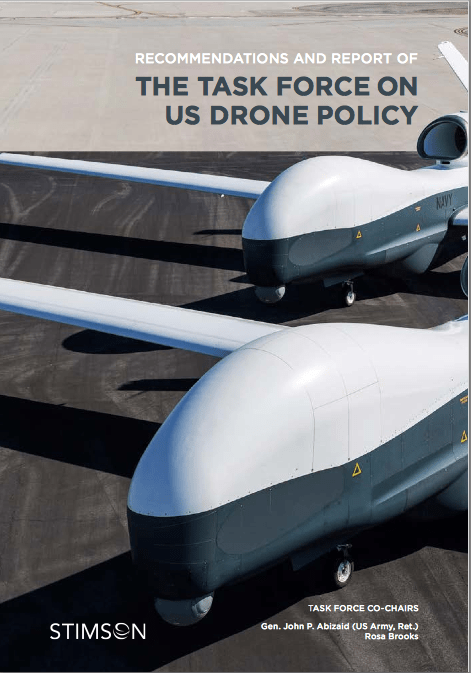
STIMSON Drone report 2014

This morning the Stimson Center issued an 81-page Recommendations and Report of the Task Force on US Drone Policy: you can access it online via the New York Times here or download it as a pdf here; Mark Mazetti‘s report for the Times is here.

Founded in 1989, the Stimson Center is a Washington-based ‘non-profit and non-partisan’ think-tank that prides itself on providing ’25 years of pragmatic solutions to global security’.  It’s named after Henry Stimson, who served Presidents Taft, Roosevelt and Truman as Secretary of War and President Hoover as Secretary of State.  The Center established its 10-member Task Force on drones a year ago, with retired General John Abizaid (former head of US Central Command, 2003-2007) and Rosa Brooks (Professor of Law at Georgetown) as co-chairs; the Task Force was aided by three Working Groups – on Ethics and Law; Military Utility, National Security and Economics; and Export Control and Regulatory Challenges – each of which is preparing more detailed reports to be published later this year.  The present Report focuses on

‘key current and emerging issues relating to the development and use of lethal UAVs outside the United States for national security purposes. In particular, we focus extensively on the use of UAVs for targeted counterterrorism strikes, for the simple reason that this has generated significant attention, controversy and concern.’

But this focus repeats and compounds the myopia of both conventional wisdom and contemporary debate.  The Report summarily (and I think properly) rejects a number of misconceptions about the use of drones, insisting that their capacity to strike from a distance is neither novel nor unique; noting that the vast majority of UAVs in the US arsenal are non-weaponized (‘less than 1 percent of … UAVs carry operational weapons at any given time’ – though their intelligence, surveillance and reconnaissance functions are of course closely tied to the deployment of weapons by conventional strike aircraft or ground forces); and arguing that ‘UAVs do not turn killing into “a video game”‘. These counter-claims are unexceptional and the Task Force presents them with clarity and conviction.

But the Report also accepts that the integration of UAVs into later modern war on ‘traditional’ or ‘hot’ battlefields [more about those terms in a moment] is, by and large, unproblematic.  Thus:

‘UAVs have substantial value for a wide range of military and intelligence tasks. On the battlefield, both weaponized and non-weaponized UAVs can protect and aid soldiers in a variety of ways. They can be used for reconnaissance purposes, for instance, and UAVs also have the potential to assist in the detection of chemical, biological, radiological and nuclear weapons, as well as ordinary explosives. Weaponized UAVs can be used to provide close air support to soldiers engaged in combat.’

A footnote expands on that last sentence:

‘In the past, warfighters on the ground under imminent threat would have to navigate a complicated command hierarchy to call for air support. The soldier on the ground would have to relay coordinates to a Forward Air Controller (FAC), who would then talk the pilot’s eyes onto a target in an extremely hostile environment. These missions have always been very dangerous for the pilot, who has to fly low and avoid multiple threats, and also for people on the ground. It is a human-error rich environment, and even today, it is not uncommon for the wrong coordinates to be relayed, resulting in the deaths of friendlies or innocent civilians. To ease these difficulties, DARPA is currently investigating how to replace the FAC and the pilot by a weaponized UAV that will be commanded by the soldier on the ground with a smartphone.’

And subsequently the Report commends the ‘robust’ targeting process put in place by the US military and the incorporation of military lawyers (JAGs) into the kill-chain:

‘The Department of Defense has a robust procedure for targeting, with outlined authorities and steps, and clear checks on individual targets. The authorization of a UAV strike by the military follows the traditional process in place for all weapons systems (be they MQ-9 Reaper drones or F-16 fighter jets). Regardless of whether particular strikes are acknowledged, the Pentagon has stated that UAV strikes, like strikes from manned aircraft, are subject to the military’s pre-strike target development procedures and post-strike assessment.

‘The process of determining and executing a strike follows a specific set of steps to ensure fidelity in target selection, strike and post-strike review.’

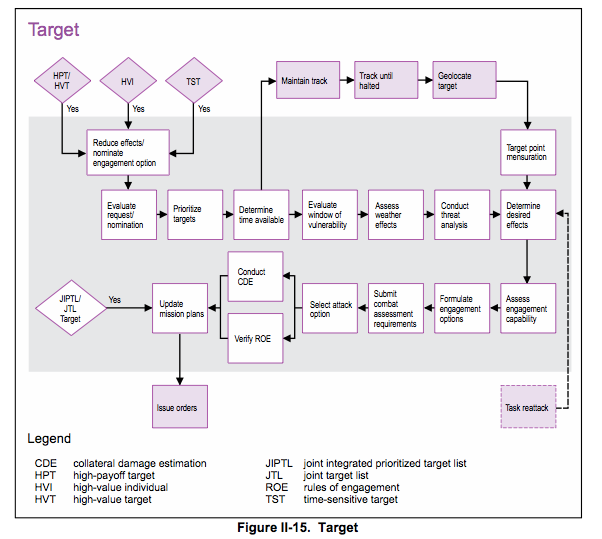
Targeting cycle

Both Craig Jones and I have discussed the targeting cycle [the figure above shows one of six steps in the ‘find-fix-track-target-engage-assess’ cycle, taken from JP 3-60 on Joint Targeting, issued in January 2013] and the role of operational law within it (Craig in much more detail than me), and these are all important considerations.  But the Report glosses over the fragilities of the process, which in practice is not as ‘robust’ as the authors imply.  They concede:

‘No weapons system is perfect, and targeting decisions — whether for UAV strikes or for any other weapons delivery system — are only as good as the intelligence on which they are based. We do not doubt that some US UAV strikes have killed innocent civilians. Nonetheless, the empirical evidence suggests that the number of civilians killed is small compared to the civilian deaths typically associated with other weapons delivery systems (including manned aircraft).’
cover_646That last sentence is not unassailable, but in addition I’ve repeatedly argued that it is a mistake to abstract strikes carried out by UAVs from the wider network of military violence in which their ISR capabilities are put to use:  hence my ongoing work on the Uruzgan airstrike in Afghanistan, for example, and on ‘militarised vision’ more generally.  What these studies confirm is that civilian casualties are far more likely when close air support is provided – by UAVs directly or by conventional strike aircraft – to ‘troops in contact’ (even more so when, as in both the Kunduz and Uruzgan airstrikes, it turns out that troops calling in CAS were not ‘in contact’ at all).

In short, while it’s perhaps understandable that a Task Force that included both General Abizaid and Lt-Gen David Barno (former head of Combined Forces Command – Afghanistan from 2003-2005) should regard the use of UAVs on ‘traditional’ battlefields as unproblematic, I think it regrettable that their considerable expertise did not result in a more searching evaluation of remote operations in Afghanistan and Iraq.

But what, then, of those ‘non-traditional’ battlefields?  A footnote explains:

‘Throughout this report, we distinguish between the use of UAV strikes on “traditional” or “hot” battlefields and their use in places such as Pakistan, Yemen and Somalia. These are terms with no fixed legal meaning; rather, they are merely descriptive terms meant to acknowledge that the US of UAV strikes has not been particularly controversial when it is ancillary to large-scale, open, ongoing hostilities between US or allied ground forces and manned aerial vehicles, on the one hand, and enemy combatants, on the other. In Afghanistan and Iraq, the United States deployed scores of thousands of ground troops and flew a range of close air support and other aerial missions as part of Operation Enduring Freedom, and UAV strikes occurred in that context. In Libya, US ground forces did not participate in the conflict, but US manned aircraft and UAVs both operated openly to destroy Libyan government air defenses and other military targets during a period of large scale, overt ground combat between the Qaddafi regime and Libyan rebel groups. In contrast, the use of US UAV strikes in Yemen, Pakistan and elsewhere has been controversial precisely because the strikes have occurred in countries where there are no US ground troops or aerial forces openly engaged in large scale combat.’
0202megret0

A major focus of the report is on what Frédéric Mégret (above) has called ‘the deconstruction of the battlefield‘ and the countervailing legal geographies that provide an essential armature for later modern war (though it’s surprising that the Report makes so little use of academic research on UAVs and contemporary conflicts).  The authors ‘disagree with those critics who have declared that US targeted killings [in Pakistan, Yemen and Somalia] are “illegal”’ – no surprise there either, incidentally, since one of the Working Groups included Kenneth Anderson, Charles Dunlap and Christine Fair: I’m not sure in what universe that counts as ‘non-partisan’) but they also accept that these remote operations move in a grey zone (and in the shadows):

‘The law of armed conflict and the international legal rules governing the use of force by states arose in an era far removed from our own. When the Geneva Conventions of 1949 were drafted, for instance, it was assumed that most conflicts would be between states with uniformed, hierarchically organized militaries, and that the temporal and geographic boundaries of armed conflicts would be clear.

‘The paradigmatic armed conflict was presumed to have a clear beginning (a declaration of war) and a clear end (the surrender of one party, or a peace treaty); it was also presumed the armed conflict to be confined geographically to specific, identifiable states and territories. What’s more, the law of armed conflict presumes that it is a relatively straightforward matter to identify “combatants” and distinguish them from “civilians,” who are not targetable unless they participate directly in hostilities. The assumption is that it is also a straightforward matter to define “direct participation in hostilities.”

‘The notion of “imminent attack” at the heart of international law rules relating to the use of force in state self-defense was similarly construed narrowly: traditionally, “imminent” was understood to mean “instant, overwhelming, and leaving no choice of means, and no moment for deliberation.”

‘But the rise of transnational non-state terrorist organizations confounds these preexisting legal categories. The armed conflict with al-Qaida and its associated forces can, by definition, have no set geographical boundaries, because al-Qaida and its associates are not territorially based and move easily across state borders. The conflict also has no temporal boundaries — not simply because we do not know the precise date on which the conflict will end, but because there is no obvious means of determining the “end” of an armed conflict with an inchoate, non-hierarchical network.

‘In a conflict so sporadic and protean — a conflict with enemies who wear no uniforms, operate in secret and may not use traditional “weapons” — the process of determining where and when the law of armed conflict applies, who should be considered a com- batant and what counts as “hostilities” inevitably is fraught with difficulty…

‘While the legal norms governing armed conflicts and the use of force look clear on paper, the changing nature of modern conflicts and security threats has rendered them almost incoherent in practice. Basic categories such as “battlefield,” “combatant” and “hostilities” no longer have a clear or stable meaning. And when this happens, the rule of law is threatened.’

These too are important considerations, but they are surely not confined to counter-terrorism operations in Pakistan, Yemen and Somalia: they also apply with equal force to counterinsurgency operations in Afghanistan and Iraq, and intersect with a wider and much more fraught debate over the very idea of ‘the civilian’.

There is a particularly fine passage in the Report:

‘Consider US targeted strikes from the perspective of individuals in — for instance — Pakistan or Yemen. From the perspective of a Yemeni villager or a Pakistani living in the Federally Administered Tribal Areas (FATA), life is far from secure. Death can come from the sky at any moment, and the instability and incoherence of existing legal categories means that there is no way for an individual to be certain whether he is considered targetable by the United States. (Would attending a meeting or community gathering also attended by an al-Qaida member make him targetable? Would renting a building or selling a vehicle to a member of an “associated” force render him targetable? What counts as an “associated force?” Would accepting financial or medical aid from a terrorist group make him a target? Would extending hospitality to a relative who is affiliated with a terrorist group lead the United States to consider him a target?).

‘From the perspective of those living in regions that have been affected by US UAV strikes, this uncertainty makes planning impossible, and makes US strikes appear arbitrary. What’s more, individuals in states such as Pakistan or Yemen have no ability to seek clarification of the law or their status from an effective or impartial legal system, no ability to argue that they have been mistakenly or inappropriately targeted or that the intelligence that led to their inclusion on a “kill list” was flawed or fabricated, and no ability to seek redress for injury. Their national laws and courts can offer no assistance in the face of foreign power, and far from protecting their fundamental rights and freedoms, their own states may in fact be deceiving them about their knowledge of and cooperation with US strikes. Meanwhile, geography and finances make it impossible to access US courts, and a variety of legal barriers — such as the state secrets privilege, the political question doctrine, and issues of standing, ripeness and mootness — in any case would prevent meaningful access to justice.’

This is one of the clearest summaries of the case for transparency and accountability I’ve seen, but the same scenario has also played out in Afghanistan (and in relation to the Taliban, which appears only once in the body of the Report) time and time again.  There are differences, to be sure, but the US military has also carried out its own targeted killings in Afghanistan, working from its Joint Prioritized Effects List.  The Report notes that ‘in practice, the military and CIA generally work together quite closely when planning and engaging in targeted UAV strikes: few strikes are “all military” or “all CIA”’ – which is true in other senses too – and this applies equally in Afghanistan.

In sum, then, this is a valuable and important Report – but it would have been far more incisive had its critique of ‘US drone policy’ cast its net wider to provide a more inclusive account of remote operations.  The trans-national geographies of what I’ve called ‘the everywhere war’ do not admit of any simple distinction between ‘traditional’ and ‘non-traditional’ battlefields, and trying to impose one on such a tangled field of military and paramilitary violence ultimately confuses rather than clarifies.  I realise that this is usually attempted as an exercise in what we might call legal cartography, but I also still think William Boyd‘s Gabriel was right when, in An Ice-Cream War, he complained that maps give the world ‘an order and reasonableness’ it doesn’t possess.  And we all also know that maps – like the law – are instruments of power, and that both are intimately entangled with the administration of military violence.
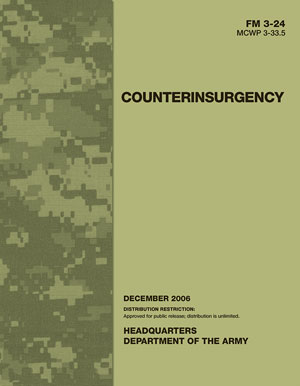
Insurgent thoughts

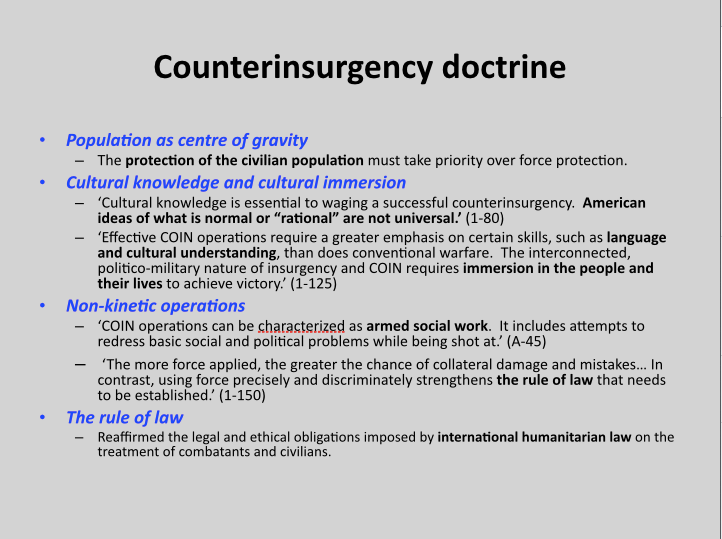
fm3-24When the US Army and Marine Corps issued their revised Field Manual 3-24 on Counterinsurgency in December 2006 there was an extraordinary public fanfare: a round of high-profile media appearances by some of its architects (you can watch John Nagl with Jon Stewart here) and, even though you could download the Manual for free – there were two million downloads in the first two months – the University of Chicago Press rushed out a paperback edition that hit the best-seller lists.  This was all to advertise counterinsurgency as what David Petraeus called ‘the graduate level of war’ and to inaugurate what I called, in ‘The rush to the intimate’ (DOWNLOADS tab), the US military’s ‘cultural turn’.  And as the media campaign made clear, it was also about the production of a public that would rally behind the new strategy to be put to work in Iraq.  The message was that the military had put the horrors of Abu Ghraib behind it – which were in any case artfully blamed on ‘rotten apples’ rather than the political-military manufacturers of the barrel that contained them – and was now marching beneath the banner of a kinder, gentler and above all smarter war (see my summary slide below).

COIN doctrine 2006

The new doctrine, first field-tested in Iraq and then applied to operations in Afghanistan, was not without its critics, both inside and outside the military.  Insiders complained that this was all smoke and mirrors – or more accurately, perhaps, too many mirrors and not enough smoke – because it was a distraction from the ‘real’ (the implication was, I think, ‘manly’) business of war-fighting, while outsiders objected to its weaponisation of culture and to the biopolitical project that it sought to advance.

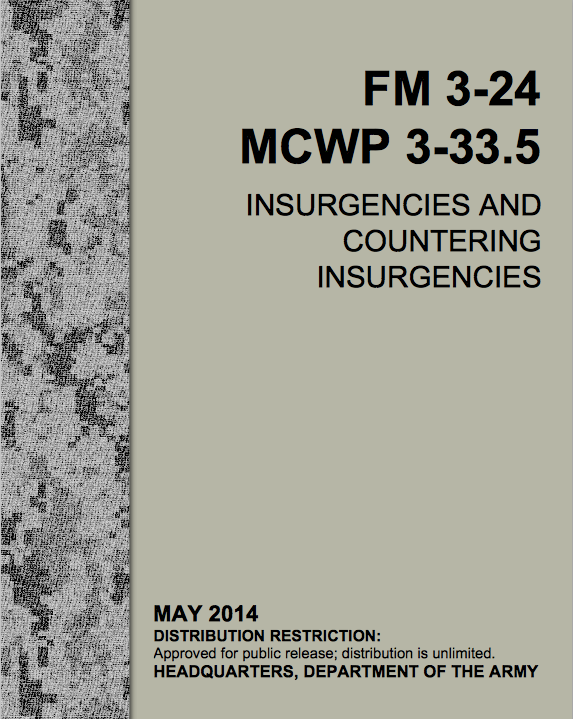
FM 3-24 2014The debate grumbled on, and many insiders insisted that COIN was dead and buried, interred in the killing fields of Afghanistan.  But a revised version of the doctrine has now been issued.  It was trailed by the Joint Publication 3-24 on Counterinsurgency last December (issued by the Army, Marine Corps, Navy, Air Force and – interestingly – the Coastguard Service), which you can download here (for an early review, see Robert Lamb and Brooke Shawn‘s ‘Is revised COIN manual backed by political will? here).  But the new Field Manual has been comprehensively re-written and even re-titled: Insurgencies and countering insurgencies, which you can download here.

I’m going to work my way through it in the next week or so – I can hardly complete The everywhere war without doing so – and I’ll post a commentary in due course, but it’s worth setting out its structure now:

PART ONE: STRATEGIC AND OPERATIONAL CONTEXT

1: Understanding the strategic context

2: Understanding an operational environment

3: Culture

PART TWO: INSURGENCIES

4: Insurgency prerequisites and fundamentals

5: Insurgency threat characteristics

PART THREE: COUNTERINSURGENCIES

6: Mission command and control

7: Planning for counterinsurgencies

8: Intelligence

9: Direct approaches to counter an insurgency

10: Indirect methods for countering insurgencies

11: Working with host-nation forces

12: Assessments

13: Legal considerations

I’m still interested in how the revision treats ‘culture’, of course, but I’m also keenly interested in the discussion of ‘intrastate war’ and insurgency, the direct incorporation of air power (which was relegated to an appendix in the previous edition), the attention paid to intelligence in it multiple guises, the role of biometrics (biopolitics again!) – and in that remarkable last chapter.  One of the central diagnostics of later modern war, in my view at any rate, is its reflexivity.  You can see that in the discussions of assessment and reassessment in the new FM 3-24 (Ch 12 in particular), but attention to metrics and ‘lessons learned’ is hardly novel even if the means of monitoring have changed.  What I have in (closer) mind is a preoccupation with the public reception of military operations and military violence – which involves a distinctive emphasis on its intellectual provenance (‘the graduate level of war’ again),  on media strategies (‘strategic communications’), and on the provision of a legal armature that works to inform and legitimate its operations (hence that last chapter).

I’m sure the new manual will be the subject of intense discussion over at the always provocative and thoroughly indispensable Small Wars Journal (see, for example, Bing West‘s opening salvo here and David Maxwell‘s more measured critique here), and elsewhere too, but I doubt that it will attract the public fanfare FM 3-24 received in 2006-7.  We’ll see.

Remote operations

I’ve noted on several occasions the multiple ways in which later modern war invokes medical metaphors to legitimise military violence (notably ‘surgical strikes’ against the ‘cancer’ of insurgency), and my preliminary work on medical-military machines has revealed all sorts of feedbacks between (in particular) trauma care by advanced militaries in war zones and trauma care by civilian agencies at home.

robotic_surgery_chb15401

But these two paths have now intersected: in a paper on ‘Automated killing and mediated caringKathrin Friedrich and Moritz Queisner draw on studies of remote platforms and visual technologies – including my own – to discuss the automated killing of tumour cells using the CyberKnife system and what they call the the techno-medical ‘kill-chain’ that mediates between physician and patient.  They write:

Gregory uses the term kill-chain to characterize the setting of military interventions by unmanned aerial systems as “a dispersed and distributed apparatus, a congerie of actors, objects, practices, discourses and affects, that entrains the people who are made part of it and constitutes them as particular kinds of subjects.” Image-guided interventions in medical contexts share similar structural features and are also characterized by tying together a heterogeneity of practices, actors, discourses and expertise in order to achieve a precisely defined goal but without obviously stating their inner relations and micro politics.

drone-pilots

Their central question, appropriately re-phrased, can also be asked of today’s remote operations in theatres of war (and beyond):

The fact that medical robots increasingly determine medical therapy and often provide the only form of access to the operation area requires us to conceptualize them as care agents rather than to merely conceive of them as passive tools. But if the physician’s action is based on confidence in and cooperation with the robot, what kind of operative knowledge does this kind of agency require and how does it change the modalities of medical intervention?

They conclude:

… since surgical intervention has become a computer-mediated practice that inscribes the surgeon into a complex setting of medical care agents, it is no longer the patient’s body but the image of the body that is the central reference for the surgeon.

As the operator of robot-guided intervention the physician accordingly needs to address and cope with the specific agency of the machine. In addition the visual interfaces need to communicate and convert their technological complexity to humanly amendable surfaces.

I recommend reading these arguments and transpositions alongside Colleen Bell‘s  ‘War and the allegory of military intervention: why metaphors matter’, International political sociology 6 (3) (2012) 325-28 and ‘Hybrid war and its metaphors’, Humanity 3 (2) (2012) and Lucy Suchman‘s ‘Situational awareness: deadly bioconvergence at the boundaries of bodies and machines’ (forthcoming at Mediatropes)…

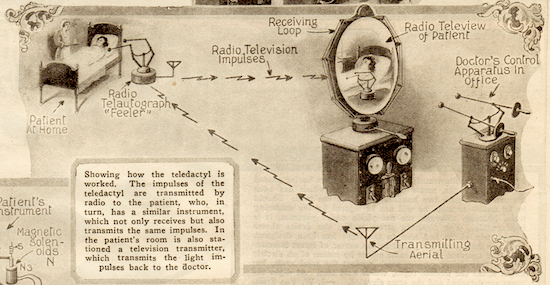
There is yet another dimension to all this.  The U.S. Army has been at the forefront of telemedicine for decades – for a recent report on ‘4G telemedicine’ see here – but since at least 2005 the Army has also been experimenting with ‘telesurgery’ or ‘remote surgery’ in which a UAV platform mediates between the surgeon and the site of patient treatment: a different version of remote operations.  You can find early reports here, here and here (‘Doc at a distance’) and a more general account of ‘Extreme Telesurgery’ here.  Still more generally, there’s a wide-ranging review of US Department of Defense research into Robotic Unmanned Systems for Combat Casualty Care here.

If this is all too futuristic – even ‘remote’ – to you, then check out the Teledactyl shown in the image below, which was originally published in 1925.  Although there’s not a drone in sight, the seer was the amazing Hugo Gernsback, who also conjured up the radio-controlled television plane

1925-Feb-science-and-invention-howto


The Days of the Roundtable

I’m very pleased (and relieved) to say that I’ve received two new grants for my work.

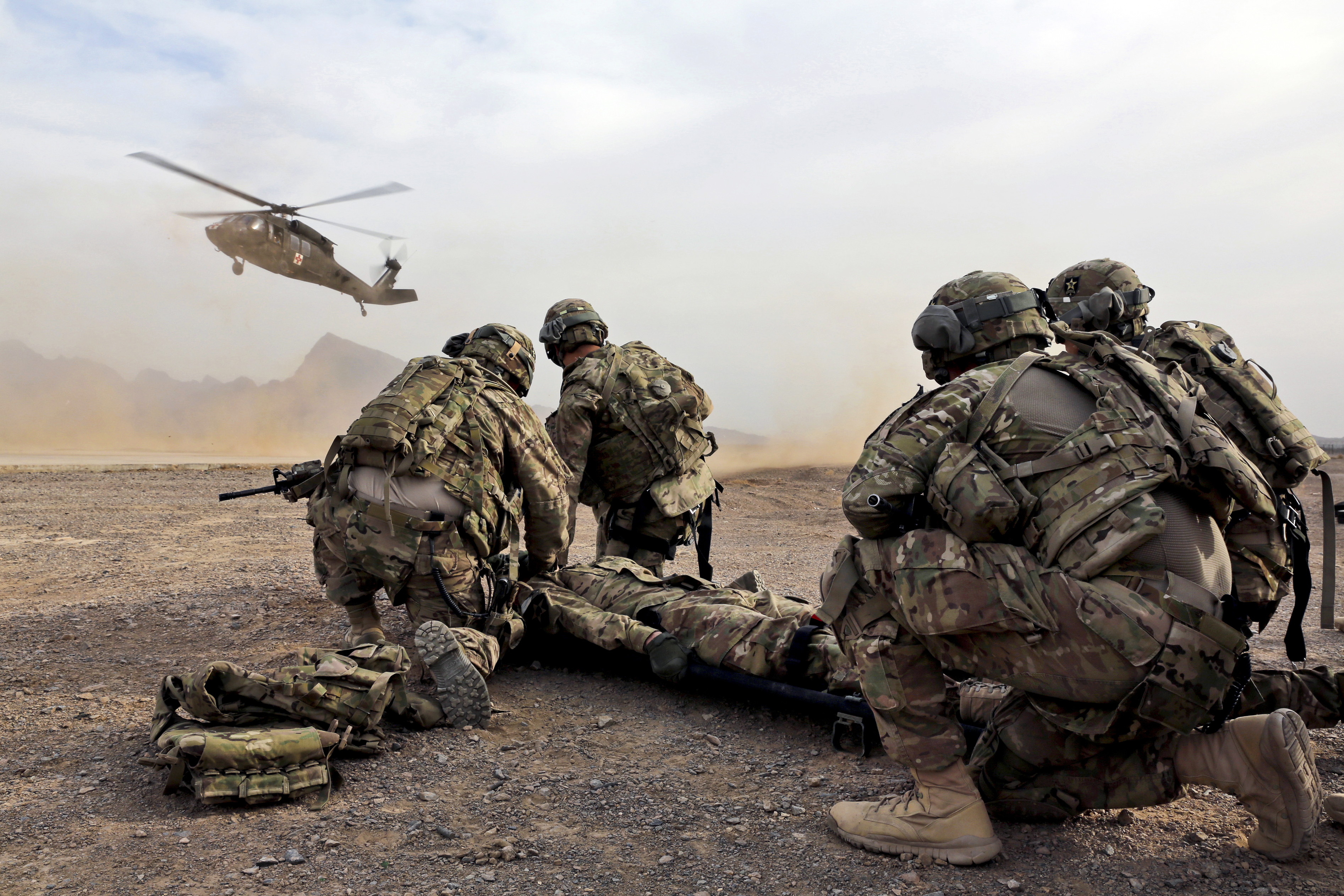
The first is an Insight Grant from the Social Science and Humanities Research Council for my project on Medical-military machines and casualties of war 1914-2014.  I’ve provided an illustrated version of the substance of the application under the DOWNLOADS tab.  The plan is to explore the human geographies of evacuation and treatment of casualties, both combatant and civilian, in four major combat zones: the Western Front 1914-1918; the Western Desert, 1942-1943; Vietnam; and Afghanistan.  Since submitting my application, though, I’ve also become interested in the medical geographies (what my good friend Omar Dewachi calls the ‘therapeutic geographies‘) in which people suffering from both war-related injuries and chronic diseases in Syria make their precarious journeys into Lebanon and Jordan for treatment.  All that in four years…

PRT Farah Conducts Medical Evacuation Training with Charlie Co., 2-211th Aviation Regiment at Forward Operating Base Farah

The second is a grant from the Peter Wall Institute for Advanced Studies at UBC to support an International Research Roundtable in May 2015 on The contours of later modern war.  This will be an invitation-only event (the grant provides for travel and accommodation for each participant), but here is the pitch.  I wrote this in an hour just before leaving for Glasgow, so forgive the rough edges:

Background

Commentators often insist that in recent years the nature of war has been transformed. Military historians who address this question display a fine-grained sensitivity to the details of armed conflict, but the imaginative (theoretical) framework they deploy usually returns to Clausewitz’s nineteenth-century theses On War. Philosophers and social scientists work with a more refined theoretical apparatus, though too often this seems to be confined to annotations of Foucault’s Paris lectures in the 1970s, and yet – unlike Foucault himself – they typically show little interest in the specifities and materialities of armed conflict. The Roundtable seeks to finesse this impasse by bringing together a group of scholars, each of whom has demonstrated both a theoretical and an empirical sensibility, to consider crucial questions about the transformations of modern war.

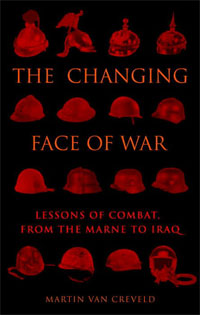
CREVELD Changing face of warThe objective is not to identify a single rupture – the Vietnam War, the end of the Cold War, the wars conducted in the wake of 9/11 – but to recognize that multiple temporalities are at work so that there are both continuities and contrasts to be identified and understood. Similarly, later modern war cannot be reduced to arguments about the Revolution in Military Affairs and its successor projects, which have indeed changed advanced military operations in all sorts of ways, or to the ‘new wars’ supposedly waged by non-state actors in the rubble of the Cold War and in the peripheries of empire: these twin modalities need to be thought together to provide a more inclusive understanding of the shifting contours of military and paramilitary violence.

In speaking of ‘later modern war’ the intention is to avoid the now tired discussions of the postmodern (what comes after that?), while indicating that the closing decades of the twentieth century witnessed a series of changes – political and legal, social and cultural, scientific and technical, legal and ethical – that started to distance armed conflict from the forms it had assumed during the First and Second World Wars. The term also suggests connections to the logics of what is sometimes called ‘late capitalism’ and to the evolving impositions of neo-liberal political and economic formations.

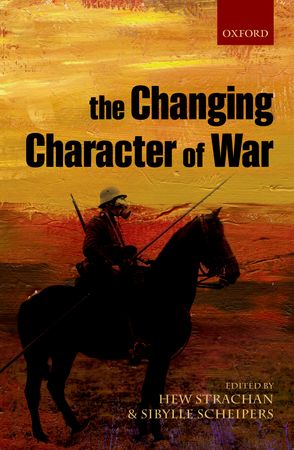
STRACHAN Changing character of warAdvanced militaries often claim that their conduct of war has become surgical, sensitive and scrupulous. The first of these relies on technical advances in intelligence, surveillance and reconnaissance (much of which now takes the form of geospatial intelligence and high-resolution, near real-time imagery) and on advances in military networks, targeting and weapons systems. The second involves the incorporation of cultural knowledge into asymmetric warfare and counter-insurgency, but it also involves a new sensitivity to public opinion: thus media operations have become central to military campaigns in an attempt to win support from populations both at home and abroad. There is also an increasing sensitivity to casualties, both combatant and civilian, and many commentators have spoken of the humanitarian armature that attends contemporary military interventions as a new ‘military humanism’. Finally, and following directly from these observations, contemporary military power is supposed to be characterized by a heightened ethical awareness and the unprecedented incorporation of international law (and military lawyers) into its operational decisions.

toc_afghan

All of these claims invite critical scrutiny, to recover their developing genealogies (how novel are they?) and to evaluate their practical consequences (what are their material effects?). They assume particular importance as interstate wars have declined, and transnational conflicts have become the dominant modality of armed conflict, as ‘war’ bleeds into terrorism, counter-terrorism and new modes of transnational policing. These changes in turn affect the sites and locations of military violence, and these in turn may be transformed not only by geopolitics and military power but also by global environmental change and the political ecologies of war. In short: is the locus of war shifting in decisive ways?

Programme

The Roundtable will address these questions through four intersecting and interlocking themes that allow for theoretical interrogation and empirical scrutiny: each of these is a stark signpost but its simplicity allows multiple questions (and the connections between them) to be addressed under each heading. In capsule form these are:

IMAGE – the role of imagery (intelligence, surveillance, reconnaissance); the images of war that circulate through media, old and new, and their role in public debate;
AGENT – the agents and vectors of military and paramilitary violence; the changing human/technological assemblages through which war is conducted;
VICTIM – the casualties of war (the dead, the wounded, the captured, the displaced); the political, cultural and legal armatures that regulate military and paramilitary violence;
LOCUS – the changing targets, spaces and ecologies of war

When they accept the invitation, each participant will be asked to provide a one-paragraph summary of their present research for posting on a dedicated website. Four weeks before the Roundtable everyone will provide a short (six page maximum) essay, written in an accessible and reference-free form, illustrated as appropriate, and drawing from their work. These may address the theme of the Roundtable in general or in detail, and will be posted on the website. Formal papers will not be presented: the emphasis will on discussion and debate.

There will be four main sessions addressing each of the four key themes:

Day 1:  Arrival

Day 2:

Morning – Walking Seminar (Stanley Park): participants will walk the Seawall as a group but in pairs, changing every 20-30 minutes, to share their research and ideas with one another.

Afternoon – IMAGE (discussion led by four participants)

Day 3:

Morning – AGENT (discussion led by four participants)

Afternoon – VICTIM (discussion led by four participants)

Evening – Public Performance: Either a staged reading of Owen Sheers’ radio play Pink Mist [about soldiers returning from Afghanistan] or George Brant’s Grounded [about a female drone operator], to be followed by public discussion led by scholars on either the Wounds of War or Drone warfare

Day 4:

Morning – Exchanges: small-group discussions (informal) about the key themes and to plan future collaborations and research projects

Afternoon – LOCUS (discussion led by four participants)

Evening – Roundtable Dinner

Day 5:  Dispersal

I also want to invite one or two visual artists to attend the Roundtable, both to take part – the visual is a vital register for both the conduct and the critique of modern war – but also to use the discussions as a provocation for their subsequent work (to be posted on and/or linked via the website).

I’ll keep you posted – I’m immensely grateful to Janis Sarra, Director of the Peter Wall Institute for Advanced Studies, and to my colleagues and friends for their support and encouragement.

I’ll keep you posted.

The God trick and the administration of military violence

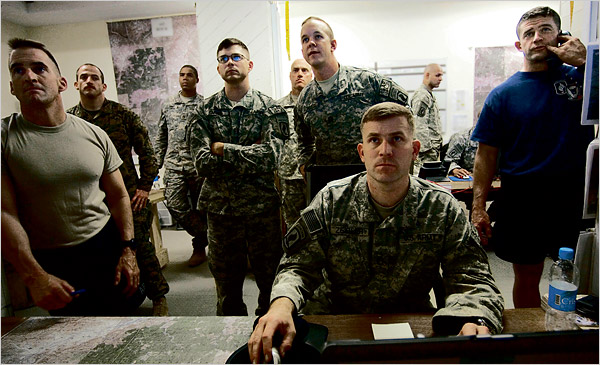
JOC staring at screen 24afghan-600

Here is the abstract for my keynote at the Lancaster symposium on Security by remote control next month; it’s a development from my presentation at the AAG in Tampa, and I’ll provide more details as I develop the argument.

The God trick and the administration of military violence

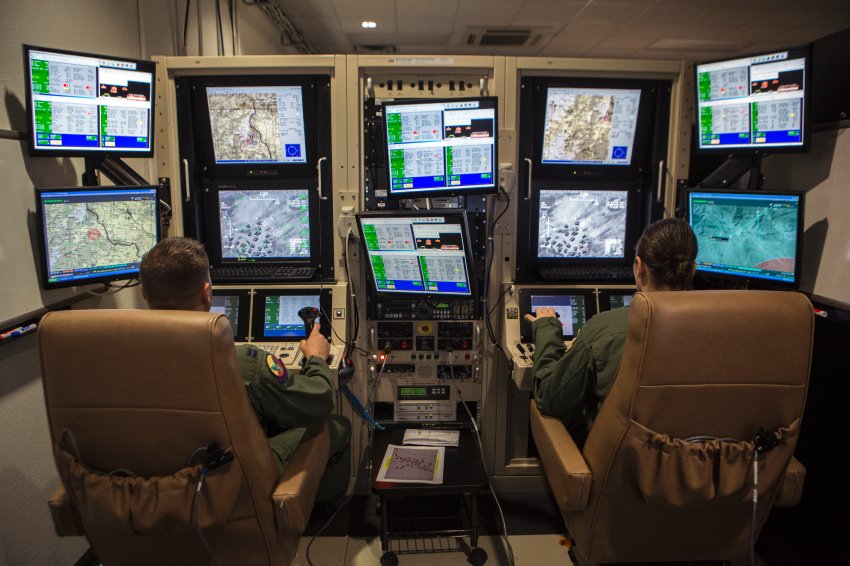
Advocates have made much of the extraordinary ability of the full motion video feeds from Predators and Reapers to provide persistent surveillance (‘the all-seeing eye’), so that they become vectors of the phantasmatic desire to produce a fully transparent battlespace.  Critics – myself included – have insisted that vision is more than a biological-instrumental capacity, however, and that it is transformed into a conditional and highly selective visuality through the activation of a distinctively political and cultural technology.  Seen thus, these feeds interpellate their distant viewers to create an intimacy with ground troops while ensuring that the actions of others within the field of view remain obdurately Other.

But the possibility of what Donna Haraway famously criticised as ‘the God-trick’ – the ability to see everything from nowhere in particular – is also compromised by the networks within which these remote platforms are deployed.  In this presentation I re-visit an air strike on three vehicles in Uruzgan province, Afghanistan, in February 2010, in which more than 20 civilians were killed in a helicopter attack prompted, in large measure, by video feeds from a Predator providing support to a Special Forces detachment in the vicinity.  Most commentaries – including mine – have treated this in terms of a predisposition on the part of the Predator crew to (mis)read every action by the victims as a potential threat.  But a close examination of the official investigations that followed, by the US Army and then the US Air Force, reveals a much more complicated situation.  The Predator was not the only ‘eye in the sky’, its feeds entered into a de-centralized, distributed and dispersed geography of vision in which different actors at different locations inside and outside Afghanistan saw radically different things, and the breaks and gaps in communication were as significant as the connections.  In short, much of later modern war may be ‘remote,’ but there’s considerably less ‘control’ than most people think.

Biometric war

The US military’s obsession with biometrics is, in part, the product of its phantasmatic desire to make the battlespace fully transparent, as its incorporation within the targeting cycle makes clear:

afghan-biometrics-cycle-1

But it’s also a vital means of furthering the profoundly biopolitical project embedded in later modern war (something that intersects, in various ways, with Mark Neocleous‘s arguments about military violence – war power/police power – and ‘ordering’):

The stated goal of the Afghan effort is no less than the collection of biometric data for every living person in Afghanistan. At a conference with Afghan officials in 2010, the commander of the U.S. Army’s Task Force Biometrics Col. Craig Osborne told the attendees that the collection of biometric data is not simply about “identifying terrorists and criminals,” but that “it can be used to enable progress in society and has countless applications for the provision of services to the citizens of Afghanistan.”

CALL-AfghanBiometrics-1I touched on some of this in a different context in ‘The biopolitics of Baghdad’ DOWNLOADS tab), and Public Intelligence has just released the U.S. Army Commander’s Guide to Biometrics in Afghanistanfrom which I’ve taken the image above, and which provides a much more detailed accounting.

The release also includes an illuminating short essay, ‘Identity dominance: the U.S. Military’s biometric war in Afghanistan‘, that provides a gloss on and a guide to the program:

In a section titled “Population Management,” the U.S. Army’s guide recommends that “every person who lives within an operational area should be identified and fully biometrically enrolled with facial photos, iris scans, and all ten fingerprints (if present).” The soldiers must also record “good contextual data” about the individual such as “where they live, what they do, and to which tribe or clan they belong.” According to the guide, popuation management actions “can also have the effect of building good relationships and rapport” by sending the message that the “census” is intended to protect them from “the influence of outsiders and will give them a chance to more easily identify troublemakers in their midst.”

For a wider, wonderfully critical commentary on biometric war, see Colleen Bell, ‘Grey’s Anatomy goes South: Global racism and suspect identities in the colonial present’, in the Canadian journal of sociology 38 (4) (2013) 465-486 available open access here.

In media res

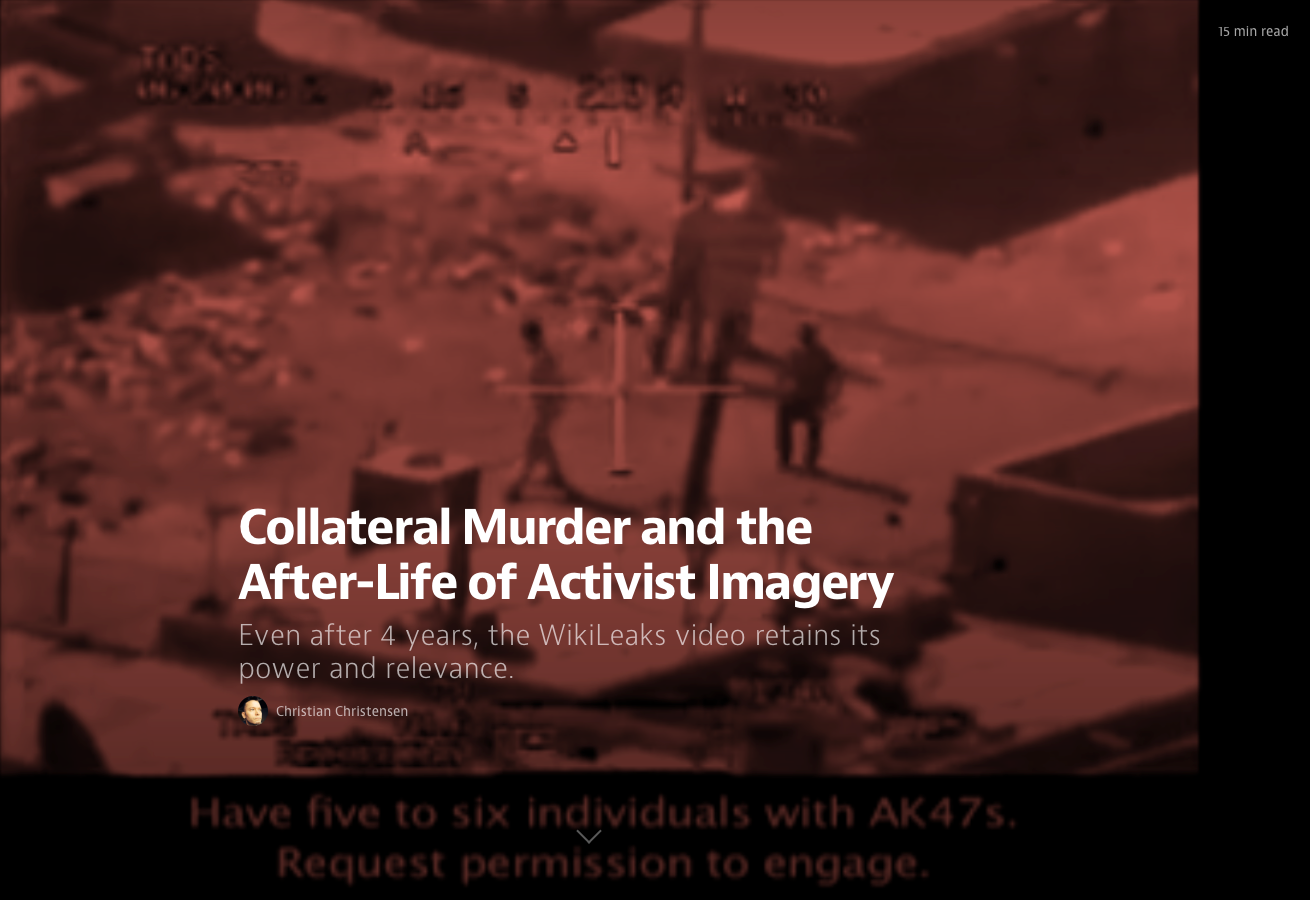
Two short essays that address the public circulation of supposedly secret information.  The first, “Collateral Murder and the After-Life of Activist Imagery”, is by Christian Christensen, and concerns the video clip released by Wikileaks as Collateral Murder in April 2010.  I’ve discussed this edited video of a US Apache helicopter attack in New Baghdad in 2007 before, together with the two documentary films that it provoked, and it forms part of my ‘Militarized Vision’ project (you can find links to the clip and to subsequent commentary in that original post).

CHRISTENSEN Collateral Murder

Christian doesn’t explore the content of the video so much as its inscription and re-inscription within public debates, part of the mediatization of later modern war.  He does make a sharp point about the status of the imagery:

One could argue that the repeated use of this imagery (and corresponding audio) has created an entirely new genre of military reporting. It is a genre with specific, often disturbing conventions: the grainy images of those on the ground, the flat, bland coloring, the “narration” of the aircraft operators which swings between the clinical and the cynical, the silence of those under surveillance or attack, the sound of the weaponry as it is discharged, and, importantly, the “overtness” of the technology, by which I mean the way in which the screen is filled with evidence of the technology being used in the form of the cross-hairs in the middle and data visible at the top and the bottom of the screen…

The Collateral Murder video not only shatters the mythology of humane warfare and benevolent US power, but also causes us to question the notion of neutral technology at the service of human development: a theme which has regained a central space in public debate in recent years.

But he also thinks there is another, no less sharp point to be made about the very act of reporting:

Within this context, the killing of two Reuters employees by the US military was particularly poignant. At the most basic level, this was the symbolic killing of Journalism (with a capital “J”) by a military unaccustomed to critical coverage or investigation at home. The killings, of course, then went unreported until Manning leaked the material and WikiLeaks published it: itself an act of journalism. With Collateral Murder, there is a layering and re-layering of meaning, and, for me, journalism lies at the heart of the clip. These are humans first, of course, and most of those killed or wounded in the attack were not journalists. But, in addition to the tragedy of human death, there is also the tragedy of what is symbolically destroyed: Transparency. Democracy. Knowledge. Critical thinking. And it took an act of journalism to bring these tragedies to light, an act of which has now itself been subjected to the full force of the state via the imprisonment of Manning, and the threat of criminal charges being brought against Assange in the US.

Incidentally, the essay is the text of Christian’s presentation to the ‘Image Operationsconference held at the Institute of Cultural Inquiry (ICI) in Berlin earlier this month; the program is here.

Image Operations

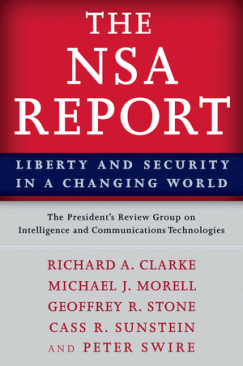
The second essay is Adam Morris‘s wide-ranging review of ‘The geopolitics of the Snowden Files‘ at the Los Angeles Review of Books.  Its immediate provocation is the publication of the Obama administration’s self-serving ‘NSA Report’:

The-NSA-Report-243x366The NSA Report — commissioned by the White House in August, published on its website in December, and now available in print via Princeton University Press— was authored by the President’s Review Group on Intelligence and Communications Technologies. As suggested by its official title, “Liberty and Security in a Changing World,” the Report was intended to advise President Obama on how to reform the data collection practices of the Intelligence Community (IC), in particular the NSA. Its authors include such veterans of the US security sector as Richard A. Clarke, Michael J. Morrell, and Peter Swire. This insiders’ perspective, in theory, is balanced by the addition to the group of constitutional lawyers Geoffrey R. Stone and Cass Sunstein. The unofficial purpose of the Report, however, was the Obama administration’s attempt to put a lid on the NSA scandal by pretending to be interested in reform. As Luke Harding points out in The Snowden Files, the Review Group was working out of the offices of the Director of National Intelligence, currently occupied by the felonious General James Clapper, w _ho knowingly lied in Congressional testimony about the bulk collection of Americans’ communication data.

The essay provides a fine, critical reading of the Report –

‘The anodyne language of these and other recommendations signals the imperial agenda out of which they are born: The NSA Report is obsessed with framing the debate over surveillance around the neopositivist vocabulary of “risk management,” but we know from history that political liberty will always suffer when a dominant regime deems a nation, its leadership or its population a “national security threat”…’

– but it also spirals off into a vigorous mapping of the context in which the NSA set about its covert operations and Edward Snowden‘s principled decision to go public (Adam also provides a commentary on Luke Harding‘s The Snowden Files: for another review, see Daniel Soar at the London Review of Books here).  And here too, of course, investigative journalism is a vital, enabling and even empowering practice.

Casualties of war

As most readers will know, there has been a lively debate – at once profoundly philosophical and intensely practical – about what counts as a ‘grievable’ (and indeed survivable) life after military and paramilitary violence, and on the calculus of war-time casualties.

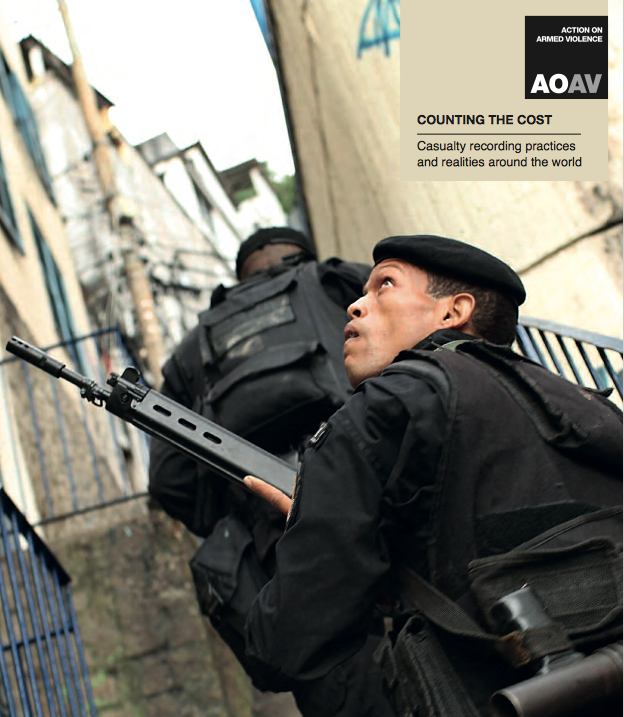
Two reports released yesterday conclude that recording and analysing data on the casualties of conflict and armed violence (both those killed and those who survive their wounds) can improve the protection of civilians and save lives.  The first, by Action on Armed Violence, is called Counting the Cost and surveys ‘casualty recording practices and realities around the world’:

Counting the costThe AOAV report shows that transparent and comprehensive information on deaths and injuries can protect civilians and save lives. The numbers of casualties have always been a contentious issue, generally dominated by secretive counting criteria, and public numbers that have been dictated more by political agendas than evidence. In other cases, the arguments have been dictated simply by the use of different estimating techniques. An example in this sense has been the debate on the total number of people that were killed during the Iraq War between Iraq Body Count and a survey published in the Lancet medical journal. The Lancet estimated over 650,000 deaths due to the war, more than 10 times the number of deaths estimated by the Iraq Body Count for the same period. A series of articles arguing for one or the other have highlighted how different systems to estimate number of deaths can lead to very different end results.

What the AOAV new report confirms is that when transparency both in the numbers produced as well as the techniques used to record them are clear and public, the debates around these numbers can be overcome. For Serena Olgiati, report co-author, “transparency makes it clear that this data is not a political weapon used to accuse opponents, but rather a practical tool that allows states to recognise the rights of the victims of violence.”

I have a more reserved view about a ‘transparent’ space somehow empty of politics – and we all know what the first casualty of war is – but the report is more artful than the press release suggests: it begins by invoking Walter Benjamin on Klee’s Angel of History:

“There is a painting by Klee called Angelus Novus. It shows an angel who seems about to move away from something he stares at. His eyes are wide, his mouth is open, his wings are spread. This is how the angel of history must look. His face is turned toward the past. Where a chain of events appears before us, he sees on single catastrophe, which keeps piling wreckage upon wreckage and hurls it at his feet. The angel would like to stay, awaken the dead, and make whole what has been smashed. But a storm is blowing from Paradise and has got caught in his wings; it is so strong that the angel can no longer close them. This storm drives him irresistibly into the future to which his back is turned, while the pile of debris before him grows toward the sky. What we call progress is this storm1.

The philosopher Walter Benjamin wrote these words in 1940 as he saw Europe engulf in flames. Within the year he had taken his own life on the French-Spanish border, the threat of deportation to a Jewish concentration camp seemingly too great for him to bear.

They are words that resonate as much today as they did then. Syria is engulfed in flames, Iraq descends back into the abyss and gun violence takes thousands of lives a week. The single catastrophe the Angelus Novus sees in the 21st century has to be the terrible harm caused by armed violence, a harm estimated to take over half a million lives a year.

Seeing this harm in its entirety is a gruelling task. Recording the true toll of armed violence reveals hard truths: it tells of underlying prejudices, of racism, of sexism: humanity’s ugliness. But only by turning behind us and calculating how many people have died and have been injured in a conflict, in a slum area, in a city in the grip of violence, can we ever begin to address the impact that armed violence has.

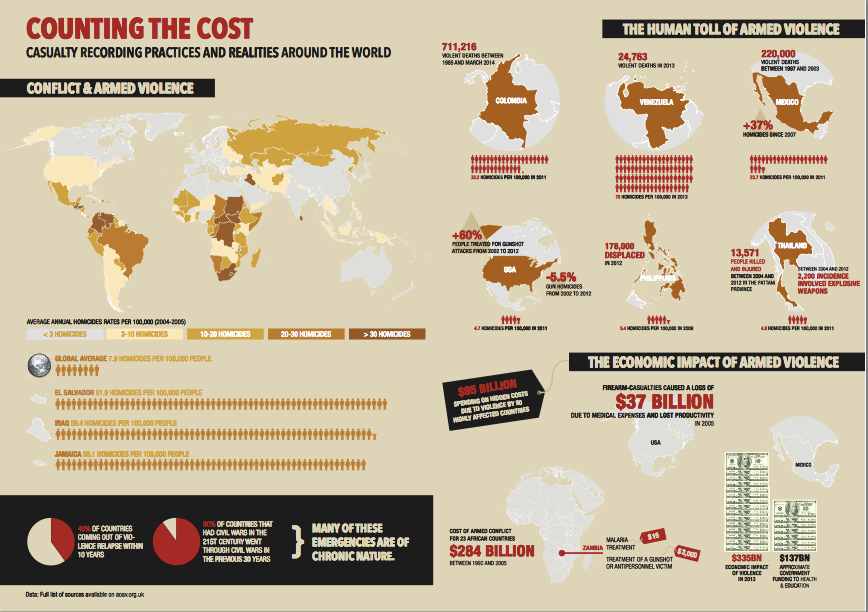
The report provided an analytical overview and a series of case studies (Colombia, Thailand and the Phillipines).

Counting the Cost Infographic

The second report is from the Oxford Research Group and is part of its Every Casualty program (see my post here).  In this report the ORG reviews the United Nations and Casualty Recording:

ORG-UN-and-CR Cover_1It concludes that when the UN systematically records the direct civilian casualties of violent conflict, and acts effectively on this information, this can help save civilian lives. However, casualty recording is not currently a widespread practice within the UN system.

The report recommends that the advancement of casualty-recording practice by the UN in conflict-affected countries should be pursued, as this would have clear benefits to the work of a range of UN entities, and so to the people that they serve.

This report looks at experiences of, and attitudes towards, casualty recording from the perspectives of UN staff based in New York and Geneva that we interviewed. It includes a case study of UN civilian casualty recording by the UN Assistance Mission in Afghanistan’s Human Rights unit. Finally, the report discusses challenges to UN casualty recording, and how these might be met.

Securing the volumes

More on war, police and the ‘security forces’ (see also herehere and here).  My copy of Mark Neocleous‘s  War power, Police power (Edinburgh, 2014) has just arrived, and I’m about to work my way through it (you can download the Introduction here).

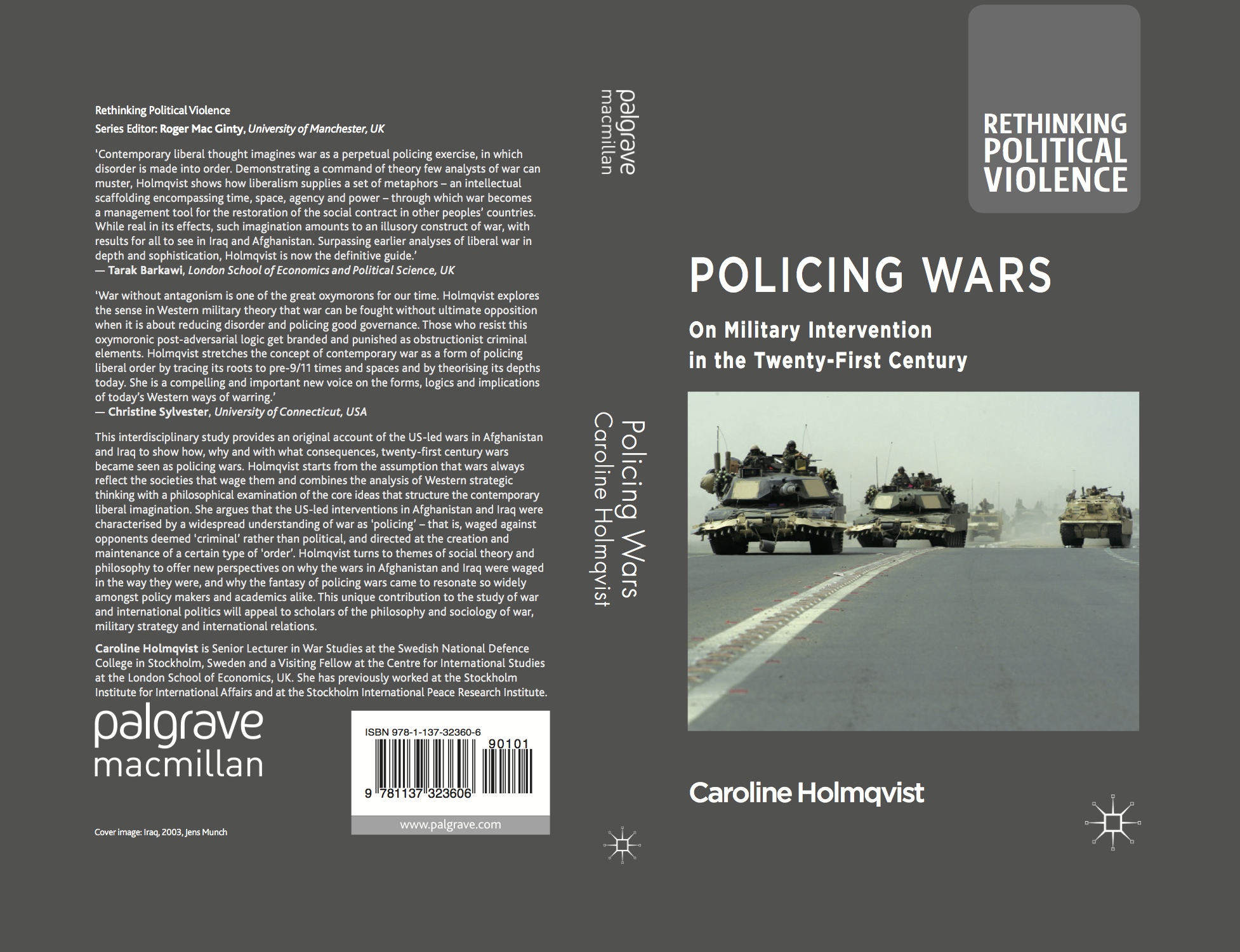
But I’ve just stumbled upon another new book, by Caroline Holmqvist – Policing Wars: On military intervention in the twenty-first century (Palgrave Macmillan, 2014) – that I obviously need to read in parallel.

COVER_POLICING_WARS-libre

I’ve referred to Caroline’s work before, and in case you can’t read the small print in the image above here’s the blurb:

This interdisciplinary study provides an original account of the US-led wars in Afghanistan and Iraq to show how, why and with what consequences, twenty-first century wars became seen as policing wars.  Holmqvist starts from the assumption that wars always reflect the societies that wage them and combines the analysis of western strategic thinking with a philosophical examination of the core ideas that structure the contemporary liberal imagination. She argues that the US-led interventions in Afghanistan and Iraq were characterised by a widespread understanding of war as ‘policing’ – that is, waged against opponents deemed ‘criminal’ rather than political, and directed at the creation and maintenance of a certain type of ‘order’. Holmqvist turns to themes of social theory and philosophy to offer new perspectives on why the wars in Afghanistan and Iraq were waged in the way they were, and why the fantasy of policing wars came to resonate so widely amongst policy makers and academics alike.