The Last Dance

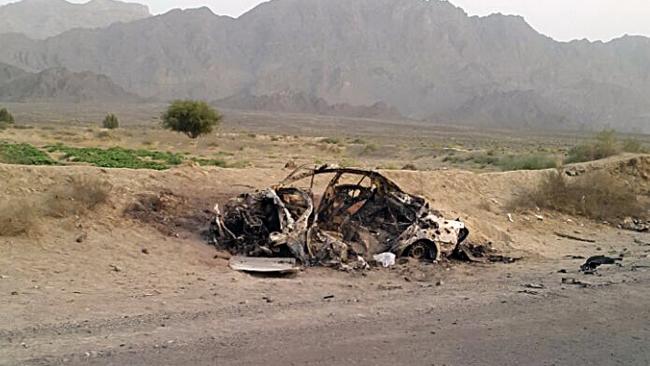
Mansour strike photo

I have – at long last – finished the longform version of “Dirty dancing: drones and death in the borderlands“, which analyses drone strikes in Pakistan’s Federally Administered Tribal Areas and situates them within a wider context of military violence in the region.  You can find it under the DOWNLOADS tab, but I’ve pasted the conclusion below; there’s also a video of the last presentation I gave under that title here.

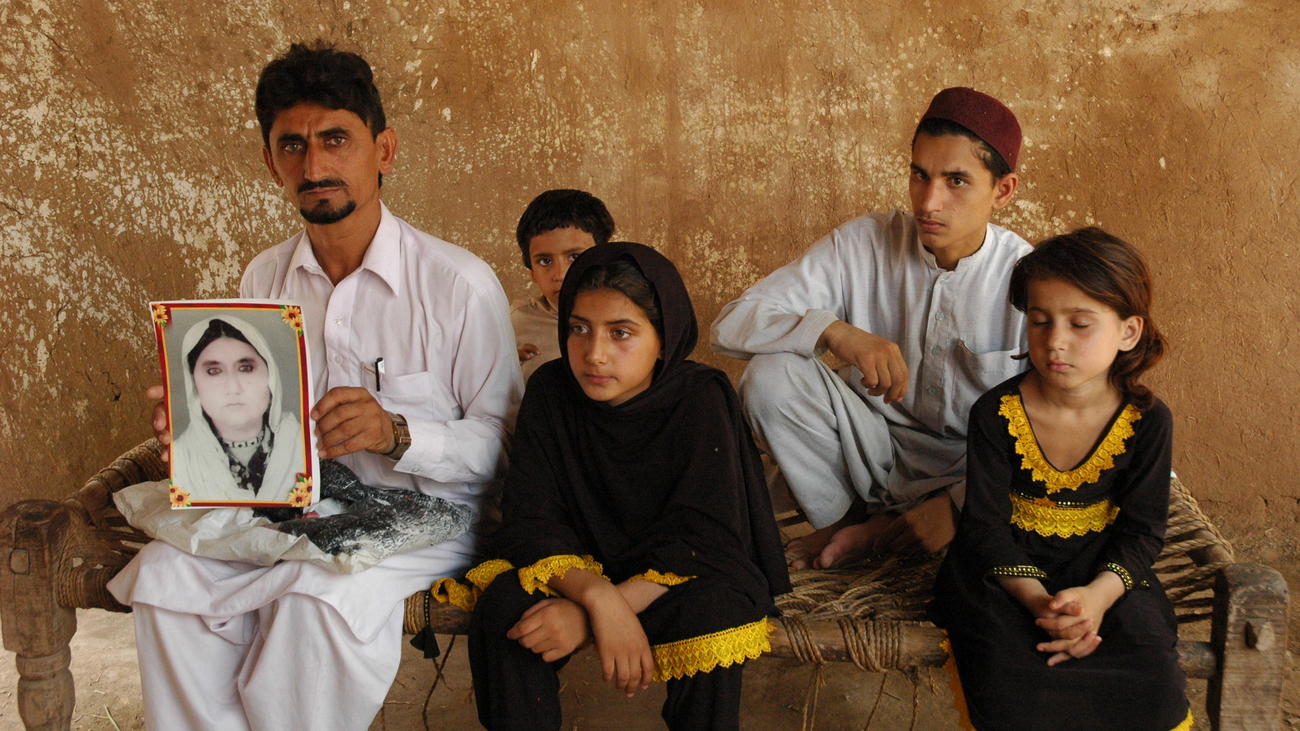
To make sense of the conclusion, I should explain that the essay opens by juxtaposing the killing of two people, Baitullah Mehsud (leader of the Pakistan Taliban) and Mamana Bibi (a village midwife), to pose the question: what kinds of spaces are the FATA made to be for incidents like these – incidents as unlike as these – to be possible?

My answer works with two framing devices.

The first is the space of exception – a space in which people are knowingly and deliberately exposed to death through the political-juridical removal of legal protections and affordances that would otherwise be available to them.  My version of this is different from that proposed by Giorgio Agamben, and far from invoking a suspension of the law I explore three legal geographies that have been used to prepare the ground for aerial violence in the borderlands.

The second is the space of execution; here I riff off Owen Sheers‘ perceptive remark about ‘the territory of the screen’ (as I note, ‘Killing somebody with a Hellfire missile controlled from thousands of miles away depends upon a screen – or more accurately a series of screens – on which the image of a human body will eventually be touched by the cross-hairs of a targeting pod’).  Owen’s phrase is much more than metaphor, so I treat ‘territory’ as a (bio)political technology whose calibrations enable states to assert, enact and enforce a claim over bodies-in-space (you can no doubt hear the echoes of Stuart Elden) and then explore the technicity involved in three of its screen elements that jointly transform the FATA into a space of execution: kill lists, signals intercepts and visual feeds.

***

Mamana Bibi's surviving family

Here, then, is the conclusion:

The production of the borderlands as spaces of exception and spaces of execution are attempts to force those who live there into particular subject-positions as a means of subjugation. These positions are partial and precarious but the project to establish them as legitimate and rational has consequences that are material and affective. They clearly affect those targeted – people like Baitullah Mehsud – whose political agency exceeds in terrifying ways the normative space allowed them by the state of Pakistan and the United States and in so doing brings their actions to the attention of both. But they also impact the rest of the population in the FATA, constricting their mobilities and stoking their fears to such a degree that ‘normal life’ for many of them threatens to become a memory or a fantasy. Their existence is rendered more precarious because the subject-positions to which they are so brutally assigned are racialized. These are ‘tribal peoples’, different from those who inhabit ‘mainland Pakistan’, while the United States writes off their incidental deaths as ‘collateral damage’ whose anonymity confers on them no individuality only a collective ascription. When a CIA-directed drone strike on a compound in the Shawal Valley of South Waziristan on 15 January 2015 was found to have killed not only a deputy leader of al-Qaeda in the Indian subcontinent and a local Taliban commander but also two hostages, an American development contractor and an Italian aid worker, a ‘grim-faced’ and ‘visibly moved’ Obama made a personal and public apology. [i] The rarity of the gesture is revealing. For the value of their lives was acknowledged and their deaths were made grievable in ways that others – which is to say Others – were not. Nobody has ever accepted responsibility or apologised for the death of Mamana Bibi or any of the other innocent victims of aerial violence.

For this reason it is important to resist those versions of the space of exception that are complicit in the denial of agency to those who live within its confines. The state of Pakistan administers the inhabitants of the FATA through Political Agents: but this does not remove (though it does diminish) their own political agency. Pakistan’s armed forces conduct clearing operations that ruthlessly drive people from their homes and into camps for displaced persons: but this does not turn the FATA into one vast ‘camp’. The presence of US drones strips those who live under them of their well-being and dignity: but this does not reduce them to ‘bare life’. Similarly, the emergent subject that is produced within the space of execution, apprehended as a network trace, a sensor signature and a screen image, is a cipher that stands in for – and in the way of – a corporeal actor whose existence is not measured by the calculative alone.

***

This version, or something very much like it, will appear in a collection edited by Caren Kaplan and Lisa Parks, Life in the Age of Drones.  But an (even longer!) version will eventually appear in my own book, with images and maps (you can find many of them scattered through my previous posts: for example here, here and here), so I really would welcome any comments or suggestions if you have time to read the full thing: derek.gregory@ubc.ca.


The Body of War

Here is a call for papers for a wonderfully creative international symposium, The Body of War: Drones and Lone Wolves,  to be held at the University of Lancaster  on 24-25 November 2016.  It’s part of the ongoing States of Exceptions project (for Part I, see here).

I’ve just agreed to give a keynote; it’s an interdisciplinary event, and the organisers tell me they are keen to encourage the participation of early career scholars.

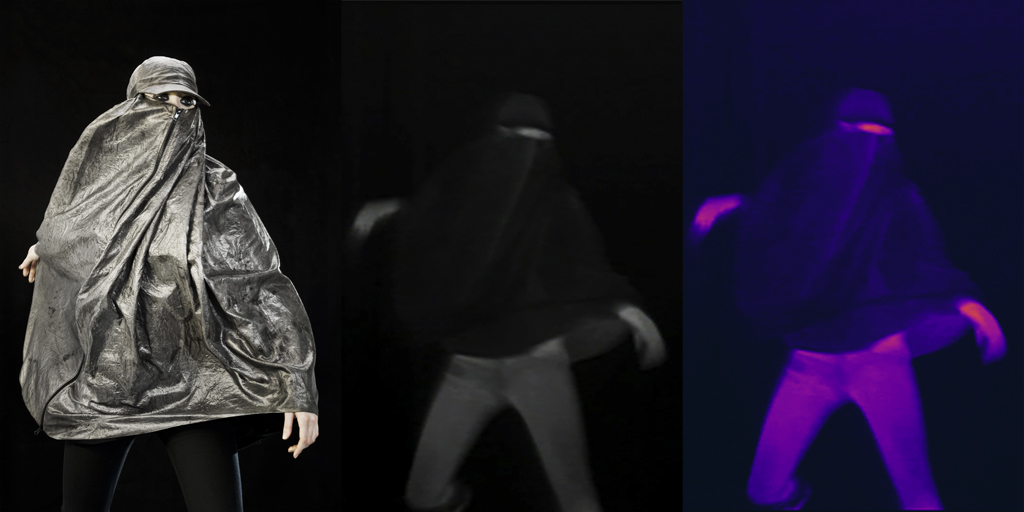
Anti-drone Burqa (Adam Harvey)

Anti-drone Burqa (Adam Harvey)

“The discriminatory concept of the enemy as a criminal and the attendant implication of justa causa run parallel to the intensification of the means of destruction and the disorientation of theaters of war. Intensification of the technical means of destruction opens the abyss of an equally destructive legal and moral discrimination. […] Given the fact that war has been transformed into a police action against troublemakers, criminals, and pests, justification of the methods of this “police bombing” must be intensified. Thus, one is compelled to push the discrimination of the opponent into the abyss.”

Carl Schmitt, The Nomos of the Earth (1950)

13 November 2015: three suicide bombers blew themselves up near the Stade de France in Saint-Denis, Paris, killing themselves and a bystander, and triggering a series of violent actions that caused 130 casualties. 15 November 2015: the President of France, François Hollande, after defying the attacks ‘an act of war’ by the Islamic State, launched a three-month state of emergency and ‘Opération Chammal’, a huge airstrike campaign against ISIL targets in Syria.

These two violent actions design a deformed and limitless theater of war, within which all distinctions and limitations elaborated by International Law seem to disappear. It is not merely the loss of the fundamental distinction between combatants and civilians, that both suicide bombers and airstrike bombings signal. In the current situation, all the fundamental principles that gave birth to the Laws of War seem to collapse: spatial and temporal limitations of hostilities, proportionality of military actions, discrimination of targets, weapons and just methods to use them. In this way, the ‘enemy’, from a juridical concept, is transformed into an ‘ideological object’; his figure, pushed to a climax from both these ‘invisible’ and ‘mobile’ fronts, becomes absolute and de-humanized. Hollande, Cameron and Obama’s unwillingness to use ground troops against the ‘uncivilized’ (Kerry 2015) is mirrored by the ISIL call to intensify suicide missions against the ‘cowards’ (Dābiq, 12: 2015).

But what lies behind the asymmetric confrontation between airstrikes and ‘humanstrikes’, behind the blurring of the distinction between the state of war and state of peace? What notion of humanity are the physical disengagement of the Western powers (with their tele-killing via drones and airstrikes) and the physical engagement of suicide bombers (ready to turn their bodies into a weapon) trying to convey? In other words, how and to what extent is there a connection between the automatization and biopoliticization of war operated by Western powers and the sacrificial nature of the conflict adopted by those who want to fight these powers?

In this second part of the “States of Exceptions” project, our intention is to explore these questions in order to map the crucial transformations of warfare, of its ethical principles and methods of engagement.

We invite potential participants to submit abstracts of no more than 250 words by 31 July 2016 drawing upon, but not limited to, such issues as:

  • Theatres of War: The New Spatialities and Temporalities of Warfare
  • Mirror Images? Drones vs. Suicide Bombers
  • Phenomenology of Drones
  • New Perspectives on Ethics, Horror & Terror
  • The Ubiquity of the Enemy: Lone Wolves and Self-Representing Terror
  • The Collapse of International Law: What Enemy? Which Proportionality?
  • The Body as a Weapon: The Immanentization of Martyrdom
  • Phenomenology of Lone Wolves
  • The End of Law: Rethinking Limitation, Proportionality and Discrimination

Please send abstracts with “States of Exception II” in subject line to bisagroup.cript@gmail.com

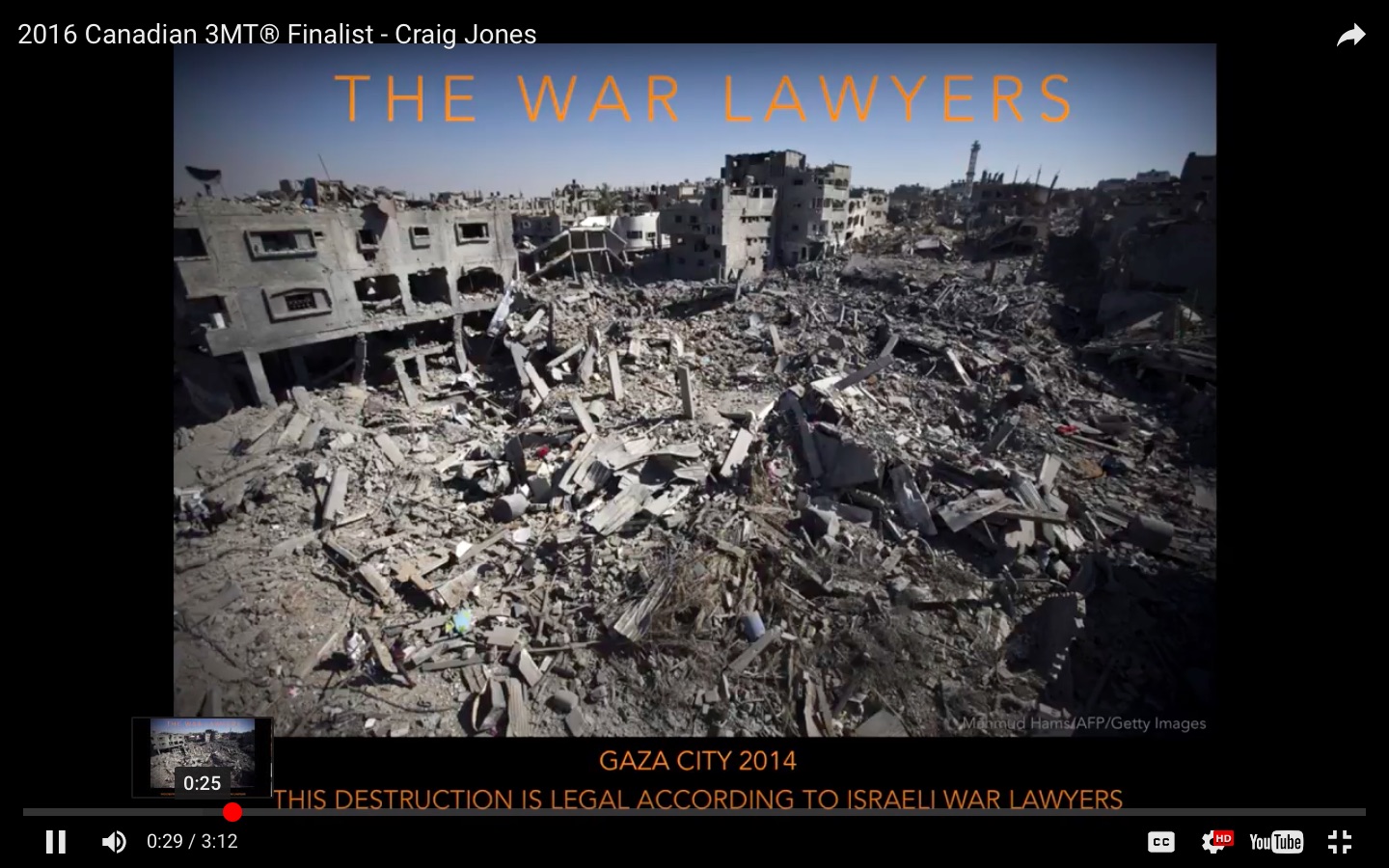
The war lawyers

If you have three minutes to spare, want to know how the incorporation of military lawyers into the so-called ‘kill-chain’ affects the conduct of later modern war by the United States and the Israeli military, and want a master-class in presentation watch Craig Jones‘ video on The War Lawyers here (scroll down).

Craig War Lawyers JPEG

This comes from Canada’s Three Minute Thesis (3MT) competition, in which graduate students present their thesis in just three minutes.  There are all sorts of rules and restrictions – not least in the use of graphics, in which Craig excels too – but the result is none the less remarkable.  Craig aced UBC’s 3MT competition on 10 March, where he competed against 100 other graduate students and also won the People’s Choice Award, and went on to win the Western Canada final on 29 April; the national final takes place online (you can vote here until 19 May), and Craig will also represent UBC in the Universitas 21 International 3MT competition in the fall.

I don’t know how long that video will be up, so in case it should disappear I’ve embedded Craig’s first presentation (at UBC) from YouTube below:

Craig’s thesis will be submitted during the summer, and from what I’ve read so far it will be a major book in very short order.  Meanwhile if you don’t know his work you can find out more at his blog War, law, space; you can also access a number of his papers there (under his DOWNLOADS tab), including ‘Frames of law: targeting advice and operational law in the Israeli military’, Society & Space 33 (4) (2015) 676-96 [from the special issue on ‘War, law and space’ Craig co-edited with Michael Smith] and  ‘Lawfare and the juridification of late modern war’, Progress in human geography 40 (2) (2016) 221-239.

Rights and REDACTED

AFGHANISTAN-US-UNREST

At Just Security the debate over the US air strike on the MSF Trauma Centre in Kunduz (see here and here) rumbles on, specifically around whether acknowledged violations of international humanitarian law (‘the laws of war’) constitute war crimes (see my previous post here).  The latest contribution is from Adil Ahmad Haque and it is extremely helpful.

But I’m struck by its title: ‘What the Kunduz report gets right (and wrong).‘  I’ve now read the report several times, and am working on my own commentary: but it turns out to be extremely difficult to know what the report gets right or wrong.

I say this having read multiple Investigation Reports, known collectively as Army Regulation 15-6 Reports, into civilian casualties caused by US military action.  They vary enormously in quality – the scope of the questions and the depth of the analysis – and in what has been released for public inspection.   Of all those that I have read, the report into the Uruzgan air strike in February 2010 that I discuss in ‘Angry Eyes‘ (here and here; more to come) now seems a model to me (see also here).

It’s redacted, but it includes real-time transcripts of radio communications between the aircrews and the ground force commander through his Joint Terminal Attack Controller, and after action transcripts of (sometimes highly combative) interviews with the principals involved.  In Kill-chain, Andrew Cockburn reports that the first act of the Investigating Officer, Major-General Timothy McHale, was to fly to the hospital where the wounded were being treated, and six weeks later he and his team had created ‘a hand-drawn time-line of the events that ultimately stretched for sixty-six feet around the four walls of the hangar he had commandeered for his office.’

This is very different from the unclassified version of the report into the Kunduz incident.  The investigation was headed by Major-General William Hickman, with two Assistant Investigating Officers – Brigadier-General Sean Jenkins and Brigadier-General Robert Armfield – supported by an unidentified Legal Advisor and five unidentified subject matter specialists in Special Operations; Intelligence, Surveillance and Reconnaissance;  AC-130 Aircrew Operations (this was the gunship that carried out the attack); Joint Targeting; and JTAC Operations.

The final report with its annexes reportedly runs to 3,000 pages, but the released version is much slimmer.   It has been redacted with a remarkably heavy hand.  I understand why names have been redacted – they were in the Uruzgan case too – but to remove all direct indications of rank or role from the various statements makes interpretation needlessly burdensome.

Some redactions seem to have been made not for reasons of security or privacy but to save embarrassment.  For example: from contextual evidence I suspect that several references to ‘MAMs’ or ‘military-aged males’ – a term that was supposedly removed from US military vocabulary – have been excised, but some have escaped the blunt red pencil.  On page after page even the time of an event has been removed: this is truly bizarre, since elsewhere the report is fastidious in fixing times and, notably, insists that the aircraft fired on the Trauma Center for precisely ‘30 minutes and 8 seconds’. The timeline matters and is central to any proper accounting for what happened: why suppress it?

Again in stark contrast to the Uruzgan report, the public version of the Kunduz report includes remarkably few transcriptions of the ‘extensive interviews’ its authors conducted with US and Afghan personnel or with MSF officials – too often just terse memoranda summarising them.

The AC-130 video has been withheld from public scrutiny – this was done in the Uruzgan case too – but, apart from a few selected extracts, the audio transcripts that were central to the Uruzgan case have been omitted from this one as well: and they are no less vital here.

Even if we bracket understandable concerns about the US military investigating itself, how can the public have any confidence in a report where so much vital information has been excluded?  If the military is to be accountable to the public that it serves and the people amongst whom (and for whom) it fights, then its accounts of incidents like this need to be as full and open as security and privacy allow.  Otherwise we pass into an Alice-in-Wonderland world where the Freedom of Information Act becomes a Freedom of Redaction Act.

As you’ll see, I’ll have more questions about the substance of the report when I complete my commentary.

War crimes

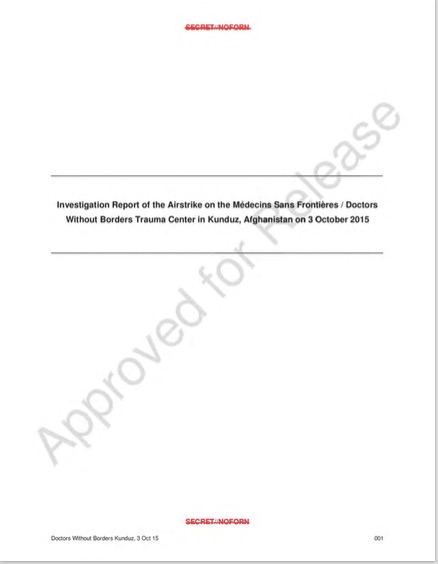
Kunduz MSF report cover JPEG

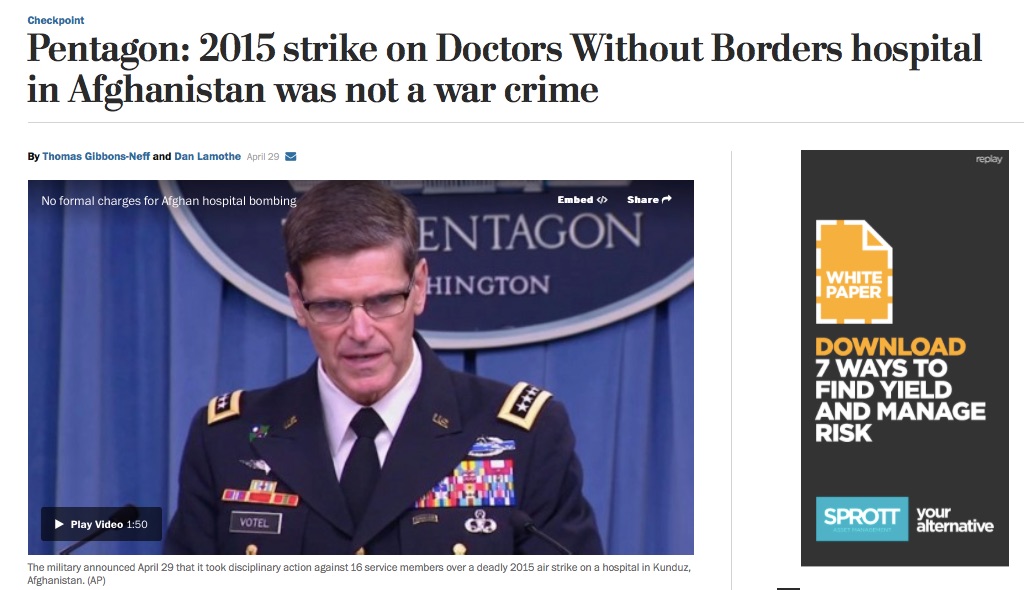
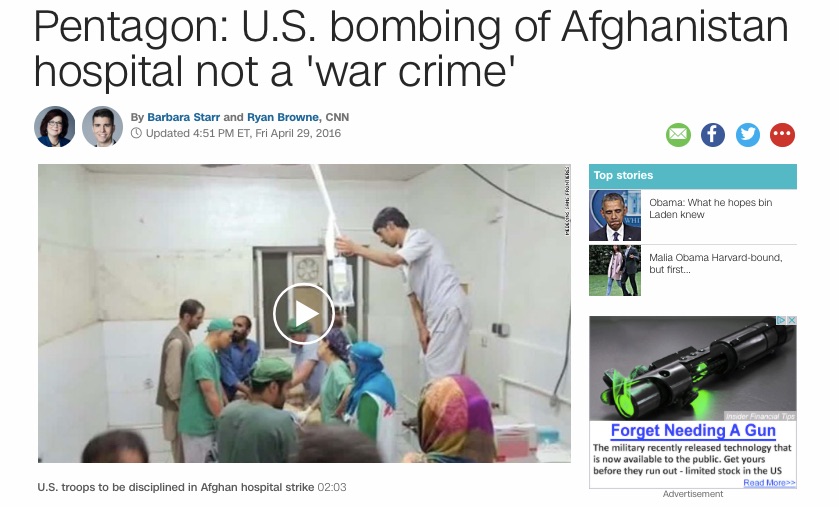
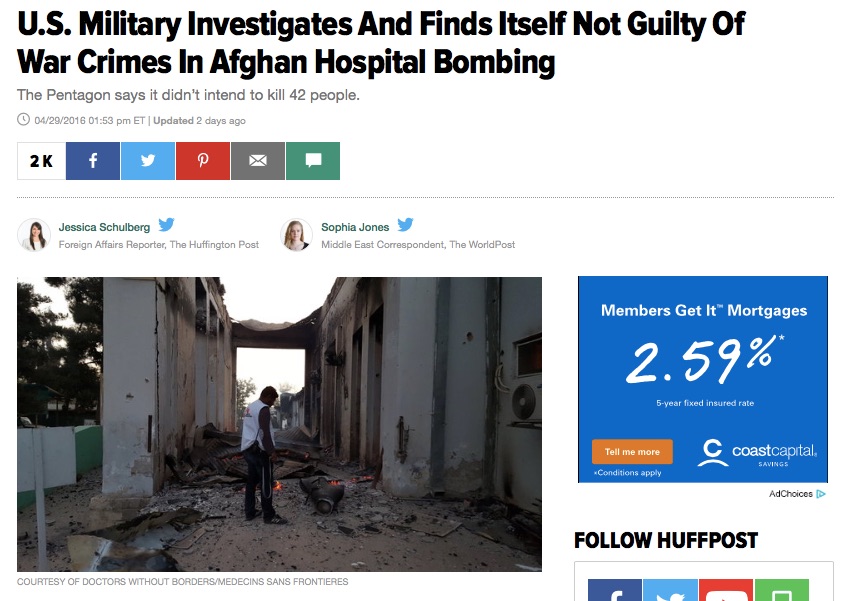
In my preliminary commentary on the US military investigation into the air strike on MSF’s trauma centre in Kunduz in October 2015 – and I’ll have much more to say about that shortly – I circled around the Pentagon’s conclusion that even though those involved in the incident had clearly violated international humanitarian law (‘the laws of war’) and the Rules of Engagement no war crimes had been committed.

That conclusion has sparked a fire-storm of protest and commentary, and to track the narrative I’ve transferred some of my closing comments from that post to this and continued to follow the debate.  (It’s worth noting that when the Pentagon published its updated Law of War Manual last year it produced an equally heated reaction – much of it from commentators who complained that its provisions hamstrung commanders and troops in the field: see here and scroll down).

Not a war crime 3 JPEG

At Just Security Sarah Knuckey and two of her students complained that the report provided no justification for such a claim. After listing the gross violations of IHL (failure to take precautions in an attack, failure to distinguish between civilians and combatants, failure to respect the requirement of proportionality), they concluded:

While it is legally correct to state that the war crime of murder requires an “intent” to kill a protected person (e.g., a civilian), nowhere in the 120-page report is there an analysis of the legal meaning of “intention.” The report actually makes no specific or direct findings about war crimes. (“War crime” appears only once, in reference to a report by the United Nations Assistance Mission in Afghanistan) [Here I should note that UNAMA’s view of what constitutes a war crime has on occasion changed with the perpetrator.  As this commentary shows, the Taliban have sometimes been held to a higher standard than the US military: in one case UNAMA suggested that the very use of high explosives in an urban area ‘in circumstances almost certain to cause immense suffering to civilians’ rendered the Taliban guilty of war crimes, whereas after the Kunduz air strike UNAMA declared that ‘should an attack against a hospital be found to have been deliberate, it may amount to a war crime’ (emphasis added)] .

Under international law, “premeditation” is not necessary for the war crime of murder, but the precise scope of intention is less clear. Numerous cases have stated that genuine mistakes and negligence are insufficient for murder. But a number of international cases and UN-mandated inquiries have found that “recklessness” or “indirect intent” could satisfy the intent requirement. Article 85 of Additional Protocol I also provides that intent encompasses recklessness. (See The 1949 Geneva Conventions: A Commentary, from page 449, for a full discussion.)

The investigation released today makes clear that US forces committed numerous violations of fundamental rules of the laws of war, violations which should and could have been avoided. Yet the report provides zero direct analysis of whether these violations amounted to war crimes. Given the seriousness of the violations committed, the US should specifically explain why the facts do not amount to recklessness, and explain the legal tests applied for the commission of war crimes.

Not a war crime 1 JPEG

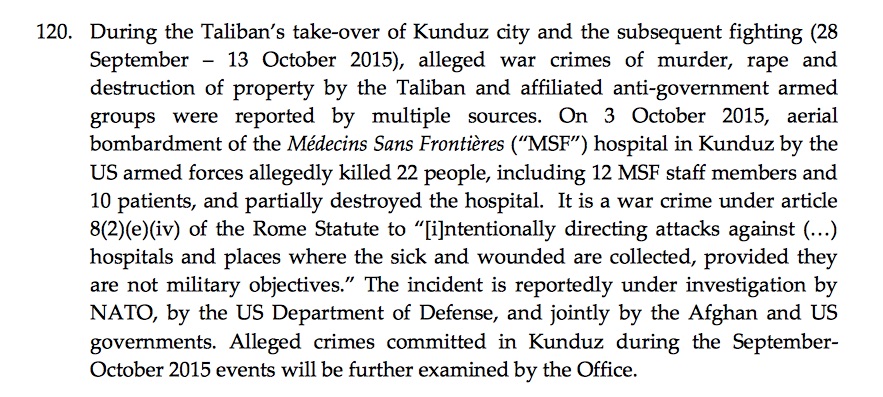
Over at Lawfare, Ryan Vogel argues that the report will ‘will surely attract the attention of the International Criminal Court’s (ICC) Office of the Prosecutor (OTP)’. In fact, while the OTP has acknowledged

that the strike was being investigated by the United States [it has also] declared that “the [a]lleged crimes committed in Kunduz [would] be further examined by the Office” as part of the ongoing preliminary examination [see extract below]. By characterizing the incident as a violation of international law (and choosing not to prosecute), the United States may unwittingly be strengthening the OTP’s case. It is true that CENTCOM’s release statement makes clear that the investigation found that the actions of U.S. personnel did not constitute war crimes, noting the absence of intentionality. But the OTP might disagree with CENTCOM’s legal rationale, as it seems to have done previously with regard to detention operations, and decide to investigate these acts anyway as potential war crimes.

ICC 2015 JPEG

As both commentaries make clear, much hangs on the interpretation of ‘intentionality’.  At Opinio Juris the ever-sharp Jens David Ohlin weighs in on the question.  Drawing from his essay on ‘Targeting and the concept of intent‘, he notes:

The word “intentionally” does not have a stable meaning across all legal cultures. … [It] is generally understood in common law countries as equivalent to purpose or knowledge, depending on the circumstances. But some criminal lawyers trained in civil law jurisdictions are more likely than their common law counterparts to give the phrase “intentionally” a much wider definition, one that includes not just purpose and knowledge but also recklessness or what civilian lawyers sometimes call dolus eventualis.

He concludes that the consequences of the latter, wider interpretation would be far reaching:

If intent = recklessness, then all cases of legitimate collateral damage would count as violations of the principle of distinction, because in collateral damage cases the attacker kills the civilians with knowledge that the civilians will die. And the rule against disproportionate attacks sanctions this behavior as long as the collateral damage is not disproportionate and the attack is aimed at a legitimate military target. But if intent = recklessness, then I see no reason why the attacking force in that situation couldn’t be prosecuted for the war crime of intentionally directing attacks against civilians, without the court ever addressing or analyzing the question of collateral damage. Because clearly a soldier in that hypothetical situation would “know” that the attack will kill civilians, and knowledge is certainly a higher mental state than recklessness. That result would effectively transform all cases of disproportionate collateral damage into violations of the principle of distinction and relieve the prosecutor of the burden of establishing that the damage was indeed disproportionate, which seems absurd to me.

His solution is to call for the codification of  ‘a new war crime of recklessly attacking civilians, and the codification of such a crime should use the word “recklessly” rather than use the word “intentionally.”’  This would then  ‘create a duty on the part of attacking forces and then penalize them for failing to live up to it.’  And this, he concludes, would allow a prima facie case to be made that those involved in the attack on the Kunduz trauma centre were guilty – but in his view, clearly, they also escape under existing law.

Not a war crime 2 JPEG

Note those five, deceptively simple words: ‘those involved in the attack’.  I’ve had occasion to comment on this dilemma before – the dispersal of responsibility that is a characteristic of later modern war (see also here: scroll down) – and Eugene Fiddell, writing in the New York Times, clearly dismayed at the way in which the military inquiry was conducted, sharpens the same point:

Among the challenges a case like Kunduz presents is how to achieve accountability in an era in which an attack on a protected site is not the act of an isolated unit or individual. In today’s high-tech warfare, an attack really involves a weapons system, with only some of the actors in the aircraft, and others — with real power to affect operations — on the ground, in other aircraft, or perhaps even at sea.

And what if some of those ‘actors’ are algorithms and/or machines?

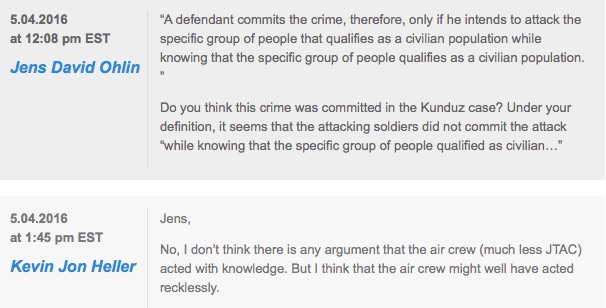
UPDATE:  Kevin Jon Heller offers this counter-reading to Jens’s:

As I read it, the war crime of “intentionally directing attacks against a civilian population” consists of two material elements: a conduct element and a circumstance element. (There is no consequence element, because the civilians do not need to be harmed.) The conduct element is directing an attack against a specific group of people. The circumstance element is the particular group of people qualifying as a civilian population. So that means, if we apply the default mental element provisions in Art. 30, that the war crime is complete when (1) a defendant “means to engage” in an attack against a specific group of people; (2) that specific group of people objectively qualifies as a civilian population; and (3) the defendant “is aware” that the specific group of people qualifies as a civilian population. Thus understood, the war crime requires not one but two mental elements: (1) intent for the prohibited conduct (understood as purpose, direct intent, or dolus directus); (2) knowledge for the necessary circumstance (understood as oblique intent or dolus indirectus).

Does this mean that an attacker who knows his attack on a military objective will incidentally but proportionately harm a group of civilians commits the war crime of “intentionally directing attacks against a civilian population” if he launches the attack? I don’t think so. The problematic element, it seems to me, is not the circumstance element but the conduct element: although the attacker who launches a proportionate attack on a legitimate military objective knows that his attack will harm a civilian population, he is not intentionally attacking that civilian population. The attacker means to attack only the military objective; he does not mean to attack the group of civilians. They are simply incidentally — accidentally — harmed. So although the attacker has the mental element necessary for the circumstance element of the war crime (knowledge that a specific group of people qualifies as a civilian population) he does not have the mental element necessary for its conduct element (intent to attack that specific group of people). He is thus not criminally responsible for either launching a disproportionate attack or intentionally directing attacks against a civilian population.

It’s a sharp reminder that international humanitarian law offers some protections to civilians but still renders their killing acceptable.  The exchange between Kevin and Jens continues below the line to this conclusion:

Opinio Juris JPEG

But if you read Charles Dunlap at Lawfire (sic), you will find him insisting that the mistakes made by the US military in firing on the MSF hospital ‘do not necessarily equate to criminal conduct’ – even though the investigation report concedes that they amounted to violations of international law – and that the charge of recklessness needs to be laid at the smashed-in door of MSF.  Really.  Here is what he says:

Had, for example, the hospital been marked with large Red Crosses/Red Crescents or one of the other internationally-recognized symbols (as the U.S. does) or something that would make its protected use clear from the air, isn’t it entirely plausible that the aircrew (or someone) might have recognized the error and stopped the attack before it began?

There were in fact two large MSF flags on the roof of the Trauma Centre, which was also one of the few buildings in the city on that fateful night to have been fully illuminated (from its own generator).

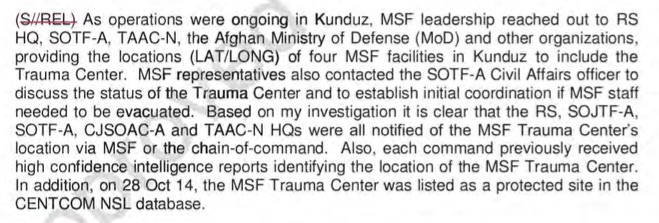
But in case you are still wondering about the responsibility borne by MSF – as ‘one of the few international humanitarian organisations that carries professional liability insurance’ (in contrast to amateur insurance, I presume), Dunlap says that is an admission that ‘even honest, altruistic, and well-intended professionals do make mistakes, even tragic ones, especially when trying to operate in the turmoil of a war zones’,  here is a paragraph from that investigation report:

MSF reach-out JPEG

How reckless was that?  The crew of the gunship that carried out the attack – in case you are still wondering – ‘specifically did not have any charts showing no strike targets or the location of the MSF Trauma Center.’

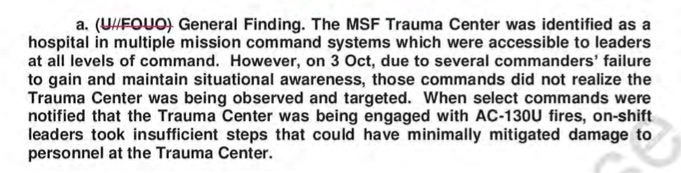
And if you picked up on Dunlap’s suggestion that if not the aircrew then ‘someone’ might have recognised the error, try this for size from the same source (and note especially the last sentence):

Multiple command failures JPEG

More to come.

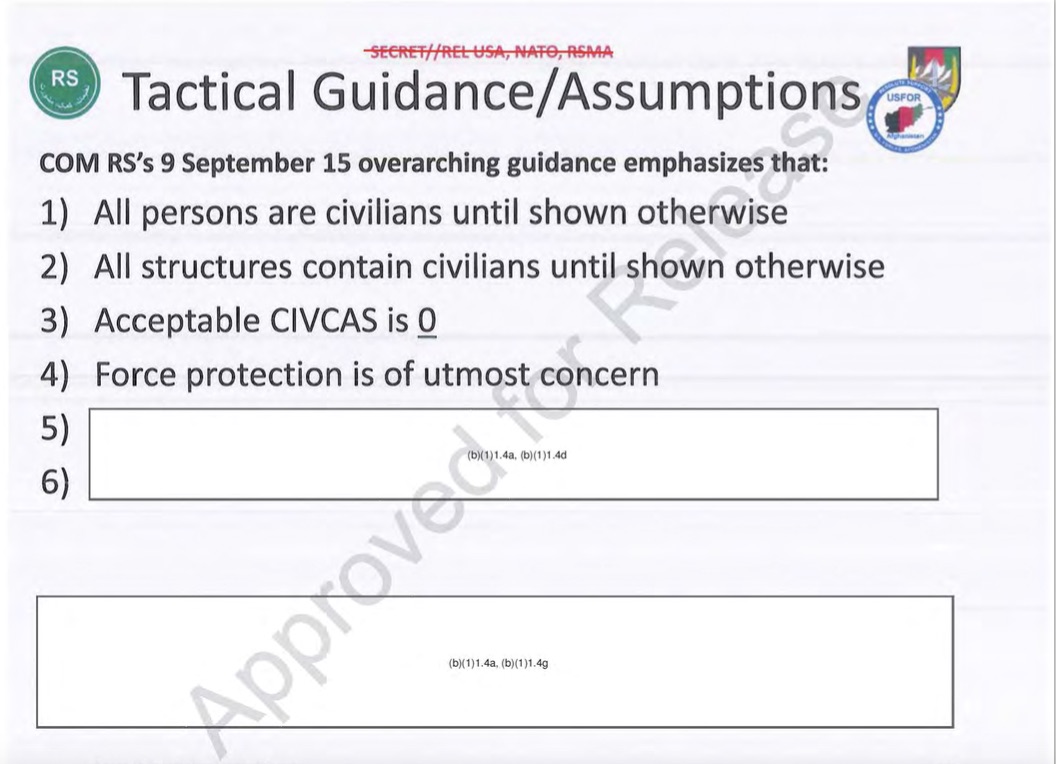
‘Acceptable CIVCAS is 0’

Kunduz 0 Extract JPEG

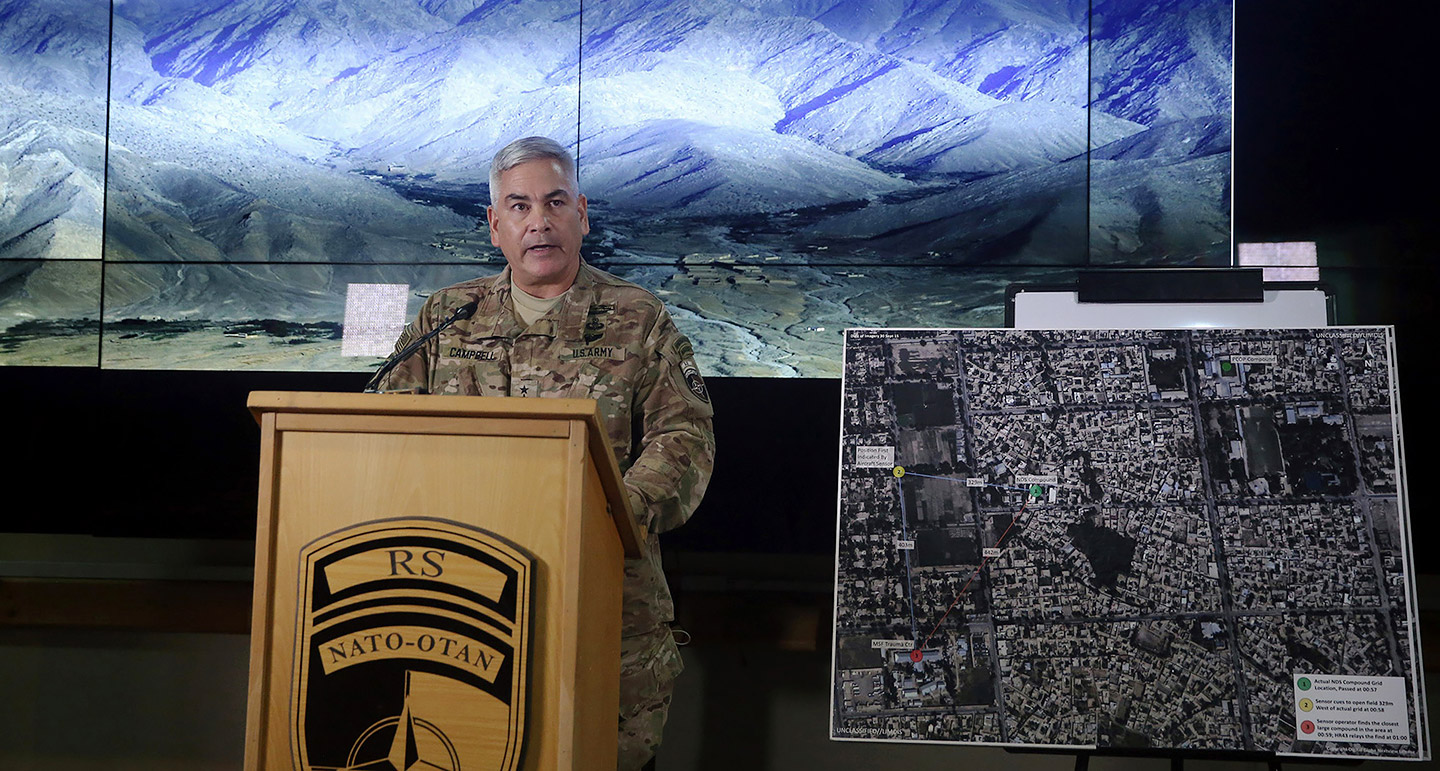
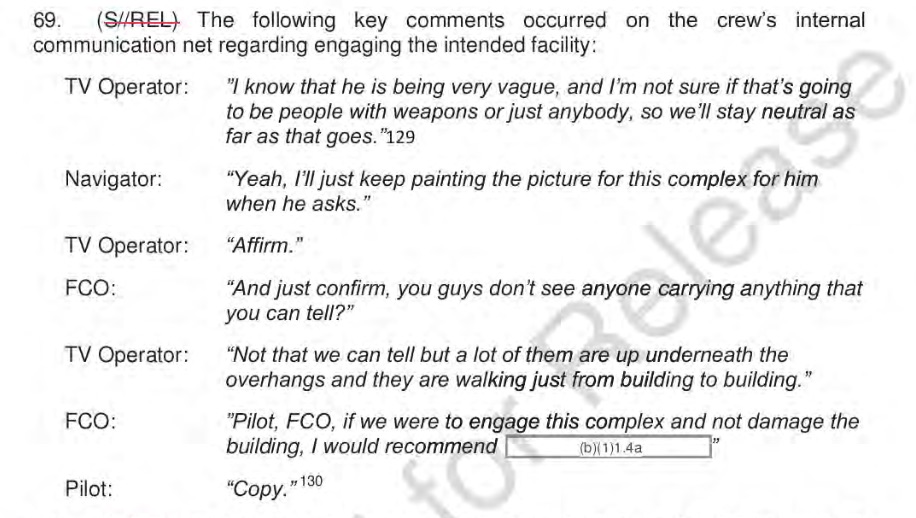
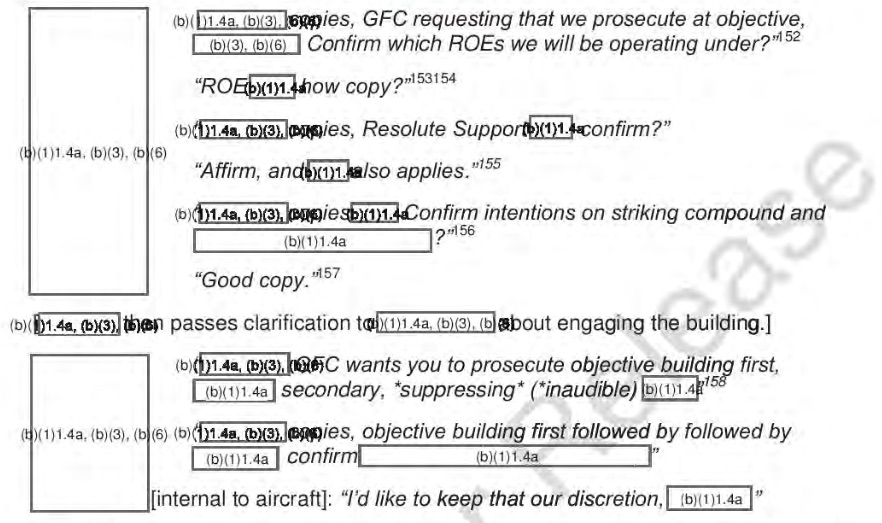
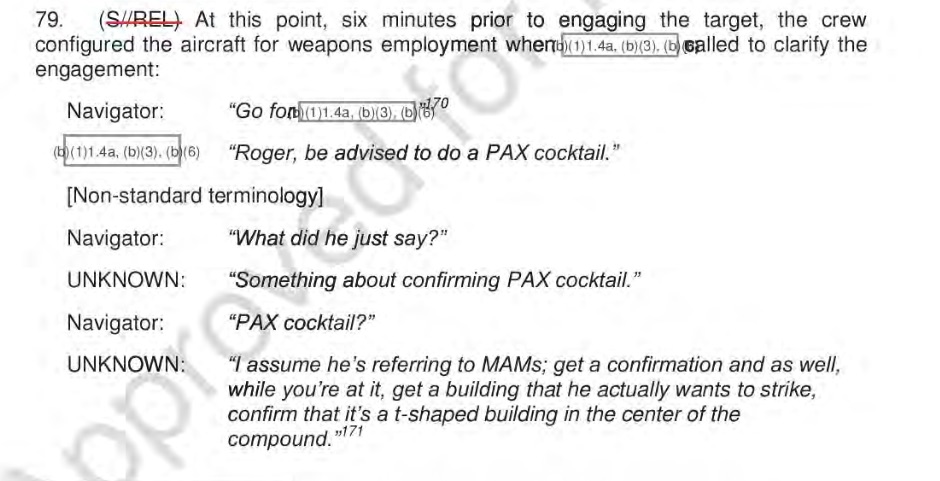
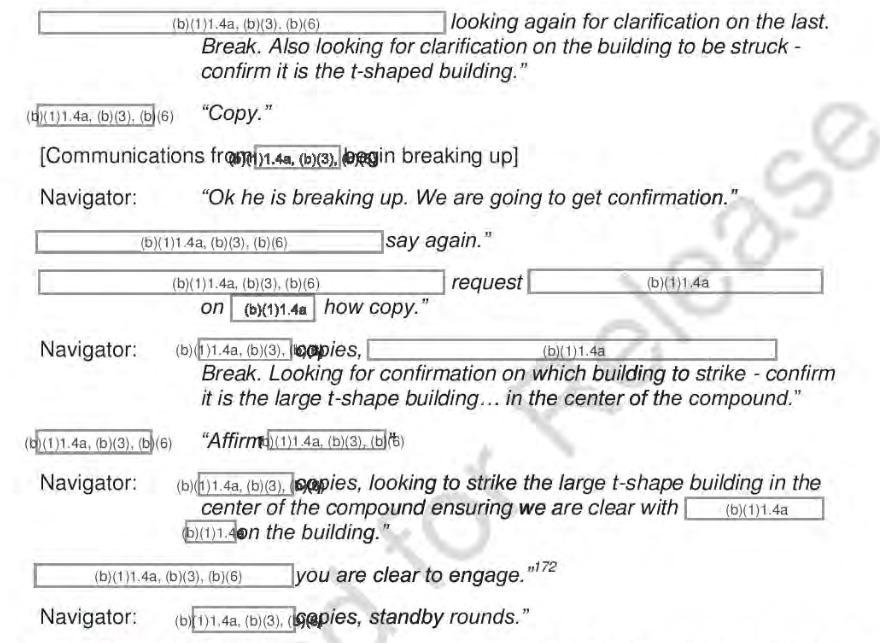
Finally US Central Command has released a redacted version of its investigation into the US airstrike on MSF’s Trauma Center in Kunduz (see my posts here, here and especially here).  You can download it from CENTCOM’s Freedom of Information Act library here.  (All the extracts pasted below capture communications exchanges before the attack, but the report includes redacted interviews with the participants involved in clearing, executing and continuing the air strike; the image above – and the title for this post – is taken from a briefing slide included in the report).

Kunduz A extract JPEG

I’ll be spending the weekend reading it, but meanwhile the Intercept has published its own long-form account of the attack by May Jeong – ‘Death from the sky: searching for ground truth in the Kunduz hospital bombing‘.  It was written before CENTCOM’s investigation was released but includes details from a series of interviews and is truly compelling reading.

Kunduz B extract JPEG

I obviously won’t be alone in working my way through the report.  Yesterday MSF was briefed by the head of CENTCOM, General Joseph Votel, and today released this preliminary statement:

MSF will take the time necessary to examine the U.S. report, and to determine whether or not the U.S. account answers the many questions that remain outstanding seven months after the attack.

MSF acknowledges the U.S. military’s efforts to conduct an investigation into the incident. Today, MSF and other medical care providers on the front lines of armed conflicts continually experience attacks on health facilities that go un-investigated by parties to the conflict. However, MSF has said consistently that it cannot be satisfied solely with a military investigation into the Kunduz attack. MSF’s request for an independent and impartial investigation by the International Humanitarian Fact Finding Commission has so far gone unanswered….

The hospital was fully functioning at the time of the airstrikes. The U.S. investigation acknowledges that there were no armed combatants within – and no fire from – the hospital compound.

The nature of the deadly bombing of the MSF Kunduz Trauma Centre, and the recurring attacks on medical facilities in Afghanistan, demand from all parties to the conflict a clear reaffirmation of the protected status of medical care in the country. MSF must obtain these necessary assurances in Afghanistan before making any decision on if it is safe to re-start medical activities in Kunduz.

Kunduz C extract JPEG

The Pentagon has insisted that no war crimes were committed but confirmed that 16 people had been punished.  Mark Thompson explains:

None of those involved will face court martial, but the administrative punishments levied against them—ranging from removal from command, letters of reprimand, to counseling—likely mark the end of their careers in uniform. None was identified by name. Those involved—the highest-ranking was a two-star general—included those aboard the AC-130 gunship that repeatedly fired on the Doctors Without Borders hospital in Kunduz, as well as members of the Army Special Force team on the ground that called in the strikes.

MSF has, understandably, condemned this response, arguing that the punishments

are out of proportion to the destruction of a protected medical facility, the deaths of 42 people, the wounding of dozens of others, and the total loss of vital medical services to hundreds of thousands of people. The lack of meaningful accountability sends a worrying signal to warring parties, and is unlikely to act as a deterrent against future violations of the rules of war.

That last sentence is particularly important, because there has been a steady increase in the targeting of medical personnel and medical facilities in Afghanistan, occupied Palestine, Syria and elsewhere: all gross violations of medical neutrality.

Kunduz D extract JPEG

So this commentary from Joanne Liu (International President of MSF) and Peter Maurer (President of the International Committee of the Red Cross) – also published today – is much more than a response to the bombing of yet another MSF facility, this time in Aleppo:

What we are witnessing is a sustained assault on, and massive disregard for, the provision of healthcare during times of conflict. Under international humanitarian law and principles, health workers must be able to provide medical care to all sick and wounded regardless of political or other affiliation, whether they are a combatant or not. And under no circumstances should they be punished for providing medical care which is in line with medical ethics. The doctor of your enemy is not your enemy.

But we are confronted with violations of these fundamental rules, with serious humanitarian consequences, for entire communities and healthcare systems that are already stretched to the limit. And this is not just the opinion of MSF and the Red Cross Red Crescent Movement.

That is why we, as the presidents of MSF and the ICRC, welcome the proposal for a landmark UN resolution to protect healthcare. But we urge the UN security council to make the resolution effective. First, it should send a powerful political message that healthcare needs to be protected. All parties to an armed conflict must fully comply with their obligations under international law, including humanitarian law. And they must clearly state their respect for the delivery of impartial medical care during times of conflict.

Second, it must urge states and all parties to armed conflict to develop effective measures to prevent violence against medical personnel, facilities and means of transport. States need to bolster, where appropriate, their legislation including by lifting restrictions and sanctions impeding impartial wartime medical care.

Armed forces and all parties to a conflict should integrate practical measures for the protection of the wounded and sick and for those engaged in medical work. These should be incorporated into orders, rules of engagement, standard operating procedures and training.

Third, it must acknowledge that when attacks on medical facilities and personnel do take place, there needs to be full, prompt, impartial and independent investigations to establish the facts. It cannot only be the victims or perpetrators who attempt to establish the facts. And there should be regular and formal reporting of such attacks at the highest level and an annual debate in the security council.

Underpinning everything has to be the acceptance that the medical needs of people – no matter who they are, where they are from or what side they support or fight for – must take precedence. Medical staff are present in areas of conflict in order to care for the sick and wounded, on the basis of need. And only need. This is the fundamental principle of impartiality and is the basis of medical ethics. It is the very fact that doctors treat on the basis of need – and are not involved in hostilities – that they can claim protection under international humanitarian law.

But there is more.  John Sifton from Human Rights Watch insists that General Viotel was simply wrong to claim that war crimes must be deliberate or intentional, so that those involved in the attacks on the MSF hospital could be absolved of criminal responsibility because the acts they committed were genuine mistakes.  According to the New York Times, Sifton argued:

There are legal precedents for war crimes prosecutions based on acts that were committed with recklessness, and that recklessness or negligence do not necessarily absolve someone of criminal responsibility under the United States military code.


Illegalities and undemocracies

121102-bds-oranges_-EI_Vredesactie

A postscript to my previous post about Palestine, solidarity and BDS.  Over at Books & IdeasBenjamin Ferron has a review essay on Ingrid Nyström and Patricia Vendramin, Le boycott (2015): Globalisation and the art of boycotting.

There’s some succinct historical context, tracing the politics of boycotts back to the late seventeenth century, but then this about the current Boycott, Disinvest, Sanctions movement:

‘Launched in 2005 at the request of Palestinian intellectuals and academics, and supported by 172 Palestinian civil society organisations, it calls for an economic, academic, cultural and political boycott of the state of Israel to protest against the colonisation and occupation of Palestinian territories, the construction of the Wall of separation and annexation, and campaign in favour of the equality of Israeli Arab and Jewish citizens, and the acknowledgement of the Palestinian refugees’ right of return. The penalisation of these actions in Israel and in France (through the so-called Alliot-Marie circular) shows that this mode of action is threatening to the intended targets or their allies.’

I knew about moves by the Cameron government in the UK and the now mercifully extinct Harper government in Canada to outlaw BDS – the irony of the former Prime Minister threatening to use ‘hate laws’ against anyone with whom he disagreed is wholly unexceptional –   but I now realise that their authoritarian response is much wider than I had imagined, and for the reasons supplied by those last eight words in the quotation.

Of particular relevance to the upcoming plenary at the AAG is this report from Glenn Greenwald at The Intercept that details attempts in the US to suppress pro-Palestinian voices and peaceful actions: ‘Greatest Threat to Free Speech in the West: Criminalizing Activism Against Israeli Occupation‘.

Standing on occupied ground

This is Reading Week at UBC, so I’m doing just that…  At the AAG Annual Meeting in San Francisco there is a Plenary Session on Friday 1 April (sic) on Forging Solidarity: Taking a stand on Palestine:

In July 2015 the International Critical Geography Group convened its seventh conference in the occupied city of Ramallah, Palestine. The conference brought together scholars and activists committed to combating social exploitation and oppression. Altogether four hundred participants from over forty countries energetically took up issues on and beyond the violent frontlines of class, gender, race, sexual, and colonial divisions. Yet they also took critical steps beyond discussion and debate of our intellectual work towards concrete collective action. An example of this was the overwhelmingly vote of conference participants for a strong resolution to sign onto the Palestinian Academic and Cultural Boycott and the broader Boycott Divestment and Sanctions (BDS) campaign against Israel. The resolution adopted is both a political statement in solidarity with the anti-colonial struggle of our Palestinian comrades but also an agenda for a broader commitment to anti-capitalist, decolonial, anti-racist, feminist and queer social movements and struggles around the world against growing social, economic and political precarity, rising authoritarianism, encroachment of fundamental rights, dispossession, structural adjustment in the south and north, revanchism, ongoing colonization of public space, land and resources, the privatization of the commons, as well as structural and state-sanctioned violence against racialized, gendered, queer bodies, and other targeted bodies and communities.

Building on the momentum generated by the conference and this resolution, this discussion panel aims to open up a serious discussion about BDS and the academic boycott of Israel within the Association of American Geographers. This is, we believe, particularly relevant in light of the current situation in Palestine/Israel but also taking into consideration how academics from other professional organisations such as the American Anthropological Association, the Association for Asian American Studies, the American Studies Association and the Native American Studies Association, as well as a number of student councils worldwide, have already endorsed this call for solidarity. Our distinguished panel of scholars and activists will speak out about the importance and the urgency to adopt a political stand on Palestine and to further the work of decolonizing the discipline of geography. In doing so, we hope to reaffirm a commitment to critical scholarship and praxis by encouraging and enabling spaces of political and conceptual possibility for geographers in solidarity with ongoing socio-political, economic and environmental struggles around the globe.

w512

In the wake of that ICG Conference in Ramallah, David Lloyd‘s moving reflections on another conference/workshop in the same city, ‘Walter Benjamin in Palestine‘, repay careful reading:

Activism is in fact the antagonist of complacency and of the satisfaction with familiar protocols that dulls thinking and makes the institutionalized academic a little stupid. But activism is not always expressed in headlong mobilization or fervent debates, nor is thought only the forethought that shapes or the afterthought that reflects on practice. As “Benjamin in Palestine” exemplified, it can also take the form of deliberate thinking in common whose very exercise is a form of resistance, however limited. As the BDS movement continues to advance, perhaps workshops like these, which step beyond mere “severance of relations” (as Benjamin described the act of striking) to shape conditions for new modes of relation, may offer a way to think the future of our resistance to Israeli apartheid. Perhaps too it offers a model also for an alternative to the insidious corporatization of our intellectual and creative lives under the neoliberal dispensation we all confront, wherever we reside, and not only in occupied Palestine. That, indeed, may be the insight we have been gifted by those who daily struggle for the right to education in the face of dispossession.

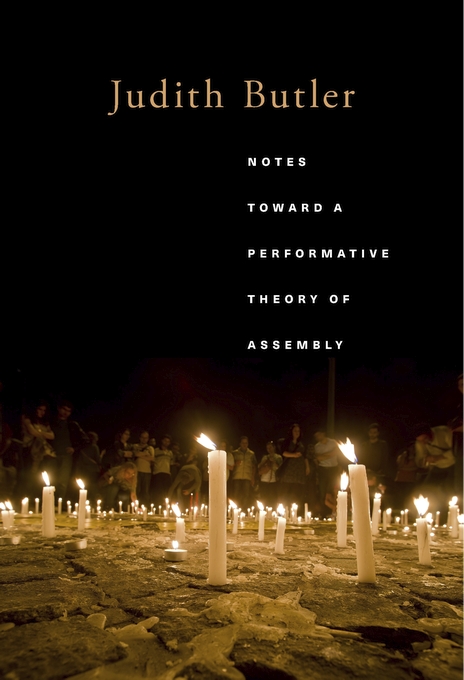
BUTLER NotesIn its way this, too, is a modestly performative politics of assembly.  So it’s good to see that panelists at the AAG plenary include this year’s Honorary Geographer, Judith Butler; full list is here.  You can find Judith’s previous remarks on BDS (at Brooklyn College) here.

You can also find out much more about the American Anthropological Association’s stand (last year) here; the statement that accompanied the successful resolution is here; a series of FAQs (“Yes, but…”) is here; and other resources are here.

It’s opportune, too, that the latest issue of borderlands should be devoted to The politics of suffering – with a special focus on occupied Palestine.  Among the many truly excellent essays three stand out for me.

First, Suvendrini Perera‘s accomplished contrapuntal reading of transnational justice, ‘Visibility, Atrocity and the Subject of Postcolonial Justice‘, which proceeds’ through a series of key sites – Congo, Belgium, Nuremberg, Israel, Gaza – that links past and present, colonial and colonizing worlds’, and then focuses on the deaths of tens of thousands of civilians on the beaches of Mullivaikkal in northeast Sri Lanka:

In the context of the 2009 atrocities in Lanka, in this paper I attempt to think through a set of questions about visibility, witness, suffering, accountability and disposability as they are played out in the relations between the necro-geo-politics of global institutions and the patchworks of local and transnational movements that attempt to materialize peoples’ suffering and realize the possibility of justice within fragile and compromised frameworks.

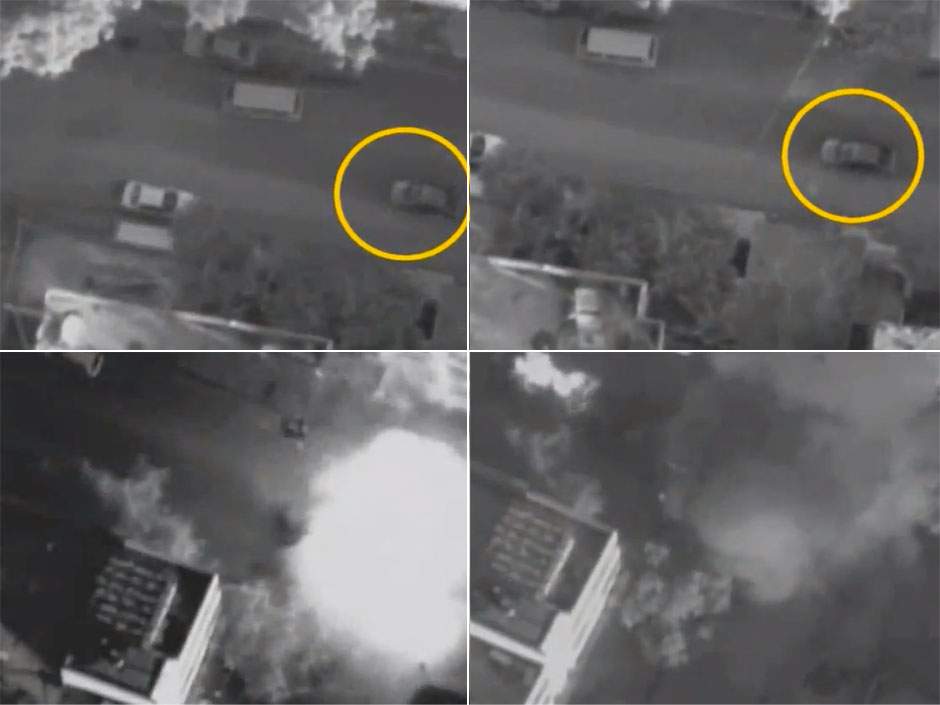
Drone feed Gaza city November 2012

Second, Joseph Pugliese‘s characteristically innovative ‘Forensic ecologies of occupied zones and Geographies of dispossession: Gaza and occupied East Jerusalem‘:

In this essay, I work to develop what I term multi-dimensional matrices of suffering that envisage the understanding of suffering beyond the locus of the human subject. In my theorising of multi-dimensional matrices of suffering, I proceed to conceptualise the suffering experienced in occupied zones as both relational and distributed. In the occupied zone, suffering encompasses complex, multi-dimensional vectors that bind humans, animals, animate and non-animate objects and entities, buildings and land. In the context of the regimes of violence that inscribe occupied zones, I situate suffering, and a range of other affects, in ecological configurations that, through a range of forensic indices, evidence the impact of these regimes of violence on the broad spectrum of entities that comprise a particular occupied zone. The conceptualisation of suffering and trauma in occupied zones in terms of its relational multi-dimensionality, its site-specific matrices and relational distribution across ecologies, I conclude, enables an understanding of suffering that moves beyond anthropocentric approaches. I situate my analysis in the context of Israel’s drone-enabled regime of unrelenting surveillance, occupation and military control over Gaza [see image above] and its continuing occupation of East Jerusalem.

It really is a tour de force, only too literally so, and builds not only on Joe’s brilliant State violence and the execution of law and his previous research but also on Jane Bennett‘s work and – as the title signposts – on Eyal Weizman‘s project of forensic architecture.  It’s doubly important because so much critical writing on military drones has virtually nothing to say about Israel’s use (and sale) of them.

Finally, Jasbir Puar‘s ‘The ‘right’ to maim: Disablement and inhumanist biopolitics in Palestine‘:

This essay argues that Israel manifests an implicit claim to the ‘right to maim’ and debilitate Palestinian bodies and environments as a form of biopolitical control and as central to a scientifically authorized humanitarian economy. In this context, the essay tracks the permeating relations between living and dying that complicate Michel Foucault’s foundational mapping of biopower, in this case, the practice of deliberate maiming. In doing so it demonstrates the limitations of the idea of ‘collateral damage’ that disarticulates the effects of warfare from the perpetration of violence, and notes that the policy of maiming is a productive one, a form of weaponized epigenetics through the profitability of a speculative rehabilitative economy.

This too is meticulously argued and imaginatively constructed, and adds important dimensions to my posts about Israel’s war on Gaza and, in particular, my preliminary speculations about the prosthetics of military violence.

Targeted killings

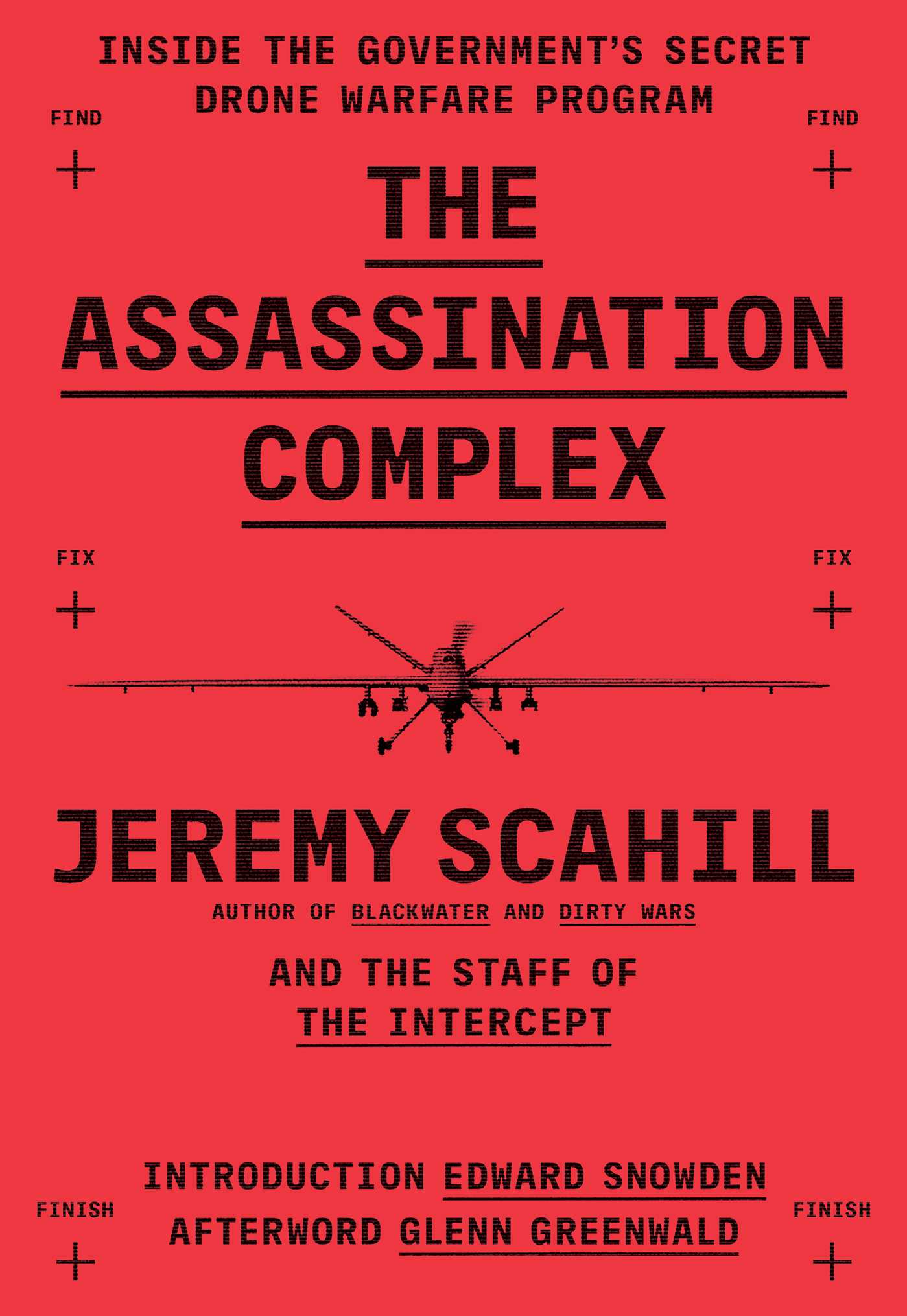
Coming from Simon and Schuster in May, a new book by Jeremy Scahill and his team at The InterceptThe Assassination Complex: Inside the Government’s Secret Drone Warfare Program.

the-assassination-complex-9781501144134_hrMajor revelations about the US government’s drone program—bestselling author Jeremy Scahill and his colleagues at the investigative website The Intercept expose stunning new details about America’s secret assassination policy.

When the US government discusses drone strikes publicly, it offers assurances that such operations are a more precise alternative to troops on the ground and are authorized only when an “imminent” threat is present and there is “near certainty” that the intended target will be killed. The implicit message on drone strikes from the Obama administration has been trust, but don’t verify.

The online magazine The Intercept exploded this secrecy when it obtained a cache of secret slides that provide a window into the inner workings of the US military’s kill/capture operations in Afghanistan, Yemen, and Somalia. Whether through the use of drones, night raids, or new platforms yet to be employed, these documents show assassination to be central to US counterterrorism policy.

The classified documents reveal that Washington’s fourteen-year targeted killing campaign suffers from an overreliance on flawed signals intelligence, an apparently incalculable civilian toll, and an inability to extract potentially valuable intelligence from terror suspects. This campaign, carried out by two presidents through four presidential terms, has been deliberately obscured from the public and insulated from democratic debate. The Assassination Complex allows us to understand at last the circumstances under which the US government grants itself the right to sentence individuals to death without the established checks and balances of arrest, trial, and appeal.

The book will include original contributions from Glenn Greenwald and Edward Snowden.

From NYU Press in July, a collection of essays edited by Kerstin Fisk and Jennifer Ramos that connects drone warfare to the Obama administration’s doctrine of ‘preventive force’ and the tangled legal armature that surrounds it: Preventive Force: Drones, Targeted Killing, and the Transformation of Contemporary Warfare.

Preventive ForceMore so than in the past, the US is now embracing the logic of preventive force: using military force to counter potential threats around the globe before they have fully materialized. While popular with individuals who seek to avoid too many “boots on the ground,” preventive force is controversial because of its potential for unnecessary collateral damage. Who decides what threats are ‘imminent’? Is there an international legal basis to kill or harm individuals who have a connection to that threat? Do the benefits of preventive force justify the costs? And, perhaps most importantly, is the US setting a dangerous international precedent?

In Preventive Force, editors Kerstin Fisk and Jennifer Ramos bring together legal scholars, political scientists, international relations scholars, and prominent defense specialists to examine these questions, whether in the context of full-scale preventive war or preventive drone strikes. In particular, the volume highlights preventive drones strikes, as they mark a complete transformation of how the US understands international norms regarding the use of force, and could potentially lead to a ‘slippery slope’ for the US and other nations in terms of engaging in preventive warfare as a matter of course. A comprehensive resource that speaks to the contours of preventive force as a security strategy as well as to the practical, legal, and ethical considerations of its implementation, Preventive Force is a useful guide for political scientists, international relations scholars, and policymakers who seek a thorough and current overview of this essential topic.

Contents are listed here.

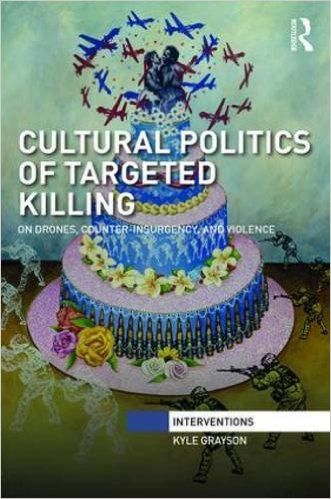
That same month comes the book I most want to read – but the eye-popping price from Routledge makes me wonder whether some mega-publishers see books as anything other than commodities.  It’s Kyle Grayson‘s Cultural Politics of Targeted Killing: On Drones, Counter-Insurgency, and Violence (hardcover only: madness).

GRAYSON Cultural politics of targeted killingThe deployment of remotely piloted air platforms (RPAs) – or drones – has become a defining feature of contemporary counter-insurgency operations. Scholarly analysis and public debate has primarily focused on two issues: the legality of targeted killing and whether the practice is effective at disrupting insurgency networks, and the intensive media and activist scrutiny of the policy processes through which targeted killing decisions have been made. While contributing to these ongoing discussions, this book aims to determine how targeted killing has become possible in contemporary counter-insurgency operations undertaken by liberal regimes.

Each chapter is oriented around a problematisation that has shaped the cultural politics of the targeted killing assemblage. Grayson argues that in order to understand how specific forms of violence become prevalent, it is important to determine how problematisations that enable them are shaped by a politico-cultural system in which culture operates in conjunction with technological, economic, governmental, and geostrategic elements. The book also demonstrates that the actors involved – what they may be attempting to achieve through the deployment of this form of violence, how they attempt to achieve it, and where they attempt to achieve it – are also shaped by culture.

The book demonstrates how the current social relations prevalent in liberal societies contain the potential for targeted killing as a normal rather than extraordinary practice.

Contents:

Chapter One: The Cultural Politics of the Targeted Killing Assemblage

Chapter Two: Beyond the Exception: The Legal Problematisation of Targeted Killing

Chapter Three: The Politics of Targeted Killing

Chapter Four: Science, Capitalism, and the RPA

Chapter Five: The Aesthetic Subjects of Targeted Killing

Chapter Six: The Quotidian Geopolitics of Targeted Killing Strikes

Chapter Seven: Concluding Remarks on the Cultural Politics of Targeted Killing

(Amazon says July, but the publisher says ‘2017’ so perhaps somebody in Taylor & Francis’s counting-house might have a serious think between now and publication; they clearly take ‘making a killing’ all too seriously).

Three strikes…

I’ve been working away on my Tanner Lectures, which has plunged me back in to my research on air strikes.  There is a dismal topicality to the subject, since in the UK the hawks on both right and left are circling the lobbies in the wake of the attacks in Paris (but still not, it seems, those in Beirut) demanding that yet more bombs fall on Syria.  They are less than hawk-eyed, however, since they offer no insight into what – precisely (not exactly the right word where bombing is concerned) – this is designed to achieve.  They have learned nothing from the 100-odd years of the history of bombing, or even from its more recent effects.

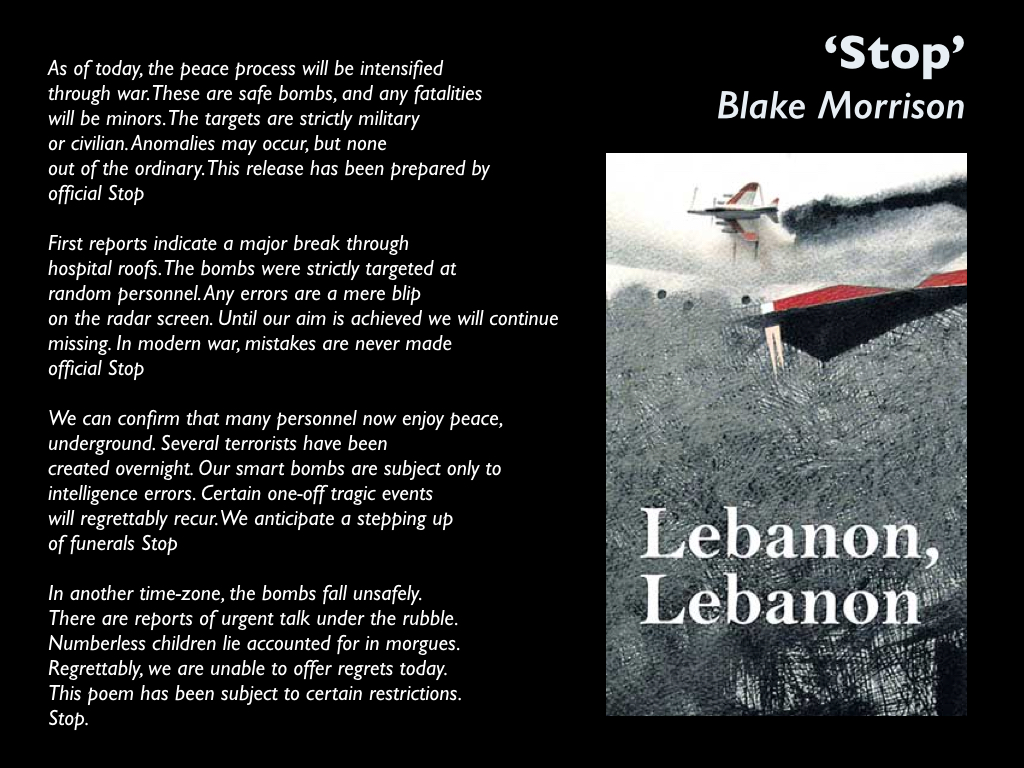
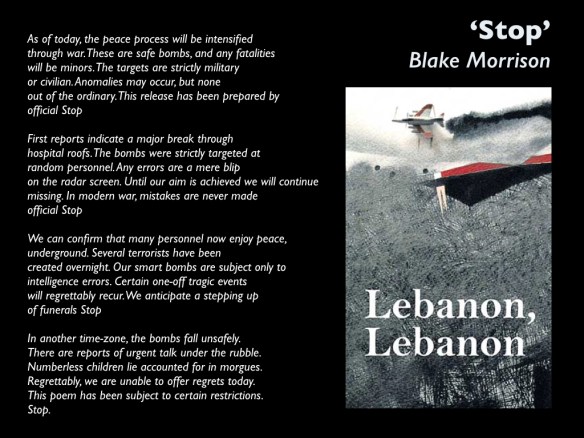
And talking of Beirut: when I delivered a presentation there in 2006, six months after Israel’s devastating air strikes on its southern suburbs, I borrowed my title [‘In another time-zone the bombs fall unsafely’: see DOWNLOADS tab] from Blake Morrison‘s poem ‘Stop’ which was reprinted in an anthology to aid children’s charities in Lebanon:
Blake Morrison STOP.001

So let me turn to three recent investigations of civilian casualties caused by US air strikes.  In each case it’s difficult to say as much as one ought to be able to say: in the first two cases (in Iraq and Syria) the reports have been heavily redacted, and in the third case (the attack on MSF’s hospital in Kunduz) all we have so far is an extended summary (though Kate Clark, as always, does a brilliant forensic job in filleting it here).

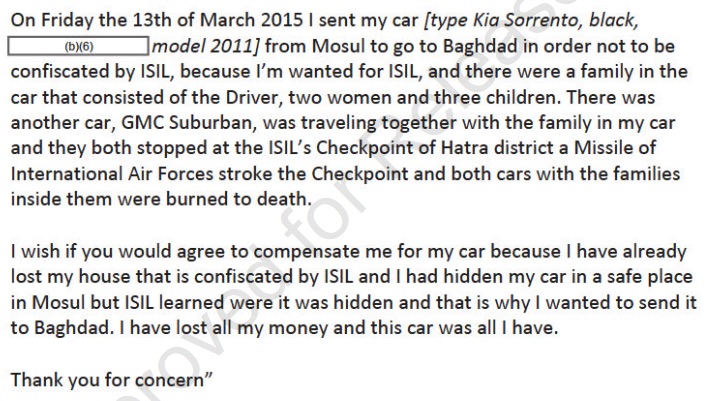
In this post I’ll discuss the report of an investigation into an air strike by two A-10 (‘Warthog’) aircraft on an Islamic State checkpoint near Al Hatra in Iraq on 13 March 2015.  On 2 April CENTCOM’s Combined Air Operations Center (CAOC) at Al Udeid Air Base in Qatar was forwarded the following e-mail:
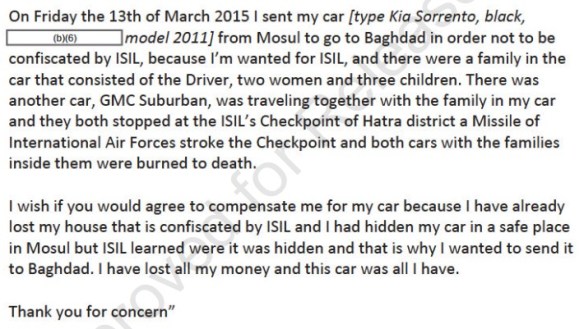
e-mail translation Al Hatra CIVCAS

Officers at the CAOC completed an initial ‘Civilian Casualty [CIVCAS] Credibility Assessment’ and agreed that the details in the e-mail were consistent with the known air strike.  On 20 April an investigation was established ‘to determine the veracity of the CIVCAS claim’ and, in the event that it was upheld, to review the targeting process ‘to determine if any errors occurred.’  Between 22 April and 1 June the investigating officer interviewed the military personnel involved in the air strike and reviewed intelligence reports and imagery of the target area.  This included an examination of the weapons system video (WSV) conducted by an ISR imagery analyst, and a transcript of the associated audio: neither has been released to the public, but you can get a sense of what A-10 imagery can (and cannot) show in this compilation video from Iraq here.
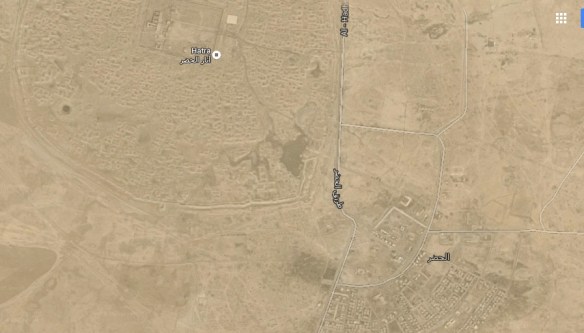
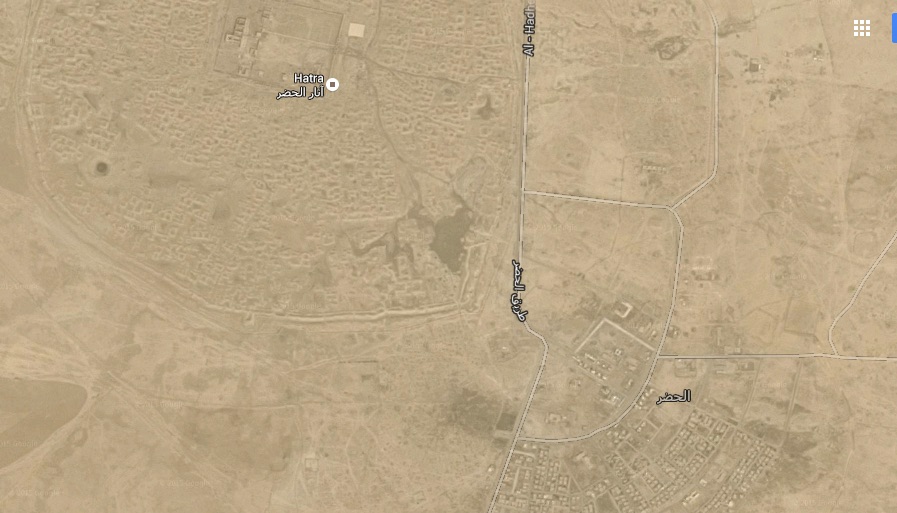
al Hatra map JPEG

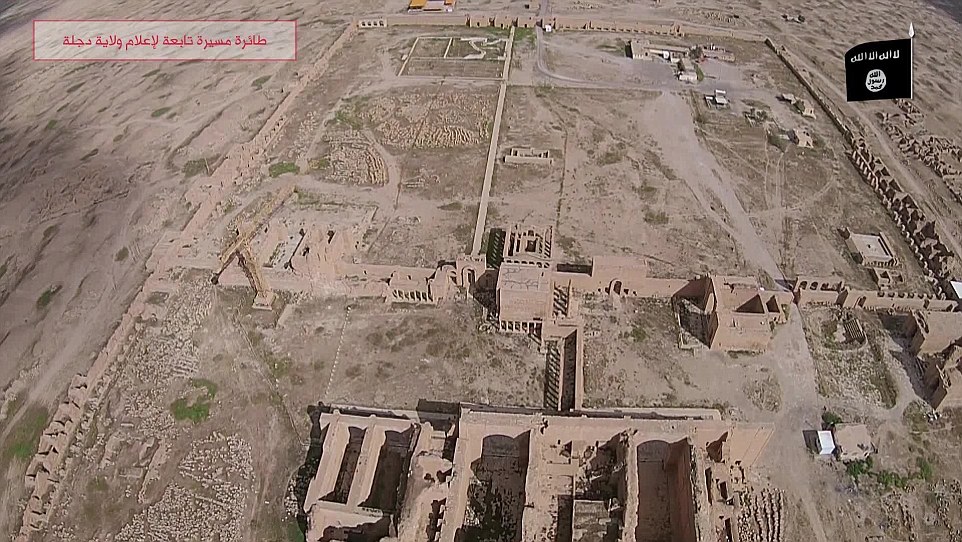
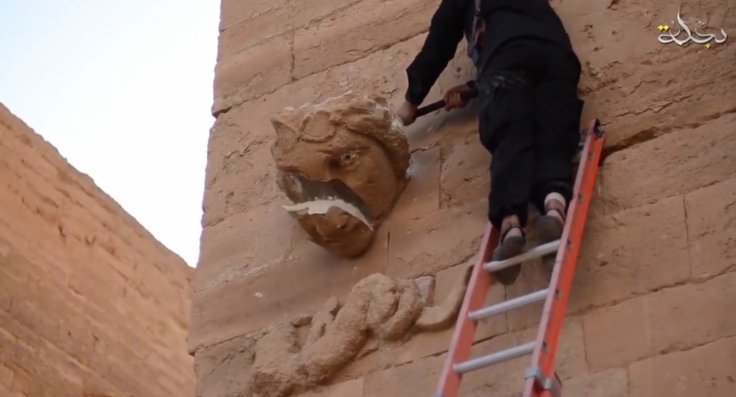
Al Hatra is the site of the ancient fortified city of al Hadr, 2km northwest of the modern settlement (see map above), established under the Seleucids, and after its capture by the Parthians it became one of the major cities of the post-Alexandrian world.   Since October, intelligence reports had identified the ruins as an Islamic State training camp, and in March IS announced its intention to level the site and purge it of the ‘symbols of idolatry‘. (In April it released a video showing just that: see the images below, and more here).
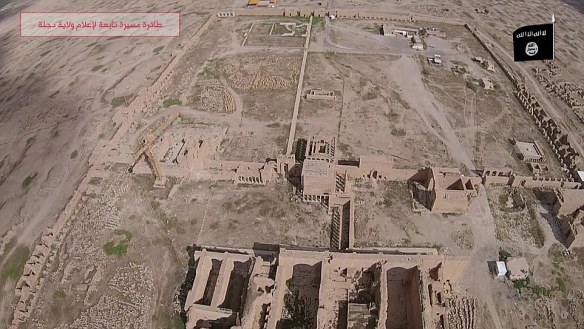

IS video of al Hatra

IS Video of destruction at al Hatra

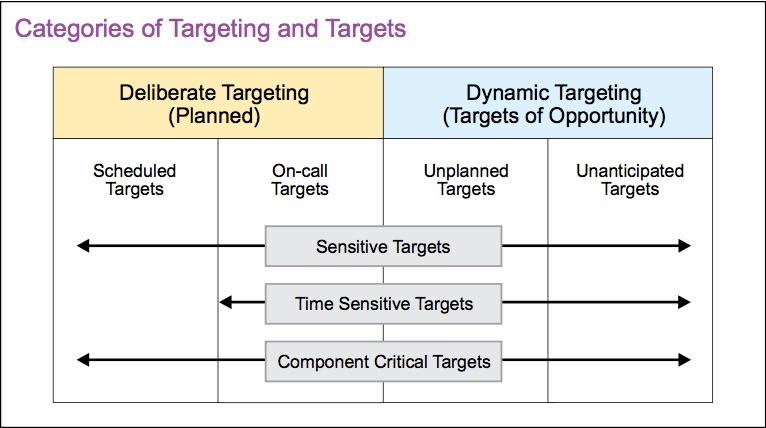
The initial target for the air strike on 13 March was an IS checkpoint and ‘enemy personnel’ who were stopping traffic.  They had been seen by an A-10 aircraft en route for refuelling – A10s fly sorties lasting between five and nine hours, and can require two or three inflight refuellings – and the information had been passed to the Dynamic Targeting Cell responsible for drawing up a detailed target folder or target package (a ‘Joint Targeting Message’) for all emergent targets: in effect, targets of opportunity.
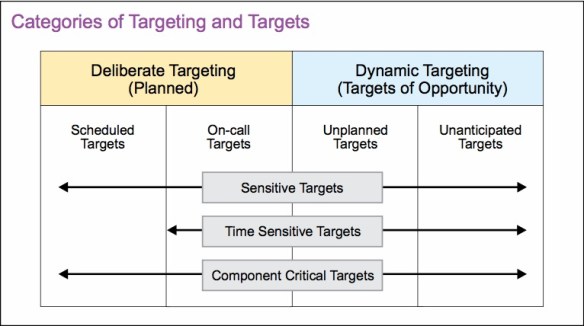
Targeting and Targets (JP 3-60) 2013

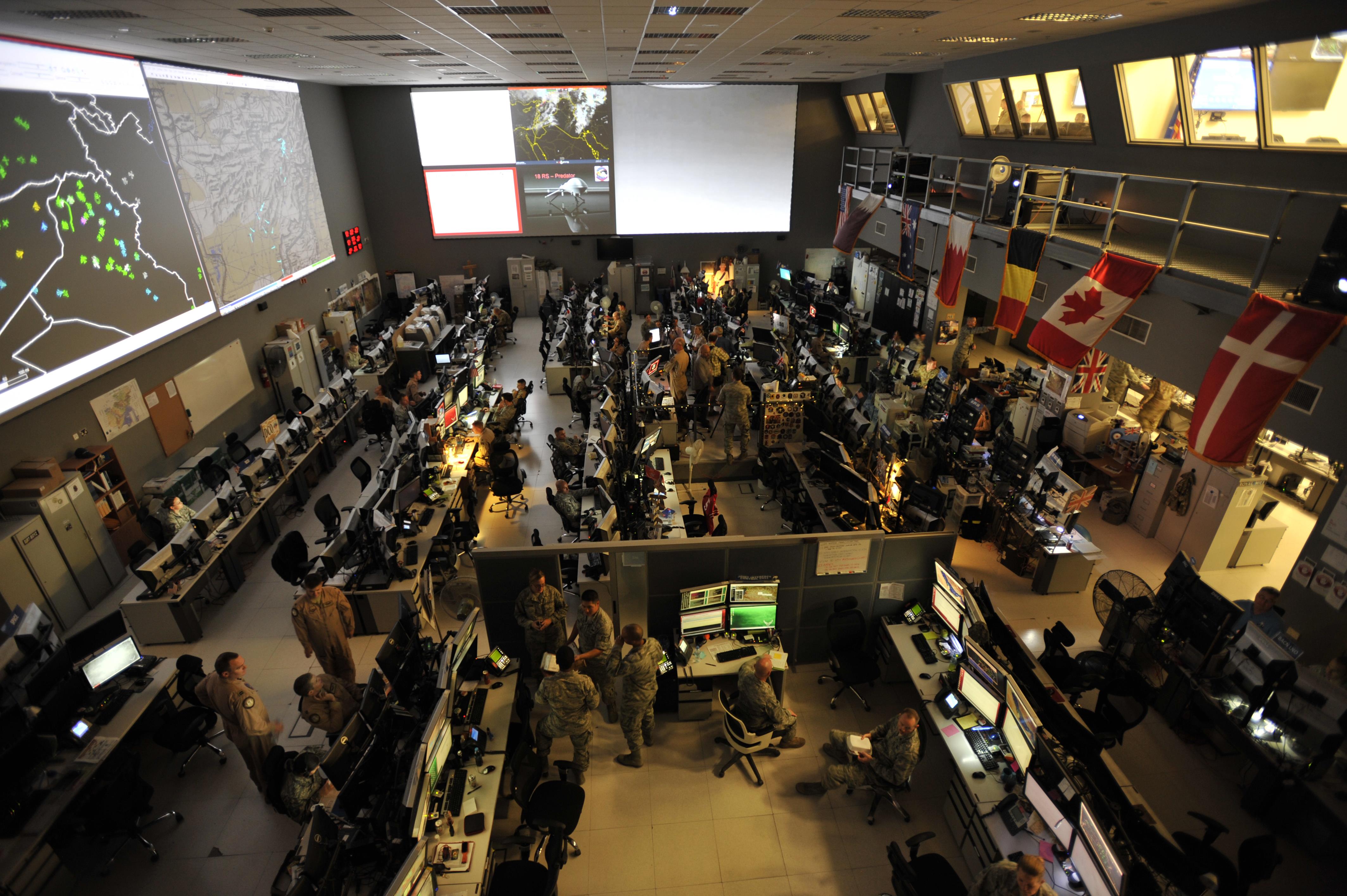
It must have seemed routine to those on duty in the CAOC (shown below): there had been multiple strikes in the vicinity for several months.  The Dynamic Targeting Cell cleared the operation via the Battle Director at Al Udeid with the CAOC director who acted as the ‘Target Engagement Authority’ to sanction the strike, with ultimate responsibility for all lethal strikes against Islamic State in Syria and designated areas of western Iraq.
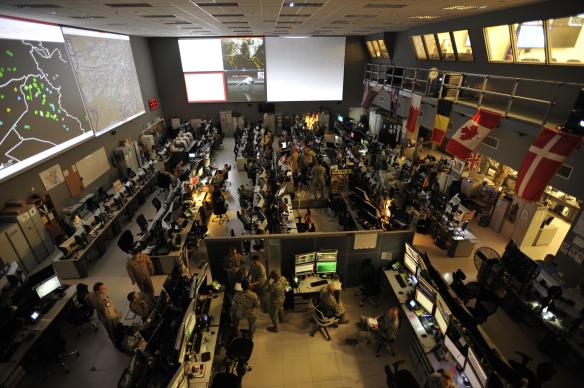
Combined Air and Space Operations Center (CAOC), Al Udeid Air Base, 2015

While this was happening, the same aircraft reported that two vehicles had pulled into the side of the road next to the checkpoint (and within ‘the target area outline’: notice how rapidly individuals disappear from view, contained first within objects and then the objects within an area).

The occupants began to interact with the people manning the checkpoint – the pilot said the two vehicles ‘appeared to be a part of the checkpoint’ but he also made it clear that this was only an ‘opinion’ and that responsibility for the positive identification of the vehicles and passengers as a legitimate target had to rest with superior officers – and the Dynamic Targeting Cell agreed to ‘seek additional authority’.  After a short time he radioed back with permission for them to be included as part of the original Joint Targeting Message: ‘You’re cleared to execute Joint Targeting Message [Reference Number] including vehicles and all associated PAX [people/passengers] with PID [Positive Identification].’  The investigating officer evidently thought this perfectly reasonable, agreeing that ‘these vehicles did not display characteristics typical of transient vehicles at checkpoints’; rather than passing through (as seven other vehicles did), they stopped and ‘appeared to be functionally and geospatially tied to the … checkpoint and personnel authorized for strike.’

But this amendment to the original targeting package was never reported up the chain of command to the Target Engagement Authority who only validated the original Joint Targeting Message.  He was provided with imagery showing the intended target area, confirmed that it had ‘a single use purpose’, and so had no doubt that the checkpoint and its operators constituted ‘a functionally and geospatially defined object of attack’ and that it was a ‘legitimate military target’ in accordance with international humanitarian law – what the US military prefers to call ‘the law of armed conflict’ – and consistent with the military’s own rules of engagement.  The repetition of those qualifiers is vital: the US military defines Positive Identification [PID] as ‘the reasonable certainty that a functionally and geospatially defined object of attack is a legitimate military target’.

The Target Engagement Authority sought no advice from a Judge Advocate, the military lawyer on duty, about the propriety of striking the vehicles and passengers because they were not included in the original package.  He testified that ‘at no point was there any discussion of vehicles in association with this strike’: in fact, he explicitly instructed the aircrew ‘to clear for transients [passing vehicles] prior to weapons release.’

The deputy legal adviser to the Combat Operations Division in the CAOC explained that a Judge Advocate was involved in all Dynamic Targeting strikes.  The Dynamic Targeting Chief works with the Targets Duty Officer to establish positive identification of the target.  The Targets Duty Officer usually spends half of a 12-hour shift on the combat operations floor with the Chief and half with ISR analysts preparing target packages, and it is the responsibility of the Chief to write the ‘5Ws’ – who, what, where, when and why – necessary for any dynamic targeting strike.  As the two of them ‘work’ the target, the deputy legal adviser added, they ‘may bring [in] the legal adviser at various times’ throughout the process to provide advice derived from international humanitarian law, the rules of engagement and any special instructions (‘spins’).  The Judge Advocate also acts as ‘a second pair of eyes’ scrutinising the co-ordinates of the target and provides legal recommendations to the Target Engagement Authority.

It seems clear, even with the redactions, that in this case the Judge Advocate was not consulted about the (verbal) amendment to the initial targeting package because the procedure was amended as a direct consequence of the incident under investigation.  Instead of ‘returning to his or her desk’ once approval had been obtained from the Target Engagement Authority, the Judge Advocate is now required to observe ‘the passing of the Joint Targeting Message and [to] monitor the strike by remaining close to the Dynamic Targeting cell.’

There is also a wider responsibility: the deputy legal adviser made it clear that ‘anyone in the chain or the Dynamic Targeting cell has the responsibility to call an abort on the strike if the conditions change.’  In this case, clearly, they did – but nobody intervened.

The Dynamic Targeting Chief claims he telephoned the Battle Director for permission to extend the original Joint Targeting Message, but the exchange took just 80 seconds.  One witness – who may well have been the Battle Director: it’s impossible to know for sure – thought this highly unlikely: 80 seconds would have been ‘very, very quick for [him] to take a call, gather the information, relay it to the Targeting Engagement Authority, get approval, and then relay it back down to [the Dynamic Targeting Cell].’  And the CAOC director was adamant: ‘even if the aviators could identify the vehicles as hostile … there was still no authority to strike without requesting authorization for a Joint Targeting Message change‘ from him.
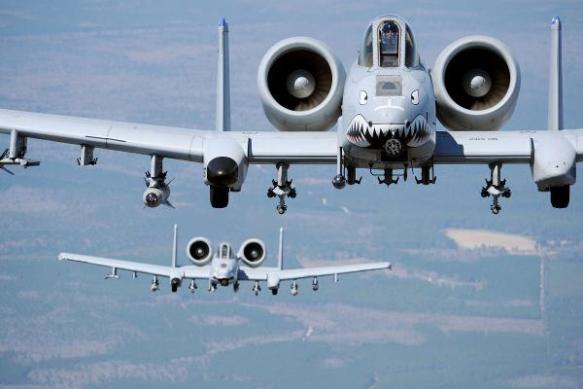
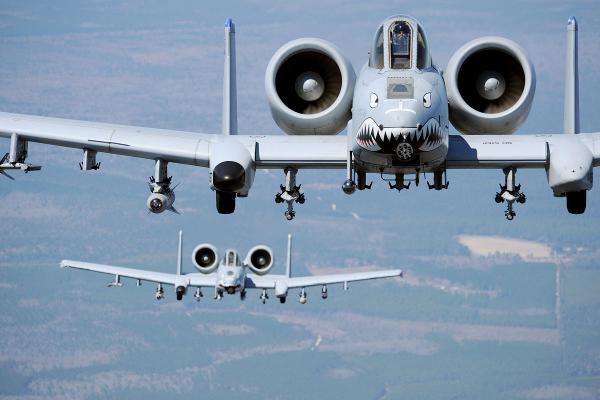
a-10-thunderbolt-ii_011-ts600

The A-10’s sensor remained ‘padlocked on these vehicles’ and when the pilot was finally cleared to engage he naturally assumed that the Target Engagement Authority had been satisfied by their inclusion in the target package.  Six seconds before they were hit, four people got out; the ISR analyst reviewing the post-strike video concluded that one of them was possibly a child.  But the investigating officer emphasised that they were only visible on the weapons system video and only after being played back at slow speed: ‘There is no reasonable expectation that [the pilot] could have seen, assessed and called for ABORT on the strike through real-time viewing of his targeting pod display inflight.’  The A-10 has a targeting pod under one wing which, as Andrew Cockburn reports, ‘ in daylight transmits video images of the ground below, and infrared images at night. This video feed is displayed on the plane’s instrument panel.’  As the pilot approached the target and entered his ‘weapons engagement envelope’ – again, note the geometric disposition – the investigating officer accepts that neither could he have ‘been able to discriminate between combatant and non-combatant personnel’.

The vehicles were attacked with the A-10’s 30mm rotary cannon – ‘a good weapon for reducing collateral damage’, according to one pilot (see the image below!) – and soon after a second A-10 dropped a single GBU-38 bomb and destroyed the guard shack; this is a conventional 500 lb bomb converted into a ‘guided bomb’, a ‘precision munition’, through the incorporation of a GPS/inertial navigation system so that it can attain a circular error probable of between 10 and 30 metres (which means that, assuming a bivariate normal distribution and all other things being equal, then 50% of the time it will land within that radius: which also means that the other half of the time it won’t, even under ideal experimental conditions).

A-10_Warthog-41

Here is how that same pilot (who was not, so far as I know, flying this mission) characterised these operations against IS to Tom Philpott in April:

A-10 pilots are trained to find a target, seek verification and do on-the-fly targeting and strike. While that sounds like a solo operation, Stohler says “the coalition flying up there is enormous and we work as a team.”

Almost all targets get vetted up to higher command to determine validity. “As you can imagine this is complex,” Stohler says… The most challenging moment “is the weapon employment phase of the flight,” says Stohler. “Our number one focus is to deliver the ordnance on target, on the first pass, while minimizing collateral damage. This takes a great deal of skill that our pilots train to daily back home.”

“I tell our guys this is like trying to drop bombs on bad guys in your hometown. Your goal is not to hurt anyone else, or destroy anything that you don’t have to destroy. It’s a constant challenge to do that and we do it very well.”

But while collateral damage is key it might not be “a showstopper,” says Stohler. “Clearly if the target we need to hit is significant we will employ on it wherever it is – if we have the approval.”

In this case it took under an hour from first observing the checkpoint to striking the target; only eight minutes elapsed between the confirmation of the Joint Targeting Message and the execution of the strike; and it took just three or four seconds ‘from trigger squeeze to impact’.  According to the e-mail, at least two women and three children were killed.  The military decided not to award the writer of that message any compensation for the destruction of her vehicle and no solatia payments will be made to the families of the deceased since no survivors have come forward to ask for them.

CENTCOM’s press release summarising the investigation is a model of complacency and fails to include any of the qualifications and mis-steps I’ve noted in the previous paragraphs:

Based on the actions being observed, aircrew and CAOC personnel assessed that the checkpoint, additional vehicles, and additional personnel were lawful targets consistent with the Law of Armed Conflict (LOAC) at the time the weapon was released on the target area.

The investigation concluded that the airstrikes resulted in the destruction of the intended target, and that the two vehicles parked at the checkpoint were also hit. Upon further review, it was determined that all ordnance functioned properly and accurately struck the intended target.

The investigation concluded that the airstrikes were conducted in accordance with applicable military authorizations, targeting guidance, and LOAC. The target engaged was a valid military target, and the LOAC principles of military necessity, proportionality, and distinction were observed. All reasonable measures were taken to avoid unintended deaths of or injuries to non-combatants by reviewing the targets thoroughly prior to engagement, relying on accurate assessments of the targets, and engaging the targets when the risk to non-combatants was thought to be minimized.

Micah Zenko has an analysis of this strike here, and he adds these chilling paragraphs:

To intensify the U.S.-led coalition’s war against the Islamic State … the Pentagon is considering further loosening the rules of engagement (ROEs) that are intended to minimize civilian casualties and expanding the target sets that can be bombed…

The first problem with this theory is that large militant armies are not defeated, either exclusively or primarily, with air power. Military and civilian policymakers repeat the mantra that “you can’t kill your way out” of the problem posed by such adversaries, but then continue to call upon air power to do just that. This is despite the fact that all of the militant armies and terrorist groups that have been bombed and droned for the past 14 years have survived. None have been completely destroyed, which is allegedly the strategic objective against the Islamic State. Moreover, the size of the al Qaeda-affiliated groups that the United States claims to be at war with have either stayed flat or grown, while the total number of State Department-designated Foreign Terrorist Organizations has grown from 34 in 2002 to 59 in 2015.

However, the larger concern with this mindset is the assured growth of collateral damage and civilian casualties that will accompany significantly loosened ROEs. Last month, Lt. Gen. Bob Otto, the U.S. Air Force’s deputy chief of staff for intelligence, surveillance, and reconnaissance, observed that the coalition was “challenged in finding enough targets that the airplanes can hit that meet the rules of engagement.” However, he added an important caveat: “If you inadvertently — legally — kill innocent men, women, and children, then there’s a backlash from that. And so we might kill three and create 10 terrorists.”

And yet, as Micah emphasizes, there have been only two military investigations into civilian casualties throughout the air campaign against IS:

8,300 airstrikes, 16,000 Islamic State targets destroyed, more than 20,000 Islamic State fighters killed — and only two claims of collateral damage. Either the U.S.-led coalition is really, really, really good at bombing these days, or they are shooting first and not asking questions later.

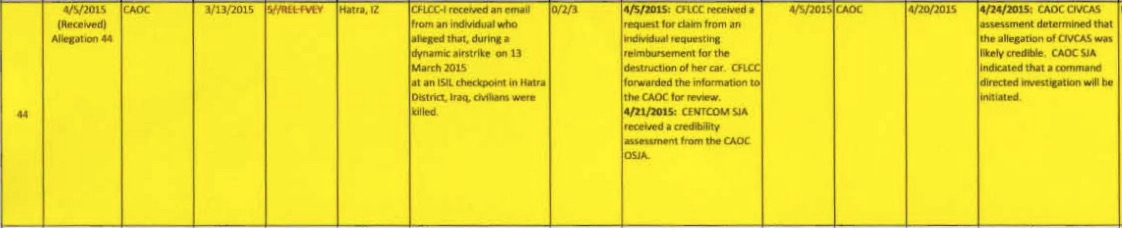
More in the same vein from Joseph Trevithick at War is Boring here.  You can access the US Air Force’s own (secret) tabulation of CIVCAS allegations here, which lists 45 separate incidents, far in excess of the two that have been officially acknowledged to date.  Joseph notes that most of them were dismissed within 48 hours as ‘not credible’ because there was ‘insufficient evidence’ or ‘insufficient information.’  Al Hatra was number 44:
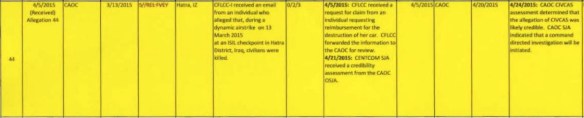
CIVCAS allegation 44 al Hatra

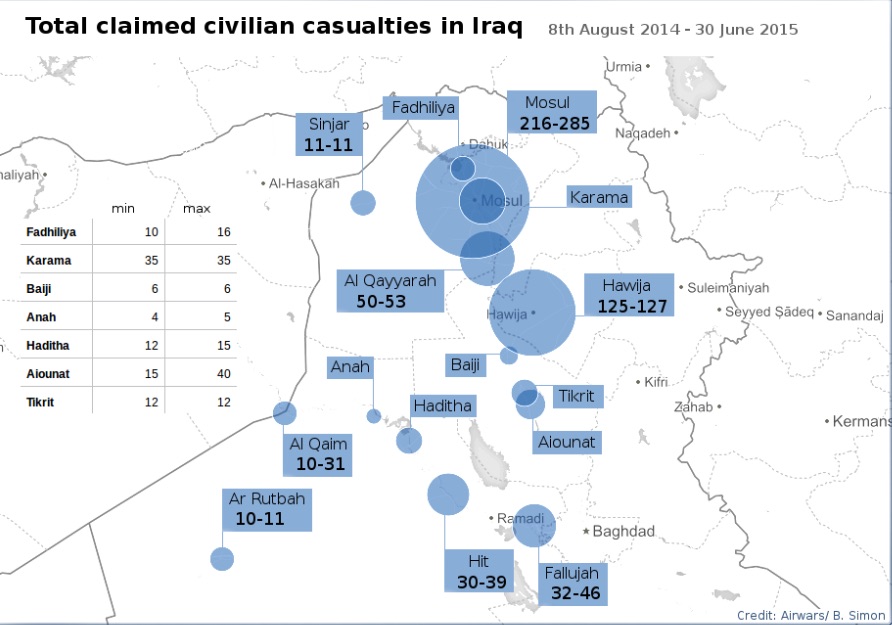
The  Airwars team has provisionally estimated that from 8 August 2014 to 24 November 2015 ‘between 682 and 977 civilian non-combatants are likely to have been killed in 113 incidents where there is fair reporting publicly available of an event, and where Coalition strikes were confirmed in the near vicinity on that date.’  I’ve pasted their map of total claimed civilian casualties in Iraq (to 30 June 2015) below; you can find their full report, Cause for Concern, here.
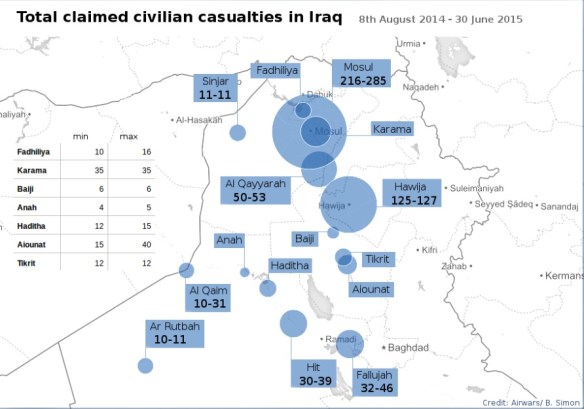
Civilian casualties claimed Iraq 8 August 2014-30 June 2015

To be continued.  Sadly.