Object Lessons

I was supposed to give a shortened version of ‘Little boys and blue skies‘ at the AAG Annual Meeting in San Francisco (about drones and atomic war: available under the DOWNLOADS tab) and fully intended to do so.  But in the event – and as I implied in a previous post – I decided to talk instead about Harry Parker‘s Anatomy of a soldier.  It was a spur of the moment decision, though it had been pricking away in my mind ever since I read the novel, and I only decided to do it at 10.30 the night before: madness.  But it was much closer to the theme of the sessions organised by Kate Kindervater and Ian Shaw on ‘Objects of Security and War: Material Approaches to Violence and Conflict‘ than my original presentation would have been.

I’ve added the presentation to those available under the DOWNLOADS tab (scroll right down).

I hope that most of it will be self-explanatory, but some notes might help.  I started out by invoking Tim O’Brien‘s twin accounts of the Vietnam War, The things they carried and If I should die in a combat zone, which provide vivid reminders of the weight – physical and emotional – borne by ground troops and the toll they impose on the soldier’s body.

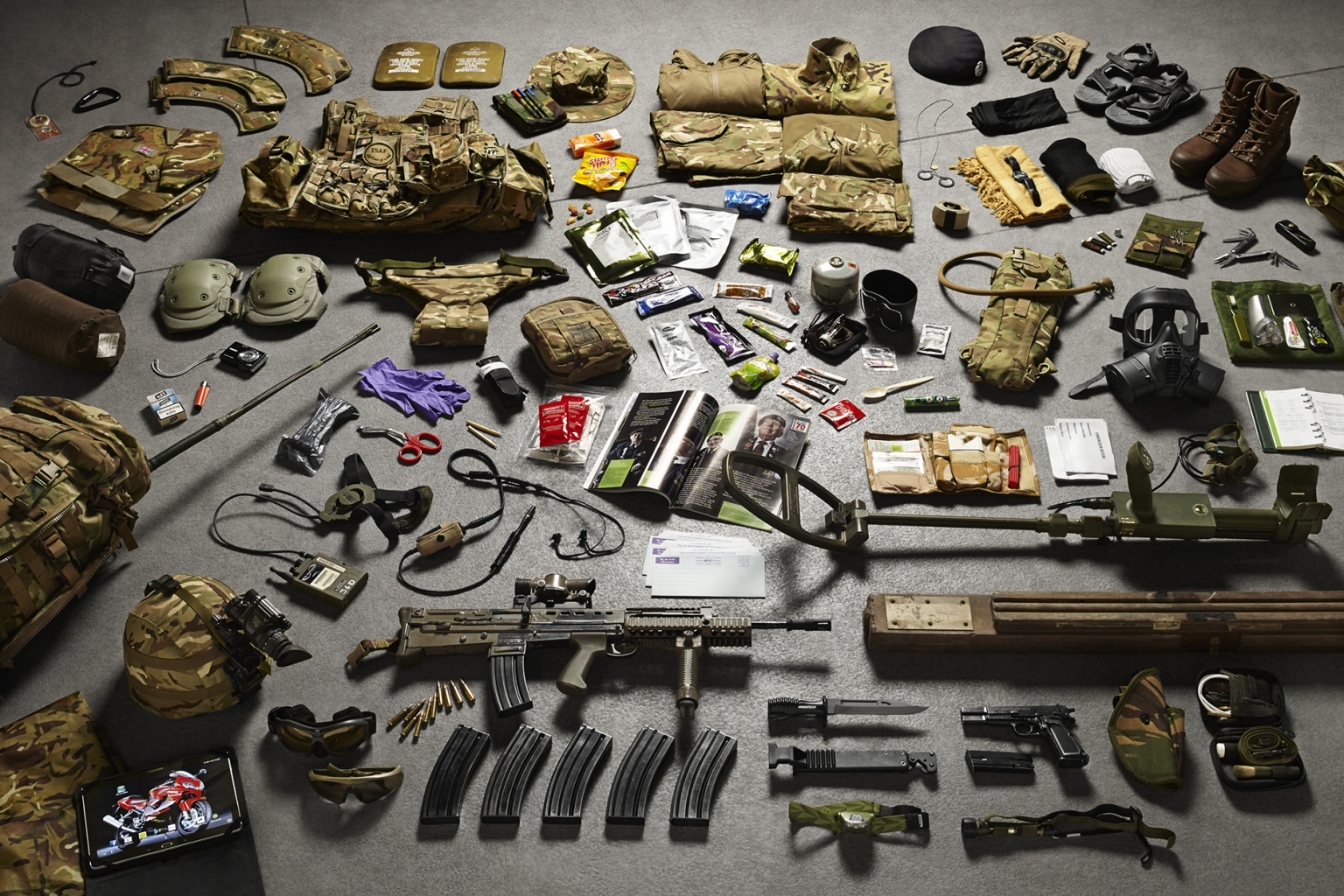
I talked about this in ‘The natures of war‘ (also under the DOWNLOADS tab) and – following in the footsteps of that essay – I sketched a brief history of the objects soldiers carried in to the killing fields: from the Somme in 1916 through Arnhem in 1944 to Helmand in Afghanistan in 2014 [shown below].  My source for these images was photographer Thom Atkinson‘s portfolio of Soldiers’ Inventories.

KIT Helmand 2014

But I was more interested now in the objects that carried the soldiers, so to speak, which is why I turned to Anatomy of a soldier.  

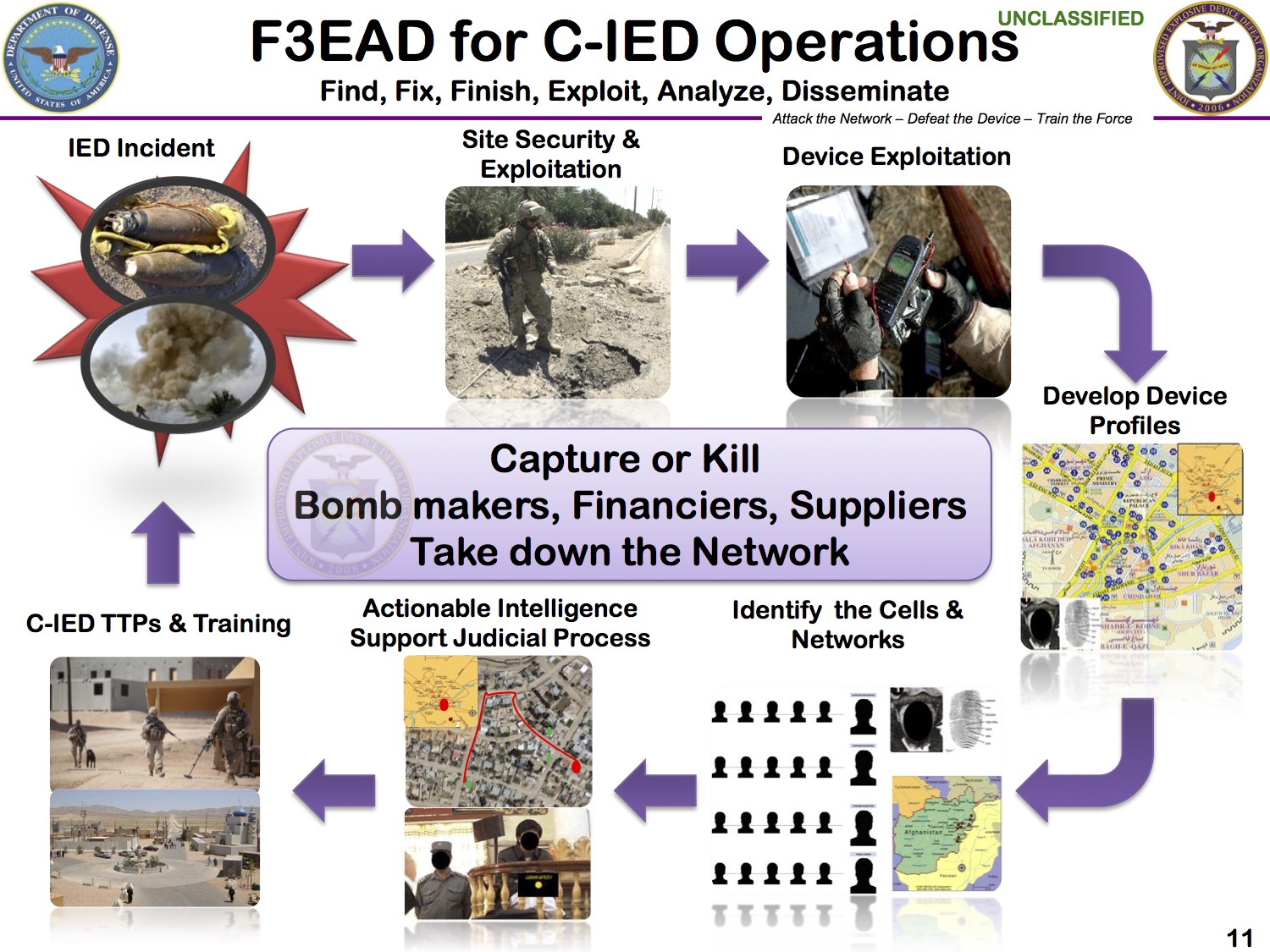
In order to throw the novel into even sharper relief, I outlined some of the other ways in which IED blasts in Afghanistan have been narrated.  These ranged from the US Army’s own schematics [the image below is taken from a presentation by Captain Frederick Gaghan here]  to Brian Castner’s truly brilliant non-fiction All the ways we kill and die, in which he describes his investigation into the death of his friend Matt Schwartz from an IED blast in Helmand in January 2012. (This book has taught me more about the war in Afghanistan than anything – I mean anything – I’ve ever read).

GAGHAN Attacking the IED Network jpegs

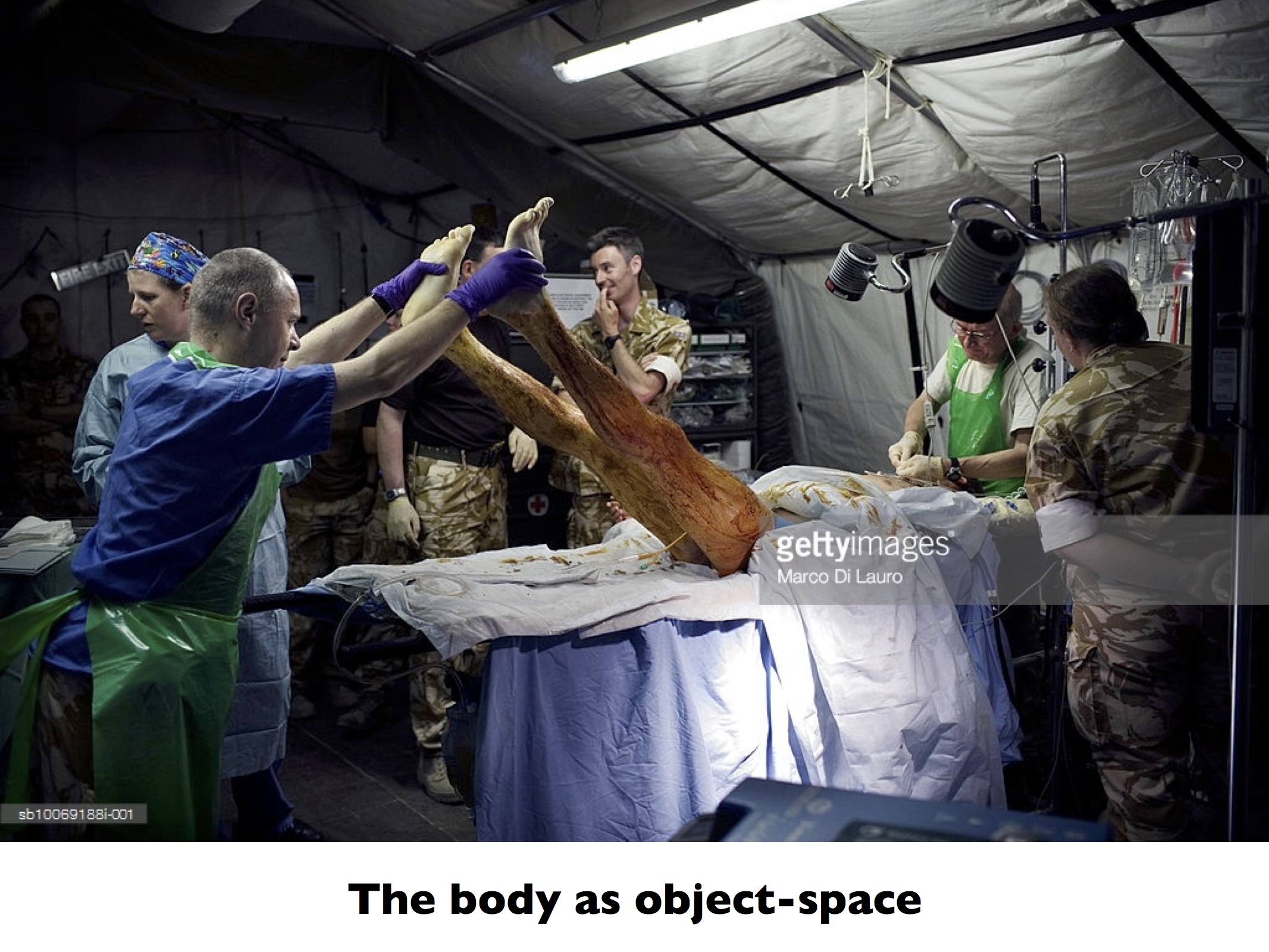
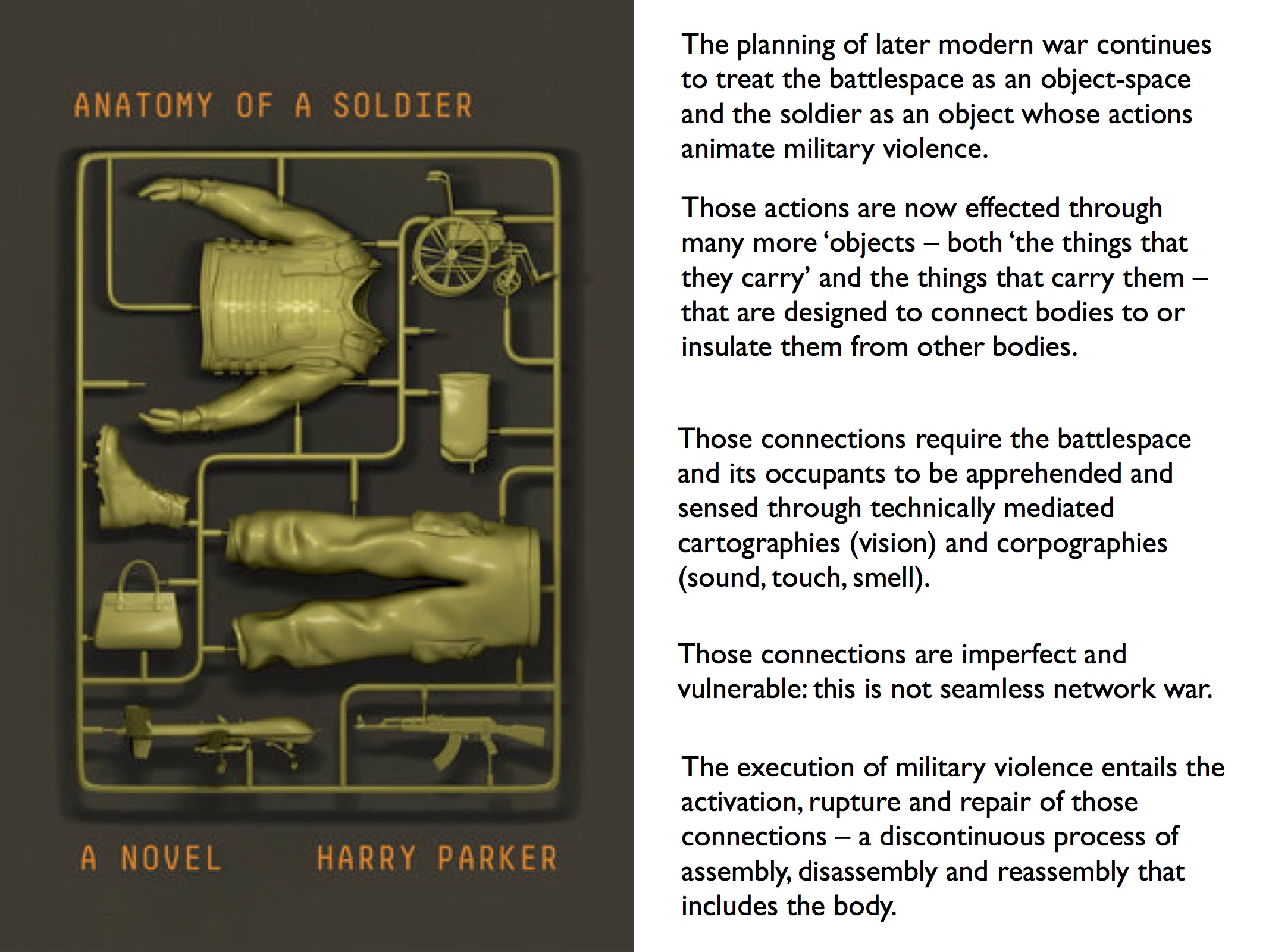
All of this prepared the ground for Parker’s novel which tells the story of a young British officer in Helmand, Tom Barnes, who loses his legs to an IED blast – told in 45 short chapters by the different objects involved.  Not all of the chapters are wholly successful, but many of them are utterly compelling and immensely affecting.  The overall effect is to emphasize at once the corporeality of war – ‘virtually every object-fragment that is proximate to Barnes is impregnated with his body: its feel – its very fleshiness – its sweat, its smell, its touch’ – and the object-ness of military violence.

GREGORY The body as object-space

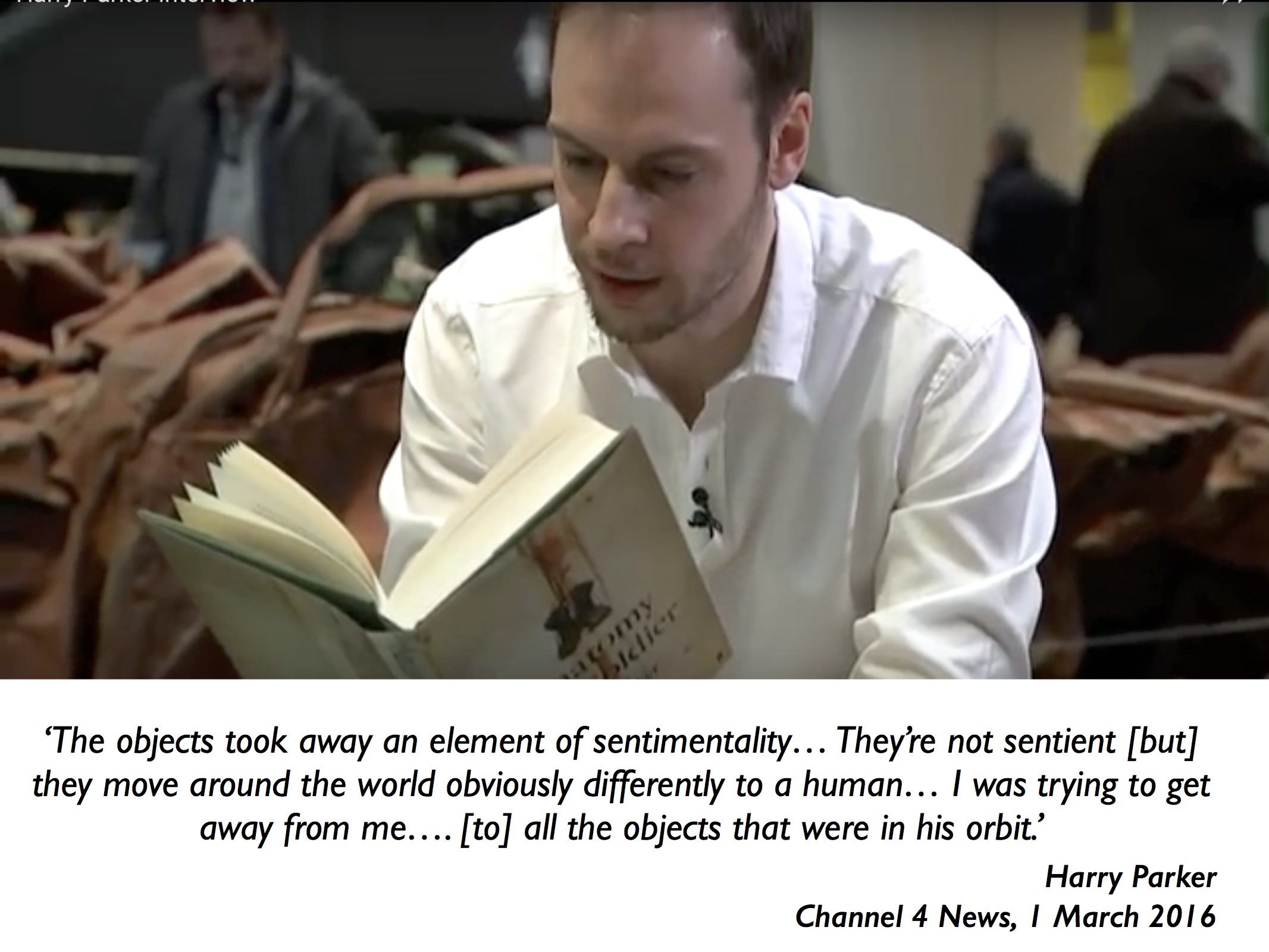
I juxtaposed the novel to Parker’s own story – he too lost his legs to an IED in Afghanistan in July 2009.  Yet he constantly emphasises that he never wanted the novel to be about him.

Harry Parker reading from Anatomy of a Soldier, IWM, LOndon

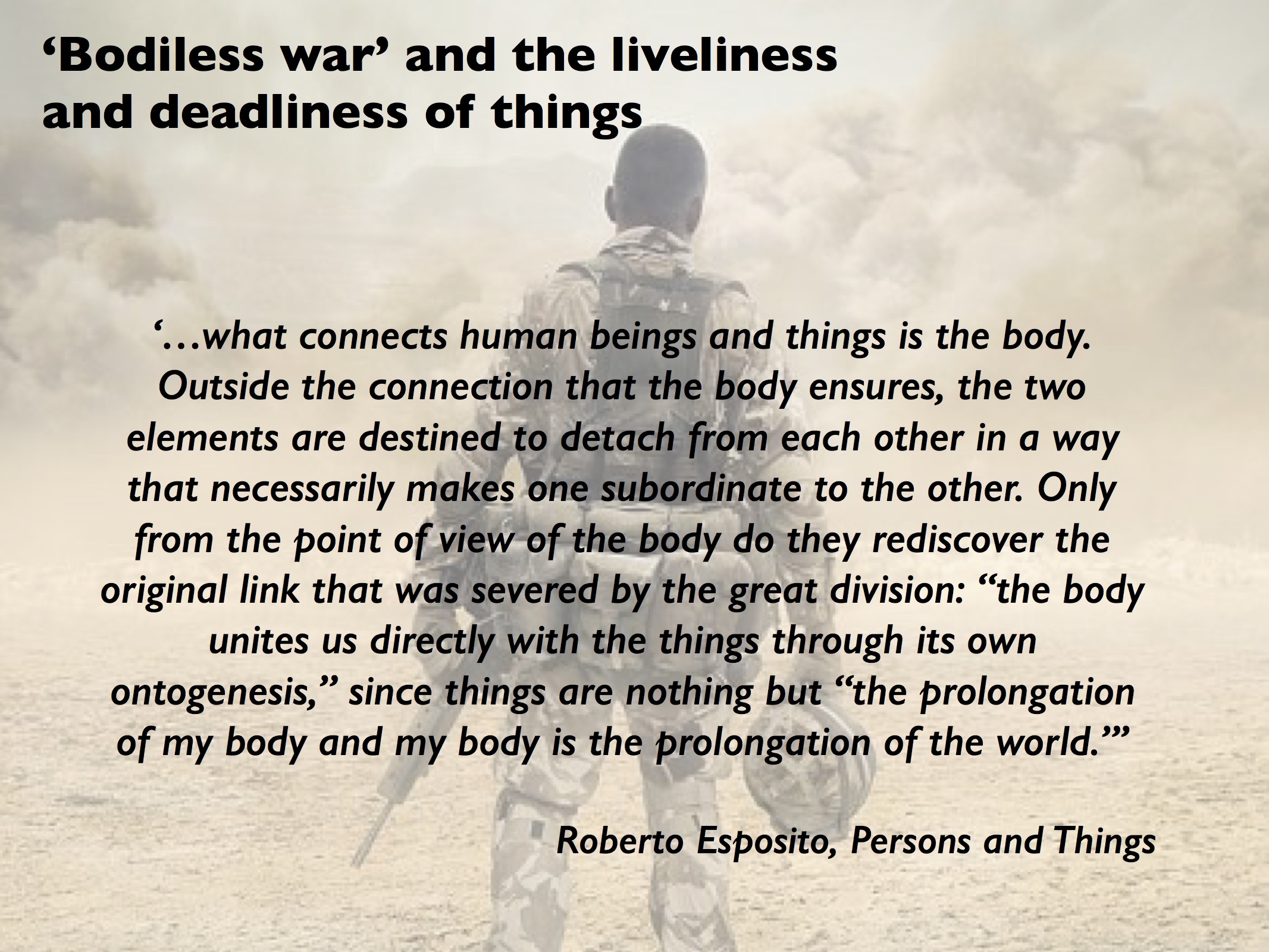
Still, the body is central to all this – Parker’s body and Barnes’s body – and so finally I drew on Roberto Esposito‘s Persons and Things to draw the wider lesson and, in particular, to nail the treacherous lie of ‘bodiless war’:

GREGORY The things that carry them

GREGORY Bodiless war

Eyes in the Skies

eyes_in_the_skies_pic

I’m just back from a wonderful time at UC Davis, where I was speaking at a symposium called “Eyes in the skies: drones and the politics of distance warfare.”  It was a creative program, packed with insights from Caren Kaplan and Andrea Miller, Priya Satia and Joe Delappe.

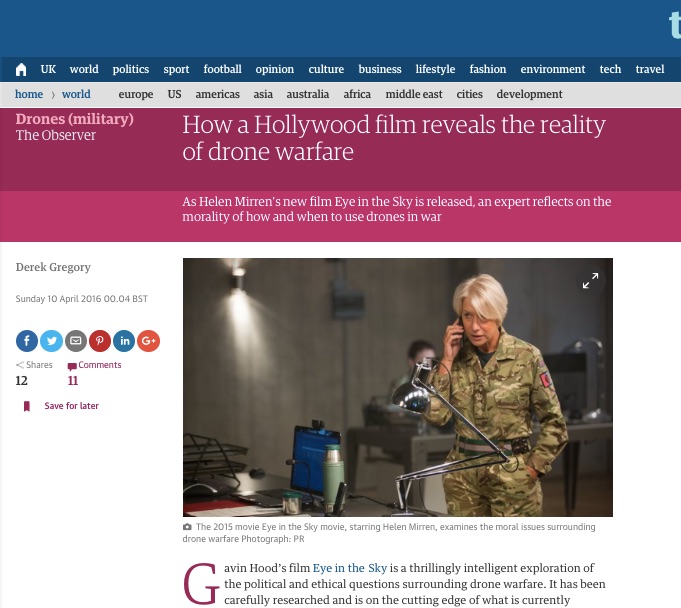
On my way back to Vancouver on Wednesday I received an invitation from Britain’s Guardian (in fact, the Sunday version, the Observer) to write something around that very question using the Gavin Hood film “Eyes in the sky” as a peg.

It’s just been published and you can find it here.

GREGORY Observer

At Davis I’d been giving what I think will be my final presentation of “Angry Eyes” (see here and here), so I was still preoccupied with remote platforms and close air support – not the contradiction it sounds – rather than targeted killing (which is the focus of the film).  The published version has, inevitably, been edited, so I’m pasting the full-length version below and added some links that might help.  There are still lots of short-cuts and elisions, necessarily so for anything of this length, so I hope readers will forgive the inevitable simplifications.

***

Gavin Hood’s Eye in the Sky is a thrillingly intelligent exploration of the political and ethical questions surrounding drone warfare. It’s been carefully researched and is on the cutting-edge of what is currently possible. But there’s a longer history and a wider geography that casts those issues in a different light.  As soon as the Wright Brothers demonstrated the possibility of human flight, others were busy imagining flying machines with nobody on board.  In 1910 Raymond Phillips captivated crowds in the London Hippodrome with a remotely controlled airship that floated out over the stalls and, when he pressed a switch, released hundreds of paper birds on the heads of the audience below. When he built the real thing, he promised, the birds would be replaced with bombs. Sitting safely in London he could attack Paris, Berlin – or Manchester (a possibility that understandably prompted questions about navigation).

There has always been something hideously theatrical about bombing, from the Hendon air displays in the 1920s featuring attacks on ‘native villages’ to the Shock and Awe visited on the inhabitants of Baghdad in 2003. The spectacle now includes the marionette movements of Predators and Reapers whose electronic strings are pulled from thousands of miles away. And it was precisely the remoteness of the control that thrilled the crowds in the Hippodrome. But what mattered even more was surely the prospect Phillips made so real: bombing cities and attacking civilians far from any battlefield.

Remoteness’ is in any case an elastic measure. Human beings have been killing other human beings at ever greater distances since the invention of the dart, the spear and the slingshot. Pope Urban II declared the crossbow illegal and Pope Innocent II upheld the ban in 1139 because it transformed the terms of encounter between Christian armies (using it against non-Christians was evidently a different matter). The invention of firearms wrought another transformation in the range of military violence, radicalized by the development of artillery, and airpower another. And yet today, in a world selectively but none the less sensibly shrunken by the very communications technologies that have made the deployment of armed drones possible, the use of these remote platforms seems to turn distance back into a moral absolute.

But if it is wrong to kill someone from 7,500 miles away (the distance from Creech Air Force Base in Nevada to Afghanistan), over what distance is it permissible to kill somebody?  For some, the difference is that drone crews are safe in the continental United States – their lives are not on the line – and this has become a constant refrain in the drone debates. In fact, the US Air Force has been concerned about the safety of its aircrews ever since its high losses during the Second World War. After Hiroshima and Nagasaki the Air Force experimented with using remotely controlled B-17 and B-47 aircraft to drop nuclear bombs without exposing aircrews to danger from the blast, and today it lauds its Predators and Reapers for their ability to ‘project power without vulnerability’.

It’s a complicated boast, because these remote platforms are slow, sluggish and easy to shoot down – they won’t be seen over Russian or Chinese skies any time soon. They can only be used in uncontested air space – against people who can’t fight back – and this echoes Britain’s colonial tactic of ‘air policing’ its subject peoples in the Middle East, East Africa and along the North-West Frontier (which, not altogether coincidentally, are the epicentres of todays’ remote operations). There are almost 200 people involved in every combat air patrol – Nick Cullather once described these remote platforms as the most labour intensive weapons system since the Zeppelin – and most of them are indeed out of harm’s way. It’s only a minor qualification to say that Predators and Reapers have a short range, so that they have to be launched by crews close to their targets before being handed off to their home-based operators. This is still remote-control war, mediated by satellite links and fiber-optic cables, but in Afghanistan the launch and recovery and the maintenance crews are exposed to real danger. Even so, Grégoire Chamayou insists that for most of those involved this is hunting not warfare, animated by pursuit not combat [see here, here and here].

Yet it’s important not to use this aperçu to lionize conventional bombing. There is an important sense in which virtually all aerial violence has become remarkably remote. It’s not just that bombing has come to be seen as a dismal alternative to ‘boots on the ground’; advanced militaries pick their fights, avoid symmetrical warfare and prefer enemies whose ability to retaliate is limited, compromised or degraded. When he was Secretary of Defense Robert Gates acknowledged that the US had not lost a pilot in air combat for forty years. ‘The days of jousting with the enemy in the sky, of flirting daily with death in the clouds, are all but over,’ writes the far-from-pacifist Mark Bowden, ‘and have been for some time.’ The US Air Force goes to war ‘virtually unopposed’. In short, the distance between the pilot in the box at Creech and the pilot hurtling through the skies over Afghanistan is less than you might think. ‘Those pilots might as well be in Nevada’, says Tom Engelhardt, ‘since there is no enemy that can touch them.’

This suggests that we need to situate armed drones within the larger matrix of aerial violence.  Bombing in the major wars of the twentieth century was always dangerous to those who carried it out, but those who dropped bombs over Hamburg or Cologne in the Second World War or over the rainforests of South Vietnam in the 1960s and 70s were, in a crucial sense, also remote from their targets. Memoirs from Bomber Command crews confirm that the target cities appeared as lights sparkling on black velvet, ‘like a Brocks firework display.’ ‘The good thing about being in an aeroplane at war is that you never touch the enemy’, recalled one veteran. ‘You never see the whites of their eyes. You drop a four-thousand-pound cookie and kill a thousand people but you never see a single one of them.’ He explained: ‘It’s the distance and the blindness that enables you to do these things.’ The crews of B-52 bombers on Arc Light missions dropped their loads on elongated target boxes that were little more than abstract geometries. ‘Sitting in their air-conditioned compartments more than five miles above the jungle’, the New York Times reported in 1972, the crews ‘knew virtually nothing about their targets, and showed no curiosity.’ One of them explained that ‘we’re so far away’ that ‘it’s a highly impersonal war for us.’

Distance no longer confers blindness on those who operate today’s drones. They have a much closer, more detailed view of the people they kill. The US Air Force describes their job as putting ‘warheads on foreheads’, and they are required to remain on station to carry out a battle damage assessment that is often an inventory of body parts.  Most drone crews will tell you that they do not feel thousands of miles away from the action: just eighteen inches, the distance from eye to screen.

Their primary function is to provide intelligence, surveillance and reconnaissance. This was exactly how the Wright brothers thought military aircraft would be used – in July 1917 Orville insisted that ‘bomb-dropping’ would be at best a minor role and almost certainly useless, though he was speaking before the major air offensives in the final year of the war and could have had no inkling of what was to come in the Second World War. The Predator and its precursors were designed to identify targets for conventional strike aircraft over the Balkans in the 1990s, and thirty years later it is still those ‘eyes in the sky’ that make the difference. Although drones have been armed since 2001, until late 2012 they were directly responsible for only 5-10 per cent of all air strikes in Afghanistan. But they were involved in orchestrating many more. Flying a Predator or a Reaper ‘is more like being a manager’, one pilot explained to Daniel Rothenberg: ‘You’re managing multiple assets and you’re involved with the other platforms using the information coming off of your aircraft.’ In principle it’s not so different from using aircraft to range targets for artillery on the Western Front, but the process has been radicalized by the drone’s real-time full-motion video feeds that enable highly mobile ‘targets of opportunity’ to be identified and tracked. In the absence of ground intelligence, this becomes crucial: until drones were relocated in sufficient numbers from Afghanistan and elsewhere to enable purported IS-targets in Syria to be identified, most US aircraft were returning to base without releasing their weapons.

Armed drones are used to carry out targeted killings, both inside and outside areas of ‘active hostilities’, and to provide close air support to ground troops. Targeted killing has spurred an intense critical debate, and rightly so – this is the focus of Eye in the sky too – but close air support has not been subject to the same scrutiny. In both cases, video feeds are central, but it is a mistake to think that this reduces war to a video game – a jibe that in any case fails to appreciate that today’s video games are often profoundly immersive.   In fact, that may be part of the problem. Several studies have shown that civilian casualties are most likely when air strikes are carried out to support troops in contact with an enemy, and even more likely when they are carried out from remote platforms. I suspect that drone crews may compensate for their physical rather than emotional distance by ‘leaning forward’ to do everything they can to protect the troops on the ground. This in turn predisposes them to interpret every action in the vicinity of a ground force as hostile – and civilians as combatants – not least because these are silent movies: the only sound, apart from the clacking of computer keys as they talk in secure chat rooms with those watching the video feeds, comes from radio communications with their own forces.

In contrast to those shown in Eye in the Sky, those feeds are often blurry, fuzzy, indistinct, broken, compressed -– and, above all, ambiguous. How can you be sure that is an insurgent burying an IED and not a farmer digging a ditch?  The situation is more fraught because the image stream is watched by so many other eyes on the ground, who all have their own ideas about what is being shown and what to do about it.  Combining sensor and shooter in the same (remote) platform may have ‘compressed the kill-chain’, as the Air Force puts it, and this is vital in an era of ‘just-in-time’, liquid war where everything happens so fast. Yet in another sense the kill-chain has been spectacularly extended: senior officers, ground force commanders, military lawyers, video analysts all have access to the feeds. There’s a wonderful passage in Brian Castner‘s All the ways we kill and die that captures the dilemma perfectly. ‘A human in the loop?’, Castner’s drone pilot complains.

‘Try two or three or a hundred humans in the loop. Gene was the eye of the needle, and the whole war and a thousand rich generals must pass through him… If they wanted to fly the fucking plane, they could come out and do it themselves.’

This is the networked warfare, scattered over multiple locations around the world, shown in Eye in the Sky. But the network often goes down and gets overloaded – it’s not a smooth and seamlessly functioning machine – and it is shot through with ambiguity, uncertainty and indecision.  And often those eyes in the sky multiply rather than disperse the fog of war.

Industrialised war

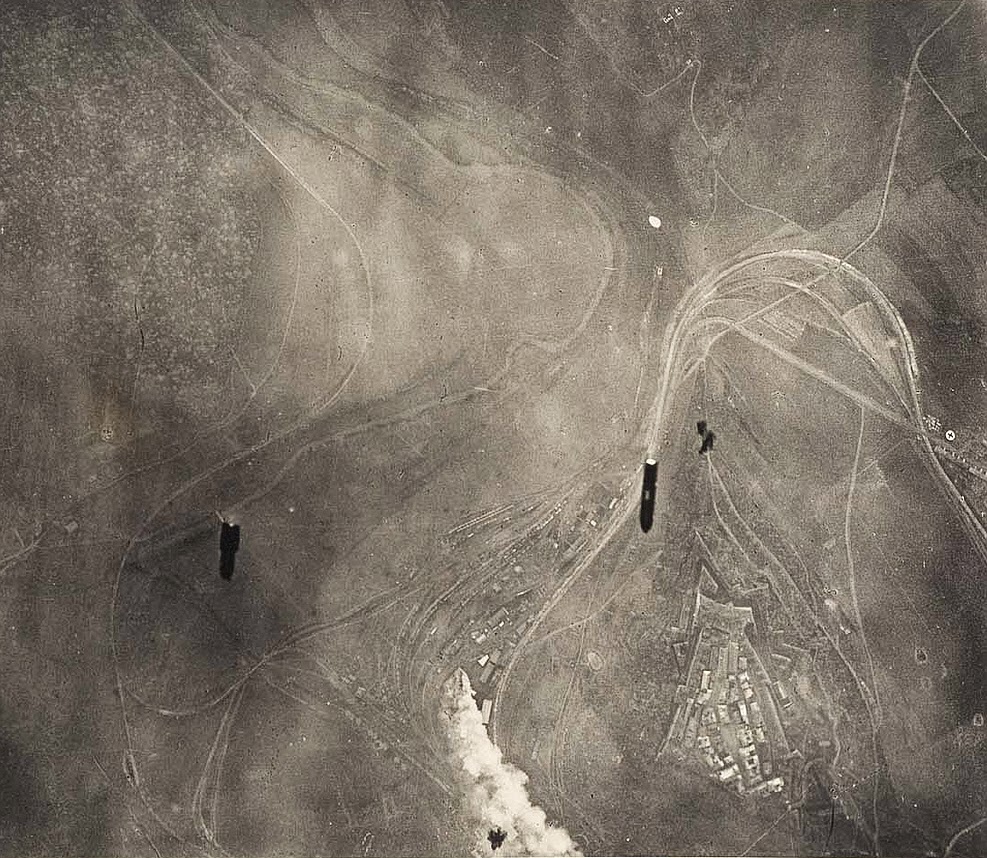
Bombs falling on Montmedy and marshalling yards

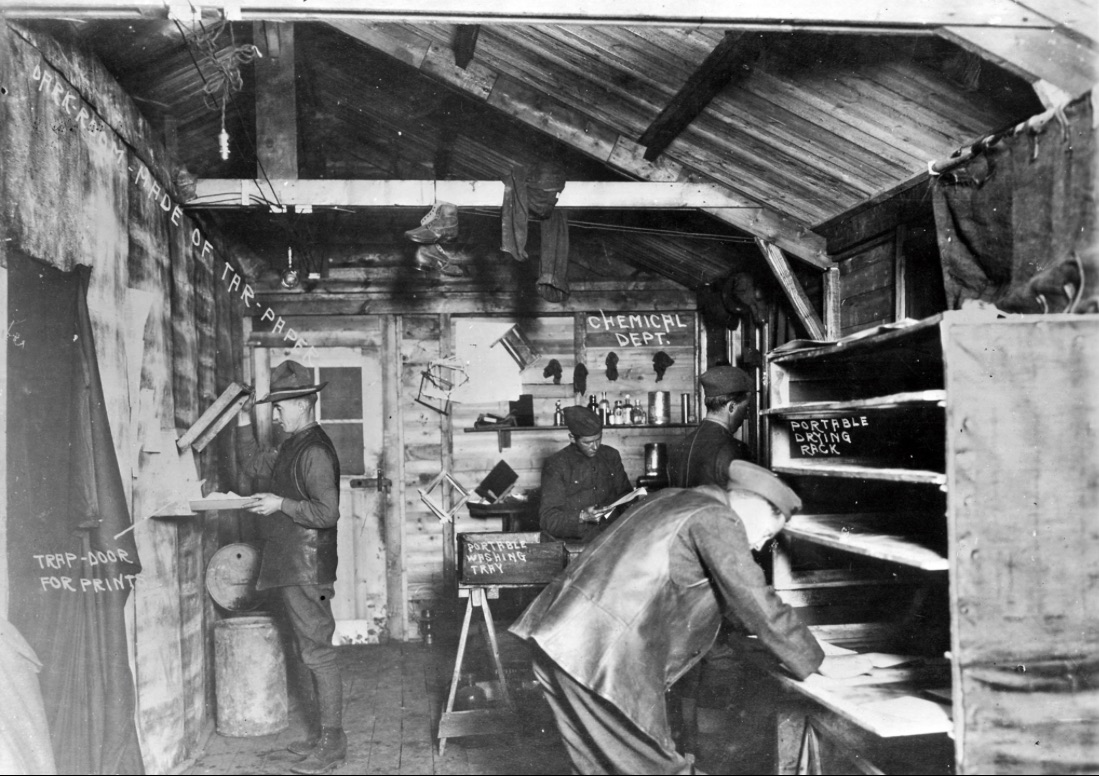
As I work on the text of “Reach from the Sky”, I’ve been revisiting the role of Edward Steichen in the development (in fact, the industrialisation) of air photography on the Western Front.  As I noted, all too briefly, in ‘Gabriel’s map’ (DOWNLOADS tab), Steichen commanded the photographic division of the American Expeditionary Forces. He organised the 55 officers and 1,111 men under his command into what Paul Virilio described as ‘a factory-style output of war information’ that ‘fitted perfectly with the statistical tendencies of this first great military-industrial conflict’.

Steichen 5th Photographic section at work on Western Front

The classic source on Steichen’s assembly-line methods of reproduction (and much more) is Allen Sekula‘s essay, ‘The instrumental image: Steichen at war’, in Artforum 14 (1975) 26-35 [see also the image above]:

The establishment of this method of production grew out of demands for resolution, volume, and immediacy. No method of reproduction but direct printing from the original negative would hold the detail necessary for reconnaissance purposes. Large numbers of prints from a single negative had to be made for distribution throughout the hierarchy of command. In addition, the information in prints dated very rapidly. Under these circumstances, efficiency depended on a thorough-going division of labor and a virtually continuous speedup of the work process. Printers worked in unventilated, makeshift darkrooms; 20 workers might produce as many as 1,500 prints in an hour, working 16-hour shifts.

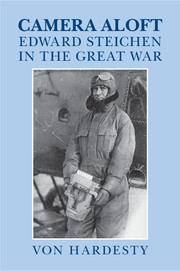
Analytically the essay has never been surpassed, but now there is a new book that fills in the biographical details of Steichen’s service during the First World War: Von Hardesty‘s Camera Aloft: Edward Steichen in the Great War (Cambridge, 2016):

Von Hardesty Camera AloftEdward Steichen (1879–1973) played a key role in the development of photography in the twentieth century. He is well known for his varied career as an artist, a celebrated photographer, and museum curator. However, Steichen is less known for his pivotal role in shaping America’s first experiments in aerial photography as a tool for intelligence gathering in what may be called his “lost years.” In Camera Aloft, Von Hardesty tells how Steichen volunteered in 1917 to serve in the American Expeditionary Forces (AEF). He rose rapidly in the ranks of the Air Service, emerging as Chief of Air Photography during the dramatic final offensives of the war. His photo sections were responsible for the rapid processing of aerial images gained through the daily and hazardous sorties over the front and in the enemy rear areas. What emerged in the eighteen months of his active service was a new template for modern aerial reconnaissance. The aerial camera, as with new weapons such as the machine gun, the tank, and the airplane, profoundly transformed modern warfare.

Here is the table of contents:

Foreword: taking the camera aloft
1. War and exile
2. A new life in the military
3. Over there
4. The world of air observation
5. Taking charge
6. Over the front
7. War and photography
Appendix: life at the cutting edge: the photo sections.

The book includes stunning reproductions of photographs (from which I’ve borrowed the annotated image of the Photographic Section above): you can see a selection from the book here.  Other Steichen aerial imagery from the period is here and here.

As you’ll be able to see when I’m finished, I’m no less interested in Steichen’s work during the Second World War, and in particular the various photographic projects he directed in the Pacific that captured – and celebrated – the masculinism and homosociality of modern war (here the work of Horace Bristol is especially revealing).

But right now it’s the industrialisation of aerial imagery that is capturing my attention.  It’s a commonplace that the First World War was industrial warfare on the grand scale, of course, but often our attention is distracted by the killing machines and mechanisms themselves – the gas, the tanks, the aircraft – and we lose sight of the assembly-line logic that animated the slaughter not only during but also before and after.

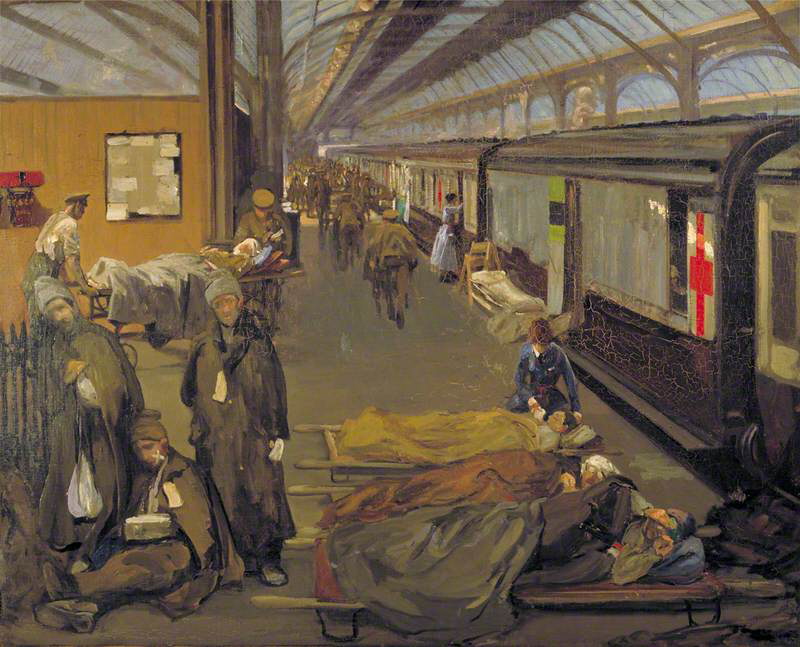
LOBLEY Reception of wounded at 1st CCS, Le Chateau October 1918

You can see it in Steichen’s production line, but there are countless other examples.  Last summer I was working in the Friends’ Library in London, recovering the role of the Quakers in providing medical care on the Western Front as part of my research on casualty evacuation, when I encountered this extraordinary passage that speaks directly to the relentless motion of the killing machine (see also my ‘Divisions of Life’ here).  It’s a medical orderly’s account of loading an ambulance train, written some time in 1915:

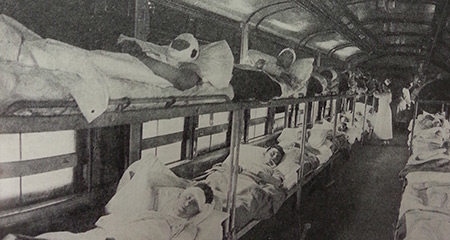
Down in a hedged field at the end of the straggling mining village lies the casualty clearing station, some two-score large tents… Since midday the [casualty] clearing station has been full to overflowing, but still an endless line of motor ambulances moves down along the crowded road from the fighting line, through the village and into the muddy field. It is night now, starless and dark as pitch, and a lashing rain is driven hard in your face before a bitter and rising wind; but still the cars are discharging their pitiful loads in dreary succession when the train is brought into the siding which serves this desolate little camp.

day2day-amb2

From the train itself you can scarcely see anything of the clearing station tonight; only the headlights of the cars as they turn in through the gate, and a few hurricane lamps flickering here and there. Near one end of the train, at the wooden footbridge which crosses the stream separating the camp from the railway track, there stands a powerful acetylene flare, casting a circle of vivid light on the deep mud of the path. Save for three or four feeble oil-lamps on the ground beside the long darkened train, this is the only light at the loading place. A few moments of uncertain waiting, and the first stretcher comes down, its weary bearers slithering and stumbling in the watery mire. As you watch the flare you see them emerge suddenly from the utter blackness beyond into the fierce glare of the light; they halt for a moment, while a cloaked officer standing on the bridge raises the waterproof sheet which protects the wounded man’s face from the beating rain; a name is given and noted; the covering is dropped over the head, and the bearers move on again, seeing to vanish as if by magic as they pass with their burden out of the light into the enveloping blackness. A pause, another stretcher enters the circle of light; the same words pass, the same motions, and it too move son, blotted out as suddenly as it appeared. Watching this time after time, you feel as if a picture were being cast on a screen and flashed off, over and over again: for there is something cruelly mechanical about it all.

(c) Rosenstiel's; Supplied by The Public Catalogue Foundation

Base Nation

VINE Base Nation

Matt Farish‘s perceptive view of David Vine‘s BaseNation – ‘a distressing and tremendously helpful resource for grappling with the global geography of the American armed forces’ (see also here, the map here [also shown above] and the interactive map here) – is up at the LA Review of Books here.

Base-Nation1-243x366The Baseworld that was pieced together during and after World War II undoubtedly represented “a qualitative and quantitative shift,” but it is noteworthy that a place like Fort Leavenworth, Kansas, once dubbed the “western edge of civilization,” is today both a heritage landscape and an active Army facility, including, of course, the military’s most prominent prison. As historians have noted, the movement of men and motifs from the “Indian Wars” to overseas conflicts like the Philippine-American War (1899–1902) was direct. “Now that the continent is subdued,” the California-based Overland Monthly announced in 1898, “we are looking for fresh worlds to conquer.”

In the 21st century, the perverse demand for “total defense” has produced an increasingly diverse roster of base types, from Germany’s Kaiserslautern Military Community (including the massive Ramstein Air Base), home to an 840,000-square-foot mall, to the small, often secretive “lily pads” that typify the Pentagon’s role “in at least forty-nine of the fifty-four African countries. It may be operating in every single one.” By limiting the number of troops in place — sometimes replacing them with “pre-positioned” weapons and matériel — and encouraging closer ties with other national militaries, lily pads present a different sort of challenge for opponents of military presence.

But Matt – I think properly refuses the distinction between ‘domestic’ and ‘extraterritorial’:

Vine’s decision to focus almost exclusively on “extraterritorial” sites is practical, but it is also political, even as the division implied by this word is unsustainable. The benefits of its retention seem meager: it allows Vine to advocate for a return of “troops and base spending back to the United States,” “stemming the leakage of money out of the U.S. economy and ensuring that economic spillover effects remain at home.” Despite the stupendous number of dollars at stake — tens if not hundreds of billions, annually — I still wonder if Vine’s heart is really in this argument, or if he would prefer to emphasize the “twenty-first century form of colonialism” he documents in places like Guam, and the restitutions that might result from demilitarization. But even on this charge, he follows the same path, claiming that the condition of Guam or Puerto Rico hinders “our country’s ability to be a model for democracy.” For followers of popular political speech, this is familiar prose. But it is still a fictional aspiration, all the more frustrating because it seems to be the result of authorial or editorial pragmatism. It falls apart as soon as we consider varieties of ongoing military colonialism and environmental injustice in the American Southwest, for instance.

David has promised to donate all proceeds from Base Nation ‘to nonprofit organizations serving military veterans, their families, and other victims of war and violence.’

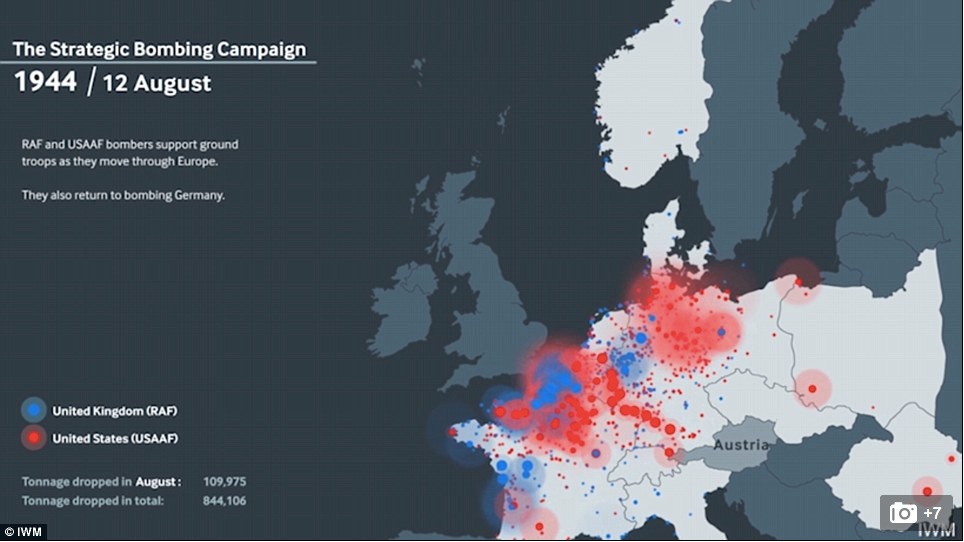
Deadly animation

IWM Strategic bombing campaign 14 December 1941

IWM Strategic bombing campaign 12 August 1944

Britain’s Imperial War Museum has produced a striking animation of the ‘strategic bombing campaign’ in Europe during the Second World War:

https://www.youtube.com/watch?v=Vwf792GKqQ0

If the YouTube link (above) doesn’t work in your region, try this.  I can’t find any version on the IWM website – this version originates with the Daily Mail here – but an interactive version will be available to visitors at the reopened American Air Museum in Britain (at IWM Duxford) from the weekend.  The first bombing mission by the USAAF took place on 29 June 1942 against the Hazebrouk marshalling yards.

All the ways we kill and die

all-the-ways-we-kill-and-die-cover

I’ve noticed Brian Castners astonishing work before – see my post here – and I’m now deep into his latest book (published on my birthday).  I’ll write a detailed response when I’m finished, but it is so very good that I wanted to give readers advance notice of it.  It’s called All the ways we kill and die (Arcade, 2016):

The EOD—explosive ordnance disposal—community is tight-knit, and when one of their own is hurt, an alarm goes out. When Brian Castner, an Iraq War vet, learns that his friend and EOD brother Matt has been killed by an IED in Afghanistan, he goes to console Matt’s widow, but he also begins a personal investigation. Is the bomb maker who killed Matt the same man American forces have been hunting since Iraq, known as the Engineer?

In this nonfiction thriller Castner takes us inside the manhunt for this elusive figure, meeting maimed survivors, interviewing the forensics teams who gather post-blast evidence, the wonks who collect intelligence, the drone pilots and contractors tasked to kill. His investigation reveals how warfare has changed since Iraq, becoming individualized even as it has become hi-tech, with our drones, bomb disposal robots, and CSI-like techniques. As we use technology to identify, locate, and take out the planners and bomb makers, the chilling lesson is that the hunters are also being hunted, and the other side—from Al-Qaeda to ISIS— has been selecting its own high-value targets.

This is how Brian himself describes the book:

In January of 2012, a good friend of mine–Matt Schwartz from Traverse City, Michigan–was killed in Afghanistan. Matt was an Explosive Ordnance Disposal technician. We had the same job, but while I had done my two tours in Iraq and went home, Matt deployed again and again and again. He was shot on his second tour, and died on his sixth.

I realize now that I was bound to do an investigation into his death; my training demanded it. But instead of asking “what” killed him–we knew immediately it was a roadside bomb–I asked “who” killed him. It’s a question that would not have made any sense in past wars, not even at the start of this one. But we have individualized the war, we target specific people in specific insurgent organizations, and in the course of my research, I discovered the leaders on the other side do the same in reverse to us.

This is the story of an American family at war, and the men and women who fight this new technology-heavy and intelligence-based conflict. I interviewed intel analysts, biometrics engineers, drone pilots, special operations aircrew, amputees who lost their legs, and the contractors hired to finish the job. They are all hunting a man known as al-Muhandis, The Engineer, the brains behind the devices that have killed so many soldiers in Iraq and Afghanistan.

You can read an excerpt at VICE (‘The problem with biometrics at war‘) and another at Foreign Policy (‘You will know the Bomber by his designs).

Reading this in counterpoint to Harry Parker‘s  Anatomy of a soldier (see my post here) – both deal with the aftermath of an IED in Afghanistan – is proving to be a rich and truly illuminating experience.

Red Cross-Fire

Yet more on violations of medical neutrality in contemporary conflicts (see my posts here, herehere and here).  Over at Afghan Analysts Network Kate Clark provides a grim review of (un)developments in Afghanistan, Clinics under fire? Health workers caught up in the Afghan conflict.

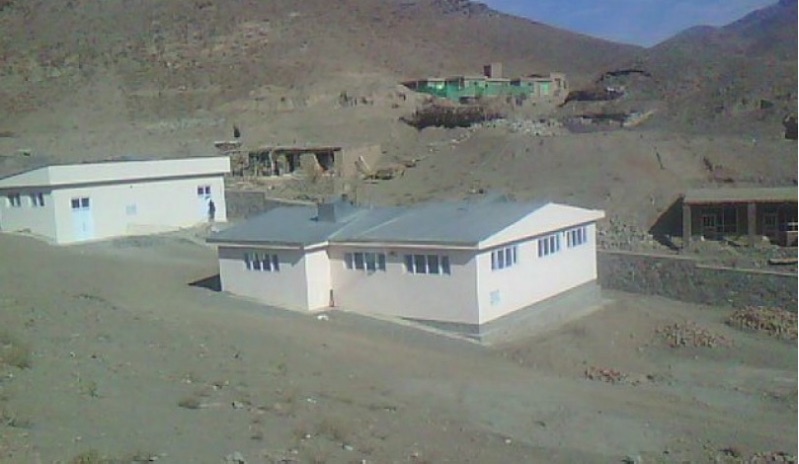
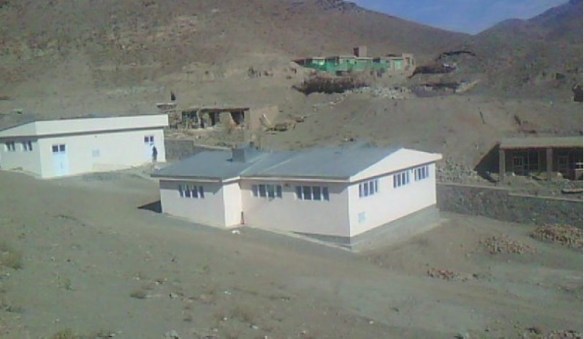
Those providing health care in contested areas in Afghanistan say they are feeling under increasing pressure from all sides in the war. There have been two egregious attacks on medical facilities in the last six months: the summary execution of two patients and a carer taken from a clinic in Wardak by Afghan special forces in mid-February – a clear war crime – and the United States bombing of the Médecins Sans Frontières (MSF) hospital in Kunduz in October 2015, which left dozens dead and injured – an alleged war crime. Health professionals have told AAN of other violations, by both pro and anti-government forces. Perhaps most worryingly, reports AAN Country Director Kate Clark, have been comments by government officials, backing or defending the attacks on the MSF hospital and Wardak clinic [see image below].
SCA Wardak clinic JPEG

So, for example:

Afghan government reactions to the news of the Wardak killings [at Tangi Sedan during the night of 17/18 February 2016; see also here] came largely at the provincial level, from officials who saw no problem in those they believed were Taleban – wounded or otherwise – being taken from a clinic and summarily executed. Head of the provincial council, Akhtar Muhammad Tahiri, was widely quoted, saying: “The Afghan security forces raided the hospital as the members of the Taliban group were being treated there.” Spokesperson for the provincial governor, Toryalay Hemat, said, “They were not patients, but Taliban,” and “The main target of the special forces was the Taliban fighters, not the hospital.” Spokesman for Wardak’s police chief, Abdul Wali Noorzai, said “Those killed in the hospital were all terrorists,” adding he was “happy that they were killed.”

Yet, the killings were a clear war crime. The Laws of Armed Conflict, also known as International Humanitarian Law, give special protection to medical facilities, staff and patients during war time – indeed, this is the oldest part of the Geneva Conventions. The Afghan special forces’ actions in Wardak involved numerous breaches: forcibly entering a medical clinic, harming and detaining staff and killing patients.  The two boys and the man who were summarily executed were, in any case, protected either as civilians (the caretaker clearly, the two patients possibly – they had claimed to have been injured in a motorbike accident) or as fighters who were hors d’combat (literally ‘out of the fight’) because they were wounded and also then detained.  Anyone who is hors d’combat is a protected person under International Humanitarian Law and cannot be harmed, the rationale being that they can no longer defend themselves. It is worth noting that, for the staff at the clinic to have refused to treat wounded Taleban would also have been a breach of medical neutrality: International Humanitarian Law demands that medical staff treat everyone according to medical need only.

That the Wardak provincial officials endorsed a war crime is worrying enough, but their words echoed reactions from more senior government officials to the US military’s airstrikes on a hospital belonging to the NGO Médecins Sans Frontières on 3 October 2015. Then, ministers and other officials appeared to defend the attack by saying it had targeted Taleban whom they said were in the hospital (conveniently forgetting that, until the fall of Kunduz city became imminent when the government evacuated all of its wounded from the hospital except the critically ill, the hospital had largely treated government soldiers). The Ministry of Interior spokesman, for example, said, “10 to 15 terrorists were hiding in the hospital last night and it came under attack. Well, they are all killed. All of the terrorists were killed. But we also lost doctors. We will do everything we can to ensure doctors are safe and they can do their jobs.”

MSF denied there were any armed men in the hospital. However, even if there had been, International Humanitarian Law would still have protected patients and medical staff: they would still have had to have been evacuated and warnings given before the hospital could have been legally attacked.

Not surprisingly heads of various humanitarian agencies all reported that the situation was worsening:

“General abuses against medical staff and facilities are on the rise from all parties to the conflict,” said one head of agency, while another said, “We have a good reputation with all sides, but we have still had threats from police, army and insurgents.” The head of a medical NGO described the situation as “messy, really difficult”:

All health facilities are under pressure. We have had some unpleasant experiences, The ALP [Afghan Local Police] are not professional, not disciplined. If the ALP or Taleban take over a clinic, we rely on local elders [to try to sort out the situation]. We are between the two parties.

He described the behaviour of overstretched Afghan special forces as “quite desperate,” adding, “They are struggling, trying to be everywhere and get very excited when there’s fighting.” Most of them, he said, were northerners speaking little or no Pashto, which can make things “difficult for our clinics in the south.”

The head of another agency listed the problems his staff are facing:

“We have seen the presence of armed men in medical facilities, turning them into targets. We have seen violations by the ANSF [Afghan National Security Forces], damage done to health facilities that were taken over as bases to conceal themselves and fight [the insurgents] from. We have seen checkpoints located close to health centres. Why? So that in case of hostilities, forces can take shelter in the concrete building. We have seen looting. We have seen ANSF at checkpoints deliberately causing delays, especially in the south, including blocking patients desperately needing to get to a health facility. We can never be certain that [such a delay] was the cause of death, but we believe it has been.”

He said his medical staff had been threatened by “ANSF intervening in medical facilities at the triage stage, forcing doctors to stop the care of other patients and treat their own soldiers, in disregard of medical priorities.” Less commonly, but more dangerously for the doctors themselves, he said, was the threat of Taleban abduction. He described a gathering of surgeons in which all reported having been abducted from their homes at least once and brought to the field to attend wounded fighters “with all the dangers you can imagine along the road.” He said the surgeons were “forced to operate without proper equipment and forced to abandon their own patients in clinics because the abduction would last days.”

Locally, medical staff often try to mitigate threats from both government forces and insurgents by seeking protection first from the local community. One head of agency described their strategy:

“When we open a clinic, our first interlocutors are the elders. Everyone wants a clinic in their area, but we decide the location and make the elders responsible for the clinic… They have to give us a building – three to four rooms. All those who work in the clinic – the ambulance driver, the owner of the vehicle, everyone – come from the area. We also need the elders to deal with the parties… If the ALP or Taleban take over clinic, we always start with the elders [who negotiate with whoever has taken over the clinic].”

However, this tactic puts a burden on community elders who may not be able to negotiate if the ANSF, ALP or insurgents are also threatening them.

***

I’ve delayed following up my previous commentaries on the US airstrike on the MSF Trauma Center in Kunduz (here and here) because I had hoped the full report of the internal investigation carried out by the US military would be released: apparently it runs to 3,000-odd pages.  I don’t for a minute believe that it would settle matters, but in any event nothing has emerged so far – though I’m sure it’s subject to multiple FOIA requests and, if and when it is released, will surely have been redacted.
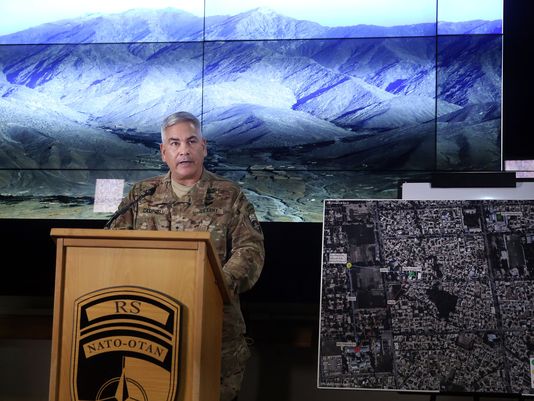
CAMBELL Press conference

All we have is an official statement by General John Campbell on 25 November 2015 (above), which described the airstrike as ‘a tragic, but avoidable accident caused primarily by human error’, and a brief Executive Summary of the findings of the Combined Civilian Casualty Assessment Team (made up of representatives from NATO and the Afghan government) which emphasised that those errors were ‘compounded by failures of process and procedure, and malfunctions of technical equipment.’

The parallel investigations identified a series of cumulative, cascading errors and malfunctions:

(1) The crew of the AC-130 gunship that carried out the attack set out without a proper mission brief or a list of ‘no-strike’ targets; the aircraft had been diverted from its original mission, to provide close air support to ‘troops in contact’, and was unprepared for this one (which was also represented as ‘troops in contact’, a standard designation meaning that troops are under hostile fire).

(2) Communications systems on the aircraft failed, including – crucially – the provision of video feeds to ground force commanders and the transmission of electronic messages (the AC-130 has a sophisticated sensor and communications suite  – or ‘battle management center’ –on board, staffed by two sensor operators, a navigator, a fire control officer, and an electronic warfare officer, and many messages are sent via classified chat rooms).
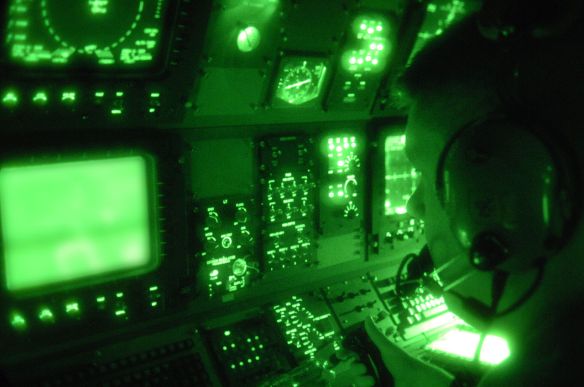
AC-130U_Sensor_Operator

The problem was apparently a jerry-rigged antenna that was supposed to link the AC-130 to the ground.  Here is how General Bradley Heithold explained it to Defense One:

“Today, we pump full-motion video into the airplane and out of the airplane. So we have a Ku-band antenna on the airplane … the U-model….  On our current legacy airplanes, the solution we used was rather scabbed on: take the overhead escape hatch out, put an antenna on, stick it back up there, move the beams around. We’ve had some issues, but we’re working with our industry partners to resolve that issue.”

He added, “99.9 percent of the time we’ve had success with it. These things aren’t perfect; they’re machines.”

Heithold said that dedicated Ku-band data transfer is now standard on later models of the AC-130, which should make data transfer much more reliable.

(3)  Afghan Special Forces in Kunduz had requested close air support for a clearing operation in the vicinity of the former National Directorate of Security compound, which they believed was now a Taliban ‘command and control node’.  The commander of US Special Forces on the ground agreed and provided the AC-130 crew with the co-ordinates for the NDS building.  He could see neither the target nor the MSF Trauma Center from his location but this is not a requirement for authorising a strike; he was also working from a map that apparently did not mark the MSF compound as a medical facility.  According to AP, he had been given the coordinates of the hospital two days before but said he didn’t recall seeing them.  The targeting system onboard the AC-130 was degraded and directed the aircraft to an empty field and so the crew relied on a visual identification of the target using a description provided by Afghan Special Forces – and they continued to rely on their visual fix even when the targeting system had been re-aligned (‘the crew remained fixated on the physical description of the facility’) and, as David Cloud points out, even though there was no visible sign of ‘troops in contact’ in the vicinity of the Trauma Center (‘An AC-130 is normally equipped with infrared surveillance cameras capable of detecting gunfire on the ground’):
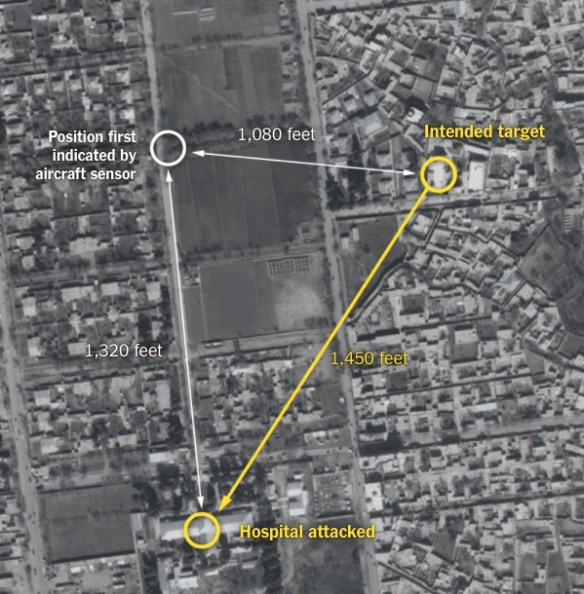
MSF Kunduz attack

Sundarsan Raghaven adds that ‘Not long before the attack on the hospital, a U.S. airstrike pummeled an empty warehouse across the street from the Afghan intelligence headquarters. How U.S. personnel could have confused its location only a few hours later is not clear…’  More disturbingly, two US Special Forces troops have claimed that their Afghan counterparts told their commander that it was the Trauma Center that was being used as the ‘command and control node’, and that the Taliban ‘had already removed and ransomed the foreign doctors, and they had fired on partnered personnel from there.’

(4) The aircrew cleared the strike with senior commanders at the Joint Operations Center at Bagram and provided them with the co-ordinates of the intended target.  Those commanders failed to recognise that these were the co-ordinates of the MSF hospital which was indeed on the ‘no-strike’ list; ‘this confusion was exacerbated by the lack of video and electronic communications between the headquarters and the aircraft, caused by the earlier malfunction, and a belief at the headquarters that the force on the ground required air support as a matter of immediate force protection’;

(5) The strike continued even after MSF notified all the appropriate authorities that their clinic was under attack; no explanation was offered, though the US military claims the duration was shorter (29 minutes) than the 60-minutes reported by those on the ground.

Campbell announced that those ‘most closely associated’ with the incident had been suspended from duty for violations of the Rules of Engagement – those ‘who requested the strike and those who executed it from the air did not undertake the appropriate measures to verify that the facility was a legitimate military target’ – though he gave no indication how far up the chain of command responsibility would be extended; in January it was reported that US Central Command was weighing disciplinary action against unspecified individuals.  In the meantime, solatia payments had been made to the families of the killed ($6,000) and injured ($3,000).
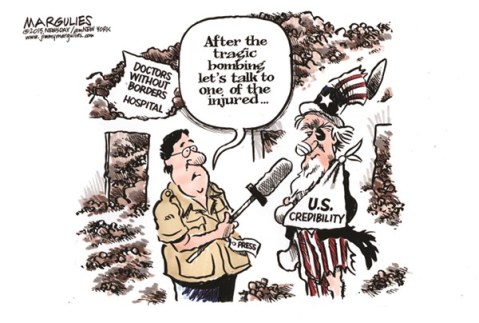
doctors-without-borders-us-credibility

Not surprisingly, MSF reacted angrily to Campbell’s summary: according to Christopher Stokes,

‘The U.S. version of events presented today leaves MSF with more questions than answers.  The frightening catalog of errors outlined today illustrates gross negligence on the part of U.S. forces and violations of the rules of war.’

Joanne Liu, MSF’s President, subsequently offered a wider reflection on war in today’s ‘barbarian times’, prompted by further attacks on other hospitals and clinics in Afghanistan, Syria, Yemen and elsewhere:

“The unspoken thing, the elephant in the room, is the war against terrorism, it’s tainting everything,” she said. “People have real difficulty, saying: ‘Oh, you were treating Taliban in your hospital in Kunduz?’ I said we have been treating everyone who is injured, and it will have been Afghan special forces, it will have been the Taliban, yes we are treating everybody.”

She added: “People have difficulty coming around to it. It’s the core, stripped-down-medical-ethics duty as a physician. If I’m at the frontline and refuse to treat a patient, it’s considered a crime. As a physician this is my oath, I’m going to treat everyone regardless.”

Kate Clark‘s forensic response to the US investigation of the Kunduz attack is here; she insists, I think convincingly, that

‘… rather than a simple string of human errors, this seems to have been a string of reckless decisions, within a larger system that failed to provide the legally proscribed safeguards when using such firepower. There were also equipment failures that compounded the problem but, again, if the forces on the ground and in the air had followed their own rules of engagement, the attack would have been averted.’

This is what just-in-time war looks like, but it’s not enough to blame all this on what General Campbell called a ‘high operational tempo’.  As a minimum, we need to be able to read the transcripts of the ground/air communications – which are recorded as a matter of course, no matter what the tempo, and which are almost always crucial in any civilian casualty incident resulting from ‘troops in contact’ (see, for another vivid example, my discussion here) – to make sense of the insensible.

Viewing Eyes in the Sky


This image released by Bleecker Street shows Phoebe Fox, left, and Aaron Paul in a scene from "Eye In the Sky." (Keith Bernstein/Bleecker Street via AP)

This image released by Bleecker Street shows Phoebe Fox, left, and Aaron Paul in a scene from “Eye In the Sky.” (Keith Bernstein/Bleecker Street via AP)

The New York Review of Books has a characteristically thoughtful response by David Cole to Gavin Hood‘s newly released Eye in the Sky: ‘Killing from the Conference Room‘.

The film traces the arc of a joint US/UK drone strike in Nairobi, told from the viewpoints of those charged with authorising and executing the kill.  The nominal target is a safehouse, and the two al-Shabab leaders inside (conveniently one American citizen and one British citizen); less conveniently, after the strike has been authorised a young girl sets up a bread stand in front of the house.

It’s a more complicated scenario than the serial drone strikes dramatized in Andrew Niccol‘s  Good Kill – because here the politicians are brought into the frame too – and David sees it as a twenty-first century version of the ‘trolley-problem’:

Eye in the SkyIn the classic version of the problem, a runaway train is hurtling down a track on which five people are tied; they will die if the train is not diverted. By pulling a lever, you can switch the train to an alternate track, but doing so will kill one person on that track. Should you pull the switch and be responsible for taking a human life, or do nothing and let five people die?

In Eye in the Sky, the question is whether to [use a drone to] strike the compound, thereby preventing an apparent terrorist attack and potentially saving many lives, though the strike itself might kill the young girl as well as the suspected terrorists. If the operation is delayed to try to avoid endangering the girl, the terrorists may leave the compound, and it may become impossible to prevent the suicide mission. But it’s also possible that the girl will finish selling her bread and leave the danger zone before the suspects depart. If the terrorists leave the compound, an opportunity to capture or kill them without harming others may arise. And of course, the suicide mission itself might fail. As a Danish proverb holds, predictions are hazardous, especially about the future. But a decision must nonetheless be made, and the clock is ticking.

As he points out, there’s no right, neat answer:

There are only competing intuitions, based on utilitarian calculations, the difference, or lack thereof, between act and omission, and the like. In Eye in the Sky, and all the more so in the real world, the choices are never as clearly delineated as in the “trolley problem”; decisions must be made in the face of multiple unknowns. The girl may die and the terrorists may get away and kill many more. But what the film makes clear is that, notwithstanding today’s most sophisticated technology, which allows us to see inside a compound in Africa from half a world away, to confirm positive identifications with facial imaging technology, to make joint real-time decision about life and death across several continents, and then to pinpoint a strike to reduce significantly the danger to innocent bystanders, the dilemmas remain. Technology cannot solve the moral and ethical issues; it only casts them into sharper relief.

Consider, for example, the implications of the purported accuracy of armed drones. The fact that it is possible to conduct “surgical” strikes and to maintain distance surveillance for extended periods of time increases the moral and legal obligation to avoid killing innocents. When the only way to counter an imminent threat was with more blunt explosives or by sending in ground forces, attacks entailing substantial harm to civilians were nonetheless sometimes warranted. As technology makes it increasingly feasible to strike with precision, risks to civilian lives that were once inescapable can now be avoided. And if they can be avoided, mustn’t they be? Thus, when President Barack Obama in May 2013 announced a standard for targeted killings away from traditional battlefields, he said he would authorize such strikes only when there was a “near-certainty that no civilians will be killed or injured—the highest standard we can set.” Precisely because they are so discriminating, drones may demand such a standard. Yet as the film shows, that standard can be very difficult to uphold, even under the best of circumstances.

Given my own interest in the film, I’ll share my thoughts as soon as I’ve seen it.

Note: In the most recent US strike against al-Shabab on 5 March, in which drones and conventional strike aircraft were used to kill perhaps 150 people (or perhaps not) at a training camp 120 miles north of Mogadishu, it seems clear that few doubts were entertained (but see Glenn Greenwald here).

Intelligence designed

LIMN 6

The latest issue of Limn is on ‘The total archive‘:

Vast accumulations of data, documents, records, and samples saturate our world: bulk collection of phone calls by the NSA and GCHQ; Google, Amazon or Facebook’s ambitions to collect and store all data or know every preference of every individual; India’s monumental efforts to give everyone a number, and maybe an iris scan; hundreds of thousands of whole genome sequences; seed banks of all existing plants, and of course, the ancient and on-going ambitions to create universal libraries of books, or their surrogates.

Just what is the purpose of these optimistically total archives – beyond their own internal logic of completeness? Etymologically speaking, archives are related to government—the site of public records, the town hall, the records of the rulers (archons). Governing a collective—whether people in a territory, consumers of services or goods, or victims of an injustice—requires keeping and consulting records of all kinds; but this practice itself can also generate new forms of governing, and new kinds of collectives, by its very execution. Thinking about our contemporary obsession with vast accumulations through the figure of the archive poses questions concerning the relationships between three things: (1) the systematic accumulation of documents, records, samples or data; (2) a form of government and governing; and (3) a particular conception of a collectivity or collective kind. (1) What kinds of collectivities are formed by contemporary accumulations? What kind of government or management do they make possible? And who are the governors, particularly in contexts where those doing the accumulation are not agents of a traditional government?

This issue of Limn asks authors to consider the way the archive—as a figure for a particular mode of government—might shed light on the contemporary collections, indexes, databases, analytics, and surveillance, and the collectives implied or brought into being by them.

The issue includes an essay by Stephen J. Collier and Andrew Lakoff on the US Air Force’s Bombing Encyclopedia of the World.  I’ve discussed the Encyclopedia in detail before, but they’ve found a source that expands that discussion, a series of lectures delivered in 1946-48 to the Air War College by Dr. James T. Lowe, the Director of Research for the Strategic Vulnerability Branch of the U.S. Army’s Air Intelligence Division. The Branch was established in 1945 and charged with conducting what Lowe described as a ‘pre-analysis of the vulnerability of the U.S.S.R. to strategic air attack and to carry that analysis to the point where the right bombs could be put on the right targets concomitant with the decision to wage the war without any intervening time period whatsoever.’

Bombing Encylopedia Coding Form

The project involved drawing together information from multiple sources, coding and geo-locating the nominated targets, and then automating the data-management system.

What interests the authors is the way in which this transformed what was called  ‘strategic vulnerability analysis’: the data stream could be interrogated through different ‘runs’, isolating different systems, in order to identify the ‘key target system’:

‘… the data could be flexibly accessed: it would not be organized through a single, rigid system of classification, but could be queried through “runs” that would generate reports about potential target systems based on selected criteria such as industry and location. As Lowe explained, “[b]y punching these cards you can get a run of all fighter aircraft plants” near New York or Moscow. “Or you can punch the cards again and get a list of all the plants within a geographical area…. Pretty much any combination of industrial target information that is required can be obtained—and can be obtained without error” (Lowe 1946:13-14).’

Their central point is that the whole project was the fulcrum for a radical transformation of knowledge production:

‘The inventory assembled for the Encyclopedia was not a record of the past; rather, it was a catalog of the elements comprising a modern military-industrial economy. The analysis of strategic vulnerability did not calculate the regular occurrence of events and project the series of past events into the future, based on the assumption that the future would resemble the past. Rather, it examined interdependencies among these elements to generate a picture of vital material flows and it anticipated critical economic vulnerabilities by modeling the effects of a range of possible future contingencies. It generated a new kind of knowledge about collective existence as a collection of vital systems vulnerable to catastrophic disruption.’

And so, not surprisingly, the same analysis could be turned inwards – to detect and minimise sites of strategic vulnerability within the United States.

All of this intersects with the authors’ wider concerns about vital systems security: see in particular their ‘Vital Systems Security: Reflexive biopolitics and the government of emergency‘, in Theory, Culture and Society 32(2) (2015):19–51:

This article describes the historical emergence of vital systems security, analyzing it as a significant mutation in biopolitical modernity. The story begins in the early 20th century, when planners and policy-makers recognized the increasing dependence of collective life on interlinked systems such as transportation, electricity, and water. Over the following decades, new security mechanisms were invented to mitigate the vulnerability of these vital systems. While these techniques were initially developed as part of Cold War preparedness for nuclear war, they eventually migrated to domains beyond national security to address a range of anticipated emergencies, such as large-scale natural disasters, pandemic disease outbreaks, and disruptions of critical infrastructure. In these various contexts, vital systems security operates as a form of reflexive biopolitics, managing risks that have arisen as the result of modernization processes. This analysis sheds new light on current discussions of the government of emergency and ‘states of exception’. Vital systems security does not require recourse to extraordinary executive powers. Rather, as an anticipatory technology for mitigating vulnerabilities and closing gaps in preparedness, it provides a ready-to-hand toolkit for administering emergencies as a normal part of constitutional government.

It’s important to add two riders to the discussion of the Bombing Encyclopedia, both of which concern techno-politics rather than biopolitics.  Although those responsible for targeting invariably represent it as a technical-analytical process – in fact, one of the most common elements in the moral economy of bombing is that it is ‘objective’, as I showed in my Tanner Lectures – it is always also intrinsically political; its instrumentality resides in its function as an irreducibly political technology.

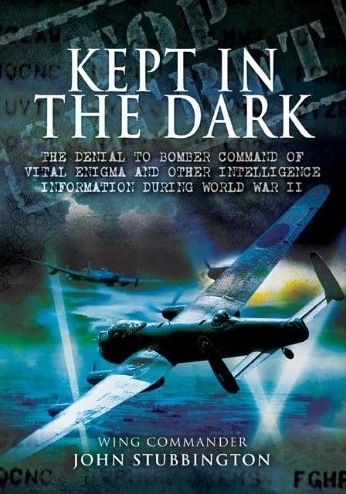
KeptDark1As Stephen and Andrew make clear, the emphasis on key target systems emerged during the Combined Bomber Offensive against Germany in the Second World War, when it was the subject of heated debate.  This went far beyond Arthur Harris‘s vituperative dismissals of Solly Zuckerman‘s arguments against area bombing in favour of economic targets (‘panacea targets’, Harris called them: see my discussion in ‘Doors into nowhere’: DOWNLOADS tab).  You can get some sense of its wider dimensions from John Stubbington‘s intricate Kept in the Dark (2010), which not only provides a robust critique of the Ministry of Economic Warfare’s contributions to target selection but also claims that vital signals intelligence – including ULTRA decrypts – was withheld from Bomber Command.  Administrative and bureaucratic rivalries within and between intelligence agencies did not end with the war, and you can find a suggestive discussion of the impact of this infighting on US targeting in Eric Schmidt‘s admirably clear (1993) account of the development of Targeting Organizations here.

Any targeting process produces not only targets (it’s as well to remember that we don’t inhabit a world of targets: they have to be identified, nominated, activated – in a word, produced) but also political subjects who are interpellated through the positions they occupy within the kill-chain.  After the Second World War, Freeman Dyson reflected on what he had done and, by implication, what it had done to him:

FREEMAN DYSON

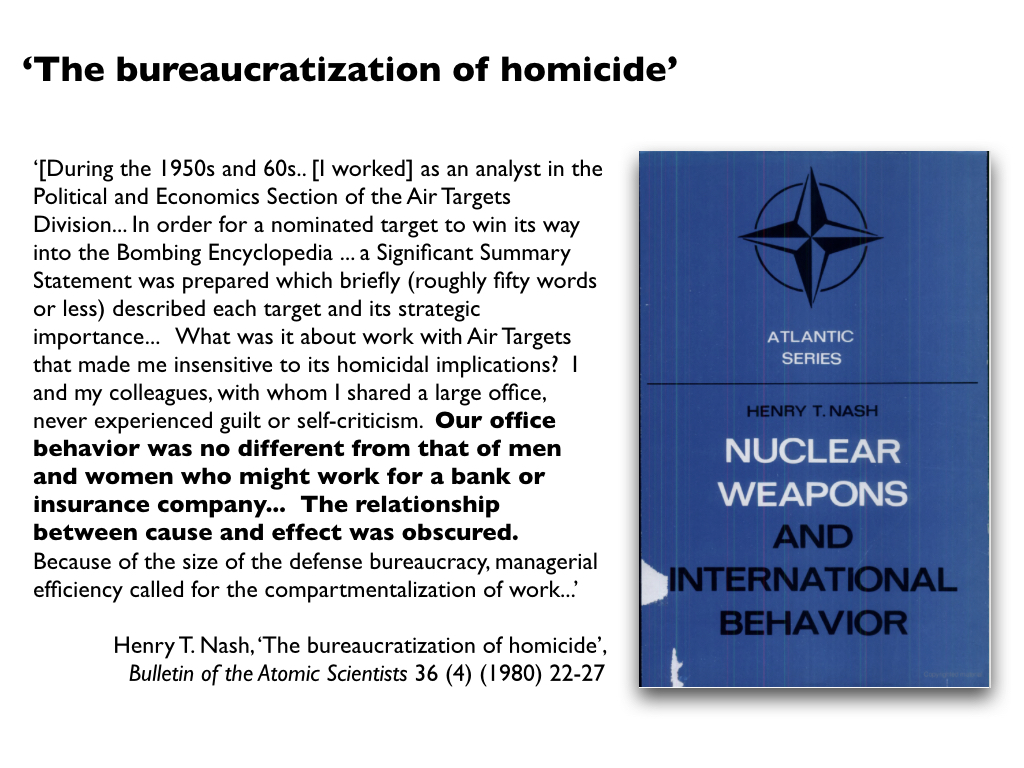
But data-management had been in its infancy.  With the Bombing Encyclopedia, Lowe argued, ‘the new “machine methods” of information management made it possible “to operate with a small fraction of the number of people in the target business that would normally be required.”‘  But there were still very large numbers involved, and Henry Nash –who worked on the Bombing Encyclopedia – was even more blunt about what he called ‘the bureaucratization of homicide‘:

HENRY NASH

This puts a different gloss on that prescient remark of Michel Foucault‘s: ‘People know what they do; frequently they know why they do what they do; but what they don’t know is what what they do does.’

Nash began his essay with a quotation from a remarkable book by Richard J. Barnet, The roots of war (1972).  Barnet said this (about the Vietnam War, but his point was a general one):

‘The essential characteristic of bureaucratic homicide is division of labor. In general, those who plan do not kill and those who kill do not plan. The scene is familiar. Men in blue, green and khaki tunics and others in three-button business suits sit in pastel offices and plan complex operations in which thousands of distant human beings will die. The men who planned the saturation bombings, free fire zones, defoliation, crop destruction, and assassination programs in the Vietnam War never personally killed anyone.

BarnetRichard‘The bureaucratization of homicide is responsible for the routine character of modern war, the absence of passion and the efficiency of mass-produced death. Those who do the killing are following standing orders…

‘The complexity and vastness of modern bureaucratic government complicates the issue of personal responsibility. At every level of government the classic defense of the bureaucratic killer is available: “I was just doing my job!” The essence of bureaucratic government is emotional coolness, orderliness, implacable momentum, and a dedication to abstract principle. Each cog in the bureaucratic machine does what it is supposed to do.

‘The Green Machine, as the soldiers in Vietnam called the military establishment, kills cleanly, and usually at a distance. America’s highly developed technology makes it possible to increase the distance between killer and victim and hence to preserve the crucial psychological fiction that the objects of America’s lethal attention are less than human.’

Barnet was the co-founder of the Institute for Policy Studies; not surprisingly, he ended up on Richard Nixon‘s ‘enemies list‘ (another form of targeting).

I make these points because there has been an explosion – another avalanche – of important and interesting essays on databases and algorithms, and the part they play in the administration of military and paramilitary violence.  I’m thinking of Susan Schuppli‘s splendid essay on ‘Deadly algorithms‘, for example, or the special issue of Society & Space on the politics of the list – see in particular the contributions by Marieke de Goede and Gavin Sullivan (‘The politics of security lists‘), Jutta Weber (‘On kill lists‘) and Fleur Johns (on the pairing of list and algorithm) – and collectively these have provided essential insights into what these standard operating procedures do.  But I’d just add that they interpellate not only their victims but also their agents: these intelligence systems are no more ‘unmanned’ than the weapons systems that prosecute their targets.  They too may be ‘remote’ (Barnet’s sharp point) and they certainly disperse responsibility, but the role of the political subjects they produce cannot be evaded.  Automation and AI undoubtedly raise vital legal and ethical questions – these will become ever more urgent and are by no means confined to ‘system failure‘ – but we must not lose sight of the politics articulated through their activation.  And neither should we confuse accountancy with accountability.

Playing the military-industrial complex

Michael Davis – not to be confused with the other Mike Davis – has a new game, The Military-Industrial Complex, which may well appeal to readers looking for other ways to delay and procrastinate.  You play the Minister for Civil Industry and War Production.

Military-Industrial Complex

This is how Jack Kotzer described the game:

You sit at a terminal with your face glued to the screens. If you press right, resources go to your defences, developing tech, and weapons. If you press left, resources go to your people, developing stickers, strip-malls, and new “very special episodes” of ALF about drugs to keep them busy all day. When you fund project for the people, Stalintron’s forces get closer to the border. If you fund the war machine, your populace starts itching for a revolution. Every few turns a wild card will appear, forces beyond your power that can temper either anxiety, such as your rival’s failures, a deal with Lord Triton god of the ocean, or the sexiest goddamn Bryan Adams album to date.

“The gameplay is designed in such a way that you can never win,” said Davis in an email to Motherboard. “You can just prolong how long it takes to lose, which is my ham-fisted pinko statement on the actual Military-Industrial Complex.”

As the image shows, it’s also a retro-tribute to the original Mac – available from the App Store.