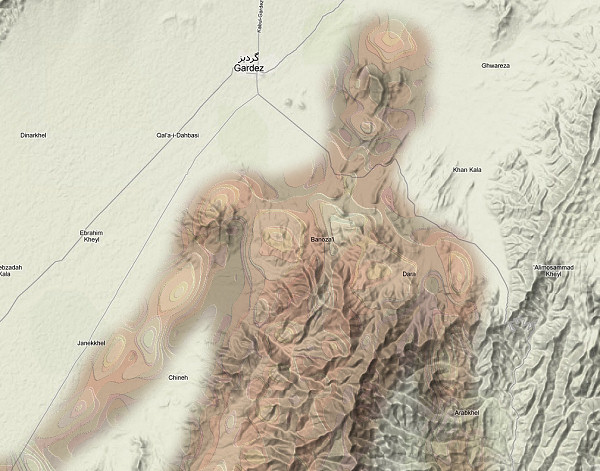
Angry Eyes (2)

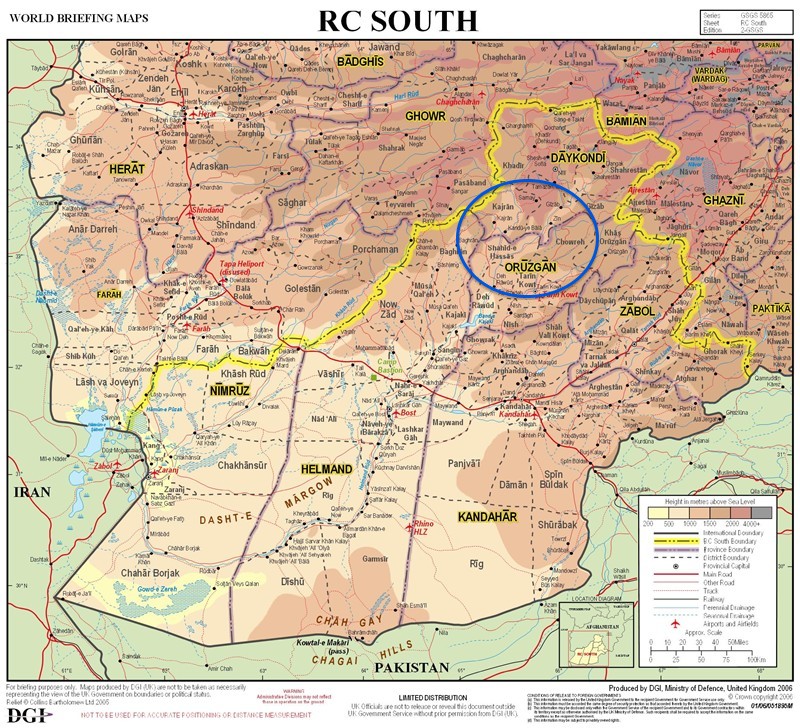
MAP isaf-rc-south

This is the second installment of my analysis of an air strike orchestrated by a Predator in Uruzgan province, Afghanistan on 21 February 2010; the first installment is here.

(4) Command and control?

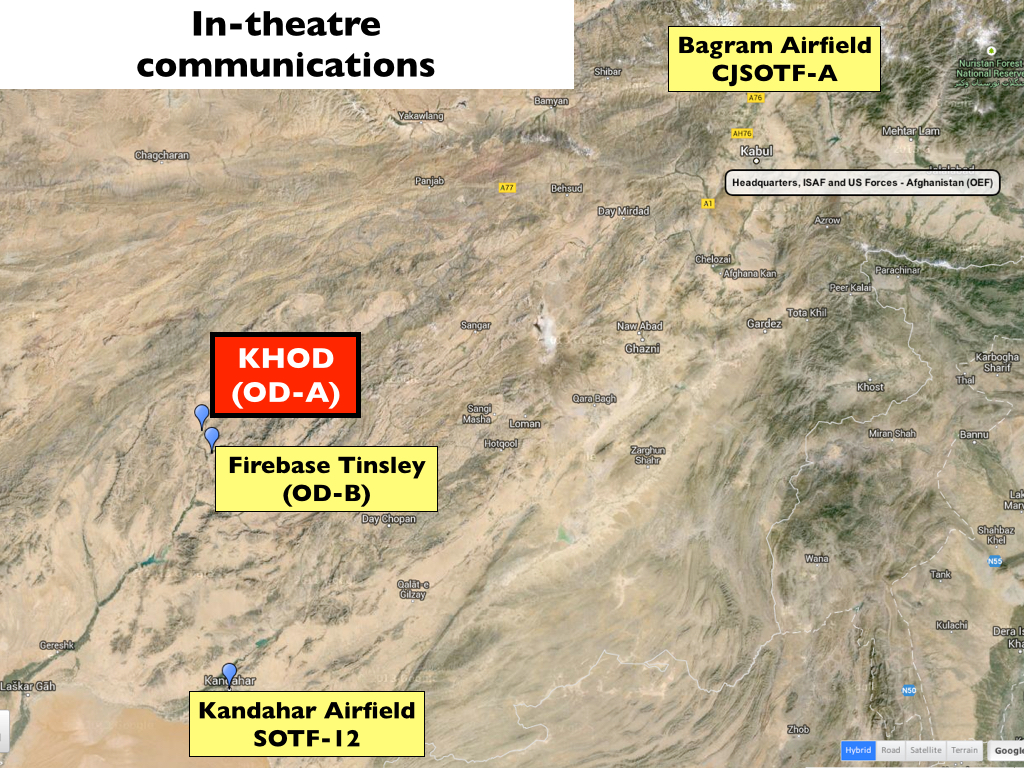
What was happening in and around Khod was being followed not only by flight crews and image analysts in the continental United States but also by several Special Forces command posts or Operations Centers in Afghanistan.  In ascending order these were:

(1) the base from which ODA 3124 had set out at Firebase Tinsley (formerly known as Cobra);

(2) Special Operations Task Force-12 (SOTF-12), based at Kandahar;

(3) Combined Joint Special Operations Task Force – Afghanistan (CJSOTF-A) based at Bagram.
GREGORY Angry Eyes 2015 IMAGES.064

Once the ODA 3124 left the wire, command and support passed to SOTF-12; the OD-B at Tinsley had limited resources and limited (and as it happens intermittent) communications access and could only monitor what was happening.

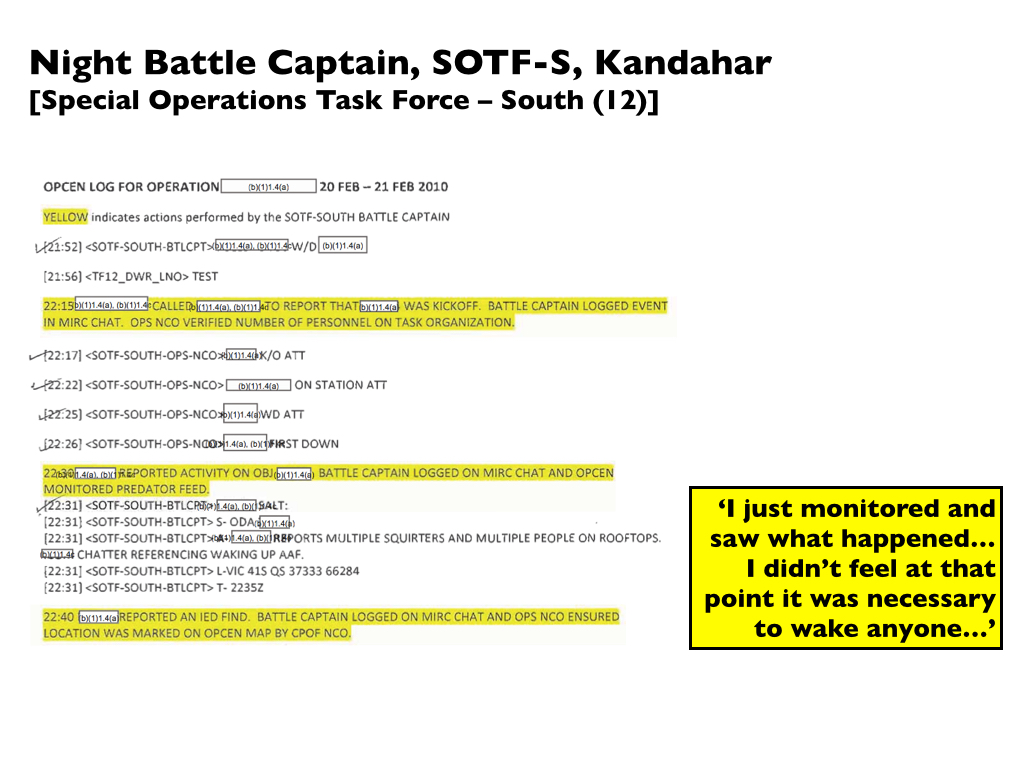
That was normal, but in fact both higher commands did more or less the same: and the investigating team was clearly appalled.  At SOTF-12 all senior (field grade) officers were asleep during the period of ‘highest density of risk and threatening kinetic activity’ (although they had established ‘wake-up criteria’ for emergency situations).  The Night Battle Captain had been in post for just three weeks and had been given little training in his role; he received a stream of SALT reports from the Ground Force Commander of ODA 3124 (which detailed Size of enemy force, Activity of enemy force, Location and Time of observation) but simply monitored the developing situation – what one investigating officer characterised as ‘a pretty passive kind of watching’.
GREGORY Angry Eyes 2015 IMAGES.065

The same was true at CJSOTF-A (the staff there monitored 15-25 missions a day, but this was the only active operation that had declared a potential Troops in Contact).

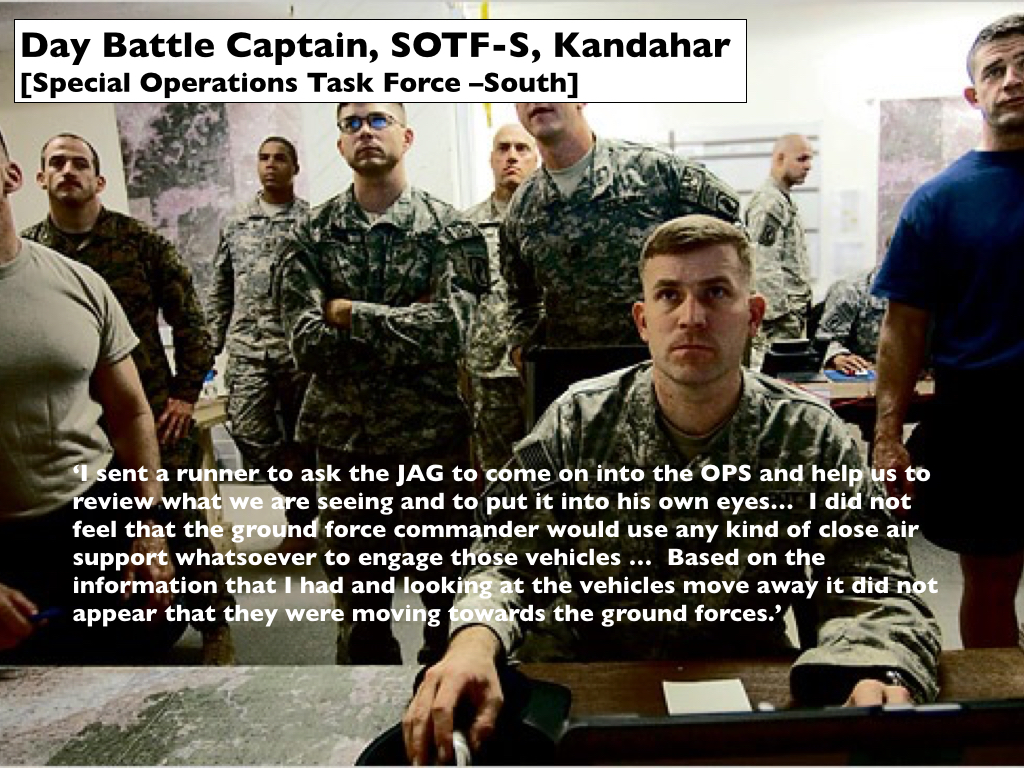
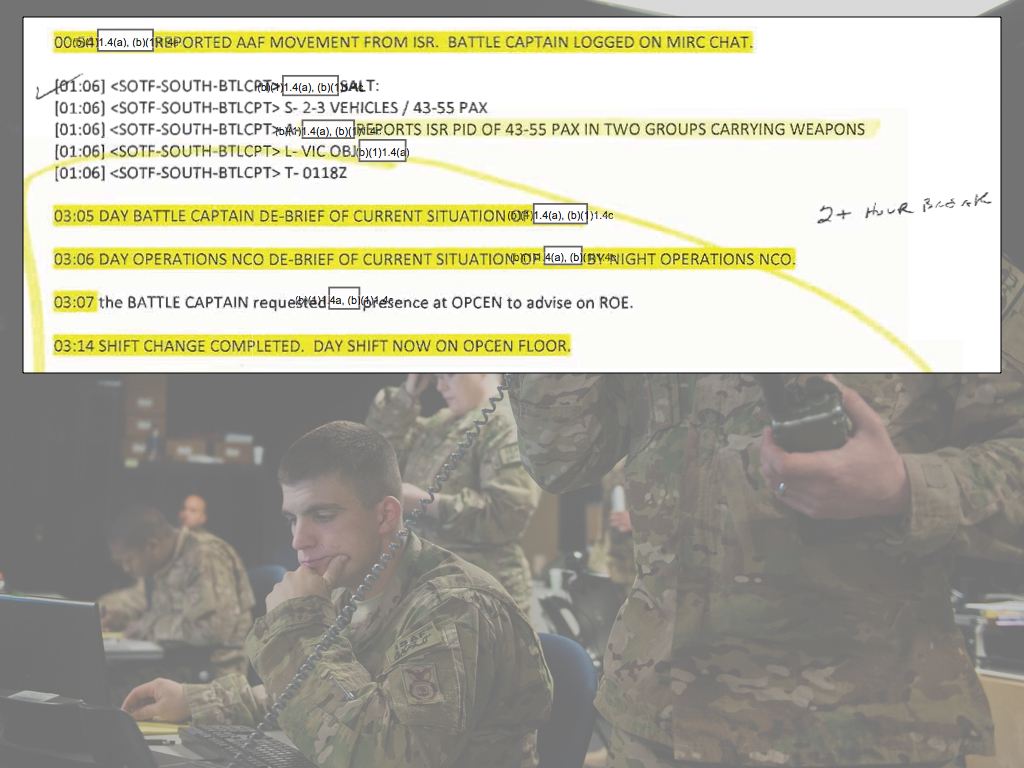
When the more experienced Day Battle Captain entered the Joint Operations Center at Kandahar and was briefed by the Night Battle Captain he was sufficiently concerned to send a runner to ask the Judge Advocate, a military lawyer, to come to the JOC.  He believed the occupants of the vehicles were hostile but was not convinced that they posed an immediate threat to troops on the ground:  ‘I wanted to hear someone who was extremely smart with the tactical directive and use of CAS [Close Air Support] in a situation I hadn’t seen before’.

This was a smart call for many reasons; the commander of US Special Forces, Brigadier General Edward Reeder, told the inquiry: ‘Honestly I don’t take a shit without one [a JAG], especially in this business’.  Significantly, the Safety Observer at Creech testified that there was no ‘operational law attorney’ available onsite for aircrews conducting remote operations; conversely, JAGs were on the operations floor of CENTCOM’s Combined Air and Space Operations Centre at Ul Udeid Air Base and, as this case shows, they were available at operations centers established by subordinate commands in-theatre.
GREGORY Angry Eyes 2015 IMAGES.073

GREGORY Angry Eyes 2015 IMAGES.074

The JAG at Kandahar was not routinely called in for ‘Troops in Contact’ but on this occasion he was told ‘my Legal Opinion [was] needed at the OPCENT and that it wasn’t imminent but they wanted me to rush over there right away…’

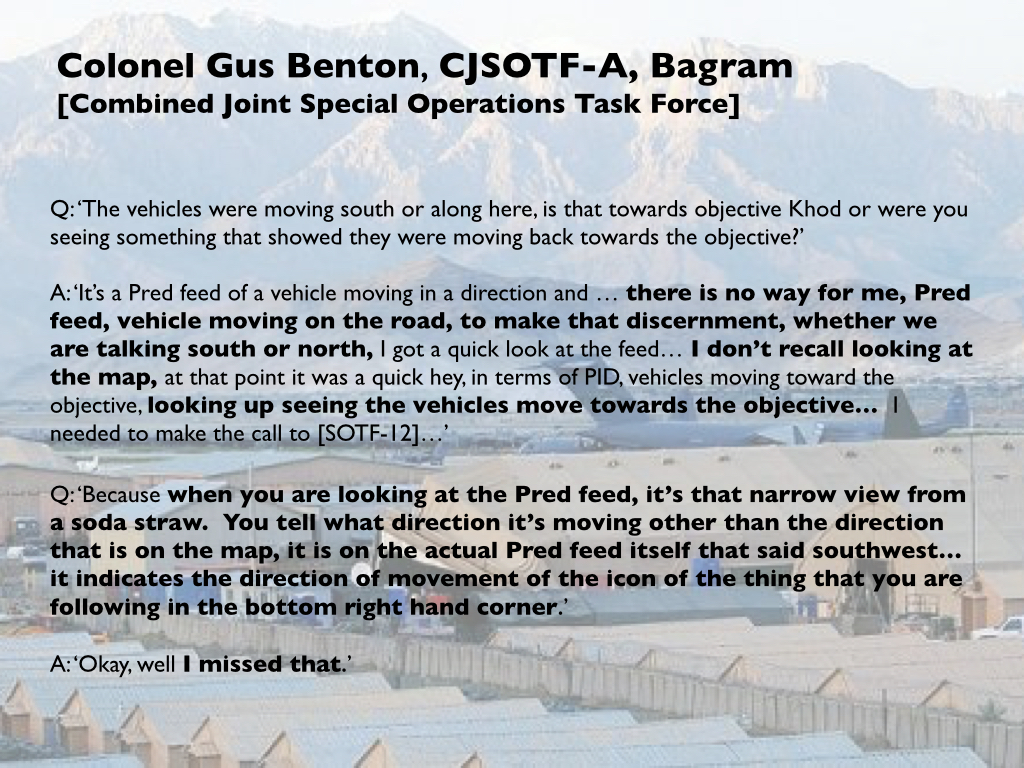
Meanwhile up at Bagram Colonel Gus Benton, the commanding officer of CJSOTF-A, was being briefed by his second-in-command who understood that the Ground Force Commander’s intention was to allow the three vehicles to move closer to his position at Khod.  He thought that made sound tactical sense.

‘I said that … is what we did, we let them come to us so we can get eyes on them. During my time I never let my guys engage with CAS if they couldn’t see it. I said that is great and COL [Benton] said “that is not fucking great” and left the room.’

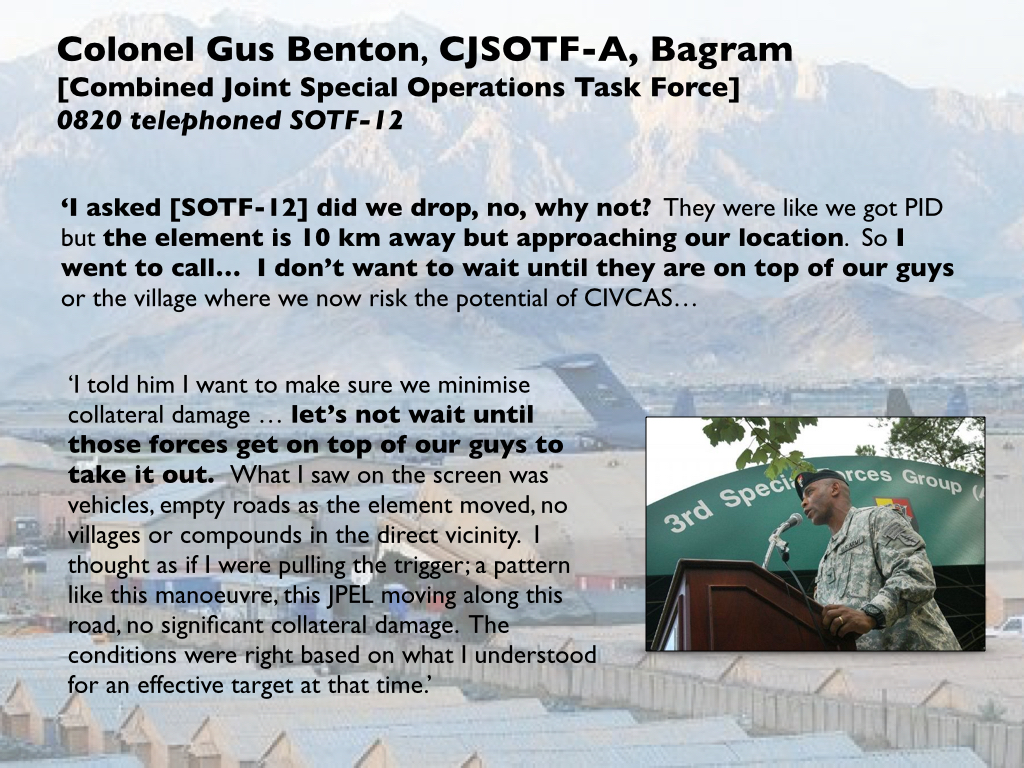
At 0820, ten minutes after the JAG entered the JOC at Kandahar, while he was watching the Predator feed, the phone rang: it was Benton.  He demanded Lt Colonel Brian Petit, the SOTF-12 commander, be woken up and brought to the phone:
GREGORY Angry Eyes 2015 IMAGES.076

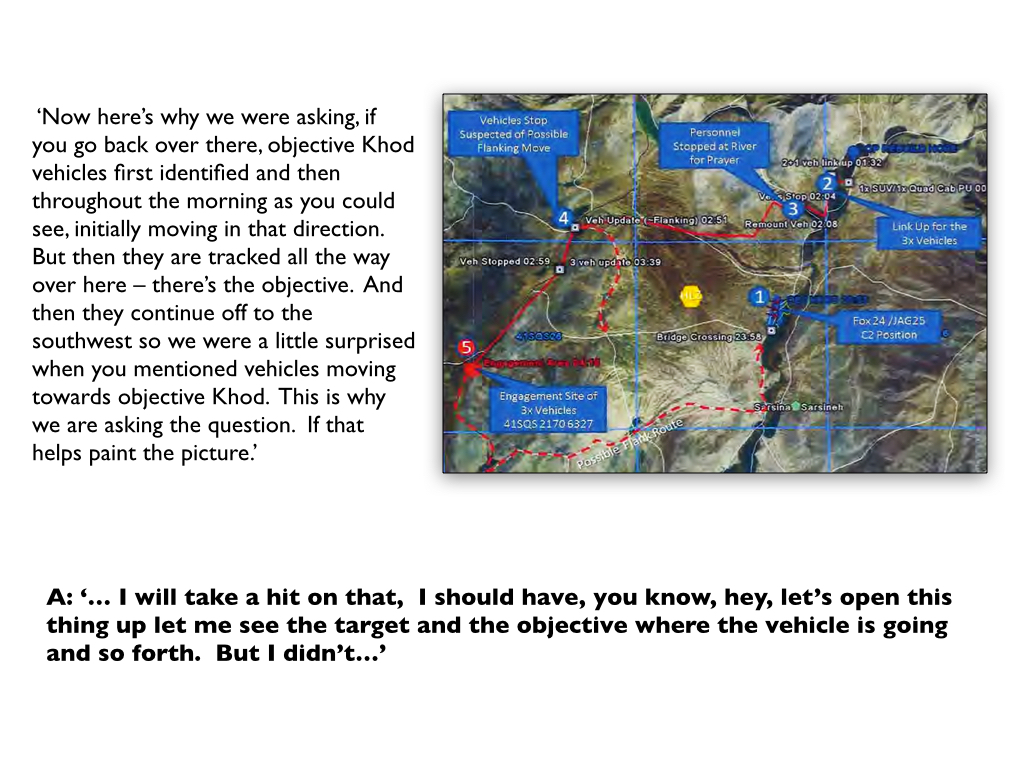
He spectacularly mis-read the situation (not least because he mis-read the Predator feed).  It was true that the vehicles were in open country, and not near any compounds or villages; but Benton consistently claimed that the vehicles were ‘travelling towards our objective’ whereas – as MG McHale’s investigating team pointed out to him – they were in fact moving away from Khod.
GREGORY Angry Eyes 2015 IMAGES.077

GREGORY Angry Eyes 2015 IMAGES.078

There had also been some, inconclusive discussion of a possible ‘High Value Target’ when the vehicles were first tracked, but the presence of a pre-approved target on the Joint Prioritised Effects List (Benton’s ‘JPEL moving along this road’) had never been confirmed and the Ground Force Commander had effectively discarded it (‘above my authority’, he said).

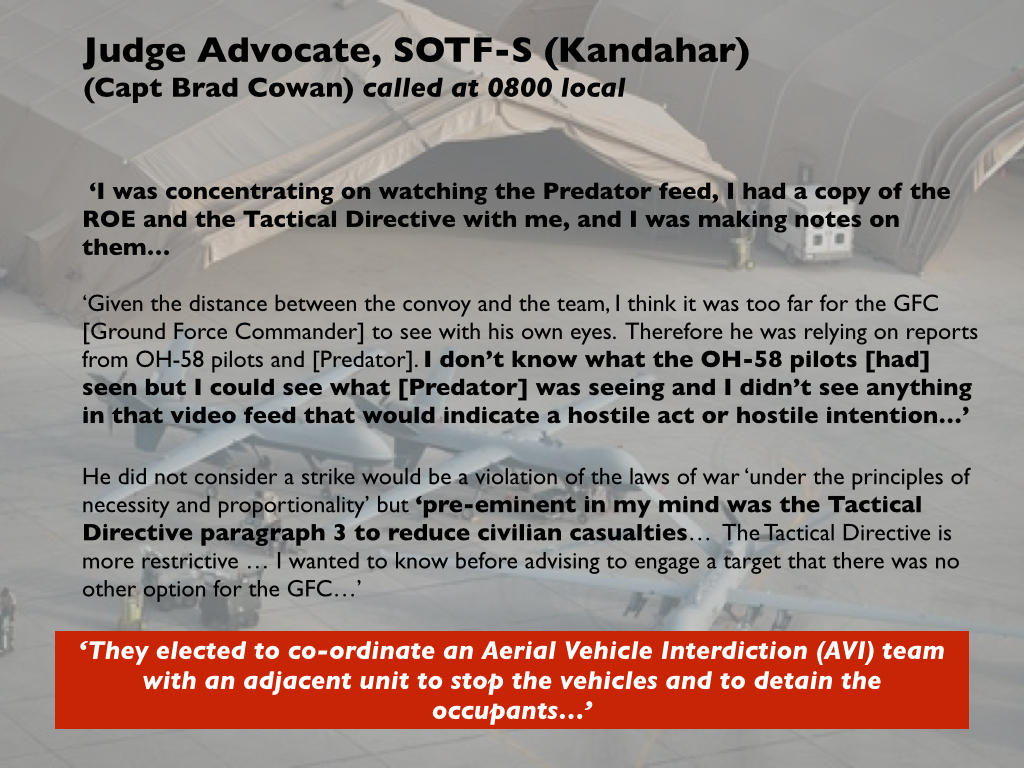
Certainly, the JAG at Kandahar read the situation differently:
GREGORY Angry Eyes 2015 IMAGES.075

When Benton rang off, the JAG went over to the Day Battle Captain and Lt Col Petit and recommended an Aerial Vehicle Interdiction (AVI) team be called in for a show of force to stop the vehicles without engaging the occupants in offensive action.

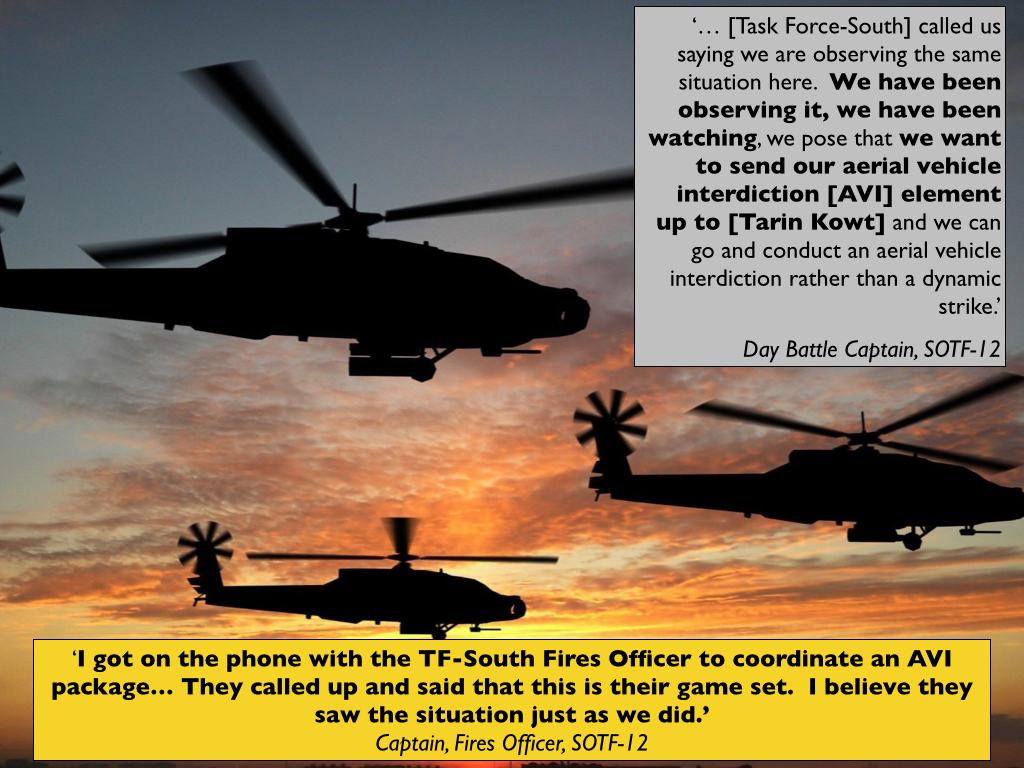
They agreed; in fact another Task Force also watching the Predator feed called to make the same suggestion, and the Fires Officer set about arranging to use their Apache helicopters to conduct an AVI:
GREGORY Angry Eyes 2015 IMAGES.079

The Fires Officer had been responsible for setting up the Restricted Operating Zone for aircraft supporting the ODA – de-conflicting the airspace and establishing what aircraft would be available – but its management was de-centralised:

‘I establish the ROZ, give the initial layout of what assets are going on, and then I pass that to the JTAC [Joint Terminal Attack Controller with the Ground Force Commander at Khod].  I pass the frequencies to the assets and the JTAC controls them from there.’

At 0630, long before all this frantic activity at Kandahar, the two OH-58s had arrived at a short hold location beyond the ‘range of enemy visual and audio detection’, and at 0730 they had left to refuel at Tarin Kowt.  The Day Battle Captain and the Fires Officer both thought they were still off station.  In fact, the helicopters had returned to hold at Tinsley/Cobra at 0810 and flat pitched to conserve fuel (which means they landed and left the rotor blades spinning but with no lift); thirty minutes later the JTAC called them forward and the Predator began to talk them on to the target.

The Day Battle Captain had another reason for thinking he and his colleagues in the JOC had more time.  He maintained that the helicopters had been brought in not to engage the three vehicles but to provide air support if and when the ‘convoy’ reached Khod and the precautionary ‘AirTic’ turned into a real TIC or Troops in Contact:

‘… the CAS brought on station for his [the Ground Force Commander’s] use was not for the vehicles but for what we thought was going to be a large TIC on the objective. The weapons team that was pushed forward to his location was not for the vehicles, it was for the possibility of a large TIC on the objective based on the ICOM chatter that we had.’

That chimes with Benton’s second-in-command at Bagram, who also thought the Ground Force Commander was waiting for the ‘convoy’ to reach Khod, but neither witness explained the basis for their belief.  It was presumably a string of transmissions from the JTAC to the Predator crew: at 0538 he told them the Ground Force Commander wanted to ‘keep tracking them and bring them in as close as we can until we have CCA up’ (referring to the Close Combat Attack helicopters, the OH-58s); shortly before 0630 he confirmed that the Ground Force Commander’s intent was to ‘permit the enemy to close, and we’ll engage them closer when they’re all consolidated’; and at 0818 he was still talking about allowing the vehicles to ‘close distance.’

Yet this does not account for the evident urgency with which the Day Battle Captain and the JAG were concerned to establish ‘hostile intent’ and ‘immediate threat’.  When the vehicles were first spotted they were 5 km from Khod, and when they were attacked they were 12 km away across broken and difficult terrain: so what was the rush if the Ground Force Commander was continuing to exercise what the Army calls ‘tactical patience’ and wait for the vehicles to reach him and his force?

In fact, the messages from the Ground Force Commander had been mixed; throughout the night the JTAC had also repeatedly made it clear that the ODA commander’s intent was ‘to destroy the vehicles and the personnel’.  The Ground Force Commander insisted that ‘sometime between 0820 and 0830’ he sent a SALT report to SOTF-12 to say that he was going to engage the target.  Unfortunately there is no way to confirm this, because SOTF’s text records of the verbal SALT reports stopped at 0630 for reasons that were never disclosed (or perhaps never pursued), but it would explain why the JTAC’s log apparently showed the JAG contacting him at 0829 to confirm there were no women and children on the target.  It would also account for testimony by one of the screeners, who realised that the helicopters were cleared to engage at 0835, ten minutes before the strike, when the NCO responsible for monitoring the Predator feed at SOTF-12 ‘dropped’ into the ‘ISR’ (I presume the relevant chat room window), and in response:

‘The MC [Mission Intelligence Co-ordinator at Creech] passed that the OH58 were cleared to engage the vehicles. We were all caught off guard… It seemed strange because we had called out that these vehicles were going west. I don’t know how they determined these vehicles to be hostile… I brought up a whisper [private chat] with the MC, I said are you sure, what are the time frames when they will be coming in, and the MC responded saying we don’t know their ETA and at that moment the first vehicle blew up…’

Should those watching the events unfold have been taken aback when the vehicles were attacked?  According to the pilot of the Predator, he and his crew were surprised at the rapid escalation of events:

‘The strike ultimately came a little quicker than we expected…. we believed we were going to continue to follow, continue to pass up feeds… When he decided to engage with the helos when they did, it happened very quickly from our standpoint. I don’t have a lot of info or situational awareness of why the JTAC decided to use them when they did. When they actually came up … the JTAC switched me on frequencies. So we weren’t talking on the frequency I was talking to him on a different frequency to coordinate with the helos.

But their surprise was as nothing compared to the reaction of most observers when the first vehicle exploded.  The officer in charge of the screeners and imagery analysts who had been scrutinising the Predator feed at Air Force Special Operations Command at Hurlburt Field in Florida couldn’t believe it:
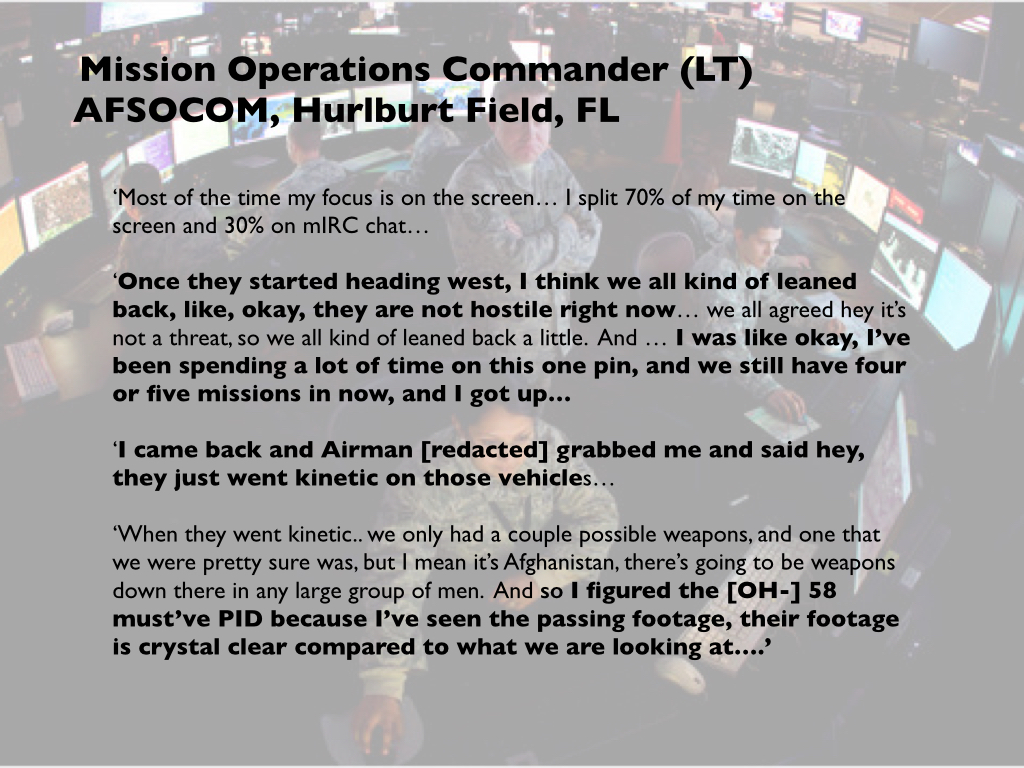
GREGORY Angry Eyes 2015 IMAGES.088

The Day Battle Captain testified:

‘I did not feel that the ground force commander would use any kind of close air support whatsoever to engage those vehicles… Based on the information that I had and looking at the vehicles move away it did not appear that they were moving towards the ground forces…

… as we were watching the Predator feed the first vehicles exploded. And everyone in the OPSCEN was immediately shocked… The amount of time from when that course of action approved by the SOTF commander to when we actually saw the strike occur there was no time, there was not adequate time to inform the ground commander that that was the course of action decided by the CJSOTF commander… I have phones ringing left and right, talking to people, trying to explain things, you know we look up on the screen and it happened…’
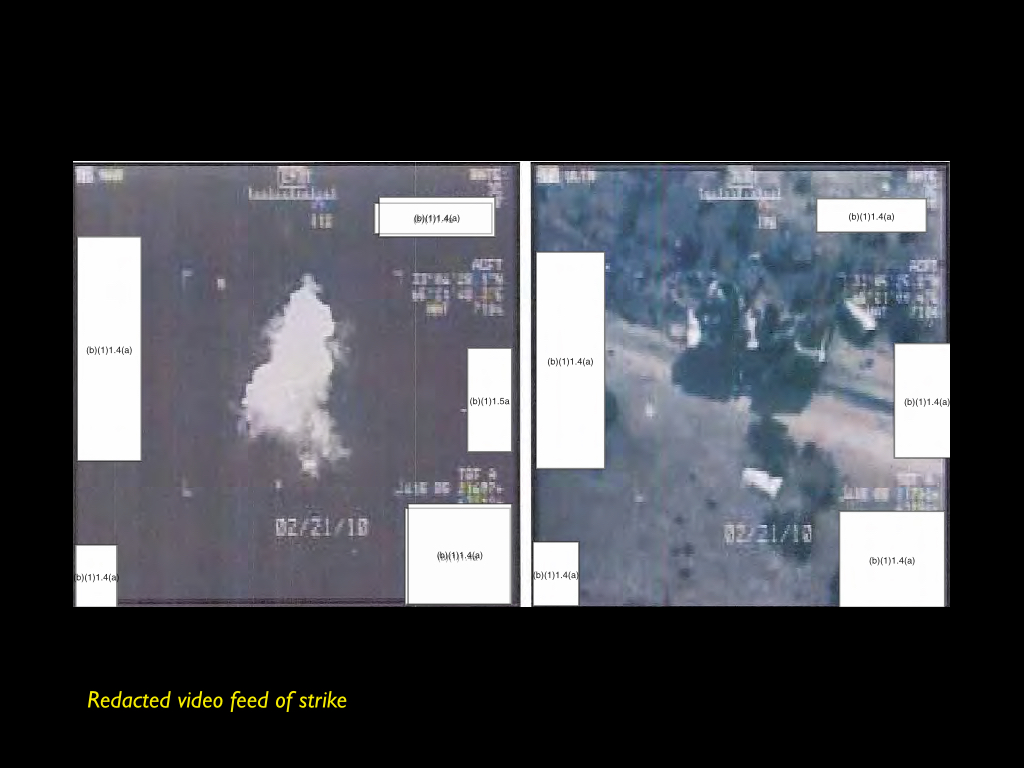
GREGORY Angry Eyes 2015 IMAGES.089

The Fires Officer:

‘I don’t think at any time anyone communicated to the GFC [Ground Force Commander] not to strike these vehicles because it is not something that we normally do. We feel that if he is in contact with the Predator and the OH-58s that we sent out to screen which we were not aware of and he is on the ground he generally has a pretty good picture of what is going on. He might be more privy to some conversation that he had with the OH-58 than what we know about. We normally give the GFC pretty big leeway on how they operate and the same with the JTAC because he has control of the assets and I am not going to try to take his assets away.’

In short, the investigation concluded that the Ground Force Commander never knew that an Aerial Vehicle Interdiction was being arranged, and neither of his higher commands were aware that he had cleared the helicopters to attack the three vehicles.

But, as I will show next, what lay behind these failures of communication was a de-centralised, distributed and dispersed geography of militarised vision whose fields of view expanded, contracted and even closed at different locations engaged in the administration of military violence.  Far from being a concerted performance of Donna Haraway‘s ‘God-trick’ – the ability to see everything from nowhere – this version of networked war was one in which nobody had a clear and full view of what was happening.

Part of this can be attributed to technical issues – the different fields of view available on different platforms, the low resolution of infra-red imagery (which Andrew Cockburn claims registers a visual acuity of 20/200, ‘the legal definition of blindness in the United States’), transmission interruptions, and the compression of full-colour imagery to accommodate bandwidth pressure.  So for example:
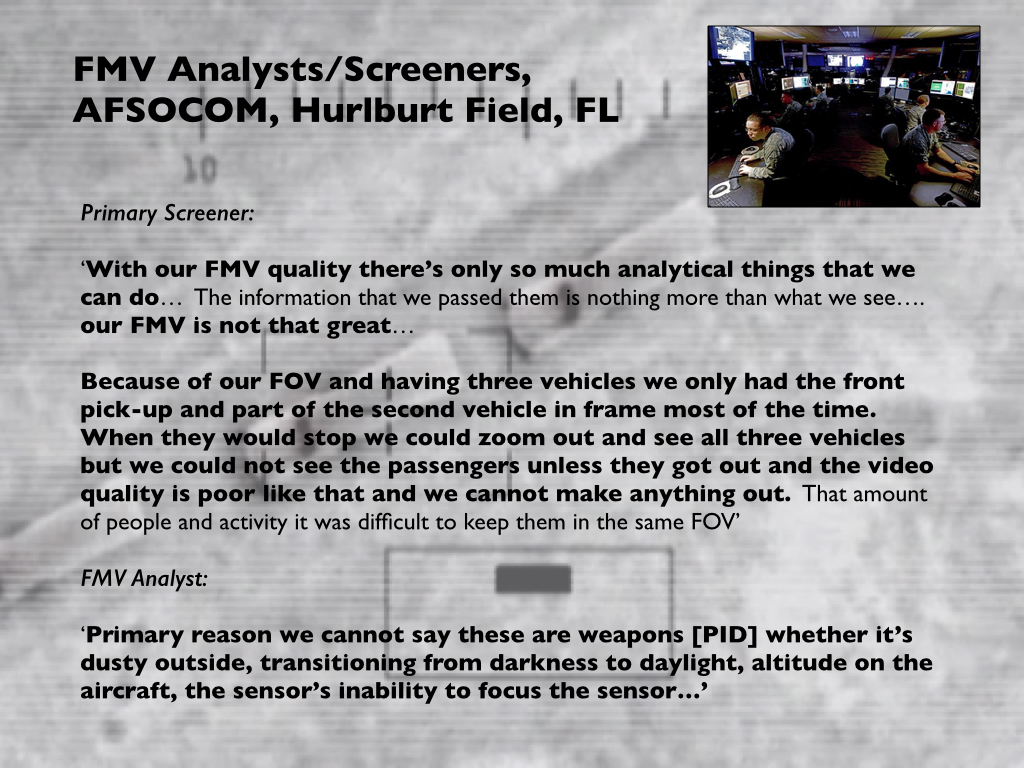
GREGORY Angry Eyes 2015 IMAGES.125

But it is also a matter of different interpretive fields.  Peter Asaro cautions:

‘The fact that the members of this team all have access to high-resolution imagery of the same situation does not mean that they all ‘‘see’’ the same thing. The visual content and interpretation of the visual scene is the product of analysis and negotiation among the team, as well as the context given by the situational awareness, which is itself constructed.’

The point is a sharp one: different visualities jostle and collide, and in the transactions between the observers the possibility of any synoptic ‘God-trick’ disappears.  But it needs to be sharpened, because different people have differential access to the distributed stream of visual feeds, mIRC and radio communications.  Here the disposition of bodies combines with the techno-cultural capacity to make sense of what was happening to fracture any ‘common operating picture’.   As one officer at Kandahar put it:

‘We didn’t have eyes on, minus ISR platform, that we can all see, who watches what? All the discrepancies between who watches what. What I see may be different from what someone else might interpret on the ISR… ISR is not reliable; it is simply a video platform.’

He was talking specifically about the multiple lines of communication (and hence bases for interpretation) within his Operations Center: now multiply that across sites scattered across Afghanistan and the continental United States and it becomes clear that the contemporary ‘fog of war’ may be as much the result of too much information as too little.

To be continued.

‘The superpower’s dilemma’

I’m on the magical island of Sicily for the 9th Pan-European Conference on International Relations: Worlds of Violence (you can find abstracts and even some papers here though presumably not for ever).

I’ve never been to one of these things before, not even the ISA (though I must do something about that) so there’s a  learning curve – not only about IR but about how people in a different field who all seem to know one another comport themselves (or don’t).  There are lots of geographers here too, though Philippe Le Billon and Simon Springer, who organised a series of sessions on Geographies of Violence, never made it (fortunately not felled by violence).

I’m giving what I hope is more or less the final version of ‘Angry Eyes‘ (updates here and here) on the Uruzgan drone strike so I’ve been attending several sessions on drones to see what other analysts have been up to beyond the range of my targeting sensors trained on ssrn and Academia [This is perhaps the place to say I don’t post anything on either platform, since all my texts are available on this website under DOWNLOADS: but maybe I should?].

web-syria-drone-epa

Yesterday Lisa Hajjar spoke on ‘Drone warfare and the superpower’s dilemma‘.  She explains the title like this:

The United States has been in a continuous—or, at least, uninterrupted—state of armed conflict since 2001, and there is no end in sight. The strategies and technologies, as well as the locales of engagement and designated enemies of this “’global’ war on terror” have changed considerably over the past fourteen years. Nevertheless, the US government still relies on the Authorization for Use of Military Force (AUMF), passed by Congress on 14 September 2001 (three days after the 9/11 terrorist attacks), as the legal authority to bomb people in Afghanistan, Pakistan, Yemen, and Somalia, in Iraq since the occupation (the 2003 invasion was authorized under a different AUMF), in Libya since 2012, and most recently in Syria. This expanding conflict is not actually the same in any empirical sense, but the 2001 AUMF continues to be relied on because of the plasticity of the label of terrorism and the fact that the war against it has neither been won nor lost. This ability to continue fighting without losing and the inability to stop without winning could be described as “the superpower’s dilemma.”

‘The most significant change over the course of the “war on terror”’, she continues, ‘is the escalating use of armed drones (unmanned aerial vehicles, or UAVs) to target geographically diffuse and unconventional enemies.’

My analysis highlights three main issues: 1) why drone strikes for targeted killing have superseded capture and combat in US counter-terrorism strategy; 2) how officials explain and justify the strategic logic of remote killing; and 3) why drones seem to provide a technological answer to the superpower dilemma of how the United States can continue to “stay in the fight” without a significant commitment of “boots on the ground.” The conclusion is that bombing operations and aerial campaigns are incapable of achieving the declared security goals that their use aims to serve. On the contrary, drone warfare has been an important factor in the continuation of the “war on terror.”

My ability to report all this is not down to phenomenal powers of recall or a crash course in shorthand: you can read the full essay in two parts at Jadaliyya here and here.

(If you wonder about the image above, by the way, you can find the answer to its symbolic significance here and here).

_85425907_raf_strike_grab_976

Meanwhile, other states are operating drones too – notably over Iraq and Syria – including Russia (more here and here) and the UK (see here and read here).  I’m keeping my eyes on those developments too, but right now it’s Angry Eyes that holds my attention (not least because it reminds us that military drones are used for far more than targeted killing).  There are discussants for my own presentation, so I’ve prepared a paper summarising the argument and conclusions in lieu of a real paper – the long-form version is still in preparation – and I’ll post that soon.  But now I must away to think myself into my part….

Reach from the Sky

Tanner_V2

I’ve been invited to give the annual Tanner Lectures in Cambridge on 13-14 January 2016. The Lectures are given in parallel at nine universities in the UK and the USA: Cambridge, Oxford, Harvard, Princeton, Stanford, Yale, Berkeley, Michigan and Utah.

Appointment as a Tanner lecturer is a recognition for uncommon achievement and outstanding abilities in the field of human values. The lecturers may be elicited from philosophy, religion, the humanities, the sciences, the creative arts, and learned professions, or from leadership in public or private affairs. The lectureships are international and intercultural and transcend ethnic, national, religious, and ideological distinctions.

The purpose of the Tanner Lectures is to advance and reflect upon the scholarly and scientific learning relating to human values. This intention embraces the entire range of values pertinent to the human condition, interest, behavior, and aspiration. The lectures are published in an annual volume.

The Tanner Lectures were established by the American scholar, industrialist, and philanthropist, Obert Clark Tanner. In creating the lectureships, Professor Tanner said, “I hope these lectures will contribute to the intellectual and moral life of mankind. I see them simply as a search for a better understanding of human behavior and human values. This understanding may be pursued for its own intrinsic worth, but it may also eventually have practical consequences for the quality of personal and social life.”

It’s a huge honour, and thoroughly intimidating when I look at the roster of previous speakers and those delivering the other lectures in 2015-16, and I’m thrilled – though so far I’ve only got as far as a title: ‘Reach from the Sky: aerial violence and the everywhere war‘.  The clock is ticking, so watch this space for progress reports…

Doomsday Books

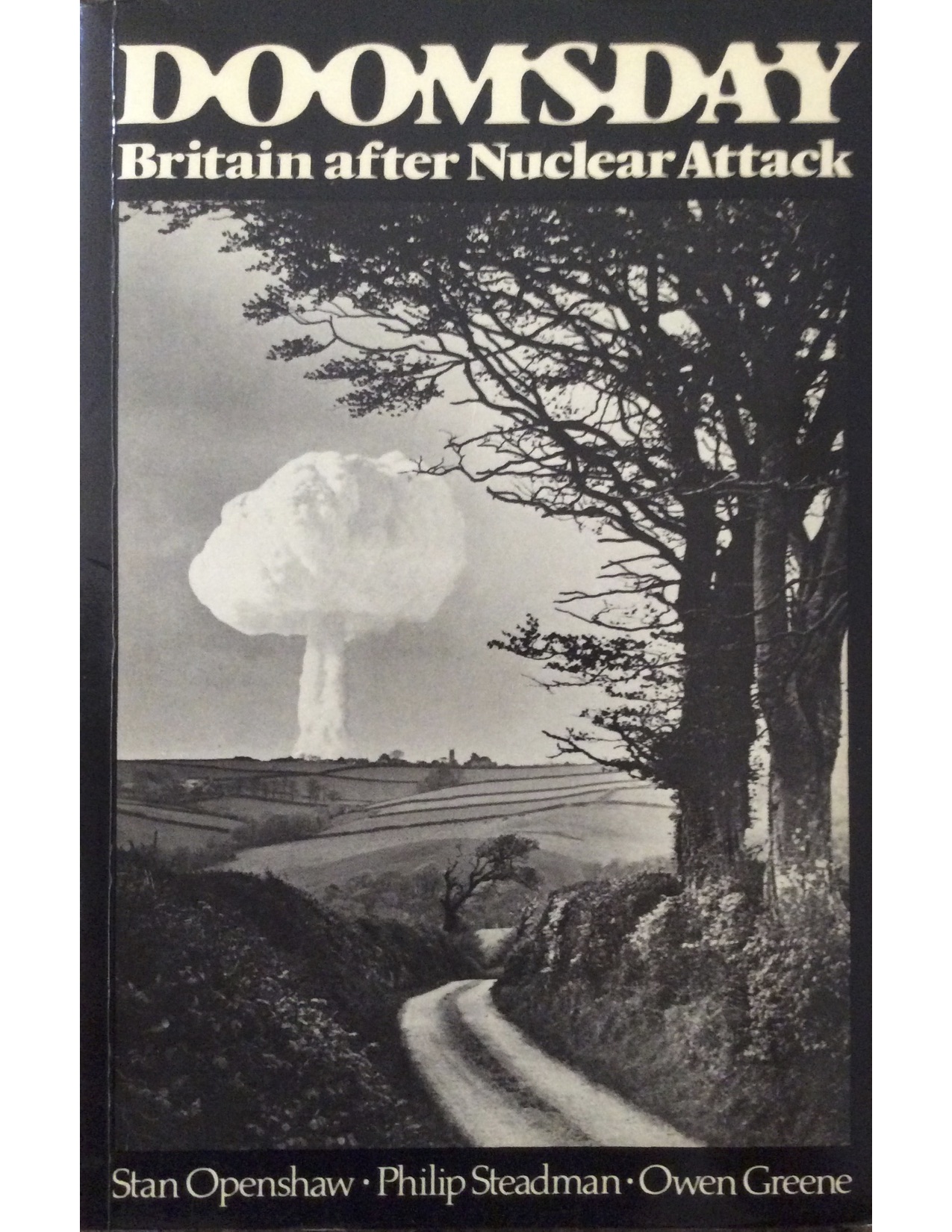
DOOMSDAYStill wandering through the nuclear wastelands… (see also here, here and here).  Not surprisingly, there is a considerable literature on the United States and nuclear war, but much less on the UK.  I still have my tattered copy of Doomsday:  Britain after nuclear attack by Stan Openshaw, Philip Steadman and Owen Greene, published more than thirty years ago.  Those were heady days: the authors were members of Scientists Against Nuclear Arms, and the book was put together soon after the European Nuclear Disarmament Appeal launched by E. P. Thompson (who famously announced he had “left his desk” to further the campaign), Mary Kaldor, Dan Smith and Ken Coates.

Next to Doomsday is my equally battered and well-thumbed copy of a book of essays edited by two other British geographers, David Pepper and Alan Jenkins, The geography of peace and war, which appeared in 1985.  It was in three Parts, ‘The geography of the Cold War and the arms race’, ‘The geography of nuclear war’ (which included an update from Stan and Philip) and ‘The geography of peace’ (with an essay on nuclear weapon free zones).

Fast forward twenty years, and these emphases are in stark contrast to Colin Flint‘s edited collection, Geography of war and peace, in which nuclear war receives just passing mention(s).  The same is true of Audrey Kobayashi‘s still more recent Geography of peace and armed conflict – apart from one brief chapter concerned with Iran.

HOGG British Nuclear CultureAll of this will explain why I am looking forward to the publication of Jonathan Hogg‘s British Nuclear Culture: official and unofficial narratives in the long 20th century, coming from Bloomsbury in January:

The advent of the atomic bomb, the social and cultural impact of nuclear science, and the history of the British nuclear state after 1945 is a complex and contested story. British Nuclear Culture is an important survey that offers a new interpretation of the nuclear century by tracing the tensions between ‘official’ and ‘unofficial’ nuclear narratives in British culture.

In this book, Jonathan Hogg argues that nuclear culture was a pervasive and persistent aspect of British life, particularly in the years following 1945. This idea is illustrated through detailed analysis of various primary source materials, such as newspaper articles, government files, fictional texts, film, music and oral testimonies. The book introduces unfamiliar sources to students of nuclear and cold war history, and offers in-depth and critical reflections on the expanding historiography in this area of research.

Chronologically arranged, British Nuclear Culture reflects upon, and returns to, a number of key themes throughout, including nuclear anxiety, government policy, civil defence, ‘nukespeak’ and nuclear subjectivity, individual experience, protest and resistance, and the influence of the British nuclear state on everyday life. The book contains illustrations, individual case studies, a select bibliography, a timeline, and a list of helpful online resources for students of nuclear history.

Joseph Masco – author of The nuclear borderlands: The Manhattan Project in post-Cold War New Mexico and The theater of operations: National security affect from the Cold War to the War on Terror  – likes it, which is more than enough for me:

We know the atomic bomb fundamentally transformed modern life, but Jonathan Hogg shows us that it did not do so in the same way everywhere. This is a important contribution to nuclear studies as it takes both nation and region seriously in the production of a nuclear culture. Hogg does not just follow expert concerns or defense policy debates, he also attends to the vernacular forms of local activisms across British cities and generations. British Nuclear Culture leads the way to a new comparative nuclear studies, and with it, a deeper understanding of the nuclear revolution.

Here is the Contents List:

Introduction
1. Early Nuclear Culture
2. The Manhattan Project
3. 1945 – 1950: Early Responses to the Bomb
4. 1950 – 1958: Maturing Responses
5. 1958 – 1979: Radicalised and Realist Responses
6. 1979 – 1989: Extreme Realism
7. 1989 – 2011: The Persistence of Nuclear Culture
8. Conclusion

For those who don’t think it surprising that – apart from people like Michael Curry, Matt FarishScott Kirsch and Fraser MacDonald– human geographers should have turned away from a critical scrutiny of atomic geographies so speedily with the presumptive waning of the Cold War, notice the title of Chapter 7…

Little Boys and Blue Skies

These are very preliminary notes and ideas for my presentation at “Through Post-Atomic Eyes” in Toronto next month: I would really – really – welcome any comments, suggestions or advice.  I don’t usually post presentations in advance, and this is still a long way from the finished version, but in this case I am venturing into (irradiated) fields unknown to me until a few months ago…

CHOMSKY On Western terrorismAt first sight, any comparison between America’s nuclear war capability and its drone strikes in Afghanistan, Iraq, Pakistan, Somalia, Syria and Yemen seems fanciful. The scale of investment, the speed and range of the delivery systems, the nature of the targets, the blast radii and precision of the munitions, and the time and space horizons of the effects are so clearly incommensurable. It’s noticeable that the conversation between Noam Chomsky and Andre Vltchek published as On Western Terrorism: from Hiroshima to drone warfare (2013) says virtually nothing about the two terms in its subtitle.

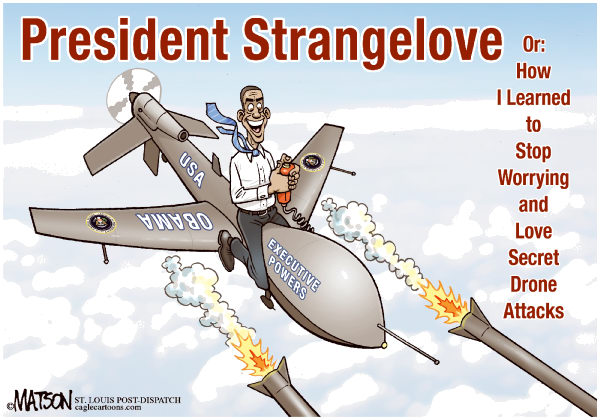
Yet nuclear weapons and drone strikes have both been attended by intense diplomatic, geopolitical and geo-legal manoeuvres, they have both sparked major oppositional campaigns by activist organisations, and they have both had major impacts on popular culture (as the two images below attest).

dr-strangelove-still-580

President-Strangelove

But there are other coincidences, connections and transformations that also bear close critical examination.

When Paul Tibbets flew the Enola Gay across the blue sky of Hiroshima on 6 August 1945 one of his major concerns was to execute a fast, tight 155 degree turn to escape the effects of the blast from ‘Little Boy’.  There is some dispute over the precise escape angle – there’s an exhaustive discussion in the new preface to Paul Nahin‘s Chases and escapes: the mathematics of pursuit and evasion (second edition, 2007) – but the crucial point is the concern for the survival of the aircraft and its crew.

Enola Gay co-pilot [Robert Lewis]'s sketch after briefing of approach and 155 turn by the B-29s weaponeer William Parsons, 4 August 1945

Tibbets successfully made his escape but four years later, when the US Atomic Energy Commission was developing far more powerful bombs, the Air Force became convinced that escape from those blasts would be impossible. And so it implemented Project Brass Ring which was intended to convert B-47 Stratojet bombers into remotely-piloted aircraft capable of delivering atomic bombs without any loss of American lives.  (What follows is taken from Delmer Trester, ‘Thermonuclear weapon delivery by unmanned B-47: Project Brass Ring‘; it was included in A history of the Air Force Atomic Energy Program, 1949-1953, which can be downloaded here; you can obtain a quick overview here).

‘It appeared that the Air Force would need some method to deliver a 10,000-pound package over a distance of 4,000 nautical miles with an accuracy of at least two miles from the center of the target. It was expected the package would produce a lethal area so great that, were it released in a normal manner, the carrier would not survive the explosion effects. Although not mentioned by name, the “package” was a thermonuclear device – the hydrogen or H-bomb…

B-47 Stratojet bomber (USAF)

‘The ultimate objective was to fashion a B-47 carrier with completely automatic operation from take-off to bomb drop… The immediate plan included the director B-47A aircraft as a vital part of the mission. Under direction from the mother aircraft, the missile would take off, climb to altitude and establish cruise speed conditions. While still in friendly territory, the crew aboard the director checked out the missile and committed its instruments to automatically accomplish the remainder of the mission. This was all that was required of the director. The missile, once committed, had no provision for returning to its base… either the B-47 became a true missile and dived toward the target … or a mechanism triggered the bomb free, as in a normal bombing run.’

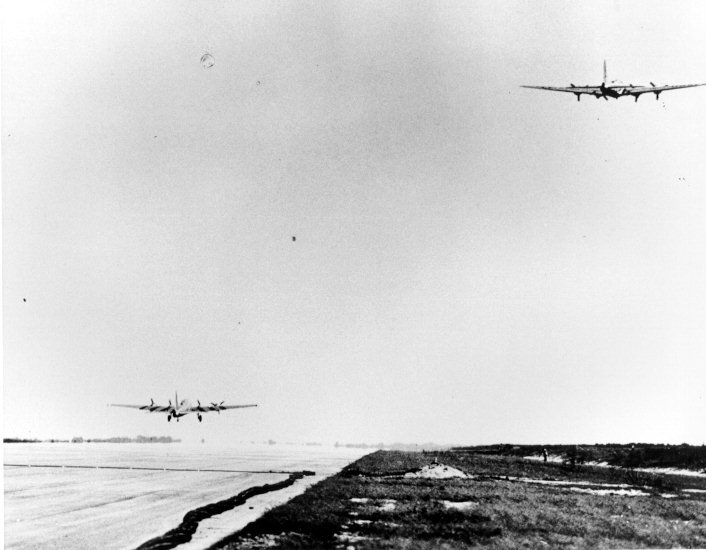
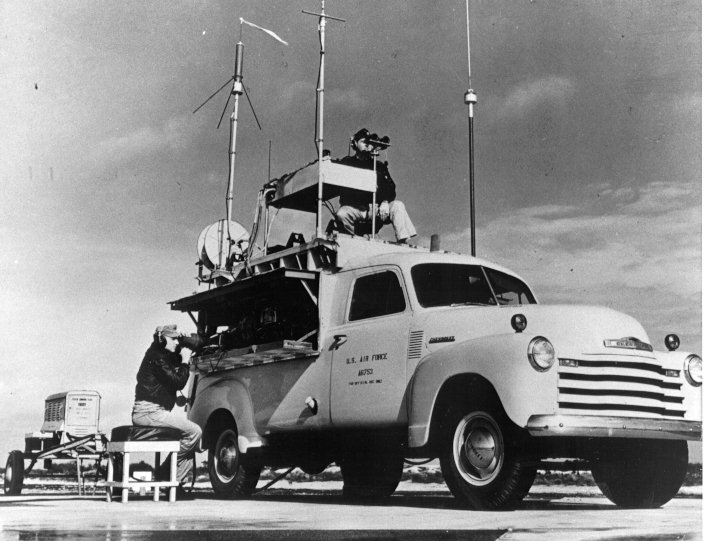
This was a re-run of Operation Aphrodite, a failed series of experiments carried out in the closing stages of the Second World War in Europe, and – as the images below show – after the war the Air Force had continued to experiment with B-17 aircraft remotely piloted from both ‘director aircraft’ [top image; the director aircraft is top right] and ‘ground control units’ [bottom image].  These operated under the aegis of the Air Force’s Pilotless Aircraft Branch which was created in 1946 in an attempt to establish the service’s proprietary rights over missile development.

B-17 drones

Ground control unit for B-17 drone

But the Brass Ring team soon discovered that their original task had swelled far beyond its original, taxing specifications: in October 1951 they were told that ‘the super-bomb’ would weigh 50,000 lbs. They modified their plans (and planes) accordingly, and after a series of setbacks the first test flight was successful:

‘The automatic take-off, climb and cruise sequence was initiated remotely from a ground control station. The aircraft azimuth, during take-off, was controlled by an auxiliary control station at the end of the runway. Subsequent maneuvers, descent and landing (including remote release of a drag parachute and application of brakes) were accomplished from the ground control station. The test was generally satisfactory; however, there were several aspects – certain level flight conditions, turn characteristics and the suitability of the aircraft as a “bombing platform” – which required further investigation.’

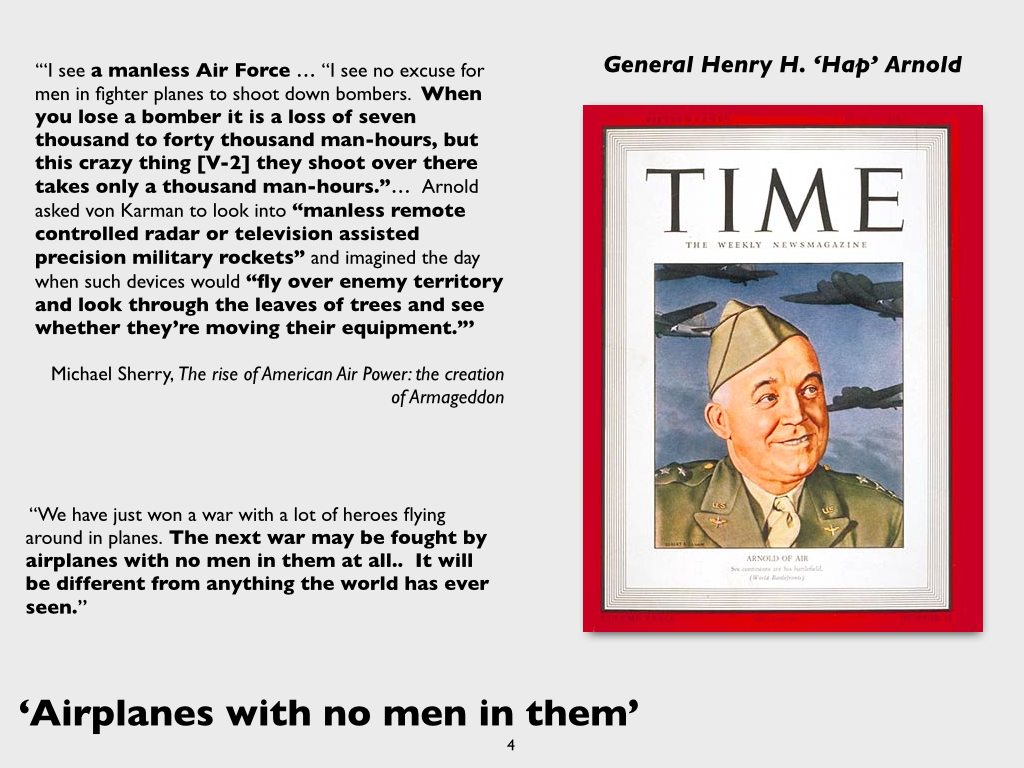
This was part of a larger imaginary in which, as Life had commented in its issue of 20 August 1945, echoing USAAF General Henry H. ‘Hap’ Arnold, ‘robot planes … and atomic bombs will do the work today done by fleets of thousands of piloted bombers.’ (Arnold thought this a mixed blessing, and in an essay ghost-written with William Shockley he noted that nuclear weapons had made destruction ‘too cheap and easy’ – one bomb and one aircraft could replace hundreds of bombs and vast fleets of bombers – and a similar concern is often raised by critics of today’s Predators and Reapers who argue that their remote, often covert operations have lowered the threshold for military violence).

Henry H Hap Arnold.001

Brass Ring was abandoned on 13 March 1953, once the Air Force determined that a manned aircraft could execute the delivery safely (at least, for those on board).  It would be decades before another company closely associated with nuclear research – General Atomics (more here) – supplied the US Air Force with its first MQ-1 Predators.

1994-august

These were originally conceived as unarmed, tactical not strategic platforms, designed to provide intelligence, surveillance and reconnaissance for conventional strike aircraft. But the concern with American lives became a leitmotif of both programs, and one of the foundations for today’s remote operations is the ability (as the USAF has it) to ‘project power without vulnerability’.

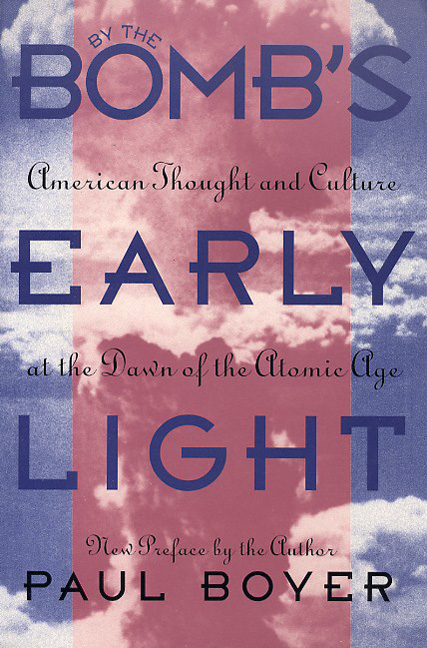
BOYER By the bomb's early lightThe visible effects of bombing Hiroshima and Nagasaki on the Japanese population were the subject of strict censorship – still photographs were never published, while Japanese media and even US military film crews had their documentary footage embargoed – and public attention in the United States was turned more or less immediately towards visualising ‘Hiroshima USA’ (Paul Boyer is particularly good on this; there are also many images and a good discussion here). Even the US Strategic Bombing Survey indulged in the same speculation: ‘What if the target for the bomb had been an American city?’ it asked in its June 1946 report. ‘The casualty rates at Hiroshima and Nagasaki, applied to the massed inhabitants of Manhattan, Brooklyn, and the Bronx, yield a grim conclusion.’ Although the original targets had been Asian cities it was American cities that were designated as future victims.  ‘Physically untouched by the war’ (apart from Pearl Harbor), Boyer wrote,

‘the United States at the moment of victory perceived itself as naked and vulnerable.  Sole possessors and users of a devastating instrument of mass destruction, Americans envisioned themselves not as a potential threat to other peoples, but as potential victims.’

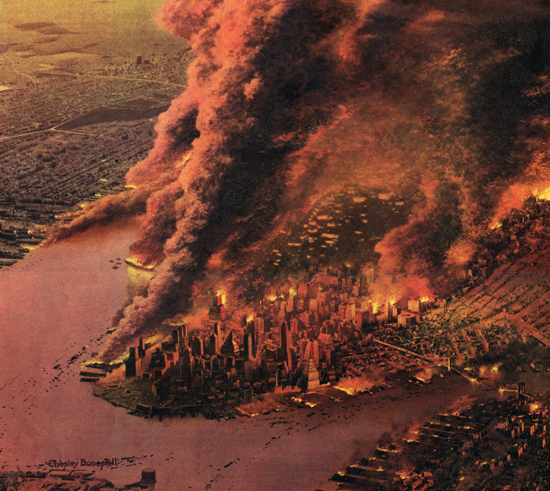
This was the abiding anxiety instilled by the national security state and orchestrated through its military-industrial-media-entertainment complex throughout the post-war decades.  Perhaps the most famous sequence of images – imaginative geographies, I suppose –accompanied an essay by John Lear in Collier’s Magazine in August 1950, ‘Hiroshima USA: Can anything be done about it?‘, showing a series of paintings by Chesley Bonestell and Birney Lettick imagining the effects of a nuclear strike on New York:

Hiroshima USA 11950-aug-6-colliers-p12-sm

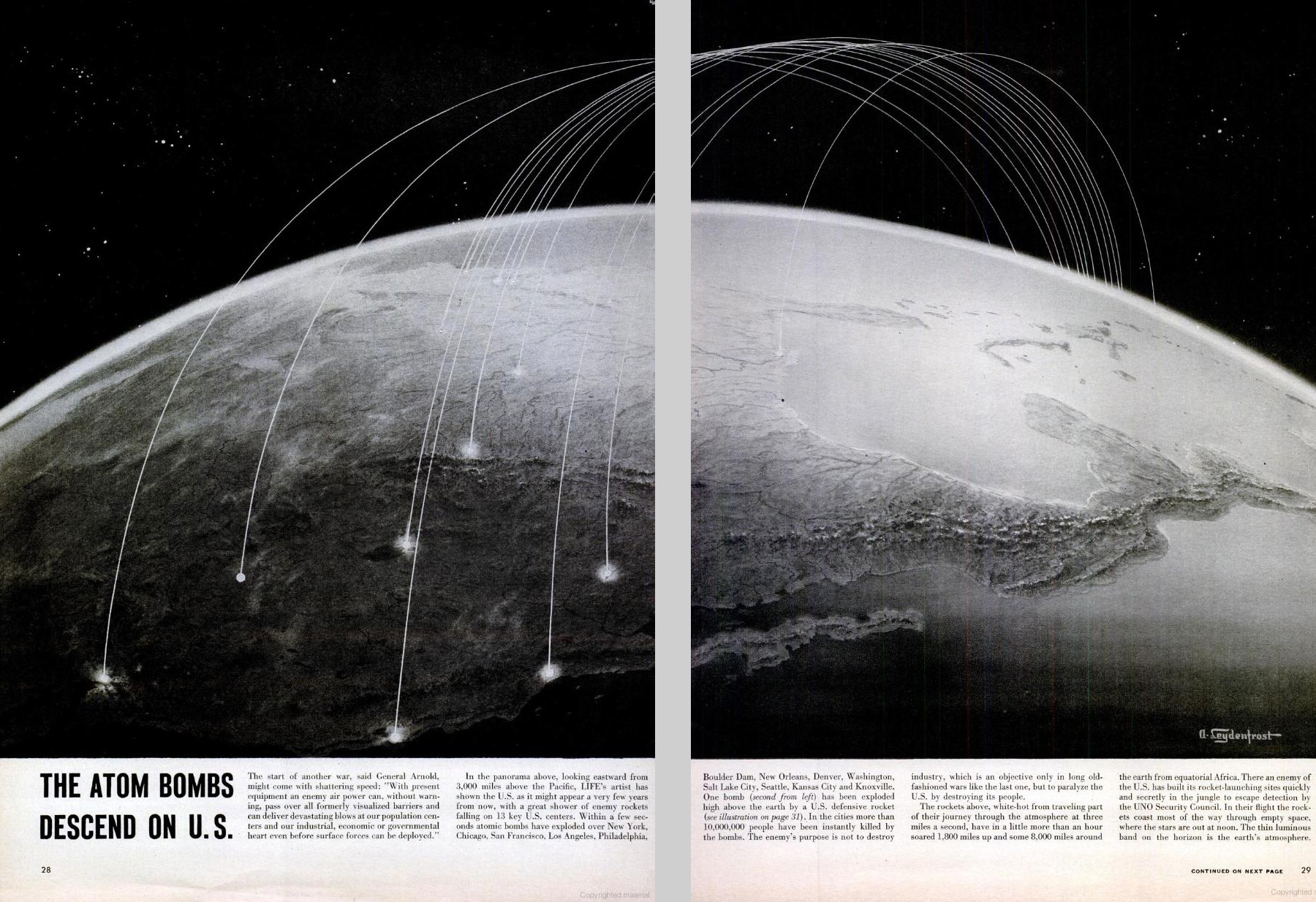
Similar sequences, often accompanied by maps, were produced for many other cities (and the simulations continue: see, for example, here).  The images below, from Life on 19 November 1945, come from ‘The 36-Hour War’ (see here for a commentary) that envisaged a nuclear attack on multiple cities across the USA, including Washington DC, from (presumably Soviet) ‘rocket-launching sites [built] quickly and secretly in the jungle’ of equatorial Africa:

1945-Life-36-Hour-War-2

1945-Life-36-Hour-War-1

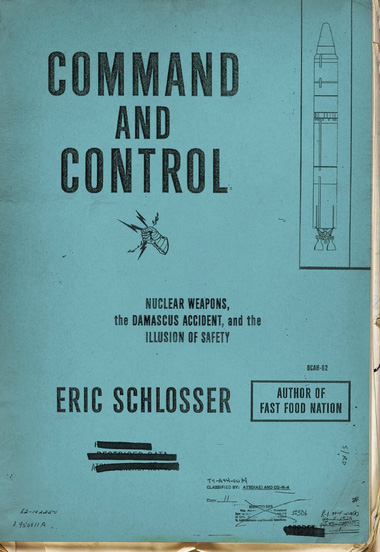
Schlosser-Command-and-Control-bookAs it happened, American cities did indeed become targets – for the US Air Force.  According to Eric Schlosser, under General Curtis Le May the goal was

to build a Strategic Air Command that could strike the Soviet Union with planes based in the United States and deliver every nuclear weapon at once. SAC bomber crews constantly trained and prepared for that all-out assault. They staged mock attacks on every city in the United States with a population larger than twenty-five thousand, practicing to drop atomic bombs on urban targets in the middle of the night. San Francisco was bombed more than six hundred times within a month.

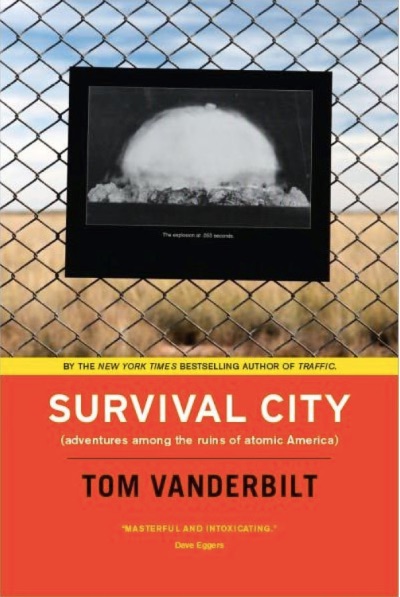
VANDERBILT Survival CityTests were also conducted at the Nevada Proving Ground, ‘the most nuclear-bombed place on the planet’, to determine the likely effects.  One of the purposes of the Strategic Bombing Survey’s Physical Damage Division had been to document the effects of the bombs on buildings in Hiroshima and Nagasaki – to read them as ‘blueprints for the atomic future‘ – and both Japanese and American medical teams had been sent in shortly after the blasts to record their effects on bodies (from 1947 their work was subsumed under the Atomic Bomb Casualty Commission).  It was now imperative bring the two together and to bring their results home.  And so, starting in 1953 with ‘Operation Doorstep’, mannequins were placed inside single-family houses at the Nevada site to calculate the prospects for the survival of what Joseph Masco calls the American ‘nuclearised’ family in the event of a nuclear attack; they subsequently went on public exhibition around the country with the tag line:

‘These mannikins could have been real people; in fact, they could have been you.’

In the Second World War experimental bombing runs had been staged against mock German and Japanese targets at the Dugway Proving Ground but – significantly – the buildings had no occupants: as Tom Vanderbilt wryly remarks, now ‘the inhabitants had been rewritten into the picture’ because the objective was to calibrate the lives of Americans.

Rachele Riley Mannequins

I have borrowed this image from the mesmerising work of artist Rachele Riley, whose project on The evolution of silence centres on Yucca Flat in the Nevada Test Site and raises a series of sharp questions about both the imagery and the soundscape of the nuclear age.

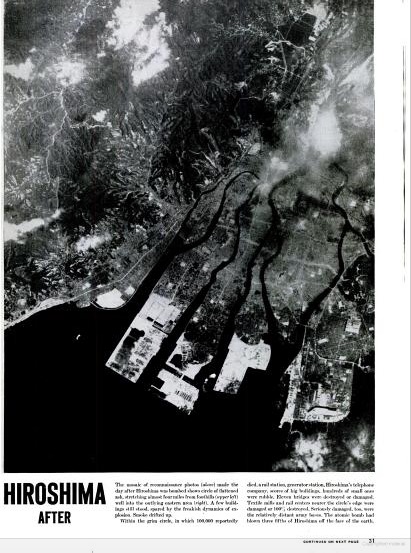
The power of the image – ‘the nuclear sublime’ – was one of the central objectives of the attacks on Hiroshima and Nagasaki: ‘the weapon’s devastating power had to be seen to be believed,’ as Kyo Maclear observed, and it had to be seen and believed in Moscow as well as in Tokyo.  Here the visual economies of nuclear attacks are radically different from drone strikes. In the immediate aftermath there was no shortage of atomic ‘views from the air’ –  aerial photographs of the vast cloud towering into the sky and of Hiroshima before and after the bomb.  Here is Life (sic) on 20 August 1945:

LIFE:Hiroshima 1

LIFE:Hiroshima 2LIFE:Hiroshima 3

Yet for the most part, and with some significant exceptions, aerial views are singularly absent from today’s drone wars. To Svea Braeunert (‘Bringing the war home: how visual artists return the drone’s gaze‘) that is all the more remarkable because drone strikes are activated by what video artist Harun Farocki called operative images: but that is also the reason for the difference. Aerial photographs of Hiroshima or Nagasaki reveal a field of destruction in which bodies are conspicuously absent; the resolution level is too coarse to discern the bomb’s victims.

But the video feeds from a Predator or Reaper, for all their imperfections, are designed to identify (and kill) individuals, and their aerial gaze would – if disclosed – reveal the bodies of their victims. That is precisely why the videos are rarely released (and, according to Eyal Weizman, why satellite imagery used by investigators to reconstruct drone strikes is degraded to a resolution level incapable of registering a human body – which remains ‘hidden in the pixels‘ – and why their forensic visual analysis is forced to focus on buildings not bodies).

OMAR FAST %000 Feet is Best

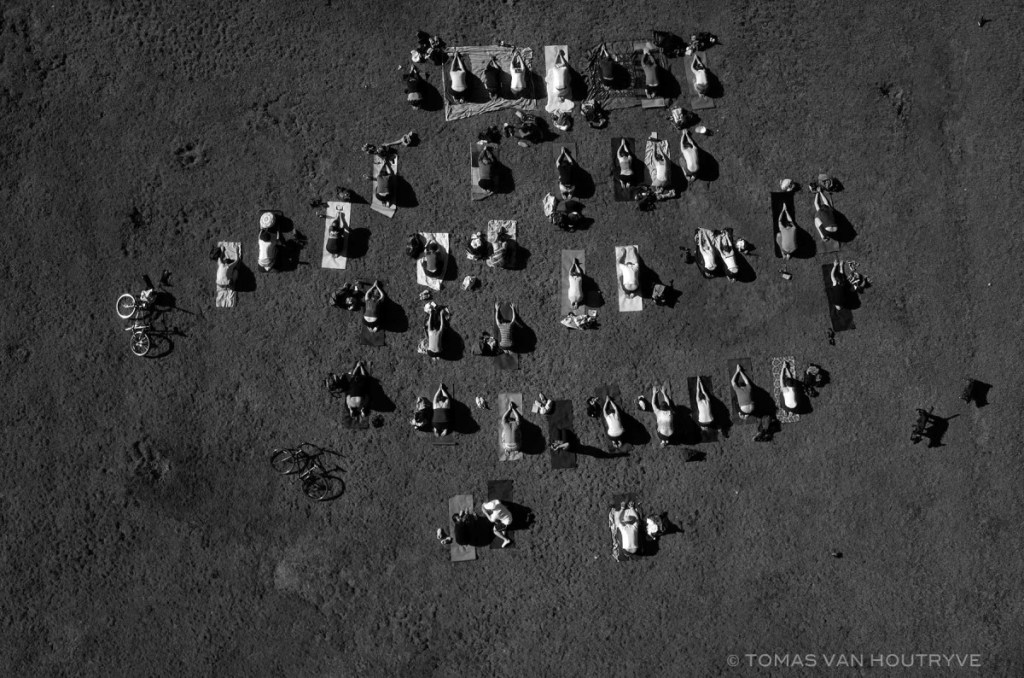
One might expect visual artists to fill in the blank. Yet – a further contrast with Hiroshima – apart from projects like Omar Fast’s ‘5,000 Feet is Best’ (above) and Thomas van Houtryve’s ‘Blue Sky Days’ (below) there have been precious few attempts to imagine drone strikes on American soil.

van HOUTRYVE Blue Sky Days

Perhaps this is because they are so unlikely: at present these remote platforms can only be used in uncontested air space, against people or states who are unable (or in the case of Pakistan, unwilling) to defend themselves. But there has been a protracted debate about such strikes on American citizens (notably the case of Anwar al-Awlaki) and a concerted attempt to focus on the rules followed by the CIA and JSOC in their programs of targeted killing (which has artfully diverted public attention to Washington and away from Waziristan).
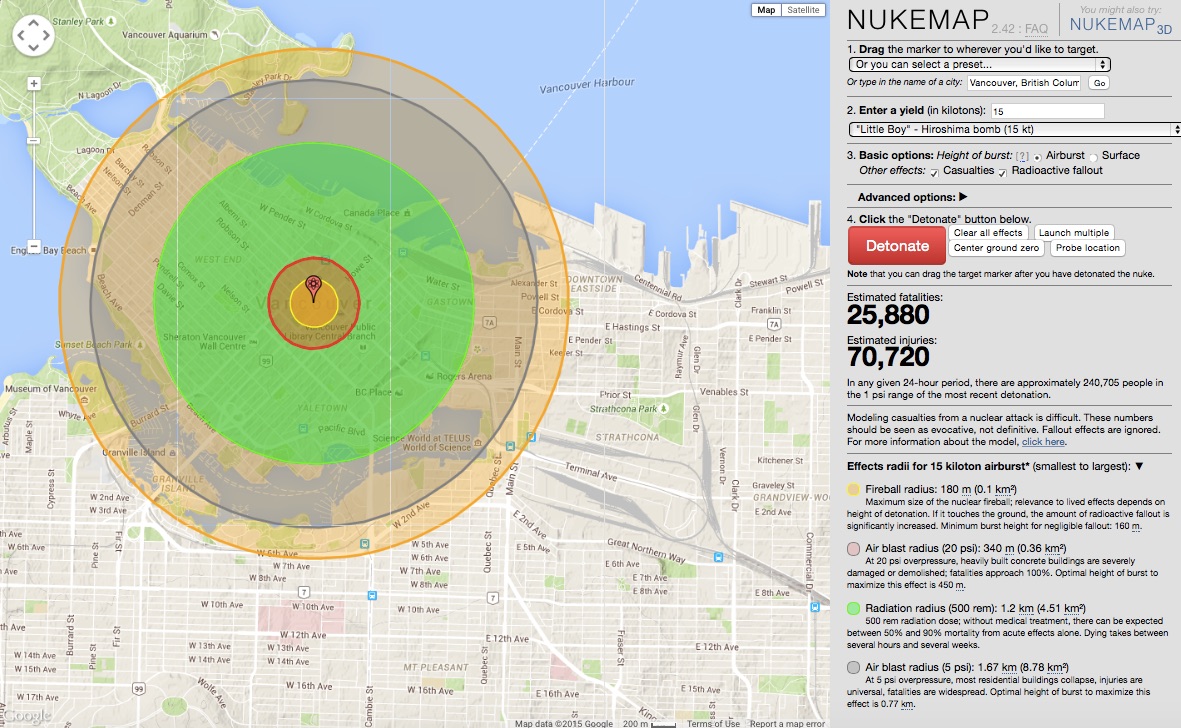
There is also a visceral, visible continuity between the two: just as in Hiroshima and Nagasaki, there has been little public concern over the victims of drone strikes, the vast majority of whom have once again been Asian.

If the targeting process continues to be racialised, it also continues to be bureaucratised. After the Second World War the US Air Force was determined to speed up its targeting cycle, and in 1946 started to compile a computerised database of potential targets in the Soviet Union; this was soon extended to Soviet satellites and Korea, and by 1960 the Bombing Encyclopedia of the World (now called the ‘Basic Encyclopedia’) contained 80,000 Consolidated Target Intelligence Files. These were harvested to plan Strategic Air Command’s nuclear strikes and to calibrate Damage and Contamination Models. One of the analysts responsible for nominating targets later described the process as ‘the bureaucratisation of homicide’. Similar criticisms have been launched against the ‘disposition matrix’ used by the CIA to nominate individuals authorised for targeted killing (see here and here); most of these are in Pakistan, Somalia, and Yemen, though there are other kill lists, including Joint Prioritised Effects Lists compiled by the US military for war zones in Afghanistan and Iraq. In both cases the target files are in principle global in reach, and both nuclear strikes and targeted killings (outside established war zones) are judged to be sufficiently serious and ‘sensitive’ to require direct Presidential approval.

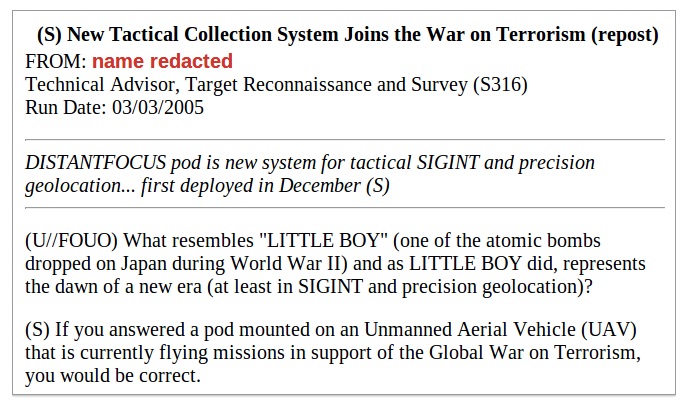
Speeding up the targeting cycle has involved more than the pre-emptive identification of targets. In contrast to the fixed targets for nuclear strikes, today’s Predators and Reapers are typically directed against mobile targets virtually impossible to locate in advance. Pursuing these fleeting ‘targets of opportunity’ relies on a rapidly changing and expanding suite of sensors to identify and track individuals in near-real time. In 2004 the Defense Science Board recommended the Pentagon establish ‘a “Manhattan Project”-like program for ID/TTI’ [identification, tagging, tracking and locating], and one year later a Technical Advisor working for the National Security Agency’s Target Reconnaissance and Survey Division posed the following question:

NSA's Little Boy

The onboard sensor suite in the pod has since become ever more effective in intercepting and monitoring electronic communications as part of a vast system of digital data capture, but Predators had already been armed with Hellfire missiles to compress the kill-chain still further, and to many commentators the most radical innovation in later modern war has been the fusion of sensor and shooter in a single platform. The new integrated systems were first trialled – on a Predator flown by test pilots from General Atomics – in February 2000 at Indian Springs Auxiliary Field. The main objective was to hunt and kill Osama bin Laden, and at the request of the Air Force and the CIA a series of tests was carried out.

First, the Air Force wanted to determine whether the Predator could withstand a missile being fired from beneath its insubstantial wings (a ghostly echo of earlier anxieties over the survivability of the Enola Gay and its successors – though plainly much reduced by the absence of any pilot on board).

Second, the CIA wanted to assess the likely effects of a Hellfire strike on the occupants of a single-storey building like those found in rural Afghanistan (nuclear tests had used mannequins and pigs as human surrogates; these used plywood cut-outs and watermelons).

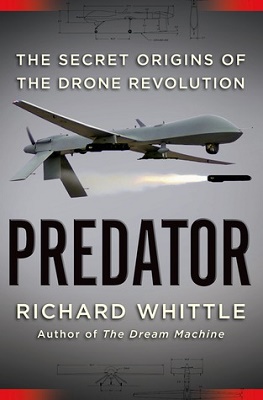
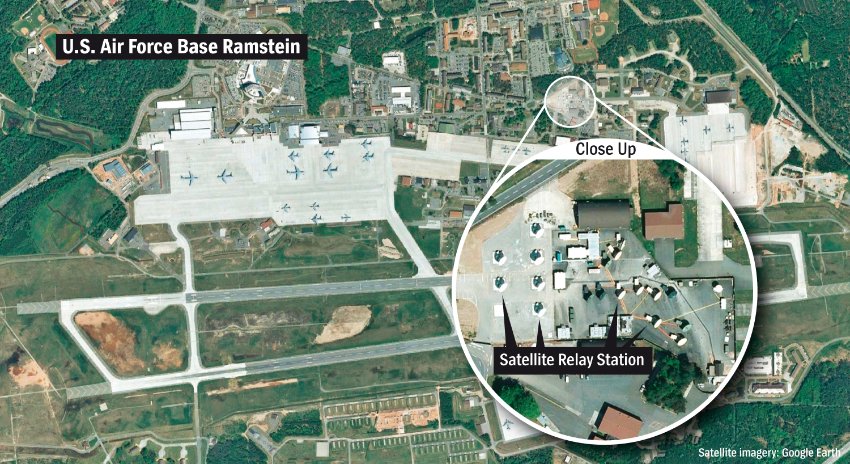
predatorBoth sets of tests were eventually successful (see also here) but, as Richard Whittle shows in consummate detail, a series of legal and diplomatic obstacles remained. In order to secure satellite access over Afghanistan, previous Predator flights to find bin Laden had been flown from a ground control station at Ramstein Air Base in Germany. But using a Predator to kill bin Laden was less straightforward. After protracted debate, US Government lawyers agreed that a Predator armed with a missile would not violate the 1987 Intermediate-Range Nuclear Forces Treaty, which eliminated nuclear and conventional missiles with intermediate ranges but which – unhelpfully for the CIA – defined missiles as ‘unmanned, self-propelled … weapon-delivery vehicles’; the lawyers determined that the Predator was merely a platform and, unlike a cruise missile, had no warhead so that it remained outside the Treaty. But they also insisted that the Status of Forces Agreement with Germany would require Berlin’s consent for the activation of an armed Predator. (The United States stored tactical nuclear warheads at Ramstein until 2005; although the US insisted it retained control over them, in the event of war they were to have been delivered by the Luftwaffe as part of a concerted NATO nuclear strike).

RAMSTEIN English captions

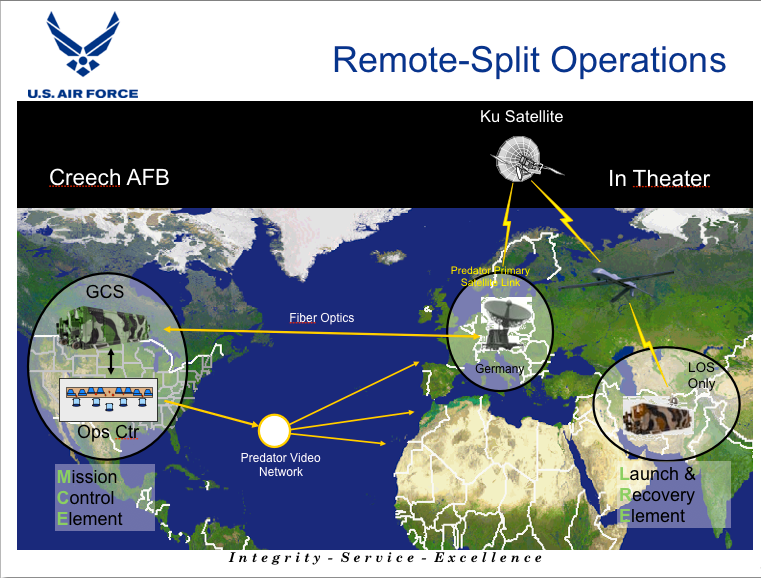
The need to bring Berlin onside (and so potentially compromise the secrecy of the project) was one of the main reasons why the ground control station was relocated to Indian Springs, connected to the satellite link at Ramstein through a fibre-optic cable under the Atlantic:

remote-split-operations-usaf

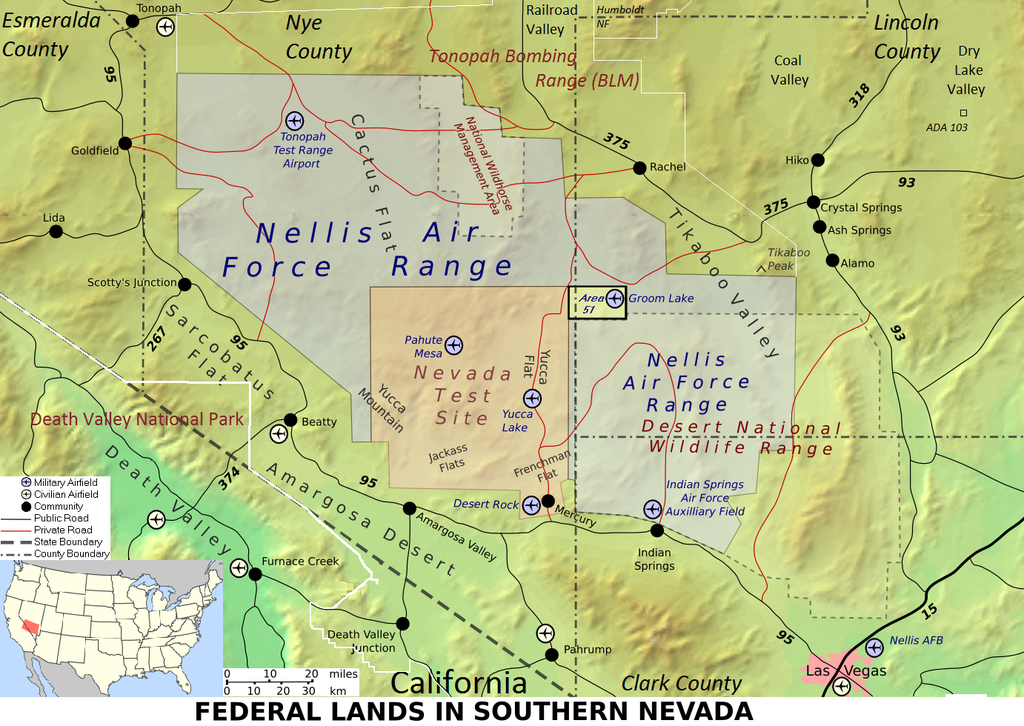
In fact, since 1952 Indian Springs had been a key portal into the Nevada Test Site – its purpose was to support both US Atomic Energy Commission nuclear testing at the Nevada Proving Grounds and US Air Force operations at the Nellis Air Force Base’s vast Gunnery and Bombing Range – and in June 2005 it morphed into Creech Air Force Base: the main centre from which ‘remote-split’ operations in Afghanistan, Pakistan and elsewhere are flown by USAF pilots. Most of the covert operations are directed by the CIA (some by Joint Special Operations Command), but the Predators and Reapers are used for more than targeted killing; the primary missions are still to provide ISR for conventional strikes and now also close air support for ground troops.

Wfm_area51_map_en

The geographies overlap, coalesce and – even allowing for the differences in scale – conjure up a radically diffuse and dispersed field of military violence.  When Tom Vanderbilt described ‘a war with no clear boundaries, no clear battlefields … a war waged in such secrecy that both records and physical locations are often utterly obscured’ he was talking about nuclear war.  But exactly the same could be said of today’s drone wars, those versions of later modern war in which the body becomes the battle space (‘warheads on foreheads’) and the hunting ground planetary: another dismal iteration of the ‘everywhere war’ (see here and here).

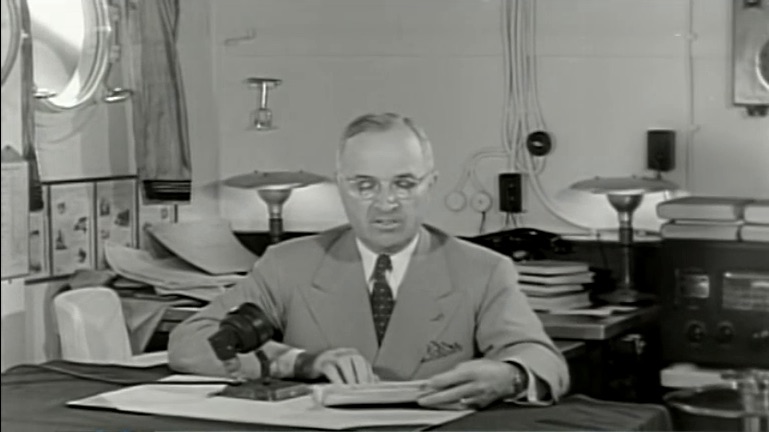
For all these connections and intersections, a key divide is the issue of civilians and casualties. On 9 August 1945 President Truman (below) described Hiroshima as a ‘military base’ selected ‘because we wished in this first attack to avoid, insofar as possible, the killing of civilians’.

TRUMAN Hiroshima speech

This was simply untrue, and similar – often no less deceptive – formulations are routinely used to justify US drone strikes and to minimise what is now called ‘collateral damage’. Still, the scale of civilian casualties is clearly different: usually dozens rather than hundreds of thousands.

And yet, there is something irredeemably personal and solitary about the response to death from either cause; parents searching for the bodies of their children in the ruins are as alone in Dhatta Khel as they were in Hiroshima.  When Yukiko Hayashi [her real name is Sachiko Kawamura] describes the anguish of a young woman and her father finding the remains of their family – the poem, ‘Sky of Hiroshima‘, is autobiographical – it is surely not difficult to transpose its pathos to other children in other places:

Daddy squats down, and digs with his hands
Suddenly, his voice weak with exhaustion, he points
I throw the hoe aside
And dig at the spot with my hands
The tiles have grown warm in the sun
And we dig
With a grim and quiet intent

Oh…
Mommy’s bone
Oh…
When I squeezed it
White powder danced in the wind
Mommy’s bone
When I put it in my mouth
Tasted lonely
The unbearable sorrow
Began to rise in my father and I
Left alone
Screaming, and picking up bones
And putting them into the candy box
Where they made a rustle

My little brother was right beside my mommy
Little more than a skeleton
His insides, not burnt out completely
Lay exposed…

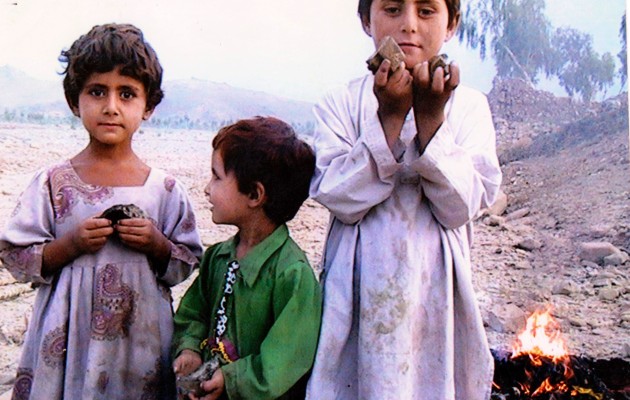
NOOR BEHRAM Orphans Dande Darpa Khel 21 August 2009

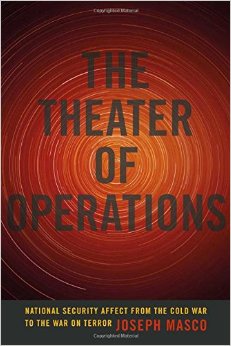
MASCO Theater of OperationsIn The Theater of Operations Joseph Masco draws a series of distinctions between the US national security state inaugurated by the first atomic bombs and the counter-terror state whose organs have proliferated since 9/11.

He properly (and brilliantly) insists on the affects instilled in the American public by the counter-terror state as vital parts of its purpose, logic and practice – yet he says virtually nothing about the affects induced amongst the vulnerable populations forced to ‘live under drones’ and its other modes of military and paramilitary violence.

In Waziristan no air raid sirens warn local people of a strike, no anti-aircraft systems protect them, and no air-raid shelters are available for them to seek refuge.

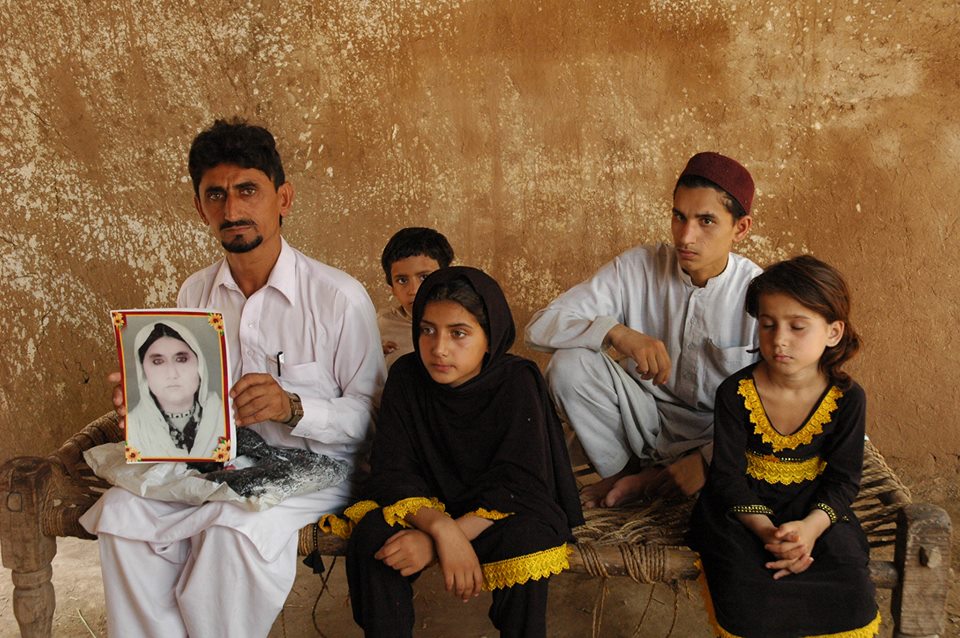
1374361_10151671014096363_1647526274_n

Hence young Zubair Rehman’s (above, top right) heartbreaking admission after a drone killed his grandmother as she tended the fields in Ghundi Kala in North Waziristan (see here and here):

‘I no longer love blue skies. In fact, I now prefer grey skies. The drones do not fly when the skies are grey.’

“This ain’t Jamaica”

The Tender SoldierA follow-up to my post on the demise of the US military’s Human Terrain System: an interesting report from Vanessa Gezari in the New York Times.  She’s the author of The Tender Soldier, a first-hand account of the Human Terrain System, and she starts her Times essay by recalling her own experience accompanying a US patrol in Afghanistan in 2010:

Cultural training and deep, nuanced understanding of Afghan politics and history were in short supply in the Army; without them, good intelligence was hard to come by, and effective policy making was nearly impossible. Human Terrain Teams, as Human Terrain System units were known, were supposed to include people with social-science backgrounds, language skills and an understanding of Afghan or Iraqi culture, as well as veterans and reservists who would help bind the civilians to their assigned military units.

On that winter day in Zormat, however, just how far the Human Terrain System had fallen short of expectations was clear. Neither of the social scientists on the patrol that morning had spent time in Afghanistan before being deployed there. While one was reasonably qualified, the other was a pleasant 43-year-old woman who grew up in Indiana and Tennessee, and whose highest academic credential was an advanced degree in organizational management she received online. She had confided to me that she didn’t feel comfortable carrying a gun she was still learning how to use. Before arriving in Afghanistan, she had traveled outside the United States only once, to Jamaica — “and this ain’t Jamaica,” she told me…

The shortcomings I saw in Zormat were hardly the extent of the Human Terrain System’s problems. The project suffered from an array of staffing and management issues, coupled with internal disagreements over whether it was meant to gather intelligence, hand out protein bars and peppermints, advise commanders on tribal conflicts or all three — a lack of clear purpose that eventually proved crippling. It outraged anthropologists, who argued that gathering information about indigenous people while embedded in a military unit in active combat posed an intractable ethical conflict. Once the subject of dozens of glowing news stories, the program had fallen so far off reporters’ radar by last fall that the Army was able to quietly pull the plug without a whisper in the mainstream media.

DEITCHMAN jpegShe suggests that the military could – and should – have learned from its previous attempts to enlist social scientists in Vietnam, Central America and elsewhere, and points to Seymour Deitchman‘s  The Best-Laid Schemes: A tale of social science research and bureaucracy (1976), which is available as an open access download from the US Marine Corps University Press here.

Deitchman worked for the Pentagon as a counterinsurgency advisor (among many other roles), and his account was a highly personal, take-no-prisoners affair.

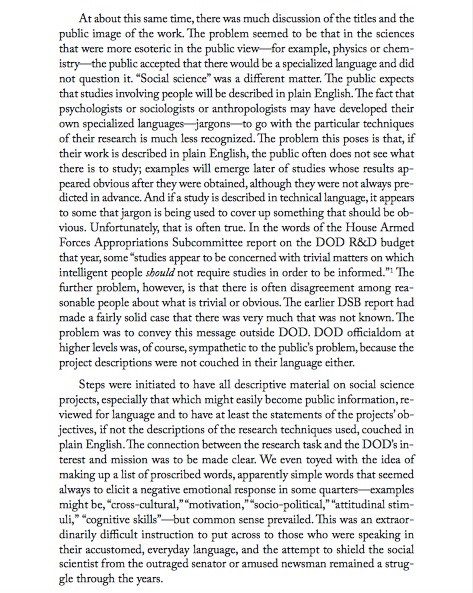
Part of the problem, he insisted, was the language of the social sciences:

DEITCHMAN p. 138 jpeg

There’s much more in a similar vein, and not surprisingly, Deitchman’s conclusion about the military effectiveness of social science was a jaundiced one.

The community of social science is likely to urge and has urged that increased government support of research on the great social problems of the day. With due recognition for the government’s need to collect data to help it plan and evaluate the social programs it is expected to undertake, I have reached the conclusion, nevertheless, that the opposite of the social scientists’ recommendation is in order. The research is needed, without question. Some of it, especially in the evaluation area, is necessary and feasible for government to sponsor. Beyond this, its support should be subject to the economic and political laws of the intellectual marketplace. And the government should do less, not more, to influence the workings of that marketplace. It should support less, not more, research into the workings of society.

You couldn’t make it up (or perhaps they did).   But this isn’t Vanessa’s view.  ‘The need for cultural understanding isn’t going away,’ she insists:

The rise of drones and sociocultural modeling, which uses data to simulate and sometimes predict human responses to conflict and crisis, have given some in the defense establishment the idea that we can do all our fighting safely, from a distance. But we’ve had this idea before, in the decades following Vietnam, and the wars in Iraq and Afghanistan should have reminded us of its falsity.

Oikological warfare

OWENS Counterinsurgency

A new book from the ever-innnovative Patricia Owens, Economy of Force: counterinsurgency and the historical rise of the Social (Cambridge University Press, 2015).

There’s an excellent interview with Patricia at e-IR here, which includes her own summary of the book:

The book retrieves the older, but surprisingly neglected, language of household governance, oikonomia, to show how the techniques and domestic ideologies of household administration are highly portable and play a remarkably central role in international and imperial relations. In contrast to the ahistorical and anachronistic adoption of social language across IR, I think there is an important story to be told of when, where, and why the social realm first emerged as the domain through which human life could be intervened in and transformed. Economy of Force tells this story in terms of modern transformations in and violent crises of household forms of rule. In two late-colonial British emergencies in Malaya (1948-1960) and Kenya (1952-1960), US counterinsurgency in Vietnam (1954-1975), and US-led campaigns in Afghanistan (2001-2014) and Iraq (2003-2011), so-called ‘armed social work’ policies were the continuation of oikonomia – not politics – by other means. Though never wholly succeeding, counterinsurgents drew on and innovated different forms of household governance to create units of rule in which local populations were domesticated. Military strategists conceived population control as sociological warfare because the social realm itself and distinctly social forms of thought are modern forms of oikonomikos, the art and science of household rule.

The argument has big implications for international theory, as well as the history and theory of counterinsurgency. Rather than objective theories of modern society and their interrelations, various forms of liberalism, political realism, social constructivism, and Marxism need to be situated within the history of the rise and violent transformation of the social realm. They are fragments of competing paradigms of social regulation. Ironically, the dominance of distinctly social forms of thought has obscured the household ontology of the modern social realm. Each of the major traditions is explicitly based on, or implicitly accepts, the erroneous notion that modern capitalism destroyed large-scale forms of household rule. So the book not only offers a new history and theory of counterinsurgency. It offers a new history of the rise of the social realm and political history and theory of household governance.

Research for the book was supported by a yearlong fellowship at the Radcliffe Institute for Advanced Study at Harvard University. There’ll be a symposium on Economy of Force at Disorder of Things later in 2015.

Here’s the Contents list:

1. Introduction: oikonomia in the use of force
2. The really real? A history of ‘social’ and ‘society’
3. Out of the confines of the household?
4. The colonial limits of society
5. ‘More than concentration camps’: the battle for hearths in two late-colonial emergencies
6. Society itself is at war: new model pacification in Vietnam
7. Oikonomia by other means: counterinsurgency in Afghanistan and Iraq
8. Conclusion: ‘it’s the oikos, stupid’.

Among the many pre-publication plaudits, here’s Didier Fassin‘s:

“Through a combination of historical perspective on the colonial world and contemporary inquiry into the imperial enterprise, Economy of Force invites us to rethink the laws of warfare and politics of counterinsurgency by paying attention to the pacification of local populations understood as a form of domestication. It thus unveils the genealogy of the blurred line between military and humanitarian interventions.”

You can get a taste of Patricia’s argument (particularly if you shrink from CUP’s extortionate pricing, even for the e-edition) in her ‘Human security and the rise of the social’, Review of International Studies 38 (2012) 547-567 and ‘From Bismarck to Petraeus:the question of the social and the social question in counterinsurgency’, European journal of international relations 19 (1) (2013) 139-161.

I’ve just heard from Patricia, who tells me that CUP will publish Economy of Force next year in paperback (which ought to make it much more accessible); she’s also made available the proofs of the Introduction on her academia.edu page here.

Warning: Graphic Content

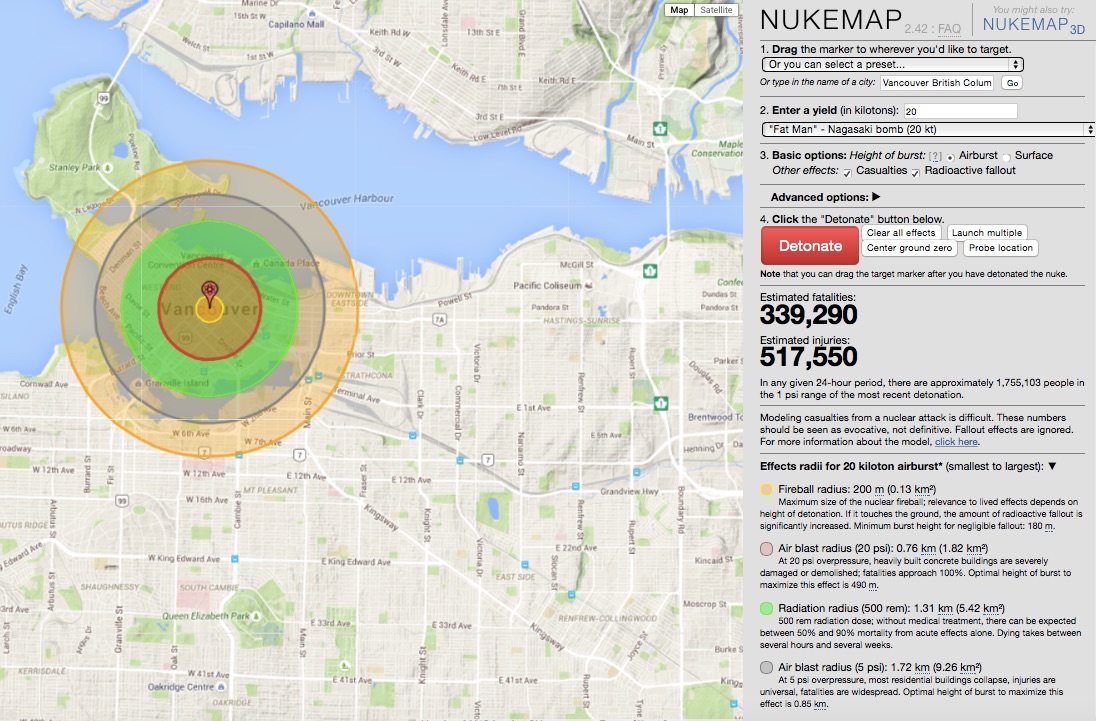
Following my last post on ‘The blue sky of Hiroshima’, I’ve received several e-mails from readers wondering at the size of the blast radius from ‘Little Boy’ (15 kilotons) shown on the image from NUKEMAP; there’s another one below, which shows the blast radius from ‘Fat Man’ (21 kilotons) originally detonated over Nagasaki and here projected on to Vancouver (for a critical note on these projections, by the way, see my original post).

Fat Man Vancouver NUKEMAP JPEG

If, like my correspondents, you are surprised at the ‘small’ size of the radii: you are right (though don’t ignore the numbers on the right…). Several years ago Maximilian Bode created this infographic to show the exorbitant increase in the destructive capacity of nuclear weapons since those two bombs were exploded over Japan 70 years ago:

1-nuclear-bomb-power

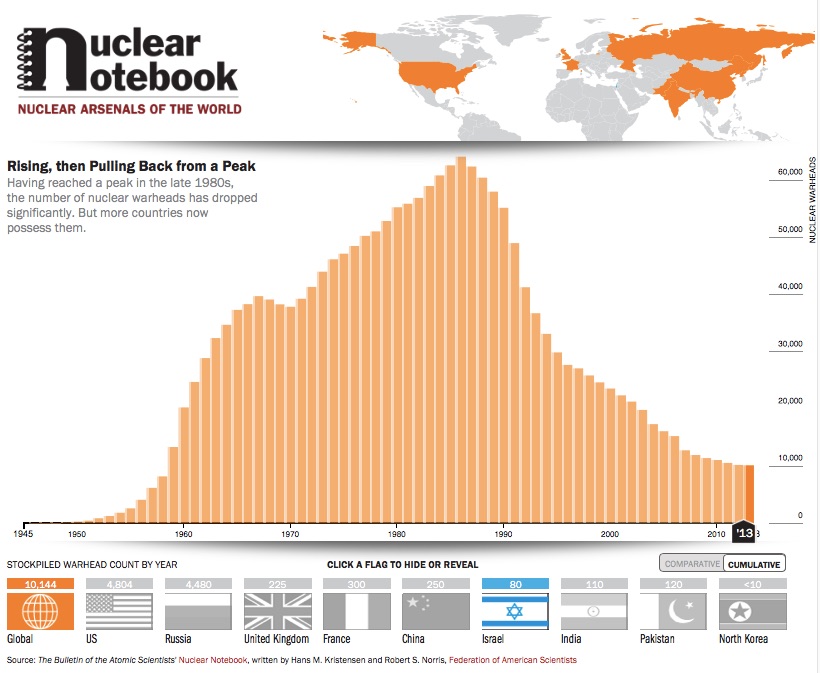
Many of today’s warheads are much smaller – the missiles carried on Trident, for example, are around 100 kilotons.   But that’s small comfort.  If you want to know how many nuclear warheads there are in the world today, this chart from the Nuclear Notebook produced for the Bulletin of Atomic Scientists will give you a rough idea (the interactive version is here):

Nuclear notebook JPEG

And finally Ehsan Rezaie has produced this video for Orbital Mechanics which plots (‘animates’ doesn’t seem the appropriate verb somehow) every nuclear detonation from 1945 on; you can also access this on Vimeo if the embed doesn’t work: search for ‘Trinity’:

The blue sky of Hiroshima

1946_08_31_001_CV1__xx_KA-880-1

It’s the bleakest of anniversaries – the bombing of Hiroshima 70 years ago today – and there is no shortage of commentary (see, for example, here and here).  John Hersey‘s book-length essay on Hiroshima, which filled most of  the 31 August 1946 issue of the New Yorker and has been republished online here.

At exactly fifteen minutes past eight in the morning, on August 6, 1945, Japanese time, at the moment when the atomic bomb flashed above Hiroshima, Miss Toshiko Sasaki, a clerk in the personnel department of the East Asia Tin Works, had just sat down at her place in the plant office and was turning her head to speak to the girl at the next desk. At that same moment, Dr. Masakazu Fujii was settling down cross-legged to read the Osaka Asahi on the porch of his private hospital, overhanging one of the seven deltaic rivers which divide Hiroshima; Mrs. Hatsuyo Nakamura, a tailor’s widow, stood by the window of her kitchen, watching a neighbor tearing down his house because it lay in the path of an air-raid-defense fire lane; Father Wilhelm Kleinsorge, a German priest of the Society of Jesus, reclined in his underwear on a cot on the top floor of his order’s three-story mission house, reading a Jesuit magazine, Stimmen der Zeit; Dr. Terufumi Sasaki, a young member of the surgical staff of the city’s large, modern Red Cross Hospital, walked along one of the hospital corridors with a blood specimen for a Wassermann test in his hand; and the Reverend Mr. Kiyoshi Tanimoto, pastor of the Hiroshima Methodist Church, paused at the door of a rich man’s house in Koi, the city’s western suburb, and prepared to unload a handcart full of things he had evacuated from town in fear of the massive B-29 raid which everyone expected Hiroshima to suffer. A hundred thousand people were killed by the atomic bomb, and these six were among the survivors. They still wonder why they lived when so many others died. Each of them counts many small items of chance or volition—a step taken in time, a decision to go indoors, catching one streetcar instead of the next—that spared him. And now each knows that in the act of survival he lived a dozen lives and saw more death than he ever thought he would see. At the time, none of them knew anything.

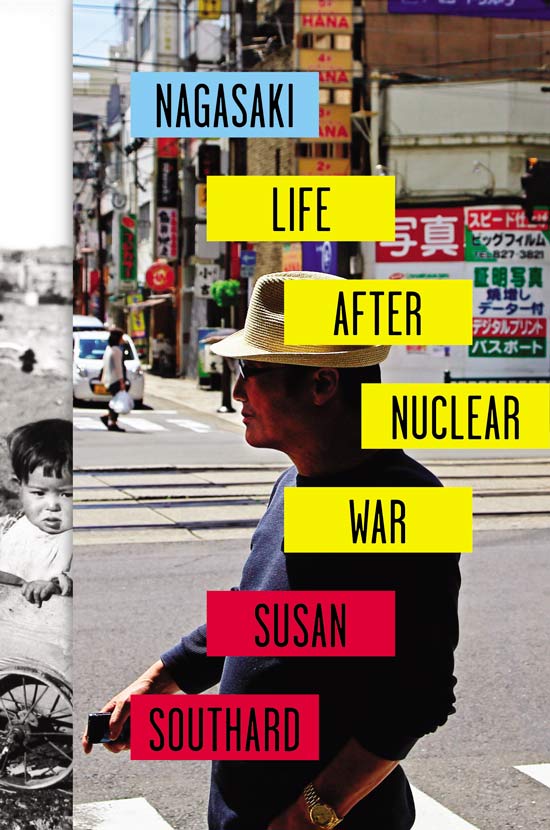
It’s worth comparing this with the opening scene of Kamila Shamsie‘s brilliant novel Burnt Shadows which imagines the second atomic bomb dropped on Nagasaki three days later.  Given the map I reproduce below, it’s also worth reading her short essay on the effect of using Google Earth to ‘map’ the bombing here; and since Nagasaki too often disappears from critical view, try Susan Southard‘s recently published Nagasaki: life after nuclear war (Viking/Penguin, 2015) – you can read a long extract here and here.

Nagasaki-Cover

For a brave attempt to bring the the two bombings into the same narrative frame, see Paul Ham‘s Hiroshima Nagasaki (2012/2014): there’s a helpful review essay by H. Bruce Franklin here, and The Atlantic has just published an extract, ‘The bureaucrats who singled out Hiroshima for destruction’ here.

Joyce C. Stearns, a scientist representing the Air Force, named the four shortlisted targets in order of preference: Kyoto, Hiroshima, Yokohama, and Kokura. They were all “large urban areas of more than three miles in diameter;” “capable of being effectively damaged by the blast;” and “likely to be unattacked by next August.”… Tokyo had been struck from the list because it was already “rubble,” the minutes noted…

Captain William “Deak” Parsons, associate director of Los Alamos’s Ordnance Division, gave another reason to drop the bomb on a city center: “The human and material destruction would be obvious.” An intact urban area would show off the bomb to great effect. Whether the bomb hit soldiers, ordnance, and munitions factories, while desirable from a publicity point of view, was incidental to this line of thinking—and did not influence the final decision.

(You’ll have to read the extract to see why Kyoto was eventually removed from the list).

hiroshima-nagasaki

For subsequent analysis, a good place to start is Alex Wellerstein‘s Restricted Data: the nuclear secrecy blog, which includes a series of excellent posts on sources and visualizations, on the Manhattan Project and what happened at Los Alamos, and most recently an essay which asks ‘Where there alternatives to the atomic bombings?‘ and gives lots of background to those terrible events.

Among Alex’s visualizations is NUKEMAP, which simulates the dropping of ‘Little Boy’ on other towns and cities.  Here is downtown Vancouver (for a discussion of airbursts, see Alex’s post here).

Little Boy VANCOUVER JPEG

Elsewhere, there’s a special issue of Critical Military Studies on the anniversary, and all the articles are open access:

The most modern city in the world: Isamu Noguchi’s cenotaph controversy and Hiroshima’s city of peace: Ran Zwigenberg
Unbearable light/ness of the bombing: normalizing violence and banalizing the horror of the atomic bomb experiences: Yuki Miyamoto
Remembering nukes: collective memories and countering state history: Stefanie Fishel
Contested spaces of ethnicity: zainichi Korean accounts of the atomic bombings: Erik Ropers
Hiroshima and two paradoxes of Japanese nuclear perplexity: Thomas E. Doyle II
Re-imagining Hiroshima in Japan: elin o’Hara slavik
Memory and survival in everyday textures – Ishiuchi Miyako’s Here and Now: Atomic Bomb Artifacts, ひろしま/ Hiroshima 1945/2007: Makeda Best
Nagasaki Re-Imagined: the last shall be first: Kathleen Sullivan

There’s also a special issue of Thesis Eleven, (August 2015: 129 (1)) edited by Brad Evans and Keith Tester in association with the Histories of Violence ‘Disposable Life’ project; articles include:

Susan Neiman, Forgetting Hiroshima, remembering Auschwitz: Tales of two exhibits
Keith Tester, Hiroshima: Remembering and forgetting, everything and nothing
Michael J Shapiro, Hiroshima temporalities
Maja Zehfuss, (Nuclear) war and the memory of Nagasaki: Thinking at the (impossible) limit
Hiro Saito, The A-bomb victims’ plea for cosmopolitan commemoration: Toward reconciliation and world peace
Arne Johan Vetlesen, Post-Hiroshima reflections on extinction
Henry A Giroux, Hiroshima and the responsibility of intellectuals: Crisis, catastrophe, and the neoliberal disimagination machine

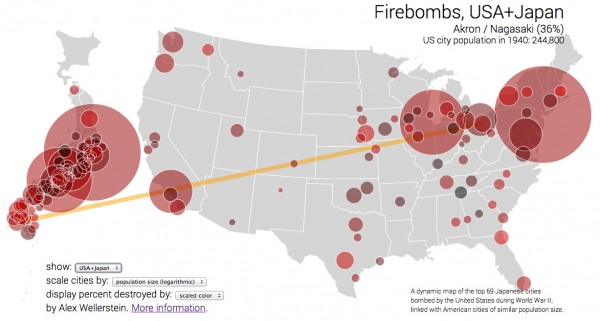
I have just two things to add.  The first is to draw attention to the firebombing of Japanese cities that preceded Hiroshima and Nagasaki (Alex compares them in an interesting commentary here and provides a series of compelling comparative interactives here: I’ve pasted an example below, and provided a short commentary here).

firebombs-usa-interactive-600x321

In fact, as my quotation from Paul Ham reveals, Hiroshima and Nagasaki were targeted precisely because they had been left alone during the previous attacks and would provide effective laboratories to test the effects of nuclear blasts.  On the firebombing campaign, see the painstaking work of Cary Karacas and his colleagues here (my commentaries on the project are here and here; see also their essay on the firebombing of Tokyo and its legacy here); their website includes both a Hiroshima archive and a Nagasaki archive.

Second, I’ve emphasised the comparative effort to ‘bring the war home’, to imagine the effects of Little Boy and Fat Man on other cities around the world.  There are obvious dangers in such an exercise – is our capacity for empathy so limited than we have to rely on a sort of critical narcissism: ‘imagine if it happened to us‘? – but perhaps the most significant objection is that such cartographic conceits can erase not only the bodies incinerated and maimed (through the very abstraction of cartography) but also the racialization of these unmarked bodies.  In the characteristically thoughtful introduction to his new book, Tense Future: Modernism, Total War, Encyclopedic Form (2015), Paul K. Saint Amour writes about ‘traumatic earliness’ – about the sense of anticipation, foreboding or bukimi that gripped the people of Hiroshima in the months before their collective deaths: that ‘uneasy combination of continued good fortune [escaping the firebombing] and expectation of catastrophe’.  But the ground had already been prepared in the United States, not only scientifically – the endless calculations, calibrations and experiments at Los Alamos – but also culturally.

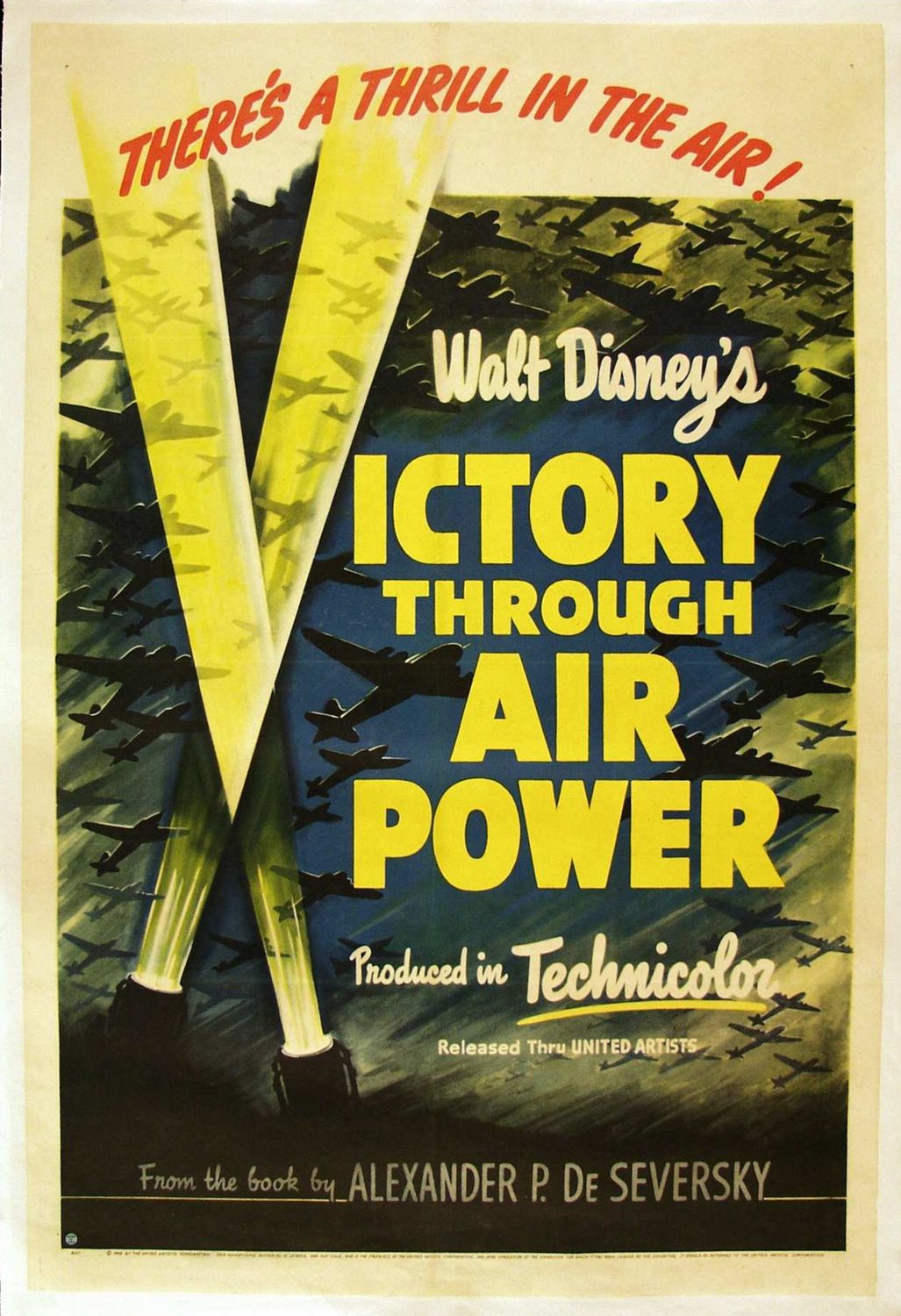
Victory_through_air_power_xlg

Michael Sherry‘s The rise of American Air Power: the creation of Armageddon (1987) and Paul Williams‘s Race, ethnicity and nuclear war (2011) are indispensable here – and there’s a sharp, contemporary commentary from Arthur Chu here –  but a vivid example is provided by Alex de Seversky‘s Victory through Air Power (1942) and, in particular, its celebration in Walt Disney‘s film version released in 1943.  For Disney, there was not only ‘a thrill in the air’ but an exuberant delight at death and destruction on the Japanese ground.  You can watch the whole thing below (or on YouTube) but to see what I mean start at 1.07 and watch right through the bombing to the anthropomorphism of the American eagle and the Japanese octopus that follows it.  There’s also a short commentary by Henry Giroux here.

Note: My title is taken from this poem by Yukiko Hayashi; if you click on nothing else, please click on this.

(In)human Terrain

humanterrain3

It’s been an age since I looked at the US military’s attempt to ‘weaponise culture’ in its counterinsurgency programs (see ‘The rush to the intimate’: DOWNLOADS tab), but Roberto Gonzalez has kept his eyes on the ground – or the ‘human terrain’ (I’ve borrowed the image above from Anthropologists for Justice and Peace here).

In a special report for Counterpunch a month ago, Roberto noted the demise of the Human Terrain System:

The most expensive social science program in history – the US Army’s Human Terrain System (HTS)–has quietly come to an end. During its eight years of existence, the controversial program cost tax payers more than $725 million…

HTS supporters frequently claimed that the program would increase cultural understanding between US forces and Iraqis and Afghans–and therefore reduce American and civilian casualties. The program’s leaders insisted that embedded social scientists were delivering sociocultural knowledge to commanders, but the reality was more complex. HTS personnel conducted a range of activities including data collection, intelligence gathering, and psychological operations. In at least one case, an HTS employee supported interrogations in Afghanistan.

The program also served a more insidious function: It became a propaganda tool for convincing the American public–especially those with liberal tendencies–that the US-led occupations of Iraq and Afghanistan were benevolent missions in which smart, fresh-faced young college graduates were playing a role. It appeared to demonstrate how US forces were engaged in a kinder, gentler form of occupation. Department of Defense photos portrayed HTS personnel sitting on rugs while drinking tea with Afghan elders, or distributing sweets to euphoric Iraqi children. Here was a war that Americans could feel good about fighting.

The program had its critics, inside as well as outside the military, and US Army Training and Doctrine Command (TRADOC) eventually confirmed that HTS had been terminated on 30 September 2014.  In his report, Roberto traces the rise and fall of HTS, and attributes its demise to US troop withdrawals from Iraq and Afghanistan, the fall from grace of the ‘new’ counterinsurgency’s champion David Petraeus, the incompetence of many of the HTS teams, and – crucially – to the precipitate shift from ‘cultural’ to geospatial intelligence.

The last, impelled by the desire to substitute air strikes for ‘boots on the ground’ and to rely on computational methods rather than human intelligence, is the key: as Oliver Belcher put it in his PhD thesis on The afterlives of counterinsurgency, “It’s algorithms, not anthropology, that are the real social science scandal in late-modern war.”

I’ve been exploring this shift in my ‘Dirty Dancing’ essay – in relation to the American production of the Federally Administered Tribal Areas of Pakistan as a space of execution, a code/space in which data surveillance and computational methods are activated to assert an extra-territorial claim over bodies-in-spaces – but it’s become clear to me that this continues to rely on (and in some respects even extends) the weaponisation of culture.  It’s an appropriate metaphor: after all, weapons are inherently dangerous, they can be misdirected, they do misfire and they can cause grievous harm far beyond their intended target.

In a follow-up post on ‘Re-making the Human Terrain’, Roberto says as much:

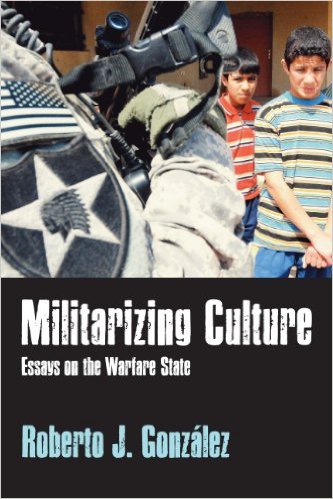
GONZALEZThe gaps in military knowledge that HTS claimed to fill still remain. The desire to weaponize culture is as old as dreams of counterinsurgency, and such dreams do not die easily.

It would be premature for those concerned about the militarization of culture to breathe a sigh of relief. The needs of empire—especially an empire in denial—are far too great to ignore cultural concerns. HTS’s sudden death can obscure the fact that elements of the program continue to survive, though in distinct and sometimes unrecognizable forms. The basic idea behind HTS—to equip the military with cultural expertise for battlefield operations—has not been eradicated. If anything, the concept has firmly taken root.

He traces its off-shoots through the development of a Global Cultural Knowledge Network – which I can’t help seeing as the cultural version of the Bombing Encyclopedia of the World – and the role of private corporations in providing ‘human terrain analysts’ to support US special operations (see also Max Forte here on what I think of as the Military-Academic-Industrial-Media complex: MAIM).  Interestingly, Whitney Kassel – who is adamant that ‘shuttering HTS will almost certainly be a mistake’ – notes that ‘the National Defense University conducted a detailed study of HTS [summarised in JFQ] in late 2013 and recommended that the function be moved and permanently housed at U.S. Army Special Operations Command … which has the lead for irregular warfare and other Army functions that make the most frequent use of sociocultural knowledge.’

Roberto also provides a more detailed analysis of the US military’s investment in socio-cultural modelling and (this is truly vital) predictive forecasting in two linked essays on ‘Seeing into hearts and minds’: Part 1 is ‘The Pentagon’s quest for a social radar’, Anthropology Today 31 (3) (June 2015) 8-13 and Part 2 is ‘‘Big data’, algorithms, and computational counterinsurgency, Anthropology Today 31 (4) (August 2015) 13-18.

Social Radar JPEG

The second part is most directly relevant to what I’ve been working on because it describes the conceptual development of so-called ‘Social Radar’ (see image above: ‘sensor systems for the 21st century‘; see also here) and the morphing of the NSA’s Real Time Regional Gateway for Iraq – which integrated data surveillance from multiple sources and domains with visual feeds from drones – into Nexus 7 in Afghanistan.

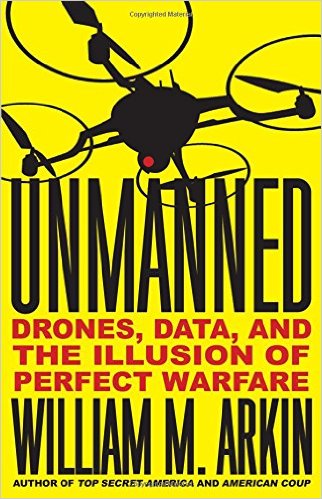
Similar fusion systems have surely been working across the border, and in his Unmanned: drones, data, and the illusion of perfect warfare (2015) William Arkin provides a fascinating glimpse into other genealogies that have produced what he calls ‘the Data Machine’:

ARKIN UnmannedToday, the Data Machine doesn’t care where it is fighting. It doesn’t matter whether targets are hiding in Hindu Kush caves or in villages of the Fertile Crescent. Nor does Predator care, or Reaper, or Global Hawk, or any other of our other aptly and awkwardly named all-seeing eyes. In fact, they don’t care about anything: they are machines. But the men and women … behind the entire Machine also don’t care, for every place is reduced to geographic coordinates that flash across a screen in seconds. Nations, armies, and even people are reduced to links and networks.

Loitering drones and geolocating weapons just need the data. Everyone needs the global information grid and the Internet—or, more precisely, an internet. Actual battlefield geography and culture have become immaterial. The node and the network sentry become the determinant and the provocateur of action—all the way to the edge of the world, anywhere.