‘Our daily threat’

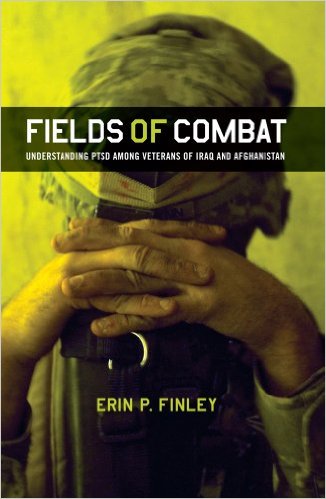
41Oi3YngcQL._SX324_BO1,204,203,200_For the longest time the only victims of Post-Traumatic Stress Disorder from the wars in Afghanistan who were accorded any media attention in Europe and North America were ground troops,  drone pilots and on occasion foreign civilians who worked in the combat zone. And much of that discussion focussed on the ways in which, as  Sebastian Junger put it, the effects of PTSD ripple far beyond the battlefield:

[Veterans] return from wars that are safer than those their fathers and grandfathers fought, and yet far greater numbers of them wind up alienated and depressed. This is true even for people who didn’t experience combat. In other words, the problem doesn’t seem to be trauma on the battlefield so much as re-entry into society.

But what about those denied re-entry into ‘normal’ society, those for whom war long ago became the ‘new normal’?  Apart from the odd glance at other combatants – ‘Do the Taliban get PTSD?Newsweek once asked – the plight of local people trapped in the battlefield, living and dying every day in the shadows of military and paramilitary violence, has been largely ignored.

There have been exceptions, like Anna Badkhen‘s report for the Pulitzer Center on Afghanistan as ‘PDSTland’ that also offered a more general commentary:

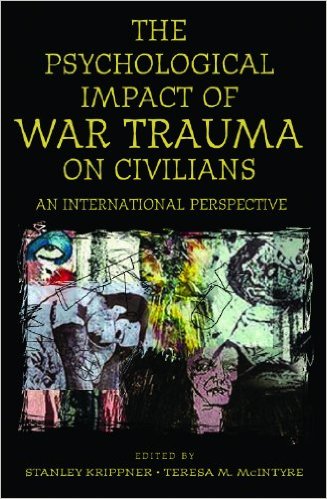
Psychological impact of war trauma on civiiliansCompared with research into the effects of conflict on U.S. war veterans, studies of combat trauma among civilians are few. But there is a growing understanding among medical scientists and conflict experts that the emotional toll of war on noncombatants is more significant than had been assumed. During World War I, when military physicians described soldiers’ traumatic reactions to war as “shell shock,” about nine out of 10 war casualties were fighters. But after nearly 50 years of the Cold War and more than 10 years of the war on terror, the way we wage war is more personal. Terrorism battlefields recognize no front lines. Vicious sectarian rampages pit neighbor against neighbor. Victims of genocidal campaigns often know their attackers by name. In the most current conflicts, at least nine out of 10 war casualties are believed to be civilians, writes psychologist Stanley Krippner in his book The Psychological Impact of War Trauma on Civilians [This is a collection of essays Krippner co-edited with Maria McIntyre]. In Iraq, where as many as 1 million people may have died since 2003, the rate might be even higher. No one kept track of civilian casualties in Afghanistan between 2001 and 2007, and estimates vary widely; given the United Nations’ tally of almost 12,000 civilian deaths since the beginning of 2007, a rough guess of between 20,000 and 30,000 civilian casualties since 2001 seems reasonable.

Communal psychological wounds – what medical anthropologist Arthur Kleinman has called “social suffering” – permeate the lives of survivors scraping by in unimaginable poverty amid collapsed infrastructure, the common afterbirth of modern combat. According to the Centers for Disease Control and Prevention, between 30 and 70 percent of people who have lived in war zones bear the scars of post-traumatic stress disorder and depression.
Over the years I’ve read endless reports about the ways in which the US military in particular is exploring new therapies for PTSD – including experiments in Virtual Reality as a way of helping victims re-live and ultimately come to terms with trauma, like Virtually Better‘s Bravemind staged in ‘Virtual Afghanistan’ (see below; also here, here, here and here).
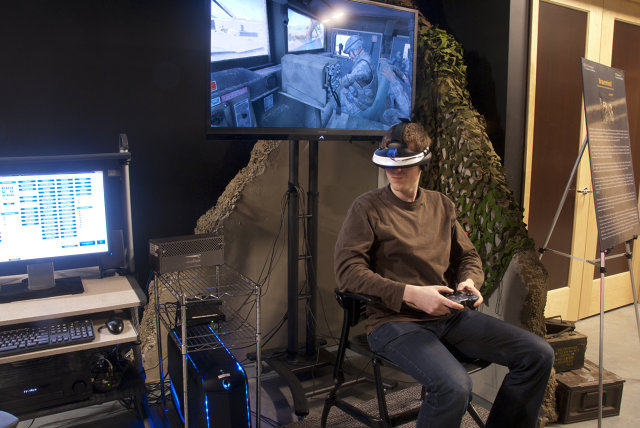
bravemind

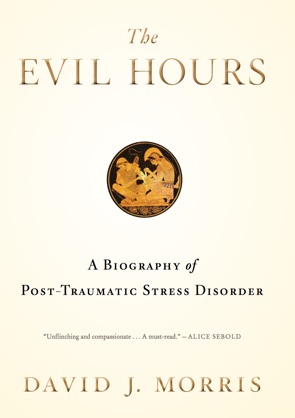
This doesn’t mean that progress is rapid or solutions straightforward, and David Morris‘s The Evil Hours ought to banish any such complacency.  Here is Tom Ricks:

From battlefields and cultural responses to traumatized warriors throughout world history to the internecine corridors of the San Diego V.A. hospital and the modern psychology establishment, Morris gives sight to the blind examining the PTSD elephant, offering up a clear understanding of what the beast is as well as the path it’s traveled across the landscape of warfare. He draws from a seemingly inexhaustible well of experience. Herding a cast that includes Hemingway, Klosterman, Sassoon, a host of anthropologists and neurologists, and the soldiers and veterans he met throughout his own odyssey, Morris accomplishes the necessary work of identifying all the necessary aspects of PTSD and still finds a way to magnify the nuances of how it affects individuals and societies.

Evil Hours Cover Final-1The “out-of-body” experience and the recurring memory of traumatic events are familiar to those afflicted by PTSD. Many describe it as watching a movie on repeat from every possible angle. It’s the mind’s vain attempt to challenge trauma like a call in a football game, gathering the referees around a screen to watch the replay over and over until the past can be rewritten in favor of justice. Others who have attempted books about PTSD have floundered in this conceit. Morris avoids that and maintains his place at the commentators’ desk — close enough to call the play-by-play, but far enough away to keep perspective. Instead of raging at length about the process of enrolling in the V.A. care system (whose bureaucracy he declares forces veterans to run “a patience marathon”), he reflects on its problematic advocacy of “large, scalable, Evidence-Supported Treatments.” Morris unearths troubling aspects in the character of these treatments as he traces the history of PTSD therapy. He finds that they are highly impersonal … and make the afflicted feel more like they’re being treated as lab rats than patients. He observes that these methods are a profound departure from the type of treatments discovered and evolved by W.H.R. Rivers during WWI and, later, Vietnam veterans groups during the 1970s. Though Morris’s own experience with prolonged exposure treatment met with poor results and he expresses misgivings about similar therapeutic methods, he remains objective about their efficacy. Rather, he takes a more important and less scrutinized view of how treatments are vetted in the first place. Questioning the practice of excluding patients who drop out of test programs from data sets instead of listing them as showing no signs of improvement, Morris asks if reports inaccurately portray success rates. This leaves the V.A.’s dogmatic insistence on evidence-based methods particularly vulnerable to skewed numbers…  His exploration of the pharmaceutical approach to PTSD reaches similar conclusions. As Morris writes, “‘Evidence-supported’ and ‘evidence-based’ mostly means that a lot of doctors happen to like it, oftentimes for reasons that have less to do with the actual value of a therapeutic protocol than with trendiness.”
So PTSD has become a medical-psychological-psychiatric and even -technological minefield, and the figure of what Roy Scranton calls ‘the trauma hero‘ still casts a long shadow over its deformations (and even contributes to them).

But when you compare these avowedly fraught therapeutic interventions with the often forcible recourse of many Afghan victims of PTSD to shrines, a radically divergent medical geography comes into view (much as it does when you compare the differential treatment for catastrophic injury: see my commentary on ‘The prosthetics of military violence’ here).  Anna writes:

Most Afghans turn for comfort to religious shrines – small mausoleums or simply fenced, coffin-sized ziggurats, painted green and laced with shreds of shiny cloth that sparkle along country roads and hillsides like jewels. Pilgrims come to kneel or lie prostrate next to the metal palisades, seeking delivery from the djinns that possess them – evil spirits that trigger sudden violent outbursts and long bouts of melancholia, that bedevil their sleepless nights with nightmares and turn their days into lethargic slogs.

This doubly dreadful world is portrayed in a new film by Jamie Doran and Najibullah Quraishi for Al Jazeera, Living beneath the drones (which you can also access on YouTube if the embedded video fails).

This is not the first time that the trauma of living beneath the ‘persistent presence’ of Predators and Reapers has been brought to critical attention, most vividly in the NYU/Stanford study Living Under Drones: Death, injury and trauma to civilians from US drone practices in Pakistan (2012).  But this is the first time I’ve seen such a detailed investigation of the impact of military violence on the people of Afghanistan.  As I’ve noted before, it’s taken a remarkably long time for investigators to examine the role of remote warfare in Afghanistan  – ‘remote’ in more ways than one – and Living beneath the Drones includes the standard interviews with David Deptula and Peter Singer who offer their usual contrasting views about its effects.
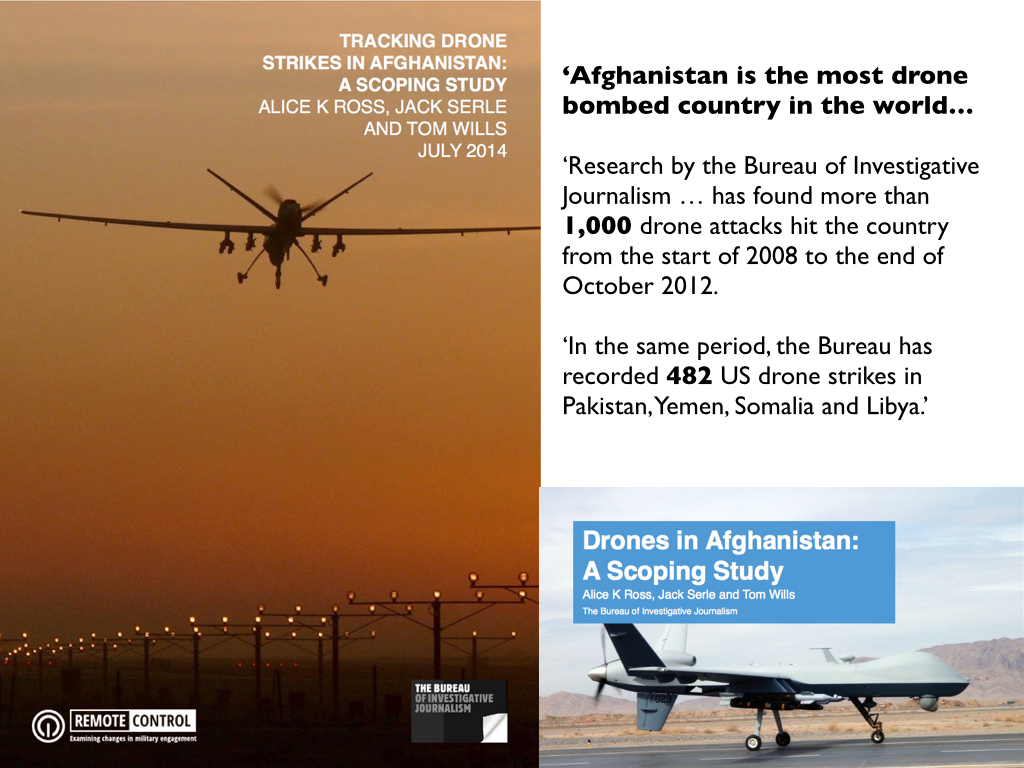
Afghanistan drone bombings BOIJ.001

But for me this is the least important contribution of the film; it’s the intimate exposure of the treatment meted out to traumatised victims of military and paramilitary violence that is most unsettling.  In fact, it’s not easy to disentangle the impact of Predators and Reapers from the larger matrix of violence in which they are enmeshed.  True, many of those interviewed describe how their lives are haunted by the drones, but this is a country where the dogs of war have prowled for four generations or more and trauma has never been rationed.  As Kevin Sieff’s report for the Washington Post in October 2012 showed, it’s usually impossible to fasten on a single incident or even to get an adequate history:

No one here knows the man whose left leg is shackled to the wall of cell No. 5. Last week, he finished tearing his mattress to shreds and then moved onto his clothes, ripping his shirt and pants off before falling asleep naked…

The man’s brothers drove him here from southern Kandahar province two weeks ago, drawn by the same belief that has attracted families from across Afghanistan for more than two centuries. Legend has it that those with mental disorders will be healed after spending 40 days in one of the shrine’s 16 tiny concrete cells. They live on a subsistence diet of bread, water and black pepper near the grave of a famous pir, or spiritual leader, named Mia Ali Sahib.

Every year, hundreds of Afghans bring mentally ill relatives here rather than to hospitals, rejecting a clinical approach to what many here see as a spiritual deficiency. The treatment meted out at the shrine and a handful of others like it nationwide might be archaic, but the symptoms are often a response to 21st-century warfare: 11 years of night-time raids, assassinations and suicide bombings.

For over a decade, Western donors have helped train Afghan psychiatrists, who diagnose many of their patients as having an ailment with a distinctly modern acronym: PTSD, or post-traumatic stress disorder. Mental health departments in Afghanistan are plastered with posters detailing the disorder’s symptoms. Pharmacies are stocked with antipsychotic drugs.

But many of those suffering from the disorder never see doctors or pharmacists. Instead, they are taken on the long, unmarked dirt road, through a village of mud huts, that leads to an L-shaped agglomeration of cells.

The brothers of the man in cell No. 5 drove back to Kandahar, more than 400 miles away, once the shackles were in place. They left an indecipherable phone number on a scrap of paper. They paid $20 for the treatment, as all patients must. If they told anyone the name of the man, no one remembers.

“What will I do with this man?” asked Shafiq, the shrine’s director and a descendant of Sahib. “Who is this man?”

Shafiq wondered: Was the man’s mental state a product of war? Was he a former soldier? A civilian who had seen too much horror?
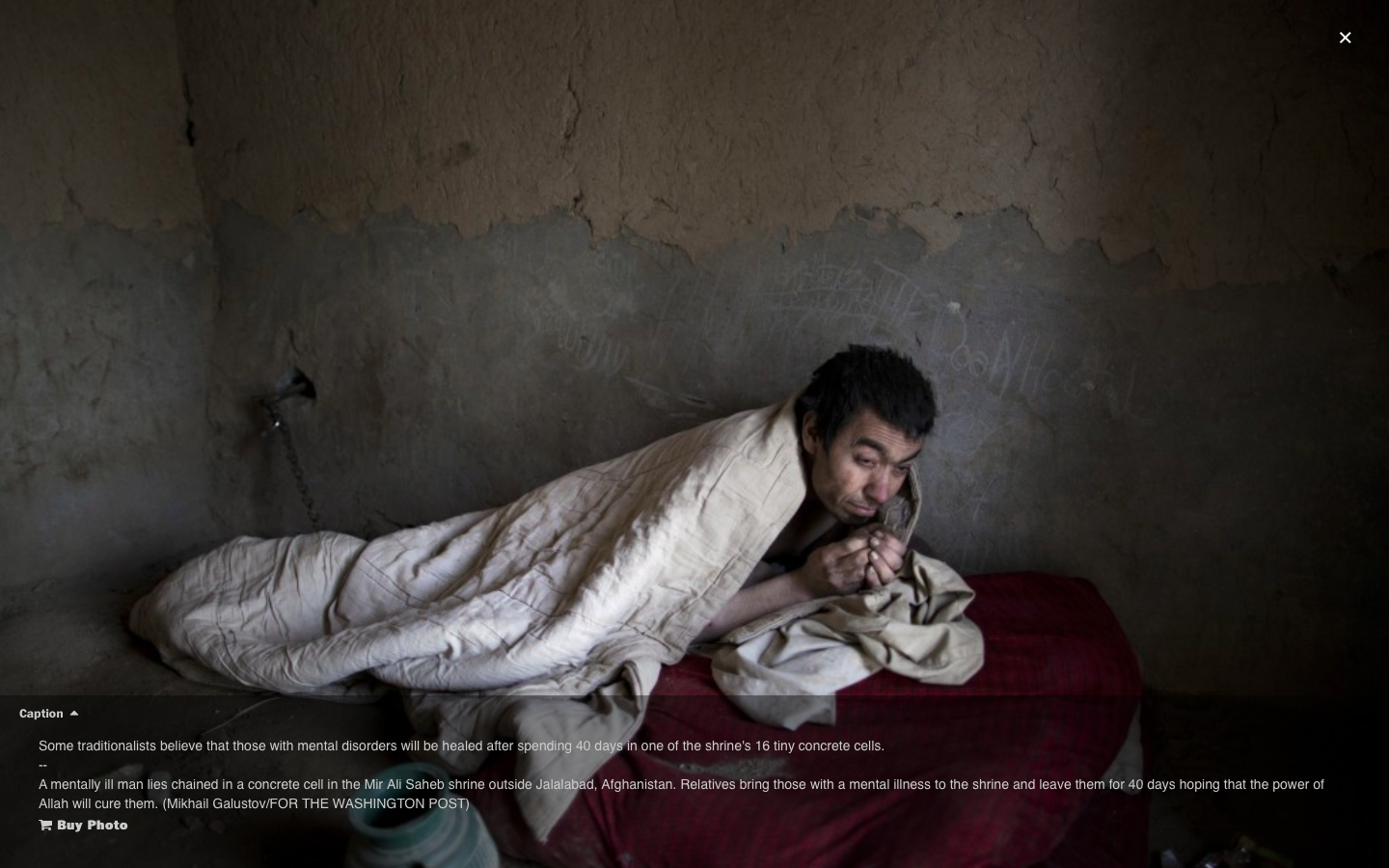
Afghan shrine:Mikhail Galustov

And so here is Emma Reynolds on what I take to be the central message of Living beneath the drones:

When a Western soldier suffers from post-traumatic stress disorder, there are doctors and organisations who can help them recover from the heartbreaking legacy of war.

When it is someone from Afghanistan, where bombings regularly wreak devastation and tear families apart, you are unlikely to find any assistance, since there is little understanding of mental illness in the country.

“The most common treatment is to take your loved one to a religious shrine where they are chained to walls or trees for up to 40 days, fed stale bread, water and ground pepper, and read dubious lines from the Qur’an by individuals with no medical or, for that matter, religious training,” documentary-makers Jamie Doran and Najibullah Quraishi [said]…

Many of the shrines are nothing more than money-making enterprises run by con artists with little or no religious training…

You might have thought that civilians and soldiers living in war zones would become hardened to this life, and find it almost normal. In fact, the pervasive atmosphere of violence and fear takes a bitter toll, and this terrible truth can be seen most clearly in Afghanistan, the site of the longest war ever for Australia and the US. “When you talk to them, there is little joy in their words any more,” said UK-based director Doran…  “Anyone with a family, children, someone you love, is forever in fear of losing them. You can see it in their worn faces.”

Hope and confidence in the future had steadily dissolved, with millions now thought to be suffering from PTSD, with little hope of treatment. Only one hospital in the entire country is dedicated to mental health, despite official estimates indicating that 60 to 70 per cent of the country’s population now suffer from some mental health problem. Unofficial estimates go as high as 95 per cent. This is the real human impact of living with the daily threat of death.
Afterwar(d)s

I’ve been working my way through the proofs of ‘The natures of war’, in which (among other things) I try to show that soldiers are not only vectors of military violence but also victims of it.  My analysis fastens on the Western Front in the First World War, Northern Africa in the Second World War, and Vietnam – the final draft is under the DOWNLOADS tab and the published version should be up on the Antipode website later this month – but I hope it will be clear to readers that the implications of this claim , and the others in the essay, extend into our own present.  They also intersect with my current research on casualty evacuation from war zones, 1914-2014.

So I’ve been interested in three recent contributions that detail the aftermath of war for those who fight them.

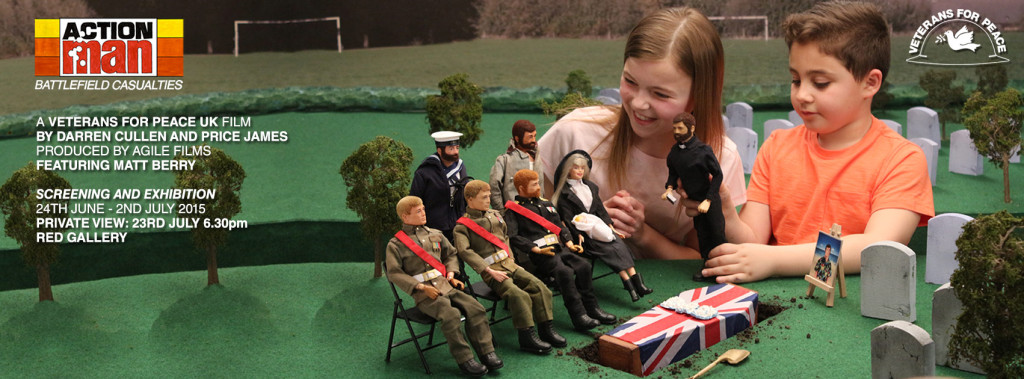
First, Veterans for Peace UK have worked with Darren Cullen to produce a short film, Action Man: Battlefield Casualties [see the clip above] in an attempt, as Charlie Gilmour explains over at Vice,

‘to show the shit beneath the shine of polished army propaganda. Featuring PTSD Action Man (“with thousand-yard stare action”), Paralysed Action Man (“legs really don’t work”) and Dead Action Man (“coffin sold separately”)…’ [see also my post on ‘The prosthetics of military violence‘]

Actionman-1024x379

In keeping with the project’s authors, Charlie insists – I think properly – that many of those who were sent to Afghanistan from the UK were child soldiers (and here I also recommend Owen Sheers‘ brilliant Pink Mist for an unforgettable portrayal of what happens when boys who grow up ‘playing war’ end up fighting it: see also here and here).  As the project’s web site notes:

The UK is one of only nineteen countries worldwide, and the only EU member, that still recruits 16 year olds into its armed forces, (other nations include Iran and North Korea). The vast majority of countries only recruit adults aged 18 and above, but British children, with the consent of their parents, can begin the application process to join the army aged just 15…

It is the poorest regions of Britain that supply large numbers of these child recruits. The army has said that it looks to the youngest recruits to make up shortfalls in the infantry, by far the most dangerous part of the military. The infantry’s fatality rate in Afghanistan has been seven times that of the rest of the armed forces.

Forces Watch JPEG

Child Soldiers International JPEG

A study by human rights groups ForcesWatch and Child Soldiers International in 2013 found that soldiers who enlisted at 16 and completed training were twice as likely to die in Afghanistan as those who enlisted aged 18 or above, even though younger recruits are, for the most part, not sent to war until they are 18.

You can find another thoughtful reflection on child soldiers by Malcolm Harris over at the indispensable Aeon here. He doesn’t include the British Army in his discussion, but once you do you can see that the implications of this passage extend beyond its ostensible locus (Nigeria):

But can a child truly volunteer to join an army? Even when they enlist by choice, child soldiers do so under a set of constraining circumstances. UNICEF makes the choices sound easy: war or dancing, war or games, war or be a doctor. No rational child would pick the former for themselves, and that’s posed as evidence that their freedom has been taken from them. But when the choice is ‘soldier or victim’, voluntarism takes on a different meaning.

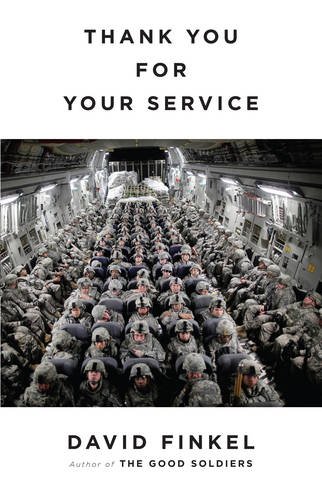
FINKEL Thank you for your service

Second, moving across the Atlantic and providing an extended riff on the ‘thank you for your service’ gesture, the latest issue of New Left Review includes an essay by Joan Wypijewski, ‘Home Alone‘, that describes the journey home faced by many US veterans.  She begins by putting David Finkel‘s compelling book in context:

The term ‘Thank You for Your Service’ developed early on in the long wars. Like ‘Support the Troops’, it was a way for a sheltered people to perform unity. In towns across America yellow ribbons, yellow lawn signs, balloons and car decals sprouted like team colours on game day. War would be a sport, the people spectators, and ‘Thank you for your service’ the high-five to combatants after quick and decisive victory. When that proved a vain hope, team spirit settled into the rhythms of commerce. ‘Support the Troops’ appeared the way ‘Buy American’ once had—a slogan on shop windows, billboards, bumper stickers. War was an enterprise, security its product, the people consumers, the soldiers trained workers and ‘Thank you for your service’ a kind of tip. As the enterprise (though hardly the business) failed, the signs faded, sometimes replaced by an image of folded hands, ‘Pray for Our Troops’. War had become a problem, the soldiers exhausted, the people clueless and ‘Thank you for your service’ a bit of empty etiquette, or a penance. By the time Finkel was writing [his book was published in October 2013], what remained among civilians was a desire to move on, and among soldiers, bitterness. ‘They wouldn’t be fucking thanking me if they knew what I did’, many would say, in almost exactly the same words.

Joan works her way through Finkel’s account, and then turns to Laurent Bécue-Renard’s Of Men and War, a documentary film – five years in the making, and the second instalment in a trilogy devoted to a ‘genealogy of wrath‘ – of Trauma Group sessions at a treatment centre in the Napa Valley:

‘What we have is embarrassing as shit’, a thick, tight young white man says in the Trauma Group. ‘You feel small—you feel defective.’ And so it goes, and so men trained for toughness talk of being weak and scared and monstrous, or just diligent. Of working in Mortuary Affairs: ‘breaking the rigour down’ to get the corpse of a 19-year-old who killed himself flat enough for a body bag, or untangling the remains of a group of faceless soldiers burned in a truck who are fused ‘like a bunch of rope’. They talk of their dreams, of their frightened wives. Maybe she moved out and got a restraining order before he came home, or maybe she has the divorce papers but is holding back as long as he’s getting help. ‘I have no clue what it’s like to be a woman married to a man twice your size and that’s lethal, in the military, and takes his rage out on you—someone that’s supposed to love you’, a former medic says. He is slim, white, deer-like. You don’t know his war story yet, and you don’t know when you’ll find out, if you’ll find out, but you listen as he and one after another after another deals with a world of pain. And maybe men balk, and maybe they storm out of the room, and maybe Gusman, whom you’ve also never really met but who is always there, has to remind them that ‘being a hostage to the war zone is not a life’. You follow them out of the room, taking smokes, meditating, visiting their wives or parents, calling on locals, trying to be well or pass for well, knowing they’re not. You watch their children doing typical childlike things, running, laughing in a high-pitched scream, and you feel anxious for everyone in the room. You itch to get back to the Trauma Group and, amazingly, don’t feel like a voyeur, because this isn’t war porn; this is the shit, as they say.

It isn’t beautiful or horrible, it just is. And you don’t like all of these people, but that isn’t the point. They are all struggling to be human again, and you have to ask yourself if you know what that means.

Not so much dressing but ‘addressing their wounds is a revolution’, Bécue-Renard insists, and you can see – literally so – what he means.  Joan’s commentary ends with other, perhaps also revolutionary reflections.  In America, she argues,

… there has been no serious debate on, let alone demand for, a universal draft as a democratic check against offensive war. We talk against empire, but are beneficiaries of the imperial state’s professional and technological adjustments to the anti-war movement’s past victories. We talk about the invisible draft but, perhaps encouraged by the bravery of Iraq Veterans Against the War, still hope that soldiers whose food, clothing, shelter, families and identity depend on the job of war-fighting will mutiny en masse. We talk, from time to time, about the culture of abuse in basic training and on military posts, but are silent on the regimens of discipline that are being hyper-enforced in anticipation of downsizing, in other words layoffs. And for the one thing the military, however twistedly, provides—belonging, solidarity, a sense of honour and family-feeling as against loneliness—we have no alternatives at all.

Finally, Duke University Press has announced that Zoe Wool‘s book, After War: the weight of life at Walter Reed, will be out soon:

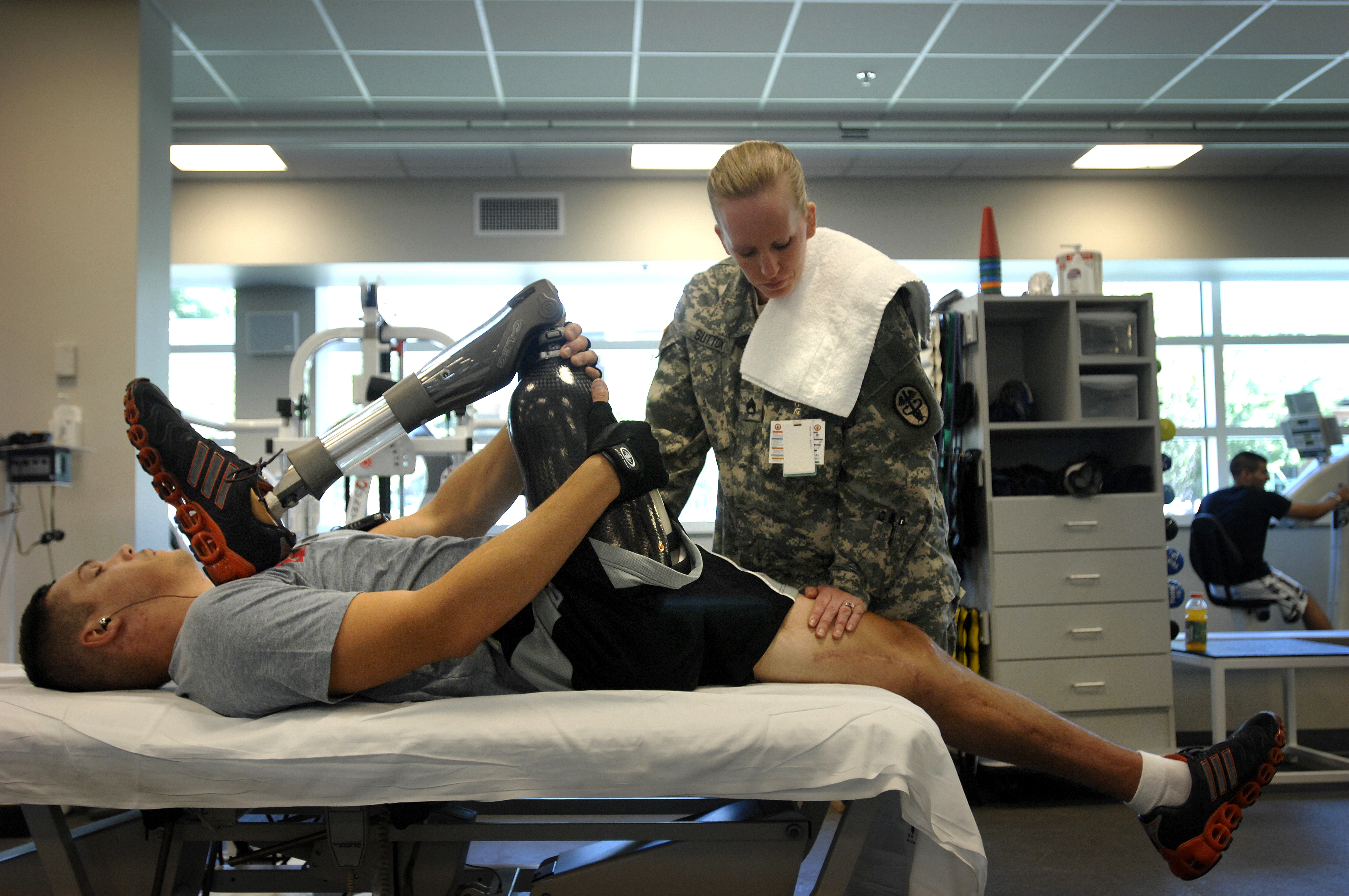
In After War Zoë H. Wool explores how the American soldiers most severely injured in the Iraq and Afghanistan wars struggle to build some kind of ordinary life while recovering at Walter Reed Army Medical Center from grievous injuries like lost limbs and traumatic brain injury. Between 2007 and 2008, Wool spent time with many of these mostly male soldiers and their families and loved ones in an effort to understand what it’s like to be blown up and then pulled toward an ideal and ordinary civilian life in a place where the possibilities of such a life are called into question. Contextualizing these soldiers within a broader political and moral framework, Wool considers the soldier body as a historically, politically, and morally laden national icon of normative masculinity. She shows how injury, disability, and the reality of soldiers’ experiences and lives unsettle this icon and disrupt the all-too-common narrative of the heroic wounded veteran as the embodiment of patriotic self-sacrifice. For these soldiers, the uncanny ordinariness of seemingly extraordinary everyday circumstances and practices at Walter Reed create a reality that will never be normal.

20080721-D-1852B-014

Here are two of the endorsements:

“Hollywood films and literary memoirs tend to transform wounded veterans into tragic heroes or cybernetic supercrips. Zoë H. Wool knows better. In her beautifully written and deeply empathic study of veterans of Iraq and Afghanistan at Walter Reed, Wool shows us the long slow burn of convalescence and how the ordinary textures of domestic life unfold in real time. An important and timely intervention.” — David Serlin, author of Replaceable You: Engineering the Body in Postwar America.

“This brilliant and absorbing ethnography reveals how the violence of war is rendered simultaneously enduring and ephemeral for wounded American soldiers. Zoë H. Wool accounts for the frankness of embodiment and the unstable yet ceaseless processes through which the ordinary work of living is accomplished in the aftermath of serious injury. After War is a work of tremendous clarity and depth opening new sightlines in disability and the critical politics of the human body.” — Julie Livingston, author of Improvising Medicine: An African Oncology Ward in an Emerging Cancer Epidemic.

Legal battles

DoD Law of War ManualFollowing up my comments on the Pentagon’s new Law of War Manual, issued last month: commentaries are starting to appear (it’s not surprising these are taking so long: the new version runs to 1200 pages).

Just Security is hosting a forum on the Manual, organised by Eric Jensen and Sean Watts.  They are both deeply embedded in the debate: Eric is a Professor at Brigham Young Law School and was formerly Chief of the Army’s International Law Branch and Legal Advisor to US military forces in Iraq and Bosnia, while Sean is a Professor at Creighton University Law School and on the Department of Law faculty at the United States Military Academy at West Point; he is also Senior Fellow at the NATO Cooperative Cyber Defence Centre of Excellence and served in the US Army’s Judge Advocate General’s Corps.

In the opening salvo, Sean focuses on the Manual‘s identification of three core principles:

“Three interdependent principles – military necessity, humanity, and honor – provide the foundation for other law of war principles, such as proportionality and distinction, and most of the treaty and customary rules of the law of war.”

The implications of this formulation are more far reaching than you might think.  Necessity, proportionality and distinction have long been watchwords, but the inclusion – more accurately, Sean suggests, the resurrection – of ‘humanity’ and ‘honor’ is more arresting: in his view, the first extends the protection from ‘unnecessary suffering’ while the second ‘marks an important, if abstract revival of good faith as a legal restraint on military operations’.

Watch that space for more commentaries, inside and outside the armed camp.

Others have already taken a much more critical view of the Manual.

Claire Bernish draws attention to two particularly disturbing elements here.  First, like several other commentators, she notes passages that allow journalists to be construed as legitimate targets.  While the Manual explains that ‘journalists are civilians’ it also insists there are cases in which journalists may be ‘members of the armed forces […] or unprivileged belligerents.’   Apparently, Claire argues,

‘reporters have joined the ranks of al-Qaeda in this new “unprivileged belligerent” designation, which replaces the Bush-era term, “unlawful combatants.” What future repercussions this categorization could bring are left to the imagination, even though the cited reasoning—the possibility terrorists might impersonate journalists—seems legitimate. This confounding label led a civilian lawyer to say it was “an odd and provocative thing for them to write.”‘

Other commentators, mindful of incidents in which the US military has been accused of targeting independent (non-embedded) journalists, have read this as far more than provocation.  Like other claims registered in the Manual, this has implications for other armed forces – and in this particular case, for example, Ken Hanly points out that ‘what is allowed for NATO and the US is surely legitimate for Israel.’

This is not as straightforward as he implies, though.  Eric Jensen agrees that

‘[T]he writers had to be aware this manual would also be looked to far beyond the US military, including by other nations who are formulating their own law of war (LOW) policies, allies who are considering US policy for purposes of interoperability during combined military operations, transnational and international organizations such as the International Committee of the Red Cross (ICRC) who look to such manuals when considering the development of customary practice, and even national and international tribunals who adjudicate LOW questions with respect to the criminality of individual actions.

While Eric acknowledges ‘the inevitable use of [the Manual] in the determination of customary practice.’ however, he also argues that the authors of the Manual go out of their way to preclude this possibility: they ‘wanted to be very clear that they did not anticipate they were writing into law the US position on the law of war.’

Second, Claire draws attention to a list of weapons with specific rules on use’ (Section 6.5.1), which includes cluster munitions, herbicides and explosive ordnance, and a following list of other ‘lawful weapons’ (Section 6.5.2) for which ‘there are no law of war rules specifically prohibiting or restricting the following types of weapons by the U.S. armed forces’; the list includes drones and Depleted Uranium munitions.  These designations are all perfectly accurate, but Claire’s commentary fastens on the fact that at least two of these weapons have been outlawed by many states.  She draws attention to the hideous consequences of DU and cluster bombs, and explains that cluster bombs:

‘are delineated in the manual as having “Specific Rules on Use”— notably, such weapons’ use “may reflect U.S. obligations under international law” [emphasis added]. While this is technically apt, cluster bombs have been banned by the 2008 Convention on Cluster Munitions—which was agreed to by 116 countries around the world. The U.S. stands out in joining infamous human rights violator, Saudi Arabia, in its refusal to sign. These insidious munitions leave unexploded ordnance for months, or even decades, after the originating bomb was dropped. Children are often maimed or killed when they unwittingly mistake them for toys.’

Meanwhile, also at Just Security but seemingly not part of the Forum, Adil Ahmad Haque has attacked the Manual‘s discussion of ‘human shields’:

The Defense Department apparently thinks that it may lawfully kill an unlimited number of civilians forced to serve as involuntary human shields in order to achieve even a trivial military advantage. According to the DOD’s recently released Law of War Manual, harm to human shields, no matter how extensive, cannot render an attack unlawfully disproportionate. The Manual draws no distinction between civilians who voluntarily choose to serve as human shields and civilians who are involuntarily forced to serve as human shields. The Manual draws no distinction between civilians who actively shield combatants carrying out an attack and civilians who passively shield military objectives from attack. Finally, the Manual draws no distinction between civilians whose presence creates potential physical obstacles to military operations and civilians whose presence creates potential legal obstacles to military operations. According to the Manual, all of these count for nothing in determining proportionality under international law.

If true, this would dramatically qualify the discussion of ‘humanity’ and ‘honor’ above; but, not surprisingly, Charles Dunlap will have none of it.  He objects not only to Adil’s reading of the Manual, but also the logic that lies behind his criticism:

Killing those who do the vast majority of the killing of civilians can save lives. It really can be that simple.

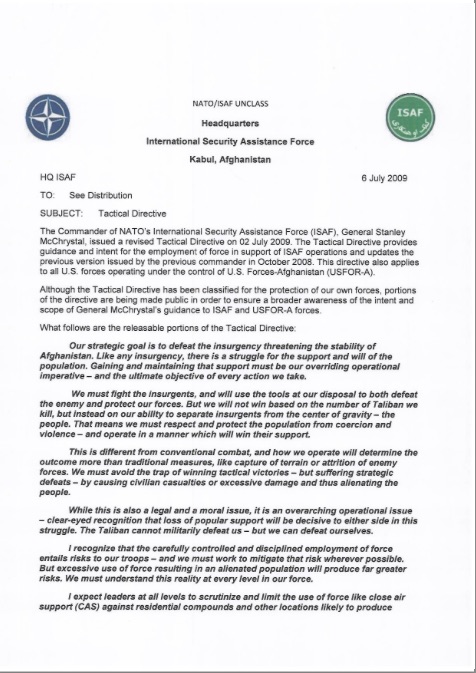
Experience shows that well-meaning efforts to curb the use of force can have disastrous effects on civilians. Think about the restrictions on airstrikes imposed by Gen. Stanley McChrystal in Afghanistan in mid-2009. The result? By the time he was fired a year later in June 2010, civilian casualties had jumped a heart-rending 31% entirely because of increased killings by anti-government forces. (In addition, casualties among friendly troops hit an all-time high in 2010.)

McChrystal Tactical Directive 1

[The unclassified section of McChrystal’s Tactical Directive (above) is here]

When Gen. David Petraeus took command in mid-2010, he took a different, more aggressive approach. While still scrupulously adhering to the law of war, he clarified the rules of engagement in a way that produced a tripling of the number of airstrikes. The result? The increase in civilian casualties was cut in half to 15% by the end of 2010. Under Petraeus’ more permissive interpretation of the use of force against the Taliban and other anti-government forces, the increase the following year was cut almost in half again to 8% (and losses of friendly troops fell 20%). To reiterate, although counterintuitive to some critics, restricting force by law or policy can actually jeopardize the lives of the civilians everyone wants to protect.

Michael O’Hanlon at the Brookings Institue makes exactly the same argument about the Manual here (scroll down), but Dunlap’s sense is much sharper: the Manual, he says, ‘is designed to win wars in a lawful way that fully internalizes, as it says itself on several occasions, the “realties of war.”’  This is immensely important because in effect it acknowledges that neither the Manual nor the laws of war are above the fray.  If the Manual ‘is designed to win wars in a lawful way’ that is precisely because law is in the army’s baggage train, fully incorporated into the juridification of later modern war.  Law is at once a powerful weapon and a moving target.

Base lines and military projections

David Vine has updated his map of the global footprint of the US military over at Politico.

VINE US military bases

I used an early version for my ‘War and Peace’ essay (DOWNLOADS tab), and that map – like this one – was drawn primarily from the annual Base Structure Report, a summary of the US military’s ‘real property inventory’ (all sites owned and managed by the Pentagon).  It’s an unwieldy document which uses a high threshold to filter inclusion:

To qualify for individual entry in the BSR, a DoD site located in the United States must be larger than 10 acres AND have a Plant Replacement Value (PRV) greater than $10 million. If the site is located in a foreign country, it must be larger than 10 acres OR have a PRV greater than $10 million to be shown as a separate entry. Sites that do not meet these criteria are aggregated as an “Other” location within each state or country.

Iraq doesn’t appear in these tabulations – though it is shown on the map – yet the continuing US involvement in the conflict there and across the all-but-erased border in Syria has surely extended its footprint.  As David notes,

‘There were 505 bases at the U.S. occupation’s height, but the Iraqi parliament rejected the Pentagon’s wish to keep 58 “enduring” bases after the 2011 withdrawal. U.S. forces have occupied at least five bases since 2014 and are considering more installations.’

Afghanistan is absent too: ‘By the end of 2014 … the U.S. military will have closed, deconstructed, or vacated most of what were once around 800 military installations, ranging from small checkpoints to larger combat outposts to city-sized bases.’  But the US military retains a significant presence there, and its drones are still based there to support continuing military operations and to attack targets across the border in Pakistan.

There are also strategic omissions.  There’s no mention in the Base Structure Report of Al Udeid Air Base in Qatar, for example, which is the location of US Central Command’s Combined Air and Operations Center.

(You can find more from David on the history of America’s ‘infrastructure for war’ in the Middle East here and on its ‘lily-pad’ strategy here).

There are all sorts of issues involved in measuring a ‘military footprint’ – see my post here and Josh Begley here (who works from the previous year’s Base Structure Report for FY 2013 to produce a radically different visualization) – but for all its uncertainties, David’s map is a sobering snapshot, and he relies on supplementary sources to conclude:

Despite recently closing hundreds of bases in Iraq and Afghanistan, the United States still maintains nearly 800 military bases in more than 70 countries and territories abroad—from giant “Little Americas” to small radar facilities. Britain, France and Russia, by contrast, have about 30 foreign bases combined.

By my calculation, maintaining bases and troops overseas cost $85 to $100 billion in fiscal year 2014; the total with bases and troops in warzones is $160 to $200 billion.

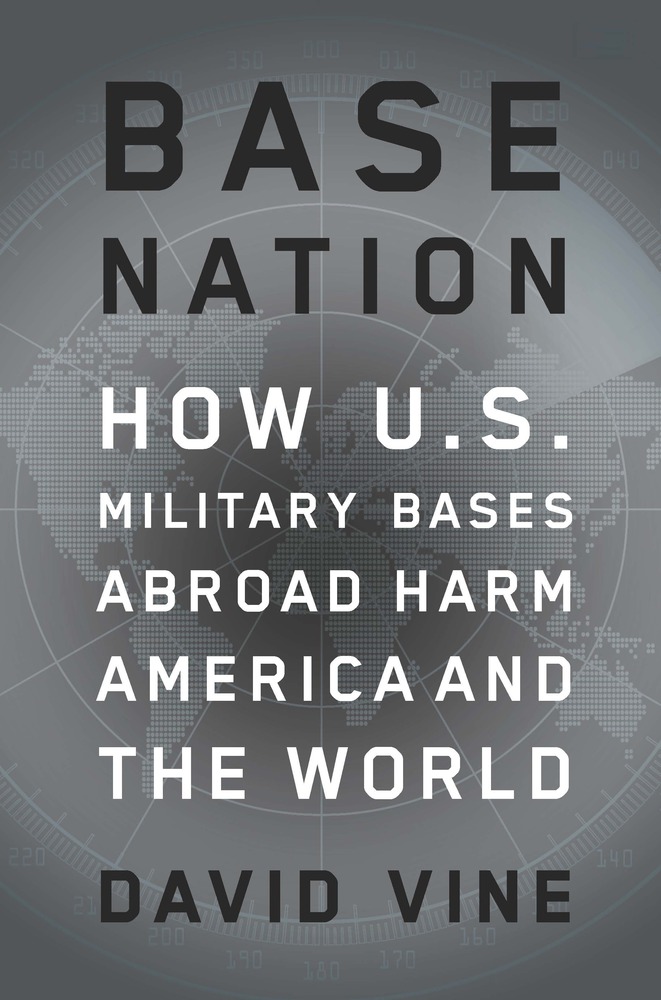
VINE Base Nation

When I first contacted David, his original map formed part of his scorching investigation into Diego Garcia: Island of Shame: the secret history of the US military base on the island of Diego Garcia (Princeton, 2009; paperback 2011: all royalties went to the Chagossians); the new version forms part of an even more ambitious project, Base Nation: how US military bases abroad harm America and the world (Metropolitan Books, 2015):

American military bases encircle the globe. More than two decades after the end of the Cold War, the U.S. still stations its troops at nearly a thousand locations in foreign lands. These bases are usually taken for granted or overlooked entirely, a little-noticed part of the Pentagon’s vast operations. But in an eye-opening account, Base Nation shows that the worldwide network of bases brings with it a panoply of ills–and actually makes the nation less safe in the long run.

As David Vine demonstrates, the overseas bases raise geopolitical tensions and provoke widespread antipathy towards the United States. They also undermine American democratic ideals, pushing the U.S. into partnerships with dictators and perpetuating a system of second-class citizenship in territories like Guam. They breed sexual violence, destroy the environment, and damage local economies. And their financial cost is staggering: though the Pentagon underplays the numbers, Vine’s accounting proves that the bill approaches $100 billion per year.

For many decades, the need for overseas bases has been a quasi-religious dictum of U.S. foreign policy. But in recent years, a bipartisan coalition has finally started to question this conventional wisdom. With the U.S. withdrawing from Afghanistan and ending thirteen years of war, there is no better time to re-examine the tenets of our military strategy. Base Nation is an essential contribution to that debate.

There is a long history of struggles against the presence of US military bases overseas – Catherine Lutz‘s edited collection, The bases of empire: the global struggle against US military posts (New York University Press, 2009) remains an indispensable starting-point.

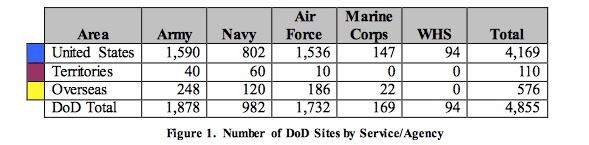
Of course, the US military is also omnipresent in the United States, with installations in all 50 states and seven territories.  The Base Structure Report includes this summary:

DoD sites JPEG

And these bases have brought their own problems and spawned their own protests too.


A world of proliferated drones

CNAS A world of proliferated dronesA new report from Kelley Sayler at the Center for a New American Security, A world of proliferated drones, starts to map what she calls ‘the likely contours of a drone-saturated world’.  The report emphasises that the United States does not have a monopoly on drones  – more than 90 states and non-state actors have them – but unusually the report pays close attention to the repurposing of small, commercial off-the-shelf drones.  It begins by summarising their capability for intelligence, surveillance and reconnaissance:

‘Current commercial drone technologies – available for purchase in either pre-assembled or customizable, component form – enable a number of high-end capabilities that were formerly the monopoly of major military powers.

Many commercial off-the-shelf (COTS) drones – including the best-selling model, the DJI Phantom – are now equipped with GPS and waypoint navigation systems. These systems enable the drone to accurately determine and hold its position, in turn removing the need for line-of-sight communications and allowing for autonomous flight… Operators of pre-assembled systems can also take advantage of smartphone-based control systems, dramatically improving ease of use. Such systems enable the user to navigate the drone simply by selecting a destination on a map or even by merely tilting the user’s phone…

High-definition video cameras are also widely available on COTS drones and, when combined with video downlinks, can provide real-time intelligence, surveillance, and reconnaissance (ISR) capabilities to multilocation receivers, though these capabilities are often limited by range and battery life.’

The report emphasises the potential weaponisation of these small drones for what it calls ‘overmatch’, in effect reversing the terms of asymmetric warfare, through (for example) the development of ‘flying IEDs‘:

‘While such systems may not appear sophisticated in a traditional military sense, ground-emplaced IEDs have caused thousands of American deaths in Iraq and Afghanistan and proved profoundly hard to defeat. Drones will enable airborne IEDs that can actively seek out U.S. forces, rather than passively lying in wait. Indeed, low-cost drones may lead to a paradigm shift in ground warfare for the United States, ending more than a half- century of air dominance in which U.S. ground forces have not had to fear attacks from the air.  Airborne IEDs could similarly be used in a terrorist attack against civilians or in precision strikes against high-profile individuals or landmarks.’

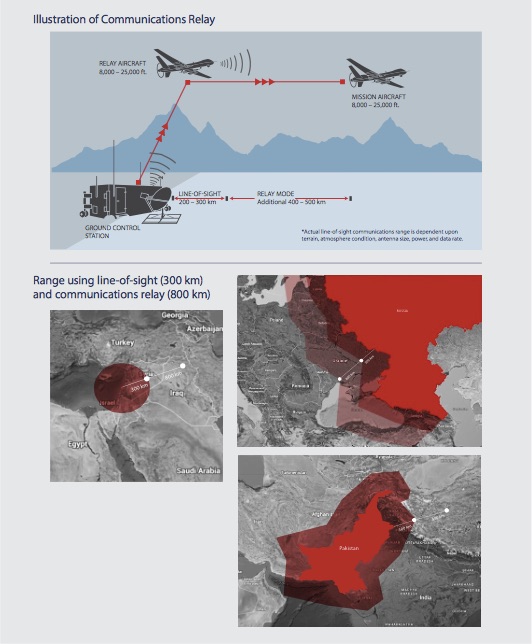
But the report also makes much of the US’s continued military-industrial investment in high-end drones.  Here various forms of stealth technology make much of the running, or at least issue most of the promissory notes, since today’s Predators and Reapers can only operate in more or less undefended air space – which is another way of saying they can only be used against the weak and/or with the complicity of other states (as in Pakistan and Yemen) – and face immense difficulties in what the US Air Force calls A2/AD [anti-access/area-denial] environments (see here and here). But I’m particularly interested in what the report has to say about the use of large military drones to act as communications relays.  Here the emphasis is on the ability of these remote relays to integrate what is otherwise often remarkably un-networked warfare and to extend the range of operational control and transmissable data.

Drones as communication relays (CNAS)

‘Large military-specific systems offer a number of additional improvements in communications capabilities. Many include wide-band satellite communications (SATCOM) that expand the amount and extend the range of transmittable data, providing distant ground stations with real-time ISR. Like some baseline systems, high-end systems are generally capable of line-of-sight communi- cations with other platforms operating in their area and, for this reason, are often employed as communications relays. Perhaps the most vivid example of the force-multiplying effects of such capabilities is the EQ-4 – what is essentially an RQ-4 Global Hawk outfitted with the Battlefield Airborne Communications Node (BACN). BACN serves as a universal translator for a diverse set of U.S. aircraft that are not otherwise capable of communicating with each other due to incompatible data links – providing a vital connection between, for example, fourth-generation F-16 fighter jets, B-1 bombers, and stealthy, fifth-generation F-22s [BACN is also used on conventional platforms: see here for its role in co-ordinating an air strike in Afghanistan]. Communications relay capabilities will also allow states to operate drones at extended ranges (300 to 800 kilometers) without satellite communications, allowing significant penetration into neighboring countries or contested areas’ (my emphasis).

Steve Graham and I are presently working on an essay on drones and satellite communications: so much of the discussion of geospatial intelligence has focused on satellite imagery, but the geographies of satellite communications (and, crucially, bandwidth) play a major role in the deployment of drones and in the highly variable quality of the imagery they transmit to users across the network.

Wars over the laws of war

DoD Law of War Manual

The Pentagon has just published a new edition of its Law of War Manual: you can download all 1200 pages here.  From the Foreword by Stephen Preston, the Pentagon’s General Counsel:

The law of war is a part of our military heritage, and obeying it is the right thing to do. But we also know that the law of war poses no obstacle to fighting well and prevailing. Nations have developed the law of war to be fundamentally consistent with the military doctrines that are the basis for effective combat operations. For example, the self-control needed to refrain from violations of the law of war under the stresses of combat is the same good order and discipline necessary to operate cohesively and victoriously in battle. Similarly, the law of war’s prohibitions on torture and unnecessary destruction are consistent with the practical insight that such actions ultimately frustrate rather than accomplish the mission.

Thanks to Marty Lederman at Just Security: watch that space for more commentary (I think….)

W Hays Parks 2003In the meantime, for some of the politics involved in the protracted publication process of the new manual (and an explanation of the title of Marty’s post), see Edwin Williamson and Hays Parks [right] writing in the neo-conservative standard bearer the Weekly Standard in July 2013 here, who – even as they insist on their non-partisan, apolitical and thoroughly objective perspective – nailed their colours to the mast in no uncertain terms:

From the outset it was agreed that the manual would be apolitical—it would be based on the law rather than political arguments inconsistent with the law of war. For example, the working group rejected arguments by some Bush administration officials that the law of war did not protect captured al Qaeda and that “enhanced interrogation procedures,” including waterboarding, should not be banned.

Obama administration political appointees, though, have aggressively sought changes in the manual to conform to their political philosophies or legal arguments in detainee litigation, pushing for rules and principles that vary from longstanding law of war treaty-based terminology and norms previously accepted by Republican and Democratic administrations.

One of the more egregious changes proposed by State Department political appointees and human rights activists on the National Security Council was the removal of a paragraph acknowledging that the law of war is lex specialis—the controlling law in armed conflict. Denying the lex specialis status of the law of war would enable activists to inject human rights law into the manual and onto the battlefield. Deletion of the lex specialis text was apparently not sought on the basis that it was legally incorrect, but, we suspect, because it was inconsistent with their political agenda.

Such a change would impose restrictions on U.S. forces in combat so that deadly force could be used only against an enemy who had refused a surrender opportunity or who posed an “imminent threat.” These requirements would place our fighters on a footing comparable to a police officer in the United States in a peacetime environment and at an extreme and unprecedented risk of being killed by the enemy or facing “war crimes” allegations by human rights activists.

Justice Department efforts toward the draft manual echo its continued post-9/11 view of the battle with al Qaeda entirely (and incorrectly) from a law enforcement perspective. It seeks to bring the manual text into conformity with terms and arguments it uses in court (many of which are inconsistent with the law of war).

A change Justice Department lawyers sought involved civilians on the battlefield. Under the law of war, a civilian loses immunity from direct attack if he or she “takes a direct part in hostilities.” The working group agreed that this participation does not, however, necessarily constitute criminal activity. Without consulting with working group experts or senior DoD or State policymakers, Justice Department attorneys have asserted that it does. This extreme (and incorrect) position would place at risk of enemy prosecution the substantial number of U.S. and foreign civilians who accompany our armed forces in the field in time of war and whose support is a major basis for the way in which the United States—with congressional approval—determines its military force structure. Justice Department lawyers created new law to enable the department to win its cases against al Qaeda, disregarding battlefield consequences for civilians lawfully accompanying our own forces.

More from Charles Kels here.

Airwars

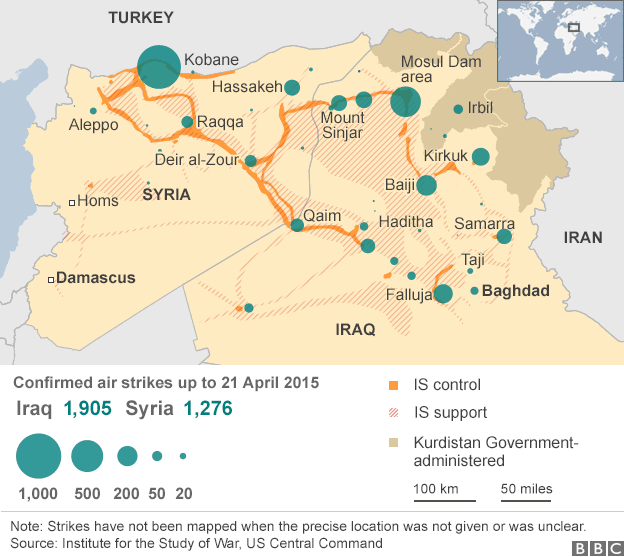
Air strike sin Iraq and Syria to April 2015

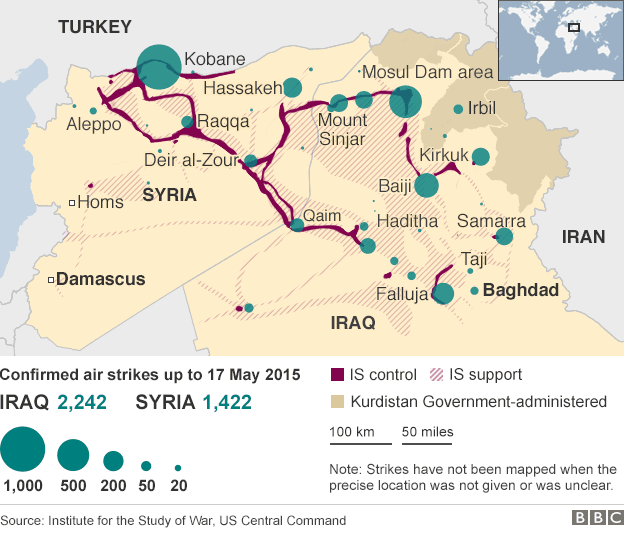
Air strikes in Iraq and Syria to 17 May 2015

I’ve taken the maps above from the BBC, which rely on reports from the Institute for the Study of War and news releases from US Central Command on ‘Operation Inherent Resolve‘.

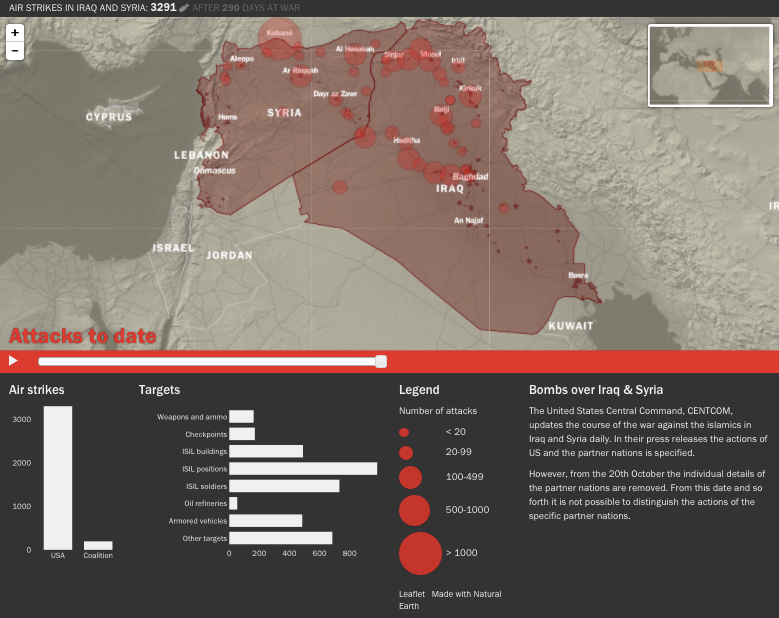
For readers wanting to follow and analyse the US-led air campaign in Iraq and Syria in more detail, I recommend Chris Woods‘ new project, Airwars.  Chris is a veteran of the Bureau of Investigative Journalism’s Drone War Project and the author of Sudden Justice: America’s secret drone wars (2015) – which really is the gold standard for analysis of US remote operations.

Airwars.org is a collaborative, not-for-profit transparency project aimed both at tracking and archiving the international air war against Islamic State (Daesh), in both Iraq and Syria. We also seek to highlight – and follow up where possible – those cases in which claims of civilian non-combatant casualties from coalition airstrikes have been indicated by credible monitoring agencies. In addition we track reported ‘friendly fire’ incidents.

The site includes tabulations and also an interactive, zoomable map (see the screenshot below).  You can find a detailed discussion of sources and methodology here.

AIRWARS 25 May 2015

I’m tracking all this for The everywhere war…  In case you are wondering why that is taking so long to finish: The colonial present started out as an essay on 9/11 and the US invasion of Afghanistan; I then realised that Sharon was taking advantage of the ‘war on terror’ to ramp up Israeli dispossession and repression of the Palestinian people, and so started work on a second essay (I’m ashamed to say that at the time I knew as little about the West Bank and Gaza as I did about Afghanistan on 11 September 2001).  Then the US invaded Iraq…  Much the same is happening with The everywhere war, but I do have the end in my sights.  I hope.


Joining the dots…

The Bureau of Investigative Journalism and The Rendition Project have just published their first quarterly report on 119 people secretly detained and tortured by the CIA as part of the ‘war on/of terror’.

You can download the brief report as a pdf here, but the infographic below summarises the key findings (and don’t let its stark simplicity fool anyone about the detailed research that went into its production: this is difficult work).

what-we-know

Many commentators have noted that the Obama administration’s determination to end the CIA’s rendition program coincided with a decision to ramp up its covert program of targeted killing.  The preference for ‘kill’ over ‘capture’ is complicated by the living death suffered by many of those who were imprisoned in the carceral archipelago of black sites and prisons – and we should surely welcome the determination to widen the focus beyond Guantanamo to include, notably, Bagram.

But the apparent distinction between the two programs becomes even more blurred once you realise that many of the officials in charge of the one were switched to the other.  According to Mark Mazzetti and Matt Apuzzo writing in the New York Times:

‘Perhaps no single C.I.A. officer has been more central to the effort than Michael D’Andrea, a gaunt, chain-smoking convert to Islam who was chief of operations during the birth of the agency’s detention and interrogation program and then, as head of the C.I.A. Counterterrorism Center, became an architect of the targeted killing program. Until last month, when Mr. D’Andrea was quietly shifted to another job, he presided over the growth of C.I.A. drone operations and hundreds of strikes in Pakistan and Yemen during nine years in the position…

‘Mr. D’Andrea was a senior official in the Counterterrorism Center when the agency opened the Salt Pit, a notorious facility in Afghanistan where prisoners were tortured. His counterterrorism officers oversaw the interrogation and waterboarding of Abu Zubaydah, Abd al-Rahim al-Nashiri and Khalid Shaikh Mohammed. His actions are described in the withering Senate Intelligence Committee report about torture that was released late last year, although he was not identified publicly.’

(On the Times‘ decision to name names, see Jack Goldsmith‘s interview with Dean Baquet, Executive Editor of the Times).

But the real sting in the tail comes when Mazetti and Apuzzo also note:

‘The confidence [Senator Dianne] Feinstein and other Democrats express about the drone program, which by most accounts has been effective in killing hundreds of Qaeda operatives and members of other militant groups over the years, stands in sharp contrast to the criticism among lawmakers of the now defunct C.I.A. program to capture and interrogate Qaeda suspects in secret prisons.

‘When Ms. Feinstein was asked in a meeting with reporters in 2013 why she was so sure she was getting the truth about the drone program while she accused the C.I.A. of lying to her about torture, she seemed surprised.

‘“That’s a good question, actually,” she said.’

Law, ethics and drone warfare

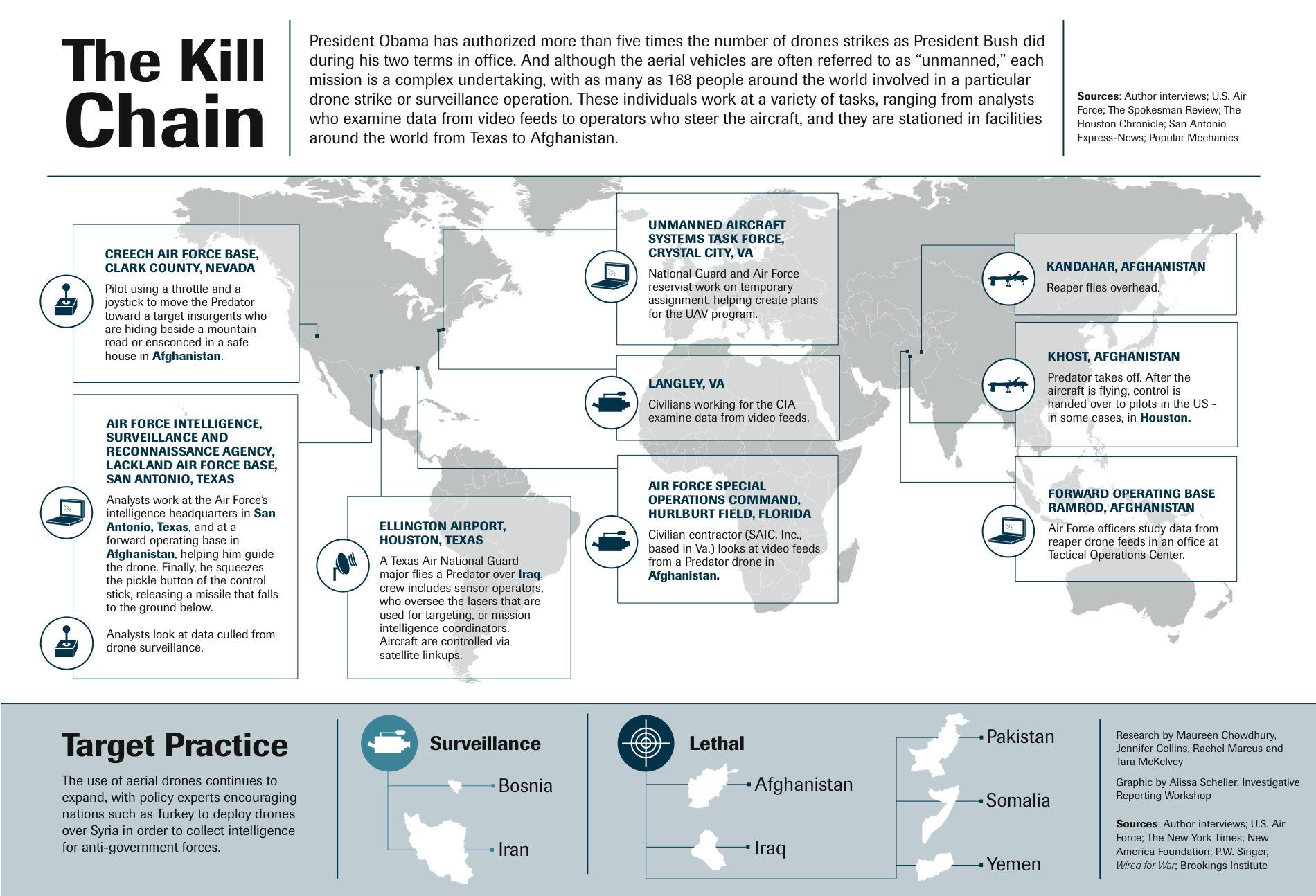
SCHELLER Kill-chain

The infographic above was produced by Alissa Scheller for an Investigative Reporting Workshop on Drones, and specifically an article by Tara McKelvey on Harold Koh and the legal armature that the Obama administration has sought for its nominally covert program of targeted killing.

Since then (2012) there has been a cascade of essays around these legal and ethical issues; much of the spikiest writing is to be found on the indispensable ssrn, but here are some other essays I’ve just caught up with that readers might also find helpful:

Special issue: ‘Legal and ethical implications of drone warfare’, in International Journal of Human Rights 19 (2) (2015) including:

Michael J. Boyle, ‘The legal and ethical implications of drone warfare’ (pp 105-126)

Stephanie Carvin, ‘Getting drones wrong’ (pp. 127-141)

Craig Martin, ‘A means-methods paradox and the legality of drone strikes in armed combat’ (pp. 142-175)

Daniel R. Brunstetter & Arturo Jimenez-Bacardi, ‘Clashing over drones: the legal and normative gap between the United States and the human rights community’ (pp. 176-198)

David Whetham, ‘Drones to protect’ (pp. 199-210)

Caroline Kennedy & James I. Rogers, ‘Virtuous drones?’ (pp. 210-227)

Symposium: ‘Towards a drone accountability regime‘, in Ethics and International Affairs 1 (2015) with a major contribution from Allen Buchanan and Robert O. Keohane

From a moral standpoint, lethal drones are intrinsically no worse as a means of warfare than bombing or sending commandos to kill enemies. From the perspective of their users, they have six major advantages over more conventional weapons: they are often cheaper; their use can be more readily concealed; they allow for more precise targeting, with the potential for less “collateral damage”; their use can involve less serious infringements of sovereignty than invasion by troops; and they may be less likely to provoke widespread hostile reactions by the population of the country in which they are used than military operations involving troops on the ground. But these advantages generate three major risks: of violating sovereignty, of over-using the military option, and of making it more difficult to identify violations of constraints against targeting noncombatants. To deal with these risks, a Drone Accountability Regime is needed that imposes obligations on states, which in turn would be required to impose them on their agents. Since it would be infeasible to negotiate a treaty-based legal regime at present and for the foreseeable future, the Drone Accountability Regime should be informal and should involve transnational actors as well as states. Its key principle should be transparency, helping enable civil society to hold states accountable, and its central agent would be an Ombudsperson with broad authority to investigate situations and publicize her findings. No institution can ensure that states, or operators, are held fully accountable to appropriate standards of conduct, but such a regime could increase the degree of accountability for the use of lethal drones.

— and critical responses from Neta Crawford, Janina Dill, and David Whetham.

Bianca Baggiarini, ‘Drone warfare and the limits of sacrifice’, Journal of international political theory 11 (1) (2015) 128-44

M.J. Boyle, ‘The race for drones’, Orbis 59 (1) (2015) 76-94

Lindsay Cohn-Warrior, ‘Drones and targeted killing: costs, accountability and US Civil-Military relations’, Orbis 59 (1) (2015) 95-110

Jelena Pejic, ‘Extraterritorial targeting by means of armed drones: some legal implications’, International review of the Red Cross (2015) (online early)

Lauren Wilcox, ‘Drone warfare and making bodies out of place’, Critical studies on security 3 (1) (2015) 127-131

John Williams, ‘Distant intimacy: space, drones and Just War’, Ethics and International Affairs 1 (2015) 93-110

And to widen the discussion and give it substantive depth, see Craig Jones, ‘Lawfare and the juridification of late modern war‘, Progress in human geography (2015) (Online First):

Processes of juridification are a defining feature of late modern war. But geographic accounts of war have generally not considered the role that law plays in shaping its conduct. This paper explores the juridification of war using the concept of lawfare. Lawfare may signal an intensification and shift in the relationship between war and law, but I argue that understanding the nature and extent of these changes requires a careful examination of the historical geographies of war, law and lawfare. Drawing from critical legal approaches I offer a preliminary geographical and historical theorization of lawfare so that we may better understand the relationship between war and law today.

Freedom fries, anyone?

Three more contributions to the Charlie Hebdo debate to think about.  The first is from Pankaj Mishra at the Guardian.  Not sure about his call for a ‘new Enlightenment’ – though there was certainly much wrong with the old one – but it’s a luminously (sic) intelligent argument.  He writes about ‘a profound clash – not between civilisations, or the left and the right, but a clash of old and new visions of the world in the space we call the west, which is increasingly diverse, unequal and volatile.’

It is not just secular, second-generation immigrant novelists [Hari Kunzru, Laila Lalami and Teju Cole] who express unease over the unprecedented, quasi-ideological nature of the consensus glorifying Charlie Hebdo’s mockery of Islam and Muslims. Some Muslim schoolchildren in France refused to observe the minute-long silence for the victims of the attack on Charlie Hebdo mandated by French authorities.

It seems worthwhile to reflect, without recourse to the clash of civilisations discourse, on the reasons behind these striking harmonies and discords. Hannah Arendt anticipated them when she wrote that “for the first time in history, all peoples on earth have a common present … Every country has become the almost immediate neighbour of every other country, and every man feels the shock of events which take place at the other end of the globe.” Indeed, it may be imperative to explore this negative solidarity of mankind – a state of global existence in which people from different pasts find themselves thrown together in a common present.’

Construction of Statue of Liberty in Paris.comI think that’s right, which is why I’m disconcerted by Pankaj’s focus on Europe; I certainly don’t think the murders in Paris can be assimilated to ‘an assault on American values’ (far from it), but the complicated and often confounding relations between the two republics need excavation too.  They go back far beyond the gift of the Statue of Liberty to the US in the 1880s – I discussed this in what is still my favourite chapter in Geographical Imaginations – and reach forward to include the double, displaced misadventures in Indochina (not least the conviction that the US would sort out Vietnam after France had failed to do) and, still more proximately, France’s refusal to support the US-led invasion of Iraq (“freedom fries“, anyone?).

NIVAT Bagdad zone rougePankaj is simply brilliant on the ghosts of the colonial past, as you would expect, and they reappear in a different spectral guise in a short essay by Anne Nivat at Warscapes.  She provided some of the most reflective reporting from occupied Iraq (see her Bagdad, zone rouge), and in ‘Charlie Hebdo and the Boomerang Effect’ she mines that rich vein of experience to reflect on the knee-jerk responses to the murders in Paris:

In a democracy, one has the privilege of freedom of expression, and it is in the name of this that, for years, I have been traveling to the lands of “Islamist” wars.

For some time, I have been amazed, and even hurt, to hear friendly voices claim not to understand why I continue to give the floor to “the other side”; to those who make us afraid; to the “bad guy”; the “barbarian”; the “jihadist”; the Taliban; the “Islamic fighters” – the ones our allies have sought out to fight, or to “bump off in the outhouse,” as Russian President Vladimir Putin so elegantly put it in 2000 in reference to Chechen separatist fighters (Western military and political leaders typically use less violent vocabulary, but the meaning remains the same).

I regret that the attempts to know the “enemy” – my work, and others’ – have not been sufficient, as evidenced by the onslaught of hate on social networks.

And at the same site Andrew Ryder explores the multiform versions of ‘hate’ in ‘Charlie Hebdo and the limits of nihilism’.  He maps the gavotte between iconoclasm and nationalism and in so doing returns us to the figure of the Republic and to the dilemmas exposed by Pankaj Mishra.

Three years ago, [the editor of Charlie Hebdo] said, “If we say to religion, ‘You are untouchable,’ we’re fucked.” His idea was that no religion should be free from mockery, because to allow this is to permit the continuing subjugation of human freedom by religious superstition…

However, Charb also said, that same year, “I don’t blame Muslims for not laughing at our drawings. I live under French law. I don’t live under Koranic law.” This is the point where this apparent commitment to freedom actually masks French nationalism. What he is really saying, whether he was conscious of it or not, is that traditional French secularism, the products of a distinct national revolutionary tradition, should take absolute precedence over the values of immigrants. The secularism takes the shape of social chauvinism. In this context, it’s no longer a progressive contribution to the liberation of human beings. The apparent irreverence is bound to a greater advocacy of European heritage over the cultural character of the immigrants who now comprise such a large part of its society, and who were traditionally colonized and exploited by the ostensibly progressive and liberal nations whose secular values are then rhapsodized… [T]his complicity with racism was probably unrecognizable to him. We can see this today in the irony of the French right, paying homage to a magazine that hated them.