Eyes in the Skies

eyes_in_the_skies_pic

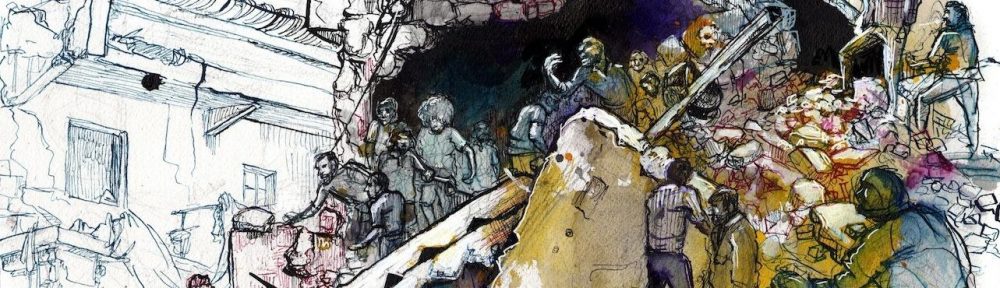
I’m just back from a wonderful time at UC Davis, where I was speaking at a symposium called “Eyes in the skies: drones and the politics of distance warfare.”  It was a creative program, packed with insights from Caren Kaplan and Andrea Miller, Priya Satia and Joe Delappe.

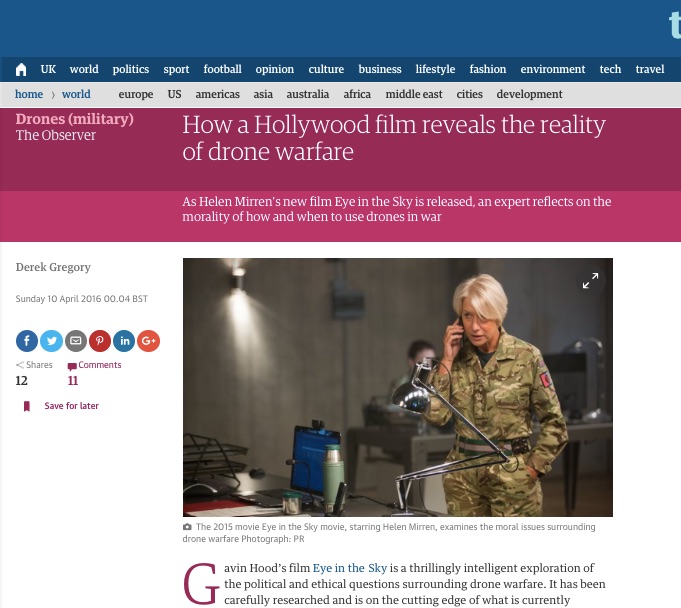
On my way back to Vancouver on Wednesday I received an invitation from Britain’s Guardian (in fact, the Sunday version, the Observer) to write something around that very question using the Gavin Hood film “Eyes in the sky” as a peg.

It’s just been published and you can find it here.
GREGORY Observer

At Davis I’d been giving what I think will be my final presentation of “Angry Eyes” (see here and here), so I was still preoccupied with remote platforms and close air support – not the contradiction it sounds – rather than targeted killing (which is the focus of the film).  The published version has, inevitably, been edited, so I’m pasting the full-length version below and added some links that might help.  There are still lots of short-cuts and elisions, necessarily so for anything of this length, so I hope readers will forgive the inevitable simplifications.

***

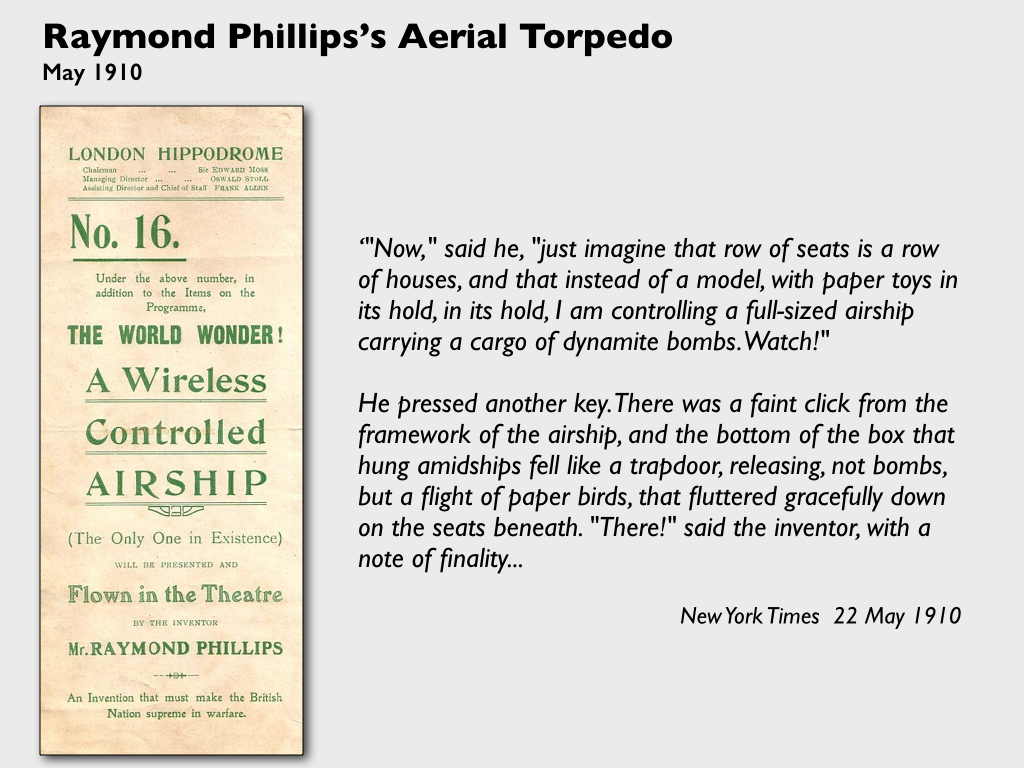
Gavin Hood’s Eye in the Sky is a thrillingly intelligent exploration of the political and ethical questions surrounding drone warfare. It’s been carefully researched and is on the cutting-edge of what is currently possible. But there’s a longer history and a wider geography that casts those issues in a different light.  As soon as the Wright Brothers demonstrated the possibility of human flight, others were busy imagining flying machines with nobody on board.  In 1910 Raymond Phillips captivated crowds in the London Hippodrome with a remotely controlled airship that floated out over the stalls and, when he pressed a switch, released hundreds of paper birds on the heads of the audience below. When he built the real thing, he promised, the birds would be replaced with bombs. Sitting safely in London he could attack Paris, Berlin – or Manchester (a possibility that understandably prompted questions about navigation).

There has always been something hideously theatrical about bombing, from the Hendon air displays in the 1920s featuring attacks on ‘native villages’ to the Shock and Awe visited on the inhabitants of Baghdad in 2003. The spectacle now includes the marionette movements of Predators and Reapers whose electronic strings are pulled from thousands of miles away. And it was precisely the remoteness of the control that thrilled the crowds in the Hippodrome. But what mattered even more was surely the prospect Phillips made so real: bombing cities and attacking civilians far from any battlefield.

Remoteness’ is in any case an elastic measure. Human beings have been killing other human beings at ever greater distances since the invention of the dart, the spear and the slingshot. Pope Urban II declared the crossbow illegal and Pope Innocent II upheld the ban in 1139 because it transformed the terms of encounter between Christian armies (using it against non-Christians was evidently a different matter). The invention of firearms wrought another transformation in the range of military violence, radicalized by the development of artillery, and airpower another. And yet today, in a world selectively but none the less sensibly shrunken by the very communications technologies that have made the deployment of armed drones possible, the use of these remote platforms seems to turn distance back into a moral absolute.

But if it is wrong to kill someone from 7,500 miles away (the distance from Creech Air Force Base in Nevada to Afghanistan), over what distance is it permissible to kill somebody?  For some, the difference is that drone crews are safe in the continental United States – their lives are not on the line – and this has become a constant refrain in the drone debates. In fact, the US Air Force has been concerned about the safety of its aircrews ever since its high losses during the Second World War. After Hiroshima and Nagasaki the Air Force experimented with using remotely controlled B-17 and B-47 aircraft to drop nuclear bombs without exposing aircrews to danger from the blast, and today it lauds its Predators and Reapers for their ability to ‘project power without vulnerability’.

It’s a complicated boast, because these remote platforms are slow, sluggish and easy to shoot down – they won’t be seen over Russian or Chinese skies any time soon. They can only be used in uncontested air space – against people who can’t fight back – and this echoes Britain’s colonial tactic of ‘air policing’ its subject peoples in the Middle East, East Africa and along the North-West Frontier (which, not altogether coincidentally, are the epicentres of todays’ remote operations). There are almost 200 people involved in every combat air patrol – Nick Cullather once described these remote platforms as the most labour intensive weapons system since the Zeppelin – and most of them are indeed out of harm’s way. It’s only a minor qualification to say that Predators and Reapers have a short range, so that they have to be launched by crews close to their targets before being handed off to their home-based operators. This is still remote-control war, mediated by satellite links and fiber-optic cables, but in Afghanistan the launch and recovery and the maintenance crews are exposed to real danger. Even so, Grégoire Chamayou insists that for most of those involved this is hunting not warfare, animated by pursuit not combat [see here, here and here].

Yet it’s important not to use this aperçu to lionize conventional bombing. There is an important sense in which virtually all aerial violence has become remarkably remote. It’s not just that bombing has come to be seen as a dismal alternative to ‘boots on the ground’; advanced militaries pick their fights, avoid symmetrical warfare and prefer enemies whose ability to retaliate is limited, compromised or degraded. When he was Secretary of Defense Robert Gates acknowledged that the US had not lost a pilot in air combat for forty years. ‘The days of jousting with the enemy in the sky, of flirting daily with death in the clouds, are all but over,’ writes the far-from-pacifist Mark Bowden, ‘and have been for some time.’ The US Air Force goes to war ‘virtually unopposed’. In short, the distance between the pilot in the box at Creech and the pilot hurtling through the skies over Afghanistan is less than you might think. ‘Those pilots might as well be in Nevada’, says Tom Engelhardt, ‘since there is no enemy that can touch them.’

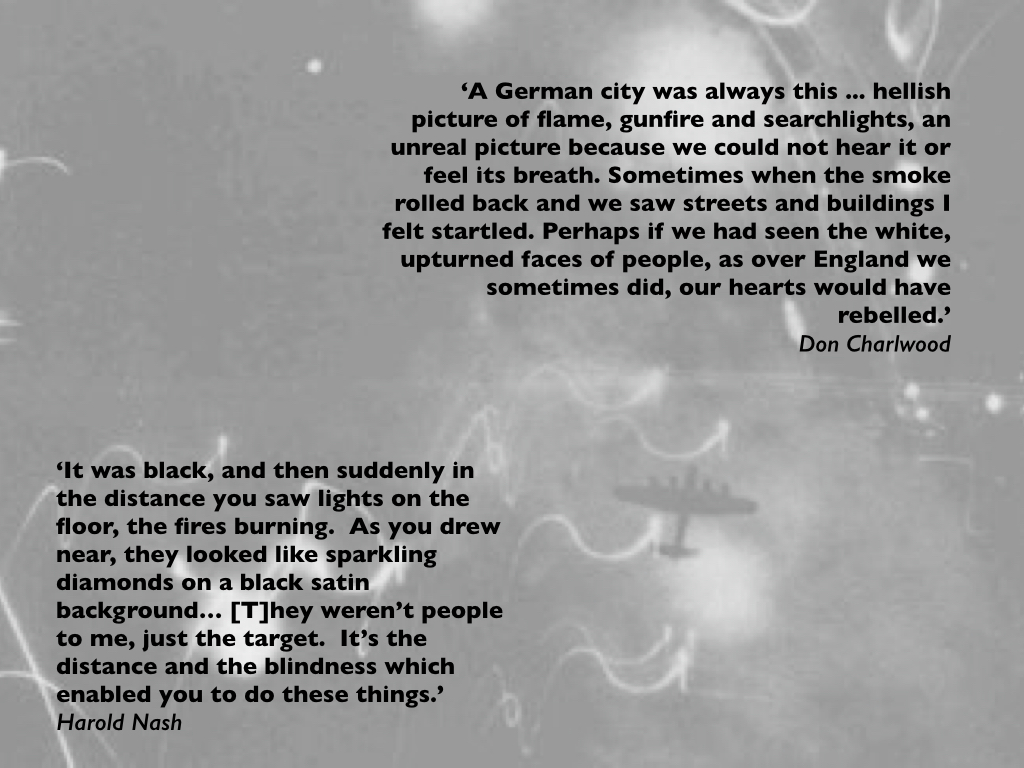
This suggests that we need to situate armed drones within the larger matrix of aerial violence.  Bombing in the major wars of the twentieth century was always dangerous to those who carried it out, but those who dropped bombs over Hamburg or Cologne in the Second World War or over the rainforests of South Vietnam in the 1960s and 70s were, in a crucial sense, also remote from their targets. Memoirs from Bomber Command crews confirm that the target cities appeared as lights sparkling on black velvet, ‘like a Brocks firework display.’ ‘The good thing about being in an aeroplane at war is that you never touch the enemy’, recalled one veteran. ‘You never see the whites of their eyes. You drop a four-thousand-pound cookie and kill a thousand people but you never see a single one of them.’ He explained: ‘It’s the distance and the blindness that enables you to do these things.’ The crews of B-52 bombers on Arc Light missions dropped their loads on elongated target boxes that were little more than abstract geometries. ‘Sitting in their air-conditioned compartments more than five miles above the jungle’, the New York Times reported in 1972, the crews ‘knew virtually nothing about their targets, and showed no curiosity.’ One of them explained that ‘we’re so far away’ that ‘it’s a highly impersonal war for us.’

Distance no longer confers blindness on those who operate today’s drones. They have a much closer, more detailed view of the people they kill. The US Air Force describes their job as putting ‘warheads on foreheads’, and they are required to remain on station to carry out a battle damage assessment that is often an inventory of body parts.  Most drone crews will tell you that they do not feel thousands of miles away from the action: just eighteen inches, the distance from eye to screen.

Their primary function is to provide intelligence, surveillance and reconnaissance. This was exactly how the Wright brothers thought military aircraft would be used – in July 1917 Orville insisted that ‘bomb-dropping’ would be at best a minor role and almost certainly useless, though he was speaking before the major air offensives in the final year of the war and could have had no inkling of what was to come in the Second World War. The Predator and its precursors were designed to identify targets for conventional strike aircraft over the Balkans in the 1990s, and thirty years later it is still those ‘eyes in the sky’ that make the difference. Although drones have been armed since 2001, until late 2012 they were directly responsible for only 5-10 per cent of all air strikes in Afghanistan. But they were involved in orchestrating many more. Flying a Predator or a Reaper ‘is more like being a manager’, one pilot explained to Daniel Rothenberg: ‘You’re managing multiple assets and you’re involved with the other platforms using the information coming off of your aircraft.’ In principle it’s not so different from using aircraft to range targets for artillery on the Western Front, but the process has been radicalized by the drone’s real-time full-motion video feeds that enable highly mobile ‘targets of opportunity’ to be identified and tracked. In the absence of ground intelligence, this becomes crucial: until drones were relocated in sufficient numbers from Afghanistan and elsewhere to enable purported IS-targets in Syria to be identified, most US aircraft were returning to base without releasing their weapons.

Armed drones are used to carry out targeted killings, both inside and outside areas of ‘active hostilities’, and to provide close air support to ground troops. Targeted killing has spurred an intense critical debate, and rightly so – this is the focus of Eye in the sky too – but close air support has not been subject to the same scrutiny. In both cases, video feeds are central, but it is a mistake to think that this reduces war to a video game – a jibe that in any case fails to appreciate that today’s video games are often profoundly immersive.   In fact, that may be part of the problem. Several studies have shown that civilian casualties are most likely when air strikes are carried out to support troops in contact with an enemy, and even more likely when they are carried out from remote platforms. I suspect that drone crews may compensate for their physical rather than emotional distance by ‘leaning forward’ to do everything they can to protect the troops on the ground. This in turn predisposes them to interpret every action in the vicinity of a ground force as hostile – and civilians as combatants – not least because these are silent movies: the only sound, apart from the clacking of computer keys as they talk in secure chat rooms with those watching the video feeds, comes from radio communications with their own forces.

In contrast to those shown in Eye in the Sky, those feeds are often blurry, fuzzy, indistinct, broken, compressed -– and, above all, ambiguous. How can you be sure that is an insurgent burying an IED and not a farmer digging a ditch?  The situation is more fraught because the image stream is watched by so many other eyes on the ground, who all have their own ideas about what is being shown and what to do about it.  Combining sensor and shooter in the same (remote) platform may have ‘compressed the kill-chain’, as the Air Force puts it, and this is vital in an era of ‘just-in-time’, liquid war where everything happens so fast. Yet in another sense the kill-chain has been spectacularly extended: senior officers, ground force commanders, military lawyers, video analysts all have access to the feeds. There’s a wonderful passage in Brian Castner‘s All the ways we kill and die that captures the dilemma perfectly. ‘A human in the loop?’, Castner’s drone pilot complains.

‘Try two or three or a hundred humans in the loop. Gene was the eye of the needle, and the whole war and a thousand rich generals must pass through him… If they wanted to fly the fucking plane, they could come out and do it themselves.’

This is the networked warfare, scattered over multiple locations around the world, shown in Eye in the Sky. But the network often goes down and gets overloaded – it’s not a smooth and seamlessly functioning machine – and it is shot through with ambiguity, uncertainty and indecision.  And often those eyes in the sky multiply rather than disperse the fog of war.

Remote sensing

Harris BLUE BOOK.img008

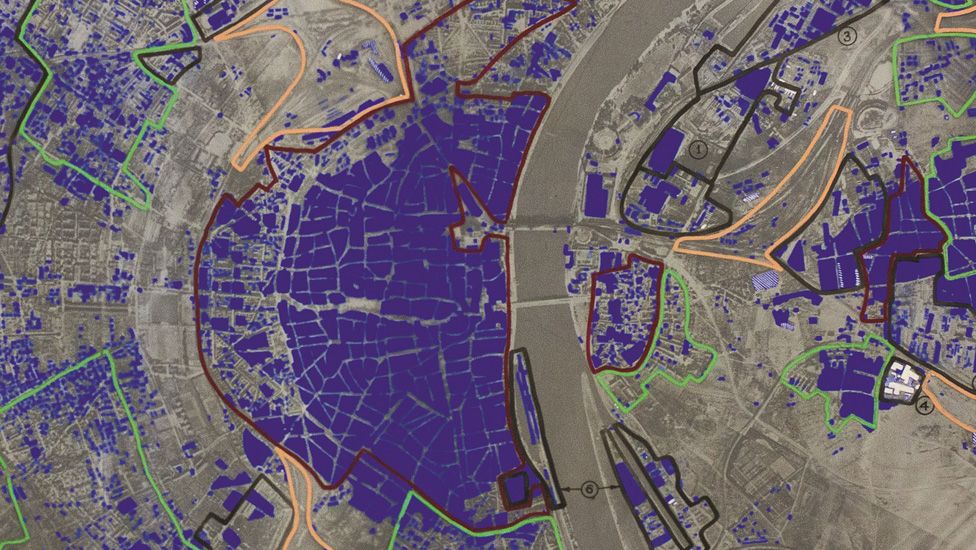
As a supplement to my previous post on mapping the bombing of Germany in the Second World War, I thought I should draw attention to Lauren Turner‘s report on the maps RAF Bomber Command had drawn to show the effects of its raids on individual cities.  I described the construction of target maps in ‘Doors into nowhere’ (DOWNLOADS tab); these maps were compiled for the Blue Books kept by Arthur Harris as chief of Bomber Command (above). In the summer of 1943 Harris ordered the preparation of a large book (which eventually extended to several volumes) which would show the “spectacular” results of the bomber offensive. “After each attack on a German city,” he explained, “the area of devastation was progressively marked with blue paint over a mosaic of air photographs of the city as a whole”. Harris was immensely proud of this “inventory of destruction,” as Tami Biddle calls it, and showed it to all his prominent visitors (see also here for a short discussion of how blind Harris was to the strategic significance of his campaign).

Here, for example, is Cologne in November 1944:

_85959916_cologne_976

The dark blue shows the area destroyed or badly damaged: you can also find more information about the damaged city in my post on the geometry of destruction here (which includes an early target map).

Lauren’s report for the BBC includes similar maps for Berlin and Dresden.

Deadly animation

IWM Strategic bombing campaign 14 December 1941

IWM Strategic bombing campaign 12 August 1944

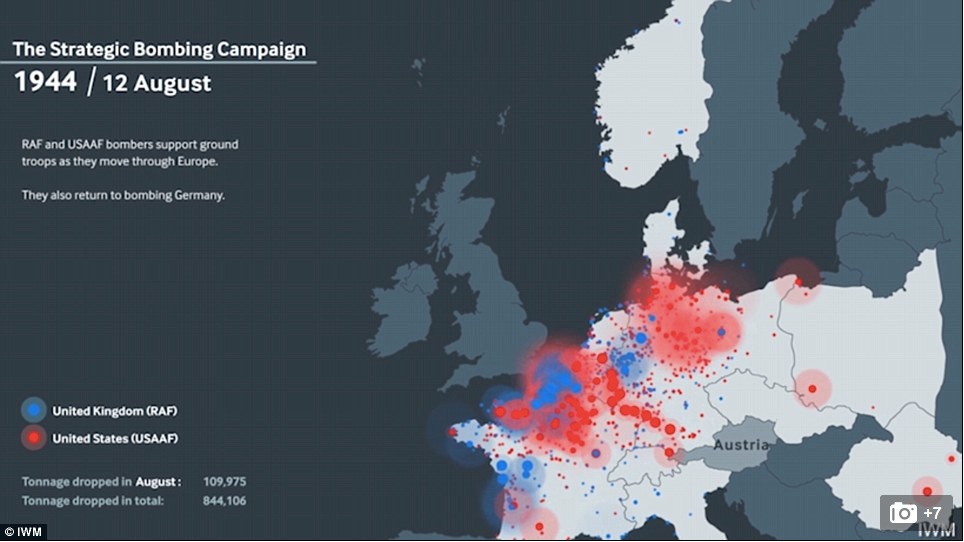
Britain’s Imperial War Museum has produced a striking animation of the ‘strategic bombing campaign’ in Europe during the Second World War:

If the YouTube link (above) doesn’t work in your region, try this.  I can’t find any version on the IWM website – this version originates with the Daily Mail here – but an interactive version will be available to visitors at the reopened American Air Museum in Britain (at IWM Duxford) from the weekend.  The first bombing mission by the USAAF took place on 29 June 1942 against the Hazebrouk marshalling yards.

‘Reach from the sky’ ONLINE

Tanner_Lecture_2016_FINAL

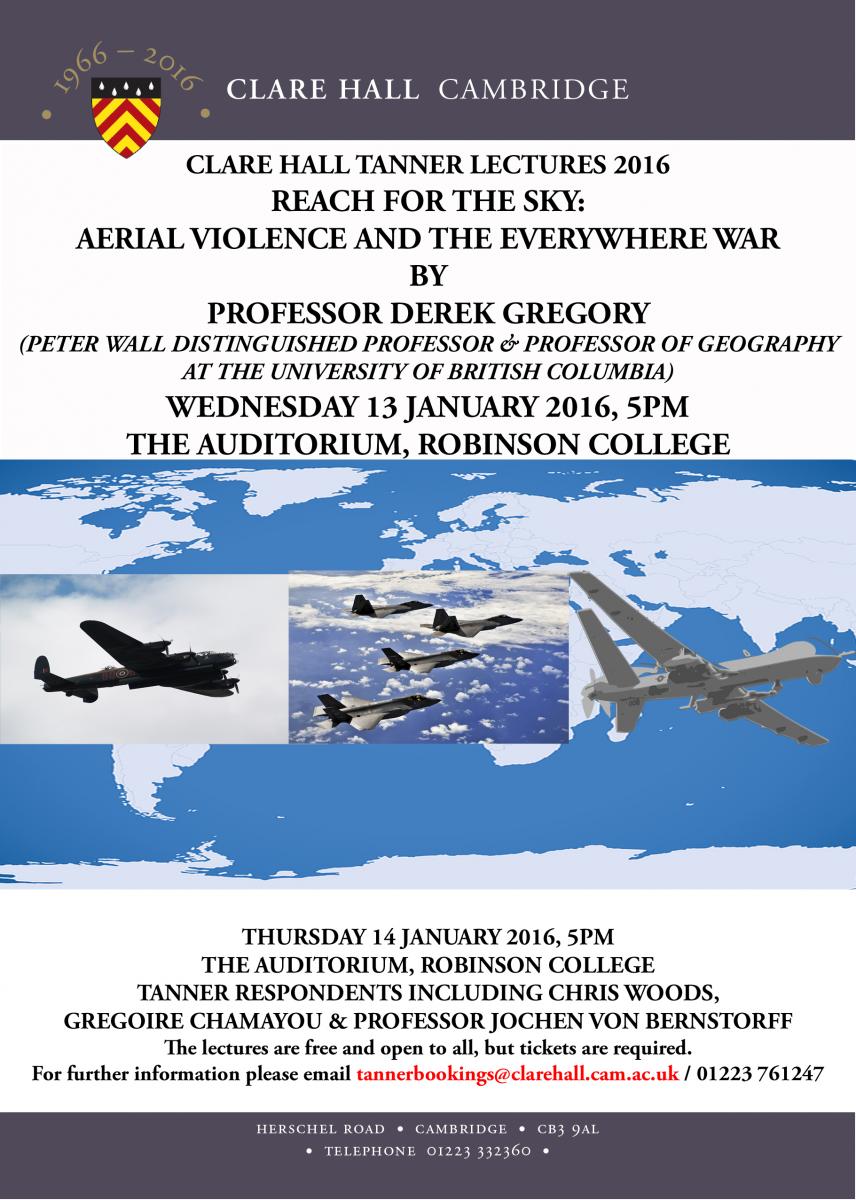
The video of my two Tanner Lectures, Reach from the sky: aerial violence and the everywhere war, delivered in Cambridge last month, is now available on the Clare Hall website.  The first, ‘Good bomb, bad bomb’ is here, and the second, ‘Killing Space’, is here, while the responses from Grégoire Chamayou, Jochen von Bernstorff and Chris Woods are here.

I’m immensely grateful to the video team, who were exceptionally helpful and remarkably accomplished.

I’m now hard at work on the long-form version…  And yes, I have – just! – notice the mistake on the poster.  It was indeed ‘Reach from the sky.’  Per ardua….

There’s also a short and kind reflection on the lectures from Alex Jeffrey over at Placing Law here.

A long day’s journey…

Anti-landscape of the Western Front.001

A note from Antipode to say that the latest edition is now available online and, unless I’ve mis-read things, is open access (for now, at any rate).  It includes what the editors say ‘might well be Antipode‘s longest ever paper’ – pp. 3-56! – my ‘Natures of war’ essay here.

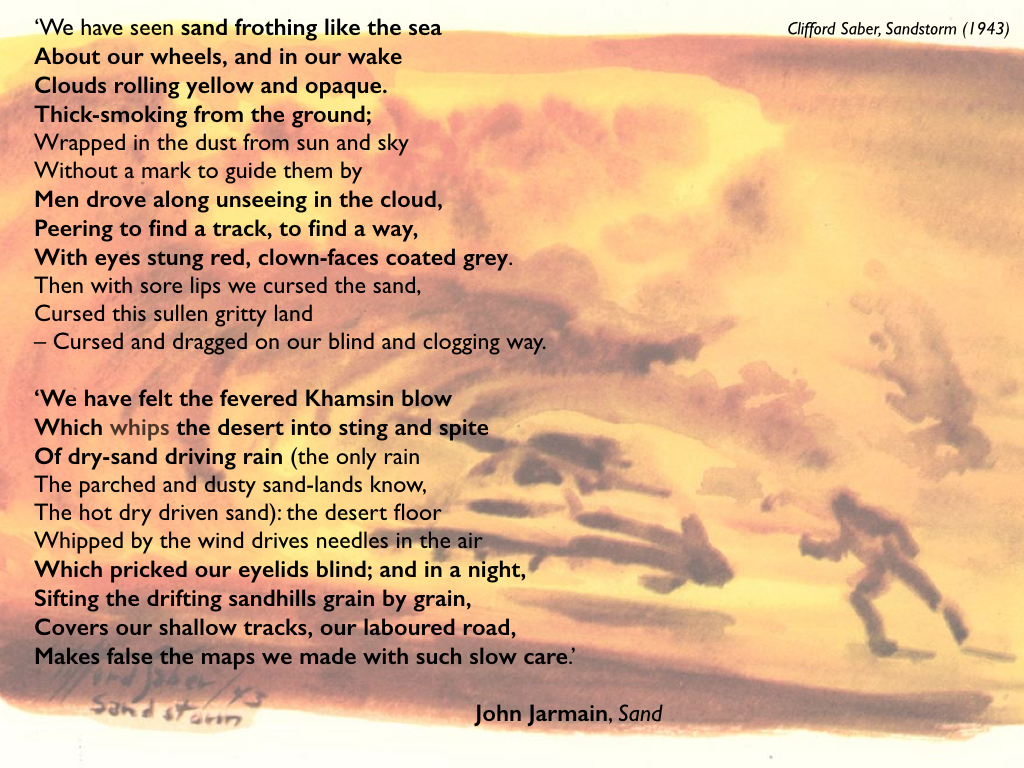
JARMAN Sand.001

Still reaching from the skies…

Sorry for the long silence – I’ve had my head down since soon after Christmas preparing the Tanner Lectures which I gave this past week in Cambridge [‘Reach from the sky: aerial violence and the everywhere war’].  The lectures were recorded and the video will be available on the Clare Hall website in a fortnight or so: more when I know more.

In outline – and after a rare panic attack the night before, which had me working until 2.30 in the morning –  I organised the two Lectures like this:

ONE

Prelude: The historical geography of bombing

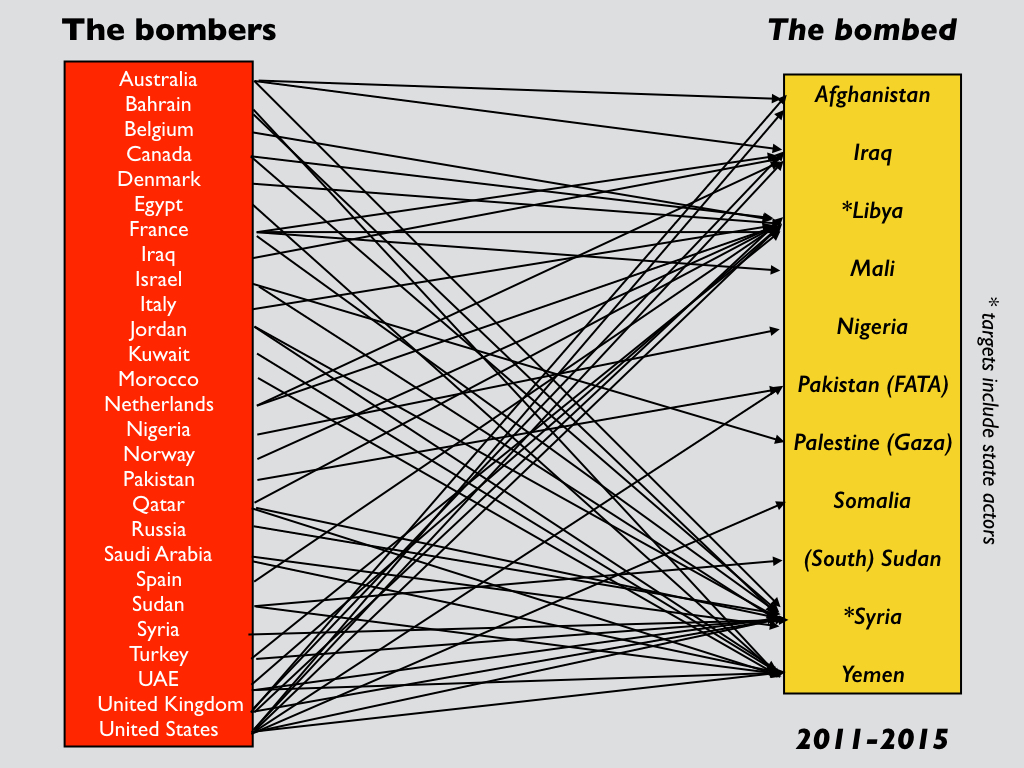
Bombing is back in the headlines but it never really left – and yet those who remain advocates of aerial violence don’t seem to have learned from its dismal history.  They also ignore the geographies that have been intrinsic to its execution, both the division between ‘the bombers and the bombed’ (the diagram below is an imperfect and fragmentary example of what I have in mind) and the pulsating spaces through which bombing is performed.

The bombers and the bombed.001

Good bomb, bad bomb

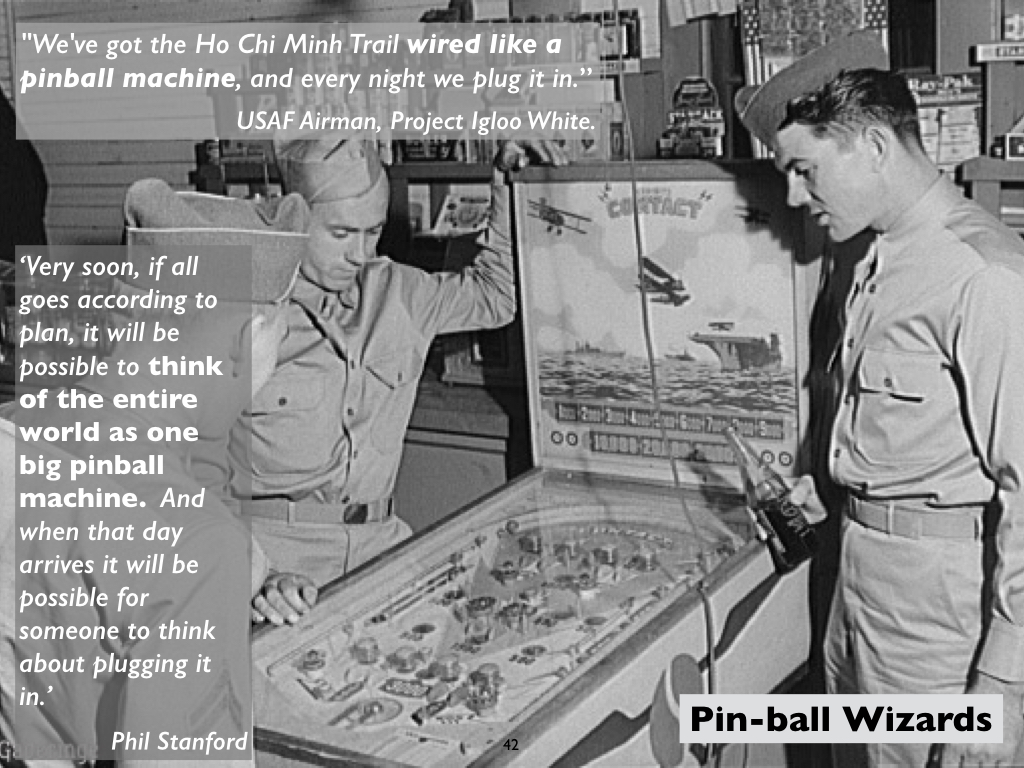
(with apologies to Mahmood Mamdani….)  In the first part I traced The machinery of bombing from before the First World War through to today’s remote operations.  Even though most early commentators believed that the primary role of military aircraft would be in reconnaissance, it was not long before they were being used to orchestrate artillery fire and to conduct bombing from the air. This sequence parallels the development of the Predator towards the end of the twentieth century.  In fact, almost as soon as the dream of flight had been realised the possibility of ‘unmanned flight’ took to the air.  Perhaps the most significant development, though, because it directs our attention to the wider matrix within which aerial violence takes place, was the development of the electronic battlefield in Laos and Cambodia. I’ve written about this in detail in ‘Lines of Descent‘ (DOWNLOADS tab); the electronic battlefield was important not because of what it did – the interdiction program on the Ho Chi Minh Trail was a spectacular failure (something which too many historians have failed to recognise)  – but because of what it showed: it conjured up an imaginative landscape, an automated killing field, in which sensors and shooters were linked through computer systems and automatic relays.  Contemporaries described the system as a vast ‘pinball machine’ (see the image below: you can have no idea how long it took me to track it down…).

Pinball wizards.001

The analogy allowed me to segue into the parallel but wholly inadequate characterisation of today’s remote operations as reducing military violence to a video game.

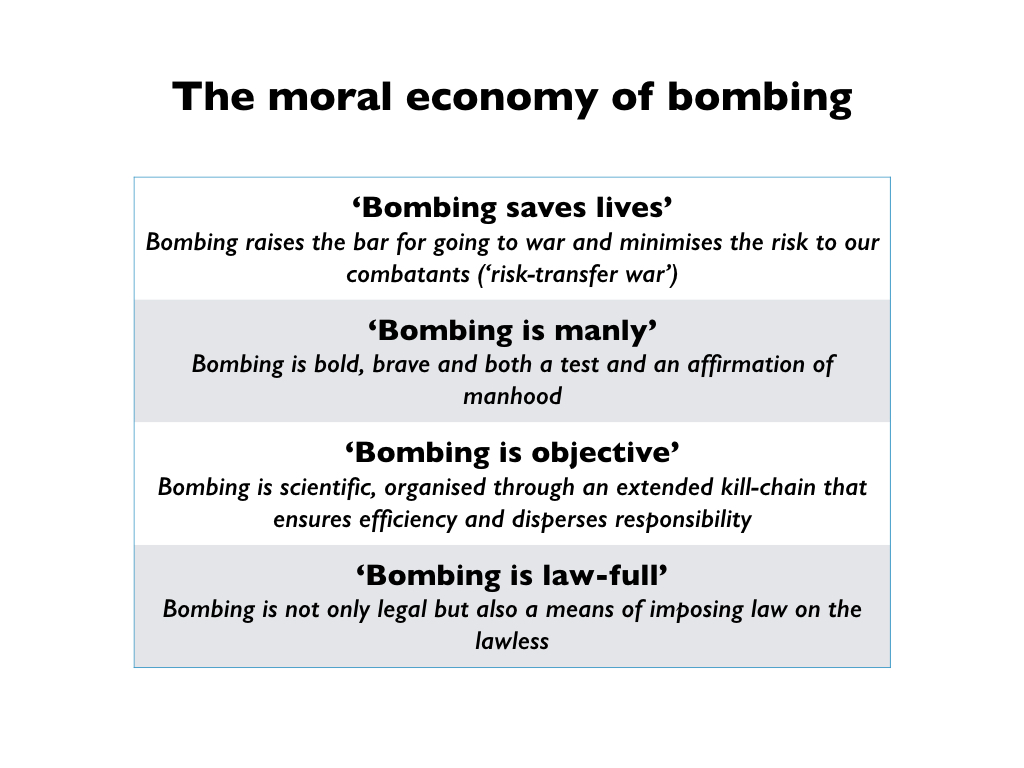
That is an avowedly ethical objection, of course, so I then turned to The moral economy of bombing.  Here I dissected four of the main ways in which bombing has been justified.  These have taken different forms at different times, and they intersect and on occasion even collide.  But they have been remarkable persistent, so in each case I tracked the arguments involved and showed how they have been radicalised or compromised by the development of Predators and Reapers.

Moral economy of bombing.001

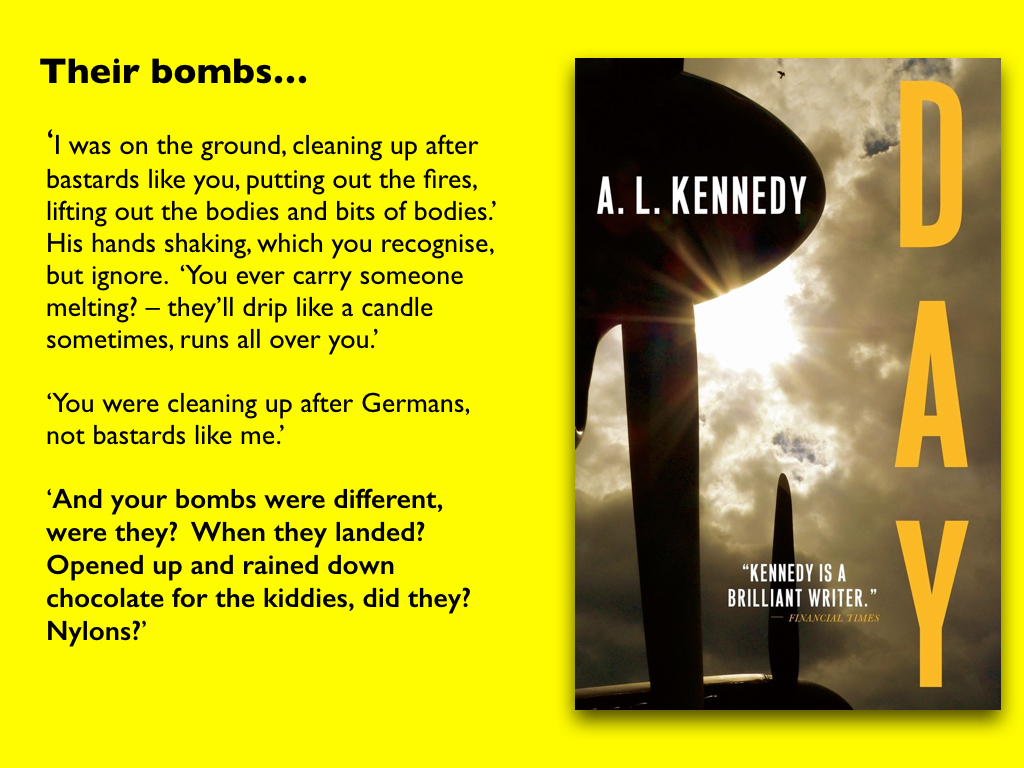
All of these justifications applied to ‘our bombs’, needless to say, which become ‘good bombs’, not to ‘their bombs’ – the ‘bad bombs’.

Their bombs.001

TWO

Killing Space

Phillips' Aerial Torpedo.001

I started the second lecture by discussing The deconstruction of the battlefield; the wonder of Raymond Phillips’s fantasies of ‘aerial torpedoes‘ before the First World War was not so much their promise of ‘bomb-dropping by wireless’ but the targets:

Phillips' bomb-dropping by wireless.001

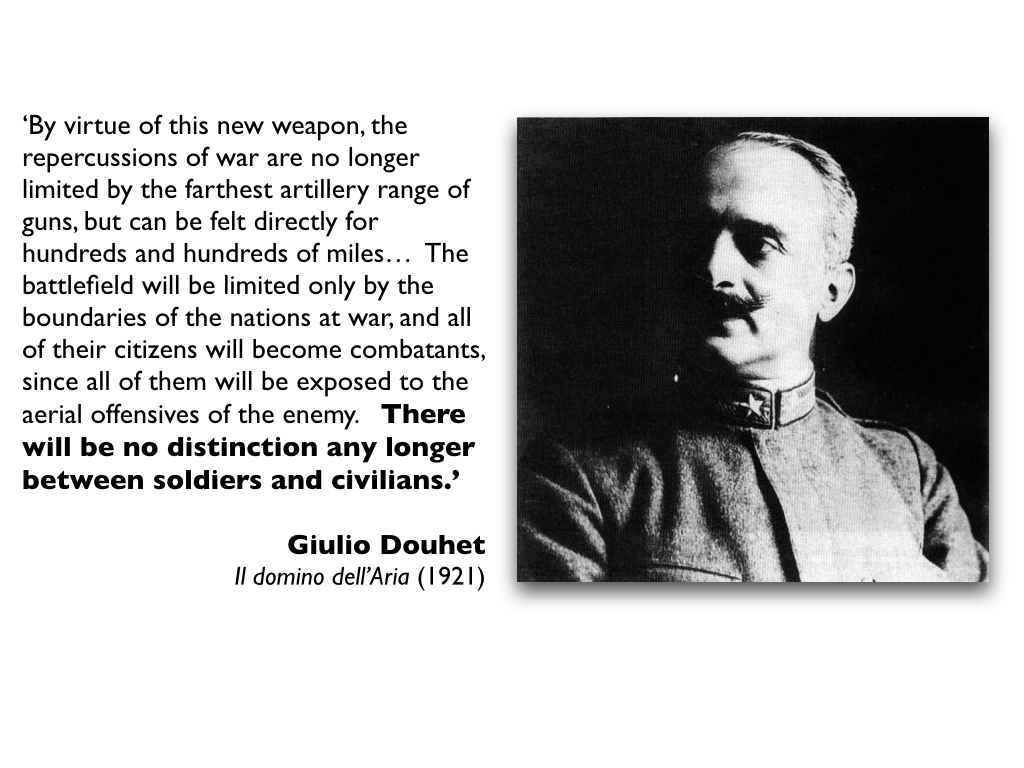
It was this radical extension of the battle space that counted.  In the event,  it was not British airships that dropped bombs on Berlin but German Zeppelins that bombed London and Paris, but the lesson was clear:

Douhet.001

To explore the formations and deformations of the battlespace in more detail, I used the image of The dark heart of bombing to describe a battlespace that alternately expanded and contracted.  So Allied bombing in the Second World war extended its deadly envelope beyond Germany, Italy and Japan into Belgium, Bulgaria, Denmark, France, the Netherlands, Norway and Romania; later the United States would bomb North Vietnam but reserved most of its ordnance for South Vietnam, Laos and Cambodia; and US air strikes in Afghanistan and Iraq would eventually spill over into Pakistan, Syria and elsewhere.  In the course of those air wars, the accuracy of targeting improved until it was possible to aim (if not always to hit) point-targets – individual buildings and eventually individual people – but this contraction of the killing space was accompanied by its expansion.  These ‘point-targets’ were selected because they were vital nodes that made possible the degradation or even destruction of an entire network.  Hence, for example, the Israeli attack on the Gaza power station (more in a previous post here):

Gaza Power Strip.001

A similar argument can be made about the US Air Force’s boast that it can now put ‘warheads on foreheads’, and I linked the so-called individuation of warfare to the US determination to target individuals wherever they go – to what Jeremy Scahill and others describe as the production of a newly expanded ‘global battlefield’.  What lies behind this is more than the drone, of course, since these killing fields rely on a global system of surveillance orchestrated by the NSA, and I sketched its contours and showed how they issued in the technical production of an ‘individual’ not as a fleshy, corporeal person but as a digital-statistical-spatial artefact (what Ian Hacking once called ‘making people up’ and what Grégoire Chamayou calls ‘schematic bodies‘).

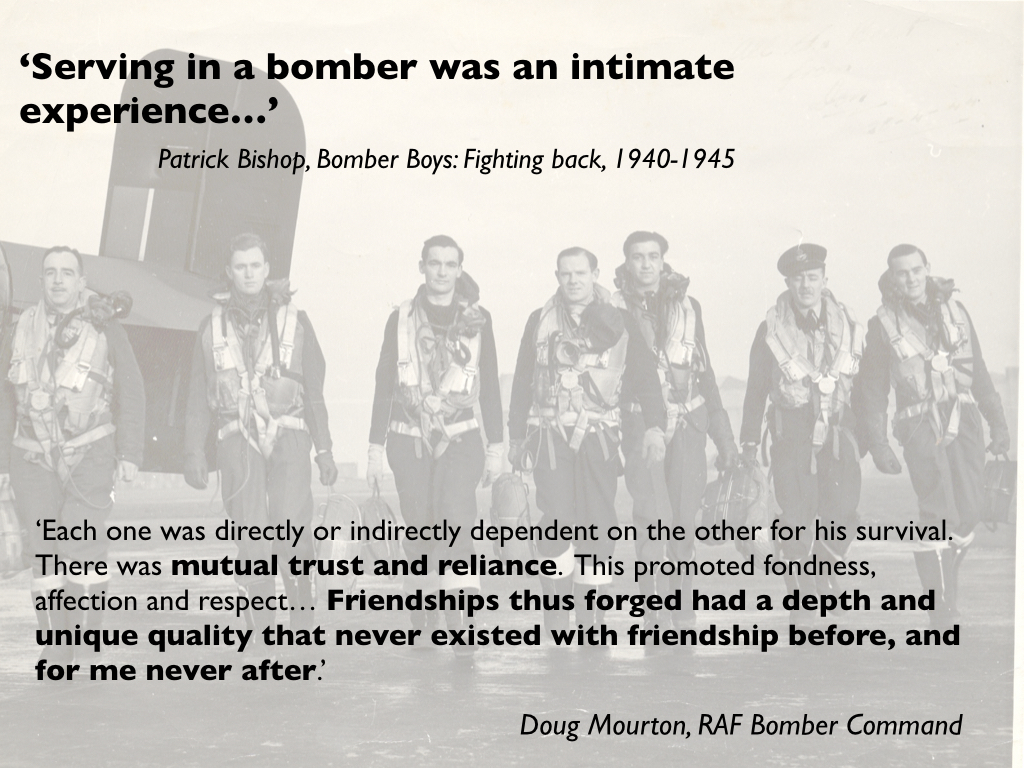
Next I explored a different dialectical geography of the battlespace: Remote splits: intimacy and detachment.  I started with RAF Bomber Command and traced in detail the contrast between the intimacy between members of bomber crews (a mutual dependence reinforced by the bio-convergence between their bodies and the machinery of the bomber itself) and the distance and detachment through which they viewed their targets.

Bioconvergence and the bomber crew.001

Intimacy in Bomber Command.001

The Good Wife.001

Cockpit dials.001

Distance and blindness.001

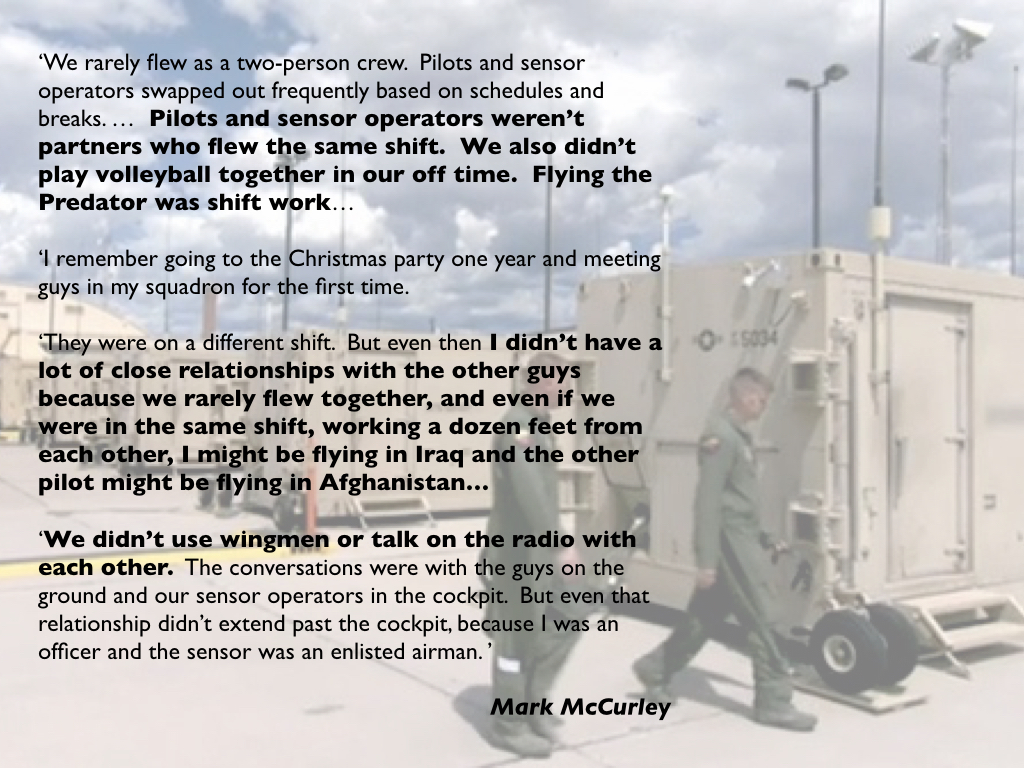
There’s much more on this in ‘Doors into nowhere‘ (DOWNLOADS tab), though I think my discussion in the Lectures breaks new ground. All of this is in stark contrast to today’s remote operations, where – as Lucy Suchman reminds us – there remains a remarkable (though different) degree of bioconvergence and yet now a persistent isolation and anomie is felt by many pilots and sensor operators who work in shifts:

Anomie and the drone.001

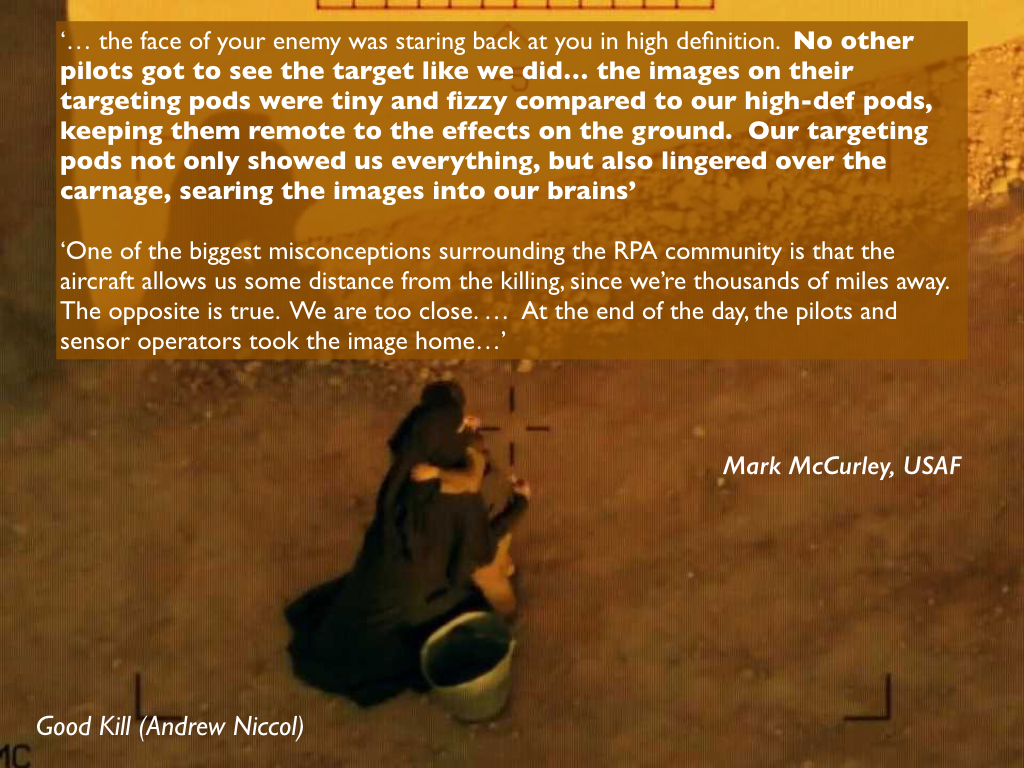
This is thrown into relief by the closeness remote operators feel to the killing space itself, an immersion made possible through the near real-time full-motion video feeds, the internet relay chatter and the radio communications with troops on the ground (where there are any). In contrast to the bomber crews of the Second World War – or those flying over the rainforests of Vietnam, Laos and Cambodia – there is a repeated insistence on a virtualized proximity to the target.

Good Kill in high-definition.001

But I used a discussion of Andrew Niccol‘s Good Kill to raise a series of doubts about what drone crews really can see, as a way into the next section, Sweet target, which provided an abbreviated presentation of the US air strike in Uruzgan I discuss in much more (I hope forensic) detail in Angry Eyes (see here and here).  That also allowed me to bring together many of the key themes I had isolated in the course of the two lectures.

As I approached my conclusion, I invoked Thomas Hippler‘s Le gouvernement du ciel: Histoire globale des bombardements aériens, (I’ve just discovered that Verso will publish the English-language version later this year or early next: Governing from the skies: a global history of aerial bombing):

Hippler Neo-douhetism.001

I’m not convinced that the military and paramilitary violence being visited on people today is all ‘low-intensity’ (Gaza? Afghanistan? Iraq? Syria? Yemen?).  But neither do I think it’s ‘de-territorialised’, unless the word is flattened into a conventionally Euclidean frame.  Hence, following Stuart Elden‘s lead, I treated territory as a political-juridical technology whose calibrations and enclosures assert, enable and enforce a claim over bodies-in-spaces.  And it was those ‘bodies-on-spaces’ that brought me, finally, to The loneliest space of all:  the irreducible, truly dreadful loneliness of death and grief:

Counting the dead.001

Behind the body-counts and the odious euphemisms of collateral damage and the rest lies the raw, inconsolable loss so exquisitely, painfully rendered in ‘Sky of Horoshima‘…

In the coming days I’ll post some of the key sections of the Lectures in more detail, which I’ll eventually develop into long-form essays.

I learned a lot from the expert and wonderfully constructive commentaries after the Lectures from Grégoire Chamayou, Jochen von Bernstorff and Chris Woods, and I’ll do my best to incorporate their suggestions into the final version.

In his response Grégoire traced my project on military violence in general and bombing/drones in particular back to a series of arguments I’d developed in Geographical imaginations in 1994 about vision, violence and corporeality; I had overlooked these completely, full of the conceit that my work had never stood still…. I shall go back, re-read and think about that some more, since some of the ideas that Grégoire recovered (and elaborated) may be even more helpful to me now.  Jochen and Chris also gave me much food for thought, so I shall be busy in the coming months, and I’m immensely grateful to all three of them.

City of Light, City of Darkness

I’ve long been interested in cities under military occupation, and in particular in the ways in which armies spatialise the city in order to securitise it.  I still have a detailed presentation on the French occupation of Cairo at the end of the eighteenth century – for Edward Said the formative and diagnostic moment in the formation of a distinctively modern Orientalsim – and the US occupation of Baghdad at the beginning of the twenty-first.  The parallels are as striking as the differences, and one of these days I know I have to find the time to convert the image-stream into a word-stream.

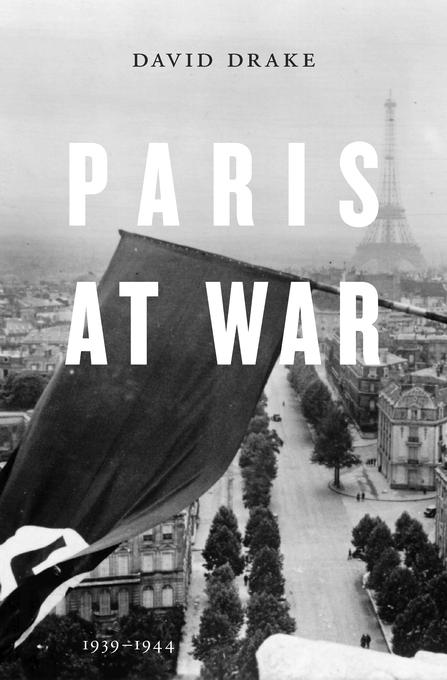
So this explains why a new book on Paris under German occupation in the Second World War caught my eye.

DRAKE Paris at warDavid Drake‘s Paris at War, 1939-1945 from Harvard/Belknap was published last month:

Paris at War chronicles the lives of ordinary Parisians during World War II, from September 1939 when France went to war with Nazi Germany to liberation in August 1944. Readers will relive the fearful exodus from the city as the German army neared the capital, the relief and disgust felt when the armistice was signed, and the hardships and deprivations under Occupation. David Drake contrasts the plight of working-class Parisians with the comparative comfort of the rich, exposes the activities of collaborationists, and traces the growth of the Resistance from producing leaflets to gunning down German soldiers. He details the intrigues and brutality of the occupying forces, and life in the notorious transit camp at nearby Drancy, along with three other less well known Jewish work camps within the city.

The book gains its vitality from the diaries and reminiscences of people who endured these tumultuous years. Drake’s cast of characters comes from all walks of life and represents a diversity of political views and social attitudes. We hear from a retired schoolteacher, a celebrated economist, a Catholic teenager who wears a yellow star in solidarity with Parisian Jews, as well as Resistance fighters, collaborators, and many other witnesses.

Drake enriches his account with details from police records, newspapers, radio broadcasts, and newsreels. From his chronology emerge the broad rhythms and shifting moods of the city. Above all, he explores the contingent lives of the people of Paris, who, unlike us, could not know how the story would end.

Here is the Contents list:

Prologue
Introduction: The Road to War: September 1938–September 1939
1. The Phoney War: September 3, 1939–May 10, 1940
2. Blitzkrieg and Exodus: May 10, 1940–June 14, 1940
3. Parisians and Germans, Germans and Parisians
4. Paris, German Capital of France
5. Unemployment, Rationing, Vichy against Jews, Montoire
6. From Mass Street Protest to the “Führer’s Generous Gesture”
7. Protests, Pillaging, “V” for Victory, the First Roundup of Jews
8. Resistance and Repression
9. Resistance, Punishment, Allied Bombs, and Deportation
10. SS Seizure of Security, the Yellow Star, the Vél’d’hiv’ Roundup, La Relève
11. Denunciations, Distractions, Deprivations
12. Labour Conscription, Resistance, the French Gestapo
13. Anti-Bolshevism, Black Market, More Bombs, Drancy
14. A Serial Killer on the Run, Pétain in Paris, the Milice on the Rampage, the Allies on Their Way
15. The Liberation of Paris
Conclusion

For a principled contemporary account, incidentally, and one that reverberates with the power of the literary sensibility that was so repugnant to the Nazis, it’s hard to beat Jean Guéhenno‘s Diary of the Dark Years, 1940-1944: Collaboration, Resistance, and Daily Life in Occupied Paris.

Little Boys and Blue Skies

These are very preliminary notes and ideas for my presentation at “Through Post-Atomic Eyes” in Toronto next month: I would really – really – welcome any comments, suggestions or advice.  I don’t usually post presentations in advance, and this is still a long way from the finished version, but in this case I am venturing into (irradiated) fields unknown to me until a few months ago…

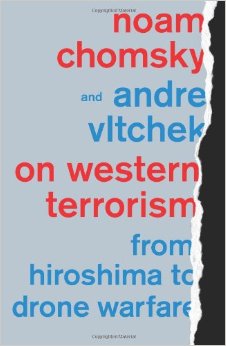
CHOMSKY On Western terrorismAt first sight, any comparison between America’s nuclear war capability and its drone strikes in Afghanistan, Iraq, Pakistan, Somalia, Syria and Yemen seems fanciful. The scale of investment, the speed and range of the delivery systems, the nature of the targets, the blast radii and precision of the munitions, and the time and space horizons of the effects are so clearly incommensurable. It’s noticeable that the conversation between Noam Chomsky and Andre Vltchek published as On Western Terrorism: from Hiroshima to drone warfare (2013) says virtually nothing about the two terms in its subtitle.

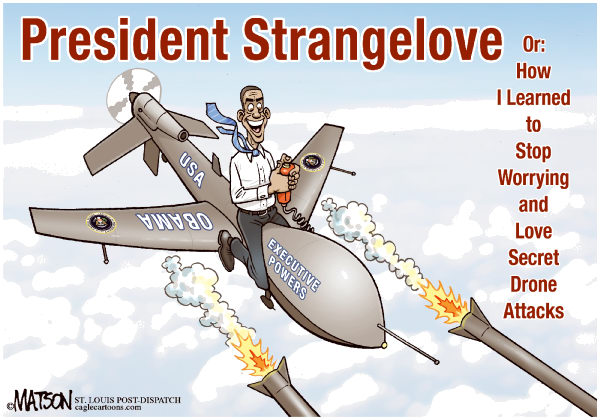
Yet nuclear weapons and drone strikes have both been attended by intense diplomatic, geopolitical and geo-legal manoeuvres, they have both sparked major oppositional campaigns by activist organisations, and they have both had major impacts on popular culture (as the two images below attest).

dr-strangelove-still-580

President-Strangelove

But there are other coincidences, connections and transformations that also bear close critical examination.

When Paul Tibbets flew the Enola Gay across the blue sky of Hiroshima on 6 August 1945 one of his major concerns was to execute a fast, tight 155 degree turn to escape the effects of the blast from ‘Little Boy’.  There is some dispute over the precise escape angle – there’s an exhaustive discussion in the new preface to Paul Nahin‘s Chases and escapes: the mathematics of pursuit and evasion (second edition, 2007) – but the crucial point is the concern for the survival of the aircraft and its crew.

Enola Gay co-pilot [Robert Lewis]'s sketch after briefing of approach and 155 turn by the B-29s weaponeer William Parsons, 4 August 1945

Tibbets successfully made his escape but four years later, when the US Atomic Energy Commission was developing far more powerful bombs, the Air Force became convinced that escape from those blasts would be impossible. And so it implemented Project Brass Ring which was intended to convert B-47 Stratojet bombers into remotely-piloted aircraft capable of delivering atomic bombs without any loss of American lives.  (What follows is taken from Delmer Trester, ‘Thermonuclear weapon delivery by unmanned B-47: Project Brass Ring‘; it was included in A history of the Air Force Atomic Energy Program, 1949-1953, which can be downloaded here; you can obtain a quick overview here).

‘It appeared that the Air Force would need some method to deliver a 10,000-pound package over a distance of 4,000 nautical miles with an accuracy of at least two miles from the center of the target. It was expected the package would produce a lethal area so great that, were it released in a normal manner, the carrier would not survive the explosion effects. Although not mentioned by name, the “package” was a thermonuclear device – the hydrogen or H-bomb…

B-47 Stratojet bomber (USAF)

‘The ultimate objective was to fashion a B-47 carrier with completely automatic operation from take-off to bomb drop… The immediate plan included the director B-47A aircraft as a vital part of the mission. Under direction from the mother aircraft, the missile would take off, climb to altitude and establish cruise speed conditions. While still in friendly territory, the crew aboard the director checked out the missile and committed its instruments to automatically accomplish the remainder of the mission. This was all that was required of the director. The missile, once committed, had no provision for returning to its base… either the B-47 became a true missile and dived toward the target … or a mechanism triggered the bomb free, as in a normal bombing run.’

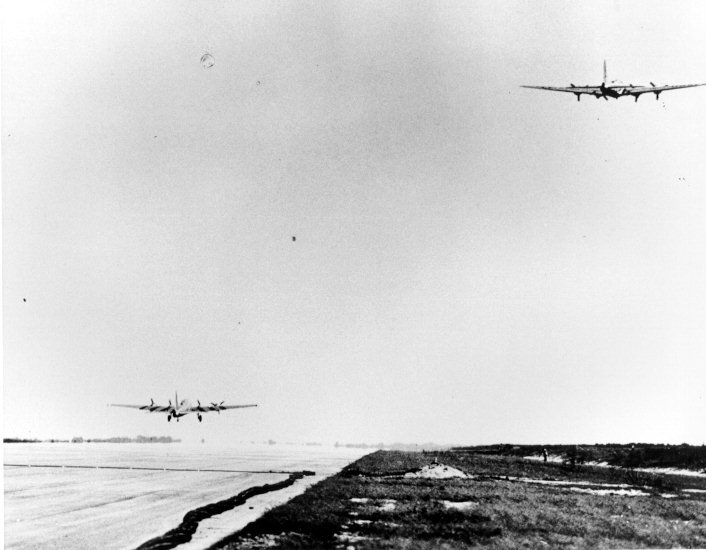
This was a re-run of Operation Aphrodite, a failed series of experiments carried out in the closing stages of the Second World War in Europe, and – as the images below show – after the war the Air Force had continued to experiment with B-17 aircraft remotely piloted from both ‘director aircraft’ [top image; the director aircraft is top right] and ‘ground control units’ [bottom image].  These operated under the aegis of the Air Force’s Pilotless Aircraft Branch which was created in 1946 in an attempt to establish the service’s proprietary rights over missile development.

B-17 drones

Ground control unit for B-17 drone

But the Brass Ring team soon discovered that their original task had swelled far beyond its original, taxing specifications: in October 1951 they were told that ‘the super-bomb’ would weigh 50,000 lbs. They modified their plans (and planes) accordingly, and after a series of setbacks the first test flight was successful:

‘The automatic take-off, climb and cruise sequence was initiated remotely from a ground control station. The aircraft azimuth, during take-off, was controlled by an auxiliary control station at the end of the runway. Subsequent maneuvers, descent and landing (including remote release of a drag parachute and application of brakes) were accomplished from the ground control station. The test was generally satisfactory; however, there were several aspects – certain level flight conditions, turn characteristics and the suitability of the aircraft as a “bombing platform” – which required further investigation.’

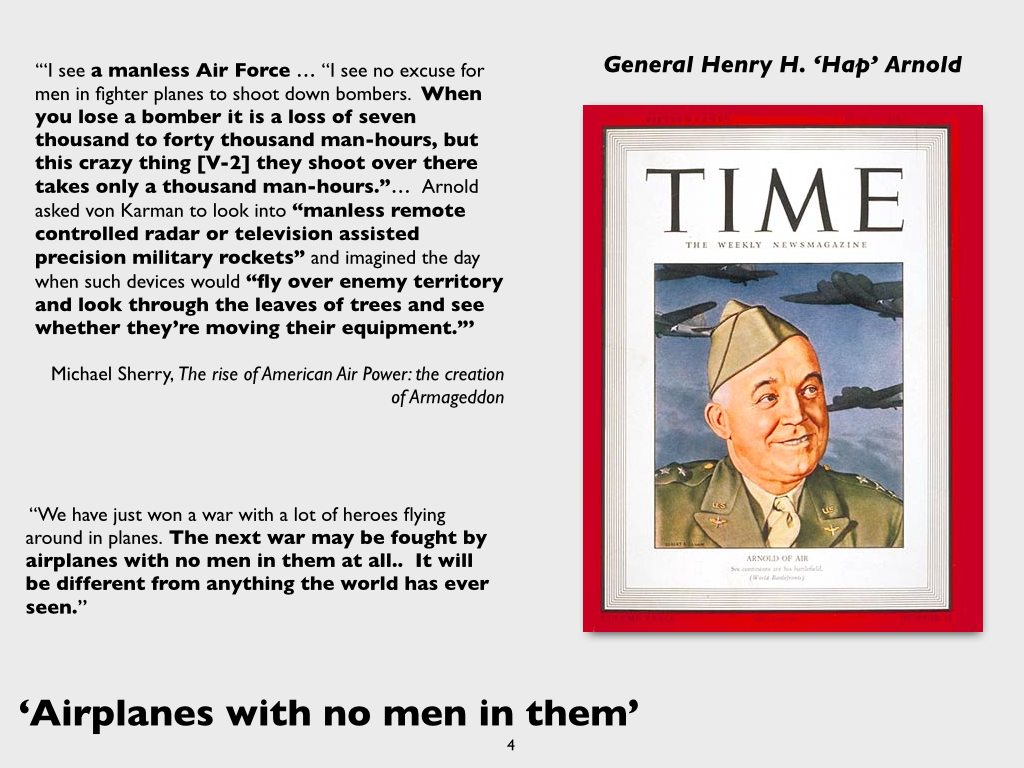
This was part of a larger imaginary in which, as Life had commented in its issue of 20 August 1945, echoing USAAF General Henry H. ‘Hap’ Arnold, ‘robot planes … and atomic bombs will do the work today done by fleets of thousands of piloted bombers.’ (Arnold thought this a mixed blessing, and in an essay ghost-written with William Shockley he noted that nuclear weapons had made destruction ‘too cheap and easy’ – one bomb and one aircraft could replace hundreds of bombs and vast fleets of bombers – and a similar concern is often raised by critics of today’s Predators and Reapers who argue that their remote, often covert operations have lowered the threshold for military violence).

Henry H Hap Arnold.001

Brass Ring was abandoned on 13 March 1953, once the Air Force determined that a manned aircraft could execute the delivery safely (at least, for those on board).  It would be decades before another company closely associated with nuclear research – General Atomics (more here) – supplied the US Air Force with its first MQ-1 Predators.

1994-august

These were originally conceived as unarmed, tactical not strategic platforms, designed to provide intelligence, surveillance and reconnaissance for conventional strike aircraft. But the concern with American lives became a leitmotif of both programs, and one of the foundations for today’s remote operations is the ability (as the USAF has it) to ‘project power without vulnerability’.

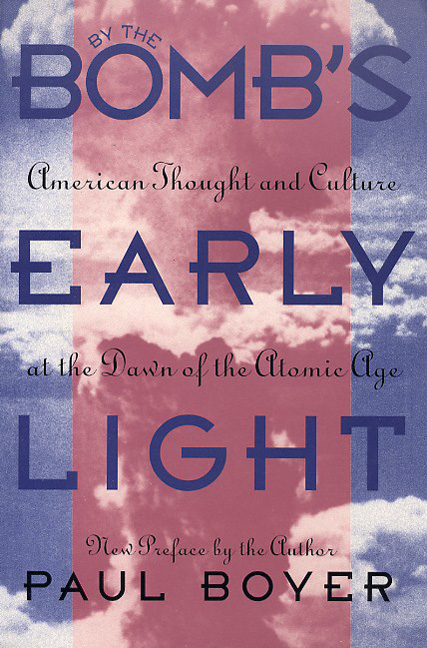
BOYER By the bomb's early lightThe visible effects of bombing Hiroshima and Nagasaki on the Japanese population were the subject of strict censorship – still photographs were never published, while Japanese media and even US military film crews had their documentary footage embargoed – and public attention in the United States was turned more or less immediately towards visualising ‘Hiroshima USA’ (Paul Boyer is particularly good on this; there are also many images and a good discussion here). Even the US Strategic Bombing Survey indulged in the same speculation: ‘What if the target for the bomb had been an American city?’ it asked in its June 1946 report. ‘The casualty rates at Hiroshima and Nagasaki, applied to the massed inhabitants of Manhattan, Brooklyn, and the Bronx, yield a grim conclusion.’ Although the original targets had been Asian cities it was American cities that were designated as future victims.  ‘Physically untouched by the war’ (apart from Pearl Harbor), Boyer wrote,

‘the United States at the moment of victory perceived itself as naked and vulnerable.  Sole possessors and users of a devastating instrument of mass destruction, Americans envisioned themselves not as a potential threat to other peoples, but as potential victims.’

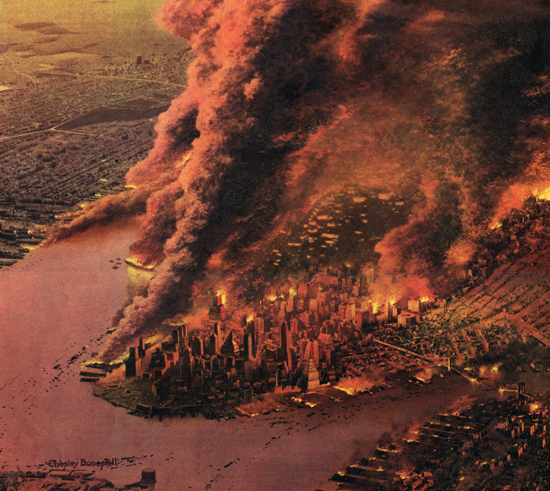
This was the abiding anxiety instilled by the national security state and orchestrated through its military-industrial-media-entertainment complex throughout the post-war decades.  Perhaps the most famous sequence of images – imaginative geographies, I suppose –accompanied an essay by John Lear in Collier’s Magazine in August 1950, ‘Hiroshima USA: Can anything be done about it?‘, showing a series of paintings by Chesley Bonestell and Birney Lettick imagining the effects of a nuclear strike on New York:

Hiroshima USA 11950-aug-6-colliers-p12-sm

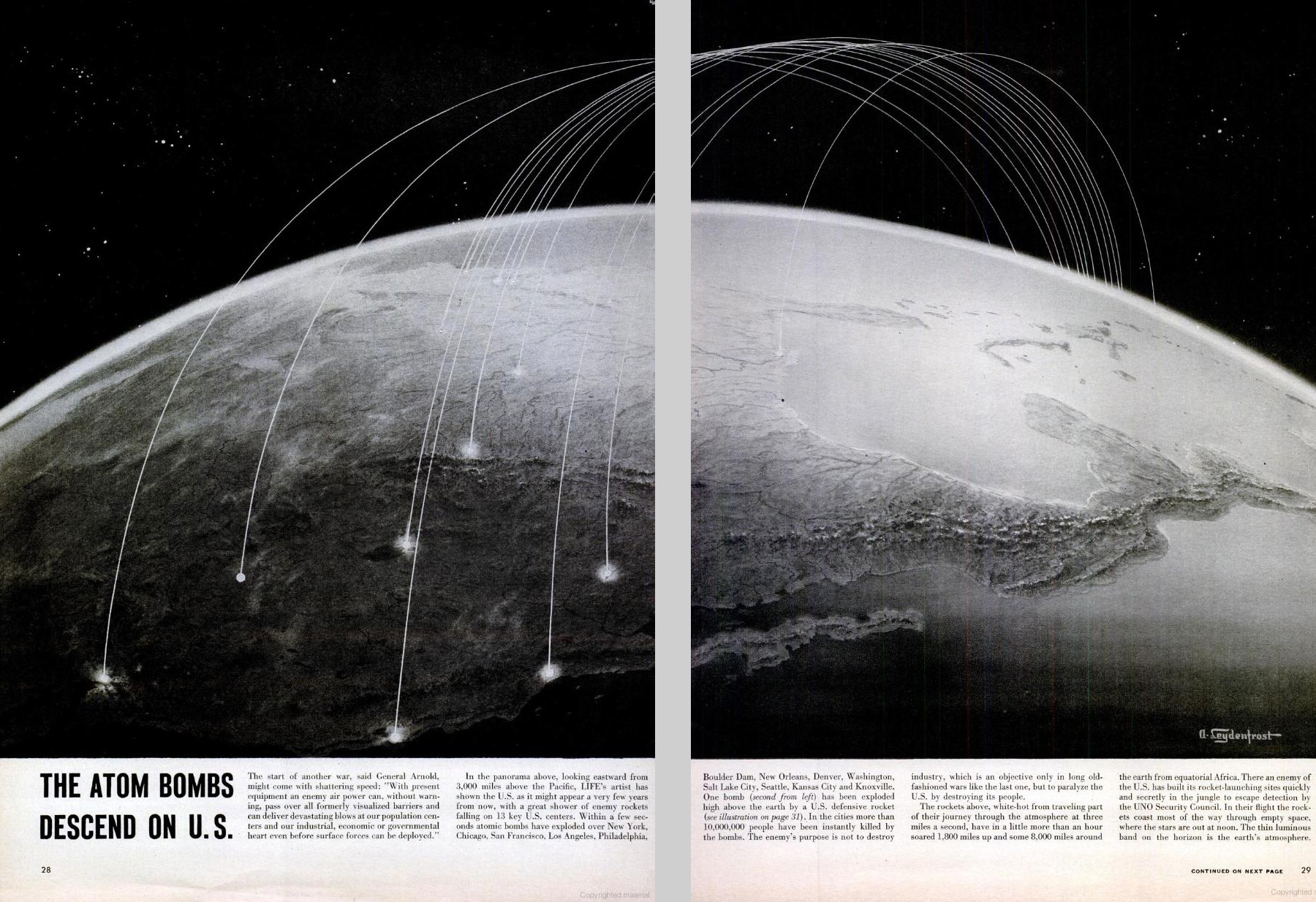
Similar sequences, often accompanied by maps, were produced for many other cities (and the simulations continue: see, for example, here).  The images below, from Life on 19 November 1945, come from ‘The 36-Hour War’ (see here for a commentary) that envisaged a nuclear attack on multiple cities across the USA, including Washington DC, from (presumably Soviet) ‘rocket-launching sites [built] quickly and secretly in the jungle’ of equatorial Africa:

1945-Life-36-Hour-War-2

1945-Life-36-Hour-War-1

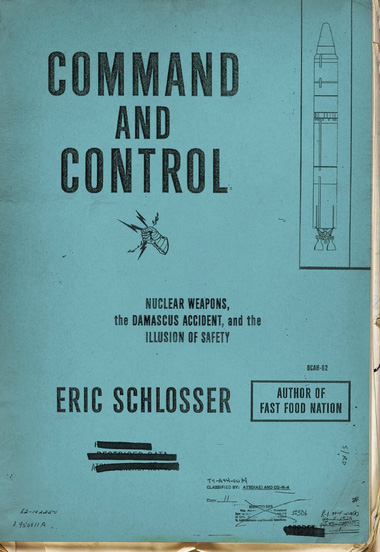
Schlosser-Command-and-Control-bookAs it happened, American cities did indeed become targets – for the US Air Force.  According to Eric Schlosser, under General Curtis Le May the goal was

to build a Strategic Air Command that could strike the Soviet Union with planes based in the United States and deliver every nuclear weapon at once. SAC bomber crews constantly trained and prepared for that all-out assault. They staged mock attacks on every city in the United States with a population larger than twenty-five thousand, practicing to drop atomic bombs on urban targets in the middle of the night. San Francisco was bombed more than six hundred times within a month.

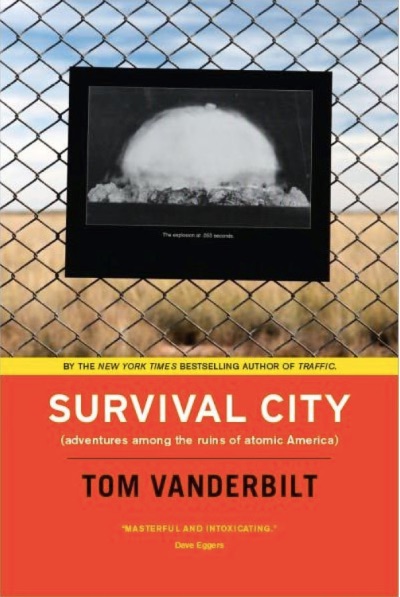
VANDERBILT Survival CityTests were also conducted at the Nevada Proving Ground, ‘the most nuclear-bombed place on the planet’, to determine the likely effects.  One of the purposes of the Strategic Bombing Survey’s Physical Damage Division had been to document the effects of the bombs on buildings in Hiroshima and Nagasaki – to read them as ‘blueprints for the atomic future‘ – and both Japanese and American medical teams had been sent in shortly after the blasts to record their effects on bodies (from 1947 their work was subsumed under the Atomic Bomb Casualty Commission).  It was now imperative bring the two together and to bring their results home.  And so, starting in 1953 with ‘Operation Doorstep’, mannequins were placed inside single-family houses at the Nevada site to calculate the prospects for the survival of what Joseph Masco calls the American ‘nuclearised’ family in the event of a nuclear attack; they subsequently went on public exhibition around the country with the tag line:

‘These mannikins could have been real people; in fact, they could have been you.’

In the Second World War experimental bombing runs had been staged against mock German and Japanese targets at the Dugway Proving Ground but – significantly – the buildings had no occupants: as Tom Vanderbilt wryly remarks, now ‘the inhabitants had been rewritten into the picture’ because the objective was to calibrate the lives of Americans.

Rachele Riley Mannequins

I have borrowed this image from the mesmerising work of artist Rachele Riley, whose project on The evolution of silence centres on Yucca Flat in the Nevada Test Site and raises a series of sharp questions about both the imagery and the soundscape of the nuclear age.

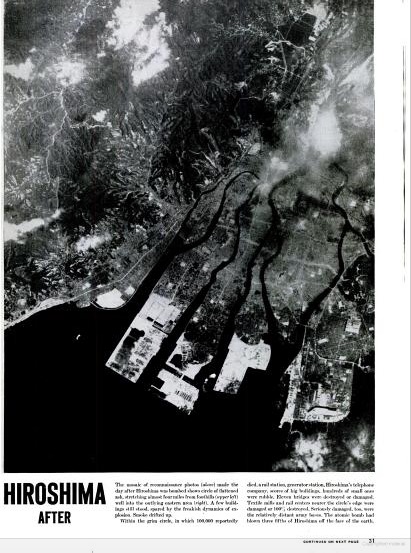
The power of the image – ‘the nuclear sublime’ – was one of the central objectives of the attacks on Hiroshima and Nagasaki: ‘the weapon’s devastating power had to be seen to be believed,’ as Kyo Maclear observed, and it had to be seen and believed in Moscow as well as in Tokyo.  Here the visual economies of nuclear attacks are radically different from drone strikes. In the immediate aftermath there was no shortage of atomic ‘views from the air’ –  aerial photographs of the vast cloud towering into the sky and of Hiroshima before and after the bomb.  Here is Life (sic) on 20 August 1945:

LIFE:Hiroshima 1

LIFE:Hiroshima 2LIFE:Hiroshima 3

Yet for the most part, and with some significant exceptions, aerial views are singularly absent from today’s drone wars. To Svea Braeunert (‘Bringing the war home: how visual artists return the drone’s gaze‘) that is all the more remarkable because drone strikes are activated by what video artist Harun Farocki called operative images: but that is also the reason for the difference. Aerial photographs of Hiroshima or Nagasaki reveal a field of destruction in which bodies are conspicuously absent; the resolution level is too coarse to discern the bomb’s victims.

But the video feeds from a Predator or Reaper, for all their imperfections, are designed to identify (and kill) individuals, and their aerial gaze would – if disclosed – reveal the bodies of their victims. That is precisely why the videos are rarely released (and, according to Eyal Weizman, why satellite imagery used by investigators to reconstruct drone strikes is degraded to a resolution level incapable of registering a human body – which remains ‘hidden in the pixels‘ – and why their forensic visual analysis is forced to focus on buildings not bodies).

OMAR FAST %000 Feet is Best

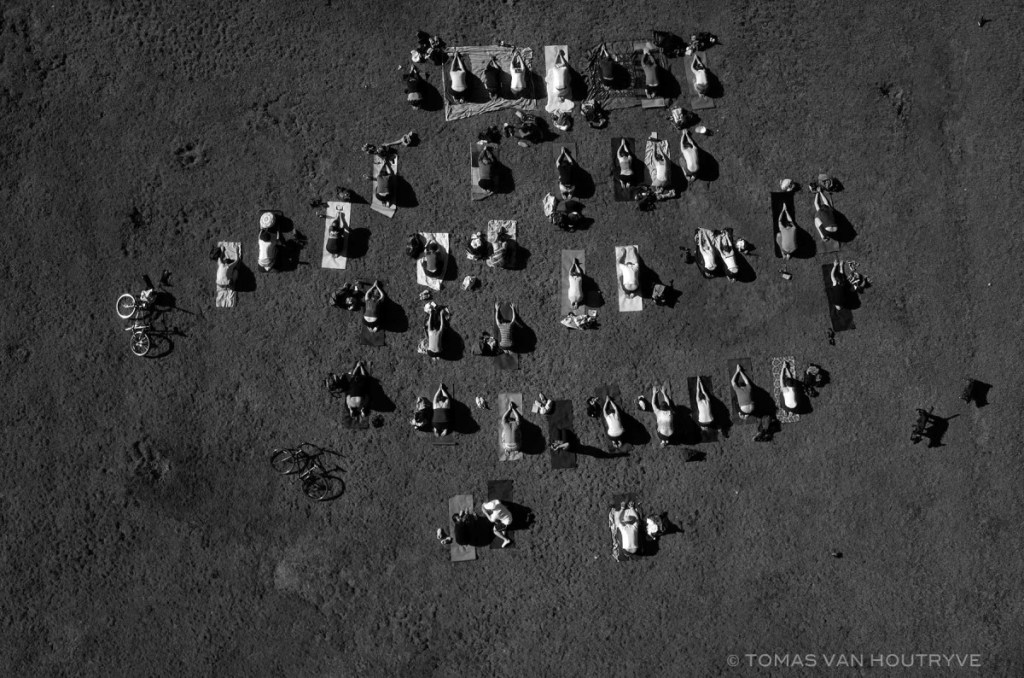
One might expect visual artists to fill in the blank. Yet – a further contrast with Hiroshima – apart from projects like Omar Fast’s ‘5,000 Feet is Best’ (above) and Thomas van Houtryve’s ‘Blue Sky Days’ (below) there have been precious few attempts to imagine drone strikes on American soil.

van HOUTRYVE Blue Sky Days

Perhaps this is because they are so unlikely: at present these remote platforms can only be used in uncontested air space, against people or states who are unable (or in the case of Pakistan, unwilling) to defend themselves. But there has been a protracted debate about such strikes on American citizens (notably the case of Anwar al-Awlaki) and a concerted attempt to focus on the rules followed by the CIA and JSOC in their programs of targeted killing (which has artfully diverted public attention to Washington and away from Waziristan).

There is also a visceral, visible continuity between the two: just as in Hiroshima and Nagasaki, there has been little public concern over the victims of drone strikes, the vast majority of whom have once again been Asian.

If the targeting process continues to be racialised, it also continues to be bureaucratised. After the Second World War the US Air Force was determined to speed up its targeting cycle, and in 1946 started to compile a computerised database of potential targets in the Soviet Union; this was soon extended to Soviet satellites and Korea, and by 1960 the Bombing Encyclopedia of the World (now called the ‘Basic Encyclopedia’) contained 80,000 Consolidated Target Intelligence Files. These were harvested to plan Strategic Air Command’s nuclear strikes and to calibrate Damage and Contamination Models. One of the analysts responsible for nominating targets later described the process as ‘the bureaucratisation of homicide’. Similar criticisms have been launched against the ‘disposition matrix’ used by the CIA to nominate individuals authorised for targeted killing (see here and here); most of these are in Pakistan, Somalia, and Yemen, though there are other kill lists, including Joint Prioritised Effects Lists compiled by the US military for war zones in Afghanistan and Iraq. In both cases the target files are in principle global in reach, and both nuclear strikes and targeted killings (outside established war zones) are judged to be sufficiently serious and ‘sensitive’ to require direct Presidential approval.

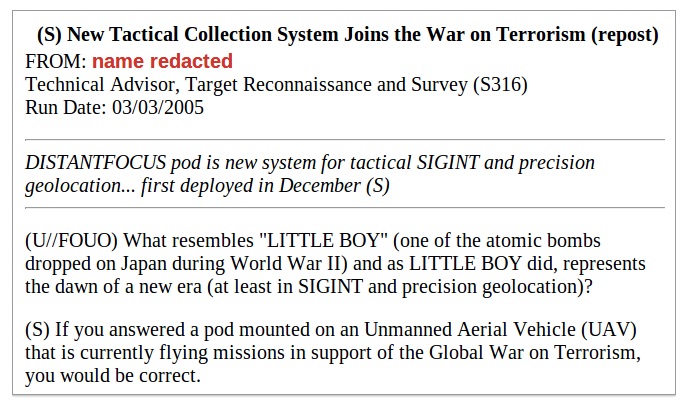
Speeding up the targeting cycle has involved more than the pre-emptive identification of targets. In contrast to the fixed targets for nuclear strikes, today’s Predators and Reapers are typically directed against mobile targets virtually impossible to locate in advance. Pursuing these fleeting ‘targets of opportunity’ relies on a rapidly changing and expanding suite of sensors to identify and track individuals in near-real time. In 2004 the Defense Science Board recommended the Pentagon establish ‘a “Manhattan Project”-like program for ID/TTI’ [identification, tagging, tracking and locating], and one year later a Technical Advisor working for the National Security Agency’s Target Reconnaissance and Survey Division posed the following question:

NSA's Little Boy

The onboard sensor suite in the pod has since become ever more effective in intercepting and monitoring electronic communications as part of a vast system of digital data capture, but Predators had already been armed with Hellfire missiles to compress the kill-chain still further, and to many commentators the most radical innovation in later modern war has been the fusion of sensor and shooter in a single platform. The new integrated systems were first trialled – on a Predator flown by test pilots from General Atomics – in February 2000 at Indian Springs Auxiliary Field. The main objective was to hunt and kill Osama bin Laden, and at the request of the Air Force and the CIA a series of tests was carried out.

First, the Air Force wanted to determine whether the Predator could withstand a missile being fired from beneath its insubstantial wings (a ghostly echo of earlier anxieties over the survivability of the Enola Gay and its successors – though plainly much reduced by the absence of any pilot on board).

Second, the CIA wanted to assess the likely effects of a Hellfire strike on the occupants of a single-storey building like those found in rural Afghanistan (nuclear tests had used mannequins and pigs as human surrogates; these used plywood cut-outs and watermelons).

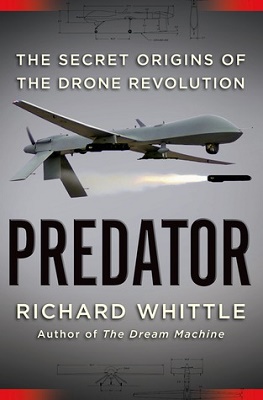
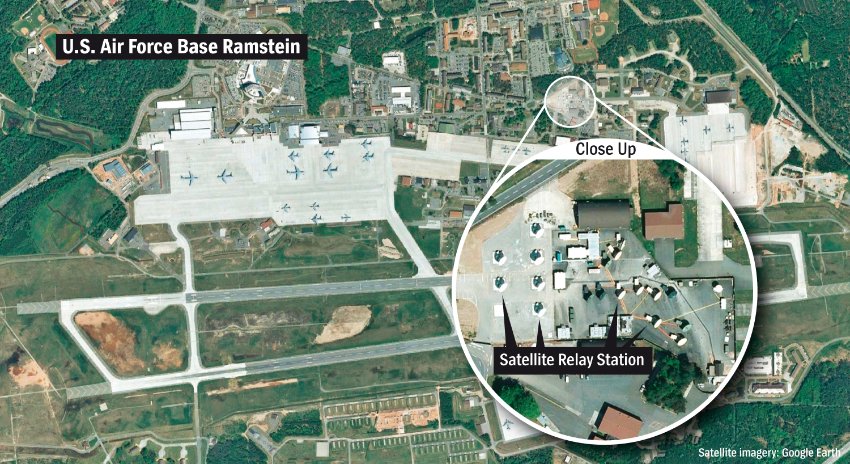
predatorBoth sets of tests were eventually successful (see also here) but, as Richard Whittle shows in consummate detail, a series of legal and diplomatic obstacles remained. In order to secure satellite access over Afghanistan, previous Predator flights to find bin Laden had been flown from a ground control station at Ramstein Air Base in Germany. But using a Predator to kill bin Laden was less straightforward. After protracted debate, US Government lawyers agreed that a Predator armed with a missile would not violate the 1987 Intermediate-Range Nuclear Forces Treaty, which eliminated nuclear and conventional missiles with intermediate ranges but which – unhelpfully for the CIA – defined missiles as ‘unmanned, self-propelled … weapon-delivery vehicles’; the lawyers determined that the Predator was merely a platform and, unlike a cruise missile, had no warhead so that it remained outside the Treaty. But they also insisted that the Status of Forces Agreement with Germany would require Berlin’s consent for the activation of an armed Predator. (The United States stored tactical nuclear warheads at Ramstein until 2005; although the US insisted it retained control over them, in the event of war they were to have been delivered by the Luftwaffe as part of a concerted NATO nuclear strike).

RAMSTEIN English captions

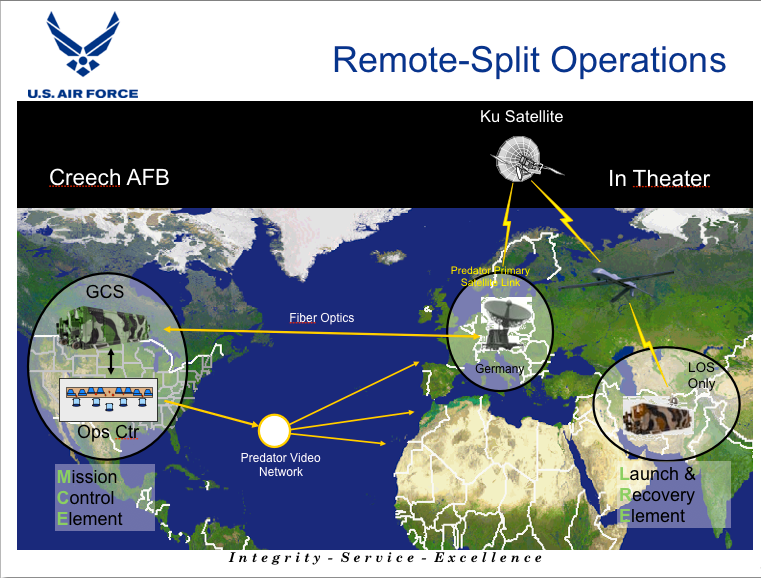
The need to bring Berlin onside (and so potentially compromise the secrecy of the project) was one of the main reasons why the ground control station was relocated to Indian Springs, connected to the satellite link at Ramstein through a fibre-optic cable under the Atlantic:

remote-split-operations-usaf

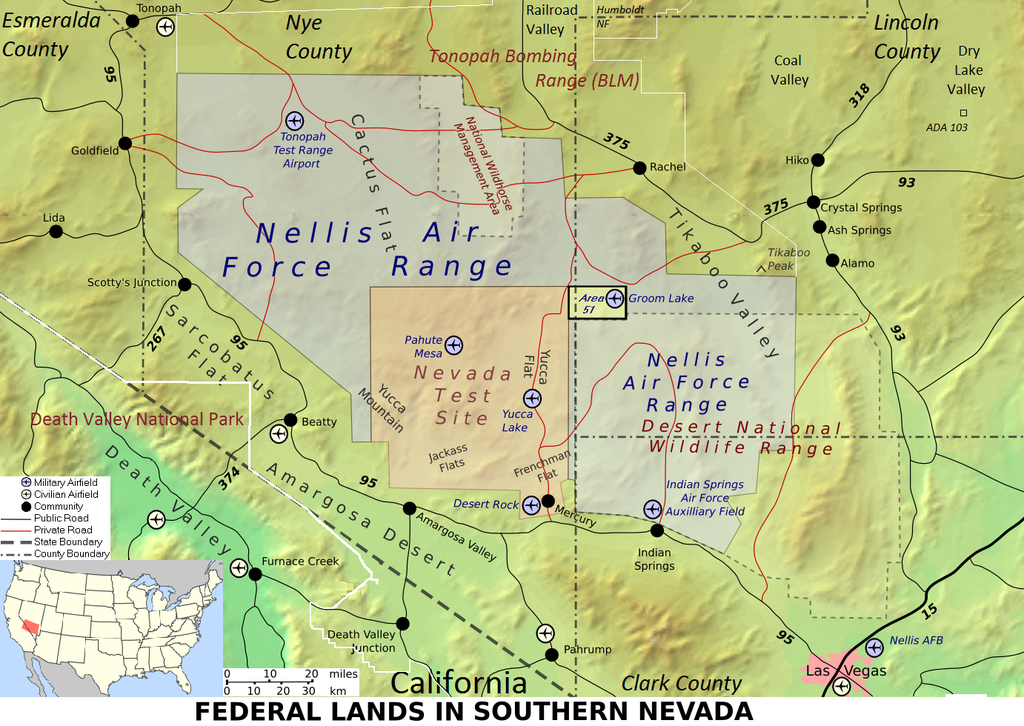
In fact, since 1952 Indian Springs had been a key portal into the Nevada Test Site – its purpose was to support both US Atomic Energy Commission nuclear testing at the Nevada Proving Grounds and US Air Force operations at the Nellis Air Force Base’s vast Gunnery and Bombing Range – and in June 2005 it morphed into Creech Air Force Base: the main centre from which ‘remote-split’ operations in Afghanistan, Pakistan and elsewhere are flown by USAF pilots. Most of the covert operations are directed by the CIA (some by Joint Special Operations Command), but the Predators and Reapers are used for more than targeted killing; the primary missions are still to provide ISR for conventional strikes and now also close air support for ground troops.

Wfm_area51_map_en

The geographies overlap, coalesce and – even allowing for the differences in scale – conjure up a radically diffuse and dispersed field of military violence.  When Tom Vanderbilt described ‘a war with no clear boundaries, no clear battlefields … a war waged in such secrecy that both records and physical locations are often utterly obscured’ he was talking about nuclear war.  But exactly the same could be said of today’s drone wars, those versions of later modern war in which the body becomes the battle space (‘warheads on foreheads’) and the hunting ground planetary: another dismal iteration of the ‘everywhere war’ (see here and here).

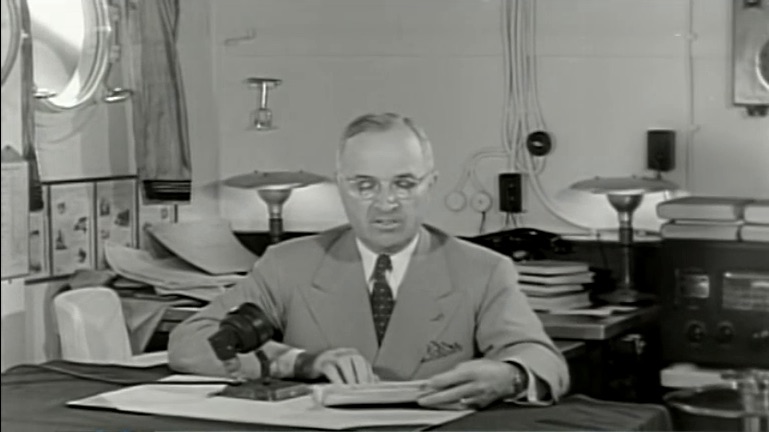
For all these connections and intersections, a key divide is the issue of civilians and casualties. On 9 August 1945 President Truman (below) described Hiroshima as a ‘military base’ selected ‘because we wished in this first attack to avoid, insofar as possible, the killing of civilians’.

TRUMAN Hiroshima speech

This was simply untrue, and similar – often no less deceptive – formulations are routinely used to justify US drone strikes and to minimise what is now called ‘collateral damage’. Still, the scale of civilian casualties is clearly different: usually dozens rather than hundreds of thousands.

And yet, there is something irredeemably personal and solitary about the response to death from either cause; parents searching for the bodies of their children in the ruins are as alone in Dhatta Khel as they were in Hiroshima.  When Yukiko Hayashi [her real name is Sachiko Kawamura] describes the anguish of a young woman and her father finding the remains of their family – the poem, ‘Sky of Hiroshima‘, is autobiographical – it is surely not difficult to transpose its pathos to other children in other places:

Daddy squats down, and digs with his hands
Suddenly, his voice weak with exhaustion, he points
I throw the hoe aside
And dig at the spot with my hands
The tiles have grown warm in the sun
And we dig
With a grim and quiet intent

Oh…
Mommy’s bone
Oh…
When I squeezed it
White powder danced in the wind
Mommy’s bone
When I put it in my mouth
Tasted lonely
The unbearable sorrow
Began to rise in my father and I
Left alone
Screaming, and picking up bones
And putting them into the candy box
Where they made a rustle

My little brother was right beside my mommy
Little more than a skeleton
His insides, not burnt out completely
Lay exposed…

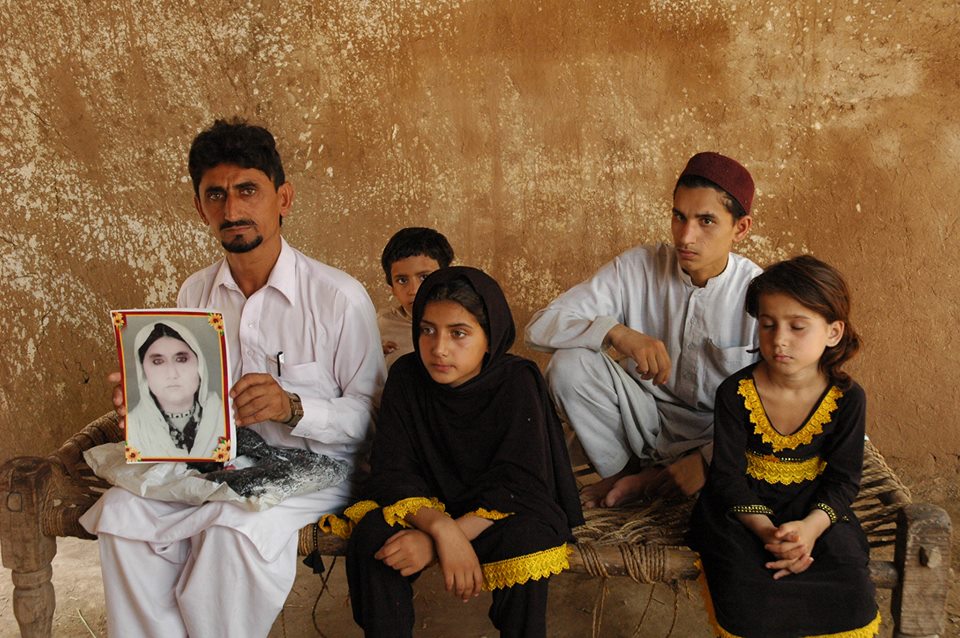
NOOR BEHRAM Orphans Dande Darpa Khel 21 August 2009

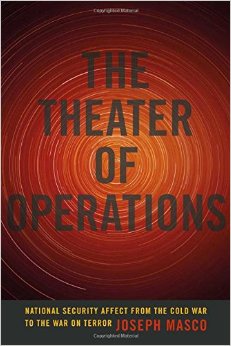
MASCO Theater of OperationsIn The Theater of Operations Joseph Masco draws a series of distinctions between the US national security state inaugurated by the first atomic bombs and the counter-terror state whose organs have proliferated since 9/11.

He properly (and brilliantly) insists on the affects instilled in the American public by the counter-terror state as vital parts of its purpose, logic and practice – yet he says virtually nothing about the affects induced amongst the vulnerable populations forced to ‘live under drones’ and its other modes of military and paramilitary violence.

In Waziristan no air raid sirens warn local people of a strike, no anti-aircraft systems protect them, and no air-raid shelters are available for them to seek refuge.

1374361_10151671014096363_1647526274_n

Hence young Zubair Rehman’s (above, top right) heartbreaking admission after a drone killed his grandmother as she tended the fields in Ghundi Kala in North Waziristan (see here and here):

‘I no longer love blue skies. In fact, I now prefer grey skies. The drones do not fly when the skies are grey.’

Post-atomic eyes

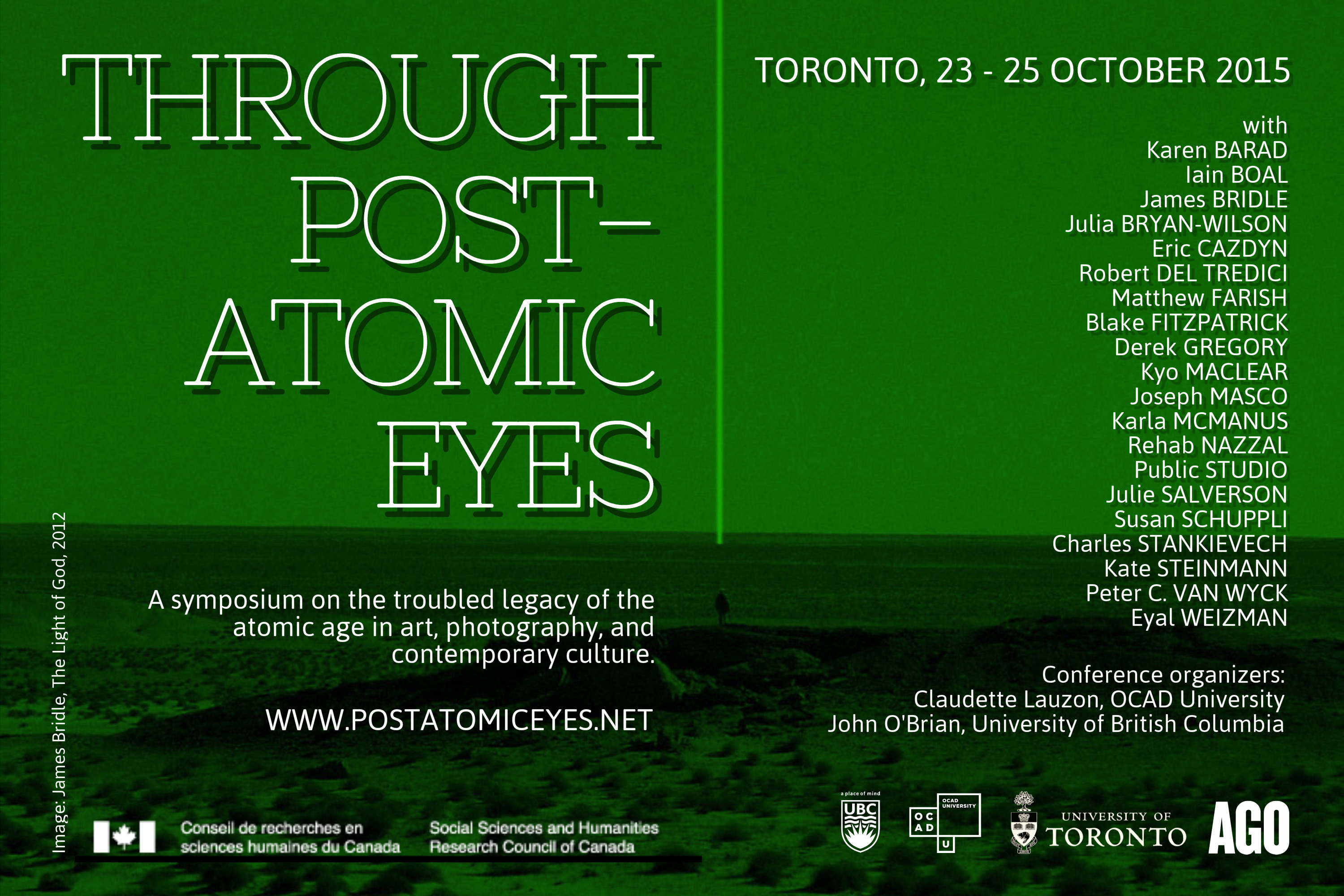
Postcard

I’m speaking at a conference called “Through Post-Atomic Eyes” in Toronto next month.

Through Post-Atomic Eyes brings together an interdisciplinary group of artists and scholars to explore the complex legacy of the atomic age in contemporary art and culture. In what ways do photography and other lens-based art practices shed light on this legacy in the 21st century, and how has atomic culture shaped contemporary intersections of photography, nuclear industries, and military techno-cultures? Join us as we explore some of the most urgent issues of our time, from climate change and the Anthropocene to surveillance culture and the advent of drone warfare, through a post-atomic lens.

Through Post-Atomic Eyes is scheduled to coincide with John O’Brian’s groundbreaking exhibition, Camera Atomica, the first substantial exhibition of nuclear photography to encompass the postwar period from the bombings of Hiroshima and Nagasaki in 1945 to the meltdown at Fukushima in 2011. Now on view at the Art Gallery of Ontario (until November 15, 2015).

(John’s exhibition at the AGO follows a successful showing in London late last year: see my post here).

I confess that when I received the Toronto invitation I was at a loss: how was I supposed to view drone warfare through post-atomic eyes?  At first sight, any comparison between America’s nuclear war capability and its drone strikes in Afghanistan, Iraq, Pakistan, Somalia, Syria and Yemen seems fanciful. The scale of investment, the speed and range of the delivery systems, the nature of the targets, the blast radii and precision of the munitions, and the time and space horizons of the effects are so clearly incommensurable.  So I dragged my feet, accepting the invitation because the other presenters (see the poster above) include so many people whose work I admire, but not making much progress.

Eventually I realised that the root problem was that, while I had extensive research on genealogies of bombing under my belt, I knew next to nothing about The Bomb.  So, while I’ve been burrowing away in the archives in London for my project on casualty evacuation 1914-2014 and also inching my “Dirty Dancing’ essay into the home straight, I’ve also been reading and reading and reading.  So much wonderful, sobering material out there, some of which surfaced in my recent posts on Hiroshima and the metastases of nuclear weapons since then.

And, as I’ll try to show in detail in my next post, I’ve found a startling series of coincidences, convergences and transformations.  I now have a rough shape for my presentation, which I’m calling “Little Boys and Blue Skies“: a title which, as you’ll soon see, traces an arc from bombing Hiroshima to bombing Waziristan.  Watch this space.

War Material

SARGENT Two soldiers at Arras

I’m thrilled to say that the (very!) long-form version of The Natures of War, the 1st Neil Smith Lecture which I gave at the University of St Andrews in November 2013, is now online (‘Early View’) at Antipode, all 54 pages of it.

Here is the abstract:

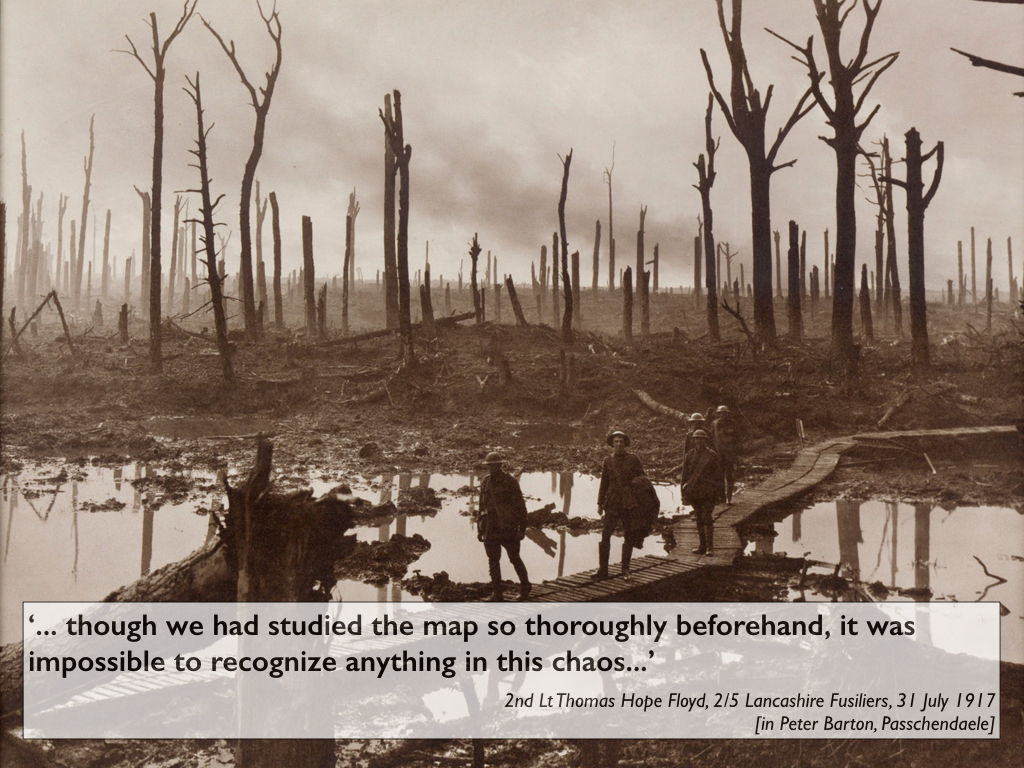
“Nature” is more than a resource bank whose riches can trigger armed conflict and finance its depredations; it is also a medium through which military and paramilitary violence is conducted. The militarisation of nature is part of a dialectic in which earthy, vibrant matter shapes the contours of conflict and leaves its marks on the bodies of soldiers who are both vectors and victims of military violence. Three case studies identify some of the central bio-physical formations that became entangled with armed conflict in the twentieth century: the mud of the Western Front in the First World War, the deserts of North Africa in the Second World War, and the rainforests of Vietnam. Taken together, these reveal vital connections between the materiality and corporeality of modern war and their continued relevance to its contemporary transformations.

You can still find the original, non-Harvard style version under the DOWNLOADS tab – and I’m truly grateful to Andy Kent for relieving me of the task of converting my original MS into the Harvard system.

The image above, incidentally, is John Singer Sargent‘s Two soldiers at Arras (1917), and is a perfect illustration of this passsage from the essay:

In the face of these horrors, some soldiers came to regard themselves as having become as “un-natural” as the militarised, industrialised natures in which they were embedded. The Tommy “will soon be like nothing on earth”, wrote one officer on the Somme in January 1916. “If only we could be clothed in rubber all over and fed through a tube I think some real progress in our equipment might have been made”. He was only half-joking. The next phase in the emergence of this cyborg warrior can be seen in the tank battles that raged across the deserts of North Africa during the Second World War. But, as I must now show, even in the midst of this more fully mechanised warfare, bio-physical entanglements remained immensely powerful—and the human body intensely vulnerable.

I then do the same for Vietnam.

My plan is to rework this version: to incorporate as many of the images I used in the Vietnam extracts I posted online here and here (together with others from the Western Front and the Western Desert), to add a fourth case study of Afghanistan, and to include the revised version in a new book of essays that I’m calling War material.

The plan looks like this (in each case the original essays, apart from the intro, are available under the DOWNLOADS tab too; I’m re-working those versions, planing away any overlaps, and adding more images):

Chapter 1: War material

Chapter 2: Gabriel’s map

Chapter 3: The Natures of War

Chapter 4: Doors into Nowhere

Chapter 5: Lines of Descent

These are all more or less ready to go, apart from the introduction, but I’m debating whether to add a sixth chapter, called ‘Wounds of war’, which would parallel ‘The Natures of War’ in many ways and chart the changing geographies of casualty evacuation from war zones, 1914-2014.

Each of the essays in the book, even in their present form, has something to say about the way in which the conduct of modern war has – and has not – changed over the last hundred years, but the title also tilts at those who seem to think that everything we need to know about modern military violence was uncannily anticipated by Michel Foucault in his (I too think brilliant) Paris lectures in the 1970s so that this absolves them of the need for any research or even reading into the materialities of war (a strangely non-Foucauldian assumption, given his own frequent immersion in the archive and his densely empirical way of working).

I’d be grateful for any comments or suggestions.