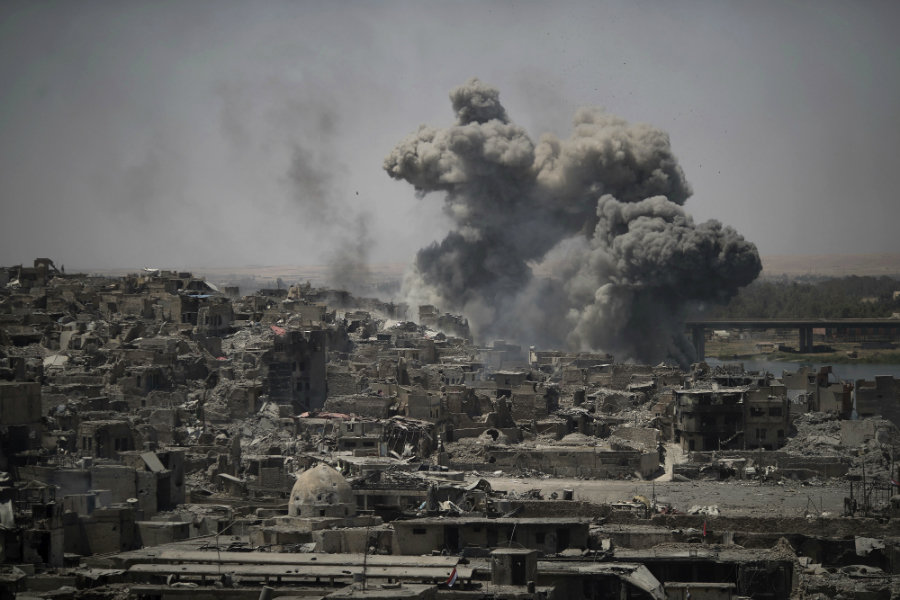
Cities under siege (I)

This is the first of a two-part post, in which I return (at last!) to a promissory note I issued last year about siege warfare in Syria.  My return is prompted by a series of reports about the catastrophic situation in Eastern Ghouta (a suburb of Damascus) and Idlib.

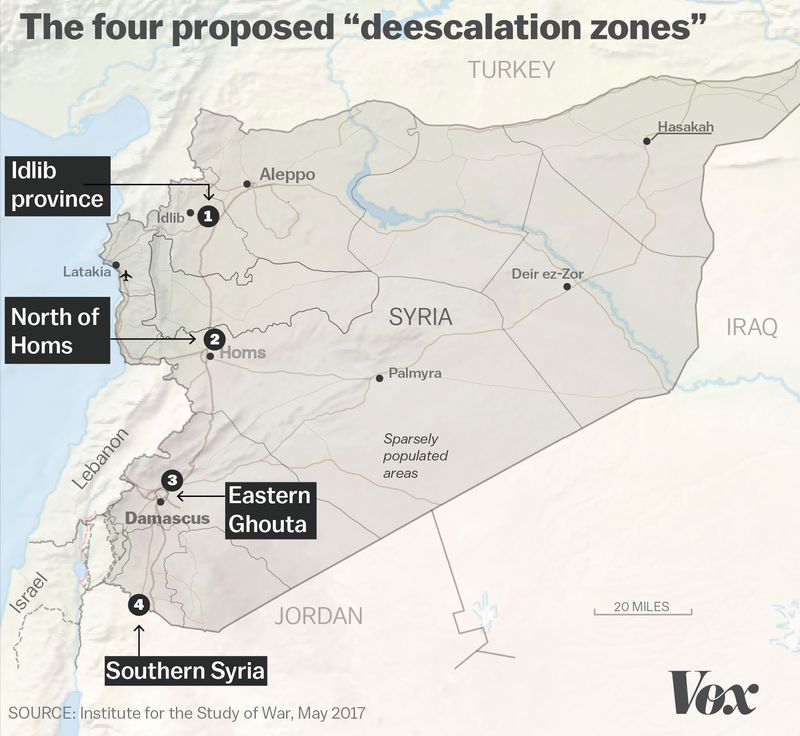
First, Eastern Ghouta, which has been under siege by the Syrian Arab Army and its allies since April 2013.  Most of Eastern Ghoutta was designated as one of four ‘de-escalation zones’ (see map above) under an agreement reached in May 2017, in which aerial violence and all other hostilities would be suspended for six months and humanitarian aid would be allowed across the siege lines.

But the agreement turned out to be primarily a way of killing time.  Aron Lund writes:

In September, just as the Eastern Ghouta’s de-escalation zone was finalized, the situation abruptly worsened. After ordering a halt to the already heavily restricted commercial traffic through the Wafideen crossing [see map below: more here and here], the Syrian government refused to permit any more UN aid missions.

It was a transparent attempt to stoke the humanitarian emergency in Eastern Ghouta, but this time the effect was more severe than during previous rounds of food cuts. With the rebel trading tunnels out of commission for half a year, smuggling could no longer compensate for the shortfall or bring in medicine or basic necessities like fuel, which has not entered the Ghouta since February.

Food stockpiles dwindled quickly and triggered a scramble for whatever remained available on the market, the panicky mood inflamed by suspicions that rebel-connected businessmen were hoarding goods for speculation purposes. From August to October, the already high prices inside Eastern Ghouta increased fivefold, far beyond any other region of Syria.

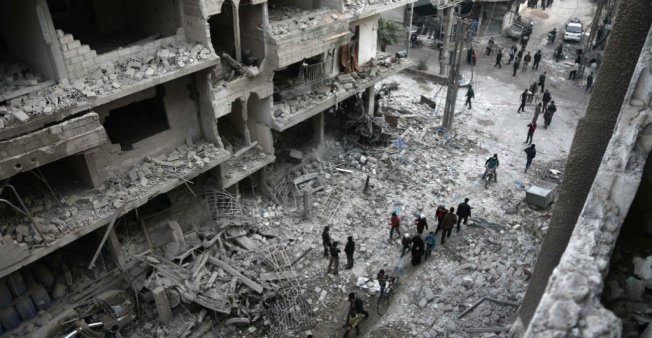
Air strikes (above) and artillery bombardment resumed in November and have continued, and urgent medical evacuations were denied.  Here is UN Senior Adviser Jan Egelan in December 2017:

Six months ago a very detailed evacuation plan was delivered to the government for needy cases of evacuation, on medical grounds from eastern Ghouta.  Since then, names have been added regularly and it is now, we now have a revised list of 494 names. There are among them 282 cases that need] specialized surgery, specialized treatment, specialized investigations that [they] cannot get inside. There are 73 severe cancer cases, 25 kidney failure cases and 97 heart disease cases [that are] very concerning, five acutely malnourished children that need to be evacuated, six acute mental health cases etc.

The list had to be revised because 12 patients had died while waiting for ‘a half an hour drive to hospitals in Damascus and elsewhere that stand ready to help and save lives.’  Egelan explained that ‘231 of the cases are female, 137 are children, 61 are over 65 years old.  So these are civilians, in the midst of this horrific war.’

He added:  ‘Civilians, children, no one can be a bargaining chip in some kind of tug of war, where many things are negotiated at the same time. These have a right to be evacuated and we have an obligation to evacuate them.’

Siege warfare involves not only closure of movement across the lines for those inside; it also involves opening the zone to violence from the outside.  The assault on Eastern Ghouta has provided ample evidence, but the second case is even more instructive.

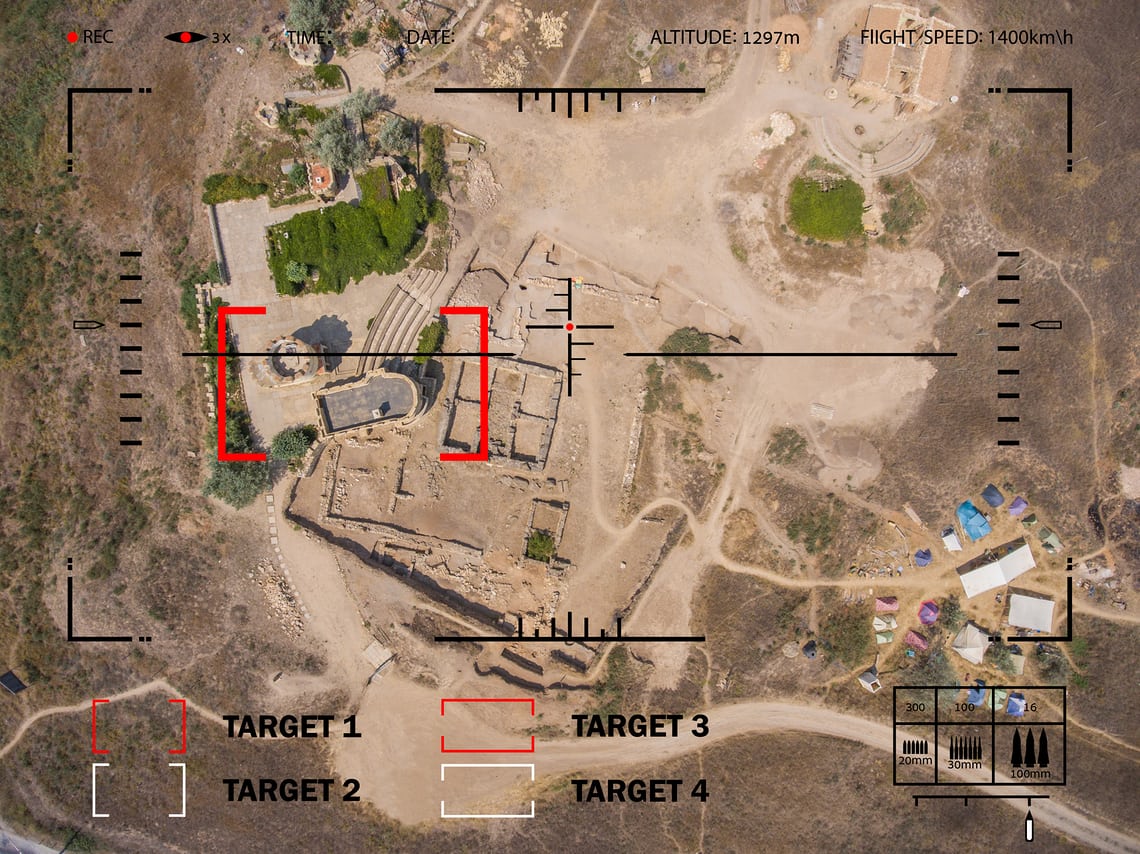
And so, second, what was supposed to be the ‘de-escalation’ zone of Idlib has been converted into a ‘kill box’ (for a discussion of the term in relation to remote warfare, see here and here).  Here is Martin Chulov and Kareem Shaheen writing in the Guardian:

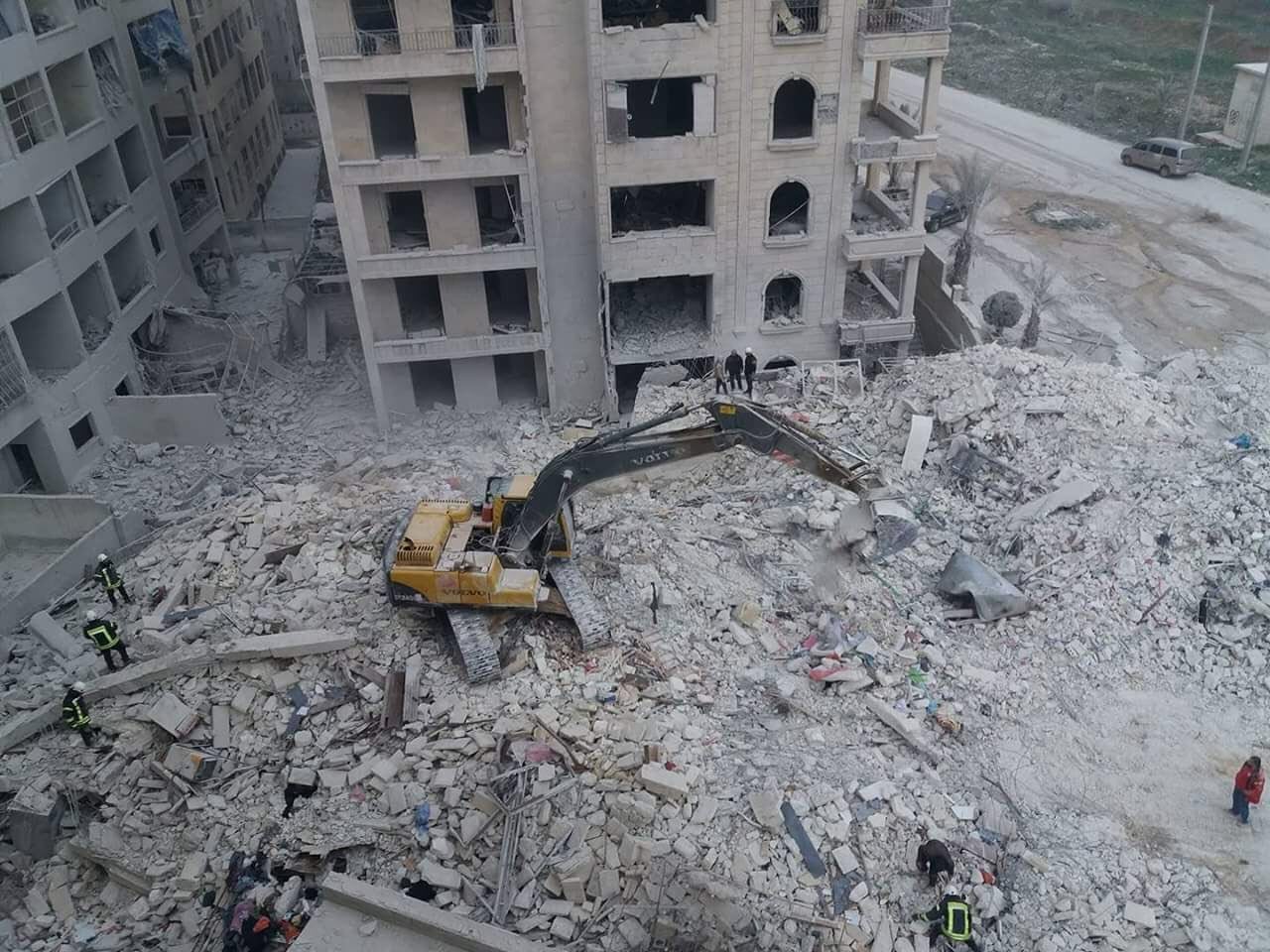
Russian and Syrian jets bombed towns and villages across north-west Syria on Monday, devastating civilian areas and forcing fresh waves of refugees to flee to open ground in the biggest aerial blitz on opposition-held areas since the fall of Aleppo more than a year ago.  Monitoring groups said as many as 150 airstrikes were recorded in Idlib province by Monday, with dozens more pounding up to 18 towns across the region by nightfall.  Residential areas bore the brunt of the strikes, which severely damaged at least two major hospitals, and levelled dozens of buildings in which panicked locals had taken shelter.

Refugees and locals say they fear that Idlib has been transformed into a kill box, with the international community paying scant regard to their fate, as regional powers, Russia, Turkey and Iran all vie for influence in a vital corner of the country.

These strikes were in retaliation for the downing of a Russian aircraft – in this spectacularly asymmetric war, only air-to-ground attacks are acceptable – but aerial violence against civilian infrastructure in Idlib precedes that incident.  Owdai (al Hisan) hospital in Saraqab City was hit by air strikes on 21 and 29 January, for example, and has now closed indefinitely  MSF reports that the loss of the hospital is all the more devastating because ‘medical needs in the area are expected to increase due to the massive displacement of Syrians fleeing fresh violence in Idlib’s eastern countryside and northeast Hama.’

Since then, the strikes intensified:

“The Russians are on a frenzy. They’re going mad. The shelling is ongoing throughout the day and night. The warplanes are hitting residential areas,” Hadi Abdullah, a local journalist, told Al Jazeera by phone from the town of Kafr Nabl in the northwestern Syrian province bordering Turkey…

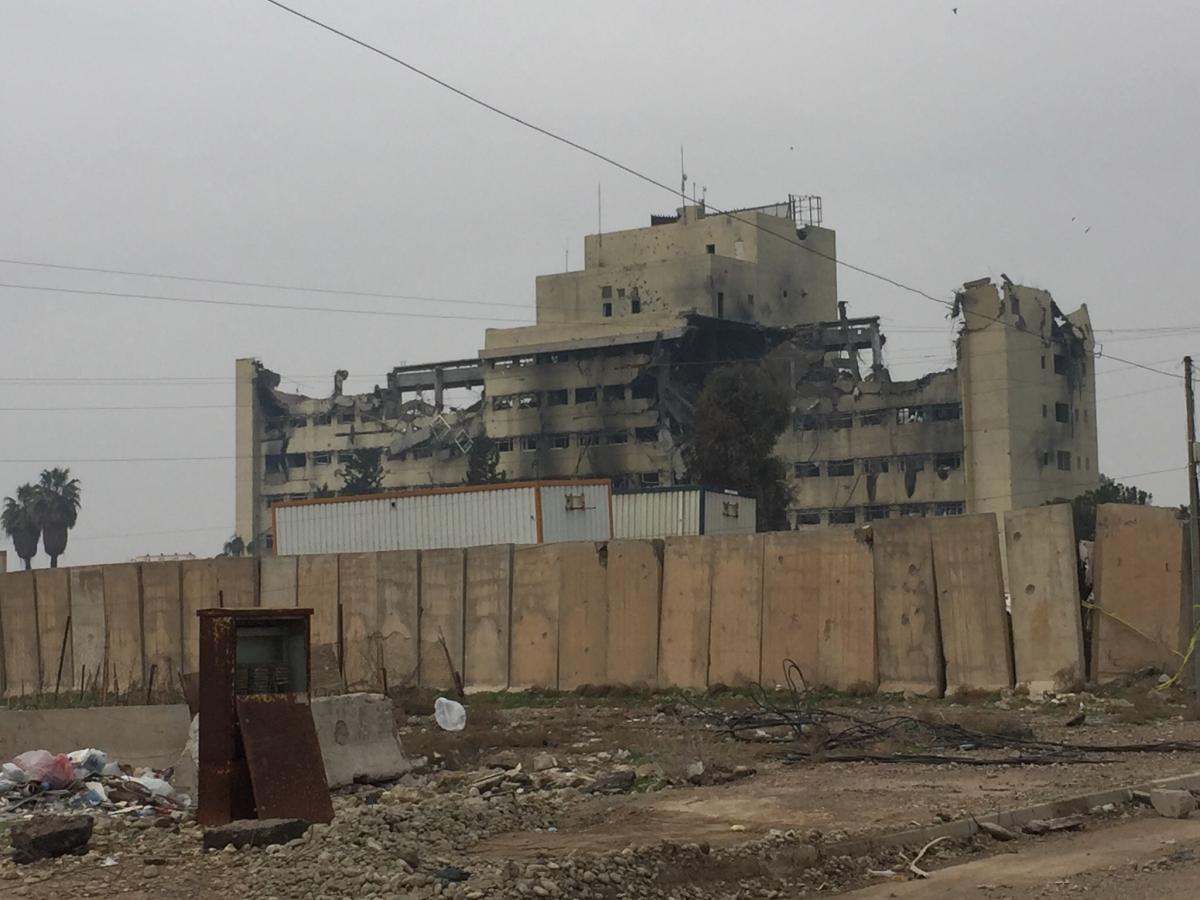
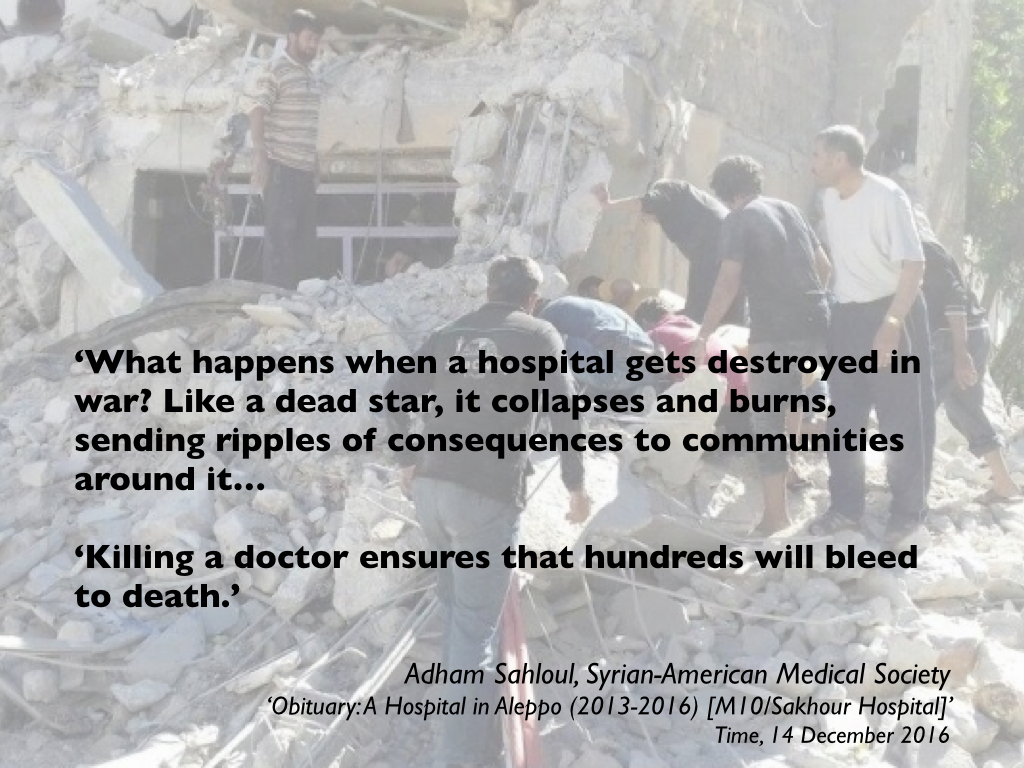
The main hospital in Maaret al-Numan [above: this was the largest hospital in Idlib], east of Kafr Nabl, has stopped working after it was hit by air strikes, according to the civil defence – also known as the White Helmets.  “About 10 air raids hit the hospital. It was a disaster,” said Hadi, who had rushed to the scene.”The most difficult and heartbreaking scene was when the volunteers were quickly pulling the babies out of the hospital. I can’t get the image out of my head,” he recalled with a trembling voice.

‘De-escalation’ has become a prelude to its inverse.  “There is a misperception that the de-escalation areas have resulted in peace and stability,’ UN assistant secretary-general Panos Moumtsiz said today. “If anything, these have been serious escalation areas.”

With all these horrors in mind, in my second post I’ll turn to the back-story.  You can find other dimensions to the critique of siege warfare in Susan Power, ‘Siege warfare in Syria: prosecuting the starvation of civilians’, Amsterdam Law Forum 8: 2 (2016) 1-22 here or Will Todman, ‘Isolating dissent, punishing the masses: siege warfare as counterinsurgency’, Syria Studies 9 (1) (2017) 1-32.

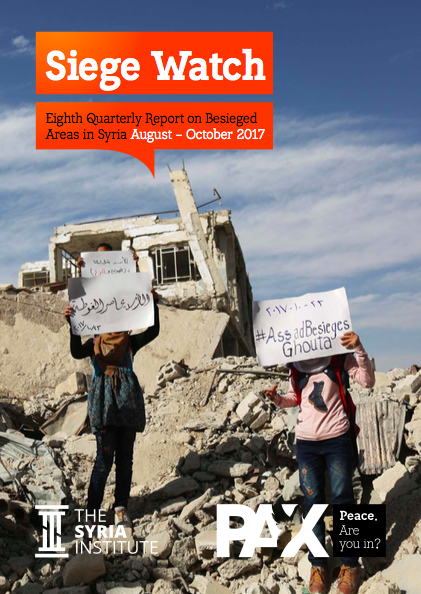
There’s also a series of important quarterly reports from Siege Watch; these started in February 2016, and the most recent covers August-September 2017 and includes a detailed analysis of both Eastern Ghouta and Idlib.

I plan to approach the issue through one of my favourite books, Steve Graham‘s Cities under siege.  Steve’s object was what he called ‘the new military urbanism’ but the situation in Syria – and elsewhere: think Mosul in Iraq (see, for example, here: scroll down) or Israel’s endless sieges of Gaza (see, for example, here) – demonstrate the extraordinary capacity of later modern war to combine cutting-edge technology (never has that adjective been more dismally appropriate) with medieval cruelty.  There is another difference; for all Steve’s analytical passion – and empathy – the voices of those inside the cities under siege are largely silent, yet in Syria (again: and elsewhere) digital media allow us to listen to them and to witness their suffering.  More soon.

Re-launch and Rescue

The much-missed Radical Philosophy has just re-launched as an open access journal with downloadable pdfs here.  The site also includes access to the journal’s wonderful archive.

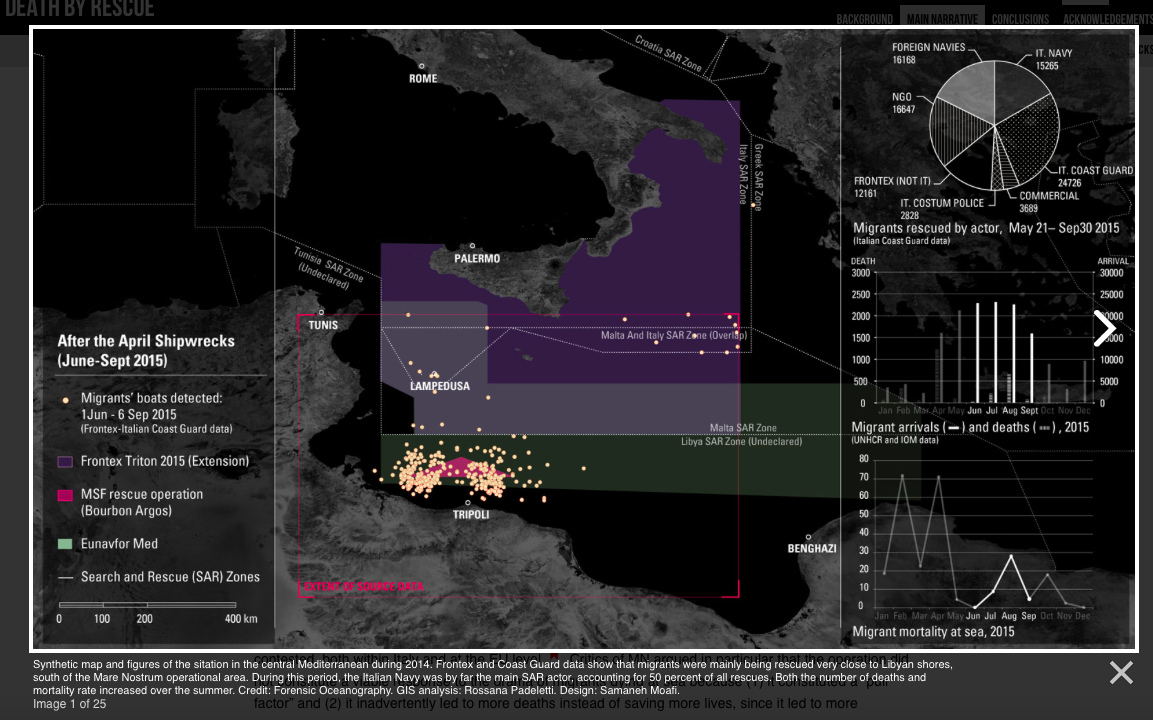
Among the riches on offer, I’ve been particularly engaged by Martina Tazzioli‘s Crimes of solidarity. which picks up on one of the central themes in the last of the ‘old’ RP series.  It addresses what she calls ‘migration and containment through rescue’, the creeping criminalisation of the rescue of migrants in the Mediterranean.  In a perceptive section on ‘Geographies of Ungrievability’ Martina writes:

The criminalisation of alliances and initiatives in support of migrants’ transit should not lead us to imagine a stark opposition between ‘good humanitarians’, on the one side, and bad military actors or national authorities, on the other. On the contrary, it is important to keep in mind the many entanglements between military and humanitarian measures, as well as the role played by military actors, such as the Navy, in performing tasks like rescuing migrants at sea that could fall under the category of what Cuttitta terms ‘military-humanitarianism’. Moreover, the Code of Conduct enforced by the Italian government actually strengthens the divide between ‘good’ NGOs and ‘treacherous’ humanitarian actors. Thus, far from building a cohesive front, the obligation to sign the Code of Conduct produced a split among those NGOs involved in search and rescue operations.

In the meantime, the figure of the refugee at sea has arguably faded away: sea rescue operations are in fact currently deployed with the twofold task of not letting migrants drown and of fighting smugglers, which de facto entails undermining the only effective channels of sea passage for migrants across the Mediterranean. From a military-humanitarian approach that, under Mare Nostrum, considered refugees at sea as shipwrecked lives, the unconditionality of rescue is now subjected to the aim of dismantling the migrants’ logistics of crossing. At the same time, the migrant drowning at sea is ultimately not seen any longer as a refugee, i.e. as a subject of rights who is seeking protection, but as a life to be rescued in the technical sense of being fished out of the sea. In other words, the migrant at sea is the subject who eventually needs to be rescued, but not thereby placed into safety by granting them protection and refuge in Europe. What happens ‘after landing’ is something not considered within the framework of a biopolitics of rescuing and of letting drown. Indeed, the latter is not only about saving (or not saving) migrants at sea, but also, in a more proactive way, about aiming at human targets. In manhunting, Gregoire Chamayou explains, ‘the combat zone tends to be reduced to the body of the enemy’. Yet who is the human target of migrant hunts in the Mediterranean? It is not only the migrant in distress at sea, who in fact is rescued and captured at the same time; rather, migrants and smugglers are both considered the ‘prey’ of contemporary military-humanitarianism.

As I’ve explained in a different context, I’m no longer persuaded by Grégoire’s argument about the reduction of the conflict zone (‘battlefield’) to the body, but the reduction of the migrant to a body adds a different dimension to that discussion.

In the case of the eastern Mediterranean, Martina describes an extraordinary (though also all too ordinary) ‘spatial rerouting of military-humanitarianism, in which migrants [fleeing Libya] are paradoxically rescued to Libya’:

Rather than vanishing from the Mediterranean scene, the politics of rescue, conceived in terms of not letting people die, has been reshaped as a technique of capture. At the same time, the geographic orientation of humanitarianism has been inverted: migrants are ‘saved’ and dropped in Libya. Despite the fact that various journalistic investigations and UN reports have shown that after being intercepted, rescued and taken back to Libya, migrants are kept in detention in abysmal conditions and are blackmailed by smugglers, the public discussion remains substantially polarised around the questions of deaths at sea. Should migrants be saved unconditionally? Or, should rescue be secondary to measures against smugglers and balanced against the risk of ‘migrant invasion’? A hierarchy of the spaces of death and confinement is in part determined by the criterion of geographical proximity, which contributes to the sidelining of mechanisms of exploitation and of a politics of letting die that takes place beyond the geopolitical borders of Europe. The biopolitical hold over migrants becomes apparent at sea: practices of solidarity are transformed into a relationship between rescuers and drowned.

There’s much more in this clear, compelling and incisive read.  A good companion is Forensic Architecture‘s stunning analysis of ‘Death by Rescue’ in The Left-to-Die Boat here and here (from which I’ve taken the image that heads this post).

Losing sight

May Jeong – whose excellent investigation of the US air strike on the MSF Trauma Centre at Kunduz I’ve commended before – has a new, equally enthralling extended report over at the Intercept on the sole survivor of a US drone strike in Kunar province in eastern Afghanistan on 7 September 2013: ‘Losing Sight‘.

It’s a long, rich read, but there are two issues I want to highlight.

First, May captures the stark, bio-physical horror of an air strike with an economy and force I’ve rarely seen equalled.  As I’ve noted before (see here and here), many critical analyses emphasise the bio-convergences that animate what happens behind the digital screens of the kill-chain and say remarkably little about those that lie on the other side.  It’s all too easy to lose sight of the embodied nature of remote warfare, though in another powerful essay Joseph Pugliese argues that it’s often not possible to speak of the corporeal at all in the face of such catastrophic violence: ‘The moment of lethal violence transmutes flesh into unidentifiable biological substance that is violently compelled geobiomorphologically to assume the topographical contours of the debris field’ ( ‘Death by Metadata: The bioinformationalisation of life and the transliteration of algorithms to flesh’, in Holly Randell-Moon and Ryan Tippet (eds) Security, race, biopower: essays on technology and corporeality (London: Palgrave, 2016) 3-20).

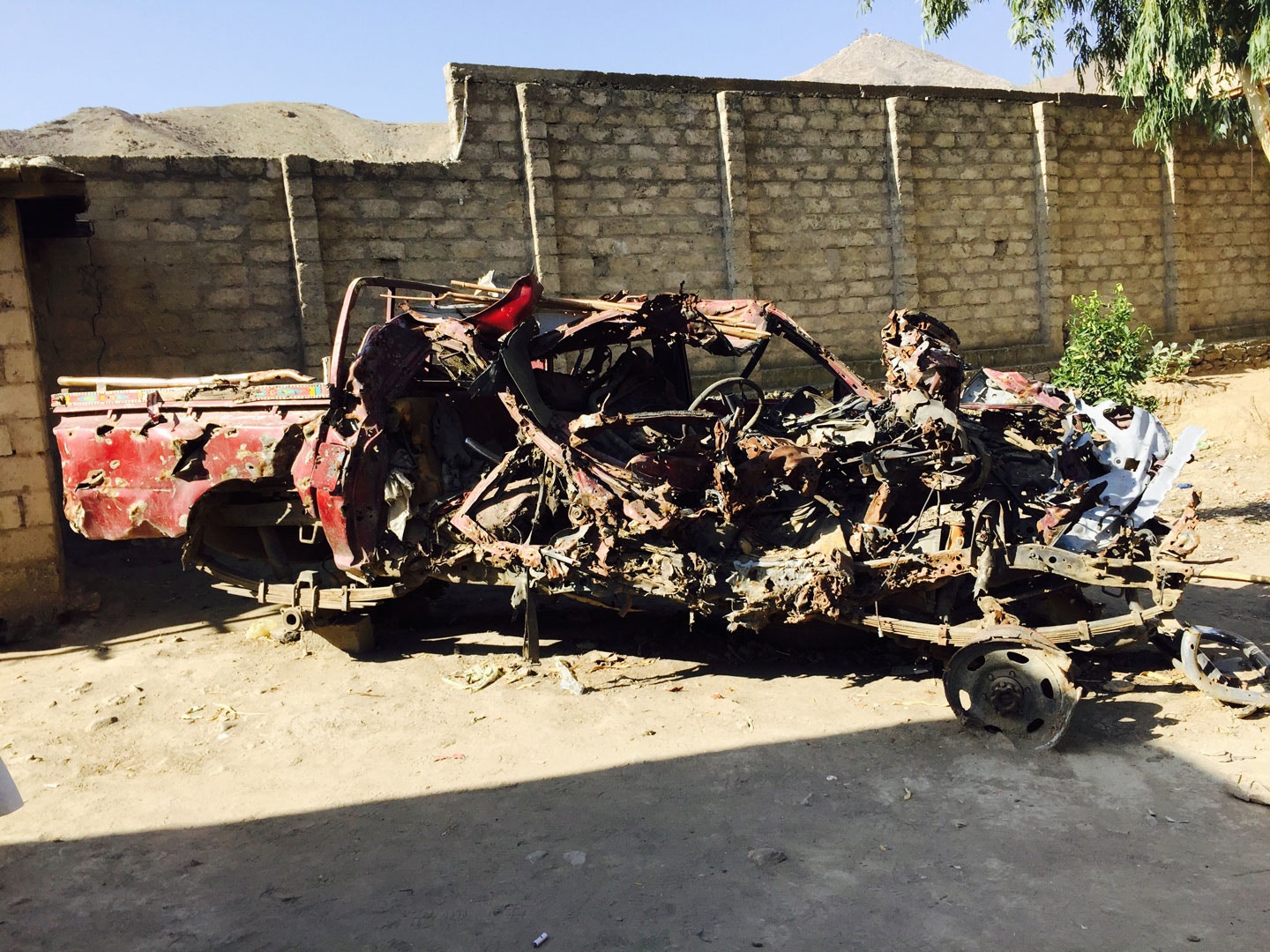
So here is May describing the strike on a pick-up truck in the early evening as it ground its way along a rough road through the Pech Valley; inside the cabin were the driver, three women and four young children, while seven men were crammed into the back along with sacks of flour they had bought to take back to their village.  There were a couple of miles from home, Gambir, when five missiles hit the truck in a 20-minute period.  Minutes later a second truck – which had been racing to catch up with the first – arrived close to the scene.  The driver (Mohibullah) scrambled up a small hill with a local villager:

[T]hey saw the husk of the pickup, strafed and lit up in flames. They hurried toward the fire.

When Mohibullah arrived at the blast site, he saw that of the 17 bags of flour he had helped load onto the truck, just two were intact. The rest had splayed open. There was a sick beauty to the scene — white powder over blood-red carnage.  These were men and women Mohibullah had grown up with, but he couldn’t recognize any of them. Their mangled body parts made it difficult to ascertain where one person ended and another began: spilled brains over severed limbs over ground flesh…

At first, it was just Mohibullah, another driver named Hamish Gul, and three villagers from Quroo who came to help. Most people in the area knew to stay away. The ghanghai [drones] often attacked again. Even so, the five of them worked at untangling the dead bodies — among them Aisha’s mother, father, grandmother, and little brother — and stacking them in neat rows atop the bed of Mohibullah’s truck.

Astonishingly, there was one survivor, but she too had been brutalised beyond recognition:

Mohibullah did not recognize the girl — her face had been “scrambled, she didn’t have her nose.” She still had both of her legs, but he wasn’t sure if her torso was connecting them to the rest of her body. It wasn’t until she asked in a frail voice — “Where is my father? Where is my mother?” — that he understood her to be his 4-year-old niece Aisha

A neighbor named Nasir held Aisha together for the drive back to Gambir. During the 2-mile journey, Aisha did not make a sound. Life seemed to be slipping away from her. Nasir assumed she would be buried. But when they arrived in Gambir, Aisha turned her head and asked for water. Her voice was so full of intent that they decided to rush her to a hospital in Asadabad.

Read those paragraphs again to see what Pugliese means.

Now the second issue starts to come into focus.  They reached Asadabad Provincial Hospital at 10 p.m., but the duty nurse could do little for Aisha:

Her stomach was missing, as were parts of her face and her left arm. He registered her into the hospital database, writing “acute abdominal injuries” next to her name, treated her with basic first aid, and sent her to the nearest hospital in Jalalabad, 57 miles away.

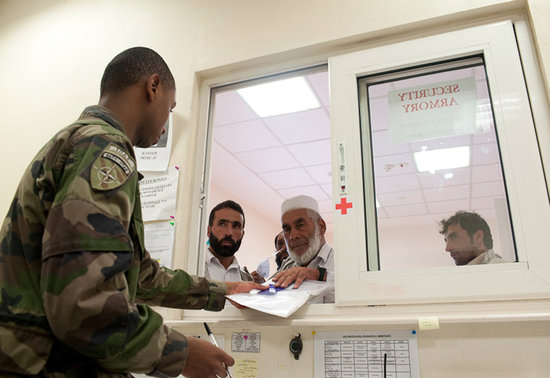
Aisha reached Jalalabad Public Health Hospital shortly after midnight, where her burns were dressed.  But here too there was little the surgeon could do; she had multiple head injuries, had lost one of her hands, and had major internal injuries.  A helicopter was called to take her to Kabul but it couldn’t land; a second helicopter arrived at midnight – 24 hours after she had reached Jalalabad – and ferried her to the French military hospital at Kabul Airport.

That hospital was a NATO Role 3 hospital, which had been run by the French since July 2009; by the summer of 2013 43 per cent of the procedures carried out by its staff had involved orthopaedic surgery.  Half of these were emergency surgeries; just 17 per cent of the patients were French military personnel and another 17 per cent were Afghan National Army or other ISAF soldiers,  while 47 per cent were Afghan (adult) civilians and 17 per cent were children.

Like other Role 3 hospitals, the facility was tasked with ‘damage-control’, for which it could call on three surgical teams rotation with a general surgeon, (abdominal, chest or vascular surgery) and an orthopedic surgeon as well as an ophthalmologist,  a neurosurgeon and an ENT or maxillofacial surgeon (I’ve taken these details from O. Barbier and others, ‘French surgical experience in the Role 3 Medical Treatment Facility of KaIA (Kabul International Airport…’, Orthopaedics and Traumataology: Surgery & Research 100 (6) (2014) 681-5; see also Christine Joubert and others, ‘Military neurosurgery in operation’, Acta Neurochir 158 (8) (2016) 1453-63).

While Aisha was being treated the hospital was visited by Afghan President Hamid Karzai.  Here is May again:

There, Karzai was confronted with a girl who had lost her sight, her nose, her lower lip, the skin on her forehead, the skin on her torso, her left hand, and nine members of her family, including her grandmother, her uncles, her aunts, her cousin, her mother, her father, and her baby brother.

“I cannot describe what I saw there,” Rangin Spanta, who served as national security adviser under Karzai and accompanied him to the hospital that day, told me from his home in Kabul. We were sitting on a rattan set on his front porch. In telling this story, Spanta covered his face and wept. “Still I have my trauma.” Spanta had lost five family members in the war, but the sight of Aisha, a girl who had been reduced to a “piece of biological construct,” gave him “the feeling that this was a kind of a nightmare.” Spanta, who had seen the guts of suicide bombers splattered across his car window and has visited double, triple, and quadruple amputees, said Aisha was the “most shocking thing I’ve seen in this war.” Karzai asked the attending doctor why her face was covered. “Because there is nothing there” was the answer.

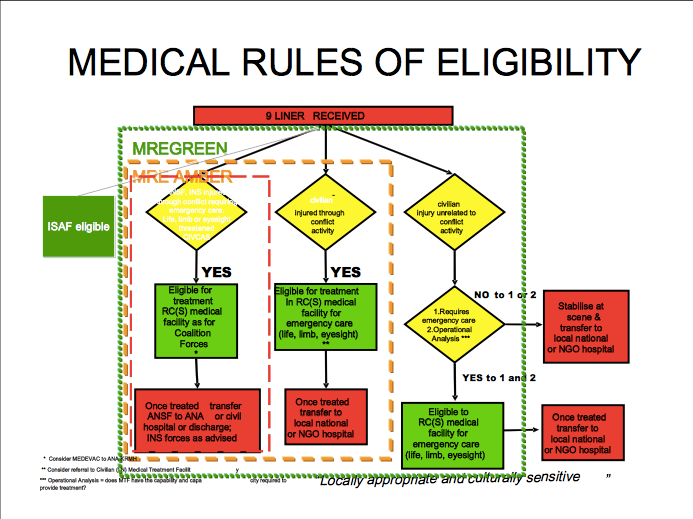
That a high proportion of patients the military hospital were Afghan civilians was by no means unusual for a Role 3 facility, but as I’ve noted before ISAF had strict Rules of Medical Eligibility.  Afghan civilians who were injured during military operations and/or needed ‘life, limb or eyesight saving care’ – both of which applied to Aisha – could be admitted to the international medical system.  But as soon as possible, Afghans were to be treated by Afghans and so, after surgical intervention, they had to be transferred to the local healthcare system.


That system was – is – often rudimentary, which is why Aisha was passed from Asadabad to Jalalabad before reaching Kabul.  And returning someone in her post-operative condition to that system was obviously fraught with danger.  Here is Emily Mayhew in A Heavy Reckoning describing the dilemma for doctors at the Role 3 hospital at Camp Bastion in Helmand province:

Some of the most difficult decisions taken by the Deployed Medical Director related to local patients, Afghans civilians, their families and others. Locals made up the majority (probably as much as 80 per cent) of the patients cared for during the lifetime of the hospital. During the war there were no Afghan hospitals with the technology or capability to ventilate patients with severe chest wounds, therefore leaving Bastion meant death. So anyone intubated who could not be returned to Britain had to stay at Bastion until they could breathe unaided, which sometimes took days or weeks. They were discharged only when it was certain they could survive away from Bastion: probably in a local hospital that was under severe stress, and which could only provide medical care for two or three hours a day, where the rest of the time they would be looked after by their families.

I’ll return to this in a later post, because in some cases those local hospitals have been supplemented and even supplanted by more advanced medical facilities operated or supported by international NGOs like Emergency or MSF.

But what is extraordinary in Aisha’s case is that her pathway did not follow any of these routes.  Karzai had asked both the French and the Germans to help, but they deferred to the Americans who insisted that she be taken to the United States for further treatment.  ‘Twelve days after the strike,’ May reports, ‘Aisha was gone’: but nobody ever told her relatives what had happened to her.  Every attempt they made to find out was rebuffed.

Months later her uncle was informed that she was at Walter Reed hospital in Maryland; she had been sponsored by an American organisation, Solace for the Children.  According to its website:

Each Summer Solace for the Children Summer Medical Program brings children from areas affected by war to the United States so they may receive medical care unavailable to them in their country. We currently focus our efforts on children in Afghanistan. Each fall, applications are accepted for treatment. Our office in Afghanistan typically receives more than 50 applications they must review and qualify. Youth are qualified for services based on need and health condition. They are then placed with a host family for approximately 6 weeks while receiving the medical care they require. After care, youth return to Afghanistan with a better quality of life, brighter future and hope for peace.

While ‘there was no official relationship between the U.S. military and Solace,’ May was told by the charity’s director Patsy Wilson, ‘individual members of the military often reached out to Solace, which had been the case for Aisha.’

“We just get calls. We get calls from the military all over Afghanistan,” she said. She repeatedly deferred to the military, stating, “I am sure they don’t say we kidnap children.” Wilson also expressed doubts that Aisha had been injured in a drone strike, despite the claims of scores of villagers interviewed by The Intercept. “We do not necessarily believe Aisha was in a drone strike, but I know that is one of the stories,” she said. When pressed for details, she said, “I have been told not to discuss that,” adding, “We have no facts. There are no facts.”

Those last sentences are becoming all too familiar, but in this case ISAF not only acknowledged the ‘IM [international military] aerial attack’ but carried out its own investigation into the civilian casualties.  It has never been declassified.

New depths

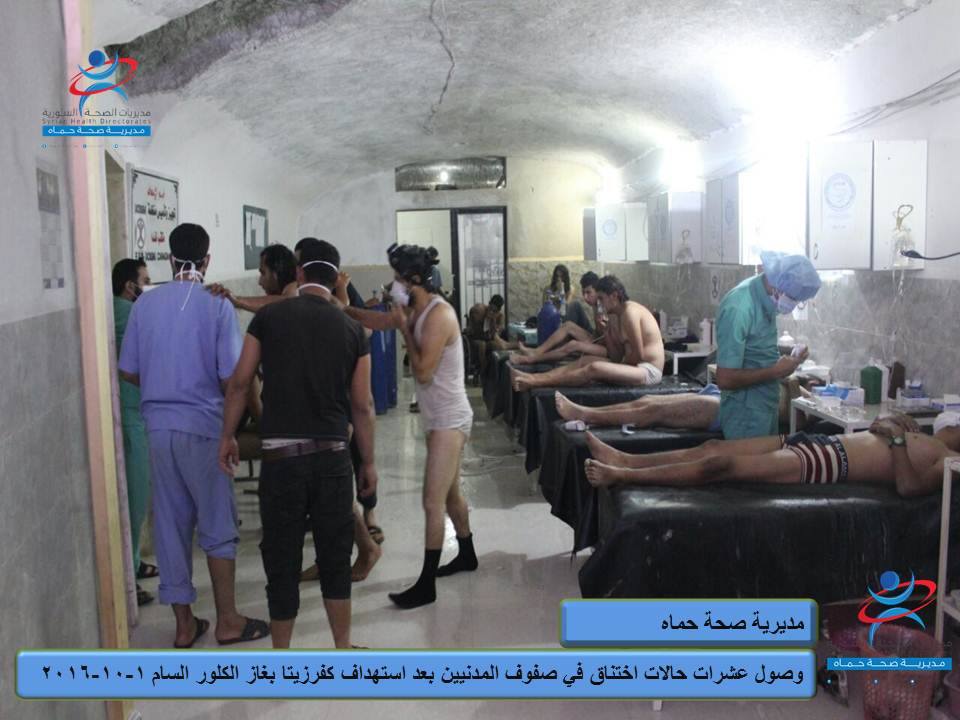
I’m still working on the (very) long-form version of ‘The Death of the Clinic’; in a previous post I described the attacks on hospitals in Syria and, in particular, the the construction – and destruction – of the underground Cave Hospital in Hama, Syria (see also my update on ‘Bombs, bunkers and borders’ here).  You can find videos and photographs from Jake Godin here.  The hospital has provided trauma surgery and paediatric care, treatment for major illnesses, and emergency treatment for victims of gas attacks (below):

Th hospital opened in late 2015; it suffered series of devastating air strikes in October 2016 (see here).

I have just received this bleak news:

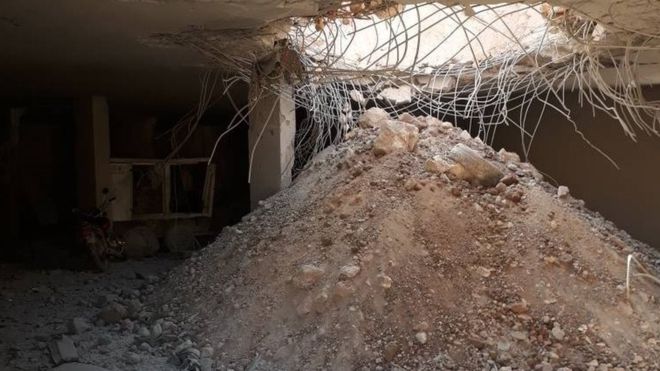
A few hours ago, at 12:15 pm Damascus time [on 1 February], the Al Maghara (Dr. Hassan Al Araj) Cave Hospital in Kafr Zita, Hama was hit by five missiles from an airstrike. The hospital, built under 60 feet of rock, suffered extensive damage.

The pharmacy was destroyed and there was extensive damage to the emergency department, which UOSSM supports, and ambulances. There were minor injuries and no casualties reported. The facility was put out of service. The hospital serves a population of 50,000 people, has 7,000 beneficiaries a month and performs roughly 150 major surgeries a month.

The hospital was previously hit by three airstrikes in 2018; on January 30, January 5, January 2. The hospital was built under 60 ft. of rock to protect it from airstrikes and is considered one of the most structurally fortified hospitals in all of Syria. Damaging the structure to this extent is only possible through advanced weapons/ bunker buster missiles.

Cities and War

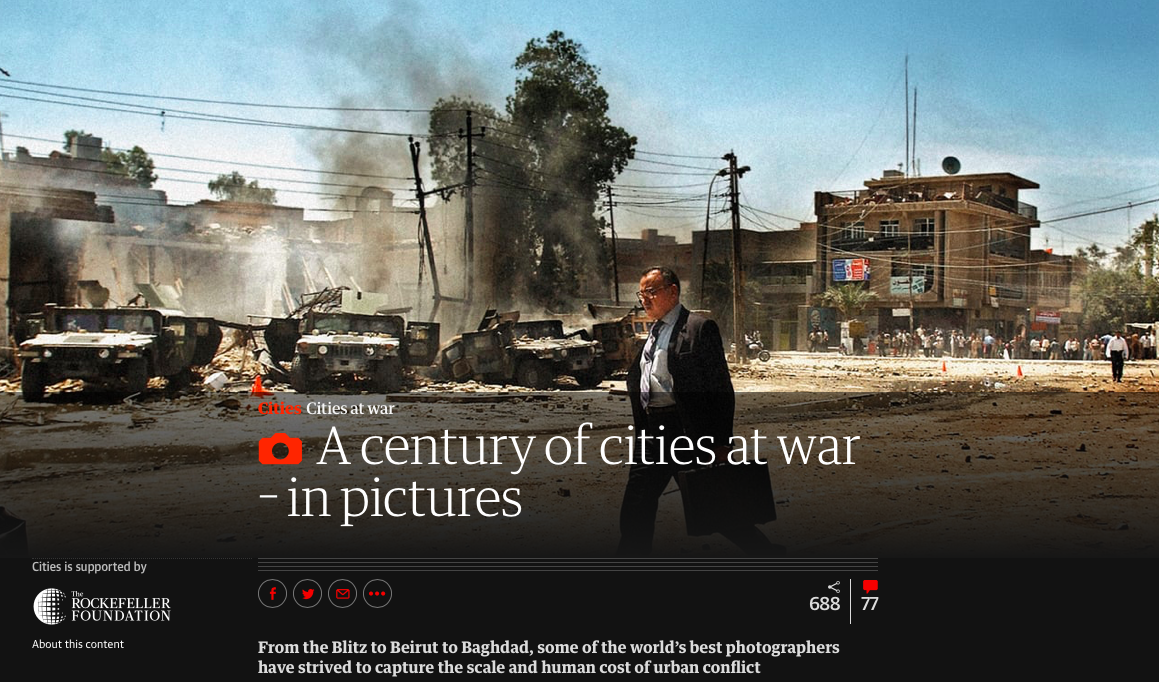
This week the Guardian launched a new series on Cities and War:

War is urbanising. No longer fought on beaches or battlefields, conflict has come to the doors of millions living in densely populated areas, killing thousands of civilians, destroying historic centres and devastating infrastructure for generations to come.

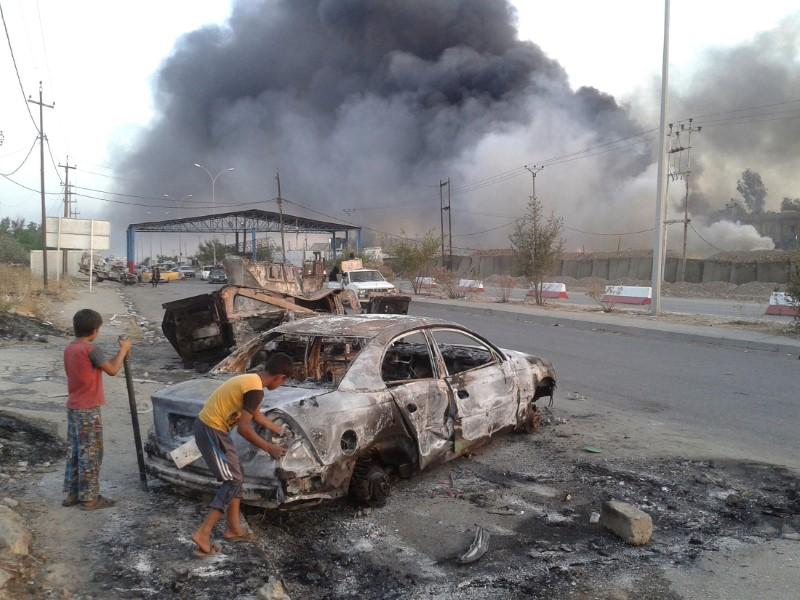
Last year, the world watched the Middle East as Mosul, Raqqa, Sana’a and Aleppo were razed to the ground. Across Europe, brutal attacks stunned urban populations in Paris, London and Berlin, while gang warfare tore apart the fabric of cities in central and south America.

In 2018, Guardian Cities will explore the reality of war in cities today – not merely how it is fought, but how citizens struggle to adapt, and to rebuild stronger than ever.

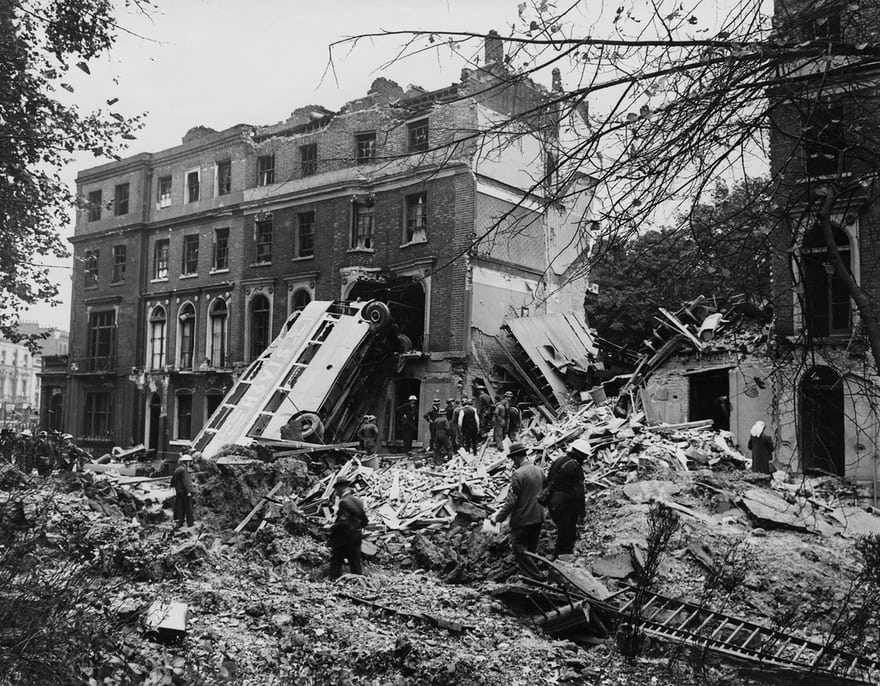
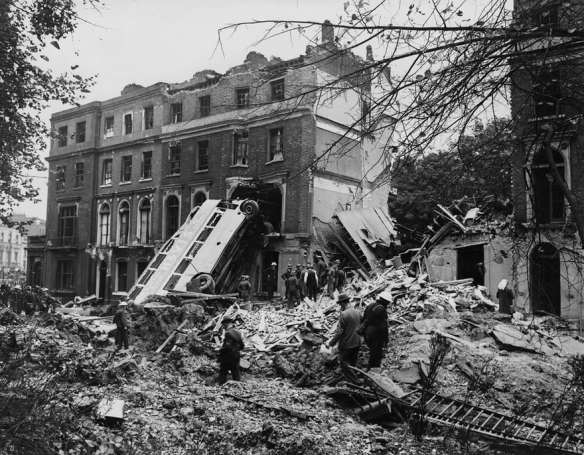
The series opened on Monday with a photographic gallery illustrating ‘a century of cities at war’; some of the images will be familiar, but many will not.  When I was working on ‘Modern War and Dead Cities‘ (which you can download under the TEACHING tab), for example, I thought I had seen most of the dramatic images of the Blitz, but I had missed this one:
It’s an arresting portfolio, and inevitably selective: there is a good discussion below the line on what other cities should have made the cut.

The first written contribution is an extended essay from Jason Burke, ‘Cities and terror: an indivisible and brutal relationship‘, which adds a welcome historical depth and geographical range to a discussion that all too readily contracts around recent attacks on cities in Europe and North America, and suggests an intimate link between cities and terrorism:

[I]t was around the time of the Paddington station attack [by Fenians in 1883]  that the strategy of using violence to sway public opinion though fear became widespread among actors such as the anarchists, leftists and nationalists looking to bring about dramatic social and political change.

This strategy depended on two developments which mark the modern age: democracy and communications. Without the media, developing apace through the 19th century as literacy rates soared and cheap news publications began to achieve mass circulations, impact would be small. Without democracy, there was no point in trying to frighten a population and thus influence policymakers. Absolutist rulers, like subsequent dictators, could simply ignore the pressure from the terrified masses. Of course, a third great development of this period was conditions in the modern city itself.

Could the terrorism which is so terribly familiar to us today have evolved without the development of the metropolis as we now know it? This seems almost impossible to imagine. Even the terror of the French revolution – Le Terreur – which gives us the modern term terrorism, was most obvious in the centre of Paris where the guillotine sliced heads from a relatively small number of aristocrats in order to strike fear into a much larger number of people.

The history of terrorism is thus the history of our cities. The history of our cities, at least over the last 150 years or so, is in part the history of terrorism. This is a deadly, inextricable link that is unlikely to be broken anytime soon.

Today Saskia Sassen issued her ‘Welcome to a new kind of war: the rise of endless urban conflict‘.  She begins with an observation that is scarcely novel:

The traditional security paradigm in our western-style democracies fails to accommodate a key feature of today’s wars: when our major powers go to war, the enemies they now encounter are irregular combatants. Not troops, organised into armies; but “freedom” fighters, guerrillas, terrorists. Some are as easily grouped by common purpose as they are disbanded. Others engage in wars with no end in sight.

What such irregular combatants tend to share is that they urbanise war. Cities are the space where they have a fighting chance, and where they can leave a mark likely to be picked up by the global media. This is to the disadvantage of cities – but also to the typical military apparatus of today’s major powers.

The main difference between today’s conflicts and the first and second world wars is the sharp misalignment between the war space of traditional militaries compared to that of irregular combatants.

Irregular combatants are at their most effective in cities. They cannot easily shoot down planes, nor fight tanks in open fields. Instead, they draw the enemy into cities, and undermine the key advantage of today’s major powers, whose mechanised weapons are of little use in dense and narrow urban spaces.

Advanced militaries know this very well, of course, and urban warfare is now a central medium in military training.  Saskia continues:

We have gone from wars commanded by hegemonic powers that sought control over sea, air, and land, to wars fought in cities – either inside the war zone, or enacted in cities far away. The space for action can involve “the war”, or simply specific local issues; each attack has its own grievances and aims, seeking global projection or not. Localised actions by local armed groups, mostly acting independently from other such groups, let alone from actors in the war zone – this fragmented isolation has become a new kind of multi-sited war.
This is, in part, what I tried to capture in my early essay on ‘The everywhere war’, and I’m now busily re-thinking it for my new book.  More on this in due course, but it’s worth noting that the Trump maladministration’s National Defense Strategy, while recognising the continuing importance of counter-terrorism and counterinsurgency, has returned the Pentagon’s sights to wars between major powers – notably China and Russia (see also here)– though it concedes that these may well be fought (indeed, are being fought) in part through unconventional means in digital domains.  In short, I think later modern war is much more complex than Saskia acknowledges; it has many modalities (which is why I become endlessly frustrated at the critical preoccupation with drones to the exclusion of other vectors of military and paramilitary violence), and these co-exist with – or give a new inflection to – older modalities of violence (I’m thinking of the siege warfare waged by Israel against Gaza or Syria against its own people).

The two contributions I’ve singled out are both broad-brush essays, but Ghaith Abdul-Ahad has contributed a two-part essay on Mosul under Islamic State that is truly brilliant: Part I describes how IS ran the city (‘The Bureaucracy of Evil‘) and Part II how the people of Mosul resisted the reign of terror (‘The Fall‘).
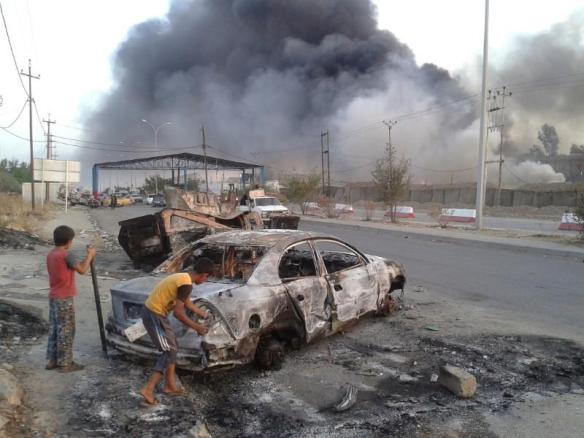
Mosul fell to IS in July 2014, and here is part of Ghaith’s report, where he tells the story of Wassan, a newly graduated doctor:

Like many other diwans (ministries) that Isis established in Mosul, as part of their broader effort to turn an insurgency into a fully functioning administrative state, the Diwan al-Siha (ministry of health) operated a two-tier system.There was one set of rules for “brothers” – those who gave allegiance to Isis – and another for the awam, or commoners.

“We had two systems in the hospitals,” Wassan said. “IS members and their families were given the best treatment and complete access to medicine, while the normal people, the awam, were forced to buy their own medicine from the black market.

“We started hating our work. As a doctor, I am supposed to treat all people equally, but they would force us to treat their own patients only. I felt disgusted with myself.”

(Those who openly resisted faced death, but as IS came under increasing military pressure at least one doctor was spared by a judge when he refused to treat a jihadist before a civilian: “They had so few doctors, they couldn’t afford to punish me. They needed me in the hospital.”)

Wassan’s radical solution was to develop her own, secret hospital:

“Before the start of military operations, medicines begun to run out,” she said. “So I started collecting whatever I could get my hands on at home. I built a network with pharmacists I could trust. I started collecting equipment from doctors and medics, until I had a full surgery kit at home. I could even perform operations with full anaesthesia.”

Word of mouth spread about her secret hospital.

“Some people started coming from the other side of Mosul, and whatever medicine I had was running out,” she said. “I knew there was plenty of medicine in our hospital, but the storage rooms were controlled by Isis.

“Eventually, I began to use the pretext of treating one of their patients to siphon medicine from their own storage. If their patient needed one dose, I would take five. After a while they must have realised, because they stopped allowing doctors to go into the storage.”

The punishment for theft is losing a hand. Running a free hospital from her home would have been sedition, punishable by death…

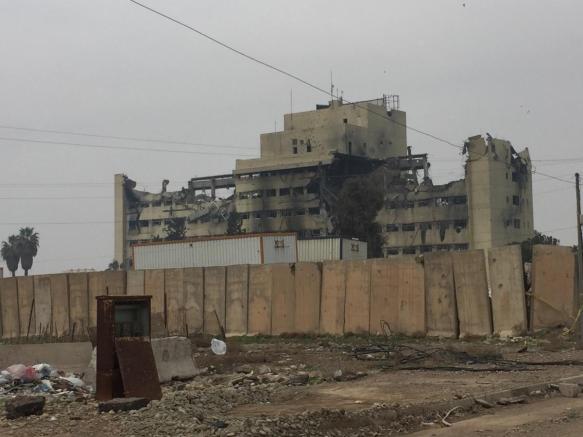
When Wassan’s hospital was appropriated by Isis fighters [this was a common IS tactic – see the image below and the Human Rights Watch report here; the hospital was later virtually destroyed by US air strikes] her secret house-hospital proved essential. More than a dozen births were performed on her dining table; she kicked both brothers out of their rooms to convert them into operating theatres; her mother, an elderly nurse, became her assistant.
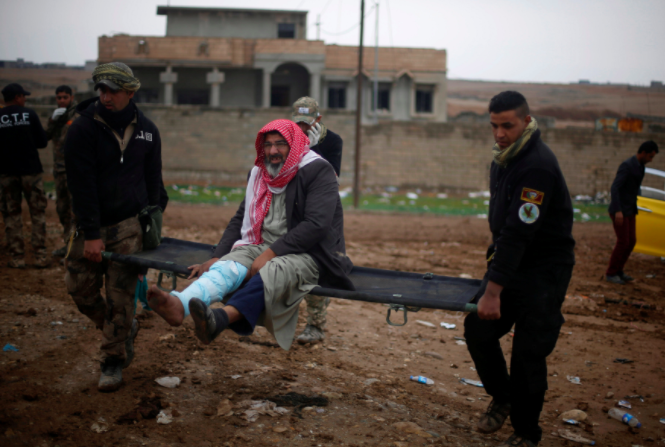
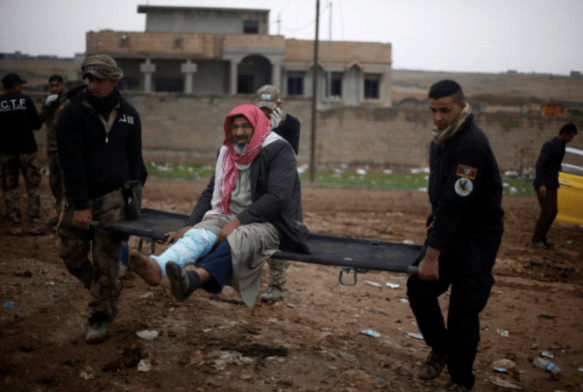
As the siege of Mosul by the Iraqi Army ground on, some of the sick and injured managed to run (or stumble) the gauntlet to find medical aid in rudimentary field hospitals beyond the faltering grip of IS, while others managed to make it to major trauma centres like West Irbil.
But for many in Mosul Wassan’s secret hospital was a lifeline (for a parallel story about another woman doctor running a secret clinic under the noses of IS, see here).

Yet there is a vicious sting in the tail:

For Wassan, the ending of Isis rule in Mosul is bittersweet. After many attempts to reach Baghdad to write her board exams for medical school, she was told her work in the hospital for the past three years did not count as “active service”, and she was disqualified.

“The ministry said they won’t give me security clearance because I had worked under Isis administration,” she said.

This, too, is one of the modalities of later modern war – the weaponisation of health care, through selectively withdrawing it from some sections of the population while privileging the access and quality for others.  ‘Health care,’ writes Omar Dewachi, ‘has become not only a target but also a tactic of war.’  (If you want to know more about the faltering provision of healthcare and the fractured social fabric of life in post-IS Mosul, I recommend an interactive report from Michael Bachelard and Kate Geraghty under the bleak but accurate title ‘The war has just started‘). 

The weaponisation of health care has happened before, of course, and it takes many forms. In 2006, at the height of sectarian violence in occupied Baghdad, Muqtada al-Sadr’s Shi’a militia controlled the Health Ministry and manipulated the delivery of healthcare in order to marginalise and even exclude the Sunni population.  As Amit Paley reported:

 ‘In a city with few real refuges from sectarian violence – not government offices, not military bases, not even mosques – one place always emerged as a safe haven: hospitals…

‘In Baghdad these days, not even the hospitals are safe. In growing numbers, sick and wounded Sunnis have been abducted from public hospitals operated by Iraq’s Shiite-run Health Ministry and later killed, according to patients, families of victims, doctors and government officials.

‘As a result, more and more Iraqis are avoiding hospitals, making it even harder to preserve life in a city where death is seemingly everywhere. Gunshot victims are now being treated by nurses in makeshift emergency rooms set up in homes. Women giving birth are smuggled out of Baghdad and into clinics in safer provinces.’

He described hospitals as ‘Iraq’s new killing fields’, but in Syria the weaponisation of health care has been radicalised and explicitly authorized by the state.

You may think I’ve strayed too far from where I started this post; but I’ve barely moved.  For towards the end of her essay Saskia wonders why military and paramilitary violence in cities in so shocking – why it attracts so much more public attention than the millions murdered in the killing fields of the Congo.  And she suggests that the answer may lie in its visceral defilement of one of humanity’s greatest potential achievements:

Is it because the city is something we’ve made together, a collective construction across time and space? Is it because at the heart of the city are commerce and the civic, not war?

Lewis Mumford had some interesting things to say about that.  I commented on this in ACME several years ago, and while I’d want to flesh out those skeletal remarks considerably now, they do intersect with Saskia’s poignant question about the war on the civic:

In The Culture of Cities, published just one year before the Second World War broke out, Mumford included ‘A brief outline of hell’ in which he turned the Angelus towards the future to confront the terrible prospect of total war. Raging against what he called the ‘war-ceremonies’ staged in the ‘imperial metropolis’ (‘from Washington to Tokyo, from Berlin to Rome’: where was London, I wonder? Moscow?), Mumford fastened on the anticipatory dread of air war. The city was no longer the place where (so he claimed) security triumphed over predation, and he saw in advance of war not peace but another version of war. Thus the rehearsals for defence (the gas-masks, the shelters, the drills) were ‘the materialization of a skillfully evoked nightmare’ in which fear consumed the ideal of a civilized, cultivated life before the first bombs fell. The ‘war-metropolis’, he concluded, was a ‘non-city’.

After the war, Mumford revisited the necropolis, what he described as ‘the ruins and graveyards’ of the urban, and concluded that his original sketch could not be incorporated into his revised account, The City in History, simply ‘because all its anticipations were abundantly verified.’ He gazed out over the charnel-house of war from the air — Warsaw and Rotterdam, London and Tokyo, Hamburg and Hiroshima — and noted that ‘[b]esides the millions of people — six million Jews alone — killed by the Germans in their suburban extermination camps, by starvation and cremation, whole cities were turned into extermination camps by the demoralized strategists of democracy.’

I’m not saying that we can accept Mumford without qualification, still less extrapolate his claims into our own present, but I do think his principled arc, at once historical and geographical, is immensely important. In now confronting what Stephen Graham calls ‘the new military urbanism’ we need to recover its genealogy — to interrogate the claims to novelty registered by both its proponents and its critics — as a way of illuminating the historical geography of our own present.

It’s about more than aerial violence – though that is one of the signature modalities of modern war – and we surely need to register the heterogeneity and hybridity of contemporary conflicts.  But we also need to recognise that they are often not only wars in cities but also wars on cities.

War | Space

Regular readers will remember Craig Jones wonderful old blog, War, law, space; it’s now re-launched, re-imagined and refurbished and you can find it here.

WAR | SPACE

WAR | SPACE brings attention to the enduring but not inevitable nature of war and imagines a world without (para)military violence. It offers critical perspectives that eschew narratives of geopolitical grand strategy in favour of a people-centric view of war. By ‘people’ we mean not only the political and military architects of (para)military violence, but crucially also those civilians, soldiers, and fighters who are caught in the mighty cross-hairs of war.

In a famous 1985 essay, the American essayist and professor of English and American Literature and Language Elaine Scarry wrote: “the main purpose and outcome of war is injuring”. She points out that this fact is so obvious that it is often forgotten altogether. She continues:

“one can read many pages of an historic or strategic account of a particular military campaign, or listen to many installments in a newscast narrative of events in a contemporary war, without encountering the acknowledgment that the purpose of the event described is to alter (to burn, to blast, to shell, to cut) human tissue, as well as to alter the surface, shape, and deep entirety of the objects that human beings recognize as extensions of themselves.”

Scarry’s words ring truer than ever 30 years on. The genres to which she refers are still replete with pages and reels devoted to what might best be described as Clean War. Clean War is full of euphemism and offers a bloodless, glossy account of war in which ‘we’ defeat the barbarians with law, ethics and an overflowing vocabulary of legitimisation on our side. In Clean War only the bad guys die; actually, they are simply taken out, liquidated, targeted, replaced or disposed. They are not mourned, for there is no life that has been lost; nobody – and no body – to mourn, to speak with Judith Butler.  In his famous essay Politics and the English LanguageGeorge Orwell described a version of Clean War as “the defence of the indefensible”. He wrote:

“[P]olitical language has to consist largely of euphemism, question-begging and sheer cloudy vagueness. Defenceless villages are bombarded from the air, the inhabitants driven out into the countryside, the cattle machine-gunned, the huts set on fire with incendiary bullets: this is called pacification. Millions of peasants are robbed of their farms and sent trudging along the roads with no more than they can carry: this is called transfer of population or rectification of frontiers. People are imprisoned for years without trial, or shot in the back of the neck or sent to die of scurvy in Arctic lumber camps: this is called elimination of unreliable elements.”

And so it is with precise, clean, surgical, just, legal, necessary, and proportional war today. So much so that we must constantly remind ourselves, pace Scarry, that first and foremost, war is injury.

WAR | SPACE pays special attention to those who injure, those who are injured, and those who care for the fractured, fragile and injured bodies and souls who remain. It also pays special attention to the ideas, institutions and processes that cause, constrain, and remedy war’s many painful injuries.

Craig adds that he’s also looking for ‘collaborators and authors to expand this project to include cutting edge critical thinking about war, especially in the Middle East and North Africa.

If you are interested in joining this project or would like to contribute in any way please email: craig . jones at ncl. ac . uk.

Victims of (para)military violence, academics, journalists, activists and interested citizens are encouraged to get in touch.

The slow violence of bombing

When I spoke at the symposium on ‘The Intimacies of Remote Warfare’ in Utrecht before Christmas, one of my central arguments was about the slow violence of bombing.  The term is, of course, Rob Nixon‘s, but I borrowed it to emphasise that the violence of sudden death from the air – whether in the air raids of the First and Second World Wars or the drone strikes of the early twenty-first century – neither begins nor ends with the explosion of bombs and missiles.

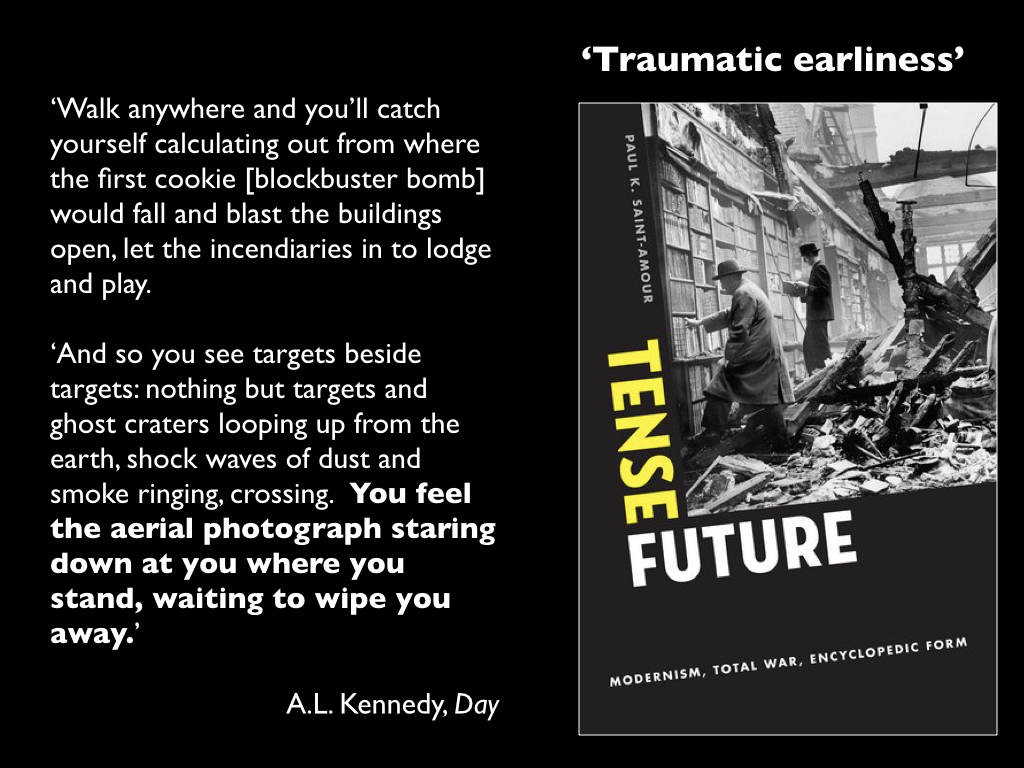
Paul Saint-Amour speaks of ‘traumatic earliness’: that dreadful sense of deadly anticipation.  The sense of not only preparation – communal and individual – but also of an involuntary tensing.  I described this for the First and Second World Wars in ‘Modern Wars and Dead Cities’, which you can download from the TEACHING tab, but here is A.L. Kennedy who captures it as well as anyone:

Add to that the blackouts, the new landscape of civil defence with its sandbags and shelters, the new choreography of movement through the war-time city, the air-raid sirens and the probing arcs of the searchlights.

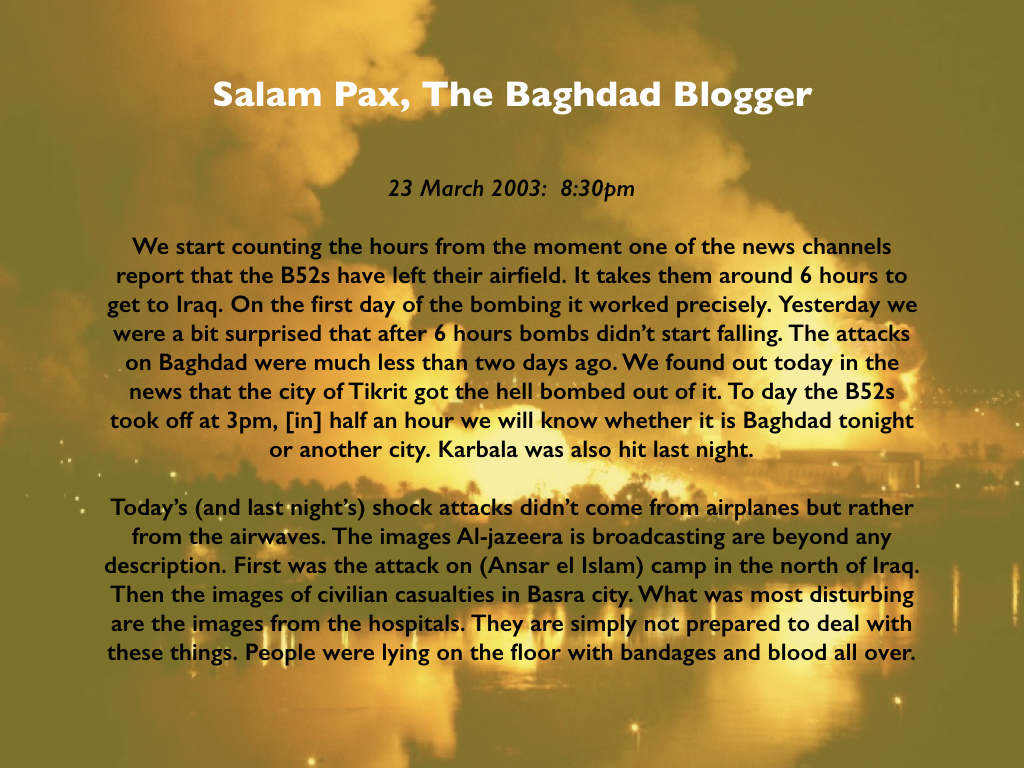
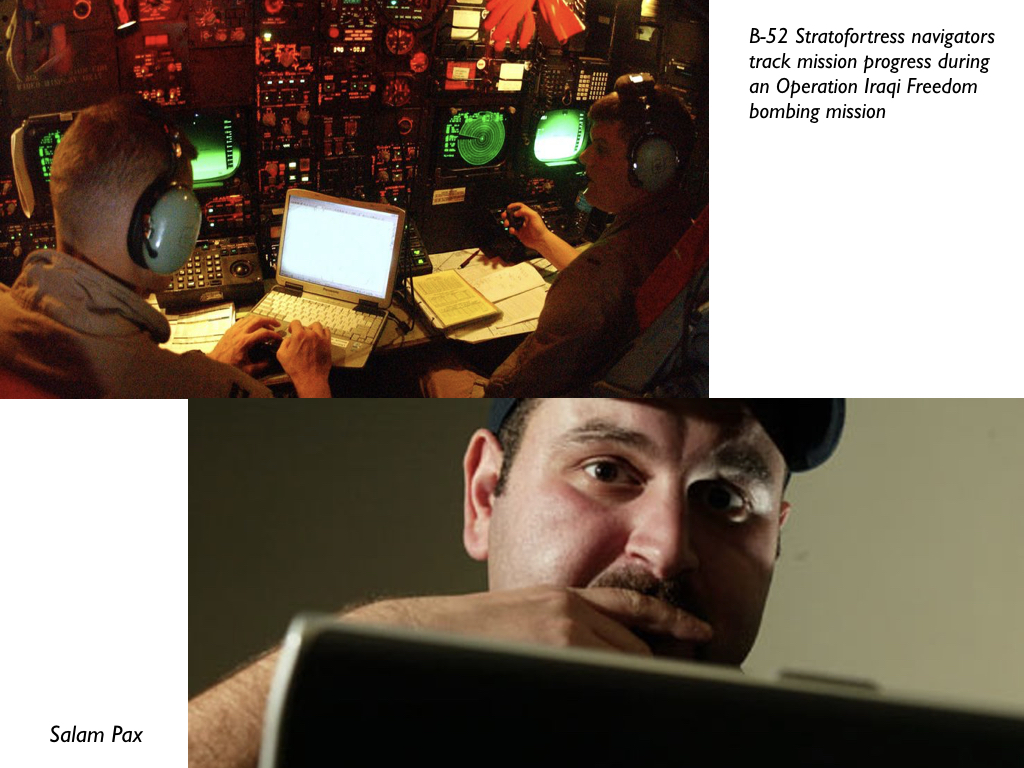
Perhaps this seems remote, but it shouldn’t.  Modern technology can radically heighten that sense of foreboding: calibrate it, give it even sharper definition.  Here is Salam Pax, counting down the hours to US air strikes on Baghdad:

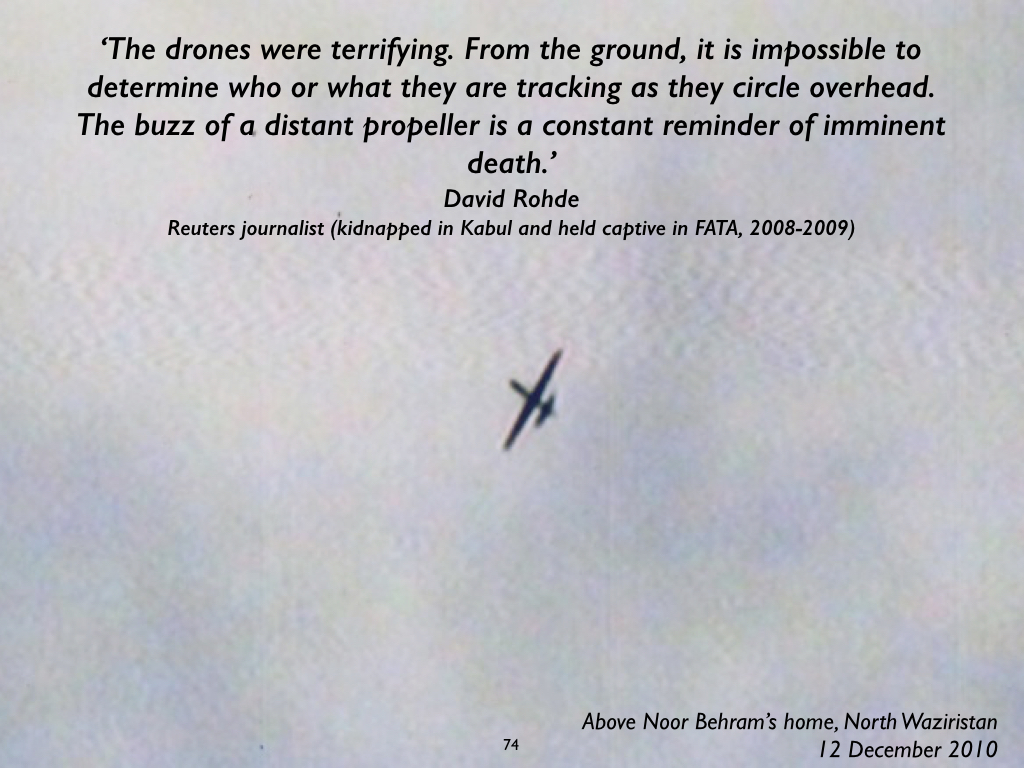
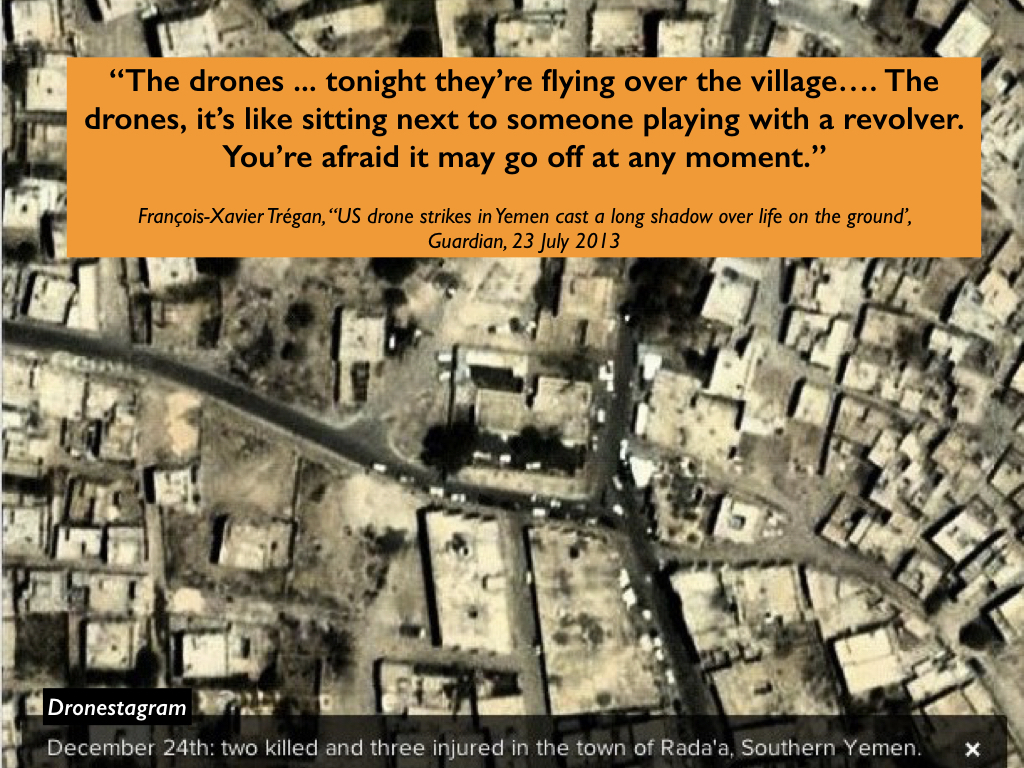
Fast forward to drone strikes.  The sense of dread visited on innocents by multiple US drone programmes is readily overlooked in the emphasis on ‘targeted killing’, on what the US Air Force once called its ability to put ‘warheads on foreheads’, and on the individuation of this modality of later modern war.  ‘The body is the battlefield’, as Grégoire Chamayou argues.

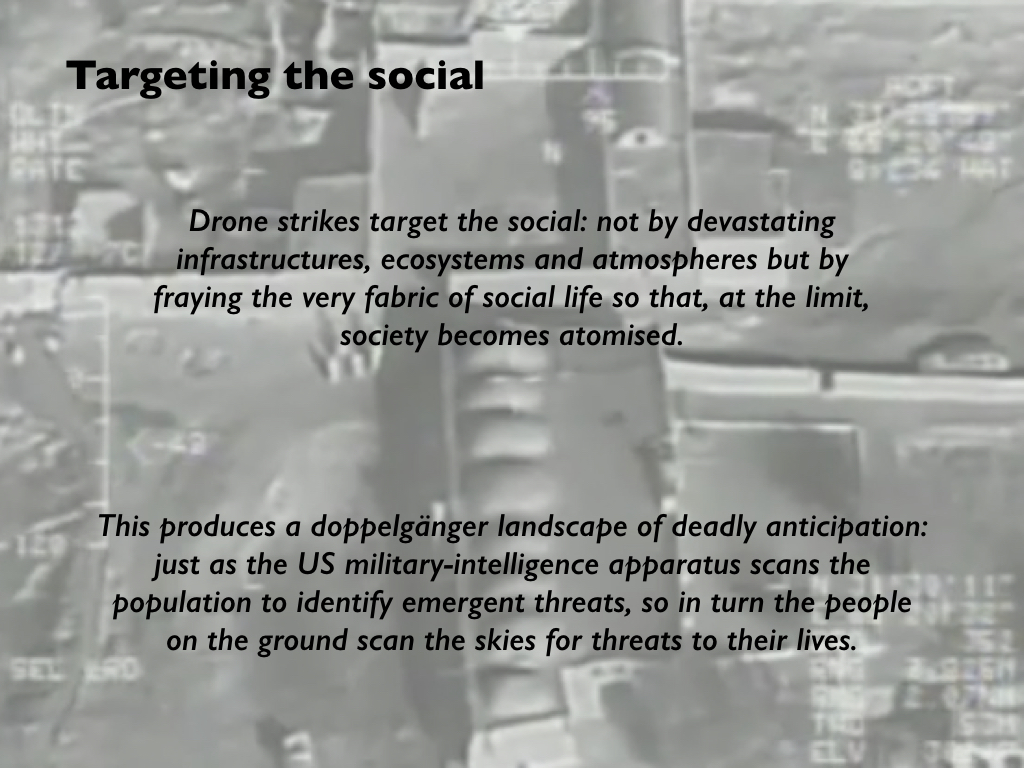
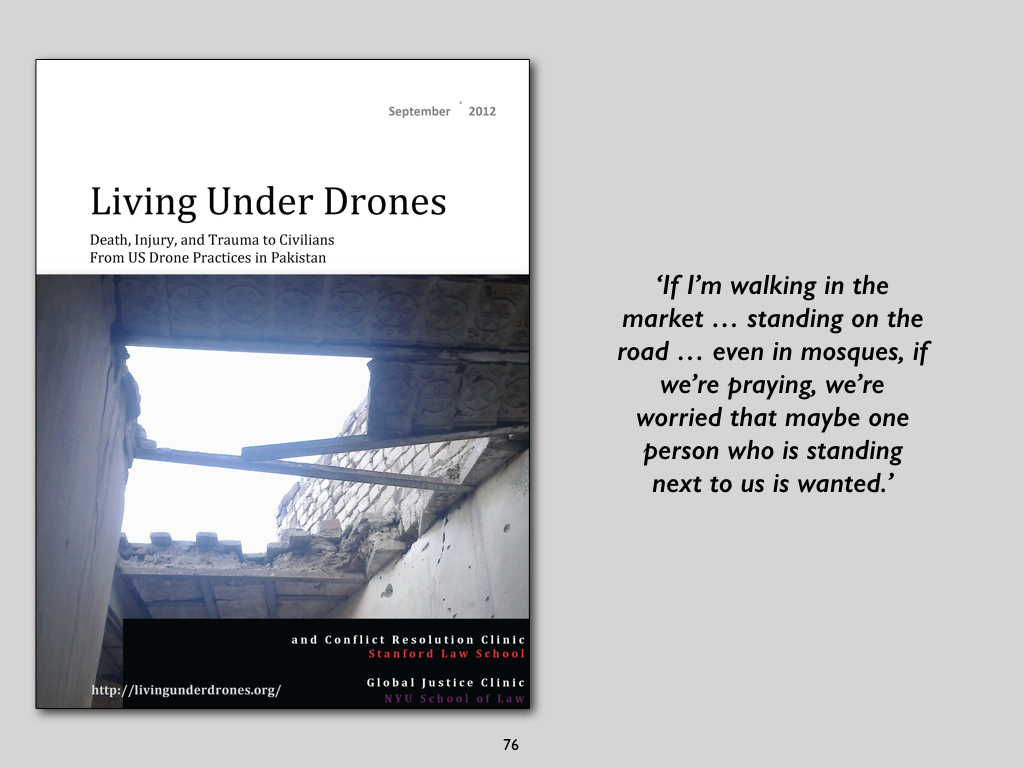
I’ve written about all those things, but there is a powerful sense in which the battle space still exceeds the body: for in order to target the individual these programmes also target the social, as this set of slides from my Utrecht presentation tries to show:

Here too, surely, is traumatic earliness.  (I’ve discussed this in more detail in ‘Little Boys and Blue Skies’ [DOWNLOADS tab], and I’m indebted to Neal Curtis, ‘The explication of the social’, Journal of sociology 52 (3) (2016) 522-36) for helping me to think this through).

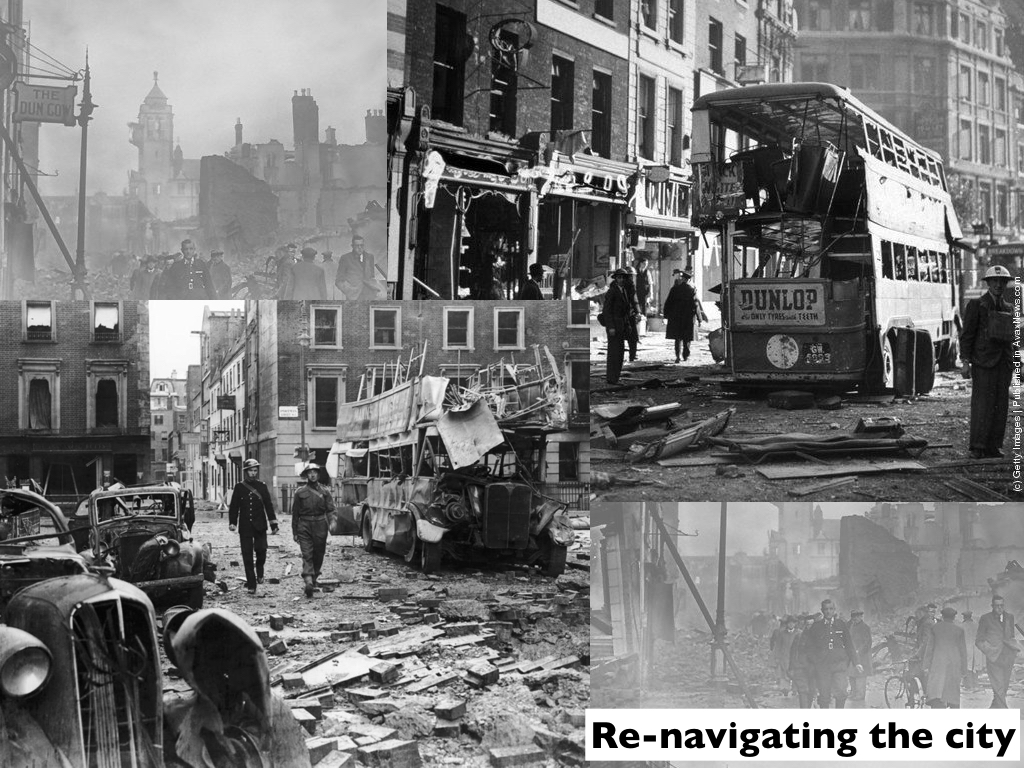
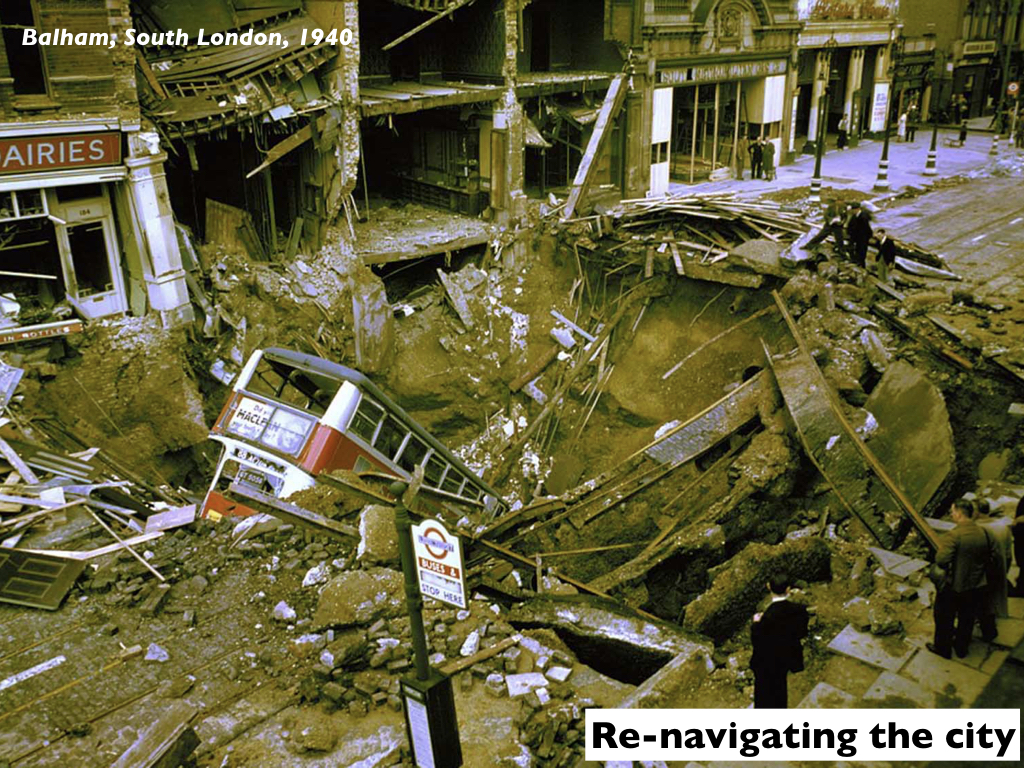
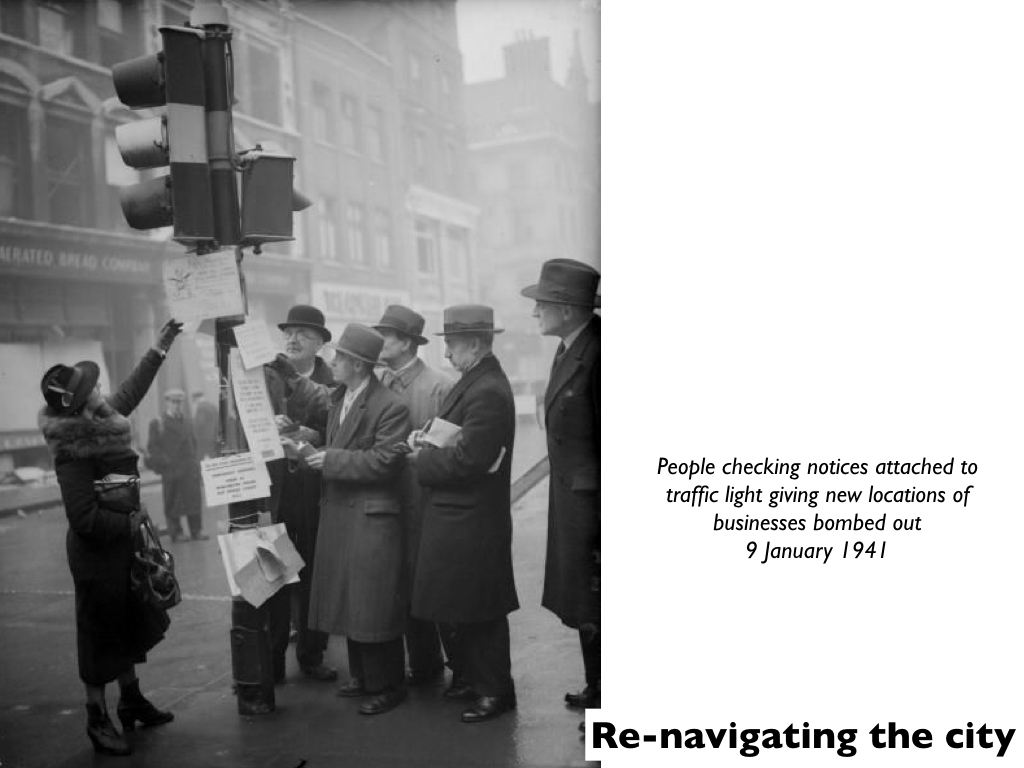
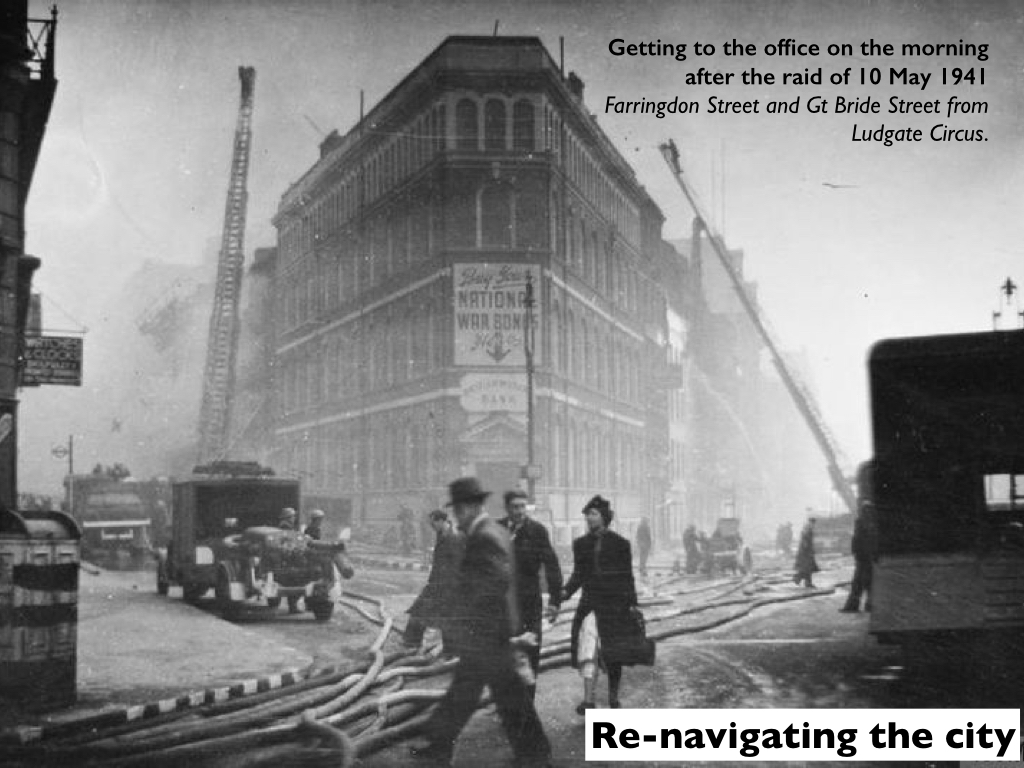
And then, after the explosion – the shocking bio-convergence that in an instant produces the horror of meatspace – the violence endures: stored in the broken buildings and in the broken bodies.  In the Second World War (again as I show in ‘Modern Wars and Dead Cities’) the landscape was made strange every morning: buildings newly demolished, people driven from their homes and their workplaces, roads blocked by hoses and ambulances, by craters and unexploded bombs, rescue workers still toiling in the rubble to remove the dead and the injured, hospitals still treating and caring for the casualties.

And the violence of a drone strike lingers too: not on the same scale, but still the destroyed houses, the burned-out cars, the graves of the dead and above all the traumatized survivors (and their rescuers), some of them forced into newly prosthetic lives (see here and here).  The explosion is instantaneous, a bolt from the blue, but the pain, the grief and the scars on the land and the body endure.

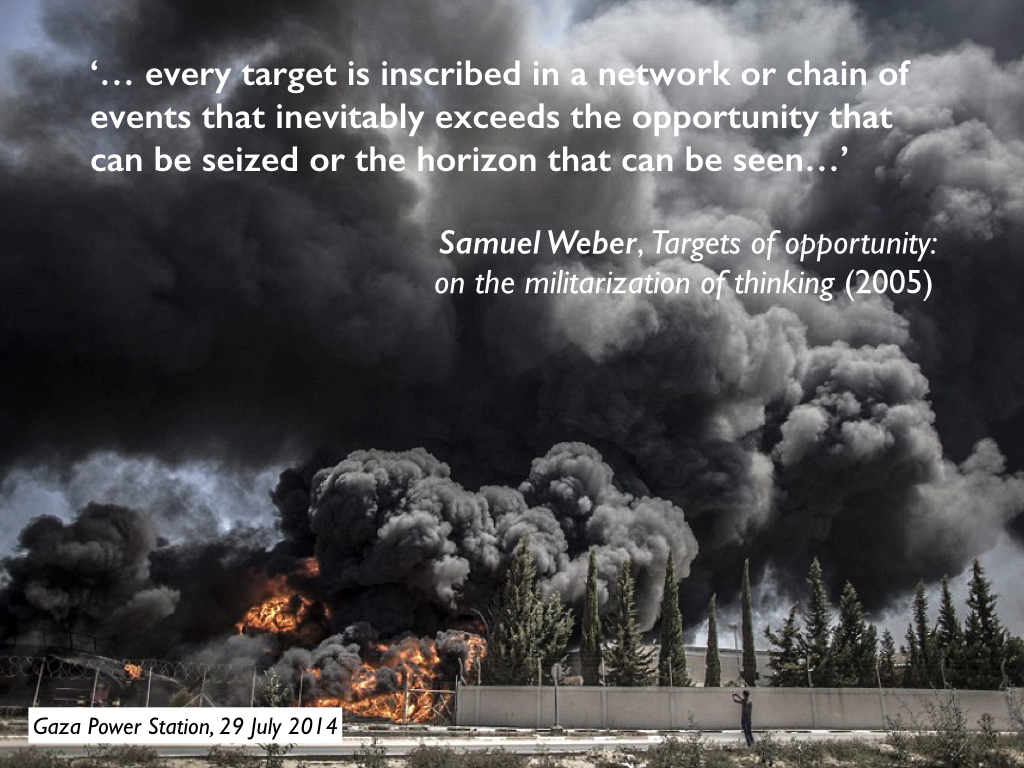
These effects have a horizon that is not contained by any carefully calculated blast radius.  The grief spirals out through extended families and communities; and – depending on the target – so too do the casualties.  As I’ve said before, power stations in Gaza or Iraq have been targeted not for any localised destructon but because without power water cannot be pumped, sewage cannot be treated, food (and medicines) stored in refrigerators deteriorates.  And hospitals have been systematically targeted in Syria to deny treatment to hundreds and thousands of sick and injured:

The work of enumerating and plotting air strikes, in the past or in the present, is immensely important.  But those columns on graphs and circles on maps should not be read as signs of an episodic or punctiform violence.

‘We’re not in Kansas anymore’

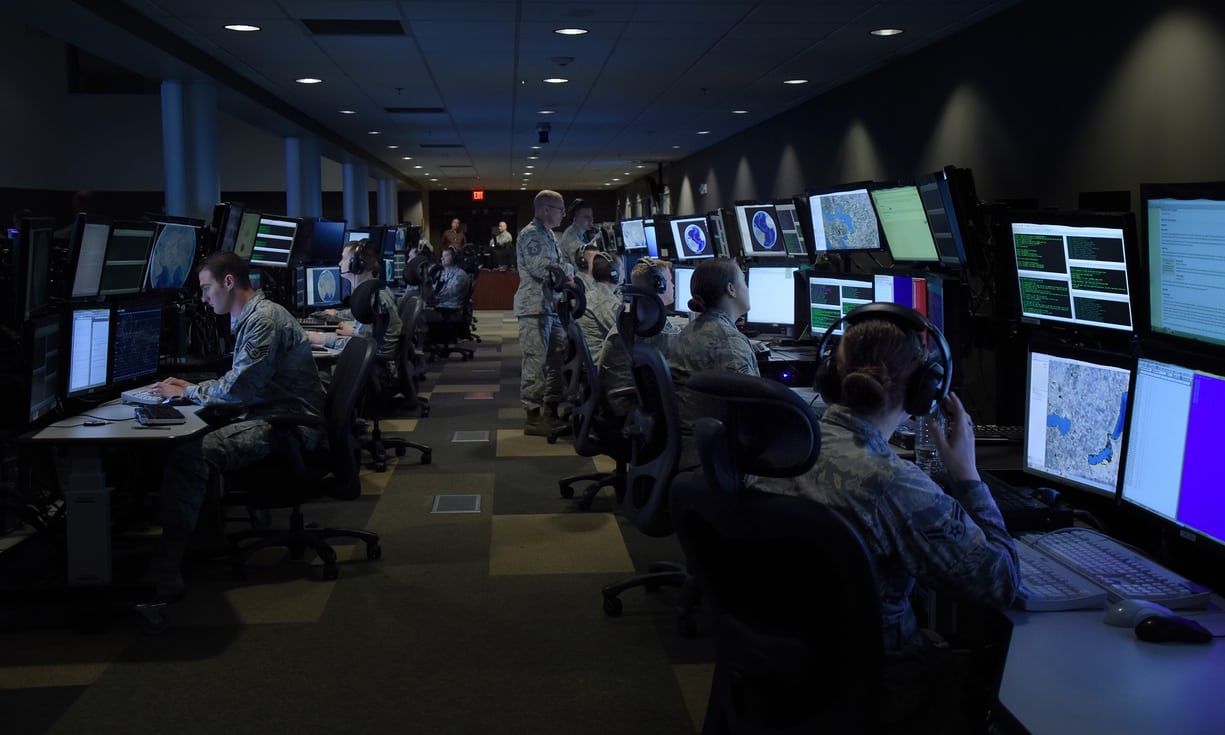
Today’s Guardian has a report from Roy Wenzl called ‘The kill-chain: inside the unit that tracks targets in America’s drone wars’.  There’s not much there that won’t be familiar to regular readers, but the focus is not on the pilots and sensor operators but on the screeners – the analysts who scrutinise the full-motion video feeds from the drones to provide ISR (intelligence, surveillance and reconnaissance).

The report describes the work of the 184th Intelligence Wing of the National Air Guard at McConnell AFB in Kansas:

‘They video-stalk enemy combatants, and tell warfighters what they see… The group does this work in the middle of America, at an air base surrounded by flat cow pastures and soybean fields….

The work is top secret.They say that they see things in those drone images that no one wants to see. Sometimes, it’s terrorists beheading civilians. Sometimes it’s civilians dying accidentally in missions that the Kansans help coordinate.

They agonize over those deaths. The most frequently heard phrase in drone combat, one airman says, is: “Don’t push the button.”

“You see [enemy combatants] kiss their kids goodbye, and kiss their wives goodbye, and then they walk down the street,” said a squadron chief master sergeant. “As soon as they get over that hill, the missile is released.”

The Americans wait to fire, he says, “because we don’t want the family to see it”.

One of those involved marvels at the technology involved: ‘The technology we use is just insane, it’s so good.’  As the report notes, critics of the programme have a more literal meaning of insanity in their minds….

The report also confirms the intensity (and, as part of that intensity, the tedium) of the shift-work involved:

Back in Kansas, in the SCIF (Sensitive Compartmented Intelligence Facility), members of Col Brad Hilbert’s group watch dozens of screens. One eight-hour shift will watch multiple targets, then hand off surveillance to the next shift. Multiple missions run simultaneously.

While enemy combatants walk around carrying weapons, the group studies their movements. They can watch one person, or one building, or one small neighborhood. The drones loiter high and unseen, giving clear, hi-tech visuals….

Most of what they watch is tedious. “They will sometimes watch one pile of sand every day for a month,” their chaplain says.

But sometimes, they see that an enemy is about to attack US troops. The commanders decide to “neutralize” him. When commanders order attacks, the Kansans become one link in a kill chain, which can include armed Reaper and Predator drone operators, fighter pilots, ground artillery commanders – and commanders with authority to approve or deny strikes.

A refugee state

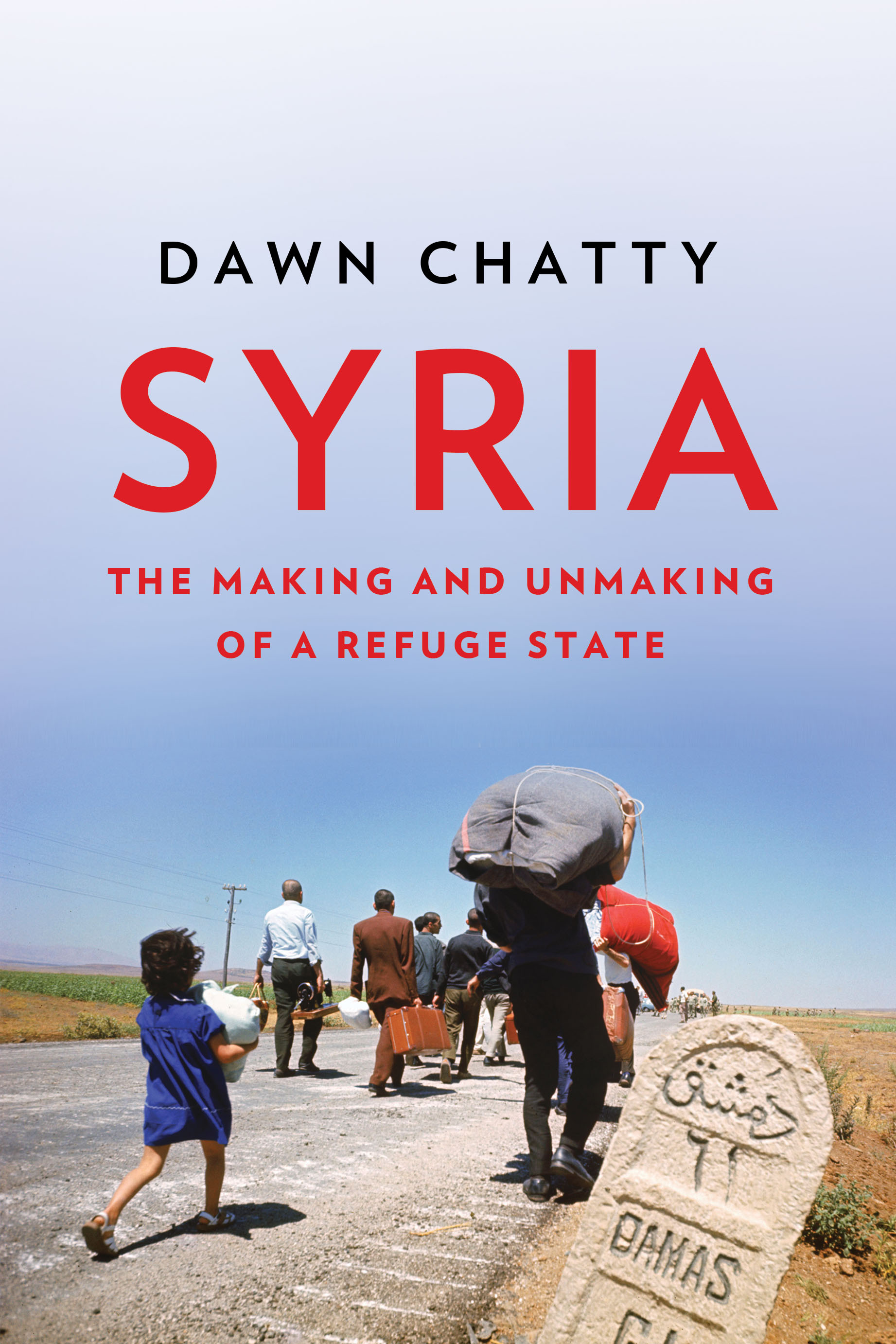
I’ve been working on the (very) long-form version of “Death of the Clinic”, so apologies for the silence: it’s been – and continues to be – utterly absorbing.  But I have managed to get my head sufficiently far above the water to notice this vital new book: Dawn Chatty‘s Syria: the making and unmaking of a refugee state (from Hurst in the UK and Oxford University Press elsewhere), out next month:

The dispossession and forced migration of nearly 50 per cent of Syria’s population has produced the greatest refugee crisis since World War II. This new book places the current displacement within the context of the widespread migrations that have indelibly marked the region throughout the last 150 years. Syria itself has harbored millions from its neighboring lands, and Syrian society has been shaped by these diasporas. Dawn Chatty explores how modern Syria came to be a refuge state, focusing first on the major forced migrations into Syria of Circassians, Armenians, Kurds, Palestinians, and Iraqis. Drawing heavily on individual narratives and stories of integration, adaptation, and compromise, she shows that a local cosmopolitanism came to be seen as intrinsic to Syrian society. She examines the current outflow of people from Syria to neighboring states as individuals and families seek survival with dignity, arguing that though the future remains uncertain, the resilience and strength of Syrian society both displaced internally within Syria and externally across borders bodes well for successful return and reintegration. If there is any hope to be found in the Syrian civil war, it is in this history.

Contents:

Chapter One: Greater Syria at the end of the Ottoman Empire
Chapter Two: The Circassians and other Caucasian forced migrants reimagining a homeland
Chapter Three: The Armenians and other Christians seek protection and refuge
Chapter Four: The Kurds seeking freedom of religious expression
Chapter Five: Palestinians return to their ‘motherland’
Chapter Six: Sha’laan: a modern cosmopolitan quarter in Damascus
Chapter Seven: Iraqis and second wave Assyrians as temporary guests
Chapter Eight: The unmaking of a State, as Syrians flee the country

Here is Raymond Hinnebusch on the book:

Passionate and erudite, combining the intimacy of the anthropological eye with a broad historical sweep, Dawn Chatty tells the two-century story of Syria as a place of refuge. Beginning with Sultan Abdul Hamid’s creation of the muhajireen quarter of Damascus as a refuge for Muslims from Crete, Chatty further exposes the often-forgotten forced migrations of Muslims from the Balkans, Crimea, and the Caucasus; the story continues with the Armenians, Kurds, then the Palestinians and Iraqis. The last chapter recounts the tragedy of how Syrians have now become refugees from their own country.

Taking it to the limit

A postscript to my posts here, here and here on civilian deaths from air strikes in Iraq, Syria and elsewhere: Vice has an extended interview with Chris Woods of Airwars here.

The biggest issue we saw in 2017—particularly if we look at the US-led coalition—was that the war moved very heavily into cities. That, more than any other single factor, resulted in the deaths of many more civilians and casualty events. We saw a similar pattern at the back end of 2016, when Russia and the Assad regime heavily bombed east Aleppo. There’s a very strong correlation between attacks on cities and large numbers of civilian casualties. And frankly, it doesn’t matter who’s carrying out those attacks. The outcome for civilians is always dire…

Things didn’t get any better under Trump for civilians—in fact, they got a lot worse. One of the reasons for that was the intensity of the bombardment. We saw an absolutely ferocious bombing campaign by the US and its allies in both Mosul and Raqqa in 2017. Between those two cities, the coalition alone dropped 50,000 munitions. One bomb or missile was dropped on Raqqa every 12 minutes, on average, for the duration of the four-month battle…

When Russia and the Assad regime were bombing Aleppo in late 2016, we had assumed that a key reason for the large number of civilian casualties was down to the fact they were primarily using dumb-bombs. We have actually changed our modeling since then, based on what we have seen with the coalition in places like Raqqa and Mosul. The reason is that even when you use precision bombs on cities, really, the outcome for civilians is the same as a dumb bomb. You can’t control what the bombs do when they land.

We saw very little difference between Russian and coalition strikes when it came to bombing cities. This is the big problem we have with a shift to urban warfare —it’s really taking us to the limits of any benefits we might have in terms of protecting civilians by using precision munitions.

Chris also has some characteristically smart (and sharp) things to say about transparency and accountability too…