Conflict Urbanism

I’m in Copenhagen – and still bleary-eyed – for a symposium organised by my good friends Kirsten Simonsen and Lasse Koefoed at Roskilde on their current project  ‘Paradoxical spaces: Encountering the other in public space‘.  I’ll be talking about the war in Syria, drawing on my previous work on attacks on hospitals, healthcare workers and patients (see ‘Your turn, doctor‘) – which I’ve now considerably extended as I work on turning all this into  a longform essay: I’ll post some updates as soon as I can – but now adding a detailed discussion of siege warfare in Syria.  More on that in my next post; but for now I wanted to share some remarkable work on Aleppo by Laura Kurgan and her students at the Center for Spatial Research at Columbia:

Conflict Urbanism: Aleppo is a project in two stages.

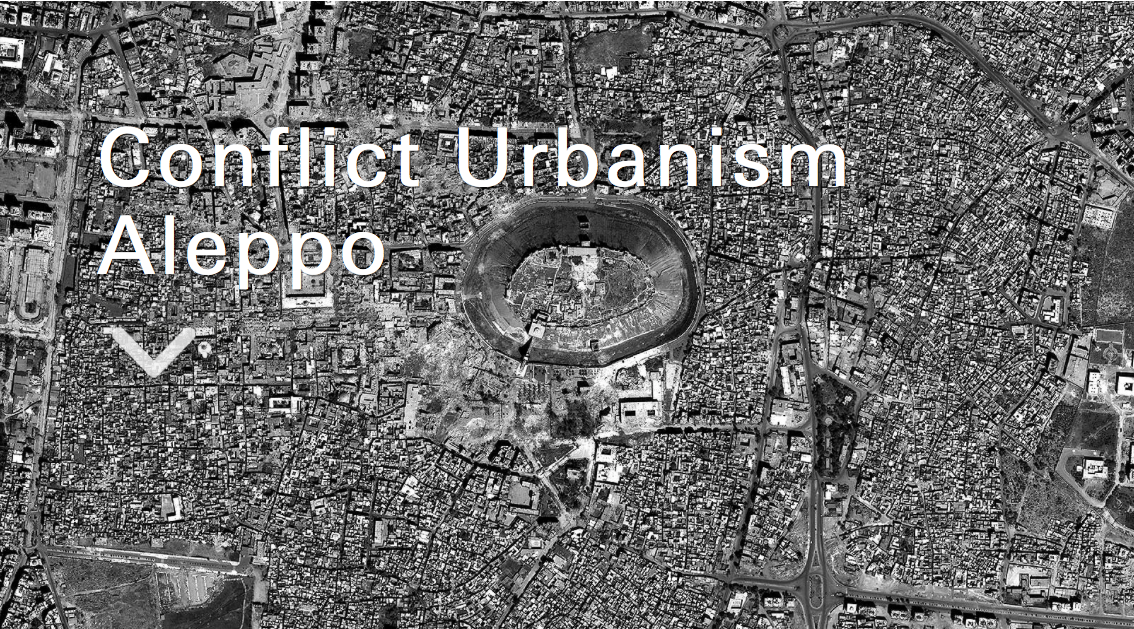
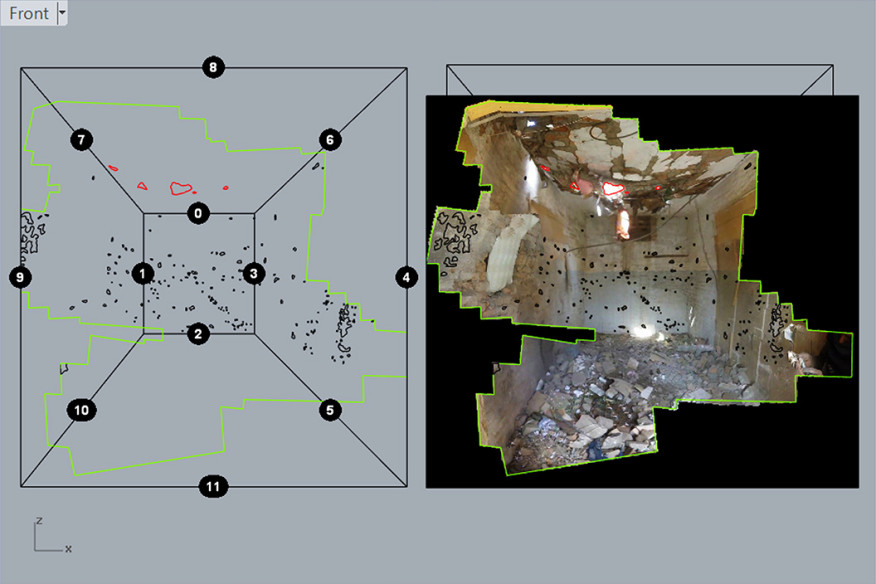
First, we have built an open-source, interactive, layered map of Aleppo, at the neighborhood scale. Users can navigate the city, with the aid of high resolution satellite imagery from before and during the current civil war, and explore geo-located data about cultural sites, neighborhoods, and urban damage.

Second, the map is a platform for storytelling with data. We are inviting collaborators and students to bring new perspectives and analyses into the map to broaden our understanding of what’s happening in Aleppo. Case studies will document and narrate urban damage — at the infrastructural, neighborhood, building, social, and cultural scales — and will be added to the website over time.

We invite ideas and propositions, and hope to build on the data we have compiled here to create an active archive of the memory of destruction in Aleppo through investigation and interpretation, up close and from a distance.

That last phrase is an echo of Laura’s book, Close Up at a Distance: Mapping, Technology and Politics, published by MIT in 2013.  The new project emerged out of a seminar taught by Laura in 2016:

Students worked collaboratively to develop a series of case studies using a map developed by the Center for Spatial Research, specifically designed to research urban damage in Aleppo during the ongoing civil war. Their work incorporates a range of disciplines, methods and results. Each student was asked to create case studies and add layers to the existing map. The results — spatializing youtube video, interior borders between fighting factions, imagining urban survival during wartime, imaging escape routes, audio memory maps, roads, water, hospitals, informal neighborhoods, religion, communications infrastructure, and refugee camps at the borders — are [available online here].

I’m particularly taken by ‘Spatializing the YouTube War’.   One of the challenges for those of us who follow these events ‘at a distance’ is precisely how to get ‘close up’; digital media and the rise of citizen journalism have clearly transformed our knowledge of many of today’s conflict zones – think, for example, of the ways in which Forensic Architecture has used online videos to narrate and corroborate Russian and Syrian Arab Air Force attacks on hospitals in rebel-held areas Syria; similarly, Airwars has used uploaded videos for its painstaking analysis of US and coalition airstrikes and civilian casualties (see this really good backgrounder by Greg Jaffe on Kinder Haddad, one of the Airwars team, ‘How a woman in England tracks civilian deaths in Syria, one bomb at a time) – and I’ve used similar sources to explore the effects of siege warfare on Aleppo, Homs and Madaya.

Here is how Laura and her students – in this case, Nadine Fattaleh, Michael James Storm and Violet Whitney describe their contribution:

The civil war in Syria has shown how profoundly the rise of cellphones with video-cameras, as well as online video-hosting and emergent citizen journalism, has changed the landscape of war documentation. YouTube has become one of the largest sources (and archives) of information about events on the ground in Syria: since January 2012 over a million videos of the conflict there have been uploaded, with hundreds of millions of views to date. Major news agencies have come to rely on YouTube as a primary source for their reporting, and human rights organizations often cite videos as part of their advocacy and documentation efforts. This independently reported footage has created a new powerful archive, but opens up crucial questions of credibility, verification, and bias. As with all data, every video comes to us bearing the traces of the situation and intentions that motivated its production. This does not disqualify it – quite to the contrary – but it does demand that we approach everything critically and carefully.

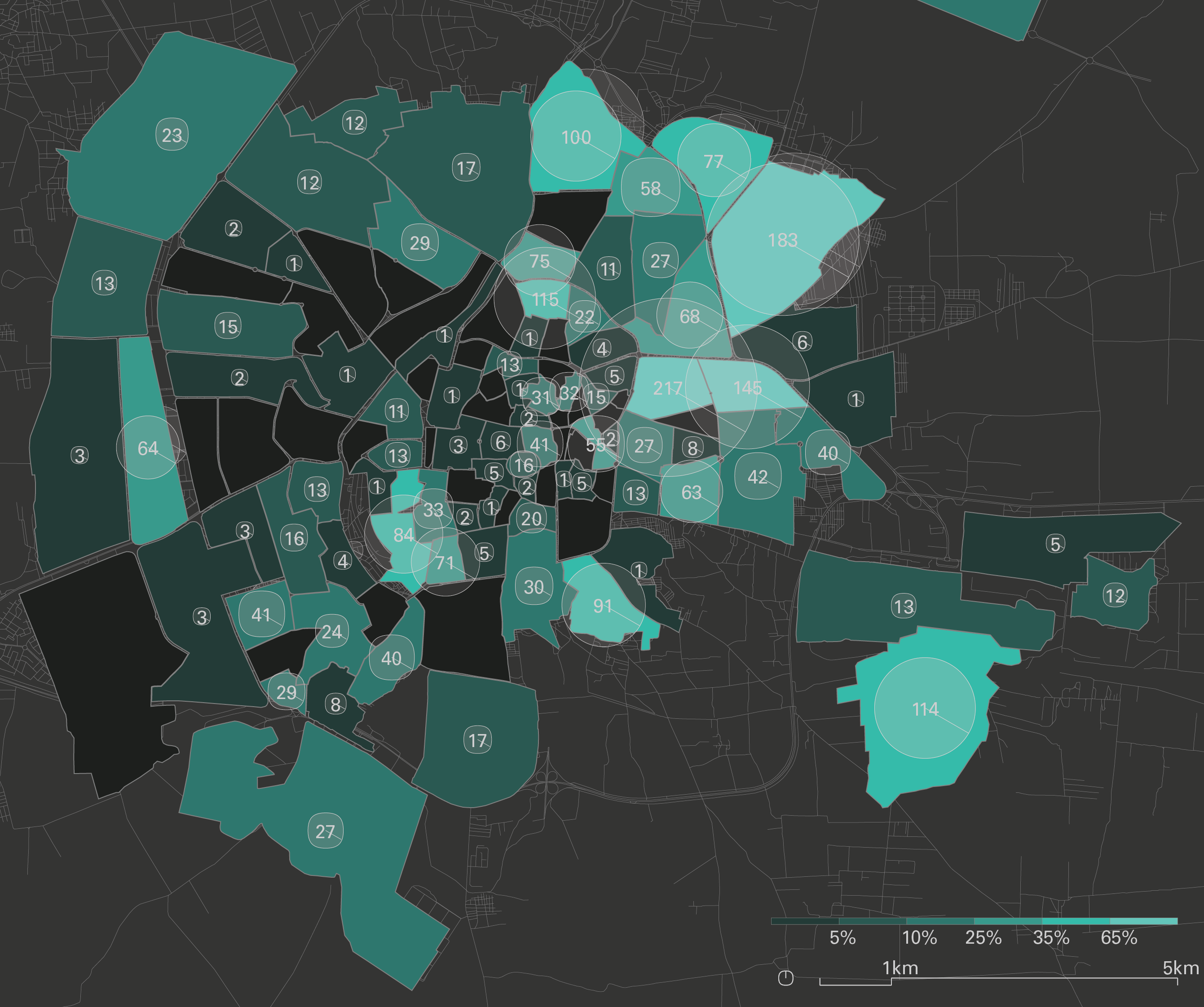
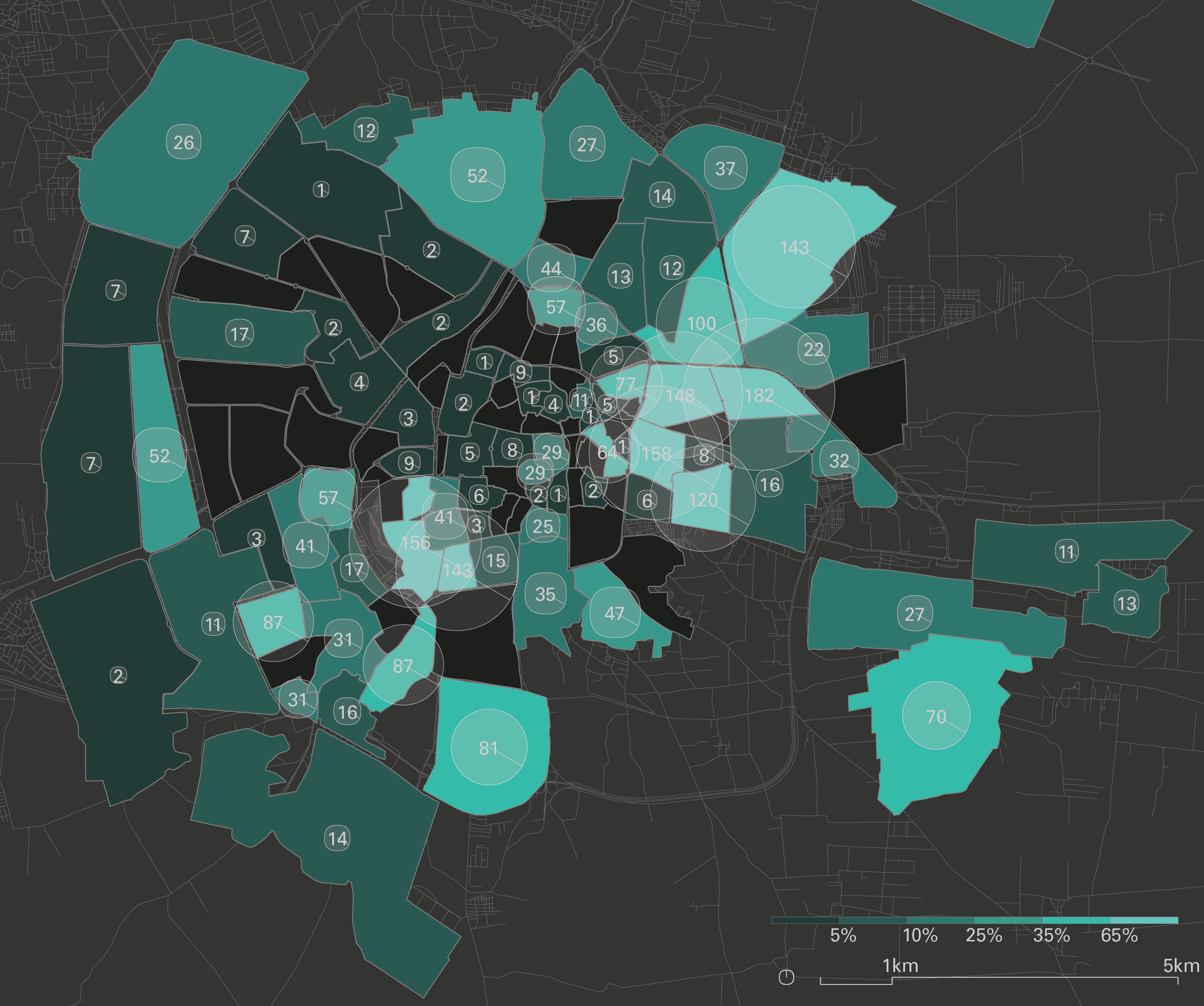
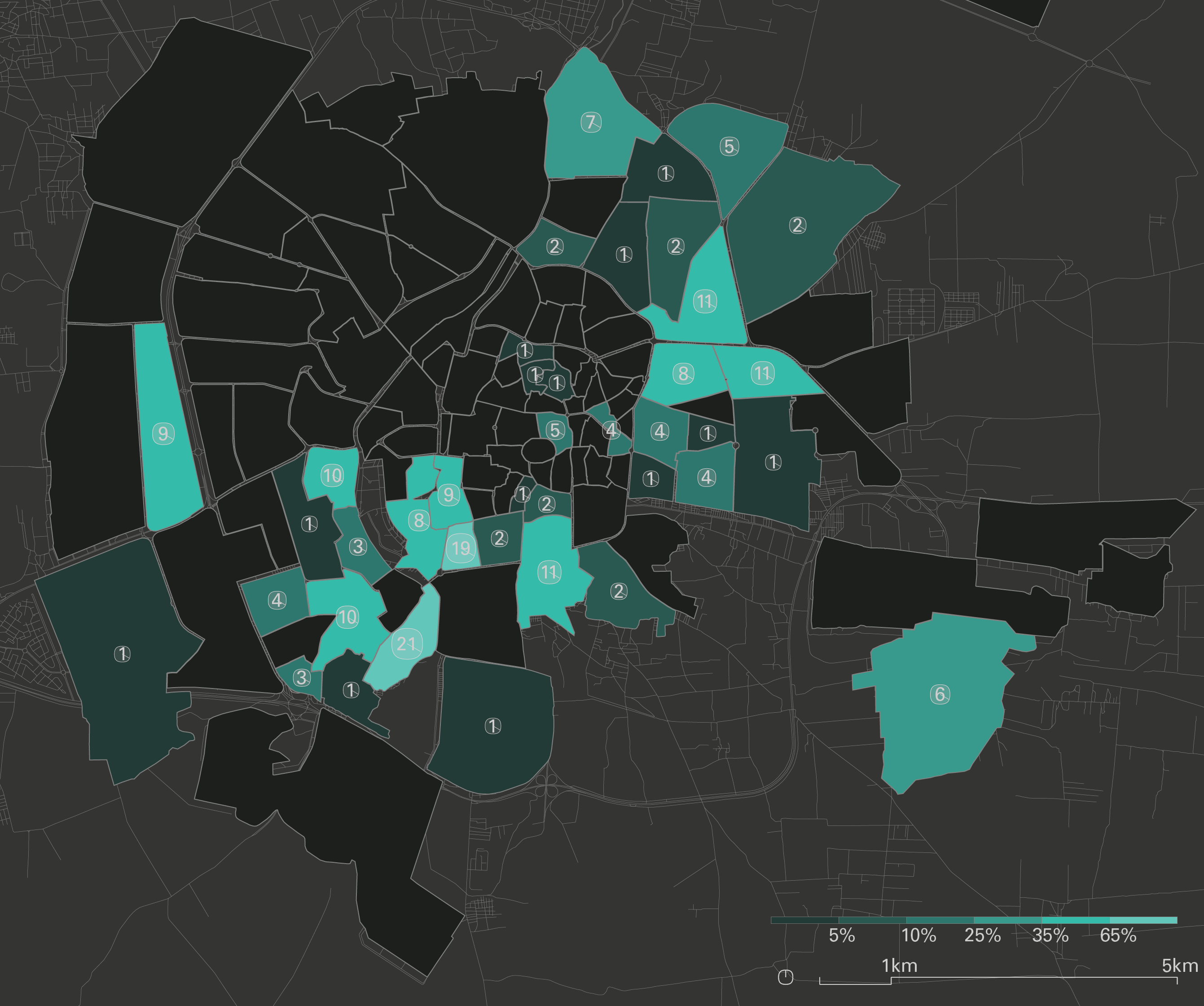
We set out to investigate YouTube as archive of the Syrian uprising and to develop a method for organizing that archive spatially. We used the frameworks that we had developed for the Conflict Urbanism Aleppo interactive map, together with a naming convention used by Syrian civic media organizations, in order to sort and geolocate YouTube videos from multiple sources. We then produced a searchable interactive interface for three of the most highly cited YouTube channels, the Halab News Network, the Aleppo Media Center, and the Syrian Civil Defense. We encourage journalists, researchers, and others to use this specifically spatial tool in sorting and searching through the YouTube dataset.

The Halab News Network [above] shows a wide distribution of videos across the city, including the city center and government-held Western side of the city. The Eastern half of the city — in particular the Northeastern neighborhoods of ash-Sha’ar (الشعار), Hanano (هنانو), and Ayn at-Tal (عين التينة) – is the best-documented.

In contrast:

The videos published by the Aleppo Media Center [above] roughly follow the formerly rebel-held Eastern side of the city, with a small number of videos from the central and Western areas. The highest number of videos is in the neighborhood of ash-Sha’ar (الشعار). Particular spots include ash-Sha’ar (الشعار), coverage of which is shared with the Syrian Civil Defense. Another notable concentration are two neighborhoods in the Southwest, Bustan al-Qaser (بستان القصر) and al-Fardos (الفردوس).

They also analyse the video geography produced by the White Helmets [below]: ‘The Syrian Civil Defense, also known as the White Helmets, have uploaded videos primarily in the formerly rebel-held Eastern and Southern areas of Aleppo. Only the Western area of ash-Shuhada’ (الشهداء) falls outside of this trend.’

This, like the other collaborative projects under the ‘Conflict Urbanism’ umbrella, is brilliant, essential work, and we are all in their debt.

You can read more about the project in a short essay by Laura, ‘Conflict Urbanism, Aleppo: Mapping Urban Damage’, in Architectural Design 87 (1) (2017) 72-77, and in another essay she has written with Jose Francisco Salarriaga and Dare Brawley, ‘Visualizing conflict: possibilities for urban research’, open access download via Urban Planning 2 (1) (2017) here [this includes notice of a parallel project in Colombia].

Seeing Civilians (or not)

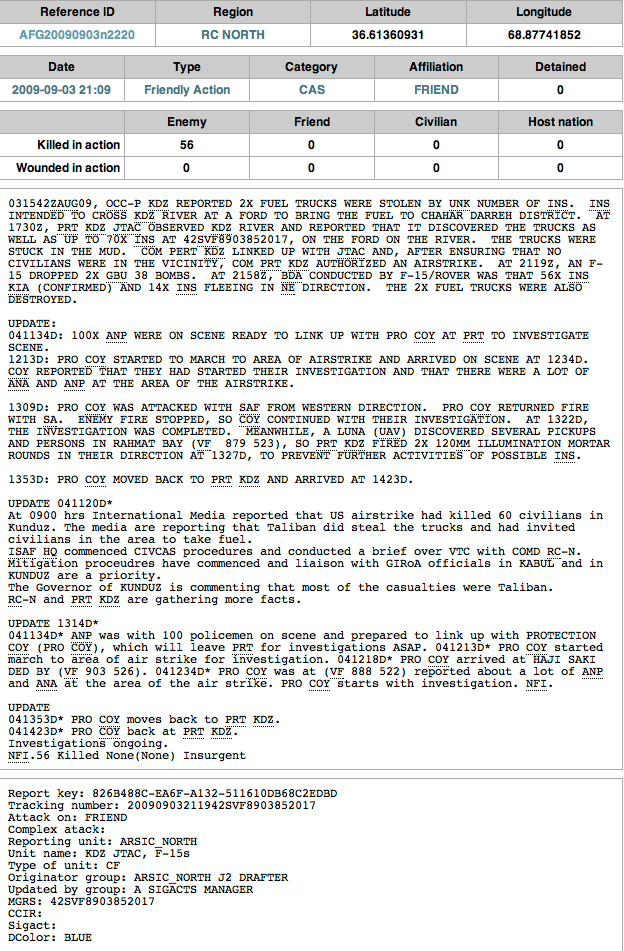
Very welcome news from Christiane Wilke that her essay, ‘Seeing and Unmaking Civilians in Afghanistan: Visual Technologies and Contested Professional Visions‘, has just been published in Science, Technology and Human Values.

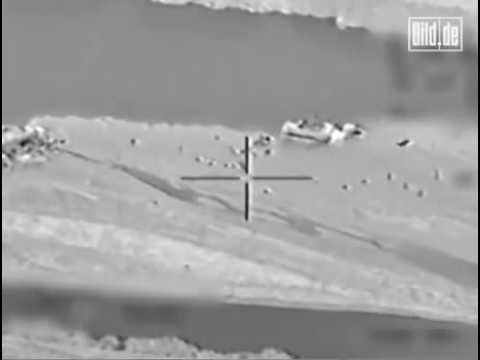
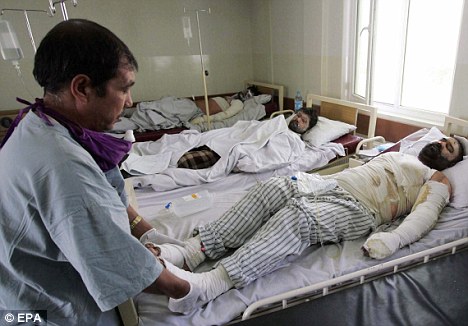
It’s an original, compelling and immensely important analysis of a US air strike on two tankers hijacked by the Taliban and beached on a river crossing near Kunduz (Afghanistan) in September 2009.  The strike was called in by a Bundeswehr officer who claimed – falsely – that he was facing what the military call ‘troops in contact’ which required immediate action; the two American pilots of the F-15s repeatedly questioned his decision but to no avail, and when the smoke cleared somewhere between 26 and 147 civilians who had been siphoning petrol from the stranded tankers had been killed.

I published a preliminary analysis of the attack, ‘Seeing like a military‘, and subsequently heard Christiane give an early version of her own argument at a conference in Lancaster in May 2014; we’ve had a lively dialogue about the strike since then.  Here is the abstract:

While the distinction between civilians and combatants is fundamental to international law, it is contested and complicated in practice. How do North Atlantic Treaty Organization (NATO) officers see civilians in Afghanistan? Focusing on 2009 air strike in Kunduz, this article argues that the professional vision of NATO officers relies not only on recent military technologies that allow for aerial surveillance, thermal imaging, and precise targeting but also on the assumptions, vocabularies, modes of attention, and hierarchies of knowledges that the officers bring to the interpretation of aerial surveillance images. Professional vision is socially situated and fre- quently contested with communities of practice. In the case of the Kunduz air strike, the aerial vantage point and the military visual technologies cannot fully determine what would be seen. Instead, the officers’ assumptions about Afghanistan, threats, and the gender of the civilian inform the vocabulary they use for coding people and places as civilian or noncivilian. Civilians are not simply “found,” they are produced through specific forms of professional vision.

And here is her key conclusion which clearly resonates far beyond Kunduz (see, for example, here and here; I’ve radically reworked the presentation from which those two posts derive, and you can get some sense of where I’m heading here):

In Afghanistan and in situations of armed conflict more generally, the distinction between civilians and noncivilians is a crucial dimension of seeing, intervening in, and responding to violence. The protection of civi- lians is an almost universally proclaimed goal; it is the centerpiece of the ISAF 2009 Tactical Directive. Yet without a reliable understanding of who counts as a civilian and how they can be recognized, the promise of civilian protection rings hollow. The category of the civilian, derived from specific Eurocentric understandings of armed conflict, had been grafted onto Afgha- nistan and Afghans who had to negotiate their security amidst conflict. Yet it is not clear what Afghans should do or avoid in order to be recognized as civilians. Those who shared the aerial viewpoint could not agree on the civilian status of the people near the trucks and neither could those who had extensive personal knowledge of the local social structures. Thus, a shift in perspective did not solve the problem that civilians are not clearly recogniz- able to those who have a mission to spare and protect them. At a deeper level, the lack of consensus about visually identifying civilians indicates a lack of agreement about who counts as a civilian. NATO officers consistently try to stabilize and shrink the category of civilian by juxtaposing it with a capacious category of noncivilians: insurgents, militants, supporters, and Taliban…

Yet civilians don’t simply exist. They are enacted and produced by, among other sites, socially situated interpretation of images produced with the aid of visual technologies. Sociocultural prisms of visibility not only produce counts of legitimate civilians but also legitimize the category of civilian as a workable and meaningful foundation of international law. The people who would like to be regarded as civilians bear the burden of distinguishing themselves from putative noncivilians according to criteria that they can never fully grasp because they don’t know which background knowledges and epistemes will be mobilized by those in charge of distinguishing civilians from combatants.

And – please note – this is not about drone strikes; not only have the vast majority of strikes in Afghanistan been carried out by conventional strike aircraft (why do so many of those who campaign against drones ignore other forms of aerial violence?) but no drones were involved in this particular attack either; the sharp point that Christiane makes applies to all airstrikes – and indeed, to militarised vision more generally.

Logistics in war

I’ve written about military logistics before – here and here (the last is also available under the DOWNLOADS tab as ‘Supplying the war in Afghanistan’) – and that early work, both historical and contemporary, intersects with my current work on casualty evacuation, so it’s good to find a new-ish blog on Logistics in War, managed by David Beaumont; its base is Australia but it casts its remit far and wide and, in a recent post, engages with Deb Cowen‘s work and my own.

It is the purpose of this blog to instigate and inspire, continue and create, a discussion on military logistics that is so often sorely lacking (or if it does occur, does so behind closed doors). Although the blog currently reflects an Australian and Army orientation, its vision is to become broadly applicable; to reflect the many different approaches to logistics as practiced by different military Services, the Joint domain, and militaries of all persuasions.

Furthermore, the blog will support the establishment of an international community of military logisticians that can share ideas, concepts and useful material in an insightful, courteous and professional manner which reflects the values of the militaries and Defence organisations that its readers may serve in. In time, guest posts will be added to the site, including from the international military logistics community.

‘Logistics in War’ aspires to provide life to a topic area that is generally dry, overly technical and grossly specialised. Its practical perspective serves the logistician and commander alike. Logistics is, after all, the conjunction of military strategy and operational concepts with the realities and practicalities of war. It deals with facts and the compromises of commanders who must shape their decisions upon the limitations and constraints of their force. As Thomas Kane, in the great Military logistics and strategic performance, puts it, logistics is an ‘arbiter’ in battle and in war. It is therefore well worth our while to understand it.

Aleppo in London and Berlin

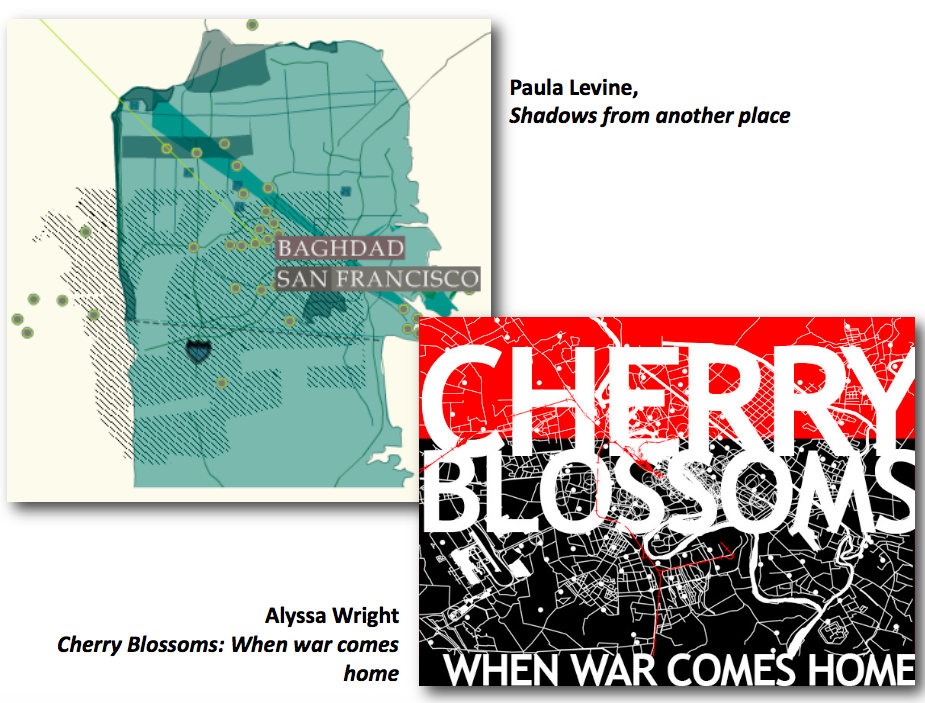
A common response to mass violence elsewhere is to imagine its impact transferred to our own lives and places.  It’s a problematic device in all sorts of ways.  After Hiroshima and Nagasaki US media became obsessed with imagining the impact of a nuclear attack on US cities – though, as I’ve also noted elsewhere, there were multiple ironies in conjuring up ‘Hiroshima, USA’ – and in the wake of the US-led invasion of Iraq there were several artistic projects that mapped the violence in Baghdad onto (for example) Boston, New York or San Francisco (I discussed some of them in the closing sections of ‘War and Peace’: DOWNLOADS tab).

This may be one way to ‘bring the war home’, as Martha Rosler‘s mesmerising work has shown, and even constitute a counter-mapping of sorts, but sometimes it can devolve into a critical narcissism: rather than being moved by the suffering of others, we place ourselves in the centre of the frame.  To forestall any misunderstanding about Rosler’s own work, let me repeat what I wrote in ‘War and Peace’:

Domestic critics have frequently noted the interchange between security regimes inside and outside the United States; they insist that the ‘war on terror’ ruptures the divide between inside and outside, and draw attention to its impact not only ‘there’ but also ‘here’. But Rosler’s sharper point is to goad her audience beyond what sometimes trembles on the edge of a critical narcissism (‘we are vulnerable too’) to recognise how often ‘our’ wars violate ‘their’ space: her work compels us to see that what she makes seem so shocking in ‘our’ space is all too terrifyingly normal in ‘theirs’.

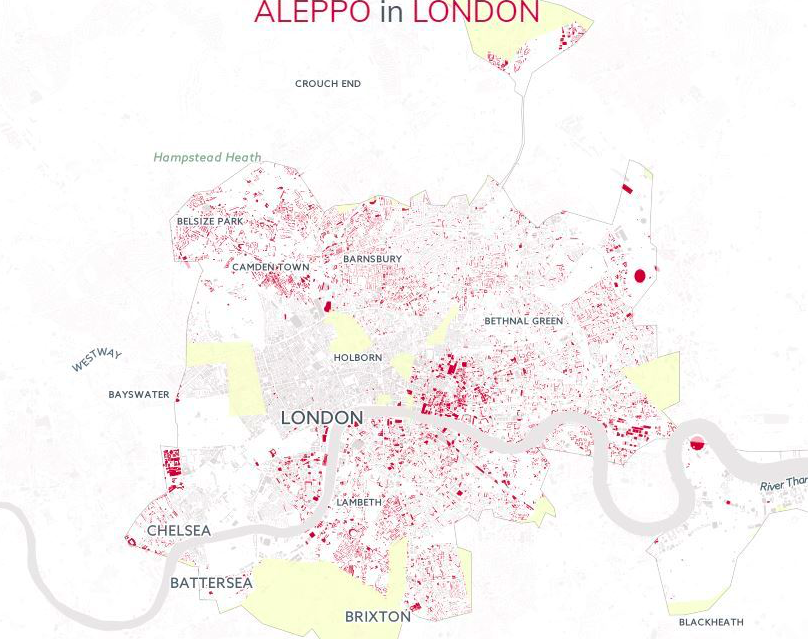
So it’s with somewhat mixed feelings that I record Hans Hack‘s attempt to transfer violence in Aleppo to London and Berlin.

He explains his Reprojected Destruction like this:

The United Nations Institute for Training and Research (UNITAR) has recently published a map which “illustrates the percentage of buildings damaged in the city of Aleppo” based on satellite imagery analysis. The map shows the levels of destruction in each of Aleppo’s districts. For this project “Reprojected Destruction” information from that map has been reprojected onto figure-ground maps of Berlin and London. As a geographical reference point, the historical center of Aleppo (The Citadel of Aleppo) has been superimposed on that of Berlin (Museum Island) and London (The Tower of London). The reprojected destruction is indicated by randomly selected buildings marked in red. To make it more representative, the distribution of the reprojected destruction has also been mapped with respect to Aleppo’s administrative borders provided by OCHA. The overall aim of the exercise is to help viewers imagine the extent of destruction that might have been visited upon the UK and German capitals had these cities stood at the centre of Syria’s current conflict.

Hans told Reuters:

For me it’s hard to understand in the news what it means, how strongly Aleppo was destroyed. I wanted to take this information and project it onto something I know personally that I can have some reference to. So I chose Berlin and London.

But the key question for me is simply this: why is it so hard?

MOAB and the moral economy of bombing

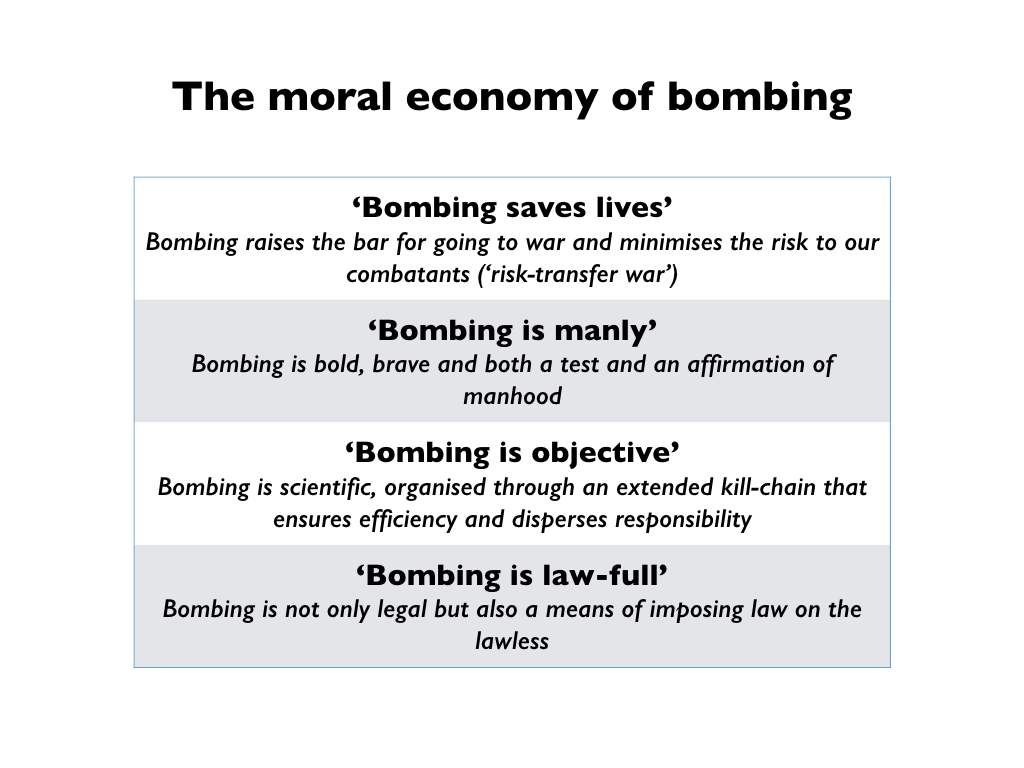
In Reach from the Sky, my Tanner Lectures which I’m presently preparing for publication, I sketched what I called a ‘moral economy of bombing’:

It’s the last of these claims that concerns me here: bombing represented as ‘law-full’.  In the lectures I discussed the legal armature of aerial violence – referring to the combined bomber offensive against Germany in the Second World War Air Chief Marshall Arthur Harris famously insisted that ‘In this matter of the use of aircraft in war there is, it so happens, no international law at all’, a claim that was, I suppose, literally true in so far as it applied to the specific application of air power; I tried to show what has (and has not) changed since then, not least through the development of international humanitarian law and the juridification of later modern war – and the insistence that air power is an effective means of imposing a legal order on the nominally ‘lawless’ (a claim registered through colonial ‘air policing’ and continued in the US and Pakistan air strikes on the Federally Administered Tribal Areas of Pakistan: see ‘Dirty Dancing’ (DOWNLOADS tab).

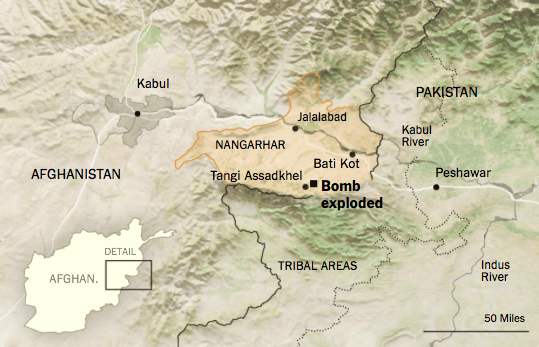
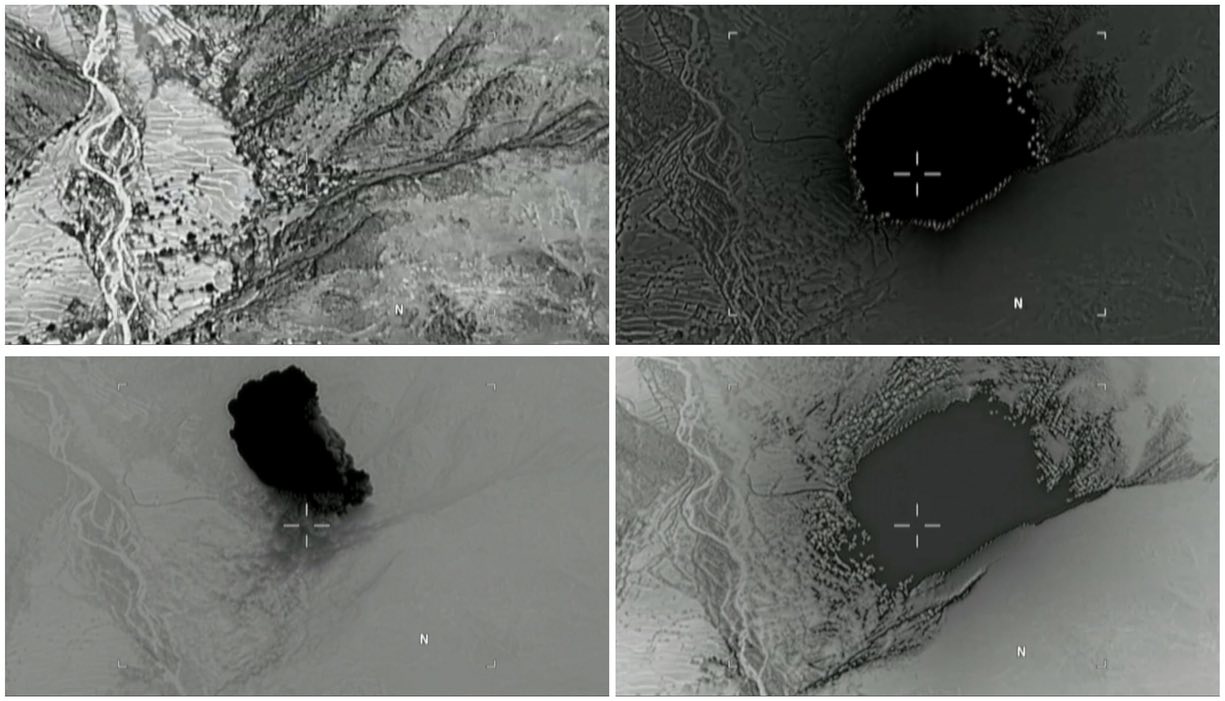
In the ghastly light of the Trump administration’s decision last month to drop (for the first time in combat) what the US Air Force calls ‘the Mother Of All Bombs‘ (MOAB), the GBU-43/B,  on an IS ‘tunnel complex’ in eastern Afghanistan, Michael Weinman has written an excellent essay for Public Seminar on ‘Ordnance as ordinance‘ that elaborates the second part of my claim about bombing being ‘law-full’:

[B]oth the decision to name this weapon MOAB and the decision to deploy it in Afghanistan is tightly linked with what Judith Butler called a “new military convention” begun by Colin Powell when he described the deployment of “smart bombs” during the first Iraq War as “the delivery of ordnance.” In “Contingent Foundations,” Butler noted that Powell “figures an act of violence as an act of law” by substituting “ordnance” (munitions, agents of destructive violence) for “ordinance” (a law or decree). Powell’s speech act, apparently delivered in an unscripted moment during a press conference in January 1991, is an important instance of the “illocutionary force” of language that Butler explores throughout the work she did in the late 1990s and early 2000s — her most impressive and important work in my view. This aerial bombardment of Iraqi installations with technologically advanced munitions, viewable in real time on network and cable TV for the first time, was itself a phenomenon. But it was the declaration that such a display in itself was an act of law enforcement that truly brought us into a new era. An era in which, thanks to Powell and the Bush (41) administration, the alignment of violence and law against a regime that violates international law figures state violence, even where it might be in contradiction of international agreements, as the very agent of law and legitimation. Watching the media response to the recent deployment of MOAB in Afghanistan, it is clear we still haven’t learned Butler’s lesson.

The deeper resonance of reading this particular ordnance as a form of ordinance requires that we attend to a different resonance of its chosen acronym, MOAB. Not the “Mother of All Bombs” nomenclature, which bespeaks its terrifying awesomeness — in the literal sense of the term “awesome,” connoting utter sublimity. That is part of the story too, but it is not the heart of it. Rather, continuing Butler’s pursuit of the line of thought by which Saddam (Hussein) was recast as (the Biblical) Sodom,[1] we must turn instead to the Biblical Moab, patriarch of the Moabites. Crucially, we must bear in mind that, within the Hebrew Bible, this people, whose lands lay across the Dead Sea, is cast as a hostile neighboring people — indeed, the Moabites are depicted as the neighboring tribe most inherently in conflict with the people of Israel. Viewed in this light, there is continuing power in Powell’s fantasy that the deliverance of ordnance is the way “we” publicly declare the ordinance that those who defy international law will be vanquished by the synthesis of law and force executed by the United States military as the leader the coalition of the willing. This vision remains the reigning principle behind the self-image of the United States as an actor on the international scene. And this is so because, deeply steeped in an “Old Testament morality” (a morality wherein the enemies of the United States are figured as the ancient enemies of the people of Israel), this vision justifies a view of America as the model exemplar of a “Judeo-Christian” civilization. A civilization that is — as it ever was — waging a war, engaging in a “clash of civilizations.” Of course we would name our most deadly non-nuclear weapon “Moab” (or M.O.A.B., if you like): what other name than that of the oldest and deepest “frenemy” of Israel could the United States military have possibly dreamt up?

There is more that could be said, I think, especially if one stays with Butler and thinks of this episode as a speech-act.  After all – and repeating a line that was repeated endlessly during the Rolling Thunder campaign against North Vietnam – MOAB was originally developed in 2002 for the ‘Shock and Awe’ campaign that heralded the US-led  invasion of Iraq, and the Pentagon claimed that deploying the MOAB was an act of communication (really): it sent ‘a very clear message’ to IS that it would be ‘annihilated‘.  (The message-in-a-bomb line shouldn’t be confused with the terse messages that ground crews have scrawled on bombs in war after war after war, and I suppose it is less grotesque than the description of bombing Syria as a form of ‘after-dinner entertainment‘ for the US President – which sends an even more terrifying message to anyone with a shred of decency or understanding).

If the bombing in Afghanistan did send a message to IS – and to state actors elsewhere in the world – it also sent a message to innocent others in the vicinity of the blast:

“There is no doubt that Isis are brutal and that they have committed atrocities against our people. But I don’t see why the bomb was dropped,” said the mayor of Achin, Naweed Shinwari. “It terrorised our people. My relatives thought the end of the world had come. Every day fighter jets, helicopters and drones are in the area.”

In that vein, and to return to the colonial genealogy I mentioned at the start, the use of the global South as a laboratory for weapons testing and demonstration has a long history, as Scott Beauchamp‘s report here documents:

…the most interesting commentary probably came from former Afghanistan president Hamid Karzai, who tweeted that “This is not the war on terror but the inhuman and most brutal misuse of our country as a testing grounds for new and dangerous weapons.”

He’s got a point. There is a dark history of Western military powers testing novel weapons and strategies on technologically overmatched non-Western (and non-white) populations. It’s a legacy that mixes the brutal arrogance of colonialism with the technological promise of an easy fix. There are of course numerous examples of this cruel dynamic at play in the centuries leading up to the 20th — conquistadors with dogs and swords, gunpowder in general — but the disparity that currently exists between the material advantages of Western countries and the technological capability of enemies abroad continues to be exploited in ways that conform to a recognizable pattern.

PS Much as I’ve enjoyed Michael’s essay, I think Stephen Fry also had a point.

The rise of Forensic Architecture

Andrew Curry has an interesting essay on Eyal Weizman‘s development of his Forensic Architecture research agency out of his work on the role of architecture in enacting and enforcing the Israeli occupation and colonisation of the West Bank here.

En route Andrew illuminates the combination of patient, meticulous analysis with imaginative, affective public engagement that is the signature of the ‘forensis‘ to which Eyal constantly appeals (and demonstrates):

Since Weizman, 46, founded FA in 2010, it has established itself as a unique hybrid of architecture studio and human rights investigator. The agency’s reports balance high-flown architectural theory with cold facts. “To build a quasi-discipline requires a combination of theoretical, historical, experimental, and technical capacity—along with serious historical analysis and serious theoretical understanding of the relationship between the architectural materiality and events,” Weizman says. “On the other hand, we’re very practical. It’s important to provide evidence to convince people and win cases.”

… The agency’s flair for showmanship is thanks in no small part to Weizman himself, who manages to marry undisputed intellectual heft—he’s published more than a dozen books (Forensic Architecture: Violence at the Threshold of Detectability comes out in May) and teaches at the University of London and Princeton University—with undeniable stage presence. Take his appearance outside an Israeli Army base in the West Bank, filmed for a 2014 Al Jazeera documentary called The Architecture of Violence: Weizman initiated a shouted exchange with an unseen (but presumably armed) soldier concealed inside a tall concrete watchtower. “Is this place only yours? It’s everybody’s place,” Weizman yelled in Hebrew, with an exaggerated wave and theatrical shrug. “Why are you here, anyway? Is that tube your home? It’s not even your home and you’re sitting in that tube telling me what to do?”

Point made, Weizman turned his back on the tower and strode through a scrubby field back to the waiting camera, sporting a toothy grin under aviator shades. “Fuck them,” he said dismissively. “Doesn’t he look ridiculous, inside his pipe house? Like he’s king of the hill, inside his tube?”

UPDATE:  There’s a first look at Eyal’s new book of essays, Forensic Architecture: violence at the threshold of detectability, at We make money not art here.

Violence and imagination

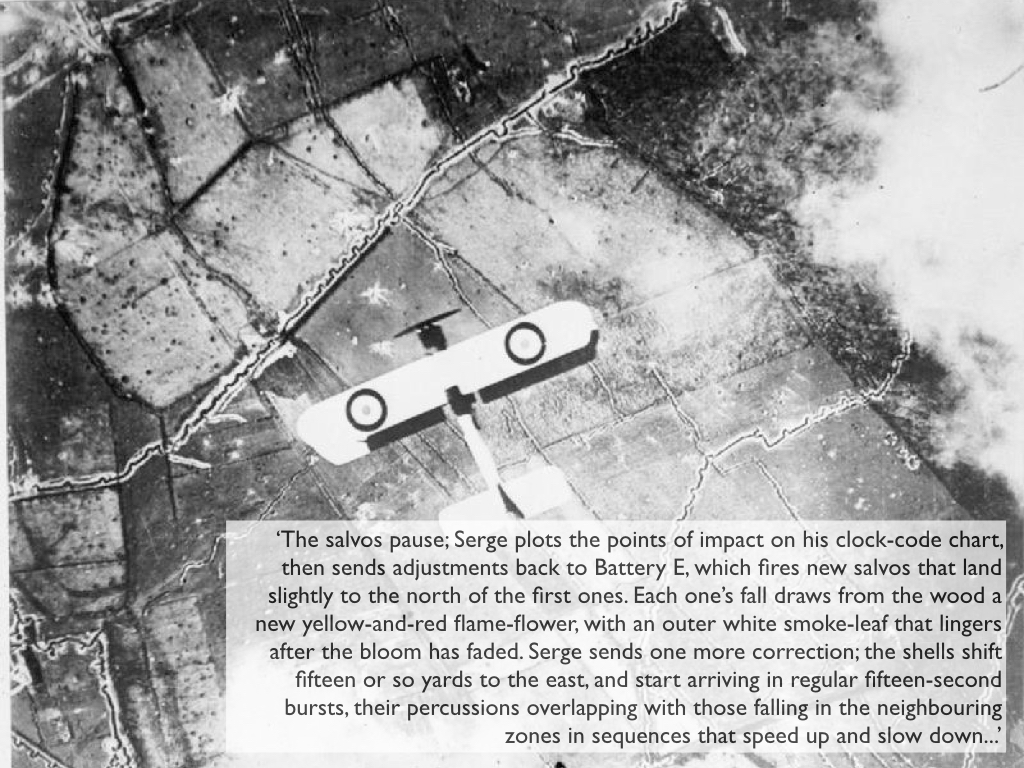
While I was working on ‘Gabriel’s Map’ (DOWNLOADS tab) Trevor Barnes introduced me to Tom McCarthy‘s mesmerising novel C which, among many other things, contains some extraordinary passages describing a young British pilot soaring high over No Man’s Land on the Western Front in the First World War.  His job was to identify the location of enemy artillery batteries and then direct (‘range’) the British guns on to them:

‘Serge feels an almost sacred tingling, as though he himself had become godlike, elevated by machinery and signal code to a higher post within the overall structure of things, a vantage point from which the vectors and control lines linking earth and heaven … have become visible, tangible even, all concentrated at a spot just underneath the index finger of his right hand which is tapping out, right now, the sequence C3E MX12 G…

‘‘Almost immediately, a white rip appears amidst the wood’s green cover on the English side. A small jet of smoke spills up into the air from this like cushion stuffing; out of it, a shell rises. It arcs above the trench-meshes and track-marked open ground, then dips and falls into the copse beneath Serge, blossoming there in vibrant red and yellow flame. A second follows it, then a third. The same is happening in the two-mile strip between Battery I and its target, and Battery M and its one, right on down the line: whole swathes of space becoming animated by the plumed trajectories of plans and orders metamorphosed into steel and cordite, speed and noise. Everything seems connected: disparate locations twitch and burst into activity like limbs reacting to impulses sent from elsewhere in the body, booms and jibs obeying levers at the far end of a complex set of ropes and cogs and relays.’

Serge is using the clock code to range the guns on to their target, but the passage is remarkable for McCarthy’s imagery of ‘machinery and signal code’ and ‘ropes and cogs and relays’. Some of those who survived the war used the same mechanical imagery, perhaps nobody more effectively than Ernst Jünger:

‘The modern battlefield is like a huge, sleeping machine with innumerable eyes and ears and arms, lying hidden and inactive, ambushed for the one moment on which all depends. Then from some hole in the ground a single red light ascends in fiery prelude. A thousand guns roar out on the instant, and at a touch, driven by innumerable levers, the work of annihilation goes pounding on its way.’

What distinguishes McCarthy, I think, is his realisation that more is happening than lights setting levers in motion. Later he has Serge recognise that he is the messenger of death but insist that

‘he doesn’t think doesn’t think of what he’s doing as a deadening. Quite the opposite: it’s a quickening, a bringing to life. He feels this viscerally, not just intellectually, every time his tapping finger draws shells up into their arcs, or sends instructions buzzing through the woods to kick-start piano wires for whirring cameras, or causes the ground’s scars and wrinkles to shift and contort from one photo to another: it’s an awakening, a setting into motion.’

This is much on my mind today for two reasons.  First, while I’ve been recovering from my eye surgeries last month I’ve been reading more diaries from the First World War (reading is apparently good therapy!), and in one of them Captain Henry Wynard Kaye of the Royal Army Medical Corps describes several visits to a friend in command of a Royal Flying Corps squadron on the Western Front.  He describes exactly that sense of ‘a quickening, a bringing to life’ – and death – that McCarthy evokes so perceptively.  Here is Kaye’s entry for 12 August 1915:

 ‘Two of his officers went off at 5 to destroy some trenches up by Hooge. The observer had the spots on which they were going to put shells marked on his map, and off they sailed saying they would be back at 8. Their programme was to fly up to the place, and directly they secure a suitable place for observing the observer sends a wireless signal to the Battery Commander telling him to begin. Thereafter the observer directs the battery about each shot by wireless until the job is done…  In an artillery job he clearly regards himself as running the whole show, and talks about ‘I’m going to shoot’, ‘I’m going to put shells there and there’, regarding the Battery Commander only as the man who puts his orders into effect’.


I drew on McCarthy’s work in “Gabriel’s Map’ because, so it seems to me, there are times when nominally ‘fictional’ writing captures with distilled perfection what ostensibly ‘factual’ sources labour to bring into partial view: the ‘truth’ of fiction, if you like.  So much so that I’ve written elsewhere about the lazy distinction between ‘fact’ and ‘fiction’ (though since I wrote that the US election has clearly made that distinction even more tense).

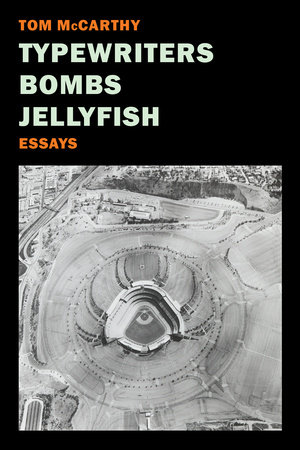
And so my second reason for returning to all this: Brad Evans‘s interview in the latest Los Angeles Review of Books with Tom McCarthy, which pivots around his new collection of essays Typewriters, Bombs, Jellyfish, and the intricate imbrications between philosophy and literature throughout his work:

I try to undo the distinction that’s usually made between “fiction” and “reality,” as though “fiction” were synonymous with fakery. I don’t think that’s the right layout to work with; I think there’s something else going on. In Typewriters, Bombs, Jellyfish, I try to argue that “fiction” is best understood in terms of a gap or interim, a delay or décalage — what Hamlet calls an out-of-jointness. Another way of thinking about this would be (and this perhaps goes back to Faulkner’s ripple image) as a kind of asynchronic overlay. And vitally, what this overlay gives rise to, in its collisions and its recesses, is a possibility — and an ethics — of witnessing. Tell him we were here, says Vladimir to the boy-angel amid all the replays and repetition loops and waiting periods of Godot: Don’t turn up here tomorrow and deny you ever saw me. Then, watching Estragon sleeping, he asks himself, “Was I sleeping, while the others suffered?”; and he muses that someone is also watching over him (Vladimir) and thinking: “He is sleeping, he knows nothing, let him sleep on.” Now, of course someone is watching him — it’s a play! But beyond that, I think Beckett is invoking the notion of literature as a shared or consensual hallucination in which the act of witnessing, of affirming the existence of “the others,” becomes possible. This is not a journalistic or “scientific” act; it’s ultimately an imaginative one, an act of the imagination.

Davey’s Locker

I’m sorry for the silence – I’ve been recovering from eye surgery a fortnight ago and have tried hard to restrict my screen time during that period.  But today I received the immensely sad news of the death of John Davey last Friday, two days after his 72nd birthday, and so, following a long walk, I’m back at my keyboard and staring blankly into the white space.  And not because of the spots in my eyes.

To say that John was the Geography editor for Edward Arnold in the 1960s and 70s (where, among many other pathbreaking books, he published David Harvey‘s Explanation in Geography and Social justice and the city) and from 1977 at Blackwell (where he continued and even accelerated that critical tradition) is already to say a lot: his extraordinary contributions to nurturing geographical scholarship were justly recognised by the AAG and the Royal Geographical Society.

But it isn’t to say nearly enough.  John, like a handful of others I can think of from that time – Janice Price at Methuen, Mark Cohen and Rob Shreeve at Hutchinson – was one of those rare publishers who believed passionately that books created their audiences and that geography was so much more than a textbook machine.   He didn’t spurn textbooks, but he had a non-mercenary and thoroughly ambitious sense of what they ought to strive for.

John was an English graduate, and a constant reminder that a geographical sensibility is scarcely confined to the discipline, and his conversations were generous lessons in intellectual vitality laced with an enviable wit (enviable not least because it was never cruel).  When I was writing what eventually  – how John would have smiled at that adverb – became Geographical imaginations he was always encouraging, never hectoring (he never once reminded me of a missed deadline, let alone rebuked me for it; he understood that intellectual work takes time and that deadlines are artificial and sometimes inimical to serious work).  He read carefully and critically what I wrote and engaged with it in a generous, wide-ranging and unfailingly creative fashion.  In fact, all my conversations with John were like that, so much so that he was the very best academic colleague I never had.

I remember too how he wrote to Ron Johnston, Peter Haggett, David SmithDavid Stoddart and me about his idea for a Dictionary of Human Geography.  Most of us – the exception was of course Ron – were deeply sceptical and I think politely said no; but it was impossible to say no to John for very long, and he artfully told each of us that it was such a pity since everybody else had agreed… so we were all hauled on board his pirate ship.  Like so much else it would never have been launched without John’s imagination, foresight and good humour (or the bottles he cracked across our bows).  And that’s more than fantasy: working with him was always an adventure, an open invitation to sail further into the unknown and to share what we found.

After John left Blackwell – the victim of corporate stupidity and cruelty – I  remember going to dinner at the house he shared in Jericho with his partner Alison, the unforced warmth of their collective welcome, and their (then) two children Emily and George roaring with delight as they wrestled me to the ground: and above all, I remember John’s evident delight at our delight.

His enthusiasm for books of all kinds was boundless, and he believed passionately that you could never become a good writer unless you were also a good reader.  Limiting yourself to academic prose was never going to raise the bar.  I remember endless conversations at conferences – geographical conferences – about crime fiction, sometimes with Barbara Kennedy, another aficionado (aficianoda? John would have known…), and as we gossiped about our favourite authors and new discoveries, John would take notes in that wonderfully spiky hand of his on tiny scraps of paper.

So as I arrive at what I think of as an Oxford full stop – if only it were just a comma – I shall miss that hand, both physically and metaphorically, his friendship and above all his infectious enthusiasm for life.  In her message to his friends today Alison wrote of the jolly times they had together, even in these last months, and that’s the word that captures so much of the wonderful man I knew: jolly.  His appetite for life, and his determination to share it with others, was a lasting gift to all of us.  It’s quite something when the death of a friend brings tears to your eyes and a smile to your face.

Transnational war and international law

New from Hurst: Jack McDonald‘s Enemies known and unknown: Targeted killings in America’s transnational war:

President Obama was elected on an anti-war platform, yet targeted killings have increased under his command of the ‘War on Terror’. The US thinks of itself as upholding the rule of international law and spreading democracy, yet such targeted killings have been widely decried as extra-judicial violations of human rights. This book examines these paradoxes, arguing that they are partially explained by the application of existing legal standards to transnational wars.

Critics argue that the kind of war the US claims to be waging — transnational armed conflict — doesn’t actually exist. McDonald analyses the concept of transnational war and the legal interpretations that underpin it, and argues that the Obama administration’s adherence to the rule of law produces a status quo of violence that is in some ways more disturbing than the excesses of the Bush administration.

America’s interpretations of sovereignty and international law shape and constitute war itself, with lethal consequences for the named and anonymous persons that it unilaterally defines as participants. McDonald’s analysis helps us understand the social and legal construction of legitimate violence in warfare, and the relationship between legal opinions formed in US government departments and acts of violence half a world away.

No shortage of books on targeted killing, I know, but this one stands out through its focus on the entanglements between law and violence in the very idea of transnational war and its interest in the individuation of later modern war.  Here’s the Table of Contents:

Introduction: The Balkan Crucible

1. The Cleanest War
2. The Lens of War
3. In Washington’s Shadow
4. Lawful Annihilation?
5. Unto Others
6. Individuated Warfare
7. Killing through a Monitor, Darkly
8. The Body as a Battlefield
9. Gyges’ Knife

That said, I do have reservations about the claim that the US ‘thinks of itself as upholding the rule of international law’ – or, more precisely, about the reality that lies behind that rhetoric.

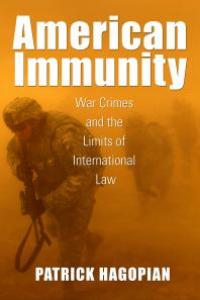
As I continue to work on ‘The Death of the Clinic‘, and the assaults on hospitals and healthcare in Syria and beyond, I’ve been drawn into debates that circle around the selective impotence of international law and appeals to the International Criminal Court.  In the Syrian case, the geopolitics of international law are laid bare: the jursdiction of the ICC is limited to acts carried out in the territory of a state that is party to the Rome Statute [Syria is not] unless the crimes are referred to the ICC by the UN Security Council – where Russia has consistently exercised its veto to protect its ally/client.  But it is important not to lose sight of what Patrick Hagopian called ‘American immunity’; based on a close reading of Korea and Vietnam he shows how the United States has consistently sought ‘to police a system of law universally binding on others from which it reserves the right at any moment to exempt itself.’  Similarly, Jens David Ohlin has traced a persistent American scepticism towards international law that was redoubled in the years after 9/11 and, as I’ve suggested before, the US is by no means alone in what Jens identifies as a sustained ‘assault on international law‘.

I don’t say this to detract from Enemies known and unknown: it’s just really a promissory (foot)note to my continuing work on spaces of exception in Syria (where it isn’t intended to give succour to the legions of Putin/Assad trolls inside and outside the academy either – on which see this long overdue, forensic take-down of one of the most egregious offenders by Brian Slocock here).

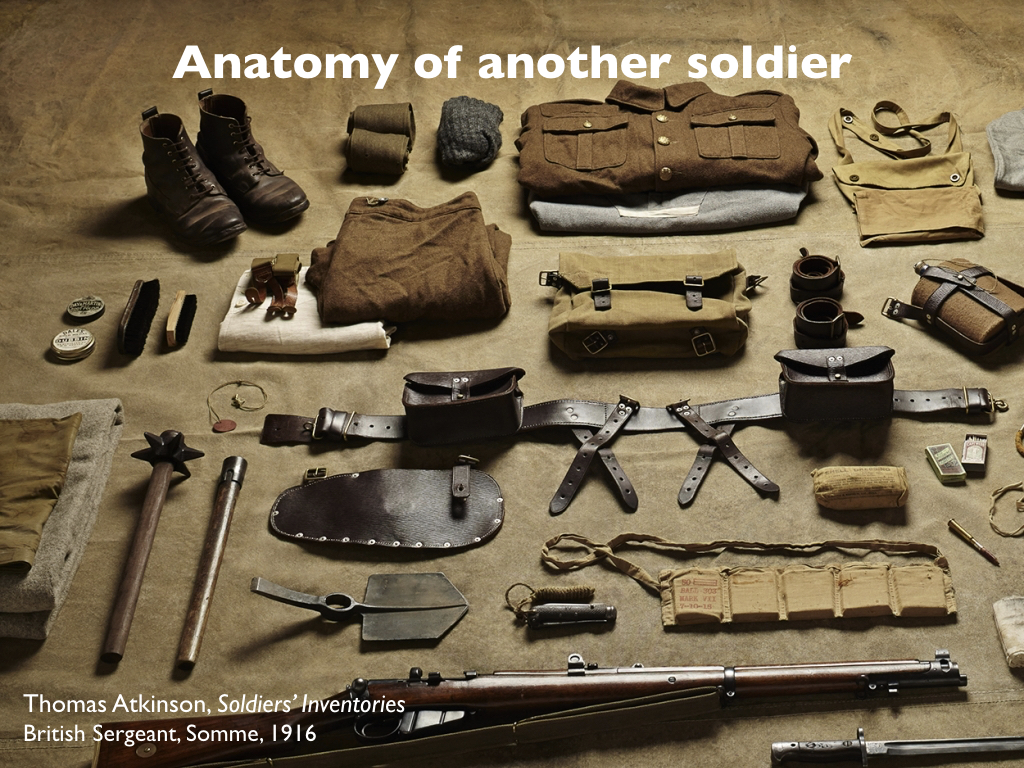
Anatomy of another soldier

I’ve drawn attention to Harry Parker‘s Anatomy of a soldier before: see here and here (and especially ‘Object lessons’: DOWNLOADS tab).  Most of the reviews of the novel were highly favourable, applauding Parker’s experimental attempt to tell the story of a soldier seriously wounded by an IED in Afghanistan through the objects with which he becomess entangled.

But writing in The Spectator Louis Amis saw it as an object lesson in ‘How not to tell a soldier’s story‘.  He complained that Parker’s device produced a narrative

‘as if the war were composed only of its inanimate processes, either accidental or inevitable. It’s a different planet to the bloody, profane, outlaw Iraq of [Phil] Klay’s Redeployment, radiating shame, PTSD and suicide, and the unbearable awkwardness of transmitting such truths to an alienated civilian world.

Parker’s device gestures aptly towards a spreading out of consciousness, a transmutation, the scattering of the individual along some plane at the threshold of death; the sensations of depersonalisation and hyper-perceptivity associated with traumatic experience; and the soothing quiddity of simple objects, as opposed to abstract thought, for a recovering victim. But it is also a method of averting the gaze from a war’s futility and waste, and worse — and probably, therefore, too, from the true nature of any saving grace.’

I do think Parker’s narrative accomplishes more than Amis allows. It succeeds in making the war in Afghanistan at once strange and familiar; and its strangeness comes not from the people of Afghanistan, that ‘exotic tableau of queerness’ exhibited in so many conventional accounts, but through the activation of objects saturated with the soldier’s sweat, blood and flesh.  It’s also instructive to read the novel alongside Jane Bennett‘s Vibrant matter: a political ecology of things or Robert Esposito‘s Persons and things, as I’ve done elsewhere, and to think through the corpo-materialities of modern war and its production of the battle space as an object-space: but neither of these has much to say about how their suggestive ideas might be turned to substantive account.

Still, Amis’s point remains a sharp one; Scottt Beauchamp says something very similar:

Harry Parker goes further than [Tim] O’Brien [in The things they carried] in giving equal narrative play to nonhuman things. Not only do they make the plot of Parker’s novel possible, they also bear semiconscious witness to our shared reality, corroborating it. Their inability to pass moral judgment comes off as a silent accusation. If this ontological shift toward objects is the most honest way we have of talking about war, it’s still limiting: it turned its weakness—its inability to fully articulate the moral significance of war—into a defining characteristic.

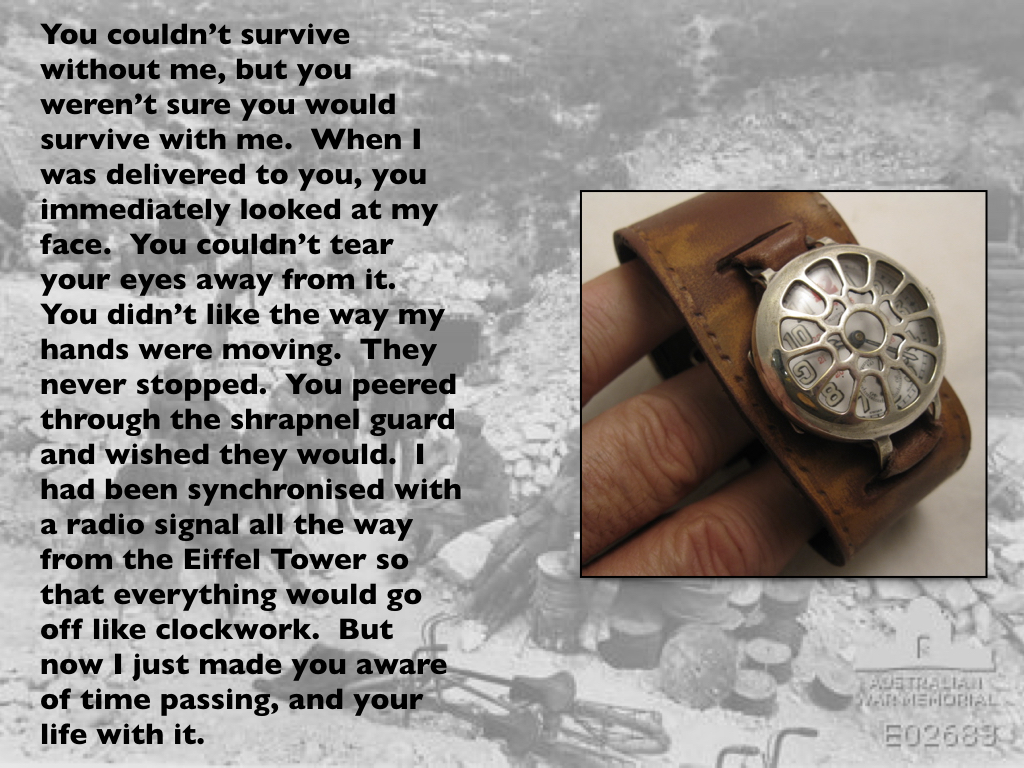
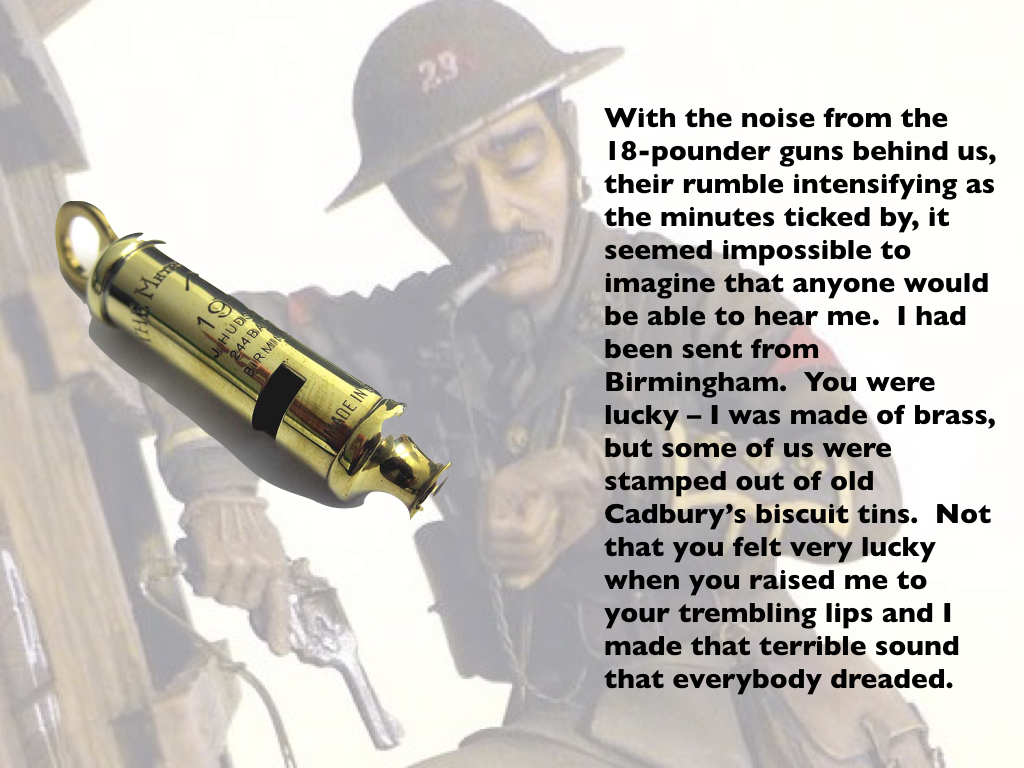
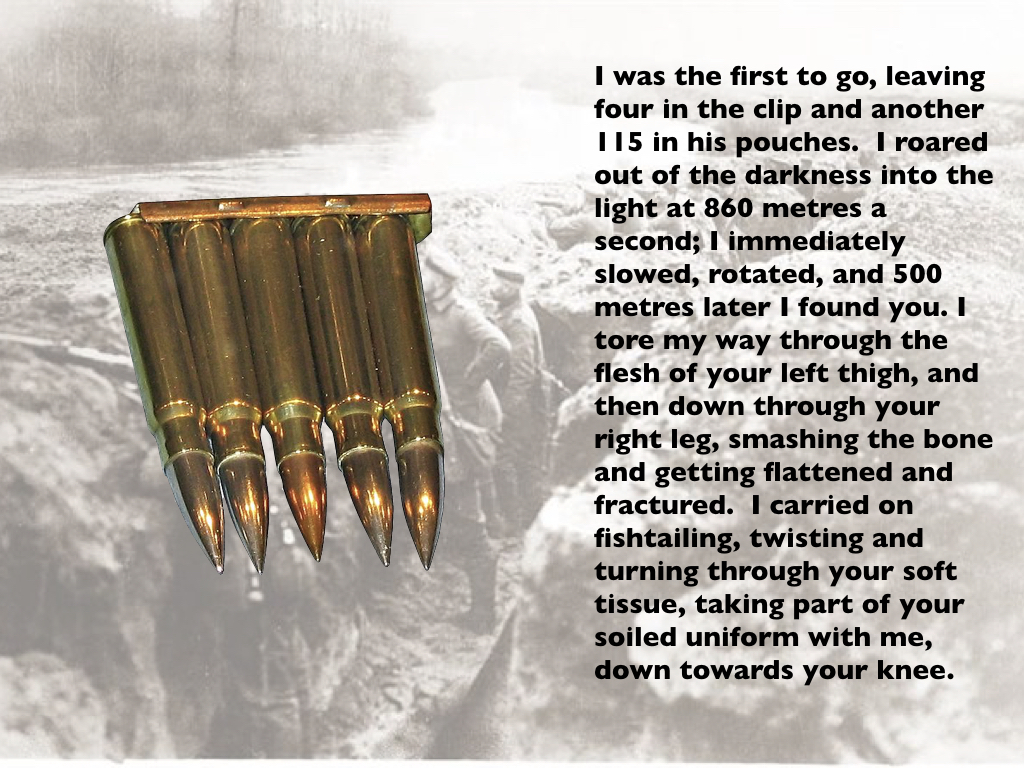
But I haven’t been able to let Parker’s experiment go.  So, for one of my presentations in Durham last month – on the parallels and differences between combat medical care and casualty evacuation on the Western Front in the First World War and Afghanistan a century later – I sketched out an Anatomy of another soldier.  It’s based on my ongoing archival work; earlier in the presentation I had used diaries, letters, memoirs, sketches and photographs to describe what Emily Mayhew calls the ‘precarious journey’ of British and colonial troops through the evacuation chain – you can see a preliminary version in ‘Divisions of life’ here – so this experiment was a supplement not a substitute.  But I wanted to see where it would take me.

So here are the slides; they ought to be self-explanatory – or at any rate, sufficiently clear – but I’ve added some additional notes.  I should probably also explain that in each case the object in question appeared on the slide at the end of its associated narrative.

***
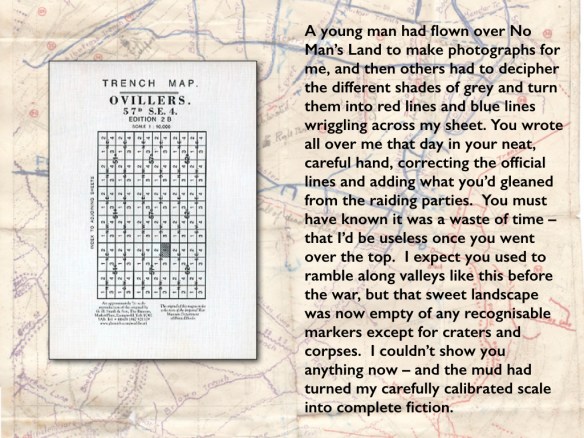
I discuss aerial photography and trench mapping on the Western Front – and the difficulty of navigating the shattered landscapes of trench warfare – in ‘Gabriel’s map: cartography and corpography in modern war’ (DOWNLOADS tab).

You can find a short account of the synchronisation of officers’ watches on the Western Front in ‘Homogeneous (war) time’ here.

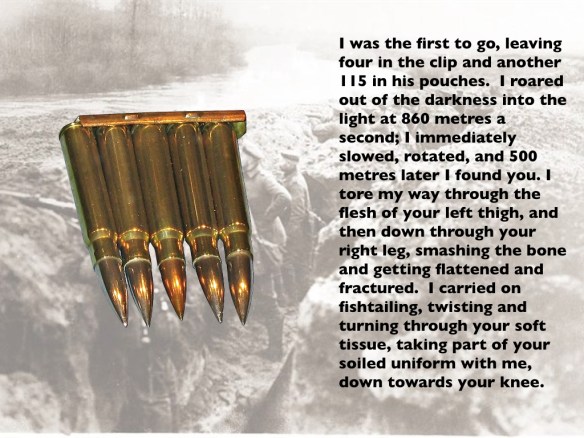
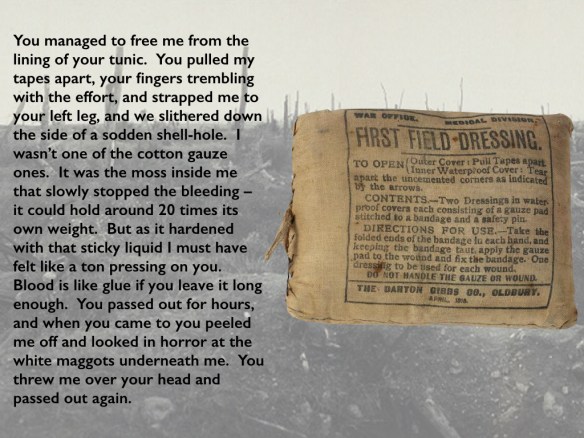
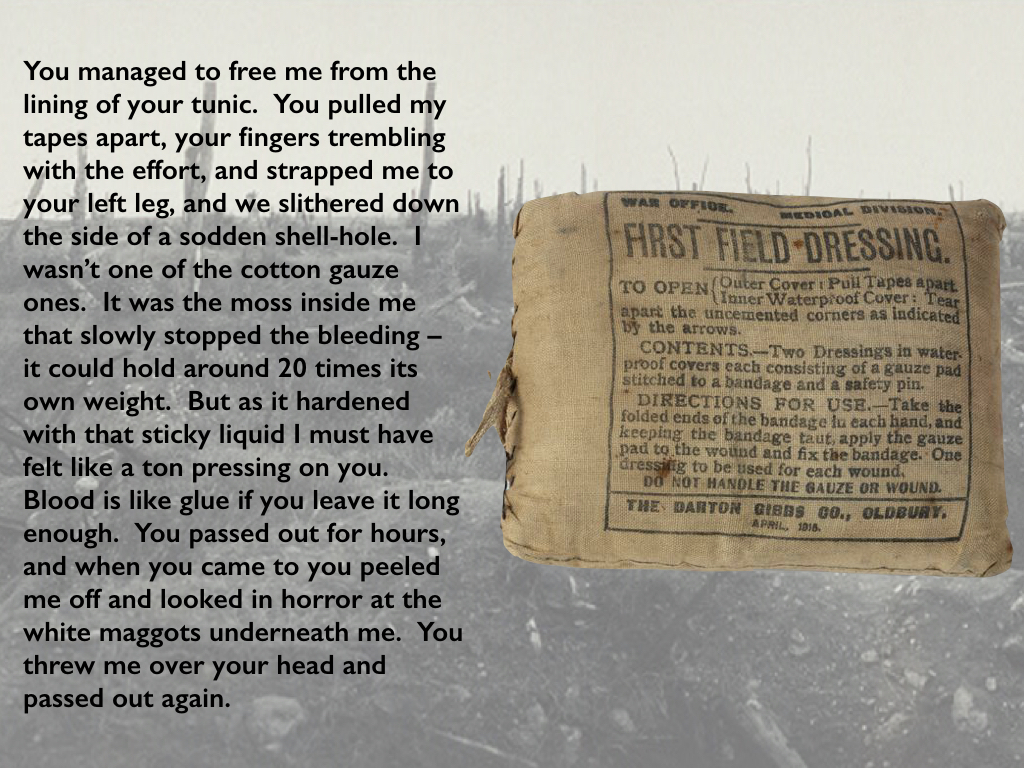
A shortage of cotton (combined with its relatively high cost) together with the extraordinary demand for wound dressings prompted the War Office to use sphagnum moss – the British were years behind the Germans and the French in appreciating its antiseptic and absorbent qualities, which also required dressings to be changed less often.  You can get the full story from Peter Ayres, ‘Wound dressing in World War I: the kindly sphagnum moss’, Field Bryology 110 (2013) 27-34 here.

But one RAMC veteran [in ‘Field Ambulance Sketches’, published in 1919] insisted on the restorative power of the white bandage, administered not by regimental stretcher bearers but by the experts of the Royal Army Medical Corps’s Field Ambulance:

The brown first field dressing, admirable as it is from a scientific point of view, always looks a desperate measure; and if it slips, as it generally does on a leg wound, it becomes for the patient merely a depressing reminder of his plight. A clean white dressing, though it may not be nearly so satisfactory in the surgeon’s eyes, seems to reassure a wounded man strangely. It makes him feel that he is being taken care of, gives him a kind of status, and stimulates his sense of personal responsibility. With a white bandage wound in a neat spiral round his leg, he will walk a distance which five minutes earlier, under the dismal suggestion of a first field dressing, he has declared to be utterly beyond his powers.

I borrowed the white maggots (and some of the other details of the wounds) from John Stafford‘s extraordinary, detailed recollection of being wounded on the Somme in August 1916 available here.
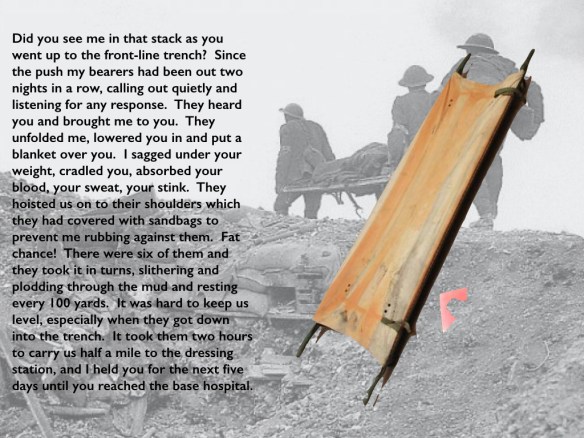
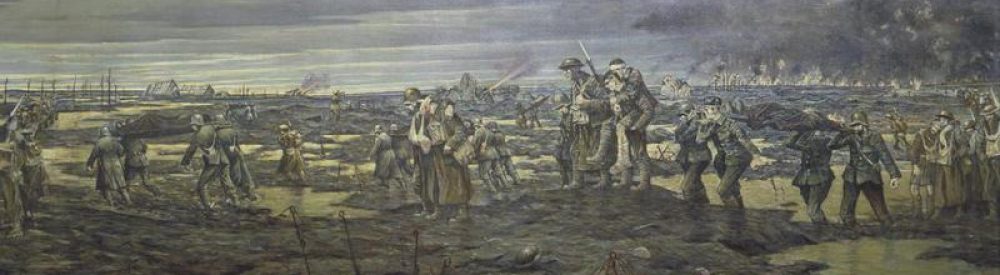
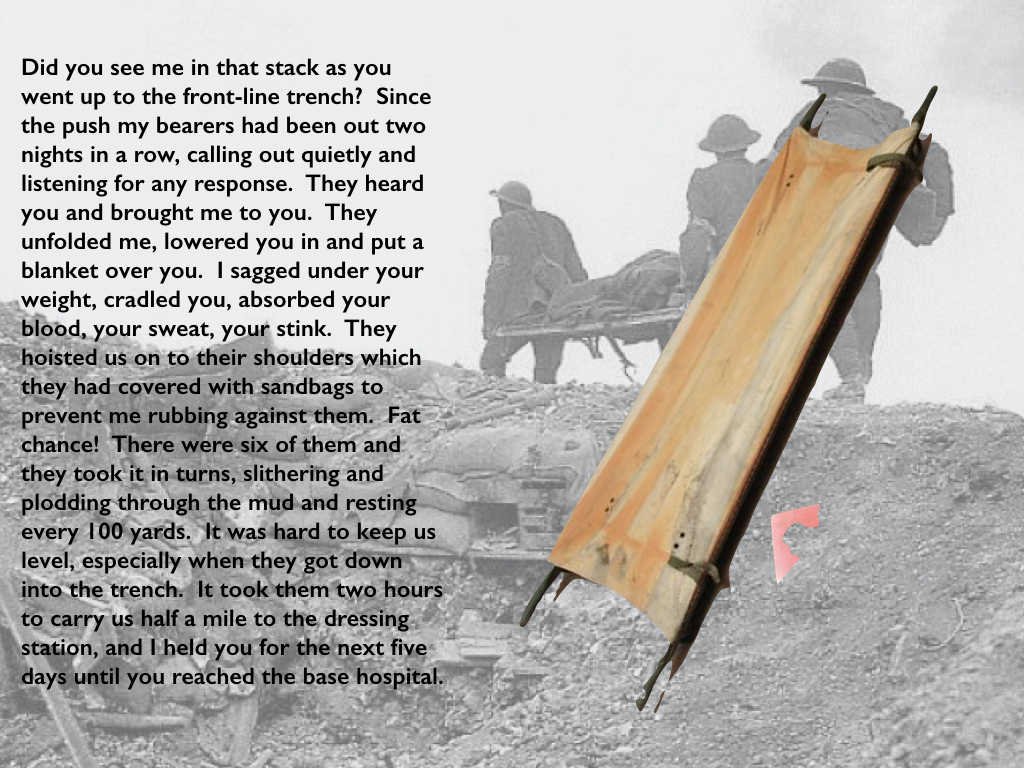
Carrying a stretcher across a mud-splattered, shell-blasted landscape was immensely tiring and it was all too easy to lose one’s bearings.  From ‘A stretcher-Bearer’s Diary’, 17 September 1916:

‘The shell fire, and the mud, are simply beyond description, and it is a miracle that any escape being hit. We have to carry the wounded shoulder high, the only way it can be done, because of the mud. Our shoulders are made raw by the chafing of the stretcher handles, although we wear folded sandbags under our shoulder straps. Sweat runs into our eyes, until we can hardly see. When a barrage comes we must keep on and take no notice, as even if we could find cover, there is none for the man on the stretcher….

‘…The rain has made the ground a sea of mud, and we have to carry the wounded three miles to the Dressing Stations, as the wheeled stretchers cannot be used at all. Two men using stretcher slings could not carry a man thirty yards, and I have seen four bearers up to their knees in mud, unable to move without further assistance.

By the time of the 3rd Battle of Ypres, it could take eight men to carry a stretcher half a mile to an aid post – and it could take them two hours to do it.

Even in ideal circumstances, manoeuvering a stretcher down a narrow, crowded trench was extremely difficult, ‘like trying to move a piano down an avenue of turnstiles.’  During major offensives a one-way system was in operation, and stretcher bearers were supposed to use only the ‘down’ trenches.  From the Aid Posts the RAMC stretcher-bearers of the Field Ambulance would take over from the regimental stretcher-bearers.  Here is one young novice, Private A.F. Young with the 2n3/4th London Field Ambulance:

Step by step we picked our way over the duckboards. It is useless to try and maintain the regulation broken step to avoid swaying the stretcher. Slowly we wind our way along the trenches, our only guide our feet, forcing ourselves through the black wall of night and helped occasionally by the flash of the torch in front. Soon our arms begin to grow tired and the whole weight is thrown on to the slings, which begin to bite into our shoulders; our shoulders sag forward, the sling finds its way on to the back of our necks; we feel half-suffocated. A twelve-stone man, rolled up in several blankets on a stretcher, is no mean load to carry, and on that very first trip we found that the job had little to do with the disciplined stretcher-bearing we had spent so many weary hours practising. We are automatons wound up and propelled by one fixed idea, the necessity of struggling forward. The form on the stretcher makes not a sound; the jolts, the shakings seem to have no effect on him. An injection of morphine has drawn the veil. Lucky for him.  

Stretcher-bearers changed – they worked in relays close to the front – but the stretcher remained the same.  Ideally the wounded soldier would remain on his stretcher only as far as the Casualty Clearing Station, from where used stretchers would be returned to dressing stations and aid posts by now empty ambulances.  

Twelve stretchers were supposed to be kept at every Regimental Aid Post, but supplies could easily run out.  When Major Sidney Greenfield was wounded, he remembered:

… the call ‘stretcher-bearers’, ‘stretcher-bearers’, the reply ‘No stretchers’. ‘Find one, it’s an officer.’

And it was not uncommon for those evacuated ‘in a rush’ to remain on their stretcher until the base hospital; and since ambulance trains heading to the coast were less urgent than troop trains and supply trains heading in the opposite direction the journey was usually a slow one.  If the nearest hospital turned out to be full, a not uncommon occurrence, the train would be sent on to the next available one, thus prolonging the journey still more.    

H.G. Hartnett recalled the sheer pleasure of finally being put to bed at the base hospital at Wimereux:

After being washed and changed into clean pyjamas I was lifted off the stretcher on which I had lain for five days and nights into a soft bed—between sheets.

The contrast, of course, was not only with the canvas stretcher but with sleeping in the trenches wrapped in a groundsheet.

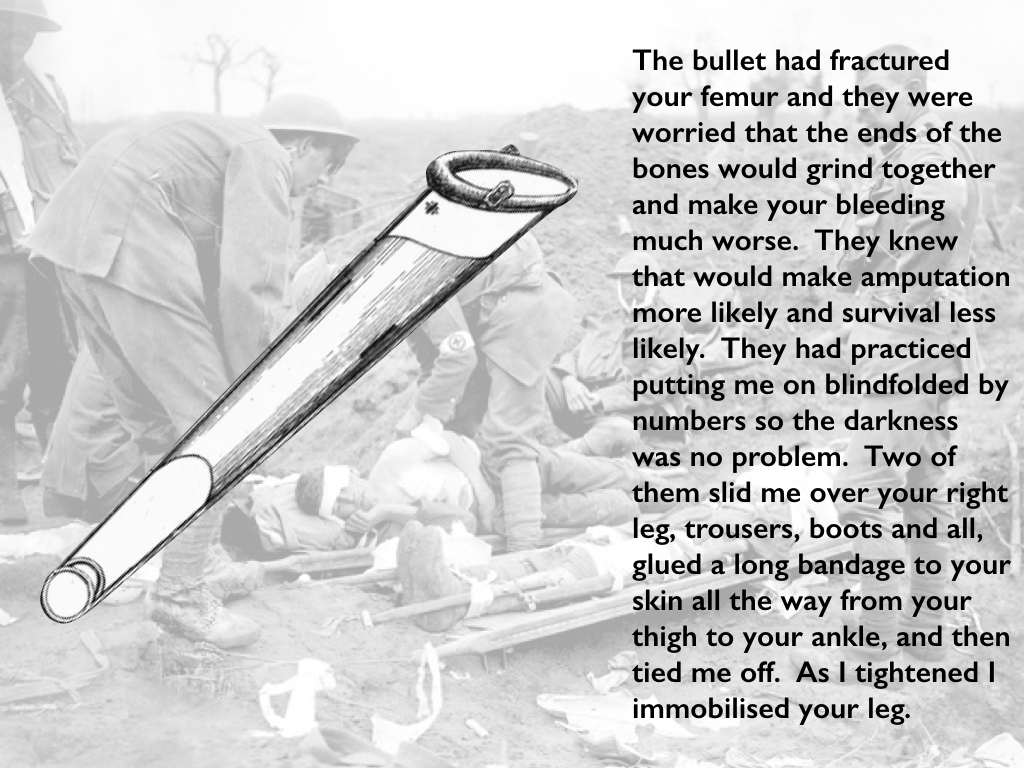
Before the widespread introduction of the Thomas splint (above), ordinary or even improvised splints were used.  Here is Sister Kate Luard on board an ambulance train in October 1914:

The compound-fractured femurs were put up with rifles and pick-handles for splints, padded with bits of kilts and straw; nearly all the men had more than one wound – some had ten; one man with a huge compound fracture above the elbow had tied on a bit of string with a bullet in it as a tourniquet above the wound himself.

A fractured femur would turn out to be one of the most common injuries, described by Robert Jones as ‘the tragedy of the war’: if fractures were not properly splinted the soldier would arrive at the Casualty Clearing Station in a state of shock caused by excessive blood loss and pain:

‘These men required radical surgery to save their limbs and lives… Entry and exit wounds would have to be extended widely, removing all dead skin and fat… The bone ends of the femur at the fracture site would then have to be pulled out of the wound and be inspected directly [for loose fragments of bone, clothing and debris]… Wounded soldiers arriving at casualty clearing stations with a weak pulse and low blood pressure secondary to excess blood loss due to inadequately splinted fractures would be unlikely to survive the major procedure’ – let alone the amputations that were often administered.

Mortality rates in such circumstances were around 50 per cent. The Thomas splint was specifically designed to immobilise a fractured femur, and by April/May 1917 its use during the battle of Arras had reduced the mortality rate to 15 per cent, and far fewer men lost their legs: see Thomas Scotland, ‘Developments in orthopaedic surgery’, in Thomas Scotland and Stephen Heys (eds) War surgery 1914-1918.

Stretcher bearers were trained to apply the splint in the field, as in this case, but one senior officer made it clear that in any event it had to be applied no later than the Regimental Aid Post:

The Thomas thigh splint should be applied with the boot and trousers on, the latter being cut at the seam to enable the wound to be dressed. The method of obtaining extension by means of a triangular bandage has been sketched and circulated to all MOs in the Divn. After the splint is adjusted it should be suspended both at the foot and at the ring by two tapes at either end tied to the iron supports one of which is fitted to the stretcher opposite the foot and one opposite the hip.

More information on this truly vital innovation: P.M. Robinson and M. J. O’Meara, ‘The Thomas splint: its origins and use in trauma’, Journal of bone and joint surgery 91 (2009) 540-3: never in my wildest dreams did I imagine reading or referencing such a journal – but it is an excellent and thoroughly accessible account.  See for yourself here.

It was vital not to leave a tourniquet on for long.  Here is one RAMC officer, Captain Maberly Esler, recalling his service on the Somme in June 1915:

If a limb had been virtually shot off and they were bleeding profusely you could stop the whole thing by putting a tourniquet on, but you couldn’t keep it on longer than an hour without them losing the leg altogether. So it was necessary to get the field ambulance as soon as possible so they could ligature the vessels, and the quicker that was done the better.

Lt Col Henderson‘s pencilled notes on the treatment of the wounded (1916-16) urged stretcher bearers to make every effort to stop bleeding with a compress or bandage: ‘ A tourniquet should only be applied if this response fails and where a tourniquet is applied the [Regimental Medical Officer] should be at once informed on the arrival of the case at the [Regimental Aid Post].’  By May 1916 Medical Officers were being warned ‘against too frequent use of the tourniquet, on the grounds that the dreaded gas bacillus (perfringens) is most likely to thrive in closed tissues.’

A tourniquet could aggravate damaged tissues and did indeed increase the risk of gangrene; 80 per cent of those whose limbs had a tourniquet applied for more than three hours required amputation.

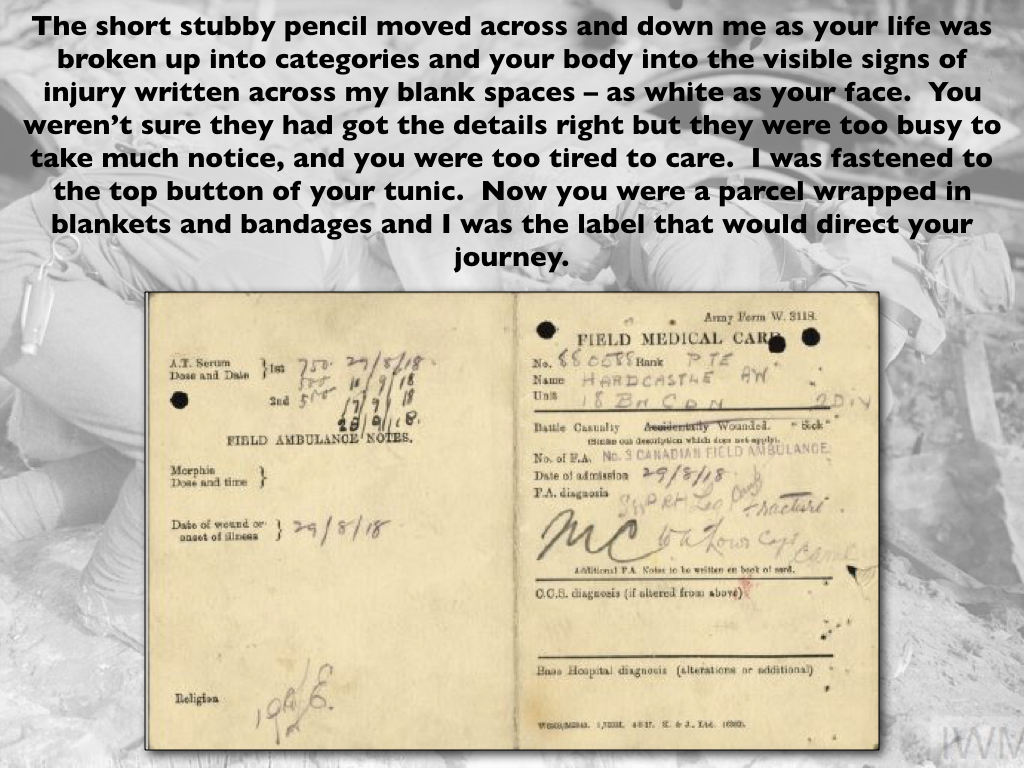
This was a major responsibility; sometimes the card was filled in at a Dressing Station, sometimes at the Casualty Clearing Station.  George Carter‘s diary entry for 31 August 1915 explains its importance:

‘My work consists of nailing every patient and getting his number, rank, name, initial, service, service in France, age, religion, battalion and company. That is usually fairly plain sailing, I find, but entails a certain amount of searching [extracting paybook or diary, for example] when a patient is too ill to be bothered with questions. Then I have to find out what is the matter with him, what treatment he has had, and what is going to be done with him… The reason for taking these particulars and making out forms is to prevent any man being lost sight of, whatever happens to him. If he finishes in England after taking a week on the journey, he has got all his partics on him, everywhere he has stopped, the RAMC have been able to see at a glance all about him and can turn up all about him if called on.’

But things could easily go awry.  Here is one young soldier, Henry Ogle:

I think it must have been here [at the CCS] that orderlies tied Casualty Labels on our top tunic buttons, and got mine wrong, though it may have been at Louvencourt or even Hébuterne. Wherever it had happened, it was here that I first noticed it and called the attention of an orderly to it. I had been wounded in the right calf by part of a rifle bullet which penetrated deeply and remained in but I had been labelled for superficial something or other, while Frank Wallsgrove was GSW for gunshot wound. I said, ‘Mine’s wrong, for we two were hit by the same bullet.’ ‘Can’t alter your label, chum. Anyhow it doesn’t matter. It’ll get proper attention.’ We were already being packed into a train so nothing could be done and I didn’t worry about it.

At the base hospital he tried again:

An orderly came along (it was then dark night) and threw a nightgown and a towel at me. ‘Bathroom. Down that passage. On the right. Any of them.’ ‘Don’t think I can get there. Can’t walk.’ ‘Let’s see your label.’ ‘Label’s wrong.’ ‘What do you know about that? Go on.’ ‘I know a bloody sight more about it than you do, chum, but I’ll see what I can do.’ It was not easy as the leg was quite out of action and my orderly friend had no time to watch…  On crawling back I found Frank tucked into bed. Our case-sheets were clipped to boards which hung on the wall behind our beds and, so far, the items from our tunic labels had been copied out on the case-sheets. The next morning the customary round of visits was made by the Medical Officer on duty with Matron and Sister of Ward and an orderly or two. I tried to explain that my label was wrong and Frank backed me up but we were simply ignored. My wound was dressed as a surface wound.

It was only after the swelling of his leg alarmed Matron that Henry was shipped off for an X-ray that revealed the need for an operation to remove the bullet.

‘T’ for anti-tetanus serum.  In the first weeks of the war tetanus threatened to become a serious problem: on 19 October 1915 Sister Kate Luard recorded ‘a great many deaths from tetanus’ in her diary, but two months later she was able to note ‘The anti-tetanus serum injection that every wounded man gets with his first dressing has done a great deal to keep the tetanus under.’  In A Surgeon in Khaki, published in 1915, Arthur Andersen Martin confirmed that ‘every man wounded in France or Flanders today gets an injection of this serum within twenty-four hours of the receipt of the wound’ – at least, if he had been recovered in that time – and ‘no deaths from tetanus have occurred since these measures were adopted.’

More information: Peter Cornelis Wever and Leo van Bergen, ‘Prevention of tetanus during the First World War’, Medical Humanities 38 (2012) 78-82.

Morphine was administered for pain relief, but it still awaits its medical-military historian (unless I’ve missed something).
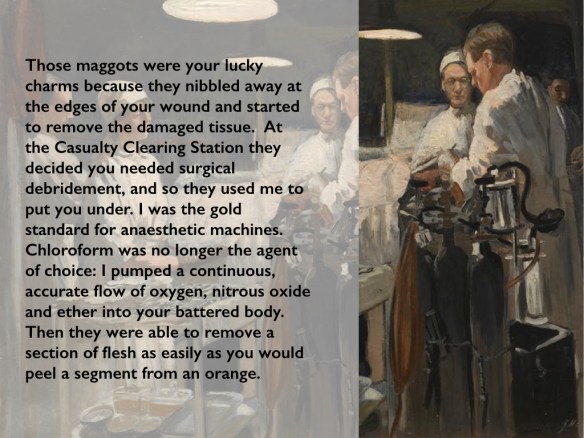
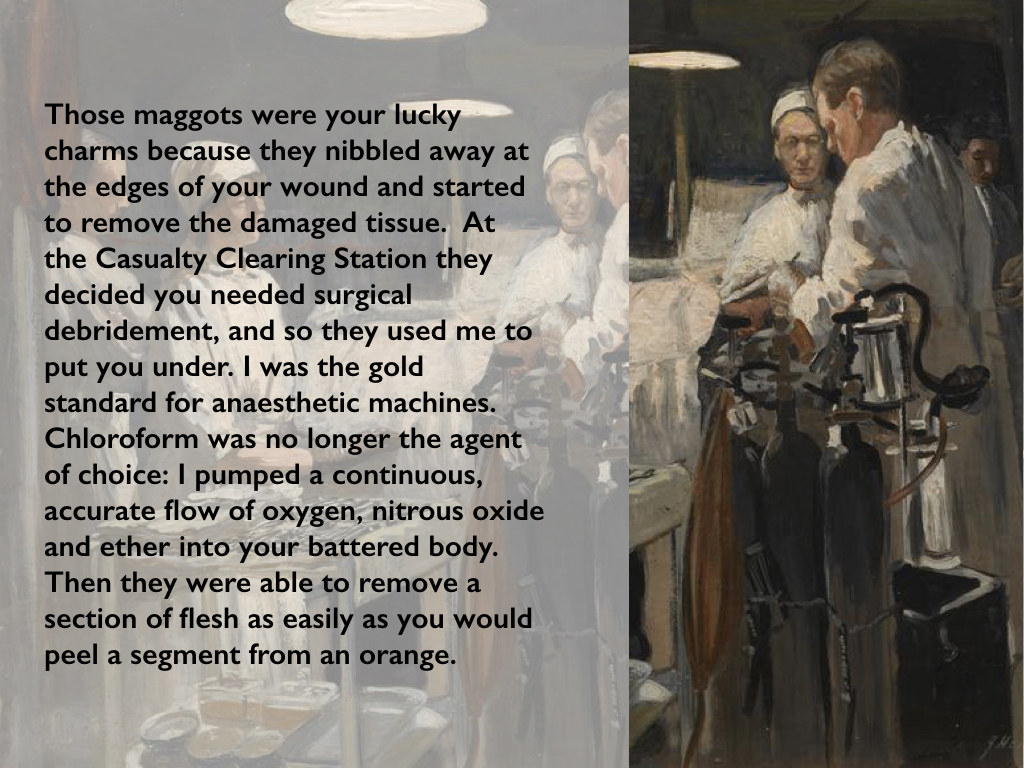
This was Boyle’s anaesthetic apparatus, but before the widespread availability of these machines a variety of systems was in use and, in the heat of the moment, the administration of anaesthesia was often far removed from the clinical, calibrated procedures the machine made possible. Here is a chaplain who served at No 44 Casualty Clearing Station:

I spent most of my time giving anaesthetics. I had no right to be doing this, of course, but we were simply so rushed. We couldn’t get the wounded into the hospital quickly enough, and the journey from the battlefield was terrible for these poor lads. It was a question of operating as quickly as possible. If they had had to wait their turn in the normal way, until the surgeon was able to perform an operation with another doctor giving the anaesthetic, it would have been too late for many of them. As it was, many died.

The most fortunate patients were those who had little or no recollection of the procedure.  Here is H.G. Hartnett on his experience at No 15 Casualty Clearing Station (the second occasion he was wounded):

 I was destined for surgery and lay in agony on my stretcher until near 9.00 pm, when orderlies carried me into a brilliantly lit operating theatre. I was placed on the centre one of three operating tables where I lay watching doctors and nurses completing an operation on another patient only a few feet from where I lay. When my turn came my wound was uncovered and a doctor placed a mask over my face. Then he asked me the name of the colonel of my battalion as he administered the anaesthetic. I remember no more about the operation or the theatre. When I returned to brief consciousness about 4.00 am the next morning I was lying on a stretcher on the ground in a large canvas marquee, in the third position on my side of it. Others had been carried in during the night, all from the operating theatre. The fumes of the anaesthetic from their clothes and blankets continued to put us off to sleep again. The day was well advanced when I finally returned to full consciousness.  

In the early years of the war anaesthesia was not a recognised speciality – and chloroform was the most widely used agent – but as the tide of wounded surged, operative care became more demanding and Casualty Clearing Stations assumed an increasing operative load so it became necessary to refine both its application and the skills of those who administered it.   In the British Army advances in anaesthesia were pioneered by Captain Geoffrey Marshall at No 17 Casualty Clearing Station at Remy Siding near Ypres from 1915.  By then nitrous oxide and oxygen were commonly used for short operations (which did not mean they were minor: they included guillotine amputations) but longer procedures typically relied on chloroform and ether.  A crucial disadvantage of chloroform was that it lowered blood pressure in patients who had often already lost a lot of blood.  ‘If chloroform be used,’ Marshall warned, ‘the patient’s condition will deteriorate during the administration, and he will not rally afterwards.’  And while ether would often produce an improvement during the operation, this was typically temporary: ‘the after-collapse [would be] more profound and more often fatal.’   His achievement was to show that a combination of nitrous oxide, oxygen and ether significantly improved survival rates for complex procedures – from 10 per cent to 75 per cent for leg amputations – and to have a machine made to regulate the combination of the three agents.  His design was copied and modified by Captain Henry Boyle, whose name became attached to the device.  

More information: Geoffrey Marshall, ‘The administration of anaesthetics at the front’, in British medicine in the war, 1914-1917N.H. Metcalfe, ‘The effect of the First World War (1914-1918) on the development of British anaesthesia’, European Journal of Anaesthesiology 24 (2007) 649-57; E. Ann Robertson, ‘Anaesthesia, shock and resuscitation’, in Thomas Scotland and Steven Heys (eds) War surgery, 1914-1918.
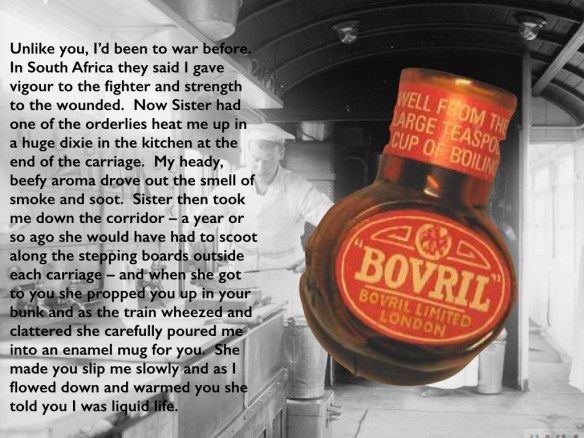
Bovril was advertised in all these ways; the company used a sketch of the Gallipoli campaign to claim that Bovril would ‘give strength to win’ and that it was a ‘bodybuilder of astonishing power’.  In 1916 the company even published an extract from a letter purported to come from the Western Front, accompanied by an image of an RAMC Field Ambulance tending a wounded soldier: 

But for a plentiful supply of Bovril I don’t know what we should have done.  During Neuve Chapelle and other engagements we had big cauldrons going over log fires, and as we collected and brought in the wounded we gave each man a good drink of hot Bovril and I cannot tell you how grateful they were.

Oxo seems to have been less popular, and least for any supposed medicinal or restorative properties, but it was often sent to soldiers by their families at home.  One advertising campaign enjoined them to ‘be sure to send Oxo’, and in one ad a Tommy writes home to say that when he returned to his billet to find the parcel, ‘the first thing I did was to make a cup of OXO and I and my chums declared on the spot this cup of OXO was the best drink we had ever tasted.’  
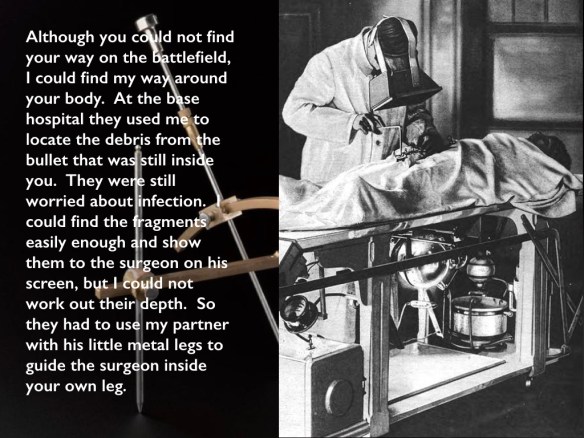
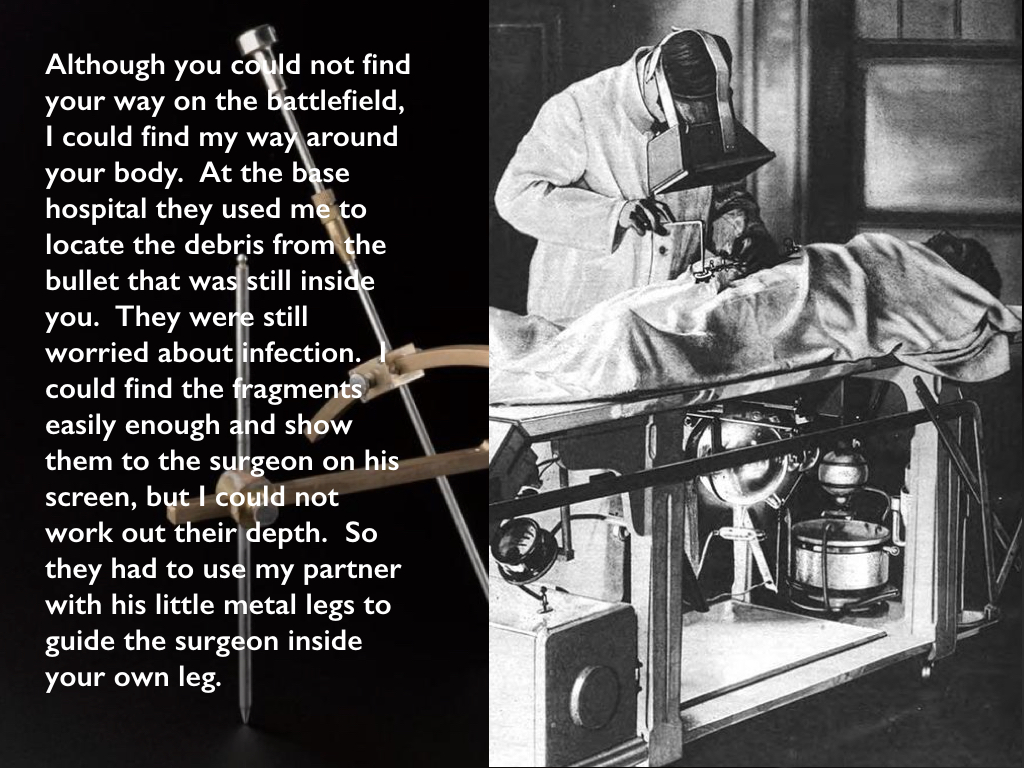
The image shows a surgeon using a fluoroscope to locate the fragments of the bullet:

An early Crookes x-ray tube visible under the table emits a beam of x-rays vertically through the patient’s body. The surgeon wears a large fluoroscope on his face, a screen coated with a fluorescent chemical such as calcium tungstate which glows when x-rays strike it. The x-ray image of the patient’s body appears on the screen, with the bullet fragments appearing dark.

The ‘partner’ referred to was the Hirtz compass (visible on the left of the image).  According to one standard military-medical history:

The essential feature of the H[i]rtz compass is the possibility of adjustment of the movable legs that support the instrument, so that when resting on fixed marks on the body of the patient the foreign body will be at the center of asphere, a meridian arc of which is carried by the compass. This arc is capable of adjustment in any position about a central axis. An indicating rod passes through a slider attached to the movable arc in such a way as to coincide in all positions with a radius of the sphere, and whether it actually reaches the center or not it is always directed toward that point. If its movement to the center of the sphere is obstructed by the body of the patient, the amount it lacks of reaching the center will be the depth of the projectile in the direction indicated by the pointer.

The value of the compass lies in its wide possibility as a surgical guide, in that it does not confine the attention of  the surgeon to a single point marked on the skin, with a possible uncertainty as to the direction in which he should proceed in order to reach the projectile, but gives him a wide latitude of approach and explicit information as to depth in a direction of his own selection.

The compass built on Gaston Contremoulins‘ attempts at ‘radiographic stereotaxis’; it could usually locate foreign objects to within 1-2 mm: much more than you could possibly want here.

The reassuring scientificity of all this is tempered by a cautionary observation from a wounded officer, Major Sidney Greenfield, who was X-rayed at a Casualty Clearing Station: 

My next recollection was the x-ray machine and two young fellows who were operating it. Apparently the operator had been killed the previous night by a bomb on the site and these two were standing in with little or no experience of an x-ray machine. Their conversation was far from encouraging and was roughly like this: ‘Now we have got to find where it is … is it this knob?’ ‘No.’ ‘Try that one.’ ‘Try turning that one.’ ‘No, that doesn’t seem to be right.’ ‘Ah, There it is.’ ‘Where’s the pencil. We must mark where it is. Now we have to find out how deep it is.’ After some time they seemed to be satisfied. In my condition and knowing little about electrical machines such as x-ray I wondered whether I should be electrocuted and was more relaxed when I was taken back to bed.

Incidentally, X-rays were called Roentgen rays (after the scientist Wilhelm Roentgen who discovered them in 1895) but the British antipathy towards all things German saw them re-named ‘X-rays’ from 1915: Alexander MacDonald, ‘X-Rays during the Great War’, in Thomas Scotland and Steven Heys (eds) War surgery, 1914-1918.
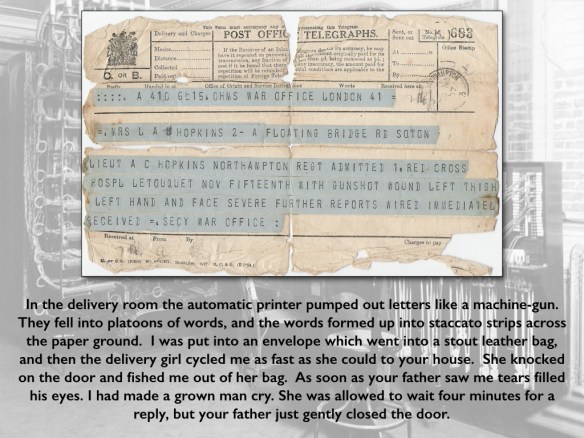
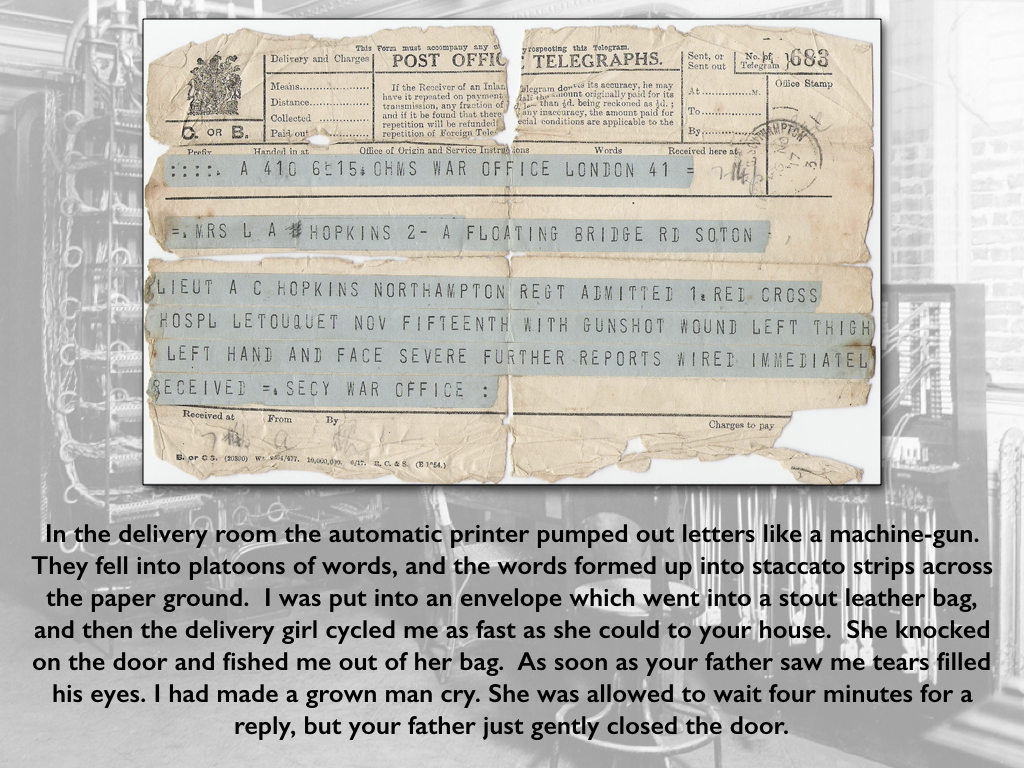
In addition to these terse communications, nurses and chaplains usually wrote to relatives on behalf of their patients. It was seen as a sacred duty, but it often seemed to be a never-ending task.  On 1 August 1917 Sister Kate Luard confided in her diary: ‘I don’t see how the “break-the-news” letters are going to be written, because the moment for sitting down literally never comes from 7 a.m. to midnight.’  In the case shown here, Sister Kathleen Mary Latham had written to Lt Hopkins’s wife on 12 November 1917 from a Casualty Clearing Station to say that

‘your husband has been brought to this hospital with wounds of the legs, arms, hand and face.  He has had an operation and is going on well. Unfortunately it was found necessary to remove the left eye as it was badly damaged, but he can see with the other though the lid is swollen and he cannot use it yet.  No bones are broken.  It will not be advisable for you to write to this address as he will probably be going on to the base in a day or two.’

The telegram from the War Office is dated three days later, by which time Hopkins had reached the base hospital at Le Touquet.  Sister Latham’s earlier account of her work at Casualty Clearing Station No. 3 at Poperinghe in 1915 is here.

***

In Durham, Louise Amoore pressed me on the anthropomorphism that seems inescapable in a narrative like this; it worries me too (I’ve always been leery of Bruno Latour‘s Aramis for that very reason).  I tried removing the ‘I’ and substituting an ‘it’ but I found doing so destroyed both the operative agency of the objects and, perhaps more important, the transient, enforced intimacy between them and the soldier’s body.  That intimacy was more than physical, I think.  I’ve already cited the reassurance provided by the prick of a needle, the whiteness of a new bandage; but the mundanity of objects could also be disorientating, intensifying an already intense sur-reality.  Here, for example, is Gabriel Chevallier recalling the moment when he and his comrades went over the top:

The feeling of being suddenly naked, the feeling that there is nothing to protect you. A rumbling vastness, a dark ocean with waves of earth and fire, chemical clouds that suffocate. Through it can be seen ordinary, everyday objects, a rifle, a mess tin, ammunition belts, a fence post, inexplicable presences in this zone of unreality.

Aramis also alerted me to another, and perhaps even more debilitating dilemma: a latent functionalism in which everything that is pressed into service works to carry the soldier through the evacuation chain.  That seems unavoidable in a narrative whose telos is precisely the base hospital and Blighty beyond.  Yet we know that, for all the Taylorist efficiency that was supposed to orchestrate the evacuation system in this profoundly industrial war, in many cases the chain was broken, another life was lost or permanently, devastatingly transformed.  As you can see, I’ve tried to do something about that with some of the objects I’ve selected.

I’ll probably add more objects: this is very much a work in progress, and I’m not sure where it will go – so as always, I’d welcome any constructive comments or suggestions.  Any written version would involve longer descriptions, I think, and would probably dispense with most of the scaffolding of notes I’ve erected here (though some of it could and probably should be incorporated into the descriptions).