Afterwar(d)s

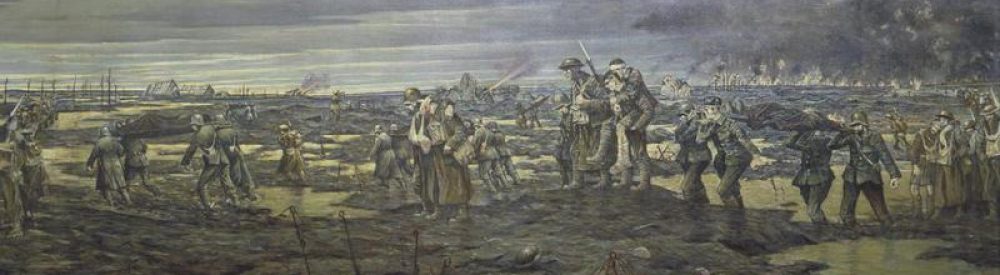
I’ve been working my way through the proofs of ‘The natures of war’, in which (among other things) I try to show that soldiers are not only vectors of military violence but also victims of it.  My analysis fastens on the Western Front in the First World War, Northern Africa in the Second World War, and Vietnam – the final draft is under the DOWNLOADS tab and the published version should be up on the Antipode website later this month – but I hope it will be clear to readers that the implications of this claim , and the others in the essay, extend into our own present.  They also intersect with my current research on casualty evacuation from war zones, 1914-2014.

So I’ve been interested in three recent contributions that detail the aftermath of war for those who fight them.

First, Veterans for Peace UK have worked with Darren Cullen to produce a short film, Action Man: Battlefield Casualties [see the clip above] in an attempt, as Charlie Gilmour explains over at Vice,

‘to show the shit beneath the shine of polished army propaganda. Featuring PTSD Action Man (“with thousand-yard stare action”), Paralysed Action Man (“legs really don’t work”) and Dead Action Man (“coffin sold separately”)…’ [see also my post on ‘The prosthetics of military violence‘]
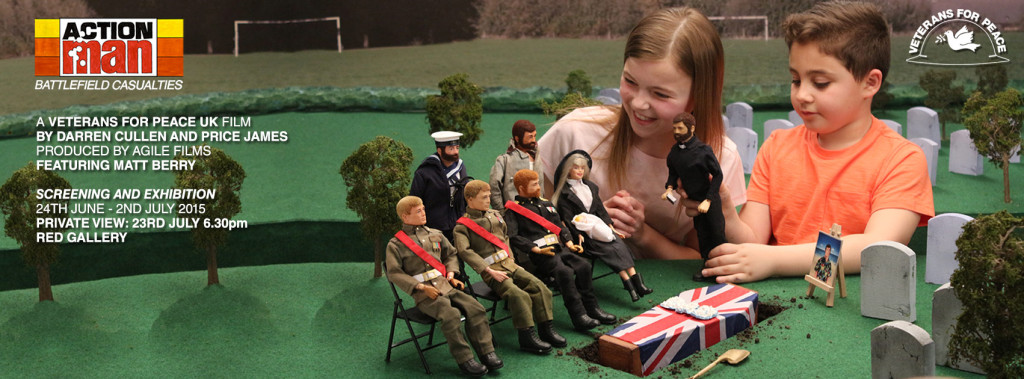
Actionman-1024x379

In keeping with the project’s authors, Charlie insists – I think properly – that many of those who were sent to Afghanistan from the UK were child soldiers (and here I also recommend Owen Sheers‘ brilliant Pink Mist for an unforgettable portrayal of what happens when boys who grow up ‘playing war’ end up fighting it: see also here and here).  As the project’s web site notes:

The UK is one of only nineteen countries worldwide, and the only EU member, that still recruits 16 year olds into its armed forces, (other nations include Iran and North Korea). The vast majority of countries only recruit adults aged 18 and above, but British children, with the consent of their parents, can begin the application process to join the army aged just 15…

It is the poorest regions of Britain that supply large numbers of these child recruits. The army has said that it looks to the youngest recruits to make up shortfalls in the infantry, by far the most dangerous part of the military. The infantry’s fatality rate in Afghanistan has been seven times that of the rest of the armed forces.

Forces Watch JPEG

Child Soldiers International JPEG

A study by human rights groups ForcesWatch and Child Soldiers International in 2013 found that soldiers who enlisted at 16 and completed training were twice as likely to die in Afghanistan as those who enlisted aged 18 or above, even though younger recruits are, for the most part, not sent to war until they are 18.
You can find another thoughtful reflection on child soldiers by Malcolm Harris over at the indispensable Aeon here. He doesn’t include the British Army in his discussion, but once you do you can see that the implications of this passage extend beyond its ostensible locus (Nigeria):

But can a child truly volunteer to join an army? Even when they enlist by choice, child soldiers do so under a set of constraining circumstances. UNICEF makes the choices sound easy: war or dancing, war or games, war or be a doctor. No rational child would pick the former for themselves, and that’s posed as evidence that their freedom has been taken from them. But when the choice is ‘soldier or victim’, voluntarism takes on a different meaning.
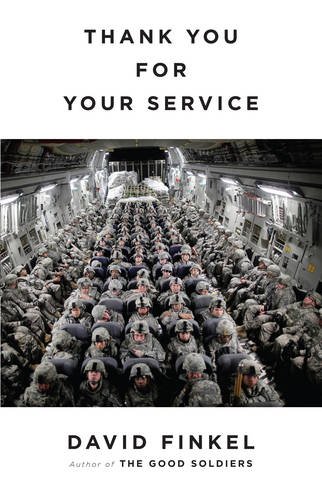
FINKEL Thank you for your service

Second, moving across the Atlantic and providing an extended riff on the ‘thank you for your service’ gesture, the latest issue of New Left Review includes an essay by Joan Wypijewski, ‘Home Alone‘, that describes the journey home faced by many US veterans.  She begins by putting David Finkel‘s compelling book in context:

The term ‘Thank You for Your Service’ developed early on in the long wars. Like ‘Support the Troops’, it was a way for a sheltered people to perform unity. In towns across America yellow ribbons, yellow lawn signs, balloons and car decals sprouted like team colours on game day. War would be a sport, the people spectators, and ‘Thank you for your service’ the high-five to combatants after quick and decisive victory. When that proved a vain hope, team spirit settled into the rhythms of commerce. ‘Support the Troops’ appeared the way ‘Buy American’ once had—a slogan on shop windows, billboards, bumper stickers. War was an enterprise, security its product, the people consumers, the soldiers trained workers and ‘Thank you for your service’ a kind of tip. As the enterprise (though hardly the business) failed, the signs faded, sometimes replaced by an image of folded hands, ‘Pray for Our Troops’. War had become a problem, the soldiers exhausted, the people clueless and ‘Thank you for your service’ a bit of empty etiquette, or a penance. By the time Finkel was writing [his book was published in October 2013], what remained among civilians was a desire to move on, and among soldiers, bitterness. ‘They wouldn’t be fucking thanking me if they knew what I did’, many would say, in almost exactly the same words.

Joan works her way through Finkel’s account, and then turns to Laurent Bécue-Renard’s Of Men and War, a documentary film – five years in the making, and the second instalment in a trilogy devoted to a ‘genealogy of wrath‘ – of Trauma Group sessions at a treatment centre in the Napa Valley:

‘What we have is embarrassing as shit’, a thick, tight young white man says in the Trauma Group. ‘You feel small—you feel defective.’ And so it goes, and so men trained for toughness talk of being weak and scared and monstrous, or just diligent. Of working in Mortuary Affairs: ‘breaking the rigour down’ to get the corpse of a 19-year-old who killed himself flat enough for a body bag, or untangling the remains of a group of faceless soldiers burned in a truck who are fused ‘like a bunch of rope’. They talk of their dreams, of their frightened wives. Maybe she moved out and got a restraining order before he came home, or maybe she has the divorce papers but is holding back as long as he’s getting help. ‘I have no clue what it’s like to be a woman married to a man twice your size and that’s lethal, in the military, and takes his rage out on you—someone that’s supposed to love you’, a former medic says. He is slim, white, deer-like. You don’t know his war story yet, and you don’t know when you’ll find out, if you’ll find out, but you listen as he and one after another after another deals with a world of pain. And maybe men balk, and maybe they storm out of the room, and maybe Gusman, whom you’ve also never really met but who is always there, has to remind them that ‘being a hostage to the war zone is not a life’. You follow them out of the room, taking smokes, meditating, visiting their wives or parents, calling on locals, trying to be well or pass for well, knowing they’re not. You watch their children doing typical childlike things, running, laughing in a high-pitched scream, and you feel anxious for everyone in the room. You itch to get back to the Trauma Group and, amazingly, don’t feel like a voyeur, because this isn’t war porn; this is the shit, as they say.

It isn’t beautiful or horrible, it just is. And you don’t like all of these people, but that isn’t the point. They are all struggling to be human again, and you have to ask yourself if you know what that means.

Not so much dressing but ‘addressing their wounds is a revolution’, Bécue-Renard insists, and you can see – literally so – what he means.  Joan’s commentary ends with other, perhaps also revolutionary reflections.  In America, she argues,

… there has been no serious debate on, let alone demand for, a universal draft as a democratic check against offensive war. We talk against empire, but are beneficiaries of the imperial state’s professional and technological adjustments to the anti-war movement’s past victories. We talk about the invisible draft but, perhaps encouraged by the bravery of Iraq Veterans Against the War, still hope that soldiers whose food, clothing, shelter, families and identity depend on the job of war-fighting will mutiny en masse. We talk, from time to time, about the culture of abuse in basic training and on military posts, but are silent on the regimens of discipline that are being hyper-enforced in anticipation of downsizing, in other words layoffs. And for the one thing the military, however twistedly, provides—belonging, solidarity, a sense of honour and family-feeling as against loneliness—we have no alternatives at all.

Finally, Duke University Press has announced that Zoe Wool‘s book, After War: the weight of life at Walter Reed, will be out soon:

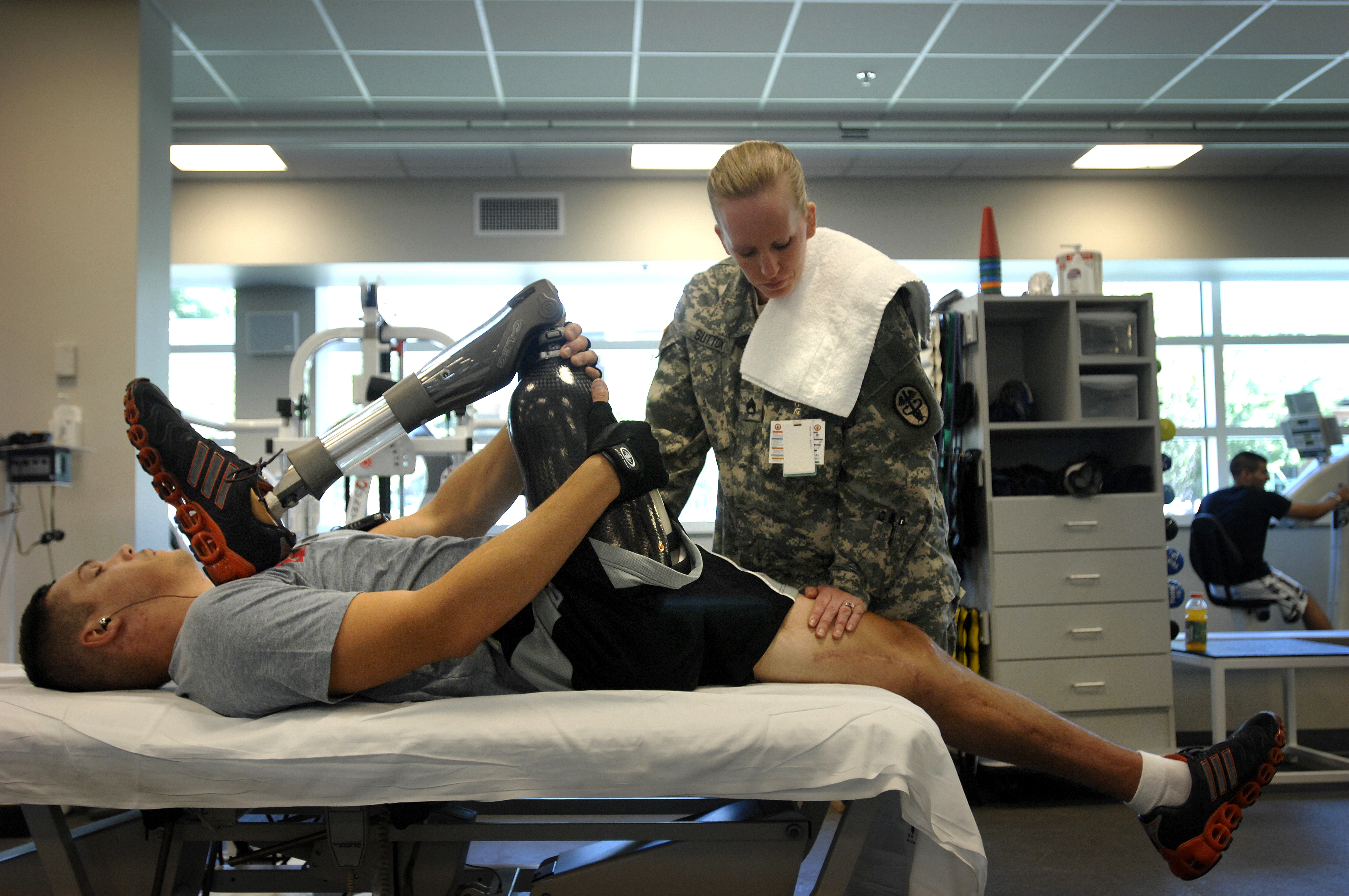
In After War Zoë H. Wool explores how the American soldiers most severely injured in the Iraq and Afghanistan wars struggle to build some kind of ordinary life while recovering at Walter Reed Army Medical Center from grievous injuries like lost limbs and traumatic brain injury. Between 2007 and 2008, Wool spent time with many of these mostly male soldiers and their families and loved ones in an effort to understand what it’s like to be blown up and then pulled toward an ideal and ordinary civilian life in a place where the possibilities of such a life are called into question. Contextualizing these soldiers within a broader political and moral framework, Wool considers the soldier body as a historically, politically, and morally laden national icon of normative masculinity. She shows how injury, disability, and the reality of soldiers’ experiences and lives unsettle this icon and disrupt the all-too-common narrative of the heroic wounded veteran as the embodiment of patriotic self-sacrifice. For these soldiers, the uncanny ordinariness of seemingly extraordinary everyday circumstances and practices at Walter Reed create a reality that will never be normal.
20080721-D-1852B-014

Here are two of the endorsements:

“Hollywood films and literary memoirs tend to transform wounded veterans into tragic heroes or cybernetic supercrips. Zoë H. Wool knows better. In her beautifully written and deeply empathic study of veterans of Iraq and Afghanistan at Walter Reed, Wool shows us the long slow burn of convalescence and how the ordinary textures of domestic life unfold in real time. An important and timely intervention.” — David Serlin, author of Replaceable You: Engineering the Body in Postwar America.

“This brilliant and absorbing ethnography reveals how the violence of war is rendered simultaneously enduring and ephemeral for wounded American soldiers. Zoë H. Wool accounts for the frankness of embodiment and the unstable yet ceaseless processes through which the ordinary work of living is accomplished in the aftermath of serious injury. After War is a work of tremendous clarity and depth opening new sightlines in disability and the critical politics of the human body.” — Julie Livingston, author of Improvising Medicine: An African Oncology Ward in an Emerging Cancer Epidemic.

Gravity modelling

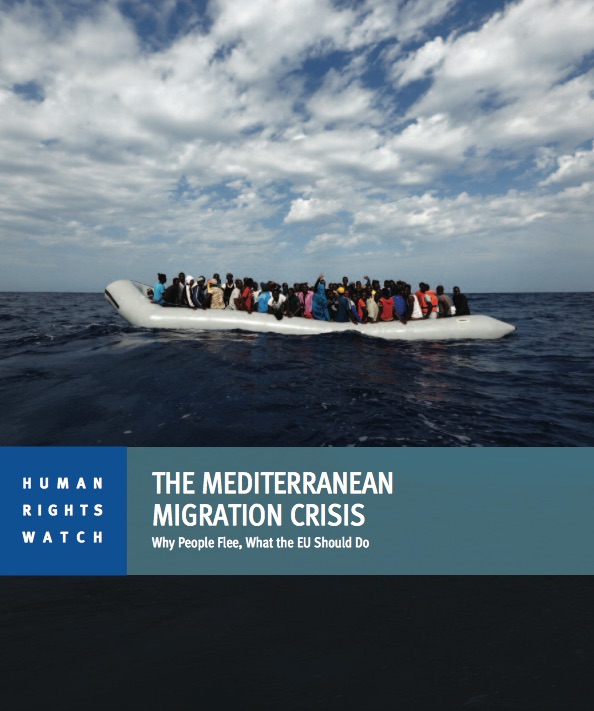
Mediterranean migration crisis (HRW) MAP

The latest issue of Radical Philosophy (192, July/August 2015) is out now, and it includes a short essay by Martina Tazzioli, ‘The politics of counting and the scene of rescue: Border deaths in the Mediterranean’ (see also my post about The Left to Die Boat).  Her commentary adds new dimensions to discussions of the humanitarian present:

The exclusive focus on the modalities of rescue has overshadowed the peculiar politics of life that underpins military-humanitarian operations: migrants seeking asylum become lives to rescue and their freedom – of movement and of choosing a safe place to stay – is dislodged from the outset. The mechanisms of capture and containment of unauthorized movements act simultaneously through border restrictions that cause border deaths and through the humanitarian channelling system. The risks to life that people who seek asylum in Europe take, being forced to cross the Mediterranean ‘illegally’, and rescue politics are not opposite mechanisms of migration government. This means that humanitarian measures hold a specific political technology over migrant lives by rescuing, sorting and channelling migrants, one in which people escaping wars can seek asylum only by first becoming shipwrecked persons to rescue. Humanitarian and security measures are thus two intertwined political technologies of migration governmentality.

mapsmania

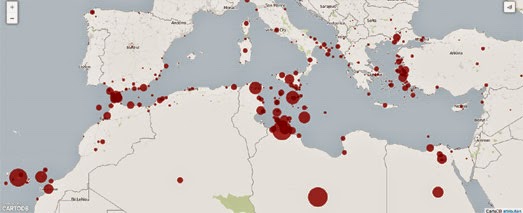
The map above is drawn from the Migrants Files, a database recording the deaths of more than 29,000 migrants who have tried to seek refuge in Europe since 200.  But Martina’s commentary details what she calls the ‘politics of counting’ and in doing so she enlarges the scope of those (other) projects that seek to move behind the statistical toll of wars and other forms of military and paramilitary violence to identify and name their otherwise nameless casualties:

If border deaths are accounted for through a logic of counting, something remains undetectable from the political perspective of the northern shore of the Mediterranean. Moving beyond the logic of counting means refusing to look at border deaths from the standpoint of this governmental gaze – migration agencies or states – and taking into account what border deaths are for the friends and the relatives of the missing migrants. This means engaging in a decolonial move that challenges the logic of recognition that sustains political campaigns and research projects aiming to count and identify dead migrants. By moving from the northern to the southern shore of the Mediterranean we realize that these uncounted deaths not only have a name but are fully known by their friends and relatives. Rather than producing a more exact border deaths population database, it is a question of bringing into visibility the reality of what the visa regime and the European mechanisms of border control generate: the ‘disappearance’ of women and men who die without being detected but who are counted as ‘missing’ in the countries of origin or of transit by those who know them. The logic of identification – giving a name to corpses found at sea – risks, paradoxically, reproducing the hierarchy that assumes dead migrants are people who, in order to exist, have to be recognized, counted and named from the northern shore of the Mediterranean. A politics that accounts for border deaths without reproducing this space of governmentality attends to what exists beyond counting and identification: unaccountable deaths represent the unquantifiable ‘cost’ of borders that cannot be assessed from the northern shore of the Mediterranean and that requires taking into account those people – friends and relatives – for whom they are missing persons.

HRW Med Migration Crisis JPEG

Last week, Human Rights Watch issued a report on The Mediterranean Migration Crisis: Why People Flee, What the EU Should Do; the map at the head of this post identifies sample migration routes derived from the interviews carried out by HRW for its report:

The report draws on Human Rights Watch’s extensive work on the human rights situation in the four main sending countries as well as interviews with Syrians, Eritreans, Afghans, and Somalis who crossed the Mediterranean in May 2015. Human Rights Watch staff interviewed over 150 recently-arrived migrants and asylum seekers in Italy (Lampedusa, Catania, and Milan) and Greece (the islands of Lesbos, Chios, Samos, Leros, and Kos).

Note: For those who had the good fortune to escape spatial science in the 1960s and 70s, and who might well be puzzled by my title, gravity models were (and probably still are) one of the canonical forms of migration modelling.  Martina’s commentary is an urgent reminder of the gravity that lies behind the politics of calibration and calculation.

Legal battles

DoD Law of War ManualFollowing up my comments on the Pentagon’s new Law of War Manual, issued last month: commentaries are starting to appear (it’s not surprising these are taking so long: the new version runs to 1200 pages).

Just Security is hosting a forum on the Manual, organised by Eric Jensen and Sean Watts.  They are both deeply embedded in the debate: Eric is a Professor at Brigham Young Law School and was formerly Chief of the Army’s International Law Branch and Legal Advisor to US military forces in Iraq and Bosnia, while Sean is a Professor at Creighton University Law School and on the Department of Law faculty at the United States Military Academy at West Point; he is also Senior Fellow at the NATO Cooperative Cyber Defence Centre of Excellence and served in the US Army’s Judge Advocate General’s Corps.

In the opening salvo, Sean focuses on the Manual‘s identification of three core principles:

“Three interdependent principles – military necessity, humanity, and honor – provide the foundation for other law of war principles, such as proportionality and distinction, and most of the treaty and customary rules of the law of war.”

The implications of this formulation are more far reaching than you might think.  Necessity, proportionality and distinction have long been watchwords, but the inclusion – more accurately, Sean suggests, the resurrection – of ‘humanity’ and ‘honor’ is more arresting: in his view, the first extends the protection from ‘unnecessary suffering’ while the second ‘marks an important, if abstract revival of good faith as a legal restraint on military operations’.

Watch that space for more commentaries, inside and outside the armed camp.

Others have already taken a much more critical view of the Manual.

Claire Bernish draws attention to two particularly disturbing elements here.  First, like several other commentators, she notes passages that allow journalists to be construed as legitimate targets.  While the Manual explains that ‘journalists are civilians’ it also insists there are cases in which journalists may be ‘members of the armed forces […] or unprivileged belligerents.’   Apparently, Claire argues,

‘reporters have joined the ranks of al-Qaeda in this new “unprivileged belligerent” designation, which replaces the Bush-era term, “unlawful combatants.” What future repercussions this categorization could bring are left to the imagination, even though the cited reasoning—the possibility terrorists might impersonate journalists—seems legitimate. This confounding label led a civilian lawyer to say it was “an odd and provocative thing for them to write.”‘

Other commentators, mindful of incidents in which the US military has been accused of targeting independent (non-embedded) journalists, have read this as far more than provocation.  Like other claims registered in the Manual, this has implications for other armed forces – and in this particular case, for example, Ken Hanly points out that ‘what is allowed for NATO and the US is surely legitimate for Israel.’

This is not as straightforward as he implies, though.  Eric Jensen agrees that

‘[T]he writers had to be aware this manual would also be looked to far beyond the US military, including by other nations who are formulating their own law of war (LOW) policies, allies who are considering US policy for purposes of interoperability during combined military operations, transnational and international organizations such as the International Committee of the Red Cross (ICRC) who look to such manuals when considering the development of customary practice, and even national and international tribunals who adjudicate LOW questions with respect to the criminality of individual actions.

While Eric acknowledges ‘the inevitable use of [the Manual] in the determination of customary practice.’ however, he also argues that the authors of the Manual go out of their way to preclude this possibility: they ‘wanted to be very clear that they did not anticipate they were writing into law the US position on the law of war.’

Second, Claire draws attention to a list of weapons with specific rules on use’ (Section 6.5.1), which includes cluster munitions, herbicides and explosive ordnance, and a following list of other ‘lawful weapons’ (Section 6.5.2) for which ‘there are no law of war rules specifically prohibiting or restricting the following types of weapons by the U.S. armed forces’; the list includes drones and Depleted Uranium munitions.  These designations are all perfectly accurate, but Claire’s commentary fastens on the fact that at least two of these weapons have been outlawed by many states.  She draws attention to the hideous consequences of DU and cluster bombs, and explains that cluster bombs:

‘are delineated in the manual as having “Specific Rules on Use”— notably, such weapons’ use “may reflect U.S. obligations under international law” [emphasis added]. While this is technically apt, cluster bombs have been banned by the 2008 Convention on Cluster Munitions—which was agreed to by 116 countries around the world. The U.S. stands out in joining infamous human rights violator, Saudi Arabia, in its refusal to sign. These insidious munitions leave unexploded ordnance for months, or even decades, after the originating bomb was dropped. Children are often maimed or killed when they unwittingly mistake them for toys.’

Meanwhile, also at Just Security but seemingly not part of the Forum, Adil Ahmad Haque has attacked the Manual‘s discussion of ‘human shields’:

The Defense Department apparently thinks that it may lawfully kill an unlimited number of civilians forced to serve as involuntary human shields in order to achieve even a trivial military advantage. According to the DOD’s recently released Law of War Manual, harm to human shields, no matter how extensive, cannot render an attack unlawfully disproportionate. The Manual draws no distinction between civilians who voluntarily choose to serve as human shields and civilians who are involuntarily forced to serve as human shields. The Manual draws no distinction between civilians who actively shield combatants carrying out an attack and civilians who passively shield military objectives from attack. Finally, the Manual draws no distinction between civilians whose presence creates potential physical obstacles to military operations and civilians whose presence creates potential legal obstacles to military operations. According to the Manual, all of these count for nothing in determining proportionality under international law.

If true, this would dramatically qualify the discussion of ‘humanity’ and ‘honor’ above; but, not surprisingly, Charles Dunlap will have none of it.  He objects not only to Adil’s reading of the Manual, but also the logic that lies behind his criticism:

Killing those who do the vast majority of the killing of civilians can save lives. It really can be that simple.

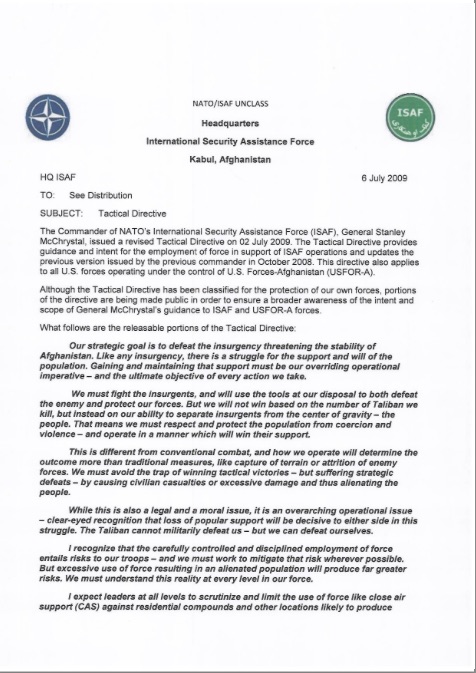
Experience shows that well-meaning efforts to curb the use of force can have disastrous effects on civilians. Think about the restrictions on airstrikes imposed by Gen. Stanley McChrystal in Afghanistan in mid-2009. The result? By the time he was fired a year later in June 2010, civilian casualties had jumped a heart-rending 31% entirely because of increased killings by anti-government forces. (In addition, casualties among friendly troops hit an all-time high in 2010.)

McChrystal Tactical Directive 1

[The unclassified section of McChrystal’s Tactical Directive (above) is here]

When Gen. David Petraeus took command in mid-2010, he took a different, more aggressive approach. While still scrupulously adhering to the law of war, he clarified the rules of engagement in a way that produced a tripling of the number of airstrikes. The result? The increase in civilian casualties was cut in half to 15% by the end of 2010. Under Petraeus’ more permissive interpretation of the use of force against the Taliban and other anti-government forces, the increase the following year was cut almost in half again to 8% (and losses of friendly troops fell 20%). To reiterate, although counterintuitive to some critics, restricting force by law or policy can actually jeopardize the lives of the civilians everyone wants to protect.

Michael O’Hanlon at the Brookings Institue makes exactly the same argument about the Manual here (scroll down), but Dunlap’s sense is much sharper: the Manual, he says, ‘is designed to win wars in a lawful way that fully internalizes, as it says itself on several occasions, the “realties of war.”’  This is immensely important because in effect it acknowledges that neither the Manual nor the laws of war are above the fray.  If the Manual ‘is designed to win wars in a lawful way’ that is precisely because law is in the army’s baggage train, fully incorporated into the juridification of later modern war.  Law is at once a powerful weapon and a moving target.

Banquet’s ghosts

I’ve just finished a remarkable book by Atef Abu Saif, The drone eats with me: diaries from a city under fire (Comma Press, 2015).  The city in question is Gaza:

The Drone Eats With Me COVER IMAGE-Atef Abu SaifOn 7 July 2014, in an apparent response to the murder of three teenagers, Israel launched a major offensive against the Gaza Strip, lasting 51 days, killing 2145 Palestinians (578 of them children), injuring over 11,000, and demolishing 17,200 homes.

The global outcry at this collective punishment of an already persecuted people was followed by widespread astonishment at the pro-Israeli bias of Western media coverage. The usual news machine rolled up, and the same distressing images and entrenched political rhetoric were broadcast, yet almost nothing was reported of the on-going lives of ordinary Gazans – the real victims of the war.

One of the few voices to make it out was that of Atef Abu Saif, a writer and teacher from Jabalia Refugee Camp, whose eye-witness accounts (published in The Guardian, The New York Times, and elsewhere) offered a rare window into the conflict for Western readers. Here, Atef’s complete diaries of the war allow us to witness the full extent of last summer’s atrocities from the most humble of perspectives: that of a young father, fearing for his family’s safety, trying to stay sane in an insanely one-sided war.

Over at the electronic intifada Pam Bailey explains:

Although already the author of four novels and a political science text, Abu Saif did not write this book with publication in mind. Rather, it began as entries to his diary, printed only after Ra Page, founder of Comma Press, recognized the potential in the passages shared by his friend in Gaza.

The writing alternates between poignant simplicity and dramatic flourishes and haunting metaphors. Abu Saif often uses a comparison to hunger and eating to describe the rapaciousness of war and those who “feed” off of it. “Destruction is a rich meal for the media,” he writes. “Their camera does not observe the fast of Ramadan, it devours and devours. It is constantly eating new images.”

The diary begins on 6 July — two days before the officially declared beginning of the war — with this chilling observation: “When it comes, it brings with it a smell, a fragrance even. You learn to recognize it as a kid growing up in these narrow streets. You develop a knack for detecting it, tasting it in the air. You can almost see it. It lurks in the shadows, follows you at a distance wherever you go. If you retain this skill, you can tell that it’s coming — hours, sometimes days, before it actually arrives. You can’t mistake it. War.”

KAFKA Metamorphosis

I’ve been asked to speak on drones later this year at a conference at UC Santa Barbara on Metamorphosis: Animal, Human, Armor – the image above is from the extraordinary British film of Kafka’s novella: you can catch a clip on YouTube here – and no doubt partly for this reason I too have been taken by the ways in which, as Pam notes, Abu Saif turns again and again to tropes of human-machines feeding (captured in the title of the book too).  I’d read parts of the diary as it was being composed – see here, for example – but the imaginary of predation is now even more compelling and even more shocking:

As the noise of the explosion subsides, it’s replaced by the inevitable whir of a drone, sounding so close it could be right beside us. It’s like it wants to join us for the evening, and has pulled up a chair.

Later:

The food is ready. I wake the children and bring them in. We all sit around five dishes: white cheese, hummus, orange jam, yellow cheese, and olives. Darkness eats with us. Fear and anxiety eat with us. The unknown eats with us. The F16 eats with us. The drone, and its operator somewhere out in Israel, eat with us.

More once I’ve worked out what I want to say at the conference, but for now there is a particularly thoughtful review and response to Abu Saif by Jacob Bacharach at The Rumpus here.

Base lines and military projections

David Vine has updated his map of the global footprint of the US military over at Politico.

VINE US military bases

I used an early version for my ‘War and Peace’ essay (DOWNLOADS tab), and that map – like this one – was drawn primarily from the annual Base Structure Report, a summary of the US military’s ‘real property inventory’ (all sites owned and managed by the Pentagon).  It’s an unwieldy document which uses a high threshold to filter inclusion:

To qualify for individual entry in the BSR, a DoD site located in the United States must be larger than 10 acres AND have a Plant Replacement Value (PRV) greater than $10 million. If the site is located in a foreign country, it must be larger than 10 acres OR have a PRV greater than $10 million to be shown as a separate entry. Sites that do not meet these criteria are aggregated as an “Other” location within each state or country.

Iraq doesn’t appear in these tabulations – though it is shown on the map – yet the continuing US involvement in the conflict there and across the all-but-erased border in Syria has surely extended its footprint.  As David notes,

‘There were 505 bases at the U.S. occupation’s height, but the Iraqi parliament rejected the Pentagon’s wish to keep 58 “enduring” bases after the 2011 withdrawal. U.S. forces have occupied at least five bases since 2014 and are considering more installations.’

Afghanistan is absent too: ‘By the end of 2014 … the U.S. military will have closed, deconstructed, or vacated most of what were once around 800 military installations, ranging from small checkpoints to larger combat outposts to city-sized bases.’  But the US military retains a significant presence there, and its drones are still based there to support continuing military operations and to attack targets across the border in Pakistan.

There are also strategic omissions.  There’s no mention in the Base Structure Report of Al Udeid Air Base in Qatar, for example, which is the location of US Central Command’s Combined Air and Operations Center.

(You can find more from David on the history of America’s ‘infrastructure for war’ in the Middle East here and on its ‘lily-pad’ strategy here).

There are all sorts of issues involved in measuring a ‘military footprint’ – see my post here and Josh Begley here (who works from the previous year’s Base Structure Report for FY 2013 to produce a radically different visualization) – but for all its uncertainties, David’s map is a sobering snapshot, and he relies on supplementary sources to conclude:

Despite recently closing hundreds of bases in Iraq and Afghanistan, the United States still maintains nearly 800 military bases in more than 70 countries and territories abroad—from giant “Little Americas” to small radar facilities. Britain, France and Russia, by contrast, have about 30 foreign bases combined.

By my calculation, maintaining bases and troops overseas cost $85 to $100 billion in fiscal year 2014; the total with bases and troops in warzones is $160 to $200 billion.

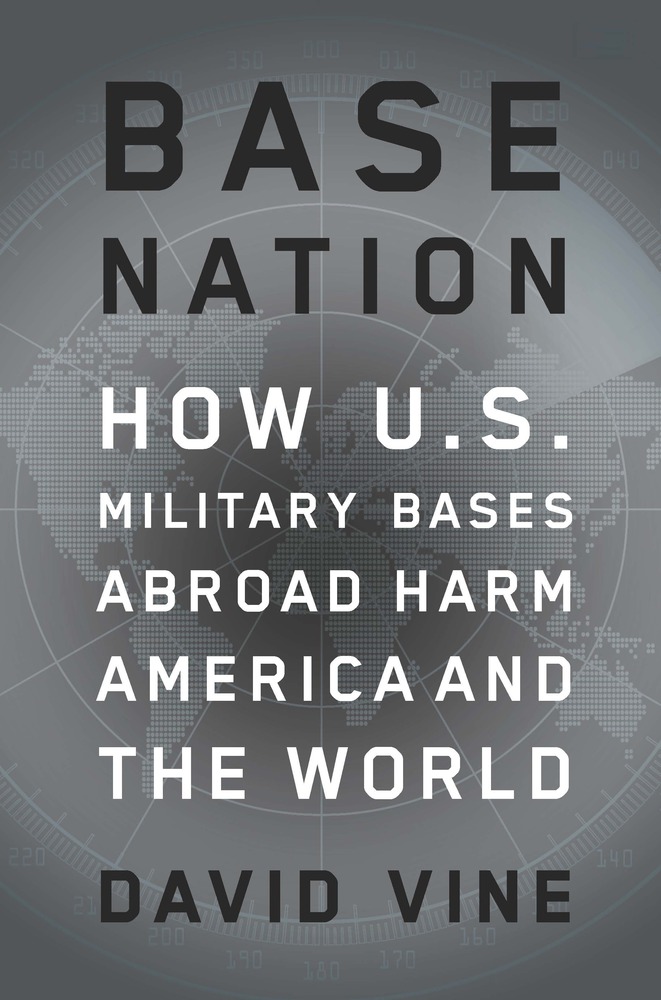
VINE Base Nation

When I first contacted David, his original map formed part of his scorching investigation into Diego Garcia: Island of Shame: the secret history of the US military base on the island of Diego Garcia (Princeton, 2009; paperback 2011: all royalties went to the Chagossians); the new version forms part of an even more ambitious project, Base Nation: how US military bases abroad harm America and the world (Metropolitan Books, 2015):

American military bases encircle the globe. More than two decades after the end of the Cold War, the U.S. still stations its troops at nearly a thousand locations in foreign lands. These bases are usually taken for granted or overlooked entirely, a little-noticed part of the Pentagon’s vast operations. But in an eye-opening account, Base Nation shows that the worldwide network of bases brings with it a panoply of ills–and actually makes the nation less safe in the long run.

As David Vine demonstrates, the overseas bases raise geopolitical tensions and provoke widespread antipathy towards the United States. They also undermine American democratic ideals, pushing the U.S. into partnerships with dictators and perpetuating a system of second-class citizenship in territories like Guam. They breed sexual violence, destroy the environment, and damage local economies. And their financial cost is staggering: though the Pentagon underplays the numbers, Vine’s accounting proves that the bill approaches $100 billion per year.

For many decades, the need for overseas bases has been a quasi-religious dictum of U.S. foreign policy. But in recent years, a bipartisan coalition has finally started to question this conventional wisdom. With the U.S. withdrawing from Afghanistan and ending thirteen years of war, there is no better time to re-examine the tenets of our military strategy. Base Nation is an essential contribution to that debate.

There is a long history of struggles against the presence of US military bases overseas – Catherine Lutz‘s edited collection, The bases of empire: the global struggle against US military posts (New York University Press, 2009) remains an indispensable starting-point.

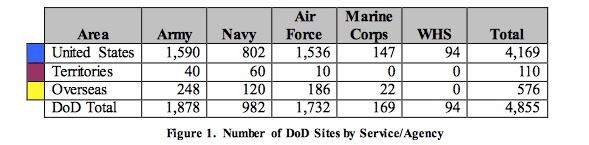
Of course, the US military is also omnipresent in the United States, with installations in all 50 states and seven territories.  The Base Structure Report includes this summary:

DoD sites JPEG

And these bases have brought their own problems and spawned their own protests too.


War against the people

I’ve long admired Jeff Halper‘s work with the Israeli Committee Against House Demolitions (though to me, haunted by the passages from The poetics of place that Edward Said invokes in Orientalism,  ‘home demolition’s would carry even more resonance: it’s so much more than buildings that the Israelis so brutally turn to rubble).

ICAHD

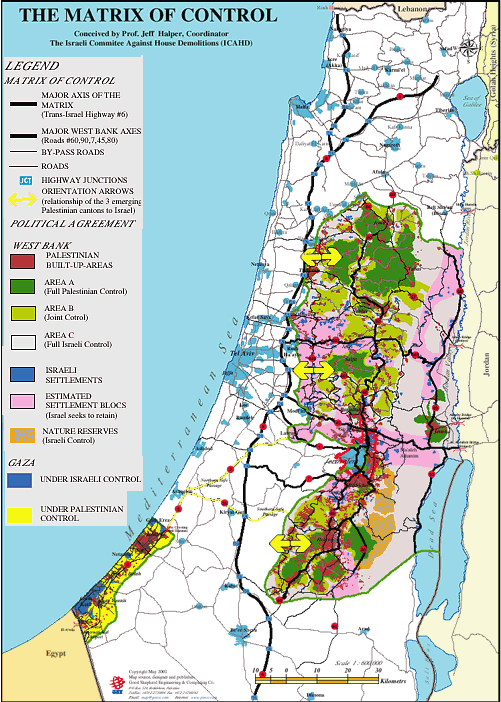
Jeff’s classic, even canonical essay on ‘the matrix of control‘ (see also here) was a constant reference point for my chapters on occupied Palestine in The Colonial Present, and on my first visit to the West Bank I was part of a group that Jeff generously spent a day showing the materialities of military occupation and illegal colonisation: you think you know what you’re going to see, but all the reading in the world can’t prepare you for what Israel has done – and continues to do – to the people of Palestine.

the-matrix-of-control

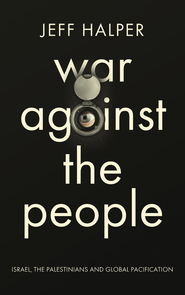
So I’m really pleased to hear from Jeff that his new book, War against the people: Israel, the Palestinians and global pacification, will be out in September (from Pluto Press in the UK and via the University of Chicago Press in the USA):

Modern warfare has a new form. The days of international combat are fading. So how do major world powers maintain control over their people today?

HALPER War against the peopleWar Against the People is a disturbing insight into the new ways world powers such as the US, Israel, Britain and China forge war today. It is a subliminal war of surveillance and whitewashed terror, conducted through new, high-tech military apparatuses, designed and first used in Israel against the Palestinian population. Including hidden camera systems, sophisticated sensors, information databases on civilian activity, automated targeting systems and, in some cases, unmanned drones, it is used to control the very people the nation’s leaders profess to serve.

Drawing from years of research, as well as investigations and interviews conducted at international arms fairs, Jeff Halper reveals that this practice is much more insidious than was previously thought. As Western governments tighten the grip on their use of private information and claw back individual liberties, War Against the People is a timely reminder that fundamental human rights are being compromised for vast sections of the world, and that this is a subject that should concern everyone.

I’ve noted before the ways in which Israel has used its continuing occupation of Palestine as a laboratory to test new technologies of military violence – and as a series of test cases designed to push the envelope of what is permissible under international humanitarian law and even international human rights law – but here Jeff radicalises the argument to develop a deeply disturbing vision of what he calls ‘securocratic wars in global battlespace’.  It’s vitally necessary to remember that later modern war is not the exclusive artefact of the United States and its military-academic-industrial-media (MAIM) complex, and that what happens in Israel/Palestine has desperately important implications for all of us.

Many commentators have claimed – I think wrongly – that one of the new characteristics of war in the twenty-first century is that it has become ‘war amongst the people’: as though No Man’s Land on the Western Front was somehow roped off from the gas attacks and shells that assaulted farms, villages and towns behind the front lines, for example, and air raids were limited to exclusively military-industrial targets.  Even if we confine ourselves to the trajectory of ostensibly modern warfare and track forward through the Second World War, Korea, Malaya, Vietnam, Laos and Cambodia…. the story is the same: modern war has long been fought amongst the people (though increasingly amongst ‘their’ people).  The deconstruction of the battlefield, as Frédéric Mégret calls it, is clearly visible in Palestine and is inseparable from its globalization.  It’s hardly surprising, then, that ‘war amongst the people’ should so easily turn into what Jeff describes as ‘war against the people’.

Here is the list of contents:

Introduction : How Does Israel Get Away With It?

Part I: The Global Pacification Industry
1. Enforcing Hegemony: Securocratic Wars in Global Battlespace

Part II: A Pivotal Israel
2. Why Israel? The Thrust Into Global Involvement
3. Niche-Filling in a Global Matrix of Control

Part III: Weaponry of Hybrid Warfare and Securocratic Control (Niche 1)
4. Niche 1: Weaponry of Hybrid Warfare and Securocratic Control
5. Dominant Maneuver
6. Precision Engagement

Part IV: Securitization and “Sufficient Pacification” (Niche 2)
7. Niche 2: The Securocratic Dimension: A Model of “Sufficient Pacification”
8. Operational Doctrines and Tactics

Part V: Serving Hegemons Throughout the World-System
9. Serving the Hegemons on the Peripheries: The “Near” Periphery
10. Security Politics on the “Far” Periphery
11. The Private Sector

Part VI: Domestic Securitization and Policing
12. Serving the Core’s Ruling Classes “At Home”

Conclusions: Mounting Counterhegemonic Challenges and Resisting Pacification
Resisting Capitalist Hegemony and Pacification: The Need for Infrastructure
Resistance to Pacification: Focusing on the MISSILE Complex

Disposable futures

EVANS and GIROUX Disposable futures

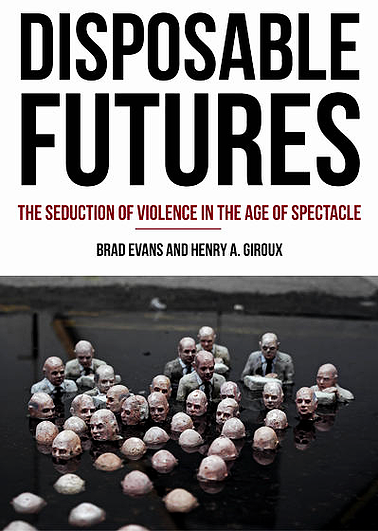
News from Brad Evans of a new book co-authored with Henry Giroux, Disposable futures: the seductions of violence in the age of spectacle (out next month from City Lights).

Disposable Futures makes the case that we have not just become desensitized to violence, but rather, that we are being taught to desire it.

From movies and other commercial entertainment to “extreme” weather and acts of terror, authors Brad Evans and Henry Giroux examine how a contemporary politics of spectacle–and disposability–curates what is seen and what is not, what is represented and what is ignored, and ultimately, whose lives matter and whose do not.

Disposable Futures explores the connections between a range of contemporary phenomena: mass surveillance, the militarization of police, the impact of violence in film and video games, increasing disparities in wealth, and representations of ISIS and the ongoing terror wars. Throughout, Evans and Giroux champion the significance of public education, social movements and ideas that rebel against the status quo in order render violence intolerable.

You can read the preface and an excerpt from the first chapter here, and you can get a taste of their argument from their op-ed for Truthout in June 2014 here, where they explain why they decided

‘…to develop a paradigm that focused on the intensification of what we called the politics of disposability. This requires taking our analysis beyond 20th century frames of analysis to look at the ways in which more and more individuals and groups are now considered excess by the onslaught of global forces that no longer offer the possibility of alternative futures. It talks precisely to those contemporary forms of disposability that have become so normalized; the burden of the guilt is placed on the shoulders of the victims, while the most pernicious of systemic abuses continues to hide things in plain sight. And it develops a critical angle of vision that goes well beyond the mere authentication of lives as simply born vulnerable to question the systemic design for oppression and exploitation that produces humans as some expendable category…

‘There is something, however, more at stake here than the contemporary plight of those millions forced to live in intolerable conditions. What makes the contemporary forms of disposability so abhorrent is precisely the way it shapes disposable futures. The future now appears to us as a terrain of endemic catastrophe and disorder from which there is no viable escape except to draw upon the logics of those predatory formations that put us there in the first place. Devoid of any alternative image of the world, we are merely requested to see the world as predestined and catastrophically fated. Frederic Jameson‘s claim then that it is easier to “imagine the end of the world than it is the end of capitalism” is more than a reflection on the poverty of contemporary imaginations. It is revealing of the nihilism of our times that forces us to accept that the only world conceivable is the one we are currently forced to endure: a world that is brutally reproduced and forces us all to become witness to its spectacles of violence that demand we accept that all things are ultimately insecure by design. In this suffocating climate, the best we can hope for is to be connected to some fragile and precarious life support system that may be withdrawn from us at any moment. Hope has dissolved into the pathology of social and civil death and the quest for mere survival. For if there is a clear lesson to living in these times, it is precisely that the lights can go out at any given moment, without any lasting concern for social responsibility. This is simply the natural order of things (so we are told) and we need to adapt our thinking accordingly.’

And, as always, you can find much more on these themes over at Brad’s History of Violence project (and particularly the Disposable Life series of lectures here).

Future imperfect and tense

A clutch of forthcoming books on war that seek, in different ways, to illuminate dimensions of what I’ve been calling ‘later modern war’:

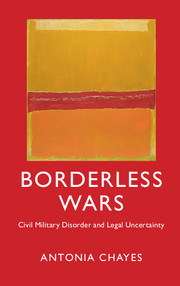
Antonia ChayesBorderless Wars (due in August at an eye-popping price from Cambridge University Press):

9781107109346In 2011, Nasser Al-Awlaki, a terrorist on the US ‘kill list’ in Yemen, was targeted by the CIA. A week later, a military strike killed his son. The following year, the US Ambassador to Pakistan resigned, undermined by CIA-conducted drone strikes of which he had no knowledge or control. The demands of the new, borderless ‘gray area’ conflict have cast civilians and military into unaccustomed roles with inadequate legal underpinning. As the Department of Homeland Security defends against cyber threats and civilian contractors work in paramilitary roles abroad, the legal boundaries of war demand to be outlined. In this book, former Under Secretary of the Air Force Antonia Chayes examines these new ‘gray areas’ in counterinsurgency, counter-terrorism and cyber warfare. Her innovative solutions for role definition and transparency will establish new guidelines in a rapidly evolving military-legal environment.

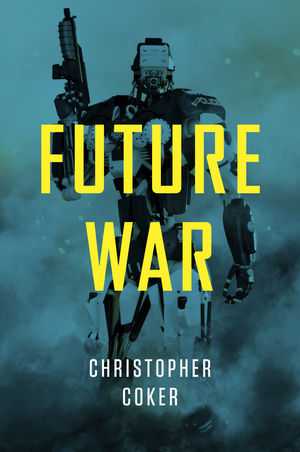
Christopher Coker‘s Future War (due in September from Polity):

COKER Future WarWill tomorrow’s wars be dominated by autonomous drones, land robots and warriors wired into a cybernetic network which can read their thoughts? Will war be fought with greater or lesser humanity? Will it be played out in cyberspace and further afield in Low Earth Orbit? Or will it be fought more intensely still in the sprawling cities of the developing world, the grim black holes of social exclusion on our increasingly unequal planet? Will the Great Powers reinvent conflict between themselves or is war destined to become much ‘smaller’ both in terms of its actors and the beliefs for which they will be willing to kill?

In this illuminating new book Christopher Coker takes us on an incredible journey into the future of warfare. Focusing on contemporary trends that are changing the nature and dynamics of armed conflict, he shows how conflict will continue to evolve in ways that are unlikely to render our century any less bloody than the last. With insights from philosophy, cutting-edge scientific research and popular culture, Future War is a compelling and thought-provoking meditation on the shape of war to come.

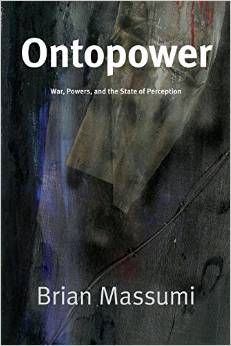
Brian Massumi‘s Ontopower: War, Powers, and the State of Perception (due in September from Duke University Press):

MASSUMI OntopowerColor coded terror alerts, invasion, drone war, rampant surveillance: all manifestations of the type of new power Brian Massumi theorizes in Ontopower. Through an in-depth examination of the War on Terror and the culture of crisis, Massumi identifies the emergence of preemption, which he characterizes as the operative logic of our time. Security threats, regardless of the existence of credible intelligence, are now felt into reality. Whereas nations once waited for a clear and present danger to emerge before using force, a threat’s felt reality now demands launching a preemptive strike. Power refocuses on what may emerge, as that potential presents itself to feeling. This affective logic of potential washes back from the war front to become the dominant mode of power on the home front as well. This is ontopower—the mode of power embodying the logic of preemption across the full spectrum of force, from the “hard” (military intervention) to the “soft” (surveillance). With Ontopower, Massumi provides an original theory of power that explains not only current practices of war but the culture of insecurity permeating our contemporary neoliberal condition.

Wastelands

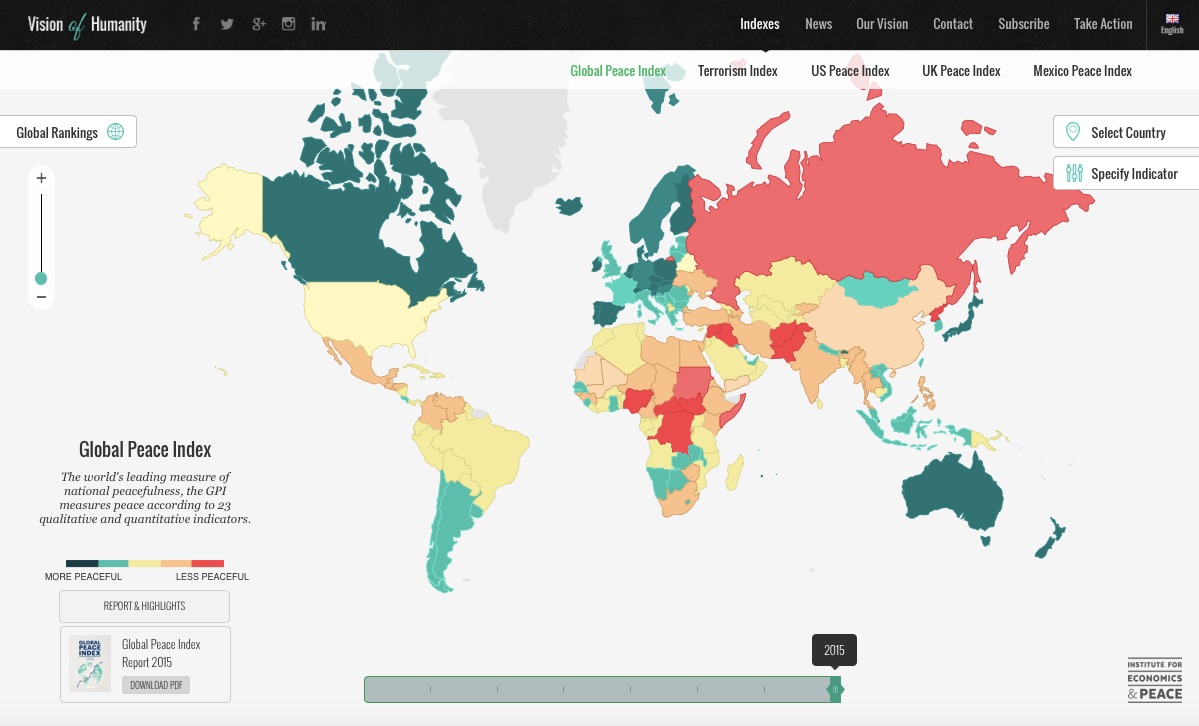
Global Peace Index 2015 JPEG The Institute for Economics and Peace has issued its Global Peace Index for 2014.  There are all sorts of problems in calculating indices like these – and interpreting them (as you can see if you read some of the press releases and reports surrounding the publication of the GPI) – and in this case:

The Global Peace Index is a composite index comprised of 23 qualitative and quantitative indicators that gauge the level of peace in 162 countries. These indicators can be grouped into three broad themes: the level of safety and security in a society, the number of international and domestic conflicts and the degree of militarisation.

Crunching the numbers,  the Institute concludes that

Syria remains the world’s least peaceful country, followed by Iraq and Afghanistan. The country that suffered the most severe deterioration in peace was Libya, which now ranks 149th of 162 countries. Ukraine suffered the second largest deterioration…

Its President, Steve Killelea, explained that:

2014 was marked by contradictory trends: on the one hand many countries in the OECD achieved historically high levels of peace, while on the other, strife-torn nations, especially in the Middle East, became more violent.

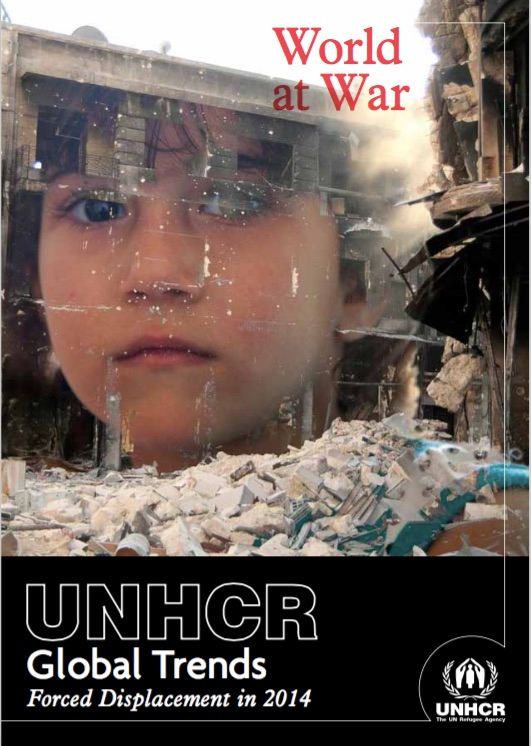
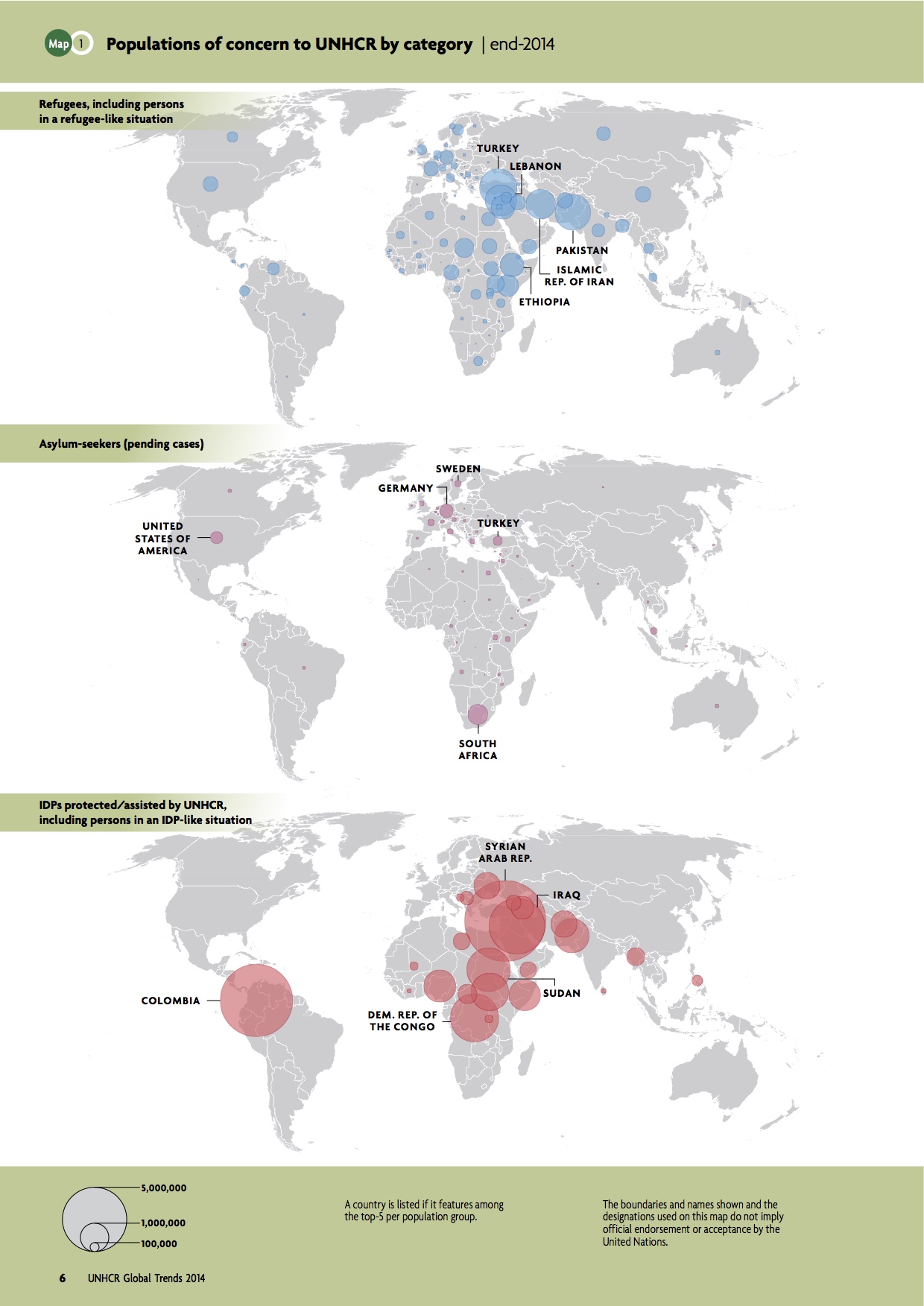
What the Report doesn’t pursue are the close links between those two trends; and when you look at the map you will soon realise that being ‘peaceful’ is not the same thing as not being belligerent… But the Report does emphasise the absurdist cost of all this violence (while noting that much more is at stake than money): ‘The economic impact of violence reached a total of US$14.3 trillion or 13.4% of global GDP last year.’ You can download the full Report here or find the interactive map (screenshot at the head of this post) here. UNHCR World at War 2014 JPEG On the same day, the United Nations High Commissioner for Refugees published different maps in World at War that provide a radically different calculus of the cost of such violence.  Writing in the New York Times Somini Sengupta reports:

Nearly 60 million people have been driven from their homes by war and persecution, an unprecedented global exodus that has burdened fragile countries with waves of newcomers and littered deserts and seas with the bodies of those who died trying to reach safety. 0745631649The new figures, released Thursday by the United Nations refugee agency, paint a staggering picture of a world where new conflicts are erupting and old ones are refusing to subside, driving up the total number of displaced people to a record 59.5 million by the end of 2014, the most recent year tallied. Half of the displaced are children. Nearly 14 million people were newly displaced in 2014, according to the annual report by the Office of the United Nations High Commissioner for Refugees. In other words, tens of thousands of people were forced to leave their homes every day and “seek protection elsewhere” last year, the report found. That included 11 million people who scattered within the borders of their own countries, the highest figure ever recorded in the agency’s 50-year history. Tens of millions of others fled in previous years and remain stuck, sometimes for decades, unable to go home or find a permanent new one, according to the refugee agency. They include the more than 2.5 million displaced in the Darfur region of Sudan, and the 1.5 million Afghans still living in Pakistan.

Populations of concern to UNHCR to end 2014 And the map reveals a starkly different bi-polar geography to the division highlighted by the GPI:

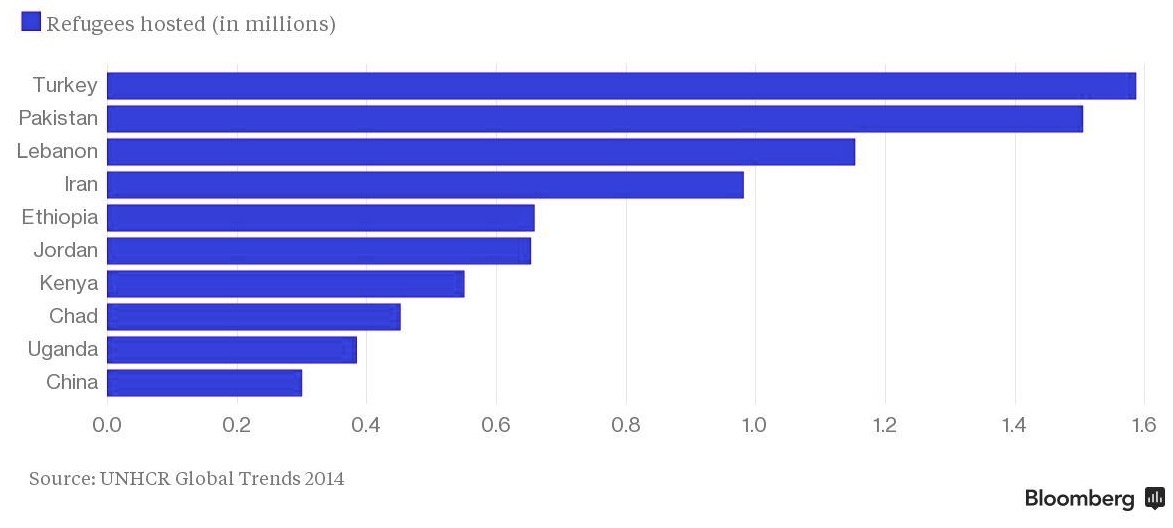
When refugees flee their own countries, most of them wind up in the world’s less-developed nations, with Turkey, Iran and Pakistan hosting the largest numbers. One in four refugees now finds shelter in the world’s poorest countries, with Ethiopia and Kenya taking many more refugees than, say, Britain and France. As the report states, “the global distribution of refugees remains heavily skewed away from wealthier nations and towards the less wealthy.”

Refugees hosted 2014 JPEG You can download World at War here.

A world of proliferated drones

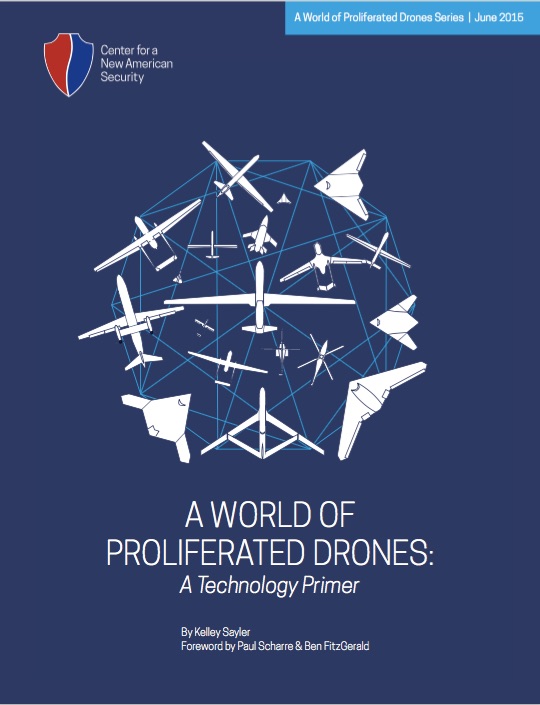
CNAS A world of proliferated dronesA new report from Kelley Sayler at the Center for a New American Security, A world of proliferated drones, starts to map what she calls ‘the likely contours of a drone-saturated world’.  The report emphasises that the United States does not have a monopoly on drones  – more than 90 states and non-state actors have them – but unusually the report pays close attention to the repurposing of small, commercial off-the-shelf drones.  It begins by summarising their capability for intelligence, surveillance and reconnaissance:

‘Current commercial drone technologies – available for purchase in either pre-assembled or customizable, component form – enable a number of high-end capabilities that were formerly the monopoly of major military powers.

Many commercial off-the-shelf (COTS) drones – including the best-selling model, the DJI Phantom – are now equipped with GPS and waypoint navigation systems. These systems enable the drone to accurately determine and hold its position, in turn removing the need for line-of-sight communications and allowing for autonomous flight… Operators of pre-assembled systems can also take advantage of smartphone-based control systems, dramatically improving ease of use. Such systems enable the user to navigate the drone simply by selecting a destination on a map or even by merely tilting the user’s phone…

High-definition video cameras are also widely available on COTS drones and, when combined with video downlinks, can provide real-time intelligence, surveillance, and reconnaissance (ISR) capabilities to multilocation receivers, though these capabilities are often limited by range and battery life.’

The report emphasises the potential weaponisation of these small drones for what it calls ‘overmatch’, in effect reversing the terms of asymmetric warfare, through (for example) the development of ‘flying IEDs‘:

‘While such systems may not appear sophisticated in a traditional military sense, ground-emplaced IEDs have caused thousands of American deaths in Iraq and Afghanistan and proved profoundly hard to defeat. Drones will enable airborne IEDs that can actively seek out U.S. forces, rather than passively lying in wait. Indeed, low-cost drones may lead to a paradigm shift in ground warfare for the United States, ending more than a half- century of air dominance in which U.S. ground forces have not had to fear attacks from the air.  Airborne IEDs could similarly be used in a terrorist attack against civilians or in precision strikes against high-profile individuals or landmarks.’

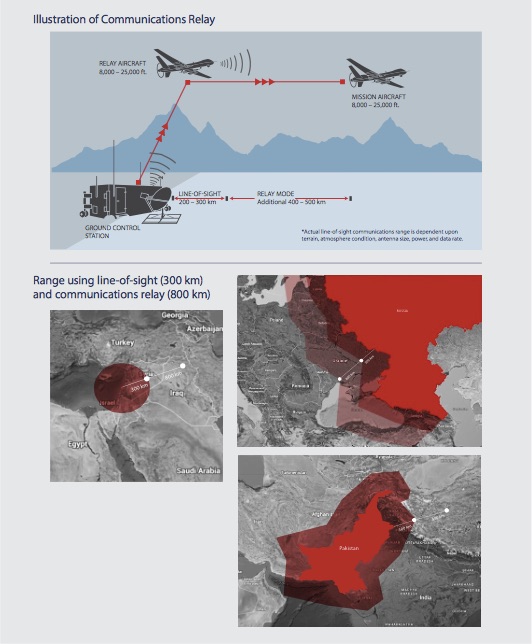
But the report also makes much of the US’s continued military-industrial investment in high-end drones.  Here various forms of stealth technology make much of the running, or at least issue most of the promissory notes, since today’s Predators and Reapers can only operate in more or less undefended air space – which is another way of saying they can only be used against the weak and/or with the complicity of other states (as in Pakistan and Yemen) – and face immense difficulties in what the US Air Force calls A2/AD [anti-access/area-denial] environments (see here and here). But I’m particularly interested in what the report has to say about the use of large military drones to act as communications relays.  Here the emphasis is on the ability of these remote relays to integrate what is otherwise often remarkably un-networked warfare and to extend the range of operational control and transmissable data.

Drones as communication relays (CNAS)

‘Large military-specific systems offer a number of additional improvements in communications capabilities. Many include wide-band satellite communications (SATCOM) that expand the amount and extend the range of transmittable data, providing distant ground stations with real-time ISR. Like some baseline systems, high-end systems are generally capable of line-of-sight communi- cations with other platforms operating in their area and, for this reason, are often employed as communications relays. Perhaps the most vivid example of the force-multiplying effects of such capabilities is the EQ-4 – what is essentially an RQ-4 Global Hawk outfitted with the Battlefield Airborne Communications Node (BACN). BACN serves as a universal translator for a diverse set of U.S. aircraft that are not otherwise capable of communicating with each other due to incompatible data links – providing a vital connection between, for example, fourth-generation F-16 fighter jets, B-1 bombers, and stealthy, fifth-generation F-22s [BACN is also used on conventional platforms: see here for its role in co-ordinating an air strike in Afghanistan]. Communications relay capabilities will also allow states to operate drones at extended ranges (300 to 800 kilometers) without satellite communications, allowing significant penetration into neighboring countries or contested areas’ (my emphasis).

Steve Graham and I are presently working on an essay on drones and satellite communications: so much of the discussion of geospatial intelligence has focused on satellite imagery, but the geographies of satellite communications (and, crucially, bandwidth) play a major role in the deployment of drones and in the highly variable quality of the imagery they transmit to users across the network.