Novel wars

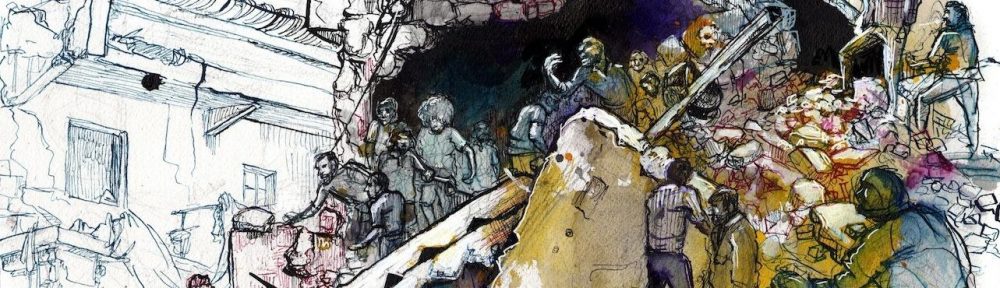
Since I added ‘The Natures of War’ to the DOWNLOADS section several people have asked me about my use of novels, especially in relation to Vietnam, while others have asked me to recommend writings – both novels and memoirs – that treat contemporary conflicts, especially Afghanistan.
Writing letters to home

The first part is easy.  To say things too quickly, I think the usual distinction between ‘fiction’ and ‘non-fiction’ is much more problematic than it seems (don’t we all know this? and in any case where exactly do you place a ‘memoir’ in such a strangely bifurcated landscape?).  I also believe that there are some insights – truths, if you prefer – that are best conveyed in ostensibly fictional form.  For that reason I suspect it’s significant that it’s my appeal to (for example) Karl Marlantes‘s magnificent Matterhorn in the Vietnam section that seems to trouble some readers much more than my use of poetry in the section on the Western Desert in the Second World War.  Yet both emerged through their authors’ reflections on their experiences of modern war in those places.  That doesn’t mean that one can ignore literary conventions or linguistic devices – no text is a transparent reflection of the world, after all – but this surely also holds for nominally factual accounts too (and that goes for military blogs, which have created their own conventions).  In other ‘fictional’ cases I can think of – like Tom McCarthy‘s C, which I drew upon in ‘Gabriel’s Map’ to characterise the battlefields of the Western Front  – the narrative is clearly embedded in intensive and immensely thoughtful research.  In fact, I’d push this further: hence my interest in documentary drama as part of – not simply a product of – the research process.

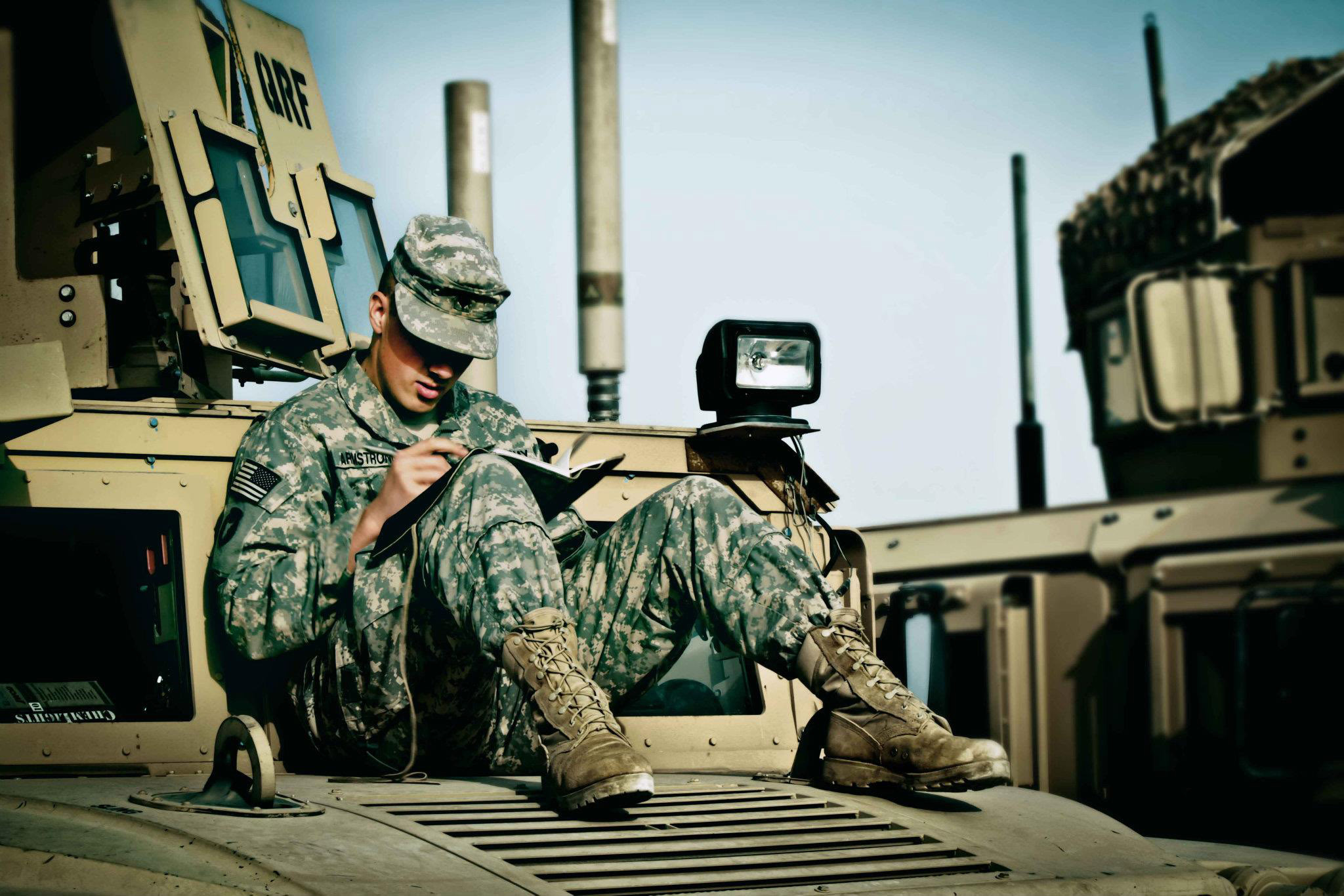
The second question is more difficult, but there are some recent guides which might help.  A good place to start is George Packer‘s ‘Home Fires: how soldiers write their wars‘ which appeared in the New Yorker last spring.  Packer tries to pin down what is distinctive about writing that seeks to capture the wars fought in the shadows of 9/11:

‘The first wave of literature by American combatants in these long, inconclusive wars has begun to appear—poems, memoirs, short stories, novels. Their concerns are the same as in all war writing: bravery and fear, the thin line between survival and brutality, the maddening unknowability of the enemy, tenderness, brotherhood, alienation from a former self, the ghosts of the past, the misfit of home.

But Iraq was also different from other American wars… Without a draft, without the slightest sacrifice asked of a disengaged public, Iraq put more mental distance between soldiers and civilians than any war of its duration that I can think of. The war in Iraq, like the one in Vietnam, wasn’t popular; but the troops, at least nominally, were—wildly so. (Just watch the crowd at a sports event if someone in uniform is asked to stand and be acknowledged.) Both sides of the relationship, if they were being honest, felt its essential falseness.’

Given this disconnect, he concludes, ‘it’s not surprising that the new war literature is intensely interested in the return home.’  But when it deals with the soldiers’ experience of war, he continues,

‘It deals in particulars, which is where the heightened alertness of combatants has to remain, and it’s more likely to notice things. To most foreign observers, the landscape of Iraq is relentlessly empty and ugly, like a physical extension of the country’s trauma. But in the poetry and the prose of soldiers and marines the desert comes to life with birdsong and other noises, the moonlit sand breeds dreams and hallucinations.’

It’s that struggle to turn the experience of land into its evocation that interests me.  But Packer makes surprisingly little of it, and his gaze is focused almost unwaveringly on Iraq rather than Afghanistan (not surprising, given his own war reporting).

Writing in the New York TimesMichiko Kakutani identifies a series of writings on the human costs of what Dexter Filkins called ‘the forever war’:

‘War cracks people’s lives apart, unmasks the most extreme emotions, fuels the deepest existential questions. Even as the wars in Iraq and Afghanistan morph into shapeless struggles with no clear ends in sight, they have given birth to an extraordinary outpouring of writing that tries to make sense of it all: journalism that has unraveled the back story of how and why America went to war, and also a profusion of stories, novels, memoirs and poems that testify to the day-to-day realities and to the wars’ ever-unspooling human costs.

‘All war literature, across the centuries, bears witness to certain eternal truths: the death and chaos encountered, minute by minute; the bonds of love and loyalty among soldiers; the bad dreams and worse anxieties that afflict many of those lucky enough to return home. And today’s emerging literature … both reverberates with those timeless experiences and is imprinted with the particularities of the conflicts in Afghanistan and Iraq: changes in technology, the increased presence of female soldiers and, most importantly, the all-volunteer military, which has opened a chasm between soldiers (“the other 1 percent”) and civilians.’

Here too there is an attempt to see how today’s writing differs from the established canon of war literature.  En route, Kakutani makes some good suggestions for reading, but she says very little about the differences – those dense ‘particulars’ again – between Iraq and Afghanistan.
afghan1

She leaves that to Brian Castner‘s outstanding essay for the LA Review of Books, ‘Afghanistan: a stage without a play.’

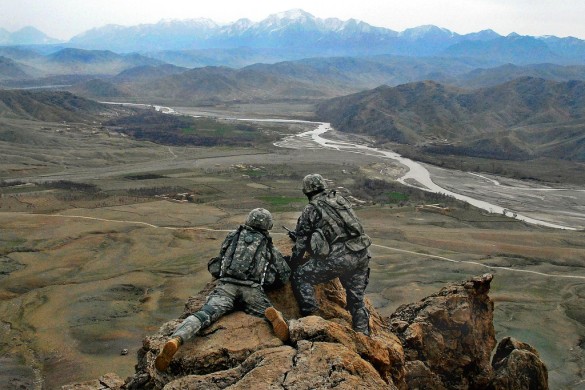
Castner did two tours in Iraq, and his own account of that experience (and, just as important, what followed) in The Long Walk is a tour de force in every sense of the phrase.  But he is also remarkably perceptive in his readings of Afghanistan (‘the Undescribed War’, he calls it) and – of particular interest to me, given my interest in ‘the natures of war’ or what my good friend Gastón Gordillo would prefer me to call ‘terrain‘ – its land and landscapes.  Castner also draws several illuminating comparisons with Vietnam (not least through a double parallel with the US’s ‘Indian Wars’ of the nineteenth century).

Kevin Maurer covered both wars, and always found

“Afghanistan far more riveting than Iraq because it’s a whole different world. Baghdad is a Middle Eastern city, but it is a modern city. In Afghanistan that barely exists. I’ve always been able to turn my brain into Afghanistan mode and out, while Iraq blurs.”

The influence of the terrain, especially its beauty, is clear: while a few descriptions of colorful Iraqi skies creep into the literature, it was mostly an ugly urban war fought along the New York State Thruway, rest stop to rest stop. “Afghanistan always had that Vietnam vibe to it,” Maurer said, “because you can go get lost in Afghanistan, you can be on some hill on some outpost. In Iraq you were never that far out.”
Korengal

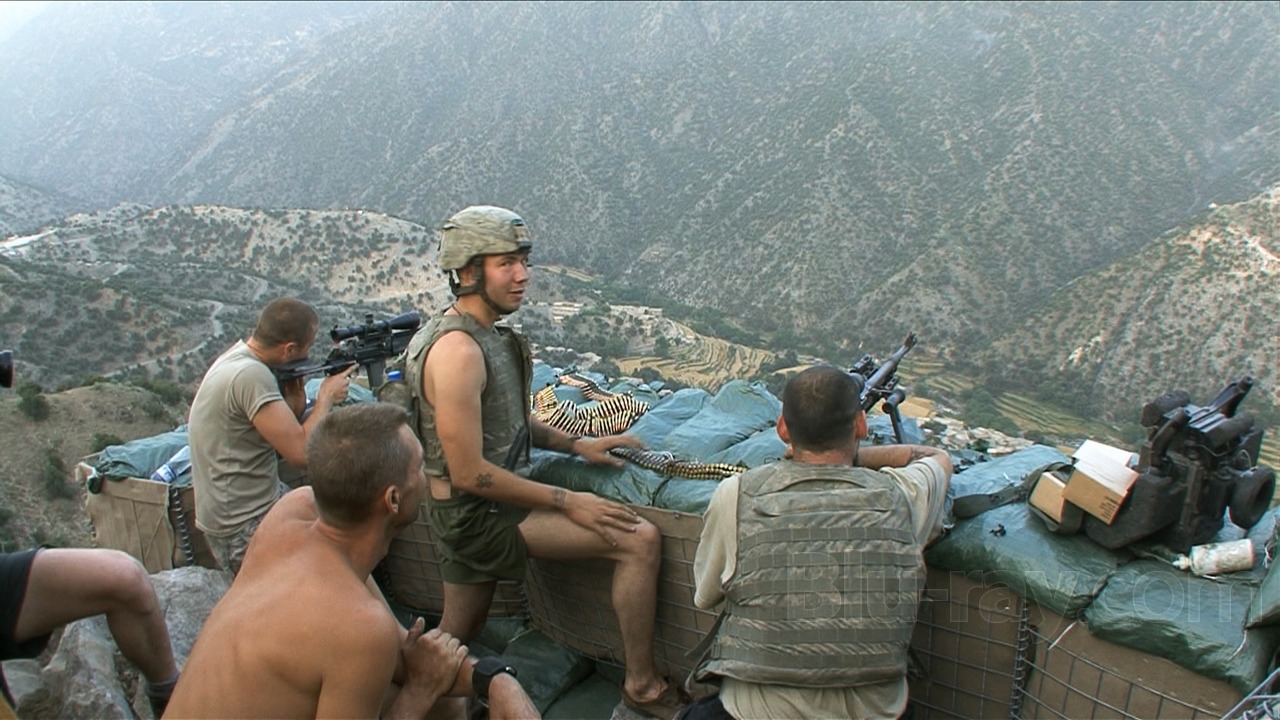
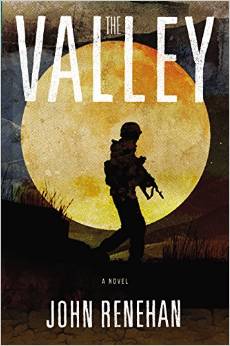
And for that very reason the terrain was always more than beautiful.  You can see that in a film like Restrepo – and even more clearly in Koregal (above) – but according to Castner you can also see it in John Renehan’s forthcoming novel, The Valley.  And here too Vietnam continues to haunt the imaginative landscape:

RENEHAN The ValleyThe landscape acts as an omnipresent consciousness, an apparition always in the corner of [Lieutenant] Black’s eye, and Renehan attaches to it layers of reverence and dread and unknowable quasi-mysticism; the valley is capable of anything. This infection spreads slowly for the reader, and Renehan says his writing process followed a similar path. “I more or less thought I was setting out to write a mystery story that happened to be set in a war. But as I started writing it I realized it was growing into something different in my mind, and it changed on paper too.” A detective story becomes a heroin- and concussion-fueled dreamscape that crosses genres. “Going After Cacciato gave me comfort in writing the parts of The Valley that become almost surreal,” Renehan said. “It reassured me that this sort of thing is okay, because it’s a war novel, right?”
What I need to think more about – the process I started in ‘Gabriel’s Map’ and continued in ‘The Natures of War’ – is how, despite Castner’s title, the stage is always part of the play.  And novels and poems will continue to help me do so.

POSTSCRIPT  Just after I finished drafting this post, I stumbled across ‘s Peter Molin‘s excellent blog: Time Now: the Iraq and Afghan wars in art, film and literature which also discusses the three reviews I list here.  Peter is a US Army officer who served in Afghanistan in 2008-9, and his posts are rich in ideas, insights and resources: well worth bookmarking.
Degrees of intimacy

Drone warsNext month Cambridge University Press is publishing a book of essays edited by Peter Bergen and Daniel Rothenberg, Drone wars: transforming conflict, law and policy, due out from Cambridge University Press at the end of the year.  Here’s the blurb:

Drones are the iconic military technology of many of today’s most pressing conflicts, a lens through which U.S. foreign policy is understood, and a means for discussing key issues regarding the laws of war and the changing nature of global politics. Drones have captured the public imagination, partly because they project lethal force in a manner that challenges accepted rules, norms, and moral understandings. Drone Wars presents a series of essays by legal scholars, journalists, government officials, military analysts, social scientists, and foreign policy experts. It addresses drones’ impact on the ground, how their use adheres to and challenges the laws of war, their relationship to complex policy challenges, and the ways they help us understand the future of war. The book is a diverse and comprehensive interdisciplinary perspective on drones that covers important debates on targeted killing and civilian casualties, presents key data on drone deployment, and offers new ideas on their historical development, significance, and impact on law and policy. Drone Wars documents the current state of the field at an important moment in history when new military technologies are transforming how war is practiced by the United States and, increasingly, by other states and by non-state actors around the world.

And here is the Contents List:

Part I. Drones on the Ground:

1. My guards absolutely feared drones: reflections on being held captive for seven months by the Taliban David Rohde
2. The decade of the drone: analyzing CIA drone attacks, casualties, and policy Peter Bergen and Jennifer Rowland
3. Just trust us: the need to know more about the civilian impact of US drone strikes Sarah Holewinski
4. The boundaries of war?: Assessing the impact of drone strikes in Yemen Christopher Swift
5. What do Pakistanis really think about drones? Saba Imtiaz

Part II. Drones and the Laws of War:

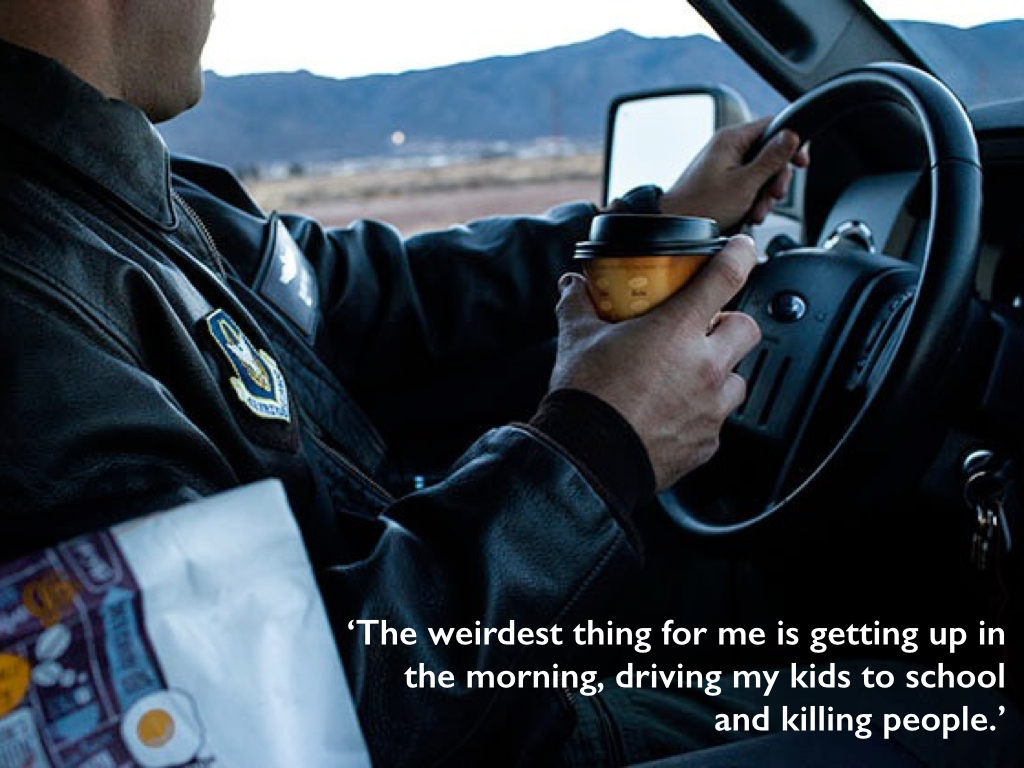
6. It is war at a very intimate level USAF pilot
7. This is not war by machine Charles Blanchard
8. Regulating drones: are targeted killings by drones outside traditional battlefields legal? William Banks
9. A move within the shadows: will JSOC’s control of drones improve policy? Naureen Shah
10. Defending the drones: Harold Koh and the evolution of US policy Tara McKelvey
Part III. Drones and Policy Challenges:
11. ‘Bring on the magic’: using drones in combat Michael Waltz
12. The five deadly flaws of talking about emerging military technologies and the need for new approaches to law, ethics, and war P. W. Singer
13. Drones and cognitive dissonance Rosa Brooks
14. Predator effect: a phenomenon unique to the war on terror Meg Braun
15. Disciplining drone strikes: just war in the context of counterterrorism David True
16. World of drones: the global proliferation of drone technology Peter Bergen and Jennifer Rowland

Part IV. Drones and the Future of Warfare:

17. No one feels safe Adam Khan
18. ‘Drones’ now and what to expect over the next ten years Werner Dahm
19. From Orville Wright to September 11: what the history of drone technology says about the future Konstantin Kakaes
20. Drones and the dilemma of modern warfare Richard Pildes and Samuel Issacharoff
21. How to manage drones, transformative technologies, the evolving nature of conflict and the inadequacy of current systems of law Brad Allenby
22. Drones and the emergence of data-driven warfare Daniel Rothenberg

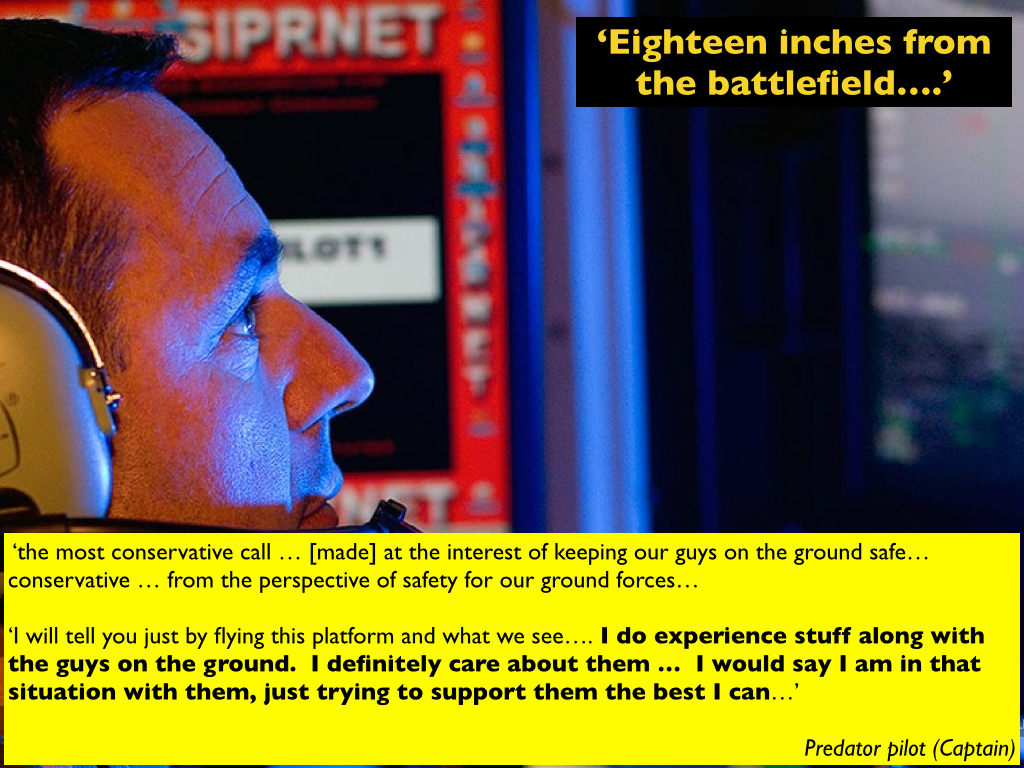
Over at Foreign Policy you can find an early version of Chapter 6, which is an interview with a drone pilot conducted by Daniel Rothenberg.  There are two passages in the interview that reinforce the sense of the bifurcated world inhabited by drone crews that I described in ‘From a view to a kill’ and ‘Drone geographies’ (DOWNLOADS tab).  On the one side the pilot confirms the inculcation of an intimacy with ground troops, particularly when the platforms are tasked to provide Close Air Support, which is in some degree both reciprocal and verbal:

“Because of the length of time that you’re over any certain area you’re able to engage in lengthy communications with individuals on the ground. You build relationships. Things are a little more personal in an RPA than in an aircraft that’s up for just a few hours. When you’re talking to that twenty year old with the rifle for twenty-plus hours at a time, maybe for weeks, you build a relationship. And with that, there’s an emotional attachment to those individuals.

“You see them on a screen. That can only happen because of the amount of time you’re on station. I have a buddy who was actually able to make contact with his son’s friend over in the AOR [area of responsibility]. If you don’t think that’s going to make you focus, then I don’t know what will.

“Many individuals that have been over there have said, ‘You know, we were really happy to see you show up’; ‘We knew that you were going to keep us from being flanked’; ‘We felt confident in our ability to move this convoy from ‘A’ to ‘B’ because you were there.’ The guy on the ground and the woman on the ground see how effective we are. And it gives them more confidence.”

GREGORY Angry Eyes Extract.001

[The image above is taken from my ‘Angry Eyes’ presentation; the Predator pilot in this instance was involved in orchestrating the air strike in Uruzgan province, Afghanistan on 21 February 2010, and the quotation is taken from the US Army investigation into the incident.  I’m converting the presentation into the final chapter for The everywhere war, and I’ll post the draft as soon as I’m finished.]

But when the pilot in Rothenberg’s interview goes on to claim that ‘Targeting with RPAs is very intimate’ and that ‘It is war at a very intimate level’, he reveals on the other side an altogether different sense of intimacy: one that is strictly one-sided, limited to the visual, and which resides in a more abstracted view:

“Flying an RPA, you start to understand people in other countries based on their day-to-day patterns of life. A person wakes up, they do this, they greet their friends this way, etc. You become immersed in their life. You feel like you’re a part of what they’re doing every single day. So, even if you’re not emotionally engaged with those individuals, you become a little bit attached. I’ve learned about Afghan culture this way. You see their interactions. You’re studying them. You see everything.”

The distinction isn’t elaborated, but the claims of ‘immersion’ and becoming ‘part of what they’re doing every day’ are simply astonishing, no?  You can find more on the voyeurism of ‘pattern of life analysis’ and the remarkable conceit that ‘you see everything’ here.

GREGORY Drones and the everywhere war 2014 Homeland insecurities.001

[The image above is taken from my ‘Drone geographies’ presentation]

The interview emphasises a different bifurcation, which revolves around the alternation between ‘work’ and ‘home’ when remote operations are conducted from the United States:

“”When you’re doing RPA operations, you’re mentally there, wherever there is. You’re flying the mission. You’re talking to folks on the ground. You’re involved in kinetic strikes. Then you step out the ground control station (GCS) and you’re not there anymore…

“Those are two very, very different worlds. And you’re in and out of those worlds daily. I have to combine those two worlds. Every single day. Multiple times a day. So, I am there and then I am not there and then I am there again. The time between leaving the GCS [Ground Control Station] and, say, having lunch with my wife could be as little as ten minutes. It’s really that fast.”

You can find much more on these bifurcations in my detailed commentary on Grégoire Chamayou‘s Théorie du drone here and in ‘Drone geographies’ (DOWNLOADS tab).

There’s one final point to sharpen.  In my developing work on militarized vision, and especially the ‘Angry eyes’ presentation/essay,  I’ve tried to widen the focus beyond the strikes carried out by Predators and Reapers to address the role they play in networked operations where the strikes are carried out by conventional strike aircraft.  Here is what Rothenberg’s pilot says about what I’ve called the administration of military violence (where, as David Nally taught me an age ago, ‘administration’ has an appropriately double meaning):

‘”Flying an RPA is more like being a manager than flying a traditional manned aircraft, where a lot of times your focus is on keeping the shiny side up; keeping the wings level, putting the aircraft where it needs to be to accomplish the mission. In the RPA world, you’re managing multiple assets and you’re involved with the other platforms using the information coming off of your aircraft.

“You could use the term ‘orchestrating’; you are helping to orchestrate an operation.”

***

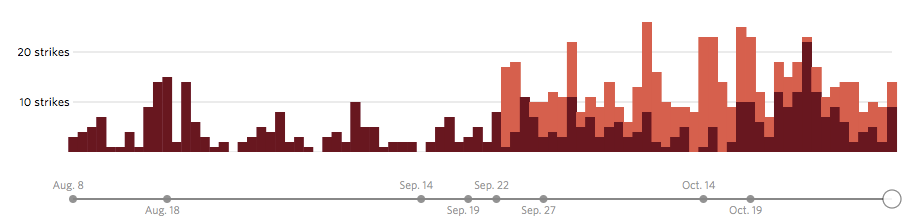
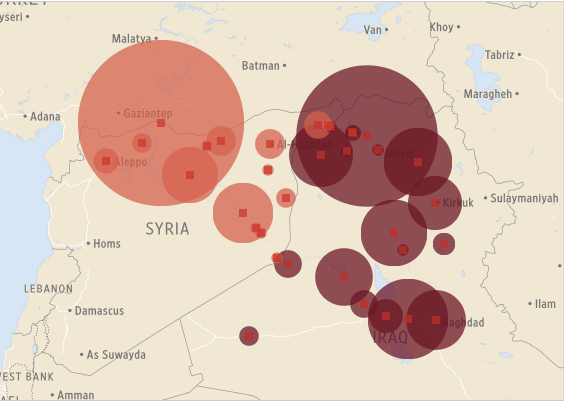
Drone wars appears just as remote operations over Iraq and Syria are ramping up: you can find an excellent review by Chris Cole at Drone Wars UK here, ‘Drones in Iraq and Syria: What we know and what we don’t.’  The images below are from the Wall Street Journal‘s interactive showing all air strikes reported by US Central Command 8 August through 3 November 2014:

Air strikes in Iraq and Syria

During this period  769 coalition air strikes were reported: 434 in Syria (the dark columns), including 217 on the besieged border city of Kobane, and 335 in Iraq (the light columns), including 157 on Mosul and the Mosul Dam.

Air strikes in Iraq and Syria August-November 2014

But bear in mind these figures are for all air strikes and do not distinguish between those carried out directly by drones and those carried out by conventional strike aircraft.  As Chris emphasises:

‘Since the start of the bombing campaign, US drones have undertaken both surveillance and strike missions in Iraq and Syria but military spokespeople have refused to give details about which aircraft are undertaking which strikes repeatedly using the formula “US military forces used attack, fighter, bomber and remotely-piloted aircraft to conduct airstrikes.”’

Although the USAF has used a mix of MQ-1 (Predator) and MQ-9 (Reaper) drones, F-15E, F-16, F/A-18 and F-22 fighters, B-1 bombers, AC-130 gunships and AH-64 Apache helicopters in these operations, it seems likely that its capacity to use remote platforms to provide intelligence, surveillance and reconnaissance is limited by its continuing commitments in Afghanistan (though Britain’s Royal Air Force has now deployed its Reapers for operations in both Iraq and Syria).

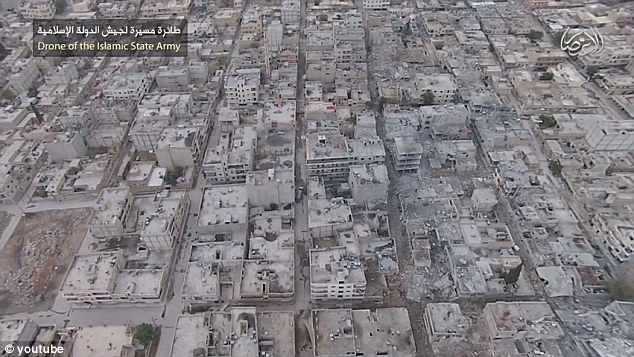
IS (Islamic State) claims to have its own drones too.  In February it released video of its aerial surveillance of Fallujah in Iraq, taken from a DJI Phantom FC40 quadcopter, in August it released video of Taqba air base in Syria taken from the same platform, tagged as ‘a drone of the Islamic State army’, and in September a propaganda video featuring hostage John Cantile showed similar footage of Kobane (below).

1414438887900_wps_7_IS_have_released_a_new_vi

These image streams are all from commercial surveillance drones, but in September the Iranian news agency Fars reported that Hezbollah had launched an air strike from Lebanon against a command centre of the al-Nursra Front outside Arsal in Syria using an armed (obviously Iranian) drone.

You can find Peter Bergen’s and Emily Schneiders view on those developments here, and a recent survey of the proliferation of drone technologies among non-state actors here.

The details of both the state and non-state air strikes remain murky, but I doubt that much ‘intimacy’ is claimed for any of them.

Conflicts without borders

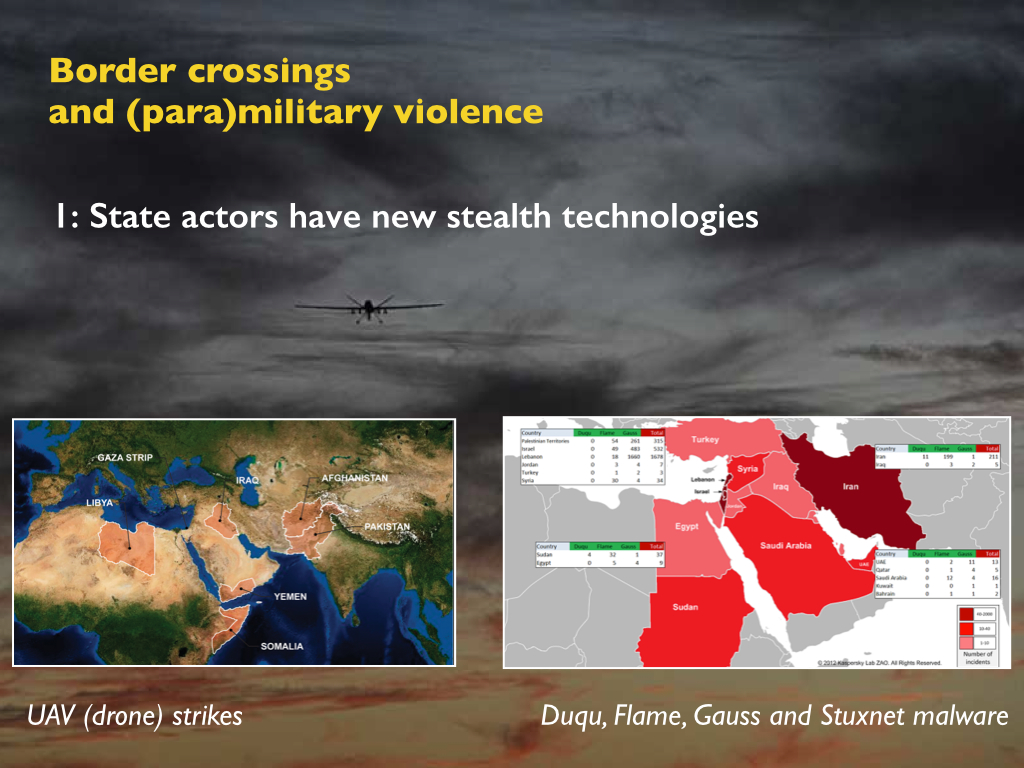
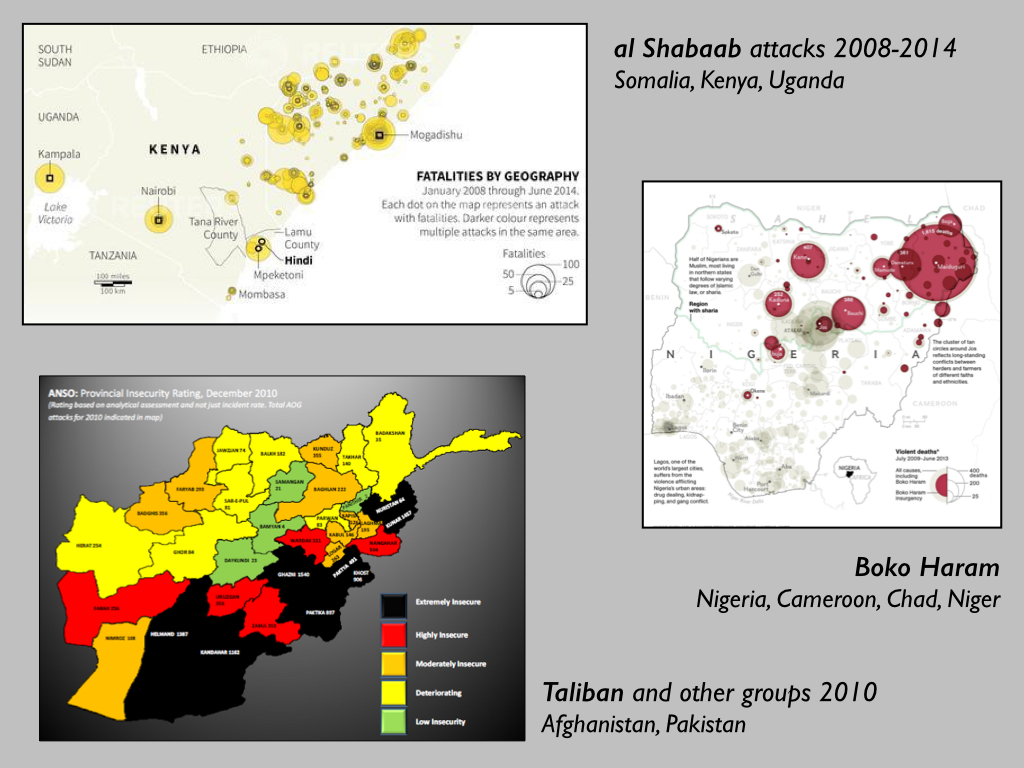
In Finland last month I gave a presentation on Law, violence and b/ordering, in which I began by making two preliminary points about border crossings and (para)military violence: trans-border incursions and transgressions have been facilitated by (i) new stealth technologies deployed by state actors and (ii)  the rise of new non-state and para-state actors.  Here are the relevant slides:

GREGORY 2 Law, violence and b:ordering.001

GREGORY 2 Law, violence and b:ordering.002

GREGORY 2 Law, violence and b:ordering.003

GREGORY Law, violence and b:ordering.003

I derived the map showing the advance of IS(IS)/ISIL from the Institute for the Study of War; say what you like about their politics (this is the Kagans we are talking about), their maps and summaries are extremely helpful.

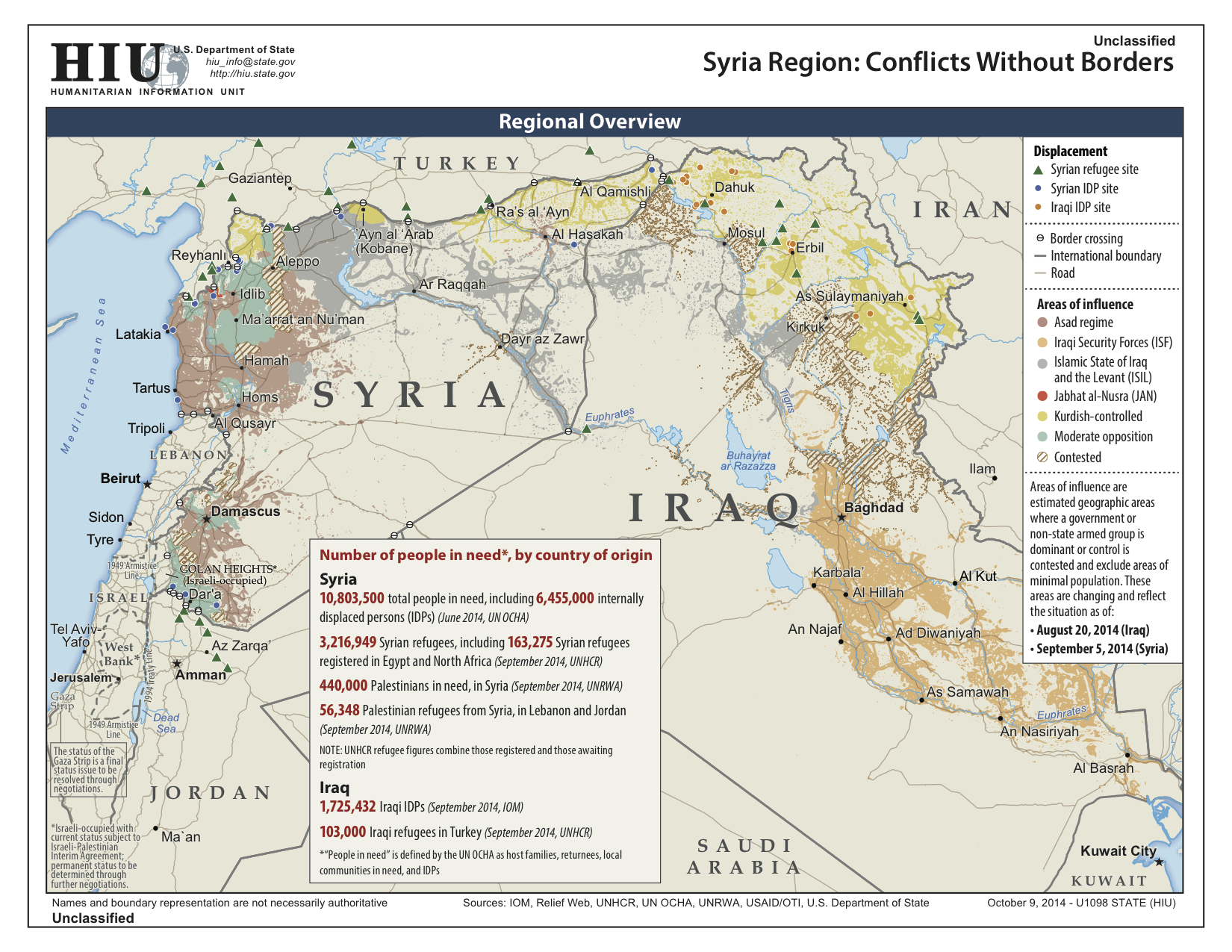
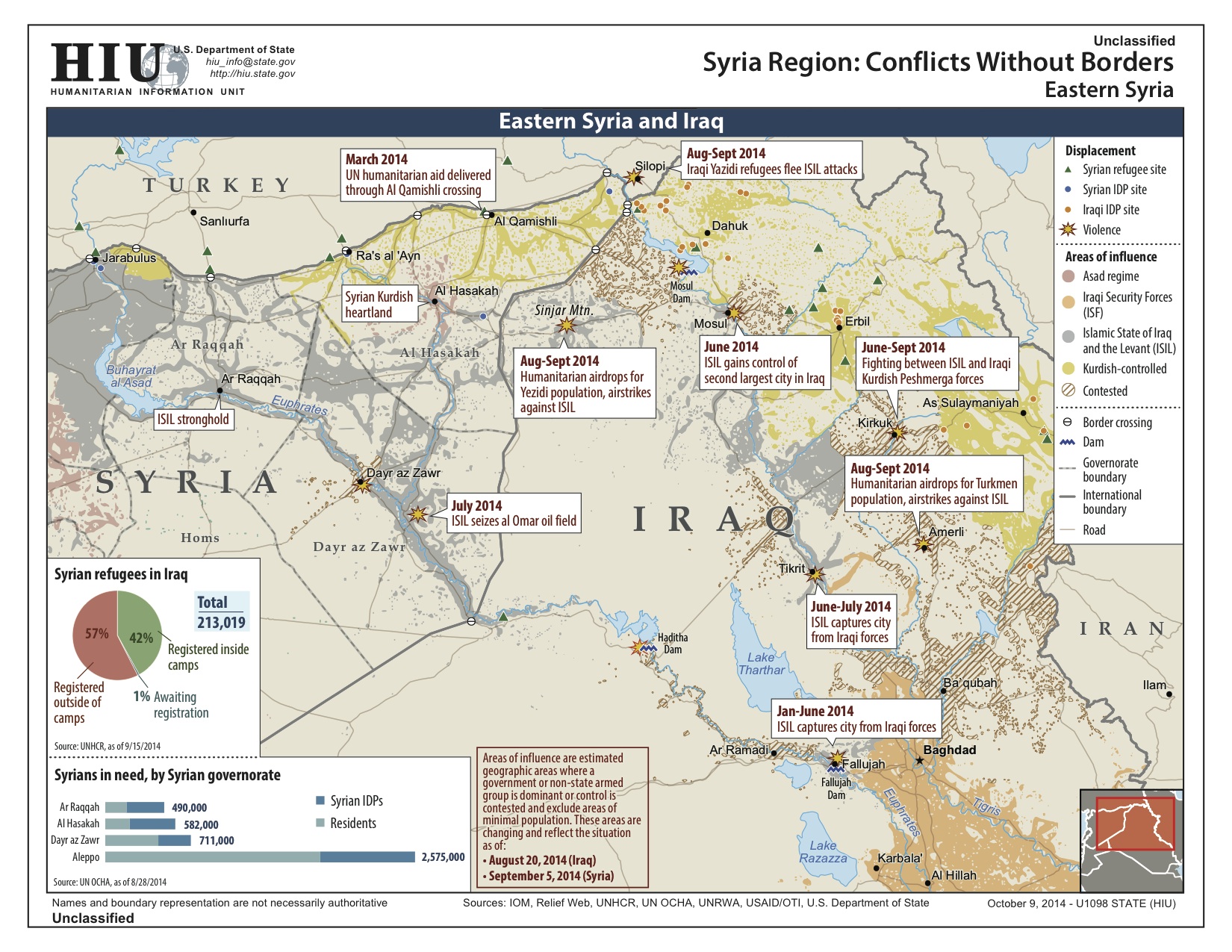
Now Public Intelligence has just published a series of (unclassified) maps of Iraq, Syria, Lebanon and Jordan produced by the Humanitarian Information Unit of the US State Department called Conflicts Without Borders:

‘Conflicts Without Borders refers to a conflict in one country that draws in other governments and non-state actors, exacerbates stresses and conflicts in the neighbouring countries, and generates displacement across borders.’

That’s a definition to think about; there are obvious ironies in the US offering a definition that I suspect is intended to exclude its own part in initiating conflicts (if so, it doesn’t work), and there is the interesting attribution of causal powers to conflicts (which ‘draw in’ other actors like so many black holes).

This map series is dated 9 October 2014; the maps provide a Regional Overview (the first map below) and then show Northern Syria and Turkey, Western Syria and Lebanon, Southern Syria and Jordan and Eastern Syria and Iraq (the second map below).

DoS-Syria-ISIL

DoS-Iraq and Syria-ISIL

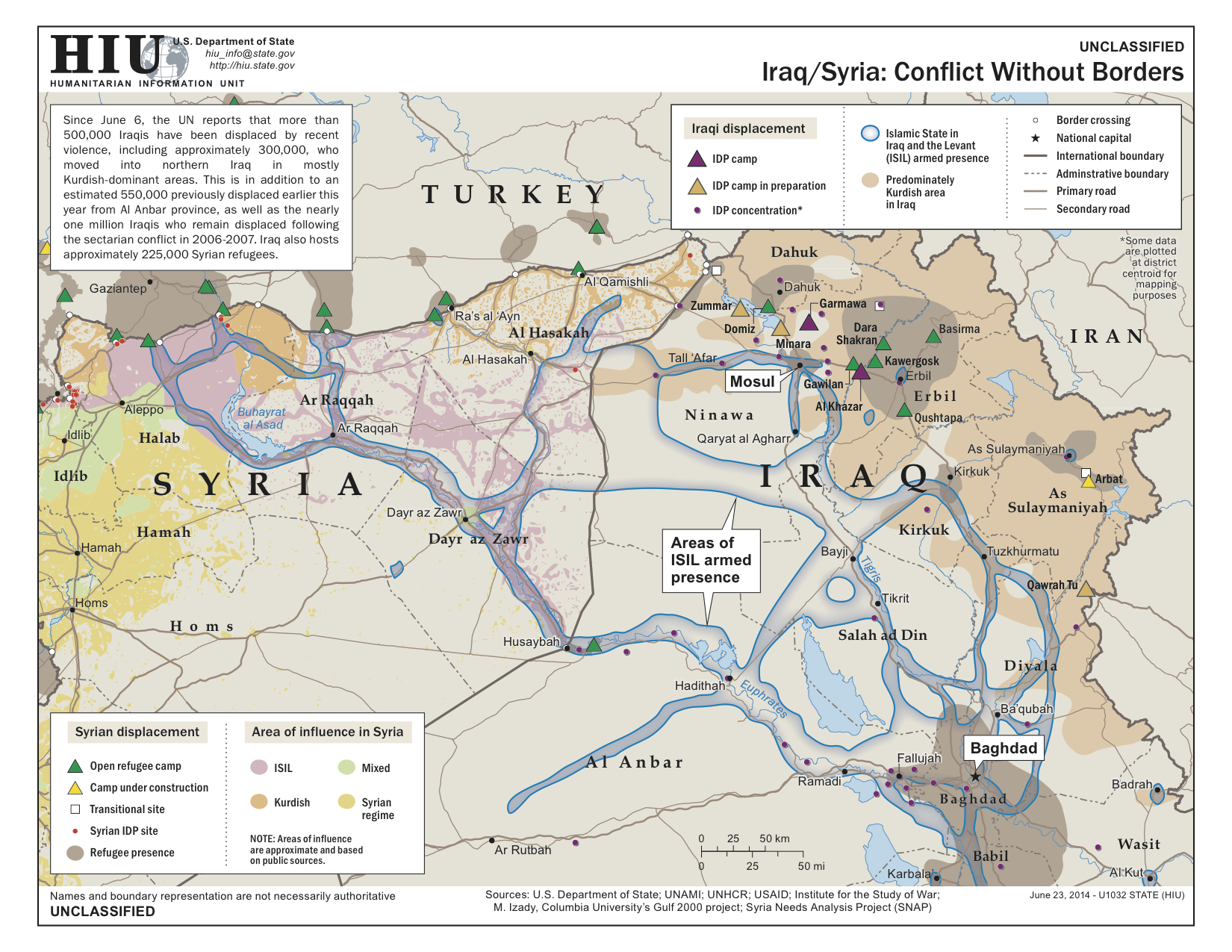
You can access a single summary map for late June here (shown below):

DoS Iraq Syria Conflict June 2014

I still haven’t found what I’m looking for

U2 (USAF photograph)

Rummaging around for more people working on militarized vision, I encountered a forum on Military optics and Bodies of difference held at Berkeley’s Center for Race and Gender earlier this year, and through that the research of Katherine Chandler, who holds a Townsend Center for the Humanities Dissertation Fellowship in the Department of Rhetoric.  Her dissertation in progress is entitled Drone Flight and Failure: the United States’ Secret Trials, Experiments and Operations in Unmanning, 1936 – 1973, which promises to fill in a crucial gap in conventional genealogies of today’s remote operations.

As you’ll see if you visit her website here, Katherine is an accomplished artist as well as researcher and critic.  You can read her essay on ‘System Failures’, which includes a discussion of Trevor Paglen‘s Drone Vision and Omer Fast‘s 5,000 Feet is the Best, at The New Inquiry (August 2012) here, and find a fuller discussion of Fast’s video situated within what Katherine calls the ‘knowledge politics’ and political ecologies of remote operations on pp. 63-74 of Knowledge politics and intercultural dynamics here.

Here is the abstract for her talk at the forum, Unmanning Politics: Aerial Surveillance 1960-1973:

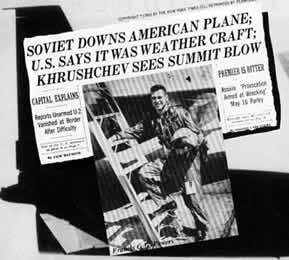
u2_spy_plane_incident_newspaper_clippingOn May 1, 1960, Francis Gary Powers’ U-2 plane was shot down over the Soviet Union while on a secret reconnaissance mission. The ensuing diplomatic fallout caused the cancellation of the Paris Summit between Dwight Eisenhower and Nikita Khrushchev. Less well known, in April 1960, Robert Schwanhausser, an engineer for Ryan Aeronautical, briefed the United States Air Force on the possibility that its Firebee target drone, used at the time for air defense training, might be re-engineered as an unmanned reconnaissance plane. In the weeks following the Powers incident, the Air Force began wholesale negotiations with Ryan Aeronautical to develop a pilotless spy plane and, on July 8, 1960, the company was given funding to begin the project. Among the noted advantages were: “political risk is minimized due to the absence of a possible prisoner” (“Alternative Reconnaissance System,” 1960). I investigate the resulting Lightning Bugs, flown for three-thousand reconnaissance missions in Southeast Asia between 1964 and 1973. 

Researching how aircraft were unmanned during the Cold War is instructive both in the ways they mimic contemporary unmanned combat aerial vehicles and trouble assumptions about them. I follow how unmanned systems operated within the logics of American Cold War politics and their perceived usefulness geopolitically – crossing borders as spy aircraft, collecting and jamming electronic signals, and gathering battlefield reconnaissance. I ask how conquest, and the ensuing assumptions of empire, colonialism and race, underlie the unmanning of military aircraft, even while these aspects were purposefully, although, unsuccessfully occluded through the idea that technologies could mitigate political risks. Moreover, unmanned reconnaissance projects were cancelled at the end of the Vietnam War and their failure provides clues about what might be left out of visions of aerial control and the ways politics, and human vulnerabilities, persisted in spite of efforts to engineer systems that would suggest otherwise.

The legitimacy of contemporary drone strikes relies on the ability of unmanned aircraft to “see” enemy targets. Yet, as Isabel Stengers has argued, any representation gives value. Looking at the few available images from these early unmanned reconnaissance flights, I move between what is seen and unseen to examine how values, particularly, secrecy and control, are formed through unmanned reconnaissance. Claiming to produce a mechanical, rather than political, view of the territories surveyed, I show how the supposedly apolitical lens of the drone occludes how politics, industry and military come together to privilege certain positions and target others.

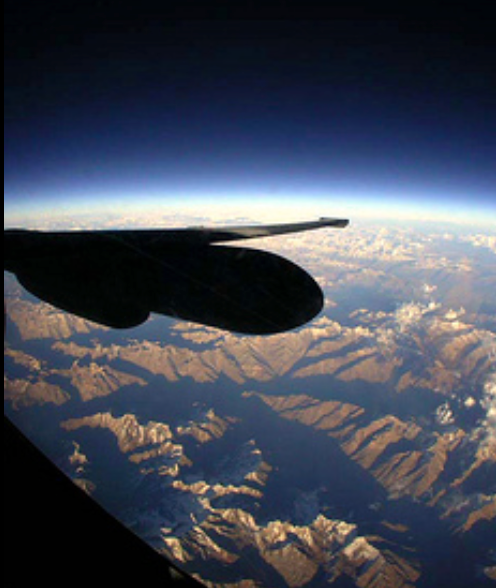
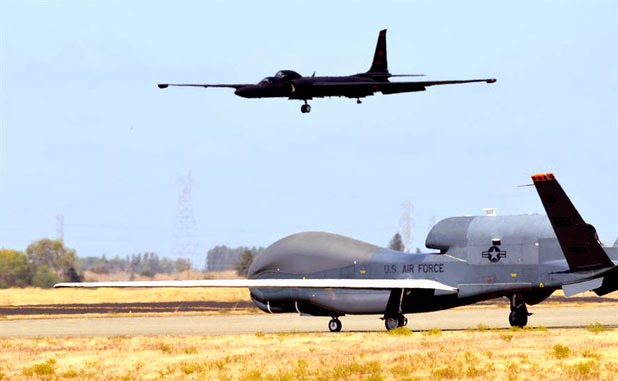
Interesting stuff – especially that first paragraph linking ‘un-manning’ to the U-2.  There is a strange irony here, because until this year the US Air Force had in fact favoured its fleet of 33 U-2 (‘Dragon Lady’) aircraft [one of which is shown at the top of the photograph] over the high-altitude Global Hawk [shown at the bottom], so much so that it had asked for permission to cancel its orders for the new Block 30 Global Hawks and place others in storage.

GlobalHawk_USAFAirmanFirstClassBobbyCummings

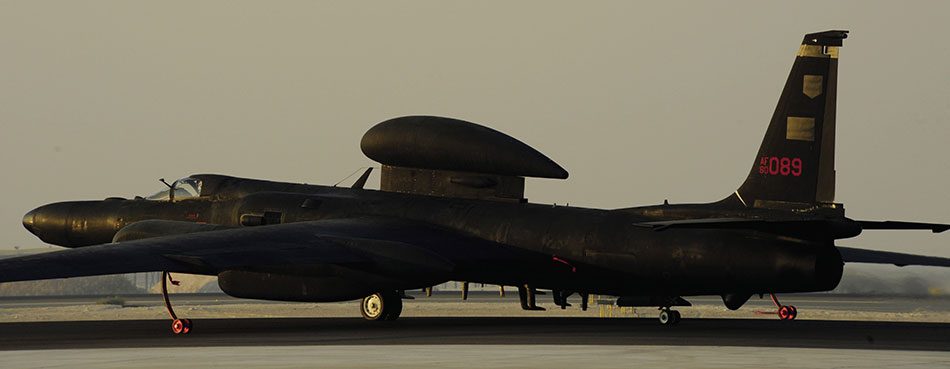
You may be surprised to discover that the U-2 is still flying, but the airframe has been repeatedly modified and so too has the network in which it is embedded.  One pilot explained:

“The U-2 started out only carrying a wet-film camera. Now, with today’s technology, I’m alone up there, but I may be carrying 40 to 50 Airmen via data link who are back at a (deployable ground station).”

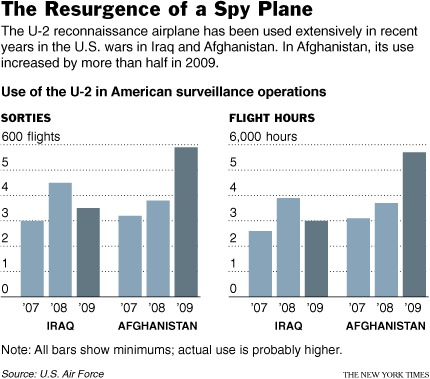
U-2 flying hours in Afghanistan and Iraq (New York Times)It’s important to remember that Predators and Reapers are not the only platforms streaming imagery to the Air Force’s Distributed Common Ground System.  The U-2 was given a new lease of life by the Gulf War in 1991, when nine U-2s flying out of the UAE  provided 50 per cent of all imagery and over 90 per cent of all ground forces targeting imagery.  During the invasion of Iraq in 2003 U-2s flew only 19 percent of the air reconnaissance missions, but they provided more than 60 per cent of the signals intelligence and 88 per cent of battlefield imagery.  The continuing wars in Afghanistan and Iraq confirmed that the U-2’s original, strategic significance had been eclipsed by its new tactical role.  Chris Pocock explains:

“The U-2 today is more a tactical intelligence gatherer…  It supports ground operations on a daily basis, flying over Afghanistan, flying around Korea, flying in the eastern Mediterranean, doing all those things every day and it’s actually not only providing intelligence that is analyzed for the benefit of those ground troops, but it’s actually in contact with those ground troops in real time.”

And that close contact – akin to the intimacy remote operators in the continental United States claim when they say they are not 7,000 miles but 18 inches from the battlespace, the distance from eye to screen – takes its toll on the U-2 pilots too.  In addition to the extraordinary pressures flying the U-2 imposes on their bodies, one USAF physician insisted that ’emotionally… they’re wrung out from that… When you’re talking to somebody on the radio and there’s gunfire in the background… you’re not taking a nap while that’s happening.’

Writing in the New York Times, Christopher Drew provided a revealing example:

Major Shontz said he was on the radio late last year with an officer as a rocket-propelled grenade exploded. “You could hear his voice talking faster and faster, and he’s telling me that he needs air support,” Major Shontz recalled. He said that a minute after he relayed the message, an A-10 gunship was sent to help.

In fact, that last clause can be generalised; the U-2 has often been deployed in close concert with other platforms, including Predators and Reapers.  Drew again:

The U-2’s altitude [70,000 feet or more], once a defense against antiaircraft missiles, enables it to scoop up signals from insurgent phone conversations that mountains would otherwise block.  As a result, Colonel Brown said, the U-2 is often able to collect information that suggests where to send the Predator and Reaper drones, which take video and also fire missiles. He said the most reliable intelligence comes when the U-2s and the drones are all concentrated over the same area, as is increasingly the case.

Part of the reason for that is that the U-2 has such an advanced imagery system:

Even from 13 miles up its sensors can detect small disturbances in the dirt, providing a new way to find makeshift mines [IEDs] that kill many soldiers.  In the weeks leading up to the [2010] offensive in Marja, military officials said, several of the … U-2s found nearly 150 possible mines in roads and helicopter landing areas, enabling the Marines to blow them up before approaching the town.

Marine officers say they relied on photographs from the U-2’s old film cameras, which take panoramic images at such a high resolution they can see insurgent footpaths, while the U-2’s newer digital cameras beamed back frequent updates on 25 spots where the Marines thought they could be vulnerable.

U-2 preparing for takeoff 'in SW Asia' (USAF/Eric Harris)

For all that,  in the last two years the Air Force’s plan to cut the Global Hawk program was repeatedly over-ridden by Congress, in response to an extraordinary campaign waged by Northrop Grumman, which launched what Mark Thompson called ‘its own ISR – intelligence, surveillance and reconnaissance – mission over Capitol Hill to decide where to strategically target cash-bombs to keep its plane, and more of them, flying for another day’: you can find a  full report at the Center for Public Integrity here.

The Air Force has now accepted the retirement of Lockheed Martin’s ageing Cold warrior, because (so it says) the cost per flying hour of the Hawk has now fallen below that of the U-2 ($24,000 vs. $32,000).  ‘U2 shot down by budget cuts’, is how PBS put it, while the Robotics Business Review triumphantly announced ‘Here comes automated warfare’.

Even so, cost per flying hour is not the whole story, as Amy Butler explains.  Part of the problem is logistical and, by extension, geopolitical: ‘Global Hawks based in Guam have to transit for hours just to reach North Korea, whereas the U-2, based at Osan air base, South Korea, has a shorter commute’ (details of the Hawk’s global basing can be found here).

A second issue is reliability, which bedevils all major UAVs and makes cost per flying hour a dubious index:

‘Intelligence, surveillance and reconnaissance collection is in high demand, and aircraft downtime is extremely worrisome for combatant commanders. In the Pacific, 55% of Global Hawk’s missions were canceled in fiscal 2013; 96% of the U-2’s missions were achieved. The U-2 was also scheduled for nearly three times as many missions. Global Hawk lacks anti-icing equipment and is not able to operate in severe weather.’

Finally, critics continue to complain that the sensors on the U-2 remain superior to those on the Hawk and provide a wider field of view.  According to a report from Eric Beidel,

The Global Hawk carries Raytheon’s Enhanced Integrated Sensor Suite, which includes cloud-penetrating radar, a high-resolution electro-optical digital camera and an infrared sensor. But the U-2’s radar can see farther partly because the plane can fly at altitudes over 70,000 feet, about 10,000 feet higher than a Global Hawk. A longer focal length also gives the U-2’s camera an edge, experts said…

Air Force Chief of Staff Gen. Norton Schwartz has said that the drone’s sensors just weren’t cutting it. Further, the U-2 can carry a larger payload, up to 5,000 pounds compared to 3,000 pounds for the Global Hawk.

“Some of the most useful sensors are simply too big for Global Hawk,” said Dave Rockwell, senior electronics analyst at Teal Group Corp. He referred to an optical bar camera on the U-2 that uses wet film similar to an old-fashioned Kodak. “It’s too big to fit on Global Hawk even as a single sensor.”

All of these technical considerations are also political ones, as Katherine’s abstract indicates, and none of them answers the other questions she poses about what can and cannot be seen…

War and therapeutic geographies

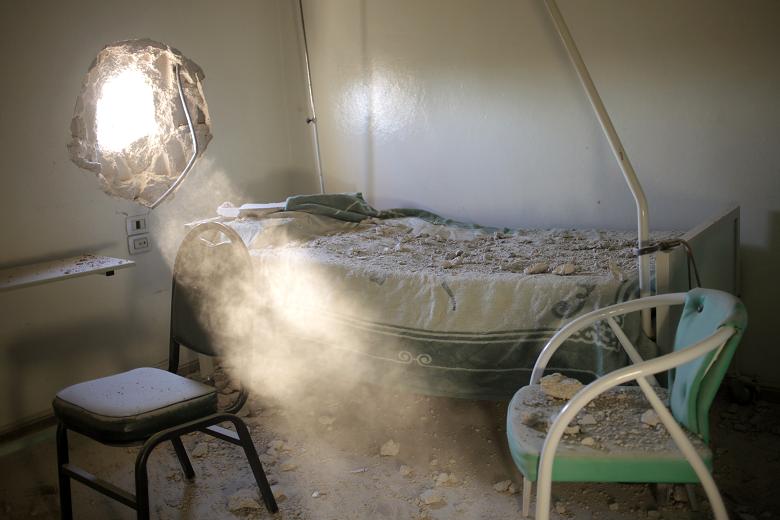
Tall Rifat hospital near Aleppo attacked by helicopter gunships June 2012

I previously noted the problems of providing medical care to those fleeing the war in Syria – and to those who’ve been left behind – and an article by Thanassis Cambanis in the Boston Globe (‘Medical care is now a tool of war’) reinforces the importance of the issue:

 The medical students disappeared on a run to the Aleppo suburbs. It was 2011, the first year of the Syrian uprising, and they were taking bandages and medicine to communities that had rebelled against the brutal Assad regime. A few days later, the students’ bodies, bruised and broken, were dumped on their parents’ doorsteps.

Dr. Fouad M. Fouad, a surgeon and prominent figure in Syrian public health, knew some of the students who had been killed. And he knew what their deaths meant. The laws of war—in which medical personnel are allowed to treat everybody equally, combatants and civilians from any side—no longer applied in Syria.

“The message was clear: Even taking medicine to civilians in opposition areas was a crime,” he recalled.

As the war accelerated, Syria’s medical system was dragged further into the conflict. Government officials ordered Fouad and his colleagues to withhold treatment from people who supported the opposition, even if they weren’t combatants. The regime canceled polio vaccinations in opposition areas, allowing a preventable disease to take hold. And it wasn’t just the regime: Opposition fighters found doctors and their families a soft target for kidnapping; doctors always had some cash and tended not to have special protection like other wealthy Syrians.

Doctors began to flee Syria, Fouad among them. He left for Beirut in 2012. By last year, according to a United Nations working group, the number of doctors in Aleppo, Syria’s largest city, had plummeted from more than 5,000 to just 36.

Since then, Fouad has joined a small but growing group of doctors trying to persuade global policy makers—starting with the world’s public health community—to pay more urgent attention to how profoundly new types of war are transforming medicine and public health.

It is grotesquely ironic that ‘global policy-makers’ should have to be persuaded of the new linkages between war, medicine and public health, given how often later modern war is described (and, by implication, legitimated) through medical metaphors: see in particular Colleen Bell, ‘War and the allegory of medical intervention: why metaphors matter’, International Political Sociology 6: 3 (2012) 325-28 and ‘Hybrid warfare and its metaphors’, Humanity 3 (2) (2012) 225-47.

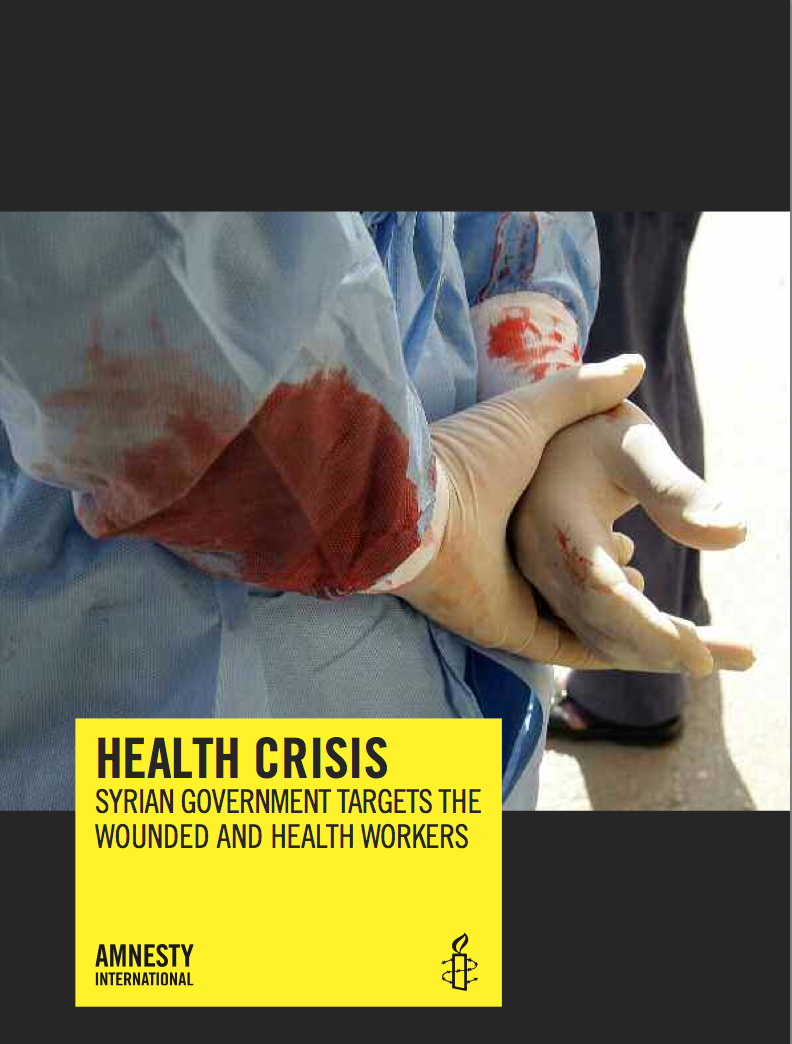
AI Health Crisis in SyriaBut there are, as Fouad emphasises, quite other, densely material biopolitics attached to contemporary military and paramilitary violence, including not only the targeting of medical staff, as he says, but also their patients.

“In Syria today, wounded patients and doctors are pursued and risk torture and arrest at the hands of the security services,” said Marie-Pierre Allié, president of [Médecins san Frontières’]. “Medicine is being used as a weapon of persecution.”

In October 2011 Amnesty International described the partisan abuse of the wounded in hospitals in Damascus and Homs, and the denial of medical care in detention facilities, in chilling detail.

At least then (and there) there were hospitals.  Linking only too directly to my previous post on Aleppo, Cambanis concludes:

Today, Fouad’s former home of Aleppo is largely a ghost town, its population displaced to safer parts of Syria or across the border to Turkey and Lebanon. The city’s former residents carry the medical consequences of war to their new homes, Fouad said—not just injuries, but effects as varied as smoking rates, untreated cancer, and scabies. Wars like those in Syria and Iraq don’t follow the old rules, and their effects don’t stop at the border.

I first became aware of these issues at a conference on War and medicine in Paris in December 2012, which prompted my current interest in the casualties of war, combatant and civilian, and the formation of modern medical-military machines.  Several friends from the Paris meeting (Omar Dewachi, Vinh-Kim Nguyen and  Ghassan Abu Sitta) have since joined with other colleagues to produce a preliminary review published this month in The Lancet: ‘Changing therapeutic geographies of the Iraqi and Syrian wars’.  They write:

War is a global health problem. The repercussions of war go beyond death, injury, and morbidity. The effects of war are long term, reshaping the everyday lives and survival of entire populations.

In this report,we assess the long-term and transnational dimensions of two conflicts: the US-led occupation of Iraq in 2003 and the ongoing armed conflict in Syria, which erupted in 2011. Our aim is to show that, although these conflicts differ in their geopolitical contexts and timelines, they share similarities in terms of the effects on health and health care. We analyse the implications of two intertwined processes—the militarisation and regionalisation of health care.  In both Syria and Iraq,boundaries between civilian and combatant spaces have been blurred. Consequently,hospitals and clinics are no longer safe havens. The targeting and misappropriation of health-care facilities have become part of the tactics of warfare. Simultaneously, the conflicts in Iraq and Syria have caused large-scale internal and external displacement of populations. This displacement has created huge challenges for neighbouring countries that are struggling to absorb the health-care needs of millions of people.

They emphasise ‘the targeting and implication of medicine in warfare’ and note that ‘the militarisation of health care follows the larger trends of the war on terror, where the boundaries between civilian and combatant spaces are broadly disrespected.’  They have in mind ‘not only the problem of violence against health care, but also [the ways in which] health care itself has become an instrument of violence, with health professionals participating (or being forced to participate) in torture, the withholding of care, or preferential treatment of soldiers.’

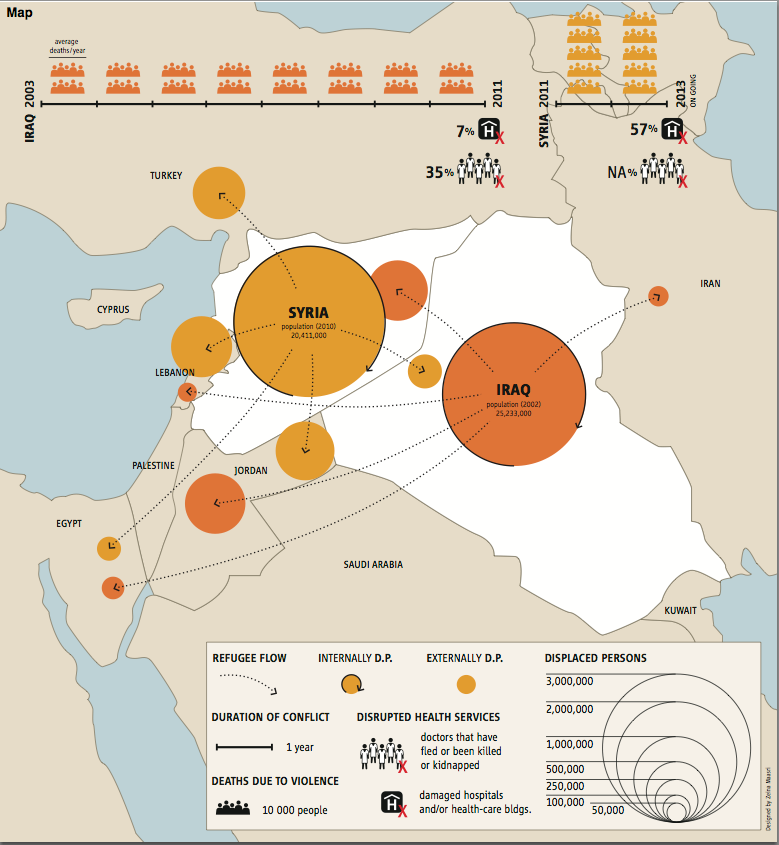
And they describe a largely unplanned dispersal of medical care across the region that blurs other – national – boundaries, requiring careful analysis of the ‘therapeutic geographies‘ which trace the precarious and shifting journeys through which people obtain medical treatment in and beyond the war zone.  They insist that ‘migrants seeking refuge from violence cannot be framed and presented as mere victims but as people using various strategies to acquire health care and remake their lives.’ The manuscript version of the report included the map below, which illustrates the scale of the problem:

Therapeutic geographies

My own work addresses similar issues through four case studies over a longer time-span, to try to capture the dynamics of these medical-military constellations: the Western Front in 1914-18, the Western Desert in the Second World War, Vietnam, and Afghanistan 2001-2014 (see ‘Medical-military machines’, DOWNLOADS tab).

msf-afghanistan-report-finaToday Médecins sans Frontières published an important report, Between rhetoric and reality:  the ongoing struggle to access healthcare in Afghanistan, that speaks directly to these concerns.  Like the Lancet team, the report explores the ways in which war affects not only the provision of healthcare for those wounded by its violences but also access to healthcare for those in the war zone who suffer from other, often chronic and life-threatening illnesses: ‘The conflict creates dramatic barriers that people must overcome to reach basic or life- saving medical assistance. It also directly causes death, injury or suffering that increase medical needs.’  Releasing their findings, MSF explained:

After more than a decade of international aid and investment, access to basic and emergency medical care in Afghanistan remains severely limited and sorely ill-adapted to meet growing needs created by the ongoing conflict…  While healthcare is often held up as an achievement of international state-building efforts in Afghanistan, the situation is far from being a simple success story. Although progress has been made in healthcare provision since 2002, the report … reveals the serious and often deadly risks that people are forced to take to seek both basic and emergency care.

The research – conducted over six months in 2013 with more than 800 patients in the hospitals where MSF works in Helmand, Kabul, Khost and Kunduz provinces – makes it clear that the upbeat rhetoric about the gains in healthcare risks overlooking the suffering of Afghans who struggle without access to adequate medical assistance.

“One in every five of the patients we interviewed had a family member or close friend who had died within the last year due to a lack of access to medical care,” said Christopher Stokes, MSF general director. “For those who reached our hospitals, 40 per cent of them told us they faced fighting, landmines, checkpoints or harassment on their journey.”

The patients’ testimonies expose a wide gap between what exists on paper in terms of healthcare and what actually functions. The majority said that they had to bypass their closest public health facility during a recent illness, pushing them to travel greater distances – at significant cost and risk – to seek care.

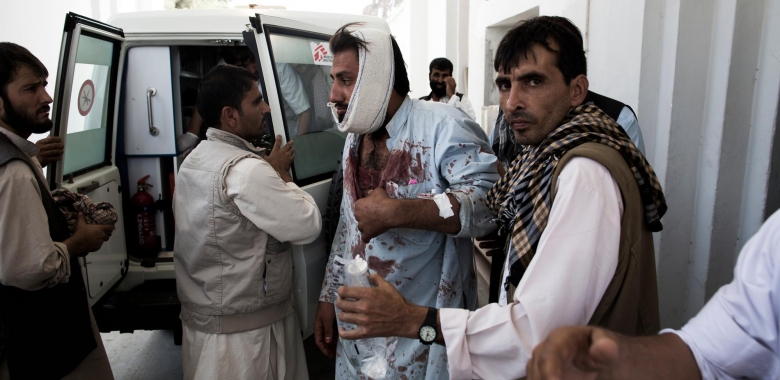
MSF provides a photoessay describing some of these precarious journeys (‘Long and dangerous roads’) here, from which I’ve taken the photograph below, showing an inured man being led by a relative into the Kunduz Trauma Centre.

MSB5652