Airwars

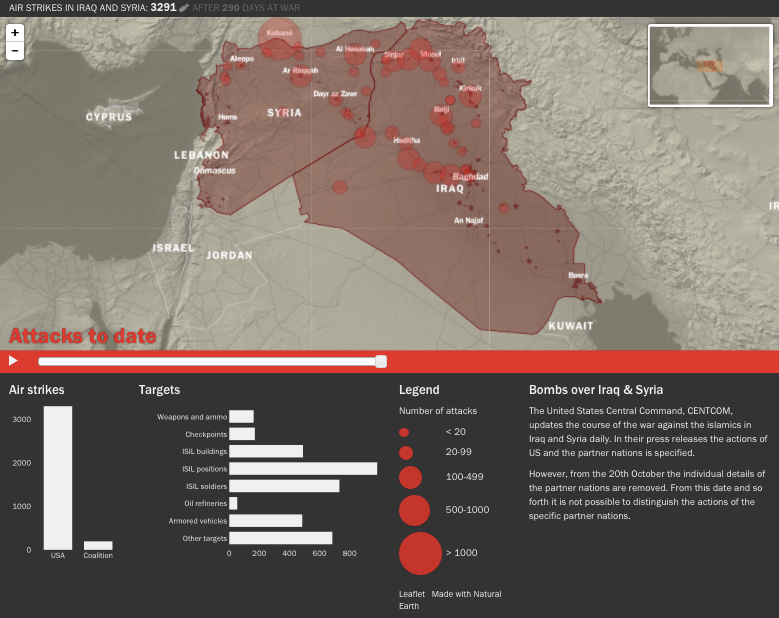
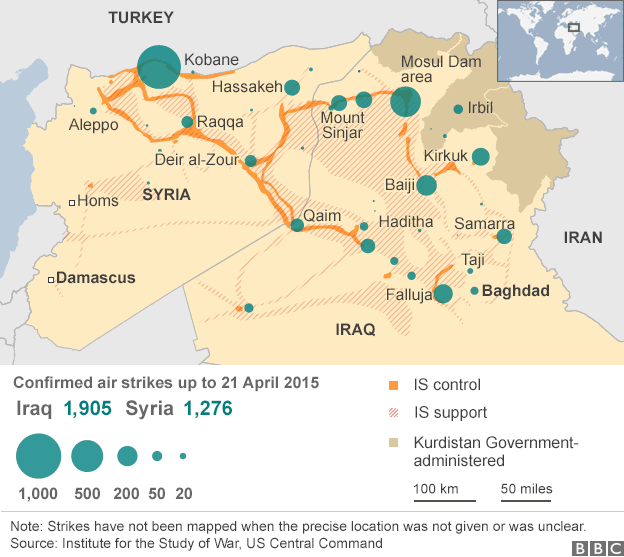
Air strike sin Iraq and Syria to April 2015

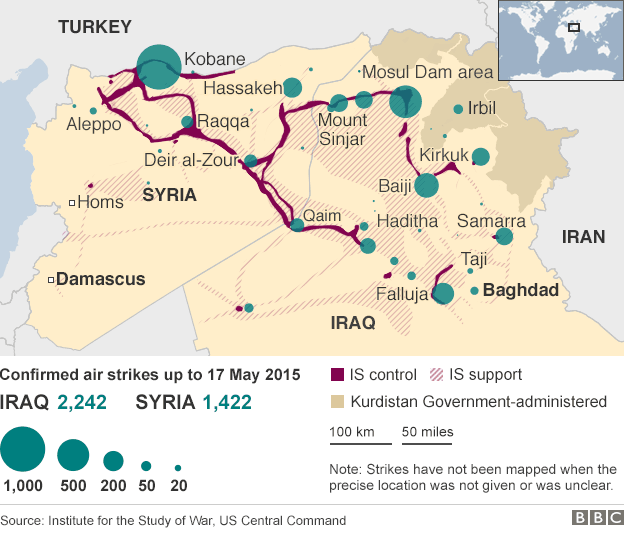
Air strikes in Iraq and Syria to 17 May 2015

I’ve taken the maps above from the BBC, which rely on reports from the Institute for the Study of War and news releases from US Central Command on ‘Operation Inherent Resolve‘.

For readers wanting to follow and analyse the US-led air campaign in Iraq and Syria in more detail, I recommend Chris Woods‘ new project, Airwars.  Chris is a veteran of the Bureau of Investigative Journalism’s Drone War Project and the author of Sudden Justice: America’s secret drone wars (2015) – which really is the gold standard for analysis of US remote operations.

Airwars.org is a collaborative, not-for-profit transparency project aimed both at tracking and archiving the international air war against Islamic State (Daesh), in both Iraq and Syria. We also seek to highlight – and follow up where possible – those cases in which claims of civilian non-combatant casualties from coalition airstrikes have been indicated by credible monitoring agencies. In addition we track reported ‘friendly fire’ incidents.

The site includes tabulations and also an interactive, zoomable map (see the screenshot below).  You can find a detailed discussion of sources and methodology here.

AIRWARS 25 May 2015

I’m tracking all this for The everywhere war…  In case you are wondering why that is taking so long to finish: The colonial present started out as an essay on 9/11 and the US invasion of Afghanistan; I then realised that Sharon was taking advantage of the ‘war on terror’ to ramp up Israeli dispossession and repression of the Palestinian people, and so started work on a second essay (I’m ashamed to say that at the time I knew as little about the West Bank and Gaza as I did about Afghanistan on 11 September 2001).  Then the US invaded Iraq…  Much the same is happening with The everywhere war, but I do have the end in my sights.  I hope.


Civil(ian) wars in Yemen

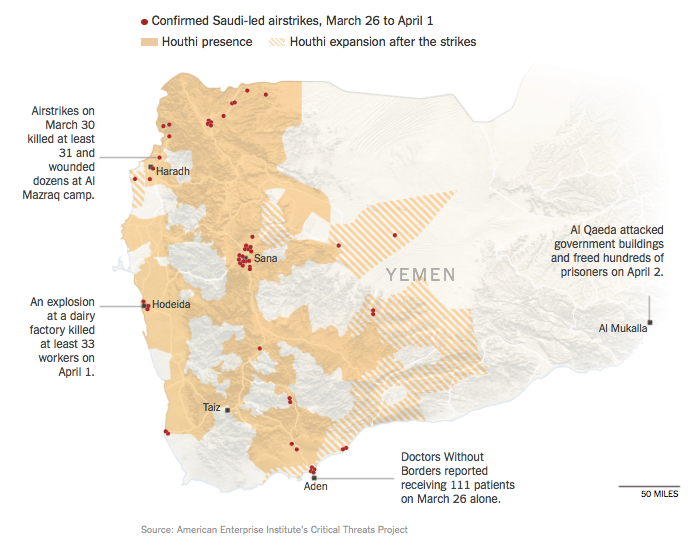
It’s not easy to keep track of the intensifying civil war/proxy war in Yemen, but the New York Times has published a series of maps – including the one below – that sketch out some of the contours of violence.

Saudi-led airstrikes in Yemen to April 2015

Not surprisingly, the Saudi-led air strikes (‘Operation Decisive Storm’ – really) have been ineffective in halting the advance of the Houthis; in fact, they may be counterproductive.  Three days ago senior United Nations officials warned that the loss of civilian lives and the repeated attacks on civilian infrastructure may constitute grave violations of international law, and there are now reports that US officials are also becoming alarmed at the mounting toll of civilian casualties.

The United States is, of course, intimately involved in the air campaign.  According to the Los Angeles Times:

Pentagon officials, who pride themselves on the care they take to avoid civilian casualties, have watched with growing alarm as Saudi airstrikes have hit what the U.N. this week called “dozens of public buildings,” including hospitals, schools, residential areas and mosques. The U.N. said at least 364 civilians have been killed in the campaign.

Although U.S. personnel don’t pick the bombing targets, Americans are working beside Saudi military officials to check the accuracy of target lists in a joint operations center in Riyadh, defense officials said. The Pentagon has expedited delivery of GPS-guided “smart” bomb kits to the Saudi air force to replenish supplies.

The U.S. role was quietly stepped up last week after the civilian death toll rose sharply. The number of U.S. personnel was increased from 12 to 20 in the operations center to help vet targets and to perform more precise calculations of bomb blast areas to help avoid civilian casualties.

U.S. reconnaissance drones now send live video feeds of potential targets and of damage after the bombs hit. The Air Force also began daily refueling flights last week to top off Saudi and United Arab Emirates fighter jets in midair, outside Yemen’s borders, so they can quickly return to the war.

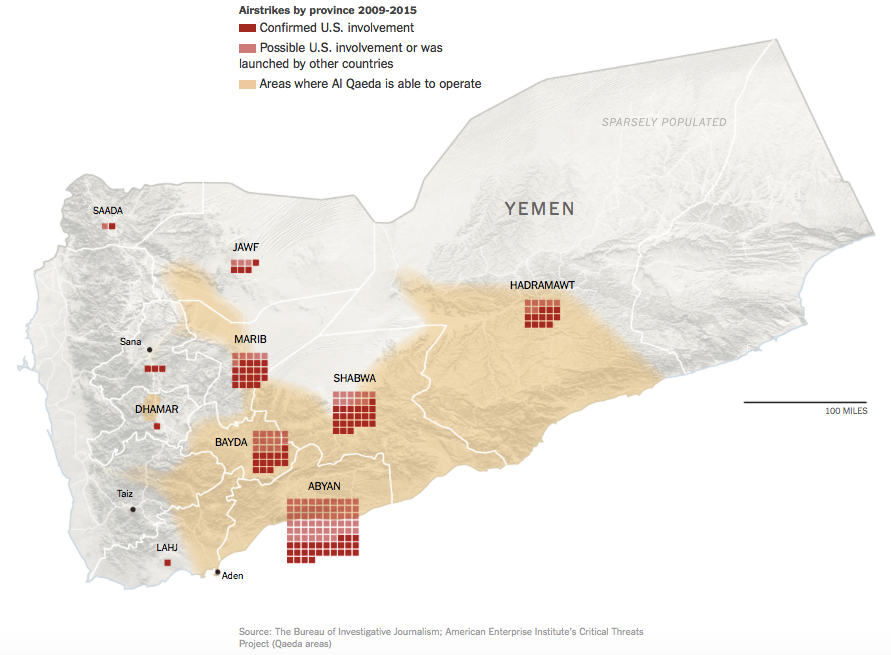
You could be forgiven for thinking this a bit rich.  The US has long been waging its own air campaign in Yemen:

US air strikes in Yemen 2009-15

The NYT map above is derived from the vital work of the Bureau of Investigative Journalism, and you can find its detailed accounting of drone strikes in Yemen here.  Drone strikes have not been suspended during the new air offensive: earlier this week Al Qaeda in the Arabian Peninsula announced that one of its most prominent spokesmen and clerics, Ibrahim al-Rubeish, had been killed by a US drone strike near the coastal city of al Mukalla.

Readers will know that there has been considerable critical discussion of civilian casualties caused by the programme of targeted killing in Yemen (and elsewhere): so much so that on 23 May 2013 the Obama administration issued a Presidential Policy Guidance [PPG] for the use of force ‘outside the United States and areas of active hostilities’ that supposedly imposed more stringent restrictions on its use of (para)military violence outside ‘hot battlefields’ like Afghanistan.

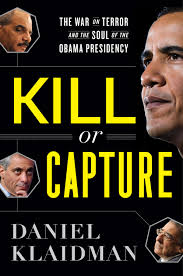
KLAIDMAN Kill or CaptureThe guidelines affirmed a preference for ‘capture’ over ‘kill’ – ‘The policy of the United States is not to use lethal force when it is feasible to capture a terrorist suspect, because capturing a terrorist offers the best opportunity to gather meaningful intelligence and to mitigate and disrupt terrorist plots’ – and so limited the use of lethal force to situations where ‘capture is not feasible at the time of the operation‘.  That last clause –my emphasis – clearly provides wide latitude for elevating ‘kill’ over capture’, but for a recent, vigorous discussion of the kill/capture debate prompted by the arrest and indictment of Mohanad Mahmoud Al Farekh earlier this month, see David Cole on ‘Targeted killing’ here.

In addition, crucially, the PPG required there to be a ‘near certainty’ that civilians would not be killed or injured during the operation.

Yet even when the guidelines were issued, they were ambiguous.  As Ryan Goodman pointed out, grey zones remained:

The notion of “areas of active hostilities” essentially refers to geographic zones where belligerents engage in sustained fighting. It is a term of art, as far as we can tell, developed by the administration at an unknown date, and not found in international law. In congressional testimony, the administration has stated that it considers Afghanistan an area of active hostilities, and it considers Yemen (despite frequent drone operations in that country) and Somalia outside the area of active hostilities.

These topological contortions did not begin with Obama.  The Bush administration made no secret of its central interest in ‘conducting war in countries we are not at war with‘.

Ryan’s discussion focused on the ambiguous location of Pakistan in this atlas of violence, and in particular the Federally Administered Tribal Areas: were they inside or outside “areas of active hostilities” (or even ‘half-in, half-out’)?  Since then, clearly, Yemen too may have been repositioned by Obama’s cartographers: it’s surely difficult to maintain the pretence that it is now not an ‘area of active hostilities’.

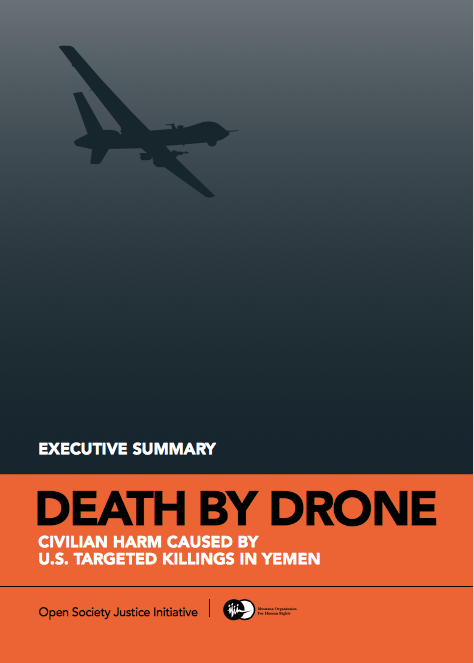
But in between the PPG and the opening of the new air offensive in Yemen, how effective were those restrictions on civilian casualties?  A collaborative investigation carried out by the Open Society Justice Initiative in the United States and the Mwatana Organization for Human Rights in Yemen raises plausible doubts.

Death by Drone (Yemen) (2015)

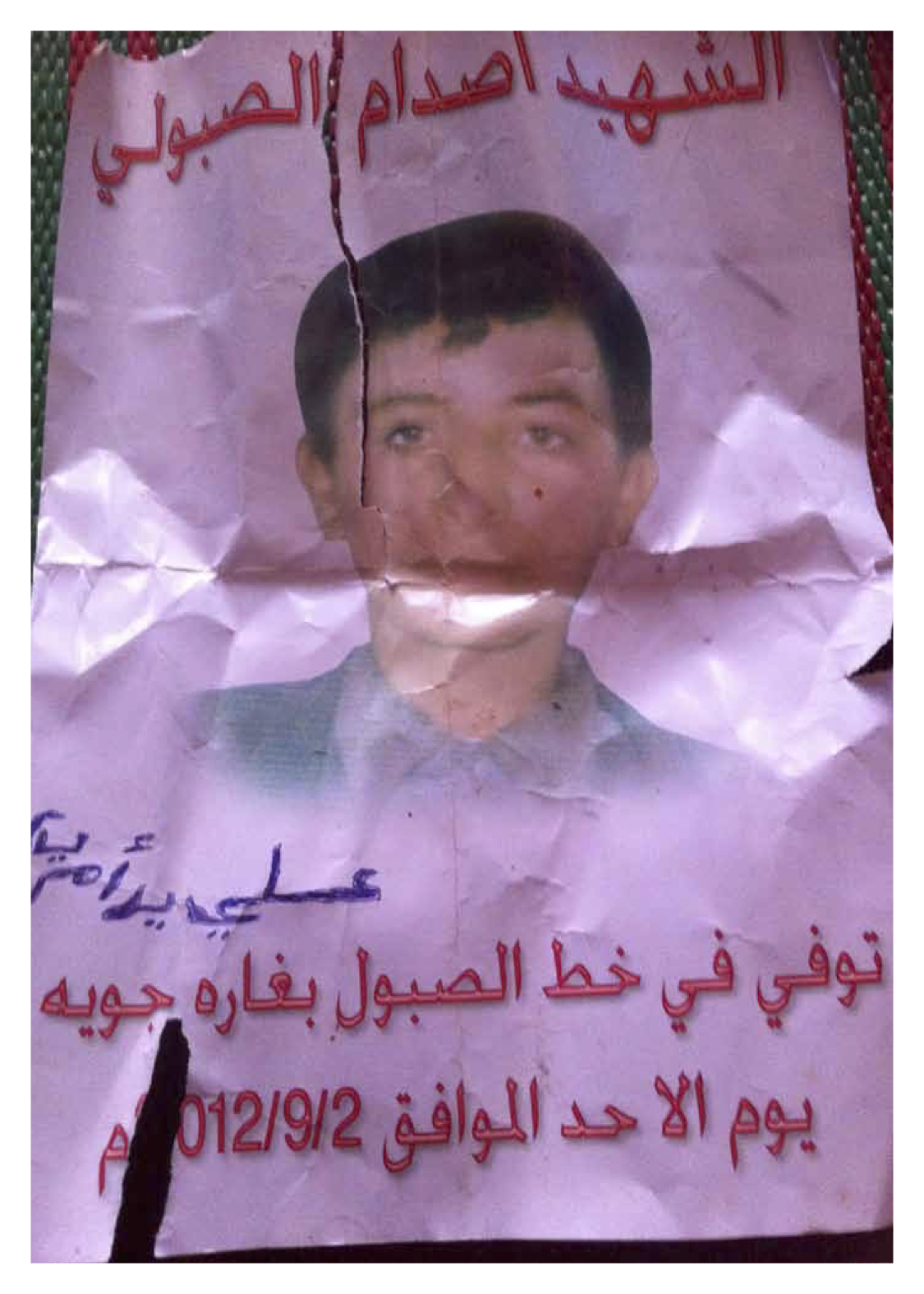
Their joint report, Death by Drone: civilian harm caused by targeted killing in Yemen, investigates nine US air strikes carried out between May 2012 and April 2014, and is based on interviews with survivors and eyewitnesses, relatives of individuals killed or injured in the attacks, local community leaders, doctors and hospital staff who were involved in the treatment of victims, and Yemeni government officials:

The nine case studies documented in this report provide evidence of 26 civilian deaths and injuries to an additional 13 civilians. This evidence casts doubt on the U.S. and Yemeni governments’ statements about the precision of drone strikes. Yemen’s President Abdu Rabbu Mansour al-Hadi praised U.S. drone strikes in Yemen as having a “zero margin of error” and commented that “the electronic brain’s precision is unmatched by the human brain.” The United States government has similarly emphasized that the precision afforded by drone technology enables the U.S. to kill al-Qaeda terrorists while limiting civilian harm…

[T]his report provides credible evidence that civilians were killed and/or injured in all nine airstrikes, including four which post-date President Obama’s [PPG] speech. To be sure, it is possible—owing to a mistake or an unforeseeable change of circumstances that manifests between the ordering of a strike and its occurrence—for civilians to be killed or injured despite a near-certainty prior to the strike that this would not happen. Nonetheless, the evidence of civilian deaths and injuries in nine cases raises serious concerns about the effective implementation of the “near-certainty” standard.

death-drones-report-eng-20150413 (dragged)

And in paragraphs that will be dismally familiar to anyone who has read the Stanford/NYU report on Living under drones in the Federally Administered Tribal Areas, the authors add:

The testimonies in this report describe desperately poor communities left to fend for themselves amid the devastation caused by U.S. drone strikes. Mothers and fathers who lost their children in drone strikes speak of inconsolable loss. They speak of their children’s bodies charred beyond recognition. Wives speak of losing their breadwinners, and of young children asking where their fathers have gone. The victims of these strikes say that these strikes will not make the United States or Yemen safer, and will only strengthen support for al-Qaeda.

The report also describes the terrorizing effects of U.S. drones on local populations. In many of the incidents documented, local residents had to live with drones continually flying overhead prior to the strikes and have lived in constant fear of another attack since. Some fled their villages for months after the strike, and lost their source of livelihood in the process. Survivors of the attacks continue to have nightmares of being killed in the next strike. Men go to their farms in fear. Children are afraid to go to school.

The Executive Summary is here, and you can download the full 123pp report here.

Kill Chain

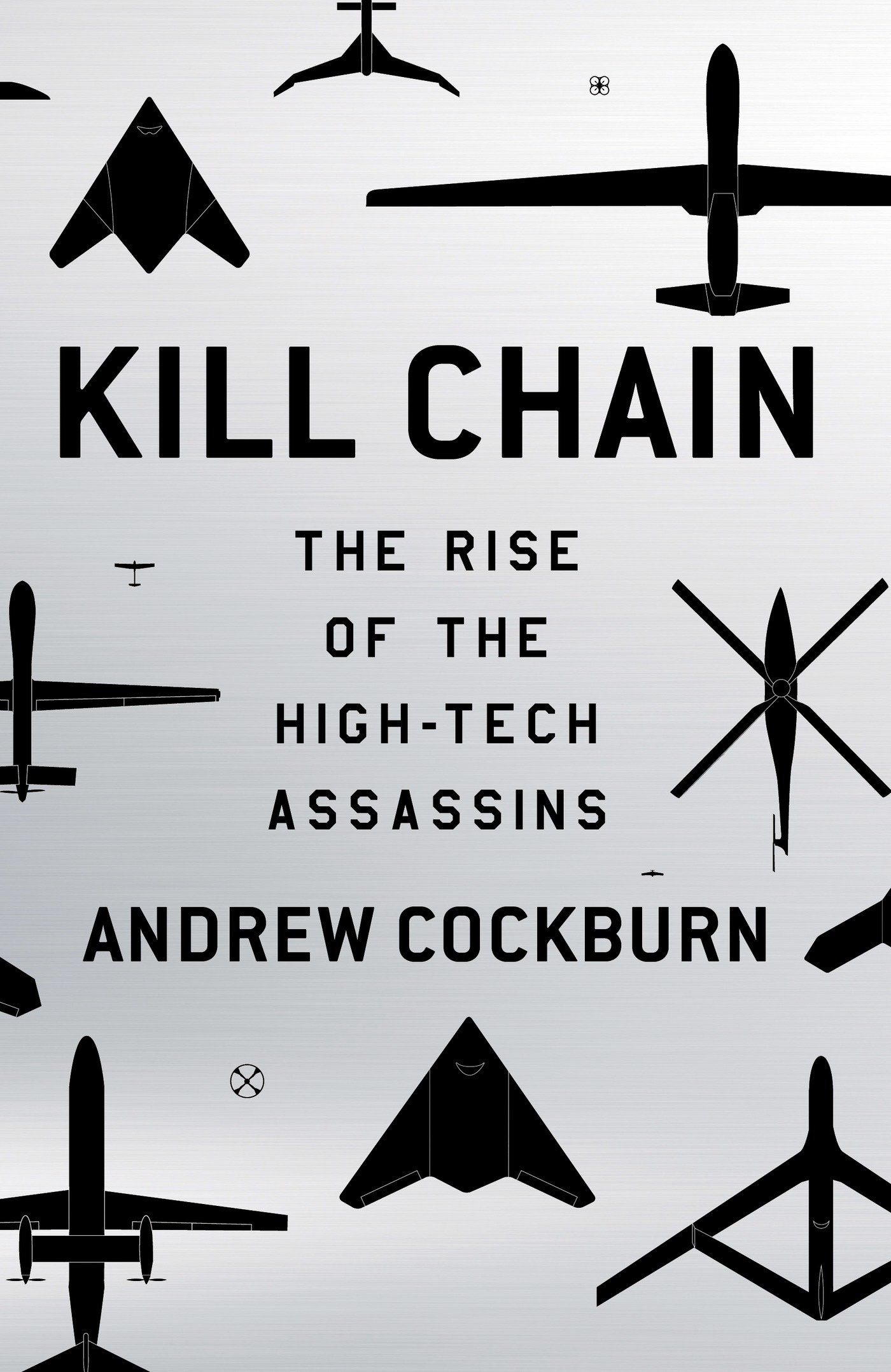
COCKBURN Kill chain 1

Yet more on targeted killing/assassination: new from Verso and Henry Holt in March, Andrew Cockburn‘s Kill Chain: the rise of the high-tech assassins.

Kill Chain uncovers the real and extraordinary story of drone warfare, its origins in long-buried secret programs, the breakthroughs that made drone operations possible, the ways in which the technology works, and, despite official claims, does not work. Through the well-guarded world of national security, the book reveals the powerful interests—military, CIA, and corporate—that have led the drive to kill individuals by remote control. Most importantly of all, the book describes what has really happened when the theories underpinning the strategy—and the multi billion-dollar contracts they spawn—have been put to the test.

Andrew is the author of the brilliant Rumsfeld: an American disaster, and he’s also been writing around the issue of military and paramilitary violence for some time.  There’s an early review of Kill Chain from Kirkus here, and Andrew discusses writing the book in a short audio clip here.

If you can’t wait until March, there’s a taster in ‘Drones, baby, drones‘, which appeared in the London Review of Books (8 March 2012); if you aren’t a subscriber you can obtain 24-hour access free of charge.

Time and again, the military has claimed that advances in technology have finally made warfare predictable and precise. That was the promise of Igloo White in Vietnam [see my ‘Lines of descent’: DOWNLOADS tab], the video-game spectacle of the Gulf War, the war for Kosovo and the counter-guerrilla wars of the past ten years. Time and again, the military’s claims have been disproved. Will drones change everything? Robert Gates, secretary of defence from 2006 to 2011, expressed the official view in his address to the CIA Officers Memorial Foundation annual dinner last March. Confessing that he hadn’t initially done enough to quash resistance to innovation from ‘flyboys in silk scarves’, Gates said: ‘From now on, it’s drones, baby, drones.’

In the audio clip Andrew insists that the full-motion video feeds from Predators and Reapers are far less clear than most commentators make out, and in subsequent contributions Andrew has perceptively linked the fantasies of the God-trick with militarized vision more generally: see, for example, his ‘Tunnel vision‘ (about the comparative merits of the A10 and the B1 bomber) which appeared in Harper’s in February 2014 and ‘Flying Blind‘, which appeared on Harper’s blog in September.

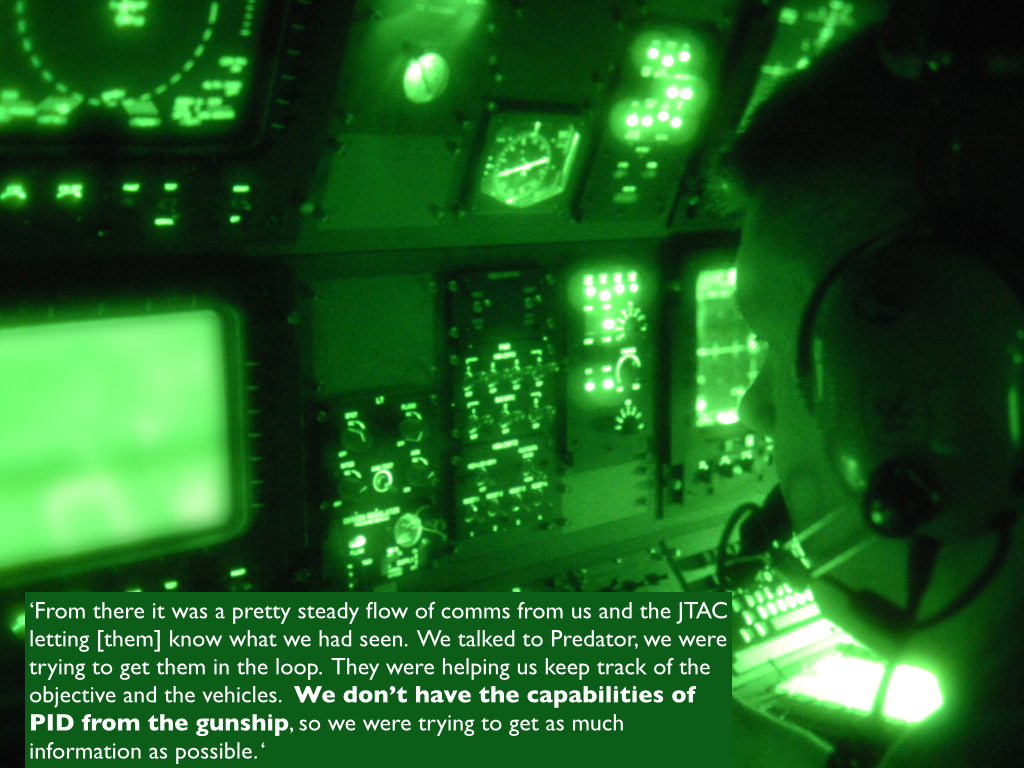
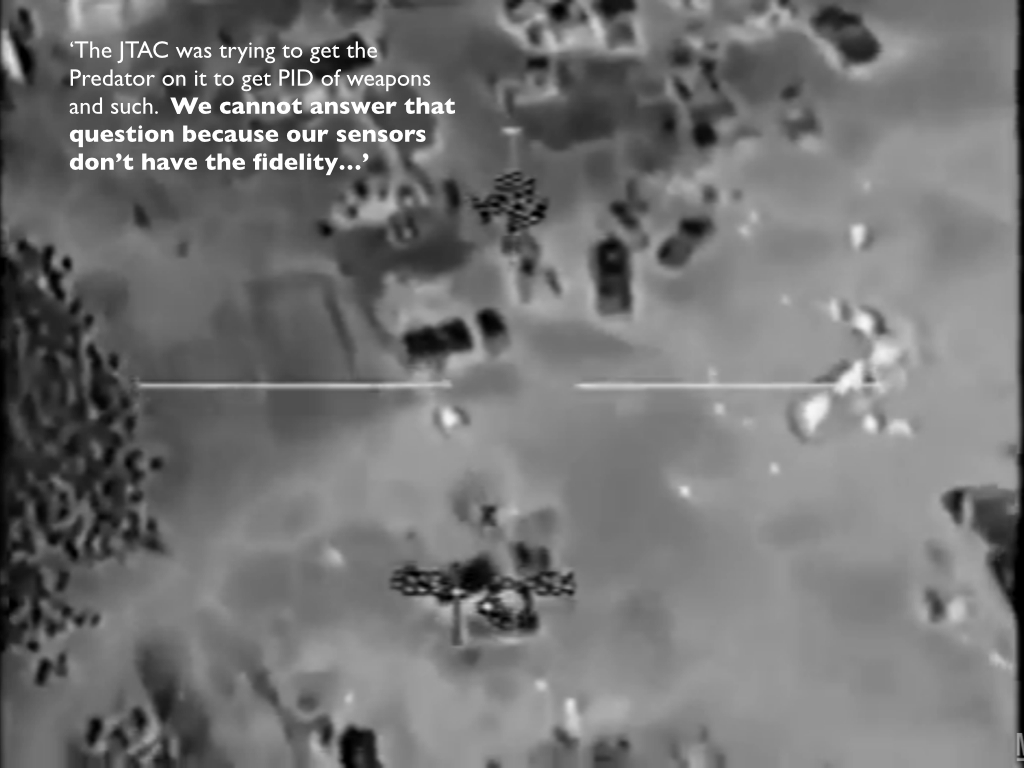
I’m not convinced that the A-10 is able to ‘observe the battleground with such precision, and safely to target enemy forces a stone’s throw away from friendly troops’ as Andrew maintains, but his more general point is a sharp one.  Too often we forget that other aircraft rely on optical sensors and video screens too, not only Predators and Reapers, and that these political technologies differ from platform to platform, as the following slides from ‘Angry eyes’ indicate (where the captain of an AC-130 gunship in fact defers to the crew of a Predator):

Angry eyes VISION.001

Angry eyes VISION.002

And, as Andrew also makes clear, these technologies produce their own interpellations:

Video will often supply a false clarity to preconceived notions. One A-10 pilot described to me an afternoon he spent circling high over southern A ghanistan in May 2010, watching four people—tiny figures on his cockpit screen—clustering at the side of a road before they retreated across a field to- ward a house. Everything about their movements suggested a Taliban I.E.D.- laying team. Then the door to the house opened and a mother emerged to hustle her children in to supper.

“On the screen,” he explained, “the only way to tell a child from an adult is when they are standing next to each other. Otherwise everyone looks the same.”

“We call the screens face magnets,” remarked another veteran, Lieutenant Colonel Billy Smith, a former A-10 squadron commander who flew tours over Bosnia, Iraq, and Afghanistan. “They tend to suck your face into the cockpit, so you don’t pay attention to what’s going on outside.”

All of this intersects with my continuing work on militarized vision, and in the next several weeks I’ll be uploading a series of new essays that deal with drone strikes in Pakistan [based on my ‘Dirty dancing‘ presentations], the Sangin Valley in Afghanistan (a ‘friendly fire’ incident), and an air strike in Uruzgan in Afghanistan that was orchestrated by a drone [based on my ‘Angry Eyes’ presentations]. So watch this space…

Incidentally, ‘kill chain’ is both the extended, networked apparatus that leads from air targeting to execution – for all platforms, remote and conventional – and the injunction that is typed into US military chat rooms (mIRC) to close down ‘chatter’ that might distract pilots once they are cleared to engage (see my discussion here).

Untargeted killing

Back in November 2012 I explained that the debate over CIA-directed targeted killing in Pakistan, Yemen, Somalia and elsewhere risked overlooking the conduct of targeted killing by the US military and its coalition partners in Afghanistan:

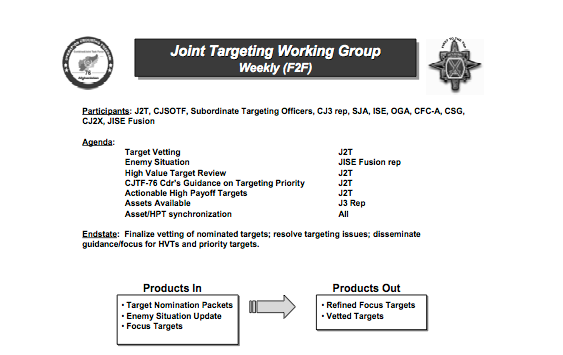
Targeted killings are also carried out by the US military – indeed, the US Air Force has advertised its ability to put ‘warheads on foreheads’ – and a strategic research report written by Colonel James Garrett for the US Army [‘Necessity and Proportionality in the Operation Enduring Freedom VII Campaign‘] provides a rare insight into the process followed by the military in operationalising its Joint Prioritized Effects List (JPEL). Wikileaks has provided further information about JSOC’s Task Force 373 – see, for example, here and here – but the focus of Garrett’s 2008 report is the application of the legal principles of necessity and proportionality (two vital principles in the calculus of International Humanitarian Law (IHL)) in counterinsurgency operations. Garrett describes ‘time-sensitive targeting procedures’ used by the Joint Targeting Working Group to order air strikes on ‘high-value’ Taliban and al-Qaeda leaders in Afghanistan, summarised in this diagram:

joint-targeting-working-group

Notice that the members included representatives from both Combined Joint Special Operations Task Force (CJSOTF) and the CIA (‘Other Government Agency’, OGA). This matters because Joint Special Operations Command (JSOC) – once commanded by General Stanley McChrystal – and the CIA, even though they have their own ‘kill lists’, often co-operate in targeted killings and are both involved in strikes outside Afghanistan. Indeed, there have been persistent reports that many of the drone strikes in Pakistan attributed to the CIA – even if directed by the agency – have been carried out by JSOC.

Now Spiegel Online has provided new, detailed information about the Joint Prioritized Effects List and targeted killing in Afghanistan.  Its base materials – some of which come from the Snowden cache – cover the period 2009-2011 and include an anonymised version of the JPEL (extract below).

JPEL Afghanistan PNG

The Spiegel team explains:

[This is] the first known complete list of the Western alliance’s “targeted killings” in Afghanistan. The documents show that the deadly missions were not just viewed as a last resort to prevent attacks, but were in fact part of everyday life in the guerilla war in Afghanistan.

The list, which included up to 750 people at times, proves for the first time that NATO didn’t just target the Taliban leadership, but also eliminated mid- and lower-level members of the group on a large scale. Some Afghans were only on the list because, as drug dealers, they were allegedly supporting the insurgents.

As I’ve said, the JPEL was maintained through close collaboration between the CIA and the US military, including Joint Special Operations Command, so it is not surprising that the list is not confined to Afghanistan but also includes Pakistanis who were located inside Pakistan.

We already know that targeted killings inside Pakistan’s Federally Administered Tribal Areas involved signal intelligence from the NSA, Britain’s GCHQ and Australia’s Pine Gap facility.  Spiegel‘s cache of documents shows that coalition states outside the ‘Five Eyes’ (US, UK, Canada, Australia and New Zealand) were included in the wider Center Ice platform that also supplied geospatial intelligence for tracking and targeting.  Taken together:

Predator drones and Eurofighter jets equipped with sensors were constantly searching for the radio signals from known telephone numbers tied to the Taliban. The hunt began as soon as the mobile phones were switched on.

Britain’s GCHQ and the US National Security Agency (NSA) maintained long lists of Afghan and Pakistani mobile phone numbers belonging to Taliban officials. A sophisticated mechanism was activated whenever a number was detected. If there was already a recording of the enemy combatant’s voice in the archives, it was used for identification purposes. If the pattern matched, preparations for an operation could begin. The attacks were so devastating for the Taliban that they instructed their fighters to stop using mobile phones.

The document also reveals how vague the basis for deadly operations apparently was. In the voice recognition procedure, it was sufficient if a suspect identified himself by name once during the monitored conversation. Within the next 24 hours, this voice recognition was treated as “positive target identification” and, therefore, as legitimate grounds for an airstrike. This greatly increased the risk of civilian casualties…

[In addition]  Center Ice was not just used to share intelligence about mobile phone conversations, but also information about targets.

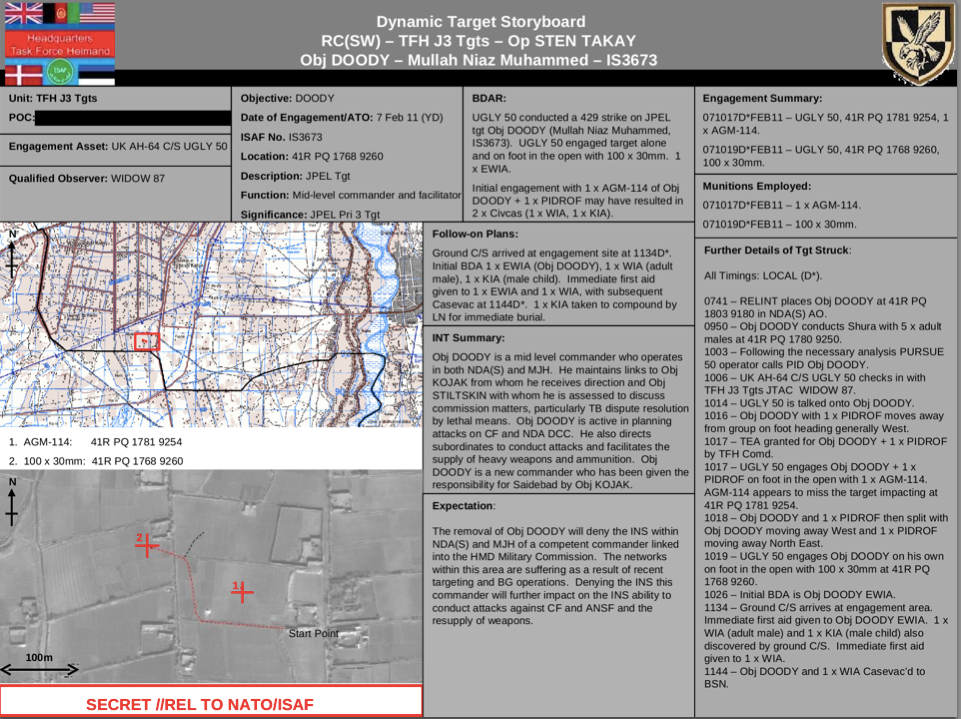
Finally – and directly relevant to that penultimate paragraph – Spiegel includes a detailed post-strike ‘Dynamic Target Storyboard‘ that explains how one mission executed by a British AH-60 helicopter (callsign/codename UGLY 50) armed with Hellfire missiles missed its target (‘Objective DOODY’, a mid-level Taliban commander called Mullah Niaz Muhammed categorised as JPEL ‘level 3’) on its first pass and then, coming in for a second attack, seriously wounded an innocent father and killed his child:

Dynamic Targeting Storyboard PNG

To navigate the storyboard – a standard ‘after action’ report – you need to wade through an alphabet soup of acronyms, some of which I know and others I don’t.  Working left to right along the top line, the mission was under the control of TFH – ISAF’s Task Force Helmand – whose main component was provided by the UK military; under BDAR (Battle Damage Assessment and Repair) the AH-64 attack helicopter is identified as operating under ISAF Rules of Engagement 429 (the details of all these ROEs remain classified).  The Intelligence Summary shown below identifies the target as ‘Objective DOODY’, provides skeletal details of his activities, and links him with two other targets on the JPEL, ‘KOJAK’ and ‘STILTSKIN’ (presumably part of the military’s standard social network analysis).

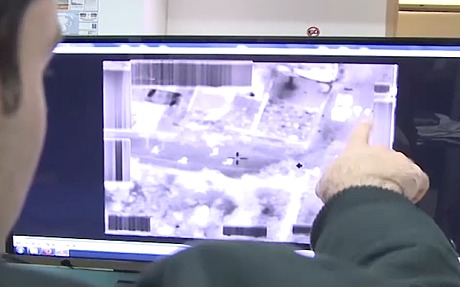
The far right column provides further information about the attack.  At 0741 intelligence (ELINT is electronic intelligence, but RELINT is not included in the Ministry of Defence’s acronym list) places ‘DOODY’ in Nad-e-Ali (South); by 0950 he is holding a meeting with five other men, and at 1003 a ‘PURSUE 50 operator’ [how I would like to know more about what means] confirms positive identification (PID) which denotes ‘reasonable certainty that this is a legitimate military target’. Shortly afterwards, a Joint Terminal Attack Controller (JTAC), listed as a ‘Qualified Observer’ with the grim call sign WIDOW 87,  contacts the helicopter crew and talks them on to the target: once they have him in their field of view they are ready to attack.  What isn’t clear from all this is whether the JTAC is relying on a video feed from a drone – this seems the most likely source, and an aerial view is included on the storyboard, tracking the target’s movements once the attack is under way – or whether s/he is on the ground (unlikely, I think, since ground troops take more than an hour to arrive on site after the attack: see ‘Follow-on Plans’ box).

When the target walks away from the meeting, accompanied by one man, the helicopter crew is cleared to engage both of them (TEA) (I’ve explained PID but if anyone knows what PIDROF means please let me know since that seems to authorise killing his unknown and unnamed companion).

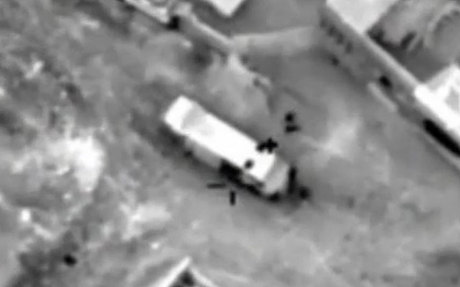
According to a supplementary page on the storyboard file, shown below, the AH-64 makes its initial run but fails to engage and returns for a second attempt; in doing so, the crew loses visual identification of the target, what the military usually calls the ‘visual chain of custody’, and at 1017 fires a Hellfire missile which misses the nominated target and instead causes fragmentation injuries to two civilians nearby (marked 1 on the aerial view).  The helicopter returns again; by then ‘DOODY’ and his companion have parted company, and the crew fires 100 rounds from its 30 mm cannon at ‘DOODY’, leaving him seriously wounded (EWIA: ‘enemy wounded in action’; marked 2 on the aerial view).

Assessment
Over an hour later, at 1134, ground troops arrive to capture ‘DOODY’ – but they also find one other seriously wounded man and the body of his young son.  The boy is buried by his family, and the casualties are airlifted to the military hospital at Camp Bastion (BSN);  ‘DOODY’ is later transferred to Kandahar for further treatment for a serious head wound.
ISAF launched an investigation into the incident, but no details have been released.

So: two innocent, unnamed bystanders killed.  As more evidence unfolds of the inaccuracies of ‘targeted killing’, even when the target is supposedly named and identified (so not a ‘signature strike’), it seems that we should start talking about the prevalence of untargeted killing…

Keeping up with the Drones

Patrick Svensson:Unblinking stare

Several recent contributions on military drones – what Forensic Architecture calls Unmanned Aerial Violence – you might be interested in.

First, Steve Coll has a long essay in the latest New Yorker on ‘The Unblinking Stare‘ (and, yes, I do know that those watching the screens blink.  Duh) about the drone war in Pakistan.  Many readers will remember that it was the New Yorker that published Jane Mayer‘s classic essay on ‘The Predator War‘ (26 October 2009), so it’s high time for an up-date since so much has happened since then.  It’s a very helpful survey.  Much of it will not be news, but Steve does provide some interesting background to the deadly gavotte between the US and Pakistan (what I’ve called ‘dirty dancing‘; see also here):

Pakistan’s generals and politicians, who come mainly from the country’s dominant, more developed province of Punjab, treated Waziristan’s residents “as if they were tribes that were living in the Amazon,” the journalist Abubakar Siddique, who grew up in the region and is the author of “The Pashtun Question,” told me.

In 2002, Musharraf sent Pakistan’s Army into South Waziristan to quell Al Qaeda and local sympathizers. In 2004, the Army intensified its operations, and, as violence spread, Musharraf allowed the C.I.A. to fly drones to support Pakistani military action. In exchange, Musharraf told me, the Bush Administration “supplied us helicopters with precision weapons and night-operating capability.” He added, “The problem was intelligence collection and targeting. . . . The Americans brought the drones to bear.”

Musharraf allowed the C.I.A. to operate drones out of a Pakistani base in Baluchistan. He told me that he often urged Bush Administration officials, “Give the drones to Pakistan.” That was not possible, he was told, “because of high-technology transfer restrictions.”

We know that close co-operation and even co-ordination between Washington and Islamabad was still the order of the day until at least 2011.  We know, too, that local people live under a double threat, and the essay reports on a group interview in Islamabad with half a dozen young men, mainly university students, from Waziristan.  On one side, recalling the Stanford/NYU ‘Living under dronesreport:

Being attacked by a drone is not the same as being bombed by a jet. With drones, there is typically a much longer prelude to violence. Above North Waziristan, drones circled for hours, or even days, before striking. People below looked up to watch the machines, hovering at about twenty thousand feet, capable of unleashing fire at any moment, like dragon’s breath. “Drones may kill relatively few, but they terrify many more,” Malik Jalal, a tribal leader in North Waziristan, told me. “They turned the people into psychiatric patients. The F-16s [of the Pakistan Air Force] might be less accurate, but they come and go.”

On the other side:

Families in North Waziristan typically live within large walled compounds. Several brothers, their parents, and their extended families might share a single complex. Each compound may contain a hujra, or guesthouse, which usually stands just outside the main wall. In the evening, men gather there to eat dinner and talk war and politics. A rich man signals his status by building a large hujra with comfortable guest rooms for overnight visitors. The less well-heeled might have a hujra with just two rooms, carpets, rope cots, and cushions.

Taliban and Al Qaeda commanders moved from hujra to hujra to avoid detection. The available records of drone strikes make clear that the operators would regularly pick up commanders’ movements, follow them to a hujra attached to a private home, watch for hours—or days—and then fire. Many documented strikes took place after midnight, when the target was presumably not moving, children were asleep, and visitors would have returned home.

North Waziristan residents and other Pakistanis I spoke with emphasized how difficult it would be for a drone operator to distinguish between circumstances where a Taliban or Al Qaeda commander had been welcomed into a hujra and where the commander had bullied or forced his way in. If the Taliban “comes to my hujra and asks for shelter, you have no choice,” Saleem Safi, a journalist who has travelled extensively in Waziristan, told me. “Now a potential drone target is living in a guest room or a guesthouse on your compound, one wall away from your own house and family.”

“You can’t protect your family from a strike on a hujra,” another resident of North Waziristan said. “Your children will play nearby. They will even go inside to play.” The researcher in Islamabad said, “There is always peer pressure, tribal pressure, to be hospitable.” He went on, “If you say no, you look like a coward and you lose face. Anyway, you can’t say no to them. If a drone strike does take place, you are a criminal in the courts of the Taliban,” because you are suspected of espionage and betrayal. “You are also a criminal to the government, because you let the commander sleep in your hujra.” In such a landscape, the binary categories recognized by international law—combatant or noncombatant—can seem inadequate to describe the culpability of those who died. Women, children, and the elderly feel pressure from all sides. A young man of military age holding a gun outside a hujra might be a motivated Taliban volunteer, a reluctant conscript, or a victim of violent coercion.

This speaks directly to a general point made by Christiane Wilke: in today’s wars the requirement that combatants identify themselves as combatants (a standard obligation of international humanitarian law) has effectively been transferred to civilians, so that it becomes their responsibility to make themselves known as non-combatants.  Even to an unblinking eye at 20,000 feet.

Screen_shot_2014-1_3111155c

Second, this week the Telegraph carried a video and an interview with ‘Major Yair’, the pseudonym for the pilot of a Israeli Heron TP drone based near Tel Aviv.  He reports that roughly 65 per cent of Israeli air operations are conducted by drones.  ‘Yair’ served in all three Israeli assaults on Gaza and he says nothing about Israel’s targeted killing – the focus is on the provision of Close Air Support.  But the claims he makes will be all too familiar to those familiar with USAF air strikes in Afghanistan:

As Israeli ground units pressed into Gaza, they would call Major Yair for close air support. “They’d be saying ‘we keep getting fire from within those buildings’ and I’m sitting at a distance – on a neat floorspace with screens and air conditioning systems – but you’re sweating and it’s ‘what do I do, what do I do’? How do I not cause more damage than help?”

I’ve repeatedly noted the affinity – even proximity – USAF crews working out of Creech Air Force Base in Nevada feel with troops on the ground in Afghanistan.  But ‘Yair’ doesn’t elaborate on the Israeli ground assault.  Instead, remarkably, persistently – unblinkingly, you might say – he circles around his own last sentence:

Major Yair stressed how he was constrained by rules of engagement designed to avoid innocent deaths. Hamas operatives, he added, routinely exploited this restraint by hiding behind civilians. One sequence shot by a Heron showed four men preparing to launch a salvo of rockets under a screen of trees. Seconds later, the men were shown running to a nearby street filled with children.

“They’re untouchable now,” said Major Yair, pointing at the screen. “I know that no mission commander, under current directions given by the chief of staff, will engage in this situation. No way.”

He added: “It is sometimes frustrating because you feel that you’re fighting with your hands tied. There are a lot of situations where you see your targets, but you will not engage because they’re next to kindergartens, because they’re driving with their wives and their kids.”

drone2_3111097c

David Blair presses him on the large number of Palestinian civilians killed in Gaza, including children, only to be told:

“We do make mistakes… but it’s nature. People make mistakes. We learn from those mistakes. You’ll see no smiling face after an incident where kids were killed. None of us wants to be in a position where he does these mistakes. We learn and try to avoid this as much as we can.”…

“You learn to live with it,” he said. “It’s not easy. I’ve made mistakes that, for many years, will come back at me. But it’s something that people have to do. It’s not easy. We do not shove it back somewhere in our minds and try to avoid talking about it. We talk about it, we support each other.”

And so, as so often happens in the United States (and elsewhere) too, our gaze is directed away from the victims and towards the torment suffered by those who inflict military violence from the air.

But, third, Corporate Watch has just published the fifth in its series of reports on living under drones in Gaza.  These eyewitness reports are indispensable because there are serious problems in using satellite imagery to reconstruct drone strikes.  Nobody is better at doing so than Forensic Architecture, but as they note, there is a threshold of detectability:

IMG_0076rsSome drone-fired missiles can drill a hole through the roof before burrowing their way deep into buildings, where their warheads explode. The size of the hole the missile leaves is smaller than the size of a single pixel in the highest resolution to which publicly-available satellite images are degraded [a square that translate sin to 50 cm by 50 cm of terrain].  The hole is thus at the “threshold of visibility” and might appear as nothing more than a slight color variation, a single darker pixel perhaps. This has direct implications for the documentation of drone strikes in satellite imagery, which is often as close to the scene as most investigators can get. When the figure dissolves into the ground of the image, it is the conditions—legal, political, technical—that degrade the image, or that keep it at a lower resolution that become the relevant material for forensic investigations.

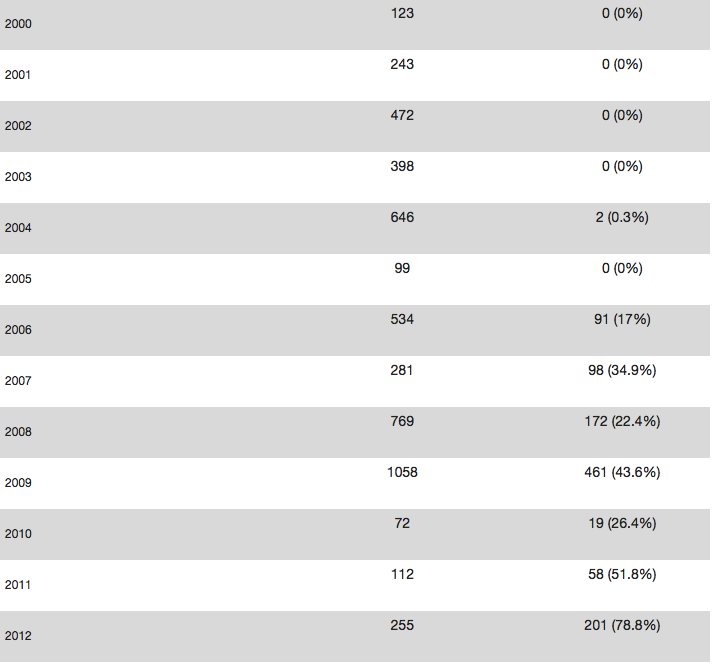
The Corporate Watch report also includes a remarkable tabulation from the Al Mezan Centre for Human Rights in Gaza, showing the numbers of people killed by the Israeli military in Gaza (col. 2) and the proportion killed by drone strikes (col. 3):

Israeli drone strikes in Gaza

I’m not sure what the sources for these tabulations might be: as Craig Jones has emphasised in a vitally important post, it’s exceptionally difficult to parse Israel’s targeted killings in occupied Palestine, and while these tabulations clearly include many other situations I have no idea how you begin to separate different killing machines in what is, after all, a networked mode of military violence in which drones are likely to perform vital surveillance operations for strikes carried out from other platforms. But the increased reliance on drones chimes with the report from David Blair.

Degrees of intimacy

Drone warsNext month Cambridge University Press is publishing a book of essays edited by Peter Bergen and Daniel Rothenberg, Drone wars: transforming conflict, law and policy, due out from Cambridge University Press at the end of the year.  Here’s the blurb:

Drones are the iconic military technology of many of today’s most pressing conflicts, a lens through which U.S. foreign policy is understood, and a means for discussing key issues regarding the laws of war and the changing nature of global politics. Drones have captured the public imagination, partly because they project lethal force in a manner that challenges accepted rules, norms, and moral understandings. Drone Wars presents a series of essays by legal scholars, journalists, government officials, military analysts, social scientists, and foreign policy experts. It addresses drones’ impact on the ground, how their use adheres to and challenges the laws of war, their relationship to complex policy challenges, and the ways they help us understand the future of war. The book is a diverse and comprehensive interdisciplinary perspective on drones that covers important debates on targeted killing and civilian casualties, presents key data on drone deployment, and offers new ideas on their historical development, significance, and impact on law and policy. Drone Wars documents the current state of the field at an important moment in history when new military technologies are transforming how war is practiced by the United States and, increasingly, by other states and by non-state actors around the world.

And here is the Contents List:

Part I. Drones on the Ground:

1. My guards absolutely feared drones: reflections on being held captive for seven months by the Taliban David Rohde
2. The decade of the drone: analyzing CIA drone attacks, casualties, and policy Peter Bergen and Jennifer Rowland
3. Just trust us: the need to know more about the civilian impact of US drone strikes Sarah Holewinski
4. The boundaries of war?: Assessing the impact of drone strikes in Yemen Christopher Swift
5. What do Pakistanis really think about drones? Saba Imtiaz

Part II. Drones and the Laws of War:

6. It is war at a very intimate level USAF pilot
7. This is not war by machine Charles Blanchard
8. Regulating drones: are targeted killings by drones outside traditional battlefields legal? William Banks
9. A move within the shadows: will JSOC’s control of drones improve policy? Naureen Shah
10. Defending the drones: Harold Koh and the evolution of US policy Tara McKelvey
Part III. Drones and Policy Challenges:
11. ‘Bring on the magic’: using drones in combat Michael Waltz
12. The five deadly flaws of talking about emerging military technologies and the need for new approaches to law, ethics, and war P. W. Singer
13. Drones and cognitive dissonance Rosa Brooks
14. Predator effect: a phenomenon unique to the war on terror Meg Braun
15. Disciplining drone strikes: just war in the context of counterterrorism David True
16. World of drones: the global proliferation of drone technology Peter Bergen and Jennifer Rowland

Part IV. Drones and the Future of Warfare:

17. No one feels safe Adam Khan
18. ‘Drones’ now and what to expect over the next ten years Werner Dahm
19. From Orville Wright to September 11: what the history of drone technology says about the future Konstantin Kakaes
20. Drones and the dilemma of modern warfare Richard Pildes and Samuel Issacharoff
21. How to manage drones, transformative technologies, the evolving nature of conflict and the inadequacy of current systems of law Brad Allenby
22. Drones and the emergence of data-driven warfare Daniel Rothenberg

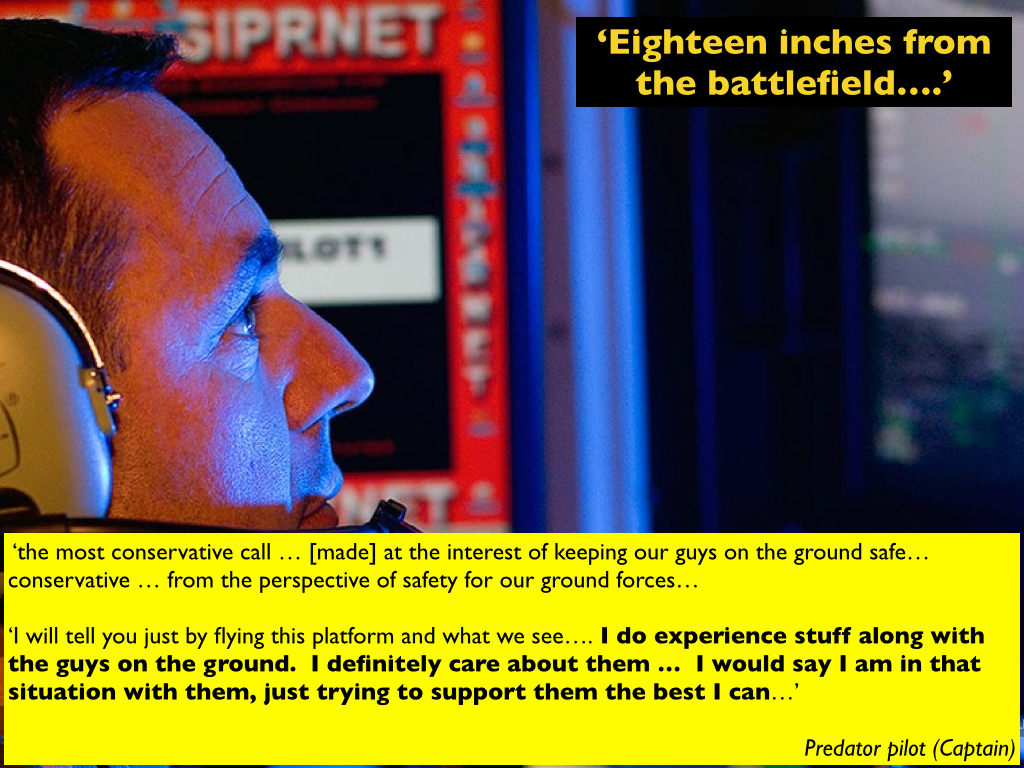
Over at Foreign Policy you can find an early version of Chapter 6, which is an interview with a drone pilot conducted by Daniel Rothenberg.  There are two passages in the interview that reinforce the sense of the bifurcated world inhabited by drone crews that I described in ‘From a view to a kill’ and ‘Drone geographies’ (DOWNLOADS tab).  On the one side the pilot confirms the inculcation of an intimacy with ground troops, particularly when the platforms are tasked to provide Close Air Support, which is in some degree both reciprocal and verbal:

“Because of the length of time that you’re over any certain area you’re able to engage in lengthy communications with individuals on the ground. You build relationships. Things are a little more personal in an RPA than in an aircraft that’s up for just a few hours. When you’re talking to that twenty year old with the rifle for twenty-plus hours at a time, maybe for weeks, you build a relationship. And with that, there’s an emotional attachment to those individuals.

“You see them on a screen. That can only happen because of the amount of time you’re on station. I have a buddy who was actually able to make contact with his son’s friend over in the AOR [area of responsibility]. If you don’t think that’s going to make you focus, then I don’t know what will.

“Many individuals that have been over there have said, ‘You know, we were really happy to see you show up’; ‘We knew that you were going to keep us from being flanked’; ‘We felt confident in our ability to move this convoy from ‘A’ to ‘B’ because you were there.’ The guy on the ground and the woman on the ground see how effective we are. And it gives them more confidence.”
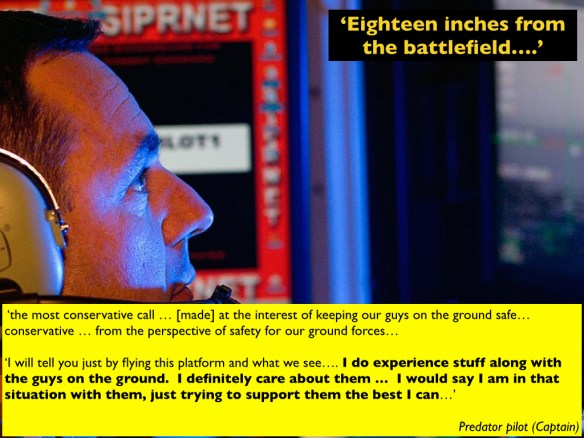
GREGORY Angry Eyes Extract.001

[The image above is taken from my ‘Angry Eyes’ presentation; the Predator pilot in this instance was involved in orchestrating the air strike in Uruzgan province, Afghanistan on 21 February 2010, and the quotation is taken from the US Army investigation into the incident.  I’m converting the presentation into the final chapter for The everywhere war, and I’ll post the draft as soon as I’m finished.]

But when the pilot in Rothenberg’s interview goes on to claim that ‘Targeting with RPAs is very intimate’ and that ‘It is war at a very intimate level’, he reveals on the other side an altogether different sense of intimacy: one that is strictly one-sided, limited to the visual, and which resides in a more abstracted view:

“Flying an RPA, you start to understand people in other countries based on their day-to-day patterns of life. A person wakes up, they do this, they greet their friends this way, etc. You become immersed in their life. You feel like you’re a part of what they’re doing every single day. So, even if you’re not emotionally engaged with those individuals, you become a little bit attached. I’ve learned about Afghan culture this way. You see their interactions. You’re studying them. You see everything.”

The distinction isn’t elaborated, but the claims of ‘immersion’ and becoming ‘part of what they’re doing every day’ are simply astonishing, no?  You can find more on the voyeurism of ‘pattern of life analysis’ and the remarkable conceit that ‘you see everything’ here.
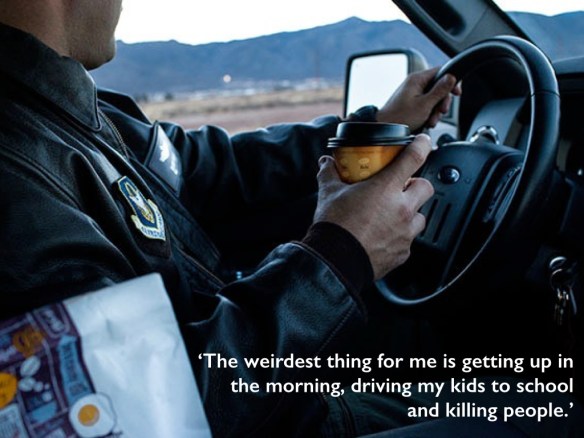
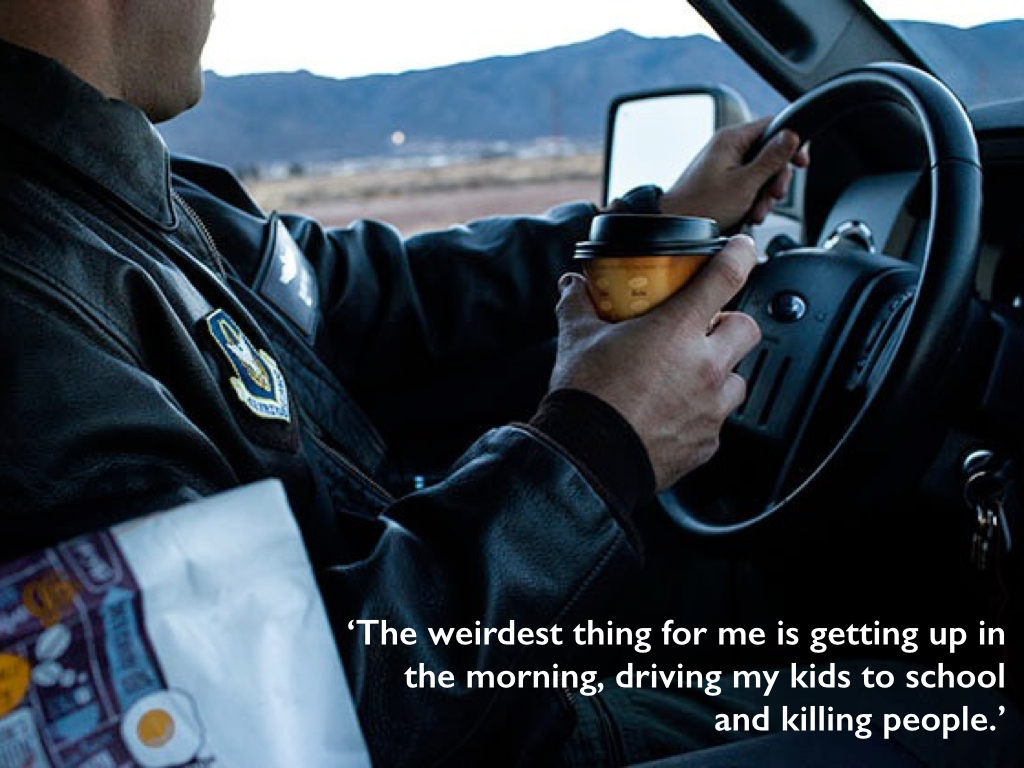
GREGORY Drones and the everywhere war 2014 Homeland insecurities.001

[The image above is taken from my ‘Drone geographies’ presentation]

The interview emphasises a different bifurcation, which revolves around the alternation between ‘work’ and ‘home’ when remote operations are conducted from the United States:

“”When you’re doing RPA operations, you’re mentally there, wherever there is. You’re flying the mission. You’re talking to folks on the ground. You’re involved in kinetic strikes. Then you step out the ground control station (GCS) and you’re not there anymore…

“Those are two very, very different worlds. And you’re in and out of those worlds daily. I have to combine those two worlds. Every single day. Multiple times a day. So, I am there and then I am not there and then I am there again. The time between leaving the GCS [Ground Control Station] and, say, having lunch with my wife could be as little as ten minutes. It’s really that fast.”

You can find much more on these bifurcations in my detailed commentary on Grégoire Chamayou‘s Théorie du drone here and in ‘Drone geographies’ (DOWNLOADS tab).

There’s one final point to sharpen.  In my developing work on militarized vision, and especially the ‘Angry eyes’ presentation/essay,  I’ve tried to widen the focus beyond the strikes carried out by Predators and Reapers to address the role they play in networked operations where the strikes are carried out by conventional strike aircraft.  Here is what Rothenberg’s pilot says about what I’ve called the administration of military violence (where, as David Nally taught me an age ago, ‘administration’ has an appropriately double meaning):

‘”Flying an RPA is more like being a manager than flying a traditional manned aircraft, where a lot of times your focus is on keeping the shiny side up; keeping the wings level, putting the aircraft where it needs to be to accomplish the mission. In the RPA world, you’re managing multiple assets and you’re involved with the other platforms using the information coming off of your aircraft.

“You could use the term ‘orchestrating’; you are helping to orchestrate an operation.”

***

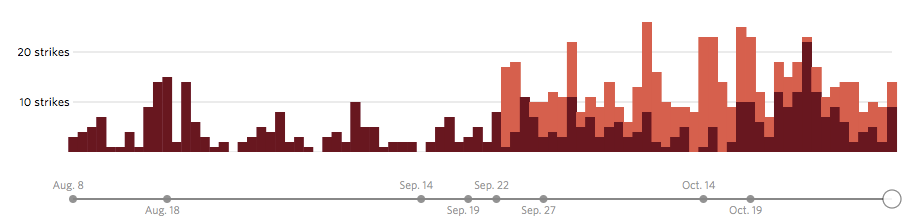
Drone wars appears just as remote operations over Iraq and Syria are ramping up: you can find an excellent review by Chris Cole at Drone Wars UK here, ‘Drones in Iraq and Syria: What we know and what we don’t.’  The images below are from the Wall Street Journal‘s interactive showing all air strikes reported by US Central Command 8 August through 3 November 2014:
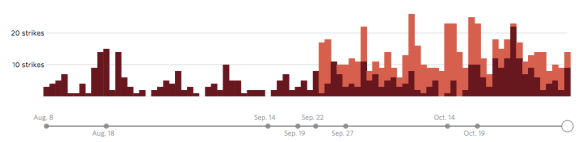
Air strikes in Iraq and Syria

During this period  769 coalition air strikes were reported: 434 in Syria (the dark columns), including 217 on the besieged border city of Kobane, and 335 in Iraq (the light columns), including 157 on Mosul and the Mosul Dam.
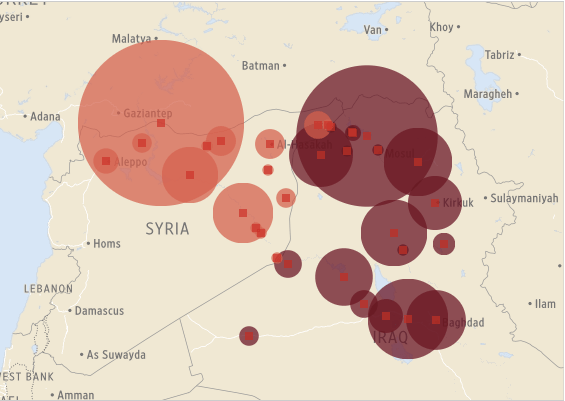
Air strikes in Iraq and Syria August-November 2014

But bear in mind these figures are for all air strikes and do not distinguish between those carried out directly by drones and those carried out by conventional strike aircraft.  As Chris emphasises:

‘Since the start of the bombing campaign, US drones have undertaken both surveillance and strike missions in Iraq and Syria but military spokespeople have refused to give details about which aircraft are undertaking which strikes repeatedly using the formula “US military forces used attack, fighter, bomber and remotely-piloted aircraft to conduct airstrikes.”’

Although the USAF has used a mix of MQ-1 (Predator) and MQ-9 (Reaper) drones, F-15E, F-16, F/A-18 and F-22 fighters, B-1 bombers, AC-130 gunships and AH-64 Apache helicopters in these operations, it seems likely that its capacity to use remote platforms to provide intelligence, surveillance and reconnaissance is limited by its continuing commitments in Afghanistan (though Britain’s Royal Air Force has now deployed its Reapers for operations in both Iraq and Syria).

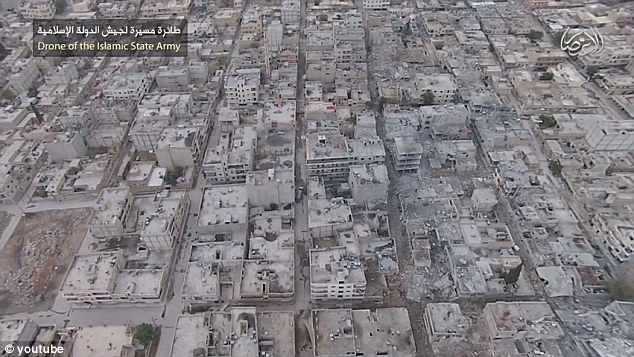
IS (Islamic State) claims to have its own drones too.  In February it released video of its aerial surveillance of Fallujah in Iraq, taken from a DJI Phantom FC40 quadcopter, in August it released video of Taqba air base in Syria taken from the same platform, tagged as ‘a drone of the Islamic State army’, and in September a propaganda video featuring hostage John Cantile showed similar footage of Kobane (below).
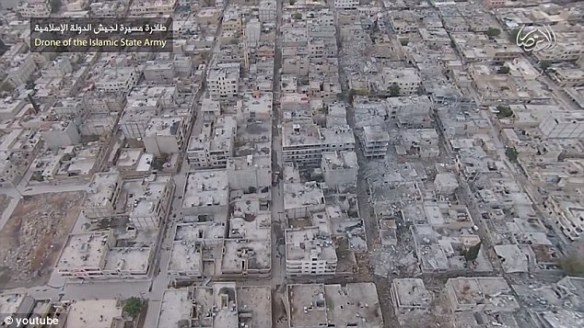
1414438887900_wps_7_IS_have_released_a_new_vi

These image streams are all from commercial surveillance drones, but in September the Iranian news agency Fars reported that Hezbollah had launched an air strike from Lebanon against a command centre of the al-Nursra Front outside Arsal in Syria using an armed (obviously Iranian) drone.

You can find Peter Bergen’s and Emily Schneiders view on those developments here, and a recent survey of the proliferation of drone technologies among non-state actors here.

The details of both the state and non-state air strikes remain murky, but I doubt that much ‘intimacy’ is claimed for any of them.
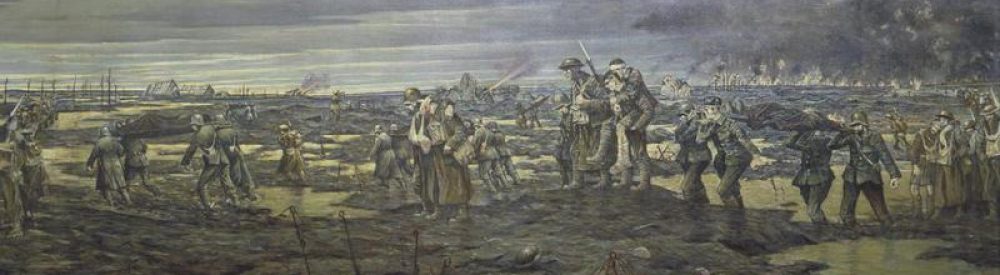
Under American Skies

I’ll be in Berlin in December for a conversation with James Bridle about drone wars and related issues, and I’m already looking forward to it since I’m a great admirer of his work. I particularly admire the way in which he challenges so many of our assumptions about ‘looking’ through his presentations about militarised vision and violence, and I’ve noted before the filiations between his various projects and Josh Begley‘s.

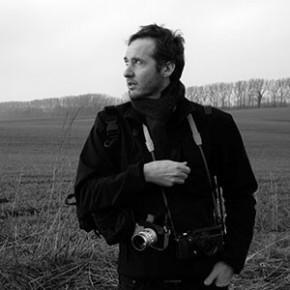
Tomas van HoutryveSo I was interested to read about photographer Tomas van Houtryves (right) project Blue Sky Days.  He begins with an arresting observation with which both James and Josh would be only too familiar:

‘Although a huge amount of [full motion video] footage has been collected [by US drones], the program is classified, and few people have ever seen images of the drone war and its casualties. This seems like a paradox in our thoroughly media-connected age. How can America be involved in a decade-long war where the sky is buzzing with cameras, and yet the public remains totally in the dark?’

But his response to the question is distinctly different: he repatriates the drone wars from Pakistan to the United States (here the most appropriate comparison is with Omar Fast‘s 5,000 Feet is the Best).

Tomas van Houtryve 1

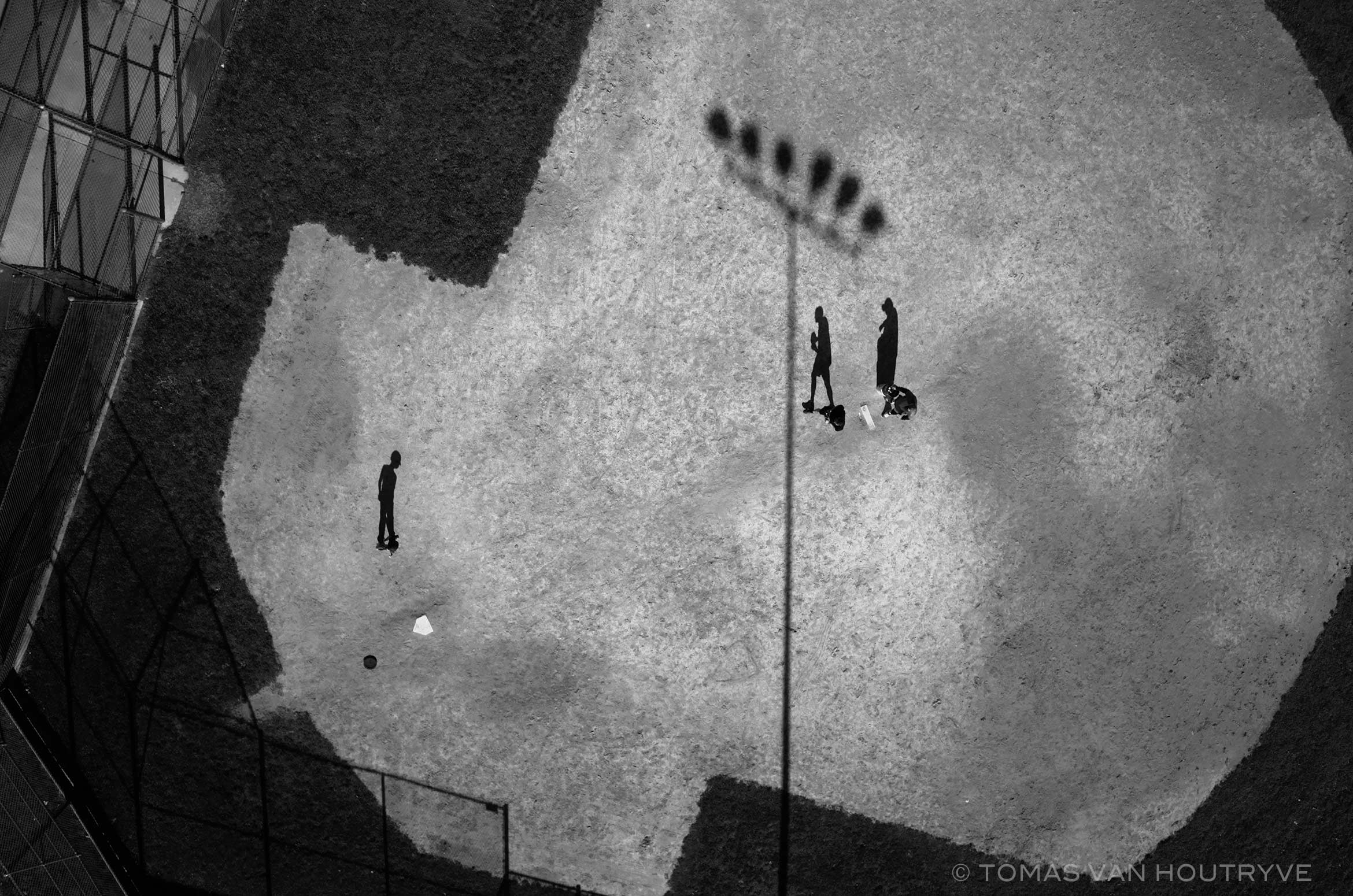
To do so, Tomas travelled across America with a small quadcopter drone bought from Amazon.com attached to his camera.  His concept was simple, Rena Silverman explains in the New York Times:

Take the idea of foreign drone strikes and instead target similar domestic situations, putting them under surveillance using his drone in public spaces. He made a list of hundreds of different strike reports, gleaning as many details about the circumstances…

He rented a black car with tinted windows and placed himself, his drones, his batteries and lists in the car. He spent six weeks in late 2013 averaging between seven and 10 drone flights daily, sleeping in a different town every night. He would pull the car into an empty lot, get out, launch the drone for about five to 10 minutes — about as long as its power lasted — take footage, land the drone, drive away and recharge the batteries while en route to the next location…

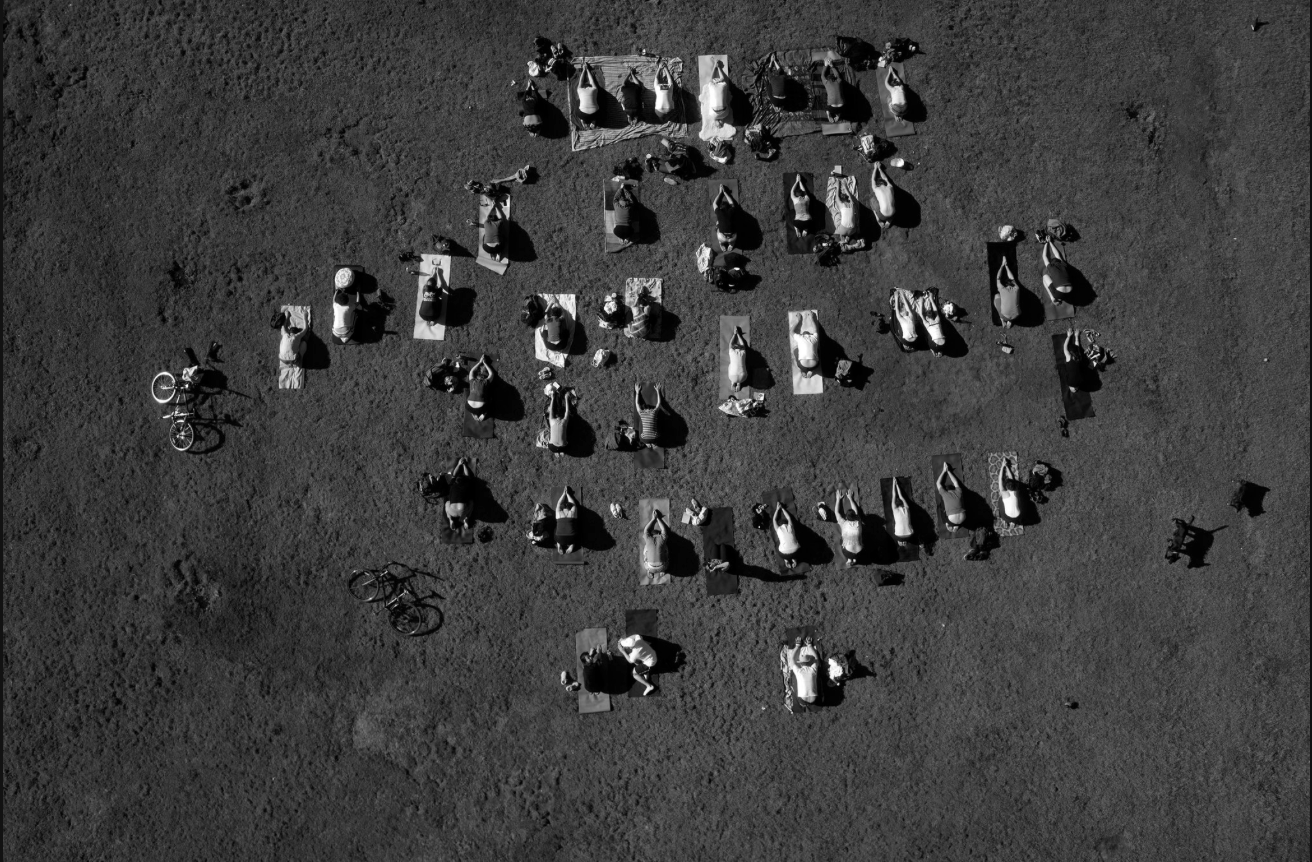
He followed his list carefully, trying to imitate “signature strikes,” referring to a May 2012 New York Times article in which some State Department officials complained about the lax criteria for identifying a terrorist “signature.” The joke was that “three guys doing jumping jacks” could be enough suspicious activity for the C.I.A. to conclude it could be a terrorist training camp. In other words, targeting people based on behavior rather than identity.

Tomas van Houtryve 2 copy

He photographed people exercising in Philadelphia, their shadows long and pinned against the grid of a park. He noticed more “signature” behavior while driving through San Francisco, where he encountered a group doing yoga [above]. When Mr. van Houtryve recently printed the image, he asked viewers if they thought the subjects were praying or exercising. It was a toss-up.

Although these images are not quite ‘what drone attacks in America would look like’, as Pete Brook suggested in WIRED – Tomas’s drone was flying much lower (‘only about six stories high’) and these images are pin-point sharp: there’s none of the ambiguity of infra-red heat signatures here – none the less that last sentence really says it all.  Images do not speak for themselves and interpretation counts for everything – which is why, as I’ve repeatedly argued, it matters so much what pilots, sensor operators and image analysts are pre-disposed to see.

It turns out that a particular incident provoked Tomas’s project – the murder of Mamana Bibi at Ghunda Kala in North Waziristan on 24 October 2012, which I described here –  and also gives it its title.

Zubair RehmanIn October 2012, a drone strike in northeast Pakistan killed a 67-year-old woman picking okra outside her house. At a briefing held in 2013 in Washington, DC, the woman’s 13-year-old grandson, Zubair Rehman, spoke to a group of five lawmakers. “I no longer love blue skies,” said Rehman, who was injured by shrapnel in the attack. “In fact, I now prefer gray skies. The drones do not fly when the skies are gray.”

There’s more from Tomas at Harper’s here, which originally co-sponsored the project with the Pulitzer Center, and you can see more of his drone’s eye view images at the National Geographic here.

There’s also a revealing interview conducted by Bard College’s Center for the Study of the Drone here; it contains all sorts of interesting observations, but one in particular resonated.  Asked about the tension between the beauty of his photographic compositions and the horror of what he is seeking to convey, Tomas says this:

‘The base subject that I’m trying to raise awareness about and get people to think about in less abstract terms is the foreign drone war. If you take the time to read through the particular airstrikes, a lot of them are quite horrifying. But on the other hand, as a photographer, I know that beauty is one of the tools that we use to get people to look at a picture. Beauty has a lot of power, so there’s a tension between trying to seduce people with the language of photography, which is beautiful composition, and trying to reveal something that might be uncomfortable or difficult to digest, once people fully grasp it.’

Another of my art icons, elin o’Hara slavick, says something very similar about her mesmerising sequence of aerial images of places bombed by the US, Bomb after bomb (see also Brian Howe‘s discussion here and my own in ‘Doors in to Nowhere’ [DOWNLOADS tab], from which I’ve taken this passage):

‘She adopts an aerial view—the position of the bombers—in order to stage and to subvert the power of aerial mastery. The drawings are made beautiful “to seduce the viewer,” she says, to draw them into the deadly embrace of the image only to have their pleasure disrupted when they take a closer look. “Like an Impressionist or Pointillist painting,” slavick explains, “I wish for the viewer to be captured by the colors and lost in the patterns and then to have their optical pleasure interrupted by the very real dots or bombs that make up the painting.”’

A tart reminder that there are multiple ways of ‘just looking‘.

Predator View

I’m in Zurich – many thanks to Benedikt Korf for the invitation and the wonderful hospitality – for a seminar with Benedikt’s doctoral students on the long form version of ‘The Natures of War’ (they have what I hope is the penultimate draft; I’ll post the final version once I’ve reworked it after the seminar) and then a public lecture: ‘Angry eyes: the militarization of vision and modern war’.

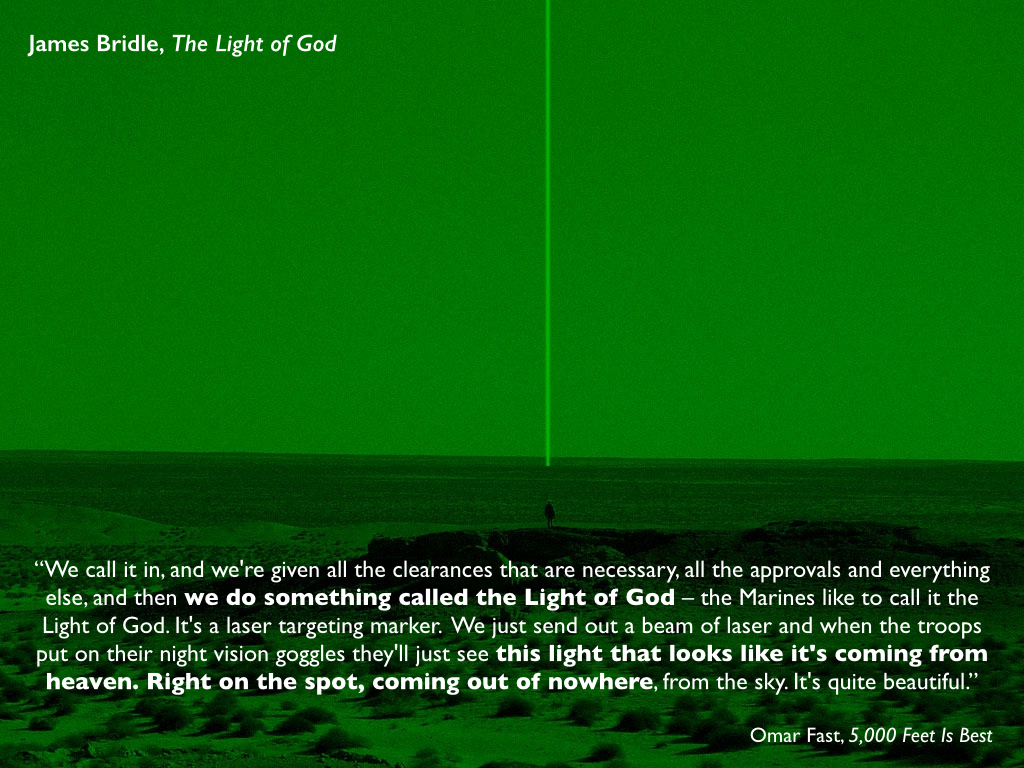
Part of my argument in the lecture is about the narrowness of ‘Predator View’, so let me explain what I mean.  My starting point is the illusion that the use of the intelligence, surveillance and reconnaissance capabilities of remote platforms like the MQ-1 Predator or the MQ-9 Reaper produces a transparent battlespace: in effect, a version of Donna Haraway‘s ‘God-trick’, the ability to see everything from nowhere in particular.  The most succinct version of this is the treatment of laser targeting as ‘the eye of God’:

Eye of God.001

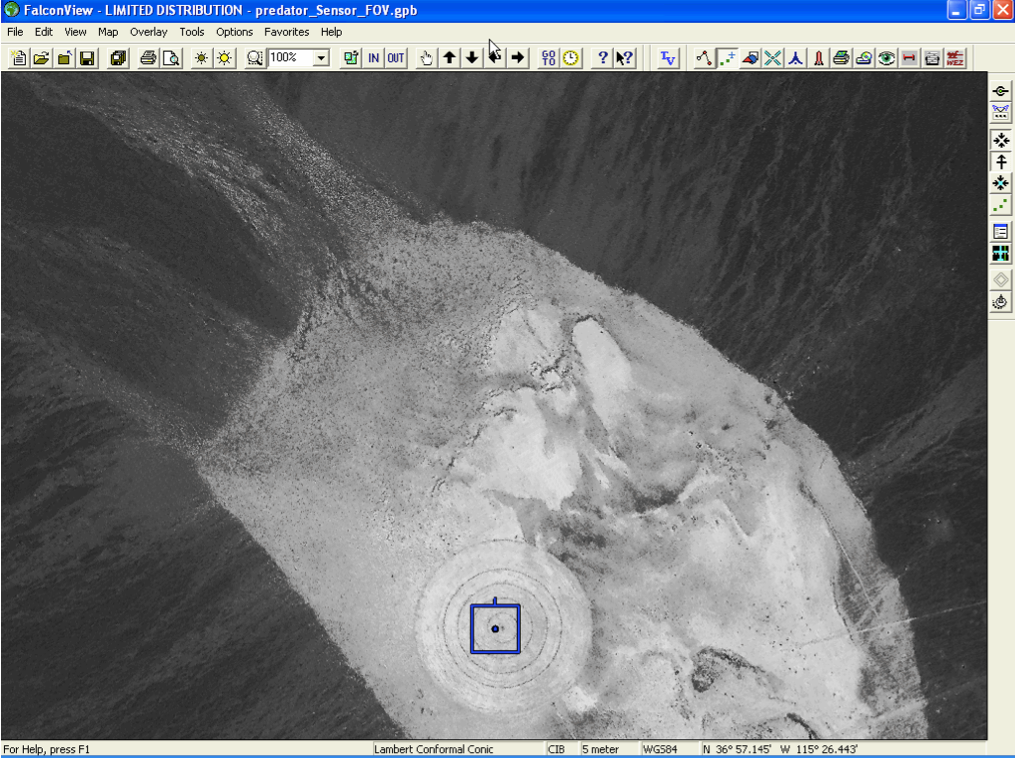
In fact, ‘Predator View’ is remarkably narrow. First, and most directly, a common complaint is that the view provided by its Full Motion Video is literally too narrow – ‘like looking through a soda straw’.  It’s for this reason that pilots and sensor operators also use FalconView, a Windows-based mapping tool that is supposed to provide them with situational awareness.  I’ve taken the image below from a presentation by Lt Col Paul Hastert (USAF) on ‘Spiral development in wartime’ – the screenshot is the FalconView image, the small square the field of view from a Predator – but the most detailed account of FalconView is Jon Lindsay‘s ‘”War upon the map”‘: User innovation in American military software’, Technology and culture 51 (3) (2010) 619-51.

FALCONVIEW and Predator FOV

There have been several later releases of FalconView, and a version is now even open source, so it’s probably not surprising that the US military also uses Google Earth.  In fact, in two of the air strikes I consider in detail it was, in part, juggling these different views that contributed to wrong targeting decisions.  (There are projects that provide a wider field of view – the nine-camera suite of Gorgon Stare is in operation and its second increment is already in use in Afghanistan – and others that integrate imagery from multiple sources, like Raytheon’s Zeus, which is intended to supplant FalconView as the ‘primary mission execution tool‘).

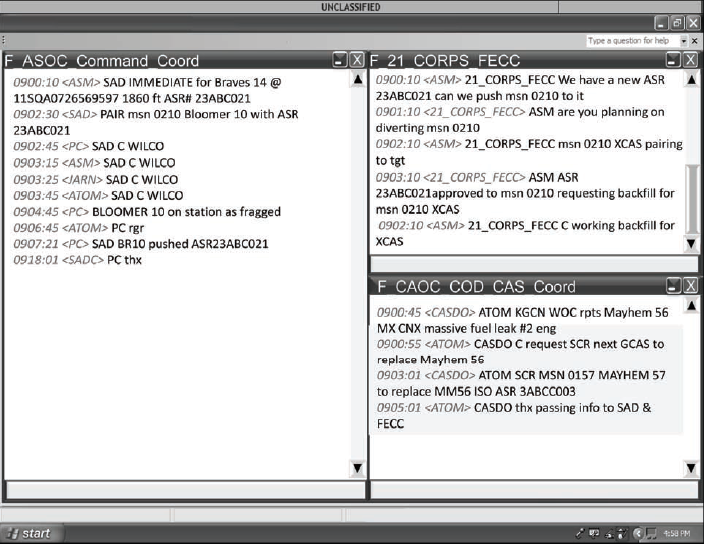
But in the air strikes that I consider those involved in these networked operations are also busy communicating via radio and – crucially – via the typed messages displayed in mIRC‘s online chat windows.  The image below is taken from the US military’s multi-service manual on Tactical Chat (see also the discussion at Public Intelligence here).

mIRC 3 chatrooms

In the case of the ‘friendly fire’ incident in the Sangin Valley in 2011, the pilot and sensor operator were unaware of crucial entries made by image analysts in mIRC and of private (or ‘whisper’) chats to the Mission Intelligence Co-ordiator.  That’s not entirely surprising.  Once permission has been given to engage a target, ‘KILL CHAIN” is typed into the room to minimise extraneous chatter that might otherwise visually distract and so ‘degrade’ the strike.  According to the Mission Intelligence Controller for the Sangin incident:

‘When we got a standby for a 9-line [strike briefing] we put [KILLCHAIN] in the mIRC room to shut down chatter so we can be heads down supporting the pilot and the sensor … as they are getting ready for a possible Hellfire shot our whatever action… That’s our job, to be their third set of eyes…’

That third set of eyes is vital, though of little use if its responses are shut down.  In this case the pilot was paying no attention to mIRC because he was fully occupied:

‘I did not see the chat in the main mission room after seeing muzzle flashes. From that point on, my focus was clear concise communications with the [Joint Terminal Attack Controller] and ensuing [Close Air Support] comms, 9 line etc. At this point I was also focused on keeping the aircraft in position to maintain FMV on the individuals. I was also getting the aircraft into the [Weapons Engagement Zone]. Winds were 30 knots out of the west so I had to make sure I kept the aircraft position and direction in cross check.’

All of this suggests that it is unduly narrow to focus the analytical gaze on the Full Motion Video feeds.

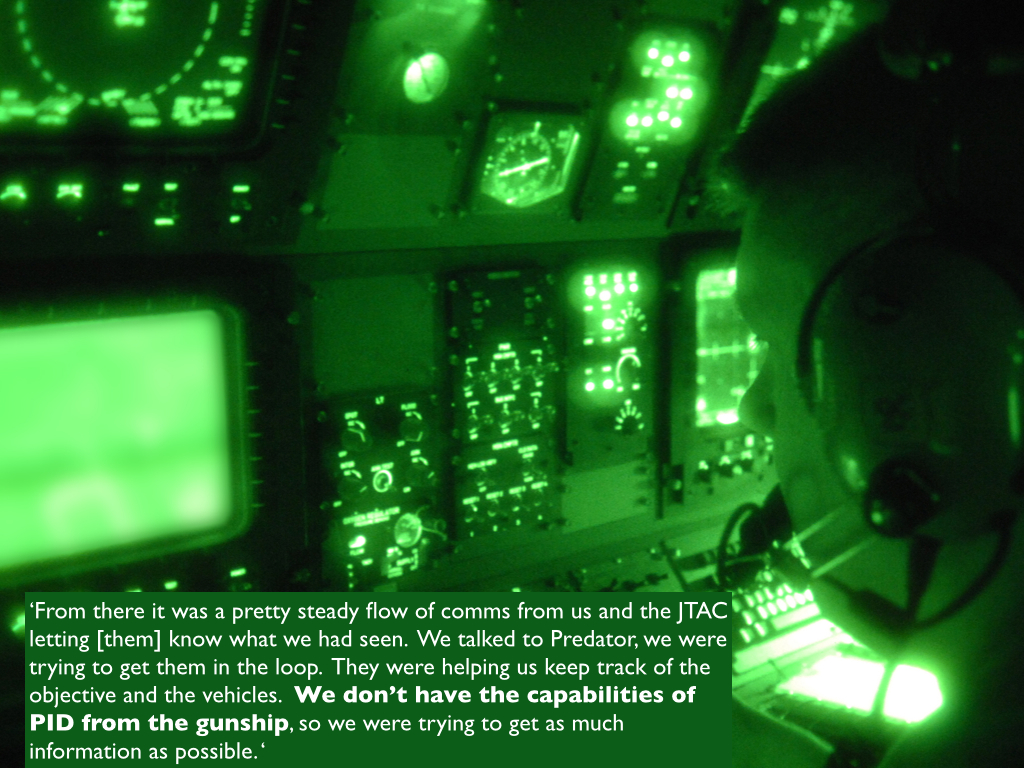
But there’s more.  Militarised vision is not limited to Predators and their successors, and it’s important to consider the clarity and resolution of the imagery captured and transmitted from other, conventional aircraft like the AC-130 (first image below), the B-1 bomber, F-15E strike aircraft or attack helicopters (second image below)  – again, this was important in two of the strikes I consider in detail.

AC-10 Uruzgan.001

MMS from attack helicopter - Uruzgan.001

This leads me to two other senses in which the critical emphasis on ‘Predator View’ is too narrow.  It’s a mistake to fasten on one incident – even what has become the iconic ‘signature strike’ coordinated by a Predator on three civilian trucks in Uruzgan – because that misses the continuities, repetitions and transformations in Close Air Support (which is where most of the mistakes are made).

Better, I think, to widen the analytical gaze, which is why I examine the Kunduz air strike on 4 September 2009 (in which no remote platform was involved), the Uruzgan air strike of 21 February 2010 (which was co-ordinated by a Predator but carried out by two attack helicopters), and the Sangin Valley air strike of 6 April 2011 (which was executed by a Predator).  The Granai strike is included because it trigged McChrystal’s Tactical Directive of 6 July 2009 to minimise civilian casualties: ‘‘We must avoid the trap of winning tactical victories – but suffering strategic defeats – by causing civilian casualties or excessive damage and thus alienating the people.’  In all three cases I’ve worked through thousands of pages of official investigations – one by the German Bundestag since the ISAF report remains classified (Kunduz), and the others by the US Army and US Air Force (Uruzgan) and the US Marine Corps (Sangin Valley).

4 US air strikes in Afghanistan.001

And finally, it is also necessary to consider the multiple viewing positions involved in networked military violence.  There is a de-centralised, distributed and dispersed geography of militarised vision whose fields of view expand, contract and even close at different locations engaged in the administration of military violence.  And in all three incidents it turns out that vital mistakes in the interpretation of imagery were made at operations centres in theatre on the ground.

This has prompted me to radically revise the argument I originally set out in ‘From a view to a kill’ (DOWNLOADS tab).  There my focus was on the geography shown in the first map below – like every other commentator I’ve read, incidentally – but I’ve now widened the angle to take in the geography shown in the second map and this substantially changes the story.

Dispersed vision Uruzgan (1).001

Dispersed vision Uruzgan (2).001

It was what happened at the operations centres at Special Operations Task Force 12 in Kandahar and Combined Joint Special Operations Task Force in Bagram that turned out to be every bit as important as the Predator crew’s obvious desire to ‘go kinetic’.

I make similar arguments about Kunduz, where the F-15E pilots were clearly reluctant to strike and the ground commander and JTAC at the Forward Operating Base overrode their objections.

Sangin is even more instructive, because the official investigation of this ‘friendly fire’ incident that resulted in the deaths of two Marines largely exonerated both the Predator crew and the ground commander and JTAC at the operations centre – but a detailed, spirited counter-memorandum from the US Marines commandant refuted the findings line by line, castigated the attempt to pin the blame for what happened on the young, inexperienced lieutenant leading the patrol, and excoriated the ground commander and JTAC back at the patrol base.  More on this soon.

The (long!) essay on these  strikes is the last chapter I need to complete for The everywhere war. There is a strong sense, so I shall argue, in which it was the view ‘on the ground’ that mattered much more than any ‘light of God’ from above.  And as for transparency….

‘Life is a rock but the radio rolled me…’

tumblr_nb88ij9V0e1qivon6o1_1280

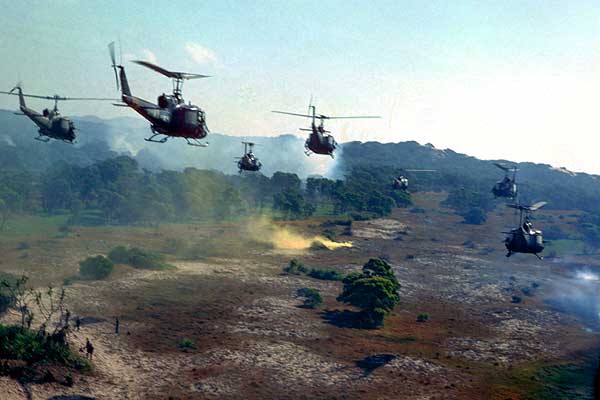
The war in Vietnam was often heralded as ‘a new kind of war’, one that reached its awful climax in what James Gibson brilliantly criticised as ‘technowar’.  It had many dimensions, including the reintroduction of chemical warfare (Agent Orange and all the other herbicides) and the development of the ‘electronic battlefield’.

But at the time the US Army made the most of its commitment to what it called ‘air mobility’.

As you can see from this contemporary Army video, the concept was claimed as revolutionary (and, in its way of course, counter-revolutionary).  ‘An entirely new concept of warfare known as heli-borne or air mobile operations has been developed by the United States Army,’ claims the commentator, ‘and has been successfully employed to meet the problems posed by South East Asia’s hostile wilderness and bye enemy who hides there.’

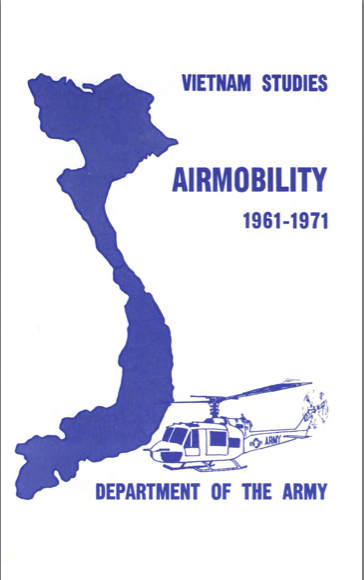
In fact, it wasn’t invented in Vietnam, but it was a dominant mode of army operations there: you can download the US Army’s historical report on Air mobility 1961-1971 here, for example, the Vietnam Center and Archive has a helpful page on ‘The helicopter war’ here, and you can read an extract from Walter Boyne‘s How the helicopter changed modern warfare here.  There is also a considerable literature on ‘dust-off‘ that I’m working through for my new research project on casualty evacuation in war zones.

Airmobility 1961-1971

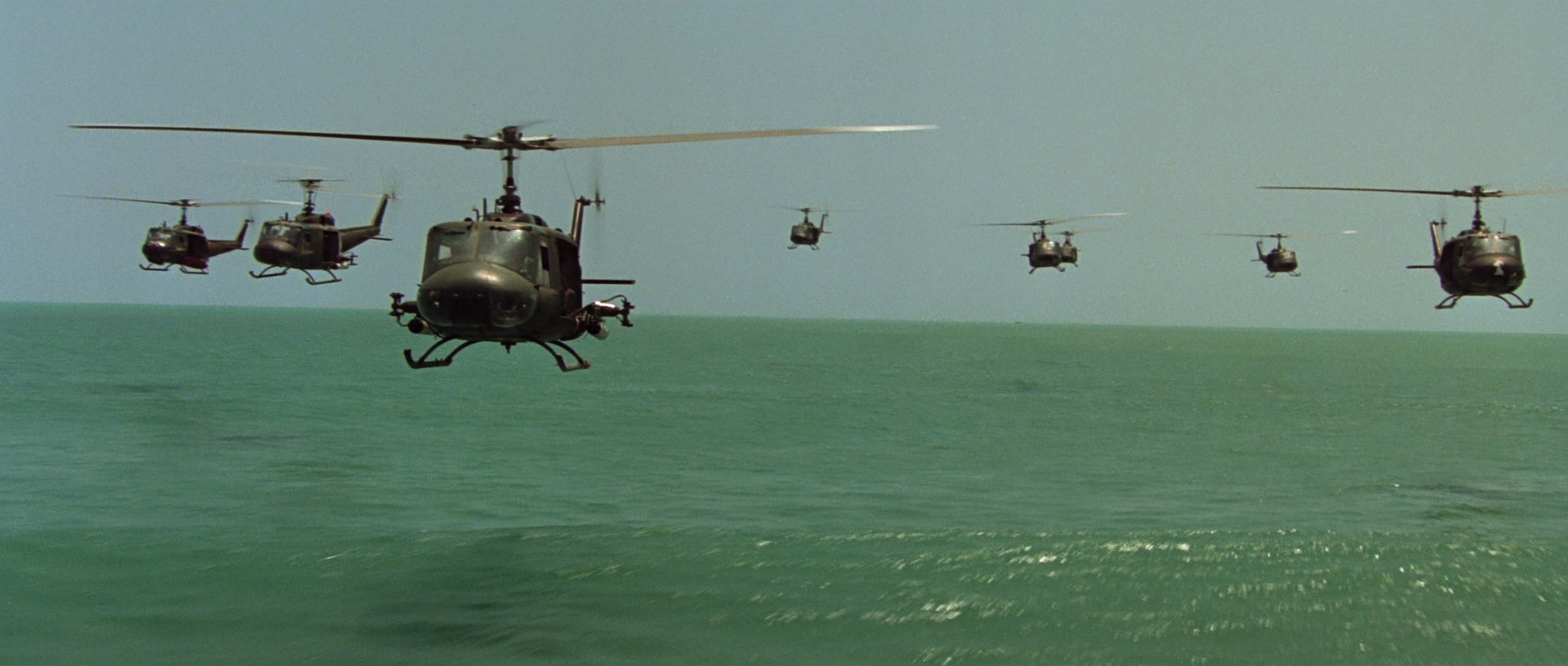
And don’t forget its role in popular culture.  The helicopter loomed large in the iconography of Francis Ford Coppola‘s Apocalypse Now (1979):

apocalypsenowbdcap4_original

More recently Pete Adey provided a summary of a more general concept of ‘aeromobilities’ [Geography Compass 2/5 (2008) 1318-1336] though his emphasis, perhaps not surprisingly, is on vision.

What interests me here, though, is another capacity, and one without which the potential of air mobility would have remained unrealised.

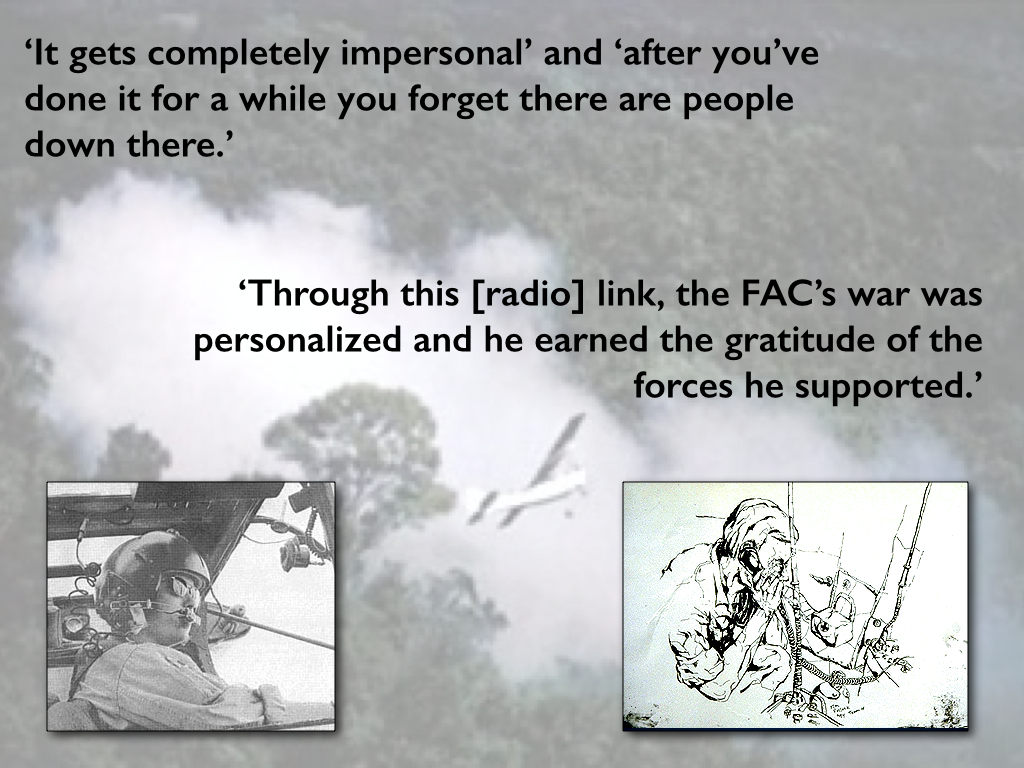
I’m talking about the voice on the radio.  I’ve written about the role of the forward air controller before, and the parallels between the air strikes they directed in Vietnam and today’s remote operations in Afghanistan (see ‘Lines of descent’, DOWNLOADS tab).

GREGORY From a view to a kill Shock and Awe Extract.001

This destructive power was captured with extraordinary economy by Phil Caputo in A Rumor of War:

Simply by speaking a few words into a two-way radio, I had performed magical feats of destruction. Summoned by my voice, jet fighters appeared in the sky to loose their lethal droppings on villages and men. High-explosive bombs blasted houses to fragments, napalm sucked air from lungs and turned human flesh to ashes. All this just by saying a few words into a radio transmitter. Like magic.

But the radio was part of a much wider network of military violence and military logistics in Vietnam.  Here is Frederick Downs in The killing zone:

With the radio, we grunts could make use of modern weapons. Without it, everything stayed put. We used the radio to call in artillery, naval gun support if it was close enough, air strikes, gunships, dustoffs, Puff the Magic Dragon [the AC-47 gunship], mortars, tanks, APCs and other rifle platoons. The radio kept us supplied. One day our order went in; the next day the chopper flew out with a delivery. We found each other by using grid coordinates and radioing them back and forth. A pilot knew he had the right location when we popped smoke and he identified it over the radio. By this method, we received C rations, ammo, new weapons, grenades, parts for our equipment, shoes, new clothes, underwear, socks, medicine, personnel replacements, beer, iodine tablets for use in the water, mail, and once in a while even a chaplain. To complete the cycle, the radio was used to extract us from trouble. Saving a life was often a matter of seconds. The radio was also a comfort at night. The periodic radio checks assured us that friends and help were always near.

Here too, incidentally, there are lessons for contemporary analysis: satellite imagery is clearly of vital significance for today’s advanced militaries, but so too are satellite communications.  I’ll discuss this is another post, but without those communication links there would be no full-motion video-feeds from all those Predators and Reapers – and their operating range would be dramatically constricted.  Ground operations in Afghanistan and elsewhere would also be virtually impossible without their radio links.

The-new-RTO

From 1965 the main field radio in Vietnam was the PRC-25 (‘Prick 25’).  You can find a detailed technical specification here, but here are the key passages:

‘The PRC-25 was about the size and weight of a case of soda. With its battery “can” included, call it a case of soda sitting on top of a six-pack. (It actually weighed slightly more than that, 23.5 pounds) There was a handle on each side at the top to carry it. The radio consisted of two parts, both in metal boxes, called “cans.” The upper can held the radio itself, the lower can held its battery pack. Metal buckles held the two together. The radio was tough and would easily survive a 50 foot fall from a helicopter onto a metal-planked runway. You could throw the whole thing in the water for an hour, completely submerged, then pull it out and expect it to work…

‘The radio antenna was exactly like a metal tape measure, but the bottom foot or so was a round flexible tube that screwed into the radio. There were actually two antennas, a regular one and a long-range antenna, carried in a canvas bag strapped to the side of the radio The radio had a transmission range, with the short antenna, of about 3-4 miles, but various terrain factors could influence this, of course. It helped to be higher up. The long range antenna was supposed to be good for up to 18 miles.

The rule of thumb was that the battery was good for about a day of casual operation, listening mostly, some occasional transmissions. In a period of intense use, transmitting/receiving all the time, it was good for perhaps 2-3 hours. The way the LRRPs [Long Range Reconnaissance Patrols] and SF [Special Forces] used it, shutting it off and only coming up at scheduled times to briefly transmit or listen, it was good for perhaps four days. Spare batteries were usually kept in a spare .30 caliber ammo can. When expended, the battery pack had to be physically destroyed. Inside were flashlight-type batteries which the Viet Cong could use in booby traps or to ignite bombardment rockets.’

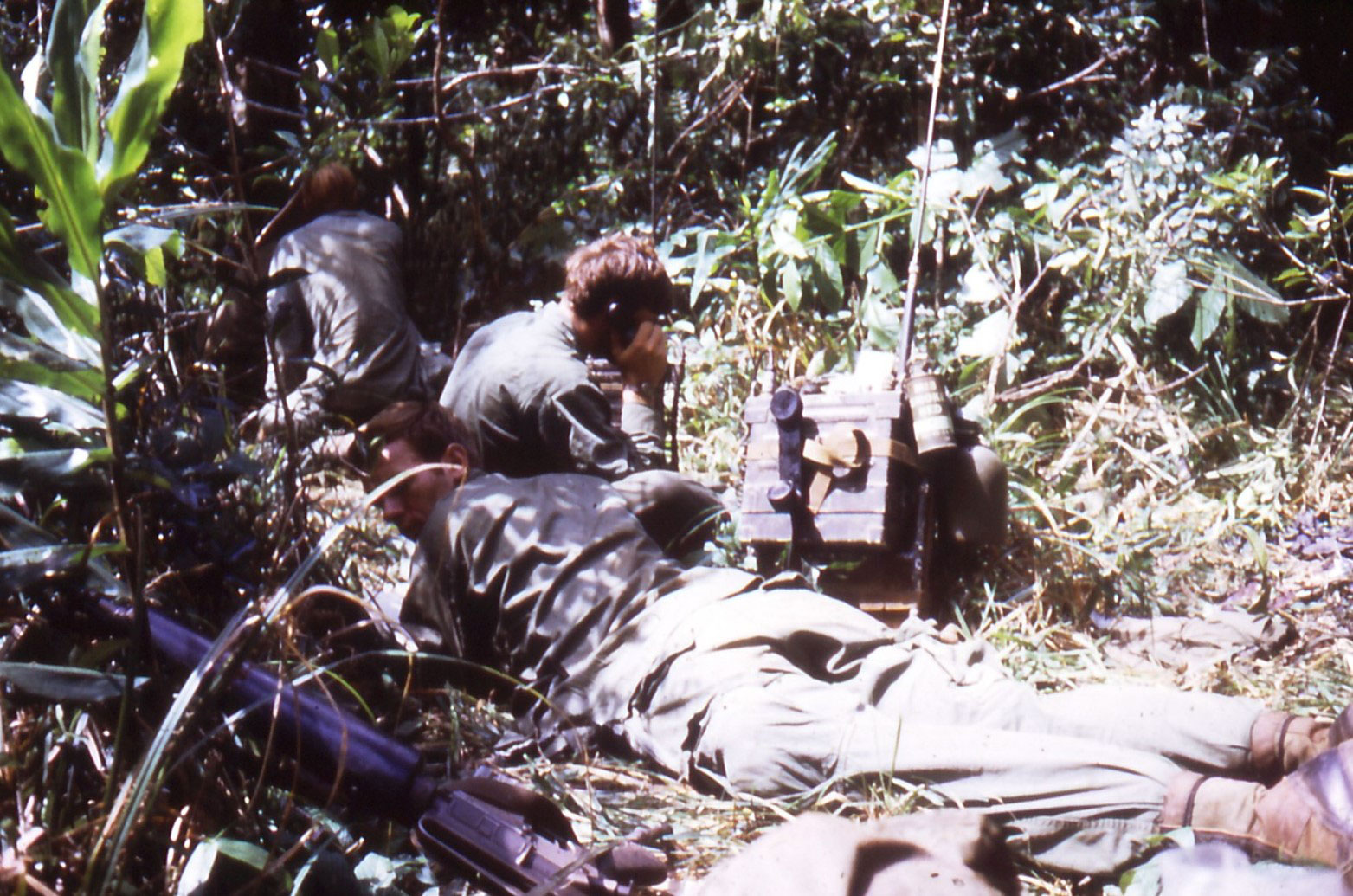
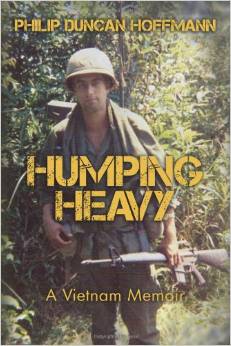
Hoffman Humping HeavyNotice first the extraordinary weight of the thing.  I’ve detailed the loads humped by soldiers and Marines in Vietnam before, but you can see from this that the radio operator (RTO) was even more heavily burdened.  He also had to contend with a difficult load distribution: according to Rodger Jacobs ‘radiomen had to wear their radios on their chests because if worn on their backs the thickness of the jungle and the vines would constantly catch on the controls and change the frequencies.’  The best account of the trials and tribulations of an RTO that I know is Phillip Hoffman‘s appropriately titled Humping Heavy (right).

RTO2

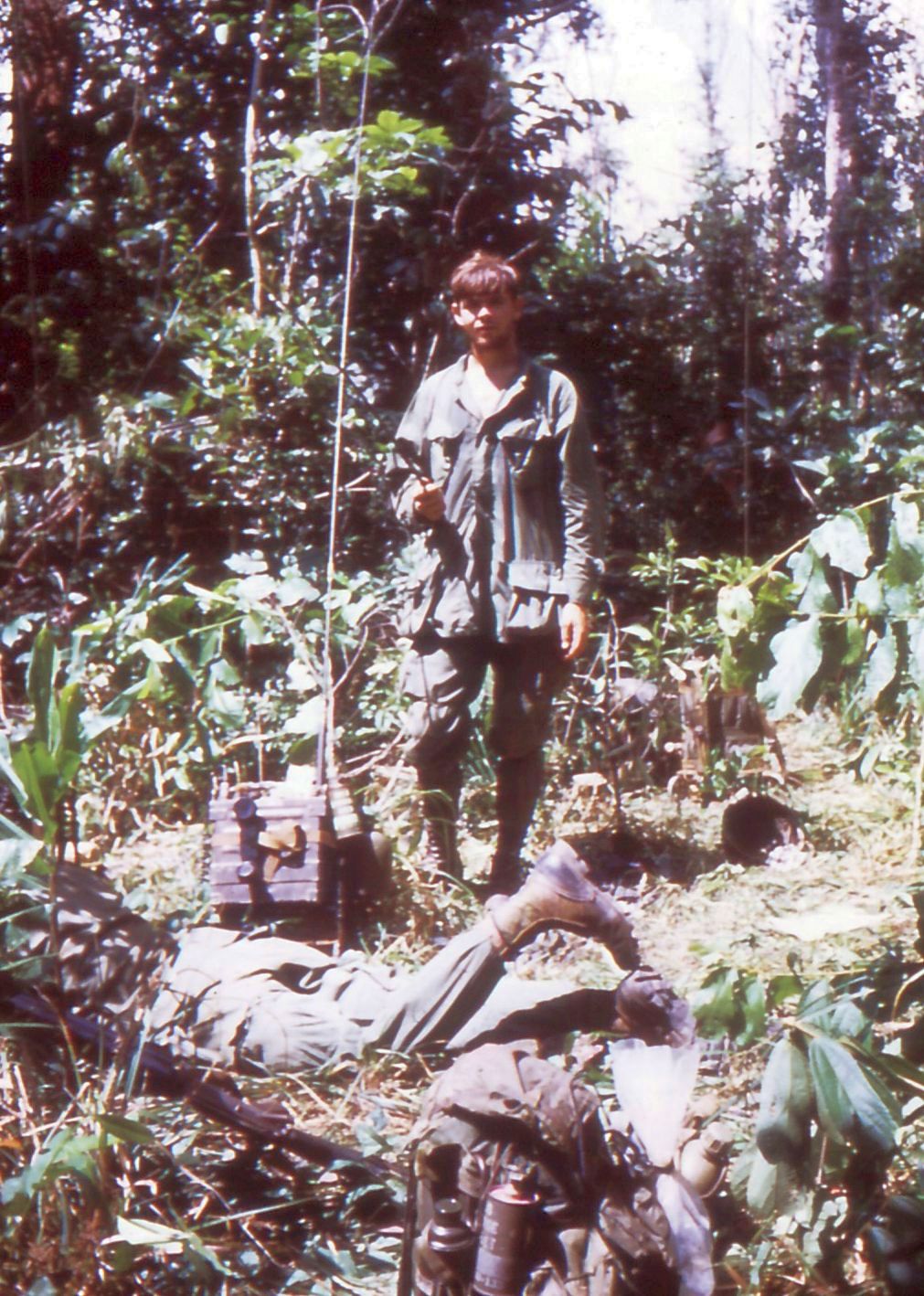
Then notice the size of the aerial (above); RTOs carried a ten-feet rigid mast in sections but much of the time used a three-feet whip antenna.  This made the RTO extremely vulnerable: not only was he a marked target, but he was always close to the platoon or patrol commander and so both were hi-vis priorities in an enemy attack or ambush.   For that reason the most prized possession of many RTOs was a North Vietnamese Army rucksack: ‘They’re better than anything the Corps has,’ Jeff Kelly was told.  ‘It’ll hang lower on your back and won’t catch on branches. But the big thing is you won’t be giving off that radioman silhouette.’  Most RTOs taped the antenna down, but Hoffman made the mistake of questioning the wisdom:

Right away he demanded I stuff the flexible, three-foot whip antenna down my shirt to limit me (and by extension him) as a target. He knew a priority of the enemy was to knock out communication, and our commo was located on my back. I complied with his directive but made the mistake of telling him our signal strength would suffer. In no uncertain words he told me never to question him again.

Even with a network of relay stations and airborne retransmissions, communications were uneven and intermittent: the terrain could block signals, especially in the Central Highlands, and rain (especially during the monsoon) could play havoc with reception.  At night even a whisper was dangerous; here is John Edmund Delezen:

Hourly situation reports are sent to the radio relay atop of Hill 950 some three kilometers north of the Khe Sanh airstrip. The “sit-reps” are not sent in the form of words-we dare not speak in the black void; when the relay asks us to acknowledge his call, there are just the two distinct pauses in the constant squelch as the handset is keyed twice. The two small audible clicks are all that connects us with the world, and all that assures the relay that we have not disappeared into the liquid black night.

Artillery fire direction center Vietnam

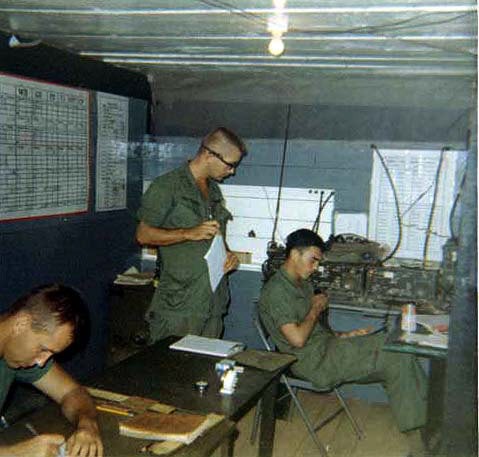
It could be strangely remote for those receiving the transmissions too (above, an artillery fire support center).  Kenneth Sympson, an artillery officer, explained:

‘Our only contact with the men of the patrols was from radio transmissions—the infrequent call-in at a checkpoint or request for fire on some pretargeted location on their route. They were a noise on the radio and a trace on a map of the region. When you fired an artillery round in support, it was almost as if you were simply throwing it into the night and it just disappeared. It would later strike a place on the map, but there was no life there; there was only some representation for crossing trails or the contour lines indicative of the slope of a hill or a pin hole named Registration Point 3.’

Downs says much the same, describing gun crews anticipating ‘the release of their impersonal death into a grid square.’

But for those beyond the wire those staccato messages were far from abstract or impersonal.  ‘The radio was our link with literally everything outside our platoon,’ said Downs, ‘from supplies to survival’.  And without it, as he also said, ‘everything stayed put.’

Hence my title: and for those too young (or too old) to remember it, listen to this (YouTube).

Angry eyes

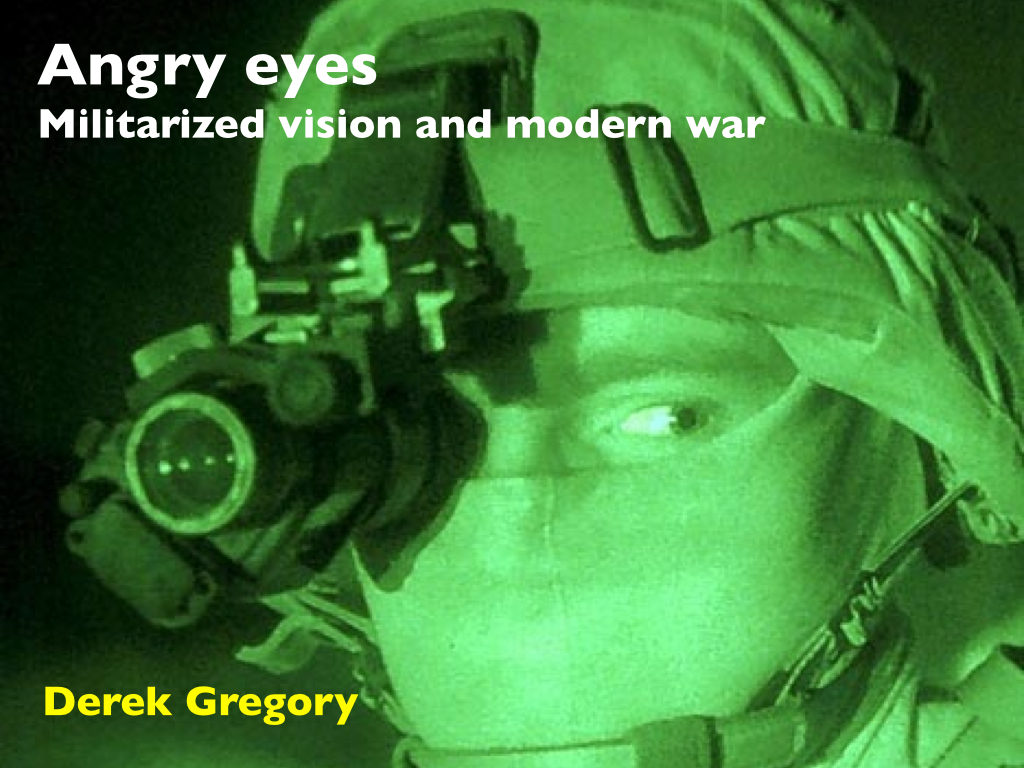
GREGORY Angry eyes JPEG.001

As part of my project on Militarized Vision I’ve been drawing together my work on two air strikes in Afghanistan in which the full motion video feeds from UAVs played a central role.  The first was an air strike in Uruzgan on 21 February 2010, which was carried out by two combat helicopters but mediated by video and commentary from a Predator and other eyes in the sky (the most thorough press account is by David Cloud here).  The second was a  ‘friendly fire’ incident in the Sangin valley on 5 April 2011 when a Predator strike claimed the lives of two US Marines (you can find an excellent summary account by David Cloud and David Zucchino here).

The two reports I’ve just cited were published in the LA TimesCombat by Camera series, but a close reading of the two official investigations – thousands of pages obtained through FOIA requests – inevitably shows that the stories were more complicated than the tag-line implies.  Still, for all the differences there are some remarkably close parallels between the two, and these have prompted me to revise (in radical ways) the analysis I originally offered in “From a view to a kill” (DOWNLOADS tab).

Searching for a title for the presentations I’m giving on this in October and November, I half-remembered a song called ‘Angry Eyes’.  When I tracked down the lyrics (by Kenny Loggins) I literally could not believe my eyes.  He obviously wasn’t writing about the US Air Force (or the Israeli), but it requires no great leap of the imagination to switch from love to violence:

Time, time and again
I’ve seen you starin’ out at me.

Now, then and again, I wonder
What it is that you see

[Chorus:]
With those Angry Eyes.
Well, I bet you wish you could
Cut me down with those Angry Eyes…

You want to believe that
I am not the same as you.
I can’t concieve, oh no,
What it is you’re tryin’ to do

[Chorus]

What a shot you could be if
You could shoot at me
With those Angry Eyes…

You tried to defend that
You are not the one to blame.

But I’m finding it hard, my friend,
When I’m in the deadly aim
Of those Angry Eyes.

So the presentations (here in Vancouver, and in Zurich and Bergen) will be called “‘Angry eyes’: militarized vision and modern war”.  As the image implies, there’s more to this than full motion video displays, and I’m also going to try to say something about the genealogy of what Paul K. Saint-Amour calls ‘optical war’ (and its distance from the corpographies of ‘boots on the ground‘).

More on all this later, when I’ve finished the essay that I am presently spinning off the presentations with the same title; it’s the last thing I have to do for “The everywhere war” (I hope).