Banquet’s ghosts

I’ve just finished a remarkable book by Atef Abu Saif, The drone eats with me: diaries from a city under fire (Comma Press, 2015).  The city in question is Gaza:

The Drone Eats With Me COVER IMAGE-Atef Abu SaifOn 7 July 2014, in an apparent response to the murder of three teenagers, Israel launched a major offensive against the Gaza Strip, lasting 51 days, killing 2145 Palestinians (578 of them children), injuring over 11,000, and demolishing 17,200 homes.

The global outcry at this collective punishment of an already persecuted people was followed by widespread astonishment at the pro-Israeli bias of Western media coverage. The usual news machine rolled up, and the same distressing images and entrenched political rhetoric were broadcast, yet almost nothing was reported of the on-going lives of ordinary Gazans – the real victims of the war.

One of the few voices to make it out was that of Atef Abu Saif, a writer and teacher from Jabalia Refugee Camp, whose eye-witness accounts (published in The Guardian, The New York Times, and elsewhere) offered a rare window into the conflict for Western readers. Here, Atef’s complete diaries of the war allow us to witness the full extent of last summer’s atrocities from the most humble of perspectives: that of a young father, fearing for his family’s safety, trying to stay sane in an insanely one-sided war.

Over at the electronic intifada Pam Bailey explains:

Although already the author of four novels and a political science text, Abu Saif did not write this book with publication in mind. Rather, it began as entries to his diary, printed only after Ra Page, founder of Comma Press, recognized the potential in the passages shared by his friend in Gaza.

The writing alternates between poignant simplicity and dramatic flourishes and haunting metaphors. Abu Saif often uses a comparison to hunger and eating to describe the rapaciousness of war and those who “feed” off of it. “Destruction is a rich meal for the media,” he writes. “Their camera does not observe the fast of Ramadan, it devours and devours. It is constantly eating new images.”

The diary begins on 6 July — two days before the officially declared beginning of the war — with this chilling observation: “When it comes, it brings with it a smell, a fragrance even. You learn to recognize it as a kid growing up in these narrow streets. You develop a knack for detecting it, tasting it in the air. You can almost see it. It lurks in the shadows, follows you at a distance wherever you go. If you retain this skill, you can tell that it’s coming — hours, sometimes days, before it actually arrives. You can’t mistake it. War.”

KAFKA Metamorphosis

I’ve been asked to speak on drones later this year at a conference at UC Santa Barbara on Metamorphosis: Animal, Human, Armor – the image above is from the extraordinary British film of Kafka’s novella: you can catch a clip on YouTube here – and no doubt partly for this reason I too have been taken by the ways in which, as Pam notes, Abu Saif turns again and again to tropes of human-machines feeding (captured in the title of the book too).  I’d read parts of the diary as it was being composed – see here, for example – but the imaginary of predation is now even more compelling and even more shocking:

As the noise of the explosion subsides, it’s replaced by the inevitable whir of a drone, sounding so close it could be right beside us. It’s like it wants to join us for the evening, and has pulled up a chair.

Later:

The food is ready. I wake the children and bring them in. We all sit around five dishes: white cheese, hummus, orange jam, yellow cheese, and olives. Darkness eats with us. Fear and anxiety eat with us. The unknown eats with us. The F16 eats with us. The drone, and its operator somewhere out in Israel, eat with us.

More once I’ve worked out what I want to say at the conference, but for now there is a particularly thoughtful review and response to Abu Saif by Jacob Bacharach at The Rumpus here.


Base lines and military projections

David Vine has updated his map of the global footprint of the US military over at Politico.

VINE US military bases

I used an early version for my ‘War and Peace’ essay (DOWNLOADS tab), and that map – like this one – was drawn primarily from the annual Base Structure Report, a summary of the US military’s ‘real property inventory’ (all sites owned and managed by the Pentagon).  It’s an unwieldy document which uses a high threshold to filter inclusion:

To qualify for individual entry in the BSR, a DoD site located in the United States must be larger than 10 acres AND have a Plant Replacement Value (PRV) greater than $10 million. If the site is located in a foreign country, it must be larger than 10 acres OR have a PRV greater than $10 million to be shown as a separate entry. Sites that do not meet these criteria are aggregated as an “Other” location within each state or country.

Iraq doesn’t appear in these tabulations – though it is shown on the map – yet the continuing US involvement in the conflict there and across the all-but-erased border in Syria has surely extended its footprint.  As David notes,

‘There were 505 bases at the U.S. occupation’s height, but the Iraqi parliament rejected the Pentagon’s wish to keep 58 “enduring” bases after the 2011 withdrawal. U.S. forces have occupied at least five bases since 2014 and are considering more installations.’

Afghanistan is absent too: ‘By the end of 2014 … the U.S. military will have closed, deconstructed, or vacated most of what were once around 800 military installations, ranging from small checkpoints to larger combat outposts to city-sized bases.’  But the US military retains a significant presence there, and its drones are still based there to support continuing military operations and to attack targets across the border in Pakistan.

There are also strategic omissions.  There’s no mention in the Base Structure Report of Al Udeid Air Base in Qatar, for example, which is the location of US Central Command’s Combined Air and Operations Center.

(You can find more from David on the history of America’s ‘infrastructure for war’ in the Middle East here and on its ‘lily-pad’ strategy here).

There are all sorts of issues involved in measuring a ‘military footprint’ – see my post here and Josh Begley here (who works from the previous year’s Base Structure Report for FY 2013 to produce a radically different visualization) – but for all its uncertainties, David’s map is a sobering snapshot, and he relies on supplementary sources to conclude:

Despite recently closing hundreds of bases in Iraq and Afghanistan, the United States still maintains nearly 800 military bases in more than 70 countries and territories abroad—from giant “Little Americas” to small radar facilities. Britain, France and Russia, by contrast, have about 30 foreign bases combined.

By my calculation, maintaining bases and troops overseas cost $85 to $100 billion in fiscal year 2014; the total with bases and troops in warzones is $160 to $200 billion.

VINE Base Nation

When I first contacted David, his original map formed part of his scorching investigation into Diego Garcia: Island of Shame: the secret history of the US military base on the island of Diego Garcia (Princeton, 2009; paperback 2011: all royalties went to the Chagossians); the new version forms part of an even more ambitious project, Base Nation: how US military bases abroad harm America and the world (Metropolitan Books, 2015):

American military bases encircle the globe. More than two decades after the end of the Cold War, the U.S. still stations its troops at nearly a thousand locations in foreign lands. These bases are usually taken for granted or overlooked entirely, a little-noticed part of the Pentagon’s vast operations. But in an eye-opening account, Base Nation shows that the worldwide network of bases brings with it a panoply of ills–and actually makes the nation less safe in the long run.

As David Vine demonstrates, the overseas bases raise geopolitical tensions and provoke widespread antipathy towards the United States. They also undermine American democratic ideals, pushing the U.S. into partnerships with dictators and perpetuating a system of second-class citizenship in territories like Guam. They breed sexual violence, destroy the environment, and damage local economies. And their financial cost is staggering: though the Pentagon underplays the numbers, Vine’s accounting proves that the bill approaches $100 billion per year.

For many decades, the need for overseas bases has been a quasi-religious dictum of U.S. foreign policy. But in recent years, a bipartisan coalition has finally started to question this conventional wisdom. With the U.S. withdrawing from Afghanistan and ending thirteen years of war, there is no better time to re-examine the tenets of our military strategy. Base Nation is an essential contribution to that debate.

There is a long history of struggles against the presence of US military bases overseas – Catherine Lutz‘s edited collection, The bases of empire: the global struggle against US military posts (New York University Press, 2009) remains an indispensable starting-point.

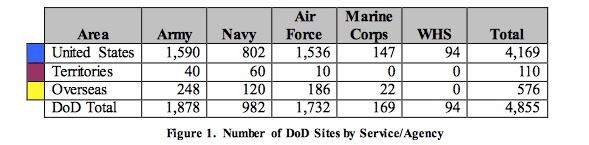
Of course, the US military is also omnipresent in the United States, with installations in all 50 states and seven territories.  The Base Structure Report includes this summary:

DoD sites JPEG

And these bases have brought their own problems and spawned their own protests too.


War against the people

I’ve long admired Jeff Halper‘s work with the Israeli Committee Against House Demolitions (though to me, haunted by the passages from The poetics of place that Edward Said invokes in Orientalism,  ‘home demolition’s would carry even more resonance: it’s so much more than buildings that the Israelis so brutally turn to rubble).

ICAHD

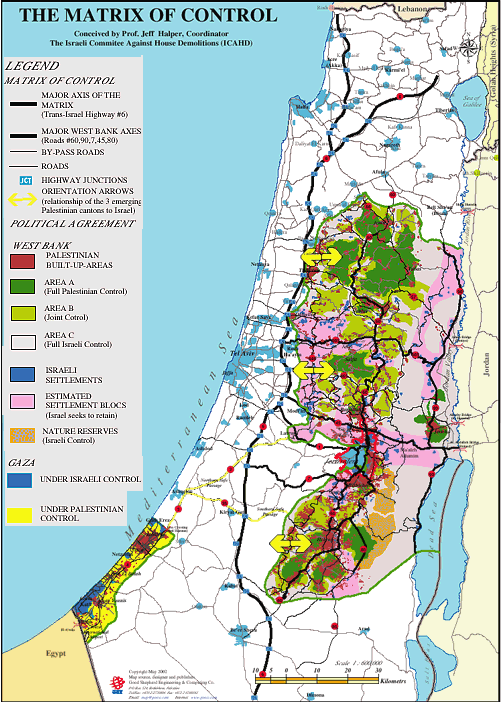
Jeff’s classic, even canonical essay on ‘the matrix of control‘ (see also here) was a constant reference point for my chapters on occupied Palestine in The Colonial Present, and on my first visit to the West Bank I was part of a group that Jeff generously spent a day showing the materialities of military occupation and illegal colonisation: you think you know what you’re going to see, but all the reading in the world can’t prepare you for what Israel has done – and continues to do – to the people of Palestine.

the-matrix-of-control

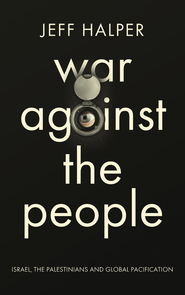
So I’m really pleased to hear from Jeff that his new book, War against the people: Israel, the Palestinians and global pacification, will be out in September (from Pluto Press in the UK and via the University of Chicago Press in the USA):

Modern warfare has a new form. The days of international combat are fading. So how do major world powers maintain control over their people today?

HALPER War against the peopleWar Against the People is a disturbing insight into the new ways world powers such as the US, Israel, Britain and China forge war today. It is a subliminal war of surveillance and whitewashed terror, conducted through new, high-tech military apparatuses, designed and first used in Israel against the Palestinian population. Including hidden camera systems, sophisticated sensors, information databases on civilian activity, automated targeting systems and, in some cases, unmanned drones, it is used to control the very people the nation’s leaders profess to serve.

Drawing from years of research, as well as investigations and interviews conducted at international arms fairs, Jeff Halper reveals that this practice is much more insidious than was previously thought. As Western governments tighten the grip on their use of private information and claw back individual liberties, War Against the People is a timely reminder that fundamental human rights are being compromised for vast sections of the world, and that this is a subject that should concern everyone.

I’ve noted before the ways in which Israel has used its continuing occupation of Palestine as a laboratory to test new technologies of military violence – and as a series of test cases designed to push the envelope of what is permissible under international humanitarian law and even international human rights law – but here Jeff radicalises the argument to develop a deeply disturbing vision of what he calls ‘securocratic wars in global battlespace’.  It’s vitally necessary to remember that later modern war is not the exclusive artefact of the United States and its military-academic-industrial-media (MAIM) complex, and that what happens in Israel/Palestine has desperately important implications for all of us.

Many commentators have claimed – I think wrongly – that one of the new characteristics of war in the twenty-first century is that it has become ‘war amongst the people’: as though No Man’s Land on the Western Front was somehow roped off from the gas attacks and shells that assaulted farms, villages and towns behind the front lines, for example, and air raids were limited to exclusively military-industrial targets.  Even if we confine ourselves to the trajectory of ostensibly modern warfare and track forward through the Second World War, Korea, Malaya, Vietnam, Laos and Cambodia…. the story is the same: modern war has long been fought amongst the people (though increasingly amongst ‘their’ people).  The deconstruction of the battlefield, as Frédéric Mégret calls it, is clearly visible in Palestine and is inseparable from its globalization.  It’s hardly surprising, then, that ‘war amongst the people’ should so easily turn into what Jeff describes as ‘war against the people’.

Here is the list of contents:

Introduction : How Does Israel Get Away With It?

Part I: The Global Pacification Industry
1. Enforcing Hegemony: Securocratic Wars in Global Battlespace

Part II: A Pivotal Israel
2. Why Israel? The Thrust Into Global Involvement
3. Niche-Filling in a Global Matrix of Control

Part III: Weaponry of Hybrid Warfare and Securocratic Control (Niche 1)
4. Niche 1: Weaponry of Hybrid Warfare and Securocratic Control
5. Dominant Maneuver
6. Precision Engagement

Part IV: Securitization and “Sufficient Pacification” (Niche 2)
7. Niche 2: The Securocratic Dimension: A Model of “Sufficient Pacification”
8. Operational Doctrines and Tactics

Part V: Serving Hegemons Throughout the World-System
9. Serving the Hegemons on the Peripheries: The “Near” Periphery
10. Security Politics on the “Far” Periphery
11. The Private Sector

Part VI: Domestic Securitization and Policing
12. Serving the Core’s Ruling Classes “At Home”

Conclusions: Mounting Counterhegemonic Challenges and Resisting Pacification
Resisting Capitalist Hegemony and Pacification: The Need for Infrastructure
Resistance to Pacification: Focusing on the MISSILE Complex

Disposable futures

EVANS and GIROUX Disposable futures

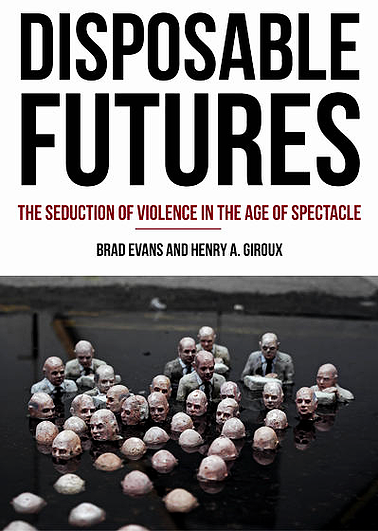
News from Brad Evans of a new book co-authored with Henry Giroux, Disposable futures: the seductions of violence in the age of spectacle (out next month from City Lights).

Disposable Futures makes the case that we have not just become desensitized to violence, but rather, that we are being taught to desire it.

From movies and other commercial entertainment to “extreme” weather and acts of terror, authors Brad Evans and Henry Giroux examine how a contemporary politics of spectacle–and disposability–curates what is seen and what is not, what is represented and what is ignored, and ultimately, whose lives matter and whose do not.

Disposable Futures explores the connections between a range of contemporary phenomena: mass surveillance, the militarization of police, the impact of violence in film and video games, increasing disparities in wealth, and representations of ISIS and the ongoing terror wars. Throughout, Evans and Giroux champion the significance of public education, social movements and ideas that rebel against the status quo in order render violence intolerable.

You can read the preface and an excerpt from the first chapter here, and you can get a taste of their argument from their op-ed for Truthout in June 2014 here, where they explain why they decided

‘…to develop a paradigm that focused on the intensification of what we called the politics of disposability. This requires taking our analysis beyond 20th century frames of analysis to look at the ways in which more and more individuals and groups are now considered excess by the onslaught of global forces that no longer offer the possibility of alternative futures. It talks precisely to those contemporary forms of disposability that have become so normalized; the burden of the guilt is placed on the shoulders of the victims, while the most pernicious of systemic abuses continues to hide things in plain sight. And it develops a critical angle of vision that goes well beyond the mere authentication of lives as simply born vulnerable to question the systemic design for oppression and exploitation that produces humans as some expendable category…

‘There is something, however, more at stake here than the contemporary plight of those millions forced to live in intolerable conditions. What makes the contemporary forms of disposability so abhorrent is precisely the way it shapes disposable futures. The future now appears to us as a terrain of endemic catastrophe and disorder from which there is no viable escape except to draw upon the logics of those predatory formations that put us there in the first place. Devoid of any alternative image of the world, we are merely requested to see the world as predestined and catastrophically fated. Frederic Jameson‘s claim then that it is easier to “imagine the end of the world than it is the end of capitalism” is more than a reflection on the poverty of contemporary imaginations. It is revealing of the nihilism of our times that forces us to accept that the only world conceivable is the one we are currently forced to endure: a world that is brutally reproduced and forces us all to become witness to its spectacles of violence that demand we accept that all things are ultimately insecure by design. In this suffocating climate, the best we can hope for is to be connected to some fragile and precarious life support system that may be withdrawn from us at any moment. Hope has dissolved into the pathology of social and civil death and the quest for mere survival. For if there is a clear lesson to living in these times, it is precisely that the lights can go out at any given moment, without any lasting concern for social responsibility. This is simply the natural order of things (so we are told) and we need to adapt our thinking accordingly.’

And, as always, you can find much more on these themes over at Brad’s History of Violence project (and particularly the Disposable Life series of lectures here).

Future imperfect and tense

A clutch of forthcoming books on war that seek, in different ways, to illuminate dimensions of what I’ve been calling ‘later modern war’:

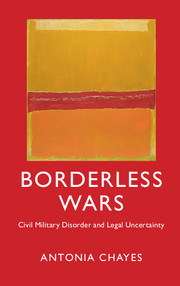
Antonia ChayesBorderless Wars (due in August at an eye-popping price from Cambridge University Press):

9781107109346In 2011, Nasser Al-Awlaki, a terrorist on the US ‘kill list’ in Yemen, was targeted by the CIA. A week later, a military strike killed his son. The following year, the US Ambassador to Pakistan resigned, undermined by CIA-conducted drone strikes of which he had no knowledge or control. The demands of the new, borderless ‘gray area’ conflict have cast civilians and military into unaccustomed roles with inadequate legal underpinning. As the Department of Homeland Security defends against cyber threats and civilian contractors work in paramilitary roles abroad, the legal boundaries of war demand to be outlined. In this book, former Under Secretary of the Air Force Antonia Chayes examines these new ‘gray areas’ in counterinsurgency, counter-terrorism and cyber warfare. Her innovative solutions for role definition and transparency will establish new guidelines in a rapidly evolving military-legal environment.

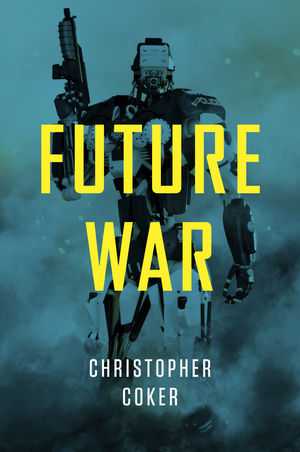
Christopher Coker‘s Future War (due in September from Polity):

COKER Future WarWill tomorrow’s wars be dominated by autonomous drones, land robots and warriors wired into a cybernetic network which can read their thoughts? Will war be fought with greater or lesser humanity? Will it be played out in cyberspace and further afield in Low Earth Orbit? Or will it be fought more intensely still in the sprawling cities of the developing world, the grim black holes of social exclusion on our increasingly unequal planet? Will the Great Powers reinvent conflict between themselves or is war destined to become much ‘smaller’ both in terms of its actors and the beliefs for which they will be willing to kill?

In this illuminating new book Christopher Coker takes us on an incredible journey into the future of warfare. Focusing on contemporary trends that are changing the nature and dynamics of armed conflict, he shows how conflict will continue to evolve in ways that are unlikely to render our century any less bloody than the last. With insights from philosophy, cutting-edge scientific research and popular culture, Future War is a compelling and thought-provoking meditation on the shape of war to come.

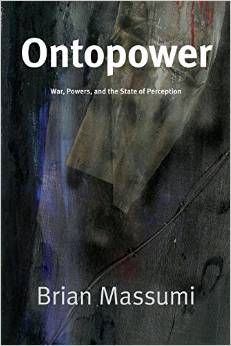
Brian Massumi‘s Ontopower: War, Powers, and the State of Perception (due in September from Duke University Press):

MASSUMI OntopowerColor coded terror alerts, invasion, drone war, rampant surveillance: all manifestations of the type of new power Brian Massumi theorizes in Ontopower. Through an in-depth examination of the War on Terror and the culture of crisis, Massumi identifies the emergence of preemption, which he characterizes as the operative logic of our time. Security threats, regardless of the existence of credible intelligence, are now felt into reality. Whereas nations once waited for a clear and present danger to emerge before using force, a threat’s felt reality now demands launching a preemptive strike. Power refocuses on what may emerge, as that potential presents itself to feeling. This affective logic of potential washes back from the war front to become the dominant mode of power on the home front as well. This is ontopower—the mode of power embodying the logic of preemption across the full spectrum of force, from the “hard” (military intervention) to the “soft” (surveillance). With Ontopower, Massumi provides an original theory of power that explains not only current practices of war but the culture of insecurity permeating our contemporary neoliberal condition.

Military, media and (im)mobilities

Two important new books on Israel’s occupation of Palestine that both have even wider implications.

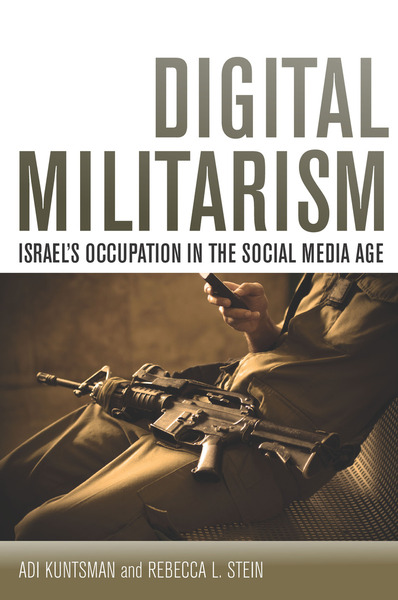
First, Adi Kuntsman and Rebecca Stein on Digital militarism: Israel’s occupation in the social media age from Stanford University Press:

pid_23022Israel’s occupation has been transformed in the social media age. Over the last decade, military rule in the Palestinian territories grew more bloody and entrenched. In the same period, Israelis became some of the world’s most active social media users. In Israel today, violent politics are interwoven with global networking practices, protocols, and aesthetics. Israeli soldiers carry smartphones into the field of military operations, sharing mobile uploads in real-time. Official Israeli military spokesmen announce wars on Twitter. And civilians encounter state violence first on their newsfeeds and mobile screens.

Across the globe, the ordinary tools of social networking have become indispensable instruments of warfare and violent conflict. This book traces the rise of Israeli digital militarism in this global context—both the reach of social media into Israeli military theaters and the occupation’s impact on everyday Israeli social media culture. Today, social media functions as a crucial theater in which the Israeli military occupation is supported and sustained.

Here is Laleh Khalili on the book:

“Amidst the hype of Facebook revolutions and the ostensible democratizing power of social media, Adi Kuntsman and Rebecca Stein illuminate the counterpoint: online militarization and the extension of state politics into the virtual realm. They expose the machinery of the Israeli state power at work within social media, and show the possibilities for countering the force of this machinery. Powerfully argued, beautifully researched, and thought-provoking, Digital Militarism is vitally important.”

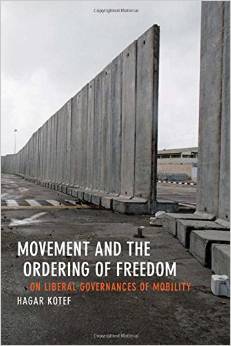
Second, Hagar Kotef‘s Movement and the Ordering of Freedom: On Liberal Governances of Mobility from Duke University Press:

KOTEF Movement and the ordering of freedomWe live within political systems that increasingly seek to control movement, organized around both the desire and ability to determine who is permitted to enter what sorts of spaces, from gated communities to nation-states. In Movement and the Ordering of Freedom, Hagar Kotef examines the roles of mobility and immobility in the history of political thought and the structuring of political spaces. Ranging from the writings of Locke, Hobbes, and Mill to the sophisticated technologies of control that circumscribe the lives of Palestinians in the Occupied West Bank, this book shows how concepts of freedom, security, and violence take form and find justification via “regimes of movement.” Kotef traces contemporary structures of global (im)mobility and resistance to the schism in liberal political theory, which embodied the idea of “liberty” in movement while simultaneously regulating mobility according to a racial, classed, and gendered matrix of exclusions.

And here is Eyal Weizman on this one:

“In this book Hagar Kotef manages to successfully weave several intellectual projects: a wide-ranging and theoretically sophisticated contribution to political theory, a robust and fine-grained analysis of the mechanisms of Israeli control of Palestinian movement, and a direct confrontation with its injustice. This book is a major contribution to the topological shift in the study of space. Kotef does nothing less than rewrite the history of territory as a matter of movement, and that of sovereignty as the control of matter in movement. By pushing her original insight as far as it would go, she best captures the logic of the world we struggle to live within.”

You can read the introduction on Scribd.

Visual occupations and a counter-politics of visuality

Most readers will know Eyal Weizman‘s searing account of the cruel intersections between the politics of visibility and the politics of verticality in occupied Palestine, Hollow Land: Israel’s architecture of occupation.

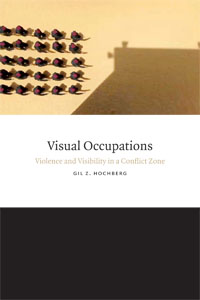
But there are other, no less intimate and intrusive dimensions to the politics of visibility for a people under military (and civilian) occupation that amount to what Gil Hochberg calls an ‘uneven distribution of “visual rights”‘.  In her brilliant new book from Duke University Press, Visual occupations: violence and visibility in a conflict zone, she explores ‘the political importance of various artistic attempts to redistribute the visible’ (my emphasis) and, in effect, to put in place a counter-politics of visuality.

978-0-8223-5887-9_prIn Visual Occupations Gil Z. Hochberg shows how the Israeli Occupation of Palestine is driven by the unequal access to visual rights, or the right to control what can be seen, how, and from which position. Israel maintains this unequal balance by erasing the history and denying the existence of Palestinians, and by carefully concealing its own militarization. Israeli surveillance of Palestinians, combined with the militarized gaze of Israeli soldiers at places like roadside checkpoints, also serve as tools of dominance. Hochberg analyzes various works by Palestinian and Israeli artists, among them Elia Suleiman, Rula Halawani, Sharif Waked, Ari Folman, and Larry Abramson, whose films, art, and photography challenge the inequity of visual rights by altering, queering, and manipulating dominant modes of representing the conflict. These artists’ creation of new ways of seeing—such as the refusal of Palestinian filmmakers and photographers to show Palestinian suffering or the Israeli artists’ exposure of state manipulated Israeli blindness —offers a crucial gateway, Hochberg suggests, for overcoming and undoing Israel’s militarized dominance and political oppression of Palestinians.

Here’s the Contents List:

Introduction. Visual Politics at a Conflict Zone

Part I. Concealment

1. Visible Invisibility: On Ruins, Erasure, and Haunting
2. From Invisible Spectators to the Spectacle of Terror: Chronicles of a Contested Citizenship

Part II. Surveillance

3. The (Soldier’s) Gaze and the (Palestinian) Body: Power, Fantasy, and Desire in the Militarized Contact Zone
4. Visual Rights and the Prospect of Exchange: The Photographic Event Placed under Duress

Part III. Witnessing

5. “Nothing to Look At”; or, “For Whom Are You Shooting?”: The Imperative to Witness and the Menace of the Global Gaze
6. Shooting War: On Witnessing One’s Failure to See (on Time)

Closing Words

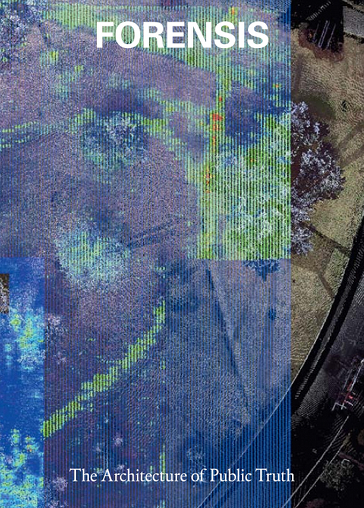
2014_cover_publication_forensisIt’s a compelling book, and I’m struck by another parallel with Eyal’s work.  In Hollow Land Eyal showed the central role that architecture and architects play in Israel’s illegal occupation of the West Bank, but in subsequently developing his collaborative Forensic Architecture project he effectively reverse-engineers architecture’s dominant imaginary to use built forms and spatial formations as a way of revealing prior trajectories of violence to a public forum.  That too is a counter-politics of visuality.

Butler and bodies in alliance

9780674967755-lg

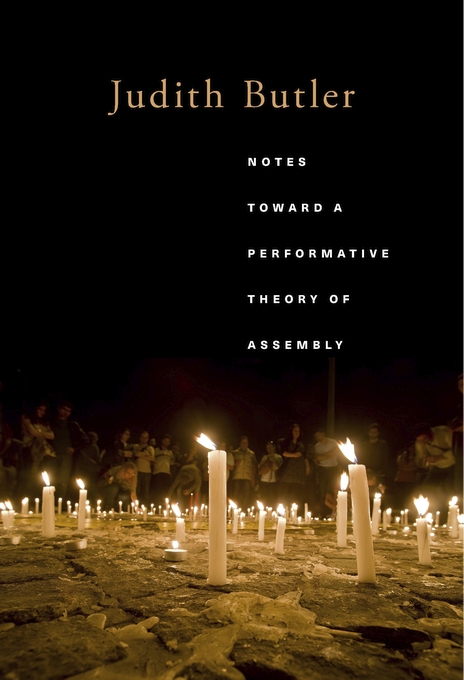
I’ve been inspired by Judith Butler‘s work in all sorts of ways – most recently by her discussions of performance, performativity and bodies in spaces that helped me make sense of the events that unfolded in Tahrir Square (see here and here).  I now have news of a new book from Judith that addresses these themes in more detail: Notes Toward a Performative Theory of Assembly, due from Harvard in November.

Judith Butler elucidates the dynamics of public assembly under prevailing economic and political conditions, analyzing what they signify and how. Understanding assemblies as plural forms of performative action, Butler extends her theory of performativity to argue that precarity—the destruction of the conditions of livability—has been a galvanizing force and theme in today’s highly visible protests.

Butler broadens the theory of performativity beyond speech acts to include the concerted actions of the body. Assemblies of physical bodies have an expressive dimension that cannot be reduced to speech, for the very fact of people gathering “says” something without always relying on speech. Drawing on Hannah Arendt’s view of action, yet revising her claims about the role of the body in politics, Butler asserts that embodied ways of coming together, including forms of long-distance solidarity, imply a new understanding of the public space of appearance essential to politics.

Butler links assembly with precarity by pointing out that a body suffering under conditions of precarity still persists and resists, and that mobilization brings out this dual dimension of corporeal life. Just as assemblies make visible and audible the bodies that require basic freedoms of movement and association, so do they expose coercive practices in prison, the dismantling of social democracy, and the continuing demand for establishing subjugated lives as mattering, as equally worthy of life. By enacting a form of radical solidarity in opposition to political and economic forces, a new sense of “the people” emerges, interdependent, grievable, precarious, and persistent.

butler_overviewThe book is based on Judith’s three Mary Flexner Lectures, ‘Bodies in Alliance‘, delivered at Bryn Mawr College in 2011:

‘Gender politics and the right to appear’

‘Bodies in alliance and the politics of the street’

‘Towards an ethics of co-habitation’

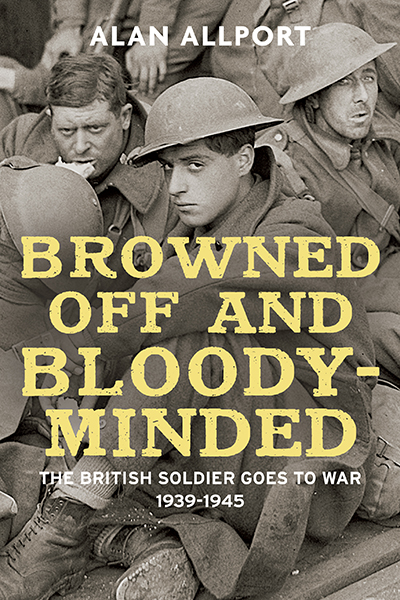
Browned Off and Bloody Minded

Browned Off and Bloody Minded

Not me: a new book by Alan Allport from Yale University Press: Browned-Off and Bloody Minded: the British soldier goes to war 1939-1945:

More than three-and-a-half million men served in the British Army during the Second World War, the vast majority of them civilians who had never expected to become soldiers and had little idea what military life, with all its strange rituals, discomforts, and dangers, was going to be like. Alan Allport’s rich and luminous social history examines the experience of the greatest and most terrible war in history from the perspective of these ordinary, extraordinary men, who were plucked from their peacetime families and workplaces and sent to fight for King and Country. Allport chronicles the huge diversity of their wartime trajectories, tracing how soldiers responded to and were shaped by their years with the British Army, and how that army, however reluctantly, had to accommodate itself to them. Touching on issues of class, sex, crime, trauma, and national identity, through a colorful multitude of fresh individual perspectives, the book provides an enlightening, deeply moving perspective on how a generation of very modern-minded young men responded to the challenges of a brutal and disorienting conflict.

Here is the Contents List:

Introduction

PART ONE: REGULARS

Colonel Lawrence and Colonel Blimp

Gentlemen and Old Sweats

Strange Defeat

PART TWO: CIVVIES

Army of Shopkeepers

Britain Blancoes while Russia Bleeds

Get some service in

PART THREE: CRUSADERS

Into the Blue

Come to Sunny Italy

Fighting Bloody Nature

Second Front

PART FOUR: KILLERS

Teeth and Tail

The Grammar of War

Categories of Courage

PART FIVE: CITIZENS

Them and Us

“What a colossal waste of time war is”

Here is a video preview:

There’s also a perceptive review by Victoria Harris here:

Allport’s latest work is far more than a revolutionary narrative of the (British) war effort. It is a window into the psyche of Britain – male Britain, it has to be said – and into the clashes between the classes, generations and masculinities that comprised it and attempted to defend their particular version of it. The British patrician class’ aversion to training the lower classes as officers, Winston Churchill’s disparaging view of the enlisted generation as weak and effeminate, tired soldiers with 300 days of continuous battle under their belts deserting en masse before D-Day; all of this is a “shock to us today”, we who have been fed a near-exclusive diet of a meritocracy fighting for democracy, backed by a prime minister confident in the toughness of this “greatest generation”. But the muddy, frustrated, sometimes downright incompetent reality Allport presents us with is far more powerful, revealing as it does how a diverse, independent-minded group of men fought, whether in a trench or at a depot or from behind a desk, despite immense fear or through tears, not from a nebulous sense of righteousness but out of a deeply human love for the man beside them.

If there is a criticism to be made of Browned Off and Bloody-Minded, it is how male and front line orientated this story remains…

I’m interested in approaches like Alan’s not least because they intersect with what I’ve tried to do in ‘The Natures of War’ (DOWNLOADS tab).  I’ve read endless first-hand accounts written by those who served on the Western Front in the First World War – and will be reading even more for my current work on casualty evacuation – but there seems to have been less interest in recovering the experiences of soldiers in the Second World War.  Alan’s work has involved excavating the archives in the Imperial War Museum, where I will be heading soon.  This time I will be switching gears to explore the lifeworlds of those who fought in the deserts of North Africa (‘the Blue’ of Part Three above).  Again, I made some headway on this in ‘The Natures of War’  – here too Part Three is of exceptional interest for me – but now I need to know much more about casualty evacuation.

War at a distance

Porter-The-Global-Village-Myth-webNews from Patrick Porter of a new book due out in March, The global village myth: distance, war and the limits of power (from Hurst in the UK/Georgetown University Press in the US):

According to security elites, revolutions in information, transport, and weapons technologies have shrunk the world, leaving the United States and its allies more vulnerable than ever to violent threats like terrorism or cyberwar. As a result, they practice responses driven by fear: theories of falling dominoes, hysteria in place of sober debate, and an embrace of preemptive war to tame a chaotic world.

Patrick Porter challenges these ideas. In The Global Village Myth, he disputes globalism’s claims and the outcomes that so often waste blood and treasure in the pursuit of an unattainable “total” security. Porter reexamines the notion of the endangered global village by examining Al-Qaeda’s global guerilla movement, military tensions in the Taiwan Strait, and drones and cyberwar, two technologies often used by globalists to support their views. His critique exposes the folly of disastrous wars and the loss of civil liberties resulting from the globalist enterprise. Showing that technology expands rather than shrinks strategic space, Porter offers an alternative outlook to lead policymakers toward more sensible responses—and a wiser, more sustainable grand strategy.

You can get a preliminary preview of Patrick’s basic argument at War on the Rocks here.