Paris of/in the Middle East

Paris:Peace

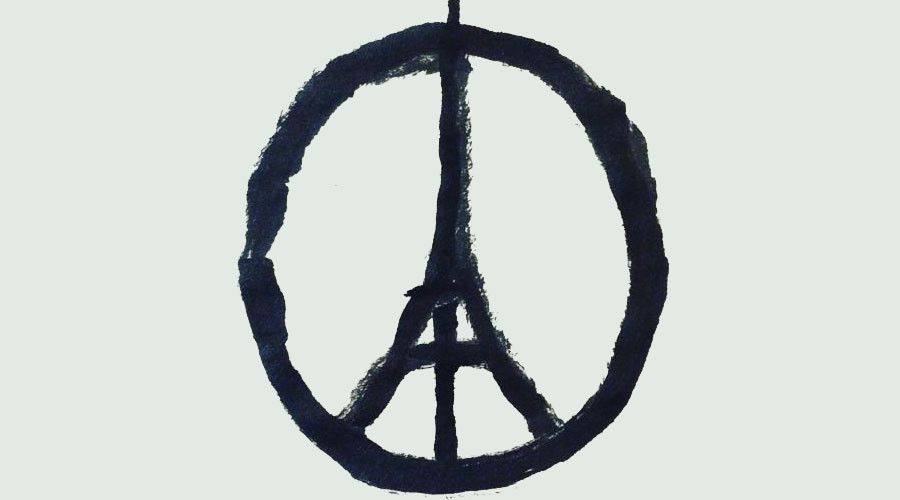
Islamic State has claimed responsibility for last night’s co-ordinated terrorist attacks in Paris, calling them the ‘first of the storm’ and castigating the French capital as ‘the capital of prostitution and obscenity’.   Walter Benjamin‘s celebrated ‘capital of the nineteenth century’ has been called many things, of course, and as I contemplated the symbol that has now gone viral (above), designed by Jean Jullien, I realised that Paris had been the stage for the 1919 Peace Conference that not only established the geopolitical settlement after the First World War but also accelerated the production of today’s ‘Middle East’ by awarding ‘mandates’ to both Britain and France and crystallising the secret Sykes-Picot agreement struck between the two powers in 1916 (more on that from the Smithsonian here).

Margaret MacMillan has a spirited summary of the conference here, with some lively side-swipes at the astonishing lack of geographical knowledge displayed by the principal protagonists.  Much on my mind was the French mandate for Syria and Lebanon:
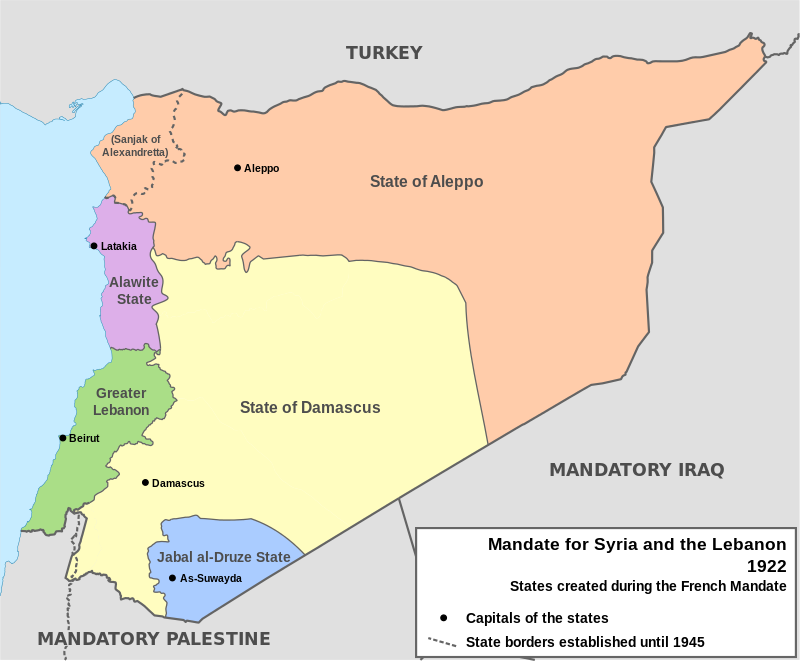
French Mandate for Syria and Lebanon

For as I watched Friday night’s terrifying events in Paris unfold, I had also been reminded of the horrors visited upon Beirut the evening before.

Two suicide bombers detonated their explosives in Burj el-Barajneh in the city’s southern suburbs; the attacks were carefully timed for the early evening, when the streets were full of families gathering after work and crowds were leaving mosques after prayers: they killed 43 people and injured more than 200 others.

Islamic State issued a statement saying that ’40 rafideen– a pejorative term for Shiite Muslims used by Sunni Islamists – were killed in the “security operation”’ and claimed the attacks were in retaliation for Hezbollah’s role in the Syrian war.
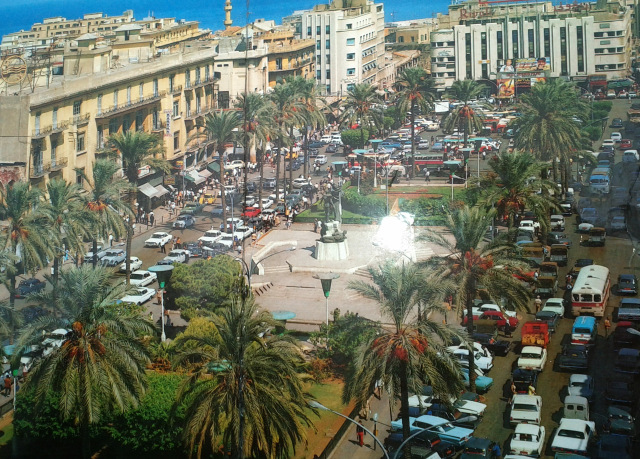
beirut60s

In the 1950s and 60s Beirut was known as ‘the Paris of the Middle East’ (above) – widely seen as more chic, more cosmopolitan than the ‘Paris-on-the-Nile’ created by Francophile architects and planners west of the old city of Cairo in the late nineteenth and early twentieth centuries.

Now I’ve always been troubled by these city switchings – the ‘Venice of the North’ is another example – because they marginalise what is so distinctive about the cities in question and crush the creativity that is surely at the very heart of their urbanity.

And yet, after last night, I can see a different point in the politics of comparison (from Kennedy’s Ich bin ein Berliner to the post 9/11 insistence that “we are all New Yorkers…”).  More accurately, in the politics of non-comparison: as Chris Graham asks (and answers): why the silence over what happened in Beirut on Thursday?  Why no mobilisation of the news media and no interruptions to regular programmes on TV or radio?  Why no anguished personal statements from Obama, Cameron or, yes, Hollande?

Beirut:Paris

Nobody has put those questions with more passion and justice than Elie Fares writing from Beirut:

I woke up this morning to two broken cities. My friends in Paris who only yesterday were asking what was happening in Beirut were now on the opposite side of the line. Both our capitals were broken and scarred, old news to us perhaps but foreign territory to them….

Amid the chaos and tragedy of it all, one nagging thought wouldn’t leave my head. It’s the same thought that echoes inside my skull at every single one of these events, which are becoming sadly very recurrent: we don’t really matter.

When my people were blown to pieces on the streets of Beirut on November 12th, the headlines read: explosion in Hezbollah stronghold, as if delineating the political background of a heavily urban area somehow placed the terrorism in context.

When my people died on the streets of Beirut on November 12th, world leaders did not rise in condemnation. There were no statements expressing sympathy with the Lebanese people. There was no global outrage that innocent people whose only fault was being somewhere at the wrong place and time should never have to go that way or that their families should never be broken that way or that someone’s sect or political background should never be a hyphen before feeling horrified at how their corpses burned on cement. Obama did not issue a statement about how their death was a crime against humanity; after all what is humanity but a subjective term delineating the worth of the human being meant by it?

Here we might pause to remind ourselves that most of the victims of Islamic State have been Muslims (see, for example, here and here).

Here Hamid Dabashi‘s reflections are no less acute:

In a speech expressing his solidarity and sympathy with the French, US President Barack Obama said, “This is an attack not just on Paris, it’s an attack not just on the people of France, but this is an attack on all of humanity and the universal values that we share.”

Of course, the attack on the French is an attack on humanity, but is an attack on a Lebanese, an Afghan, a Yazidi, a Kurd, an Iraqi, a Somali, or a Palestinian any less an attack “on all of humanity and the universal values that we share”? What is it exactly that a North American and a French share that the rest of humanity is denied sharing?

In his speech, UK Prime Minister David Cameron, speaking as a European, was emphatic about “our way of life”, and then addressing the French he added: “Your values are our values, your pain is our pain, your fight is our fight, and together, we will defeat these terrorists.”

What exactly are these French and British values? Can, may, a Muslim share them too – while a Muslim? Or must she or he first denounce being a Muslim and become French or British before sharing those values?

These are loaded terms, civilisational terms, and culturally coded registers. Both Obama and Cameron opt to choose terms that decidedly and deliberately turn me and millions of Muslims like me to their civilisational other.

They make it impossible for me to remain the Muslim that I am and join them and millions of other people in the US and the UK and the EU in sympathy and solidarity with the suffering of the French.

As a Muslim I defy their provincialism, and I declare my sympathy and solidarity with the French; and I do so, decidedly, pointedly, defiantly, as a Muslim.

When Arabs or Muslims die in the hands of the selfsame criminal Islamic State of Iraq and the Levant (ISIL) gangs in Afghanistan, Iraq, Syria, or Lebanon, they are reduced to their lowest common denominator and presumed sectarian denominations, overcoming and camouflaging our humanity. But when French or British or US citizens are murdered, they are raised to their highest common abstractions and become the universal icons of humanity at large.

Why? Are we Muslims not human? Does the murder of one of us not constitute harm to the entire body of humanity?
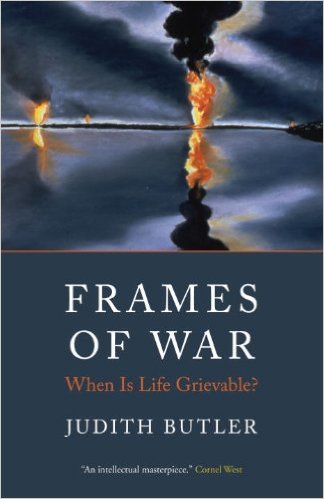
BUTLER Frames of WarElie’s and Hamid’s questions are multiple anguished variations of Judith Butler‘s trenchant demand: why are these lives deemed grievable and not those others?

To ask this is not to minimise the sheer bloody horror of mass terrorism in Paris nor to marginalise the terror, pain and suffering inflicted last night on hundreds of innocents – and also affecting directly or indirectly thousands and thousands of others.

In fact the question assumes a new urgency in the wake of what happened in Paris – where I think the most telling comparison is with Beirut and not with the attacks on Charlie Hebdo (see my commentary here) – because the extreme right (the very same people who once elected to stuff “Freedom Fries” down their throats) has lost no time in using last night’s events to ramp up their denigration of Syrian refugees and their demands for yet more bombing (and dismally failing to see any connection between the two).  You can see something of what I mean here.

And so I suggest we reflect on Jason Burke‘s commentary on Islamic State’s decision to ‘go global’ and its tripartite strategy of what he calls ‘terrorise, mobilise, polarise’.  The three are closely connected, but it’s the last term that is crucial:

In February this year, in a chilling editorial in its propaganda magazine, Dabiq, Isis laid out its own strategy to eliminate what the writer, or writers, called “the grey zone”.

This was, Isis said, what lay between belief and unbelief, good and evil, the righteous and the damned. It was home, too, to all those who had yet to commit to the forces of either side.

The grey zone, Isis claimed, had been “critically endangered [since] the blessed operations of September 11th”, as “these operations showed the world” the two camps that mankind must choose between.

Over the years, since successive violent acts had narrowed the grey zone to the point where by the end of 2014 “the time had come for another event to … bring division to the world and destroy the grey zone everywhere”.
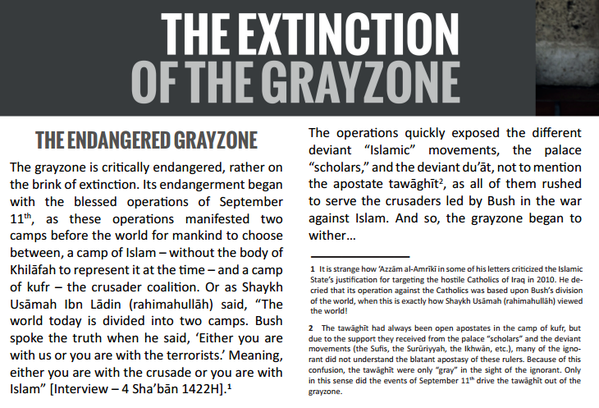
extinction-of-the-grayzone

More from Ben Norton here.  The imaginative geographies of Islamic State overlap with those spewed by the extreme right in Europe and North America and, like all imaginative geographies, they have palpable effects: not fifty shades of grey but fifty versions of supposedly redemptive violence.

UPDATE (1):  For more on these questions – and the relevance of Butler’s work– see Carolina Yoko Furusho‘s essay ‘On Selective Grief’ at Critical Legal Thinking here.

As it happens, Judith is in Paris, and posted a short reflection on Verso’s blog here.  She ends with these paragraphs:

My wager is that the discourse on liberty will be important to track in the coming days and weeks, and that it will have implications for the security state and the narrowing versions of democracy before us. One version of liberty is attacked by the enemy, another version is restricted by the state. The state defends the version of liberty attacked as the very heart of France, and yet suspends freedom of assembly (“the right to demonstrate”) in the midst of its mourning and prepares for an even more thorough militarization of the police. The political question seems to be, what version of the right-wing will prevail in the coming elections? And what now becomes a permissable right-wing once le Pen becomes the “center”. Horrific, sad, and foreboding times, but hopefully we can still think and speak and act in the midst of it.

Mourning seems fully restricted within the national frame. The nearly 50 dead in Beirut from the day before are barely mentioned, and neither are the 111 in Palestine killed in the last weeks alone, or the scores in Ankara. Most people I know describe themseves as “at an impasse”, not able to think the situation through. One way to think about it may be to come up with a concept of transversal grief, to consider how the metrics of grievability work, why the cafe as target pulls at my heart in ways that other targets cannot. It seems that fear and rage may well turn into a fierce embrace of a police state. I suppose this is why I prefer those who find themselves at an impasse. That means that this will take some time to think through. It is difficult to think when one is appalled. It requires time, and those who are willing to take it with you – something that has a chance of happening in an unauthorized “rassemblement” [gathering].

UPDATE (2): At Open Democracy Nafeez Mossadeq Ahmed has a helpful essay, ‘ISIS wants to destroy the “grey zone”: Here’s how we defend it’: access here.
Unimaginative geographies

Last week I was asked to contribute a 6-700 word Op-Ed to the Washington Post‘s In Theory series on ‘othering’ and the Middle East.  They wanted me to write about Edward Said‘s concept of ‘imaginative geographies’ and its implications for US foreign policy.

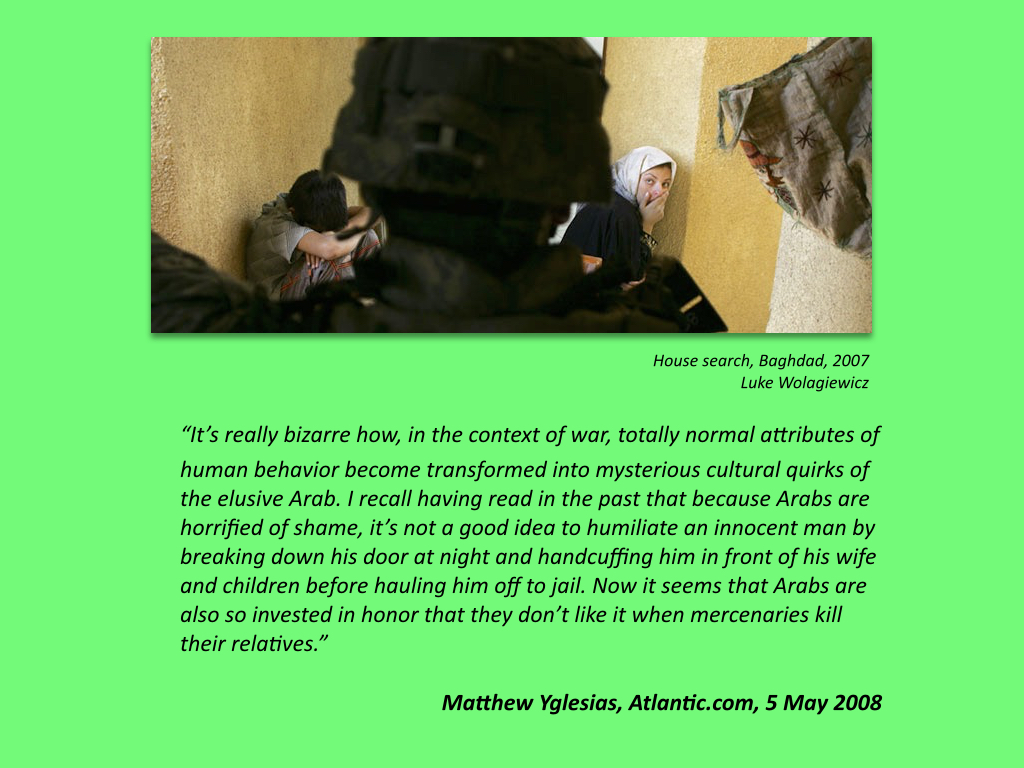
I wrote a quick draft and sent it off.  The core argument was that one of the most debilitating consequences of these bipolar imaginative geographies is their refusal to recognize and value those things that we have in common with others.  This wasn’t a clarion call for the reinstatement of the supposedly universal subject of humanism, of course: just a reminder that the accent on difference can blind us to the co-presence of commonality.  Nothing new about that, really, and like Matthew Yglesias (below) I’ve been arguing this for an age:

YGLESIAS Commonality.001

Then I took the dog for a walk.  By the time I returned, I had an idea for a conclusion, which was about radical narcissism, so I sent it off:

At best, we are offered a radical narcissism in which we imagine what it would be like if the suburbs of Washington, D.C., suffered air raids night after night, or if our skies were full of the sound of drones, watching and waiting to strike without warning. In imagining our lives made newly vulnerable to military violence, however, we continue to privilege “our” space and separate it from “their” space. If we can imagine such horrors happening to us, why is it so difficult to imagine them being visited on others?

This follows more or less directly from what I’d been thinking about the ways in which, in the wake of Hiroshima and Nagasaki, the United States collectively imagined itself as newly vulnerable: hence the stream of articles and illustrations in the 1940s and 50s imagining a nuclear strike on New York or Washington.

But over the weekend I took the dog for another walk, and had another thought – about the politics of affect.   If we limit our understanding of imaginative geographies to the interpretative frameworks of ‘the other’ – the assumptions and conventions through which they make sense of the world – then we marginalise the affective: in particular those visceral responses to the experience of violent death and destruction which we also share to varying degrees.  So it is that too often we fail to grasp the anger of somebody desperately seeking shelter from yet another air strike, the anguish of a mother or father cradling the body of their dead child, the despair of a family as they watch their home bulldozed to the ground, or the humiliation of a young man made to lower his trousers and raise his shirt by soldiers at a checkpoint.  And as we attribute their response to ‘their’ unreason we continue to inflict our own, always ‘rational’ – read ‘precise’, ‘measured’, ‘scientific’ – violence upon them.

Too late for the published version, which you can find here.

Surgical strike

Kunduz Trauma Center (Andrew Quilty)

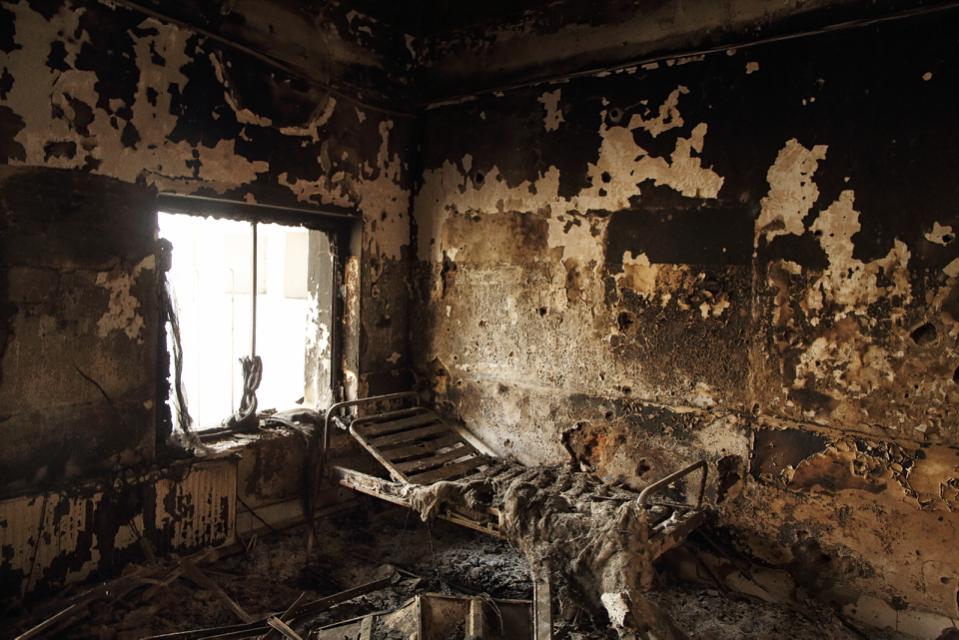
An update to my post (which I’ve updated several times) on the US air strike on the hospital in Kunduz early last month: MSF has released an internal review of the events that took place that night.  It’s only a preliminary report – the inquiry is ongoing – but it makes for grim reading.

MSF opened its Kunduz Trauma Center in August 2011, providing free, high-quality surgical care to all those who needed it (for more on MSF and other medical charities in Afghanistan, see my post on ‘The prosthetics of military violence’ here).

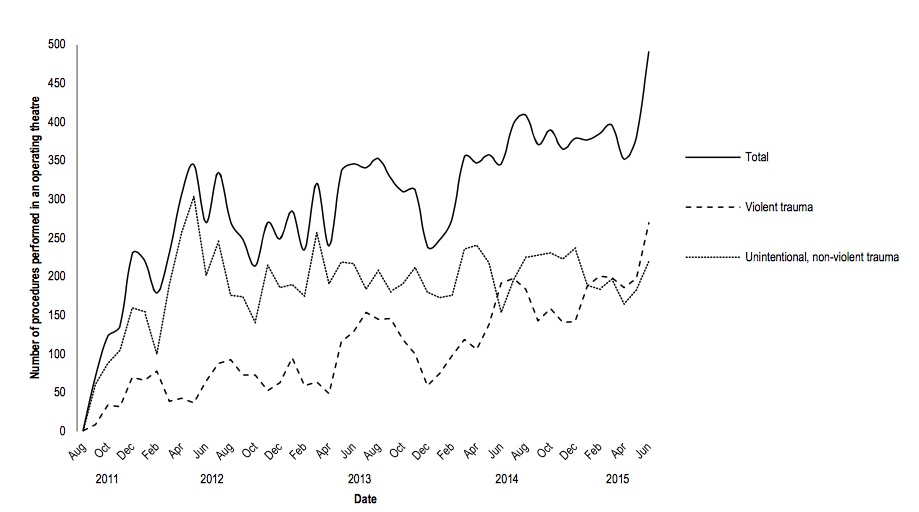
By the end of September 2015 the original 92 beds had grown to 140 as the numbers being treated grew:

Case load Kunduz Trauma Center 2011-2015 (MSF)

MSF is an experienced, highly regarded relief organisation and so it comes as no surprise to learn that it was fully aware of the cardinal principle of medical neutrality and took all possible steps to secure the legal and military foundations on which it operated:

MSF activities in Kunduz were based on a thorough process to reach an agreement with all parties to the conflict to respect the neutrality of our medical facility. In Afghanistan, agreements were reached with the health authorities of both the government of Afghanistan and health authorities affiliated with the relevant armed opposition groups. These agreements contain specific reference to the applicable sections of International Humanitarian Law including:

  • –  Guaranteeing the right to treat all wounded and sick without discrimination
  • –  Protection of patients and staff guaranteeing non-harassment whilst under medical care
  • –  Immunity from prosecution for performing their medical duties for our staff
  • –  Respect for medical and patient confidentiality
  • –  Respect of a ‘no-weapon’ policy within the hospital compound

The report makes it clear that this had been clearly endorsed by all the military and paramilitary parties to the conflict.

Fighting intensified in the week before the air strike.  Most of those treated since the Trauma Center opened had been from the Afghan government side, but from Monday 28 September ‘this shifted to primarily wounded Taliban combatants.’  The Afghan government speedily arranged the transfer of all its patients (apart from the most severely wounded cases) to another hospital.  By that night the Taliban announced that it was in control of the district.

The next day, as the numbers seeking treatment increased yet again, MSF reconfirmed the GPS co-ordinates of the Trauma Center with both the Afghan authorities and the US military.

On Thursday 1 October MSF was asked by Carter Malkasian, a a special adviser to the Chairman of the Joint Chiefs of Staff, whether the hospital ‘had a large number of Taliban “holed up” and enquired about the safety of [MSF] staff’ and was told that its staff ‘were working at full capacity’ and that the hospital ‘was full of patients including wounded Taliban combatants’.  And because the Taliban were hors de combat they were not a legitimate military target: there is absolutely no ambiguity about this.

That same day a UN civilian/military liason ‘advised MSF to remain within the GPS coordinates provided to all parties to the conflict as “bombing is ongoing in Kunduz.”’

On Friday 2 October two large MSF flags were placed on the roof of the hospital.  That night the hospital was calm, there was no fighting taking place within the vicinity and MSF insists that there were no armed combatants in the buildings or the grounds of the hospital.

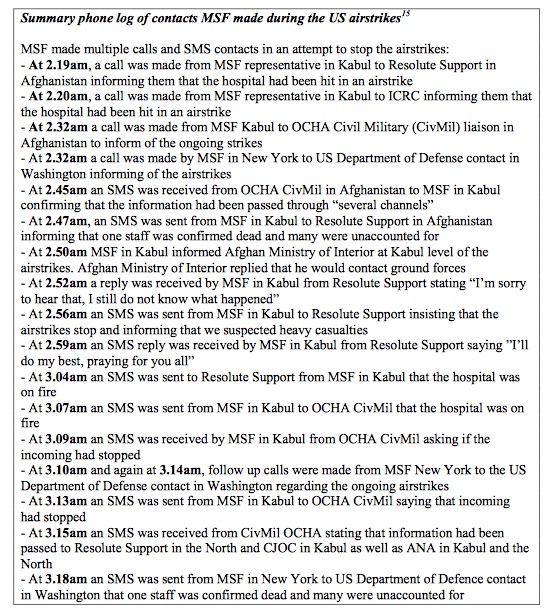
The air strikes began soon after 2 a.m. on Saturday 3 October, and throughout the attack – which lasted for over an hour – MSF made repeated attempts to stop the assault:

MSF Kunduz phone log

And yet, despite everything the US military had been told in advance and despite these repeated attempts to stop the air strikes, an AC-130 gunship made five repeated passes:

A series of multiple, precise and sustained airstrikes targeted the main hospital building, leaving the rest of the buildings in the MSF compound comparatively untouched. This specific building of the hospital correlates exactly with the GPS coordinates provided to the parties to the conflict [my emphasis].

Bombing of Kunduz Trauma Center

As MSF’s Director concludes,

‘The question remains as to whether our hospital lost its protected status in the eyes of the military forces engaged in this attack – and if so, why. The answer does not lie within the MSF hospital. Those responsible for requesting, ordering and approving the airstrikes hold these answers’.

And, as the report notes, this is the view from the inside: ‘What we lack is the view from outside the hospital – what happened within the military chains of command.’

So far, controlled leaks from the US military investigation have suggested that an Afghan ‘rapid reaction force’ requested the attack, that it had been rushed to Kunduz from elsewhere in Afghanistan, arriving ‘just days before the air strike’, and that it had no experience in working with the US ground troops from the Third Special Forces Group who relayed the request for ‘aerial fires’ to the Joint Operations Center at Kunduz airfield.  The Green Berets ‘were aware it was a functioning hospital,’ AP reported, ‘but believed it was under Taliban control.’  The report continues:

The Green Berets had asked for Air Force intelligence-gathering flights over the hospital, and both Green Berets and Air Force personnel were aware it was a protected medical facility, the records show, according to the two people who have seen the documents.

The analysts’ dossier included maps with the hospital circled, along with indications that intelligence agencies were tracking the location of [an] … operative [from Pakistan’s Inter-Services Intelligence directorate who was allegedly co-ordinating Taliban operations in the area] and activity reports based on overhead surveillance, according to a former intelligence official who is familiar with some of the documents. The intelligence suggested the hospital was being used as a Taliban command and control center and may have housed heavy weapons.

According to the Washington Post,

… the crew of the AC-130, call sign Hammer, verified their permission to fire twice before engaging the hospital. AC-130Us carry a crew of 14, often including a special forces liaison officer responsible for communicating with ground units.

And the US troops remained in contact with the AC-130 gunship throughout the attacks.

So even if you accept all these unverified claims about the intelligence (or lack of it) behind the air strikes, you surely have to wonder about the studied lack of response to the repeated calls to have the attacks stopped.  Bear in mind, too, that the AC-130 has a sophisticated sensor suite on board, including IR and low-light cameras, that the hospital kept its lights on throughout the night (it was one of the few buildings in the city whose electricity was still working), and that MSF staff were advised to remain inside the co-ordinate grid they had given to the military: which turned out to be the very co-ordinates used for the attack.  It seems dismally clear that the trauma center was precisely targeted and that it could not have been mistaken for any other building.

Regular readers will know that the US military has repeatedly relied on an elaborate bio-medical discourse to legitimise its actions (for a brilliant recent discussion, see Elke Schwarz‘s ‘Prescription drones: on the techno-biopolitical regimes of contemporary ‘ethical killing’’, online early at Security Dialogue); the most familiar version, hideously ironic given the events in Kunduz, is the claim that the US military has an unprecedented ability to carry out ‘surgical strikes’…

UPDATE:  For an excellent analysis, see Kate Clark at the Afghan Analysts Network here

Big Data and Bombs on Fifth Avenue

Big Data, No Thanks

James Bridle has posted a lightly edited version of the excellent presentation he gave to “Through Post-Atomic Eyes” in Toronto last month – Big Data, No Thanks – at his blog booktwo.  It’s an artful mix of text and images and, as always with James, both repay close scrutiny.

If you look at the situation we are in now, a couple of years after the Snowden revelations, most if not all of the activities which they uncovered have been, if not secretly authorised already, signed into law and continued without much fuss.

As Trevor Paglen has said: Wikileaks and the NSA have essentially the same political position: there are dark secrets at the heart of the world, and if we can only bring them to light, everything will magically be made better. One legitimises the other. Transparency is not enough – and certainly not when it operates in only one direction.  This process has also made me question my own practice and that of many others, because making the invisible visible is not enough either.

James talks about the ‘existential dread’ he feels caused not ‘by the shadow of the bomb, but by the shadow of data’:

It’s easy to feel, looking back, that we spent the 20th Century living in a minefield, and I think we’re still living in a minefield now, one where critical public health infrastructure runs on insecure public phone networks, financial markets rely on vulnerable, decades-old computer systems, and everything from mortgage applications to lethal weapons systems are governed by inscrutable and unaccountable softwares. This structural and existential threat, which is both to our individual liberty and our collective society, is largely concealed from us by commercial and political interests, and nuclear history is a good primer in how that has been standard practice for quite some time.

newyorker-720-loIt’s a much richer argument than these snippets can convey.  For me, the high spot comes when James talks about IBM’s Selective Sequence Electronic Calculator (really), which turns out to be the most explosive combination of secrecy and visibility that you could possibly imagine.

I’m not going to spoil it – go and read it for yourself, and then the title of this post will make horrible sense.  You can read more in George Dyson‘s absorbingly intricate account of Turing’s Cathedral: the origins of the digital universe (Allen Lane/Penguin, 2012).

Atomic soldiers and the nuclear battlefield

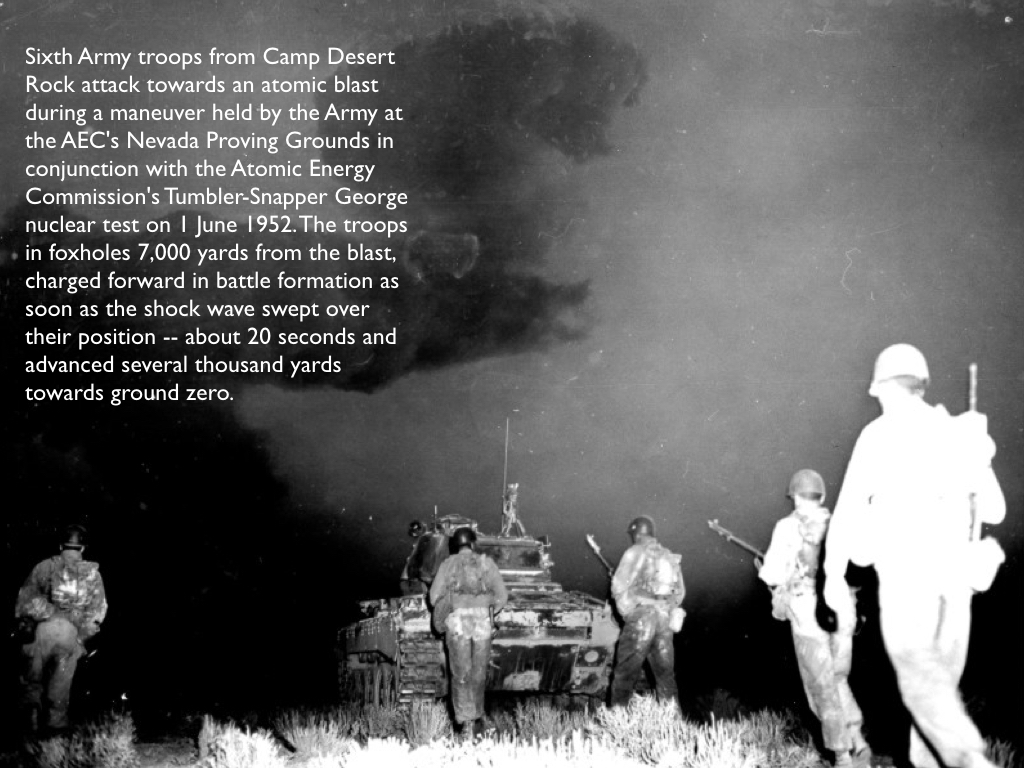
As promised, I’ve posted the slides from my presentation on “Little Boys and Blue Skies: drones through post-atomic eyes” under the DOWNLOADS tab.  Given my previous posts (here and here) these ought to be reasonably self-explanatory, but I’ve added a series of images derived from Matt Farish‘s brilliant presentation “Beneath the bombs” at the same conference and these probably need explanation.

Tumbler-Snapper 1 June 1952.001

One of the central themes of my presentation was the emphasis placed on American lives by those who planned the attacks on Hiroshima and Nagasaki – which is why the crew of the Enola Gay had to execute such a tight turn to escape the shock waves from the blast – and by American commentators who almost immediately contemplated the possibility of a nuclear attack on the continental United States.

The same was true of those who prepared for subsequent nuclear strikes (which is why the US Air Force experimented with drones to ‘deliver’ the bombs) and by those who orchestrated subsequent nuclear tests in the Marshall Islands and in Nevada (which is why the US Air Force and the US Navy used drones to fly through the atomic clouds to collect samples).

As I showed in the presentation, these same priorities have been extended to today’s use of armed drones by the US Air Force, which repeatedly cites its Predators and Reapers as ‘projecting power without vulnerability’.

All of this will be clear from my slides and posts.

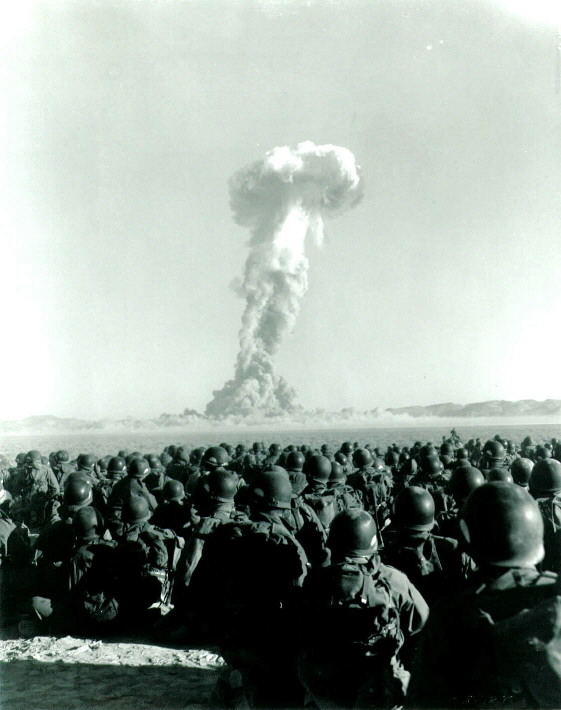
Troops watching atomic test, Yucca Flat, November 1951

But what I didn’t know was that the US Army and Marine Corps had no such qualms about exposing the bodies of their soldiers and marines to the dangers of atomic tests.  Matt described a series of exercises in Nevada – Desert Rock – held between 1951 and 1957 in which ground troops not only watched the tests from a distance (this I did know: see the image above) but were also ordered forward to secure the blast area.  Here is an official video (watch from 3.00).

This is a silent film, but if you prefer a video with a jaunty, reassuring commentary you can find one from the Internet Archive here.  It’s accompanied by this transcript of an interview between a sergeant and a training officer before a blast:

Question. “How many of your men would volunteer to go up and be in the foxholes?” (one-half mile from ground zero)

Answer. “I guess about half a dozen.”

Question. “It’s quite a loud noise when that bomb goes off … would it do them any harm?”

Answer. “No sir, not the noise, no.”

Question. “How about the radiation? Do you think there is much danger?”

Answer. “Radiation is the least of their worries that the men are thinking about.”

Question. “I think most thought radiation was the greatest danger, didn’t they? Where did they learn differently?”

Answer. “They were, prior to our instructions here. We received a very thorough briefing.”
royal_nevada_atomic_soldiers_19550418_courtesy_las_vegas_news_bureau_WEB-300x300

Part of the purpose of the tests was indeed to show how safe the tests were.  As Dr Richard Meiling, the chair of the Armed Forces Medical Policy Council, explained in a memorandum to the Pentagon on 27 June 1951:

‘Fear of radiation … is almost universal among the uninitiated and unless it is overcome in the military forces it could present a most serious problem if atomic weapons are used…. It has been proven repeatedly that persistent ionizing radiation following air bursts does not occur, hence the fear that it presents a dangerous hazard to personnel is groundless.’

Meiling-Richard-L.-218x300Meiling recommended that ‘positive action be taken at the earliest opportunity to demonstrate this fact in a practical manner’, ideally by deploying a Regimental Combat Team ‘approximately twelve miles from the designated ground zero of an air blast and immediately following the explosion . . . they should move into the burst area in fulfillment of a tactical problem.’

In effect, Meiling wanted to conduct an extended psychological experiment in which the Test Site would become a vast human – as much as physical – laboratory.

Simon 1953 EMP shock test

According to a report from the Human Resources Research Organization:

By means of attitude measurement methods measuring psychological effects of stress, both applied at critical points during the maneuver, an attempt was made:

1. To evaluate effects of atomic indoctrination on troop participants; and

2. To estimate effects of the detonation together with its accompanying affects on performance.

One Army officer, Captain Richard Taffe, provided a remarkably cheery first-hand account for Collier’s on 26 January 1952:

I walked through an atom-bombed area. I didn’t get burned, I didn’t become radioactive, and I didn’t become sterile. And neither did the 5,000 guys with me. Furthermore, I wasn’t scared—either while taking my walk through the blasted miles, or while watching the world’s most feared weapon being exploded seven miles in front of me.

But, I’ve been asked a hundred times since the Desert Rock maneuvers at Yucca Flats in the Nevada atomic test site, “What was it like?”…

Suddenly it came. A gigantic flash of white light, bright as a photoflash bulb exploding in our eyes—even with our backs turned. The order “Turn” screamed over the public address system and 5,000 soldiers spun and stared. As we turned, it was as though someone had opened the door of a blast furnace as the terrific heat reached us. There, suspended over the desert floor, was the fireball which follows the initial flash of an atomic bomb.

Hung there in the sky, the tremendous ball of flame was too blinding to stare at, and suddenly there was much more to see.

Sucked into that fireball were the tons of debris from the desert floor. Almost at once dust clouds climbed hundreds of yards off the ground for miles in each direction. Then the familiar column of dirty gray smoke formed and started to rise.

Up to this point we had seen, but we had not heard and we had not felt, the explosion.

But then came the shock wave. The ground beneath us started to heave and sway. Not back and forth as you might expect, but sideways. The earthquakelike movement of the ground rocked us on our haunches and, had we been standing, it could have knocked us down.

About that time, our heads were snapped back with the force of the terrible blast as the sound finally crossed those seven miles and reached us. The tremendous crack was a louder one than most of us had ever heard before. And right behind it came another crack—there seemed to be some debate as to whether this was an echo or another chain reaction in the fireball.

From the throats of everyone there came noises. Noises, not words. I listened particularly for the first coherent statement, but, like myself, few people could voice normal exclamations. It was not something normal and words just wouldn’t come out—only unintelligible sounds.

The first words I did hear came from a caustic corporal behind me, who said, almost calmly, “Well, I finally located that damned Ground Zero.”

Our roar of laughter broke the tension, but the spectacle was far from over.

The horror turned to beauty. It isn’t difficult to associate the word beautiful with such a lethal exhibition, because from this point on, the atomic blast became just that—beautiful. A column rose from where the fireball had dimmed, crawled through the brown doughnut above the fireball, and boiled skyward. The dirty gray of the stem was rapidly offset by the purple hues and blues of the column. Then came the mushroom—the trade-mark of an atomic bomb.

Capped in pure white, the seething mushroom emitted browns, blood orange, pastel pinks, each fighting its way to the surface only to be sucked to the bottom and then back into the middle of the mass of white. Within minutes, the top was at 30,000 feet and then the huge cloud broke loose from the stem and drifted in the wind toward Las Vegas. . . .

This explosion had three lethal qualities. They were: blast, heat and radiation. The greatest fear the public has today in connection with the atom bomb probably is radiation. People forget that it caused only 15 per cent of the 140,000 deaths at Hiroshima.

One second after an air burst of an atom bomb, 50 per cent of the radiation is gone. All danger of lingering radiation has disappeared after 90 seconds.

As to the other two qualities, blast caused 60 per cent of the deaths at Hiroshima. Heat and the accompanying fires accounted for the other 25 per cent. . . .

As we moved up the road in the trucks, the effects of the blast became more apparent. About two miles from Ground Zero—and incidentally the bomber dropped his lethal egg in the proverbial bucket, right on the target—it became obvious that a terrible force had been at work.

At one of the closest positions we again left the trucks and walked through the charred area. Despite the devastation, there was no doubt that a successful attack could have been made by friendly troops directly through the blasted area—immediately after the explosion.

You can find much more here (scroll way down).  The purpose of reports like this was clearly to ‘indoctrinate’ a far wider audience than the US military.

All of this raises two questions.  One is about the radical difference between saving the lives of airmen and risking the lives of ground troops; the answer surely lies only partly in the insistence that there was no risk at all – since the Air Force clearly believed otherwise – and so must also lie in a dismal cost-benefit analysis that reckoned the cost (and time) involved in training aircrew against that involved in training ground troops.

The other is about what could possibly have required a ‘successful attack’ on ground zero and what would have been left for those troops to ‘secure’ after the blast…

Note: If you wonder about the long-term effects of the tests on residents of the area around the Nevada Test Site, see Harvey Wasserman and Norman Solomon, Killing our own: the disaster of America’s experiencewith atomic radiation, which is open access here (see chapter 3: ‘Bringing the bombs home’).

The US Advisory Committee on Human Radiation Experiments provided a report on the effects on ground troops in The Human Radiation Experiments (1996) (Ch 10: ‘Atomic veterans: human experimentation in connection with bomb tests’).

“What is that sound high in the air?”

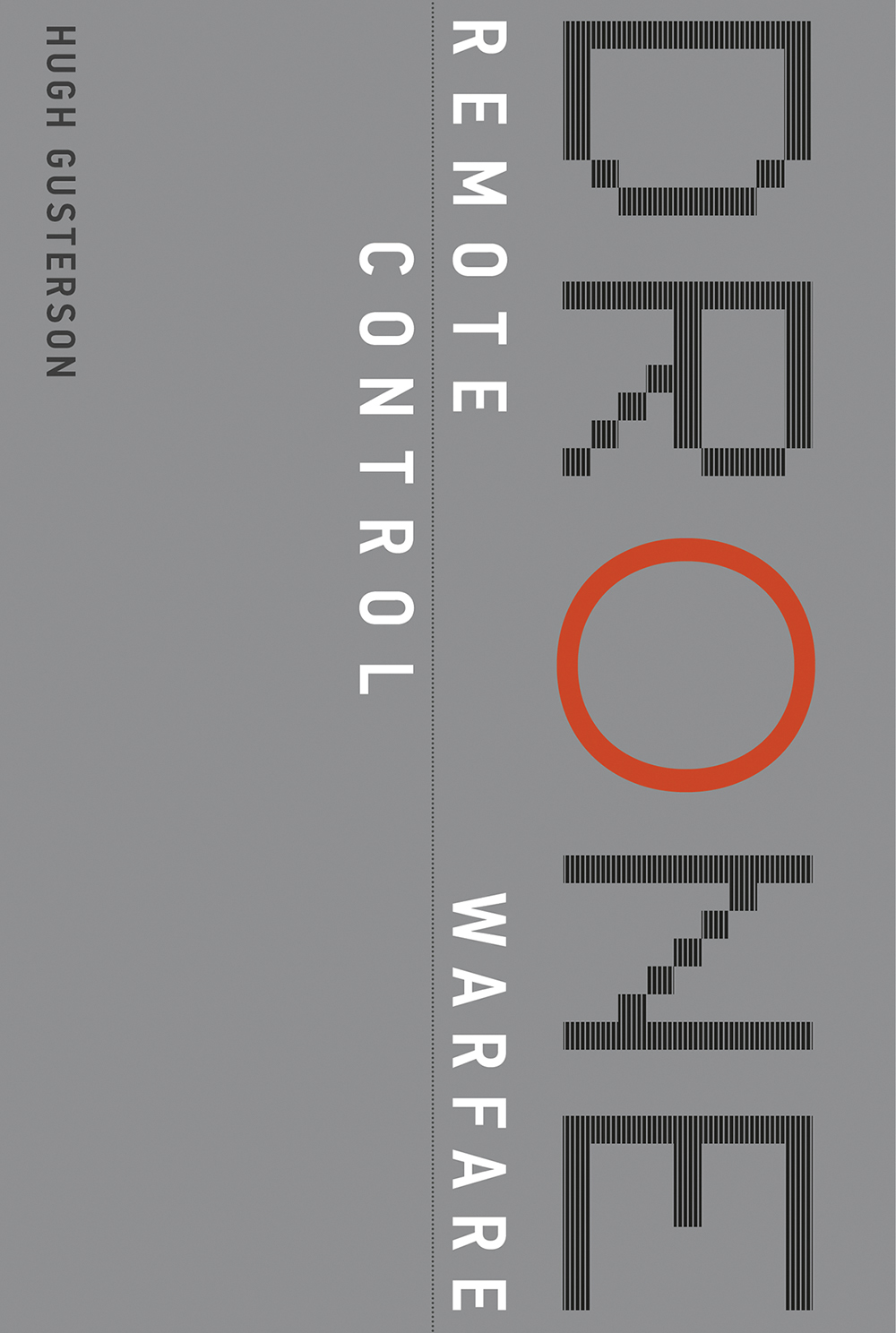
Coming from MIT in April next year, a new book by the ever-creative anthropologist Hugh Gusterson, Drone: remote control warfare.

GUSTERSON DroneDrones are changing the conduct of war. Deployed at presidential discretion, they can be used in regular war zones or to kill people in such countries as Yemen and Somalia, where the United States is not officially at war. Advocates say that drones are more precise than conventional bombers, allowing warfare with minimal civilian deaths while keeping American pilots out of harm’s way. Critics say that drones are cowardly and that they often kill innocent civilians while terrorizing entire villages on the ground. In this book, Hugh Gusterson explores the significance of drone warfare from multiple perspectives, drawing on accounts by drone operators, victims of drone attacks, anti-drone activists, human rights activists, international lawyers, journalists, military thinkers, and academic experts.

Gusterson examines the way drone warfare has created commuter warriors and redefined the space of the battlefield. He looks at the paradoxical mix of closeness and distance involved in remote killing: is it easier than killing someone on the physical battlefield if you have to watch onscreen? He suggests a new way of understanding the debate over civilian casualties of drone attacks. He maps “ethical slippage” over time in the Obama administration’s targeting practices. And he contrasts Obama administration officials’ legal justification of drone attacks with arguments by international lawyers and NGOs.

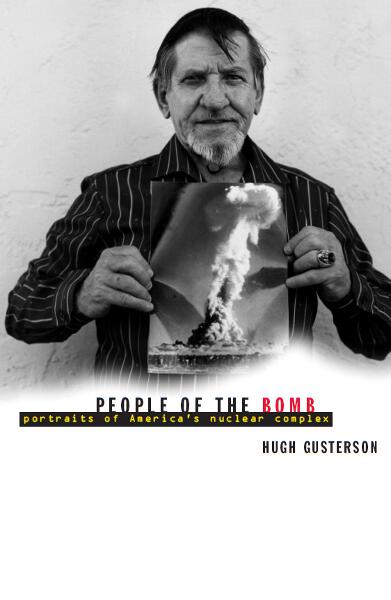
People of the bombI met Hugh at a conference on Orientalism and War in Oxford several years ago, and I’ve recently been reading his Nuclear Rites: a weapons laboratory and the end of the Cold War and People of the Bomb: Portraits of America’s Nuclear Complex as I continue my wanderings through the nuclear wastelands.

The coincidence between Hugh’s previous projects and his new one intersects with my presentation on “Little Boys and Blue Skies” in Toronto last week – see here and here – which sketched out a series of entanglements between drones and the nuclear wastelands (hence the Eliot quotation which serves as my title for this post).

Drones and atomic clouds

I’m off to Toronto on Thursday to speak at the symposium “Through Post-Atomic Eyes“.  I posted some of my earlier notes for my presentation, ‘Little Boys and Blue Skies: Drones through post-atomic eyes‘, and since then I’ve been digging deeper into the strange intersections between nuclear weapons and today’s Predators and Reapers.

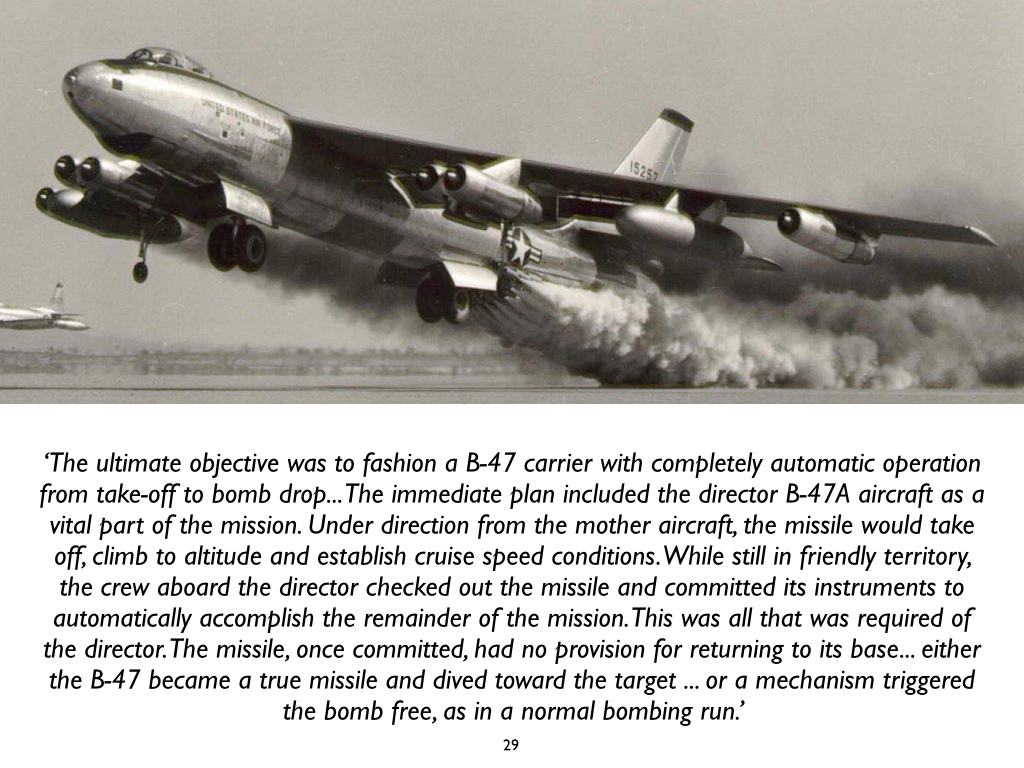
In my original post I described the US Air Force’s early attempts to devise a way of delivering atomic bombs from remotely piloted aircraft – notably Project Brass Ring:

B-47 drone.001

Following a tip from Matt Farish (who will also be speaking at the conference) I’ve now discovered that drones were also used to monitor the ‘atomic clouds’.

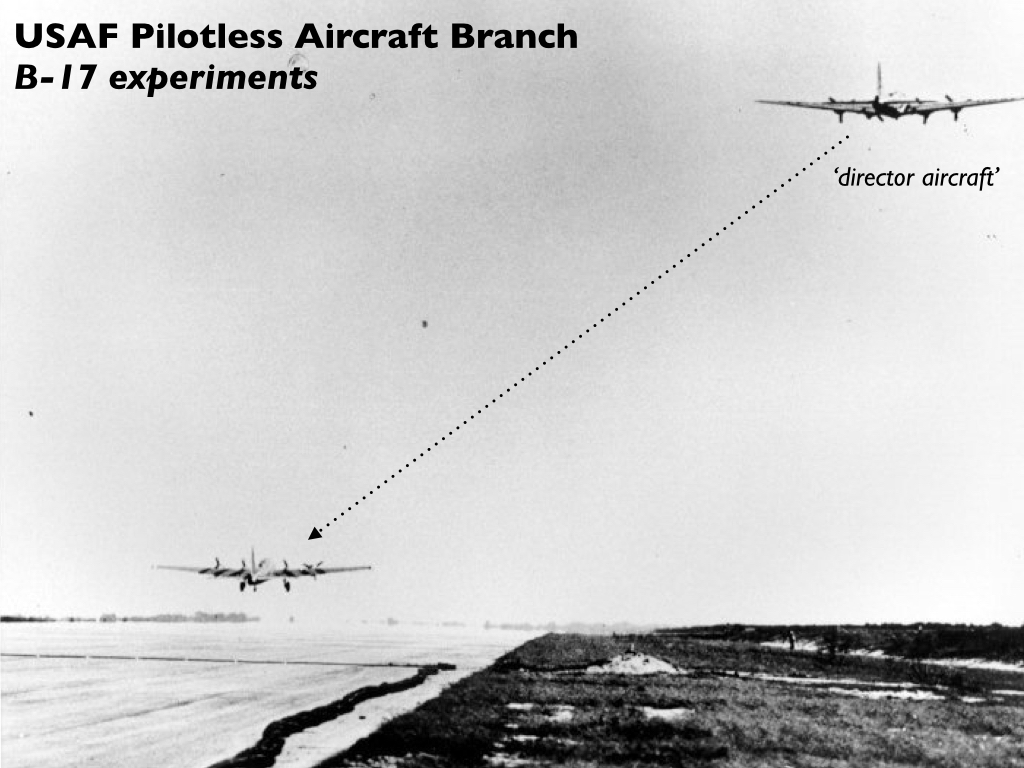
Shortly after the Second World War the US Air Force’s Pilotless Aircraft Branch resumed its experiments with remotely controlling B-17 bombers from ‘director aircraft’ and from ground stations:

B17 experiments.001

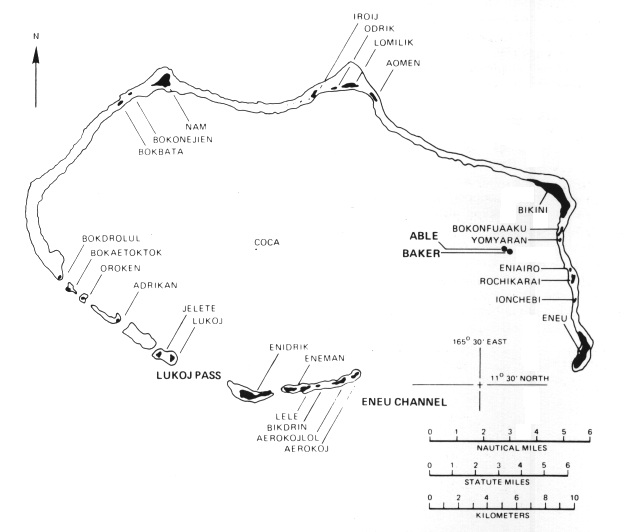
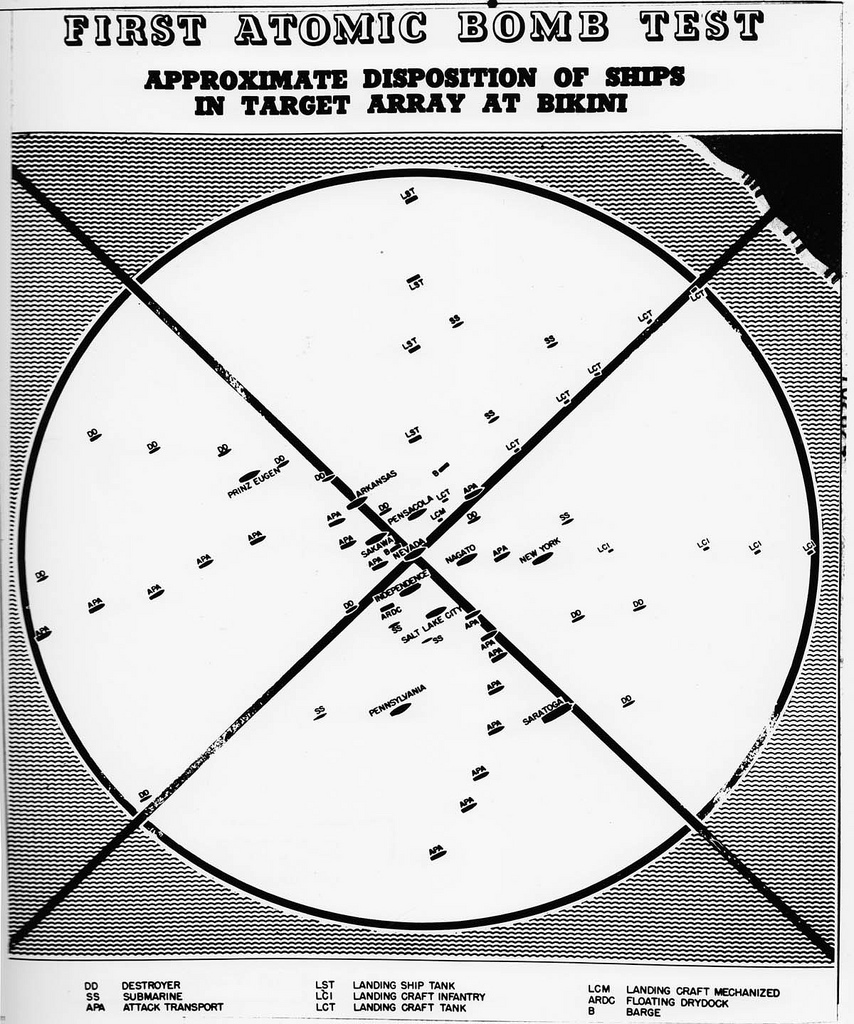
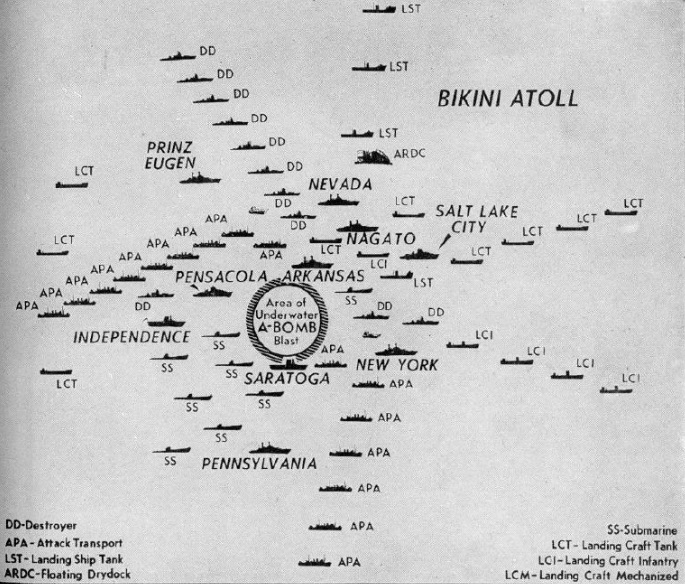
By July 1946 six to them were being successfully operated by the Army Air Group’s Drone Unit, and they were in action over Bikini Atoll in the Marshall Islands for the series of nuclear tests known as Operation Crossroads.   The first test (Able) was carried out on 1 July 1946, when a B-29 Superfortress (“Dave’s Dream”) dropped a plutonium bomb of the same power used against Nagasaki from a height of 30,000 feet on a target fleet of 90 obsolete ships; it was an air burst, detonating 520 feet above the ships (the aim point was the battleship USS Nevada, perhaps appropriately enough given that state’s use for nuclear testing in the decades ahead; it was painted bright red to make it visible to the bombardier, but the bomb missed it y 1870 feet).

Bikini2

Operation Crossroads Target Array

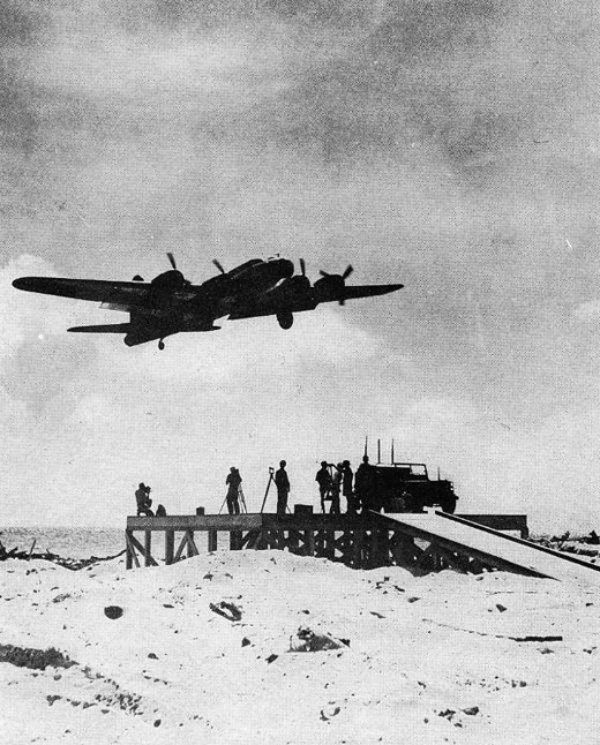
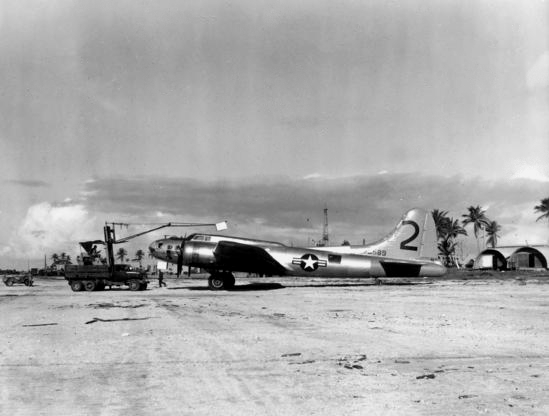
The B-17s were on station 20-30 miles away, and they were the first to approach the target area.  Eight minutes after Mike Hour one of them entered the cloud at 24,000 feet, followed by three others at 30,000 feet, 18,000 feet and 13,000 feet.  The image below shows a B-17 landing at Eniwetok under ground control:

B-17 drone Bikini

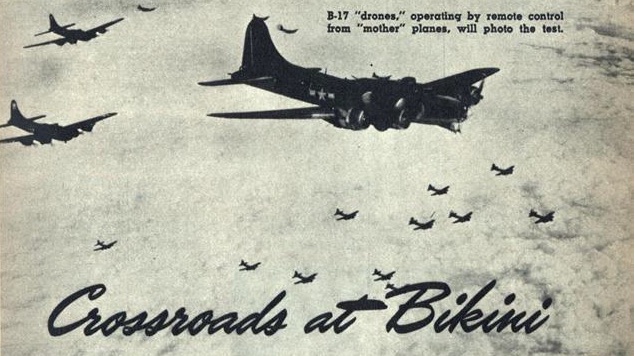
There was nothing secret about their use – like the bomb itself, making the drones public was a vital part of demonstrating American military and technical superiority.  Here, for example, is an image from Mechanix Illustrated in June 1946 describing Operation Crossroads :

Crossroads at Bikini Mexhanix Illustrated June 1946

According to Bombs at Bikini, the official (public) report on Operation Crossroads, prepared for Join Task Force One and published in 1947:

A number of Army Air Forces officials believe that the drone-plane program undertaken for Crossroads advanced the science of drone-plane operations by a year or more. To be sure, a fewwar-weary B-17’s had been flown without crews during the latter part of the recent war [Operation Aphrodite], but they and their cargoes of explosives were deliberately crash-landed. Also, a few B-17’s had been landed by remote control; but pilots were aboard, ready to take over control in case of trouble. Operation Crossroads was the first operation in which take-off, flight, and landing were accomplished with no one aboard. The feat was an impressive one; many experts had thought it could never be accomplished with planes of this size.

As this video clip shows (start at 6.01), take-off was under the control of a ‘ground beep pilot’, who then handed over to a ‘beep television control pilot’ in an accompanying director aircraft (‘the mother ship’), who handed back to the ground beep pilot for the landing.  This parallels today’s ‘remote-split operations’, though on a greatly reduced spatial scale, where a Launch and Recovery crew stationed in or near the combat zone is responsible for take-off and landing while the mission is flown by a ground control crew in the continental United States):

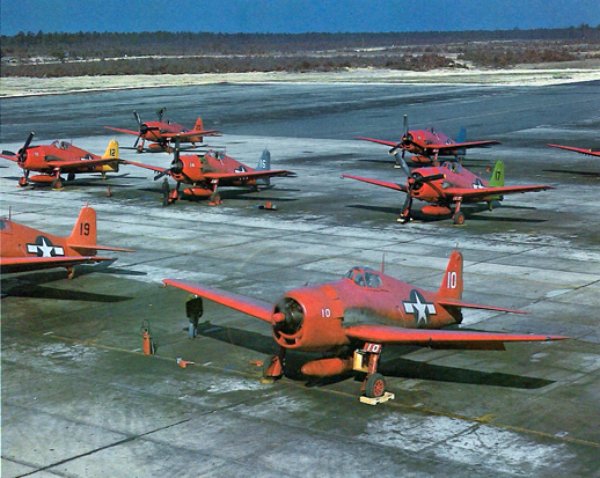
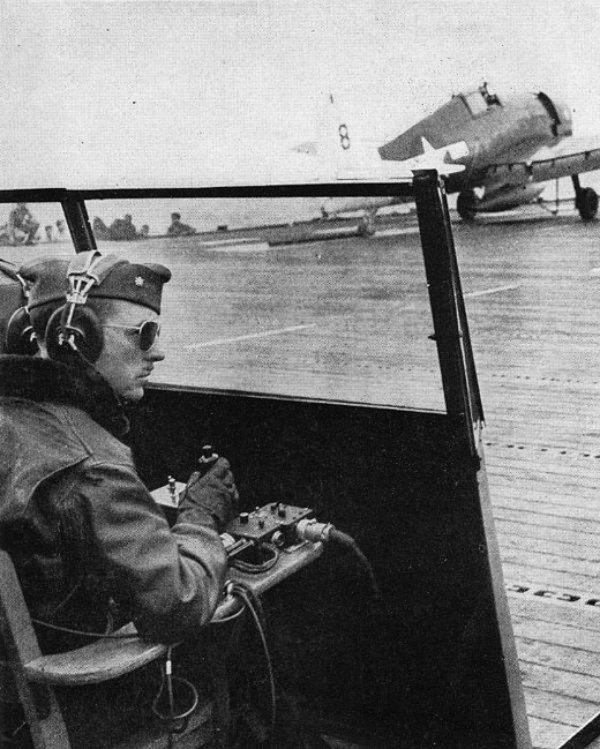
The B-17 drones operated in concert with the US Navy’s F6F-5 Hellcat drones which made transits of the cloud at 20,000 feet, 15,000 feet and 10,000 feet (see the first image below; the tail fins are painted different colours to indicate different control frequencies: more here).  The second image shows a pilot on the deck of the aircraft carrier Shangri-La controlling an F6F-5 before take-0ff; landing on the deck of a carrier was difficult enough at the best of times and with a skilled crew on board, and not surprisingly the Navy drones returned to Roi island, part of Kwajalein Atoll.

Hellcats-Bikini-1946.jpg__600x0_q85_upscale

shangri-la.jpg__600x0_q85_upscale

Paul Hoversten reports:

No manned aircraft flew over the center of the blast, called Zeropoint, until four hours later, although manned boats were on the scene after two hours.  Drones were also flown after the second test, Baker, on July 25, which was an underwater shot suspended from a target ship in Bikini’s lagoon.

Bikini atoll target disposition

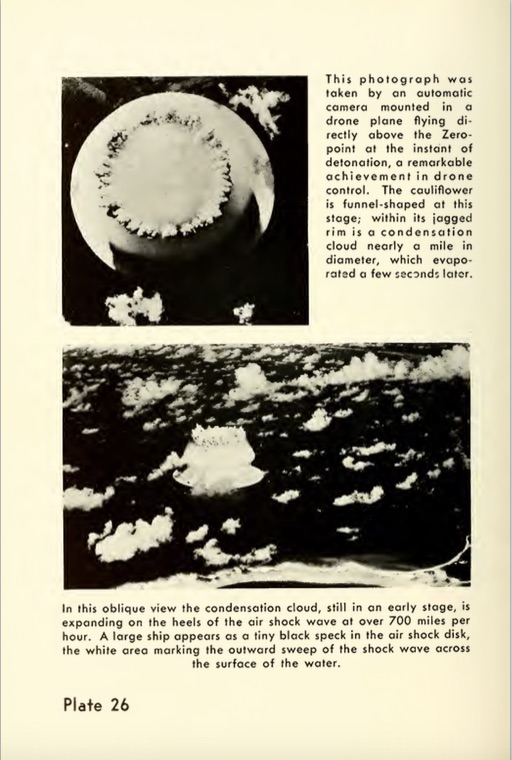
In each case the drones were tasked to take air samples from the cloud (using filters housed in boxes under the wings) and to photograph the cloud formation:

Bikini 4

As the official pictorial record boasted (its very existence underlining the importance of a controlled ‘publicness’ to these tests):

Drone planes penetrated where no man could have ventured, flew through the mushroom cloud on photographic missions, sampled its poisonous content, televised to remote onlookers their instrument panel readings for flight analysis.

The samples were crucial, and drones remained of vital importance in collecting them.  The image below shows the air filters being removed from a remotely operated B-17 used in Operation Sandstone (a series of nuclear tests conducted by the Atomic Energy Commission at Eniwetok Atoll in 1948):

Boeing_B-17_drone_at_Eniwetok_1948

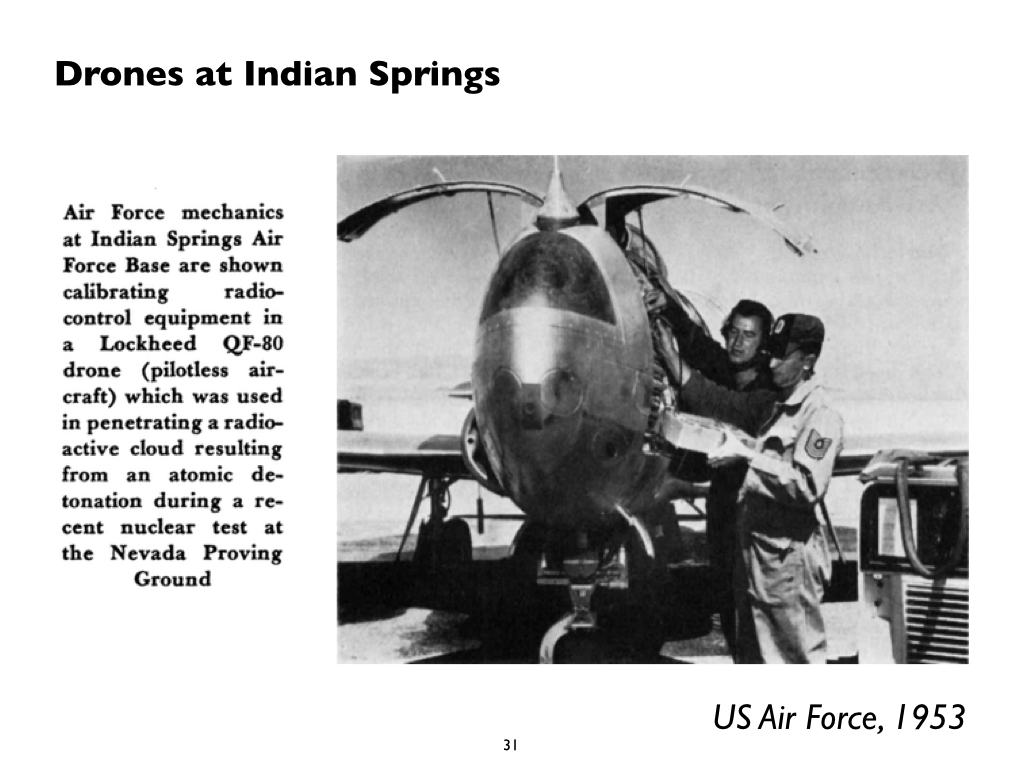
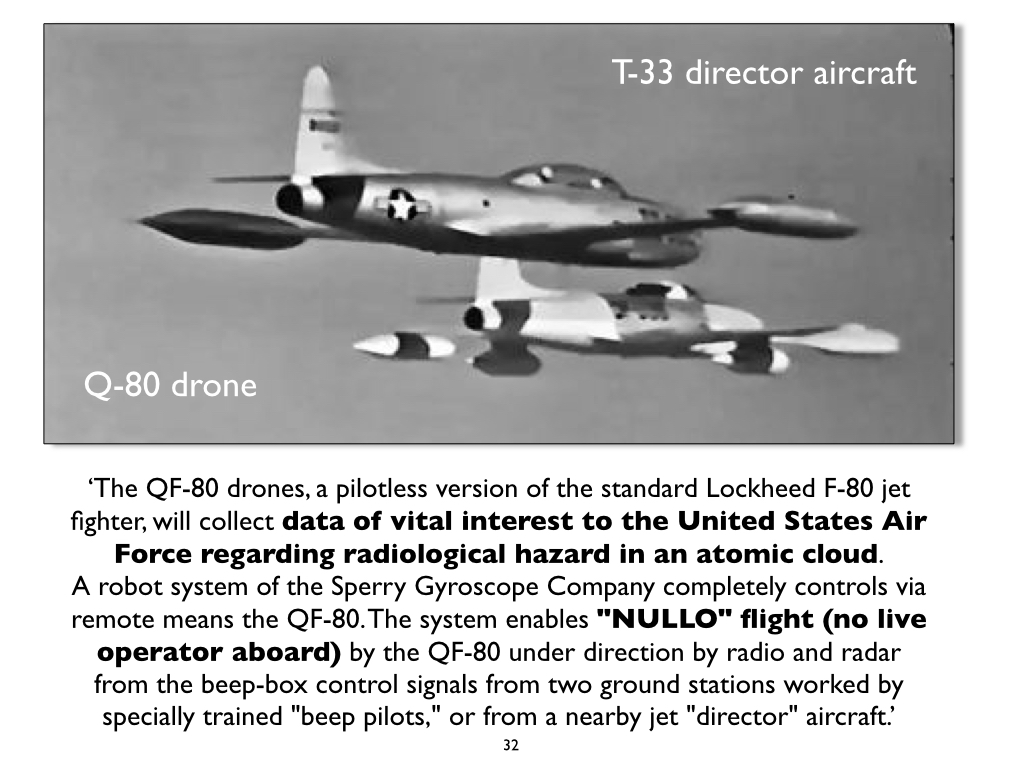
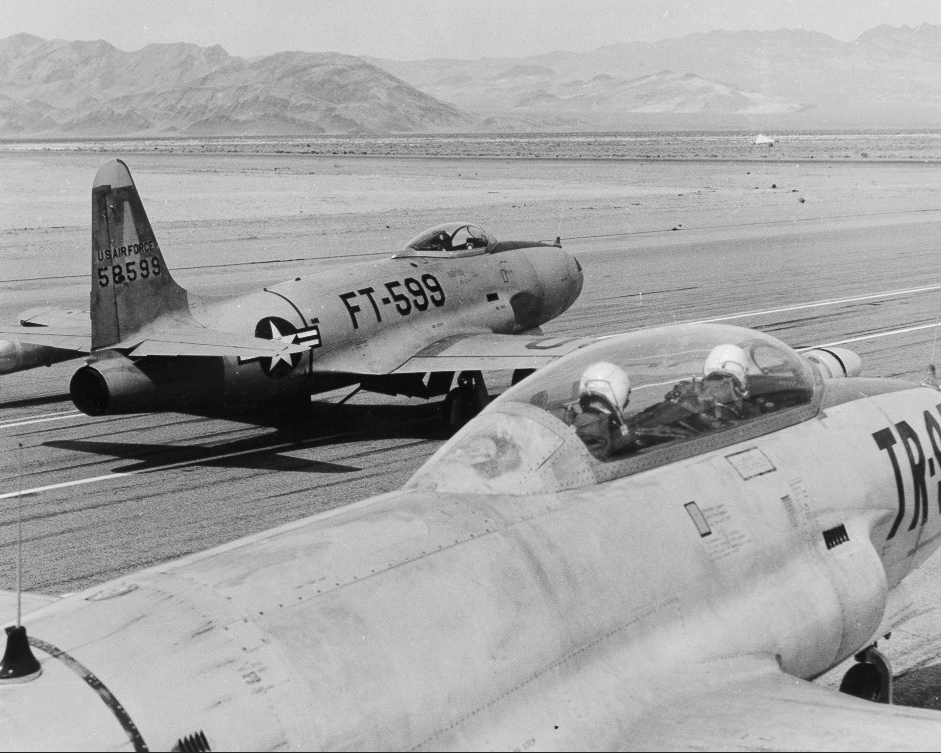
The capstone attempt to deliver atomic bombs by remote controlled aircraft, Project Brass Ring, was abandoned in March 1951 when the Air Force determined that a manned aircraft could execute the bomb delivery safely (at least for those on board), but drones continued to be used during atomic tests.  In 1953 QF-80 drones were in use at Indian Springs, the Air Force portal to the Nevada Proving Grounds (the full story is here):

Drones at Indian Springs.001Drones at Indian Springs 2.001

Lockheed QF-80 drone (FT-599) and director aircraft (a Lockheed DT33) ready for take-off at Indian Springs

Lockheed QF-80 drone (FT-599) and director aircraft (a Lockheed DT33) ready for take-off at Indian Springs

This was the first time ‘jet drones’ had been used during continental tests.  NULLO (‘No Live Operator Onboard’) operations used the same system of hand offs between beep pilots and director aircraft that had been used for the B-17s, but Sperry claimed that its precision marked a new milestone in remote operations.  Here’s a video of the drones in operation – and the effects of the blast on the aircraft:

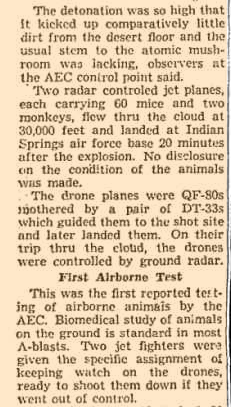
But some tests were designed to evaluate the effects of the blast and the cloud on living creatures.  Here is a clipping from the Chicago Tribune, reporting on a test carried out over Nevada on 6 April 1953 – in fact the mission shown in the last still photograph above.  Note that the radiation effects were expected to be so powerful that all air traffic was excluded from an area of 100,00 square miles:

Chicago Tribune 6 April 1953

Today Indian Springs is known as Creech Air Force Base: the operating hub for the US Air Force’s MQ-1 Predators and MQ-9 Reapers…

The Drone Papers

Drone Papers header JPEG

The Intercept has released a new series of documents – not from Edward Snowden – that provide extraordinary details about the Obama administration’s targeted killing operations (especially in Afghanistan, Yemen and Somalia).

I haven’t had a chance to work through them yet – today is taken up with teaching and Eyal Weizman‘s visit for tonight’s Wall Exchange – but I imagine that readers who don’t already have their heads up will welcome a head’s up.

The reports include a considerable number of informative graphics (taken from briefing slides) together with analysis.  Here is the full list:

The Assassination Complex (by Jeremy Scahill)

A visual glossary (by Josh Begley)

The Kill Chain (by Jeremy Scahill)

Find, Fix, Finish (by Jeremy Scahill)

Manhunting in the Hindu Kush (by Ryan Devereaux)

Firing Blind (by Cora Currier and Peter Maass)

The Life and Death of Objective Peckham (by Ryan Gallagher)

Target Africa (by Nick Turse)

More to come when I’ve worked through the reports, slides and analyses.

More tortured geographies

Route Map 2

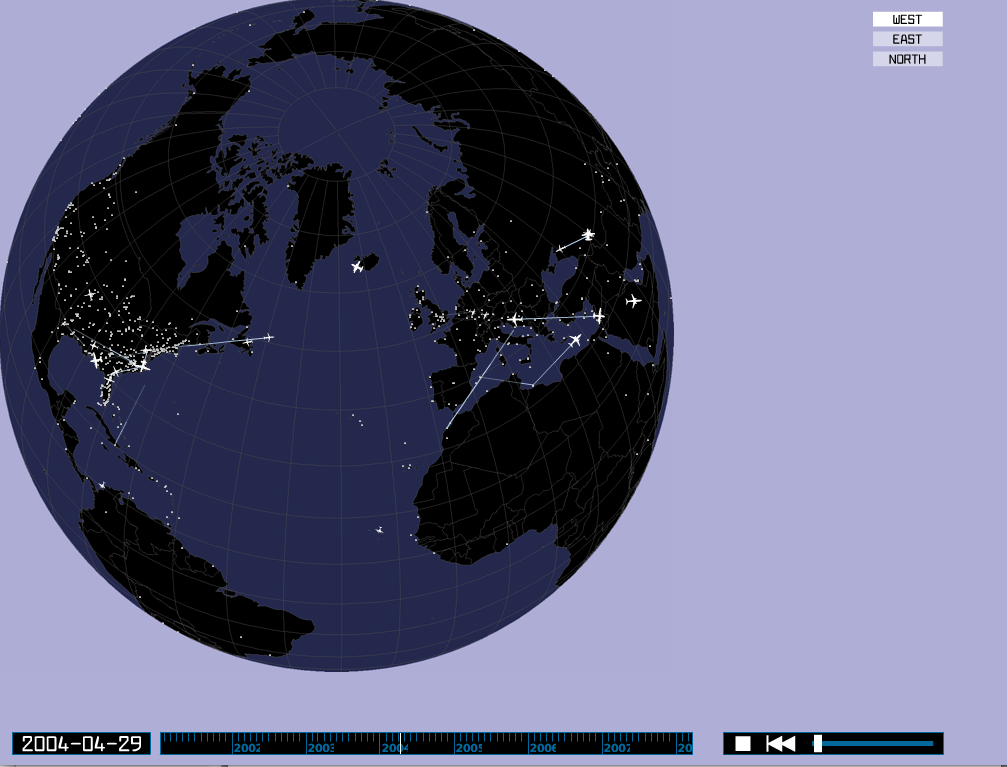
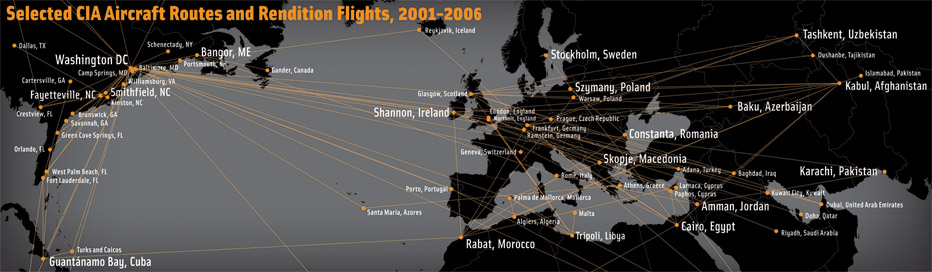
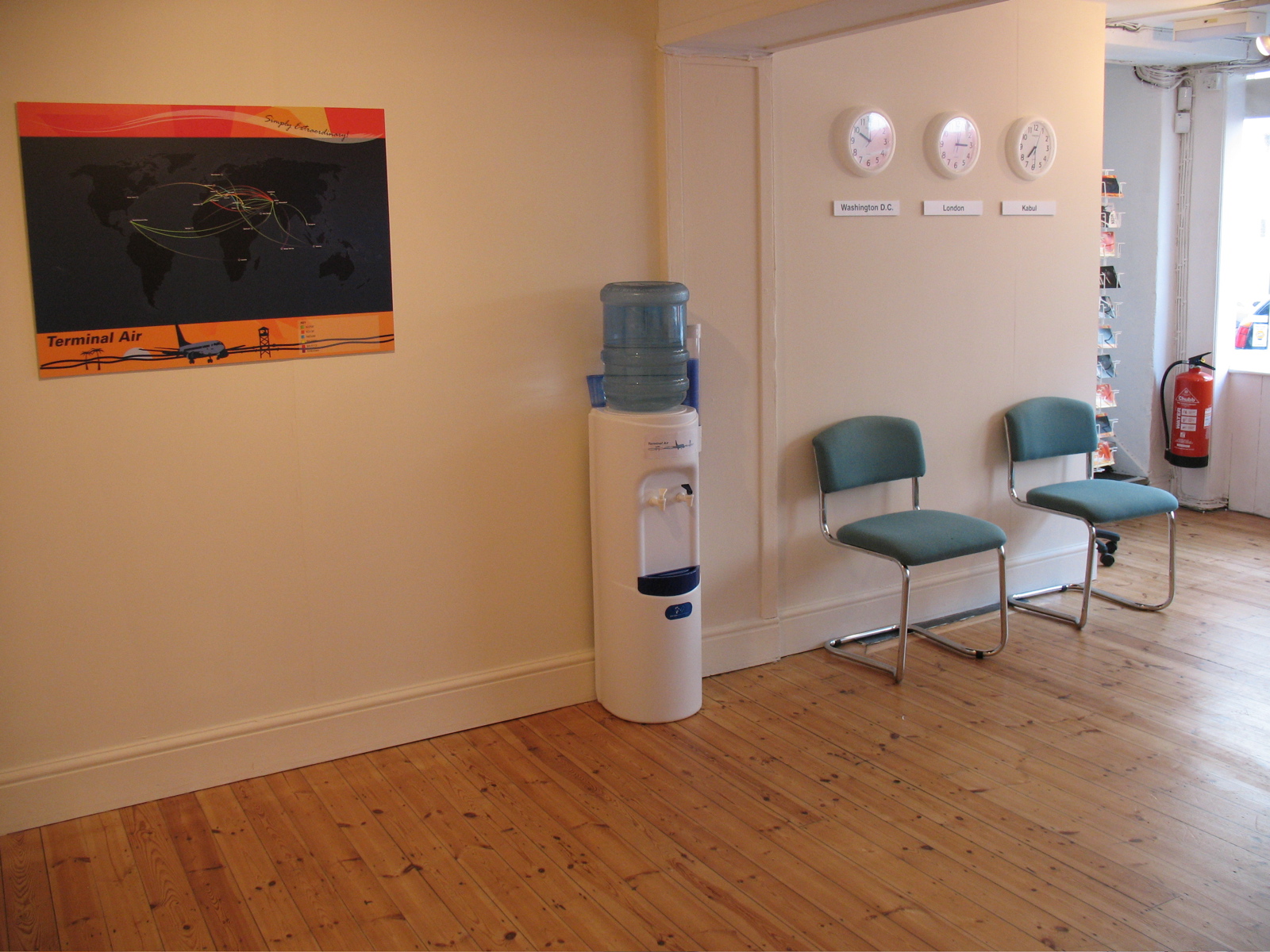
There have been several attempts to reconstruct the geography of the CIA’s program of extraordinary rendition. I’ve long admired the work of my good friend Trevor Paglen, described in his book with A.C. ThompsonTorture Taxi: on the trail of the CIA’s rendition flights, available in interactive map form through Trevor’s collaboration with the Institute for Applied Autonomy as Terminal Air. (I’ve commented on the project before, here and especially here).

terminal-air

And you can only applaud Trevor’s chutzpah is displaying the results of his work on a public billboard:

paglenemerson-cia-flights-2001-6

The project, which involved the painstaking analysis of countless flight records and endless exchanges with the geeks who track aircraft as a hobby, triggered an installation in which the CIA was reconfigured as a ‘travel agency‘:

Terminal Air travel agency

At the time (2007), Rhizome – which co-sponsored the project – explained:

Terminal Air is an installation that examines the mechanics of extraordinary rendition, a current practice of the United States Central Intelligence Agency (CIA) in which suspected terrorists detained in Western countries are transported to so-called “black sites” for interrogation and torture. Based on extensive research, the installation imagines the CIA office through which the program is administered as a sort of travel agency coordinating complex networks of private contractors, leased equipment, and shell companies. Wall-mounted displays track the movements of aircraft involved in extraordinary rendition, while promotional posters identify the private contractors that supply equipment and personnel. Booking agents’ desks feature computers offering interactive animations that enable visitors to monitor air traffic and airport data from around the world, while office telephones provide real-time updates as new flight plans are registered with international aviation authorities. Seemingly-discarded receipts, notes attached to computer monitors, and other ephemera provide additional detail including names of detainees and suspected CIA agents, dates of known renditions, and images of rendition aircraft. Terminal Air was inspired through conversations with researcher and author Trevor Paglen (Torture Taxi: On the Trail of the CIA’s Rendition Flights – Melville House Publishing). Data on the movements of the planes was compiled by Paglen, author Stephen Grey (Ghost Plane: The True Story of the CIA Torture Program – St. Martin’s Press) and an anonymous army of plane-spotting enthusiasts.

There’s a short video documenting the project on Vimeo here and embedded below (though strangely Trevor isn’t mentioned and doesn’t appear in it):

Although Trevor subsequently explained why he tried to ‘stay away from cartography and “mapping” as much as possible’ in his work, preferring instead the ‘view from the ground’, the cartography of all of this matters in so many ways – from the covert complicity of many governments around the world in a global geopolitics of torture through to the toll exerted on the bodies and minds of prisoners as they were endlessly shuffled in hoods and chains over long distances from one black site to another.

And now, thanks to the equally admirable work of the Bureau of Investigative Journalism, it’s possible to take the analysis even further.  Here is Crofton Black and Sam Raphael introducing their project, ‘The boom and bust of the CIA’s secret torture sites‘:

In spring 2003 an unnamed official at CIA headquarters in Langley sat down to compose a memo. It was 18 months after George W Bush had declared war on terror. “We cannot have enough blacksite hosts,” the official wrote. The reference was to one of the most closely guarded secrets of that war – the countries that had agreed to host the CIA’s covert prison sites.

Between 2002 and 2008, at least 119 people disappeared into a worldwide detention network run by the CIA and facilitated by its foreign partners.

Lawyers, journalists and human rights organisations spent the next decade trying to figure out whom the CIA had snatched and where it had put them. A mammoth investigation by the US Senate’s intelligence committee finally named 119 of the prisoners in December 2014. It also offered new insights into how the black site network functioned – and gruesome, graphic accounts of abuses perpetrated within it.

Many of those 119 had never been named before.

The report’s 500-page summary, which contained the CIA official’s 2003 remarks, was only published after months of argument between the Senate committee, the CIA and the White House. It was heavily censored, while the full 6,000-page study it was based on remains secret. All names of countries collaborating with the CIA in its detention and interrogation operations were removed, along with key dates, numbers, names and much other material.

In nine months of research, the Bureau of Investigative Journalism and The Rendition Project have unpicked these redactions to piece together the hidden history of the CIA’s secret sites. This account unveils many of the censored passages in the report summary, drawing on public data sources such as flight records, aviation contracts, court cases, prisoner testimonies, declassified government documents and media and NGO reporting.

Although many published accounts of individual journeys through the black site network exist, this is the first comprehensive portrayal of the system’s inner dynamics from beginning to end.

CIA black sites (BOIJ:REndition Project)

At present the mapping is rudimentary (see the screenshot above), but the database matching prisoners to black sites means that it ought to be possible to construct a more fine-grained representation of the cascade of individual movements.  The Rendition Project has already identified more than 40 rendition circuits involving more than 60 renditions of CIA prisoners: see here and the interactive maps here.
Watching the detectives

Hospital bombing, Kunduz, October 2015 MSF

I wrote about medical neutrality earlier this year (see here).  As I noted then, Physicians for Human Rights stipulates that medical neutrality requires:

The protection of medical personnel, patients, facilities, and transport from attack or interference;
Unhindered access to medical care and treatment;
The humane treatment of all civilians; and
Nondiscriminatory treatment of the sick and injured.

In the wake of the US air strike on a hospital operated by Médecins Sans Frontières  (MSF) in Kunduz on 3 October, that first requirement assumes even greater significance: the obligation is not merely to exempt medical personnel, patients and infrastructure from military and paramilitary violence but to protect them from attack.

MSF provides details and updates on the strike here.  As I write, far and away the most substantial commentary on what happened – given what we know so far – is Kate Clark‘s detailed analysis at the Afghan Analysts Network here (though Matt Lee‘s angry comparison with an Israeli military attack on a hospital in Gaza is worth reading too).  As Kate notes,

Expressing distrust in the US military, NATO or Afghan government to uncover the truth, [MSF] said it wants an investigation by the International Humanitarian Fact-Finding Commission (IHFFC), a body set up by the Additional Protocols of the Geneva Conventions and, says MSF, is the only permanent body set up specifically to investigate violations of international humanitarian law. It has never been used before and, as neither Afghanistan or the United States have formally recognized the Commission, any investigation would have to be voluntary.

logo_ihffcThe IHFFC issued this statement today:

The International Humanitarian Fact-Finding Commission (IHFFC) has been contacted by Médecins Sans Frontières (MSF, Doctors Without Borders) in relation to the events in Kunduz, Afghanistan, on 3 October 2015.

The IHFFC stands ready to undertake an investigation but can only do so based on the consent of the concerned State or States. The IHFFC has taken appropriate steps and is in contact with MSF. It cannot give any further information at this stage.

Alex Jeffrey has commented briefly on the geopolitics of any investigation by the IHFFC, but there has been little or no commentary on how the US military investigates civilian casualty incidents – and this merits discussion because the Obama administration has insisted that the inquiry already under way by the Pentagon will be ‘transparent’, ‘thorough’ and ‘objective’.  And whatever may or may not transpire with respect to the IHFFC, it’s exceptionally unlikely that the US military investigation will be stopped.

I’ve worked through five investigations of so-called ‘CIVCAS’ in Afghanistan that have been released through Freedom of Information Act requests.  Each branch of the US military is required to maintain its own digital FOIA Reading Room, so that any documentation supplied in response to these requests is released into the public domain.  I should say that you need to be adept at using the search function, and to have a very good idea of what you are looking for before you start (though the Pentagon has been remarkably helpful in responding to my inquiries and questions).

It’s also fair to say that the release of investigation reports is uneven.  In the immediate aftermath of an earlier, devastating air strike on two tankers hijacked by the Taliban near Kunduz, called in by the German Bundeswehr but carried out by two US aircraft (see my extended discussion here), the United States repeatedly promised to release the investigation report: but it never did, even to the German Bundestag’s committee of inquiry, and despite repeated requests it remains classified.

There is also considerable variation in the transparency and quality of the reports that have been released: some are so heavily redacted that it is extremely (and no doubt intentionally) difficult to construct a reasonably comprehensive narrative, while others are the product of inquiries that seem to have been, at best, perfunctory.

AR 15-6 CIVCAS Uruzgan February 2010

The report into the airstrike in Uruzgan that I have been using for my analysis of the US air strike in Uruzgan in February 2010 – see ‘Angry Eyes (1)‘ and ‘Angry Eyes (2)‘: more to come – is neither.  It has been redacted, presumably for reasons of national, operational or personal security, but its 2,000 pages provide enough detail to reconstruct most of what happened.  And the investigation team was remarkably thorough: by turns forensic, sympathetic, exasperated and eventually blisteringly angry at what they found.  Whether this provides an indication of what we can expect from the present inquiry I don’t know, but it does provide a benchmark of sorts for what we (and, crucially, MSF) ought to expect.  (There are also ongoing investigations by NATO and by the Afghan authorities, but no details have been released about them either).

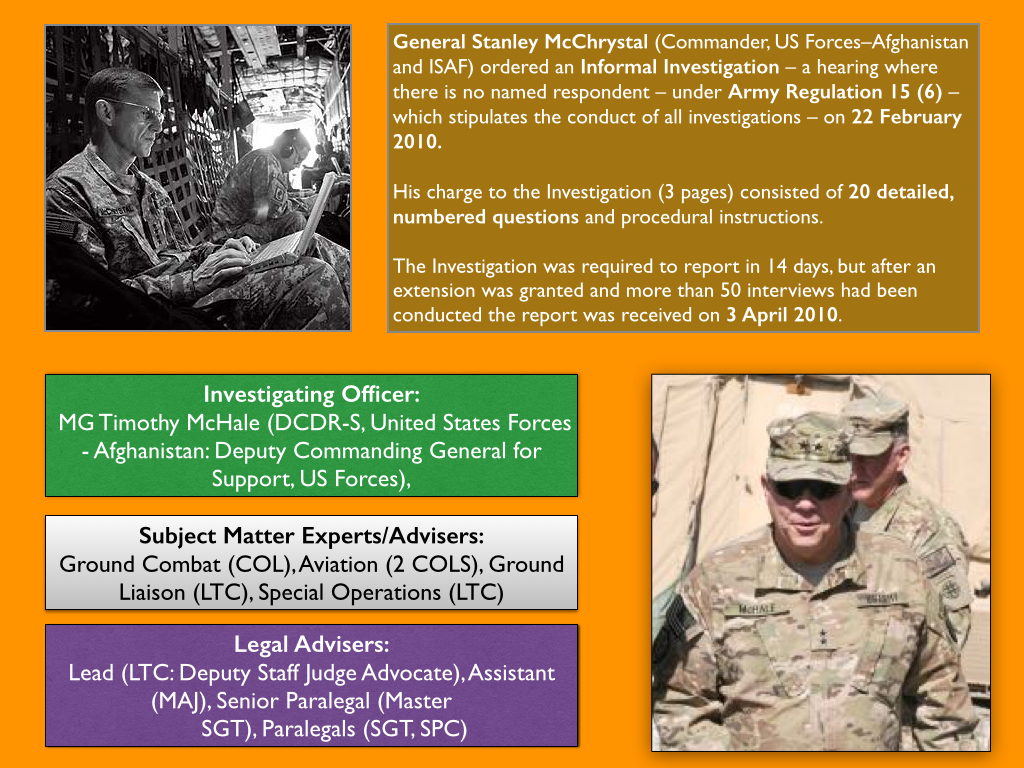
The strike took place on 21 February 2010, and the very next day General Stanley McChrystal (Commander US Forces – Afghanistan and ISAF, Afghanistan) appointed Major-General Timothy McHale to conduct what the US Army calls ‘an informal investigation’ into the incident that ‘allegedly resulted in the deaths of 12-15 local Afghan nationals and caused injured to others’; McHale was assisted by a team of senior officers, including subject matter experts and legal advisers:

GREGORY Angry Eyes 2015 IMAGES.139

There are two points to note here.

First, this was an investigation conducted by the US Army because the airstrike had been called in by US Special Forces and had been carried out by two US Army helicopter crews.  But the strike was orchestrated in large measure by a US Air Force Predator crew from Creech Air Force Base in Nevada; in addition to questioning the soldiers and helicopter crews involved, McHale’s team also questioned the Predator flight crew together with the screeners and video analysts at Air Force Special Operations Command at Hurlburt Field in Florida.  McHale’s report triggered a second ‘Commander-Directed Investigation’ by US Air Force Brigadier-General Robert Otto into the actions and assessments of the Predator crew; that report was submitted on 30 June 2010.  As I write, it’s not known who is leading the US investigation into the bombing of the hospital in Kunduz.  Since (on the fourth telling) the strike appears to have been called in by US Special Forces (at the request of Afghan forces) and carried out by a US Air Force AC-130 gunship this will presumably be a joint investigation.

Second, the term ‘informal investigation’ is a technical one; certainly, on McHale’s watch the conduct of the inquiry was remarkably rigorous.  US Army Regulation 15-6 sets out how the Army is to conduct an investigation:

‘The primary function of any investigation or board of officers is to ascertain facts and to report them to the appointing authority. It is the duty of the investigating officer or board to ascertain and consider the evidence on all sides of each issue, thoroughly and impartially, and to make findings and recommendations that are warranted by the facts and that comply with the instructions of the appointing authority.’

Here is the distinction between informal and formal investigations (I’ve taken this summary from a US Army Legal Guide here; the full version, specifying the conduct of an informal investigation, is here and here):

Informal investigations may be used to investigate any matter, to include individual conduct. The fact that an individual may have an interest in the matter under investigation or that the information may reflect adversely on that individual does not require that the proceedings constitute a hearing for that individual. Even if the purpose of the investigation is to inquire into the conduct or performance of a particular individual, formal procedures are not mandatory unless required by other regulations or by higher authority. Informal investigations provide great flexibility. Generally, only one investigating officer is appointed (though multiple officers could be appointed); there is no formal hearing that is open to the public; statements are taken at informal sessions; and there is no named respondent with a right to counsel (unless required by Art 31(b), UCMJ); right to cross-examine witnesses; etc….

“Generally, formal boards are used to provide a hearing for a named respondent. The board offers extensive due process rights to respondents (notice and time to prepare, right to be present at all open sessions, representation by counsel, ability to challenge members for cause, to present evidence and object to evidence, to cross examine witnesses, and to make argument). Formal boards include a president, voting members, and a recorder who presents evidence on behalf of the government. A Judge Advocate (JA) is normally appointed as recorder but is not a voting member. If a recorder is not appointed, the junior member of the board acts as recorder and is a voting member. Additionally, a non-voting legal advisor may be appointed to the board. Formal AR 15-6 investigations are not normally used unless required by regulation.’

In setting all this out, I should add two riders.  In treating MG McHale’s investigation in such detail, I don’t mean to imply that I fully concur with its analysis.  This is a judgement call, of course: the redactions make it difficult to press on several key issues, all of which relate to who knew what when and where (more to come on this).  And neither do I mean to suggest that any US military investigation into what happened in Kunduz, however probing, would be adequate. As MSF’s Chris Stokes has said, ‘relying only on an internal investigation by a party to the conflict would be wholly insufficient.’  But if the report is conducted with the same careful attention to detail – and if it is released with minimal redactions – it would provide a necessary resource for all those involved in and affected by this truly appalling incident.

More to come – I hope.

UPDATE (1):  The US investigation is headed by Brigadier-General Richard Kim.  Nancy Youssef reports that his arrival in Kunduz was delayed ‘because of instability in the northern Afghan city.’ As with the Uruzgan air strike in 2010, the video recording from the AC-130 gunship that carried out the attack, together with audio recordings of conversations between the air crew and ground troops, will be of great importance.  According to Youssef, these show that ‘rules of engagement—the guidelines for the use of force—were misapplied.’  (In the Uruzgan case, the radio conversations between the air crew(s) and the Joint Terminal Attack Controller on the ground were released in redacted form in response to a FOIA request; apart from a single image of the strike, however, the video remains classified.)

I’ve previously noted the debate surrounding the Pentagon’s new Law of War manual which was issued in June 2015; since the US has admitted that the strike on the hospital was carried out within the US chain of command, section 7.17 on ‘Civilian hospitals and their personnel’ is particularly relevant (see also the Guardian report here):

During international armed conflict, civilian hospitals organized to give care to the wounded and sick, the infirm, and maternity cases, may in no circumstances be the object of attack, but shall at all times be respected and protected by the parties to the conflict.

7.17.1 Loss of Protection for Civilian Hospitals Used to Commit Acts Harmful to the Enemy. The protection to which civilian hospitals are entitled shall not cease unless they are used to commit, outside their humanitarian duties, acts harmful to the enemy.

7.17.1.1 Acts Harmful to the Enemy. Civilian hospitals must avoid any interference, direct or indirect, in military operations, such as the use of a hospital as a shelter for able-bodied combatants or fugitives, as an arms or ammunition store, as a military observation post, or as a center for liaison with combat forces. However, the fact that sick or wounded members of the armed forces are nursed in these hospitals, or the presence of small arms and ammunition taken from such combatants and not yet handed to the proper service, shall not be considered acts harmful to the enemy.

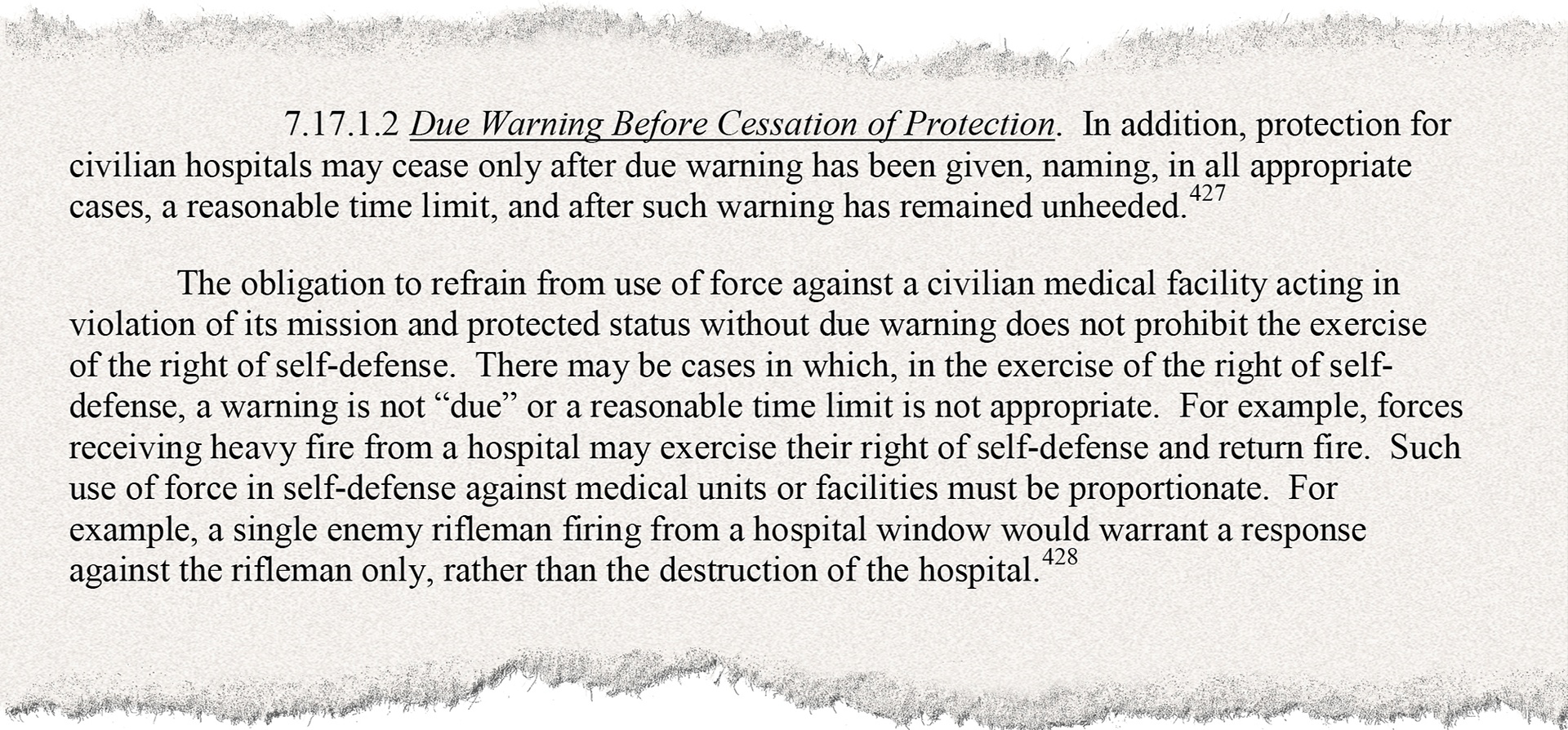
7.17.1.2 Due Warning Before Cessation of Protection. In addition, protection for civilian hospitals may cease only after due warning has been given, naming, in all appropriate cases, a reasonable time limit, and after such warning has remained unheeded.

2008-1

The obligation to refrain from use of force against a civilian medical facility acting in violation of its mission and protected status without due warning does not prohibit the exercise of the right of self-defense. There may be cases in which, in the exercise of the right of self- defense, a warning is not “due” or a reasonable time limit is not appropriate. For example, forces receiving heavy fire from a hospital may exercise their right of self-defense and return fire. Such use of force in self-defense against medical units or facilities must be proportionate. For example, a single enemy rifleman firing from a hospital window would warrant a response against the rifleman only, rather than the destruction of the hospital.

MSF has consistently denied that anyone was firing from the hospital; it has also insisted that it received no advance warning of the attack – on the contrary, MSF ensured that all US and Afghan forces had the co-ordinates of the hospital, and made frantic phone calls to try to stop the bombing once it started.

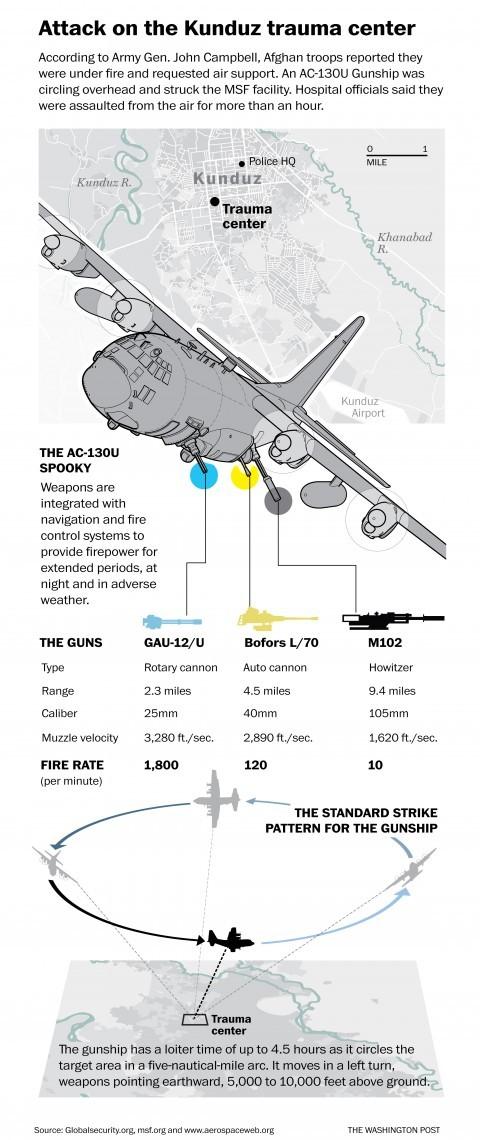
UPDATE (2):  A team from the Washington Post has produced a remarkably detailed report, ‘based on multiple interviews in Afghanistan and the United States with U.S. and Afghan military officials, Doctors Without Borders personnel and local Kunduz residents’; it includes maps and a graphic showing exactly what an AC-130 is capable of.

w512

As you can see, the illustration makes much of the aircraft’s concentrated firepower, unleashed as it circles counter-clockwise around the target in a five-mile orbit, but the AC-130 also has an extensive sensor suite on board (see ‘Angry Eyes (1)‘: an AC-130 was involved in the early stages of the Uruzgan incident).  The reporters do note that the aircraft is equipped with ‘low-light and thermal sensors that give it a “God’s eye [view]” of the battlefield in almost all weather conditions’ – but, as I’ve tried to show in my posts on Uruzgan (and as we know from other sources!), there’s no such thing as a God’s eye view.  Even so, the aircrew can surely have been in no doubt that they were bombing a hospital.