And still the poppies blow…

poppyfields

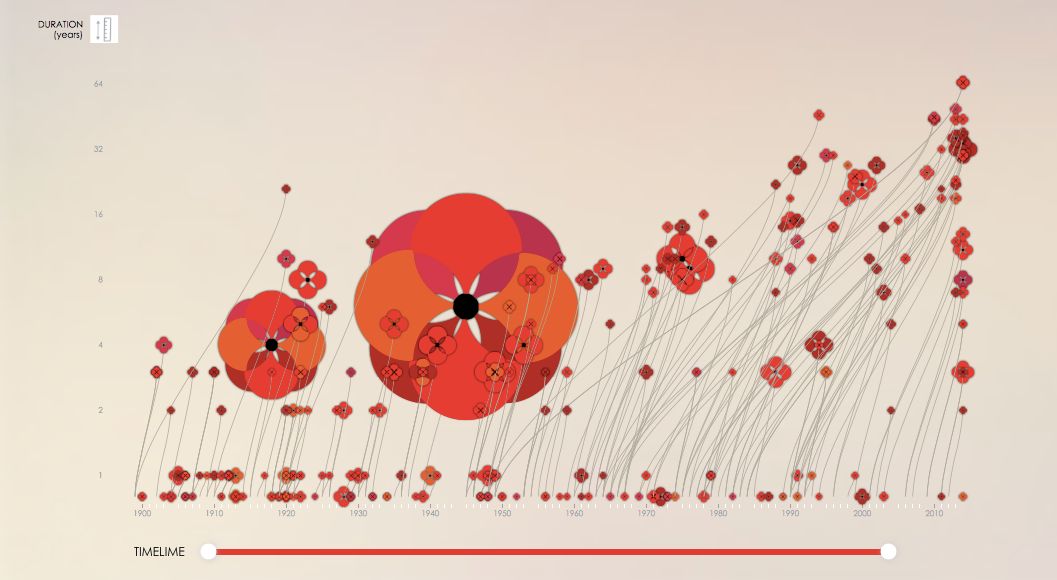
The graphic above is from Poppyfield.org.  You can find the interactive version here.  Designed by Valentina D’Efilippo with coding by Nicolas Pigelet:

Each poppy depicts a war since the 1900. The stem grows from the year when the war started and the poppy flowers in the year the war ended. Its size shows the number of deaths and the variation of colour represents the areas involved.

It is, as they note, a work in progress (sadly, that’s true in both senses of the phrase).

These grim tabulations don’t tell the whole statistical story, however, because they take no account of those wounded (and the inclusion of civilian as well as combatant casualties further complicates the picture).  As I’ve noted before, Tanisha Fazal provides an essential qualification to the Whiggish view of war and violence peddled by Steven Pinker and others:

Tanisha’s argument hinges on the reliance on ‘battle deaths’ as an index of the incidence of war; these statistics are a minefield of their own, though they are used by most of the major databases, but Tanisha argues that many contemporary wars have been distinguished by a diminution in battle deaths and a marked increase in the numbers of wounded who now survive injuries that would previously have killed them.

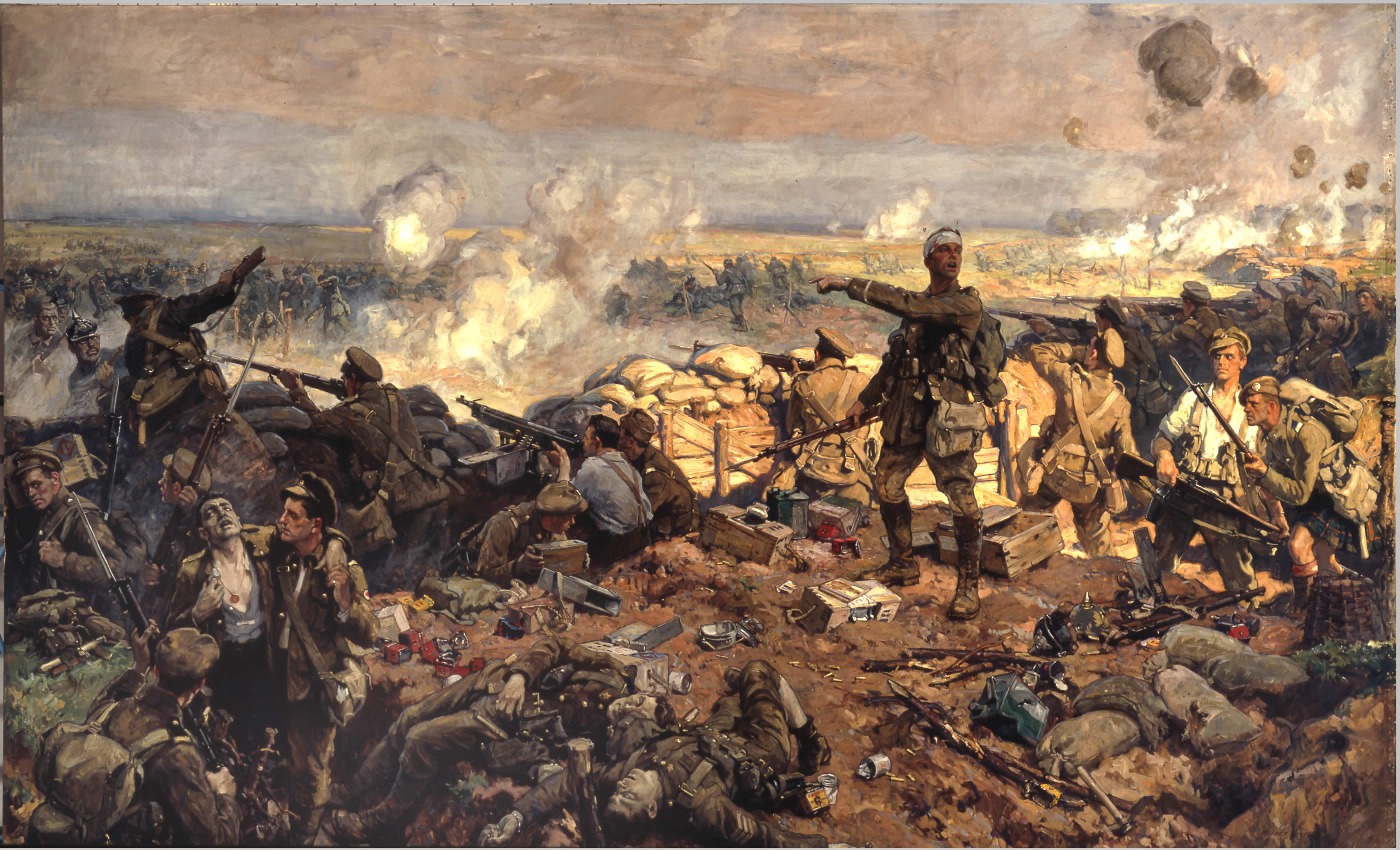
John McCrae, the author of ‘In Flanders Fields’ – whose opening lines are among the most famous of First World War poetry: ‘In Flanders fields the poppies blow/Between the crosses, row on row’ – knew that at first hand.  He composed the poem after the Second Battle of Ypres in the spring of 1915 (below), and he wrote to his mother:

‘The general impression in my mind is of a nightmare. We have been in the most bitter of fights. For seventeen days and seventeen nights none of us have had our clothes off, nor our boots even, except occasionally. In all that time while I was awake, gunfire and rifle fire never ceased for sixty seconds…  And behind it all was the constant background of the sights of the dead, the wounded, the maimed…’

Richard Jack 2nd Ypres

But, as John Keegan noted in The face of battle, in most military histories the ‘wounded apparently dematerialize as soon as they are struck down…’  Keegan was writing about General Sir William Napier’s account of the battle of Albuera in 1811, but the disappearing trick is still being performed more than two centuries later.

The War Corps

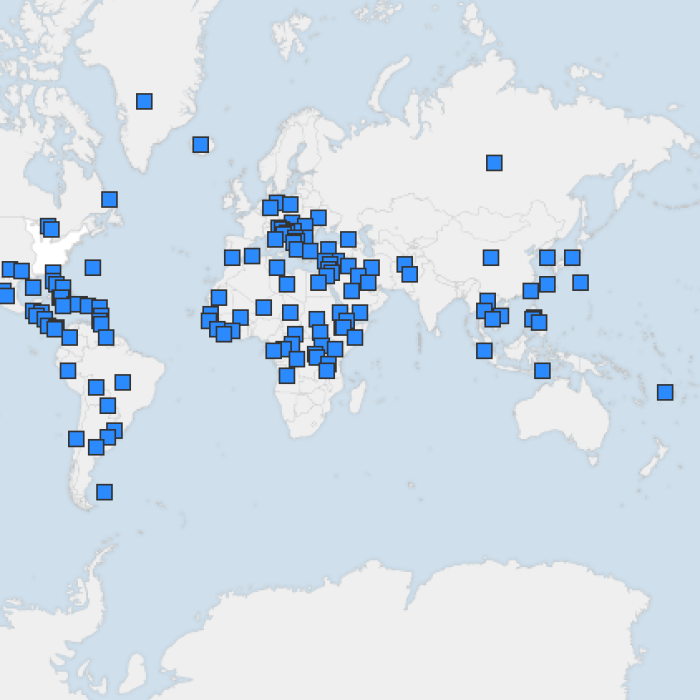
The US Congressional Research Service recently released a report, Instances of Use of United States Armed Forces Abroad, 1798-2014:

The instances differ greatly in number of forces, purpose, extent of hostilities, and legal authorization. Eleven times in its history the United States has formally declared war against foreign nations. These 11 U.S. war declarations encompassed 5 separate wars: the war with Great Britain declared in 1812; the war with Mexico declared in 1846; the war with Spain declared in 1898; the First World War, during which the United States declared war with Germany and with Austria-Hungary during 1917; and World War II, during which the United States declared war against Japan, Germany, and Italy in 1941, and against Bulgaria, Hungary, and Rumania in 1942.

Some of the instances were extended military engagements that might be considered undeclared wars. These include the Undeclared Naval War with France from 1798 to 1800; the First Barbary War from 1801 to 1805; the Second Barbary War of 1815; the Korean War of 1950-1953; the Vietnam War from 1964 to 1973; the Persian Gulf War of 1991; global actions against foreign terrorists after the September 11, 2001, attacks on the United States; and the war with Iraq in 2003. With the exception of the Korean War, all of these conflicts received congressional authorization in some form short of a formal declaration of war. Other, more recent instances often involve deployment of U.S. military forces as part of a multinational operation associated with NATO or the United Nations.

Barbara Salazar Torreon, who compiled the report, adds:

The list does not include covert actions or numerous instances in which U.S. forces have been stationed abroad since World War II in occupation forces or for participation in mutual security organizations, base agreements, or routine military assistance or training operations. Because of differing judgments over the actions to be included, other lists may include more or fewer instances.

5875790-1x1-700x700

abc news has now provided an interactive that maps the data set here, together with a discussion of the original report.

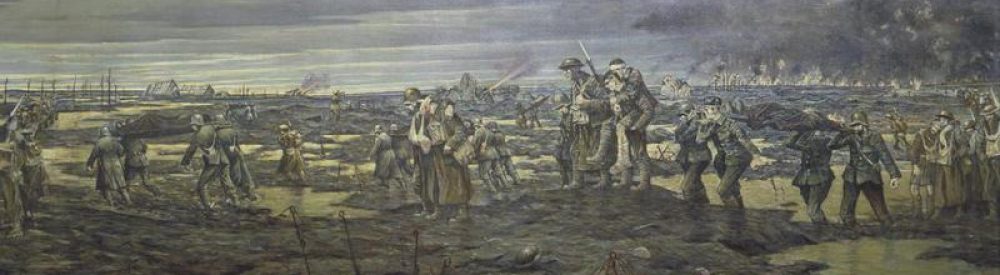
Journeys from No Man’s Land

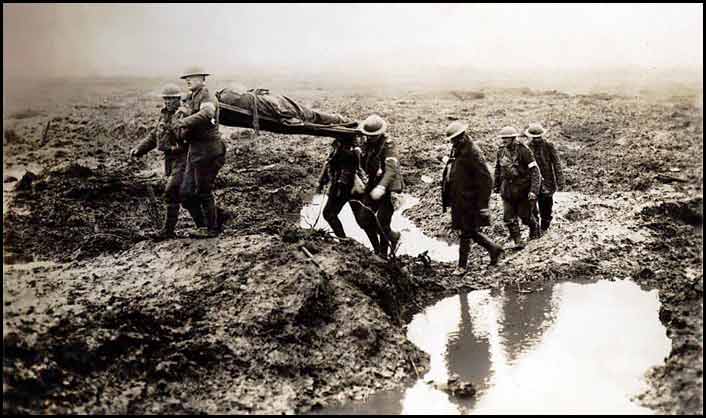
Stretcher-bearers

I’ve agreed to join a panel organised by Noam Leshem on Remnants of No Man’s Land: history, theory and excess at the Annual Meeting of the Association of American Geographers in Chicago next April (I imagine this is a follow-up to the session at the RGS/IBG in September).

The no-man’s lands of the First World War were never limited to the killing fields between the trenches. Their impact was never fully confined by the time and space of the battles: it lingered on the bodies of soldiers, in contaminated ecologies and in the radically altered post-war intellectual landscape. The violence that is unleashed in the no-man’s land and the destruction it wrought does not result in emptiness, in a terra nullius, but in excess that can never be fully contained.

This session invites additional reflections on the excessive quality of no-man’s land: its materialities, ecologies, cultural expressions and political-ideological articulations. It aims to deepen the theoretical import and conceptual power of ‘no-man’s land’, and move beyond its use as merely a convenient colloquialism. Similarly, we seek to engagements with other histories of no-man’s lands that are not solely confined to the Western Front during WWI.

LOBLEY Dugouts in the embankment near Le Cateau

Despite that last sentence, this is what I’ve come up with; these abstracts are always promissory notes, of course, written so far in advance that they can provide little real indication of what eventually transpires.  Fortunately we are now no longer lumbered with the Yellow Pages-style book of abstracts so I doubt anybody will actually read this on the day.  But here goes:

Journeys From No Man’s Land, 1914-1918

During the First World War on the Western Front a central logistical preoccupation of military planners was the deployment of troops to the front line and the evacuation of casualties from the battlefield. These priorities were closely connected – the aim was to provide medical treatment as close to the site of the wound as possible so that troops could be returned expeditiously to the line – but they also often confounded one another as hospital trains headed for the coast were shunted into sidings to allow troop trains to move up. In this presentation I address three questions. First, what it was possible to know about the ‘lie of the land’, particularly in the deadly spaces between the front-line trenches? Here I focus on the connections between aerial reconnaissance, night patrols and trench maps. A second question concerns the arrangements made in advance of major offensives – the disposition of stretcher bearers and aid posts, field ambulances and casualty clearing stations – and the ways in which these visible geometries of the medical-military machine affected the sensibilities of soldiers waiting to go ‘over the top’. Finally, how did the wounded apprehend and navigate No Man’s Land, and how did they make what Emily Mayhew calls their precarious journeys away from the fighting?

There’ll be more posts on this as I circle in towards the presentation.  It’s part of my new research project which explores military-medical machines and the casualties of war 1914-2014, but which is now widening to include other aspects of medical care in contemporary conflict zones like Gaza and Iraq/Syria and the militarisation of medical intervention in West Africa.

Peace in our time

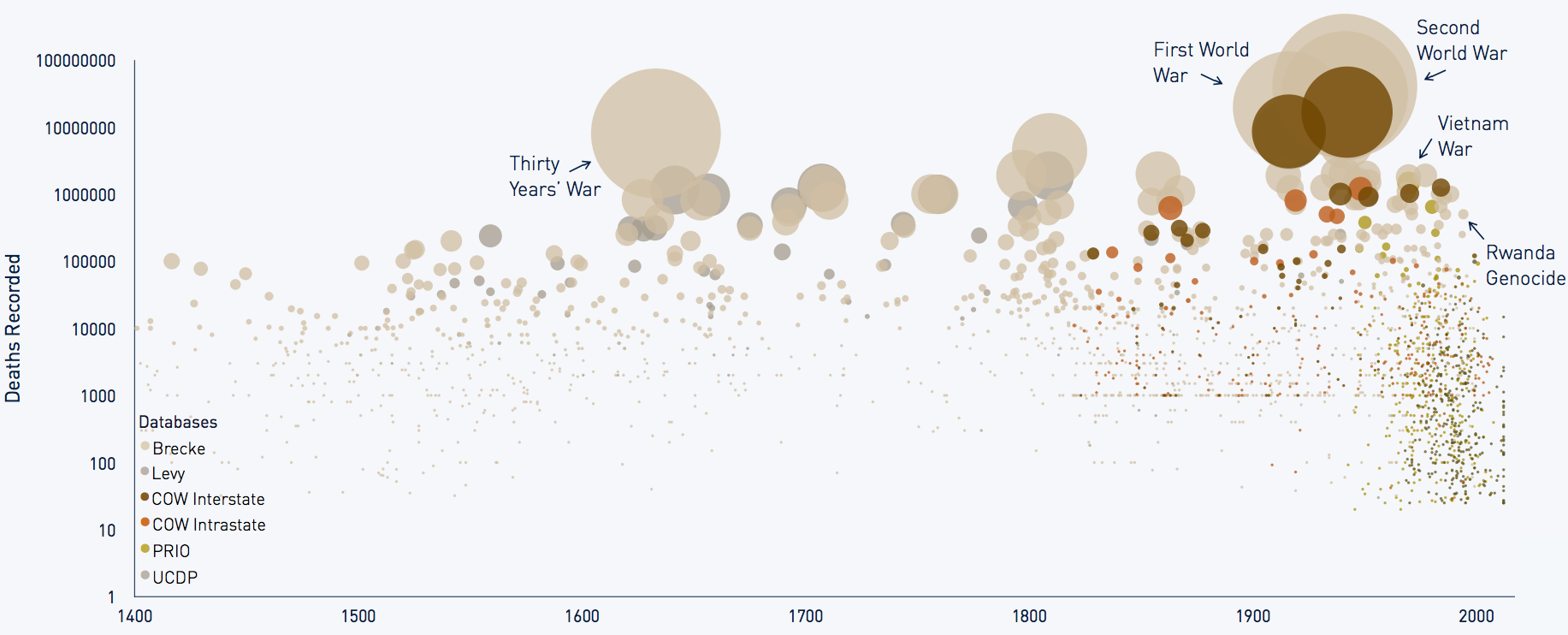
I’ve talked about charting armed conflict around the world before.  Max Rosen has a series of data visualisations – ‘Our World in Data‘ – including several on war and peace.  They include this one, drawn from multiple sources and collated (and designed) by the Hague Centre for Strategic Studies, showing global war deaths – the size of the bubble refers to the proportion of the world population killed:

ourworldindata_global-war-deaths-1400-today-size-of-the-bubble-shows-percentage-of-world-population-killed-–-the-hague-centre-for-strategic-studies0

There are of course all sorts of problems in this sort of exercise – calculating ‘war deaths’ is a political and intellectual minefield of its own – but you can find the sources used for the graphic here (click on the button on the right).

You can also download the Hague Centre’s graphics in a single pdf, ‘Peace and Conflict across time’, here (again, click on the button on the right): the display arranges the graphics into two sets – ‘Decline of Conflict’ and ‘Drivers of Peace’.  No doubt Stephen Pinker would approve.

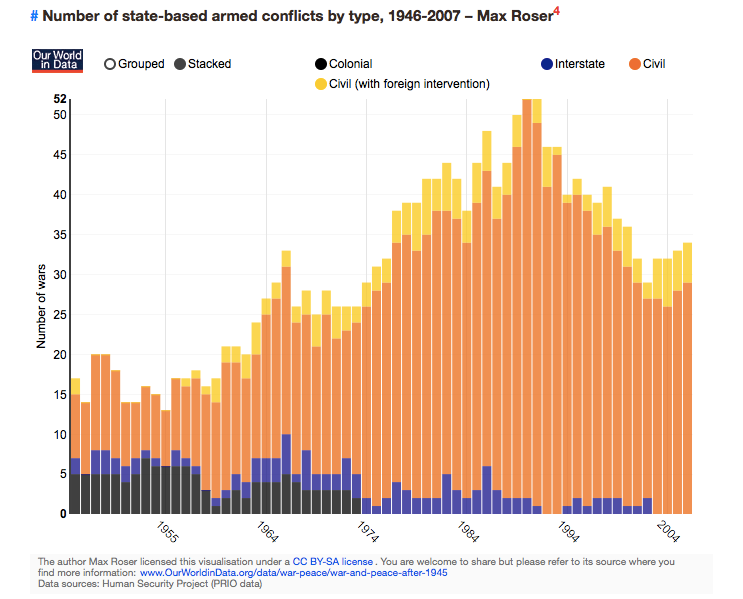
Max provides a more detailed analysis of conflicts post-1945 here, including this image (which extends only to 2004), and which is precisely the sort of thing that has licensed the debates over the decline of inter-state wars and the rise of (often transnational) ‘new wars’:

State-based armed conflicts

Before cheering the demise of inter-state war, however, we need to reflect on the multiple ways in which states and their advanced militaries are able to inflict violence by stealth (including cyber-attack), by proxy and by other other means (including economic warfare)…

War cultures

929px-William_Orpen_-_Zonnebeke_-_Google_Art_Project

The British Academy is holding a two-day Landmark Conference in London on 12-13 November 2014, The First World War: Literature, Culture, Modernity.  The conference is convened by Santanu Das and  Kate McLoughlin:

A hundred years after the war’s outbreak, this conference brings together some of the world’s leading experts and emerging scholars to reassess its literary and cultural impact and explore its vexed relationship to modernity. Was the war a ‘crack in the table of history’ or did it reinforce deep continuities? What is the relationship between artistic form and historical violence, and between combatant and civilian creative responses? What are the colonial and transnational dimensions of First World War literature? Spanning across literature, the visual arts and music, the conference will adopt an international perspective as it investigates the war’s continuing legacies.

Registration is required; full details here.

In association with the conference, there will be an evening of music and readings at King’s College Chapel (London) on 11 November, Terrible Beauty: Music and Writing of the First World War, and an evening of poetry reading at the British Academy on 12 November, The Past Hovering: An Evening of War Poetry; both events are free but registration is required.

Following the colours

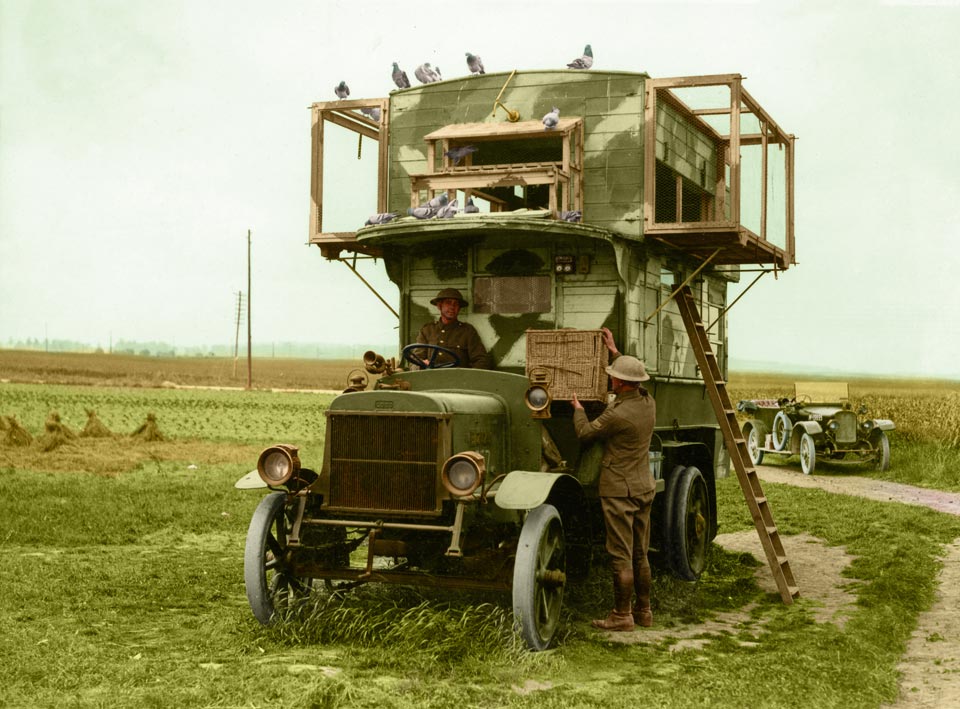
WWI Mobile carrier pigeon-loft

The Open University has just released online a series of ‘colourised’ photographs from the First World War.  My favourite is shown above: a mobile pigeon-loft so that messages could be carried back to GHQ (more on pigeons and the war effort here and especially here; their military service did not end with the First World War).

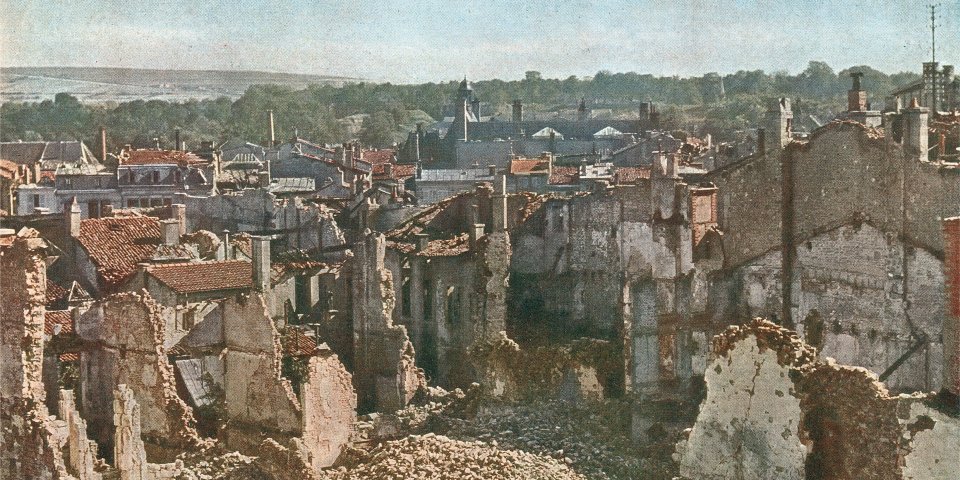
These were all originally black and white photographs, but Taschen has recently published a much more extensive collection of original colour (‘autochrome’) photographs – you can view some of the images online here – edited by Peter Walther, The First World War in Colour (384 pp).

Verdun

In an online announcement the publisher explains:

The devastating events of the First World War were captured in myriad photographs on all sides of the front. Since then, thousands of books of black-and-white photographs of the war have been published as all nations endeavour to comprehend the scale and the carnage of the “greatest catastrophe of the 20th century”. Far less familiar are the rare colour images of the First World War, taken at the time by a small group of photographers pioneering recently developed autochrome technology.

first_world_war_in_color_fo_gb_3d_05794_1406031040_id_813622To mark the centenary of the outbreak of war, this groundbreaking volume brings together all of these remarkable, fully hued pictures of the „war to end war“. Assembled from archives in Europe, the United States and Australia, more than 320 colour photos provide unprecedented access to the most important developments of the period – from the mobilization of 1914 to the victory celebrations in Paris, London and New York in 1919. The volume represents the work of each of the major autochrome pioneers of the period, including Paul Castelnau, Fernand Cuville, Jules Gervais-Courtellemont, Léon Gimpel, Hans Hildenbrand, Frank Hurley, Jean-Baptiste Tournassoud and Charles C. Zoller.

Since the autochrome process required a relatively long exposure time, almost all of the photos depict carefully composed scenes, behind the rapid front-line action. We see poignant group portraits, soldiers preparing for battle, cities ravaged by military bombardment – daily human existence and the devastating consequences on the front. A century on, this unprecedented publication brings a startling human reality to one of the most momentous upheavals in history.

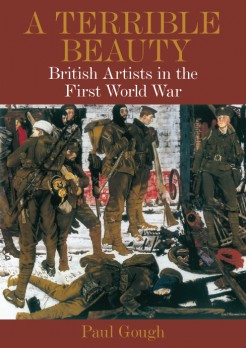
A-Terrible-Beauty-246x348And for an altogether different rendering of the First World War – often but not always in colour – I recommend Paul Gough‘s magisterial account of 15 artists (many of whom saw active service,  A terrible beauty: British artists in the First World War.  You can download the first chapter here, sadly without the illustrations: but Paul’s commentary is incisive, and I found his work really helpful in working on ‘Gabriel’s Map’, especially his essays on military sketching which considerably enlarged my sense of the ‘cartographic imaginary’ on the Western Front.  Gerry Corden has a fine account of the book here, and includes many excellent images including the work of my favourite C.W.R. Nevinson.  Finally, Paul’s own website is here: click on Vortex 1 through 5 at the bottom.

Not a pigeon in sight, though.

Siegfried’s Lines

_76646963_sassoon3

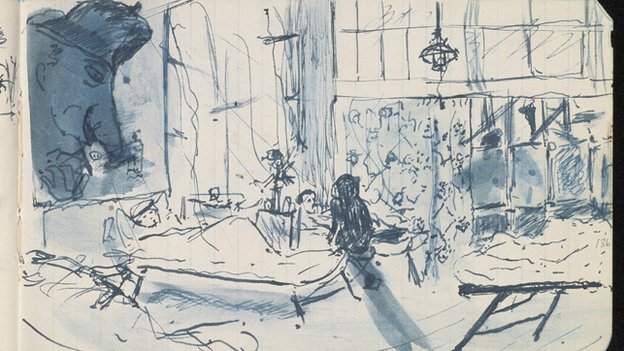
The BBC reports that Siegfried Sassoon‘s diaries from the First World War have been digitised by Cambridge University Library and are now available online (more illustrated reports here and here).  The journals and two notebooks of poetry include not only Sassoon’s jottings but also sketches like the interior of a military hospital (above).

IM.0942_zpUnlike edited printed transcriptions, the digitisations allow the viewer to form a thorough sense of the nature of the physical documents. Sassoon wrote in a small but neat and legible hand, frequently using the notebooks from both ends. His war journals were used for a wide variety of purposes: in addition to making diary entries Sassoon drafted poetry, made pencil or ink sketches, listed of members of his battalion and their fates, made notes on military briefings and diagrams of trenches, listed locations and dates of times spent at or near the Front, noted quotations, and transcribed letters. The wartime notebooks were small enough to have been carried by Sassoon in the pocket of his Army tunic, and many had enclosures such as letters tucked into the outer cover or inner pouches; some bear tangible evidence of use in the trenches, from the mud on notebook MS Add.9852/1/7 to the candlewax spilled on MS Add.9852/1/9, presumably as Sassoon sat writing in his dug-out by candlelight.

The journals give a fascinating insight into daily life in the trenches. Sassoon records for example the first day of the Somme (‘a sunlit picture of Hell’; MS Add.9852/1/7, folios 10r-12v) and the moment when he was shot by a sniper at the Battle of Arras (MS Add.9852/1/10, folios 6v-9r), along with manuscript drafts and fair copies of his ‘Soldier’s Declaration’ (MS Add.9852/1/10, folio 45v-46r; MS Add.9852/1/11, folio 21-23). His drawings from France range from studies of towns and churches (MS Add.9852/1/5, folio 36v; MS Add.9852/1/9, folio 8v) to a psychological profile of ‘the soul of an officer’ (MS Add.9852/1/7, folio 3r). The poems include previously unpublished material along with early drafts of some of his best known works, including an early version of ‘The Dug-Out’ with an additional, excised verse: MS Add.9852/6/2, folio 76r).

I read Sassoon’s (fictionalised) Memoirs of an infantry officer several times, for ‘Gabriel’s Map’ and ‘The natures of war’, and again more recently for my new project on the casualties of war,  and didn’t find it a patch on, say, Edmund Blunden‘s Undertones of war.  But I’m looking forward to working my way through the notebooks because it’s already clear to me that there’s an immediacy and rawness to the writing that Memoirs often, understandably, seemed to lack:

‘July 1st 1916…  Since 6.30 there has been hell let loose.  The air vibrates with the incessant din.  The whole earth shakes and rocks and throbs.  It is one continuous roar.  Machine guns tap and rattle, bullets whistling over head – small fry quite outdone by the gangs of hooligan-shells that dash over to [illegible] the German lines with their demolition parties…. One can’t look out as the m[achine] g[un] bullets are skimming.  Inferno – inferno – bang – smash!!’

All white on the Western Front?

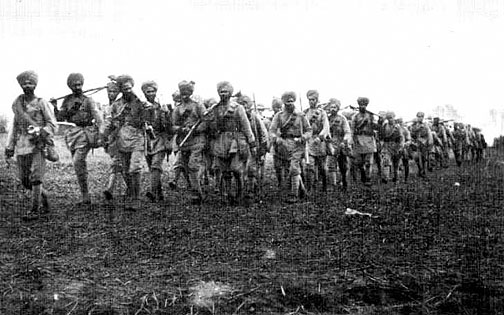
Indian troops at Ypres

There is a telling anecdote in Lyn Macdonald‘s account of The Somme:

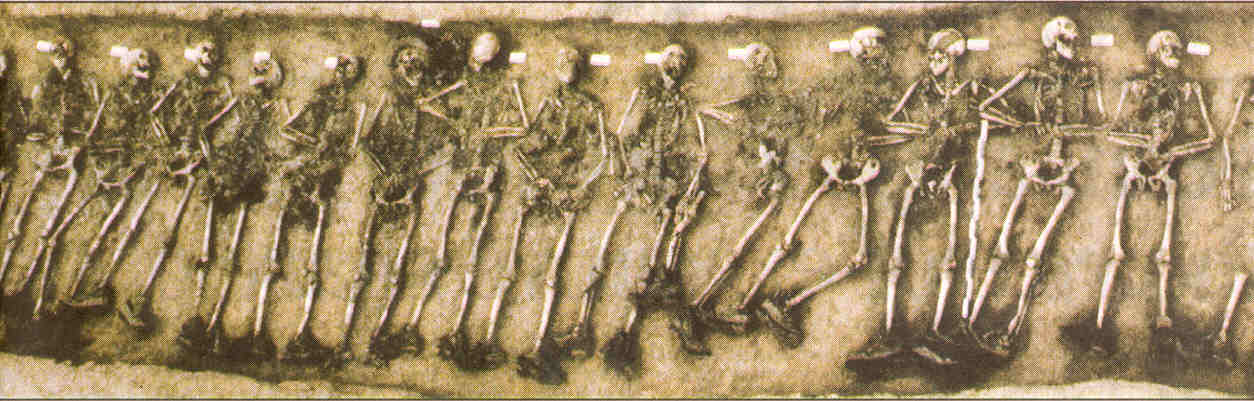
Climbing on to the firestep, the Staff Captain cautiously raised his head above the parapet and looked across. ‘Good God!’ he exclaimed. ‘I didn’t know we were using Colonial troops!’ Pretor-Pinney made no reply. Hoyles and Monckton exchanged grim looks. ‘Dear God,’ muttered Monckton, when the Colonel and the visitor had moved away to a safe distance, ‘has the bastard never seen a dead man before?’ It was a rhetorical question. Lying out in the burning sun, soaked by the frequent showers of a week’s changeable weather, the bodies of the dead soldiers had been turned black by the elements. The Battalion spent the rest of the day burying them.

In fact, it’s doubly revealing.  On one side, it confirms the (I think simplistic) stereotype of the General Staff and their distance from death; but on the other side it also speaks to what Santanu Das, writing in the Guardian, calls ‘the colour of memory’:

In 1914, Britain and France had the two largest empires, spread across Asia and Africa, and an imperial war necessarily became a world war.

More than 4 million non-white men were recruited into the armies of Europe and the US. In a grotesque reversal of Joseph Conrad’s vision, thousands of Asians, Africans and Pacific Islanders were voyaging to the heart of whiteness and far beyond – to Mesopotamia, East Africa, Gallipoli, Persia and Palestine. Two million Africans served as soldiers or labourers; a further 1.3 million came from the British “white” dominions. The first shot in the war was fired in Togoland, and even after 11 November 1918 the war continued in East Africa.

A South African labourer said he went to war to “see different races”. If one visited wartime Ypres, one would have seen Indian sepoys, tirailleur Senegalese, Maori Pioneer battalions, Vietnamese troops and Chinese workers.

Today, one of the main stumbling blocks to a truly global and non-Eurocentric archive of the war is that many of these 1 million Indians, or 140,000 Chinese, or 166,000 West Africans, did not leave behind diaries and memoirs. In India, Senegal or Vietnam there is nothing like the Imperial War Museum; when a returned soldier or village headman died, a whole library vanished.

Moreover, as the former colonies became nation states, nationalist narratives replaced imperial war memories. Stories that did not fit were airbrushed. In Europe, communities turned to their own dead and damaged.

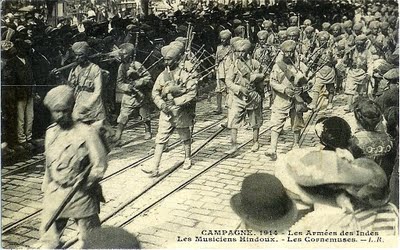
WWI Sikhs Bagpipes

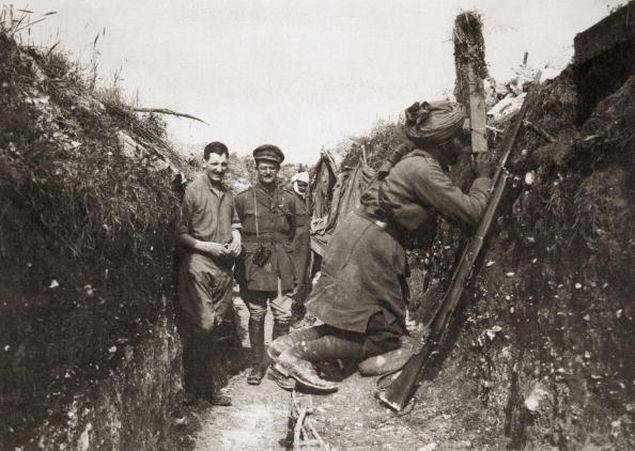
In ‘Gabriel’s Map’ I began in East Africa in 1914 with an Indian Army contingent – whose staff officers included, in William Boyd‘s An Ice-Cream War,  the young Gabriel Cobb – sent to seize German East Africa defended by the local Schutztruppen under German command.  But as I travelled back to the Western Front the colonial troops who also served there slipped from the record.  Yet by the end of September 1914 two Indian divisions and a cavalry brigade had already arrived in France (see above), and in October the first sepoys were sent into battle at Ypres.  If British, French and German troops were shocked at the devastation of a European countryside that was, in its essentials, once familiar to them, what could the freezing cold, the endless mud and the splintered trees have meant to these men (who usually arrived unprepared and ill-equipped for the winter)?

sepoysinthetrenches_0_1I suspect a satisfying answer has to wait for Santanu’s next book, India, Empire and the First World War: words, images and objects (Cambridge University Press, 2015). But in the meantime the whitening of the Western Front (and other theatres of the War) can be resisted through other sources. Some of them are listed in his brief essay on ‘The Indian sepoy in the First World War’ for the the British Library (and you can find ‘Experiences of colonial troops’, adapted from his Introduction to Race, empire and First World War writing [Cambridge University Press, 2011] here).

In addition Christian Koller‘s ‘The recruitment of colonial troops in Africa and Asia and their deployment in Europe during the First World War’, Imigrants & Minorities 26 (1/2) (2008) 111-133 [open access pdf here] provides a helpful context and more references (including French and German sources), and Gajendra Singh‘s The testimonies of Indian soldiers and the two world wars: between self and sepoy (Bloomsbury, 2014)  is a wider, though inevitably selective account of the fabrication of Indian military identities under the Ra (the chapter on ‘Throwing snowballs in France’ is also available in Modern Asian Studies 48 (4) (2014): it’s an artful discussion of the (mis)fortunes of a chain letter – this is the ‘snowball’ in question – that ran foul of the military censor).  The Round Table 103 (2) (2014) is a special issue devoted to ‘The First World War and the Empire-Commonwealth’.

http://www.oucs.ox.ac.uk/ww1lit/collections/item/3770?CISOBOX=1&REC=3

Finally, I’m working my way through Andrew Tait Jarboe‘s excellent PhD thesis, Soldiers of empire: Indian sepoys in and beyond the metropole during the First World War, 1914-1919 (Northeastern, 2013): during my current research on military-medical machines 1914-2014 I’ve found a number of references to the treatment of wounded Indian troops on the Western Front – their evacuation on hospital trains and their treatment in segregated hospitals – and Andrew’s third chapter (‘Hospital’) provides an illuminating reading of what was happening:

‘Between 1914-18, the British established segregated hospitals for wounded Indian soldiers in France and England… [T]hese hospitals were not benign institutions of healing. Like hospitals that repaired the bodies of English soldiers, Indian hospitals played a crucial role in sustaining the war-making capacity of the British Empire. Indian hospitals in Marseilles or Brighton also served an imperial purpose. As sites of propaganda, they reaffirmed the ideologies of imperial rule for audiences at home, abroad, and within the hospital wards. Yet even while the British Empire succeeded to a considerable extent in exploiting the manpower of India, … wounded sepoys were rarely ever mere pawns on the imperial chessboard. Hospital authorities were committed to two policies: returning sepoys to the front, and protecting white prestige. Wounded sepoys found ways of resisting both. In this way, Indian hospitals readily became what British authorities hoped they would not: spaces where imperial subalterns contested the policies and ideologies of imperial rule.’

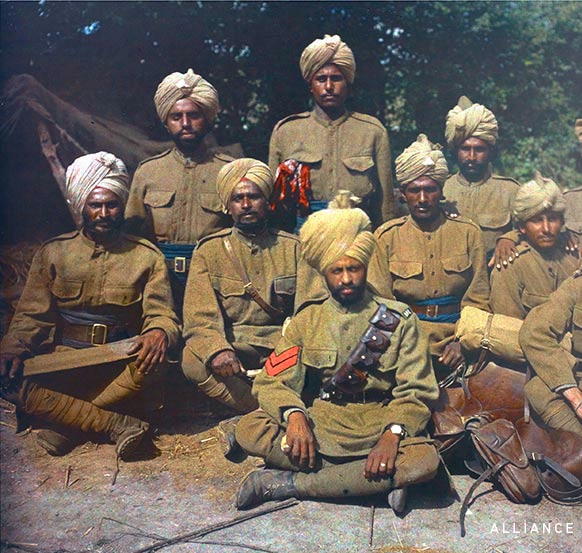
Sikhs WW1

For imagery of non-European troops on the Western front and elsewhere, try this page at the Black Presence in Britain.  More wide-ranging is the exhibition organised by the Alliance française de Dhaka, War and the colonies 1914-1918, that you can visit online here (I’ve taken the image above from that collection).

All of this, clearly, adds another dimension to Patrick Porter‘s lively discussion of Military Orientalism: Eastern war through Western eyes (2009).  But it’s not only an opportunity to reverse (and re-work) that subtitle.  The Times of India reports a campaign to change ‘the colour of memory’ by instituting 15 August as a Remembrance Day in India:

“This will be our Remembrance Day. We have attended such memorial functions in France where heads of different states converge and the civilian turnout is quite big. But we don’t see a single Indian face there—quite an irony, given the fact that 1, 40,000 Indians defended French soil from German aggression in the Great War, and many never returned home. That’s why we, NRIs from France, came up with this project,” says a representative of Global Organization for People of Indian Origin (GOPIO), France.

38761185.cms

The American way of bombing

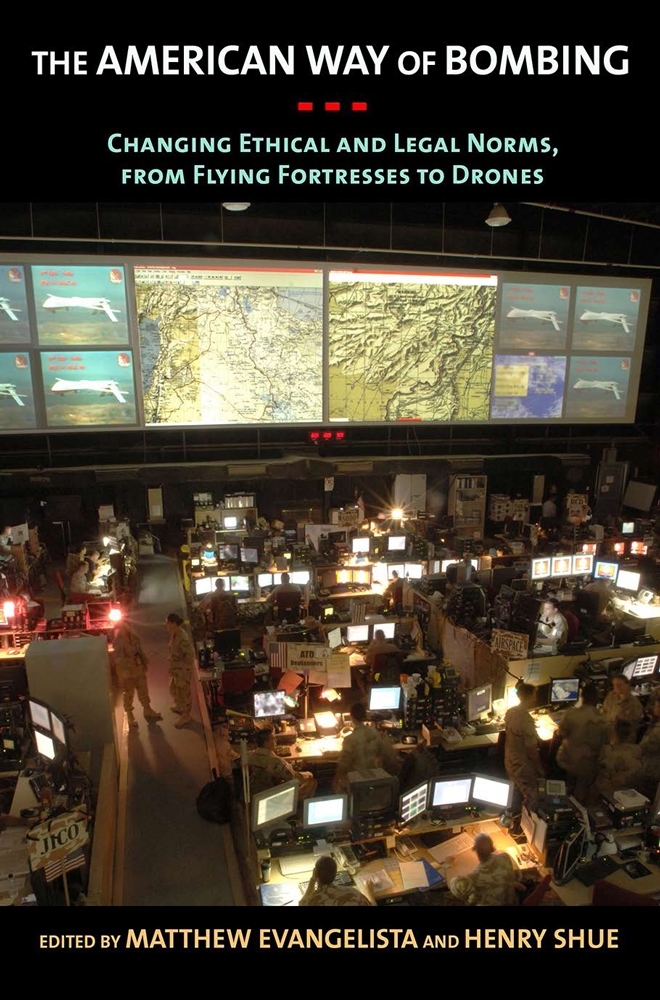
I’ve argued elsewhere (in ‘Lines of Descent’ [DOWNLOADS tab] and in ‘The American way of bombing?‘) that it’s important to situate any critical account of drones in a much longer history of air war, and a new book just out from Cornell University Press promises to do just that: The American Way of Bombing: changing ethical and legal norms from Flying Fortresses to drones, edited by Matthew Evangelista and Henry Shue.  And unlike rip-off academic-commercial publishers (most of them in the UK), this is available as an e-edition (Kindle, etc) at a perfectly reasonable price.

Here are the details:

Aerial bombardment remains important to military strategy, but the norms governing bombing and the harm it imposes on civilians have evolved. The past century has seen everything from deliberate attacks against rebellious villagers by Italian and British colonial forces in the Middle East to scrupulous efforts to avoid “collateral damage” in the counterinsurgency and antiterrorist wars of today. The American Way of Bombing brings together prominent military historians, practitioners, civilian and military legal experts, political scientists, philosophers, and anthropologists to explore the evolution of ethical and legal norms governing air warfare.

Focusing primarily on the United States—as the world’s preeminent military power and the one most frequently engaged in air warfare, its practice has influenced normative change in this domain, and will continue to do so—the authors address such topics as firebombing of cities during World War II; the atomic attacks on Hiroshima and Nagasaki; the deployment of airpower in Iraq, Afghanistan, and Libya; and the use of unmanned drones for surveillance and attacks on suspected terrorists in Pakistan, Yemen, Sudan, Somalia, and elsewhere.

American way of bombing

Introduction: The American Way of Bombing
by Matthew Evangelista

Part I. Historical and Theoretical Perspectives

1. Strategic Bombardment: Expectation, Theory, and Practice in the Early Twentieth Century
by Tami Davis Biddle

2. Bombing Civilians after World War II: The Persistence of Norms against Targeting Civilians in the Korean War
by Sahr Conway-Lanz

3. Targeting Civilians and U.S. Strategic Bombing Norms: Plus ça change, plus c’est la même chose?
by Neta C. Crawford

4. The Law Applies, But Which Law?: A Consumer Guide to the Laws of War
by Charles Garraway

Part II. Interpreting, Criticizing, and Creating Legal Restrictions

5. Clever or Clueless?: Observations about Bombing Norm Debates
by Charles J. Dunlap Jr.

6. The American Way of Bombing and International Law: Two Logics of Warfare in Tension
by Janina Dill

7. Force Protection, Military Advantage, and “Constant Care” for Civilians: The 1991 Bombing of Iraq
by Henry Shue

8. Civilian Deaths and American Power: Three Lessons from Iraq and Afghanistan
by Richard W. Miller

Part III. Constructing New Norms

9. Proportionality and Restraint on the Use of Force: The Role of Nongovernmental Organizations
by Margarita H. Petrova

10. Toward an Anthropology of Drones: Remaking Space, Time, and Valor in Combat
by Hugh Gusterson

11. What’s Wrong with Drones?: The Battlefield in International Humanitarian Law
by Klem Ryan

12. Banning Autonomous Killing: The Legal and Ethical Requirement That Humans Make Near-Time Lethal Decisions
by Mary Ellen O’Connell

Corpographies

I’ve been scribbling some notes for a short essay Léopold Lambert has invited me to write for his Funambulist Papers.  The brief is to write ‘something about the body – nothing too complicated’, so I’ve decided to say something more about the idea of corpography I sketched in ‘Gabriel’s Map’ (DOWNLOADS tab), which will in turn – so I hope – prepare the ground for the long-form version of ‘The nature(s) of war’ for a special issue of Antipode devoted to the work of Neil Smith [next on my to-do list].

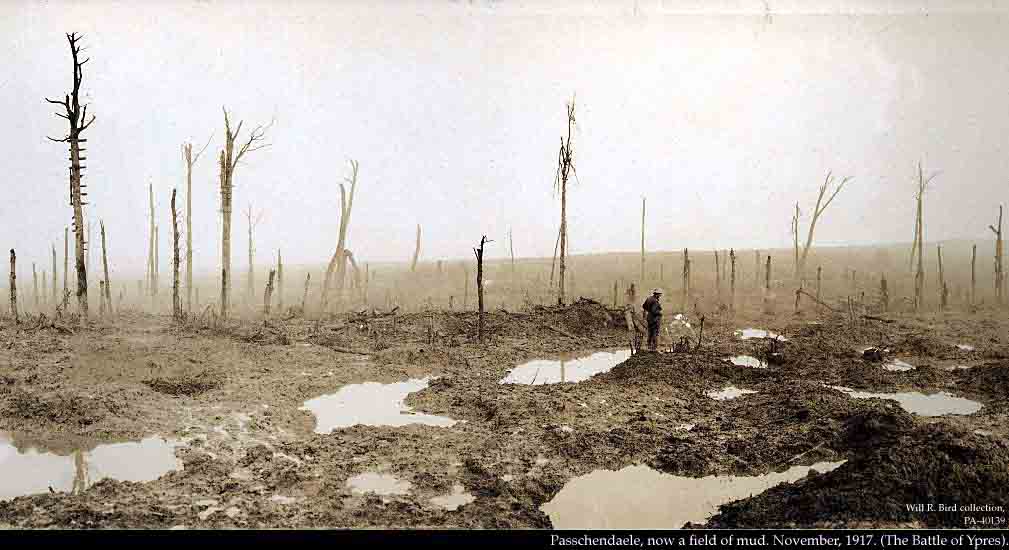
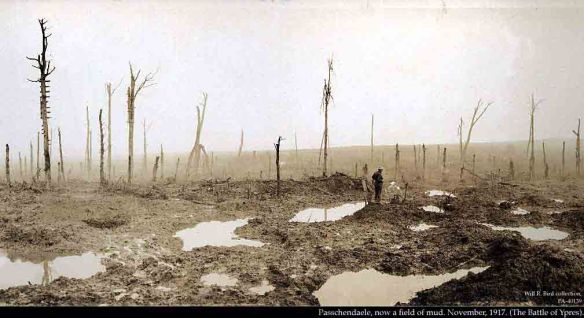
In ‘Gabriel’s Map’ (and in a preliminary sketch here) I contrasted the cartographic imaginary within which so much of the First World War was planned with a corpography improvised by soldiers caught up in the maelstrom of military violence on the ground; unlike the ‘optical war’ that relied, above all, on aerial reconnaissance, projected onto the geometric order of the map and the mechanical cadence of the military timetable – a remarkably abstract space, though its production was of course profoundly embodied – this was a way of apprehending the battle space through the body as an acutely physical field in which the senses of sound, smell and touch were increasingly privileged in the construction of a profoundly haptic or somatic geography.
passchendale1917vj0

This is hardly original; you can find intimations of all this in classics like Eric Leed‘s No Man’s Land, and once you start digging in to the accounts left by soldiers you find supporting evidence on page after page.  What I’ve tried to do is show that this constituted more than a different way of experiencing war: it was also a different way of knowing and ordering (or, as Allan Pred would surely have said, of re-cognising) the space of military violence.  These knowledges were situated and embodied – ‘local’, even – but they were also transmissable and mobile.

On the Western front, corpographies were at once an instinctive, jarring, visceral response to military violence –

‘When sound is translated into a blow on the nape of the neck, and light into a flash so bright that it actually scorches the skin, when feeling is lost in one disintegrating jar of every nerve and fibre … the mind, at such moments, is like a compass when the needle has been jolted from its pivot’ [‘A Corporal’, Field Ambulance Sketches (1919)]

– and an improvisational, learned accommodation to it:

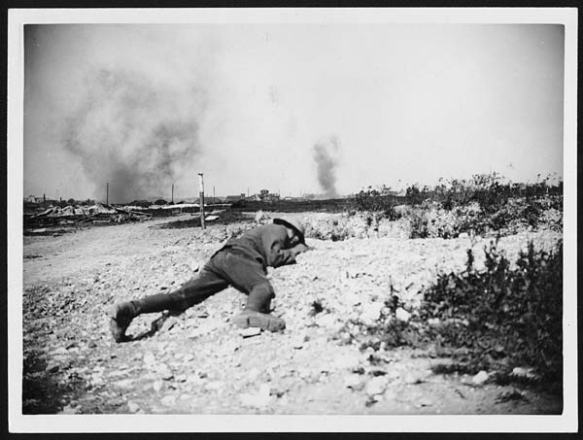
‘We know by the singing of a shell when it is going to drop near us, when it is politic to duck and when one may treat the sound with contempt. We are becoming soldiers. We know the calibres of the shells which are sent over in search of us. The brute that explodes with a crash like that of much crockery being broken, and afterwards makes a “cheering” noise like the distant echoes of a football match, is a five-point-nine.The very sudden brute that you don’t hear until it has passed you, and rushes with the hiss of escaping steam, is a whizz-bang… The funny little chap who goes tonk-phew-bong is a little high-velocity shell which doesn’t do much harm… The thing which, without warning, suddenly utters a hissing sneeze behind us is one of our own trench-mortars. The dull bump which follows, and comes from the middle distance out in front, tells us that the ammunition is “dud.” The German shell which arrives with the sound of a woman with a hare-lip trying to whistle, and makes very little sound when it bursts, almost certainly contains gas.

‘We know when to ignore machine-gun and rifle bullets and when to take an interest in them. A steady phew-phew-phew means that they are not dangerously near. When on the other hand we get a sensation of whips being slashed in our ears we know that it is time to seek the embrace of Mother Earth’ [A.M. Burrage, War is war]
National Library of Scotland (Tom Aitken)

This was not so much a re-setting of the compass, as the anonymous stretcher-bearer had it, as the formation of a different bodily instrument altogether.  As Burrage’s last sentence shows, corpographies were at once re-cognitions of a butchered landscape – one that seemed to deny all sense – and reaffirmations of an intimate, intensely sensible bond with the earth:

‘To no man does the earth mean so much as to the soldier. When he presses himself down upon her, long and powerfully, when he buries his face and his limbs deep in her from the fear of death by shell-fire, then she is his only friend, his brother, his mother; he stifles his terror and his cries in her silence and her security…. ’ [Erich Remarque, All quiet on the Western Front]

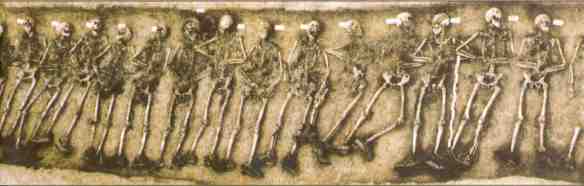
And corpographies were not only a means through which militarised subjects accommodated themselves to the warscape – providing a repertoire of survival of sorts – but also a way of resisting at least some its impositions and affirming, in the midst of what so many of them insisted was ‘murder not war’, what Santanu Das calls a ‘tactile tenderness’ between men.  This, he argues,

‘must be seen as a celebration of life, of young men huddled against long winter nights, rotting corpses, and falling shells. Physical contact was a transmission of the wonderful assurance of being alive, and more sex-specific eroticism, though concomitant, was subsidiary. In a world of visual squalor, little gestures – closing a dead comrade’s eyes, wiping his brow, or holding him in one’s arms – were felt as acts of supreme beauty that made life worth living.’
grimsbychums

A hundred years later, I have no doubt that much the same is true in Afghanistan, Iraq, Syria and elsewhere, and so my interest in corpography is also part of my refusal to acquiesce to the thoroughly disingenuous de-corporealization of today’s ‘virtuous war’.

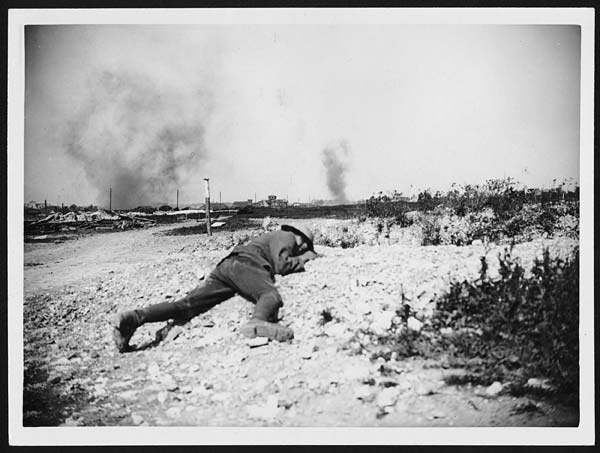
In fleshing out these ideas I’ve been indebted to a stream of work on the body in human geography. Most of it has been remarkably silent about war, even though Kirsten Simonsen once wrote about ‘the body as battlefield‘, but it’s now difficult for me to read her elegant essay ‘In quest of a new humanism: Embodiment, experience and phenomenology as critical geography’ [Progress in human geography 37 (1) (2013): open access here] – especially Part III where she discusses ‘Thinking the body’ and ‘Orientation and disorientation’ – without peopling it with bodies in khaki, blue or field grey tramping towards the front-line trenches, clambering over the top, or crawling from shell-hole to shell-hole in No Man’s Land.

That is partly down to the suggestiveness of Kirsten’s prose, but it’s also the result of my debt to the work of Santanu Das [Touch and intimacy in First World War literature], Ken MacLeish [especially Chapter 2 of his Making War at Fort Hood; the dissertation version is here] and Kevin McSorley [whose introduction to War and the body is here] which directly addresses military violence.  I wish I’d been able to attend the Sensing War conference that Kevin co-organised in London last month; I had to turn down the invitation because I was marooned on my mountaintop in Umbria, but the original Call For Papers captured some of the ways in which the materialities and corporealities of war in the early twentieth century continue to inhabit later modern war:

War is a crucible of sensory experience and its lived affects radically transform ways of being in the world. It is prosecuted, lived and reproduced through a panoply of sensory apprehensions, practices and ‘sensate regimes of war’ (Butler 2012) – from the tightly choreographed rhythms of patrol to the hallucinatory suspicions of night vision; from the ominous mosquito buzz of drones to the invasive scrape of force-feeding tubes; from the remediation of visceral helmetcam footage to the anxious tremors of the IED detector; from the desperate urgencies of triage to the precarious intimacies of care; from the playful grasp of children’s war-toys to the feel of cold sweat on a veteran’s skin.

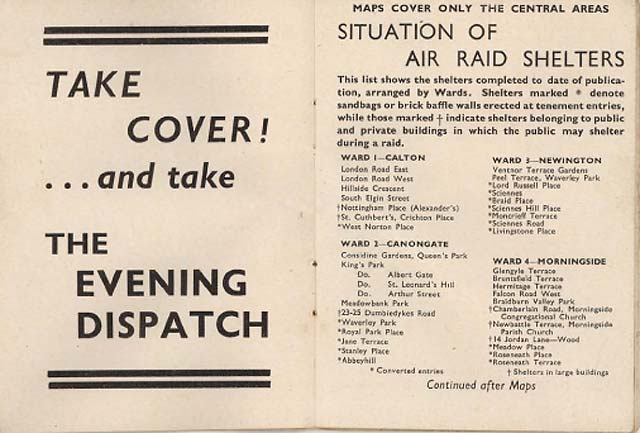
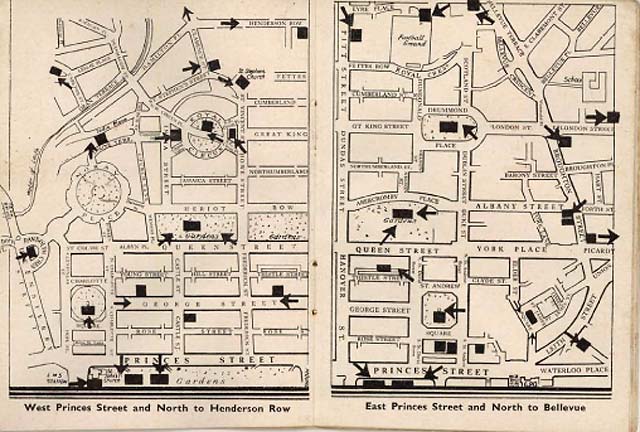
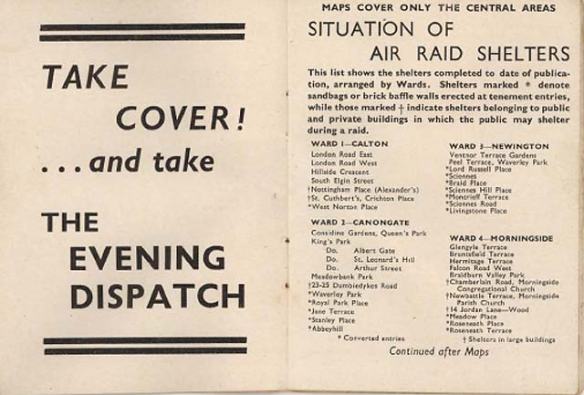
Thus far, like most of the writers I’ve drawn from here, I’ve been thinking about corpographies in relation to the soldier’s body, but as the (in)distinctions between combatant and civilian multiply I’ve started to think about the knowledges that sustain civilians caught up in military and paramilitary violence too. Some of them are undoubtedly cartographic – formal and informal maps of shelters (the images below are for Edinburgh during the Second World War), camps, checkpoints and roadblocks – and some of them rely on visual markers of territory: barriers and wires, posters and graffiti. Today much of this information is shared by social media (as the battle space has become both digital and physical).
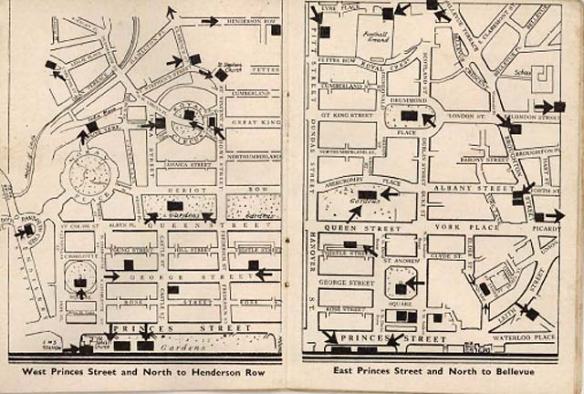
Guide to Edinburgh Air Raid Shelters WW2


0_books_-_edinburgh_air_raid_shelters_p12+p13

But much of this knowledge is also, as it has always been, corpographic.  Pete Adey once wrote – beautifully – about what he called ‘the private life of an air raid’, drawing on the files of Mass Observation during the Second World War to sketch a geography of ‘stillness’ even as the urban landscape was being violently ‘un-made’.  ‘Stillness in this sense,’ he explained,

‘denotes apprehending and anticipating spaces and events in ways that sees the body enveloped within the movement of the environment around it; bobbing along intensities that course their way through it; positioned towards pasts and futures that make themselves felt, and becoming capable of intense forms of experience and thought.’

This was a corpo-reality, and one in which – as he emphasised – sound played a vital role: ‘Waves of sound disrupted fragile tempers as they passed through the waiting bodies in the physical language of tensed muscles and gritted teeth.’  But, as he also concedes, this was also a ‘not-so private’ life – there was also a social life under the bombs – and we need to think about how these experiences were shared by and with other bodies.  These apprehensions of military violence, then as now, were not only modalities of being but also modes of knowing: as Elizabeth Dauphinée suggests, in a different but closely related context, ‘pain is not an invisible interior geography’ but rather ‘a mode of knowing (in) the world – of knowing and making known’  [‘The politics of the body in pain’, Security dialogue 38 (2) (2007) 139-55]. During an air raid these knowledges could be shared by talking with others – the common currency of comfort and despair, advice and rumour – but they also arose from making cognitive sense of physical sensations: the hissing and roaring of the bombs, the suction and compression from the blast, the stench of ruptured gas mains or sewage pipes.
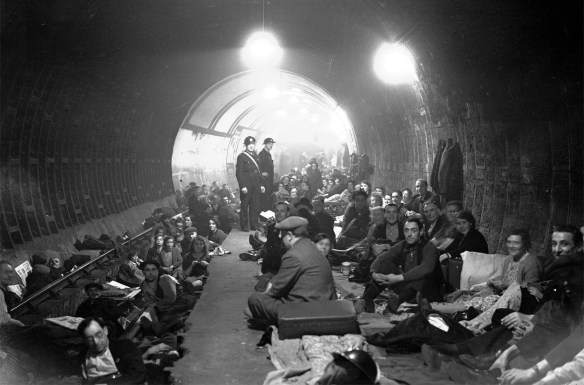
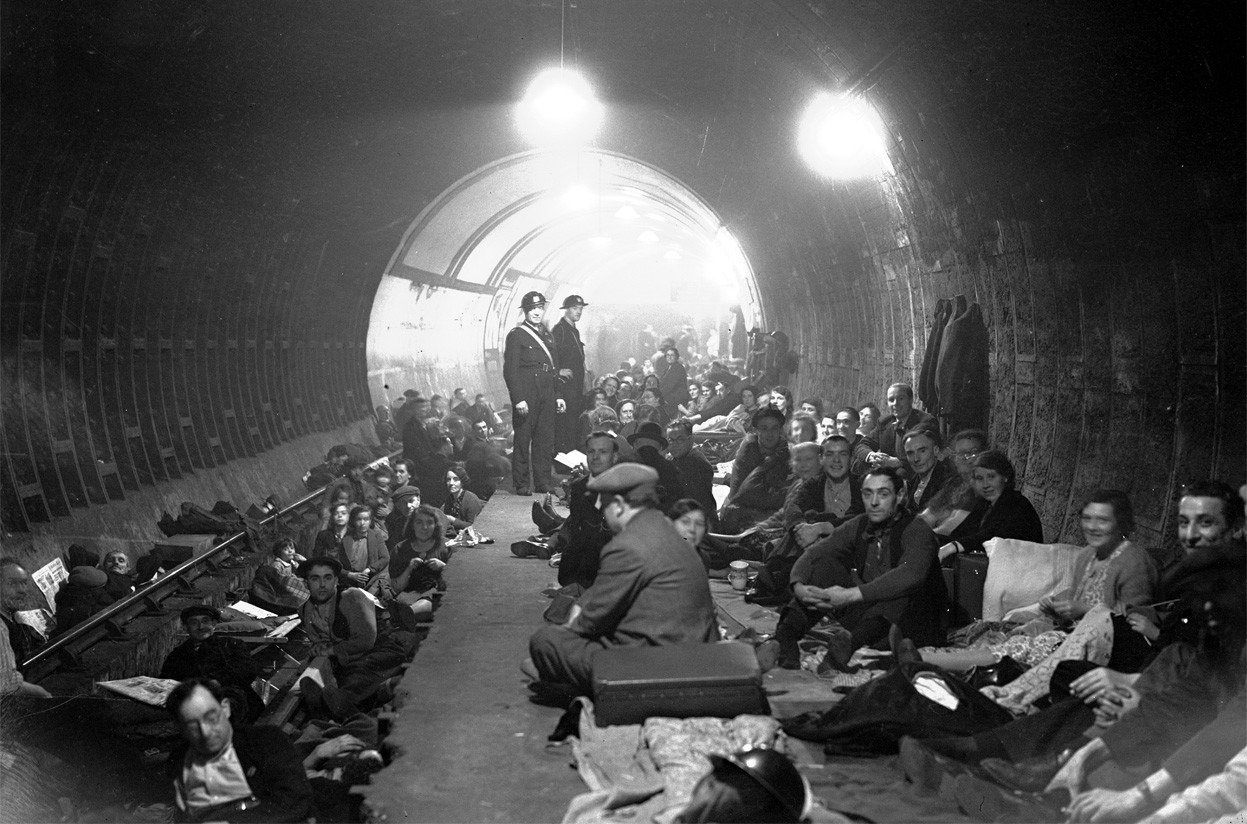
London air raid shelter

Steven Connor once suggested that air raids involve a ‘grotesquely widened bifurcation of visuality and hearing’, in which the optical-visual production of a target contrasts with ‘the absolute deprivation of sight for the victims of the air raid on the ground, compelled as they are to rely on hearing to give them information about the incoming bombs.’  Those crouching beneath the bombs have ‘to learn new skills of orientating themselves in this deadly auditory field without clear coordinates or dimensions but in which the tiniest variation in pitch and timbre can mean obliteration.’  What then can you know – and how can you know – when your world contracts to a room, a cellar, the space under the bed?  When you can’t go near a window in case it shatters and your body is sliced by the splinters?  When all you have to go on, all you can trust, are your ears parsing the noise or your fingers scrabbling at the rubble?
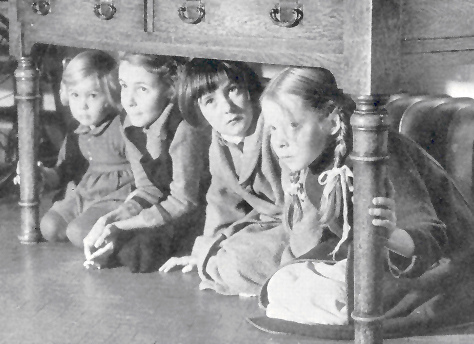
Air raid drill in children's home WW2

Here too none of this is confined to the past, and so I start to think about the thanatosonics of Israel’s air strikes on Gaza.  Sound continues to function as sensory assault; here is Mohammed Omer:

‘At just 3 months old, my son Omar cries, swaddled in his crib. It’s dark. The electricity and water are out. My wife frantically tries to comfort him, shield him and assure him as tears stream down her face. This night Omar’s lullaby is Israel’s rendition of Wagner’s Ride of the Valkyries, with F-16s forming the ground-pounding percussion, Hellfire missiles leading the winds and drones representing the string section. All around us crashing bombs from Israeli gunships and ground-based mortars complete the symphony, their sound as distinct as the infamous Wagner tubas…. Above, the ever-present thwup-thwup of hovering Apache helicopters rock Omar’s cradle through vibration. Warning sirens pierce the night—another incoming missile from an Israeli warship.’

And, as before, sound can also be a source of knowledge.  Here is Wasseem el Sarraj, writing from Gaza in November 2012:

In our house we have become military experts, specializing in the sounds of Israeli and Palestinian weapons. We can distinguish with ease the sound of Apaches, F-16 missiles, drones, and the Fajr rockets used by Hamas. When Israeli ships shell the coast, it’s a distinct and repetitive thud, marked by a one-second delay between the launch and the impact. The F-16s swoop in like they are tearing open the sky, lock onto their target and with devastating precision destroy entire apartment blocks. Drones: in Gaza, they are called zananas, meaning a bee’s buzz. They are the incessant, irritating creatures. They are not always the harbingers of destruction; instead they remain omnipresent, like patrolling prison guards. Fajr rockets are absolutely terrifying because they sound like incoming rockets. You hear them rarely in Gaza City and thus we often confuse them for low-flying F-16s. It all creates a terrifying soundscape, and at night we lie in our beds hoping that the bombs do not drop on our houses, that glass does not shatter onto our children’s beds. Sometimes, we move from room to room in an attempt to feel some sense of safety. The reality is that there is no escape, neither inside the house nor from the confines of Gaza.

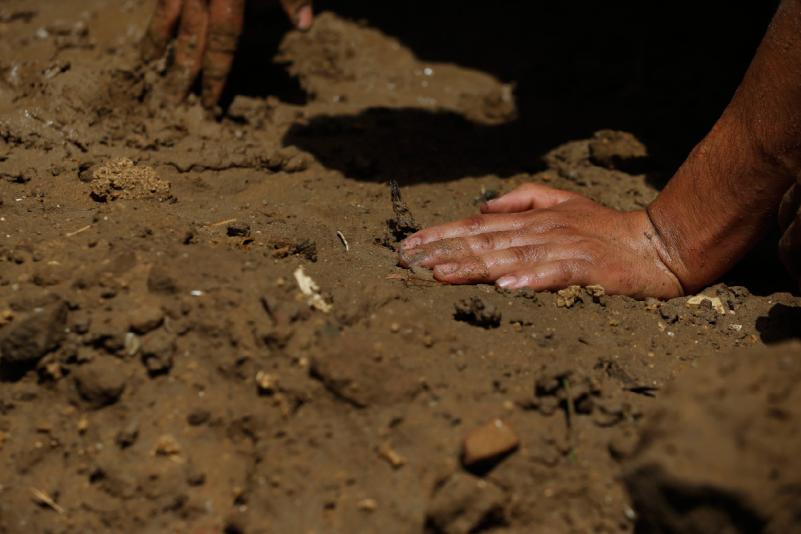
The last haunting sentences are a stark reminder that knowledge, cartographic or corpographic, is no guarantee of safety. But military and paramilitary violence is always more than a mark on a map or a trace on a screen, and the ability to re-cognise its more-than-optical dimensions can be a vital means of navigating the wastelands of war.  As in the past, so today rescue from the rubble often involves a heightened sense of sound and smell, and survival is often immeasurably enhanced by the reassuring touch of another’s body.  And these fleshy affordances – which you can find in accounts of air raids from Guernica to Gaza – are also a powerful locus for critique.
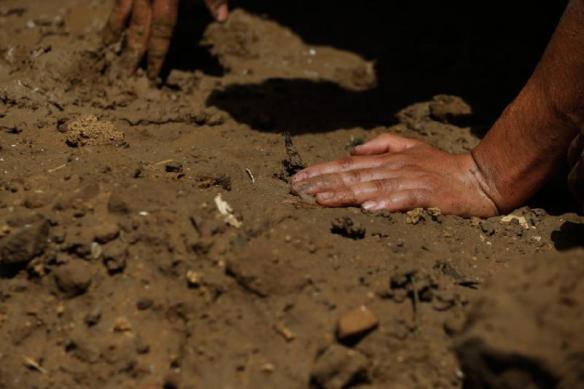
Gaza Hands and Grave

So: corpographies.  I thought I’d made the word up, but as I completed ‘Gabriel’s Map’ I discovered that Joseph Pugliese uses ‘geocorpographies’ to designate ‘the violent enmeshment of the flesh and blood of the body within the geopolitics of war and empire’ in his State violence and the execution of law (New York: Routledge, 2013; p. 86). This complements my own study, though I’ve used the term to confront the optical privileges of cartography through an appeal to the corporeal (and to the corpses of those who were killed in the names of war and empire).

And I’ve since discovered that the term has a longer history and multiple meanings that intersect, in various ways, with what I’m trying to work out.  Perhaps not surprisingly, it also serves as a medical term: cranio-corpography is a procedure devised by Claus-Frenzen Claussen in 1968 to capture in a visual trace the longitudinal and lateral movements of a patient’s body in order to detect and calibrate disorders of the ‘equilibrium function’.  More recently, corpography has also been used by dance theorists and practitioners, including Francesca Cataldi and Sebastian Prantl, to describe a critical, creative practice: a ‘dance of things’ in which the body is thoroughly immersed as a’ land.body.scape’, as Prantl puts it.  Meanwhile, Allan Parsons has proposed a ‘psycho-corpography’ – explicitly not a psycho-geography – as a way of ‘tracing the experience of living-a-body’.  Elsewhere,  Alex Chase attends to specific bodies-in-the-world, those of cultural ‘figures’ (Artaud, Bataille, Foucault, Genet, Jarman and Mishima among them), that resist normalization – hence emphatically  ‘queer’ bodies – and which figure bodies as events.  ‘I hope to develop a methodology of “corpography”,’ he says, ‘which would write between biography and textual analysis, material lived bodies and fictional work, life and representation, in order to work through other queer concepts such as temporality, space, and ethics.’

It would of course be absurd to summon all of these different usages onto a single conceptual terrain. But they do take me back to Kirsten’s essay (and to long-ago memories of an enthralling seminar in Roskilde which she introduced through her dance teacher), to ways of apprehending the danse macabre on the Western Front as both a cartography and a corpography whose junction was to be found, perhaps, in a choreography, and to think about the ways in which the sentient bodies of soldiers were at once habituated to and resisted the forceful normalizations of military violence.  They also make me wonder about civilian corpographies – about the multiple ways in which violence is inflicted on the body and yet may be resisted through the body – and in doing so they direct my steps from the past to the present and to the fragile bodies that continue to lie at the heart of today’s conflicts.  If that is to speak with Walter Benjamin, I want to insist that the ‘tiny, fragile human body’ does not only lie ‘in a field of force of destructive torrents and explosions’, as he wrote in 1936: for the body is a vector as well as a victim of military and paramilitary violence.  And it can also be a means of undoing its effects.

I suspect that these ideas will eventually thread their way into my new project on the evacuation of combatant and civilian casualties (and the sick) from war zones, 1914-2014, where it’s already clear to me that cartography and corpography are tightly locked together.  All of this is highly provisional, as you’ll realise, and as always I would welcome comments and suggestions.